 by
Tom Gurney
Tom Gurney BSc (Hons) is an art history expert with over 20 years experience
Email:
tomgurney1@gmail.com
/ Phone:
+44 7429 011000
Lighthouse, Honfleur: Introduction
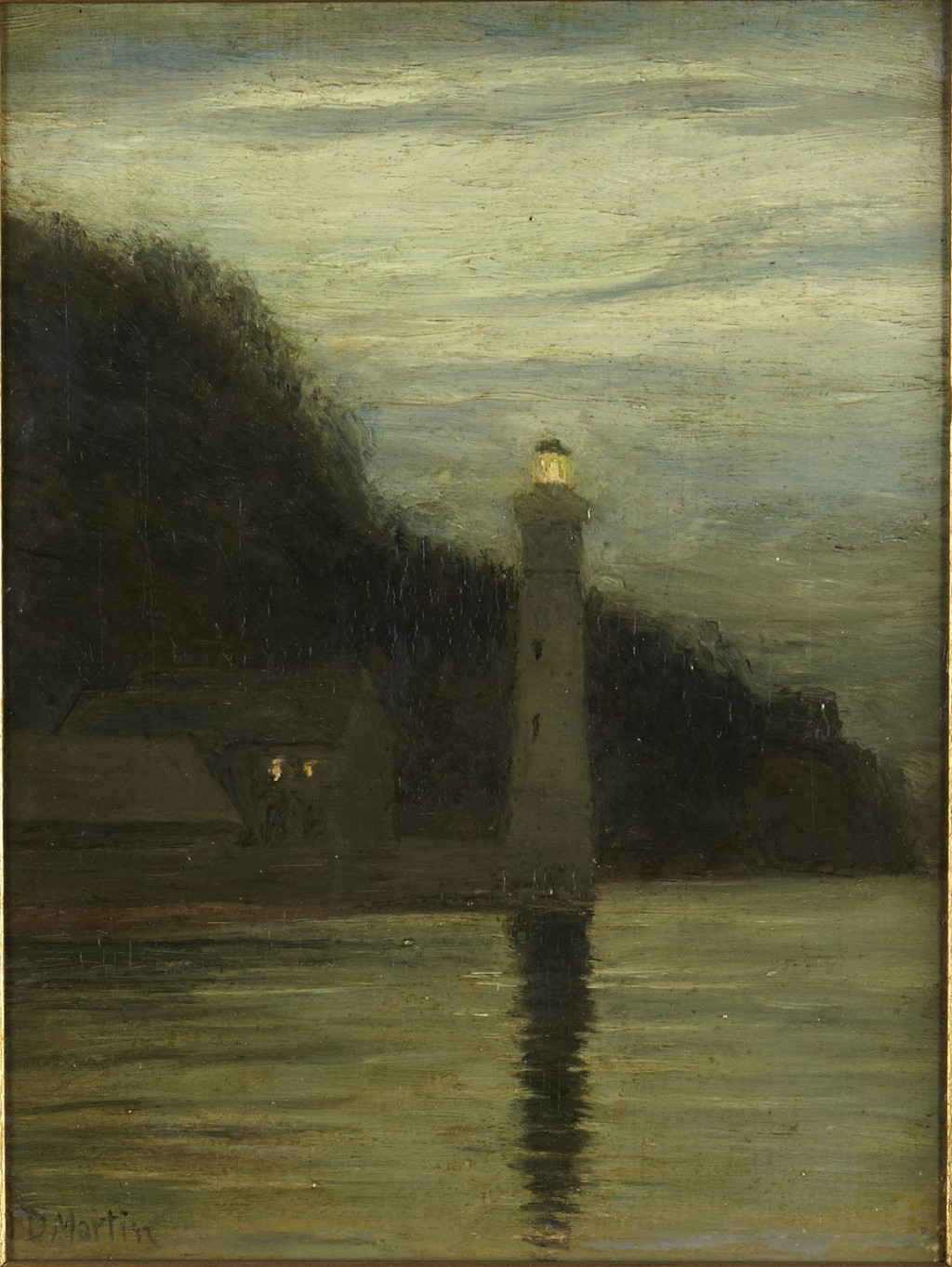
A narrow lighthouse rises beside a dark coastal slope, its lamp a small warm accent against the pale sky. Below, the tower extends again as a wavering reflection. Homer Dodge Martin’s The Lighthouse, Honfleur makes that upright form the link between land, sky and water, while the heavy silhouette behind it gives the light unusual force.
Princeton University Art Museum holds this small oil on wood panel, measuring 28 by 20 centimeters. Its record supplies no execution date. The painting has a documented historical connection with a larger Honfleur lighthouse canvas, but its own vertical arrangement and object history deserve separate attention. [1] [2]
At a Glance
- Artist Homer Dodge Martin.
- Title The Lighthouse, Honfleur.
- Date Undated in Princeton’s record.
- Medium and dimensions Oil on wood panel, 28 × 20 cm.
- Collection Princeton University Art Museum, y1948-3.
- Credit Gift of Frank Jewett Mather Jr.
- Historical relationship Described by Carroll in 1913 as a study for the larger Century Club canvas.
- Sources Princeton object record and Carroll’s entry thirty. [1] [2]
This work across Homer Dodge Martin’s career
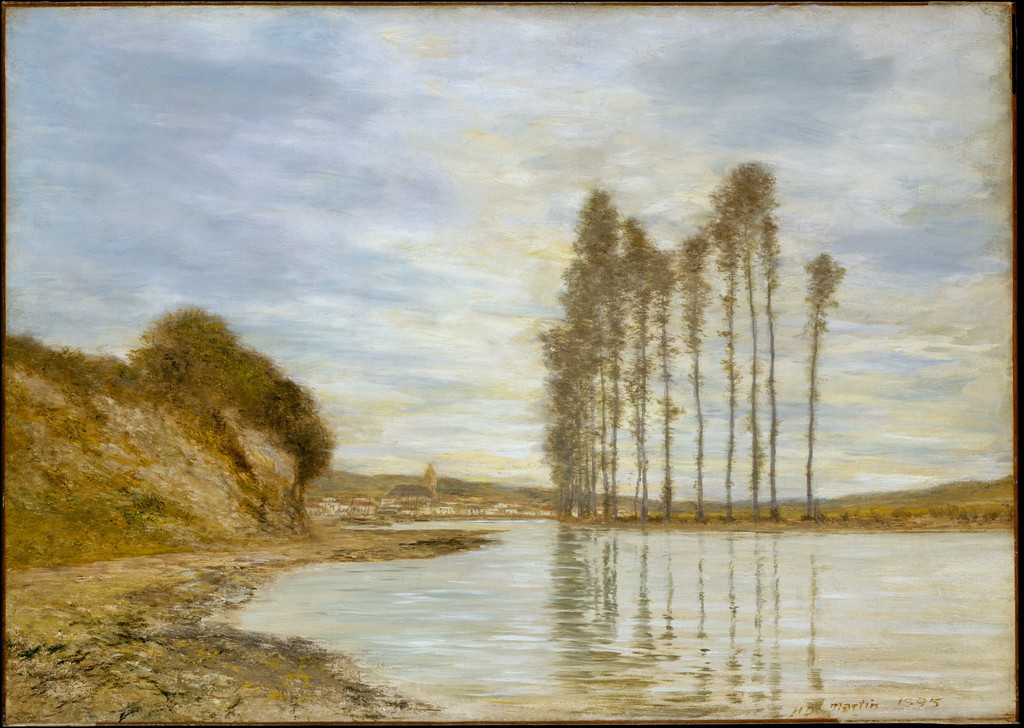
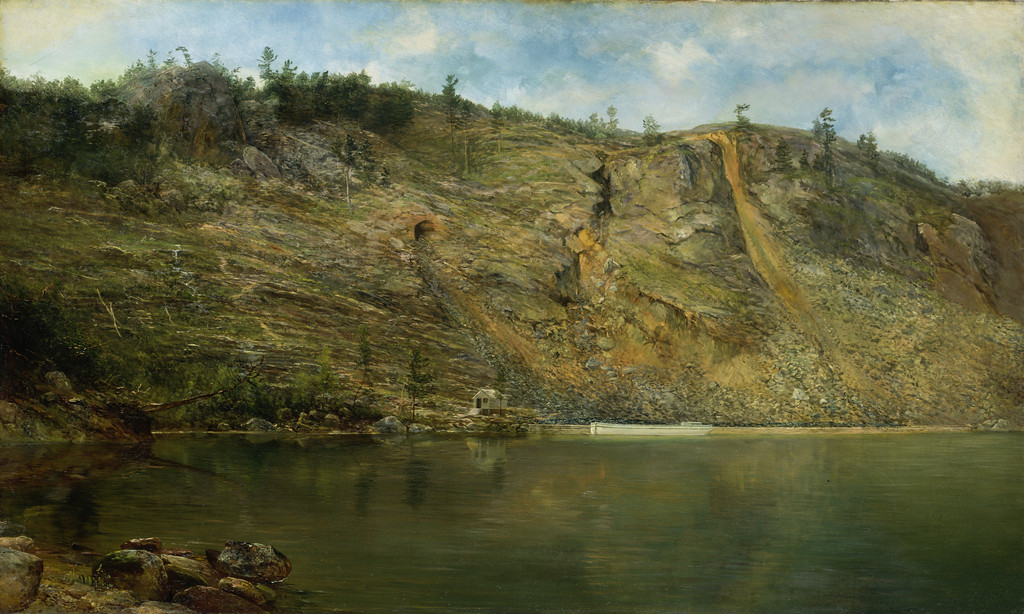
The Iron Mine, Port Henry, New York
about 1862Evening on the Thames
about 1876Old Manor of Criqueboeuf
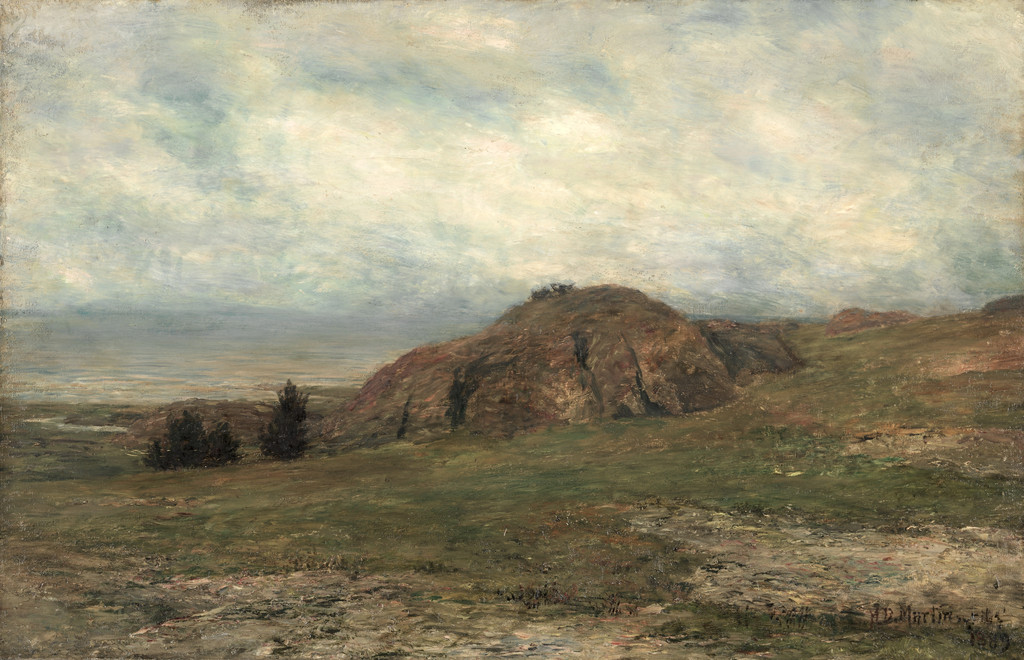
about 1882–92Behind Dunes, Lake Ontario
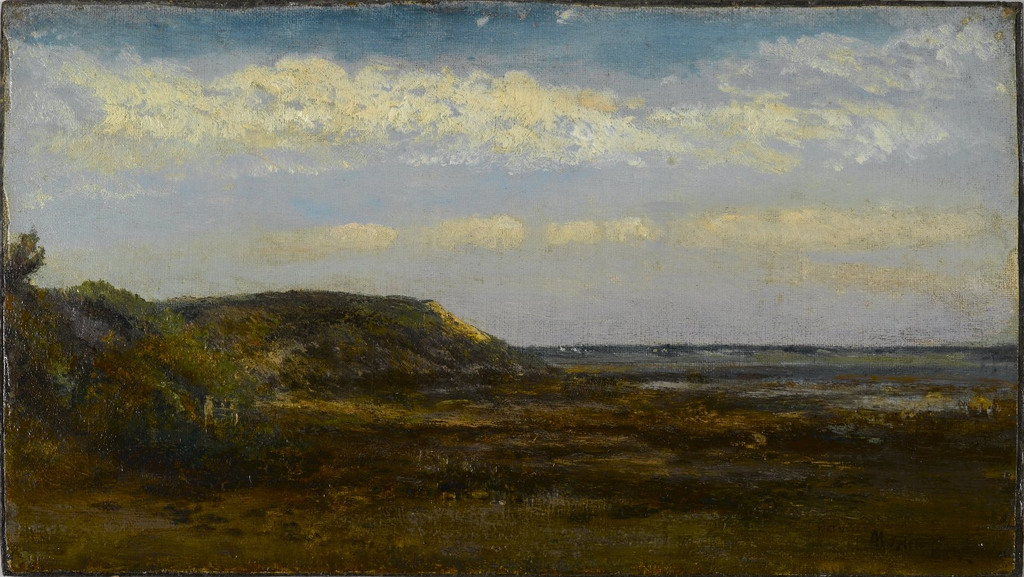
1883–87Normandy Coast
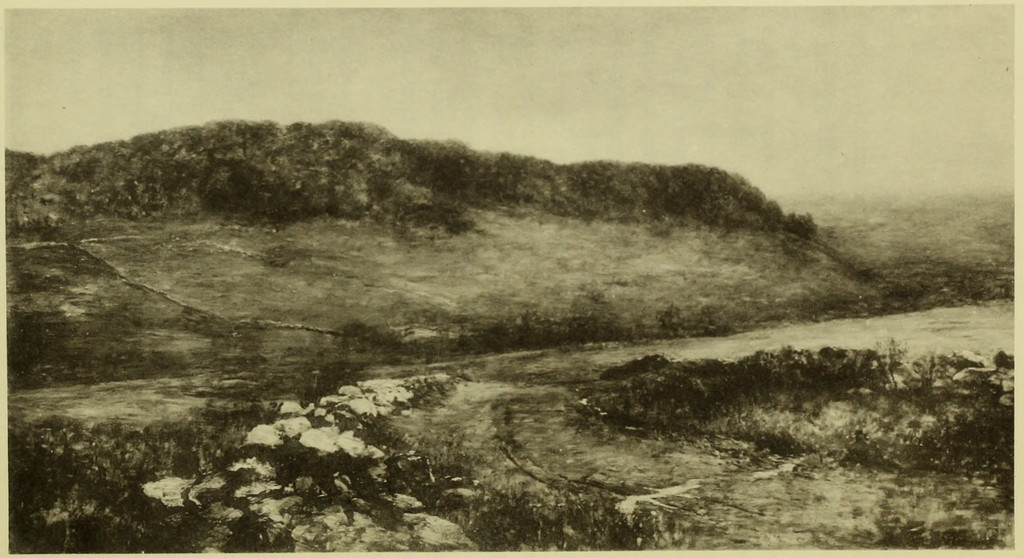
1884Westchester Hills
about 1887Notes and sources
The Iron Mine, Port Henry, New York. An industrial opening, sloping runway and worked cliff stand above Lake Champlain. The Smithsonian connects this landscape with the North’s resources during the Civil War. [3]
Upper Ausable Lake. Foreground reeds and birds lead toward a bright passage of water beneath the mountain wall. The Smithsonian identifies this canvas as Upper Ausable Lake. [4]
Evening on the Thames. A low river horizon, distant buildings and reflected light bring a British subject into Martin’s painting. The museum’s date remains approximate. [5]
Old Manor of Criqueboeuf. A house and its reflection organize this slowly developed Normandy subject. The broad date range does not mean that Martin painted it without interruption. [6]
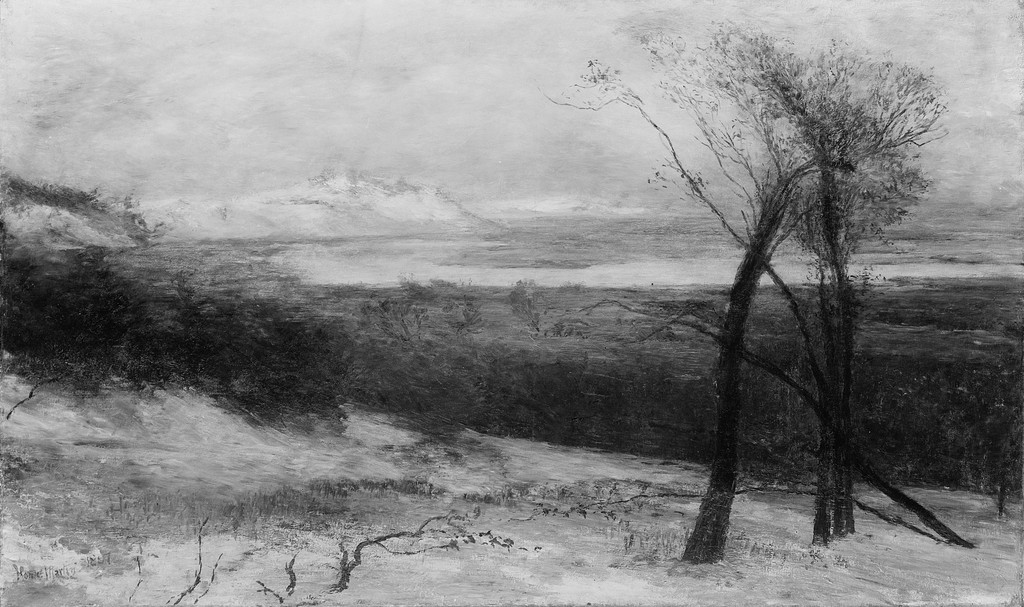
Behind Dunes, Lake Ontario. An American subject developed during the French residence and after the return. The Met records rejection at the 1884 Salon followed by revision in 1887. [7]
Normandy Coast. Freely brushed clouds dominate a small coastal board. Brooklyn places it among outdoor paintings made during Martin’s French residence. [8]
Westchester Hills. Mather describes a large outdoor undertaking at Croton Falls and records its exhibition in 1888. The probable painting date and exhibition year remain distinct. [9]
Wild Coast, Newport. An extensive sky opens above low coastal ground. This dated Cleveland canvas is distinct from the Smithsonian painting bearing the same title. [10]
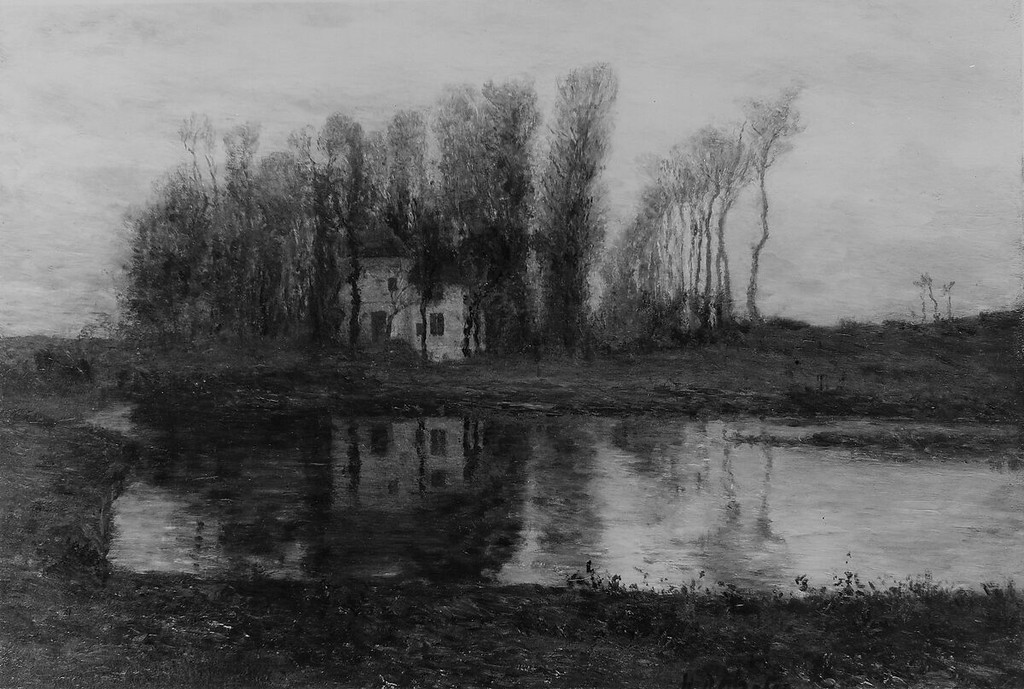
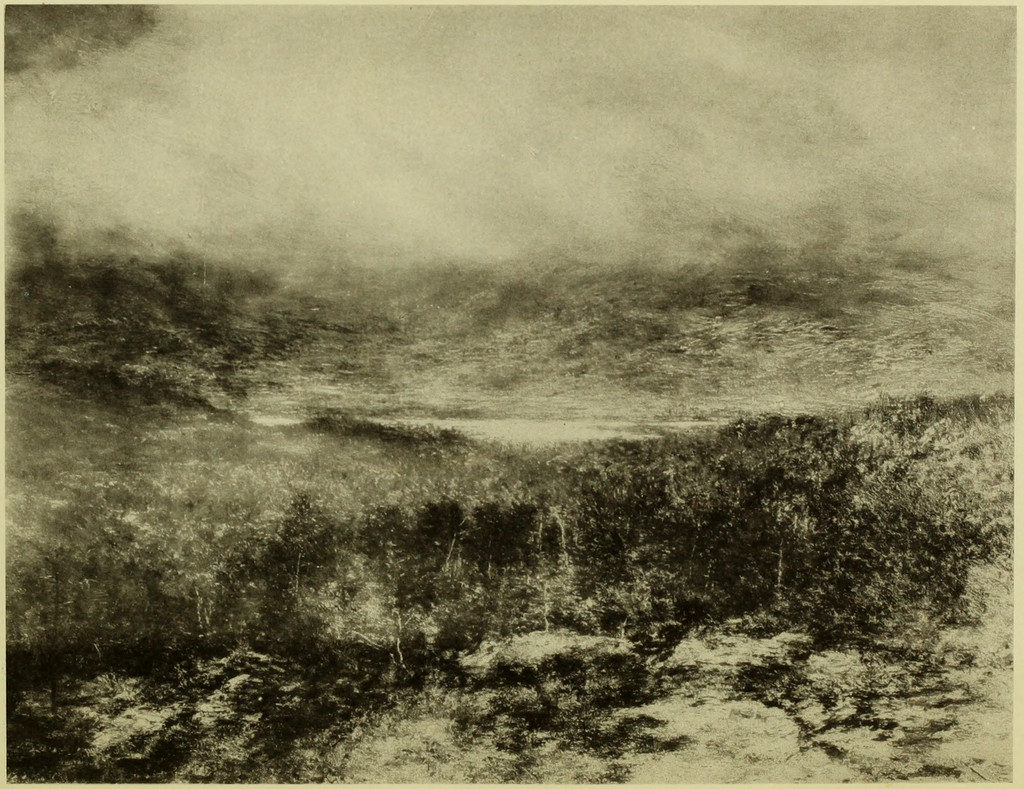
Criqueboeuf Church, Normandy. A church, trees and their reflections give architecture a place within the landscape. The current LACMA record supplies the date; the article reproduces a historical monochrome print. [11]
View on the Seine: Harp of the Winds. Poplars and their reflections repeat across the Seine. The Met records a charcoal beginning in New York in 1893 and completion in Saint Paul in 1895. [12]
Adirondack Scenery. Mountain slopes, a foreground ledge and water organize this late return to American scenery. Mather treats it as a major expression of experiences considered over many years. [9]
Lighthouse, Honfleur (current article). Princeton’s small upright wood panel sets the lighthouse within a compact landscape. It remains undated and is distinct from the larger horizontal Century Club canvas. [1]
Contents
- A small panel with a distant light
- Cliff, lighthouse and reflection
- A vertical arrangement of sea and sky
- Honfleur in Martin’s working life
- Carroll’s small study and the larger picture
- From a private collection to Princeton
- Light without a literal narrative
- Annotated details
A small panel with a distant light
The lighthouse stands slightly to the right of the center. Its body is subdued beside the brightness at its top, and small dark openings punctuate its narrow height. Though the tower is the most readily named object, the coast behind it occupies a broader, heavier area of the composition.
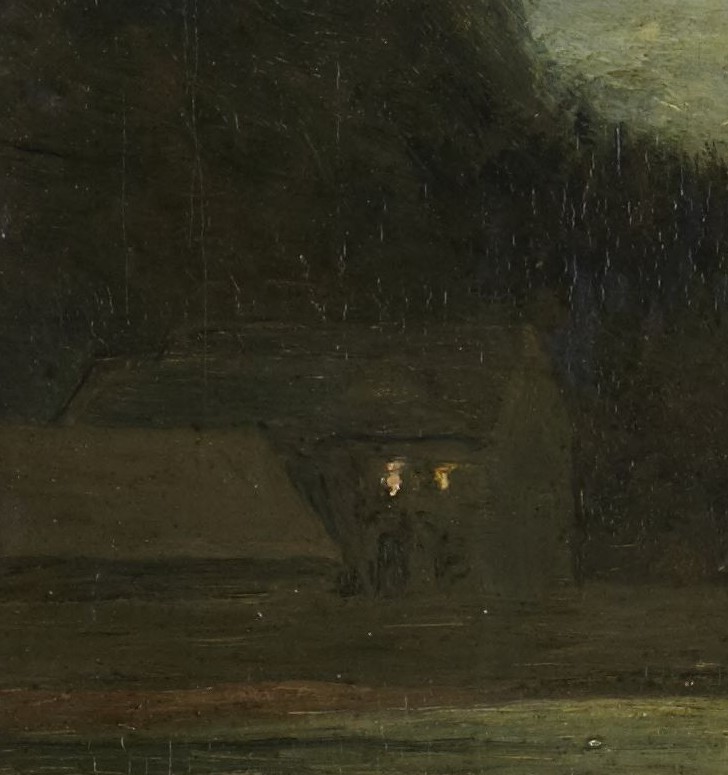
The dark slope enters high on the left and descends toward the right. It makes the lighthouse feel situated beside substantial land, rather than standing alone in an empty sea. Low buildings gather beneath the slope, with two small warm window lights answering the lantern above.
Those few lights provide a measure of human presence. No large figure or foreground action takes attention away from the tower, and the buildings remain partly absorbed into the dark shore. The scene becomes legible through selected accents rather than through an inventory of harbor activity.
Carroll’s 1913 description emphasizes the contrast between the coast’s shadow, the bright evening sky and the lit windows. His historical response corresponds to the panel’s central relationships: the light is small, but the broad darker setting makes it difficult to overlook. [2]
Annotated Details from Lighthouse, Honfleur
The numbered points identify visible features discussed in this article. Return from each detail to the whole composition. Homer Dodge Martin, The Lighthouse, Honfleur, undated. Oil on wood panel, 28 × 20 cm. Princeton University Art Museum, y1948-3. Carroll identified this small panel as a study for the larger Century Club canvas. Princeton University Art Museum, Gift of Frank Jewett Mather Jr. Image source. Public domain. Numbers added to a separate overview; detail crops made from the accepted source. No enlargement, recoloring, restoration or reconstruction.
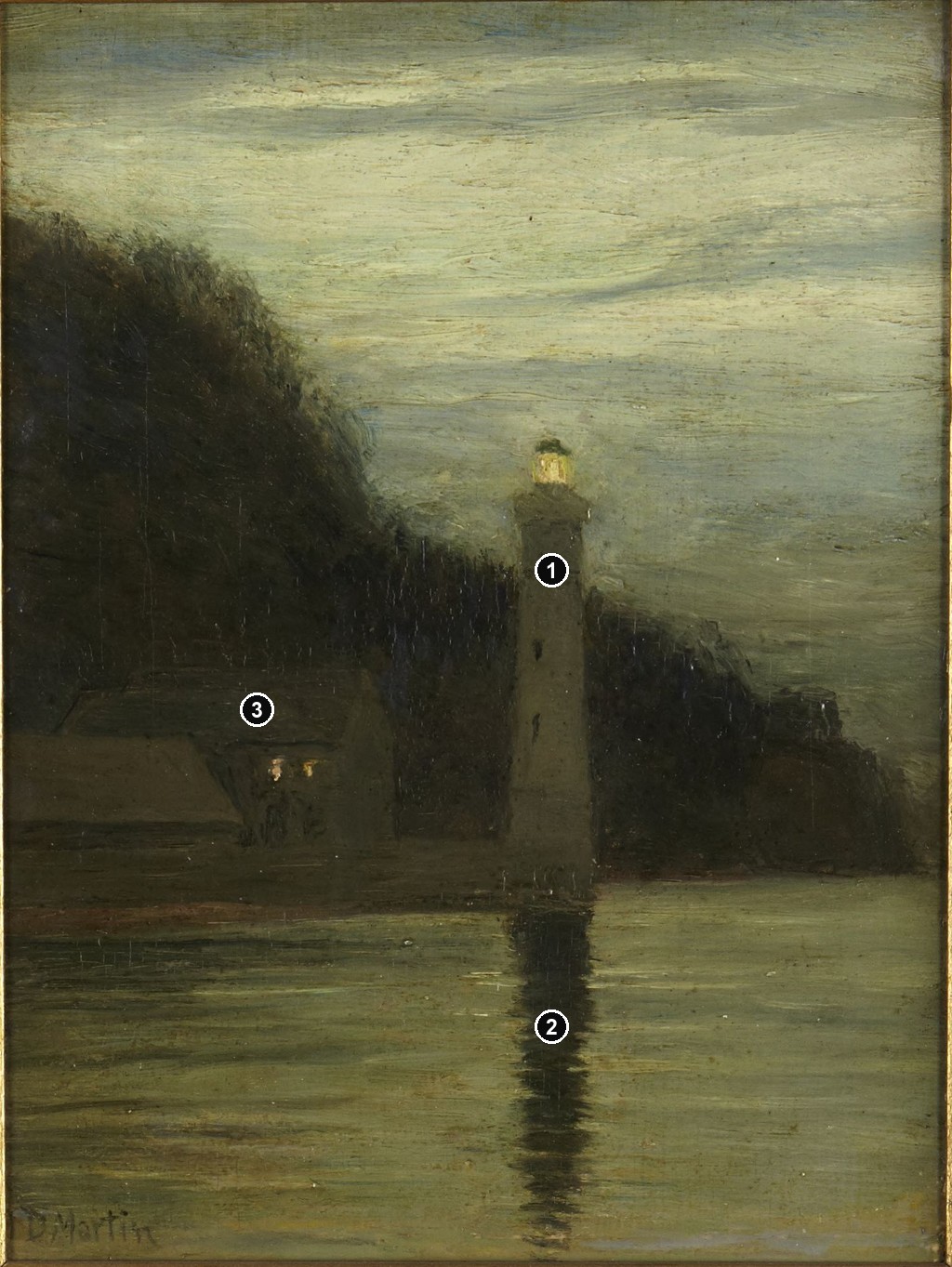
Details from LIGHTHOUSE, HONFLEUR
Compare the cropped details with the complete images above. Notice how their colours, shapes and positions contribute to the larger compositions.
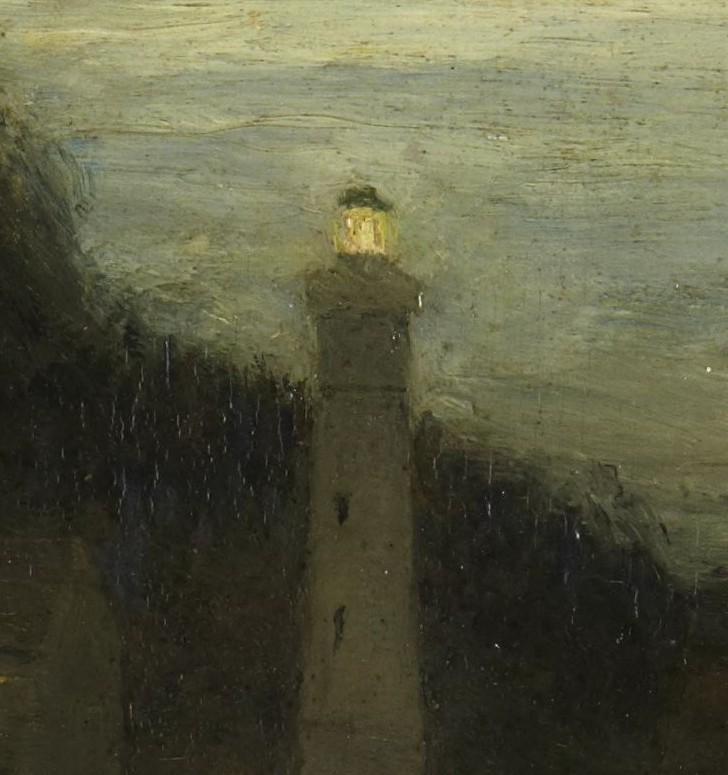
The lamp above the narrow tower
A small light enclosure crowns the slender tower. The tower remains distinct within the dark bank and buildings, with the open sky giving its upper part a clear setting.
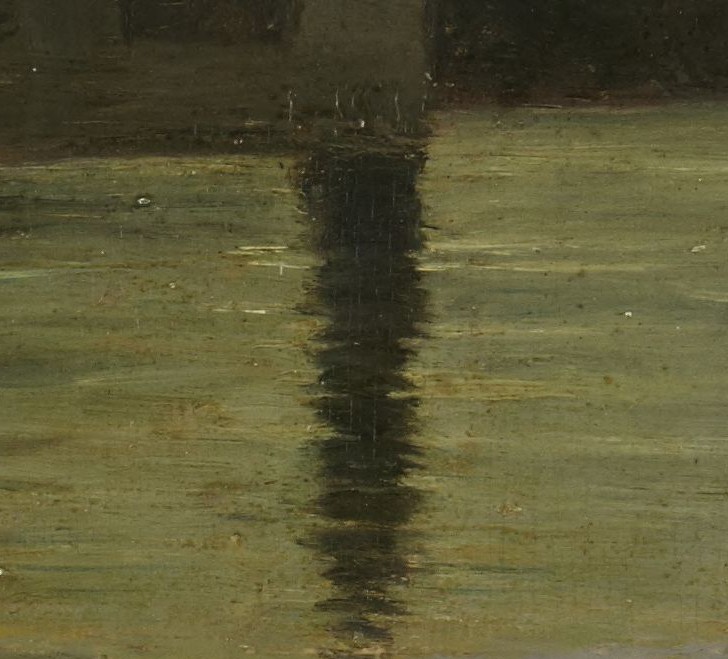
The tower extended into the water
A dark vertical reflection continues below the foot of the tower. Horizontal strokes interrupt it, joining the upright architecture to the moving surface of the water.
A dark bank and small light windows
The wooded bank and low buildings collect into a dark mass beside the tower. Small light windows punctuate that mass without competing with the lighthouse’s more sustained vertical.
Cliff, lighthouse and reflection
The reflected tower extends downward through the foreground water. It is darker and less sharply bounded than the building above, its edges interrupted by horizontal passages. Together, tower and reflection make a long upright shape that crosses the shore’s lower boundary.
That continuity competes gently with the coast’s diagonal descent. The eye can follow the land from upper left toward the water on the right, or travel vertically between the lamp and its reflection. These two directions hold the compact image together without requiring a complex arrangement of objects.
The small building to the left introduces another kind of light. Its windows lie low within the dark shore, whereas the lantern rises against a lighter field. Similar warm accents therefore work against different surroundings. One suggests an interior partly hidden by the coast; the other marks the tower’s exposed summit.
The water offers room around these concentrated forms. Its horizontal marks soften the reflection and extend beyond it, allowing the foreground to remain an open surface. The lighthouse anchors the view without filling it.
A vertical arrangement of sea and sky
The panel’s upright format is central to its effect. A substantial pale sky extends above the lantern, while the reflected tower approaches the bottom edge. The building itself occupies the interval between these two expanses. Its apparent height depends on the water below as well as on the sky above.
Across the upper field, broad bands and strokes vary the sky’s cool and warmer tones. Their predominantly horizontal movement gives the long vertical tower something to resist. The sky remains active even though its general lightness unifies it as one extensive area.
The foreground water repeats subdued greens, grays and warmer passages without becoming identical to the sky. The dark coast separates the two fields, while the lighthouse and its reflection connect them. The composition uses a few large relationships to keep the small support from feeling cramped.
Martin’s paintings include broad mountain and river views as well as compact coastal subjects. This panel shows how a restricted format could sustain considerable space. The balance comes from the intervals around the principal forms as much as from the objects themselves.
Honfleur in Martin’s working life
Martin’s Normandy residence brought familiar coastal subjects within reach of his studio. Mather dates the move from Villerville to neighboring Honfleur to early summer 1884, after nineteen months in the village. He describes a spacious studio on a wharf overlooking the harbor. [9]
Elizabeth remembered the improved studio accommodation as a possible reason for moving, while admitting uncertainty about the decision. She recalled a roomier, well-lit workspace apart from their dwelling, an arrangement Martin preferred. Her memoir places panels, watercolors and notebooks within the Honfleur period. [13]
These accounts provide the working setting without dating every object made from a Honfleur subject. Elizabeth describes notebooks continuing to fill with material, and paintings remained available for later development. Princeton’s panel should therefore retain its undated status rather than receiving an exact year simply from the dates of residence.
The France and Normandy account follows the sequence of places and works. Here the important connection is more concentrated: a coastal motif could become a small, strongly organized picture, while also contributing to a larger treatment of the subject.
Watch: Homer Dodge Martin
Start with Martin’s Normandy Landscape, then explore the wider Hudson River School tradition in which he began.
Homer Dodge Martin | Normandy Landscape
The Castellani Art Museum introduces Martin’s Normandy Landscape.
Watch on YouTubeCarroll’s small study and the larger picture
Carroll identifies his number thirty as The Lighthouse, Honfleur and calls it the original study for a large canvas owned by the Century Club. Princeton’s bibliography explicitly links its panel with that entry. This is a documented historical relationship, rather than a connection inferred solely from similar titles. [2] [1]
The relationship does not make the objects interchangeable. The small upright panel and the larger horizontal picture organize their space differently. A study can preserve a concentrated arrangement that remains interesting apart from the later or larger work associated with it.
Elizabeth places the Century Club’s Honfleur Lights among paintings developed in Martin’s last New York studio. She connects its sale to the club with the opportunity for his 1892 voyage to England. Those events belong to the larger canvas’s history; they do not establish the completion date or sale history of Princeton’s panel. [13]
Mather likewise discusses the Century picture separately, including a critical judgment that its yellow preparation had become too prominent. His observation concerns that canvas. It cannot serve as a technical diagnosis of the wood panel, whose support, scale and painted surface have their own history. [9]
From a private collection to Princeton
Carroll recorded the small study in Dr. Alexander C. Humphreys’s collection. Princeton’s provenance also lists Frank Lethbridge and the dealer William Macbeth, with an approximate 1907 date for Macbeth, before Humphreys. It records the panel in the Humphreys collection sale in New York in February 1917. [2] [1]
The museum’s gift credit names Frank Jewett Mather Jr., who had published his extended study of Martin in 1912. The panel thus became associated with an important early interpreter of the artist as well as with earlier collectors. The recorded sale and later gift leave part of the intervening ownership history unexplained. [1]
Princeton records a lower-left signature as D. Martin, while Carroll gave the fuller H. D. Martin. Their wording differs; the painting’s identity rests on the museum record and its explicit catalogue cross-reference. The two catalogues preserve different transcriptions of that lower-left mark. [1] [2]
Light without a literal narrative
The lamp can suggest guidance, shelter or the continuation of work after daylight, but no statement cited here establishes one symbolic meaning intended by Martin. Its immediate pictorial role is clear: it concentrates warmth and brightness near the top of a subdued tower.
The two window lights extend that relationship into the shadowed buildings, while the reflection leads it downward into the water. Looking among these accents changes the apparent scale of the scene. The panel’s quiet intensity grows through their placement within much larger areas of coast and sky.
The biography explains the career surrounding these coastal subjects. Returning to the picture, its particular achievement lies in the economy of its arrangement: a descending shore, a narrow tower, open water and enough light to make each depend on the others.
Artwork records
Browse 58 records from Carroll’s selected 1913 catalogue alongside 25 separately documented object records. Some records concern the same work; this is not a complete lifetime catalogue or a count of 83 unique artworks. [2]
| Name | Date | Medium |
|---|---|---|
| Carroll 1: Saranac Lake (1913 record) | 1860s; exact date not clearly decipherable | Painting — historical catalogue record |
| Carroll 2: Lake George from Bolton (1913 record) | Date not stated | Painting — historical catalogue record |
| Carroll 3: The Iron Mine, Port Henry, N. Y. (1913 record) | Date not stated | Painting — historical catalogue record |
| Carroll 4: On Lake Ontario (1913 record) | Probably late 1860s | Painting — historical catalogue record |
| Carroll 5: The Giant of the Valley (1913 record) | 1865 | Painting — historical catalogue record |
| Carroll 6: An Adirondack Lake (1913 record) | Date not stated | Painting — historical catalogue record |
| Carroll 7: Winter in Normandy (1913 record) | Date not stated | Watercolor — historical catalogue record |
| Carroll 8: Across the Lake (1913 record) | Date not stated | Painting — historical catalogue record |
| Carroll 9: New Hampshire Landscape (1913 record) | Late 1860s | Painting — historical catalogue record |
| Carroll 10: Long Lake (1913 record) | Date not stated | Painting — historical catalogue record |
| Carroll 11: Salt Meadows (1913 record) | Mid 1880s | Painting — historical catalogue record |
| Carroll 12: Autumn on the Susquehanna (1913 record) | 1879 | Painting — historical catalogue record |
| Carroll 13: Ontario Sand Dunes (1913 record) | 1887 | Painting — historical catalogue record |
| Carroll 14: Late Autumn (1913 record) | About 1877 | Painting — historical catalogue record |
| Carroll 15: Early Spring (1913 record) | About 1877; companion dating | Painting — historical catalogue record |
| Carroll 16: Raquette Lake (1913 record) | 1869 | Painting — historical catalogue record |
| Carroll 17: A Glimpse of the Sea (1913 record) | Date not established; historical suggestion disputed | Painting — historical catalogue record |
| Carroll 18: Headwaters of the Hudson (1913 record) | 1869 | Painting — historical catalogue record |
| Carroll 19: Autumn in the Adirondacks (1913 record) | 1871 | Painting — historical catalogue record |
| Carroll 20: Richmond on Thames (1913 record) | About 1877; later alterations | Painting — historical catalogue record |
| Carroll 21: Saranac Lake (1913 record) | 1878 | Painting — historical catalogue record |
| Carroll 22: Windsor Castle (1913 record) | Finished 1878 | Painting — historical catalogue record |
| Carroll 23: L’Anse St. Étienne, Saguenay (1913 record) | 25 July 1879 | Watercolor — historical catalogue record |
| Carroll 24: L’Anse aux Basses Pierres (1913 record) | Date not stated | Watercolor — historical catalogue record |
| Carroll 25: Blossoming Trees (1913 record) | Mid 1880s | Painting — historical catalogue record |
| Carroll 26: On the Seine (1913 record) | Date not stated; later years suggested | Painting — historical catalogue record |
| Carroll 27: The Dunes (1913 record) | 1883 | Watercolor — historical catalogue record |
| Carroll 28: The Moonlit Pond—Honfleur (1913 record) | Date not stated | Painting — historical catalogue record |
| Carroll 29: Normandy Landscape (1913 record) | Date not stated | Painting — historical catalogue record |
| Carroll 30: The Lighthouse, Honfleur (1913 record) | Date not stated | Painting — historical catalogue record |
| Carroll 31: Ruby Strong—Normandy (1913 record) | Date not stated | Painting — historical catalogue record |
| Carroll 32: Sand Dunes, Lake Ontario (1913 record) | 1874 | Painting — historical catalogue record |
| Carroll 33: Low Tide, Honfleur (1913 record) | Date not stated | Painting — historical catalogue record |
| Carroll 34: Evening on the Seine (1913 record) | Date not stated | Painting — historical catalogue record |
| Carroll 35: On the Seine (1913 record) | Date not stated | Painting — historical catalogue record |
| Carroll 36: On the Hudson (1913 record) | 1881 | Painting — historical catalogue record |
| Carroll 37: A Forest Brook (1913 record) | 1881 | Painting — historical catalogue record |
| Carroll 38: Coast Meadows, St. Sauveur (1913 record) | 1881 | Painting — historical catalogue record |
| Carroll 39: Landscape (1913 record) | 1883 | Painting — historical catalogue record |
| Carroll 40: An Adirondack Lake—Lake Sanford (1913 record) | 1883 | Painting — historical catalogue record |
| Carroll 41: Lower Ausable Pond (1913 record) | 1868 | Painting — historical catalogue record |
| Carroll 42: December Morning in Normandy (1913 record) | 1883 | Painting — historical catalogue record |
| Carroll 43: Low Tide—Villerville (1913 record) | 1884 | Painting — historical catalogue record |
| Carroll 44: Lake George (1913 record) | 1884 | Painting — historical catalogue record |
| Carroll 45: Crepuscule—Montvilliers (1913 record) | 1885 | Painting — historical catalogue record |
| Carroll 46: The Sea at Villerville (1913 record) | 1885 | Painting — historical catalogue record |
| Carroll 47: Golden Sands (1913 record) | Date not stated | Painting — historical catalogue record |
| Carroll 48: The Meadow Brook (1913 record) | 1887 | Painting — historical catalogue record |
| Carroll 49: The Sun Worshippers (1913 record) | After the 1886 return to New York | Painting — historical catalogue record |
| Carroll 50: South Side of Long Island (1913 record) | 1894 | Painting — historical catalogue record |
| Carroll 51: Criqueboeuf Church (1913 record) | 1893 | Painting — historical catalogue record |
| Carroll 52: Normandy Farm (1913 record) | 1895 | Painting — historical catalogue record |
| Carroll 53: On the Mississippi (1913 record) | Toward the close of the artist’s life | Painting — historical catalogue record |
| Carroll 54: Newport Neck (1913 record) | 1893 | Painting — historical catalogue record |
| Carroll 55: A Newport Landscape (1913 record) | 1896 | Painting — historical catalogue record |
| Carroll 56: A Distant View of Caen (1913 record) | Date not stated; exhibited 1894 | Painting — historical catalogue record |
| Carroll 57: The Brook (1913 record) | 1894 | Painting — historical catalogue record |
| Carroll 58: Normandy Trees (1913 record) | Date not stated | Painting — historical catalogue record |
| View on the Seine: Harp of the Winds | 1893–95 | Oil on canvas |
| The Iron Mine, Port Henry, New York | About 1862 | Oil on canvas mounted on fiberboard |
| Wild Coast, Newport | 1889 | oil on canvas |
| In the Housatonic Valley (attributed to Homer Dodge Martin) | late 1850s | oil on canvas |
| Sand Dunes, Lake Ontario | c. 1874 | Possibly black crayon on paper |
| Adirondacks | 1868 | Pencil drawing |
| Landscape | 1896 | Watercolor |
| Near Newport | mid-1800s | Watercolor |
| Effect of Trees | About 1879 | Oil on canvas |
| Behind Dunes, Lake Ontario | 1883–87 | Oil on canvas |
| Old Manor of Criqueboeuf | About 1882–92 | Oil on canvas |
| Upper Ausable Lake | 1868 | Oil on canvas |
| Wild Coast, Newport (Smithsonian version) | About 1885–95 | Oil on canvas |
| On the Seine | About 1895 | Oil on canvas |
| The Lighthouse, Honfleur | Date not supplied by museum | Oil on wood panel |
| The White Mountains from Randolph Hill (Wellin canvas) | 1866–67 | Oil on canvas |
| Old Crossing, Otter Tail River | 1871 | Black chalk touched with white chalk on paper |
| Landscape with Poplars | Date not supplied by museum | Oil on canvas |
| Normandy Coast | 1884 | Oil on board |
| Criqueboeuf Church, Normandy | 1893 | Oil on canvas |
| Evening on the Thames | About 1876 | Oil on canvas |
| Hudson River | 1860 | Graphite drawing on wove paper |
| The White Mountains, from Randolph Hill (formerly Met canvas) | About 1862–68; later revisions | Oil on canvas |
| Westchester Hills | About 1887 | Oil painting — historical accounts |
| Adirondack Scenery | 1895 | Oil painting — historical accounts |
Frequently Asked Questions
Princeton’s object record gives no execution date. The dates of Martin’s Normandy residence should not be substituted for an exact date of this work. [1]
No. Carroll described the small panel as a study for the larger Century Club canvas. [2]
It is oil on wood panel, measuring 28 by 20 centimeters. [1]
The museum credit names Frank Jewett Mather Jr. [1]
The sources cited here establish its subject and study relationship, but no particular symbolic intention by Martin.
Discussion
Look again at the images and ideas explored in Lighthouse, Honfleur. These editorial prompts invite your observations.
Reader Insights
Follow the lighthouse downward into its reflection. How much of its apparent height belongs to the water?
Compare the lamp with the two window lights. How do different surrounding tones change their effect?
Trace the coast’s diagonal and the tower’s vertical. Where do those directions meet most strongly?
Join the Conversation
Share a detail, comparison or question about Lighthouse, Honfleur below.
References
- Princeton University Art Museum , The Lighthouse, Honfleur, y1948-3, current object metadata, provenance, signature and bibliography. View source
- Dana H. Carroll , Fifty-Eight Paintings by Homer D. Martin, 1913, no.30, p.79, small study and Humphreys collection. View source
- Smithsonian American Art Museum, The Iron Mine, Port Henry, New York, 1910.9.11. View source
- Smithsonian American Art Museum, Upper Ausable Lake, 1909.7.44. View source
- Smithsonian American Art Museum, Evening on the Thames,1909.7.45. View source
- Metropolitan Museum of Art, Old Manor of Criqueboeuf, 22.117. View source
- Metropolitan Museum of Art, Behind Dunes, Lake Ontario, 06.1287. View source
- Brooklyn Museum, Normandy Coast,15.281. View source
- Frank Jewett Mather Jr. , Homer Martin: Poet in Landscape, 1912, pp.50–51 and55–56, Honfleur studio and separate Century Club canvas. View source
- Cleveland Museum of Art, Wild Coast, Newport, 1923.1118. View source
- Los Angeles County Museum of Art, Criqueboeuf Church,Normandy,M.90.159. View source
- Metropolitan Museum of Art, View on the Seine: Harp of the Winds, 97.32. View source
- Elizabeth Gilbert Martin , Homer Martin: A Reminiscence, 1904, pp.43–46, Honfleur workspace, panels and subsequent New York paintings. View source
- Splash image source.
Homer Dodge Martin, The Lighthouse, Honfleur, undated. Oil on wood panel, 28 × 20 cm. Princeton University Art Museum, y1948-3. Carroll identified this small panel as a study for the larger Century Club canvas. Princeton University Art Museum, Gift of Frank Jewett Mather Jr. Public domain . Frame and wall cropped; visible painting edge retained. Resizing only follows.
View source