 by
Tom Gurney
Tom Gurney BSc (Hons) is an art history expert with over 20 years experience
Email:
tomgurney1@gmail.com
/ Phone:
+44 7429 011000
Evening on the Thames: Introduction
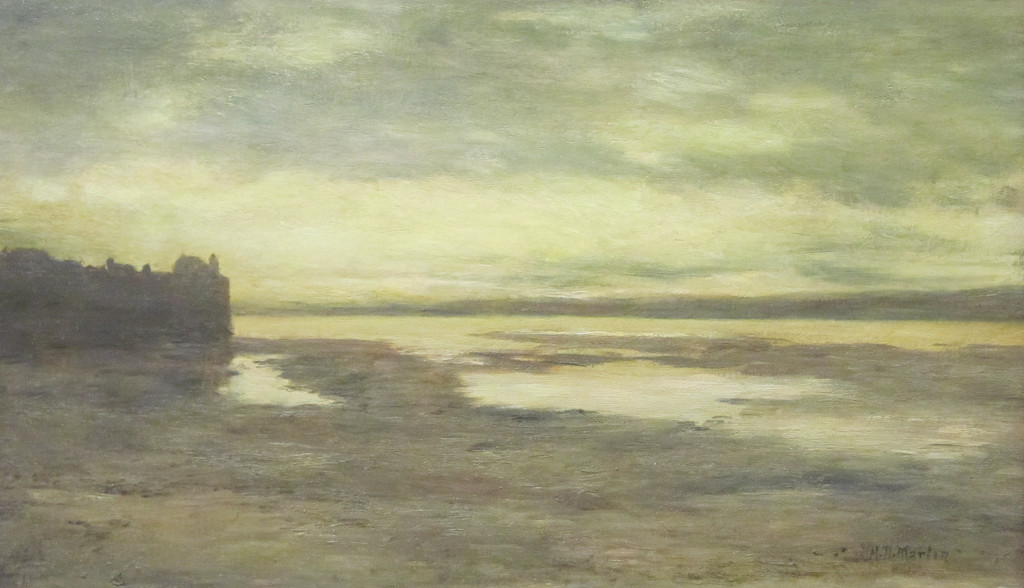
The city gathers into a dark silhouette at the left, leaving a broad field of river and clouded sky. In Homer Dodge Martin’s Evening on the Thames , buildings become one element within a much larger arrangement of subdued light. The water carries broken reflections toward the foreground, while the distant bank remains a thin boundary beneath the sky.
The Smithsonian American Art Museum dates the canvas about 1876, the year of Martin’s first European journey. His encounters in England give the painting an important career setting, but the picture’s particular balance of architecture, shore and water deserves attention before it becomes an example of influence. [1] [2]
At a Glance
- Artist Homer Dodge Martin.
- Title Evening on the Thames.
- Date About 1876.
- Medium and dimensions Oil on canvas, 46.4 × 76.6 cm.
- Collection Smithsonian American Art Museum, 1909.7.45.
- Credit Gift of William T. Evans.
- Location depicted The Thames in London; Parliament appears in the museum’s subject headings.
- Illustration Photograph by Jonathunder, CC BY-SA 3.0, proportionally resized.
- Sources Smithsonian object record and the photograph’s source record. [1] [3]
This work across Homer Dodge Martin’s career
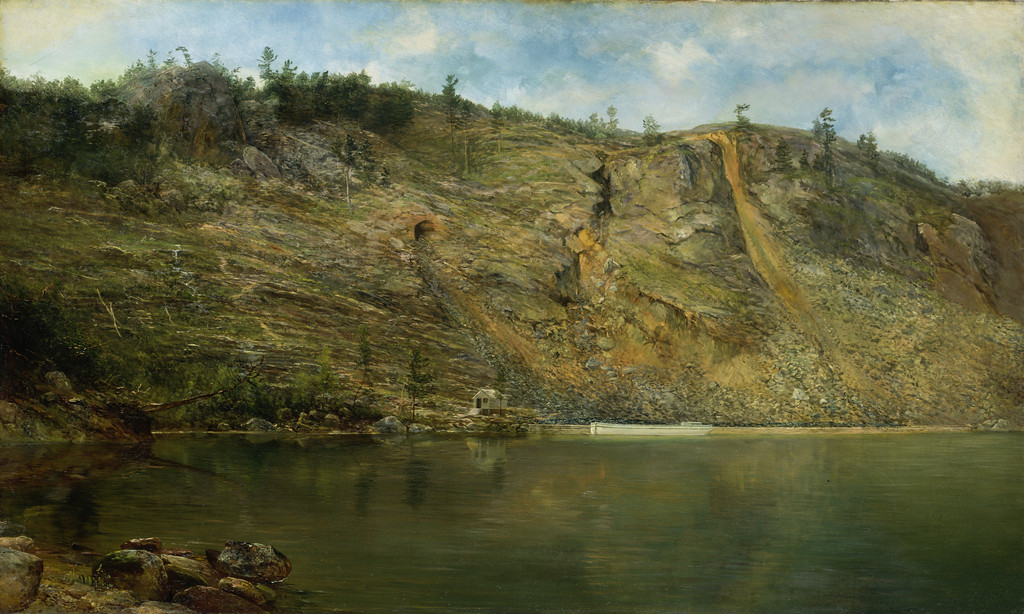
The Iron Mine, Port Henry, New York
about 1862Evening on the Thames (current article)
about 1876Old Manor of Criqueboeuf
about 1882–92Behind Dunes, Lake Ontario
1883–87Normandy Coast
1884Westchester Hills
about 1887Lighthouse, Honfleur
UndatedNotes and sources
The Iron Mine, Port Henry, New York. An industrial opening, sloping runway and worked cliff stand above Lake Champlain. The Smithsonian connects this landscape with the North’s resources during the Civil War. [4]
Upper Ausable Lake. Foreground reeds and birds lead toward a bright passage of water beneath the mountain wall. The Smithsonian identifies this canvas as Upper Ausable Lake. [5]
Evening on the Thames (current article). A low river horizon, distant buildings and reflected light bring a British subject into Martin’s painting. The museum’s date remains approximate. [1]
Old Manor of Criqueboeuf. A house and its reflection organize this slowly developed Normandy subject. The broad date range does not mean that Martin painted it without interruption. [6]
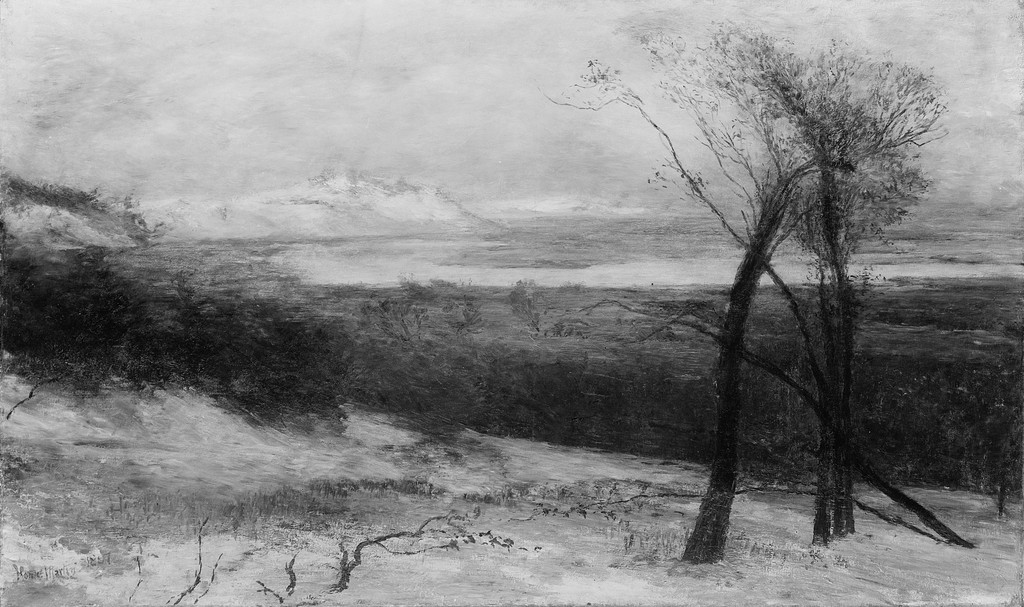
Behind Dunes, Lake Ontario. An American subject developed during the French residence and after the return. The Met records rejection at the 1884 Salon followed by revision in 1887. [7]
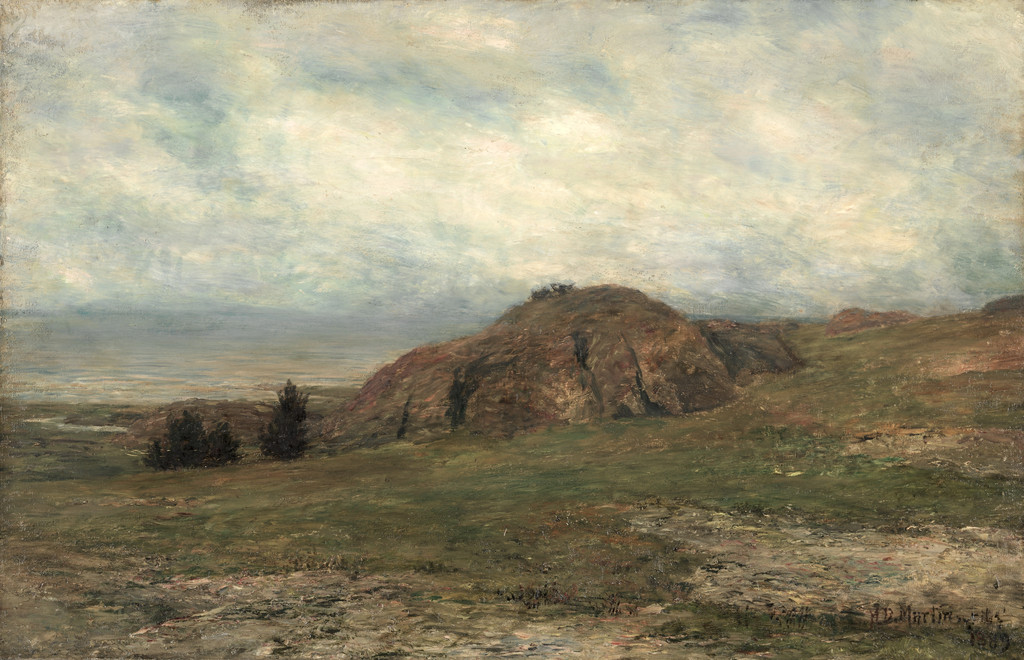
Normandy Coast. Freely brushed clouds dominate a small coastal board. Brooklyn places it among outdoor paintings made during Martin’s French residence. [8]
Westchester Hills. Mather describes a large outdoor undertaking at Croton Falls and records its exhibition in 1888. The probable painting date and exhibition year remain distinct. [2]
Wild Coast, Newport. An extensive sky opens above low coastal ground. This dated Cleveland canvas is distinct from the Smithsonian painting bearing the same title. [9]
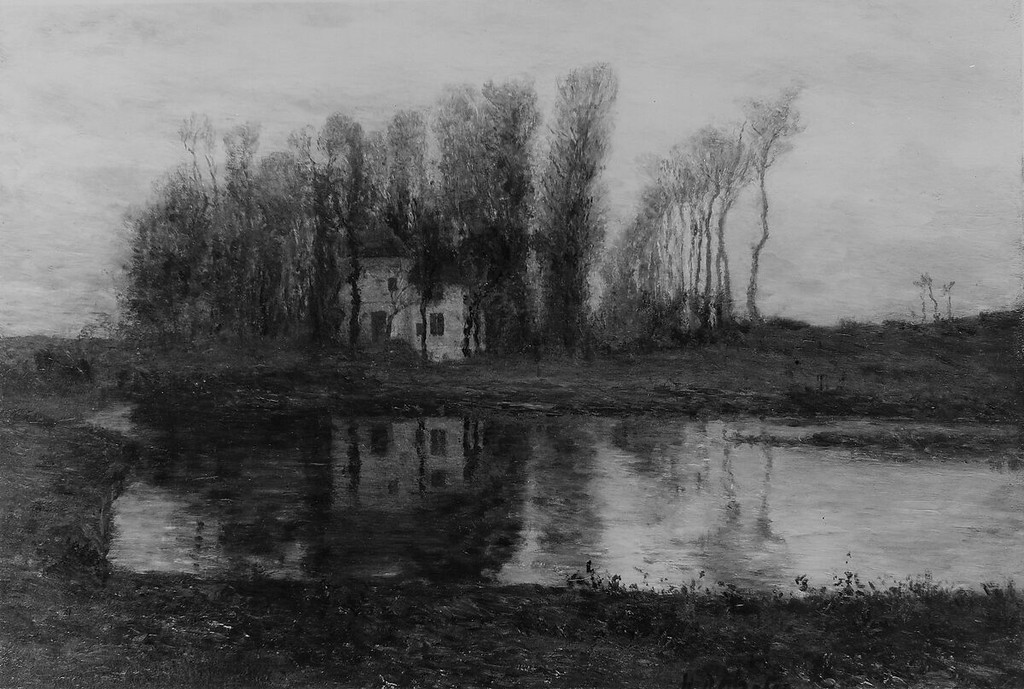
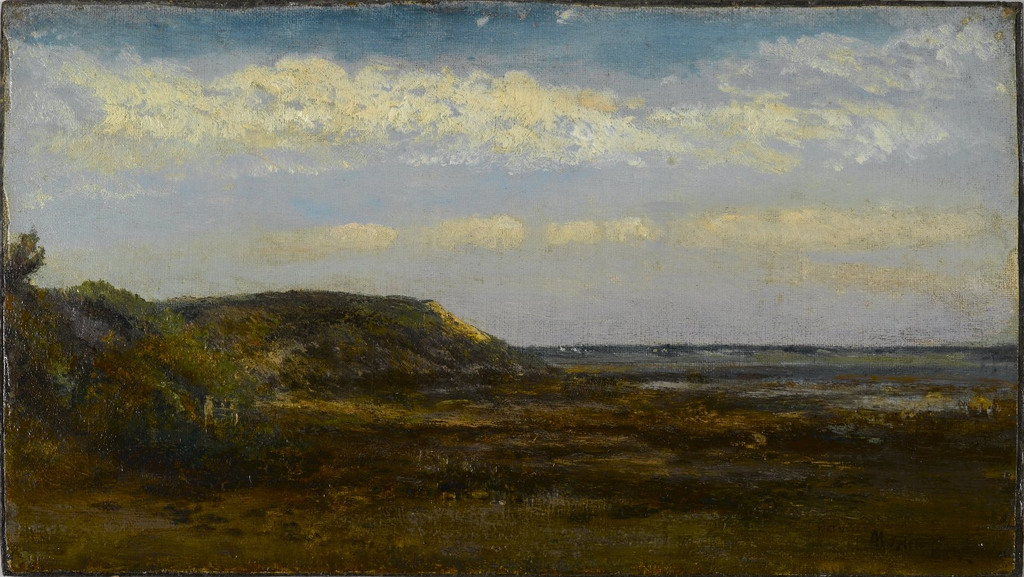
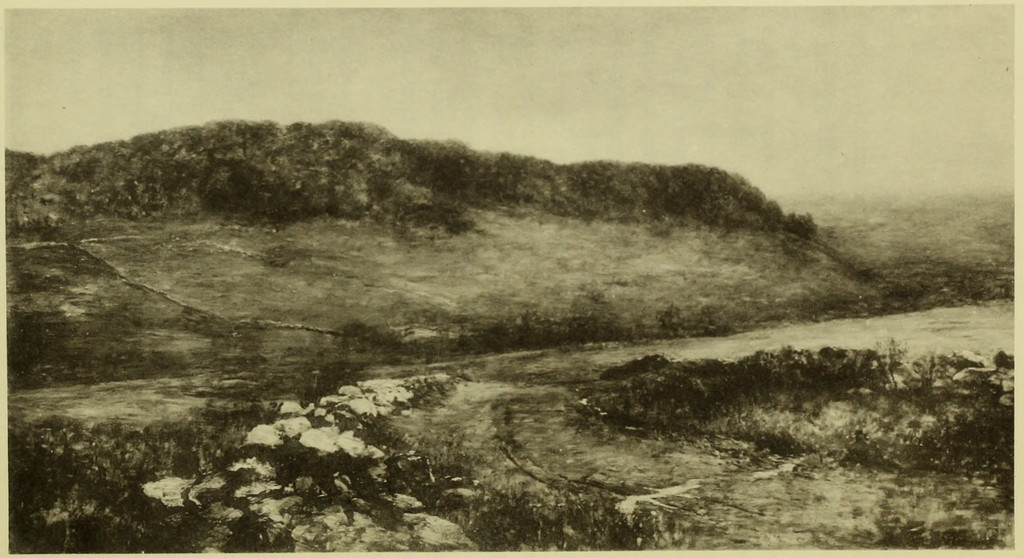
Criqueboeuf Church, Normandy. A church, trees and their reflections give architecture a place within the landscape. The current LACMA record supplies the date; the article reproduces a historical monochrome print. [10]
View on the Seine: Harp of the Winds. Poplars and their reflections repeat across the Seine. The Met records a charcoal beginning in New York in 1893 and completion in Saint Paul in 1895. [11]
Adirondack Scenery. Mountain slopes, a foreground ledge and water organize this late return to American scenery. Mather treats it as a major expression of experiences considered over many years. [2]
Lighthouse, Honfleur. Princeton’s small upright wood panel sets the lighthouse within a compact landscape. It remains undated and is distinct from the larger horizontal Century Club canvas. [12]
Contents
- London reduced to sky, shore and water
- The low city silhouette
- Reflection and the gathering evening
- The 1876 journey and the Thames
- Martin and Whistler: an encounter with limits
- A British river beside the later Seine
- The Smithsonian painting and its identification
- Annotated details
London reduced to sky, shore and water
The recognizable city occupies a surprisingly limited part of the canvas. Its nearer buildings rise along the left edge, while the far bank stretches low across the remaining width. Most of the view belongs to spaces that resist architectural detail: cloud, water and the irregular exposed-looking ground between them.
The sky contains broad cooler passages within a warmer, pale field. Its cloud bands change direction and thickness without becoming a sharply bounded pattern. They gather over the low city, then extend across the open right side, making the atmosphere the largest continuous element in the scene.
In the foreground, darker patches and lighter water passages break the surface into unequal regions. Their shapes lead inward from the lower edge toward the luminous strip near the distant shore. The painting offers a route through space without using a prominent road, bridge or central figure.
The paintings overview places this river scene beside Martin’s lakes and coasts. Here the city remains unmistakably present, yet the larger experience concerns how an extensive setting can be held together through a few broad differences of light and tone.
Annotated Details from Evening on the Thames
The numbered points identify visible features discussed in this article. Return from each detail to the whole composition. Homer Dodge Martin, Evening on the Thames, about 1876. Oil on canvas, 46.4 × 76.6 cm. Smithsonian American Art Museum, 1909.7.45. Photograph by Jonathunder; the supplied photographic proportions are retained. Smithsonian American Art Museum, Gift of William T. Evans. Photograph: Jonathunder, via Wikimedia Commons. Image source. CC BY-SA 3.0. Numbers added to a separate overview; detail crops made from the accepted source. No enlargement, recoloring, restoration or reconstruction.
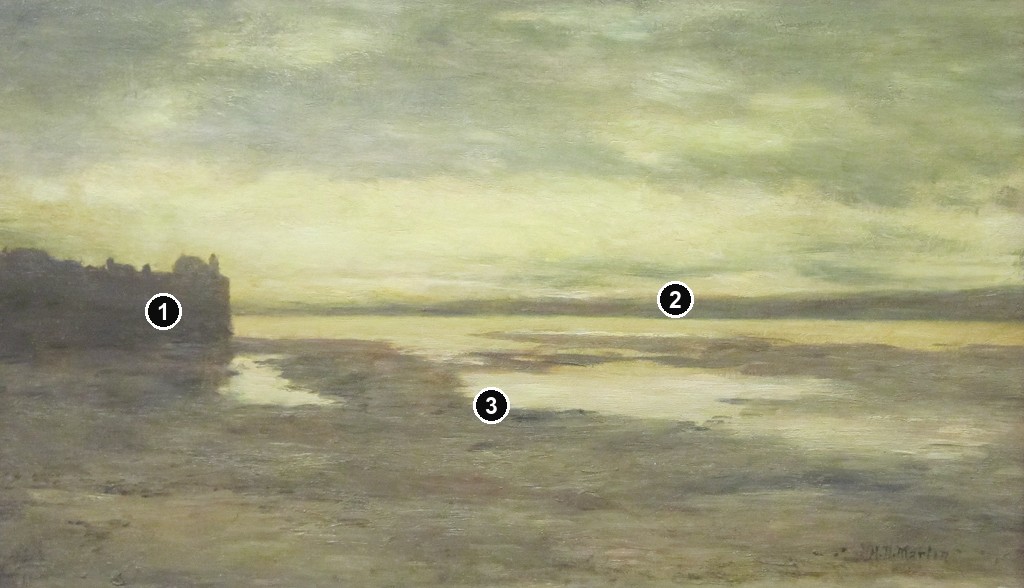
Details from EVENING ON THE THAMES
Compare broad relationships of the bank, distant shore and water in this gallery photograph. The supplied proportions and photographic softness are retained; these crops do not support microscopic paint analysis.
Buildings close to the left bank
A compact group of dark buildings interrupts the pale river horizon. Their softened outlines help place them within the wider evening atmosphere.
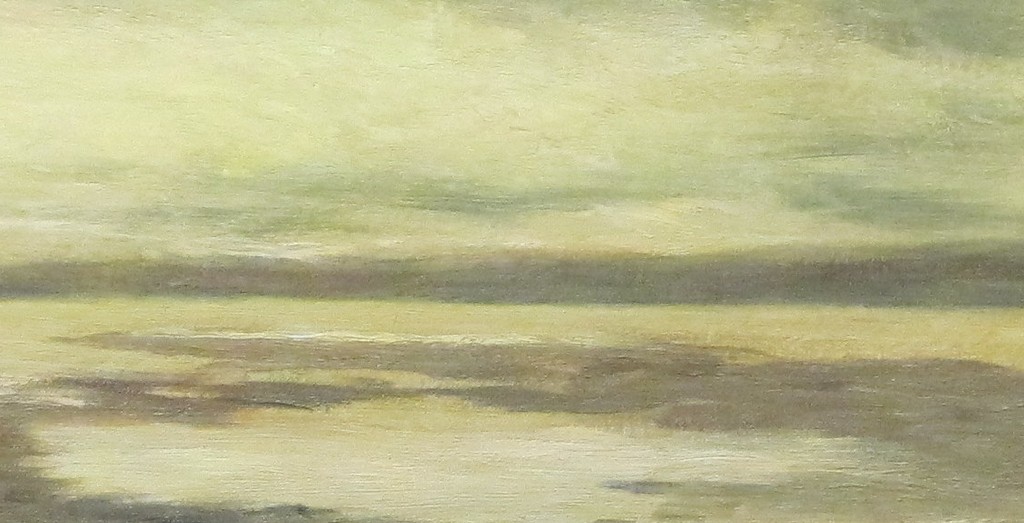
A distant strip beneath the sky
The farther bank narrows to a low band below the sky. This gallery photograph supports a broad comparison of spacing and tone, rather than an account of minute paint handling.
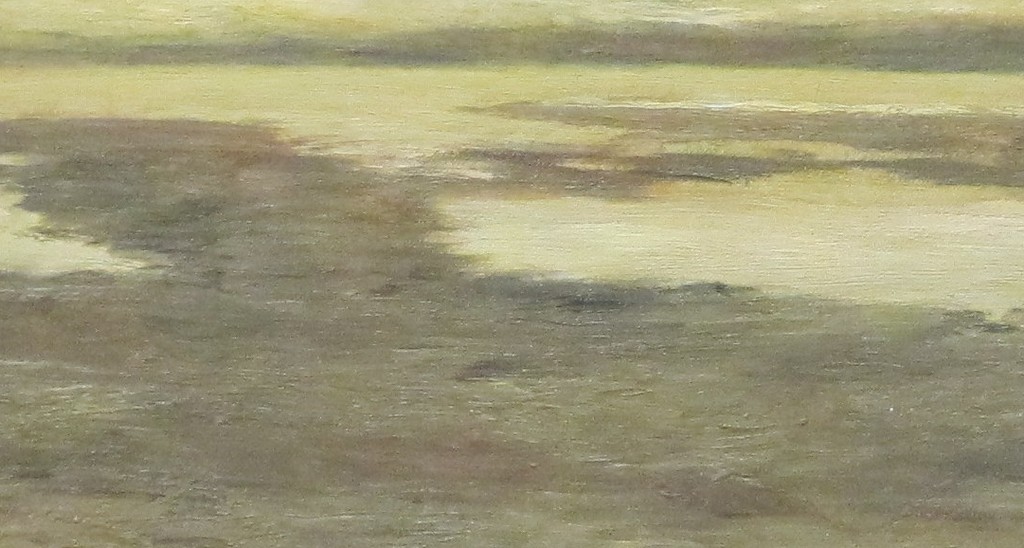
Light water between darker reflections
Pale water separates darker reflected passages below the banks. The arrangement can be followed while retaining the supplied photograph’s proportions and softness.
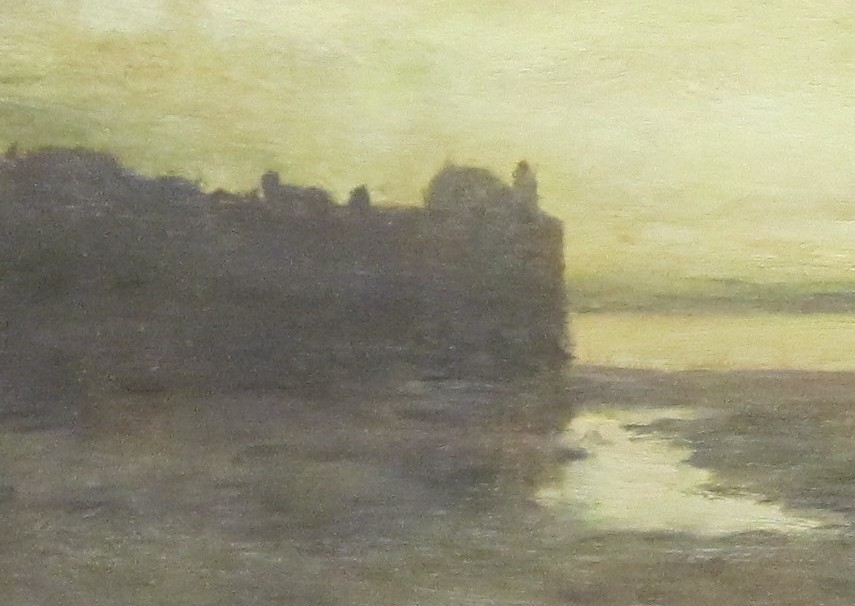
The low city silhouette
The left-hand buildings form a compact mass, with small changes in their upper profile suggesting separate roofs and projecting structures. Their dark front meets the water with a less stable edge, where the reflection begins to break into the foreground’s horizontal passages.
The Smithsonian identifies London and Parliament among the painting’s subjects. That institutional description locates the architectural setting without supplying an exact position on the bank or identifying every feature within the silhouette. The particular view should not be reconstructed from a few indistinct forms alone. [1]
The buildings also give scale to the open right side. Once a viewer recognizes the height of the near architectural mass, the long low bank and broad sky seem more extensive. The city acts as a measure within the landscape rather than filling the picture as its sole subject.
This arrangement keeps the view from feeling evenly divided. The dark left edge attracts attention first, but the light across the water draws the eye outward again. Looking becomes a movement between a concentrated object and the intervals that surround it.
Reflection and the gathering evening
The water does not function as a complete mirror. Dark reflections beneath the city merge with irregular foreground passages, while lighter openings carry the sky’s subdued warmth toward the viewer. The surface repeats the scene through interrupted shapes rather than an exact second image.
The foreground contains several changes of pace. Broad near passages slow the eye, smaller interruptions carry it farther away, and the thin brighter region near the opposite shore makes distance more legible. The painting’s space depends on those differences as much as on the named river.
The title directs attention toward evening, a time when distinct forms can become harder to separate. Martin uses that reduced clarity constructively. Buildings remain recognizable in silhouette, while the water and sky seem to share a larger atmospheric field. The particular date, weather and viewing hour remain unknown.
The technique discussion considers his increasingly softened handling through historical testimony and individual works. In this canvas, the visible relationships between adjacent tones matter more than a count of separately rendered architectural details.
The 1876 journey and the Thames
Elizabeth Gilbert Martin dates her husband’s first European journey to 1876, when he traveled with their Albany friend Dr. Jacob S. Mosher. Her memoir mentions England, France and Holland, with Belgium less certain. It also recalls sketching around Barbizon and Saint-Cloud. [13]
Mather’s later study places much of that visit in England and records Martin’s return to New York by the middle of December. The journey widened the settings and art available to him, while leaving important gaps in the detailed record of what he made or saw on particular days. [2]
The museum’s approximate 1876 date makes the Thames picture relevant to this first journey. It does not establish that the complete canvas was painted at the river, or that one known excursion supplied its exact viewpoint. Observation and subsequent studio development remain separate possibilities within the broader travel context.
Mather also records Martin’s preference for London’s irregular, accumulated appearance over the formal planning of newer Paris. That recollection concerns the painter’s response to a city rather than the documented intention of this canvas. It nevertheless gives the urban setting a more personal context. The buildings in the Thames picture form an uneven profile, and their compact mass remains integrated with the river’s broader spaces. The city supplies an interest beyond a sequence of famous monuments. [2]
Mather discusses another work, Richmond on Thames , as a painting developed after Martin’s return. That title supplies evidence of a continuing British subject, but it is not an alternative name for the Smithsonian canvas. Different river pictures require their own histories. [2]
Watch: Homer Dodge Martin
Start with Martin’s Normandy Landscape, then explore the wider Hudson River School tradition in which he began.
Homer Dodge Martin | Normandy Landscape
The Castellani Art Museum introduces Martin’s Normandy Landscape.
Watch on YouTubeMartin and Whistler: an encounter with limits
Elizabeth recalled Martin becoming acquainted with James McNeill Whistler during the 1876 journey. Mather describes their companionship in England while acknowledging that the content of their artistic conversations was not preserved. Friendship establishes an encounter; it cannot by itself explain every formal decision in Evening on the Thames . [13] [2]
The Smithsonian’s biography includes Whistler among the influences on Martin’s softened forms and muted color. The Thames painting gives that broad assessment a concrete setting, with its restricted contrasts and low architectural mass. The relationship remains more useful as a context for comparison than as a claim that Martin copied a particular nocturne. [14]
A later studio visit must also remain separate. Elizabeth joined Martin in England in 1882 and remembered visiting Whistler’s studio on the Fourth of July. She described paintings and the striking arrangement of the rooms. That recollection concerns a subsequent period, not a witnessed sitting for this approximately 1876 picture. [13]
Mather’s account preserves Martin’s independence alongside his admiration. The surviving narrative allows several artistic interests to coexist without reducing the painting to a single borrowed style. Its own distribution of city, exposed ground, reflection and sky remains available for examination.
A British river beside the later Seine
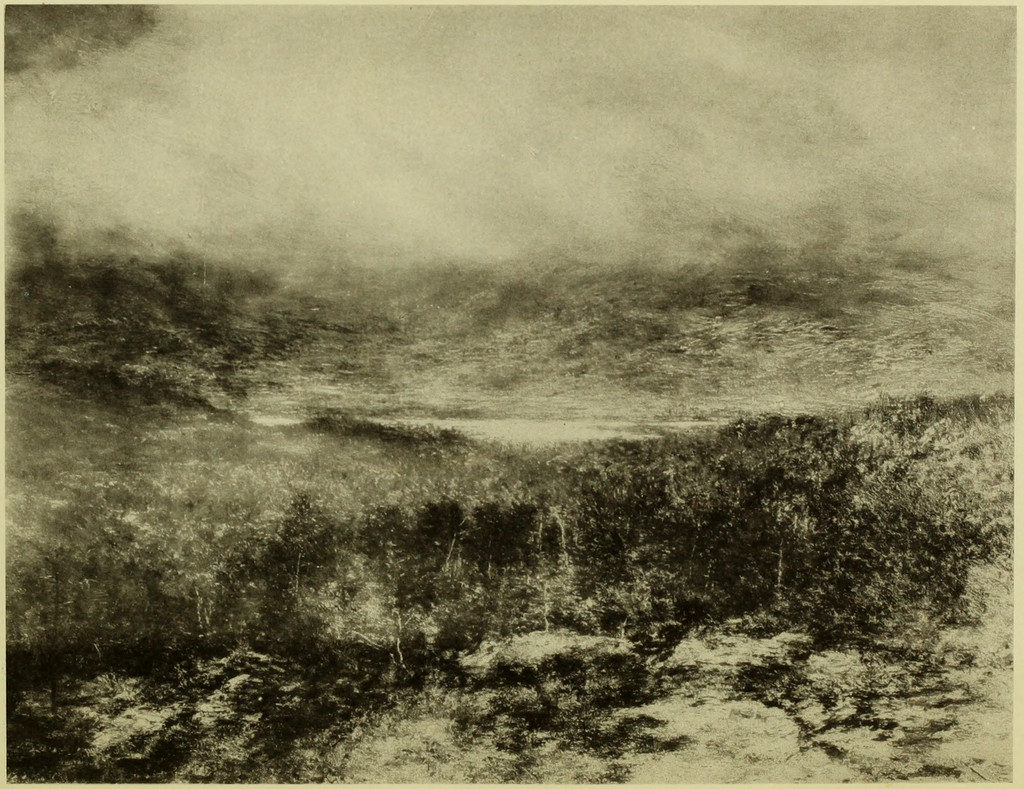
In Harp of the Winds , the later Seine landscape places repeated trees beyond an extensive foreground of water. The Met dates that canvas 1893–95. It belongs to another period and subject, but reflection and a low distant settlement provide points of comparison. [11]
The contrast is especially clear in the principal silhouettes. The Thames picture gathers its near architecture into a dense left-hand block; Harp distributes upright trees across a longer bank. Both leave substantial space for water and sky, while giving those spaces different boundaries and rhythms.
A comparison across years need not imply a direct preparatory relationship. The works reveal an enduring problem pursued through different settings: how a few darker forms can make an extensive atmosphere intelligible. The British river remains a London scene, while the later French river has its own geography and long working history.
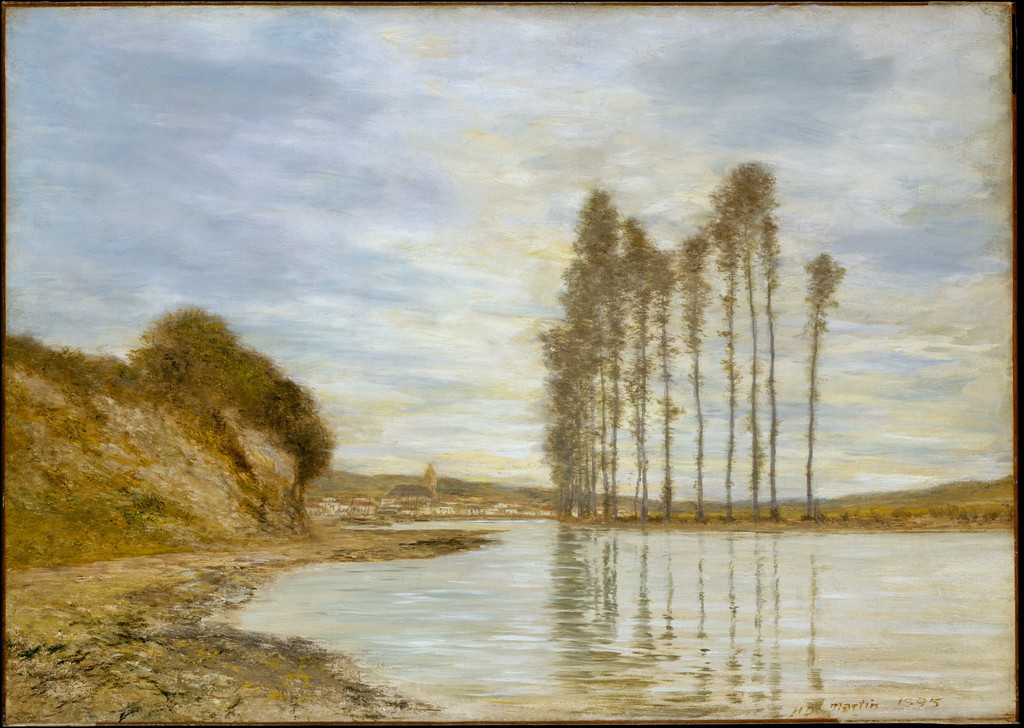
Homer Dodge Martin, View on the Seine: Harp of the Winds, 1893–95. The Metropolitan Museum of Art, 97.32. The repeated trees beyond the water offer a later comparison with the Thames picture’s compact city silhouette. The Metropolitan Museum of Art.
Image source
.
CC0 / Public domain
. Resized only; source appearance preserved.
The Smithsonian painting and its identification
The museum’s title, approximate date, dimensions and accession number identify the canvas as Evening on the Thames , 1909.7.45, Gift of William T. Evans. Its subject headings connect the river with London and Parliament. These particulars distinguish the work from other Thames views and from Martin’s French river subjects. [1]
The illustration is Jonathunder’s photograph of the painting, reproduced under CC BY-SA 3.0. The photographer’s credit accompanies the historical artwork’s identity. The image allows the broad disposition of light, city and shore to be followed while preserving the photograph’s supplied proportions. [3]
The biography follows Martin’s English encounters within his wider career. This particular picture retains a quieter claim on attention: the city recedes toward one side, its reflection loosens in the water, and a pale opening carries the view beyond the foreground into distance.
Artwork records
Browse 58 records from Carroll’s selected 1913 catalogue alongside 25 separately documented object records. Some records concern the same work; this is not a complete lifetime catalogue or a count of 83 unique artworks. [15]
| Name | Date | Medium |
|---|---|---|
| Carroll 1: Saranac Lake (1913 record) | 1860s; exact date not clearly decipherable | Painting — historical catalogue record |
| Carroll 2: Lake George from Bolton (1913 record) | Date not stated | Painting — historical catalogue record |
| Carroll 3: The Iron Mine, Port Henry, N. Y. (1913 record) | Date not stated | Painting — historical catalogue record |
| Carroll 4: On Lake Ontario (1913 record) | Probably late 1860s | Painting — historical catalogue record |
| Carroll 5: The Giant of the Valley (1913 record) | 1865 | Painting — historical catalogue record |
| Carroll 6: An Adirondack Lake (1913 record) | Date not stated | Painting — historical catalogue record |
| Carroll 7: Winter in Normandy (1913 record) | Date not stated | Watercolor — historical catalogue record |
| Carroll 8: Across the Lake (1913 record) | Date not stated | Painting — historical catalogue record |
| Carroll 9: New Hampshire Landscape (1913 record) | Late 1860s | Painting — historical catalogue record |
| Carroll 10: Long Lake (1913 record) | Date not stated | Painting — historical catalogue record |
| Carroll 11: Salt Meadows (1913 record) | Mid 1880s | Painting — historical catalogue record |
| Carroll 12: Autumn on the Susquehanna (1913 record) | 1879 | Painting — historical catalogue record |
| Carroll 13: Ontario Sand Dunes (1913 record) | 1887 | Painting — historical catalogue record |
| Carroll 14: Late Autumn (1913 record) | About 1877 | Painting — historical catalogue record |
| Carroll 15: Early Spring (1913 record) | About 1877; companion dating | Painting — historical catalogue record |
| Carroll 16: Raquette Lake (1913 record) | 1869 | Painting — historical catalogue record |
| Carroll 17: A Glimpse of the Sea (1913 record) | Date not established; historical suggestion disputed | Painting — historical catalogue record |
| Carroll 18: Headwaters of the Hudson (1913 record) | 1869 | Painting — historical catalogue record |
| Carroll 19: Autumn in the Adirondacks (1913 record) | 1871 | Painting — historical catalogue record |
| Carroll 20: Richmond on Thames (1913 record) | About 1877; later alterations | Painting — historical catalogue record |
| Carroll 21: Saranac Lake (1913 record) | 1878 | Painting — historical catalogue record |
| Carroll 22: Windsor Castle (1913 record) | Finished 1878 | Painting — historical catalogue record |
| Carroll 23: L’Anse St. Étienne, Saguenay (1913 record) | 25 July 1879 | Watercolor — historical catalogue record |
| Carroll 24: L’Anse aux Basses Pierres (1913 record) | Date not stated | Watercolor — historical catalogue record |
| Carroll 25: Blossoming Trees (1913 record) | Mid 1880s | Painting — historical catalogue record |
| Carroll 26: On the Seine (1913 record) | Date not stated; later years suggested | Painting — historical catalogue record |
| Carroll 27: The Dunes (1913 record) | 1883 | Watercolor — historical catalogue record |
| Carroll 28: The Moonlit Pond—Honfleur (1913 record) | Date not stated | Painting — historical catalogue record |
| Carroll 29: Normandy Landscape (1913 record) | Date not stated | Painting — historical catalogue record |
| Carroll 30: The Lighthouse, Honfleur (1913 record) | Date not stated | Painting — historical catalogue record |
| Carroll 31: Ruby Strong—Normandy (1913 record) | Date not stated | Painting — historical catalogue record |
| Carroll 32: Sand Dunes, Lake Ontario (1913 record) | 1874 | Painting — historical catalogue record |
| Carroll 33: Low Tide, Honfleur (1913 record) | Date not stated | Painting — historical catalogue record |
| Carroll 34: Evening on the Seine (1913 record) | Date not stated | Painting — historical catalogue record |
| Carroll 35: On the Seine (1913 record) | Date not stated | Painting — historical catalogue record |
| Carroll 36: On the Hudson (1913 record) | 1881 | Painting — historical catalogue record |
| Carroll 37: A Forest Brook (1913 record) | 1881 | Painting — historical catalogue record |
| Carroll 38: Coast Meadows, St. Sauveur (1913 record) | 1881 | Painting — historical catalogue record |
| Carroll 39: Landscape (1913 record) | 1883 | Painting — historical catalogue record |
| Carroll 40: An Adirondack Lake—Lake Sanford (1913 record) | 1883 | Painting — historical catalogue record |
| Carroll 41: Lower Ausable Pond (1913 record) | 1868 | Painting — historical catalogue record |
| Carroll 42: December Morning in Normandy (1913 record) | 1883 | Painting — historical catalogue record |
| Carroll 43: Low Tide—Villerville (1913 record) | 1884 | Painting — historical catalogue record |
| Carroll 44: Lake George (1913 record) | 1884 | Painting — historical catalogue record |
| Carroll 45: Crepuscule—Montvilliers (1913 record) | 1885 | Painting — historical catalogue record |
| Carroll 46: The Sea at Villerville (1913 record) | 1885 | Painting — historical catalogue record |
| Carroll 47: Golden Sands (1913 record) | Date not stated | Painting — historical catalogue record |
| Carroll 48: The Meadow Brook (1913 record) | 1887 | Painting — historical catalogue record |
| Carroll 49: The Sun Worshippers (1913 record) | After the 1886 return to New York | Painting — historical catalogue record |
| Carroll 50: South Side of Long Island (1913 record) | 1894 | Painting — historical catalogue record |
| Carroll 51: Criqueboeuf Church (1913 record) | 1893 | Painting — historical catalogue record |
| Carroll 52: Normandy Farm (1913 record) | 1895 | Painting — historical catalogue record |
| Carroll 53: On the Mississippi (1913 record) | Toward the close of the artist’s life | Painting — historical catalogue record |
| Carroll 54: Newport Neck (1913 record) | 1893 | Painting — historical catalogue record |
| Carroll 55: A Newport Landscape (1913 record) | 1896 | Painting — historical catalogue record |
| Carroll 56: A Distant View of Caen (1913 record) | Date not stated; exhibited 1894 | Painting — historical catalogue record |
| Carroll 57: The Brook (1913 record) | 1894 | Painting — historical catalogue record |
| Carroll 58: Normandy Trees (1913 record) | Date not stated | Painting — historical catalogue record |
| View on the Seine: Harp of the Winds | 1893–95 | Oil on canvas |
| The Iron Mine, Port Henry, New York | About 1862 | Oil on canvas mounted on fiberboard |
| Wild Coast, Newport | 1889 | oil on canvas |
| In the Housatonic Valley (attributed to Homer Dodge Martin) | late 1850s | oil on canvas |
| Sand Dunes, Lake Ontario | c. 1874 | Possibly black crayon on paper |
| Adirondacks | 1868 | Pencil drawing |
| Landscape | 1896 | Watercolor |
| Near Newport | mid-1800s | Watercolor |
| Effect of Trees | About 1879 | Oil on canvas |
| Behind Dunes, Lake Ontario | 1883–87 | Oil on canvas |
| Old Manor of Criqueboeuf | About 1882–92 | Oil on canvas |
| Upper Ausable Lake | 1868 | Oil on canvas |
| Wild Coast, Newport (Smithsonian version) | About 1885–95 | Oil on canvas |
| On the Seine | About 1895 | Oil on canvas |
| The Lighthouse, Honfleur | Date not supplied by museum | Oil on wood panel |
| The White Mountains from Randolph Hill (Wellin canvas) | 1866–67 | Oil on canvas |
| Old Crossing, Otter Tail River | 1871 | Black chalk touched with white chalk on paper |
| Landscape with Poplars | Date not supplied by museum | Oil on canvas |
| Normandy Coast | 1884 | Oil on board |
| Criqueboeuf Church, Normandy | 1893 | Oil on canvas |
| Evening on the Thames | About 1876 | Oil on canvas |
| Hudson River | 1860 | Graphite drawing on wove paper |
| The White Mountains, from Randolph Hill (formerly Met canvas) | About 1862–68; later revisions | Oil on canvas |
| Westchester Hills | About 1887 | Oil painting — historical accounts |
| Adirondack Scenery | 1895 | Oil painting — historical accounts |
Frequently Asked Questions
The Smithsonian dates it about 1876. [1]
The museum’s subject headings identify London, the River Thames and Parliament. [1]
The gift credit names William T. Evans. [1]
Jonathunder made the photograph reproduced here under CC BY-SA 3.0. [3]
Discussion
Look again at the images and ideas explored in Evening on the Thames. These editorial prompts invite your observations.
Reader Insights
Begin with the dark buildings, then move toward the open right side. Which passage of light leads you farthest into the view?
Compare the city with its reflection. Where do recognizable forms become broader patterns?
Look at the Thames and Seine pictures together. How does a compact architectural silhouette differ from a long sequence of trees?
Join the Conversation
Share a detail, comparison or question about Evening on the Thames below.
References
- Smithsonian American Art Museum , Evening on the Thames, about 1876, 1909.7.45, object record and subject headings. View source
- Frank Jewett Mather Jr. , Homer Martin: Poet in Landscape, 1912, pp.38–39 and44, first European journey, Whistler and separate Richmond subject. View source
- Jonathunder , EveningThamesHDMartin.jpg, photograph of the painting, Wikimedia Commons, CC BY-SA 3.0. View source
- Smithsonian American Art Museum, The Iron Mine, Port Henry, New York, 1910.9.11. View source
- Smithsonian American Art Museum, Upper Ausable Lake, 1909.7.44. View source
- Metropolitan Museum of Art, Old Manor of Criqueboeuf, 22.117. View source
- Metropolitan Museum of Art, Behind Dunes, Lake Ontario, 06.1287. View source
- Brooklyn Museum, Normandy Coast,15.281. View source
- Cleveland Museum of Art, Wild Coast, Newport, 1923.1118. View source
- Los Angeles County Museum of Art, Criqueboeuf Church,Normandy,M.90.159. View source
- Metropolitan Museum of Art , View on the Seine: Harp of the Winds, 1893–95, 97.32, object record. View source
- Princeton University Art Museum, The Lighthouse, Honfleur, y1948-3. View source
- Elizabeth Gilbert Martin , Homer Martin: A Reminiscence, 1904, pp.22–23, 1876 travels and later 1882 studio visit. View source
- Smithsonian American Art Museum , Homer Dodge Martin, artist biographies, Whistler and the development of softened forms and muted color. View source
- Dana H. Carroll, Fifty-Eight Paintings by Homer D. Martin, 1913, selected illustrated catalogue. View source
- Splash image source.
Homer Dodge Martin, Evening on the Thames, about 1876. Oil on canvas, 46.4 × 76.6 cm. Smithsonian American Art Museum, 1909.7.45. Photograph by Jonathunder; the supplied photographic proportions are retained. Smithsonian American Art Museum, Gift of William T. Evans. Photograph: Jonathunder, via Wikimedia Commons. CC BY-SA 3.0 . Resized only; source appearance preserved.
View source