 by
Tom Gurney
Tom Gurney BSc (Hons) is an art history expert with over 20 years experience
Email:
tomgurney1@gmail.com
/ Phone:
+44 7429 011000
Homer Dodge Martin: Style and Technique: Introduction
Homer Dodge Martin’s landscapes often achieve their effect through a small number of sustained relationships: a dark foreground against distant light, a line of trees extended by reflection, or a broad sky held above low ground. Their quietness can make the arrangement seem inevitable. Historical accounts reveal how much reconsideration could lie behind that appearance.
His practice joined observation, drawing, recollection and revision. The Smithsonian describes the later studio pictures as emotional recollections of places already seen. Individual paintings and the accounts of people who watched him working give that general description a more particular shape. They show an artist deciding what a view needed, sometimes over a period of years. [1]
At a Glance
- Principal concerns Extensive space, selected forms, reflection and tonal relationships.
- Sources of subjects Outdoor observation, drawings and remembered places.
- Working process Composition could be established, reconsidered, scraped out and revised.
- Paint handling Varied across the career; historical accounts discuss both brush and palette knife.
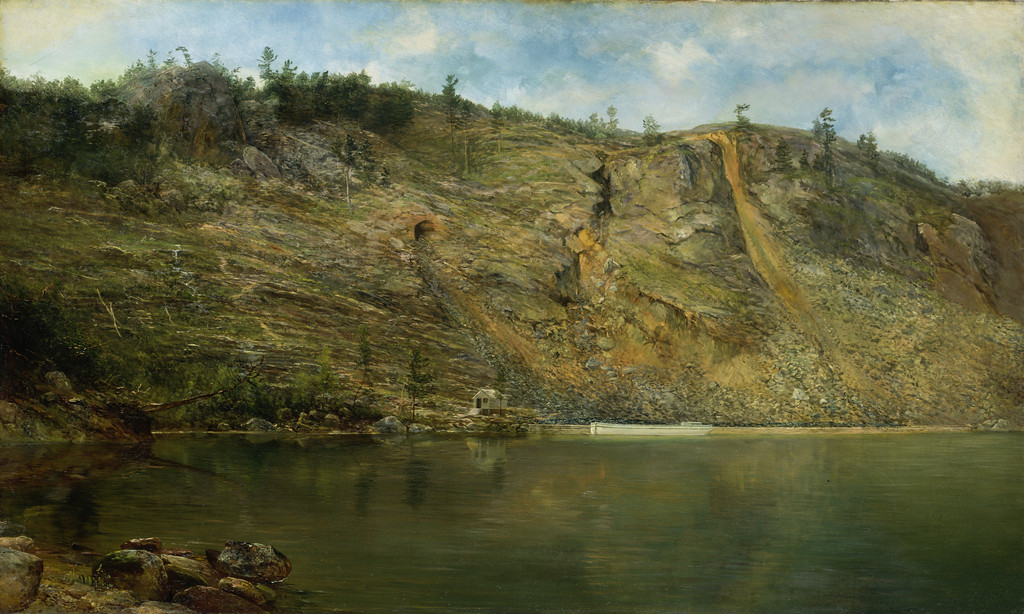
- Useful comparisons Harp of the Winds, Landscape with Poplars, Normandy Coast and Behind Dunes.
- Historical context Hudson River School, French landscape painting and Tonalism.
- Music A personal association recorded by Elizabeth Gilbert Martin, particularly in relation to Harp.
- Late eyesight Seriously impaired; Elizabeth stated that blindness never became complete.
Contents
- The construction of a landscape
- Breadth, masses and selected detail
- Drawing, memory and patient revision
- Paint surfaces and historical testimony
- The tonal arrangement of color
- Music, rhythm and the quiet view
- Hudson River School, Barbizon and Tonalism
- Eyesight, agency and late work
- Reading Martin alongside his contemporaries
The construction of a landscape
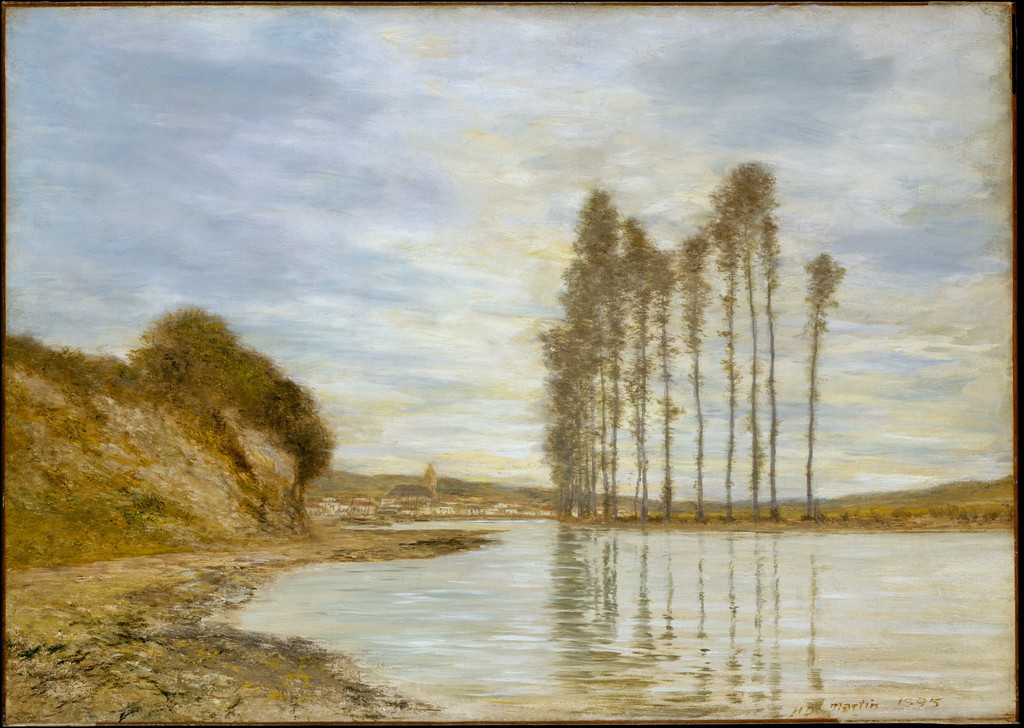
The arrangement of Harp of the Winds offers a clear starting point. The bank projects from the left, the river opens across the foreground and the poplars rise in an irregular line beyond. Their reflections continue the vertical pattern into the water. Each feature has a place within an interconnected system of shapes.
The picture represents depth, but it can also be followed as a pattern across the surface. The curved bank draws the eye around the water; the trunks interrupt the sky; the distant settlement gives a smaller scale against which to judge the trees. These relationships explain part of the painting’s effect without requiring every visible object to carry a symbolic meaning.
Elizabeth remembered an earlier arrangement with taller trees, which she preferred. Martin objected to their exaggerated height and changed them. Their disagreement reveals two responses to a working composition: she valued the elegance of the earlier state, while he wanted to adjust the relation of the trees to the view. The familiar finished painting was one outcome of those choices. [2]
The Met catalogue dates the charcoal beginning of the canvas to New York in 1893 and its completion to Saint Paul in 1895. The subject’s French origins and the painting’s American execution belong to different stages. Arranging the view continued after the painter had left the place that supplied it. [3]
Breadth, masses and selected detail
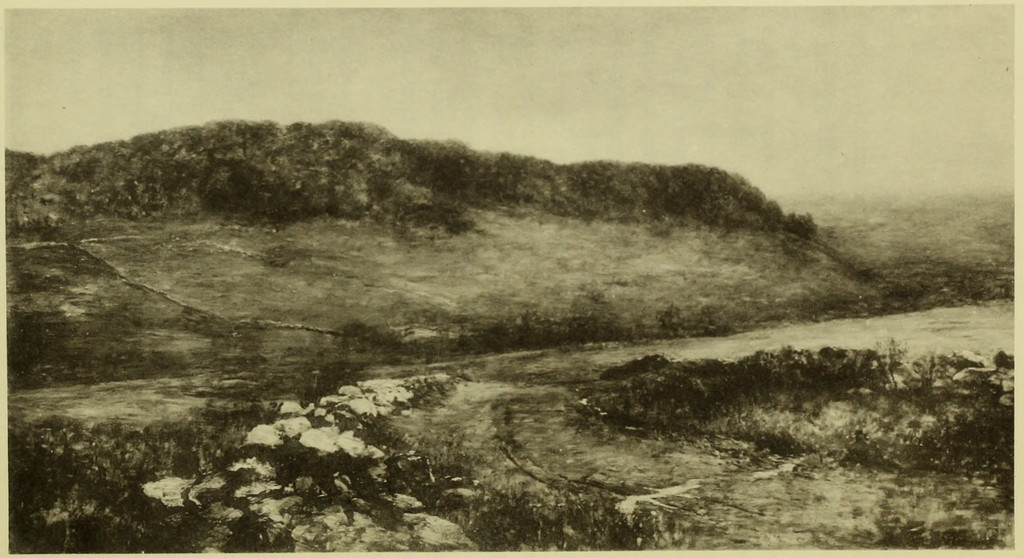
Martin’s earlier mountain and lake paintings give broad areas distinct roles. Near rocks or vegetation establish a foreground, water opens an interval beyond it, and mountains or woodland provide a farther boundary. The space can be extensive even when the main structural divisions are few. Attention moves between those divisions before settling on the smaller marks within them.
A mass is simply a shape read as a whole: a wooded slope, a cloud bank or a group of trees. In Upper Ausable Lake , the nearer reeds and farther mountain wall have different textures, but both belong within larger zones. Reading the zones first makes it easier to see how the details contribute to distance and scale.
The Met’s biography follows Martin’s gradual reduction of detail and increasing isolation of strong motifs during his early American career. This account is useful because it locates simplification before the later French residence. His developing style involved changes within an existing landscape practice, alongside the new possibilities encountered through other artists. [3]
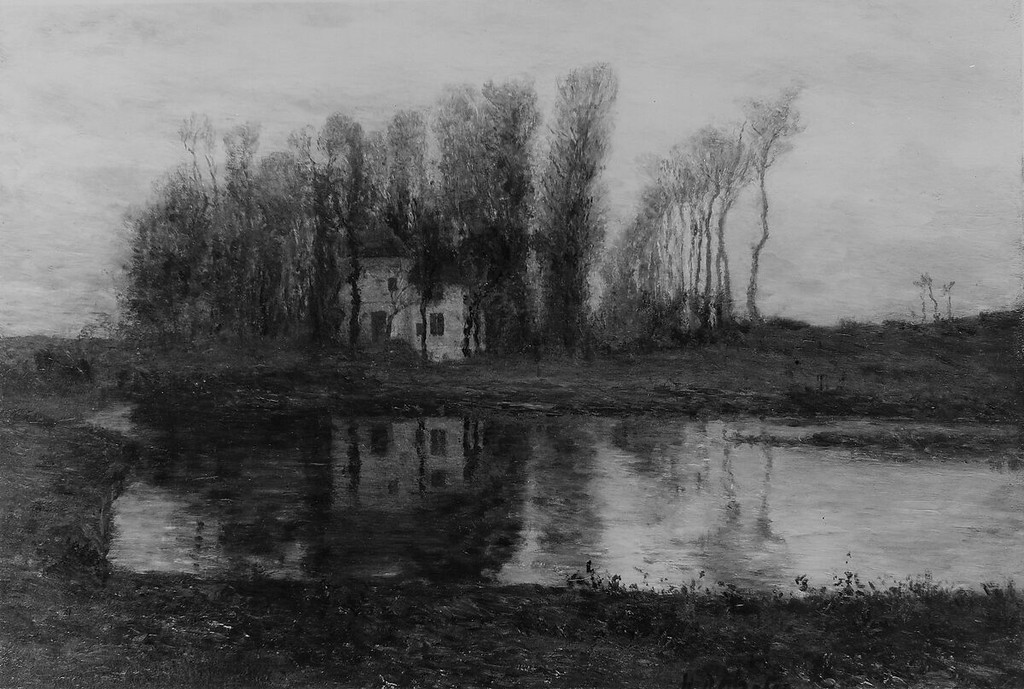
Princeton’s Landscape with Poplars provides another comparison. Its vertical format concentrates attention on a grouping of trees and reflected trunks, whereas Harp opens the motif across a much wider river view. The Princeton painting is undated, and similarity does not establish that it was a study for Harp . It remains valuable as a different arrangement of related forms. [4]
In the Princeton picture, the crowns gather into a rounded upper mass, while the slender trunks remain separate below it. Open sky enters between those verticals, making the foliage appear concentrated without turning the entire group into a solid block. The lower reflections answer the trunks with less continuous forms. A motif that could be described simply as trees beside water becomes a balance between density, openness and repetition. The narrower canvas gives that balance a more enclosed emphasis than the broad river arrangement in Harp.
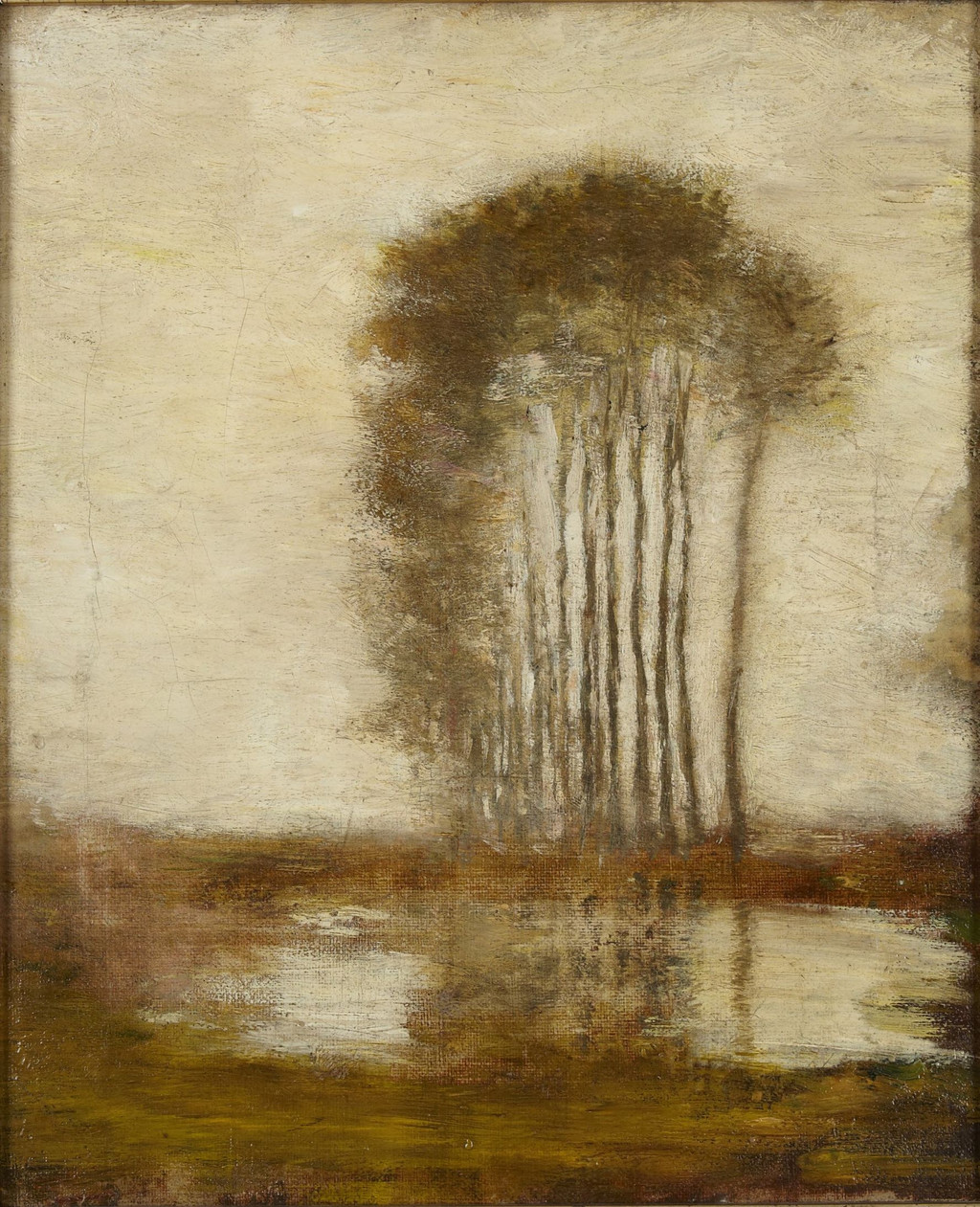
Homer Dodge Martin, Landscape with Poplars, undated. Oil on canvas, 29 × 24 cm. Princeton University Art Museum, y1946-105. The vertical format gives the trees and their reflections a compact arrangement. Princeton University Art Museum, Gift of Frank Jewett Mather Jr. and Mrs. William Crary Brownell.
Image source
.
Public domain
. Resized only; source appearance preserved.
Drawing, memory and patient revision
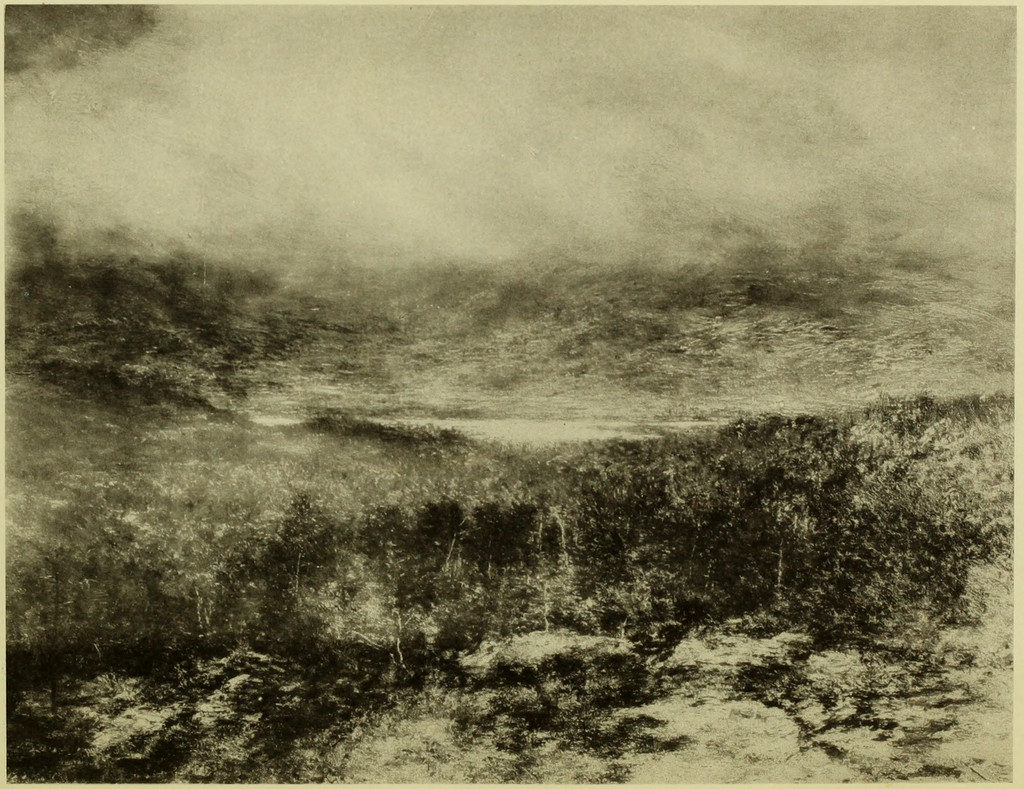
Martin’s drawings and watercolors preserve several ways of recording a landscape. A fine point can follow the edge of a rock or branch, while broader charcoal marks establish dark and light masses. Each method supplies different information. The finished oil painting can draw on that information without carrying every recorded feature into its final surface.
Mather describes the early studies as already pictorial, with arrangements sought outdoors. He also gives later charcoal notes an important place in the practice. His account suggests that the relationship between observation and studio invention began before the canvas was fully worked. The distinction between a preparatory note and a finished painting concerns the decisions still to be made as well as the amount of detail present. [5]
A letter to Thomas B. Clarke, reproduced by Mather, makes the deliberation especially clear. On 25 February 1896 Martin described a picture as “all thought out except one or two cloud forms which trouble me greatly.” A sky that might look broadly generalized could still present a precise compositional problem. The statement gives selection a practical, unfinished character. [5]
Elizabeth likewise recalled nearly finished pictures being scraped out when the painter resumed work after an interval. Revision could alter the family’s expectations as well as the picture. Her account helps explain why a canvas might remain unsettled despite substantial visible progress: Martin’s judgment of the whole could lead him to undo passages that seemed satisfactory to someone else. [2]
Paint surfaces and historical testimony
The Met catalogue’s discussion of Behind Dunes, Lake Ontario describes broad areas worked with a palette knife and distinguishes the brushed trees and weeds. Its account draws on historical commentary about flattened and overlaid paint. The point is useful for looking: different kinds of application can give near vegetation and distant ground contrasting presences. [3]
That description belongs to a particular painting and its history. It is not a universal recipe for every Martin canvas. The same catalogue traces changes in handling across the career, while Mather distinguishes relatively thin early work from broader later applications. Different supports, sizes and circumstances gave the painter different problems to solve. [3] [5]
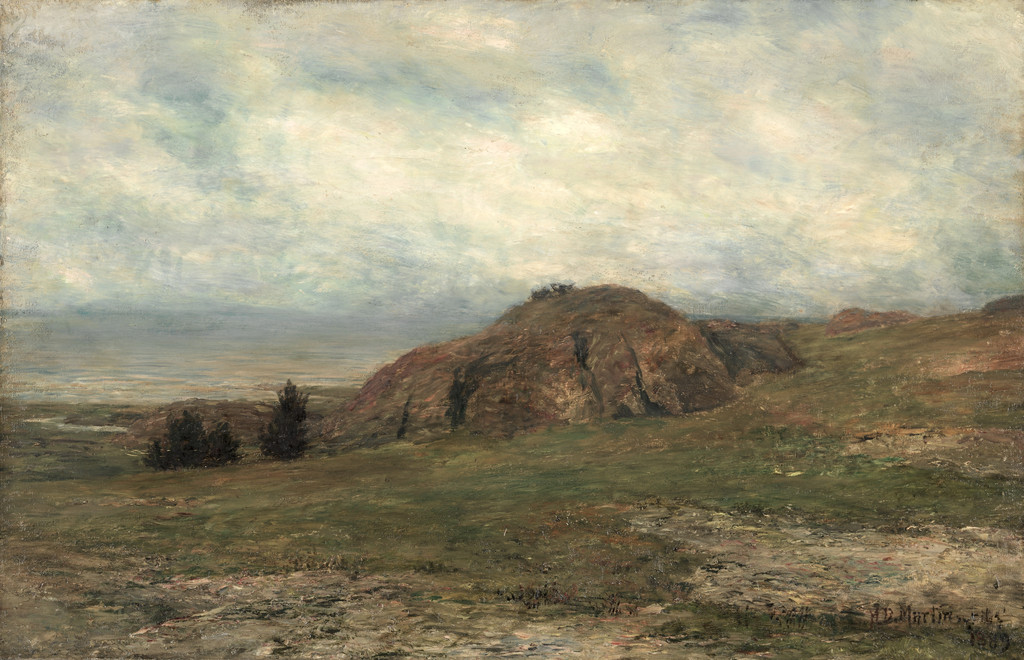
Brooklyn’s Normandy Coast offers a small, direct example of visible brushwork. The museum describes it among Martin’s outdoor paintings. Broad strokes remain conspicuous across the clouds, while the low shore occupies a narrower part of the board. Its surface should be considered alongside the slowly revised pictures, preserving the variety of his practice. [6]
A photograph can make some marks visible while concealing others. Scale, lighting and the reproduction’s resolution affect what can be judged. The distinction between a visible raised passage and an identified pigment is especially important: color names in a description do not establish chemical materials. Historical testimony and museum accounts illuminate technique without becoming a laboratory analysis of every surface.
One canvas can also preserve the meeting of different phases. The Met’s 1985 entry on the large White Mountains from Randolph Hill contrasts a detailed foreground with a more atmospheric distance. It suggests that later reworking accounts for part of the difference in handling. The interpretation makes the picture particularly interesting for a study of technique: an early arrangement could remain available for reconsideration as the painter’s methods changed. Its surface need not represent a single, uniform moment in his development. The catalogue’s proposal concerns this canvas and should remain distinct from the histories of other White Mountains pictures. [3]
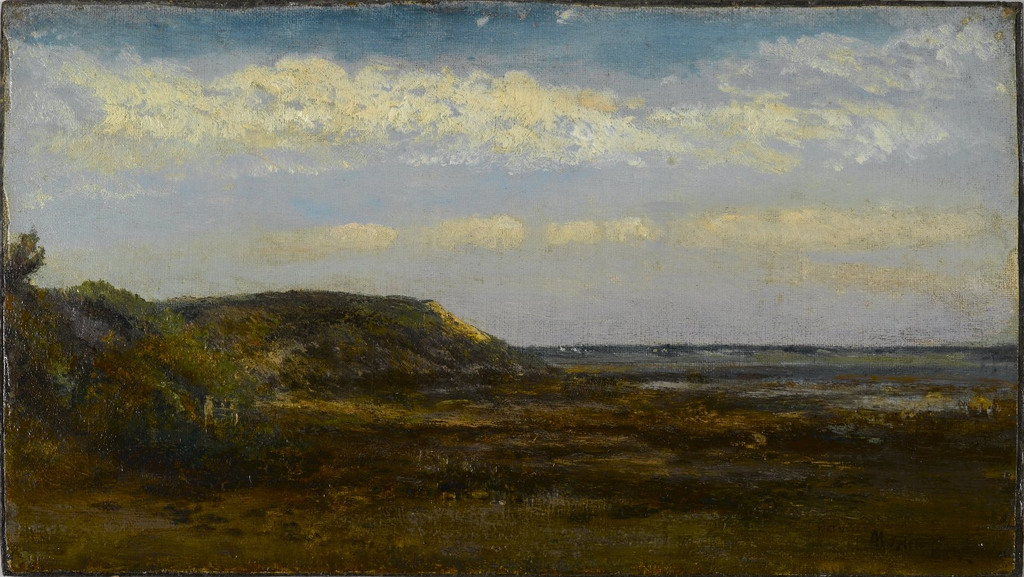
Homer Dodge Martin, Normandy Coast, 1884. Oil on board, 18.3 × 32.2 cm. Brooklyn Museum, 15.281. Broad cloud strokes remain visible across the small outdoor painting. Brooklyn Museum, Bequest of Charles A. Schieren.
Image source
.
No known copyright restrictions
. Resized only; source appearance preserved.
The tonal arrangement of color
Tone concerns relationships of light and dark, and the way those relationships hold colors together. A muted landscape can still contain a considerable variety of hues. In Harp , the ocher bank, gray-blue water, pale sky and subdued greens remain distinct, yet their relative brightness helps them belong to one extensive view.
The reflection is particularly useful to compare. It carries recognizable tree forms into water while changing their edges and continuity. Narrow marks across the river interrupt the reflected verticals. The result links the upper and lower portions of the picture without making them identical. Light, color and surface variation all contribute to that relationship.
The Smithsonian associates Martin’s later development with softer color and less sharply defined forms, connecting it with Whistler and French landscape painting. That account describes a direction within the career. Individual works still need to be considered for their particular balances: the more concentrated marks of a foreground may remain active within an otherwise subdued scene. [1]
The Wellin Museum’s account of its White Mountains from Randolph Hill places Martin across the transition from Hudson River landscape toward more expressive tonal painting. It supplies a historical context for looking at his choices of emphasis. The change is best followed through relationships in the pictures, alongside the dates and circumstances of their development. [7]
Watch: Homer Dodge Martin
Start with Martin’s Normandy Landscape, then explore the wider Hudson River School tradition in which he began.
Homer Dodge Martin | Normandy Landscape
The Castellani Art Museum introduces Martin’s Normandy Landscape.
Watch on YouTubeMusic, rhythm and the quiet view
Elizabeth connected Harp of the Winds with her husband’s experience of thinking about music as he painted. She also recorded his hesitation about a title that might sound too sentimental. The association was personal and belonged to their conversation about the work, rather than to an explanation attached to every landscape he made. [2]
The title can nevertheless guide attention toward visible rhythm. The trunks repeat with changing intervals, their crowns make an uneven upper contour, and their reflections extend downward. The curve of the bank carries those verticals through space. Following these forms lets the musical association sharpen looking without assigning a particular note or instrument to each tree.
The painting’s quietness likewise has a visible structure. Much of the foreground water is open, while repeated small disturbances keep it from becoming inert. The trees are slender enough to leave sky between them. These intervals give the arrangement both connection and breathing room, allowing the eye to pause and then continue across the surface.
Mather placed considerable value on Martin’s contemplative mood and the emotion communicated through his arrangements. That critical emphasis remains illuminating, provided it is recognized as an interpretation. A viewer can respond differently while still examining the same repeated forms, reflective water and spatial intervals that carry the picture’s effect. [5]
Hudson River School, Barbizon and Tonalism
The Hudson River School supplies Martin’s early context: extended American views, careful foreground observation and landscape organized through successive distances. The Met catalogue connects his beginnings with the Albany circle and the example of Thomas Cole’s generation. The later paintings retained an interest in broad space as their handling and emphasis changed. [3]
French painting widened that practice. Corot’s work interested Martin before his first European journey, and the 1876 trip included Barbizon and Saint-Cloud. The Met catalogue also suggests that Whistler encouraged his use of charcoal on canvas. Admiration, acquaintance and a possible practical suggestion describe different kinds of connection; they do not establish a formal apprenticeship to Corot or a single source for the whole later style. [3]
Tonalism provides a further context for the emphasis on mood, memory and unified color relationships. The New York State Museum’s introduction to its 2020 exhibition describes those concerns while acknowledging debate about the movement’s relationship with modern art. Its broad framework helps place the questions surrounding Martin without replacing the histories of particular paintings. [8]
These terms are most useful as guides to comparison. One picture may preserve a detailed American foreground while another gives greater weight to atmosphere and repeated silhouettes. Looking at what changes, and what persists, gives the labels a concrete purpose. Martin’s career belongs across these overlapping histories rather than within one permanently fixed set of effects.
Eyesight, agency and late work
Martin’s eyesight deteriorated seriously during his later years. Elizabeth described seeking an oculist’s account of his condition and observing occasions when he needed help tracing an outline. She also explicitly stated that his blindness never became complete. Her memoir establishes both the severity of the difficulty and a qualification easily lost in accounts of the final paintings. [2]
Some historical and scholarly interpretations connect late handling with impaired vision. The Met’s Old Manor discussion makes that connection, while Mather values expressive qualities that other painters considered technically uncertain. These are positions within the work’s reception. They do not remove the evidence of selection, criticism and continued revision found in the same accounts. [3] [5]
Adirondack Scenery and Harp were completed in 1895 after extended development. Their achievement can be considered through the relation of foreground to distance, the handling of clouds and the balance of repeated forms. Those decisions give the painter’s agency a visible place alongside the circumstances of declining health. [5] [3]
Reading Martin alongside his contemporaries
Comparisons with Corot, Whistler or the older American landscape painters become most useful when attached to a specific question. Look at the proportion of sky, the relation between a tree mass and its setting, or the way a bank carries the eye toward distance. A shared concern can emerge without requiring the pictures to look alike in every respect.
Mather’s argument about Martin also belongs within criticism’s own history. He defended the emotional force of the pictures against objections about their execution, while admitting limitations in the painter’s consistency and handling. The combination of admiration and reservation makes the study more particular than a simple claim that Martin was always misunderstood. [5]
The paintings overview offers further comparisons, and the biography follows the people and places surrounding the work. Taken back to an individual canvas, those histories can sharpen attention to the choices that make Martin’s landscapes hold together.
Artwork records
Browse 58 records from Carroll’s selected 1913 catalogue alongside 25 separately documented object records. Some records concern the same work; this is not a complete lifetime catalogue or a count of 83 unique artworks. [9]
| Name | Date | Medium |
|---|---|---|
| Carroll 1: Saranac Lake (1913 record) | 1860s; exact date not clearly decipherable | Painting — historical catalogue record |
| Carroll 2: Lake George from Bolton (1913 record) | Date not stated | Painting — historical catalogue record |
| Carroll 3: The Iron Mine, Port Henry, N. Y. (1913 record) | Date not stated | Painting — historical catalogue record |
| Carroll 4: On Lake Ontario (1913 record) | Probably late 1860s | Painting — historical catalogue record |
| Carroll 5: The Giant of the Valley (1913 record) | 1865 | Painting — historical catalogue record |
| Carroll 6: An Adirondack Lake (1913 record) | Date not stated | Painting — historical catalogue record |
| Carroll 7: Winter in Normandy (1913 record) | Date not stated | Watercolor — historical catalogue record |
| Carroll 8: Across the Lake (1913 record) | Date not stated | Painting — historical catalogue record |
| Carroll 9: New Hampshire Landscape (1913 record) | Late 1860s | Painting — historical catalogue record |
| Carroll 10: Long Lake (1913 record) | Date not stated | Painting — historical catalogue record |
| Carroll 11: Salt Meadows (1913 record) | Mid 1880s | Painting — historical catalogue record |
| Carroll 12: Autumn on the Susquehanna (1913 record) | 1879 | Painting — historical catalogue record |
| Carroll 13: Ontario Sand Dunes (1913 record) | 1887 | Painting — historical catalogue record |
| Carroll 14: Late Autumn (1913 record) | About 1877 | Painting — historical catalogue record |
| Carroll 15: Early Spring (1913 record) | About 1877; companion dating | Painting — historical catalogue record |
| Carroll 16: Raquette Lake (1913 record) | 1869 | Painting — historical catalogue record |
| Carroll 17: A Glimpse of the Sea (1913 record) | Date not established; historical suggestion disputed | Painting — historical catalogue record |
| Carroll 18: Headwaters of the Hudson (1913 record) | 1869 | Painting — historical catalogue record |
| Carroll 19: Autumn in the Adirondacks (1913 record) | 1871 | Painting — historical catalogue record |
| Carroll 20: Richmond on Thames (1913 record) | About 1877; later alterations | Painting — historical catalogue record |
| Carroll 21: Saranac Lake (1913 record) | 1878 | Painting — historical catalogue record |
| Carroll 22: Windsor Castle (1913 record) | Finished 1878 | Painting — historical catalogue record |
| Carroll 23: L’Anse St. Étienne, Saguenay (1913 record) | 25 July 1879 | Watercolor — historical catalogue record |
| Carroll 24: L’Anse aux Basses Pierres (1913 record) | Date not stated | Watercolor — historical catalogue record |
| Carroll 25: Blossoming Trees (1913 record) | Mid 1880s | Painting — historical catalogue record |
| Carroll 26: On the Seine (1913 record) | Date not stated; later years suggested | Painting — historical catalogue record |
| Carroll 27: The Dunes (1913 record) | 1883 | Watercolor — historical catalogue record |
| Carroll 28: The Moonlit Pond—Honfleur (1913 record) | Date not stated | Painting — historical catalogue record |
| Carroll 29: Normandy Landscape (1913 record) | Date not stated | Painting — historical catalogue record |
| Carroll 30: The Lighthouse, Honfleur (1913 record) | Date not stated | Painting — historical catalogue record |
| Carroll 31: Ruby Strong—Normandy (1913 record) | Date not stated | Painting — historical catalogue record |
| Carroll 32: Sand Dunes, Lake Ontario (1913 record) | 1874 | Painting — historical catalogue record |
| Carroll 33: Low Tide, Honfleur (1913 record) | Date not stated | Painting — historical catalogue record |
| Carroll 34: Evening on the Seine (1913 record) | Date not stated | Painting — historical catalogue record |
| Carroll 35: On the Seine (1913 record) | Date not stated | Painting — historical catalogue record |
| Carroll 36: On the Hudson (1913 record) | 1881 | Painting — historical catalogue record |
| Carroll 37: A Forest Brook (1913 record) | 1881 | Painting — historical catalogue record |
| Carroll 38: Coast Meadows, St. Sauveur (1913 record) | 1881 | Painting — historical catalogue record |
| Carroll 39: Landscape (1913 record) | 1883 | Painting — historical catalogue record |
| Carroll 40: An Adirondack Lake—Lake Sanford (1913 record) | 1883 | Painting — historical catalogue record |
| Carroll 41: Lower Ausable Pond (1913 record) | 1868 | Painting — historical catalogue record |
| Carroll 42: December Morning in Normandy (1913 record) | 1883 | Painting — historical catalogue record |
| Carroll 43: Low Tide—Villerville (1913 record) | 1884 | Painting — historical catalogue record |
| Carroll 44: Lake George (1913 record) | 1884 | Painting — historical catalogue record |
| Carroll 45: Crepuscule—Montvilliers (1913 record) | 1885 | Painting — historical catalogue record |
| Carroll 46: The Sea at Villerville (1913 record) | 1885 | Painting — historical catalogue record |
| Carroll 47: Golden Sands (1913 record) | Date not stated | Painting — historical catalogue record |
| Carroll 48: The Meadow Brook (1913 record) | 1887 | Painting — historical catalogue record |
| Carroll 49: The Sun Worshippers (1913 record) | After the 1886 return to New York | Painting — historical catalogue record |
| Carroll 50: South Side of Long Island (1913 record) | 1894 | Painting — historical catalogue record |
| Carroll 51: Criqueboeuf Church (1913 record) | 1893 | Painting — historical catalogue record |
| Carroll 52: Normandy Farm (1913 record) | 1895 | Painting — historical catalogue record |
| Carroll 53: On the Mississippi (1913 record) | Toward the close of the artist’s life | Painting — historical catalogue record |
| Carroll 54: Newport Neck (1913 record) | 1893 | Painting — historical catalogue record |
| Carroll 55: A Newport Landscape (1913 record) | 1896 | Painting — historical catalogue record |
| Carroll 56: A Distant View of Caen (1913 record) | Date not stated; exhibited 1894 | Painting — historical catalogue record |
| Carroll 57: The Brook (1913 record) | 1894 | Painting — historical catalogue record |
| Carroll 58: Normandy Trees (1913 record) | Date not stated | Painting — historical catalogue record |
| View on the Seine: Harp of the Winds | 1893–95 | Oil on canvas |
| The Iron Mine, Port Henry, New York | About 1862 | Oil on canvas mounted on fiberboard |
| Wild Coast, Newport | 1889 | oil on canvas |
| In the Housatonic Valley (attributed to Homer Dodge Martin) | late 1850s | oil on canvas |
| Sand Dunes, Lake Ontario | c. 1874 | Possibly black crayon on paper |
| Adirondacks | 1868 | Pencil drawing |
| Landscape | 1896 | Watercolor |
| Near Newport | mid-1800s | Watercolor |
| Effect of Trees | About 1879 | Oil on canvas |
| Behind Dunes, Lake Ontario | 1883–87 | Oil on canvas |
| Old Manor of Criqueboeuf | About 1882–92 | Oil on canvas |
| Upper Ausable Lake | 1868 | Oil on canvas |
| Wild Coast, Newport (Smithsonian version) | About 1885–95 | Oil on canvas |
| On the Seine | About 1895 | Oil on canvas |
| The Lighthouse, Honfleur | Date not supplied by museum | Oil on wood panel |
| The White Mountains from Randolph Hill (Wellin canvas) | 1866–67 | Oil on canvas |
| Old Crossing, Otter Tail River | 1871 | Black chalk touched with white chalk on paper |
| Landscape with Poplars | Date not supplied by museum | Oil on canvas |
| Normandy Coast | 1884 | Oil on board |
| Criqueboeuf Church, Normandy | 1893 | Oil on canvas |
| Evening on the Thames | About 1876 | Oil on canvas |
| Hudson River | 1860 | Graphite drawing on wove paper |
| The White Mountains, from Randolph Hill (formerly Met canvas) | About 1862–68; later revisions | Oil on canvas |
| Westchester Hills | About 1887 | Oil painting — historical accounts |
| Adirondack Scenery | 1895 | Oil painting — historical accounts |
Frequently Asked Questions
No. Memory was important, but drawings and documented outdoor paintings also belong to his practice. Brooklyn’s Normandy Coast is one example the museum identifies with outdoor work. [6]
The Met catalogue describes palette-knife work in Behind Dunes, Lake Ontario, alongside brushed foreground vegetation. That account should not be treated as the technique of every picture. [3]
Elizabeth stated that his blindness never became complete, although his eyesight was seriously impaired. [2]
Discussion
Look again at the images and ideas explored in Homer Dodge Martin: Style and Technique. These editorial prompts invite your observations.
Reader Insights
Follow the bank and the reflected trees in Harp of the Winds. Which relationship most strongly connects the surface pattern with depth?
Compare the narrow vertical Landscape with Poplars with the wider Harp. How does format change the role of similar forms?
Look at the brushwork in Normandy Coast. Which passages remain distinct marks, and which gather into a larger shape?
Join the Conversation
Share a detail, comparison or question about Homer Dodge Martin: Style and Technique below.
References
- Smithsonian American Art Museum , Homer Dodge Martin: artist biographies, accounts by Joan Stahl and Emery Battis. View source
- Elizabeth Gilbert Martin , Homer Martin: A Reminiscence, 1904, particularly pp.13–17,39–42 and46–55. View source
- Natalie Spassky and colleagues , American Paintings in The Metropolitan Museum of Art, Volume II, 1985, Martin section, pp.420–430. View source
- Princeton University Art Museum , Landscape with Poplars, undated, y1946-105, object record. View source
- Frank Jewett Mather Jr. , Homer Martin: Poet in Landscape, 1912, particularly pp.26–38,65–70 and73–76; letter excerpt p.67. View source
- Brooklyn Museum , Normandy Coast, 1884, 15.281, object record and curatorial account. View source
- Katherine D. Alcauskas , The White Mountains from Randolph Hill, Wellin Museum of Art, Hamilton College, 2011.6; curatorial account from Innovative Approaches, Honored Traditions, 2017, p.126. View source
- New York State Museum , Tonalism: Pathway from the Hudson River School to Modern Art, introduction to the 2020 exhibition. View source
- Dana H. Carroll, Fifty-Eight Paintings by Homer D. Martin, 1913, selected illustrated catalogue. View source
- Splash image source.
Homer Dodge Martin, View on the Seine: Harp of the Winds, 1893–95. The riverbank, repeated trees and reflections connect the surface pattern with depth. The Metropolitan Museum of Art, 97.32. The Metropolitan Museum of Art. CC0 / Public domain . Resized only; source appearance preserved.
View source