 by
Tom Gurney
Tom Gurney BSc (Hons) is an art history expert with over 20 years experience
Email:
tomgurney1@gmail.com
/ Phone:
+44 7429 011000
Behind Dunes, Lake Ontario: Introduction
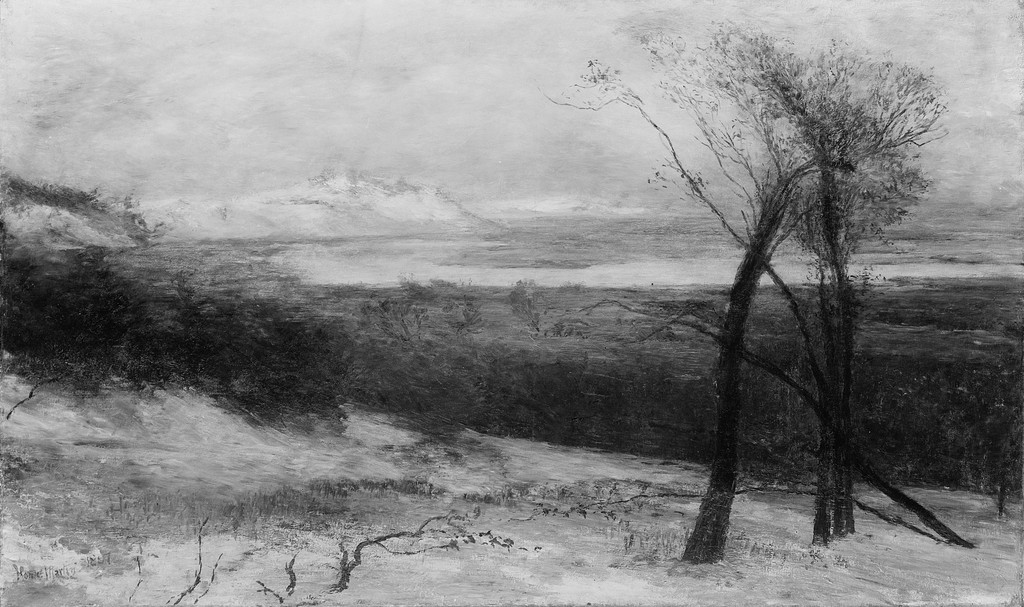
Trees rise from pale sand in the foreground, their irregular trunks interrupting a broad view of water, distant dunes and sky. Homer Dodge Martin’s Behind Dunes, Lake Ontario makes the relationship between near obstruction and open distance its central pictorial concern. The foreground feels close and uneven; the farther landscape extends beyond it in quieter, more continuous bands.
The Metropolitan Museum of Art dates the oil to 1883–87. Its subject came from Martin’s earlier experience of Lake Ontario, but the canvas developed during his French residence and continued to change after he returned to New York. A failed attempt to exhibit it at the 1884 Salon belongs to its working history, rather than describing the state in which it finally entered the museum. [1] [2]
The image shown here is a monochrome museum reproduction. It supports close attention to shape, light and dark, and the distribution of space. Written accounts of the painting’s color belong to another kind of evidence and should remain attributed to their authors.
At a Glance
- Artist Homer Dodge Martin.
- Title Behind Dunes, Lake Ontario.
- Date 1883–87.
- Medium Oil on canvas.
- Dimensions 91.4 × 153.7 cm.
- Collection The Metropolitan Museum of Art, New York.
- Accession 06.1287.
- Credit Gift of George A. Hearn, 1906.
- Subject origin Lake Ontario observations in 1874.
- Salon history Submitted and rejected in 1884; revised afterward.
- Final signed date 1887, lower left.
- Reproduction Monochrome; original paint colors are not represented here.
This work across Homer Dodge Martin’s career
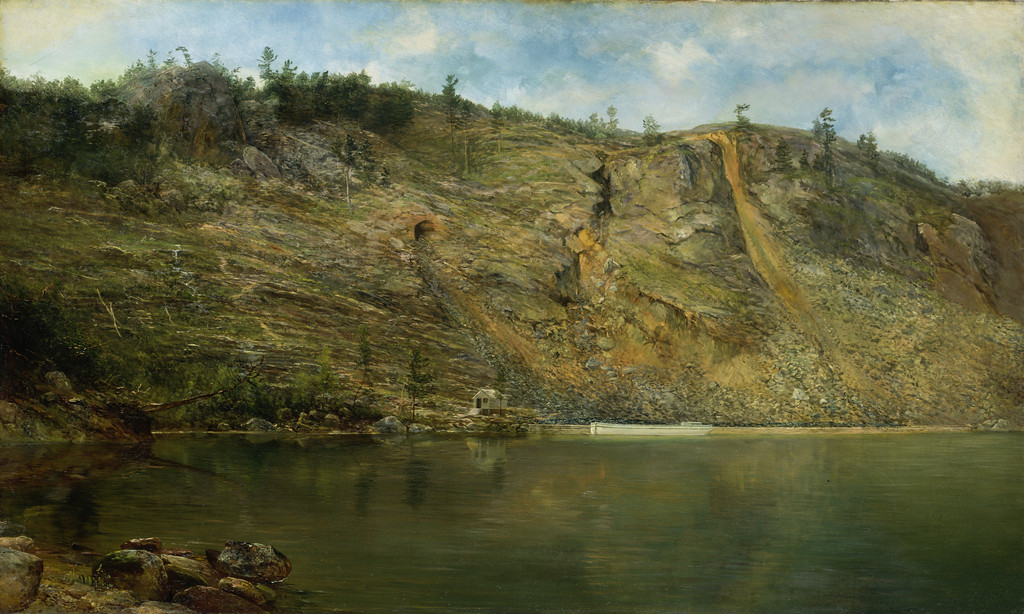
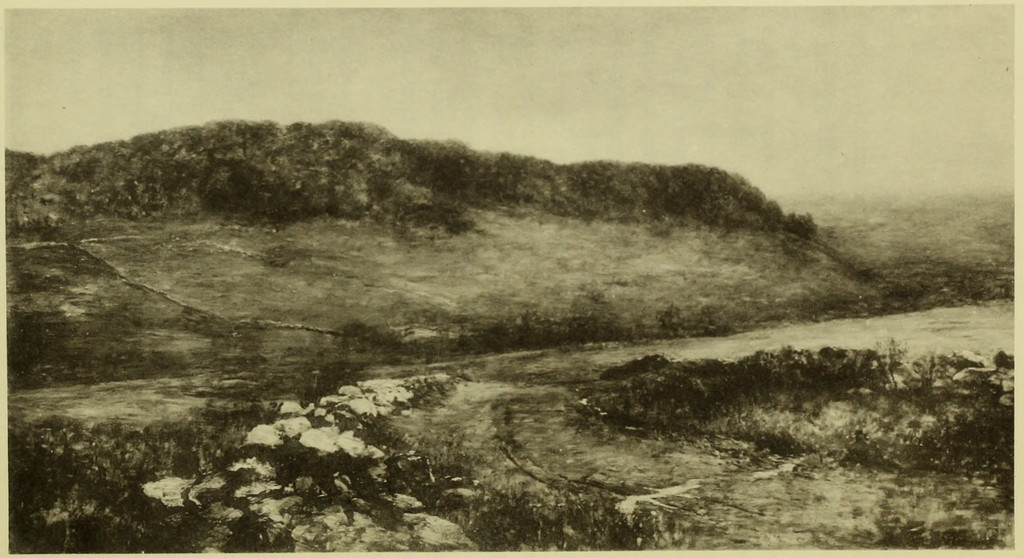
The Iron Mine, Port Henry, New York
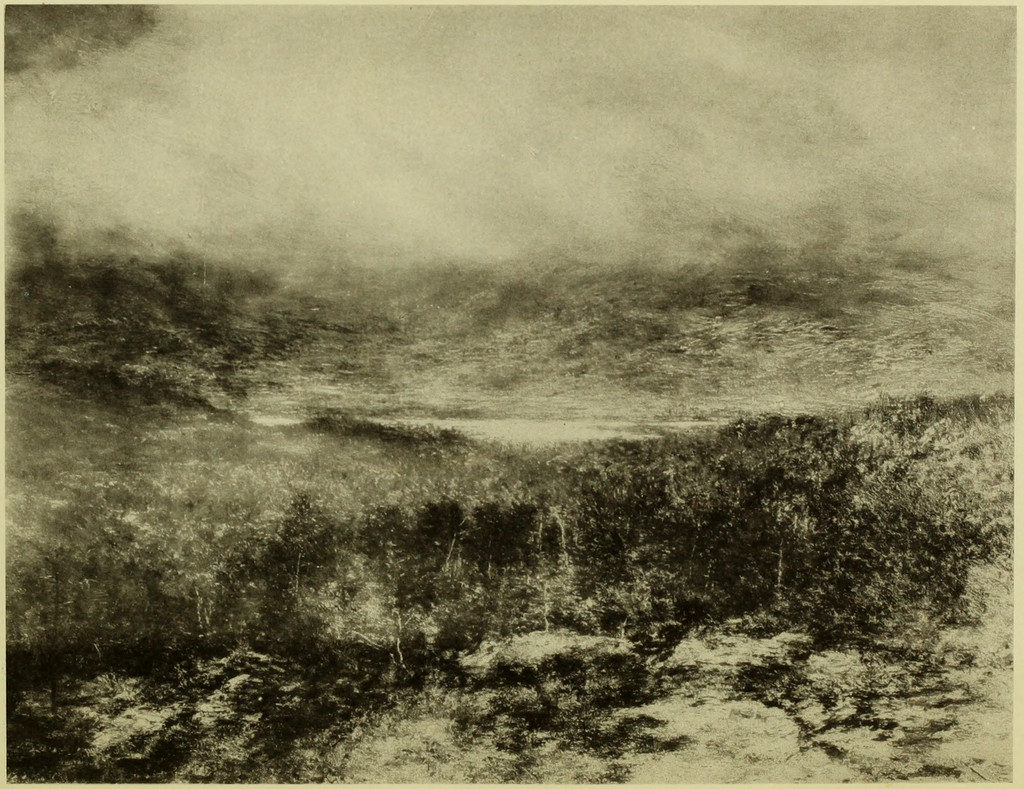
about 1862Evening on the Thames
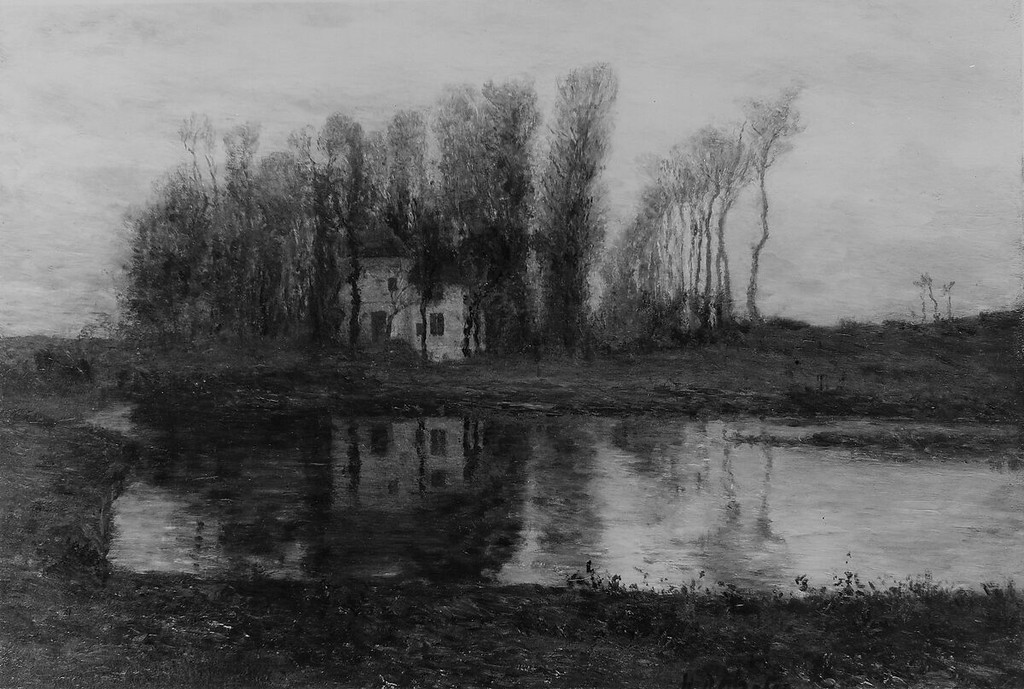
about 1876Old Manor of Criqueboeuf
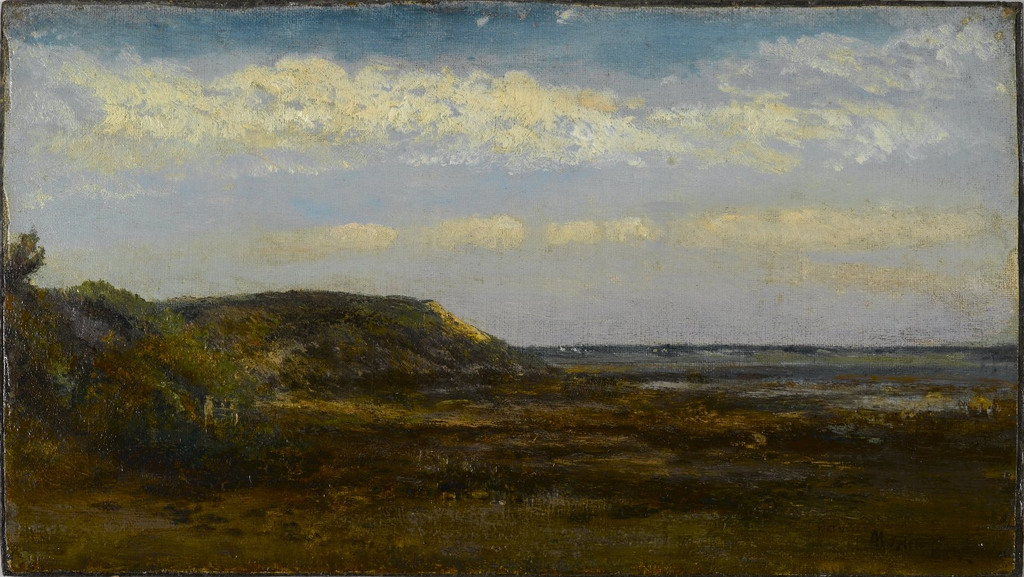
about 1882–92Normandy Coast
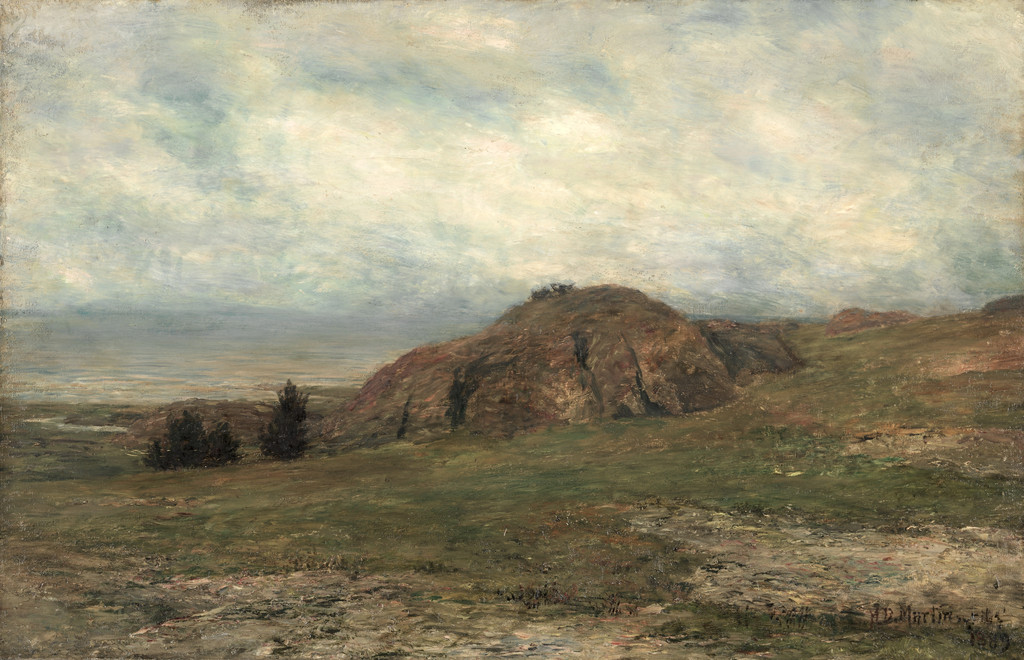
1884Westchester Hills
about 1887Lighthouse, Honfleur
UndatedNotes and sources
The Iron Mine, Port Henry, New York. An industrial opening, sloping runway and worked cliff stand above Lake Champlain. The Smithsonian connects this landscape with the North’s resources during the Civil War. [3]
Upper Ausable Lake. Foreground reeds and birds lead toward a bright passage of water beneath the mountain wall. The Smithsonian identifies this canvas as Upper Ausable Lake. [4]
Evening on the Thames. A low river horizon, distant buildings and reflected light bring a British subject into Martin’s painting. The museum’s date remains approximate. [5]
Old Manor of Criqueboeuf. A house and its reflection organize this slowly developed Normandy subject. The broad date range does not mean that Martin painted it without interruption. [6]
Behind Dunes, Lake Ontario (current article). An American subject developed during the French residence and after the return. The Met records rejection at the 1884 Salon followed by revision in 1887. [1]
Normandy Coast. Freely brushed clouds dominate a small coastal board. Brooklyn places it among outdoor paintings made during Martin’s French residence. [7]
Westchester Hills. Mather describes a large outdoor undertaking at Croton Falls and records its exhibition in 1888. The probable painting date and exhibition year remain distinct. [8]
Wild Coast, Newport. An extensive sky opens above low coastal ground. This dated Cleveland canvas is distinct from the Smithsonian painting bearing the same title. [9]
Criqueboeuf Church, Normandy. A church, trees and their reflections give architecture a place within the landscape. The current LACMA record supplies the date; the article reproduces a historical monochrome print. [10]
View on the Seine: Harp of the Winds. Poplars and their reflections repeat across the Seine. The Met records a charcoal beginning in New York in 1893 and completion in Saint Paul in 1895. [11]
Adirondack Scenery. Mountain slopes, a foreground ledge and water organize this late return to American scenery. Mather treats it as a major expression of experiences considered over many years. [8]
Lighthouse, Honfleur. Princeton’s small upright wood panel sets the lighthouse within a compact landscape. It remains undated and is distinct from the larger horizontal Century Club canvas. [12]
Contents
- A landscape of sand, trees and distance
- The foreground barrier and the open lake
- The 1874 Ontario visit
- Several versions of a lasting subject
- The Cleveland drawing and the Met oil
- The 1884 Salon and revision
- The painting’s return to the studio
- Mather’s reading of weathering and time
- The Hearn gift and later interpretation
- Annotated details
A landscape of sand, trees and distance
The composition divides into several broad regions. Pale sand occupies the near ground, a darker stretch lies beyond it, and lighter water and dunes extend toward a low horizon. The sky then opens above the whole. These divisions give the view depth before individual branches or smaller marks have been examined.
The prominent trees on the right hold a different role from the distant landscape. Their trunks cross the lighter passages behind them, and their irregular branches spread into the sky. They establish a near plane that cannot be overlooked. The viewer encounters their physical presence before moving toward the open lake.
The sand joins the near trees to the lower edge of the canvas. Its rise and fall can be followed through curving boundaries and changes of light and dark. Small stems and broken branches interrupt that surface, but its broad pale area remains legible. It supplies a quieter ground against which the trees appear more insistent.
Across the middle, the darker band separates this foreground from the farther opening. The distant dunes are less sharply defined, their low shapes extending laterally beneath the sky. Looking between these regions reveals the balance that makes the view spacious: distinct near forms are set against a distance that does not compete with them through equal detail.
The canvas’s width reinforces the arrangement. At over a meter and a half across, it gives the lower shore and farther horizon room to extend. The near trees occupy one portion of that breadth, allowing a substantial area of distance to remain open at the left. The horizontal format is an active part of how the landscape unfolds. [1]
Annotated Details from Behind Dunes, Lake Ontario
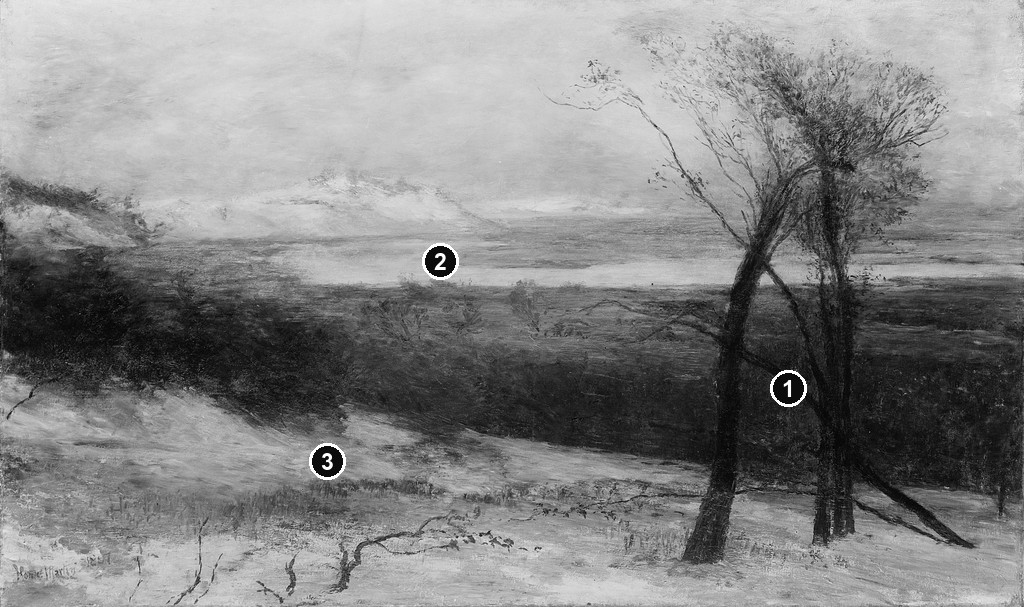
The numbered points identify visible features discussed in this article. Return from each detail to the whole composition. Homer Dodge Martin, Behind Dunes, Lake Ontario, 1883–87. Oil on canvas, 91.4 × 153.7 cm. The Metropolitan Museum of Art, 06.1287. Monochrome museum reproduction; original paint colors are not represented here. The Metropolitan Museum of Art, Gift of George A. Hearn, 1906. Image source. CC0 / Public domain. Numbers added to a separate overview; detail crops made from the accepted source. No enlargement, recoloring, restoration or reconstruction.
Details from BEHIND DUNES, LAKE ONTARIO
Compare these broad details with the complete monochrome reproduction above. Follow relationships of light and dark, shape and position; the reproduction does not preserve the painting’s original colors.
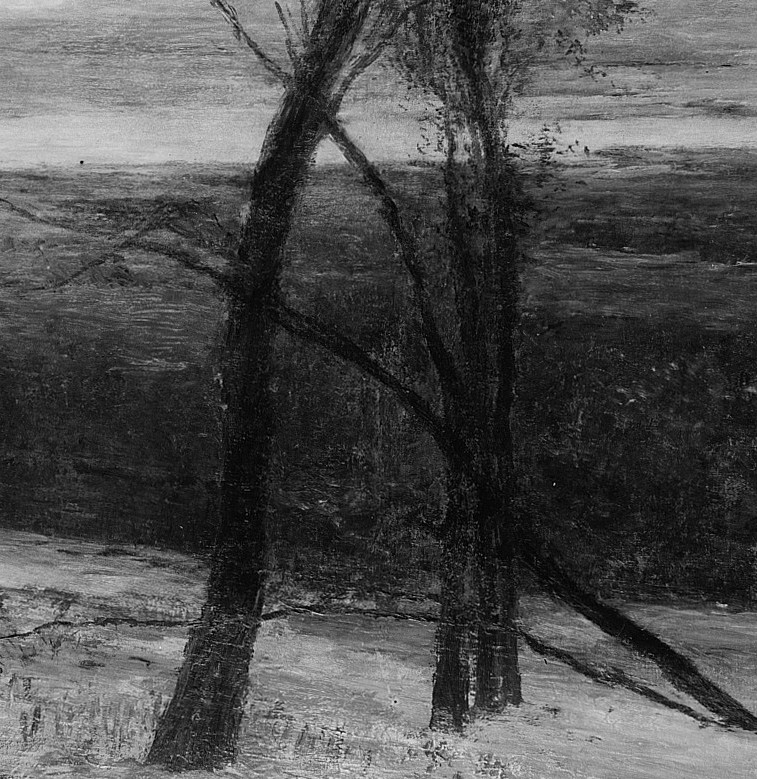
Crossing foreground trunks
The nearer trunks cross and diverge above the light ground. In this monochrome reproduction their dark silhouettes hold the foreground against the more open space beyond.
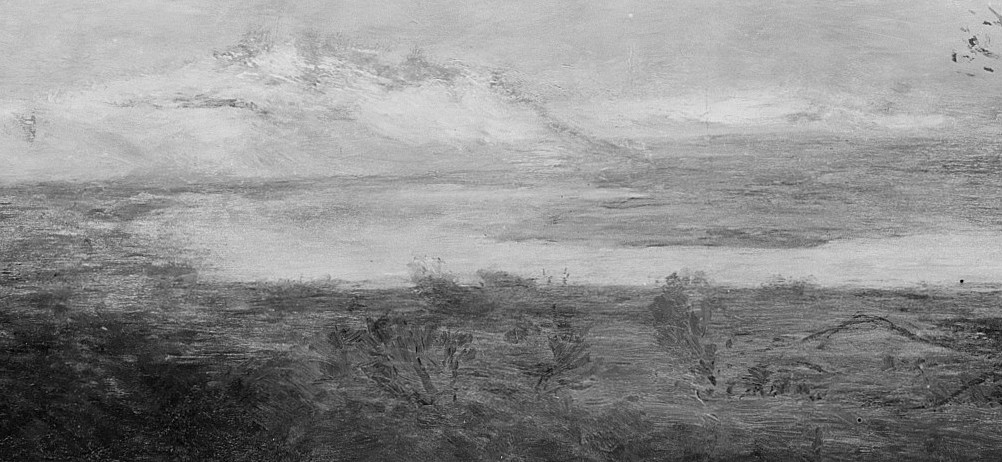
The light passage toward the lake
A pale horizontal passage separates the darker near ground from the distant horizon. Follow how that opening carries the view past the obstruction of the foreground trees.
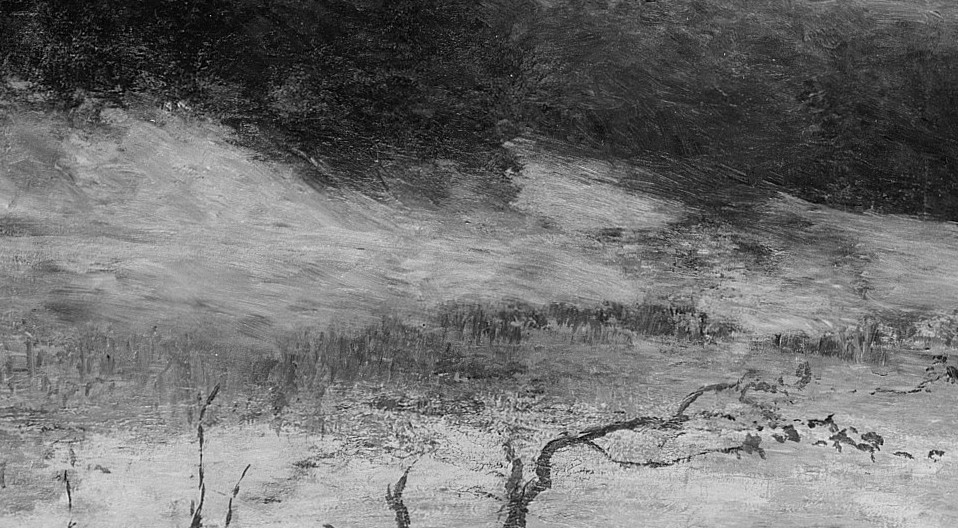
Sloping ground and low branches
The near slope and spreading branch form crossing directions below the distant opening. These broad relationships can be followed in the reproduction without inferring the painting’s original colors.
The foreground barrier and the open lake
The trees partly obstruct the view, but they also establish its scale. A trunk close to the viewer can stand against several distant bands at once. It connects ground and sky within one vertical form while making the space beyond appear more extensive. The obstruction becomes a means of judging distance.
The main trunk leans, then divides into irregular upward and lateral branches. Smaller growth stands beside it. Their different angles prevent the group from becoming a simple upright frame. One can follow separate lines through the mass, but those lines gather into a conspicuous whole against the quieter view behind.
A broken branch near the lower center provides another route across the foreground. It lies much closer to the viewer than the low dunes beyond. The contrast between this immediate irregular shape and the distant horizontal forms compresses several changes of scale into the same line of sight. Small details help make the breadth of the landscape tangible.
The open water and distant sand draw the eye around the trees rather than requiring it to pass directly through their densest growth. A viewer can begin at the lower foreground, move toward the left-hand opening and then return to the tree group from farther away. The composition allows several connected routes through the view.
That balance is useful beside Harp of the Winds . There the repeated trunks rise beyond open foreground water; here the nearer trees interrupt the passage toward distance. Related forms serve different arrangements. Martin’s interest in trees and water did not require a single recurring compositional formula.
The 1874 Ontario visit
The Met’s catalogue identifies the subject as a stretch of Lake Ontario northeast of Oswego, between Point Ontario and Sandy Pond. It dates Martin’s visit to December 1874 and quotes a letter to William Crary Brownell written on 28 December. The published letter gives the place a particular importance within the painter’s response to landscape. [2]
Martin described “The unknowable, free, outside of man” as especially manifest around the lake. The phrase reaches the reader through the museum catalogue’s transcription of his letter. It suggests the attraction of a place experienced beyond immediate human purposes, while leaving the painting’s later arrangement to be considered on its own terms. [2]
The distinction between that visit and this canvas’s execution is essential. The date 1874 belongs to an encounter and to other treatments of the subject, while the Met oil developed during 1883–87. A recurring landscape could remain productive as the painter’s handling, experience and judgment changed. [1] [2]
The biography follows the travels and working circumstances surrounding those years. Here the interval is especially revealing because it prevents the painting from being treated simply as an immediate record made before the dunes. The remembered subject remained available for reconsideration long after the initial visit.
Several versions of a lasting subject
Martin returned to the Ontario dunes in several works. Mather describes the repeated subject as an opportunity for continued refinement, with distant sand poised between water and sky and foreground trees receiving changing emphasis. His account makes repetition part of a sustained artistic inquiry. [8]
Carroll’s 1913 selection includes a smaller oil dated 1874 as entry thirty-two. His description gives its foreground trees and sand a prominent role, and the catalogue records it as a separate historical object. Its date and identity should remain attached to that version, rather than being transferred to the larger Met painting. [13]
The differences are more useful than a general label such as a dune series. A change in the size of the foreground trees alters how much distance remains visible; a lower bank can open more sky; the relation between dark vegetation and pale sand can shift the whole emphasis. Returning to a subject provides a way to test such decisions.
The Met’s account also distinguishes the earlier, more detailed treatments from the later atmospheric canvas. That is a historical interpretation supported by comparison, rather than proof that every version developed in a single straight line. Each work has its own medium, dimensions and working history. [2]
The Cleveland drawing and the Met oil
Cleveland’s Sand Dunes, Lake Ontario , accession 1946.65, is a drawing dated about 1874. The museum tentatively identifies its medium as black crayon on beige wove paper. Its sheet measures 32.6 by 50.4 centimeters. These particulars distinguish it from both the Met oil and Carroll’s earlier oil version. [14]
In the drawing, sparse trees and broken growth occupy a low rise on the right, while the left opens toward water. Much of the sheet above remains lightly worked. The principal contours and local concentrations of marks make the ground intelligible without filling the sky or every passage of sand with continuous description.
The Met canvas develops a different distribution of emphasis. Its prominent foreground tree group and broad successive bands give the view another balance. Comparing the two reveals related interests in shoreline, scattered growth and open space, while their different media change the means through which those interests take form.
The drawing’s relationship with a particular finished oil should not be assumed solely from a shared subject. It provides evidence of Martin’s engagement with the region, but the title alone does not establish one exact sequence from this sheet to that canvas. The drawings and watercolors account follows the works on paper more fully.
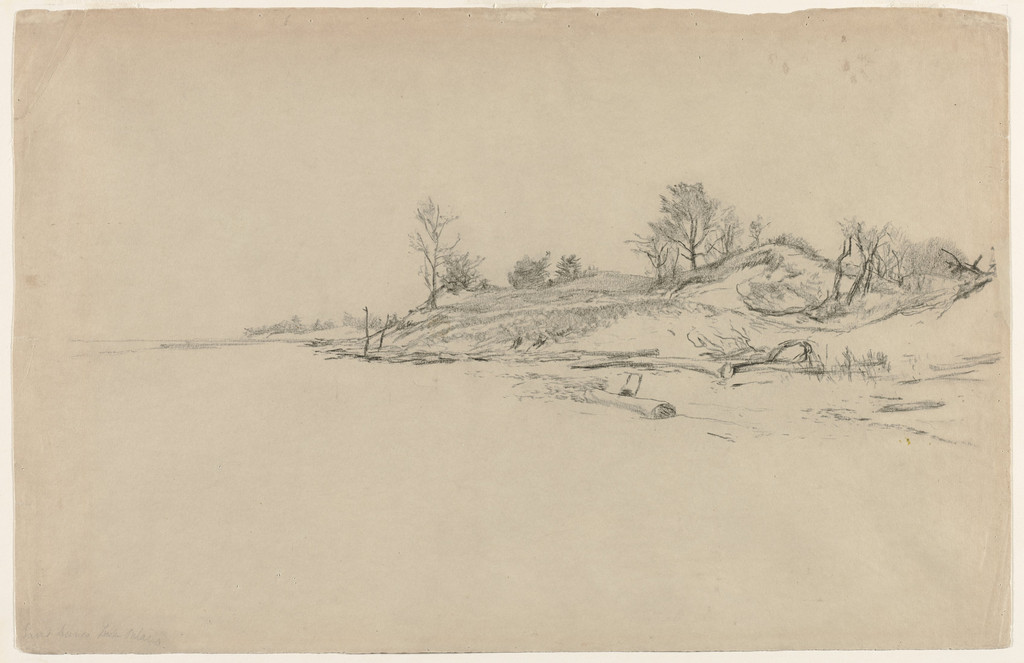
Homer Dodge Martin, Sand Dunes, Lake Ontario, about 1874. Possibly black crayon on beige wove paper, 32.6 × 50.4 cm. Cleveland Museum of Art, 1946.65. This drawing is a separate object from the Met oil. The Cleveland Museum of Art.
Image source
.
CC0 / Public domain
. Resized only; source appearance preserved.
Watch: Homer Dodge Martin
Start with Martin’s Normandy Landscape, then explore the wider Hudson River School tradition in which he began.
Homer Dodge Martin | Normandy Landscape
The Castellani Art Museum introduces Martin’s Normandy Landscape.
Watch on YouTubeThe 1884 Salon and revision
Elizabeth recalled Martin beginning the large dune picture at Villerville with the intention of sending it to the Salon. The approaching deadline made progress more difficult. In her account, both thought the work unready when the last submission day arrived, but he sent it nevertheless and it was rejected. [15]
The Met’s scholarly catalogue identifies the Salon attempt as 1884 and traces further work after it. This history distinguishes a rejected submission from a painting that was never entered. It also separates the jury’s encounter with an earlier state from the later arrangement that reached completion. [2]
Elizabeth remembered the canvas being set aside for months. When Martin returned to it, an unnamed French landscape painter saw it and encouraged another Salon submission. She explained that it had already been rejected but was no longer in the same condition. Her story records how substantially a picture could change after an unsuccessful exhibition attempt. [15]
The visitor’s encouragement does not establish that a second submission took place. Its importance within the memoir lies in the response to a revised work and in Elizabeth’s recognition that the earlier rejection did not describe its present state. The painting’s history remained open after the verdict of one jury.
The painting’s return to the studio
Martin returned to New York in December 1886 with canvases still in progress. Mather includes the Ontario picture among the works brought back from France and records it being taken up again and finished in 1887. The Met catalogue likewise follows its revision through the period after his return. [8] [2]
The lower-left signature and 1887 date mark the completed state, while the museum’s broader 1883–87 range preserves its longer development. Both forms of dating are useful. One records the final signed year; the other identifies the interval through which the canvas was begun, reconsidered and brought to completion. [1] [2]
The Met catalogue discusses palette-knife application across broad passages and brushed trees and weeds in the foreground. Its account connects different kinds of handling with the contrast between more generalized space and distinct nearer forms. That technical reading should remain attributed, especially when examining a monochrome reproduction that cannot establish the original colors. [2]
The style and technique discussion sets such testimony beside Martin’s drawings, outdoor paintings and accounts of revision. The dune canvas is particularly useful because its American subject, French working history and New York completion bring those different experiences together within one picture.
The museum catalogue also proposes a connection with Eugène Boudin’s dune landscapes. Boudin exhibited at Honfleur, near the places where Martin lived, and his work offered a possible point of comparison for the treatment of low coastal ground. The catalogue’s argument concerns subject and handling; it does not establish a meeting between the painters or direct instruction from one to the other. [2]
That comparison makes the geographical overlap especially productive. An American subject could be reconsidered while Martin was living among French coastal settings and seeing other approaches to them. The resulting picture retained its Ontario identity while belonging to a practice widened through travel, looking and experiment.
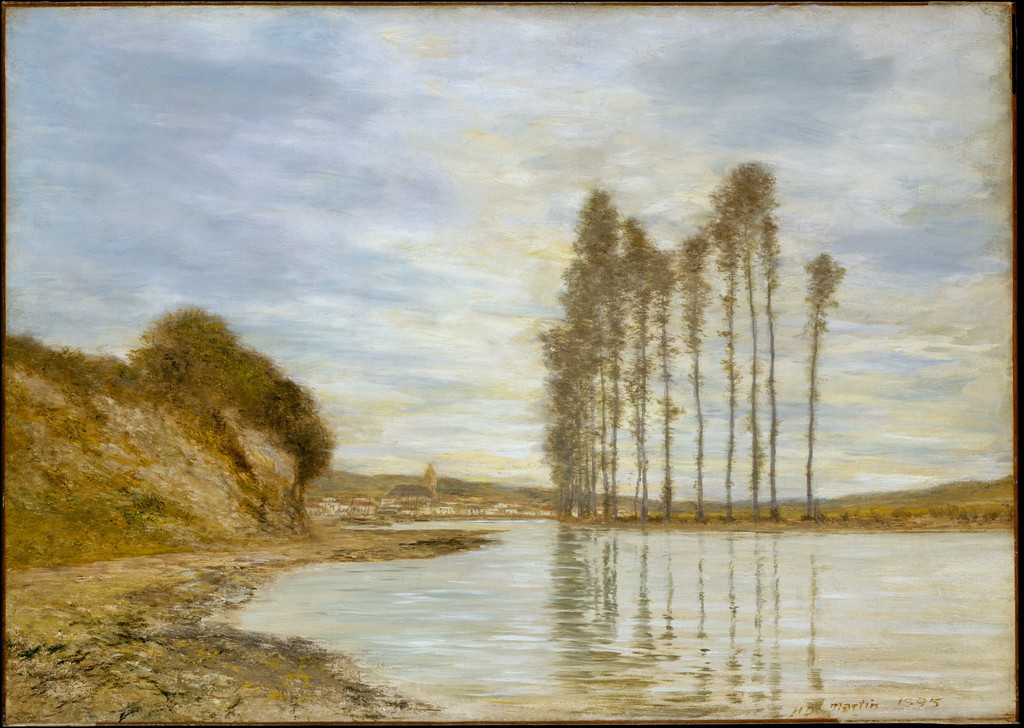
Homer Dodge Martin, View on the Seine: Harp of the Winds, 1893–95. The river picture places repeated trees beyond open water, offering a different arrangement from Behind Dunes. The Metropolitan Museum of Art, 97.32. The Metropolitan Museum of Art.
Image source
.
CC0 / Public domain
. Resized only; source appearance preserved.
Mather’s reading of weathering and time
Mather considered the Ontario pictures within Martin’s wider response to the changing earth. His discussion emphasizes growth and decay, weathered ground and the effects of storm, rain and time. He read the repeated dune subject as part of a contemplative, elegiac approach to nature. That language belongs to his critical interpretation. [8]
The image offers a concrete starting point for considering the reading. Uneven sand surrounds irregular trees and branches; the foreground feels exposed, while the distance extends more quietly beyond. The relation between these regions can suggest a landscape shaped through processes that continue outside the moment represented.
The visible forms do not establish an exact ecological history or the cause of every damaged branch. Their pictorial effect can still be examined. Near irregularity and farther continuity give the scene a tension between disturbance and repose, while the broad sky holds both within an extensive view.
Mather’s response also helps explain why the painting invites sustained looking. Once the principal subject has been recognized, the relationships between near trees, pale sand, darker middle ground and distant light continue to change the pace of attention. The work’s expressive force resides in how those parts remain connected, rather than in a single illustrated event.
The Hearn gift and later interpretation
The Met received the painting as a gift from George A. Hearn in 1906, accession 06.1287. That acquisition is later than its completion and its nineteenth-century exhibition history. The scholarly catalogue records its presentation with the Society of American Artists in 1887 and at Chicago’s World’s Columbian Exposition in 1893. [1] [2]
The same catalogue brings together contemporary responses that praised the suggestion of space, tonal harmony and the handling of distant sky. These notices show viewers responding to the finished picture through qualities of arrangement and atmosphere. They are quoted or summarized in the museum’s publication, rather than independent observations of its earlier Salon state. [2]
The long history gives the canvas several contexts at once: an American shore first experienced years earlier, a French exhibition attempt, revision in New York and eventual museum acquisition. None alone explains the whole work. Together they reveal how a landscape could remain active through changing places and judgments.
The paintings overview places the dune subjects beside Martin’s lakes, rivers and coasts, while his main page follows the broader career. Returning to this picture, the particular achievement is visible in its arrangement: a demanding near foreground held against a distance that remains open beyond it.
Artwork records
Browse 58 records from Carroll’s selected 1913 catalogue alongside 25 separately documented object records. Some records concern the same work; this is not a complete lifetime catalogue or a count of 83 unique artworks. [13]
| Name | Date | Medium |
|---|---|---|
| Carroll 1: Saranac Lake (1913 record) | 1860s; exact date not clearly decipherable | Painting — historical catalogue record |
| Carroll 2: Lake George from Bolton (1913 record) | Date not stated | Painting — historical catalogue record |
| Carroll 3: The Iron Mine, Port Henry, N. Y. (1913 record) | Date not stated | Painting — historical catalogue record |
| Carroll 4: On Lake Ontario (1913 record) | Probably late 1860s | Painting — historical catalogue record |
| Carroll 5: The Giant of the Valley (1913 record) | 1865 | Painting — historical catalogue record |
| Carroll 6: An Adirondack Lake (1913 record) | Date not stated | Painting — historical catalogue record |
| Carroll 7: Winter in Normandy (1913 record) | Date not stated | Watercolor — historical catalogue record |
| Carroll 8: Across the Lake (1913 record) | Date not stated | Painting — historical catalogue record |
| Carroll 9: New Hampshire Landscape (1913 record) | Late 1860s | Painting — historical catalogue record |
| Carroll 10: Long Lake (1913 record) | Date not stated | Painting — historical catalogue record |
| Carroll 11: Salt Meadows (1913 record) | Mid 1880s | Painting — historical catalogue record |
| Carroll 12: Autumn on the Susquehanna (1913 record) | 1879 | Painting — historical catalogue record |
| Carroll 13: Ontario Sand Dunes (1913 record) | 1887 | Painting — historical catalogue record |
| Carroll 14: Late Autumn (1913 record) | About 1877 | Painting — historical catalogue record |
| Carroll 15: Early Spring (1913 record) | About 1877; companion dating | Painting — historical catalogue record |
| Carroll 16: Raquette Lake (1913 record) | 1869 | Painting — historical catalogue record |
| Carroll 17: A Glimpse of the Sea (1913 record) | Date not established; historical suggestion disputed | Painting — historical catalogue record |
| Carroll 18: Headwaters of the Hudson (1913 record) | 1869 | Painting — historical catalogue record |
| Carroll 19: Autumn in the Adirondacks (1913 record) | 1871 | Painting — historical catalogue record |
| Carroll 20: Richmond on Thames (1913 record) | About 1877; later alterations | Painting — historical catalogue record |
| Carroll 21: Saranac Lake (1913 record) | 1878 | Painting — historical catalogue record |
| Carroll 22: Windsor Castle (1913 record) | Finished 1878 | Painting — historical catalogue record |
| Carroll 23: L’Anse St. Étienne, Saguenay (1913 record) | 25 July 1879 | Watercolor — historical catalogue record |
| Carroll 24: L’Anse aux Basses Pierres (1913 record) | Date not stated | Watercolor — historical catalogue record |
| Carroll 25: Blossoming Trees (1913 record) | Mid 1880s | Painting — historical catalogue record |
| Carroll 26: On the Seine (1913 record) | Date not stated; later years suggested | Painting — historical catalogue record |
| Carroll 27: The Dunes (1913 record) | 1883 | Watercolor — historical catalogue record |
| Carroll 28: The Moonlit Pond—Honfleur (1913 record) | Date not stated | Painting — historical catalogue record |
| Carroll 29: Normandy Landscape (1913 record) | Date not stated | Painting — historical catalogue record |
| Carroll 30: The Lighthouse, Honfleur (1913 record) | Date not stated | Painting — historical catalogue record |
| Carroll 31: Ruby Strong—Normandy (1913 record) | Date not stated | Painting — historical catalogue record |
| Carroll 32: Sand Dunes, Lake Ontario (1913 record) | 1874 | Painting — historical catalogue record |
| Carroll 33: Low Tide, Honfleur (1913 record) | Date not stated | Painting — historical catalogue record |
| Carroll 34: Evening on the Seine (1913 record) | Date not stated | Painting — historical catalogue record |
| Carroll 35: On the Seine (1913 record) | Date not stated | Painting — historical catalogue record |
| Carroll 36: On the Hudson (1913 record) | 1881 | Painting — historical catalogue record |
| Carroll 37: A Forest Brook (1913 record) | 1881 | Painting — historical catalogue record |
| Carroll 38: Coast Meadows, St. Sauveur (1913 record) | 1881 | Painting — historical catalogue record |
| Carroll 39: Landscape (1913 record) | 1883 | Painting — historical catalogue record |
| Carroll 40: An Adirondack Lake—Lake Sanford (1913 record) | 1883 | Painting — historical catalogue record |
| Carroll 41: Lower Ausable Pond (1913 record) | 1868 | Painting — historical catalogue record |
| Carroll 42: December Morning in Normandy (1913 record) | 1883 | Painting — historical catalogue record |
| Carroll 43: Low Tide—Villerville (1913 record) | 1884 | Painting — historical catalogue record |
| Carroll 44: Lake George (1913 record) | 1884 | Painting — historical catalogue record |
| Carroll 45: Crepuscule—Montvilliers (1913 record) | 1885 | Painting — historical catalogue record |
| Carroll 46: The Sea at Villerville (1913 record) | 1885 | Painting — historical catalogue record |
| Carroll 47: Golden Sands (1913 record) | Date not stated | Painting — historical catalogue record |
| Carroll 48: The Meadow Brook (1913 record) | 1887 | Painting — historical catalogue record |
| Carroll 49: The Sun Worshippers (1913 record) | After the 1886 return to New York | Painting — historical catalogue record |
| Carroll 50: South Side of Long Island (1913 record) | 1894 | Painting — historical catalogue record |
| Carroll 51: Criqueboeuf Church (1913 record) | 1893 | Painting — historical catalogue record |
| Carroll 52: Normandy Farm (1913 record) | 1895 | Painting — historical catalogue record |
| Carroll 53: On the Mississippi (1913 record) | Toward the close of the artist’s life | Painting — historical catalogue record |
| Carroll 54: Newport Neck (1913 record) | 1893 | Painting — historical catalogue record |
| Carroll 55: A Newport Landscape (1913 record) | 1896 | Painting — historical catalogue record |
| Carroll 56: A Distant View of Caen (1913 record) | Date not stated; exhibited 1894 | Painting — historical catalogue record |
| Carroll 57: The Brook (1913 record) | 1894 | Painting — historical catalogue record |
| Carroll 58: Normandy Trees (1913 record) | Date not stated | Painting — historical catalogue record |
| View on the Seine: Harp of the Winds | 1893–95 | Oil on canvas |
| The Iron Mine, Port Henry, New York | About 1862 | Oil on canvas mounted on fiberboard |
| Wild Coast, Newport | 1889 | oil on canvas |
| In the Housatonic Valley (attributed to Homer Dodge Martin) | late 1850s | oil on canvas |
| Sand Dunes, Lake Ontario | c. 1874 | Possibly black crayon on paper |
| Adirondacks | 1868 | Pencil drawing |
| Landscape | 1896 | Watercolor |
| Near Newport | mid-1800s | Watercolor |
| Effect of Trees | About 1879 | Oil on canvas |
| Behind Dunes, Lake Ontario | 1883–87 | Oil on canvas |
| Old Manor of Criqueboeuf | About 1882–92 | Oil on canvas |
| Upper Ausable Lake | 1868 | Oil on canvas |
| Wild Coast, Newport (Smithsonian version) | About 1885–95 | Oil on canvas |
| On the Seine | About 1895 | Oil on canvas |
| The Lighthouse, Honfleur | Date not supplied by museum | Oil on wood panel |
| The White Mountains from Randolph Hill (Wellin canvas) | 1866–67 | Oil on canvas |
| Old Crossing, Otter Tail River | 1871 | Black chalk touched with white chalk on paper |
| Landscape with Poplars | Date not supplied by museum | Oil on canvas |
| Normandy Coast | 1884 | Oil on board |
| Criqueboeuf Church, Normandy | 1893 | Oil on canvas |
| Evening on the Thames | About 1876 | Oil on canvas |
| Hudson River | 1860 | Graphite drawing on wove paper |
| The White Mountains, from Randolph Hill (formerly Met canvas) | About 1862–68; later revisions | Oil on canvas |
| Westchester Hills | About 1887 | Oil painting — historical accounts |
| Adirondack Scenery | 1895 | Oil painting — historical accounts |
Frequently Asked Questions
The main illustration here is monochrome. It supports study of shape and light-and-dark relationships, while color descriptions require a separate source.
George A. Hearn gave it in 1906. [1]
Discussion
Look again at the images and ideas explored in Behind Dunes, Lake Ontario. These editorial prompts invite your observations.
Reader Insights
Follow the foreground tree group toward the low dunes. Which change of scale first makes the distance seem extensive?
Compare Cleveland’s drawing with the Met oil. How do open paper and painted bands organize related ground differently?
Consider the interval between the 1884 Salon rejection and 1887 completion. How does revision change the way an exhibition verdict belongs to a painting’s history?
Join the Conversation
Share a detail, comparison or question about Behind Dunes, Lake Ontario below.
References
- Metropolitan Museum of Art , Behind Dunes, Lake Ontario, 1883–87, 06.1287, object record and curatorial account. View source
- Natalie Spassky and colleagues , American Paintings in The Metropolitan Museum of Art, Volume II, 1985, Behind Dunes entry and references, pp.428–430; published 28 December 1874 letter excerpt, p.428. View source
- Smithsonian American Art Museum, The Iron Mine, Port Henry, New York, 1910.9.11. View source
- Smithsonian American Art Museum, Upper Ausable Lake, 1909.7.44. View source
- Smithsonian American Art Museum, Evening on the Thames,1909.7.45. View source
- Metropolitan Museum of Art, Old Manor of Criqueboeuf, 22.117. View source
- Brooklyn Museum, Normandy Coast,15.281. View source
- Frank Jewett Mather Jr. , Homer Martin: Poet in Landscape, 1912, particularly pp.52–53 and 65–67. View source
- Cleveland Museum of Art, Wild Coast, Newport, 1923.1118. View source
- Los Angeles County Museum of Art, Criqueboeuf Church,Normandy,M.90.159. View source
- Metropolitan Museum of Art, View on the Seine: Harp of the Winds, 97.32. View source
- Princeton University Art Museum, The Lighthouse, Honfleur, y1948-3. View source
- Dana H. Carroll , Fifty-Eight Paintings by Homer D. Martin, 1913, no.32, p.80, earlier 1874 oil version. View source
- Cleveland Museum of Art , Sand Dunes, Lake Ontario, about 1874, 1946.65, object record and tentative medium identification. View source
- Elizabeth Gilbert Martin , Homer Martin: A Reminiscence, 1904, pp.41–44. View source
- Splash image source.
Homer Dodge Martin, Behind Dunes, Lake Ontario, 1883–87. Oil on canvas, 91.4 × 153.7 cm. The Metropolitan Museum of Art, 06.1287. Monochrome museum reproduction; original paint colors are not represented here. The Metropolitan Museum of Art, Gift of George A. Hearn, 1906. CC0 / Public domain . Resized only; source appearance preserved.
View source