 by
Tom Gurney
Tom Gurney BSc (Hons) is an art history expert with over 20 years experience
Email:
tomgurney1@gmail.com
/ Phone:
+44 7429 011000
Homer Dodge Martin in France and Normandy: Introduction
Normandy gave Homer Dodge Martin a coast, a countryside and a set of inhabited places that continued to occupy him after he returned to America. Rivers, old buildings, village lights and shorelines supplied subjects for pictures developed through drawing, recollection and revision. The French years mattered both as an experience of living and as a store of material for later work. [1]
Elizabeth Gilbert Martin’s memoir makes that experience unusually accessible. She described the journey, the rooms and meals, her French lessons and the writing that helped support them. Her account places a painter’s encounters with landscape within a household dependent on friendships, credit, literary work and intermittent income from pictures. France was a working home for both Martins. [1]
At a Glance
- First European journey 1876, including visits to Barbizon and Saint-Cloud.
- Second departure England, October 1881, for an illustration commission.
- Elizabeth joins him 1882.
- Normandy settlement By the winter of 1882–83.
- Villerville residence Nineteen months, according to Elizabeth.
- Later French home Honfleur, from 1884.
- Return to New York Elizabeth in August 1886; Martin on 12 December 1886.
- Continuing subjects Coast, lighthouse, Criqueboeuf buildings, trees and river views.
- Important distinction A French subject might be completed years later in America.
Contents
- Why France mattered
- The 1876 journey and Barbizon
- England before the Channel crossing
- Nineteen months at Villerville
- A working household beside the coast
- Honfleur and the meeting of land and water
- Criqueboeuf: church, farm and manor
- French subjects after the return to America
Why France mattered
The French pictures brought human occupation into Martin’s landscapes in particular ways. A church stands beside a pond, a manor appears among trees, a lighthouse interrupts a low shore. Buildings provide a focus without necessarily becoming independent architectural portraits. Their relationship with water, surrounding ground and sky remains central to the view.
Mather’s study emphasizes the importance of an inhabited countryside to this period. He describes the marks of human presence within scenes that often contain few prominent figures. His criticism helps direct attention toward the buildings and distant settlements, while the paintings reveal how those forms become part of a larger arrangement. [2]
The Met catalogue also follows changes in Martin’s handling during the French residence, including broader applications of paint and looser contours. It connects these developments with his exposure to Barbizon painting and contemporary French art. The experience altered an existing practice: American mountain and lake subjects continued alongside the new French material. [3]
That continuity is important when comparing the works. The France-inspired paintings do not form a sealed episode ending at the date of departure. A French building could be reconsidered in New York, while the Ontario dunes could be painted in Normandy. Subject, place of work and completion date describe different parts of a painting’s history.
The 1876 journey and Barbizon
Martin first visited Europe in 1876 with Dr. Jacob S. Mosher, an Albany friend. Elizabeth recalled travel in England, France and Holland, including Barbizon and pencil studies at Saint-Cloud. The journey brought him into places already associated with French landscape painters whose work he admired. [1]
Corot’s importance preceded the trip. Mather describes a small Corot brought to Albany by George Henry Boughton, and Elizabeth remembered her husband’s early admiration for the painter. Looking at pictures and discussing them with friends had helped establish that interest before direct experience of France became possible. [2] [1]
In England Martin became acquainted with Whistler. The Met catalogue suggests that Whistler encouraged his use of charcoal to establish a composition on canvas. The connection belongs beside other encounters with pictures and artists, rather than standing as an explanation for every change in Martin’s later handling. [3]
This first journey and the longer absence beginning in 1881 should be kept separate. The former widened his experience; the latter began with a particular illustration task and eventually became a period of residence in Normandy. Following the sequence reveals how professional needs and personal invitations could shape the geography of a painter’s work.
England before the Channel crossing
Martin sailed for England in October 1881 to make drawings of places associated with Thackeray and George Eliot for the Century . Elizabeth’s memoir describes an undertaking he disliked but could not readily refuse. The drawings progressed slowly, and she joined him in London the following year. [1]
She remembered visiting Whistler’s studio with him in July 1882, recording the conspicuous setting and her own response to the artist. Such incidents make the English stage more than a date between departures. Martin was renewing friendships and working on a commission before the possibility of a longer French stay emerged. [1]
An invitation from William J. Hennessy’s family brought them across the Channel in the autumn. The Hennessys lived at Pennedepie, and the Martins initially expected a brief visit before returning home. News of money sent by James Stillman changed what was possible and helped enable them to remain. [1]
By winter 1882–83 they were settled in the Normandy region. That chronology avoids treating the 1881 departure as an immediate arrival at Villerville. The intervening English months had their own work, financial uncertainty and sociability. The extended French residence grew out of decisions made during the journey, rather than a fully settled plan at its beginning. [3]
Nineteen months at Villerville
Elizabeth recorded nineteen months at Villerville. A studio with adjacent rooms provided their own quarters, while lunch and dinner were taken at Madame Cornu’s hotel. Her recollections of meals, bills and local kindness give the stay a physical and social setting. The place was lived in through changing seasons, beyond its attractiveness as a subject for painting. [1]
The village’s artistic company also formed part of that experience. Elizabeth described French, English and American painters visiting or living there during the warmer months. Friends from New York, including the Brownells, visited too. Yet winter could leave the Martins with few English-speaking neighbors, increasing their dependence on one another and on the language of their surroundings. [1]
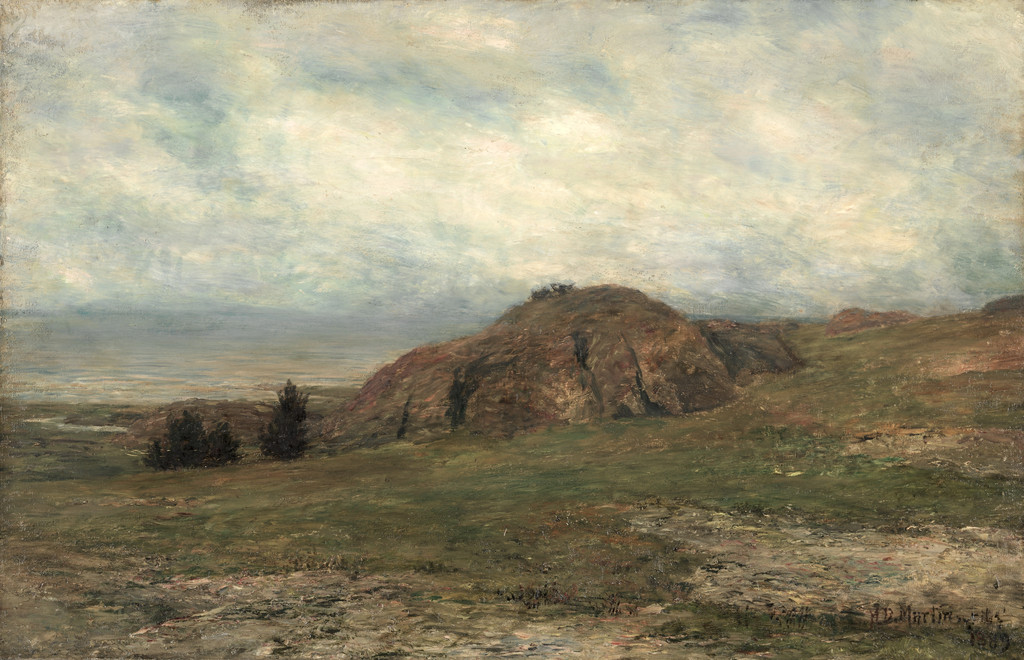
Brooklyn’s Normandy Coast , dated 1884, offers a concrete painting from this French period. A broad, freely brushed sky rises above low coastal ground. The museum identifies it among Martin’s outdoor works. Its small board gives a different scale of encounter from the larger compositions developed through prolonged studio work. [4]
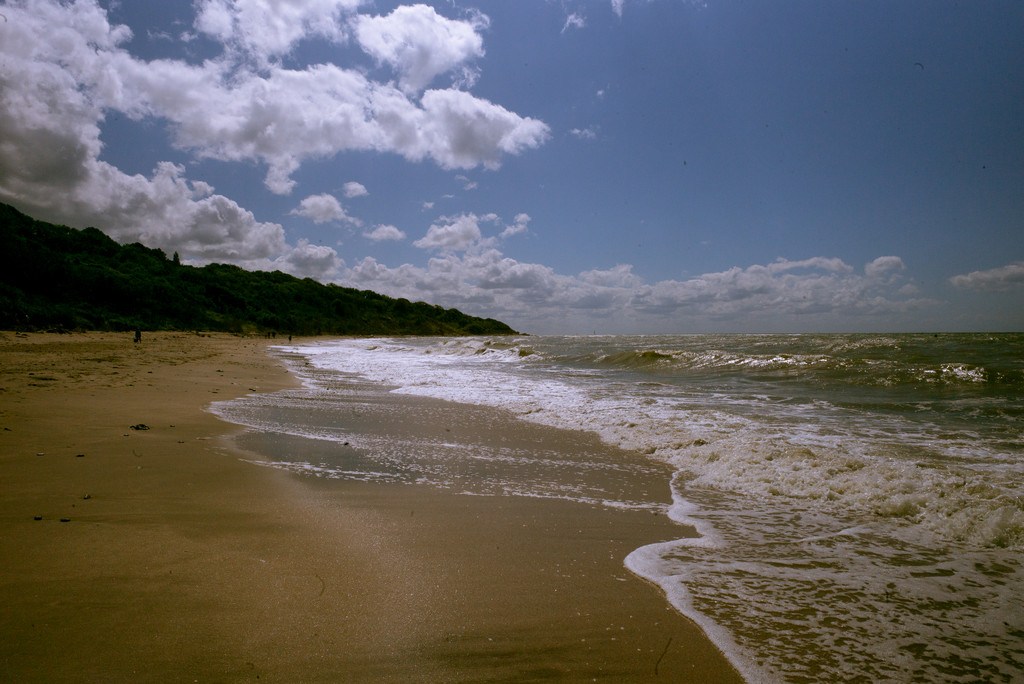
A modern photograph of Villerville’s shore can help orient the coast’s setting, but it describes another moment. Paolo Gamba’s 2020 photograph shows the beach, sea and wooded rise as they appeared to a later photographer. It provides present-day geographical context alongside the historical account, without establishing the viewpoint of any particular Martin painting. [5]
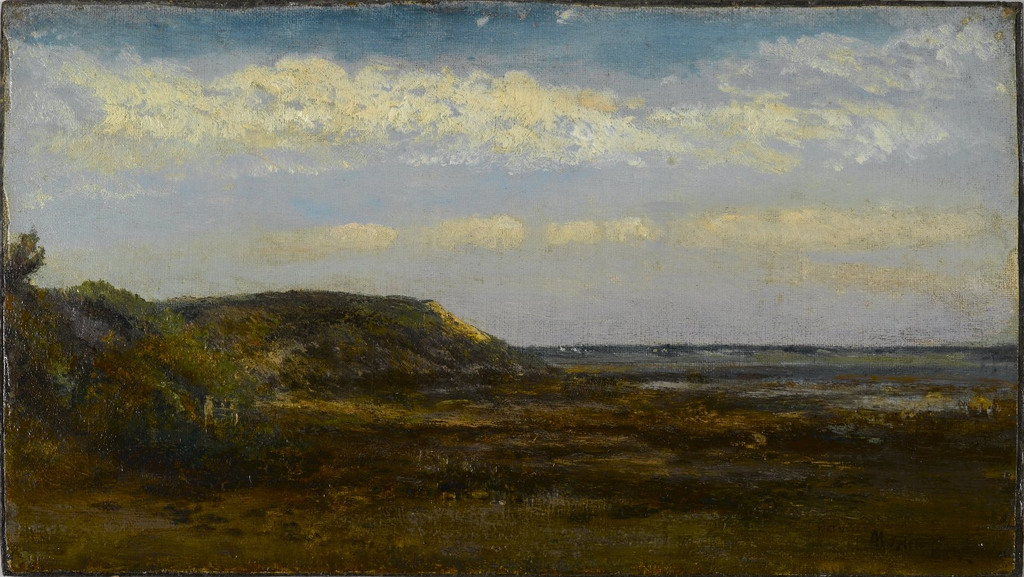
Homer Dodge Martin, Normandy Coast, 1884. Oil on board, 18.3 × 32.2 cm. The small outdoor picture belongs to his French residence. Brooklyn Museum, 15.281. Brooklyn Museum, Bequest of Charles A. Schieren.
Image source
.
No known copyright restrictions
. Resized only; source appearance preserved.
A working household beside the coast
Elizabeth began learning French partly to continue reading aloud after the available English books and periodicals had been exhausted. Her teachers included local women and a teacher from Honfleur. The memoir presents language learning as a practical adjustment that opened further reading and companionship, with consequences for her own work. [1]
She began with Edmond About’s Le Roi des montagnes, reading a sentence aloud and then translating it literally. The memoir describes the process as training both her pronunciation and Martin’s ear. It also records the help of Mademoiselle Lemonnier, the village postmistress, whose reading, intelligence and humor made her a valued teacher and companion. These recollections give language learning a place within the local relationships of their stay. [1]
Writing expanded during the stay. A description of Villerville intended to accompany Martin’s drawings was eventually published without them in the Catholic World . He encouraged her to try character and narrative, and she described the resulting encounters with editors who asked for changes or declined a piece. Literary work had its own negotiations, decisions and disappointments. [1]
Her serial Katharine ran for eighteen months in the Catholic World and, she recalled, provided for their necessary expenditure during that period. The detail changes how the French years are understood. The painter’s time to observe, draw and reconsider subjects existed within a household partly sustained by another person’s sustained production. [1]
Elizabeth also remembered the patience of local suppliers when money was lacking. These episodes are affectionate recollections rather than a full financial account, but they reveal the arrangements that made continued residence possible. The biography follows that working partnership across its earlier and later circumstances.
Mather later reproduced passages from Elizabeth’s Villerville article that describe houses and steep-roofed barns fitting naturally into their surroundings. He also selected her descriptions of sea, fields, distant shores and changing light. Her prose offers a parallel response to the region’s forms and colors, bringing the writer’s eye into the history of the painter’s subjects. Reading the two together makes the coast a shared experience approached through different kinds of work. [2]
Watch: Homer Dodge Martin
Start with Martin’s Normandy Landscape, then explore the wider Hudson River School tradition in which he began.
Homer Dodge Martin | Normandy Landscape
The Castellani Art Museum introduces Martin’s Normandy Landscape.
Watch on YouTubeHonfleur and the meeting of land and water
The move to Honfleur came in 1884. Elizabeth thought the attraction included a roomy, well-lighted studio separate from their dwelling, an arrangement Martin preferred. She remembered The Mussel Gatherers , small panels and watercolors from this period, alongside notebooks accumulating material for future use. [1] [2]
Princeton’s The Lighthouse, Honfleur provides a compact example of built form beside water. Its tower rises against a broad area of sky, with darker ground to the left and reflection below. The lit upper portion concentrates attention within an otherwise subdued arrangement. The vertical panel gives the tower a different role from a small building on a distant horizontal shore.
The museum identifies the work as an undated oil on wood panel, 28 by 20 centimeters. It is distinct from the larger horizontal Honfleur Light discussed in the historical accounts. Keeping the particular object in view allows the title to guide comparison without transferring another canvas’s dimensions or date. [6]
Coast, harbor and inland water offered related compositional possibilities. A tower or a cluster of buildings could provide a vertical focus, while a shoreline carried attention laterally. The continuing interest lay in how those forms occupied space together. Their usefulness to Martin extended beyond a record of the appearance of one town.
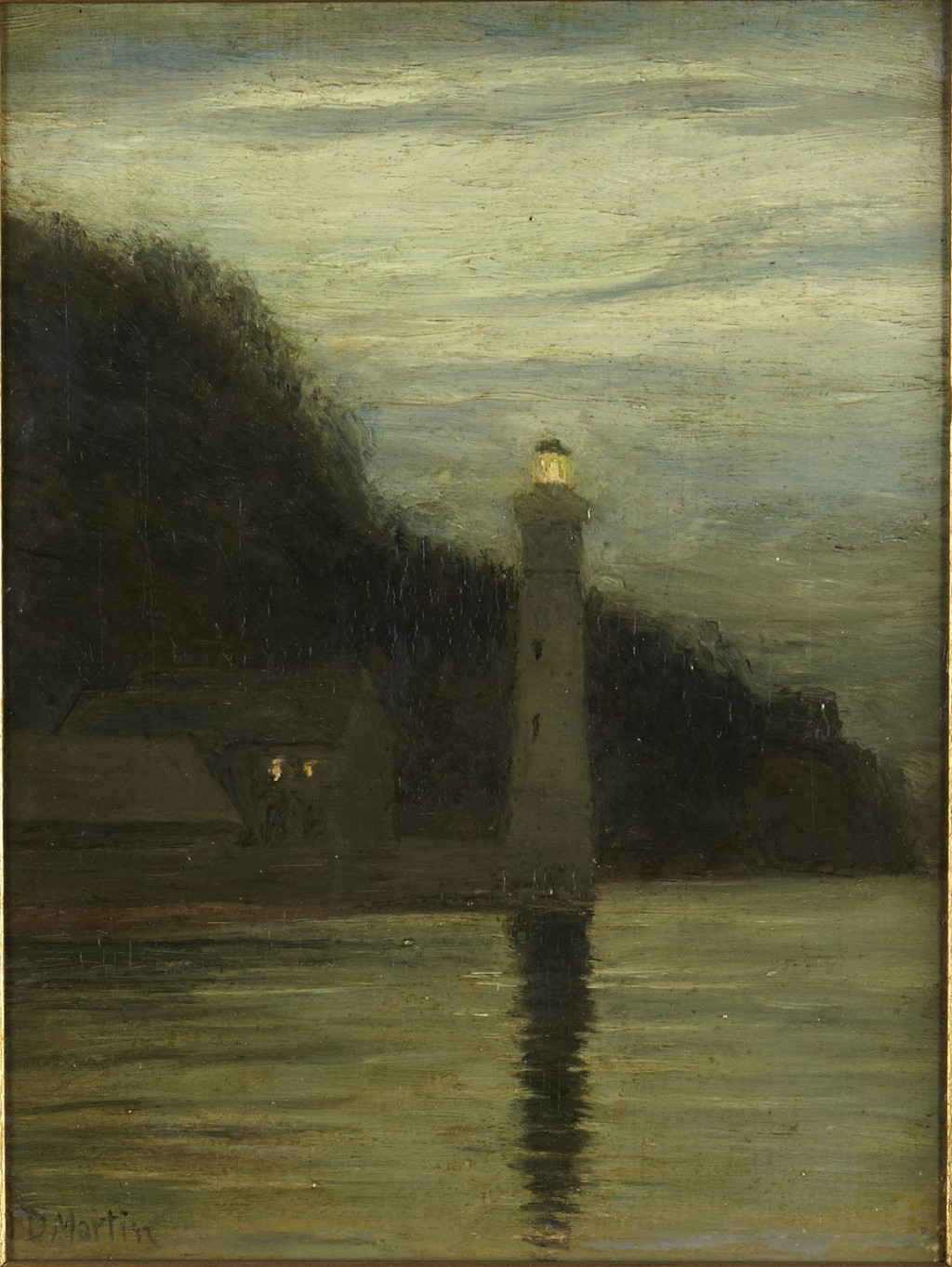
Homer Dodge Martin, The Lighthouse, Honfleur, undated. Oil on wood panel, 28 × 20 cm. Princeton University Art Museum, y1948-3. Princeton University Art Museum, Gift of Frank Jewett Mather Jr.
Image source
.
Public domain
. Frame and wall cropped; visible painting edge retained. Resizing only follows.
Criqueboeuf: church, farm and manor
Elizabeth identified the church at Criqueboeuf and neighboring ground as the source of several important subjects. She connected the church, a farm picture and the deserted manor with a small group of settings explored during the residence. Her recollection gives these paintings a local relationship while preserving their separate working histories. [1]
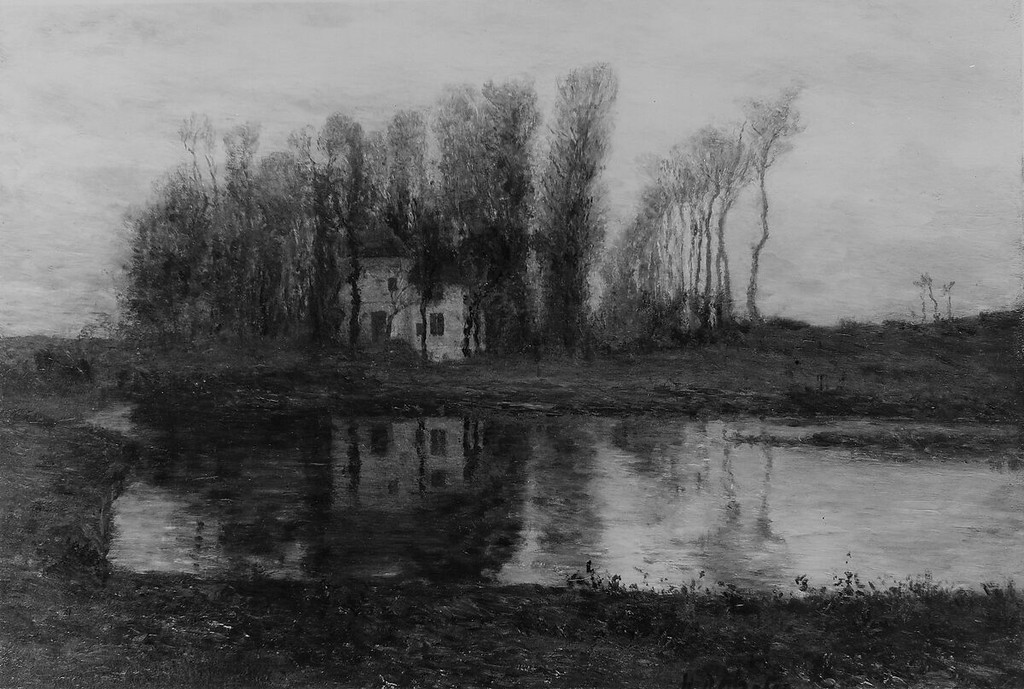
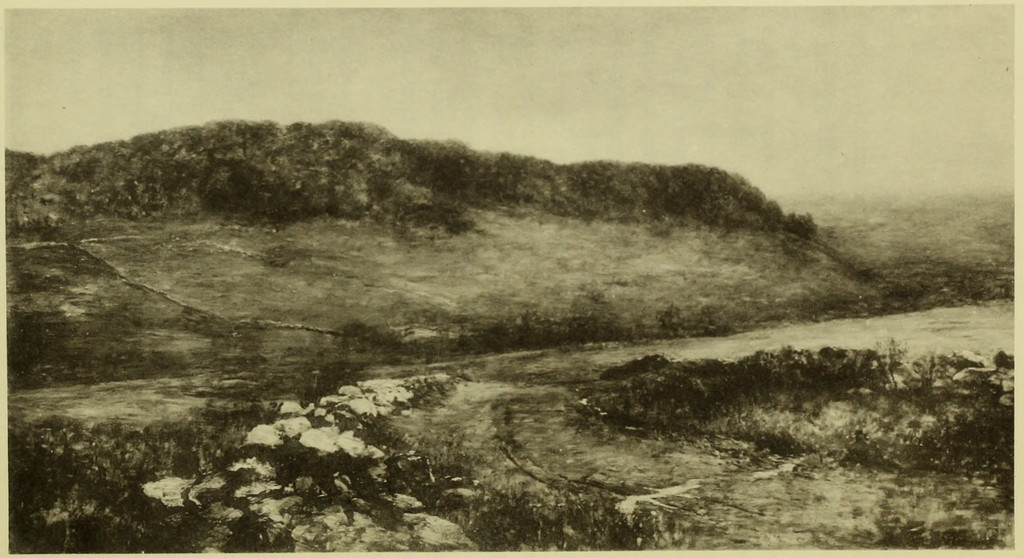
The church picture makes the building and its reflection central to the arrangement. A historical reproduction in Carroll’s 1913 selection places the dark tower above the pool, with surrounding growth binding the architecture to the ground. The monochrome print is especially useful for following those broad relationships of shape and reflection. [7]
LACMA’s current Criqueboeuf Church, Normandy is dated 1893 and catalogued as an oil on canvas made in the United States. That record brings French subject and American execution into a single object history. Old Manor of Criqueboeuf likewise remained active after the return, with the Met catalogue tracing revision into 1892. [8] [3]
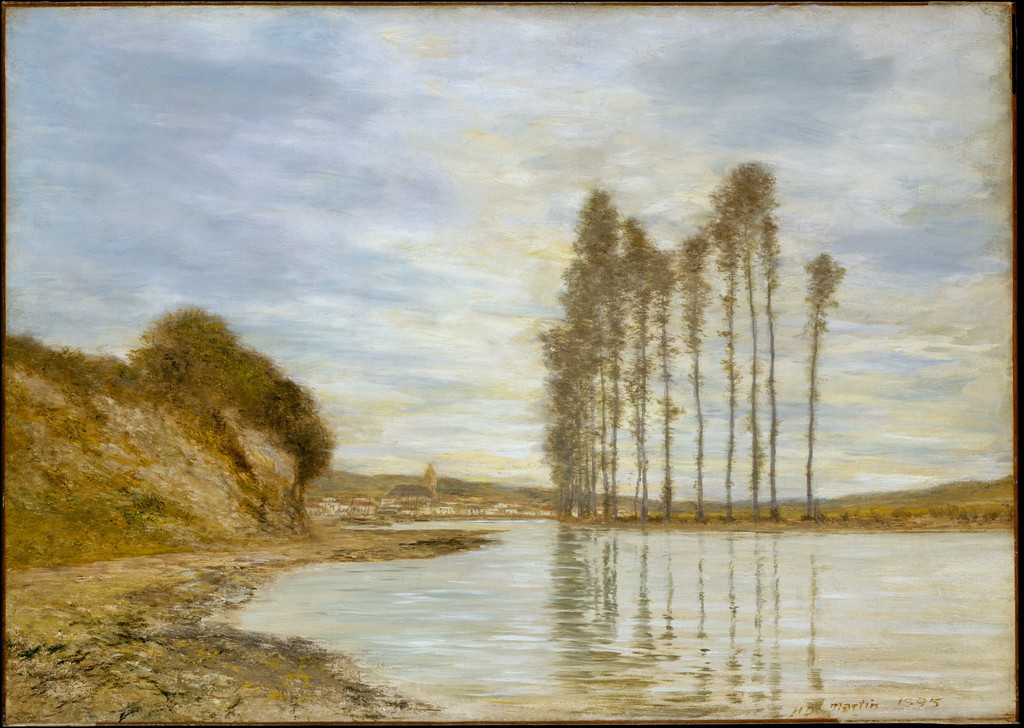
The place-name should not be allowed to settle every French landscape’s geography. For Harp of the Winds , the Met’s current account names Criqueboeuf, but its 1985 catalogue quotes a letter of 31 October 1895 in which Martin names Quilleboeuf. Those different names should remain visible rather than making the church pond the river picture’s exact setting. [9] [3]
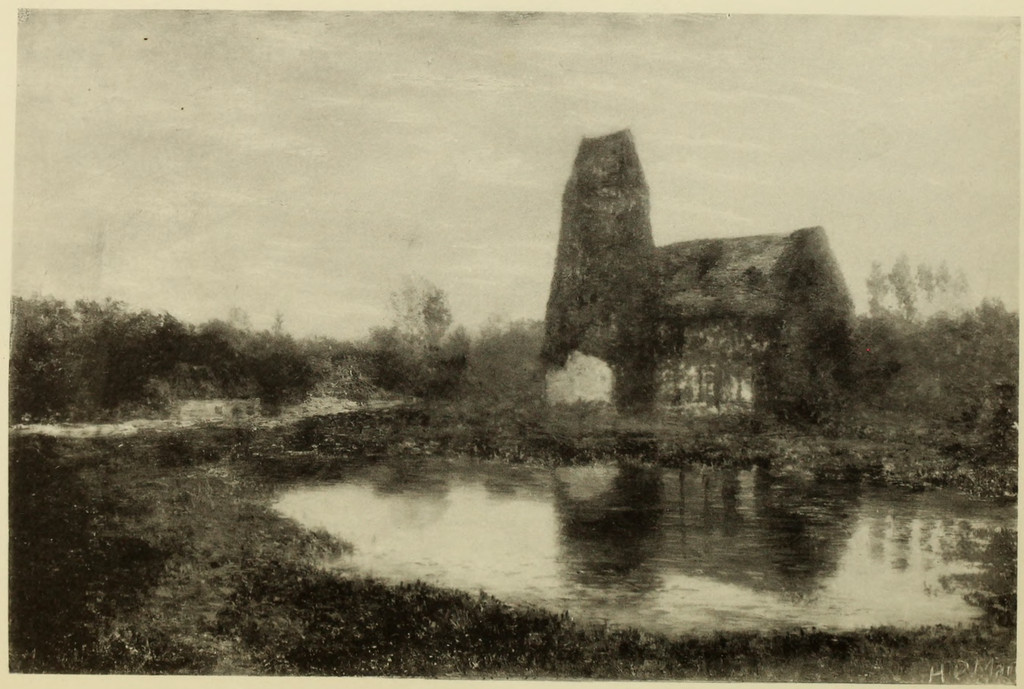
Homer Dodge Martin, Criqueboeuf Church, Normandy, as reproduced in Dana H. Carroll’s Fifty-Eight Paintings by Homer D. Martin, 1913, no. 51. Historical monochrome printed reproduction. Carroll, 1913. Original scan: Internet Archive / Getty Research Institute.
Image source
.
Public domain
. Book page margins removed and orientation corrected; original scan tone retained. Resizing only follows.
French subjects after the return to America
Elizabeth sailed for New York in August 1886. Martin stayed to finish work and arrived on 12 December. He returned with completed pictures, studies and canvases still in progress. The French residence therefore ended geographically before many of its most important pictorial consequences had reached their final form. [1]
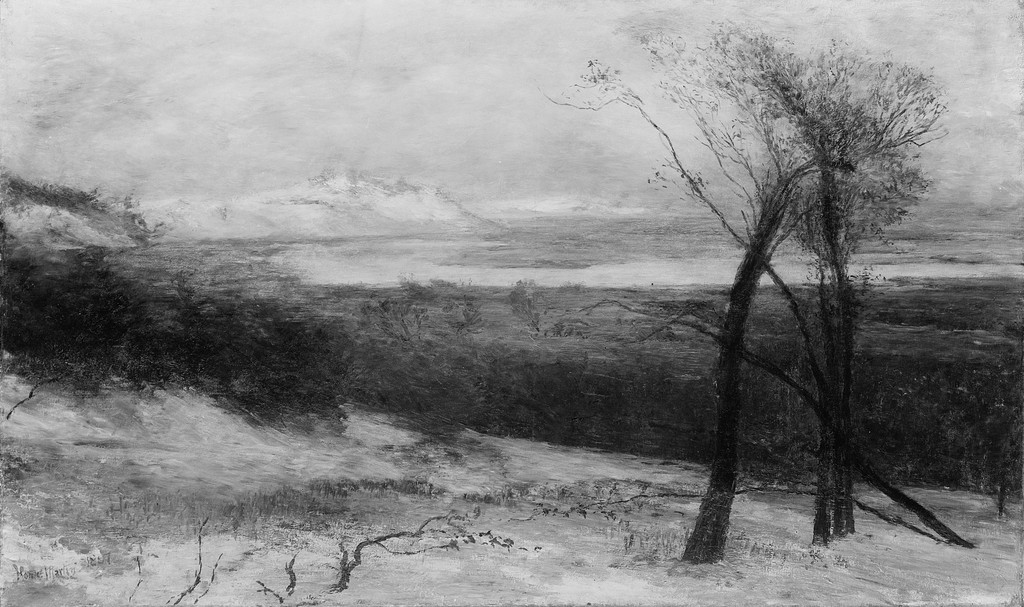
The overlap also worked in the other direction. Behind Dunes, Lake Ontario was an American subject developed during the French years, submitted unsuccessfully to the Salon in 1884 and revised until 1887. Its history makes travel more than a succession of subjects collected in separate countries. Established motifs could be reconsidered through a painter’s changing experience. [3]
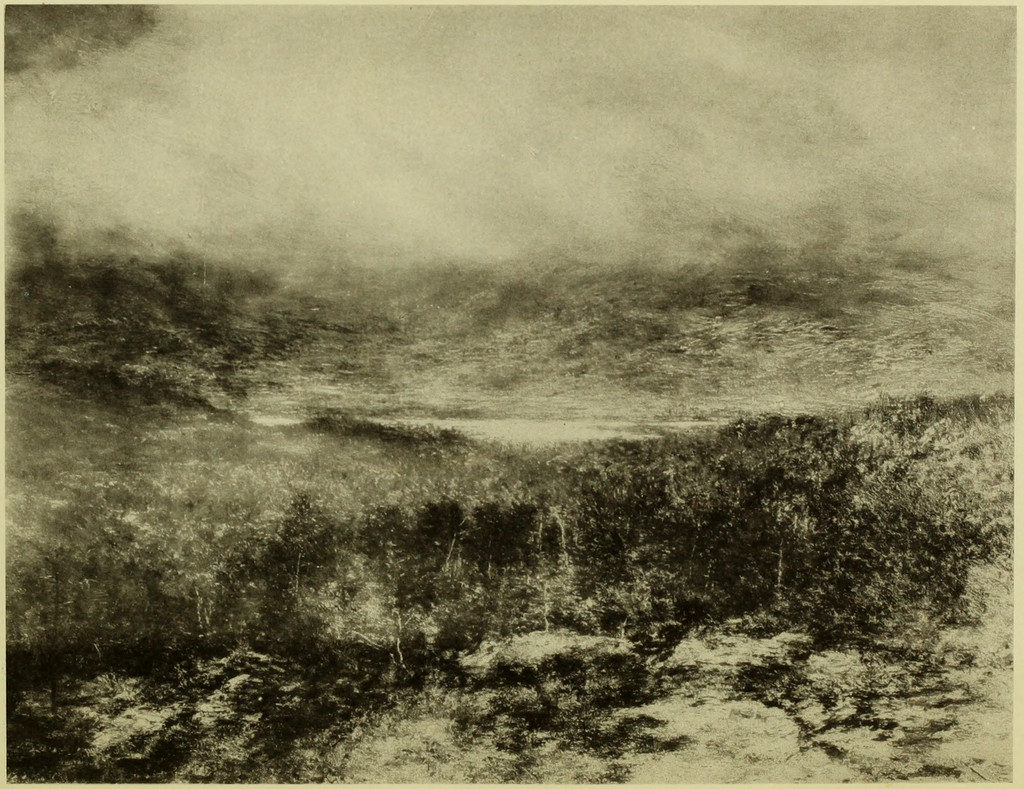
Harp of the Winds began in charcoal on canvas in New York in 1893 and was finished in Saint Paul in 1895. The interval between French observation and American completion helps explain why memory and revision matter so much in Martin’s style and technique . The remembered place remained open to compositional decisions made much later. [3]
The French years brought together coast, countryside, artistic company and a literary household. Their lasting importance can be followed through individual paintings , where buildings, water and trees take different forms. Returning to those works gives the journey its artistic substance, alongside Elizabeth’s unusually particular account of how the Martins lived there.
Artwork records
Browse 58 records from Carroll’s selected 1913 catalogue alongside 25 separately documented object records. Some records concern the same work; this is not a complete lifetime catalogue or a count of 83 unique artworks. [7]
| Name | Date | Medium |
|---|---|---|
| Carroll 1: Saranac Lake (1913 record) | 1860s; exact date not clearly decipherable | Painting — historical catalogue record |
| Carroll 2: Lake George from Bolton (1913 record) | Date not stated | Painting — historical catalogue record |
| Carroll 3: The Iron Mine, Port Henry, N. Y. (1913 record) | Date not stated | Painting — historical catalogue record |
| Carroll 4: On Lake Ontario (1913 record) | Probably late 1860s | Painting — historical catalogue record |
| Carroll 5: The Giant of the Valley (1913 record) | 1865 | Painting — historical catalogue record |
| Carroll 6: An Adirondack Lake (1913 record) | Date not stated | Painting — historical catalogue record |
| Carroll 7: Winter in Normandy (1913 record) | Date not stated | Watercolor — historical catalogue record |
| Carroll 8: Across the Lake (1913 record) | Date not stated | Painting — historical catalogue record |
| Carroll 9: New Hampshire Landscape (1913 record) | Late 1860s | Painting — historical catalogue record |
| Carroll 10: Long Lake (1913 record) | Date not stated | Painting — historical catalogue record |
| Carroll 11: Salt Meadows (1913 record) | Mid 1880s | Painting — historical catalogue record |
| Carroll 12: Autumn on the Susquehanna (1913 record) | 1879 | Painting — historical catalogue record |
| Carroll 13: Ontario Sand Dunes (1913 record) | 1887 | Painting — historical catalogue record |
| Carroll 14: Late Autumn (1913 record) | About 1877 | Painting — historical catalogue record |
| Carroll 15: Early Spring (1913 record) | About 1877; companion dating | Painting — historical catalogue record |
| Carroll 16: Raquette Lake (1913 record) | 1869 | Painting — historical catalogue record |
| Carroll 17: A Glimpse of the Sea (1913 record) | Date not established; historical suggestion disputed | Painting — historical catalogue record |
| Carroll 18: Headwaters of the Hudson (1913 record) | 1869 | Painting — historical catalogue record |
| Carroll 19: Autumn in the Adirondacks (1913 record) | 1871 | Painting — historical catalogue record |
| Carroll 20: Richmond on Thames (1913 record) | About 1877; later alterations | Painting — historical catalogue record |
| Carroll 21: Saranac Lake (1913 record) | 1878 | Painting — historical catalogue record |
| Carroll 22: Windsor Castle (1913 record) | Finished 1878 | Painting — historical catalogue record |
| Carroll 23: L’Anse St. Étienne, Saguenay (1913 record) | 25 July 1879 | Watercolor — historical catalogue record |
| Carroll 24: L’Anse aux Basses Pierres (1913 record) | Date not stated | Watercolor — historical catalogue record |
| Carroll 25: Blossoming Trees (1913 record) | Mid 1880s | Painting — historical catalogue record |
| Carroll 26: On the Seine (1913 record) | Date not stated; later years suggested | Painting — historical catalogue record |
| Carroll 27: The Dunes (1913 record) | 1883 | Watercolor — historical catalogue record |
| Carroll 28: The Moonlit Pond—Honfleur (1913 record) | Date not stated | Painting — historical catalogue record |
| Carroll 29: Normandy Landscape (1913 record) | Date not stated | Painting — historical catalogue record |
| Carroll 30: The Lighthouse, Honfleur (1913 record) | Date not stated | Painting — historical catalogue record |
| Carroll 31: Ruby Strong—Normandy (1913 record) | Date not stated | Painting — historical catalogue record |
| Carroll 32: Sand Dunes, Lake Ontario (1913 record) | 1874 | Painting — historical catalogue record |
| Carroll 33: Low Tide, Honfleur (1913 record) | Date not stated | Painting — historical catalogue record |
| Carroll 34: Evening on the Seine (1913 record) | Date not stated | Painting — historical catalogue record |
| Carroll 35: On the Seine (1913 record) | Date not stated | Painting — historical catalogue record |
| Carroll 36: On the Hudson (1913 record) | 1881 | Painting — historical catalogue record |
| Carroll 37: A Forest Brook (1913 record) | 1881 | Painting — historical catalogue record |
| Carroll 38: Coast Meadows, St. Sauveur (1913 record) | 1881 | Painting — historical catalogue record |
| Carroll 39: Landscape (1913 record) | 1883 | Painting — historical catalogue record |
| Carroll 40: An Adirondack Lake—Lake Sanford (1913 record) | 1883 | Painting — historical catalogue record |
| Carroll 41: Lower Ausable Pond (1913 record) | 1868 | Painting — historical catalogue record |
| Carroll 42: December Morning in Normandy (1913 record) | 1883 | Painting — historical catalogue record |
| Carroll 43: Low Tide—Villerville (1913 record) | 1884 | Painting — historical catalogue record |
| Carroll 44: Lake George (1913 record) | 1884 | Painting — historical catalogue record |
| Carroll 45: Crepuscule—Montvilliers (1913 record) | 1885 | Painting — historical catalogue record |
| Carroll 46: The Sea at Villerville (1913 record) | 1885 | Painting — historical catalogue record |
| Carroll 47: Golden Sands (1913 record) | Date not stated | Painting — historical catalogue record |
| Carroll 48: The Meadow Brook (1913 record) | 1887 | Painting — historical catalogue record |
| Carroll 49: The Sun Worshippers (1913 record) | After the 1886 return to New York | Painting — historical catalogue record |
| Carroll 50: South Side of Long Island (1913 record) | 1894 | Painting — historical catalogue record |
| Carroll 51: Criqueboeuf Church (1913 record) | 1893 | Painting — historical catalogue record |
| Carroll 52: Normandy Farm (1913 record) | 1895 | Painting — historical catalogue record |
| Carroll 53: On the Mississippi (1913 record) | Toward the close of the artist’s life | Painting — historical catalogue record |
| Carroll 54: Newport Neck (1913 record) | 1893 | Painting — historical catalogue record |
| Carroll 55: A Newport Landscape (1913 record) | 1896 | Painting — historical catalogue record |
| Carroll 56: A Distant View of Caen (1913 record) | Date not stated; exhibited 1894 | Painting — historical catalogue record |
| Carroll 57: The Brook (1913 record) | 1894 | Painting — historical catalogue record |
| Carroll 58: Normandy Trees (1913 record) | Date not stated | Painting — historical catalogue record |
| View on the Seine: Harp of the Winds | 1893–95 | Oil on canvas |
| The Iron Mine, Port Henry, New York | About 1862 | Oil on canvas mounted on fiberboard |
| Wild Coast, Newport | 1889 | oil on canvas |
| In the Housatonic Valley (attributed to Homer Dodge Martin) | late 1850s | oil on canvas |
| Sand Dunes, Lake Ontario | c. 1874 | Possibly black crayon on paper |
| Adirondacks | 1868 | Pencil drawing |
| Landscape | 1896 | Watercolor |
| Near Newport | mid-1800s | Watercolor |
| Effect of Trees | About 1879 | Oil on canvas |
| Behind Dunes, Lake Ontario | 1883–87 | Oil on canvas |
| Old Manor of Criqueboeuf | About 1882–92 | Oil on canvas |
| Upper Ausable Lake | 1868 | Oil on canvas |
| Wild Coast, Newport (Smithsonian version) | About 1885–95 | Oil on canvas |
| On the Seine | About 1895 | Oil on canvas |
| The Lighthouse, Honfleur | Date not supplied by museum | Oil on wood panel |
| The White Mountains from Randolph Hill (Wellin canvas) | 1866–67 | Oil on canvas |
| Old Crossing, Otter Tail River | 1871 | Black chalk touched with white chalk on paper |
| Landscape with Poplars | Date not supplied by museum | Oil on canvas |
| Normandy Coast | 1884 | Oil on board |
| Criqueboeuf Church, Normandy | 1893 | Oil on canvas |
| Evening on the Thames | About 1876 | Oil on canvas |
| Hudson River | 1860 | Graphite drawing on wove paper |
| The White Mountains, from Randolph Hill (formerly Met canvas) | About 1862–68; later revisions | Oil on canvas |
| Westchester Hills | About 1887 | Oil painting — historical accounts |
| Adirondack Scenery | 1895 | Oil painting — historical accounts |
Frequently Asked Questions
They spent nineteen months at Villerville, according to Elizabeth, and then lived at Honfleur before returning to America in 1886. [1]
No such identification is established. The 2020 photograph supplies regional context for a place where the Martins lived. [5]
Discussion
Look again at the images and ideas explored in Homer Dodge Martin in France and Normandy. These editorial prompts invite your observations.
Reader Insights
Compare the lighthouse with the church’s reflection. How does each building organize the surrounding space?
Consider Elizabeth’s account of French lessons and literary work. Which details most strongly make Normandy feel like a working home?
Look at Normandy Coast beside a later French-subject canvas. How do immediacy and prolonged revision produce different kinds of view?
Join the Conversation
Share a detail, comparison or question about Homer Dodge Martin in France and Normandy below.
References
- Elizabeth Gilbert Martin , Homer Martin: A Reminiscence, 1904, particularly pp.21–46. View source
- Frank Jewett Mather Jr. , Homer Martin: Poet in Landscape, 1912, particularly pp.38–39 and43–53. View source
- Natalie Spassky and colleagues , American Paintings in The Metropolitan Museum of Art, Volume II, 1985, Martin section, pp.420–430; published letter excerpt naming Quilleboeuf, p.425. View source
- Brooklyn Museum , Normandy Coast, 1884, 15.281, object record and curatorial account. View source
- Paolo Gamba , Villerville, Normandie, 2020 photograph, CC BY 2.0. View source
- Princeton University Art Museum , The Lighthouse, Honfleur, undated, y1948-3, object record. View source
- Dana H. Carroll , Fifty-Eight Paintings by Homer D. Martin, 1913, church entry no.51 and historical plate. View source
- Los Angeles County Museum of Art , Criqueboeuf Church, Normandy, 1893, M.90.159, object record. View source
- Metropolitan Museum of Art , View on the Seine: Harp of the Winds, 1893–95, 97.32, object record and current curatorial account. View source
- Splash image source.
The coast at Villerville, Normandy, photographed in 2020. This modern view provides geographical context for the village where the Martins lived during the 1880s. Photograph: Paolo Gamba, via Wikimedia Commons. CC BY 2.0 . Resized only; source appearance preserved.
View source