 by
Tom Gurney
Tom Gurney BSc (Hons) is an art history expert with over 20 years experience
Email:
tomgurney1@gmail.com
/ Phone:
+44 7429 011000
Normandy Coast: Introduction
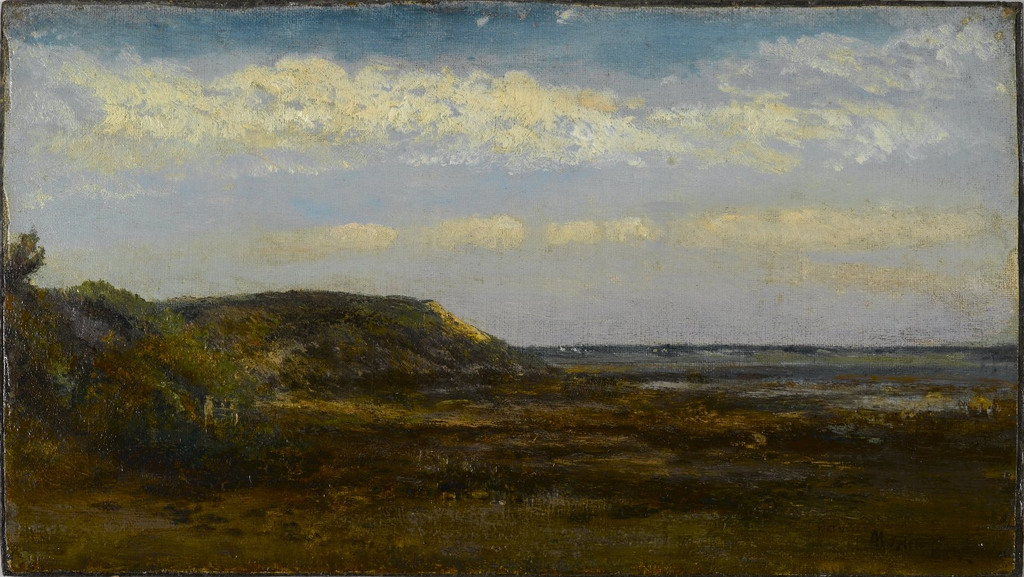
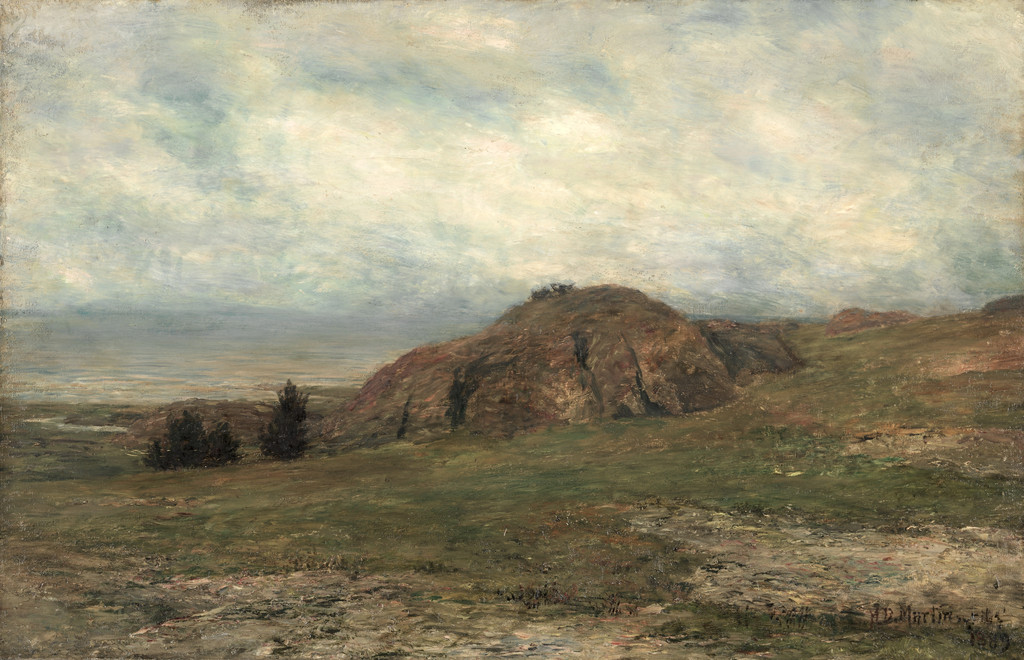
A low bank occupies the left of Homer Dodge Martin’s Normandy Coast , while exposed coastal ground opens toward a distant strip of sea. Above, light clouds spread across a broad blue-gray sky. The small picture depends on this unequal balance: concentrated dark land on one side, a more extensive opening on the other.
Brooklyn Museum dates the work 1884 and identifies it as oil on board, measuring 18.3 by 32.2 centimeters. The museum places it among Martin’s freely brushed outdoor paintings from his Villerville residence. It offers a particularly direct encounter with the French coastal settings that continued to occupy his later work. [1]
At a Glance
- Artist Homer Dodge Martin.
- Title Normandy Coast.
- Date 1884.
- Medium and size Oil on board, 18.3 × 32.2 cm.
- Collection Brooklyn Museum, 15.281.
- Credit Bequest of Charles A. Schieren.
- Signature Lower right, Homer / Martin / 1884, as transcribed by the museum.
- Working context Outdoor painting during the Villerville period, according to Brooklyn’s account.
- Source Brooklyn Museum object record and commentary. [1]
This work across Homer Dodge Martin’s career
The Iron Mine, Port Henry, New York
about 1862Evening on the Thames
about 1876Old Manor of Criqueboeuf
about 1882–92Behind Dunes, Lake Ontario
1883–87Westchester Hills
about 1887Lighthouse, Honfleur
UndatedNotes and sources
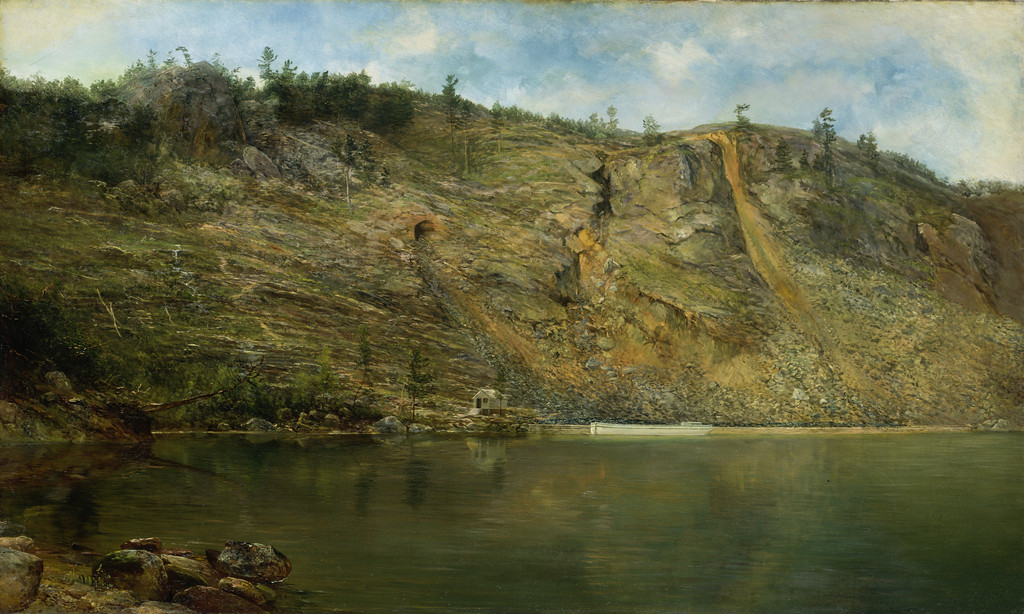
The Iron Mine, Port Henry, New York. An industrial opening, sloping runway and worked cliff stand above Lake Champlain. The Smithsonian connects this landscape with the North’s resources during the Civil War. [2]
Upper Ausable Lake. Foreground reeds and birds lead toward a bright passage of water beneath the mountain wall. The Smithsonian identifies this canvas as Upper Ausable Lake. [3]
Evening on the Thames. A low river horizon, distant buildings and reflected light bring a British subject into Martin’s painting. The museum’s date remains approximate. [4]
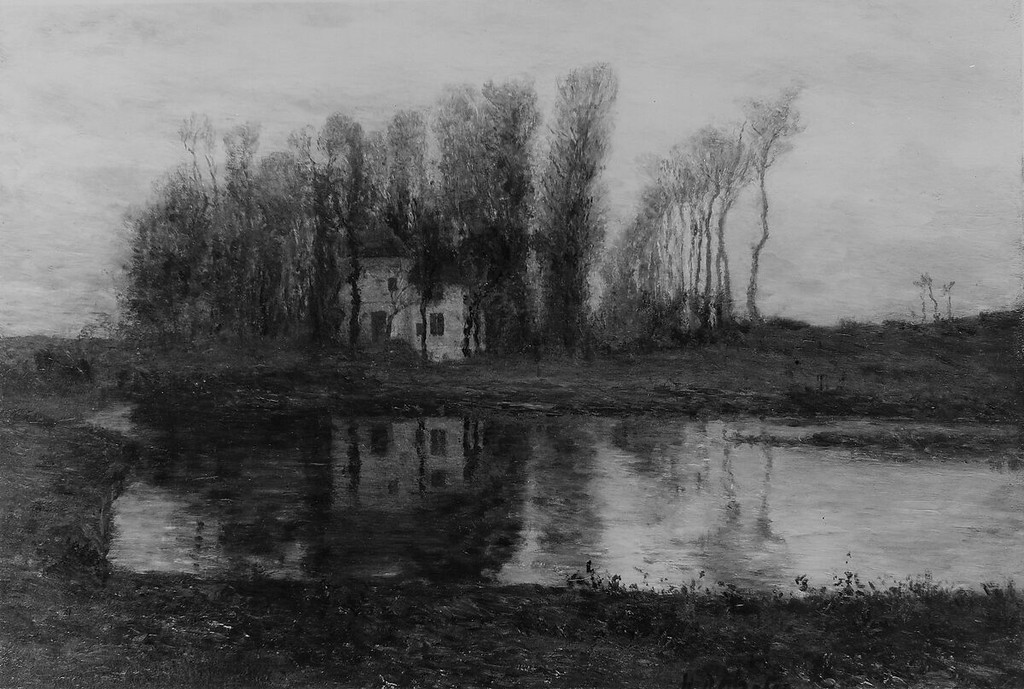
Old Manor of Criqueboeuf. A house and its reflection organize this slowly developed Normandy subject. The broad date range does not mean that Martin painted it without interruption. [5]
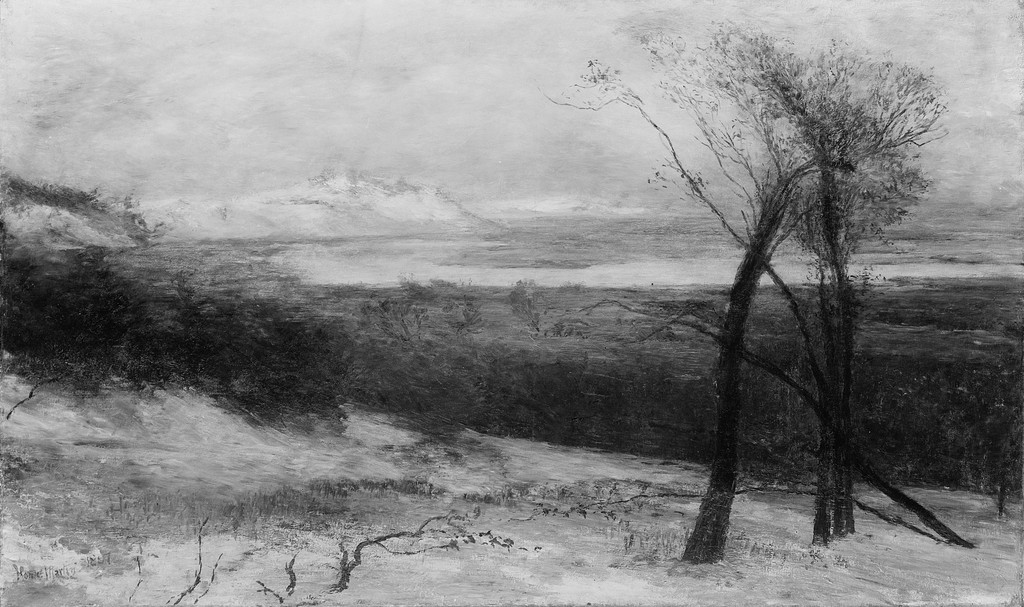
Behind Dunes, Lake Ontario. An American subject developed during the French residence and after the return. The Met records rejection at the 1884 Salon followed by revision in 1887. [6]
Normandy Coast (current article). Freely brushed clouds dominate a small coastal board. Brooklyn places it among outdoor paintings made during Martin’s French residence. [1]
Westchester Hills. Mather describes a large outdoor undertaking at Croton Falls and records its exhibition in 1888. The probable painting date and exhibition year remain distinct. [7]
Wild Coast, Newport. An extensive sky opens above low coastal ground. This dated Cleveland canvas is distinct from the Smithsonian painting bearing the same title. [8]
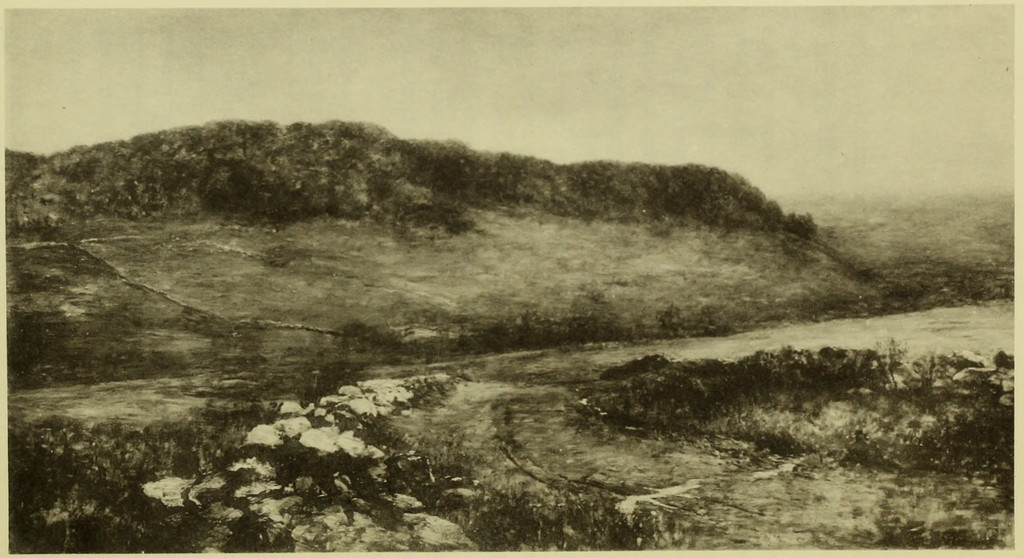
Criqueboeuf Church, Normandy. A church, trees and their reflections give architecture a place within the landscape. The current LACMA record supplies the date; the article reproduces a historical monochrome print. [9]
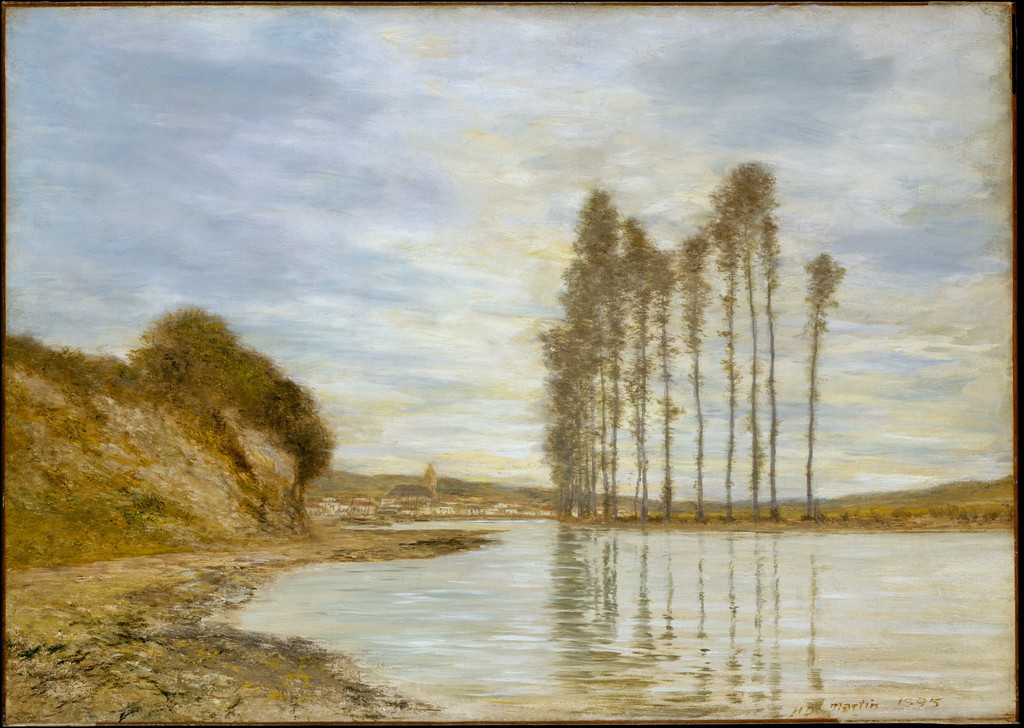
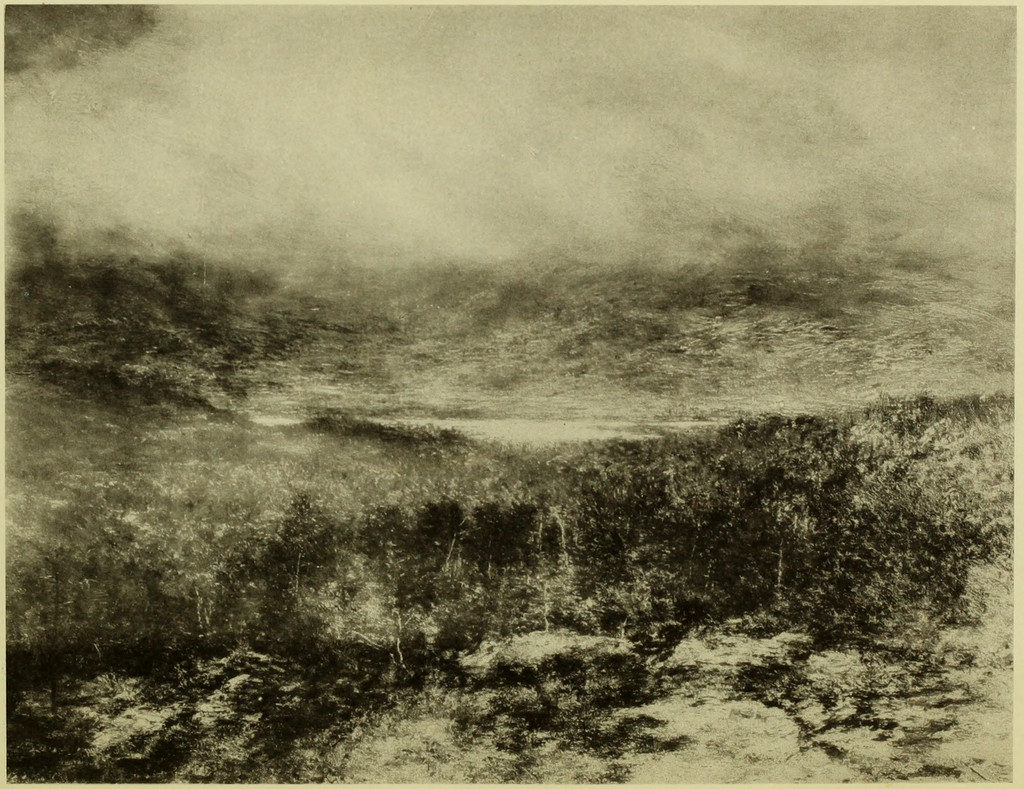
View on the Seine: Harp of the Winds. Poplars and their reflections repeat across the Seine. The Met records a charcoal beginning in New York in 1893 and completion in Saint Paul in 1895. [10]
Adirondack Scenery. Mountain slopes, a foreground ledge and water organize this late return to American scenery. Mather treats it as a major expression of experiences considered over many years. [7]
Lighthouse, Honfleur. Princeton’s small upright wood panel sets the lighthouse within a compact landscape. It remains undated and is distinct from the larger horizontal Century Club canvas. [11]
Contents
- A coastal view on a small board
- The weight of land and the breadth of sky
- Freely brushed clouds and low water
- Villerville and outdoor painting
- Barbizon as encounter rather than formula
- The 1884 signature and museum record
- Normandy compared with Newport
- Annotated details
A coastal view on a small board
The board’s wide proportions suit a landscape built from low forms. The bank’s rounded crest rises only modestly above the distant waterline. Its darker weight is concentrated toward the left, leaving the right side to develop through shallow ground, narrow water passages and distance.
There is no large building or foreground figure to determine the picture’s scale. Instead, the viewer moves from patches of near vegetation toward the low rise, then past it to the horizon. Small pale marks near the distant waterline remain subordinate to the overall coastal view.
The support is small enough for the main relationships to be taken in together. Yet its surface contains changes of direction and density that become more apparent with closer attention. Martin gives the ground sufficient variety to resist becoming one flat dark strip beneath the sky.
That combination of economy and local activity is essential to the picture’s character. The coast is recognizable through a few broad divisions, while the handling keeps those divisions from feeling mechanically separated. The land’s boundaries soften or sharpen as they meet different surrounding tones.
Annotated Details from Normandy Coast
The numbered points identify visible features discussed in this article. Return from each detail to the whole composition. Homer Dodge Martin, Normandy Coast, 1884. Oil on board, 18.3 × 32.2 cm. Brooklyn Museum, 15.281. The museum associates this freely brushed coastal board with outdoor painting during the Villerville residence. Brooklyn Museum, Bequest of Charles A. Schieren. Image source. No known copyright restrictions. Numbers added to a separate overview; detail crops made from the accepted source. No enlargement, recoloring, restoration or reconstruction.
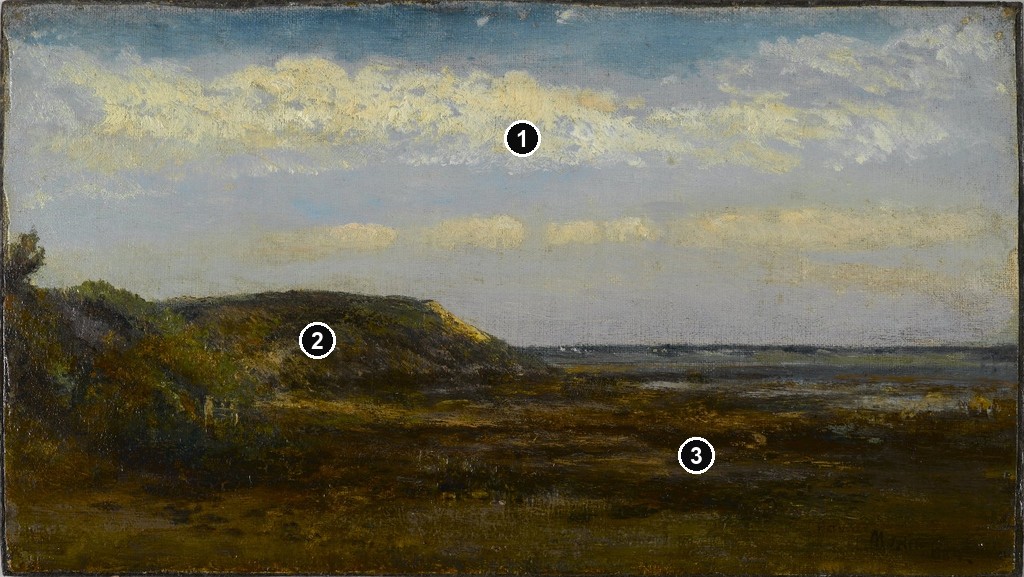
Details from NORMANDY COAST
Compare the cropped details with the complete images above. Notice how their colours, shapes and positions contribute to the larger compositions.
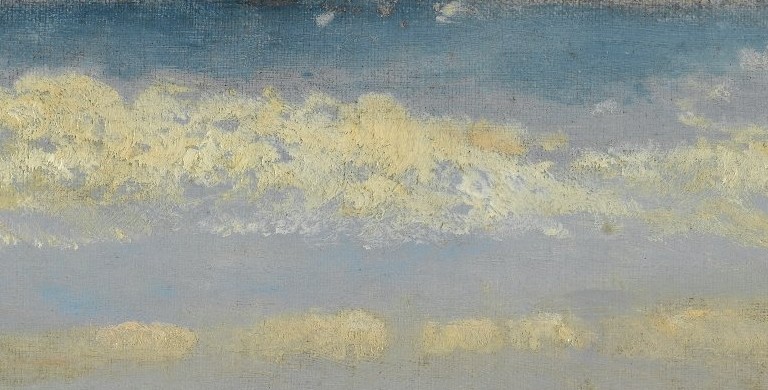
A broken band of pale clouds
Pale strokes gather into a broken band across the blue-gray sky. Their varied edges remain conspicuous above the lower, darker shore.
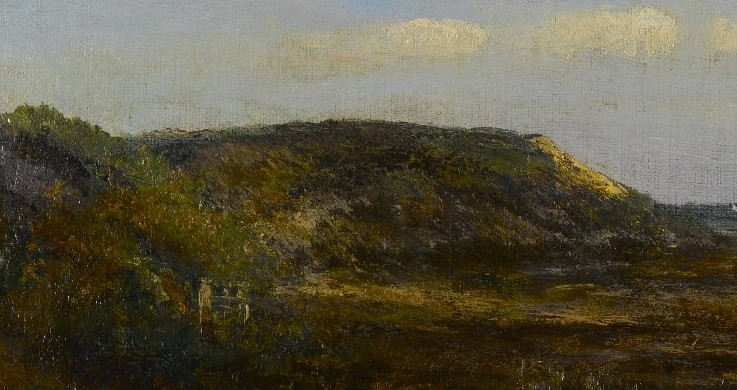
The low rise beside the coast
A rounded rise interrupts the low horizon at the left. Darker vegetation and warmer patches distinguish its surface from the open sky and sea.
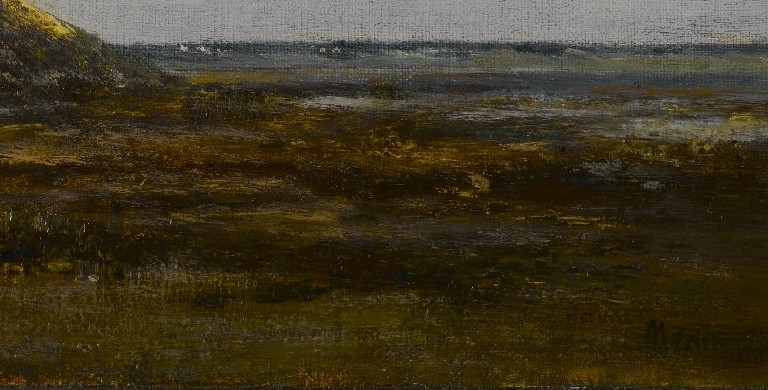
Horizontal marks across the foreground
Broken horizontal strokes spread through the low foreground. Compare their direction with the cloud band above and the darker horizon between them.
The weight of land and the breadth of sky
The left-hand rise establishes the most substantial mass. Warm browns, subdued greens and dark passages accumulate around it, with a lighter edge near its descending right side. The slope directs the eye out toward the open coast rather than drawing it toward a central summit.
The sky provides a different rhythm. Its cloud forms extend across much of the width, while the upper blue-gray field gives them space. A lighter broken band sits above another, lower sequence of pale clouds. Their separation introduces depth and movement beyond the comparatively low horizon.
The unequal distribution of weight prevents a simple division into two equivalent halves. The left is denser, the right more open; the sky extends over both. The viewer can find the same general horizon through those different conditions, connecting the compressed foreground with the farther sea.
The broader paintings overview places such coastal arrangements beside Martin’s mountain and river views. Here the scale of the landforms remains modest, allowing the sky’s breadth and the handling of the ground to carry much of the expressive work.
Freely brushed clouds and low water
The cloud passages are especially revealing. Pale paint gathers into irregular shapes rather than uniformly smooth contours. Smaller touches interrupt their edges, while cooler passages remain visible between them. The sky appears changeable without requiring an identifiable storm or a particular hour.
Below, shallow-looking water and exposed ground interweave in long horizontal passages. The darker near surface contains warmer marks and lighter interruptions, with greater openness toward the right. These differences give the coast an uneven texture while maintaining the general direction toward the sea.
Brooklyn describes the painting’s handling as free and connects it with outdoor work. The visible brushwork makes that account useful, but the historical identification comes from the museum’s commentary. Loose marks alone would not establish exactly where, how quickly or over how many sessions a picture was painted. [1]
The small board also preserves a different scale of encounter from the large Normandy canvases Martin later revised in the studio. In Old Manor of Criqueboeuf , architecture and reflection develop a concentrated mood. Here the broad cloud bands and low shore sustain an open, more rapidly apprehended view.
Villerville and outdoor painting
Elizabeth Gilbert Martin remembered Villerville as a place of coastal walks, fields and neighboring villages, with many visiting painters during the summer and autumn. Her memoir describes a studio arranged for the couple and their residence there for nineteen months. These recollections give the painting a lived setting beyond its title. [12]
Mather’s study likewise treats the Normandy years as a period of intensified attention to atmosphere and color. He draws on Elizabeth’s descriptions of sea, headlands, uplands and the broad Norman sky. His interpretation connects the region’s varied surroundings with Martin’s changing pictorial interests. [7]
The modern photograph by Paolo Gamba, taken in 2020, provides another encounter with the Villerville coast. A green bank recedes beside the beach, waves enter from the right and clouds spread across a large sky. The image shows a contemporary coastal setting, rather than Martin’s exact viewpoint or an unchanged nineteenth-century shore. [13]
The difference between photograph and painting is useful. The photograph’s advancing water and receding shoreline make its depth readily traceable; Martin’s board compresses the ground into broader horizontal and sloping passages. Both contain land, water and sky, but their proportions and routes through space remain distinct.
The photograph supplies geographical context without determining how the painting must be read. Its waves do not date Martin’s tide, and its weather does not identify his. The comparison instead encourages attention to the choices through which a real coast becomes a particular image.
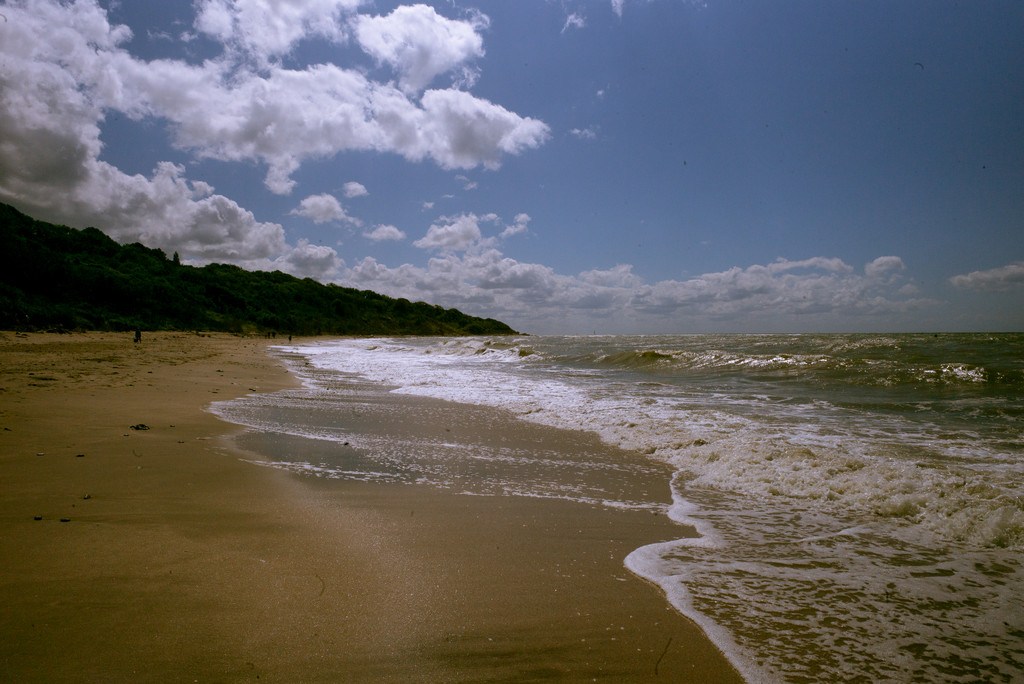
Paolo Gamba, Villerville, Normandie, 2020. Modern coastal photograph showing bank, beach, sea and sky. Regional context only; no exact match to Martin’s1884viewpoint is established. Photograph: Paolo Gamba, via Wikimedia Commons.
Image source
.
CC BY 2.0
. Resized only; source appearance preserved.
Watch: Homer Dodge Martin
Start with Martin’s Normandy Landscape, then explore the wider Hudson River School tradition in which he began.
Homer Dodge Martin | Normandy Landscape
The Castellani Art Museum introduces Martin’s Normandy Landscape.
Watch on YouTubeBarbizon as encounter rather than formula
Brooklyn connects Martin’s increasingly loose manner with the French Barbizon painters and records his sketching around Barbizon in 1876. This encounter preceded the later Villerville residence. The museum’s account therefore describes a developing interest, rather than a style acquired suddenly in the year of Normandy Coast . [1]
The Smithsonian’s biography also places his work in relation to Corot and Barbizon landscape, alongside other influences and a growing concern with softened forms. Such associations help locate the painting within a broader career. They do not establish formal instruction from Corot or require every loose passage to come from one identifiable model. [14]
Mather describes the Normandy period as a change from careful definition toward broader combinations of paint and a stronger emphasis on tone. His account is a historical critical interpretation. In this board, it can be considered alongside the visible relationship between dark earth, lighter clouds and cool intervening sky. [7]
Mather also found the Normandy setting more visibly shaped by habitation than Martin’s earlier mountain subjects. Yet he observed that the painter often limited human presence to distant villages, buildings or other small signs. The coastal board can be approached within that distinction: the expanse remains the principal subject even where small marks punctuate its distant edge. [7]
This emphasis changes the kind of attention the scene invites. Instead of following a laborer or a boat through a clear action, the viewer follows the bank’s slope, the waterline and the succession of clouds. The inhabited region supplies the setting, while the arrangement keeps weather, ground and distance in the foreground of perception.
Style and technique considers these sources beside Martin’s drawings and studio practice. Normandy Coast contributes an important qualification: the painter associated with recollection and prolonged revision also made works the owning museum identifies with direct outdoor experience.
The 1884 signature and museum record
Brooklyn transcribes the lower-right inscription as Homer, Martin and 1884 on successive lines. That dated inscription gives the small board a firmer chronological position than some undated coastal works. Its accession number, 15.281, and the Schieren bequest identify the particular object discussed here. [1]
The year also lies around a change of residence. Mather places the move from Villerville to Honfleur in early summer 1884. Brooklyn associates this painting with Villerville, but the year alone does not establish a month or a precise sequence among every coastal study made during that transition. [7] [1]
The Normandy account follows the wider sequence of places. For this picture, the museum’s subject, support and dated signature keep the identity clear while the exact shore position remains open. Its dated surface and open horizon bring a particular moment of work into a landscape whose larger extent remains only partly visible.
Normandy compared with Newport
Cleveland’s Wild Coast, Newport is a larger oil on canvas dated 1889. Its principal rocky rise occupies the center, with open water appearing toward the left. Brooklyn’s board places its rise farther left and allows the coast to open toward the right. [8]
The comparison reveals a continuing interest in low coastal forms beneath substantial skies. It also makes the differences clear: the Newport ridge is more prominent, while the French board carries a flatter, more extended passage toward the horizon. Neither picture is adequately described by locality alone.
The Newport article follows its separate versions and history. Beside it, Normandy Coast retains the immediacy of a small painted support and the distinctive balance of its dark left bank with an open right-hand distance. Its freshness resides in the relationship between those forms and the marks through which Martin gives them shape.
Homer Dodge Martin, Wild Coast, Newport, 1889. Oil on canvas, 59 × 91.6 cm. Cleveland Museum of Art, 1923.1118. The more central rise provides a comparison with Normandy Coast’s left-hand bank. The Cleveland Museum of Art, Gift of Leonard C. Hanna Jr.
Image source
.
CC0 / Public domain
. Resized only; source appearance preserved.
Artwork records
Browse 58 records from Carroll’s selected 1913 catalogue alongside 25 separately documented object records. Some records concern the same work; this is not a complete lifetime catalogue or a count of 83 unique artworks. [15]
| Name | Date | Medium |
|---|---|---|
| Carroll 1: Saranac Lake (1913 record) | 1860s; exact date not clearly decipherable | Painting — historical catalogue record |
| Carroll 2: Lake George from Bolton (1913 record) | Date not stated | Painting — historical catalogue record |
| Carroll 3: The Iron Mine, Port Henry, N. Y. (1913 record) | Date not stated | Painting — historical catalogue record |
| Carroll 4: On Lake Ontario (1913 record) | Probably late 1860s | Painting — historical catalogue record |
| Carroll 5: The Giant of the Valley (1913 record) | 1865 | Painting — historical catalogue record |
| Carroll 6: An Adirondack Lake (1913 record) | Date not stated | Painting — historical catalogue record |
| Carroll 7: Winter in Normandy (1913 record) | Date not stated | Watercolor — historical catalogue record |
| Carroll 8: Across the Lake (1913 record) | Date not stated | Painting — historical catalogue record |
| Carroll 9: New Hampshire Landscape (1913 record) | Late 1860s | Painting — historical catalogue record |
| Carroll 10: Long Lake (1913 record) | Date not stated | Painting — historical catalogue record |
| Carroll 11: Salt Meadows (1913 record) | Mid 1880s | Painting — historical catalogue record |
| Carroll 12: Autumn on the Susquehanna (1913 record) | 1879 | Painting — historical catalogue record |
| Carroll 13: Ontario Sand Dunes (1913 record) | 1887 | Painting — historical catalogue record |
| Carroll 14: Late Autumn (1913 record) | About 1877 | Painting — historical catalogue record |
| Carroll 15: Early Spring (1913 record) | About 1877; companion dating | Painting — historical catalogue record |
| Carroll 16: Raquette Lake (1913 record) | 1869 | Painting — historical catalogue record |
| Carroll 17: A Glimpse of the Sea (1913 record) | Date not established; historical suggestion disputed | Painting — historical catalogue record |
| Carroll 18: Headwaters of the Hudson (1913 record) | 1869 | Painting — historical catalogue record |
| Carroll 19: Autumn in the Adirondacks (1913 record) | 1871 | Painting — historical catalogue record |
| Carroll 20: Richmond on Thames (1913 record) | About 1877; later alterations | Painting — historical catalogue record |
| Carroll 21: Saranac Lake (1913 record) | 1878 | Painting — historical catalogue record |
| Carroll 22: Windsor Castle (1913 record) | Finished 1878 | Painting — historical catalogue record |
| Carroll 23: L’Anse St. Étienne, Saguenay (1913 record) | 25 July 1879 | Watercolor — historical catalogue record |
| Carroll 24: L’Anse aux Basses Pierres (1913 record) | Date not stated | Watercolor — historical catalogue record |
| Carroll 25: Blossoming Trees (1913 record) | Mid 1880s | Painting — historical catalogue record |
| Carroll 26: On the Seine (1913 record) | Date not stated; later years suggested | Painting — historical catalogue record |
| Carroll 27: The Dunes (1913 record) | 1883 | Watercolor — historical catalogue record |
| Carroll 28: The Moonlit Pond—Honfleur (1913 record) | Date not stated | Painting — historical catalogue record |
| Carroll 29: Normandy Landscape (1913 record) | Date not stated | Painting — historical catalogue record |
| Carroll 30: The Lighthouse, Honfleur (1913 record) | Date not stated | Painting — historical catalogue record |
| Carroll 31: Ruby Strong—Normandy (1913 record) | Date not stated | Painting — historical catalogue record |
| Carroll 32: Sand Dunes, Lake Ontario (1913 record) | 1874 | Painting — historical catalogue record |
| Carroll 33: Low Tide, Honfleur (1913 record) | Date not stated | Painting — historical catalogue record |
| Carroll 34: Evening on the Seine (1913 record) | Date not stated | Painting — historical catalogue record |
| Carroll 35: On the Seine (1913 record) | Date not stated | Painting — historical catalogue record |
| Carroll 36: On the Hudson (1913 record) | 1881 | Painting — historical catalogue record |
| Carroll 37: A Forest Brook (1913 record) | 1881 | Painting — historical catalogue record |
| Carroll 38: Coast Meadows, St. Sauveur (1913 record) | 1881 | Painting — historical catalogue record |
| Carroll 39: Landscape (1913 record) | 1883 | Painting — historical catalogue record |
| Carroll 40: An Adirondack Lake—Lake Sanford (1913 record) | 1883 | Painting — historical catalogue record |
| Carroll 41: Lower Ausable Pond (1913 record) | 1868 | Painting — historical catalogue record |
| Carroll 42: December Morning in Normandy (1913 record) | 1883 | Painting — historical catalogue record |
| Carroll 43: Low Tide—Villerville (1913 record) | 1884 | Painting — historical catalogue record |
| Carroll 44: Lake George (1913 record) | 1884 | Painting — historical catalogue record |
| Carroll 45: Crepuscule—Montvilliers (1913 record) | 1885 | Painting — historical catalogue record |
| Carroll 46: The Sea at Villerville (1913 record) | 1885 | Painting — historical catalogue record |
| Carroll 47: Golden Sands (1913 record) | Date not stated | Painting — historical catalogue record |
| Carroll 48: The Meadow Brook (1913 record) | 1887 | Painting — historical catalogue record |
| Carroll 49: The Sun Worshippers (1913 record) | After the 1886 return to New York | Painting — historical catalogue record |
| Carroll 50: South Side of Long Island (1913 record) | 1894 | Painting — historical catalogue record |
| Carroll 51: Criqueboeuf Church (1913 record) | 1893 | Painting — historical catalogue record |
| Carroll 52: Normandy Farm (1913 record) | 1895 | Painting — historical catalogue record |
| Carroll 53: On the Mississippi (1913 record) | Toward the close of the artist’s life | Painting — historical catalogue record |
| Carroll 54: Newport Neck (1913 record) | 1893 | Painting — historical catalogue record |
| Carroll 55: A Newport Landscape (1913 record) | 1896 | Painting — historical catalogue record |
| Carroll 56: A Distant View of Caen (1913 record) | Date not stated; exhibited 1894 | Painting — historical catalogue record |
| Carroll 57: The Brook (1913 record) | 1894 | Painting — historical catalogue record |
| Carroll 58: Normandy Trees (1913 record) | Date not stated | Painting — historical catalogue record |
| View on the Seine: Harp of the Winds | 1893–95 | Oil on canvas |
| The Iron Mine, Port Henry, New York | About 1862 | Oil on canvas mounted on fiberboard |
| Wild Coast, Newport | 1889 | oil on canvas |
| In the Housatonic Valley (attributed to Homer Dodge Martin) | late 1850s | oil on canvas |
| Sand Dunes, Lake Ontario | c. 1874 | Possibly black crayon on paper |
| Adirondacks | 1868 | Pencil drawing |
| Landscape | 1896 | Watercolor |
| Near Newport | mid-1800s | Watercolor |
| Effect of Trees | About 1879 | Oil on canvas |
| Behind Dunes, Lake Ontario | 1883–87 | Oil on canvas |
| Old Manor of Criqueboeuf | About 1882–92 | Oil on canvas |
| Upper Ausable Lake | 1868 | Oil on canvas |
| Wild Coast, Newport (Smithsonian version) | About 1885–95 | Oil on canvas |
| On the Seine | About 1895 | Oil on canvas |
| The Lighthouse, Honfleur | Date not supplied by museum | Oil on wood panel |
| The White Mountains from Randolph Hill (Wellin canvas) | 1866–67 | Oil on canvas |
| Old Crossing, Otter Tail River | 1871 | Black chalk touched with white chalk on paper |
| Landscape with Poplars | Date not supplied by museum | Oil on canvas |
| Normandy Coast | 1884 | Oil on board |
| Criqueboeuf Church, Normandy | 1893 | Oil on canvas |
| Evening on the Thames | About 1876 | Oil on canvas |
| Hudson River | 1860 | Graphite drawing on wove paper |
| The White Mountains, from Randolph Hill (formerly Met canvas) | About 1862–68; later revisions | Oil on canvas |
| Westchester Hills | About 1887 | Oil painting — historical accounts |
| Adirondack Scenery | 1895 | Oil painting — historical accounts |
Frequently Asked Questions
Brooklyn dates it 1884 and transcribes the same year in its lower-right inscription. [1]
Brooklyn’s commentary identifies it among Martin’s freely brushed outdoor paintings from the Villerville residence. [1]
This work is oil on board, measuring 18.3 by 32.2 centimeters. [1]
No exact viewpoint match is established. Gamba’s 2020 Villerville photograph supplies modern regional context. [13]
The museum credit is the Bequest of Charles A. Schieren. [1]
Discussion
Look again at the images and ideas explored in Normandy Coast. These editorial prompts invite your observations.
Reader Insights
Compare the dark bank with the pale cloud bands. Which area first determines your route through the picture?
Look at the modern photograph and the board. How does the distribution of open water change their sense of depth?
Compare Normandy with Newport. What changes when the main rise moves closer to the center?
Join the Conversation
Share a detail, comparison or question about Normandy Coast below.
References
- Brooklyn Museum , Normandy Coast, 1884, 15.281, current indexed object record and curatorial account. View source
- Smithsonian American Art Museum, The Iron Mine, Port Henry, New York, 1910.9.11. View source
- Smithsonian American Art Museum, Upper Ausable Lake, 1909.7.44. View source
- Smithsonian American Art Museum, Evening on the Thames,1909.7.45. View source
- Metropolitan Museum of Art, Old Manor of Criqueboeuf, 22.117. View source
- Metropolitan Museum of Art, Behind Dunes, Lake Ontario, 06.1287. View source
- Frank Jewett Mather Jr. , Homer Martin: Poet in Landscape, 1912, pp.26–27,47–51, Normandy development, regional descriptions and 1884 move. View source
- Cleveland Museum of Art , Wild Coast, Newport, 1889, 1923.1118, object record. View source
- Los Angeles County Museum of Art, Criqueboeuf Church,Normandy,M.90.159. View source
- Metropolitan Museum of Art, View on the Seine: Harp of the Winds, 97.32. View source
- Princeton University Art Museum, The Lighthouse, Honfleur, y1948-3. View source
- Elizabeth Gilbert Martin , Homer Martin: A Reminiscence, 1904, pp.27–35 and43–44, Villerville, painters, residence and studio circumstances. View source
- Paolo Gamba , Villerville, Normandie, 2020 photograph, Wikimedia Commons, CC BY 2.0; regional context, not an identified Martin viewpoint. View source
- Smithsonian American Art Museum , Homer Dodge Martin, artist biographies, Barbizon associations and changing handling. View source
- Dana H. Carroll, Fifty-Eight Paintings by Homer D. Martin, 1913, selected illustrated catalogue. View source
- Splash image source.
Homer Dodge Martin, Normandy Coast, 1884. Oil on board, 18.3 × 32.2 cm. Brooklyn Museum, 15.281. The museum associates this freely brushed coastal board with outdoor painting during the Villerville residence. Brooklyn Museum, Bequest of Charles A. Schieren. No known copyright restrictions . Resized only; source appearance preserved.
View source 1 · View source 2