 by
Tom Gurney
Tom Gurney BSc (Hons) is an art history expert with over 20 years experience
Email:
tomgurney1@gmail.com
/ Phone:
+44 7429 011000
Homer Dodge Martin Drawings and Watercolors: Introduction
Homer Dodge Martin’s works on paper reveal a landscape painter deciding how much a line, a dark passage or a wash of color can carry. They include carefully observed river views, studies of dunes and trees, and a late watercolor that spreads an extensive landscape across a small sheet. Their variety widens an account of his art centered on oil paintings.
Four works offer a useful beginning: Hudson River , Old Crossing, Otter Tail River , Sand Dunes, Lake Ontario and the watercolor Landscape . Each has its own medium, date and physical character. Together they show how the paper’s open surface can remain part of a picture, setting off the marks through which a shore, hill or stretch of water becomes visible.
Four works on paper
At a Glance
- Media represented Graphite, black and white chalk, a drawing catalogued tentatively as black crayon, and watercolor.
- Early example Hudson River, 1860, National Gallery of Art.
- Dated travel record Old Crossing, Otter Tail River, 26 July 1871.
- Recurring subject Sand Dunes, Lake Ontario, about 1874, Cleveland Museum of Art.
- Late watercolor Landscape, 1896, Cleveland Museum of Art.
- Working concerns Contour, mass, light and dark, color and pictorial arrangement.
- Relationship to oils Studies can illuminate working practice without necessarily preparing a particular named painting.
Contents
- Looking at Martin on paper
- Graphite and the 1860 Hudson River sheet
- Chalk, white highlights and the Otter Tail drawing
- Drawing the Ontario dunes
- Watercolor as a separate practice
- From outdoor notes to studio pictures
- Late Landscape and the limits of a title
- Annotated details
Looking at Martin on paper
Start with the distribution of marks. Some sheets concentrate detail within a relatively narrow band, leaving much of the paper open. Others carry color and texture across nearly the whole surface. A drawing can therefore feel spacious through the relation between worked and lightly touched areas, as well as through the landscape it represents.
Then compare the kinds of mark. A fine contour separates a branch from the sky; short overlapping strokes can gather into foliage. A wash can establish a broad interval of ground or weather without describing each object within it. These choices determine the pace of looking, drawing attention toward some features and letting others remain more lightly indicated.
Mather’s 1912 study gives drawing an important place in Martin’s development. He describes early mountain studies made with a firm pencil point and later charcoal notes that gave more emphasis to masses and relationships of light and dark. His account interprets that change as part of a broader search for arrangement and simplicity. [1]
The surviving sheets also have identities beyond that general development. Cleveland’s pencil Adirondacks , for example, is dated 1868 and measures 33 by 52 centimeters. Its regional subject joins the drawings to a long engagement with mountain country, while its medium distinguishes it from the oil canvases made from related experiences. [2]
Annotated Details from Homer Dodge Martin Drawings and Watercolors
The numbered points identify visible features discussed in this article. Return from each detail to the whole composition. The captions keep each work’s identity, date and medium separate.
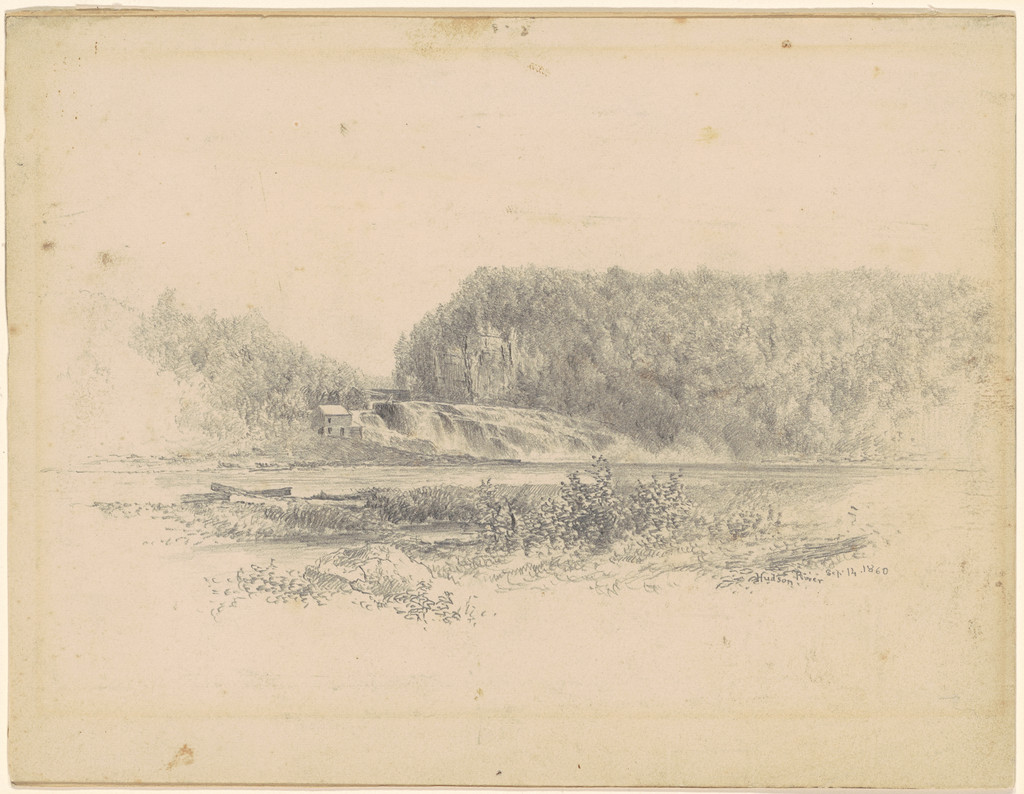
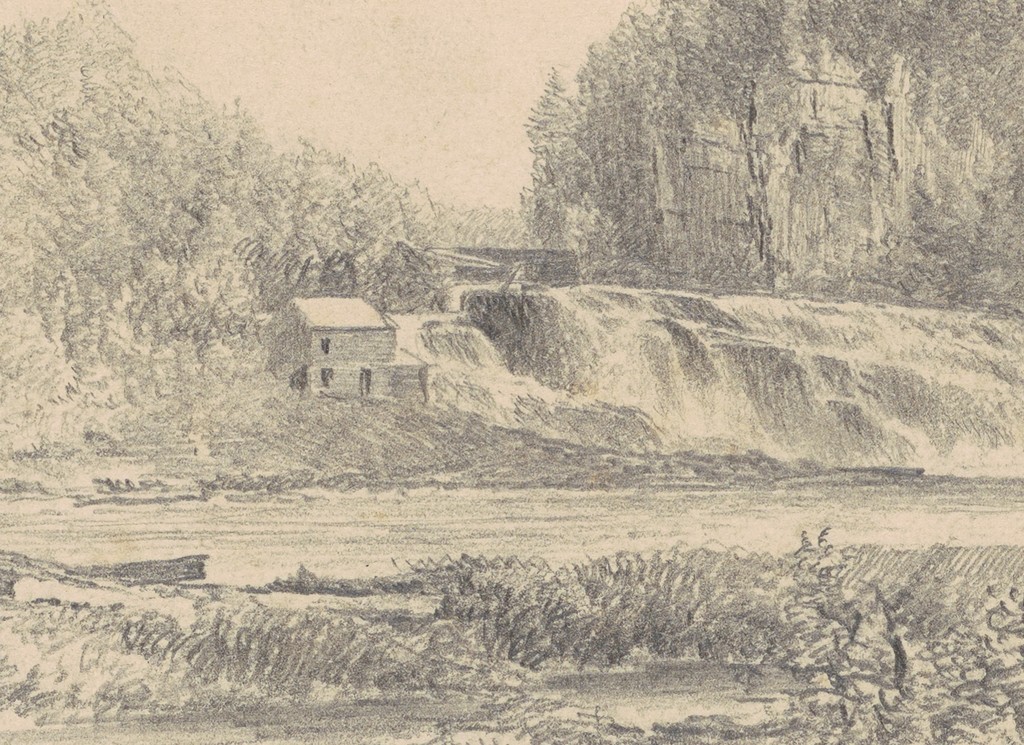
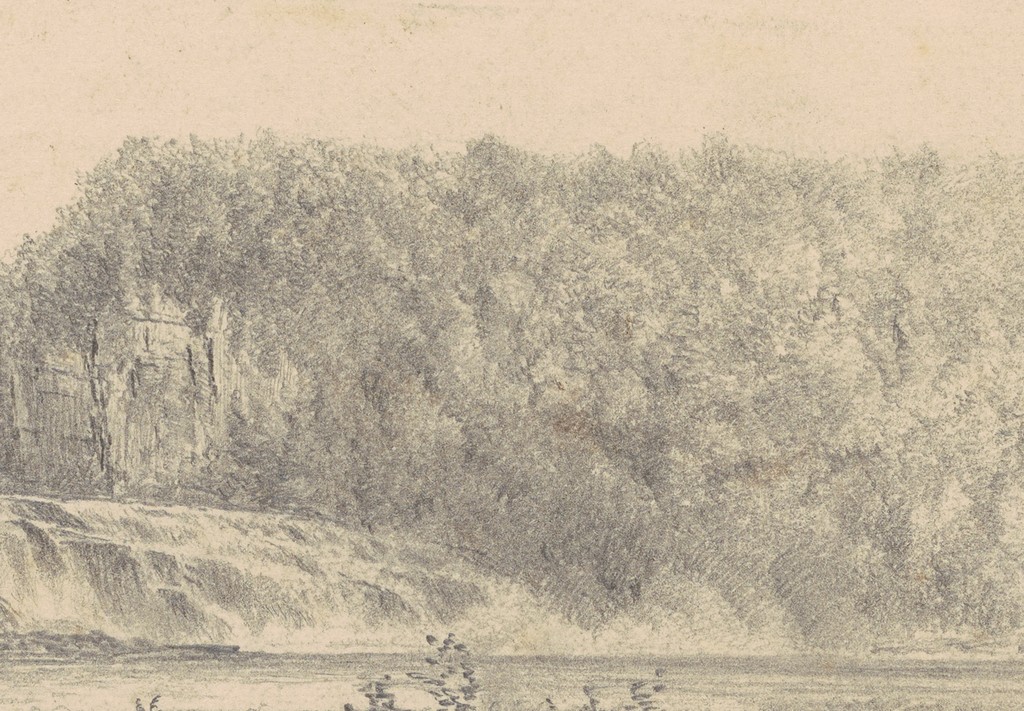
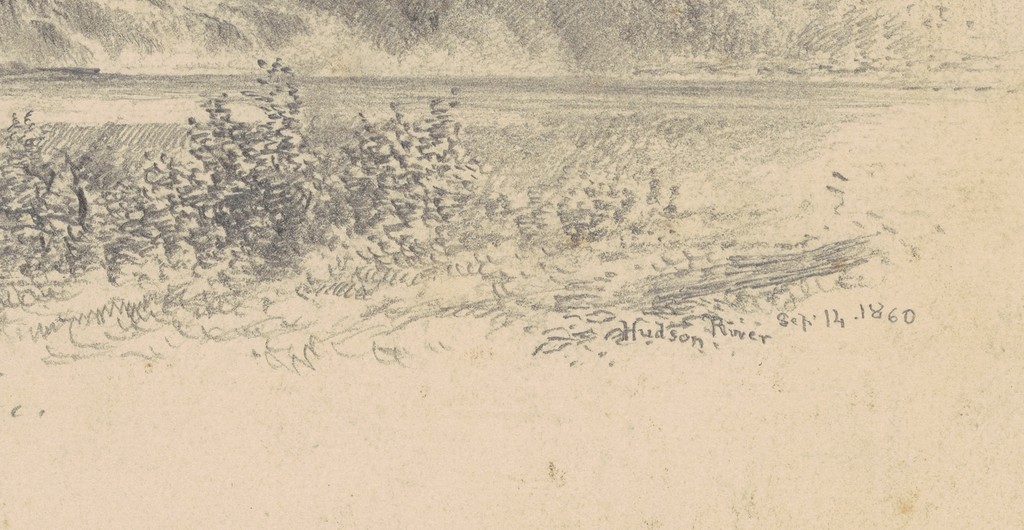
Hudson River - Graphite 1860
Homer Dodge Martin, Hudson River, 1860. Graphite on wove paper, 17.94 × 23.5 cm. The lower-right inscription dates the sheet to 14 September 1860. National Gallery of Art, 2015.19.605. National Gallery of Art. Image source. CC0 / Public domain. Numbers added to a separate overview; detail crops made from the accepted source. No enlargement, recoloring, restoration or reconstruction.
Old Crossing Otter Tail River - Chalk 1871
Homer Dodge Martin, Old Crossing, Otter Tail River, 1871. Black chalk touched with white chalk on brown wove paper, 32.5 × 50.2 cm. National Gallery of Art, 1979.20.83. National Gallery of Art. Image source. CC0 / Public domain. Numbers added to a separate overview; detail crops made from the accepted source. No enlargement, recoloring, restoration or reconstruction.
Sand Dunes Lake Ontario - Cleveland Drawing
Homer Dodge Martin, Sand Dunes, Lake Ontario, about 1874. Possibly black crayon on beige wove paper, 32.6 × 50.4 cm. The medium identification is tentative. Cleveland Museum of Art, 1946.65. The Cleveland Museum of Art. Image source. CC0 / Public domain. Numbers added to a separate overview; detail crops made from the accepted source. No enlargement, recoloring, restoration or reconstruction.
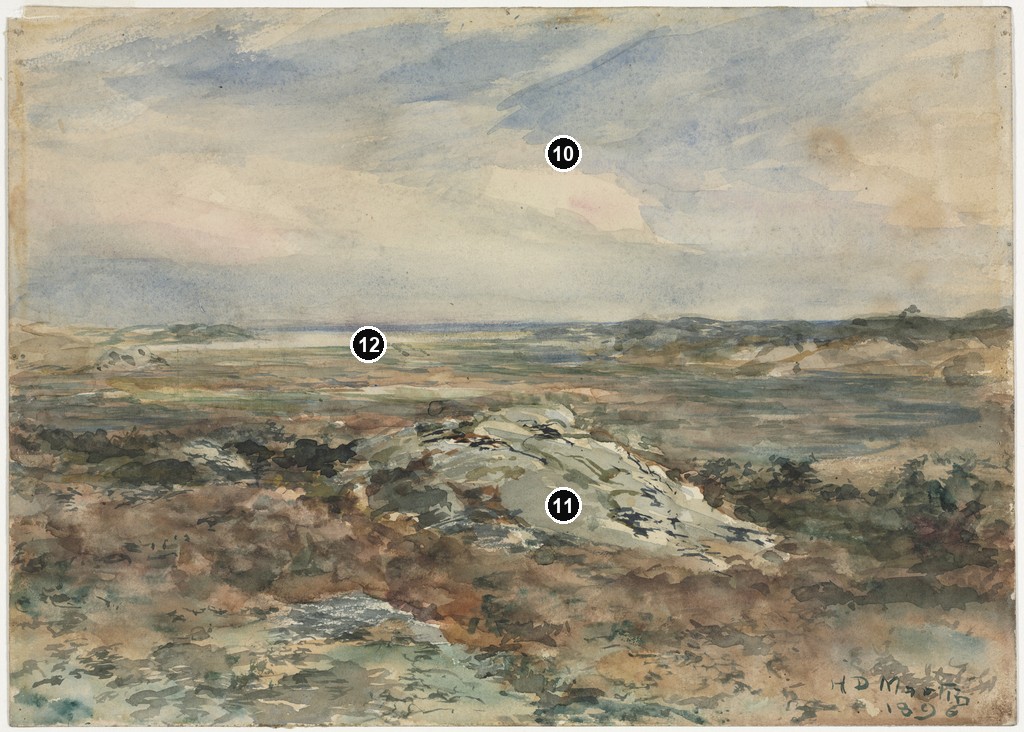
Landscape - Watercolor 1896
Homer Dodge Martin, Landscape, 1896. Watercolor, 24.8 × 34.4 cm. The title does not establish a precise locality. Cleveland Museum of Art, 1946.291. The Cleveland Museum of Art. Image source. CC0 / Public domain. Numbers added to a separate overview; detail crops made from the accepted source. No enlargement, recoloring, restoration or reconstruction.
Details from HOMER DODGE MARTIN DRAWINGS AND WATERCOLORS
Compare the details within each separately identified sheet. Graphite, chalk, the tentatively identified black-crayon drawing and watercolor make different uses of line, wash and open paper.
Hudson River - Graphite 1860
A small building beside the falls
The building’s roof and windows are distinguished beside the descending water. Compact darker marks give this small structure a different character from the looser surrounding foliage.
Wooded rock above the river
Vertical marks define a wooded rock face above the falls. Their density distinguishes this distant bank from the comparatively open paper around the river.
Plants and the dated inscription
Foreground plants lead toward the inscription at the lower right. The sheet identifies the Hudson River and records 14 September 1860, connecting this observed landscape with a specific dated drawing.
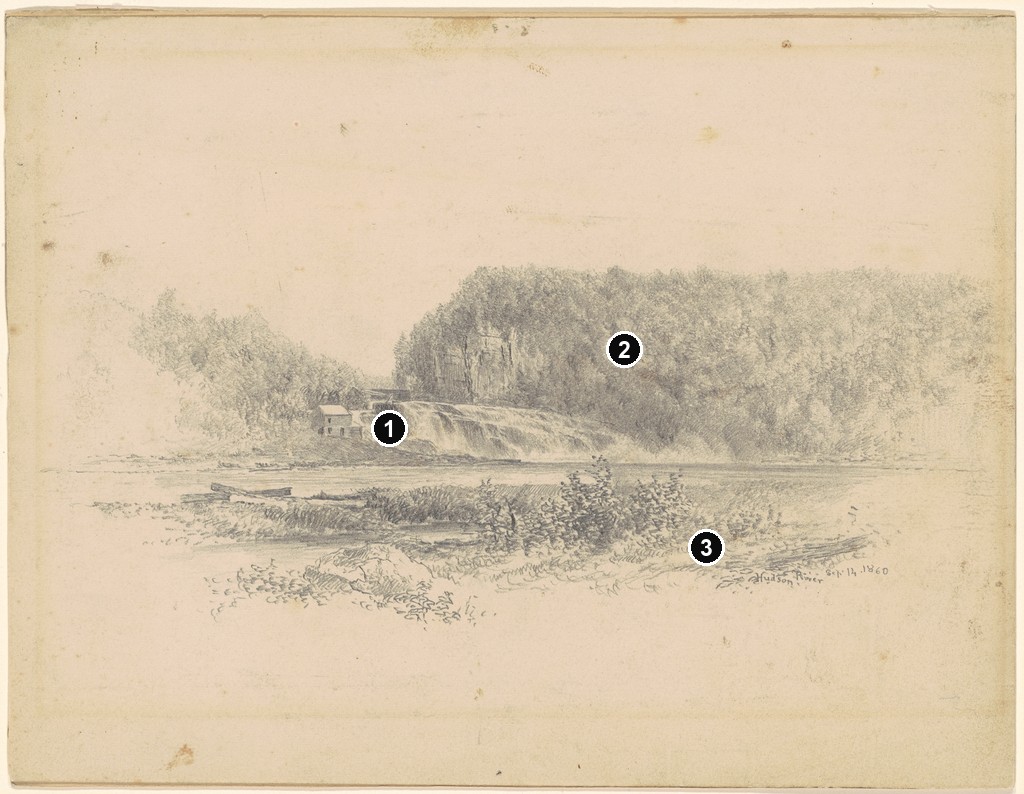
Old Crossing Otter Tail River - Chalk 1871
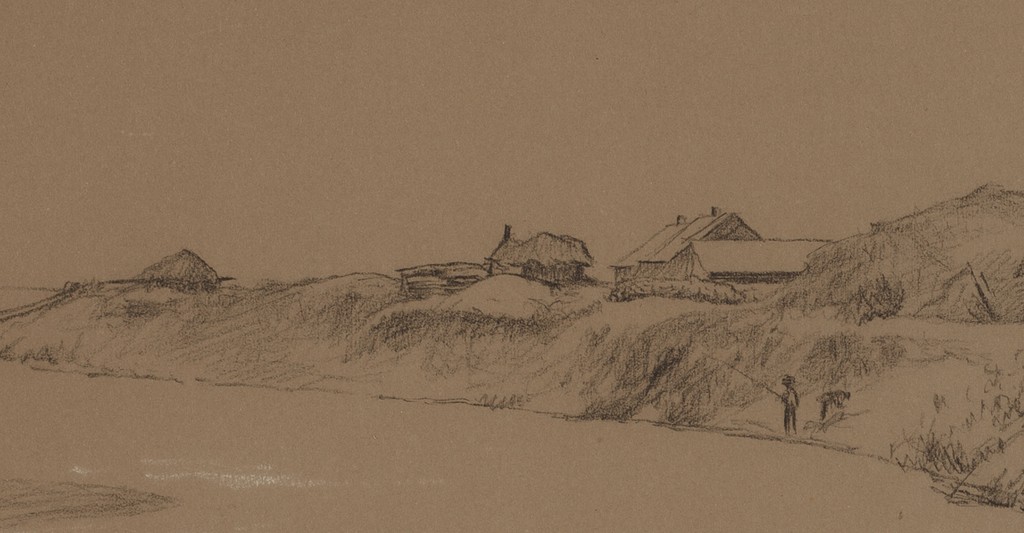
Small buildings along the far bank
A few outlined roofs sit on the low opposite bank. Their small scale leaves the sky dominant while giving the river setting visible signs of occupation.
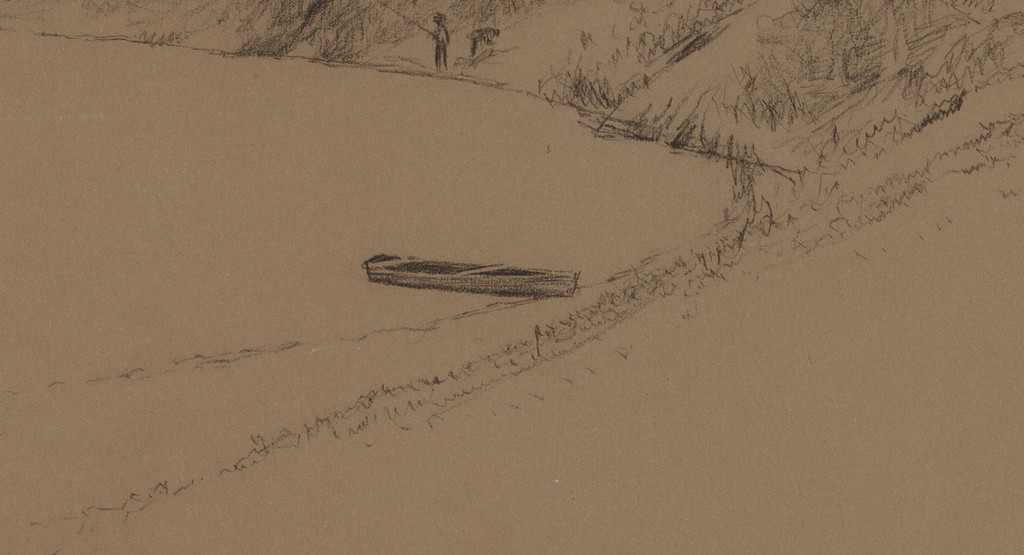
The boat beside the curving shore
The narrow boat lies beside the near curve of the bank. Its dark outline marks the water’s edge against a broad area of less worked paper.
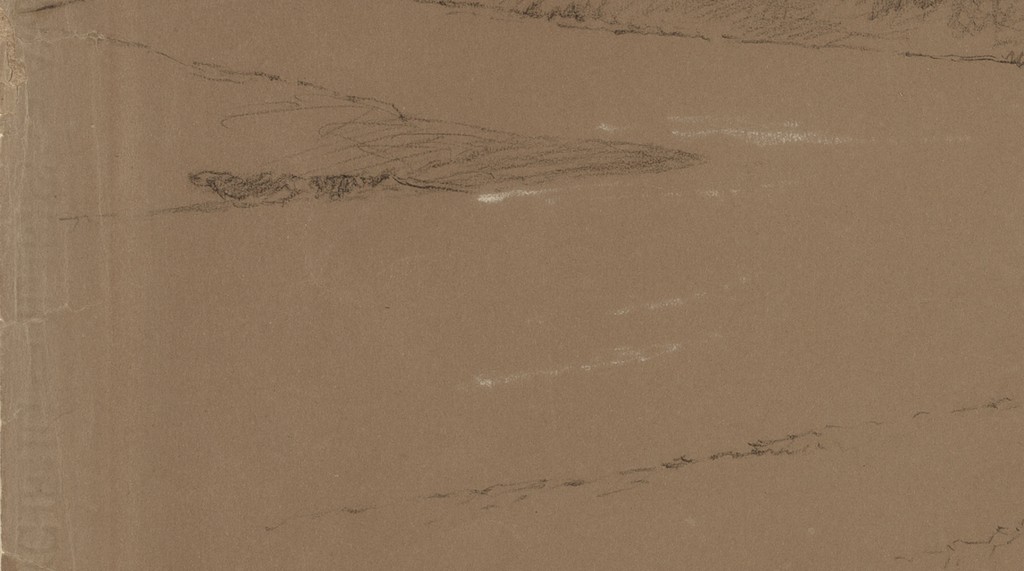
Pale touches across the dark paper
Small pale touches appear across the river below the darker lines of the bank. Compare their lightness with the paper’s own tone; the museum identifies black chalk touched with white chalk.
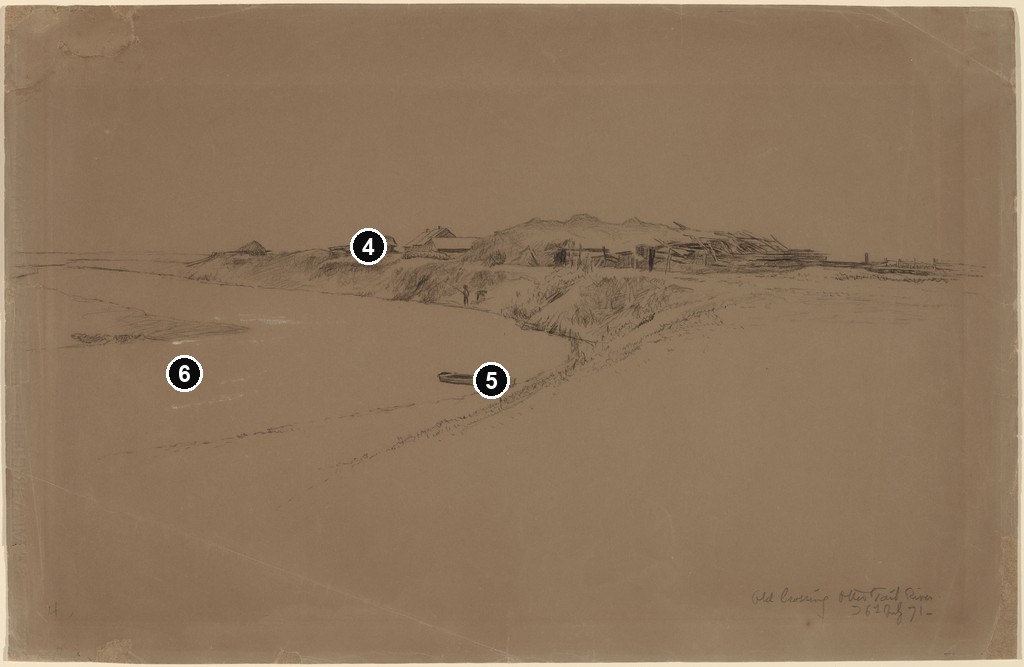
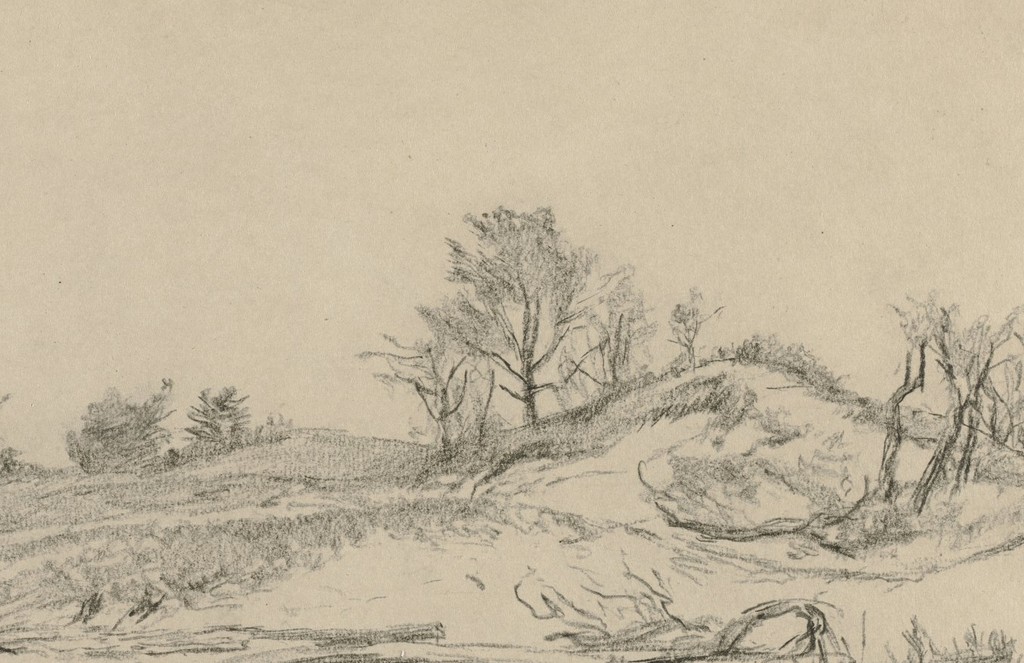
Sand Dunes Lake Ontario - Cleveland Drawing
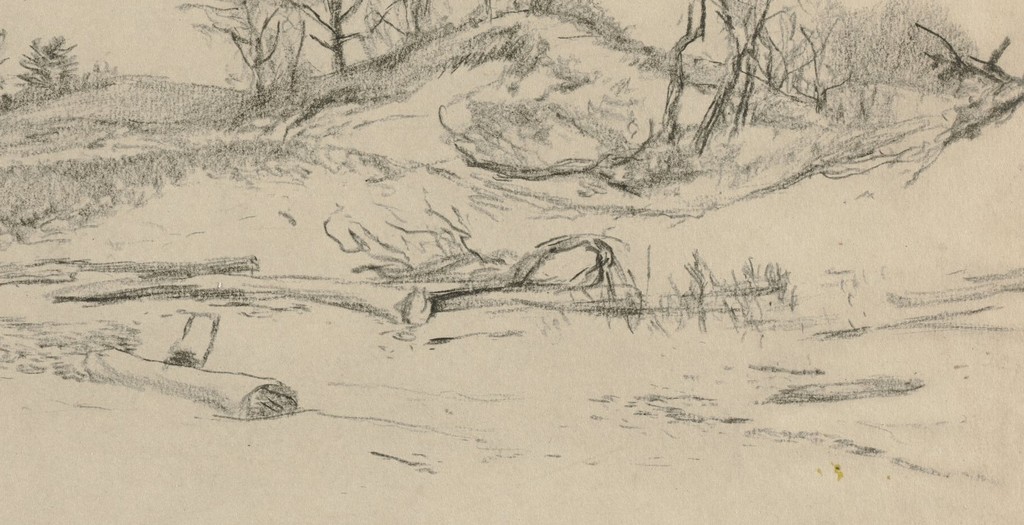
Thin trees above the dune ridge
Separate lines describe the trunks and branches above the gently rising dune. The airy openings around them differ from the denser treatment of the bank below.
Fallen timber across the slope
Long fallen forms lie across the slope, interrupting its low contours. They give the otherwise open ground several distinct changes of direction.
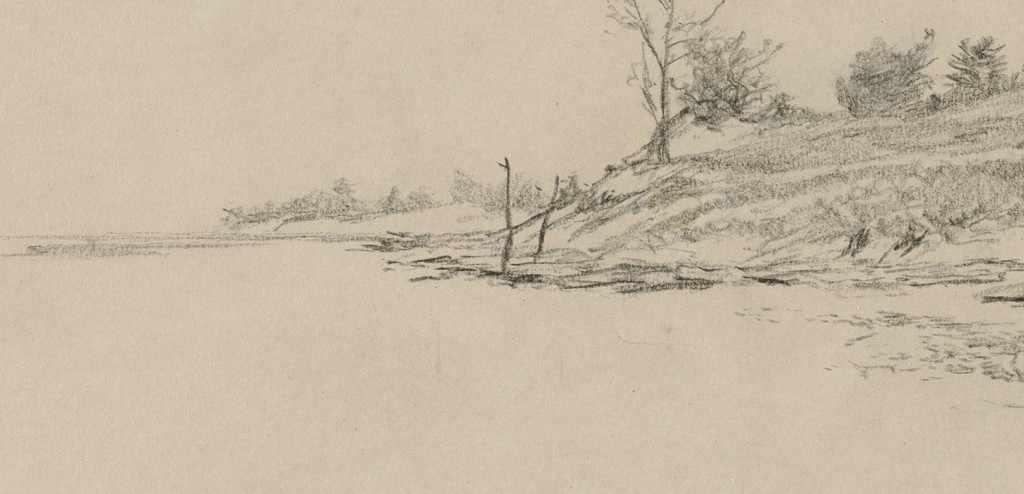
The low shore extending to the left
The drawn ground thins toward the left, where a few horizontal marks suggest the shore and water. Much of the sheet remains open around this small band of information.
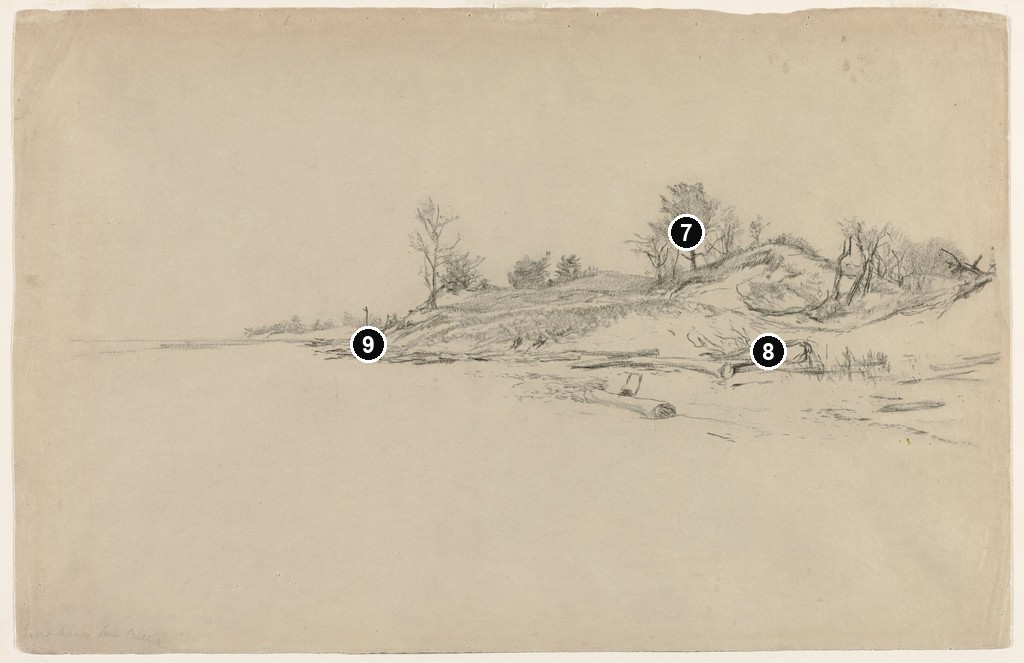
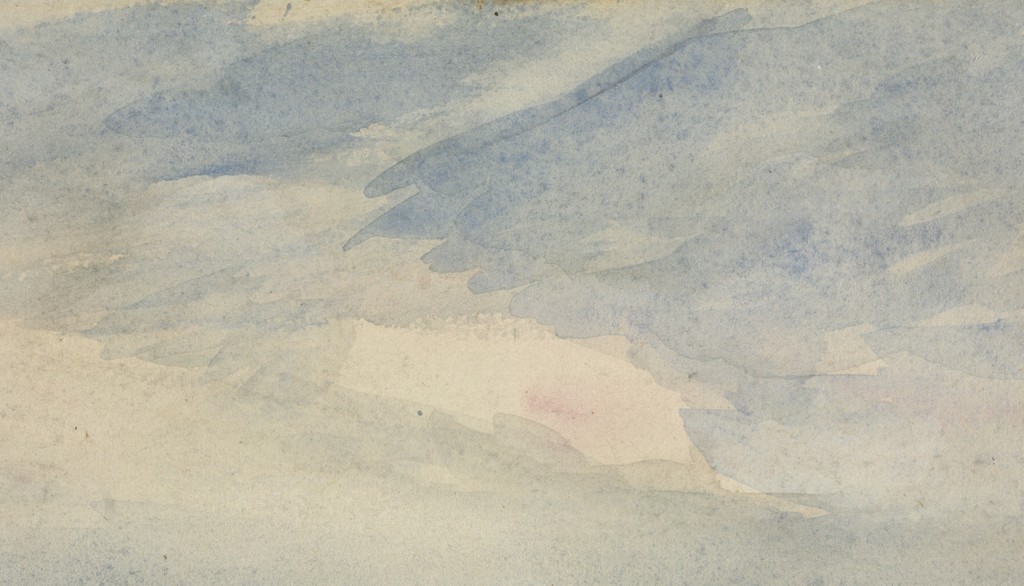
Landscape - Watercolor 1896
Broad blue washes in the sky
The sky is built from broad blue washes with visible changes of direction and overlap. Lighter paper and paler passages remain active between those strokes.
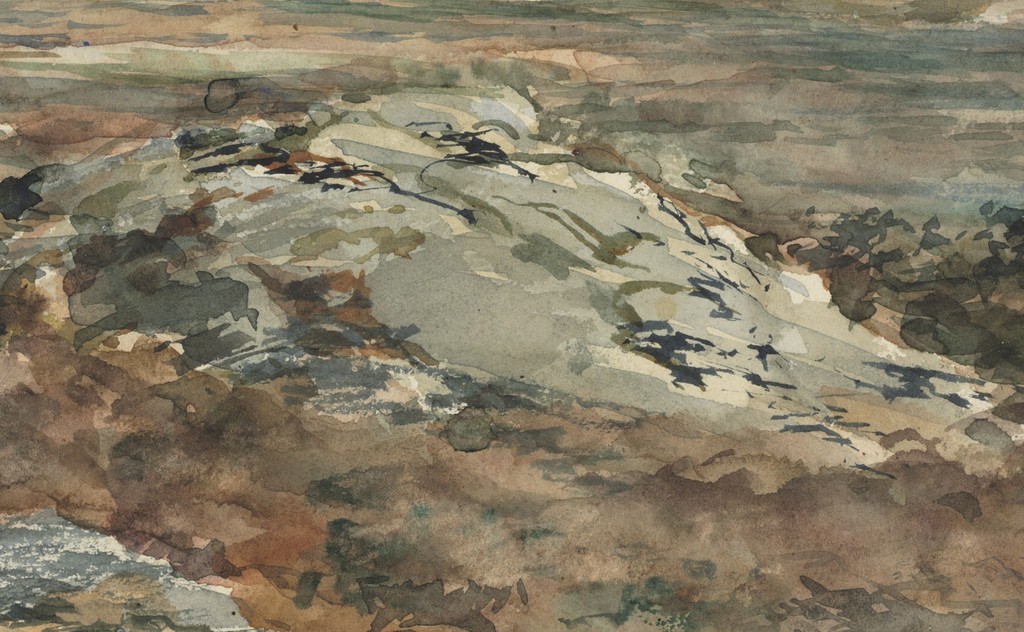
Pale rocks across the near ground
Pale rock forms cut diagonally across the lower landscape. Darker touches separate their irregular surfaces from the surrounding warmer and cooler washes.
A distant opening between low banks
A light opening near the horizon is held between low bands of ground. The broadly titled watercolor does not establish a precise locality for this landscape.
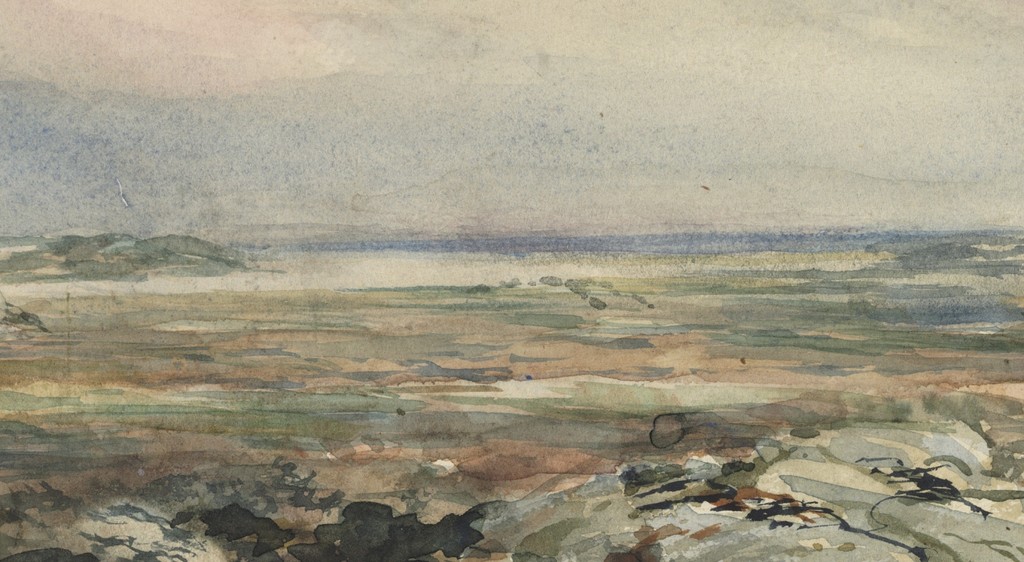
Graphite and the 1860 Hudson River sheet
The National Gallery of Art’s Hudson River is a graphite drawing on wove paper, dated 1860. It measures 17.94 by 23.5 centimeters. The inscription at the lower right records the place-name and 14 September 1860, giving the sheet a particular date within the early career. [3]
Across its middle, the river descends over a ledge beside small buildings and wooded ground. The farther trees gather into a continuous mass, while the nearer bank is articulated by more separate marks. A broad, lightly worked sky gives the landscape room above the principal forms. The composition already depends on balancing a concentrated passage against a larger open area.
Look especially at the different treatment of vegetation. The trees beyond the falls read first as a collective shape, while nearer leaves and branches can be followed individually. The distinction helps separate distances within a small sheet. Martin can suggest a densely wooded place without giving every part the same degree of definition.
The drawing also provides a useful scale comparison. Its width is less than a quarter of a meter, yet it holds a view extending beyond the foreground toward water and trees. The effect depends on proportion and selection within the sheet. Its small size does not confine the space that the arrangement can suggest.
The gallery records the sheet’s inclusion in the 1983 exhibition In Search of the Picturesque: Nineteenth Century Images of Industry Along the Hudson River Valley. That later setting directs attention toward the small structures beside the falls as well as the surrounding vegetation. [3]
Chalk, white highlights and the Otter Tail drawing
Old Crossing, Otter Tail River , dated 1871, uses black chalk touched with white chalk on brown wove paper. The National Gallery records its dimensions as 32.5 by 50.2 centimeters and transcribes the dated inscription of 26 July 1871. The sheet belongs to Martin’s western journey that year, which Mather connects with a party associated with the Northern Pacific railroad. [4] [1]
Here the paper’s brown tone is especially prominent. Buildings, earth and fences occupy a relatively narrow zone across the middle distance, while the near bank curves around the water. A small boat rests beside it. The dark marks establish the principal contours and textures, with the surrounding support supplying much of the view’s breadth.
White chalk adds another register within that limited range. Against a toned sheet, a light touch can separate a passage from both the darker drawing and the paper beneath it. The result differs from covering a white sheet with continuous shading. The support participates in the tonal arrangement from the beginning.
This dated crossing is a valuable counterpart to the better-known Adirondack subjects. It shows Martin attending to an inhabited river setting during travel farther west. The drawing can be considered for its own arrangement and its record of that encounter. Neither its date nor its subject requires it to be the preparation for a particular surviving oil painting.
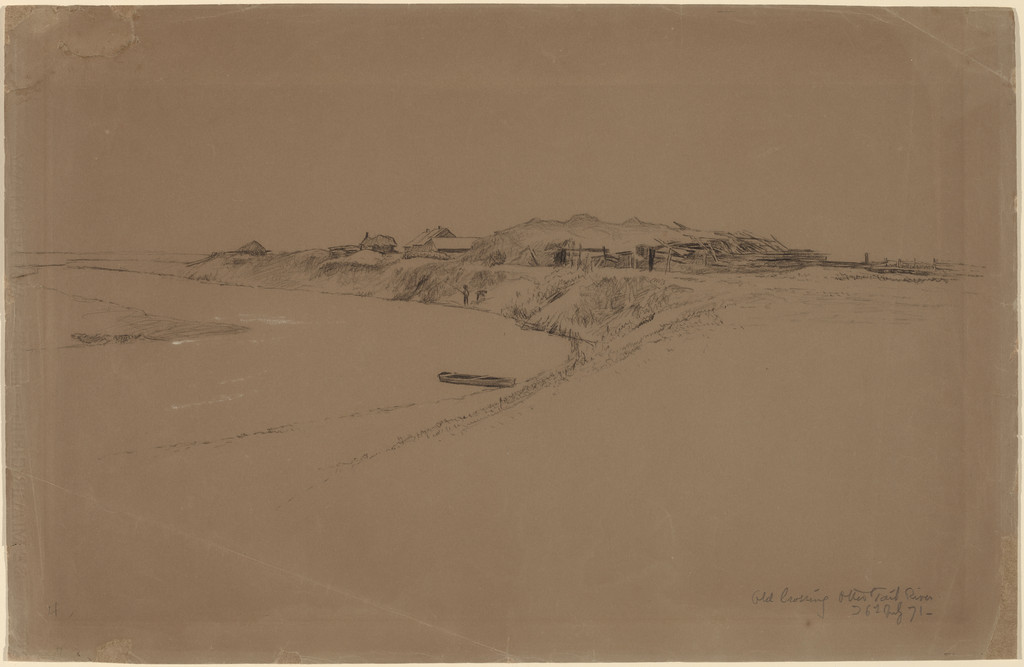
Homer Dodge Martin, Old Crossing, Otter Tail River, 1871. Black chalk touched with white chalk on brown wove paper, 32.5 × 50.2 cm. National Gallery of Art, 1979.20.83. National Gallery of Art.
Image source
.
CC0 / Public domain
. Resized only; source appearance preserved.
Drawing the Ontario dunes
Cleveland’s Sand Dunes, Lake Ontario , about 1874, sets a low bank, sparse trees and exposed branches against an extensive open sky. Marks become denser across the rise on the right, while the left opens toward the water. The contrast makes the uneven ground legible without filling every part of the sheet.
The museum tentatively identifies the medium as black crayon on beige wove paper. That qualification matters: the drawing’s dark marks can be described visually, while the material identification remains provisional. Its sheet measures 32.6 by 50.4 centimeters, and the accession is 1946.65. [5]
The low shoreline and scattered trees can be compared with Martin’s oil treatments of the same region. Their relationship lies in a recurring interest in bare branches, sand, water and open distance. In the drawing, a slight line may establish the edge of a bank that becomes a more substantial passage of paint in a canvas.
The Met’s Behind Dunes, Lake Ontario is a different object, an oil developed during 1883–87 after Martin had visited the region years earlier. The date of Cleveland’s sheet should therefore remain attached to the drawing. Comparing them is a way to follow a lasting subject, without assuming an exact preparatory relationship between these particular works. [6]
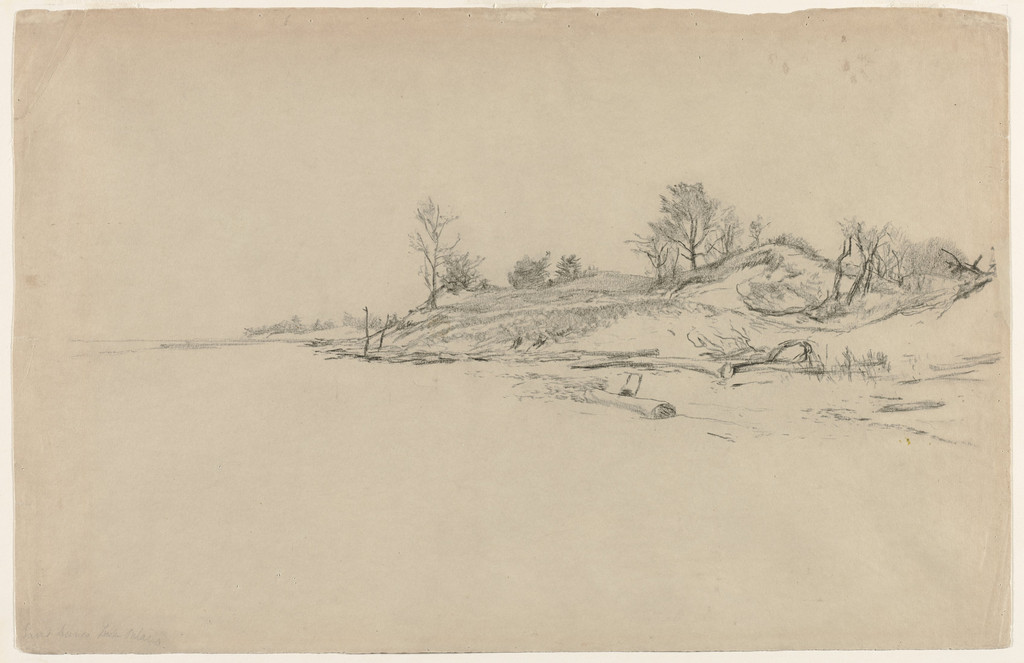
Homer Dodge Martin, Sand Dunes, Lake Ontario, about 1874. Possibly black crayon on beige wove paper, 32.6 × 50.4 cm. The medium identification is tentative. Cleveland Museum of Art, 1946.65. The Cleveland Museum of Art.
Image source
.
CC0 / Public domain
. Resized only; source appearance preserved.
Watch: Homer Dodge Martin
Start with Martin’s Normandy Landscape, then explore the wider Hudson River School tradition in which he began.
Homer Dodge Martin | Normandy Landscape
The Castellani Art Museum introduces Martin’s Normandy Landscape.
Watch on YouTubeWatercolor as a separate practice
Watercolor changes the means through which Martin can establish a landscape. A broad wash can set out a sky or a stretch of distant ground, while smaller strokes interrupt it with rocks, vegetation or a nearer ridge. The relation between transparent passages and more concentrated color becomes part of the picture’s structure.
Mather valued Martin’s watercolors for their freshness and directness. He connected important examples with the Saguenay and Normandy and described watercolor as increasingly significant during the later 1870s and the French residence. This is an early critic’s account of the medium’s place in the career, rather than a claim that every surviving sheet follows one formula. [1]
Elizabeth recalled a pocket sketchbook containing small watercolor impressions and the distress caused when it went missing during the move to Saint Paul in 1893. Her recollection makes these works part of the painter’s personal store of observations. The surviving watercolors need not be identified as pages from that missing book to be understood alongside this habit of recording. [7]
The medium also rewards looking beyond its possible use as a note. A small watercolor can bring a whole arrangement to completion on its own terms. Its open passages, changing densities and visible movement of the brush may be central to that achievement, rather than evidence of something awaiting enlargement in oil.
From outdoor notes to studio pictures
The paintings show how long an observed subject could remain active. Drawings supply one way to follow the earlier stages, but they should not be treated as a mechanical set of instructions for a later canvas. A painter can retain one relationship, alter another and leave much recorded information behind.
Mather argued that Martin’s early studies already sought pictorial arrangements outdoors. In his account, the drawings were more than collections of isolated details to be assembled afterward. A selected view could contain the beginnings of a composition, even when its final color, emphasis and surface remained undecided. [1]
Elizabeth’s memoir adds a complementary perspective. She described periods of absorption followed by later work, but also recalled the substantial Westchester Hills being painted outdoors. Her observations keep direct looking, memory and revision in the same account. The balance between them varied with the work and its circumstances. [7]
The style and technique discussion follows these relationships across media. Here the sheets themselves offer the clearest starting point: the dated river drawing, the chalk crossing and the dune study preserve different answers to how a landscape can be made intelligible with a limited set of marks.
Late Landscape and the limits of a title
Cleveland’s watercolor Landscape , dated 1896, measures 24.8 by 34.4 centimeters. Its title gives no precise locality. The date places it within Martin’s final years, but the broad name does not establish that the scene represents Minnesota, Newport or any other particular place. [8]
A pale rocky foreground leads toward a broad expanse of lower ground or water, with darker land rising toward the right. Above it, blue-gray passages cross the lighter sky. The nearer forms are more broken and varied, while the farther space is carried by longer horizontal relationships. The painting can be approached through these visible decisions before seeking a geographical identification.
Color and drawing work together across the sheet. Dark strokes sharpen some edges, while lighter washes leave others more open. The rocks acquire weight through their relation to adjacent warm and cool passages. Looking at that balance gives the small watercolor a place beside the late oil paintings , while preserving its own medium and scale.
Taken together, the works on paper reveal a continuing interest in how a limited arrangement can suggest extensive space. The biography supplies the circumstances of travel and studio life; Martin’s main overview connects these sheets with the wider career. Each drawing or watercolor remains rewarding as a particular act of looking and making.
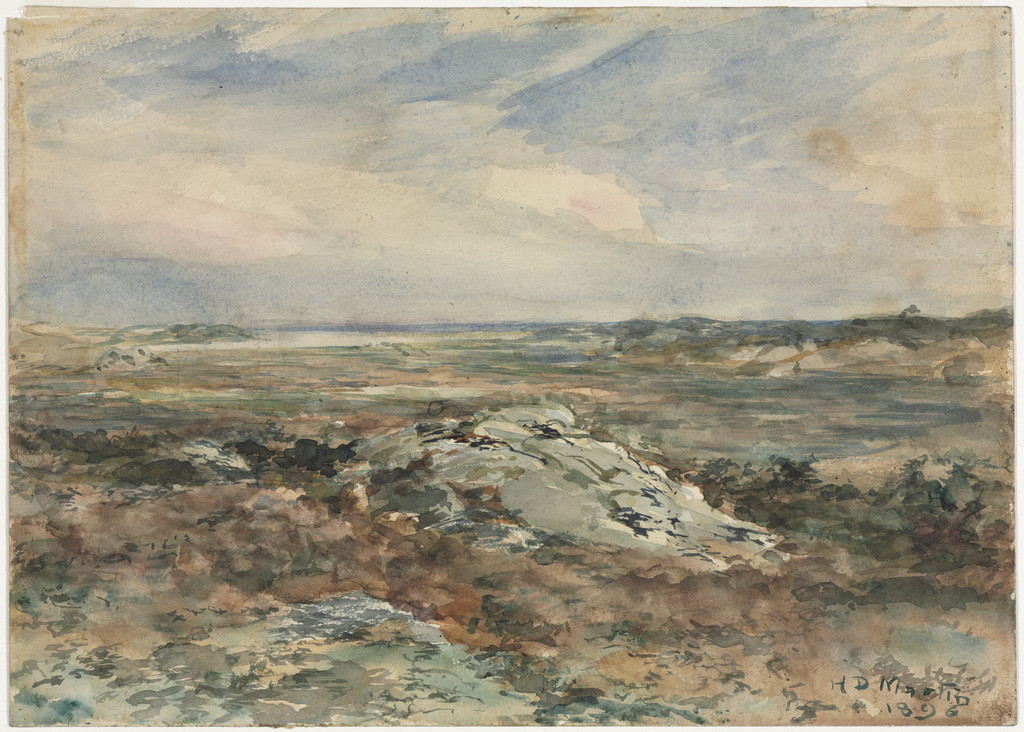
Homer Dodge Martin, Landscape, 1896. Watercolor, 24.8 × 34.4 cm. The title does not establish a precise locality. Cleveland Museum of Art, 1946.291. The Cleveland Museum of Art.
Image source
.
CC0 / Public domain
. Resized only; source appearance preserved.
Artwork records
Browse 58 records from Carroll’s selected 1913 catalogue alongside 25 separately documented object records. Some records concern the same work; this is not a complete lifetime catalogue or a count of 83 unique artworks. [9]
| Name | Date | Medium |
|---|---|---|
| Carroll 1: Saranac Lake (1913 record) | 1860s; exact date not clearly decipherable | Painting — historical catalogue record |
| Carroll 2: Lake George from Bolton (1913 record) | Date not stated | Painting — historical catalogue record |
| Carroll 3: The Iron Mine, Port Henry, N. Y. (1913 record) | Date not stated | Painting — historical catalogue record |
| Carroll 4: On Lake Ontario (1913 record) | Probably late 1860s | Painting — historical catalogue record |
| Carroll 5: The Giant of the Valley (1913 record) | 1865 | Painting — historical catalogue record |
| Carroll 6: An Adirondack Lake (1913 record) | Date not stated | Painting — historical catalogue record |
| Carroll 7: Winter in Normandy (1913 record) | Date not stated | Watercolor — historical catalogue record |
| Carroll 8: Across the Lake (1913 record) | Date not stated | Painting — historical catalogue record |
| Carroll 9: New Hampshire Landscape (1913 record) | Late 1860s | Painting — historical catalogue record |
| Carroll 10: Long Lake (1913 record) | Date not stated | Painting — historical catalogue record |
| Carroll 11: Salt Meadows (1913 record) | Mid 1880s | Painting — historical catalogue record |
| Carroll 12: Autumn on the Susquehanna (1913 record) | 1879 | Painting — historical catalogue record |
| Carroll 13: Ontario Sand Dunes (1913 record) | 1887 | Painting — historical catalogue record |
| Carroll 14: Late Autumn (1913 record) | About 1877 | Painting — historical catalogue record |
| Carroll 15: Early Spring (1913 record) | About 1877; companion dating | Painting — historical catalogue record |
| Carroll 16: Raquette Lake (1913 record) | 1869 | Painting — historical catalogue record |
| Carroll 17: A Glimpse of the Sea (1913 record) | Date not established; historical suggestion disputed | Painting — historical catalogue record |
| Carroll 18: Headwaters of the Hudson (1913 record) | 1869 | Painting — historical catalogue record |
| Carroll 19: Autumn in the Adirondacks (1913 record) | 1871 | Painting — historical catalogue record |
| Carroll 20: Richmond on Thames (1913 record) | About 1877; later alterations | Painting — historical catalogue record |
| Carroll 21: Saranac Lake (1913 record) | 1878 | Painting — historical catalogue record |
| Carroll 22: Windsor Castle (1913 record) | Finished 1878 | Painting — historical catalogue record |
| Carroll 23: L’Anse St. Étienne, Saguenay (1913 record) | 25 July 1879 | Watercolor — historical catalogue record |
| Carroll 24: L’Anse aux Basses Pierres (1913 record) | Date not stated | Watercolor — historical catalogue record |
| Carroll 25: Blossoming Trees (1913 record) | Mid 1880s | Painting — historical catalogue record |
| Carroll 26: On the Seine (1913 record) | Date not stated; later years suggested | Painting — historical catalogue record |
| Carroll 27: The Dunes (1913 record) | 1883 | Watercolor — historical catalogue record |
| Carroll 28: The Moonlit Pond—Honfleur (1913 record) | Date not stated | Painting — historical catalogue record |
| Carroll 29: Normandy Landscape (1913 record) | Date not stated | Painting — historical catalogue record |
| Carroll 30: The Lighthouse, Honfleur (1913 record) | Date not stated | Painting — historical catalogue record |
| Carroll 31: Ruby Strong—Normandy (1913 record) | Date not stated | Painting — historical catalogue record |
| Carroll 32: Sand Dunes, Lake Ontario (1913 record) | 1874 | Painting — historical catalogue record |
| Carroll 33: Low Tide, Honfleur (1913 record) | Date not stated | Painting — historical catalogue record |
| Carroll 34: Evening on the Seine (1913 record) | Date not stated | Painting — historical catalogue record |
| Carroll 35: On the Seine (1913 record) | Date not stated | Painting — historical catalogue record |
| Carroll 36: On the Hudson (1913 record) | 1881 | Painting — historical catalogue record |
| Carroll 37: A Forest Brook (1913 record) | 1881 | Painting — historical catalogue record |
| Carroll 38: Coast Meadows, St. Sauveur (1913 record) | 1881 | Painting — historical catalogue record |
| Carroll 39: Landscape (1913 record) | 1883 | Painting — historical catalogue record |
| Carroll 40: An Adirondack Lake—Lake Sanford (1913 record) | 1883 | Painting — historical catalogue record |
| Carroll 41: Lower Ausable Pond (1913 record) | 1868 | Painting — historical catalogue record |
| Carroll 42: December Morning in Normandy (1913 record) | 1883 | Painting — historical catalogue record |
| Carroll 43: Low Tide—Villerville (1913 record) | 1884 | Painting — historical catalogue record |
| Carroll 44: Lake George (1913 record) | 1884 | Painting — historical catalogue record |
| Carroll 45: Crepuscule—Montvilliers (1913 record) | 1885 | Painting — historical catalogue record |
| Carroll 46: The Sea at Villerville (1913 record) | 1885 | Painting — historical catalogue record |
| Carroll 47: Golden Sands (1913 record) | Date not stated | Painting — historical catalogue record |
| Carroll 48: The Meadow Brook (1913 record) | 1887 | Painting — historical catalogue record |
| Carroll 49: The Sun Worshippers (1913 record) | After the 1886 return to New York | Painting — historical catalogue record |
| Carroll 50: South Side of Long Island (1913 record) | 1894 | Painting — historical catalogue record |
| Carroll 51: Criqueboeuf Church (1913 record) | 1893 | Painting — historical catalogue record |
| Carroll 52: Normandy Farm (1913 record) | 1895 | Painting — historical catalogue record |
| Carroll 53: On the Mississippi (1913 record) | Toward the close of the artist’s life | Painting — historical catalogue record |
| Carroll 54: Newport Neck (1913 record) | 1893 | Painting — historical catalogue record |
| Carroll 55: A Newport Landscape (1913 record) | 1896 | Painting — historical catalogue record |
| Carroll 56: A Distant View of Caen (1913 record) | Date not stated; exhibited 1894 | Painting — historical catalogue record |
| Carroll 57: The Brook (1913 record) | 1894 | Painting — historical catalogue record |
| Carroll 58: Normandy Trees (1913 record) | Date not stated | Painting — historical catalogue record |
| View on the Seine: Harp of the Winds | 1893–95 | Oil on canvas |
| The Iron Mine, Port Henry, New York | About 1862 | Oil on canvas mounted on fiberboard |
| Wild Coast, Newport | 1889 | oil on canvas |
| In the Housatonic Valley (attributed to Homer Dodge Martin) | late 1850s | oil on canvas |
| Sand Dunes, Lake Ontario | c. 1874 | Possibly black crayon on paper |
| Adirondacks | 1868 | Pencil drawing |
| Landscape | 1896 | Watercolor |
| Near Newport | mid-1800s | Watercolor |
| Effect of Trees | About 1879 | Oil on canvas |
| Behind Dunes, Lake Ontario | 1883–87 | Oil on canvas |
| Old Manor of Criqueboeuf | About 1882–92 | Oil on canvas |
| Upper Ausable Lake | 1868 | Oil on canvas |
| Wild Coast, Newport (Smithsonian version) | About 1885–95 | Oil on canvas |
| On the Seine | About 1895 | Oil on canvas |
| The Lighthouse, Honfleur | Date not supplied by museum | Oil on wood panel |
| The White Mountains from Randolph Hill (Wellin canvas) | 1866–67 | Oil on canvas |
| Old Crossing, Otter Tail River | 1871 | Black chalk touched with white chalk on paper |
| Landscape with Poplars | Date not supplied by museum | Oil on canvas |
| Normandy Coast | 1884 | Oil on board |
| Criqueboeuf Church, Normandy | 1893 | Oil on canvas |
| Evening on the Thames | About 1876 | Oil on canvas |
| Hudson River | 1860 | Graphite drawing on wove paper |
| The White Mountains, from Randolph Hill (formerly Met canvas) | About 1862–68; later revisions | Oil on canvas |
| Westchester Hills | About 1887 | Oil painting — historical accounts |
| Adirondack Scenery | 1895 | Oil painting — historical accounts |
Frequently Asked Questions
No. The work numbered 1946.65 is a drawing on beige wove paper, dated about 1874; the museum tentatively identifies its medium as black crayon. [5]
The museum’s generic title does not establish a precise location. It is best considered without assigning an unsupported place-name. [8]
A particular relationship needs evidence. Shared subjects can reveal continuing interests without proving that one surviving sheet directly prepared one named canvas.
Discussion
Look again at the images and ideas explored in Homer Dodge Martin Drawings and Watercolors. These editorial prompts invite your observations.
Reader Insights
Compare the amount of open paper in Hudson River and Old Crossing, Otter Tail River. How does each arrangement establish distance?
Follow the broken branches and low bank in Sand Dunes. Which marks first make the ground’s shape clear?
Look at the 1896 watercolor beside a graphite drawing. How do washes and contours provide different ways to hold a view together?
Join the Conversation
Share a detail, comparison or question about Homer Dodge Martin Drawings and Watercolors below.
References
- Frank Jewett Mather Jr. , Homer Martin: Poet in Landscape, 1912, particularly pp.27–33. View source
- Cleveland Museum of Art , Adirondacks, 1868, 1946.66, object record. View source
- National Gallery of Art , Hudson River, 1860, 2015.19.605, object record and inscription. View source
- National Gallery of Art , Old Crossing, Otter Tail River, 1871, 1979.20.83, object record and inscription. View source
- Cleveland Museum of Art , Sand Dunes, Lake Ontario, about 1874, 1946.65, object record. View source
- Natalie Spassky and colleagues , American Paintings in The Metropolitan Museum of Art, Volume II, 1985, particularly Behind Dunes, Lake Ontario, pp.428–430. View source
- Elizabeth Gilbert Martin , Homer Martin: A Reminiscence, 1904, particularly pp.12–13,39–44 and49–51. View source
- Cleveland Museum of Art , Landscape, 1896, 1946.291, object record. View source
- Dana H. Carroll, Fifty-Eight Paintings by Homer D. Martin, 1913, selected illustrated catalogue. View source
- Splash image source.
Homer Dodge Martin, Hudson River, 1860. Graphite on wove paper, 17.94 × 23.5 cm. The lower-right inscription dates the sheet to 14 September 1860. National Gallery of Art, 2015.19.605. National Gallery of Art. CC0 / Public domain . Resized only; source appearance preserved.
View source