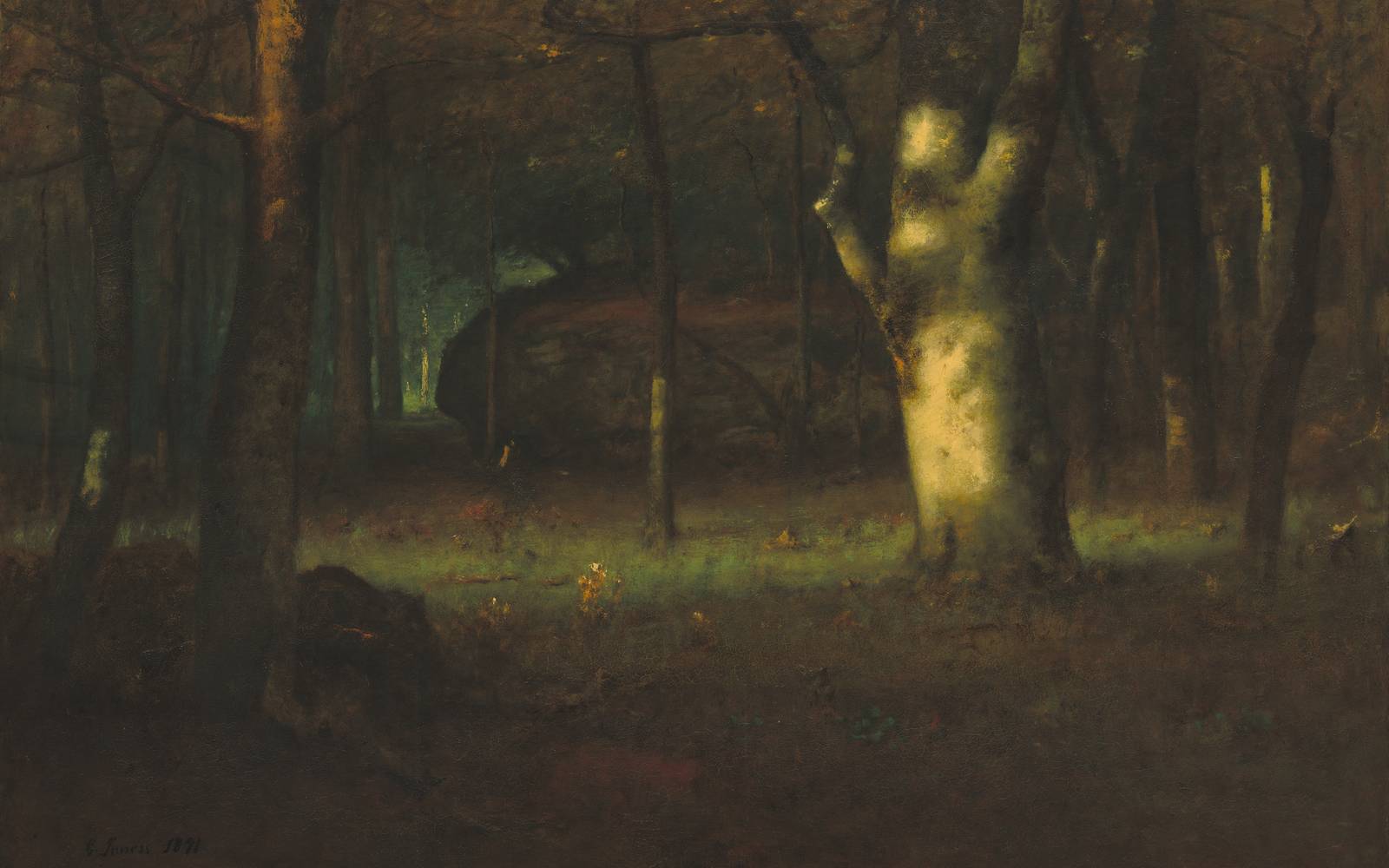
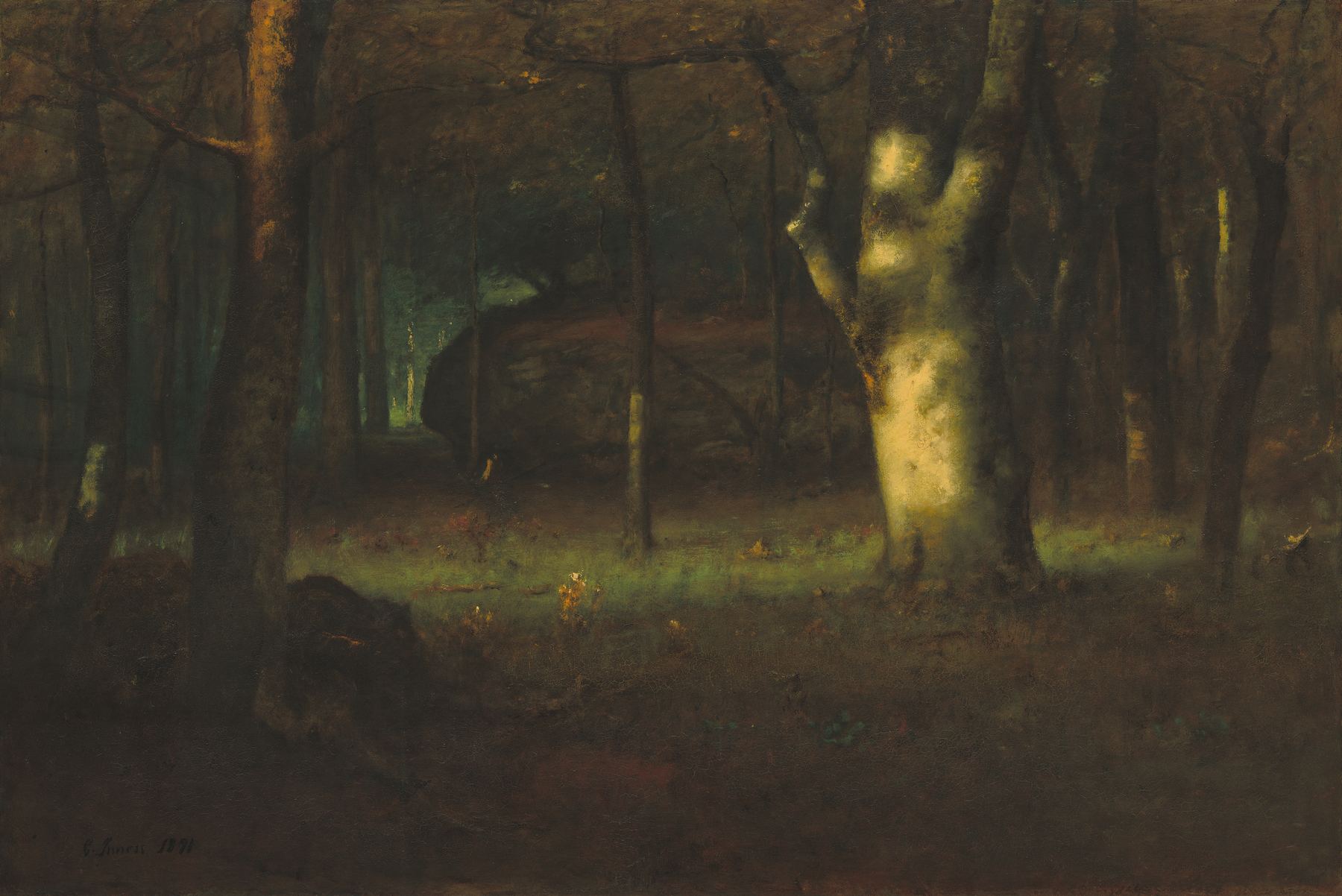
Image reference: George Inness’s Sunset in the Woods.
At a Glance
- Central periodapproximately 1880–1920, with formative works before 1880 and continued practice afterwards.
- Primary countrythe United States, within transatlantic networks centred on France, the Netherlands and Britain.
- Principal figuresGeorge Inness, James McNeill Whistler, Dwight Tryon, Albert Pinkham Ryder, Ralph Albert Blakelock, Henry Ward Ranger, J. Francis Murphy, Alexander Wyant, Thomas Wilmer Dewing and Charles Warren Eaton.
- Typical subjectsintimate landscape, twilight, dawn, moonlight, mist, autumn and winter fields, forest interiors, restrained figures and atmospheric city scenes.
- Visual methodclosely related values and hues, softened edges, reduced incident, glazes or veils, suggestive rather than exhaustive description, and a surface conceived as a total harmony.
- Important settingsNew York, Montclair, Old Lyme, Cornish, Woodstock, the Freer house in Detroit, Paris, London and the Dutch coast.
- What it was nota school of brown painting, a branch of Impressionism, a synonym for Barbizon art, or Max Meldrum's later Australian Tonalism.
Contents
- Where it fits
- Tone and Tonalism
- American origins
- George Inness
- Whistler
- Four stages
- The wider field
- Media and photography
- Australian Tonalism
- Where to study it
Where Tonalism fits
George Inness
Key career periodJames McNeill Whistler
Key career periodDwight William Tryon
Key career periodAlbert Pinkham Ryder
Key career periodRalph Albert Blakelock
Key career periodThomas Wilmer Dewing
Key career periodHenry Ward Ranger
Key career periodCharles Warren Eaton
Key career periodTonalist paintings ask the eye to adjust. At first there may seem to be very little to see: a field at dusk, a moon behind trees, a woman in a quiet room, a river dissolved by mist. Then differences begin to emerge inside the restraint. One grey leans violet while another holds green; a tree line presses dark against a luminous sky; a figure appears through the same brown paper that makes the surrounding air. The picture's subject is not removed. It is made inseparable from an atmosphere.[1]
American Tonalism flourished chiefly from about 1880 to 1920. It was not an organised group and had no manifesto. The term gathers artists who reduced sharp detail, strong local colour and narrative incident so that one dominant harmony could govern a work. It emerged from a gradual remaking of the American landscape tradition rather than from a single founding event.[2]
Its two most important sources within American art were strikingly different. George Inness used remembered landscape to suggest a correspondence between nature, humanity and spiritual reality. James McNeill Whistler, an American expatriate working principally in Europe, treated the painting as an autonomous arrangement of colour and form. Inness's fields and Whistler's nocturnes supplied later artists with complementary paths: nature internalised, and vision organised like music.[3]
Landscapes prevailed, especially at dawn, twilight, moonlight, in mist or under winter skies, but Tonalism also shaped figure painting, pastels, prints and Pictorialist photography.[4] It grew through transatlantic exchange. The Hudson River School supplied a landscape tradition to revise; the French Barbizon School offered intimate rural subjects and painterly atmosphere; the Hague School supplied silver-grey light; Aestheticism and Japanese prints encouraged flat design. American artists transformed these materials in studios, colonies, collectors' houses and new photographic societies.
The resulting art can look quiet, but quiet was an active choice in a nation altered by civil war, railroads, industrialisation, urban growth and mass immigration. Tonalist withdrawal sometimes offered genuine contemplation and sometimes an elite refuge from social change. Its best pictures keep that tension alive: they reduce the visible world while making the act of seeing unusually intense.[5]
Tone, tonality and Tonalism
Tone in painting usually means value: how light or dark a colour appears in relation to another. Tonality is the organisation of those values across a picture. Every representational painter works with tone, but a Tonalist makes the relation dominant. Bright notes, if present, remain accountable to the whole; edges do not divide every form with equal force; a narrow range becomes a source of variety rather than monotony.
Colour is not absent. Tonalist paintings may be green, blue, gold, violet, pearl-grey or rust-red. Their colour is relational. A moon does not sit like a white disc pasted over dark scenery; its light modifies water, cloud, leaves and distance. A figure's dress may differ only slightly from the field behind it, so presence is felt as emergence.
Nor does low-key colour automatically make a picture Tonalist. Tenebrist drama can set violent light against blackness. Academic painting may use a brown preparation while preserving hard contours and descriptive hierarchy. Tonalism more often suppresses the isolated climax so the entire surface acts together.
The name is useful precisely because the field was loose. Artists did not sign a Tonalist declaration. Critics used “tone,” “tonal” and “tonalist” in changing ways, while later exhibitions consolidated a historical category. Recent museum scholarship treats Tonalism as an approach based on mood, memory and suggestive relation rather than literal transcription.[6]
From panorama to intimate landscape
Many first-generation Tonalists matured while the Hudson River School remained influential. Homer Dodge Martin, Jervis McEntee and Alexander Wyant knew its detailed brushwork, open vistas and daylight clarity. Their later paintings often came closer, lowered the light and loosened description. A stream, slope or stand of trees could replace the national panorama.[7]
The transition was not a clean change of generations. McEntee could make precise Hudson River studies and still argue that imitation was insufficient: art needed suggestion. Wyant developed a darker, more compressed language after encountering Inness. Martin moved between panoramic structure and increasingly spare, atmospheric canvases. Artists carried habits between the categories rather than awakening one morning as Tonalists.
The Hudson River School had treated nature as evidence of providential order and national promise, though its artists differed greatly. Large canvases by Frederic Church or Albert Bierstadt invited visual possession of distant territory. Tonalism did not simply disprove that tradition. It changed the scale of address. Instead of saying “behold this continent,” the later picture might ask “what remains when this light fades?”
The difference can be overstated. Both traditions idealised landscape, and both could omit difficult histories of land ownership, labour and Indigenous dispossession. Tonalist intimacy did not guarantee social truth. It rearranged the viewer's position from expansive survey towards absorption.
Barbizon and the American transformation
In France, artists later grouped as the Barbizon School challenged the academy's low estimation of independent landscape. Camille Corot, Théodore Rousseau, Charles-François Daubigny, Jean-François Millet and others worked around the Forest of Fontainebleau and rural communities. Outdoor studies mattered, but finished pictures were often transformed in the studio. They pursued weather, work, trees, marshes and ordinary ground with a gravity formerly reserved for elevated subjects.[8]
Corot's late silvery landscapes offered Americans an especially powerful model. Forms could be legible without being enumerated; air seemed to bind leaf, water and sky. Rousseau gave forest interiors weight and personality. Daubigny's river practice made reflection and passing weather compositional forces. Millet demonstrated that a peasant figure could belong to the landscape without becoming picturesque ornament.
American painters encountered Barbizon pictures through travel, exhibitions, dealers, reproductions and collectors. They applied its intimacy to New England fields, Catskill farms, New Jersey wetlands and western memory. The result was sometimes called American Barbizon, especially at Old Lyme. Tonalism, however, eventually named a wider field in which Whistlerian design, spiritualism, figure painting and photography also mattered.
The Hague School and the grey that was not colourless
Dutch painters working around The Hague from roughly 1860 to 1900 offered another route. Jozef Israëls, Anton Mauve, the Maris brothers, Willem Roelofs and Jan Hendrik Weissenbruch depicted farmers, fishers, cattle, shorelines, canals and enormous skies. They resisted Romantic idealisation while studying seventeenth-century Dutch painting and contemporary Barbizon practice.
Kunstmuseum Den Haag explains that open-air studies were often carried into the winter studio, where artists composed atmospheric landscapes. Their tonal colour earned the nickname “grey school.” “Grey” did not mean literal neutral pigment across every canvas. It described a close value system in which silver light, cloud and reflected water made local colour submit to weather.[9]
The Rijksmuseum places the movement's principal activity between about 1860 and 1900 and emphasises its loose brushwork and silver-grey rendering of Dutch light. These dates and social subjects matter. The Hague School was not an American movement under another name; it was a Dutch formation that American painters studied and adapted.[10]
William Morris Hunt helped transmit Barbizon lessons in Boston after studying in France. His teaching and public example stressed directness, simplicity, harmony and the relative beauty of common subjects. The message was not “paint like Corot.” It was that selection mattered more than inventory and one convincing relation could carry a work.[11]
George Inness: landscape remembered
George Inness came of age while Hudson River landscape set American expectations. His early paintings use clearer recession, firmer detail and recognisable topography. Encounters with Barbizon painting, Dutch art and Italy gradually changed his practice, but there was no single conversion.
The Met distinguishes Inness from other Tonalists through his Swedenborgian belief in correspondence between natural and spiritual realms. He did not paint doctrine as a set of symbols. The conviction shaped his sense that a visible landscape could disclose relations extending beyond its separate objects. Rich glazes and dissolved boundaries allowed a field, figure and sky to participate in one living order.[12]
His Italian sojourns of 1851–52 and 1870–74 were formative. The Campagna offered broad pastoral structure, historic association and atmospheric distance. The Philadelphia Museum of Art's study places these visits across his development rather than treating Italy as an exotic episode. Inness learned how a landscape could feel immense without topographic accumulation.[13]
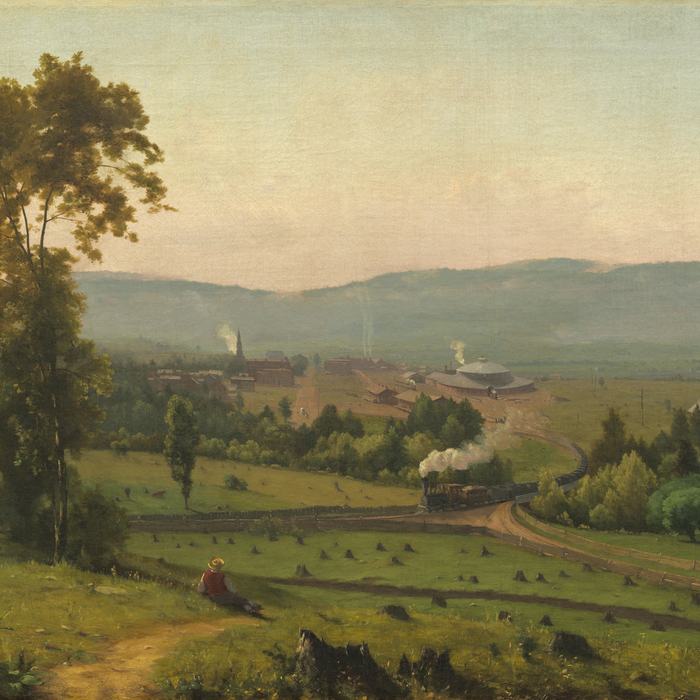
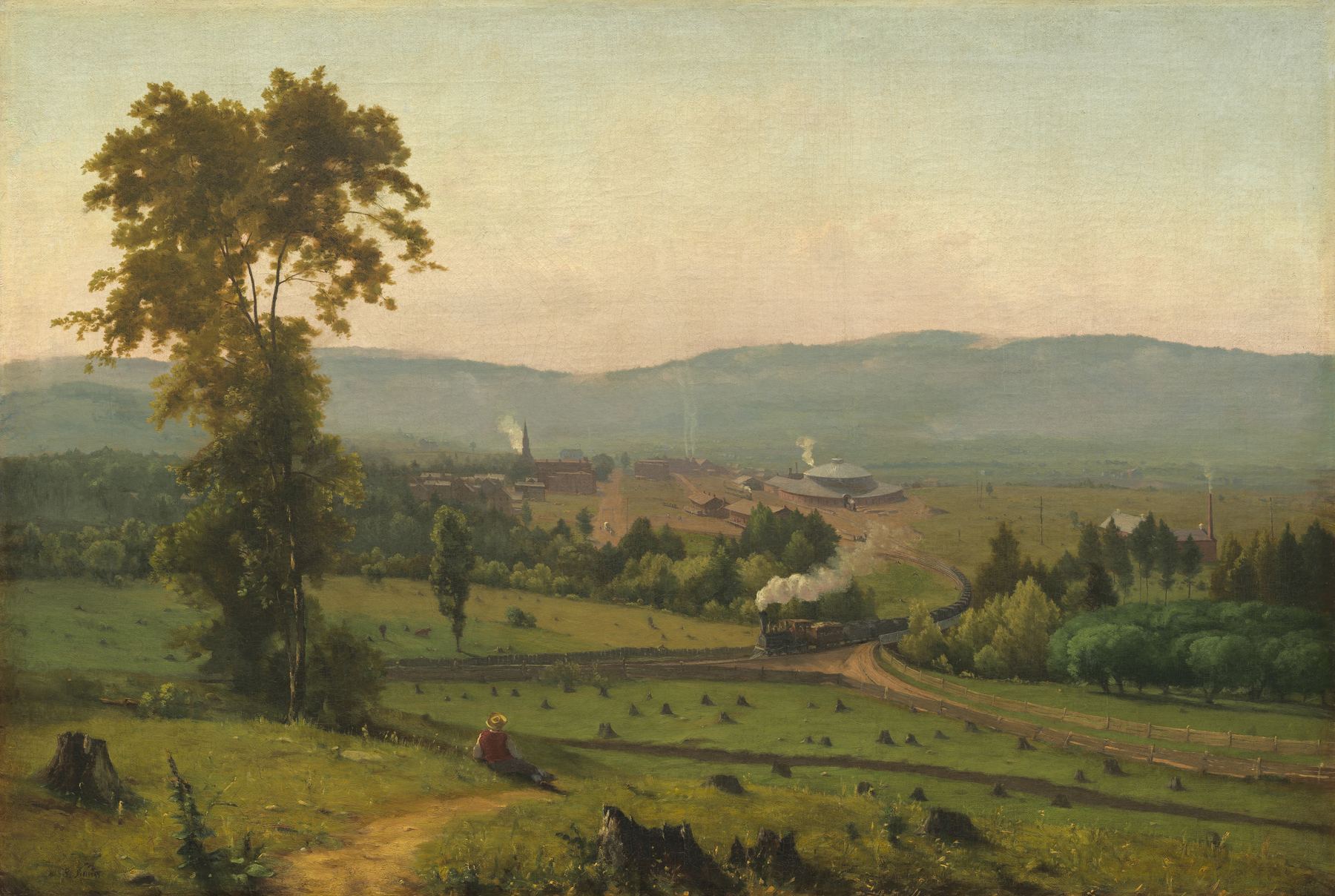
The Lackawanna Valley of about 1856 shows how far his path still had to travel. Commissioned by the Delaware, Lackawanna and Western Railroad, it presents a reclining figure above a valley where a train crosses new track towards a roundhouse. Tree stumps expose clearance for industry. The National Gallery notes that the image advertised a network linking coal mines to markets, even as the artist's ordered composition holds cultivation and damage in uneasy balance.[14]
This is not yet mature Tonalism. Distance is clearly measured, separate elements tell an industrial story and daylight reveals the terrain. Yet it prevents a false account in which Inness always painted timeless spiritual mist. Railroads, commissions and altered land were part of his career.
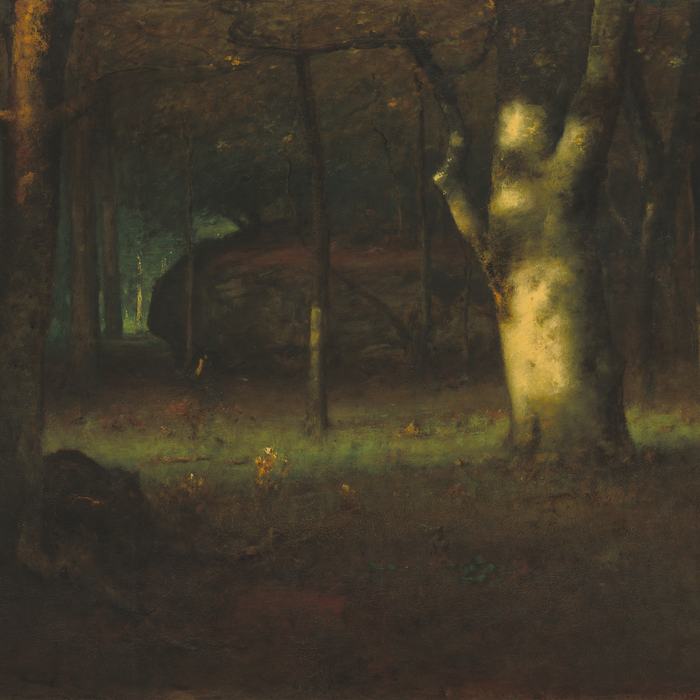
In Sunset in the Woods of 1891, the relation has changed. A shaft of light enters a dense stand of trees, strikes a pale trunk and opens a green distance. Branches and forest floor are worked with broken, layered colour rather than equal description. The illuminated trunk is not a symbolic key; it is the pivot through which surrounding darks become chromatically active.[15]
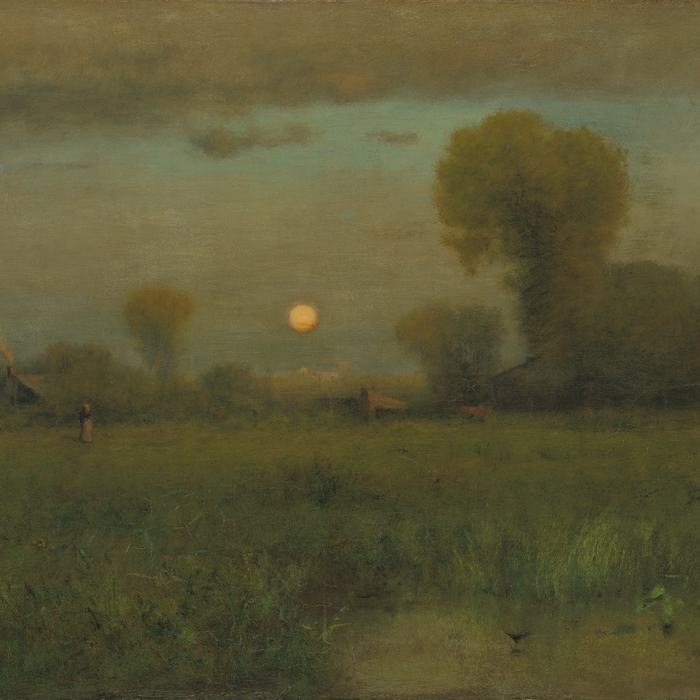
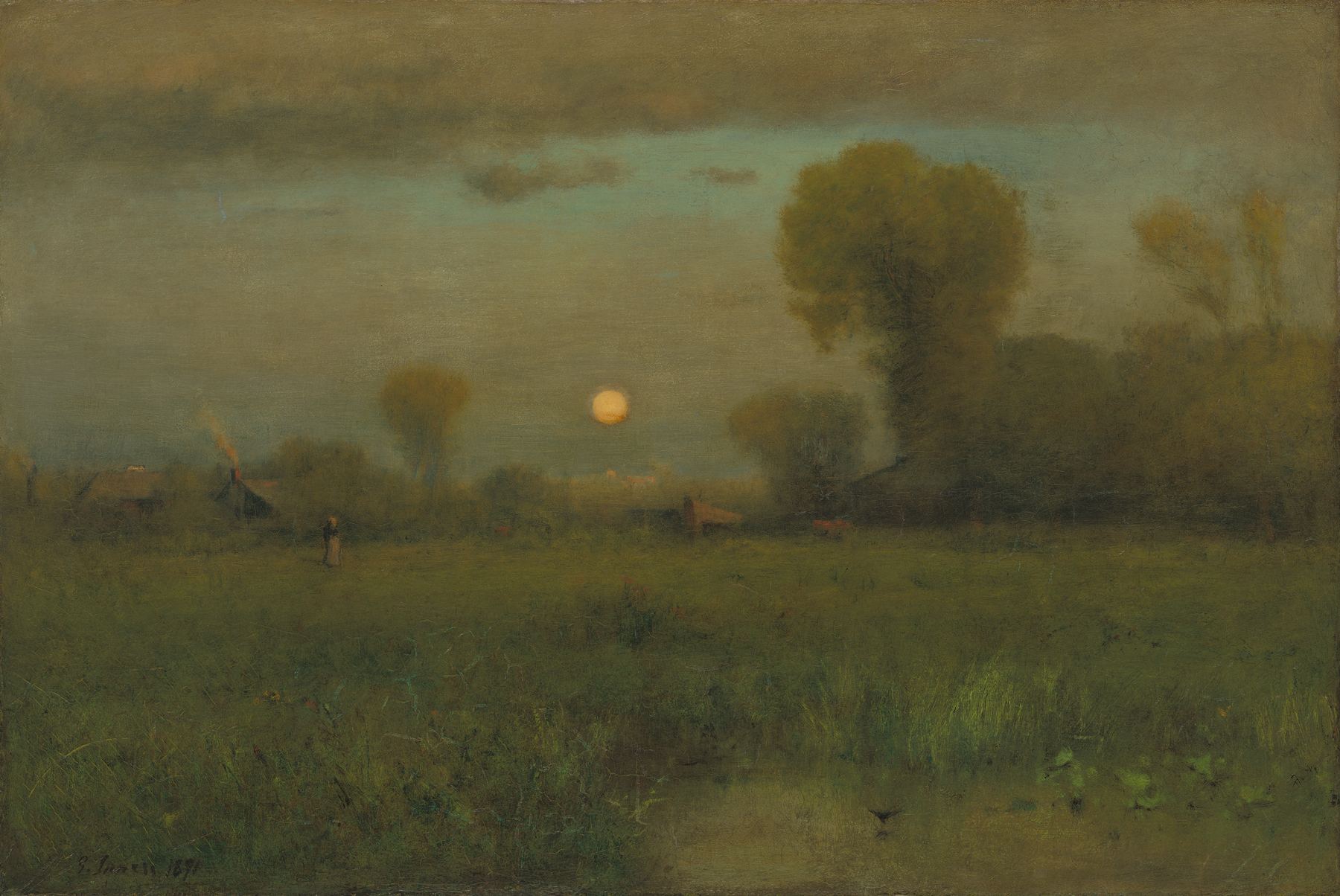
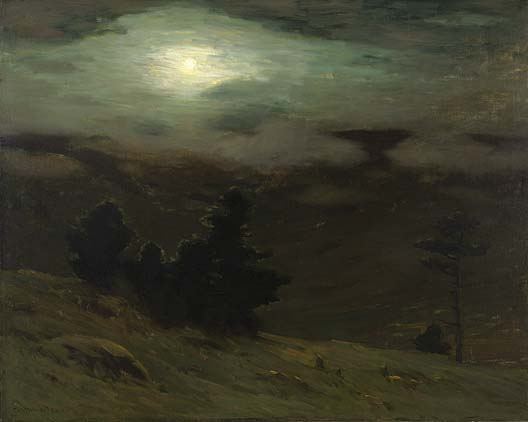
Harvest Moon, also 1891, lowers a yellow moon over cultivated fields. Small figures and structures persist, but they nearly merge with the horizontal land. Green, brown, blue-grey and pale gold carry the scene. Human work is neither heroic centre nor absent; it has become one part of the evening's unity.[16]
Inness called such subjects “civilised landscapes,” recognising fields, paths, animals and buildings as humanly inhabited nature. Smithsonian research connects his late softened style to Swedenborgian thought and to summers in New England. The term complicates any claim that Tonalism simply escaped society for wilderness.[17]
Works on paper could push reduction still further. Across the Campagna, made in 1872, divides lush foreground from pale sky with a narrow horizon of umbrella pines and farmhouses. The Met describes it as nearly abstract. It was also produced during a salaried arrangement with Boston dealers who expected sellable Italian views, joining formal experiment to a transatlantic market.[18]
Inness's achievement lies in this refusal of simple alternatives. Observation and memory, commerce and spiritual ambition, cultivated land and dissolved form inhabit the same practice. Later Tonalists could follow his atmosphere without adopting his belief.
Whistler: painting organised like music
James McNeill Whistler followed a different path. Born in Massachusetts, trained partly in Paris and based chiefly in London, he participated in French and British avant-garde circles. Courbetian realism gave way to flattened surfaces, selective description, Japanese spatial organisation and Aestheticism's claim that art need not justify itself through moral narrative.
Whistler titled works “symphonies,” “arrangements,” “harmonies” and “nocturnes.” The musical language redirected attention. A painted figure could remain a person, but the title asked viewers to notice the interval between whites or blacks. A river view could retain bridges and boats, yet function first as a chord of blue, silver and grey. The Met traces how musical nomenclature, Japonisme and “art for art's sake” became parts of one formal programme.[19]
The analogy did not create an exact code in which blue equals one note. Music supplied a model of meaningful relation without pictorial storytelling. A chord depends on how sounds meet; a Whistler depends on how tones balance, repeat or interrupt across a surface.
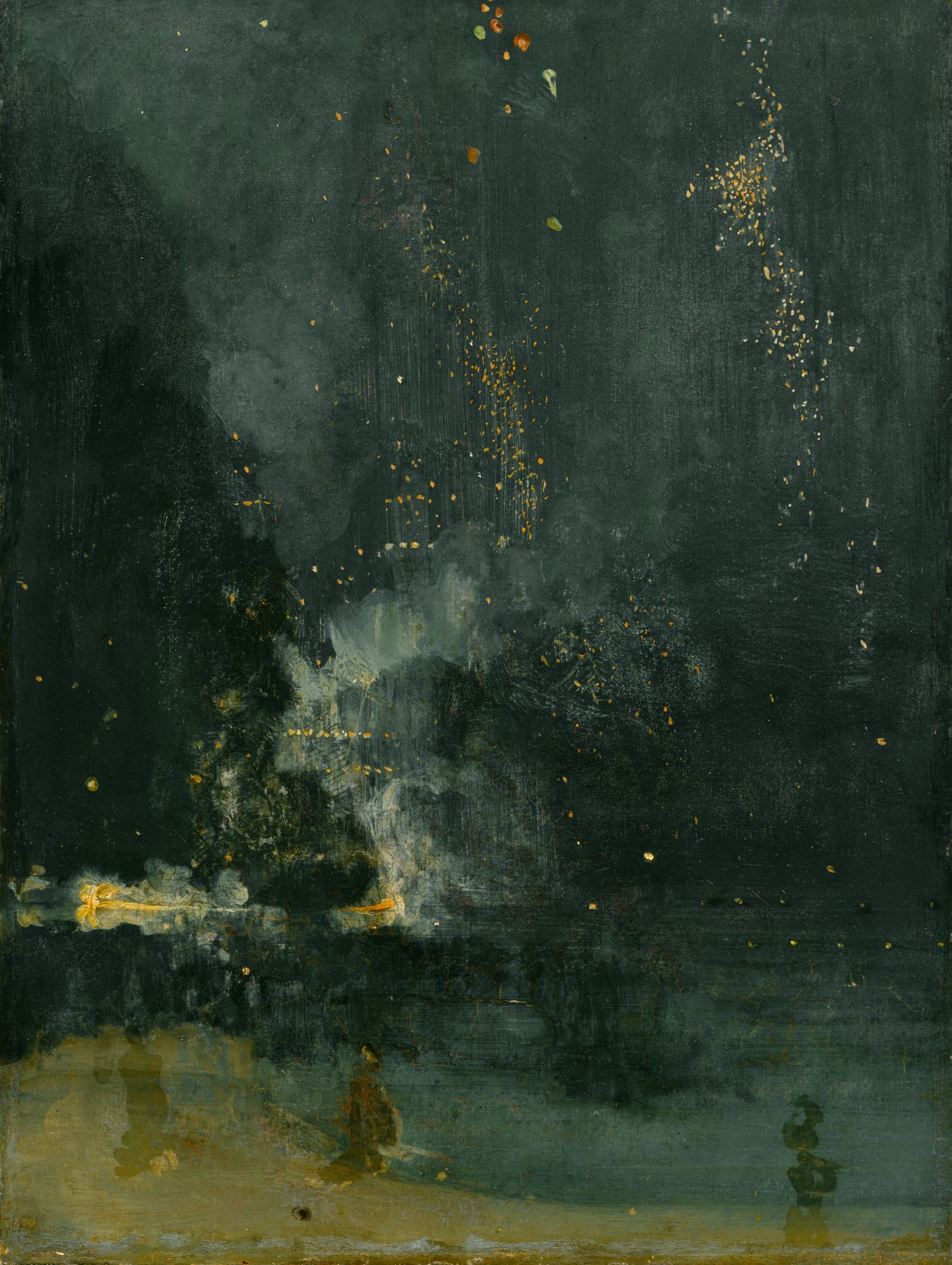
Nocturne in Black and Gold: The Falling Rocket of 1875 turns fireworks at Cremorne Gardens into gold sparks, smoke and black-green night. Figures are barely registered. The painting became notorious after John Ruskin accused Whistler of asking two hundred guineas for flinging paint at the public. Whistler sued for libel, won and received only token damages. The Detroit Institute of Arts identifies its moody, limited palette and overall Tonalist quality.[20]
The trial was more than a colourful anecdote. It exposed competing definitions of labour and value. Ruskin judged rapid appearance against visible finish and social seriousness; Whistler argued that price reflected a lifetime's knowledge, not the hours required to apply paint. The nocturne's openness forced viewers to ask when suggestion becomes sufficient.
Whistler's Cremorne scenes also unsettle the idea that Tonalism avoided modernity. Cremorne Gardens No. 2 depicts a London pleasure ground known for music, dancing and fireworks and frequented by varied social classes. Its long horizontal field, scattered lights and indistinct crowd make contemporary leisure atmospheric without turning it into timeless rural peace.[21]
Whistler's influence travelled through exhibitions, prints, statements and patrons. It encouraged American artists to regard value arrangement as the subject's equal and sometimes its master. His life in Europe and resistance to group identity mean he should be called a progenitor or foundational influence, not the leader of a Tonalist club.
Tonalist artists to know
George Inness
Inness moved from Hudson River precision through Barbizon, Dutch and Italian sources towards late landscapes in which cultivated land, figures and atmosphere participate in one living order.
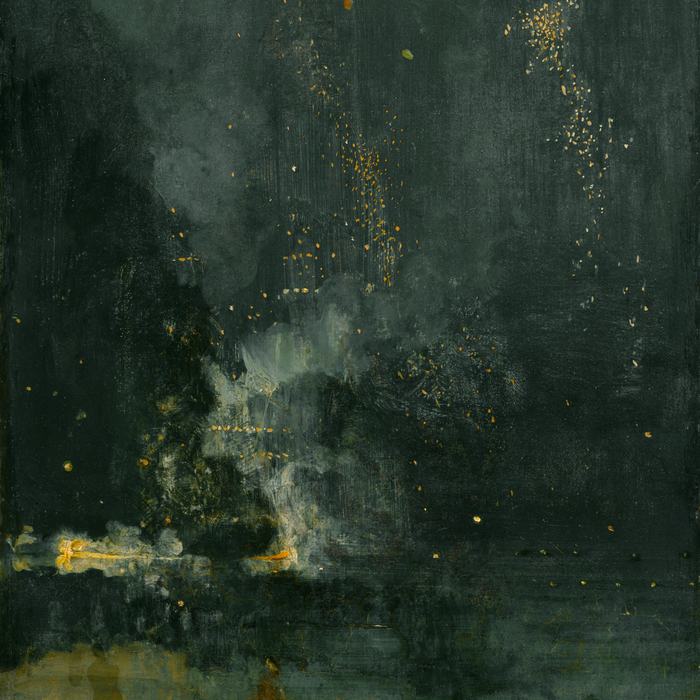
James McNeill Whistler
Whistler's musical titles, Japonisme and selective description made relations of tone and surface equal to represented story while urban leisure remained visible inside the harmony.
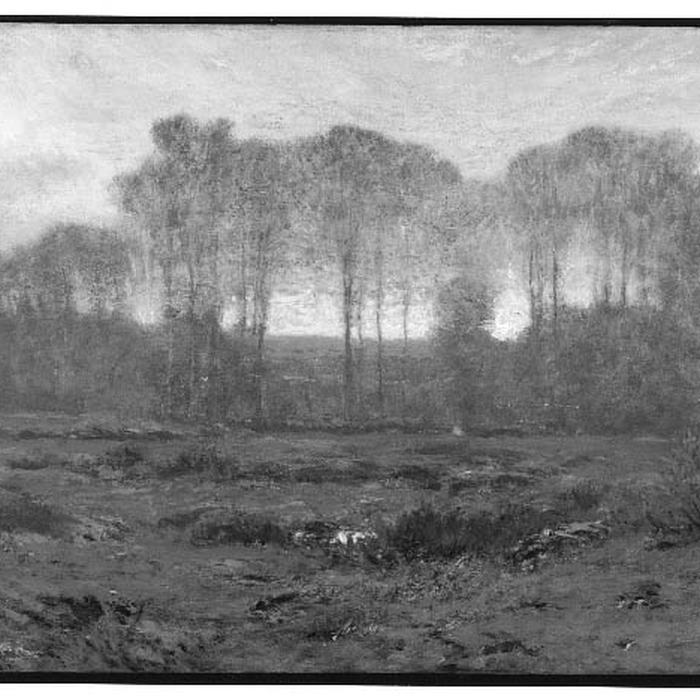
Dwight William Tryon
Tryon reduced coast, field, tree line and sky into exact seasonal keys and conceived paintings as architectural cycles as well as independent easel works.
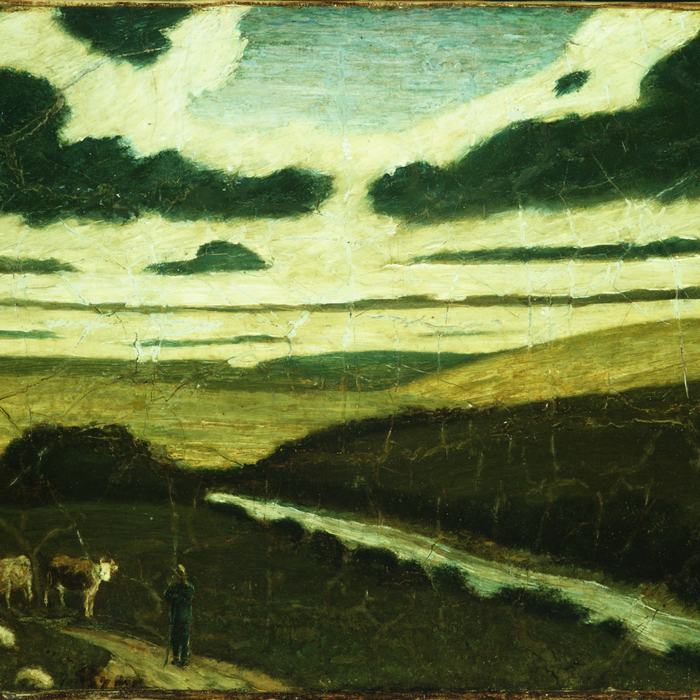
Albert Pinkham Ryder
Ryder compressed narrative, moon, cloud and hill into emblematic curves, while repeated wet layers and varnishes created the severe material instability now inseparable from his art.
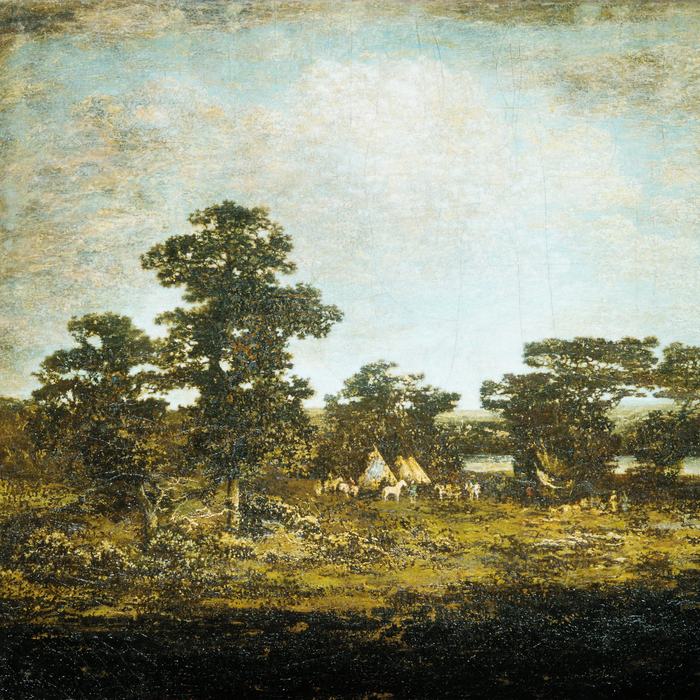
Ralph Albert Blakelock
Blakelock built active darkness through layers, glazing and abrasion; his remembered camp scenes demand ethical distinction between atmospheric invention and Indigenous historical evidence.
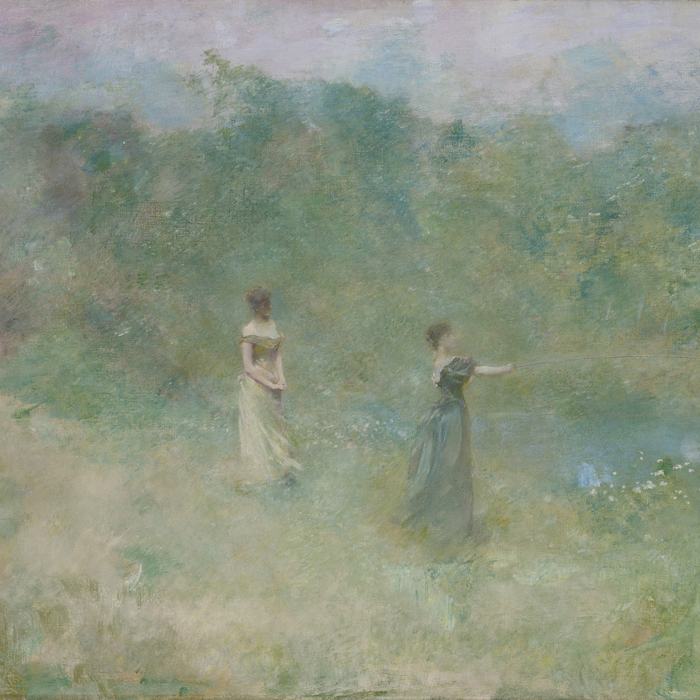
Thomas Wilmer Dewing
Dewing made figures, dress and cultivated settings share one restrained key, demonstrating that Tonalism could organise elite interiors and fields as powerfully as landscape.
Charles Lang Freer and the collected harmony
Industrialist Charles Lang Freer made a private taste into a powerful institutional legacy. After meeting Whistler in 1890, he assembled an extraordinary body of the artist's paintings, watercolours and prints. Whistler encouraged his engagement with Asian art, and Freer pursued what he called points of contact across cultures and periods. The National Museum of Asian Art now preserves that relationship as a founding principle.[22]
Freer also collected Dwight Tryon, Thomas Dewing and Abbott Thayer in depth. His American holdings were never intended as a balanced survey. They formed a concentrated environment around restrained surface, harmony and contemplative viewing, later joined to Chinese, Japanese and other Asian works.[23]
This cross-cultural vision could be illuminating and selective. It valued formal resonance, sometimes at the expense of historical difference. It also depended on wealth made through the railroad-car industry—the industrial modernity from which the pictures seemed to withdraw.
In Freer's Detroit house, art was not simply hung wherever space remained. He commissioned decorative ensembles and considered frames, walls, furniture and adjacent objects. A National Museum of Asian Art exhibition describes Dewing and Tryon as painters of “surface beauty” whose work resonated with Whistler and with ceramics from Detroit's Pewabic Pottery.[24]
Freer believed that tightly related works would “speak” to one another and reveal new beauties through repeated looking. His preference for refinement could also become exclusion: he later rejected the more forceful avant-garde abstraction developing after the First World War. The collection therefore records both the achievement and limits of Tonalist connoisseurship.[25]
Dwight Tryon and the seasons
Dwight Tryon financed study in Paris by selling his early work, then trained with Barbizon painters Charles-François Daubigny and Henri Harpignies. Corot and Whistler also shaped him. During the 1890s, he moved from dense Barbizon masses towards lighter, often near-monochromatic landscapes in which field, tree line and sky settle into horizontal bands. He taught for decades at Smith College while Freer became his principal patron.[26]
Tryon's restraint is exact rather than vague. A few vertical trees can measure a long horizon. A pale strip of water may separate land from sky. Dawn and late twilight are valuable because they place forms in transition, asking the painter to relate small differences instead of naming every object.
Dawn belonged to a seasonal cycle Tryon designed for Freer's house. Installed above a double-sided fireplace, it was understood in relation to architecture and companion pictures. Its later loans to exhibitions show that it could also operate as an independent easel work, but the original setting makes Tonalism part of domestic time: seasons and hours unfolded as a person moved through rooms.[27]
Follow Tonalism through four stages
–79
Landscape and Aestheticism establish two routes
Hudson River practice, Barbizon and Hague School atmosphere reshape American landscape while Inness and Whistler develop distinct languages of remembered nature and autonomous harmony.
–98
American Tonalism becomes a broad pictorial field
Closely related values, softened edges and studio synthesis organise landscape, nocturne and visionary pattern across Inness, Ryder, Blakelock and a widening group of painters.
–1913
Colonies, patrons and new media expand the practice
Old Lyme, Cornish, Freer's Detroit interiors and Pictorialist photography carry tonal relation through landscape, figure painting, decorative ensemble and the modern city.
–2020s
Modernism eclipses and museums reconstruct the field
Changing taste makes Tonalism appear conservative before exhibitions from 1972 onwards recover its artists, media, regions and contribution to modern pictorial reduction.
Old Lyme: an American Barbizon
Henry Ward Ranger studied Barbizon and nineteenth-century Dutch art and spent extended time in the Netherlands. His forest interiors often lead the eye in stages along a stream or path, using partially lit trunks and thick touches over damp varnish. Around 1899 he began working near Old Lyme, Connecticut, and helped establish a colony there. Smithsonian history credits him with giving the “American Barbizon” its original impetus.[28]
The colony depended on Florence Griswold. Approaching fifty, having outlived close family and inherited a large house with debt, she supported herself by taking boarders. Ranger arrived in 1899 looking for a rural base and returned with artists. The house supplied meals, rooms, sociability and continuity—the infrastructure through which a seasonal gathering became an institution.[29]
Old Lyme's old houses, church, river, woods and farms appeared to offer an alternative to New York's heat and speed. That pastoral identity was constructed as well as found. Rail and ferry made access possible, local labour maintained the boardinghouse, and professional artists carried pictures back to urban exhibitions and buyers.
Childe Hassam's arrival in 1903 helped move the colony towards brighter Impressionism. Museum records often summarise this as a shift from the “American Barbizon” to an “American Giverny.” The memorable contrast should not imply an overnight replacement. Ranger's followers continued working; Impressionists also used moonlight and muted weather; individual painters crossed between broken colour and tonal unity. The Griswold House's painted wall panels preserve these overlapping identities.[30]
Ranger's influence extended beyond the colony. At his death in 1916, he left much of his estate to the National Academy of Design for acquiring work by living American artists, with works eventually distributed to public collections. A painter associated with contemplative retreat thus helped build a continuing institutional market.
Fields, pines and ordinary weather
Tonalism's breadth becomes clearer beyond its most famous names. J. Francis Murphy, largely self-taught after working as a sign painter, repeatedly painted worn farms, empty fields and scrubby Catskill ground. Thin browns and greys over prepared surfaces gave his pictures an austere lyricism. Popular in his lifetime, he fell sharply from favour in the 1930s and 1940s—a reminder that movements disappear partly when the ordinary subjects they valued cease to look historically urgent.[31]
Bruce Crane studied with Alexander Wyant and became especially known for russet and grey uplands in late autumn or early winter. These seasons were not simply melancholy emblems. Bare structure allowed slope, wall, distant tree and cloud to meet without the distraction of summer foliage. Crane's considerable exhibition prizes show that quiet landscape once occupied a central rather than marginal position in American taste.[32]
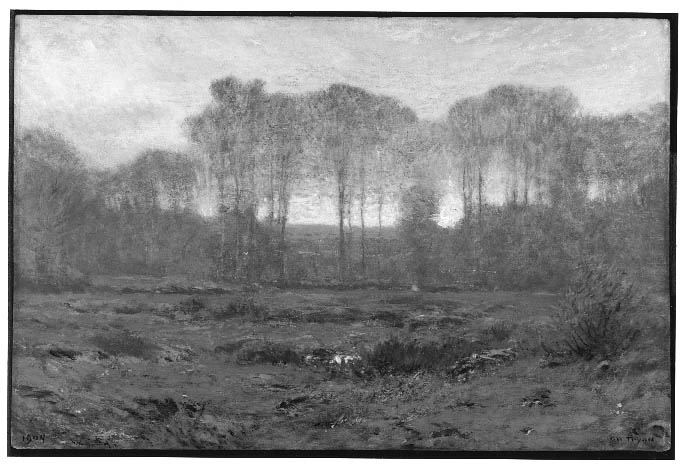
Charles Warren Eaton found a recognisable motif in tall pines set against evening sky or fog. In Gathering Mists of 1905, tree trunks and dark crowns form a broad screen while vapour dissolves depth. The composition succeeds through masses: vertical pines, rising mist and low earth. The trees are not botanical portraits but neither are they abstract signs. Their identities survive inside the weather.[33]
Homer Dodge Martin, Leonard Ochtman, Charles Melville Dewey, Leon Dabo, Birge Harrison, Walter Launt Palmer and others broaden the field still further. Some used heavy, tactile paint; Dabo could veil a landscape with thin pigment. Some moved towards Impressionism, while others stayed with low-key harmony into the twentieth century. Tonalism was a shared priority, not one studio recipe.
Regional difference also mattered. California Tonalists adapted coastal fog and eucalyptus; Woodstock artists joined atmosphere to a developing colony; southern painters such as Elliott Daingerfield brought religious or Symbolist feeling to mountain landscape. A national label should not flatten those places into generic dusk.
Albert Pinkham Ryder: the visionary object
Albert Pinkham Ryder occupies Tonalism's border with Romanticism and Symbolism. His small paintings draw on sea experience, biblical stories, Shakespeare, poetry, remembered farms and invented legend. Moon, ship, cloud and hill are compressed into powerful curves. Narrative remains, but it has been condensed until landscape behaves like emblem and pattern.
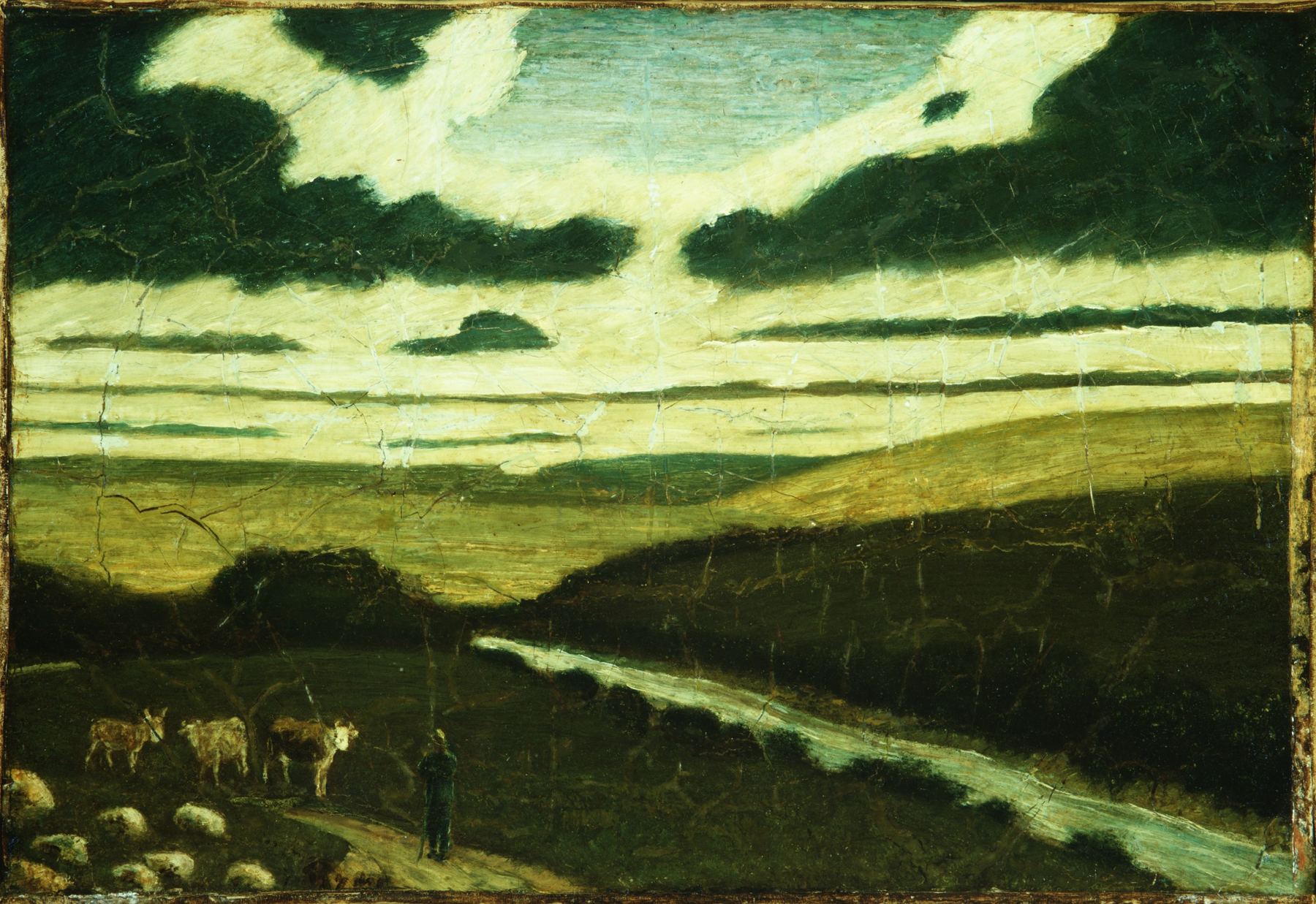
The Met's late Landscape shows a shepherd and animals overwhelmed by stylised surroundings. A stream cuts a rigid diagonal, hills rise as sinuous bands and clouds stack into deep-blue shapes edged with light. Marsden Hartley later praised Ryder as a master of the arabesque, recognising that his modernity lay in patterned movement rather than descriptive accuracy.[34]
Ryder's method produced serious material consequences. He repeatedly applied thick layers of paint, oil and varnish before earlier layers had dried. In the Stable developed severe cracking and “alligatoring”; some paintings remain soft and unstable. Conservation has altered what can safely be shown. The dark, fossil-like surfaces admired today may differ substantially from Ryder's original colour and sheen.[35]
That instability should not be romanticised as the physical trace of madness or genius. It resulted from material decisions, long reworking and unconventional mixtures. A viewer should attend both to the surviving image and to the fact that Tonalist depth was sometimes built through techniques that could not endure.
Ralph Albert Blakelock: moonlight and the imagined West
Ralph Albert Blakelock is best known for moonlit forests in which a pale disc and its reflection struggle through dense trees. He built surfaces with layers, glazes and thick paint, sometimes smoothing or abrading them with pumice. The material alternation between luminosity and crust gives darkness an active texture.
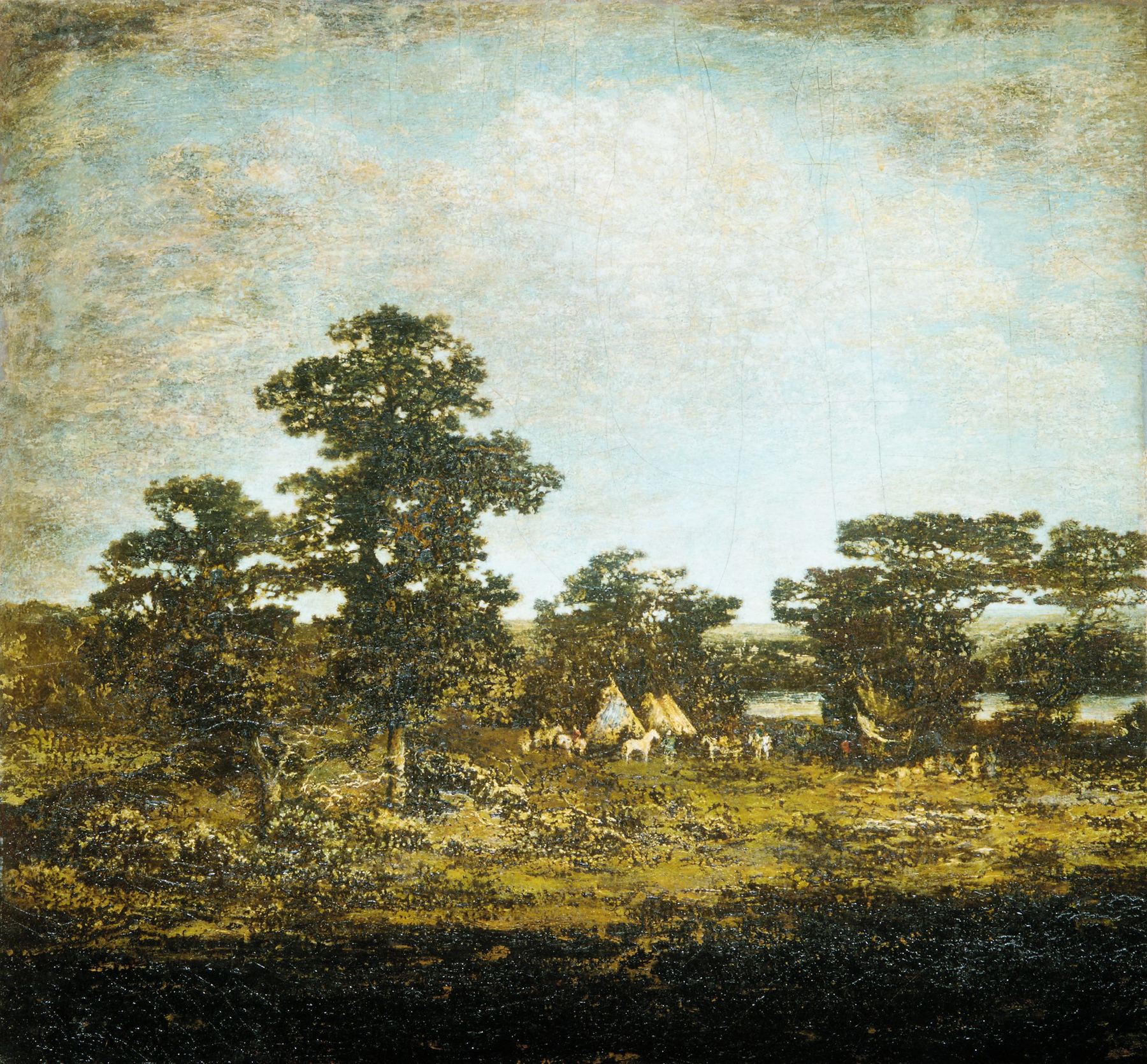
Blakelock travelled through parts of the American West in his early twenties. Later “Indian encampment” scenes often arose from memory and invention rather than specific documentation. In the Met's An Indian Encampment, tiny people and horses occupy a clearing dominated by roughly worked trees and scrub. The painting's primary drama is atmospheric, and the figures become signs of an imagined life outside modern settlement.[36]
That visual absorption has ethical consequences. During Blakelock's career, Native nations faced warfare, reservation policy, forced assimilation and land loss. European American artists ranged from caricature and the “noble savage” stereotype to attempts at specific identity and concern over federal policy. A museum exhibition devoted to the outsider's gaze places Blakelock within that uneven field.[37]
His paintings should therefore not be used as neutral evidence of Indigenous life. Direct travel did not make later memory ethnographic truth. Tonalist atmosphere can produce sympathy and erasure at once: a quiet camp appears spiritually continuous while the political violence surrounding Native survival disappears.
Figure painting and the cultivated world
Landscape dominates the movement, but Thomas Wilmer Dewing proves that tonal relation could organise the human figure. In his paintings, women sit with books or instruments, drift through green fields or stand inside sparse interiors. Action is minimal. Dress, skin, wall and air share a narrow key so the figure appears as one exquisite interval within a designed whole.
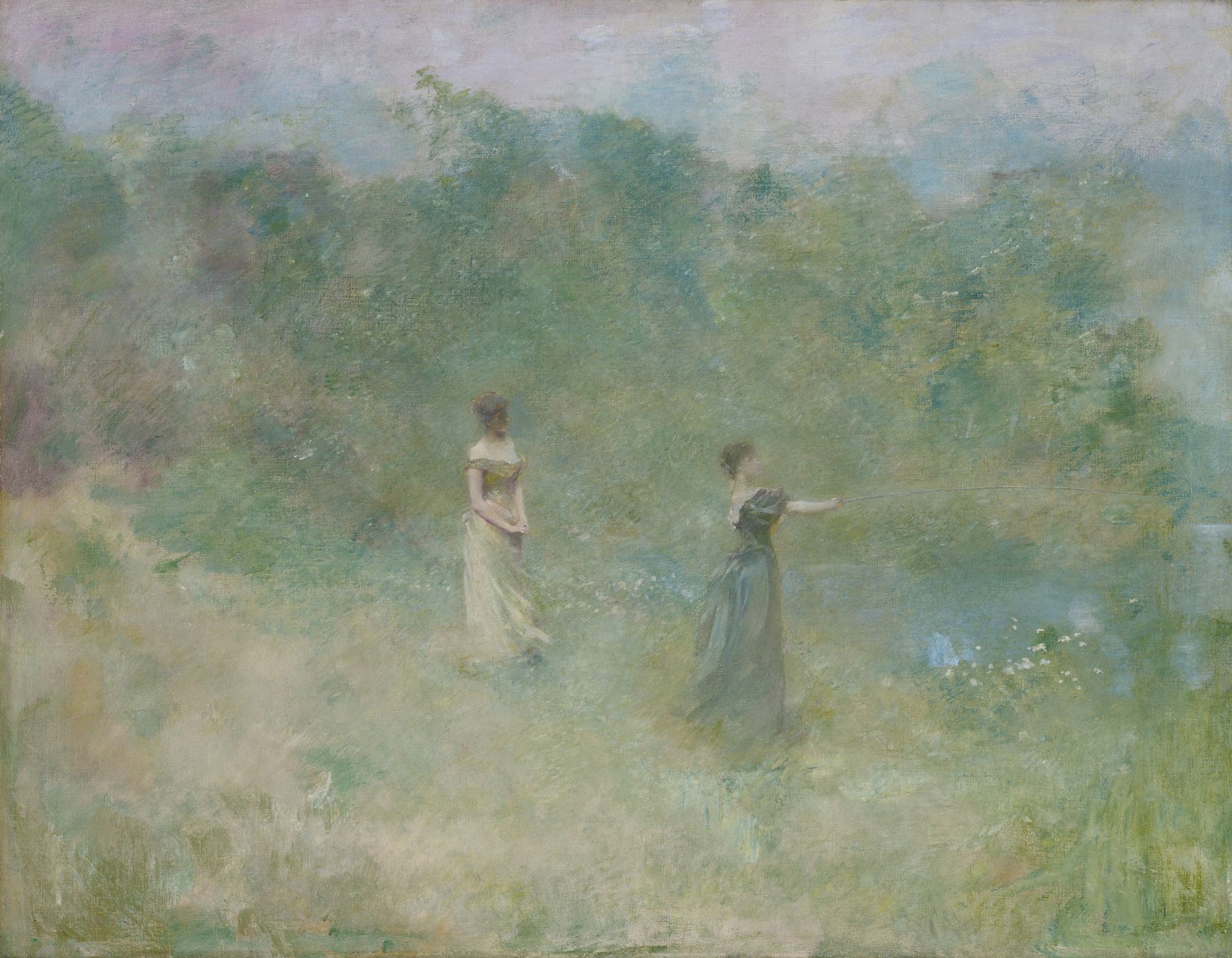
At Cornish, New Hampshire, Dewing joined an artists' colony that included Augustus Saint-Gaudens and Abbott Handerson Thayer. Summer of about 1890 stages elegantly dressed women in a green, theatrical landscape. Smithsonian interpretation connects this timeless beauty to an affluent culture seeking a “higher life” as industrialisation, urbanisation and changing belief unsettled inherited certainties.[38]
The painting's refinement should not be confused with social neutrality. Its women inhabit a world of cultivated leisure, available for contemplation but protected from specific work or public conflict. Tonal unity turns class position into atmosphere.
Dewing's works on paper could be even more reduced. In Woman in a Blue Dress, pale pastel concentrates on flesh and fabric while much of the brown paper remains active. The Met links the sheet directly to Whistlerian touch and even to the “Whistler” paper supplied by a patron. The figure becomes haunting because drawing and ground never fully separate.[39]
Women within and beyond the canon
Women participated in Tonalist networks as artists, photographers, pupils, patrons, hostesses and subjects, but the roles were not equal. Agnes Richmond began with a rich Tonalist mode before becoming better known for brighter portraits. Eva Watson-Schütze worked across Pictorialist photography and Woodstock networks. Florence Griswold's labour made a colony possible even though she did not paint its landscapes.
Maria Oakey Dewing exposes the professional boundary most clearly. Trained and ambitious, she had exhibited figure work before marriage to Thomas Dewing. She increasingly concentrated on flower painting while his figure career gained prestige. At Cornish, she cultivated a large garden and painted from within the plants, creating cropped, low viewpoints in which stems and blossoms occupy the viewer's bodily space.[40]
Her art is not Tonalist merely because her husband was. It belongs here because it shows how the movement's cultivated environments were made and how a woman artist negotiated the separation between elevated figure composition and supposedly domestic flower study. Responsible recovery should preserve that specificity rather than adding every associate to a membership list.
Tonalism beyond oil paint
Pastel naturally supported close value transitions and exposed grounds. Watercolour allowed veils and stains. Etching could make light paper as active as dark ink, while lithography could carry broad atmospheric masses. Tonalism was an organisation of perception transferable across materials.
Pictorialist photographers pursued a parallel aesthetic while campaigning for photography's recognition as fine art. After the handheld Kodak expanded casual photography, members of the Photo-Secession emphasised selection, craft and labour-intensive printing. Platinum prints offered long, delicate tonal scales; gum bichromate allowed pigment and hand-worked surfaces; photogravure joined reproduction to luxury publication. The Met's history places Gertrude Käsebier, Clarence White, Alvin Langdon Coburn, Frank Eugene and others within this institutional claim.[41]
Pictorialism is not simply photographic Tonalism. It had its own organisations, debates and technical questions. The overlap lies in soft focus, atmospheric unity, restricted values and the belief that fact recorded by a machine could be transformed into subjective form.
Edward Steichen absorbed Whistler, French painting and Symbolism during his early European years, then helped Alfred Stieglitz establish the Photo-Secession's Little Galleries at 291 Fifth Avenue. His moonlit ponds and portraits gave Camera Work some of its most influential images. Painting and photography were not separate lanes; artists, galleries and publications circulated the same formal ambitions.[42]
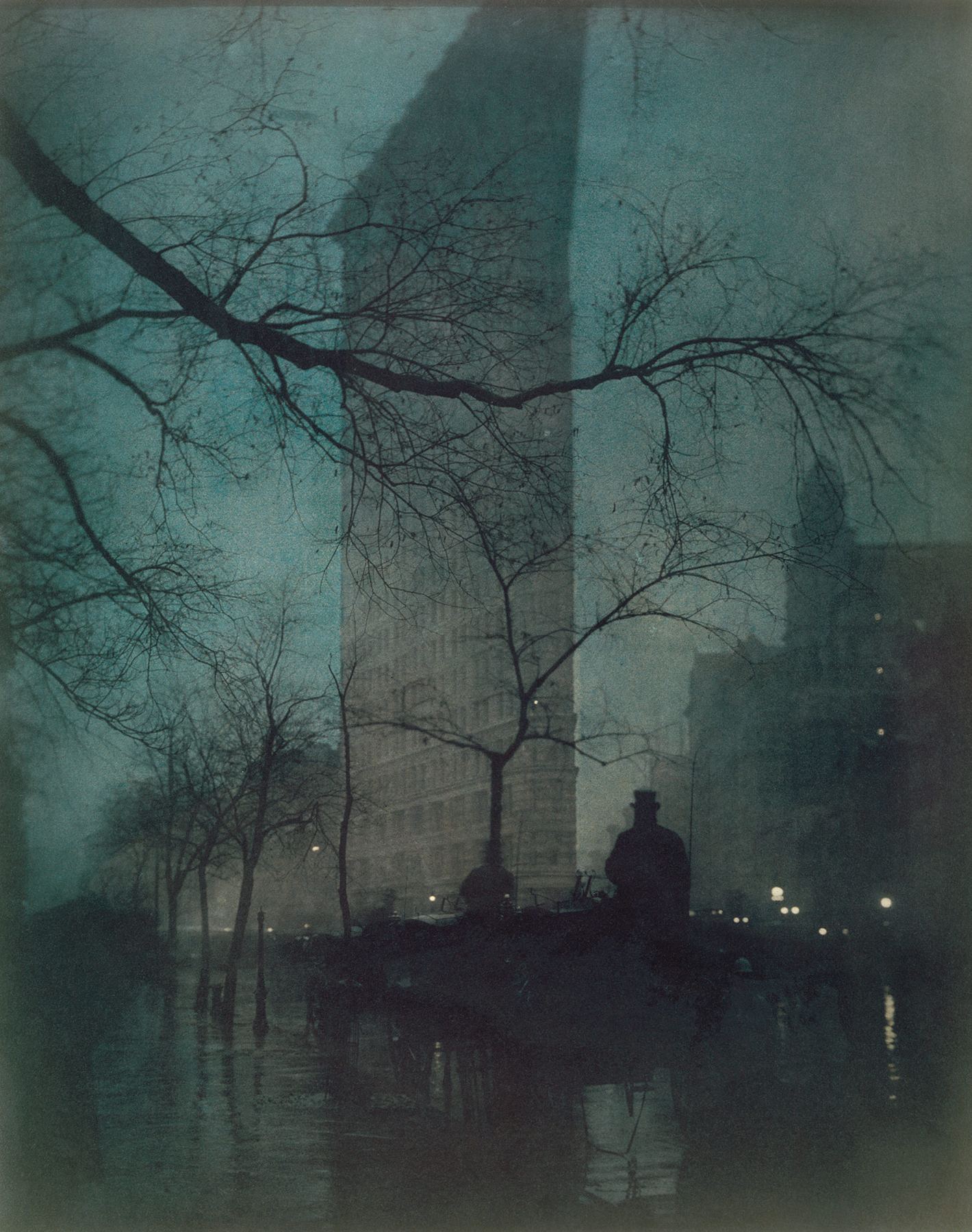
The Flatiron of 1904, printed in 1909, places a new skyscraper behind wet streets and bare branches. Steichen laid gum pigment over platinum in variants of different colour. Japanese cropping and Whistlerian nocturne harmonies shape the image, yet the towering building makes it modern and American. Tonalist atmosphere does not erase the city; it makes steel architecture emerge like weather.[43]
By the end of the First World War, Stieglitz and Steichen increasingly rejected the painterly facade of Pictorialism in favour of the camera's direct capacities. The change parallels Tonalism's broader loss of authority. Softness and hand finish, once signs of artistic judgement, could now look like evasions of the medium.
Tonalism and Impressionism
Tonalism and Impressionism overlapped in date, place and personnel. Their most typical priorities differ. An Impressionist picture often separates high-key colour into visible touches and attends to immediate outdoor light. A Tonalist more often compresses values, subordinates local hue to one harmony and reconstructs a subject through memory or studio synthesis.
Those statements describe tendencies, not a sorting machine. John Henry Twachtman moved through dark Munich and Tonalist phases into pale, broken surfaces. Walter Launt Palmer alternated between Impressionist colour and Tonalist atmosphere. Old Lyme painters could use one approach according to weather or purpose.
The same care applies to neighbouring reputations. Within the wider history of American artists, Winslow Homer could use restricted weather and low light without becoming a Tonalist by default. Resemblance must be tested against each work's structure, process and purpose.
The comparison is useful when it remains visual. Ask whether individual strokes preserve separate colour or dissolve into a veil; whether sunlight produces many local notes or one governing key; whether space arrives through optical observation or compressed memory. Avoid declaring every bright Tonalist an Impressionist and every grey Impressionist a Tonalist.
Retreat, modernity and who could withdraw
Tonalist quiet gained meaning from the world beyond the frame. Post-Civil War grief, Reconstruction, factory expansion, crowded cities and environmental change made the intimate landscape attractive. For some viewers, it supported spiritual attention. For others, it offered a purchasable image of rural continuity.
The retreat was unevenly available. Wealthy patrons could install seasonal cycles in private houses. Professional artists could travel from New York to colonies maintained by boardinghouse and local labour. Dewing's women could embody leisure because the picture excluded the work sustaining it. Blakelock's Native figures could stand for life outside modernity while federal policy imposed violent modernisation upon actual communities.
None of this makes stillness fraudulent. It makes it historical. The quietest Tonalist picture may contain industry as the condition from which patron and viewer turn away. Conversely, Whistler's pleasure gardens and Steichen's skyscraper show that atmosphere could transform modern life itself.
From Tonalism to modern art
Tonalism lost prestige after about 1910–20 as the Armory Show, European abstraction, Precisionism and changing photographic ideals made its poetry appear conservative. Its market success may also have harmed later reputation: endless minor twilight landscapes reduced a demanding practice to formula.
Yet its strongest works had already loosened representation. Ryder turned cloud and hill into arabesque. Whistler made relation more important than story. Inness dissolved objects without losing inhabited space. Pictorialists demonstrated that tone could remake mechanical description. Charles Melville Dewey's thick surfaces and Leon Dabo's thin veils allowed material itself to compete with subject.
Later affinities with the Stieglitz circle, Milton Avery or colour-field painting are real but should not become a straight family tree. Mark Rothko did not inherit a recipe for dusk from Inness. Tonalism's modernist contribution was more general and profound: a painting could build emotional force through a few large relations rather than through exhaustive representation.
Its historical recovery also changed. Mid-century surveys could describe Tonalism as forgotten; Wanda Corn's 1972 exhibition The Color of Mood gave the category renewed definition, and later museum projects expanded it across gender, region and medium. The movement we see today is partly the result of that curatorial reconstruction.
Not the same as Australian Tonalism
Australian Tonalism began later and through a different programme. Max Meldrum established a school in Melbourne in 1916 and taught a theory of “scientific” tonal variation based on optical observation. Forms were built from relative patches of tone, with line treated as an artificial boundary. The National Gallery of Victoria identifies artists including Clarice Beckett, Colin Colahan, Alexander Colquhoun, Arnold Shore, William Frater and Harley Griffith within this influence.[44]
The Australian movement flourished principally from about 1915 to 1950. Meldrum's controversial pedagogy, the “Meldrumites,” interwar Melbourne and artists such as Beckett belong to its own history. The National Gallery of Australia's Misty Moderns exhibition showed how its abbreviated landscapes contributed to Australian modernism and how Beckett transformed the system into a personal urban and coastal art.[45]
American and Australian works may share fog, restraint and low values. Shared appearance and name do not make one movement. The American field developed earlier through Inness, Whistler, Barbizon, Aestheticism and Gilded Age institutions; the Australian field arose from Meldrum's school and optical theory.
How to look at a Tonalist painting
First, identify the dominant key. Squint slightly and ask which large light and dark masses survive. If one bright object breaks the harmony, notice whether it acts as a climax or modifies everything around it.
Second, inspect edges. Tonalist painters rarely blur everything equally. A tree trunk may sharpen while its crown dissolves; a woman's face may emerge while her dress merges with the room. Alternating hard and soft boundaries controls the speed of attention.
Third, look at surface. A transparent glaze can pull colours into depth; scumbling can suspend light over dark ground; pastel paper can remain part of the figure; thick paint can make a forest materially dense. In Ryder or Blakelock, condition and technique are part of what is now visible.
Fourth, find the human world. Paths, fences, trains, houses, farms, pleasure gardens, clothing and cultivated fields prevent “mood” from becoming timeless. Ask what kind of life the image includes, what it removes and who could afford its quiet.
Finally, compare rather than label. Place the work beside a Hudson River panorama, a Corot, a Hague School grey landscape, an Impressionist canvas or a Steichen photograph. Tonalism becomes clearer through the different work that similar weather performs.
Essential Tonalist works
The Lackawanna Valley
George Inness · c. 1856 · The railroad commission joins ordered recession, felled trees and industrial infrastructure before Inness's mature Tonalist dissolution.
Sunset in the Woods
George Inness · 1891 · Penetrating light and layered colour make the pale trunk a chromatic pivot rather than a fixed spiritual symbol.
Harvest Moon
George Inness · 1891 · Fields, figures and structures nearly merge within green, brown, blue-grey and pale gold evening light.
Nocturne in Black and Gold: The Falling Rocket
James McNeill Whistler · 1875 · Fireworks, smoke and indistinct spectators reduce contemporary leisure to a provocative harmony of sparks and dark colour.
Early Morning—September
Dwight William Tryon · 1904 · Tryon's narrow seasonal key distributes land, tree line and sky into measured horizontal intervals.
Gathering Mists
Charles Warren Eaton · 1905 · Pines, fog and earth retain their identity while becoming large, balanced atmospheric masses.
Landscape
Albert Pinkham Ryder · 1897–98 · Stylised hills, clouds and stream compress remembered landscape into emblematic pattern and arabesque.
An Indian Encampment
Ralph Albert Blakelock · c. 1880–1900 · Blakelock's thick, abraded surface creates remembered atmosphere but must not be mistaken for documentary Indigenous history.
Summer
Thomas Wilmer Dewing · c. 1890 · Elegant figures share one green tonal field, making cultivated leisure and class position part of the painting's atmosphere.
The Flatiron
Edward Steichen · 1904; printed 1909 · Gum pigment over platinum turns a new skyscraper, wet street and bare branches into a modern Whistlerian twilight.
Where to see and study Tonalism
Displays, loans and access arrangements change. Check current information before travelling.
- 01
New York State Museum
Its Tonalism: Pathway from the Hudson River School to Modern Art project supplies the most accessible broad institutional survey, drawing on New York collections and expanding the field across painting, pastel, print and photography.
Albany, New York
Collection and research guideVisit official website - 02
National Gallery of Art
The National Gallery's Inness, Blakelock, Whistler and Dewing holdings allow visitors to compare early industrial landscape, late dissolved atmosphere, nocturne structure and Tonalist figure painting.
Washington, DC
Collection and research guideVisit official website - 03
Smithsonian American Art Museum
SAAM is particularly strong for Inness, Ryder, Blakelock, Tryon, Murphy, Crane and Eaton. Its object records also make material technique and the movement's institutional history unusually visible.
Washington, DC
Collection and research guideVisit official website - 04
National Museum of Asian Art / Freer Gallery
The Freer holds unrivalled concentrations of Whistler, Tryon, Dewing and Thayer. It is the essential destination for understanding Tonalism as a collected domestic ensemble and for examining Freer's proposed contacts between American and Asian art.
Washington, DC
Collection and research guideVisit official website - 05
Metropolitan Museum of Art
The Met connects Barbizon sources, Inness, Whistler, Ryder, Dewing and Pictorialist photography within one collection. Its object histories make transatlantic exchange and differences of medium easy to follow.
New York
Collection and research guideVisit official website - 06
Montclair Art Museum
Montclair is closely associated with George Inness's late career and has important American Tonalist holdings. Its collaboration with the Met helped define the movement through a collection-based exhibition.
Montclair, New Jersey
Collection and research guideVisit official website - 07
Florence Griswold Museum
The house, painted panels, gardens and landscape preserve the material setting of the Lyme Art Colony. They show how Florence Griswold's boardinghouse became first an American Barbizon and then a centre of American Impressionism.
Old Lyme, Connecticut
Collection and research guideVisit official website - 08
Detroit Institute of Arts
Whistler's Nocturne in Black and Gold: The Falling Rocket makes the DIA indispensable. Its sparks, smoke, dark surface and controversial reception compress the movement's questions of finish, value and suggestion into one work.
Detroit, Michigan
Collection and research guideVisit official website
Landmark Tonalism exhibitions
Four projects that materially shaped the modern definition, boundaries and recovery of the field.
The Color of Mood: American Tonalism, 1880–1910
M. H. de Young Memorial Museum, San Francisco
Wanda Corn's landmark exhibition gave the category renewed definition and brought painting and artistic photography into the same reconstructed field.
American Art in the Barbizon Mood
Smithsonian American Art Museum, Washington
The exhibition reconstructed how French Barbizon painting was collected, taught and transformed in the United States rather than treating American practice as a copy.
American Tonalism: Selections from the Met and Montclair
Montclair Art Museum, New Jersey
More than sixty paintings, drawings, prints and photographs made a collection-based case for the movement across media and institutions.
Tonalism: Pathway from the Hudson River School to Modern Art
Samuel Dorsky Museum and New York State Museum
The project widened the canon through New York artists, women, photography and private collections while testing Tonalism's relation to modernism.
Suggested books
A History of American Tonalism, 1880–1920 by David Adams Cleveland
This large, revised survey offers the most comprehensive account of artists, cultural setting and modernist legacy. Its breadth is especially useful for moving beyond the familiar Inness–Whistler pairing, though readers should test its strong modernist argument against individual objects and institutions.[46]
The Color of Mood: American Tonalism, 1880–1910 by Wanda M. Corn
Corn's concise 1972 exhibition catalogue was foundational to the modern recovery of Tonalism. It is now a historical document in its own right, showing how painting and artistic photography were brought together when the category was still being rebuilt.[47]
American Tonalism: Selections from the Metropolitan Museum of Art and the Montclair Art Museum by Kevin J. Avery and Diane P. Fischer
This collection-based catalogue keeps broad claims close to actual paintings, drawings, prints and photographs. It is an excellent companion for readers who want to compare techniques and see how museum holdings have shaped the canon.[48]
American Art in the Barbizon Mood by Peter Bermingham
Produced for the Smithsonian's major 1975 exhibition, this study reconstructs how French Barbizon painting was collected, taught and transformed in the United States. It clarifies the essential foundation without treating American Tonalism as a French copy.[49]
The Poetic Vision: American Tonalism by Ralph Sessions
Sessions's illustrated thematic survey is valuable for sustained looking across the wider field. It emphasises the poetry of restricted light and ordinary landscape while introducing artists frequently omitted from shorter movement histories.[50]
Artists associated with American Tonalism
This contextual directory maps a broad retrospective field rather than a formal membership roll. Individual artists moved between Tonalism, Impressionism, Symbolism, Pictorialism and other practices.
| Name | Nationality | Key Works |
|---|---|---|
| George Inness | American | The Lackawanna Valley · Sunset in the Woods · Harvest Moon |
| James McNeill Whistler | American | Nocturne in Black and Gold: The Falling Rocket · Cremorne Gardens No. 2 |
| Dwight William Tryon | American | Dawn · Early Morning—September |
| Albert Pinkham Ryder | American | Landscape · In the Stable |
| Ralph Albert Blakelock | American | An Indian Encampment · Moonlight |
| Henry Ward Ranger | American | Autumn Woodlands · Connecticut Woods |
| J. Francis Murphy | American | The Path to the Village · Autumn Landscape |
| Alexander Helwig Wyant | American | Landscape · Broad Silent Valley |
| Thomas Wilmer Dewing | American | Summer · Woman in a Blue Dress |
| Charles Warren Eaton | American | Gathering Mists · Pine Grove |
| Homer Dodge Martin | American | View on the Seine · Harp of the Winds |
| Jervis McEntee | American | A Song of Summer · Winter in the Mountains |
| Leonard Ochtman | Dutch-American | A Morning in May · Midsummer |
| Charles Melville Dewey | American | The Close of Day · The Edge of the Forest |
| Leon Dabo | American | The Hudson River at Twilight · Evening on the Hudson |
| Birge Harrison | American | Fifth Avenue at Twilight · Winter Twilight |
| Bruce Crane | American | Autumn Uplands · Winter Landscape |
| Walter Launt Palmer | American | Winter Forest · The Waterfall |
| Elliott Daingerfield | American | The Genius of the Canyon · Landscape with Sheep |
| Maria Oakey Dewing | American | Garden in May · Iris at Dawn |
| Agnes Richmond | American | The Red Dress · Portraits and landscapes |
| Eva Watson-Schütze | American | The Rose · Pictorialist portraits |
Frequently Asked Questions
American Tonalism is a broad late nineteenth- and early twentieth-century approach in which closely related values and colours, softened detail and suggestive atmosphere create a governing pictorial harmony. It was not a formal group.
The name comes from tone: the relative lightness or darkness of colour. Tonalists organised a work so that individual hues and forms belonged to one dominant key, much as notes belong to a chord.
Its central American period is approximately 1880–1920. Important formative works appeared earlier, and artists continued working in related ways later. The dates describe a field of greatest influence, not official boundaries.
No one formally founded it. George Inness and James McNeill Whistler are its principal progenitors: Inness through spiritualised, remembered landscape and Whistler through Aestheticism, musical analogy and autonomous colour relation.
No. A restricted palette is only one clue. Tonalism depends on the organisation of value, hue, edge, surface and mood across the whole picture. A dark painting with hard contours and theatrical contrast may not be Tonalist at all.
No. Barbizon was a French landscape formation centred on Fontainebleau and rural life. It strongly influenced American artists, but Tonalism also developed through Whistler, Aestheticism, the Hague School, American spiritual thought, figure painting and photography.
Impressionism typically emphasises immediate light, higher-key colour and visible divided touch. Tonalism more often compresses values and reconstructs a subject through a unified atmosphere. Many artists moved between the two, so the boundary is porous.
Many sketched or painted outdoors, but the finished work often depended on memory and studio synthesis. Tonalism valued the artist's selection and emotional relation more than a complete transcription of one optical moment.
No. Landscape dominated, but Whistler and Dewing made Tonalist figures and interiors. Pastel, watercolour, etching, lithography and Pictorialist photography also used related value structures.
Transitional light naturally reduces local colour and sharp detail, making small value differences important. It also carries associations of memory, uncertainty and contemplation. Tonalists used those conditions structurally, not merely as ready-made sentiment.
No. Australian Tonalism arose around Max Meldrum's Melbourne teaching from the 1910s and used a distinct theory of scientific tonal perception. Clarice Beckett became one of its greatest independent practitioners.
Its reduction of detail, autonomous colour relations, patterned surfaces and emphasis on suggestion helped make representation less literal. Later modernists inherited those possibilities, although there is no simple direct line from Inness or Whistler to abstraction.
Discussion
Reader Insights
Squint slightly and identify the large light and dark masses before deciding that a picture is simply brown, grey or misty.
Notice which boundaries sharpen and which dissolve; Tonalism controls attention through unequal edges rather than blurring everything alike.
Look for paths, trains, houses, clothing, work, pleasure and patronage inside the apparent retreat from modern life.
Join the Conversation
Which Tonalist device most changes your experience of a scene: a compressed range of colour, a single light within darkness, an edge that dissolves, or a surface that seems to hold weather? Share the work and the detail that became visible only after your eyes adjusted.
References
- Tonalism: Pathway from the Hudson River School to Modern Art, New York State Museum, View Source
- Hudson River School to Tonalism, New York State Museum, View Source
- The Trailblazers: George Inness and James Abbott McNeill Whistler, New York State Museum, View Source
- Tonalism in Different Media, New York State Museum, View Source
- Tonalism to Modernism, New York State Museum, View Source
- Tonalism: Pathway from the Hudson River School to Modern Art brochure, New York State Museum, View Source
- The Hudson River School, Metropolitan Museum of Art, View Source
- The Barbizon School: French Painters of Nature, Metropolitan Museum of Art, View Source
- Haagse School, Kunstmuseum Den Haag (Dutch; consulted in Dutch), View Source
- Hague School, Rijksmuseum, View Source
- William Morris Hunt, Smithsonian American Art Museum, View Source
- George Inness 1825–1894, Metropolitan Museum of Art, View Source
- George Inness in Italy, Philadelphia Museum of Art, View Source
- The Lackawanna Valley, National Gallery of Art, View Source
- Sunset in the Woods, National Gallery of Art, View Source
- Harvest Moon, National Gallery of Art, View Source
- George Inness, Smithsonian American Art Museum, View Source
- Across the Campagna, Metropolitan Museum of Art, View Source
- James McNeill Whistler 1834–1903, Metropolitan Museum of Art, View Source
- Nocturne in Black and Gold: The Falling Rocket, Detroit Institute of Arts, View Source
- Cremorne Gardens No. 2, Metropolitan Museum of Art, View Source
- Freer and Whistler: Points of Contact, National Museum of Asian Art, View Source
- Collections: American, National Museum of Asian Art, View Source
- Surface Beauty: American Art and Freer's Aesthetic Vision, National Museum of Asian Art, View Source
- A Perfect Harmony, National Museum of Asian Art, View Source
- Dwight W. Tryon, Smithsonian American Art Museum, View Source
- Dawn, National Museum of Asian Art, View Source
- Henry Ward Ranger, Smithsonian American Art Museum, View Source
- Florence Griswold Museum Overview, Florence Griswold Museum, View Source
- Florence Griswold Museum Quick Facts, Florence Griswold Museum, View Source
- J. Francis Murphy, Smithsonian American Art Museum, View Source
- Bruce Crane, Smithsonian American Art Museum, View Source
- Gathering Mists, Smithsonian American Art Museum, View Source
- Landscape, Metropolitan Museum of Art, View Source
- In the Stable, Smithsonian American Art Museum, View Source
- An Indian Encampment, Metropolitan Museum of Art, View Source
- The Outsider's Gaze, Westmoreland Museum of American Art, View Source
- Summer, Smithsonian American Art Museum, View Source
- Woman in a Blue Dress, Metropolitan Museum of Art, View Source
- Maria Oakey Dewing, Smithsonian American Art Museum, View Source
- Pictorialism in America, Metropolitan Museum of Art, View Source
- Edward J. Steichen: The Photo-Secession Years, Metropolitan Museum of Art, View Source
- The Flatiron, Metropolitan Museum of Art, View Source
- Picherit's Farm, National Gallery of Victoria, View Source
- Misty Moderns: Australian Tonalists 1915–1950, National Gallery of Australia, View Source
- A History of American Tonalism 3rd edition, David Adams Cleveland / Abbeville Press, View Source
- The Color of Mood: American Tonalism 1880–1910, Wanda M. Corn / Smithsonian Libraries, View Source
- American Tonalism: Selections from the Metropolitan Museum of Art and the Montclair Art Museum, Kevin J. Avery and Diane P. Fischer, View Source
- American Art in the Barbizon Mood, Peter Bermingham / University of Chicago Press, View Source
- The Poetic Vision: American Tonalism, Ralph Sessions / Spanierman Gallery, View Source
- Tonalism image records, Wikimedia Commons: The Lackawanna Valley (CC0 1.0; George Inness, The Lackawanna Valley, c. 1856; National Gallery of Art / Wikimedia Commons, CC0 1.0; cropped and compressed.), Sunset in the Woods (CC0 1.0; George Inness, Sunset in the Woods, 1891; National Gallery of Art / Wikimedia Commons, CC0 1.0; cropped and compressed.), Harvest Moon (CC0 1.0; George Inness, Harvest Moon, 1891; National Gallery of Art / Wikimedia Commons, CC0 1.0; cropped and compressed.), Nocturne in Black and Gold: The Falling Rocket (Public domain; James McNeill Whistler, Nocturne in Black and Gold: The Falling Rocket, 1875; Detroit Institute of Arts / Wikimedia Commons public-domain reproduction; cropped and compressed.), Early Morning—September (Public domain; Dwight William Tryon, Early Morning—September, 1904; Museum of Fine Arts, Boston / Wikimedia Commons public-domain reproduction; cropped and compressed.), Gathering Mists (Public domain; Charles Warren Eaton, Gathering Mists, 1905; Smithsonian American Art Museum / Wikimedia Commons public-domain reproduction; cropped and compressed.), Landscape (CC0 1.0; Albert Pinkham Ryder, Landscape, 1897–98; Metropolitan Museum of Art / Wikimedia Commons, CC0 1.0; cropped and compressed.), An Indian Encampment (CC0 1.0; Ralph Albert Blakelock, An Indian Encampment, c. 1880–1900; Metropolitan Museum of Art / Wikimedia Commons, CC0 1.0; cropped and compressed.), Summer (Public domain; Thomas Wilmer Dewing, Summer, c. 1890; Smithsonian American Art Museum / Wikimedia Commons public-domain reproduction; cropped and compressed.), The Flatiron (Public domain; Edward Steichen, The Flatiron, negative 1904, print 1909; Wikimedia Commons public-domain reproduction; cropped and compressed.).