


 by Tom Gurney
Tom Gurney BSc (Hons) is an art history expert with over 20 years experience
Email: tomgurney1@gmail.com / Phone: +44 7429 011000
George Inness Paintings: Introduction
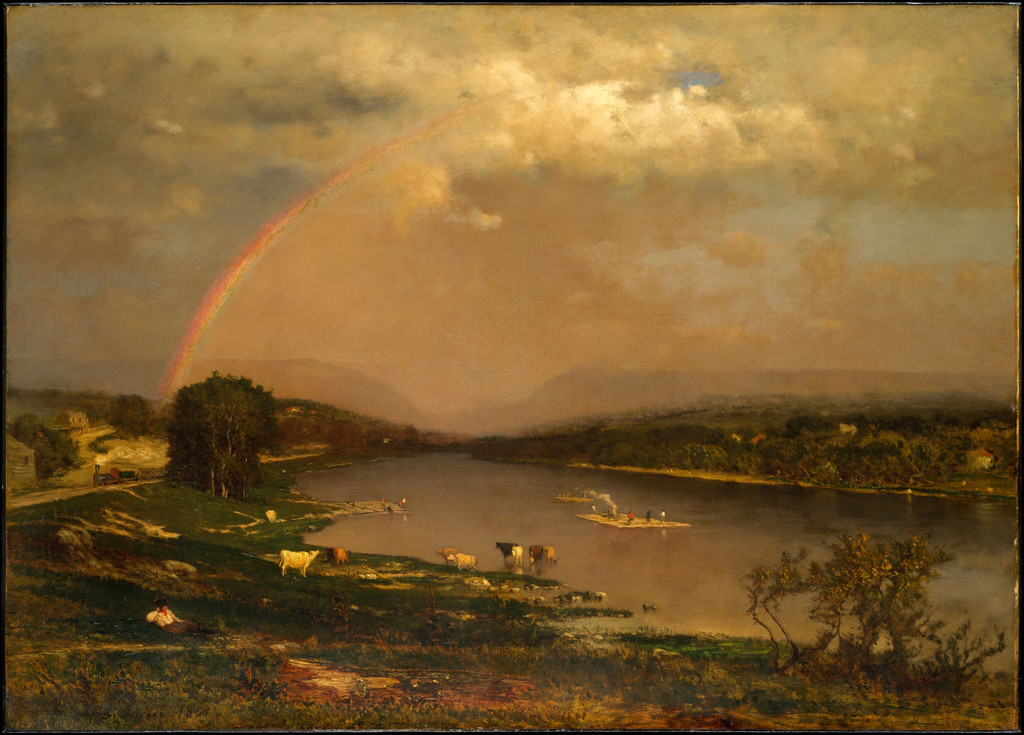
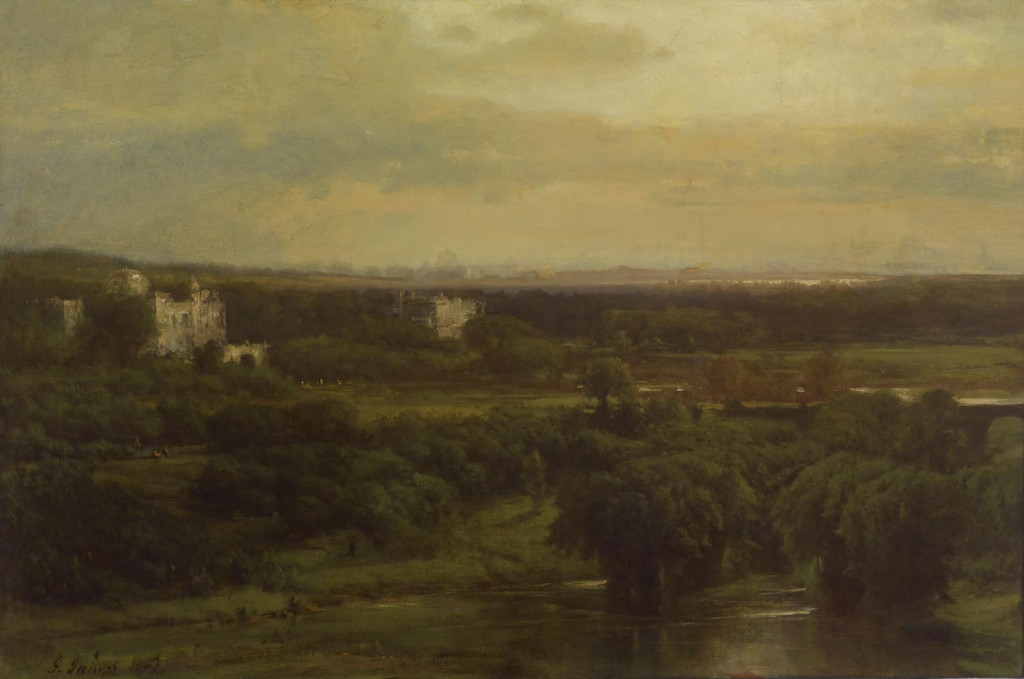
George Inness’s paintings offer several ways into a long career: a carefully articulated mill, a railway valley, a large harvest scene, an Italian grove and late landscapes in which trees seem to emerge from changing light. This guide selects works with identifiable museum records and companion articles. It also explains how to distinguish paintings that share a title. Adrienne Baxter Bell’s account of Inness’s development provides the broad chronology; the individual collection records establish the particular objects.[1]
Selected George Inness paintings
At a Glance
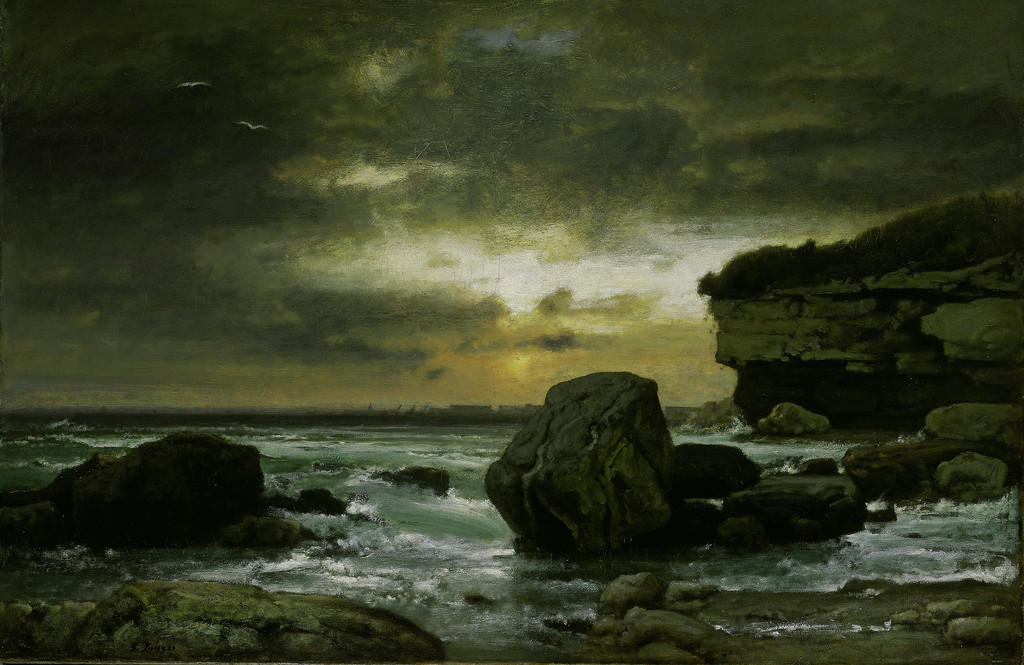
- Starting comparisonThe Old Mill (1849) and Chicago’s The Home of the Heron (1893)
- Industry and landscapeThe Lackawanna Valley and The Mill Stream
- Large compositionsPeace and Plenty and Pine Grove of the Barberini Villa
- PlacesMontclair, Italy, the Catskills, Niagara and Tarpon Springs
- IdentificationCheck date, medium, dimensions, institution and accession together
- Catalogue scopeA source-linked selection of collected museum records
Contents
- Early countryside and the railway valley
- Large fields and an Italian grove
- Small sheets alongside the oils
- A religious painting with transformed survivors
- Montclair and Florida
- Two paintings called The Home of the Heron
- Niagara versions and the importance of medium
- Using the collected records
- Annotated details
Early countryside and the railway valley
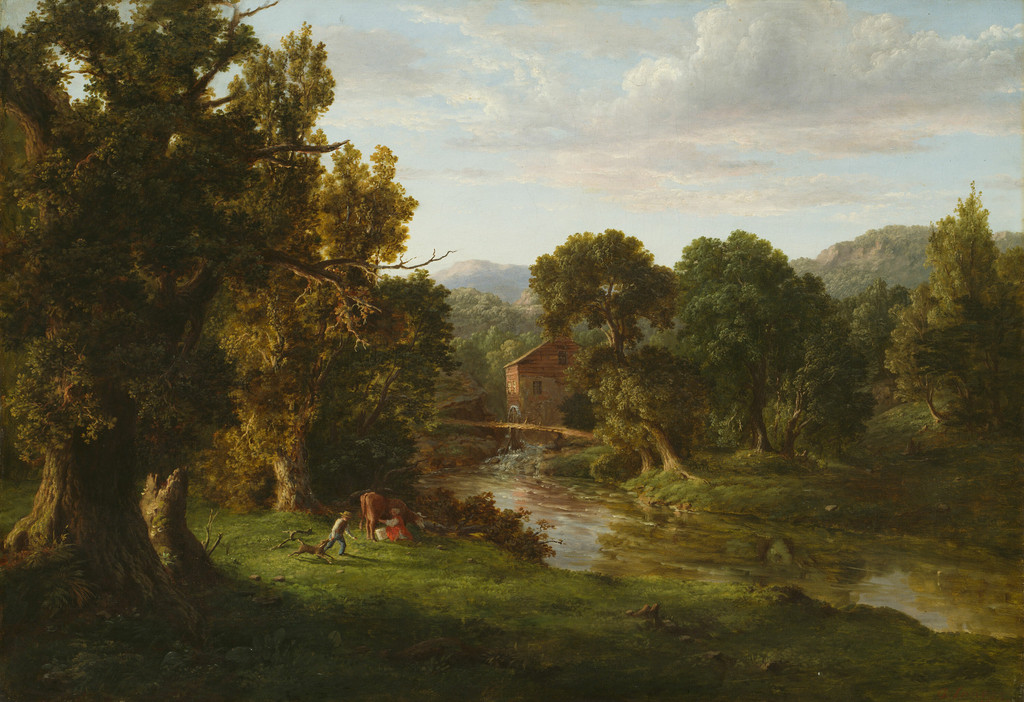
Begin with The Old Mill, dated 1849 by the Art Institute of Chicago, accession 1939.388.[2] Its buildings, path, people and surrounding vegetation give the eye many separate things to recognise. Looking between those details reveals how they organise a cultivated place. The mill belongs within a landscape shaped by habitation and work.
Try following the ground towards the building before examining the distant hill. That movement connects near and far through a sequence of recognisable forms. The painting is useful as an early starting point because the arrangement remains legible even when individual details occupy different scales. A later atmospheric scene can change that experience considerably.
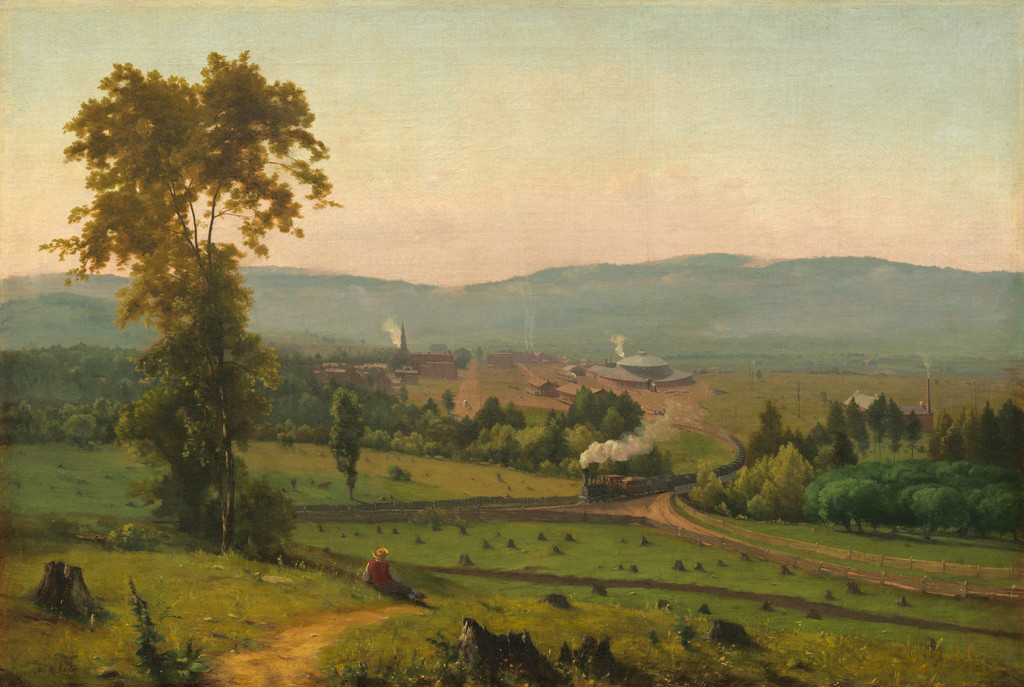
The National Gallery of Art now dates The Lackawanna Valley circa 1856. John Jay Phelps commissioned it in 1855 for the Delaware, Lackawanna and Western Railroad.[3] Train, roundhouse, settlement, foreground stumps and a reclining person bring several kinds of activity into the same valley.
The intact tree on the left and cut stumps below it make a particularly useful comparison. They are different states of the wooded land within one view. The railway leads through that land towards distant buildings; the foreground person gives the scene another point from which to consider it. Those visible relationships support questions about development without resolving the sitter’s thoughts as a documented fact.
Annotated Details from George Inness Paintings
The numbered points identify visible features discussed in this article. Return from each detail to the whole composition. The captions keep each work’s identity, date and medium separate.
The Home of the Heron (Chicago, 1893)
George Inness, The Home of the Heron, 1893. Oil on canvas, 76.2 × 115.2 cm. Art Institute of Chicago, 1911.31. Edward B. Butler Collection; Art Institute of Chicago. Image source. Public domain.
.jpg)
The Home of the Heron (Princeton, 1891)
George Inness, The Home of the Heron, 1891. Oil on canvas. Princeton University Art Museum, y1943-93. Gift of Victor Stephen Harris, Class of 1940, and David Harris, Class of 1944, in memory of their father, Victor Harris; Princeton University Art Museum. Image source. Public domain.
.jpg)
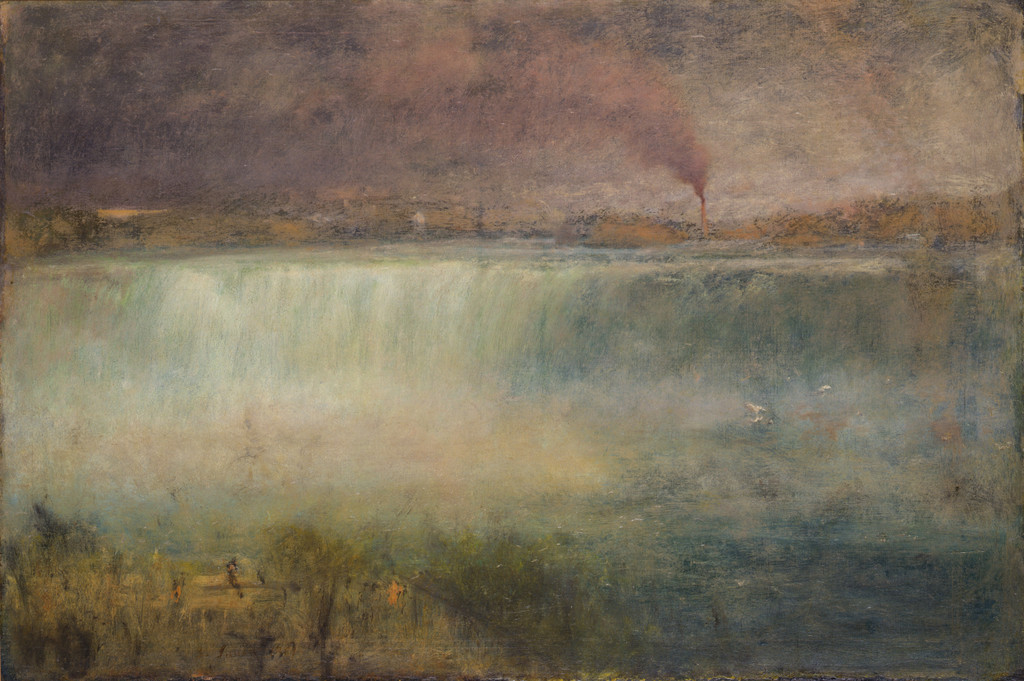
Niagara Falls (1885 wood panel)
George Inness, Niagara Falls, 1885. Oil on wood. Smithsonian American Art Museum, 1929.6.67. Gift of John Gellatly; Smithsonian American Art Museum. Image source. CC0 / Public domain.
.jpg)
Details from GEORGE INNESS PAINTINGS
Compare the cropped details with the complete images above. Notice how their colours, shapes and positions contribute to the larger compositions.
The Home of the Heron (Chicago, 1893)
Small heron
The small dark bird occupies the lower landscape. Returning to it after looking through the trees makes its modest scale more apparent.
 Detail 01 small-heron.jpg)
Slender tree structure
Thin trunks pass through connected warm and cool colour. Some edges remain clear while others join the surroundings.
 Detail 02 slender-tree-structure.jpg)
Soft distant interval
A quieter grey-green interval appears beyond the nearer vegetation. Its softened relationships differ from the darker upright trunks.
 Detail 03 soft-distant-interval.jpg)
The Home of the Heron (Princeton, 1891)
Broad pale trunk
A broad pale trunk rises through the dark upright woodland. Its scale differs from the slender trees in Chicago’s later horizontal picture.
 Detail 04 broad-pale-trunk.jpg)
Heron beside the trunk
A pale bird rests beside the tree and low branching. The surrounding darkness makes recognition gradual.
 Detail 05 heron-beside-the-trunk.jpg)
Warm upper foliage
Warm foliage opens within the upper-right woodland. Its colour differs from the quieter green lower growth.
 Detail 06 warm-upper-foliage.jpg)
Niagara Falls (1885 wood panel)
Curving brink
Green-blue water curves above the broad falling sheet. The arrangement belongs to this separate 1885 wood panel.
 Detail 07 curving-brink.jpg)
Spray at the right
Pale spray partly obscures the falling water. Its softness contrasts with the firmer edge of the brink.
 Detail 08 spray-at-the-right.jpg)
Near branch and bank
Dark branches and the near bank frame the lower right. Their position separates the spectator’s side of the view from the waterfall.
 Detail 09 near-branch-and-bank.jpg)
Large fields and an Italian grove
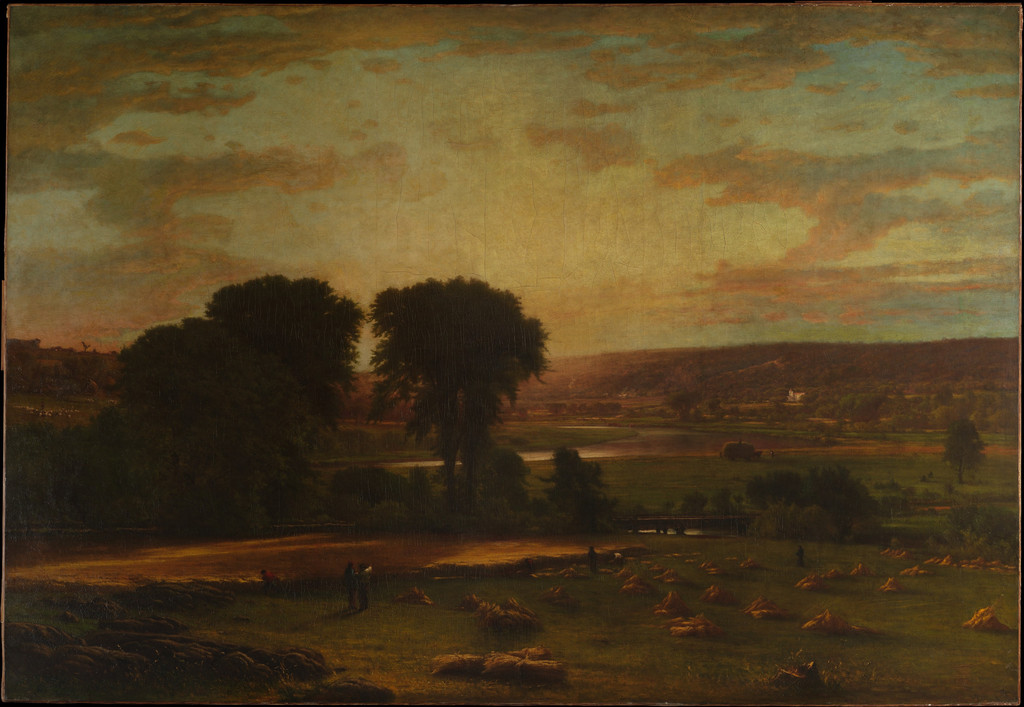
Peace and Plenty, 1865, is one of the expansive compositions in this selection. The Met records a canvas measuring 197.2 by 285.4 centimetres, accession 94.27.[4] Its field workers, harvest bundles, river and golden sky invite attention across a broad surface.
Start with a nearby worker or bundle, then move towards the low hills and bright centre of the sky. The image joins bodily work to a much larger prospect. The title directs attention to abundance and peace, but the labour remains visible. The companion article separates the common postwar interpretation from other scholarly readings of the painting’s social setting.
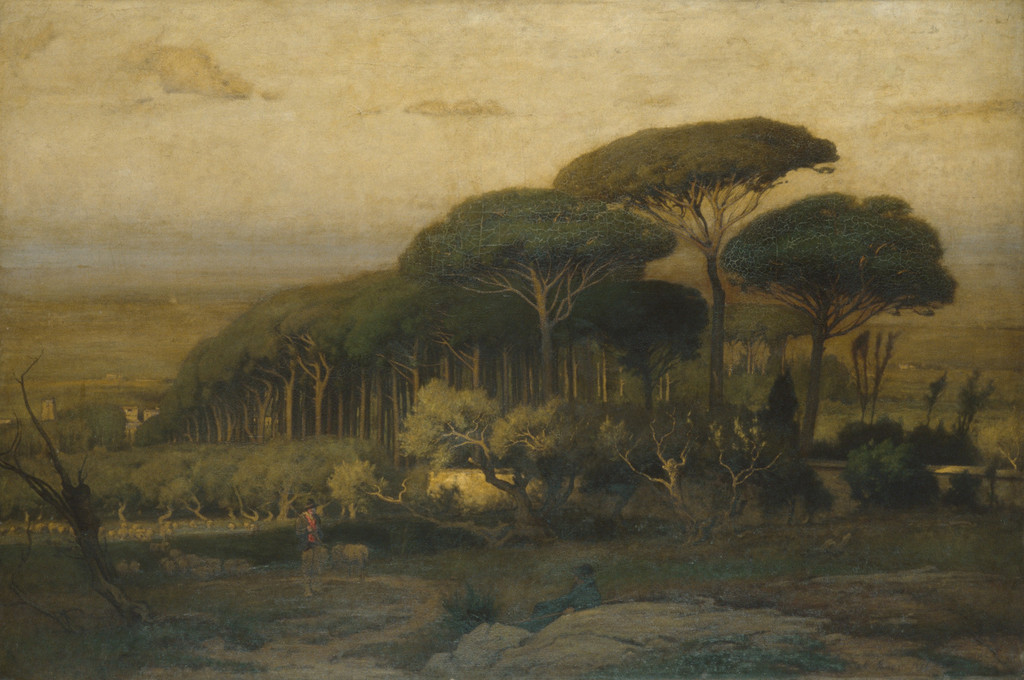
Pine Grove of the Barberini Villa, dated 1876 by the Met, is another large canvas, measuring 200 by 301 centimetres. It was painted after Inness’s extended Italian residence.[5] Here, repeated umbrella-shaped crowns and narrow trunks offer a different organising structure from the harvest field.
Follow the grove horizontally, then look between its trunks. Seated foreground figures and a smaller red-accented figure establish different distances. The left side opens towards pale architecture and a hazy prospect, while the larger tree masses dominate elsewhere. Its breadth allows an alternation between the repeated grove and the more open distance.
Small sheets alongside the oils
The two Italian works on paper in the drawings and watercolours guide provide a useful change of scale. The Met identifies Across the Campagna, 1872, as watercolour, gouache and graphite on off-white wove paper.[6] A large share of its small surface belongs to the sky, above a compressed band of buildings and land.
Olive Trees at Tivoli, 1873, uses gouache, watercolour and graphite on blue wove paper with coloured fibres.[7] Its darker near forms give the eye a different entrance into the distance. The paper and medium belong in the identification of each sheet, alongside title and date.
Compare their distribution of space before treating either as a miniature version of a large oil. One concentrates much of its incident low beneath the sky; the other sets near masses against a more open passage. Their separate records do not establish that either sheet served as a direct study for every later Italian canvas.
A religious painting with transformed survivors
The New Jerusalem requires a different approach. The Walters’ discovery account connects three surviving landscapes with a religious painting damaged in 1880 and subsequently divided and reworked. It was originally part of the three-part Triumph of the Cross commission.[8]
A reader should keep the two groups distinct: three paintings in the commissioned series, and three surviving pieces connected with one of those paintings. The present fragments have separate titles and collection identities. Their current landscapes also include later intervention, so they cannot simply be assembled as an untouched original picture.
The companion article considers what conservation evidence can establish and what remains uncertain. This example changes the meaning of a painting’s present boundary: an edge may belong to division and repair, rather than to the artist’s first arrangement of the whole composition.
Watch: George Inness
Choose a film to explore the artist’s work, its interpretation and its wider setting.
The Montclair Art Museum's George Inness Gallery
Visit the George Inness Gallery at the Montclair Art Museum in this State of the Arts feature.
Watch on YouTubeMontclair and Florida
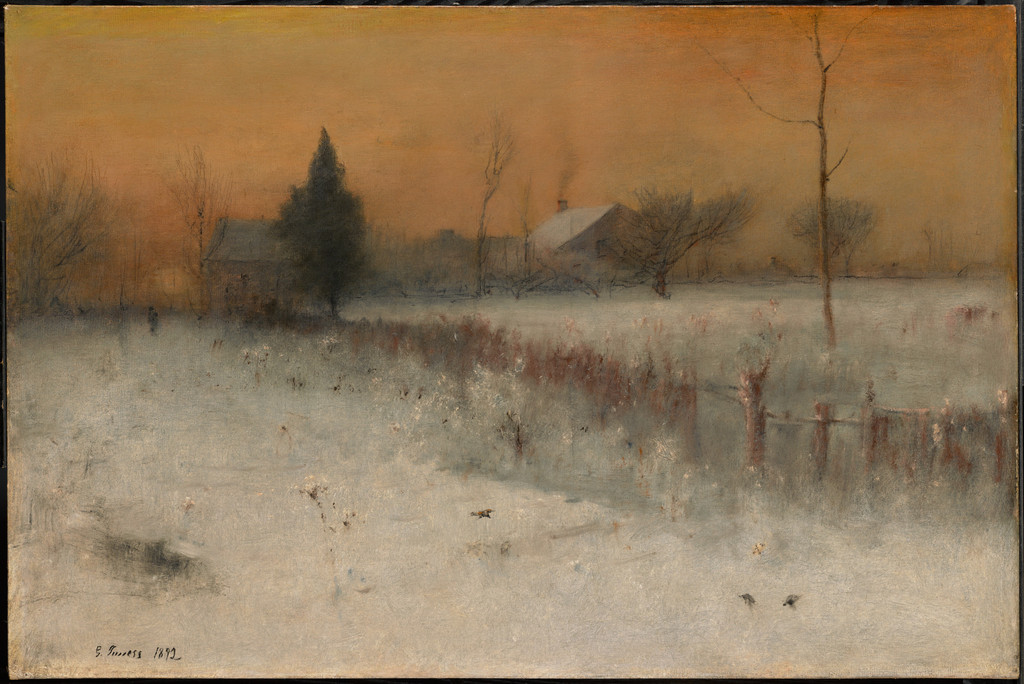
The Clark’s Home at Montclair, 1892, accession 1955.10, describes a winter subject through thin handling.[9] Much of the foreground is a cool, open snowfield beneath a warm sky. Small birds and distant houses give that openness a living and inhabited scale.
Mia’s The Mill Stream, circa 1888, accession 2000.236, gives Montclair another character. Its current record identifies the tower and chimney of Samuel Crump’s printing company.[10] Water reflects warm light towards the foreground, while trees partly screen the architecture. Compare where the brightest areas fall in the winter field and stream: their placement changes how the eye enters each locality.
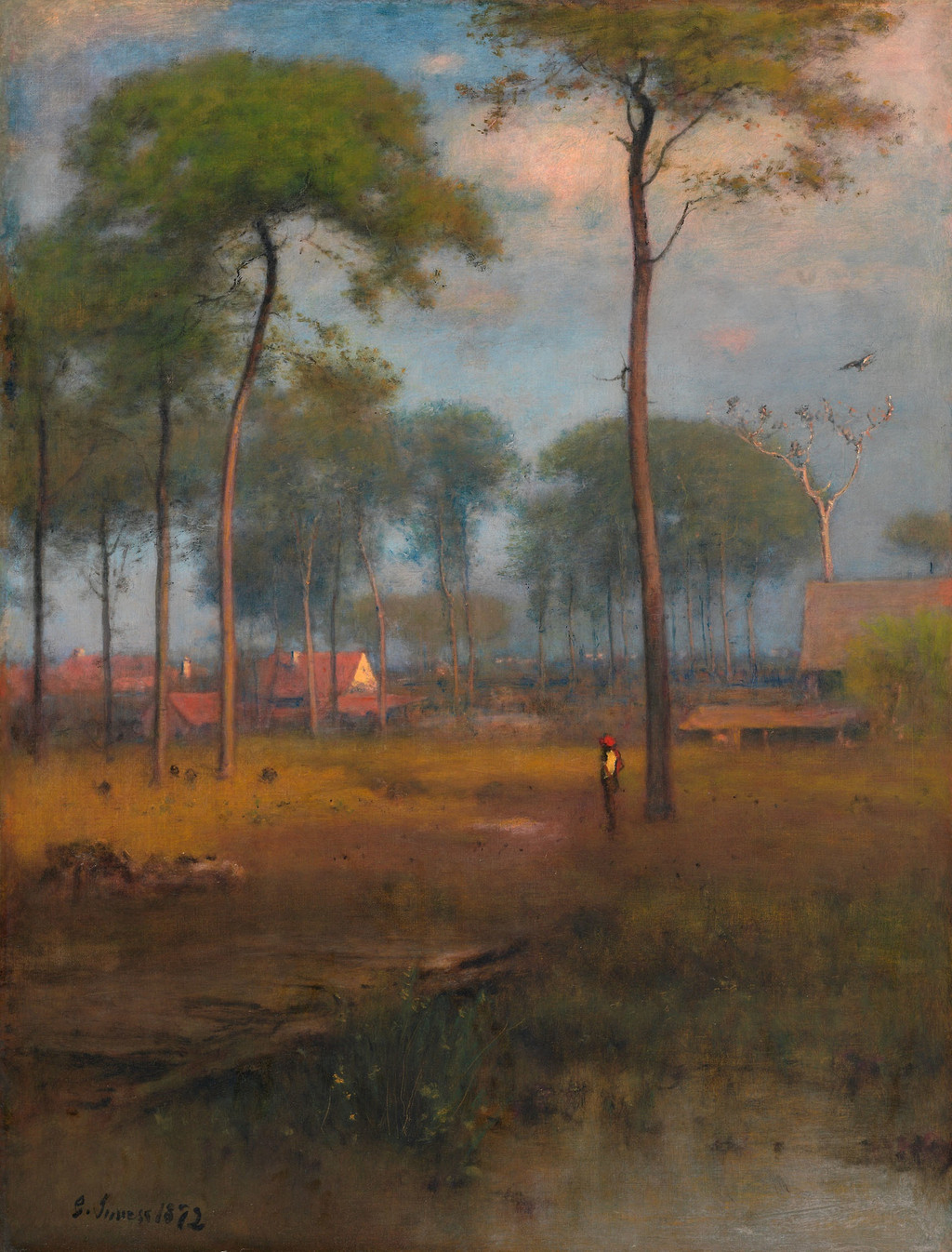
Chicago’s Early Morning, Tarpon Springs, 1892, accession 1911.32, changes both place and format. Its canvas is upright, 107.2 by 82.2 centimetres.[11] Tall trunks rise through a pink-blue sky above a small red-hatted figure. Following those trunks upward creates a different route from looking across the broad Montclair snow.
Late date therefore need not mean one composition repeated with different titles. A winter field, industrial stream and Florida grove distribute trees, open ground and small living forms differently. The Montclair article and style guide develop those comparisons within their respective local and technical contexts.
Two paintings called The Home of the Heron
The Art Institute’s The Home of the Heron is dated 1893, accession 1911.31. Its canvas measures 76.2 by 115.2 centimetres.[12] The horizontal scene contains slender trees, warm light and a small bird within a broadly joined landscape.
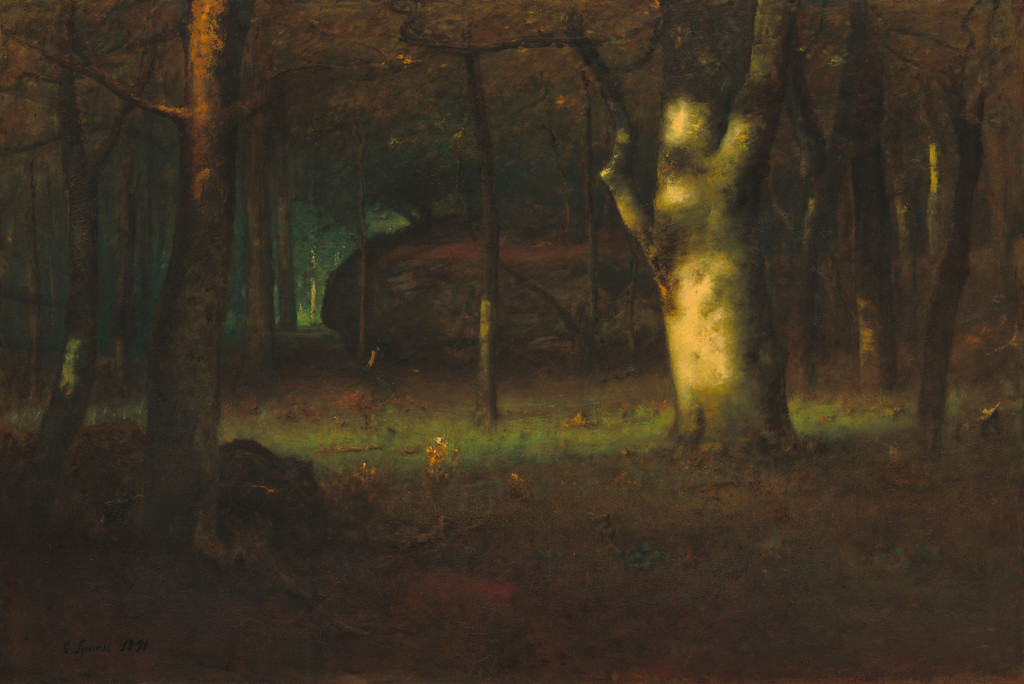
Princeton holds a separate The Home of the Heron, dated 1891, accession y1943-93. Its canvas measures 107 by 94 centimetres.[13] This upright woodland image is markedly dark, with a pale central trunk and a heron to its right. Golden foliage occupies part of the upper canopy, with only a small light opening high among the trees.
The shared title can obscure the difference when a reproduction appears without a caption. Format is a quick first clue, but date and accession complete the identification. Chicago’s dimensions are wider than they are high; Princeton’s are taller than they are wide. Each has its own record and history. Details from one should remain attached to that object when the paintings are compared.
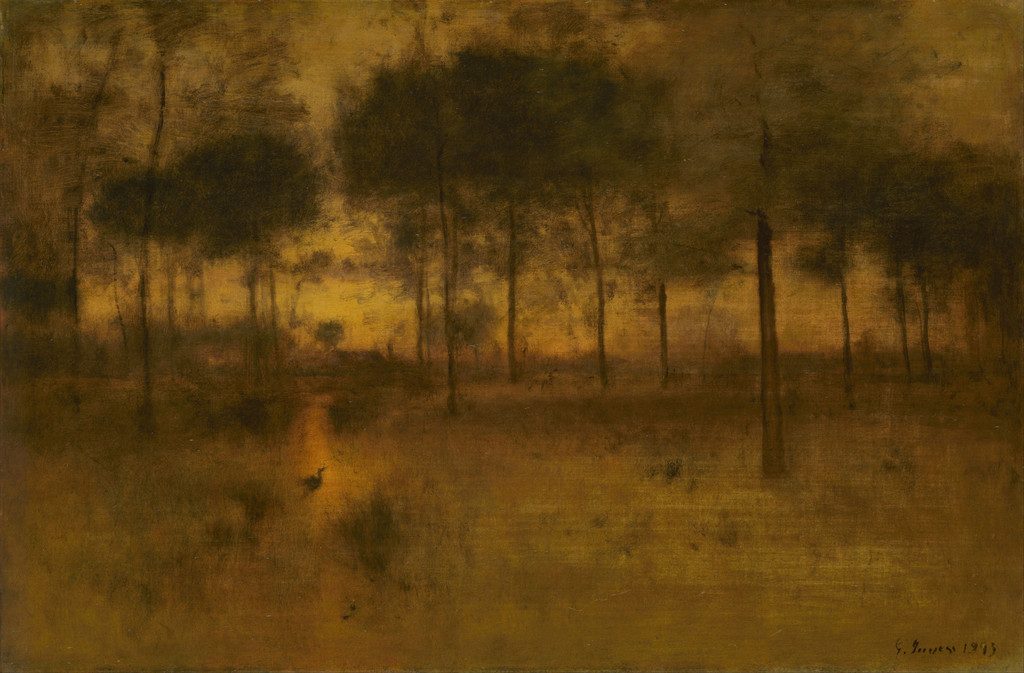
George Inness, The Home of the Heron, 1893. Oil on canvas. Art Institute of Chicago, 1911.31. Edward B. Butler Collection; Art Institute of Chicago. Image source. Public domain.
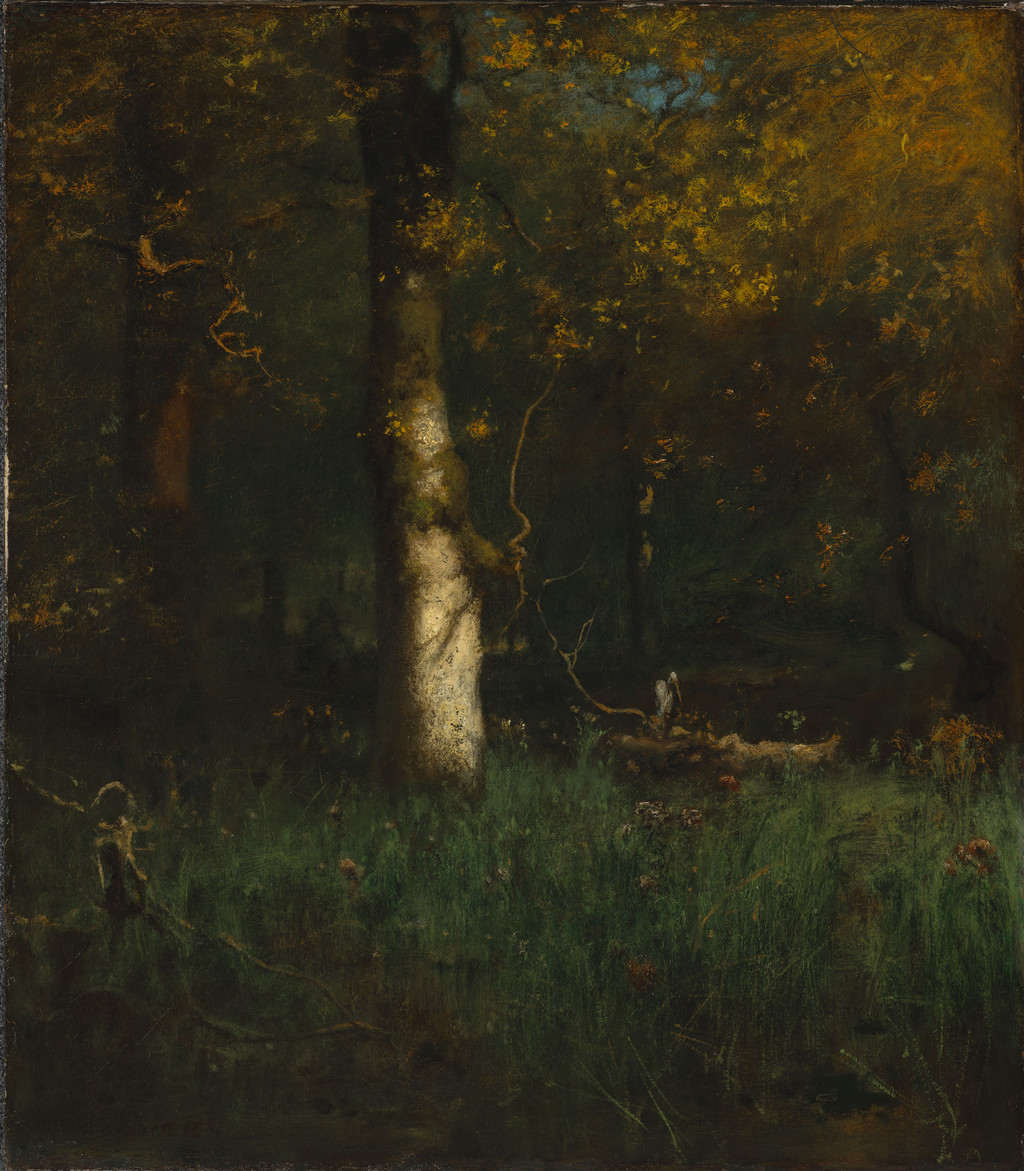
George Inness, The Home of the Heron, 1891. Oil on canvas. Princeton University Art Museum, y1943-93. Gift of Victor Stephen Harris, Class of 1940, and David Harris, Class of 1944, in memory of their father, Victor Harris; Princeton University Art Museum. Image source. Public domain.
Niagara versions and the importance of medium
The Smithsonian American Art Museum holds the Niagara of 1889, oil on canvas, accession 1909.7.31.[14] A smoking chimney remains visible towards the left of this painting. Its presence matters when considering how Inness joined waterfall, atmosphere and signs of human activity.
The museum also holds Niagara Falls, 1885, accession 1929.6.67. That smaller work is oil on wood, measuring 40.2 by 60.9 centimetres.[15] Its green-pale falling water and rising spray occupy a different arrangement, with blue foreground water and a bank at the right.
Title, date and support consequently work together. Calling both simply a Niagara landscape loses a useful distinction between the canvas and panel. The chimney in the 1889 work should not become an asserted feature of the 1885 image, where no comparably prominent smoking chimney is visible.
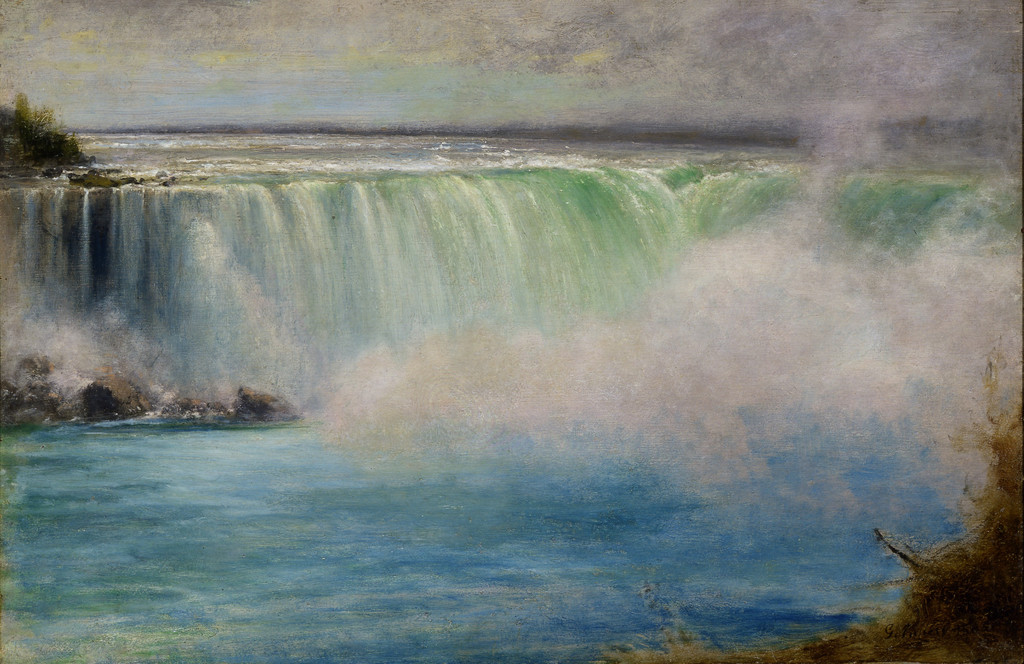
George Inness, Niagara Falls, 1885. Oil on wood. Smithsonian American Art Museum, 1929.6.67. Gift of John Gellatly; Smithsonian American Art Museum. Image source. CC0 / Public domain.
Using the collected records
The directory accompanying these articles is a bounded selection of identified museum objects. It helps readers move between the close readings and institutional records. Its collected scope should remain visible: it does not claim to replace the complete catalogue raisonné of Inness’s work.
For a particular painting, begin with its institution and accession. Then compare date, medium, dimensions and reproduction. These details help distinguish alternate titles, similar subjects and separate versions. A painting without a companion article can still have an informative museum record; the amount of commentary varies between objects.
Collection ownership also differs from present display. Before planning a visit, consult the museum’s current information for the exact work. The source links here provide a starting point, while the biography gives the wider chronology connecting these varied landscapes.
Artworks directory
A collected selection of 46 individually identified museum objects: 43 paintings and three watercolours. This is not a complete catalogue raisonné. Repeated titles identify separate objects where their institutions or accessions differ. Links lead to a companion article where available, otherwise to the museum record. Unillustrated entries remain included; the original lost New Jerusalem is represented by its three transformed survivors.
| Name | Date | Medium |
|---|---|---|
| Crossing the Ford | 1848 | Oil on canvas |
| The Old Mill | 1849 | Oil on canvas |
| The Lackawanna Valley by George Inness | c. 1856 | oil on canvas |
| Delaware Water Gap | 1861 | Oil on canvas |
| Delaware Valley | c. 1865–75 | Oil on artist's board |
| Peace and Plenty | 1865 | Oil on canvas |
| Evening Landscape | 1867; later reworked | Oil on canvas |
| Summer in the Catskills | 1867 | Oil on canvas |
| The Valley of the Olives | 1867; reworked after 1880 | Oil on canvas |
| The Valley of the Shadow of Death | 1867 | Oil on canvas |
| Visionary Landscape | 1867/1880 | Oil on canvas |
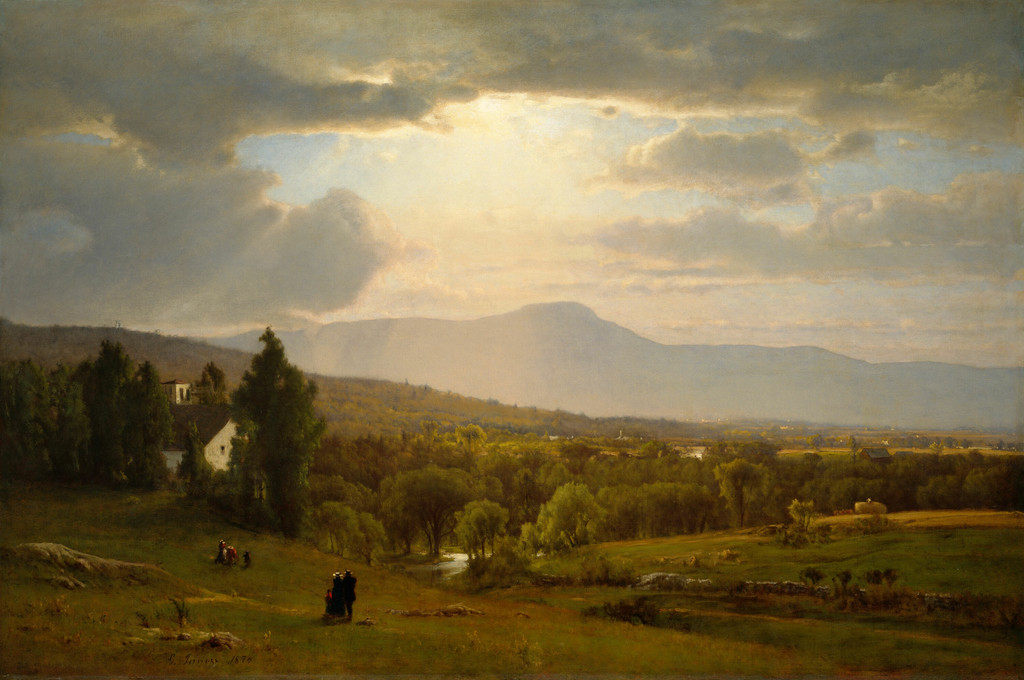
| Catskill Mountains | 1870 | Oil on canvas |
| Across the Campagna | 1872 | Watercolor, gouache, and graphite on off-white wove paper |
| Olive Trees at Tivoli | 1873 | Gouache, watercolor, and graphite on blue wove paper with colored fibers |
| A Marine | c. 1874–75 | Oil on canvas |
| Twilight in Italy — Art Institute of Chicago (1911.44) | 1874 | Oil on panel |
| Pine Grove of the Barberini Villa | 1876 | Oil on canvas |
| The Storm | 1876 | Oil on canvas |
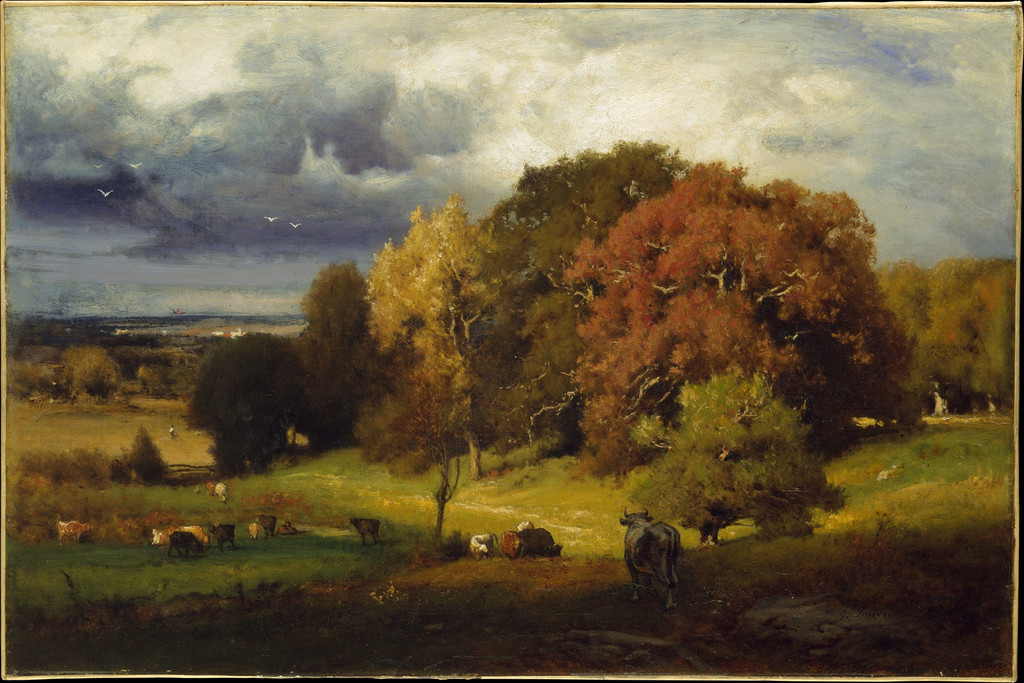
| Autumn Oaks | ca. 1878 | Oil on canvas |
| The Sisters | 1882 | Oil on millboard |
| Harvest, Montclair, New Jersey | 1884 | Oil on canvas |
| Niagara Falls | 1885 | Oil on wood |
| A Silver Morning | 1886 | Oil on canvas |
| Landscape, Sunset | 1887–89 | Oil on canvas |
| September Afternoon | 1887 | Oil on canvas |
| Sunrise | 1887 | Oil on canvas |
| The Mill Stream, Montclair, New Jersey by George Inness | c. 1888 | Oil on canvas |
| Niagara by George Inness | 1889 | oil on canvas |
| The Mill Pond | 1889 | Oil on canvas |
| Sunset in the Valley | 1890 | Oil on canvas |
| The Moon at Night | 1890 | Oil on canvas |
| Twilight in Italy — Art Institute of Chicago (1911.42) | 1890 | Oil on canvas |
| Autumn Woods | 1891–94 | Oil on canvas |
| Moonrise | 1891 | Oil on canvas |
| Spring Blossoms, Montclair, New Jersey | ca. 1891 | Oil and crayon or charcoal on canvas |
| Sunset in the Woods by George Inness | 1891 | oil on canvas |
| The Home of the Heron — Princeton University Art Museum (y1943-93) | 1891 | Oil on canvas |
| Threatening | 1891 | Oil on canvas |
| Early Morning, Tarpon Springs | 1892 | Oil on canvas |
| Home at Montclair by George Inness | 1892 | oil on canvas |
| The Lonely Farm, Nantucket | 1892 | Oil on canvas |
| Afterglow | 1893 | Oil on canvas |
| Sunlit Valley | 1893 | Oil on canvas |
| The Home of the Heron — Art Institute of Chicago (1911.31) | 1893 | Oil on canvas |
| After a Summer Shower | 1894 | Oil on canvas |
| Landscape | n.d. | Watercolor with scraping on ivory wove paper |
Frequently Asked Questions
The Old Mill of 1849 and Chicago’s The Home of the Heron of 1893 show very different ways of arranging an inhabited landscape and directing recognition.
No. It is a bounded selection of source-linked museum records, with individual articles for selected works.
Discussion
Look again at the images and ideas explored in George Inness Paintings. These editorial prompts invite your observations.
Choose one horizontal canvas and one upright canvas. Where does each place its most open area, and how does that change your route through the trees or figures?
Reader Insights
Which pair most clearly changes the balance between near objects and distant atmosphere?
What changes between the two separate paintings called The Home of the Heron?
How does checking the museum and accession alter your reading of a repeated title?
Join the Conversation
Share a detail, comparison or question about George Inness Paintings below.
References
- Adrienne Baxter Bell, “George Inness (1825–1894),” Metropolitan Museum of Art (2012).
- Art Institute of Chicago, The Old Mill, accession 1939.388.
- National Gallery of Art, The Lackawanna Valley, accession 1945.4.1.
- Metropolitan Museum of Art, Peace and Plenty, accession 94.27.
- Metropolitan Museum of Art, Pine Grove of the Barberini Villa, accession 98.16.
- Metropolitan Museum of Art, Across the Campagna, accession 67.55.145.
- Metropolitan Museum of Art, Olive Trees at Tivoli, accession 1989.287.
- Walters Art Museum, “George Inness’s New Jerusalem: Lost and Found” (2004).
- Clark Art Institute, Home at Montclair, accession 1955.10.
- Minneapolis Institute of Art, The Mill Stream, Montclair, New Jersey, accession 2000.236.
- Art Institute of Chicago, Early Morning, Tarpon Springs, accession 1911.32.
- Art Institute of Chicago, The Home of the Heron, accession 1911.31.
- Princeton University Art Museum, The Home of the Heron, accession y1943-93.
- Smithsonian American Art Museum, Niagara, accession 1909.7.31.
- Smithsonian American Art Museum, Niagara Falls, accession 1929.6.67.
- Splash image source.
George Inness, The Old Mill, 1849. Oil on canvas. Art Institute of Chicago, 1939.388. William Owen Goodman and Erna Sawyer Goodman Collection; Art Institute of Chicago. Image source. Public domain.