 by Tom Gurney
Tom Gurney BSc (Hons) is an art history expert with over 20 years experience
Email: tomgurney1@gmail.com / Phone: +44 7429 011000
The Old Mill by George Inness: Introduction
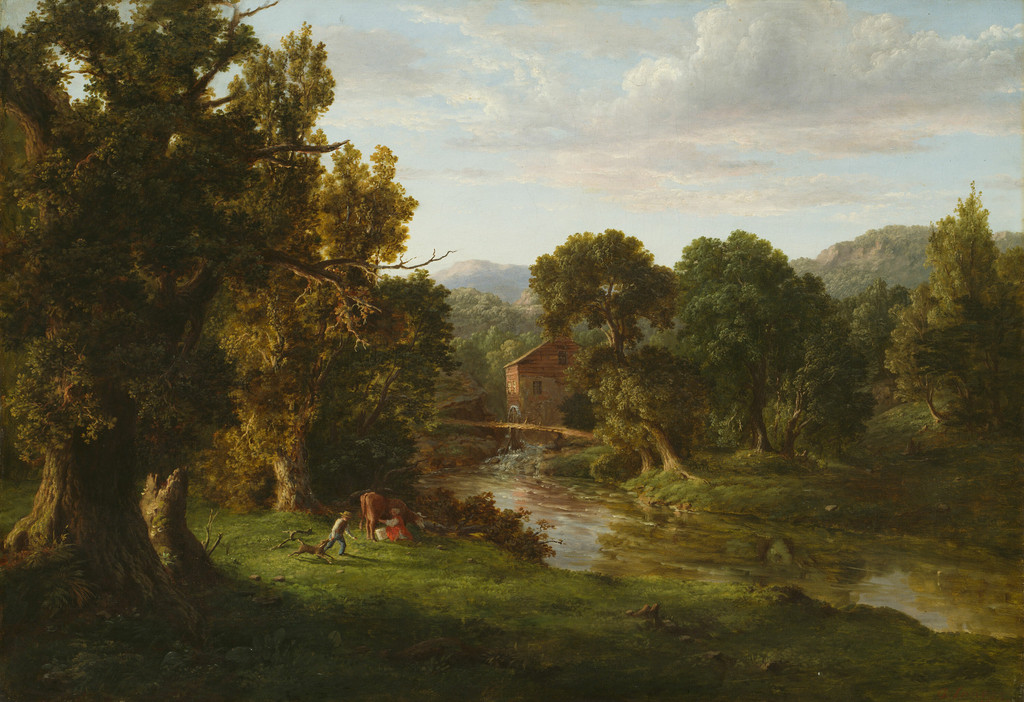
George Inness’s The Old Mill brings a working building, a stream and a small foreground encounter into a deeply wooded landscape. Painted in 1849, the horizontal oil belongs to the Art Institute of Chicago. The scene rewards attention to the relationship between cultivation and forest: the mill and figures appear relatively accessible, while the large trees create a darker, less easily penetrated setting around them. It is an early example of Inness treating inhabited land as a substantial landscape subject.[1]
At a Glance
- ArtistGeorge Inness (1825–1894)
- TitleThe Old Mill
- Date1849
- MediumOil on canvas
- Dimensions75.9 × 107 cm
- CollectionArt Institute of Chicago
- CreditThe William Owen Goodman and Erna Sawyer Goodman Collection
- Accession1939.388
This work across George Inness’s career
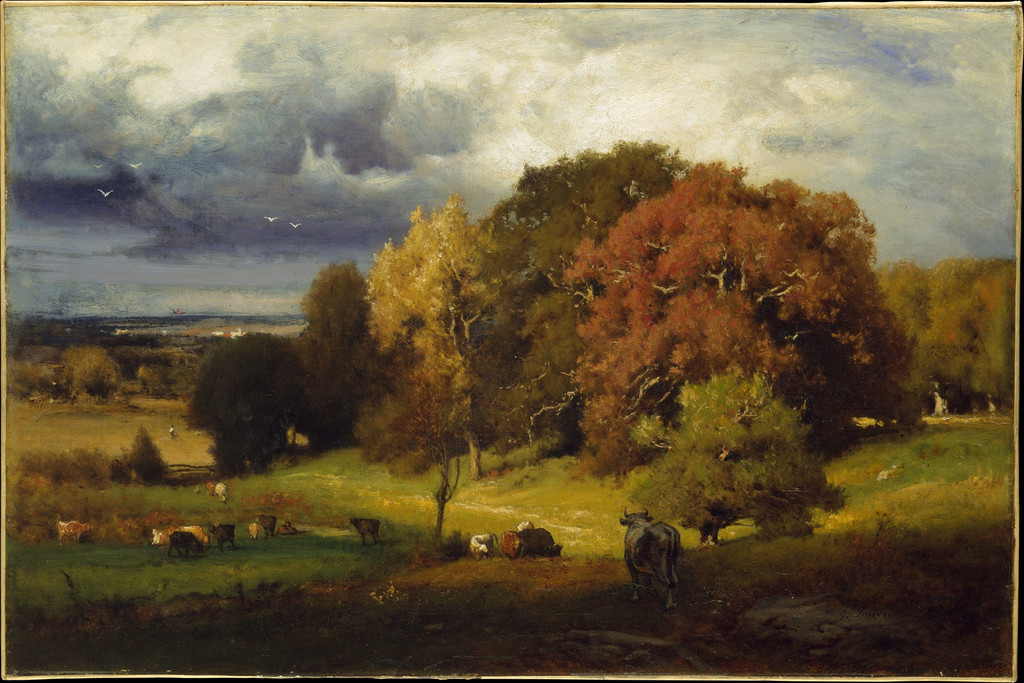
Autumn Oaks by George Inness
ca. 1878Contents
- A mill within a forest
- Light, shadow and the foreground encounter
- Water and the signs of work
- The museum’s reading of rural security and change
- The American Art-Union and the recorded collection route
- Three different mill landscapes
- Annotated details
A mill within a forest
The building does not occupy the foreground as an isolated study. It lies beyond the nearest figures and water, near the middle of the picture. Warm brown tones distinguish it from the trees without severing it from their setting. The surrounding vegetation makes the mill seem embedded in a place that extends beyond its walls and working structures.
Large trees dominate the left side. Their trunks and branches rise above the more intimate foreground encounter, while dense shadow complicates the space behind them. Moving towards the mill requires looking through or past this darker area. The building becomes a destination within the scene rather than the only subject worth noticing.
At the right, the stream opens a different route. Its lighter passages bring attention down from the building towards the nearer bank. The water connects different depths of the composition, joining work, vegetation and the foreground within one continuous setting. It gives the eye movement where the trees provide weight and enclosure.
These relationships explain why the title identifies a building without exhausting the painting’s interest. The mill matters partly through where it is placed. Remove the surrounding trees, water and figures, and the nature of the subject would change: a landscape organised around human use would become a much narrower architectural image.
Annotated Details from The Old Mill
The numbered points identify visible features discussed in this article. Return from each detail to the whole composition. George Inness, The Old Mill, 1849. Oil on canvas, 75.9 × 107 cm. Art Institute of Chicago, 1939.388. The William Owen Goodman and Erna Sawyer Goodman Collection; Art Institute of Chicago. Image source. Public domain.
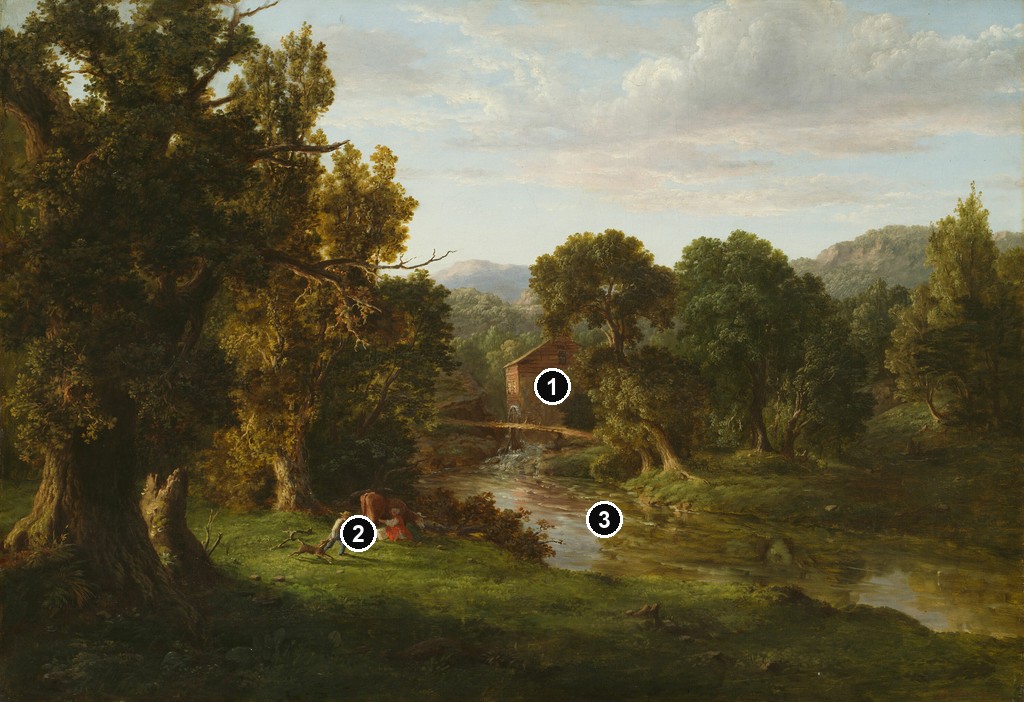
Details from THE OLD MILL
Compare the cropped details with the complete images above. Notice how their colours, shapes and positions contribute to the larger compositions.
Mill building
The warm brown building appears among the trees beyond the stream. Its modest size keeps it within a broader inhabited landscape.
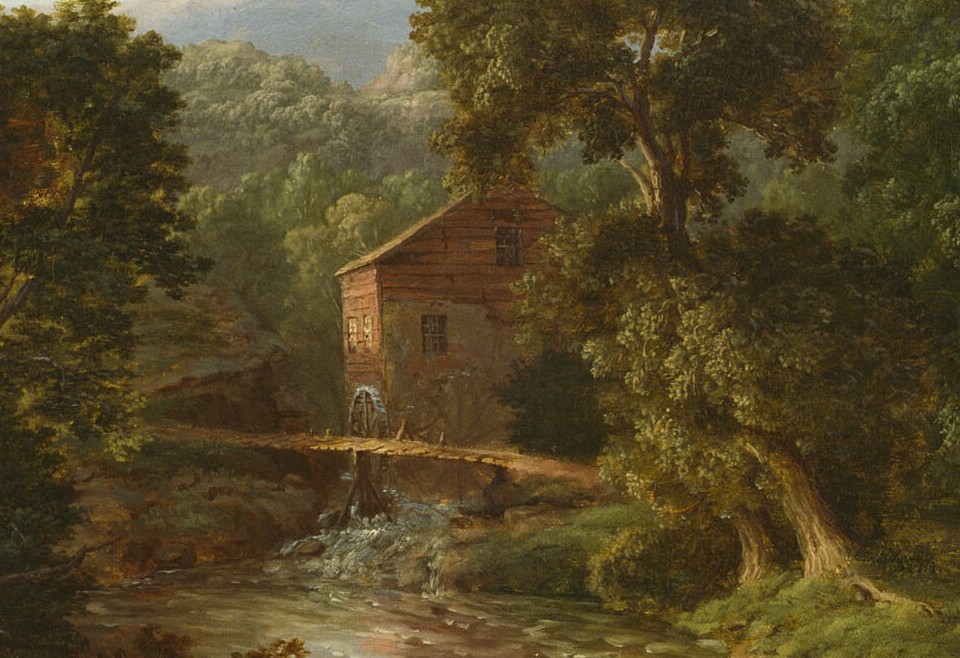
Foreground encounter
Small people and an animal occupy a clearing near the stream. Their concentrated activity contrasts with the much larger surrounding trees.
Opening stream
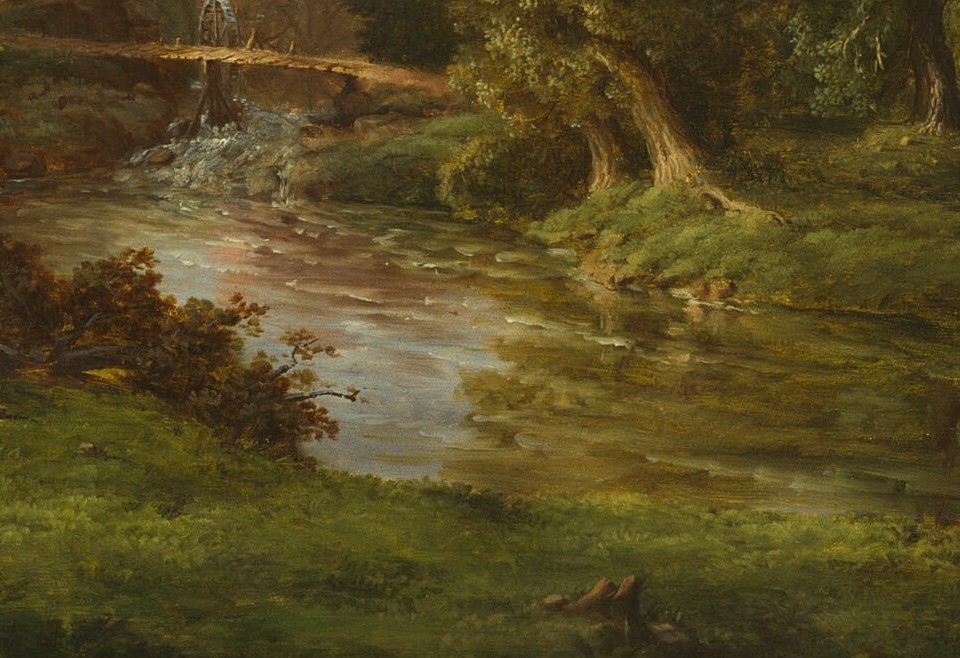
The water leads away from the building towards the lower right. Its brighter, more open passage connects different parts of the wooded setting.
Light, shadow and the foreground encounter
Small figures and an animal occupy a clearing near the viewer. Their brighter accents make them easier to locate than some of the surrounding forms. One figure stands near another who is seated or bending. The image supports attention to their grouping, but it does not supply a secure account of their names or conversation.
Their scale also matters. They make the nearby ground feel inhabitable without becoming large enough to dominate the canvas. The dark trees rise above them; the mill remains beyond them. The figures consequently provide a human measure for both the nearer forest and the more distant building.
The encounter creates a pause within a view otherwise organised by water and receding space. Looking at the figures can slow the movement towards the mill. Looking past them allows the landscape to widen again. Inness gives the viewer more than one way to enter the scene, using the small group as a point of recognition rather than a fully explained narrative.
Light helps sustain that balance. The relatively bright clearing draws attention, while shadow preserves a sense of depth and uncertainty. An illuminated figure can be clear in outline even when the surrounding terrain is harder to read. The contrast makes the painting’s accessible and less accessible spaces visible at the same time.
Water and the signs of work
The stream is both a landscape feature and a connection to the mill. A timber crossing and the descending water lead towards the building’s setting. These structures distinguish the place from an apparently untouched woodland. The view includes a landscape made useful through human activity.
The painting does not need a large machine or crowded workforce to communicate that use. Building, crossing and water are enough to establish the presence of work. Their smaller scale leaves room for the forest, yet they alter how the setting is understood. The trees surround a place where people have arranged routes and structures for practical purposes.
The stream’s changing width and direction also prevent the scene from becoming static. Nearer water catches light, while darker passages connect it to the bank and the mill. Following that sequence reveals how a working landscape can be made pictorially continuous: function and visual movement share the same route.
This is a useful starting point for Inness’s later industrial subjects. The question is not simply whether a building is present. Its size, clarity, setting and relation to figures determine how it acts within the picture. In The Old Mill, cultivation remains intimate and partly enclosed by trees.
The museum’s reading of rural security and change
The Art Institute interprets the illuminated figures and mill against the darker forest as a contrast between settlement and possible danger. It also reads the worn building as an image of rural stability that can suggest vulnerability to industrial change. This is the museum’s critical interpretation; the visible contrasts do not independently establish a single recorded intention by Inness.[1]
The interpretation is useful because it keeps contradictory impressions together. The small encounter can feel settled and familiar, yet the shadowed trees are extensive. The mill belongs to an established landscape, while its condition invites attention to time and change. The picture can offer reassurance without making every part of the scene equally secure or comprehensible.
Its rural character also deserves precision. A mill is itself a form of production. Calling the scene pastoral should not make its working elements disappear. The painting’s appeal depends partly on their incorporation into the wooded setting, rather than on a total absence of tools, structures or cultivated land.
Watch: George Inness
Choose a film to explore the artist’s work, its interpretation and its wider setting.
The Montclair Art Museum's George Inness Gallery
Visit the George Inness Gallery at the Montclair Art Museum in this State of the Arts feature.
Watch on YouTubeThe American Art-Union and the recorded collection route
The museum records the painting in the American Art-Union’s New York exhibition in 1849 as catalogue number 128. Its provenance identifies James P. Kelly as receiving it through that organisation’s distribution in the same year. These details connect the work to a public exhibition and an early owner, rather than only to an undocumented episode in the artist’s studio.[1]
The record next includes a New York sale in January 1902, where the picture was catalogue number 108. William Owen and Erna Sawyer Goodman owned it by 1939 and gave it to the Art Institute that year. The museum’s present credit retains their names. The gap between the earlier distribution and later sale should not be filled with invented owners.[1]
Selected later exhibitions show the different contexts in which an early Inness could be reconsidered. The work appeared in The Hudson River School and Early American Landscape Tradition in 1945 and in the travelling Inness exhibition of 1946. The former placed it within a wider landscape tradition; the latter allowed viewers to encounter it as part of a career. Exhibition participation is documented, while the responses of individual visitors or reviewers would require separate evidence.[1]
Three different mill landscapes
Compare this canvas with The Mill Pond, painted in 1889 and also held in Chicago. The later work is upright, with an orange-red tree and a small rower anchoring a more intensely coloured scene. The related title should not obscure the difference in format, date or subject. A pond named in a title is not evidence that the same building or locality appears.[2]
The Mill Stream, Montclair, New Jersey, circa 1888, offers another comparison. Minneapolis Institute of Art identifies its tower and chimney with Samuel Crump’s printing company. The factory appears beyond thin trees and luminous water. Looking between the works shows how a structure associated with production can remain part of Inness’s landscape while the handling and distribution of light change.[3]
The earlier Old Mill gives the building a warm, relatively contained place in a dark forest. The later pond concentrates attention on tree, boat and colour; the Montclair stream joins an industrial structure to an atmospheric setting. These differences make the three pictures useful comparisons, rather than interchangeable illustrations of a generic mill subject.
Return finally to the foreground of the 1849 canvas. The figures, animal and stream connect work with an inhabited place. The surrounding trees keep the landscape larger and less definite than the small encounter. Inness holds those scales together, allowing a modest rural subject to sustain a more complex experience of looking.
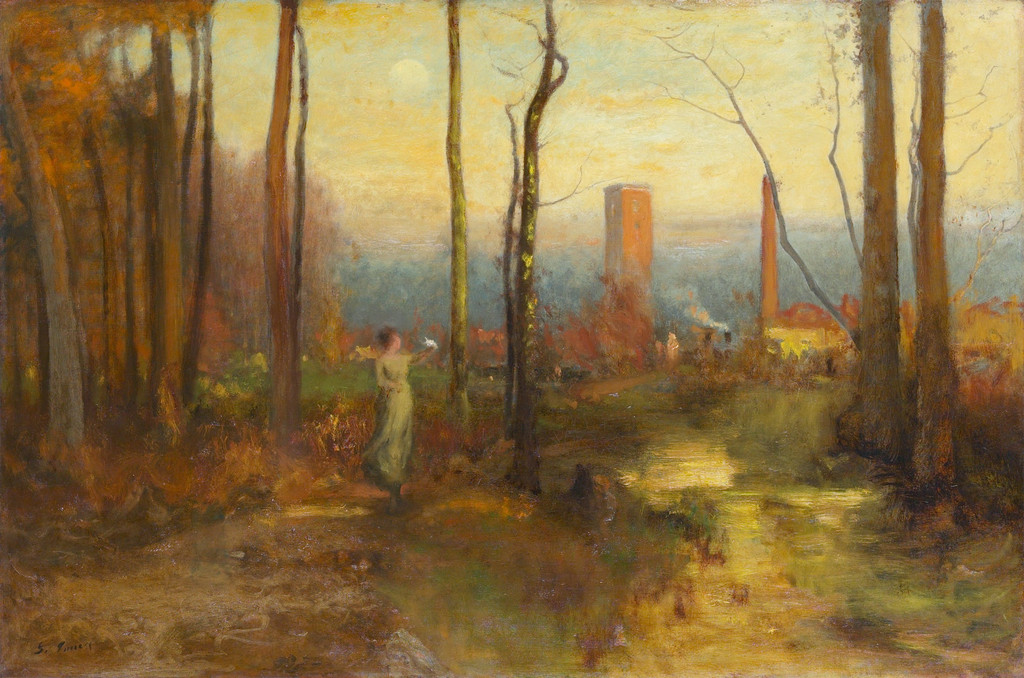
George Inness, The Mill Stream, Montclair, New Jersey, c.1888. Oil on canvas. Minneapolis Institute of Art, 2000.236. Gift of Don and Diana Lee Lucker; Minneapolis Institute of Art. Image source. Public domain.
Artworks directory
A collected selection of 46 individually identified museum objects: 43 paintings and three watercolours. This is not a complete catalogue raisonné. Repeated titles identify separate objects where their institutions or accessions differ. Links lead to a companion article where available, otherwise to the museum record. Unillustrated entries remain included; the original lost New Jerusalem is represented by its three transformed survivors.
| Name | Date | Medium |
|---|---|---|
| Crossing the Ford | 1848 | Oil on canvas |
| The Old Mill | 1849 | Oil on canvas |
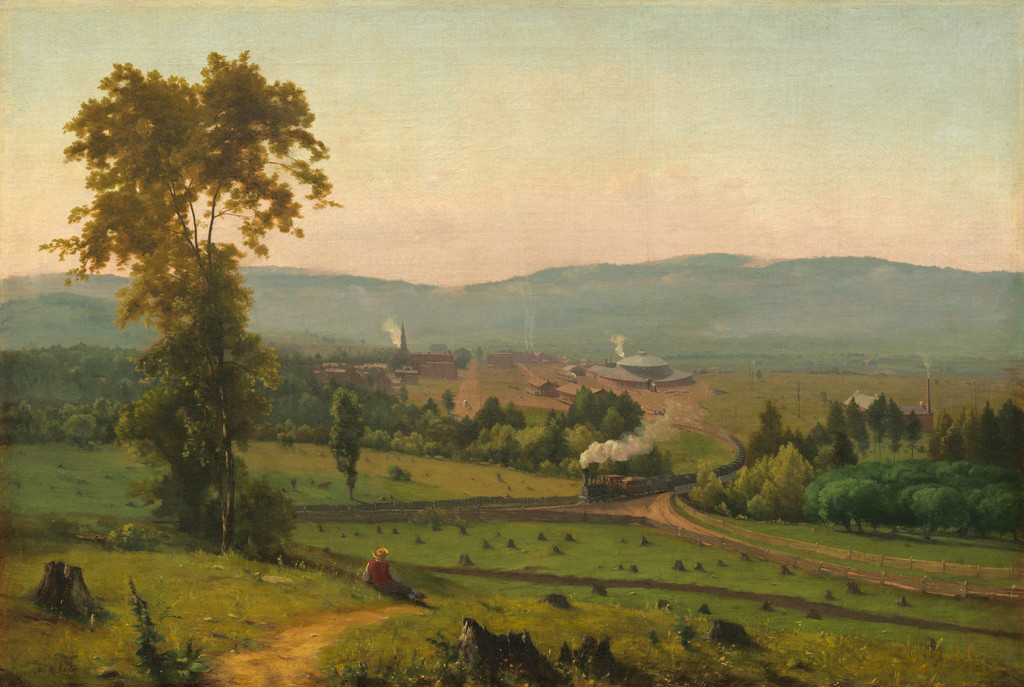
| The Lackawanna Valley by George Inness | c. 1856 | oil on canvas |
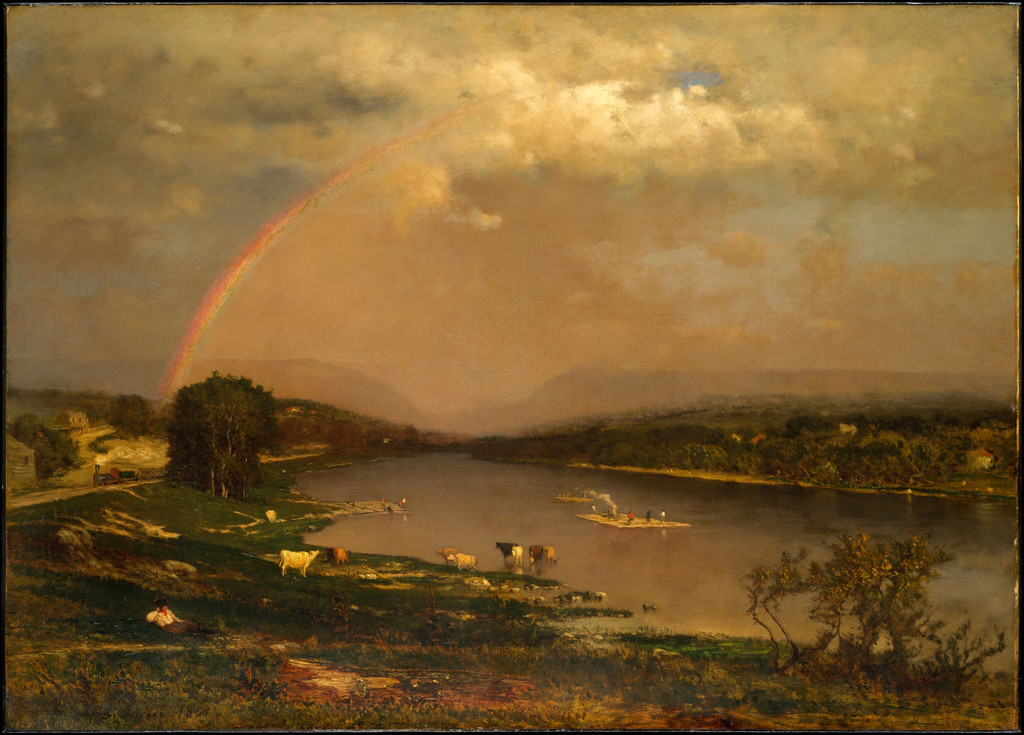
| Delaware Water Gap | 1861 | Oil on canvas |
| Delaware Valley | c. 1865–75 | Oil on artist's board |
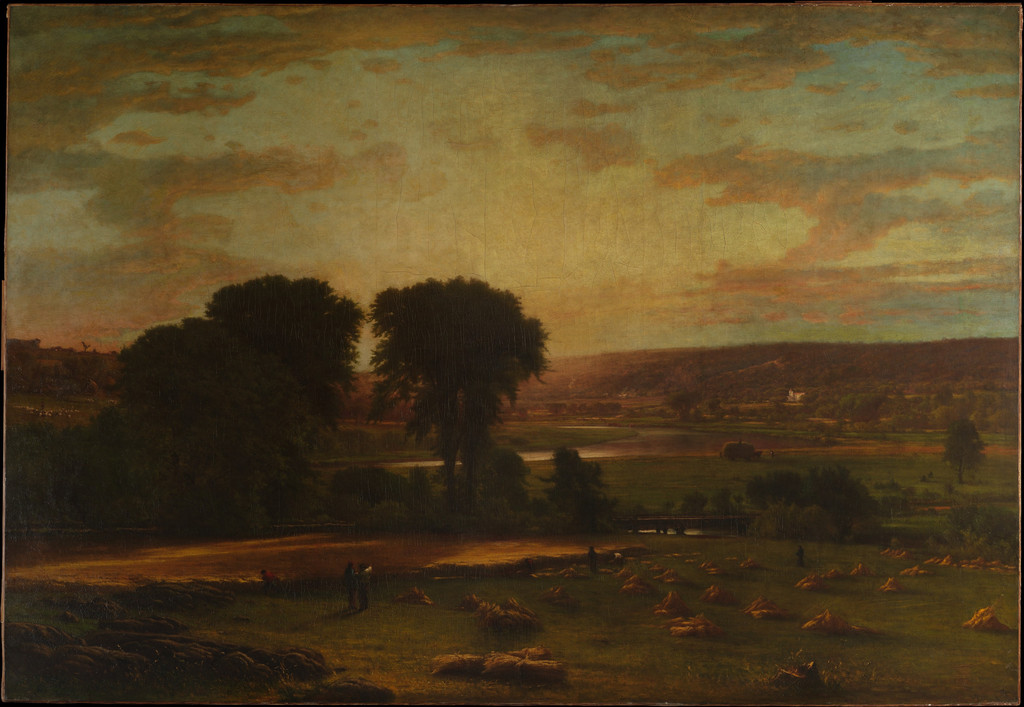
| Peace and Plenty | 1865 | Oil on canvas |
| Evening Landscape | 1867; later reworked | Oil on canvas |
| Summer in the Catskills | 1867 | Oil on canvas |
| The Valley of the Olives | 1867; reworked after 1880 | Oil on canvas |
| The Valley of the Shadow of Death | 1867 | Oil on canvas |
| Visionary Landscape | 1867/1880 | Oil on canvas |
| Catskill Mountains | 1870 | Oil on canvas |
| Across the Campagna | 1872 | Watercolor, gouache, and graphite on off-white wove paper |
| Olive Trees at Tivoli | 1873 | Gouache, watercolor, and graphite on blue wove paper with colored fibers |
| A Marine | c. 1874–75 | Oil on canvas |
| Twilight in Italy — Art Institute of Chicago (1911.44) | 1874 | Oil on panel |
| Pine Grove of the Barberini Villa | 1876 | Oil on canvas |
| The Storm | 1876 | Oil on canvas |
| Autumn Oaks | ca. 1878 | Oil on canvas |
| The Sisters | 1882 | Oil on millboard |
| Harvest, Montclair, New Jersey | 1884 | Oil on canvas |
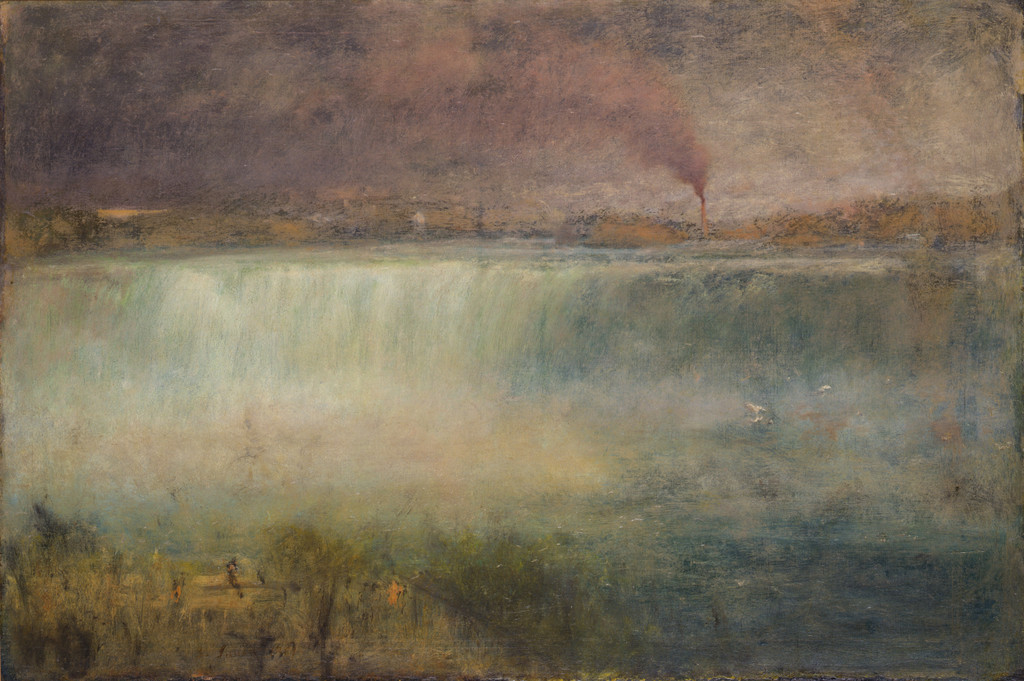
| Niagara Falls | 1885 | Oil on wood |
| A Silver Morning | 1886 | Oil on canvas |
| Landscape, Sunset | 1887–89 | Oil on canvas |
| September Afternoon | 1887 | Oil on canvas |
| Sunrise | 1887 | Oil on canvas |
| The Mill Stream, Montclair, New Jersey by George Inness | c. 1888 | Oil on canvas |
| Niagara by George Inness | 1889 | oil on canvas |
| The Mill Pond | 1889 | Oil on canvas |
| Sunset in the Valley | 1890 | Oil on canvas |
| The Moon at Night | 1890 | Oil on canvas |
| Twilight in Italy — Art Institute of Chicago (1911.42) | 1890 | Oil on canvas |
| Autumn Woods | 1891–94 | Oil on canvas |
| Moonrise | 1891 | Oil on canvas |
| Spring Blossoms, Montclair, New Jersey | ca. 1891 | Oil and crayon or charcoal on canvas |
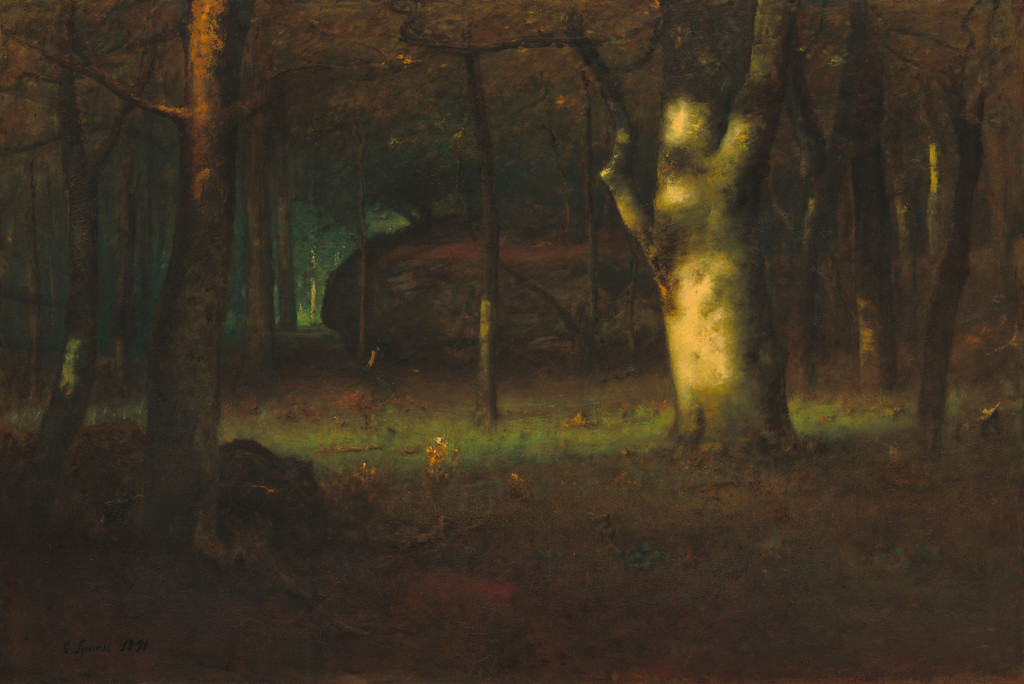
| Sunset in the Woods by George Inness | 1891 | oil on canvas |
| The Home of the Heron — Princeton University Art Museum (y1943-93) | 1891 | Oil on canvas |
| Threatening | 1891 | Oil on canvas |
| Early Morning, Tarpon Springs | 1892 | Oil on canvas |
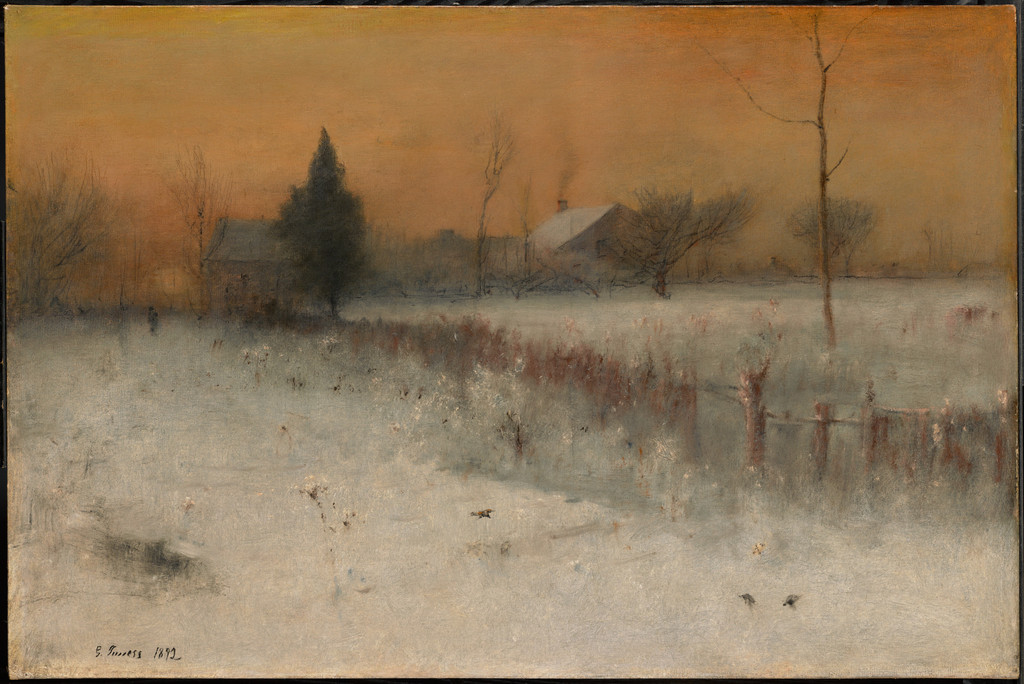
| Home at Montclair by George Inness | 1892 | oil on canvas |
| The Lonely Farm, Nantucket | 1892 | Oil on canvas |
| Afterglow | 1893 | Oil on canvas |
| Sunlit Valley | 1893 | Oil on canvas |
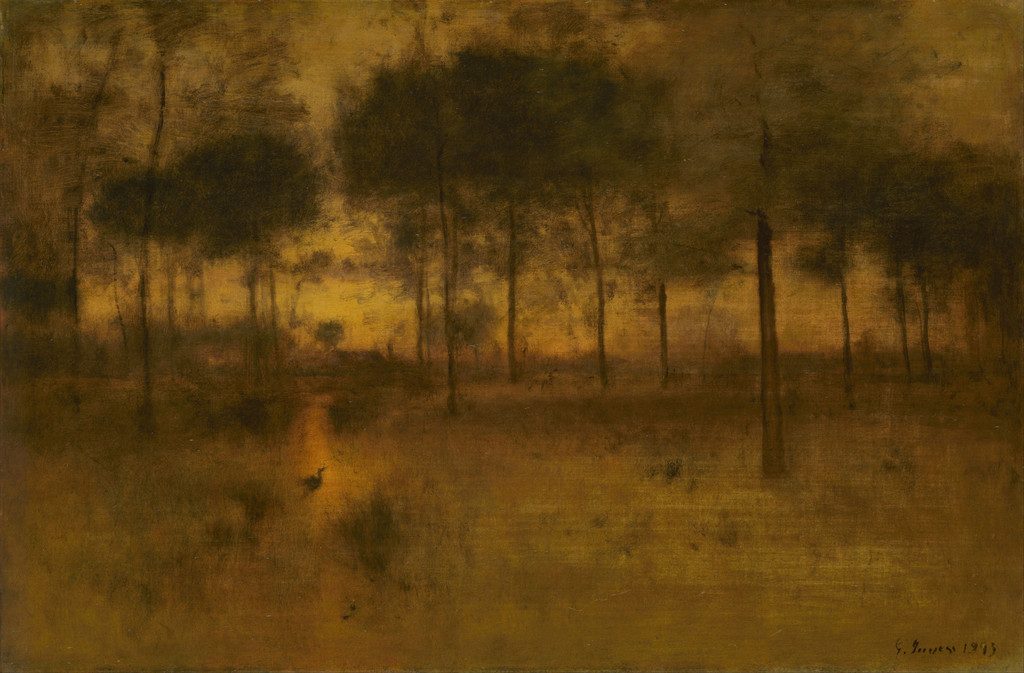
| The Home of the Heron — Art Institute of Chicago (1911.31) | 1893 | Oil on canvas |
| After a Summer Shower | 1894 | Oil on canvas |
| Landscape | n.d. | Watercolor with scraping on ivory wove paper |
Frequently Asked Questions
The Art Institute dates this canvas to 1849. It is accession 1939.388, measuring 75.9 × 107 cm.[1]
The sources used here do not establish a precise site. The visible mill and wooded setting can be discussed without inventing a location.
They are separate works. Chicago’s The Mill Pond dates to 1889, uses an upright format and has accession 1911.30.[2]
William Owen and Erna Sawyer Goodman gave it to the Art Institute in 1939.[1]
Discussion
Look again at the images and ideas explored in The Old Mill by George Inness. These editorial prompts invite your observations.
Begin with the mill, then look back towards the small foreground group. Does the building remain the centre of your attention? Consider how the dark trees and lighter water affect your sense of security, distance and human activity.
Reader Insights
How does the stream connect the building with the foreground encounter?
How does this early mill differ from the later printing plant?
Which part of the inhabited setting contributes most to its depth?
Join the Conversation
Share a detail, comparison or question about The Old Mill by George Inness below.
References
- Art Institute of Chicago, The Old Mill, accession 1939.388. Current object description, provenance and exhibition record.
- Art Institute of Chicago, The Mill Pond, accession 1911.30.
- Minneapolis Institute of Art, The Mill Stream, Montclair, New Jersey, accession 2000.236.
- Splash image source.
George Inness, The Old Mill, 1849. Oil on canvas, 75.9 × 107 cm. Art Institute of Chicago, 1939.388. The William Owen Goodman and Erna Sawyer Goodman Collection; Art Institute of Chicago. Image source. Public domain.