 by Tom Gurney
Tom Gurney BSc (Hons) is an art history expert with over 20 years experience
Email: tomgurney1@gmail.com / Phone: +44 7429 011000
Sunset in the Woods by George Inness: Introduction
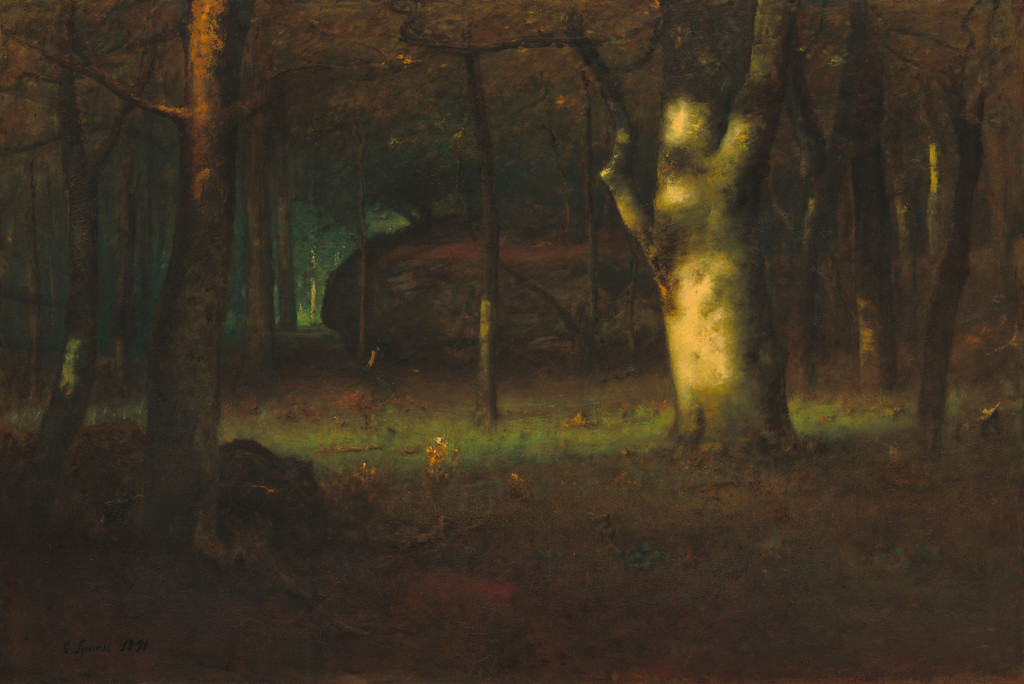
George Inness’s Sunset in the Woods keeps the viewer inside a dense landscape, where a pale branching trunk and a small greenish opening interrupt the surrounding darkness. The title suggests a change in light, but the painting offers no broad, unobstructed sunset horizon. Dated 1891, this large oil belongs to the National Gallery of Art’s Corcoran Collection. An artist letter and a published technical examination make it possible to connect its enveloping effect with memory, prolonged work and a varied material surface.[1][2][3]
At a Glance
- ArtistGeorge Inness (1825–1894)
- TitleSunset in the Woods
- Date1891
- MediumOil on canvas
- Dimensions122.2 × 183.2 cm
- CollectionNational Gallery of Art, Corcoran Collection
- Accession2014.79.43
- Documented contextA July 23, 1891 letter recalls an earlier sketch and years of work
This work across George Inness’s career
Autumn Oaks by George Inness
ca. 1878Contents
- Looking from within the wood
- The pale trunk and the small opening
- A sketch remembered after twenty years
- Seven years and the question of finish
- The independent examination of the surface
- Later treatments and qualified findings
- Purchase in 1891 and the Corcoran Collection
- Comparing open pasture and winter twilight
- Reading memory, paint and the present image together
- Annotated details
Looking from within the wood
The scene is organised through near trunks, ground and canopy rather than a distant panorama. A broad darker trunk stands left of centre, while a pale branching trunk rises on the right. Between them, the eye encounters a substantial brown rock-like form and a small opening into brighter green space.
The two large trunks create unequal kinds of emphasis. The darker one joins surrounding shadow, though warmer passages make its bark noticeable. The pale one asserts its presence through lightness and branching shape. Their different weights help hold the scene together without making both equally conspicuous.
The ground remains relatively continuous beneath them. Green, brown and warmer accents connect the nearer area with the space behind the central form. The viewer can follow these changes without finding a clearly drawn path at every point. Depth emerges through overlaps and intervals rather than an obvious route across open land.
This enclosure changes the meaning of the title. The sunset is experienced through what it does inside the trees. Light reaches selected forms; shadow thickens elsewhere; small openings become significant. The painting offers the effect of a wood at a particular transition rather than a display of the sun over an empty horizon.
Annotated Details from Sunset in the Woods
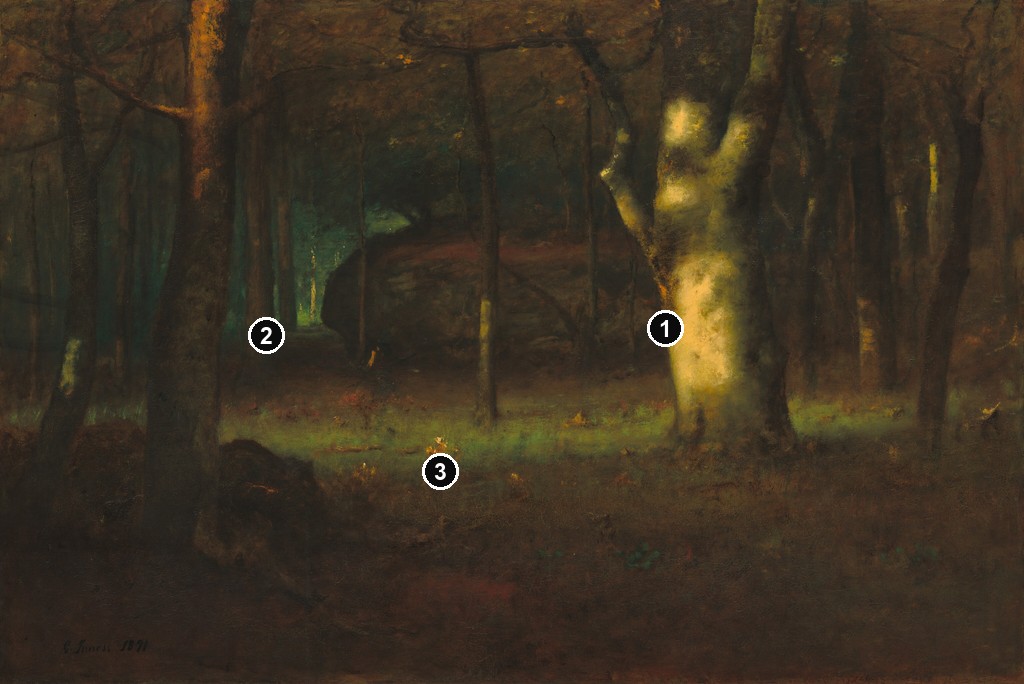
The numbered points identify visible features discussed in this article. Return from each detail to the whole composition. George Inness, Sunset in the Woods, 1891. Oil on canvas, 122.2 × 183.2 cm. National Gallery of Art, 2014.79.43. Corcoran Collection; National Gallery of Art. Image source. CC0 / Public domain.
Details from SUNSET IN THE WOODS
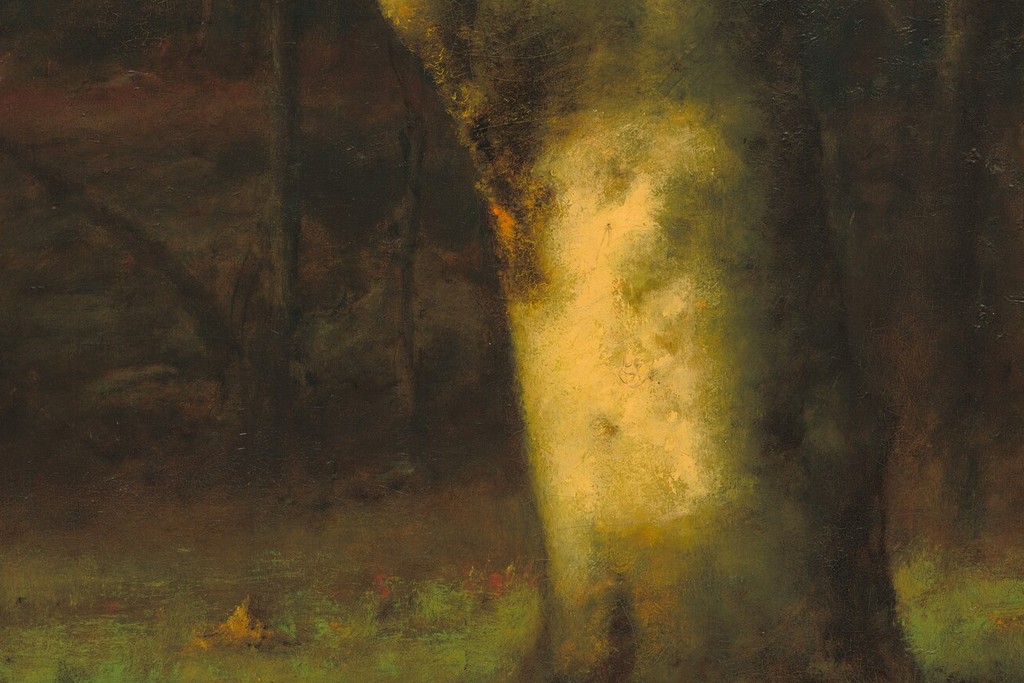
Compare the cropped details with the complete images above. Notice how their colours, shapes and positions contribute to the larger compositions.
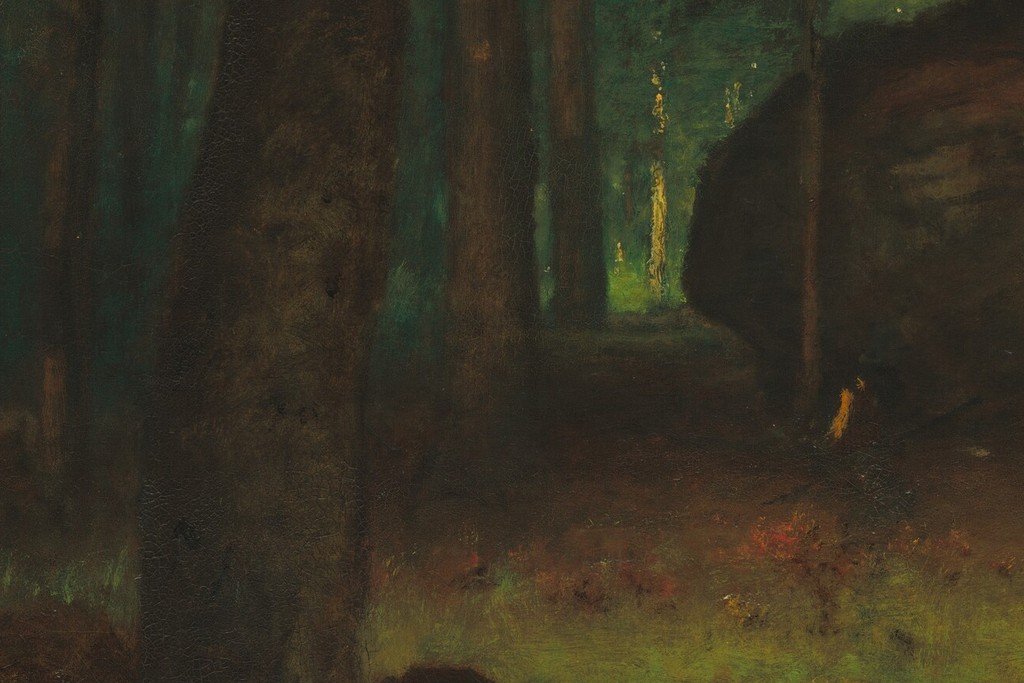
Illuminated trunk
Pale yellow light distinguishes the broad trunk from the dark trees around it. Compare its patches of light with the quieter green ground.
Small woodland opening
A small green-lit opening appears beyond the nearer trees. Its limited extent makes the surrounding dark forms feel more enclosing.
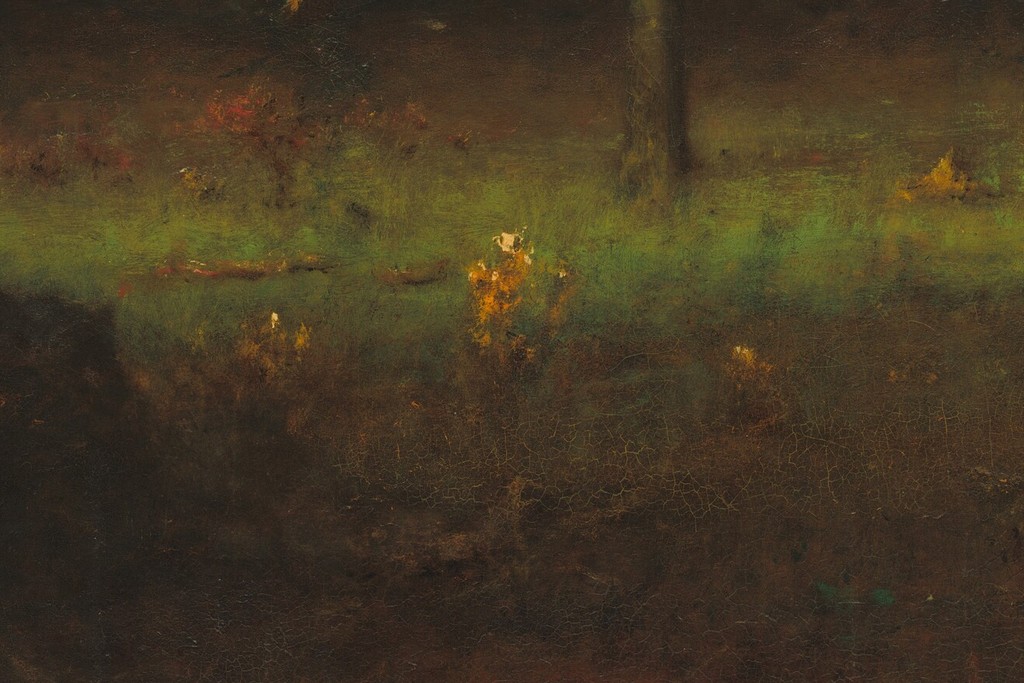
Low foreground growth
Small warm accents rise from the low vegetation. They make a different kind of detail from the large trunks and canopy.
The pale trunk and the small opening
The right-hand trunk is one of the strongest forms in the picture. It rises from the darker ground and divides into branches, carrying pale yellow-grey colour into the canopy. Its shape remains recognisable even where surrounding vegetation is less definite. That contrast gives the viewer a firm near form against which to read the rest of the scene.
The greenish opening lies farther back, left of the central brown mass. It occupies much less area, yet its change in colour creates another focus. The eye can move from the large pale trunk towards this smaller interval, sensing depth without receiving an extensive account of what lies beyond.
The two features perform different tasks. The trunk makes an object present; the opening makes space available. Their relationship explains why a landscape can feel substantial even where much of its content remains dark. A small area of relative clarity can imply a larger environment without describing it exhaustively.
The darker canopy is therefore active rather than empty. It encloses the brighter accents and limits how far the eye can travel. The painting would behave differently if every branch were equally sharp or every shadow were brightened. Its selected degrees of clarity are part of the experience the composition creates.
A sketch remembered after twenty years
The 1966 Corcoran catalogue transcribes a letter Inness wrote on July 23, 1891. In it, he recalls material taken from a sketch made near Hastings in Westchester County, New York, twenty years earlier. The statement belongs to the artist’s retrospective account at the time of the letter; it does not supply an exact date or location for the surviving sketch itself.[2]
He also says that the painting had been begun seven years before, but that an idea adequate to the original impression had emerged only during the preceding winter. The dates are revealing because they separate seeing, sketching, beginning a canvas and finding a satisfactory pictorial idea. Those activities did not coincide in one uninterrupted session.[2]
The remembered place consequently supplied material rather than an obligation to repeat every observed feature. The letter explains the aim in a particularly useful sentence: “The idea is to represent an effect in the woods towards sundown, but to allow the imagination to predominate.” The exact passage has been checked in the published transcription; the original manuscript has not been examined here.[2]
The statement brings observation and imagination into relation. The earlier impression mattered enough to be revisited, yet its pictorial expression required change and reconsideration. A painting can retain the force of remembered experience while developing a composition that differs from a straightforward report of a single viewpoint.
Seven years and the question of finish
The long interval described in the letter should not be taken as proof that the canvas was worked on continuously for seven years. It establishes the artist’s account of when it was begun and when a satisfactory idea arrived. Exact dates for individual layers or sessions require evidence of another kind.
It nevertheless changes how the viewer understands the appearance of a moment. The scene may suggest the brief transition towards sundown, while the object carries a history of sustained reconsideration. A short-lived effect in nature can become the subject of work spread across years.
That difference is especially useful beside the son’s account of studio practice. In the 1917 memoir, George Inness Jr. describes repeated glazing, scumbling, drying and repainting, while acknowledging variations. His testimony concerns a general practice; the letter gives this particular canvas a more specific relation to time and revision.[4]
The two sources should not be made identical. The son’s account does not date every passage of Sunset in the Woods, and the artist’s letter does not explain a complete physical procedure. Together they help establish why an apparently immediate experience of light need not result from an immediately completed painting.
The independent examination of the surface
Lance Mayer examined the canvas in 2005. His findings, published in the Corcoran scholarly apparatus, describe thick opaque strokes alongside very thin multilayer glazes. They also record paint applied wet into wet and dragged over dried layers. These are object-specific findings, rather than techniques inferred solely from the colour of a reproduction.[3]
The combination helps explain why “thinly painted” would be an incomplete description. Different parts of a surface can behave differently while supporting one composition. A substantial pale trunk and a less definite surrounding area need not have been made with one uniform handling of paint.
The examination records plain-weave canvas with a commercially applied cream-coloured ground and a replacement stretcher. These details concern the physical object that supports the image. They help distinguish a material history from the experience of looking into a wood.[3]
Terms such as glaze and opaque paint become useful when they remain attached to that evidence. A transparent layer can modify what lies beneath; an opaque stroke can establish a more forceful form. The published findings show variation within this canvas, but they do not establish a universal sequence for all the paintings in Inness’s career.
Watch: George Inness
Choose a film to explore the artist’s work, its interpretation and its wider setting.
The Montclair Art Museum's George Inness Gallery
Visit the George Inness Gallery at the Montclair Art Museum in this State of the Arts feature.
Watch on YouTubeLater treatments and qualified findings
The treatment history distinguishes a 1971 lining and varnish intervention from a surface coating described in a 1973 note. The dates belong to separate recorded actions. They should not be compressed into one event merely because both concern the canvas’s later care.[3]
The examination also qualifies possible palette scrapings, a possibly early varnish or glaze, and an almost certainly original frame. Those terms describe degrees of confidence. Turning them into unequivocal facts would make the explanation easier to summarise but less faithful to the findings.[3]
This is a useful example of what conservation evidence contributes to art history. It can identify material behaviour, separate later treatments and refine questions about making. It can also preserve uncertainties. A scientific account need not eliminate every question in order to be valuable.
The supplied image should therefore be used for what it can show: the positions of the trunks, the opening, the distribution of colour and the broader appearance of the surface. It is not a substitute for the examination. Stronger screen contrast cannot reveal a coating’s date or independently name the materials reported by the conservator.
Purchase in 1891 and the Corcoran Collection
The Corcoran acquired the painting through Thomas B. Clarke in July 1891. The purchase occurred close to the artist’s dated letter and provides a documented point in the object’s early history. Its later transfer with the Corcoran collection brought it to the National Gallery of Art in 2014.[1][3]
The acquisition connects the artist’s account with the object’s public collection history. The dated letter belongs to the same month as the purchase, so intention and ownership can be considered within a closely documented episode of his working life. The much later technical examination adds evidence from the surviving canvas to that earlier record.
The current accession, 2014.79.43, keeps that institutional history attached to the image. It also distinguishes the painting from other woodland and sunrise subjects with similar names. The title is useful, but the exact date, collection and accession provide a more dependable identification.
Comparing open pasture and winter twilight
The Met’s Autumn Oaks, dated circa 1878, sets a substantial tree group beside open pasture and cloud. Its left distance gives the viewer room to look beyond the nearby foliage. Sunset in the Woods creates a more enveloping position: the nearest trunks and canopy remain between the viewer and most of the distance.[5]
This difference makes the small greenish opening more significant. It offers an interval inside the wood rather than a large prospect beyond it. The effect is not simply a matter of making the later picture darker. The disposition of its forms changes the viewer’s imagined position within the landscape.
Home at Montclair of 1892 offers another contrast. Its broad snowfield and low winter sky have a quieter, more open arrangement. The Clark describes thinly applied paint, while the examination of Sunset in the Woods establishes mixed opaque and transparent handling. Late atmosphere can arise from different formats, motifs and material conditions.[6]
The comparisons resist a fixed formula for Inness’s last years. A field, a grove and a woodland interior provide different opportunities for scale and light. Looking between them makes the choices in this canvas easier to recognise: enclosure, a strong pale trunk and a small interval of depth are made to carry the fading-light effect.
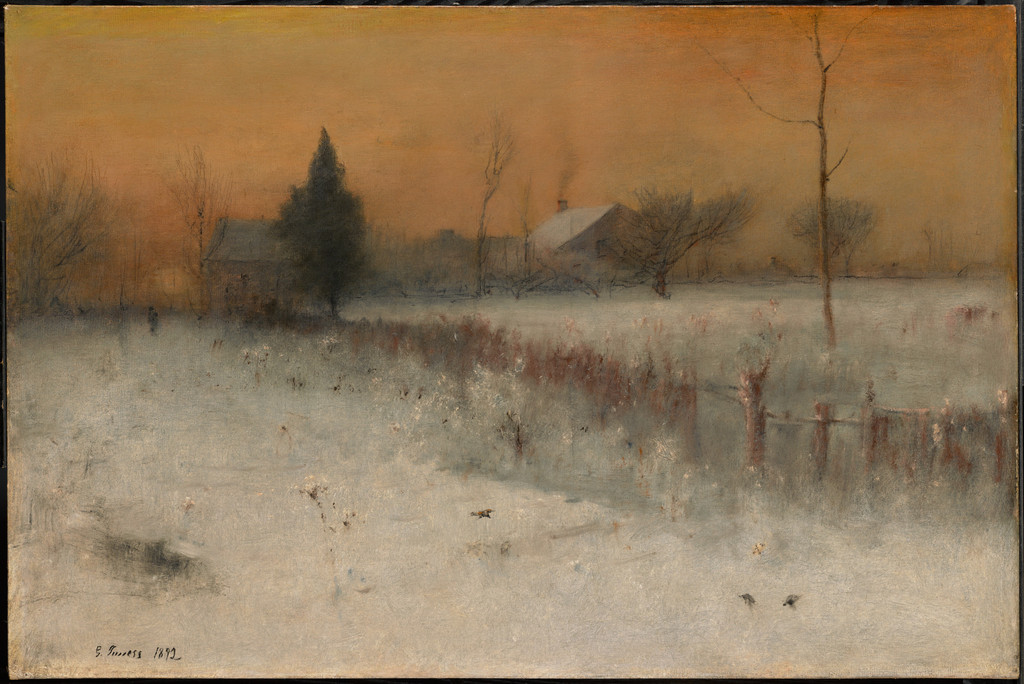
George Inness, Home at Montclair, 1892. Oil on canvas. Clark Art Institute, 1955.10. Sterling and Francine Clark Art Institute. Image source. Public domain.
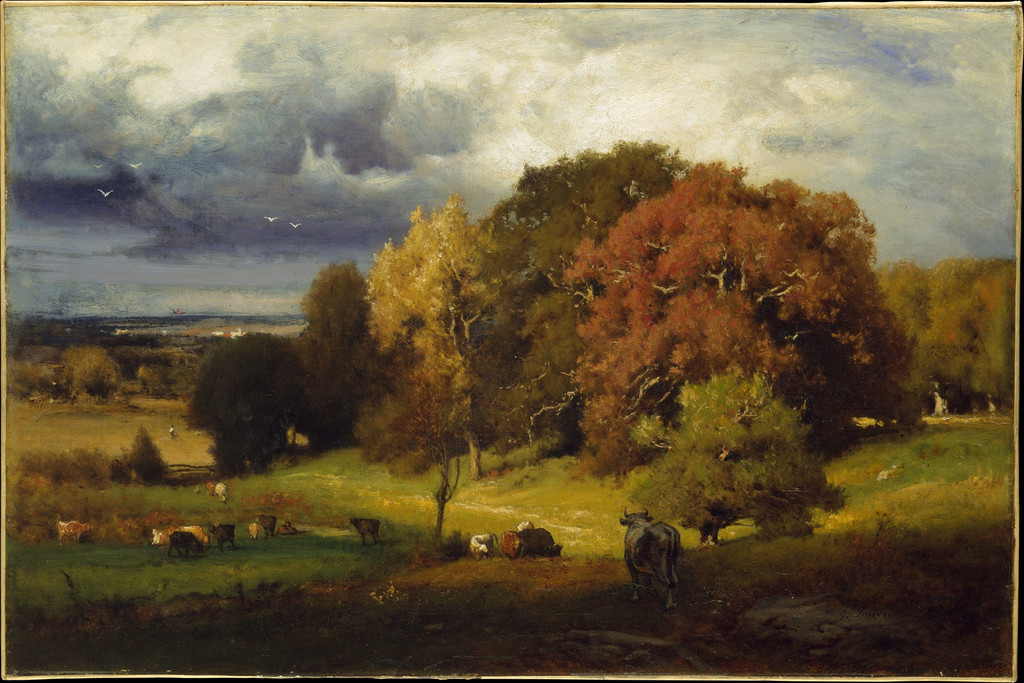
George Inness, Autumn Oaks, c.1878. Oil on canvas. Met, 87.8.8. Gift of George I. Seney, 1887; Metropolitan Museum of Art. Image source. Public domain.
Reading memory, paint and the present image together
The artist letter, son’s testimony and technical examination contribute different things. The letter records an intention and remembered chronology. The memoir describes a general practice. The examination reports material findings for the surviving object. None should be made to replace the others.
Their combination gives close looking greater substance. The pale trunk remains a visible form, while the material account makes varied handling a documented issue. The small opening remains a compositional interval, while the letter helps explain why the work need not repeat an observed setting unchanged.
Return finally to the dark whole image. The title’s sundown effect is held inside the wood through selective light and overlapping shapes. Memory has become a composition, and prolonged material work has become an experience that can feel momentary. That relation is the painting’s particular contribution to understanding Inness’s late landscape.
Artworks directory
A collected selection of 46 individually identified museum objects: 43 paintings and three watercolours. This is not a complete catalogue raisonné. Repeated titles identify separate objects where their institutions or accessions differ. Links lead to a companion article where available, otherwise to the museum record. Unillustrated entries remain included; the original lost New Jerusalem is represented by its three transformed survivors.
| Name | Date | Medium |
|---|---|---|
| Crossing the Ford | 1848 | Oil on canvas |
| The Old Mill | 1849 | Oil on canvas |
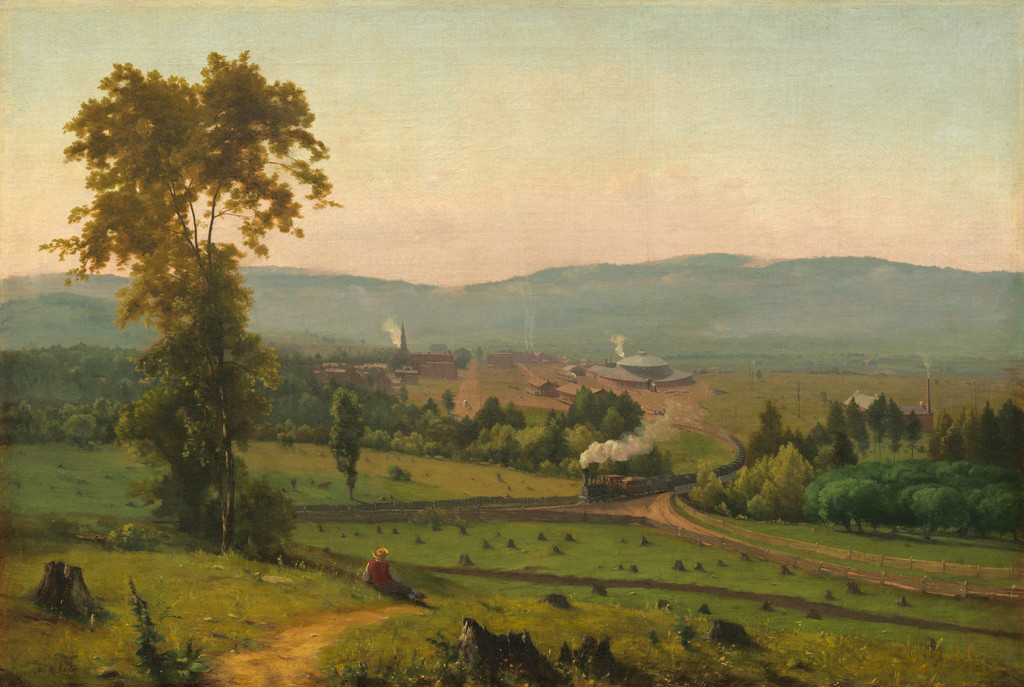
| The Lackawanna Valley by George Inness | c. 1856 | oil on canvas |
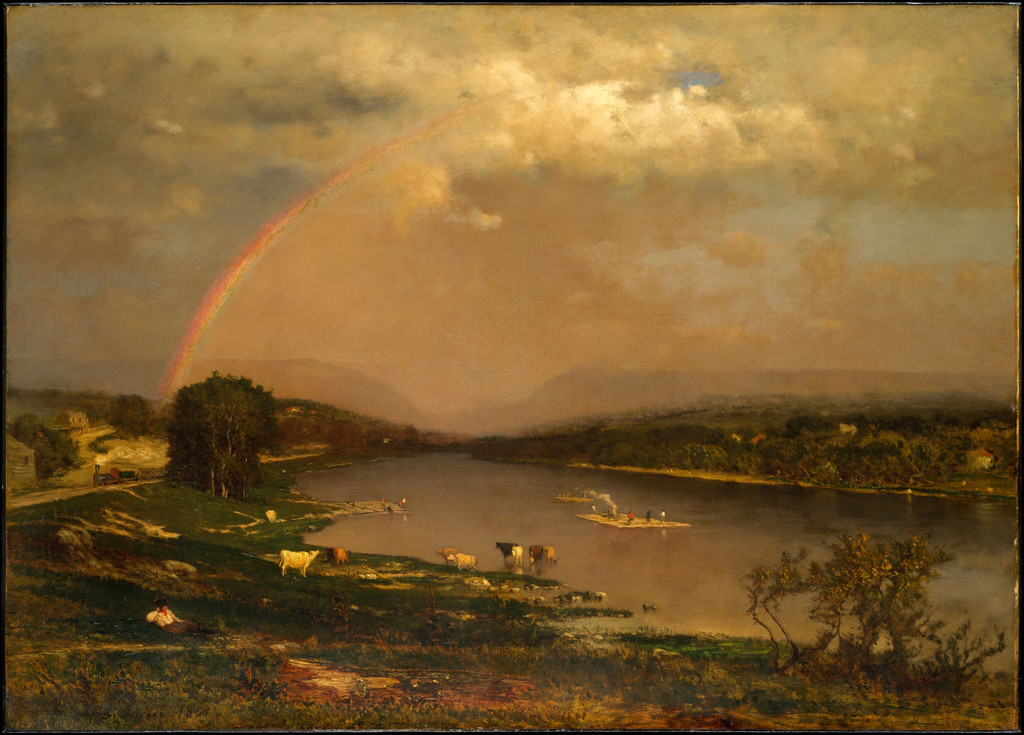
| Delaware Water Gap | 1861 | Oil on canvas |
| Delaware Valley | c. 1865–75 | Oil on artist's board |
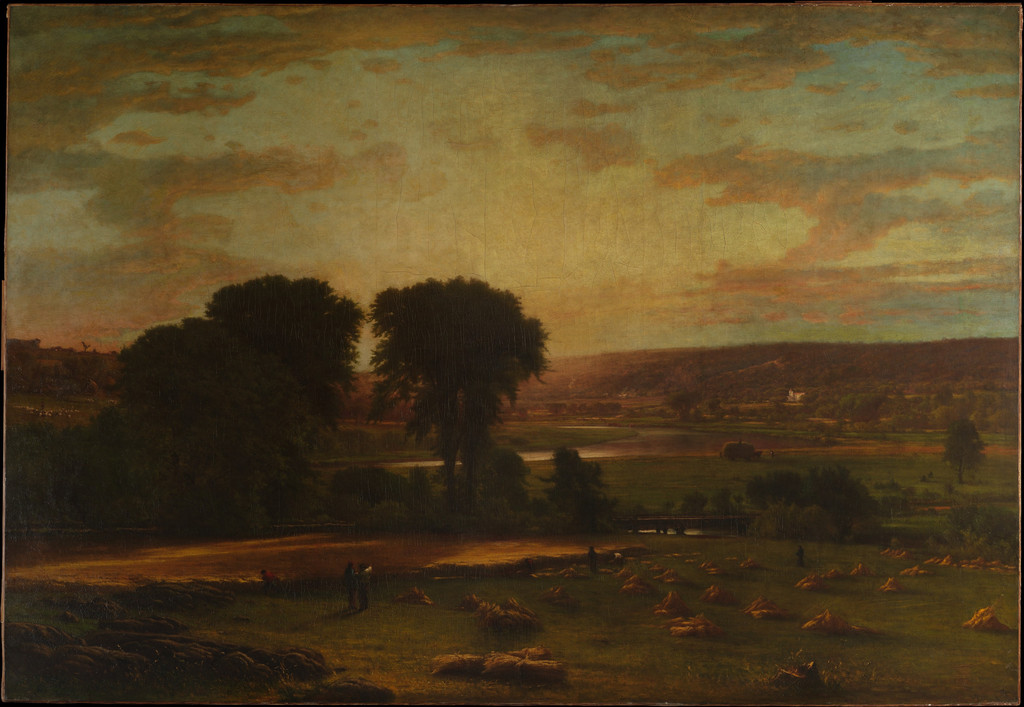
| Peace and Plenty | 1865 | Oil on canvas |
| Evening Landscape | 1867; later reworked | Oil on canvas |
| Summer in the Catskills | 1867 | Oil on canvas |
| The Valley of the Olives | 1867; reworked after 1880 | Oil on canvas |
| The Valley of the Shadow of Death | 1867 | Oil on canvas |
| Visionary Landscape | 1867/1880 | Oil on canvas |
| Catskill Mountains | 1870 | Oil on canvas |
| Across the Campagna | 1872 | Watercolor, gouache, and graphite on off-white wove paper |
| Olive Trees at Tivoli | 1873 | Gouache, watercolor, and graphite on blue wove paper with colored fibers |
| A Marine | c. 1874–75 | Oil on canvas |
| Twilight in Italy — Art Institute of Chicago (1911.44) | 1874 | Oil on panel |
| Pine Grove of the Barberini Villa | 1876 | Oil on canvas |
| The Storm | 1876 | Oil on canvas |
| Autumn Oaks | ca. 1878 | Oil on canvas |
| The Sisters | 1882 | Oil on millboard |
| Harvest, Montclair, New Jersey | 1884 | Oil on canvas |
| Niagara Falls | 1885 | Oil on wood |
| A Silver Morning | 1886 | Oil on canvas |
| Landscape, Sunset | 1887–89 | Oil on canvas |
| September Afternoon | 1887 | Oil on canvas |
| Sunrise | 1887 | Oil on canvas |
| The Mill Stream, Montclair, New Jersey by George Inness | c. 1888 | Oil on canvas |
| Niagara by George Inness | 1889 | oil on canvas |
| The Mill Pond | 1889 | Oil on canvas |
| Sunset in the Valley | 1890 | Oil on canvas |
| The Moon at Night | 1890 | Oil on canvas |
| Twilight in Italy — Art Institute of Chicago (1911.42) | 1890 | Oil on canvas |
| Autumn Woods | 1891–94 | Oil on canvas |
| Moonrise | 1891 | Oil on canvas |
| Spring Blossoms, Montclair, New Jersey | ca. 1891 | Oil and crayon or charcoal on canvas |
| Sunset in the Woods by George Inness | 1891 | oil on canvas |
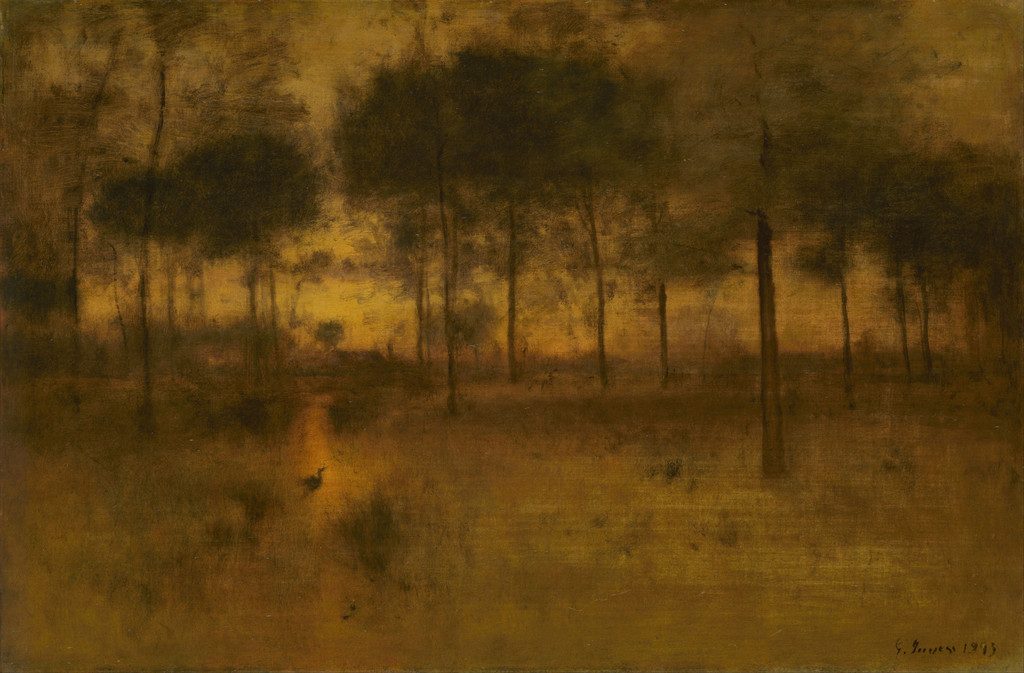
| The Home of the Heron — Princeton University Art Museum (y1943-93) | 1891 | Oil on canvas |
| Threatening | 1891 | Oil on canvas |
| Early Morning, Tarpon Springs | 1892 | Oil on canvas |
| Home at Montclair by George Inness | 1892 | oil on canvas |
| The Lonely Farm, Nantucket | 1892 | Oil on canvas |
| Afterglow | 1893 | Oil on canvas |
| Sunlit Valley | 1893 | Oil on canvas |
| The Home of the Heron — Art Institute of Chicago (1911.31) | 1893 | Oil on canvas |
| After a Summer Shower | 1894 | Oil on canvas |
| Landscape | n.d. | Watercolor with scraping on ivory wove paper |
Frequently Asked Questions
The artist’s published letter recalls a sketch near Hastings in Westchester County made about twenty years earlier. It also stresses the role of imagination.[2]
The technical examination records thin multilayer glazes alongside thick opaque strokes and other applications.[3]
The scene presents fading light within a wood rather than an unobstructed sunset horizon. The pale trunk and small opening help organise that effect.
It belongs to the National Gallery of Art’s Corcoran Collection, accession 2014.79.43.[1]
Discussion
Look again at the images and ideas explored in Sunset in the Woods by George Inness. These editorial prompts invite your observations.
Follow the pale trunk, then look towards the small green opening. Which feature makes an object feel near, and which suggests depth? Consider how the letter and examination change your understanding without replacing what the image itself shows.
Reader Insights
How does the small opening change the surrounding dark woodland?
How does the woodland differ from the open winter field?
What does the dated letter add to the relation between memory and imagination?
Join the Conversation
Share a detail, comparison or question about Sunset in the Woods by George Inness below.
References
- National Gallery of Art, Sunset in the Woods, accession 2014.79.43. Current identity, dimensions and collection record.
- Dorothy W. Phillips, Corcoran collection catalogue, vol.1 (1966), printed p.120. Checked transcription of Inness’s July 23, 1891 letter; original manuscript not examined.
- Corcoran Gallery of Art: American Paintings to 1945, scholarly apparatus (2011), printed pp.296–299. Selected entry, including Lance Mayer’s 2005 examination and Dare Hartwell’s treatment history.
- George Inness Jr., Life, Art, and Letters of George Inness (1917), printed pp.252–254. Selected printed scans of the son’s technical account.
- Metropolitan Museum of Art, Autumn Oaks, accession 87.8.8.
- Clark Art Institute, Home at Montclair, accession 1955.10.
- Splash image source.
George Inness, Sunset in the Woods, 1891. Oil on canvas, 122.2 × 183.2 cm. National Gallery of Art, 2014.79.43. Corcoran Collection; National Gallery of Art. Image source. CC0 / Public domain.