 by Tom Gurney
Tom Gurney BSc (Hons) is an art history expert with over 20 years experience
Email: tomgurney1@gmail.com / Phone: +44 7429 011000
The Mill Pond by George Inness: Introduction
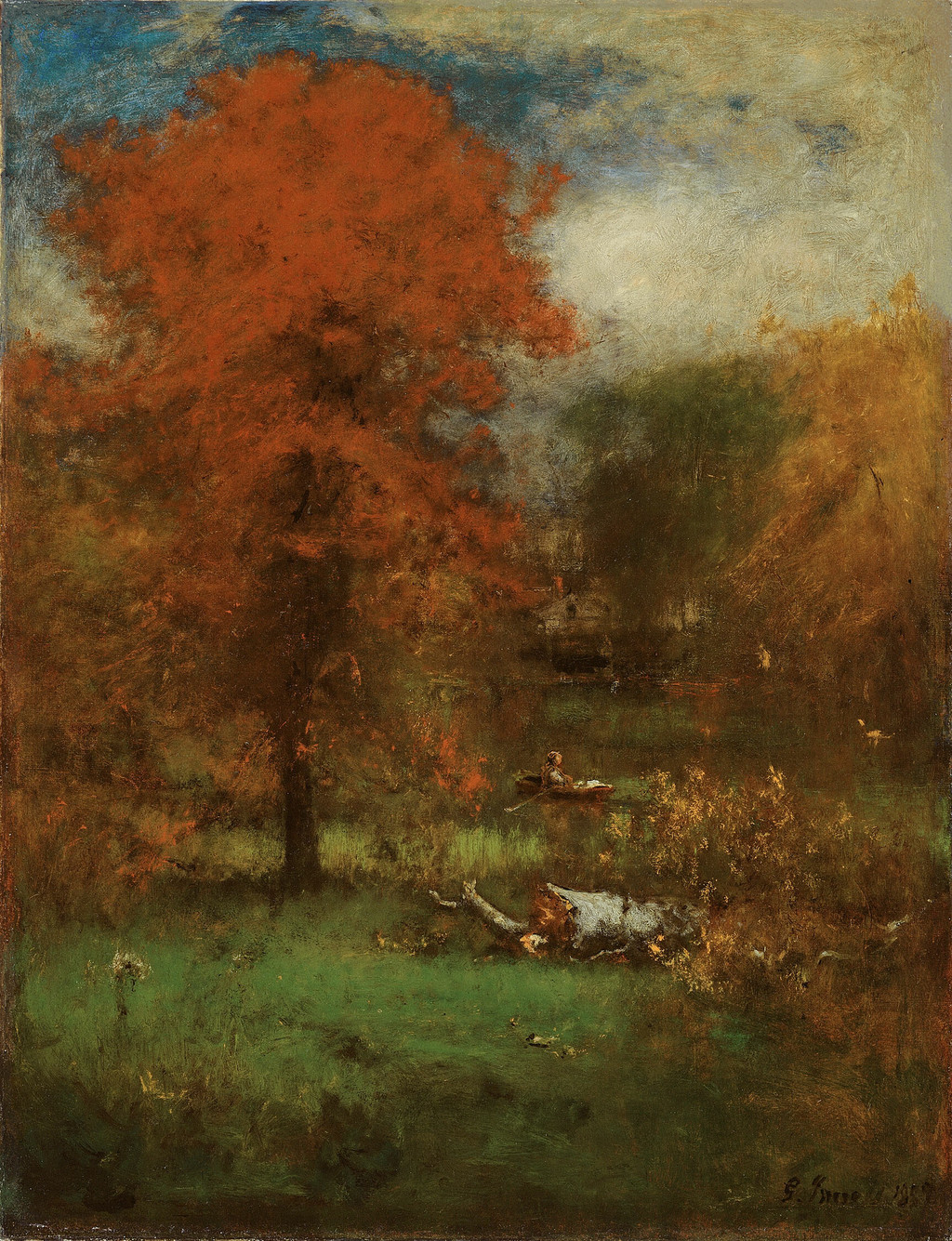
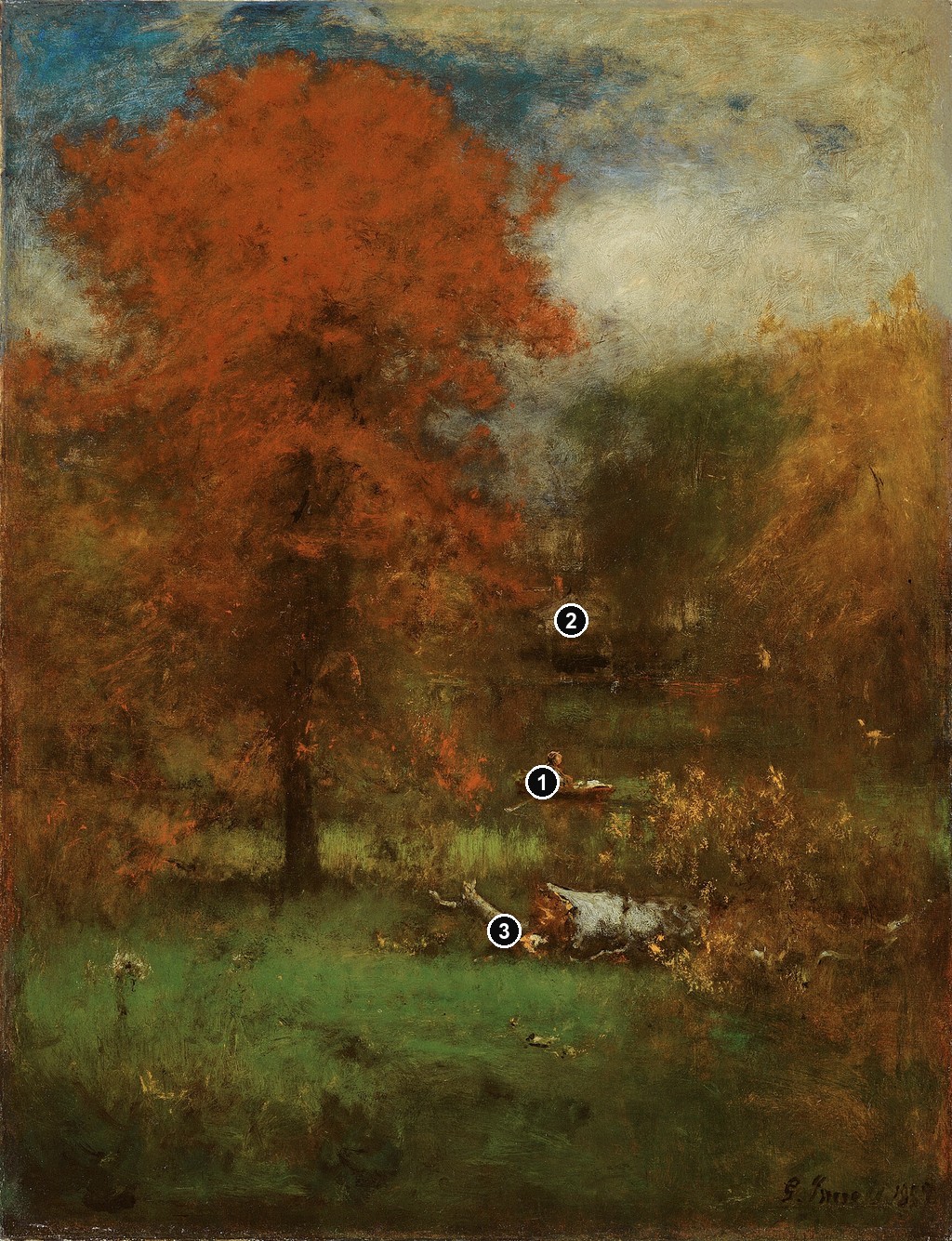
George Inness’s The Mill Pond combines a quiet boating scene with unusually forceful colour. A small rower occupies the water beneath an orange-red tree, while darker foliage and pale sky hold the upright composition together. Painted in 1889, the oil belongs to the Art Institute of Chicago’s Edward B. Butler Collection. Its intensity comes partly from the difference between the modest action of the figure and the expansive colour relationships surrounding that action.[1]
At a Glance
- ArtistGeorge Inness (1825–1894)
- TitleThe Mill Pond
- Date1889
- MediumOil on canvas
- Dimensions95.9 × 75.6 cm
- CollectionArt Institute of Chicago
- CreditEdward B. Butler Collection
- Accession1911.30
This work across George Inness’s career
Autumn Oaks by George Inness
ca. 1878Contents
- An upright landscape
- The rower and the pond
- The fallen tree and the near bank
- Colour and the museum’s account of atmosphere
- Exhibitions and the route into Butler’s collection
- Comparing different mill subjects
- Annotated details
An upright landscape
The format makes an immediate difference to the experience of looking. The painting is taller than it is wide, and the large tree at the left can develop upwards without becoming one element along a broad panoramic horizon. Its orange-red canopy occupies a substantial area, giving colour a scale that exceeds the small human activity on the pond.
The right side answers that canopy with darker foliage and an opening towards pale sky. These areas do not mirror one another exactly. Their unequal weights make the composition more active: dense colour on one side is held in relation to more open and less saturated space on the other.
The nearer green vegetation anchors the lower part of the view. It prevents the brighter upper canopy from seeming detached from the ground. Moving between green, orange and blue reveals how the painting can remain coherent even where individual leaves or branches are not separately defined.
This is a landscape that needs to be read vertically as well as into depth. The eye rises through the tree and returns towards water and bank. That movement differs from following a river across a wide horizontal canvas. The upright format allows near vegetation and distant sky to remain closely connected within the frame.
Annotated Details from The Mill Pond
The numbered points identify visible features discussed in this article. Return from each detail to the whole composition. George Inness, The Mill Pond, 1889. Oil on canvas, 95.9 × 75.6 cm. Art Institute of Chicago, 1911.30. Edward B. Butler Collection; Art Institute of Chicago. Image source. CC0 / Public domain.
Details from THE MILL POND
Compare the cropped details with the complete images above. Notice how their colours, shapes and positions contribute to the larger compositions.
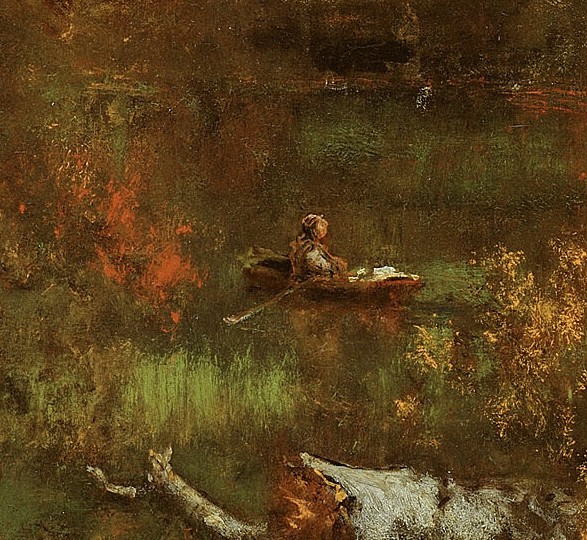
Small boat
A small boat carries a figure across the dark pond. Its narrow form becomes a point of recognition among vegetation and reflections.
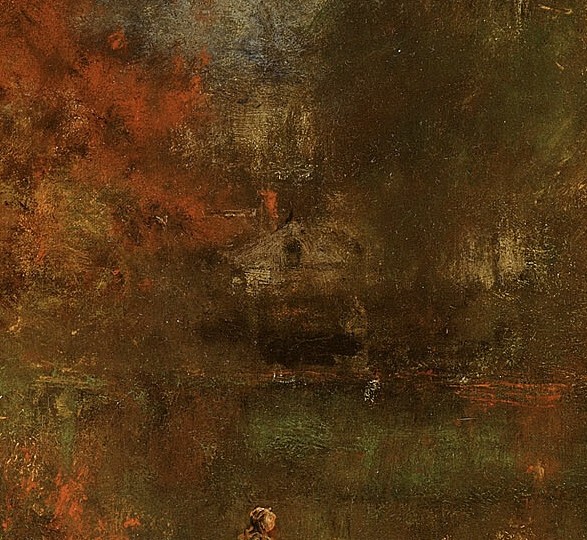
Distant figure
A small figure appears farther inside the enclosed landscape. Compare its scale with the person in the nearer boat.
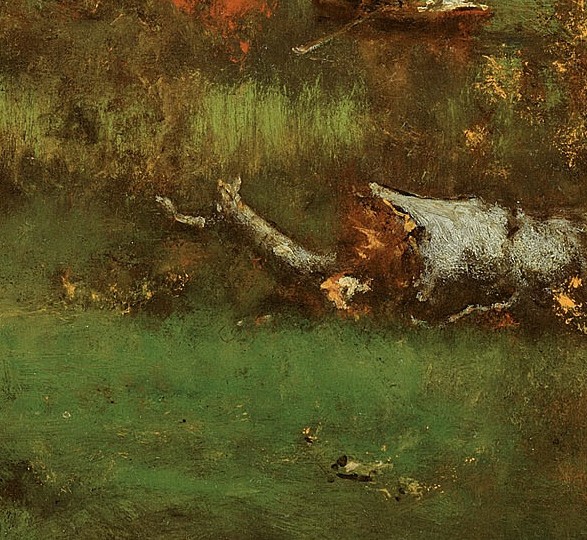
Pale fallen wood
Pale fallen wood interrupts the lower vegetation near the water. Its irregular shape differs from the long dark trunks around it.
The rower and the pond
The small person in the boat supplies a recognisable activity within the larger masses of colour. The Art Institute identifies the figure as rowing in the middle distance. Its position encourages the viewer to look into the scene, beyond the near vegetation but before the farther trees and sky.[1]
The boat does not turn the canvas into a detailed account of a particular journey. The figure’s identity and destination remain unknown in the sources used here. What can be described is the action’s place within the composition: a small movement on water occupies an extensive, comparatively still setting.
That contrast helps explain the painting’s quietness. The canopy is strong in colour, yet it does not imply fast or dramatic action. The rower gives the scene a human pace. A viewer can imagine movement across the pond while continuing to attend to the larger surrounding relationships.
The water also establishes an interval between the nearer bank and the figure. It creates room for the boat to exist within the landscape. Without that opening, the person would seem attached to the foreground; with it, the small activity becomes a measure of the space extending beyond the viewer.
The fallen tree and the near bank
A pale fallen tree or log interrupts the lower-right bank. Its shape is more definite than some of the foliage behind it, drawing attention close to the picture’s edge. It provides another kind of horizontal line within the upright composition, balancing the upward movement through the orange tree.
The lightness of the fallen form makes it legible against the darker ground. It can be followed separately, but it remains part of the bank rather than an isolated emblem. Describing its position and colour is more secure than giving it an undocumented spiritual meaning.
The distinction between living canopy and fallen wood offers a useful looking question. One form expands through colour and height; the other lies near the ground. The contrast is visible without establishing an allegory about death and renewal. The painting allows a viewer to notice the relationship while preserving the limits of what its motifs can prove.
Colour and the museum’s account of atmosphere
The Art Institute emphasises the orange, green and blue colour relationships and interprets the scene through Inness’s interest in mood and spiritual resonance. The museum’s account connects the intensity of the view to colour and atmosphere rather than exhaustive detail. That is an interpretation of this painting’s effect, rather than a scientific identification of its pigments.[1]
The visible arrangement supports attention to relationships. The orange canopy feels more emphatic beside cooler and darker areas; the green bank becomes part of the same overall structure. Colour is active across the canvas, so a viewer cannot fully explain the experience by isolating the bright tree alone.
The softened parts also retain a role. Less definite foliage allows the stronger canopy and small boat to command attention without requiring every background form to be named. This selectivity differs from an absence of composition. The placement of clearer and less clear passages controls the order in which the scene becomes readable.
No object-specific conservation study has been consulted for this article. The photograph permits close looking at the image, while claims about paint-layer sequence, named pigments or later retouching would need another kind of evidence. The effect can be discussed precisely without inventing a material history.
Watch: George Inness
Choose a film to explore the artist’s work, its interpretation and its wider setting.
The Montclair Art Museum's George Inness Gallery
Visit the George Inness Gallery at the Montclair Art Museum in this State of the Arts feature.
Watch on YouTubeExhibitions and the route into Butler’s collection
The museum records the painting in the World’s Columbian Exposition in Chicago in 1893 and the Exposition Universelle in Paris in 1900. These are documented exhibition appearances. They establish that this quiet, upright landscape circulated in prominent international settings; they do not, by themselves, prove a particular reviewer’s opinion or an award.[1]
Its provenance begins with Thomas B. Clarke and his 1899 sale, followed by Emerson McMillin’s ownership. In 1911 the recorded route runs through Knoedler and Reinhardt Galleries to Edward B. Butler, who gave the picture to the Art Institute that year. Keeping the exact accession with that history helps distinguish this canvas from other paintings with similar mill or pond titles.[1]
The picture’s exhibition and collection histories add another scale to its subject. A small rower within a wooded pond became an object moved between collectors and public displays. The scene’s intimacy did not prevent it from participating in wider presentations of American art.
Comparing different mill subjects
Chicago’s The Old Mill dates to 1849 and uses a horizontal format. A working building, stream and foreground group are embedded in dark trees. Comparing the two works reveals differences in subject and organisation, rather than a simple early and late version of one identifiable place.[2]
The Mill Stream, Montclair, New Jersey, circa 1888, includes a factory tower that Minneapolis Institute of Art identifies with Samuel Crump’s printing company. Its relationship between warm architecture, trees and luminous water offers a useful contrast to the pond’s dominant canopy and small boat. The similar wording of the titles does not make the objects interchangeable.[3]
Autumn Oaks, dated circa 1878 by the Met, offers a different colour comparison. A substantial tree group shares a horizontal landscape with open pasture and a large clouded sky. Set beside it, The Mill Pond makes its upright organisation clearer: colour rises through the height of the canvas, while the boat remains a small focus within that structure.[4]
These comparisons bring attention back to what is particular about the 1889 painting. The strong canopy, pale fallen wood, near bank and rower hold different positions and scales. Their relations create a scene that can feel quiet in action and intense in colour at the same time.
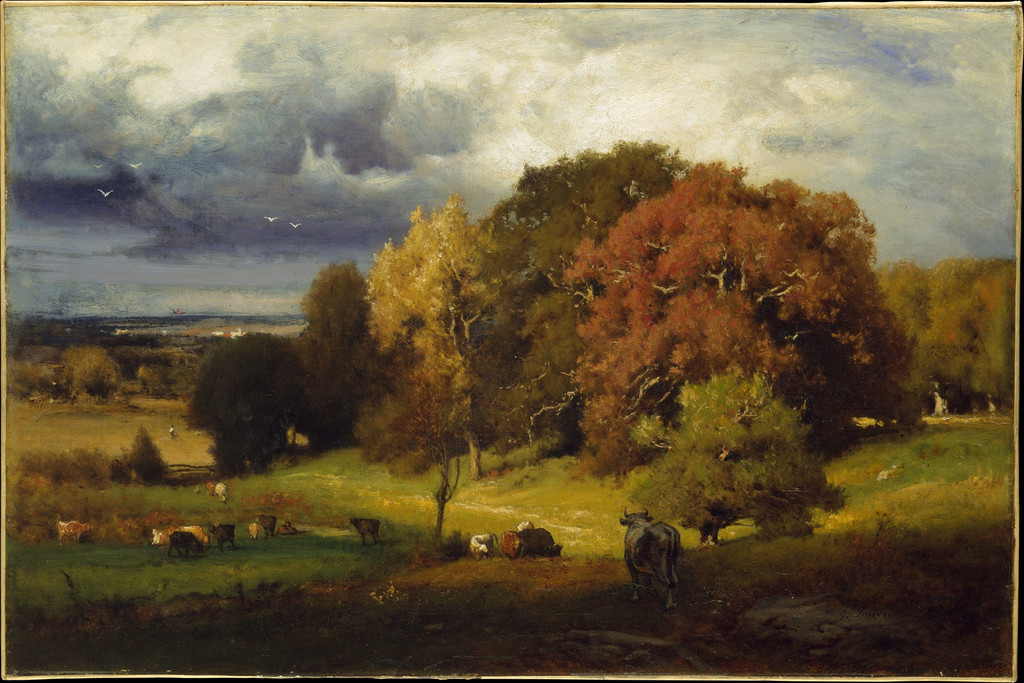
George Inness, Autumn Oaks, c.1878. Oil on canvas. Metropolitan Museum of Art, 87.8.8. Gift of George I. Seney, 1887; Metropolitan Museum of Art. Image source. Public domain.
Artworks directory
A collected selection of 46 individually identified museum objects: 43 paintings and three watercolours. This is not a complete catalogue raisonné. Repeated titles identify separate objects where their institutions or accessions differ. Links lead to a companion article where available, otherwise to the museum record. Unillustrated entries remain included; the original lost New Jerusalem is represented by its three transformed survivors.
| Name | Date | Medium |
|---|---|---|
| Crossing the Ford | 1848 | Oil on canvas |
| The Old Mill | 1849 | Oil on canvas |
| The Lackawanna Valley by George Inness | c. 1856 | oil on canvas |
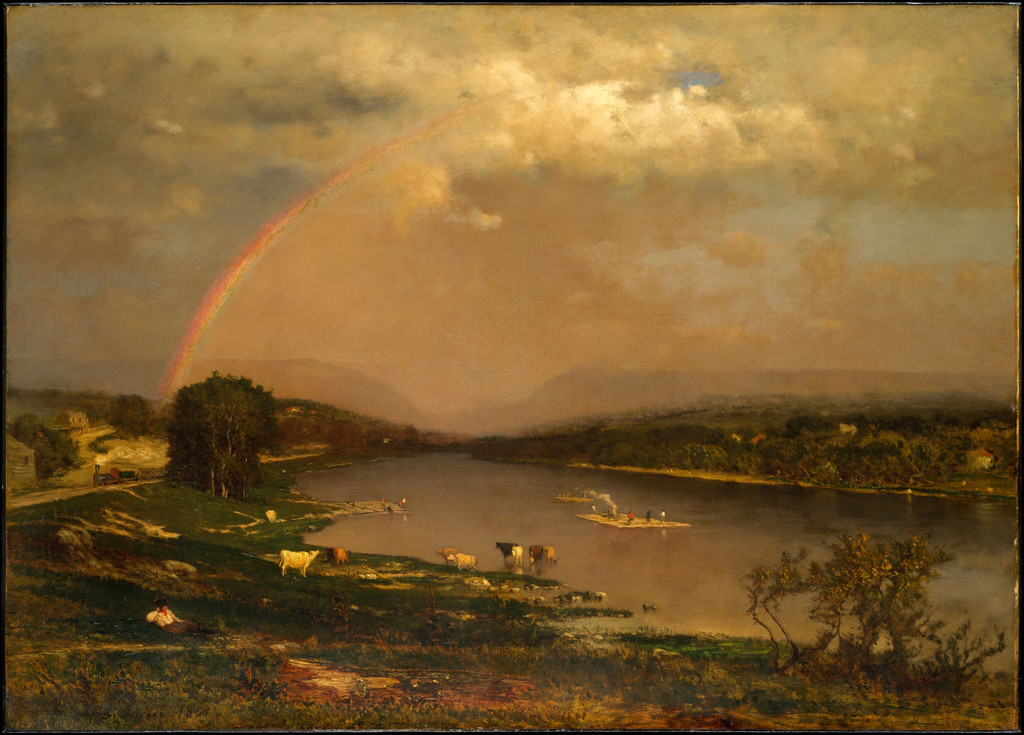
| Delaware Water Gap | 1861 | Oil on canvas |
| Delaware Valley | c. 1865–75 | Oil on artist's board |
| Peace and Plenty | 1865 | Oil on canvas |
| Evening Landscape | 1867; later reworked | Oil on canvas |
| Summer in the Catskills | 1867 | Oil on canvas |
| The Valley of the Olives | 1867; reworked after 1880 | Oil on canvas |
| The Valley of the Shadow of Death | 1867 | Oil on canvas |
| Visionary Landscape | 1867/1880 | Oil on canvas |
| Catskill Mountains | 1870 | Oil on canvas |
| Across the Campagna | 1872 | Watercolor, gouache, and graphite on off-white wove paper |
| Olive Trees at Tivoli | 1873 | Gouache, watercolor, and graphite on blue wove paper with colored fibers |
| A Marine | c. 1874–75 | Oil on canvas |
| Twilight in Italy — Art Institute of Chicago (1911.44) | 1874 | Oil on panel |
| Pine Grove of the Barberini Villa | 1876 | Oil on canvas |
| The Storm | 1876 | Oil on canvas |
| Autumn Oaks | ca. 1878 | Oil on canvas |
| The Sisters | 1882 | Oil on millboard |
| Harvest, Montclair, New Jersey | 1884 | Oil on canvas |
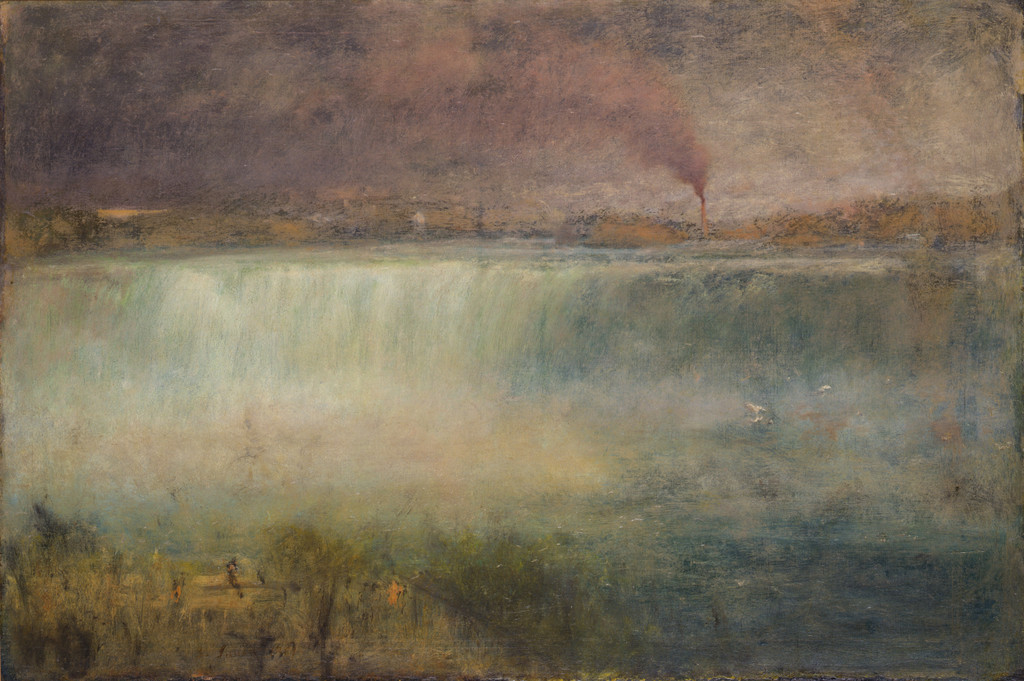
| Niagara Falls | 1885 | Oil on wood |
| A Silver Morning | 1886 | Oil on canvas |
| Landscape, Sunset | 1887–89 | Oil on canvas |
| September Afternoon | 1887 | Oil on canvas |
| Sunrise | 1887 | Oil on canvas |
| The Mill Stream, Montclair, New Jersey by George Inness | c. 1888 | Oil on canvas |
| Niagara by George Inness | 1889 | oil on canvas |
| The Mill Pond | 1889 | Oil on canvas |
| Sunset in the Valley | 1890 | Oil on canvas |
| The Moon at Night | 1890 | Oil on canvas |
| Twilight in Italy — Art Institute of Chicago (1911.42) | 1890 | Oil on canvas |
| Autumn Woods | 1891–94 | Oil on canvas |
| Moonrise | 1891 | Oil on canvas |
| Spring Blossoms, Montclair, New Jersey | ca. 1891 | Oil and crayon or charcoal on canvas |
| Sunset in the Woods by George Inness | 1891 | oil on canvas |
| The Home of the Heron — Princeton University Art Museum (y1943-93) | 1891 | Oil on canvas |
| Threatening | 1891 | Oil on canvas |
| Early Morning, Tarpon Springs | 1892 | Oil on canvas |
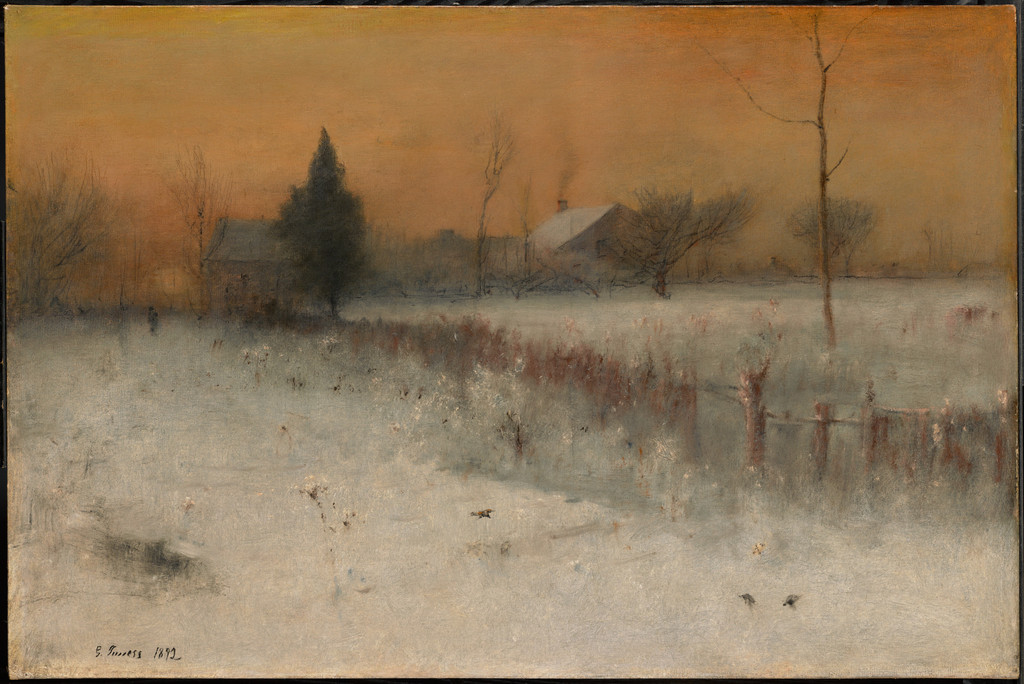
| Home at Montclair by George Inness | 1892 | oil on canvas |
| The Lonely Farm, Nantucket | 1892 | Oil on canvas |
| Afterglow | 1893 | Oil on canvas |
| Sunlit Valley | 1893 | Oil on canvas |
| The Home of the Heron — Art Institute of Chicago (1911.31) | 1893 | Oil on canvas |
| After a Summer Shower | 1894 | Oil on canvas |
| Landscape | n.d. | Watercolor with scraping on ivory wove paper |
Frequently Asked Questions
The Art Institute dates this canvas to 1889. Its accession is 1911.30.[1]
The museum identifies a person rowing a boat in the middle-distance pond. The figure’s personal identity is not established here.[1]
They are separate Chicago paintings. The Old Mill is the horizontal 1849 canvas, accession 1939.388.[2]
The museum records appearances at Chicago’s 1893 World’s Columbian Exposition and the Paris Exposition Universelle of 1900.[1]
Discussion
Look again at the images and ideas explored in The Mill Pond by George Inness. These editorial prompts invite your observations.
Look first at the rower, then at the orange canopy. Does the picture’s sense of pace change when your attention moves between them? Consider how the upright format affects the relation between the nearer bank and the sky.
Reader Insights
How do water and enclosure establish the scene’s depth?
What changes when you compare the pond with Autumn Oaks?
How does the museum record keep this work distinct from the other mill subjects?
Join the Conversation
Share a detail, comparison or question about The Mill Pond by George Inness below.
References
- Art Institute of Chicago, The Mill Pond, accession 1911.30. Current description, provenance and exhibition record.
- Art Institute of Chicago, The Old Mill, accession 1939.388.
- Minneapolis Institute of Art, The Mill Stream, Montclair, New Jersey, accession 2000.236.
- Metropolitan Museum of Art, Autumn Oaks, accession 87.8.8.
- Splash image source.
George Inness, The Mill Pond, 1889. Oil on canvas, 95.9 × 75.6 cm. Art Institute of Chicago, 1911.30. Edward B. Butler Collection; Art Institute of Chicago. Image source. CC0 / Public domain.