 by Tom Gurney
Tom Gurney BSc (Hons) is an art history expert with over 20 years experience
Email: tomgurney1@gmail.com / Phone: +44 7429 011000
A Marine by George Inness: Introduction
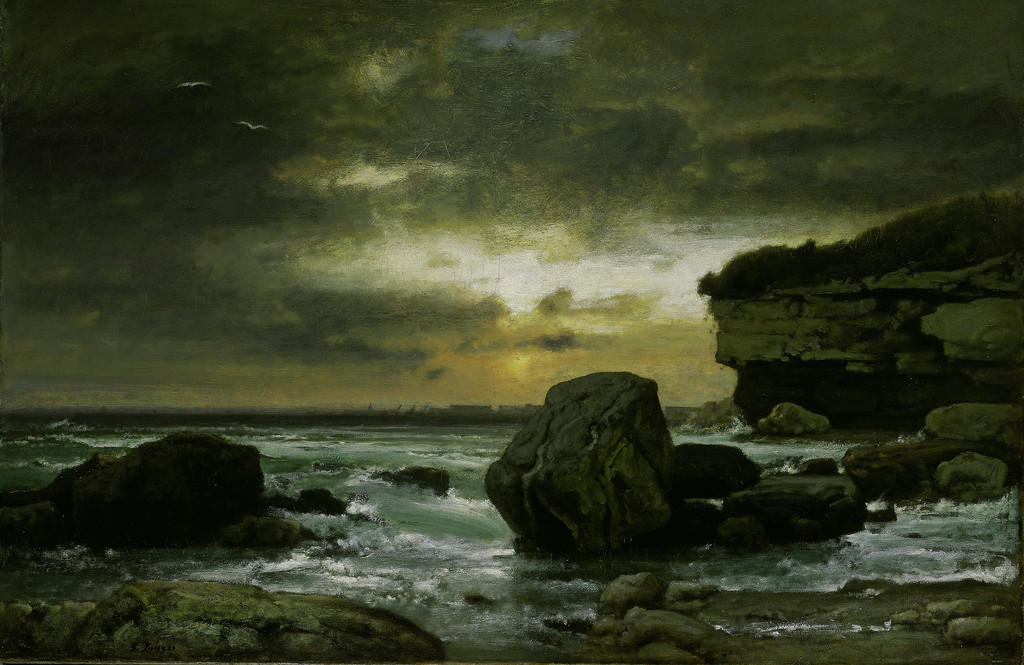
Dark cloud fills the sky above foaming water in George Inness’s A Marine. A large angular rock stands near the centre, with a layered cliff closing the right side and tiny ships along the low horizon. The Art Institute of Chicago dates the oil painting circa 1874–75. Its current account considers the setting to be Porto d’Anzio, Italy, revising an earlier identification with Étretat in Normandy. That change concerns the coastal location, while the museum continues to identify Inness as the artist.[1]
At a Glance
- ArtistGeorge Inness (1825–1894)
- TitleA Marine
- DateCirca 1874–75
- MediumOil on canvas
- Dimensions76.8 × 114.9 cm
- CollectionArt Institute of Chicago
- CreditEdward B. Butler Collection
- Accession1913.90
This work across George Inness’s career
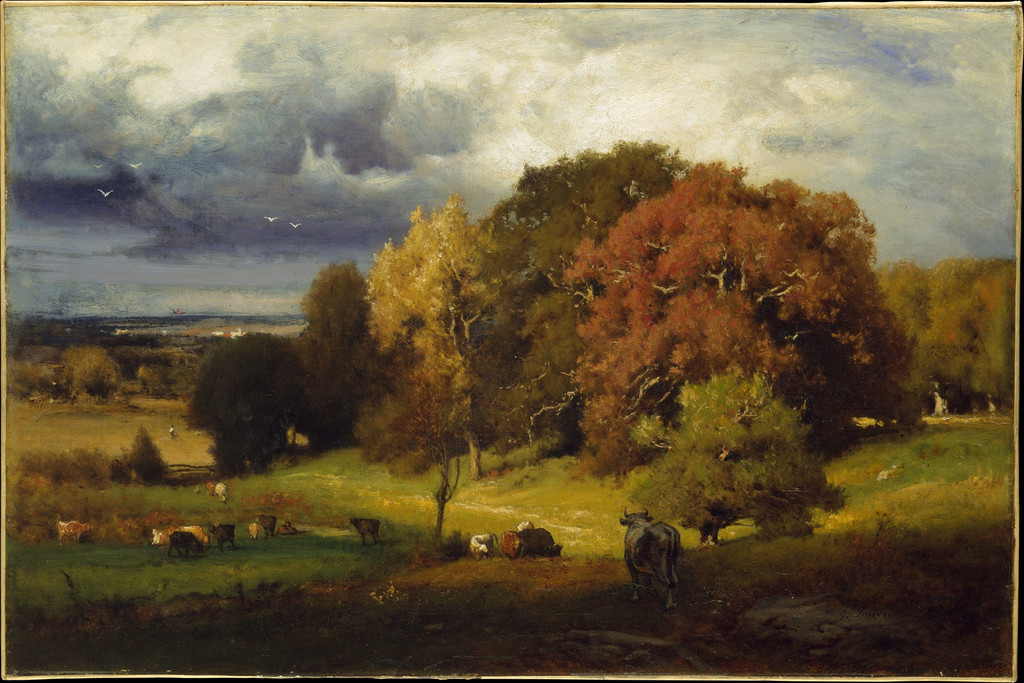
Autumn Oaks by George Inness
ca. 1878Contents
- The central rock and surrounding water
- Several surfaces within one form
- The cliff closing the right side
- Dark cloud and broken light
- Shipping on a low horizon
- Europe and the current place identification
- Collection history and comparisons
- Annotated details
The central rock and surrounding water
The large rock rises above the lower group of stones and foaming water. Its sloping faces give it a compact, angular presence, distinct from the more broken forms around it. The rock’s position makes it an important point of attention, but it does not occupy the exact middle of an otherwise symmetrical view.
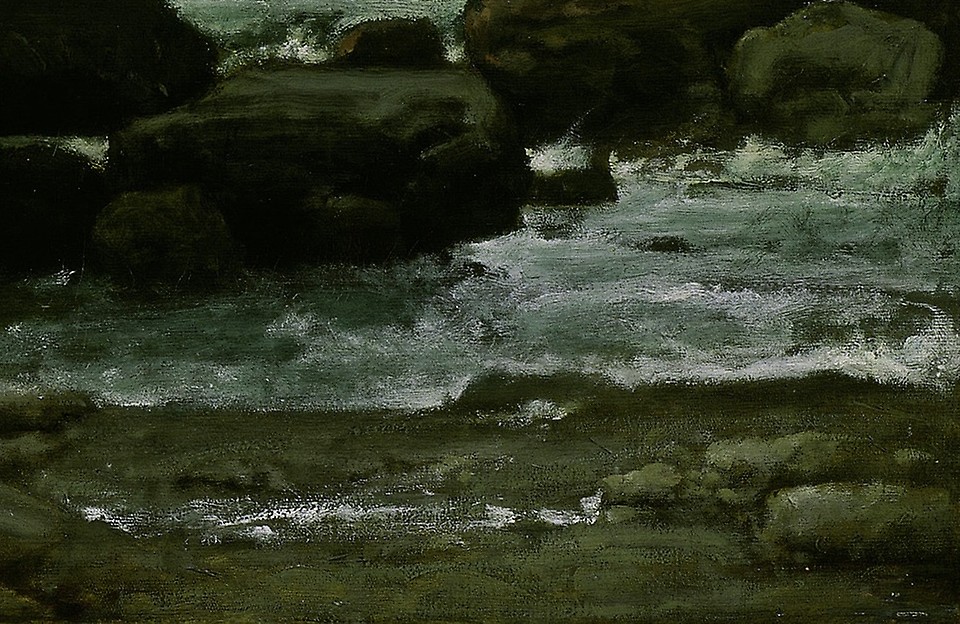
Water passes on both sides, breaking into white and pale blue-green marks. Those lighter passages help define the rock’s lower edges. Its darker mass becomes more substantial against the foam, while the surrounding movement makes its solidity more noticeable.
Other rocks spread across the foreground. At the left, a low dark group occupies a broad area; towards the right, smaller rounded and angular forms connect the main rock with the cliff. The variation prevents the shore from becoming a sequence of identical obstacles. Each form changes how the water can be followed through the image.
The foreground also brings the sea close to the viewer. There is little open, dry ground from which to survey the scene at a comfortable distance. The water and stones occupy the nearer space directly, making their relation more immediate than the distant ships or town.
Annotated Details from A Marine
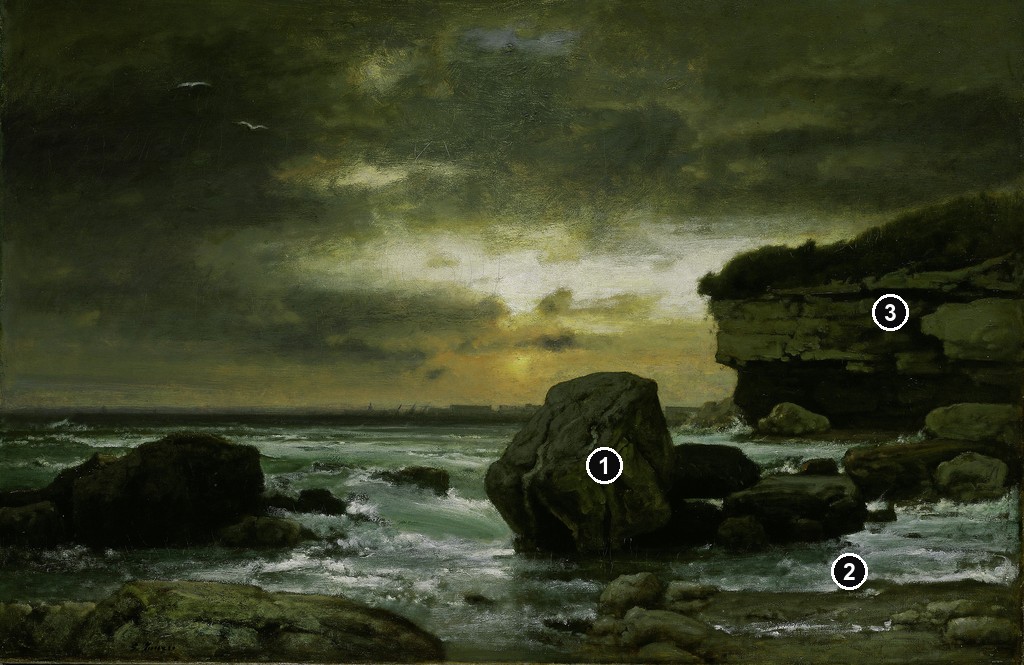
The numbered points identify visible features discussed in this article. Return from each detail to the whole composition. George Inness, A Marine, c. 1874–75. Oil on canvas. Art Institute of Chicago, 1913.90. Edward B. Butler Collection; Art Institute of Chicago. Image source. Public domain.
Details from A MARINE
Compare the cropped details with the complete images above. Notice how their colours, shapes and positions contribute to the larger compositions.
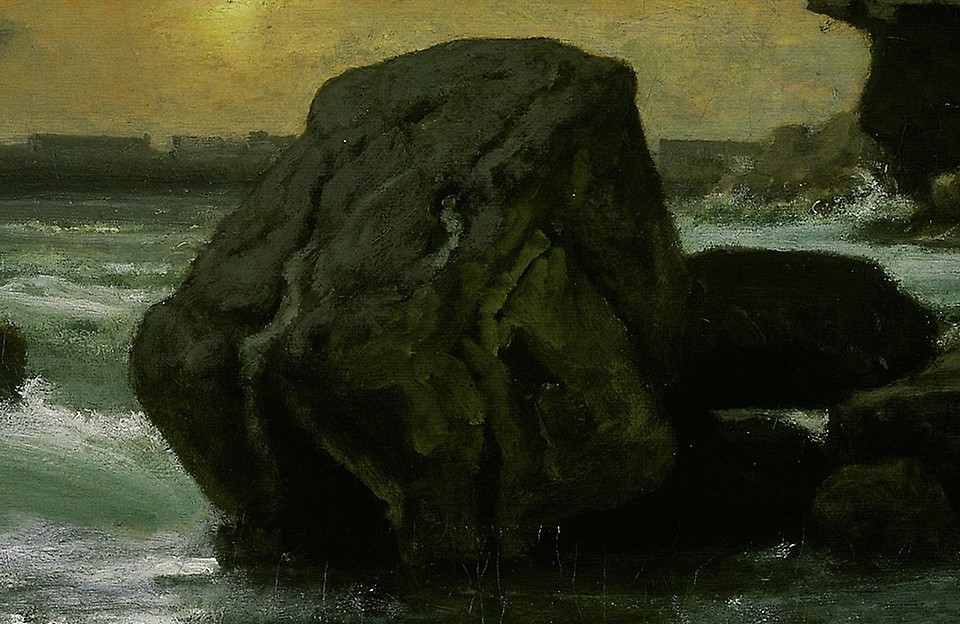
Central rock
A dark angular rock interrupts the water near the centre. Its substantial shape gives the moving pale water something to turn around.
Foam and near water
Pale foam breaks across darker water. The irregular accents differ from the more level sea at the horizon.
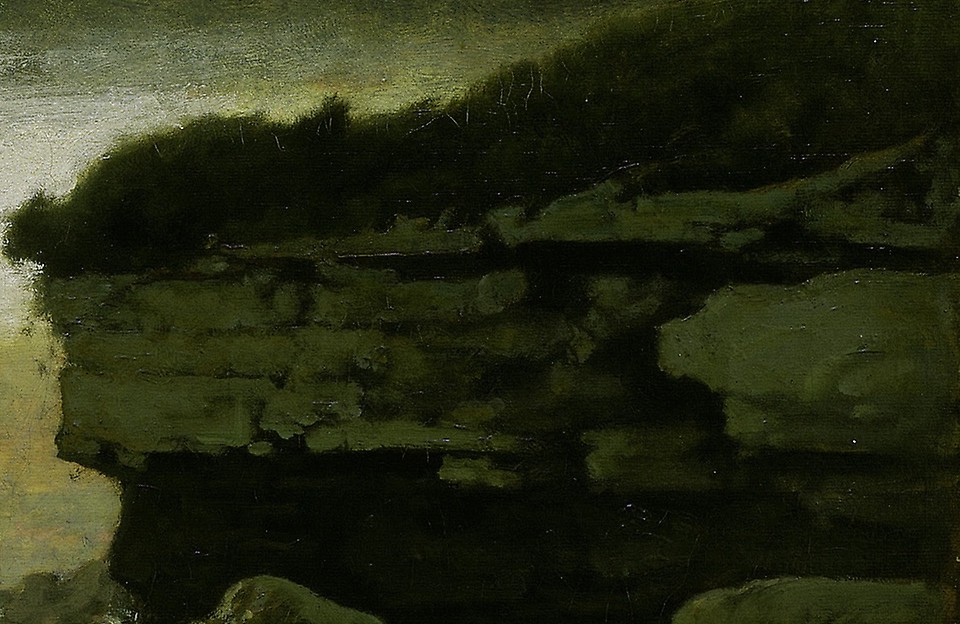
Right-hand cliff
A broad ledge projects over the near shore. Its layered, horizontal structure contrasts with the separate central rock.
Several surfaces within one form
The central rock contains green, grey and darker passages, with differently lit faces. Its angular structure can be understood through those changes of tone, rather than through one continuous outline. Follow a sloping face downward, and its shade becomes different from the adjoining surface.
AIC’s commentary draws attention to Inness’s manipulation of texture and shading. It interprets the surface as distinguishing sun and shadow, wet and dry, and clean and algae-covered areas.[1] These are the museum’s descriptions of the rock’s effect. They help direct looking without supplying a chemical analysis of the green paint.
The visible distinctions become clearer when the main rock is compared with the lower stones. The large form offers longer sloping planes, whereas the smaller rocks are interrupted more frequently by foam and dark gaps. The water therefore changes how much of each surface remains available to the eye.
The treatment of a small part of the coast has considerable force within the whole view. It gives the viewer a material point of attention below the changing sky. The seascape’s atmosphere does not dissolve every object into the same softness; the central rock remains a definite form with internal variation.
The cliff closing the right side
The cliff projects over the water at the right. Horizontal bands divide its face, and a dark upper edge stands against the brighter sky near the horizon. It supplies a different kind of rock structure from the isolated central form: broader, layered and attached to the edge of the composition.
Its projecting top limits the open distance on that side. The left horizon remains more exposed, letting sea and sky extend laterally. This inequality gives the picture a sense of enclosure at the right and openness at the left.
The cliff also frames a bright passage near the horizon. The contrast between dark rock and pale sky makes that opening more emphatic. Looking from the central boulder towards the cliff and then back into the sky shows how the larger masses organise the scene’s light.
The reproduction supports an account of these visible layers and projections. It does not independently establish the rock’s geology or a precise coastal coordinate. Those questions require evidence beyond the shapes shown in the painting.
Dark cloud and broken light
Much of the sky is dark green-grey, with changes in tone that prevent it from forming a single flat ceiling. Paler light breaks through above the horizon, and warmer orange passages appear near the middle distance. The weather therefore has structure across the painting’s width and height.
The broad darkness makes the small light openings more forceful. They do not need to occupy most of the sky to affect the scene. Their location near the low horizon helps reveal distant forms while leaving the nearer rocks under a more subdued illumination.
White foam supplies another kind of light below. Its marks are smaller, more interrupted and more closely joined to the water’s movement. Compare those broken accents with the broader pale sky passage: the picture gives different visual rhythms to sea and atmosphere.
Small bird-like forms appear against the cloud towards the upper left. They are minute beside the sky, yet their lighter marks interrupt its darkness. Like the distant shipping, they offer a scale of attention very different from the foreground rock.
Watch: George Inness
Choose a film to explore the artist’s work, its interpretation and its wider setting.
The Montclair Art Museum's George Inness Gallery
Visit the George Inness Gallery at the Montclair Art Museum in this State of the Arts feature.
Watch on YouTubeShipping on a low horizon
The ships occupy a thin band near the meeting of water and sky. Their small upright and sloping marks make them recognisable without giving them the prominence of the near rocks. Distant buildings continue along the same low interval.
These forms make the coast a place of navigation and settlement as well as rock and weather. The scene’s drama does not require the removal of human activity. Instead, shipping remains part of the distance, framed by atmospheric light.
The difference in scale is particularly effective after looking closely at the central rock. A viewer moves from a large form whose faces can be followed to vessels that are only partly articulated. The change makes the sea between shore and horizon feel more extensive.
Their identities and destinations remain open. The visible shipping already contributes enough to the composition: small signs of human movement set beneath an expansive, unsettled sky.
Europe and the current place identification
Adrienne Baxter Bell records Inness’s longer European residence from 1870 to 1874, followed by time in Normandy and a return to Boston. She also explains the importance of Barbizon painting to his development.[2] This chronology supplies context for A Marine without making its circa 1874–75 date a precise travel diary.
The changing coastal identification deserves the same care. AIC reports that scholars now favour Porto d’Anzio over Étretat.[1] The museum’s current account should accompany the work, while the approximate date and remembered subject remain separate questions. The record does not establish that Inness stood at this viewpoint throughout 1875.
The scene itself can still be read closely while those documentary limits are retained. Rock, cliff, foam and cloud have specific relationships visible in the reproduction. Their effect does not depend on forcing the image into an exact modern photograph of either proposed coast.
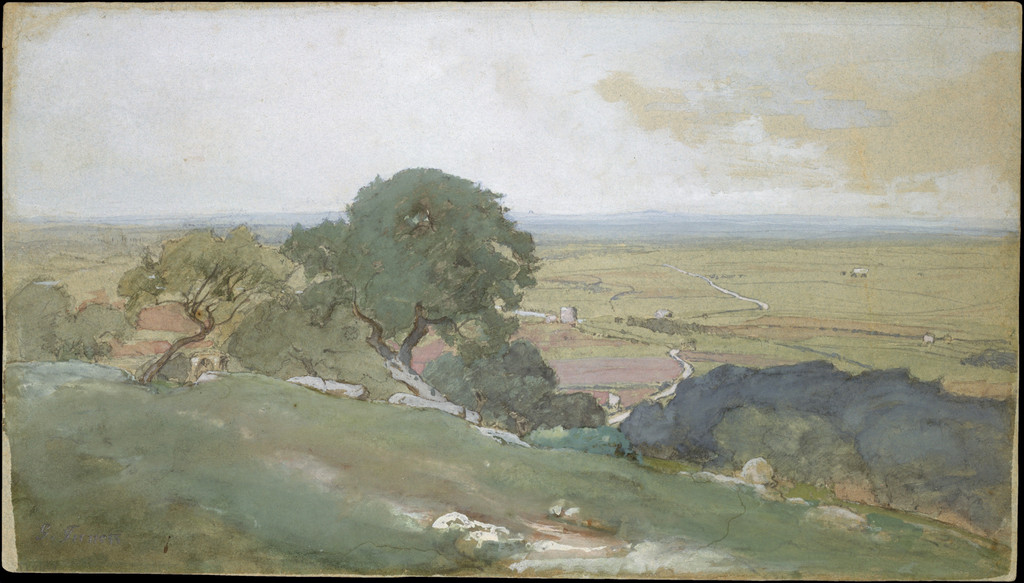
George Inness, Olive Trees at Tivoli, 1873. Gouache, watercolour and graphite on blue wove paper with coloured fibres. Met, 1989.287. Morris K. Jesup Fund, 1989; Metropolitan Museum of Art. Image source. Public domain.
Collection history and comparisons
AIC’s provenance records Harry Reinhardt in New York by 1913, Edward B. Butler in Chicago that year and Butler’s 1913 gift to the museum.[1] This identifies the documented route of accession 1913.90. Its history should remain distinct from other Butler pictures with different gifts or exhibition records.
Pine Grove of the Barberini Villa, dated 1876 by the Met, offers another Italian subject.[3] Compare the repeated trunks and crowns there with the separate boulder and cliff here. Trees organise a grove, while unequal rock masses organise this shore.
Inness’s Olive Trees at Tivoli of 1873, also in the Met, combines gouache, watercolour and graphite on blue paper.[4] Its rock forms and open distance provide a smaller, water-based comparison discussed on the drawings and watercolours page. The materials and scale differ from this oil canvas, so their visible effects should be considered separately.
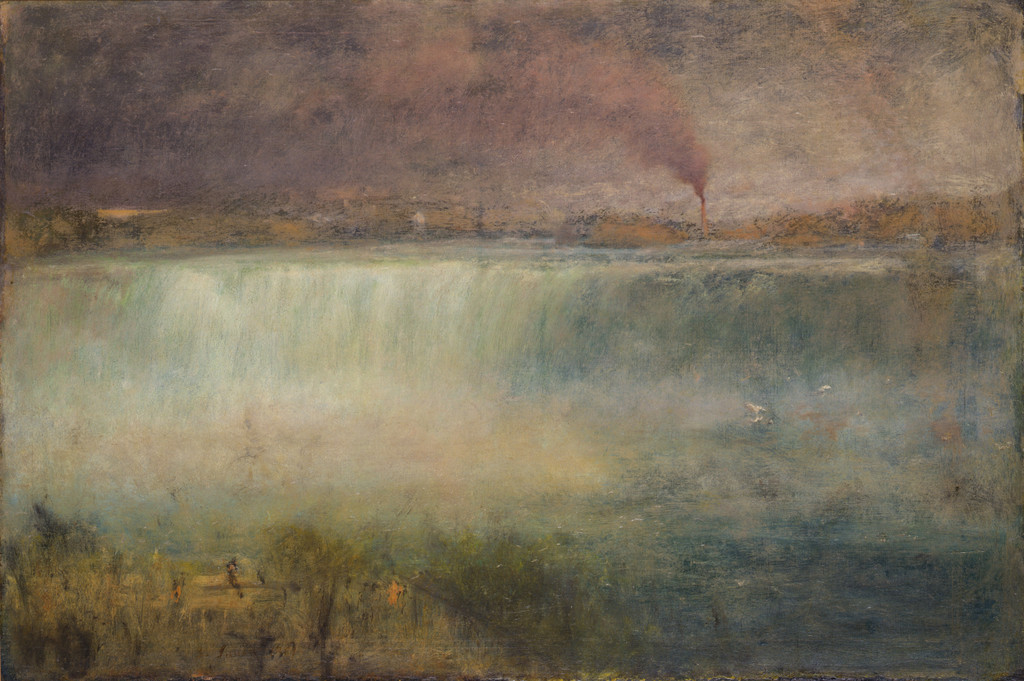
Niagara, 1889, in the Smithsonian American Art Museum, presents water through a much paler atmosphere.[5] That contrast makes the dark cloud and foreground solidity of A Marine especially clear. Inness could give water very different forms of presence, from interrupted coastal foam to a broader field of spray and falling light.
Artworks directory
A collected selection of 46 individually identified museum objects: 43 paintings and three watercolours. This is not a complete catalogue raisonné. Repeated titles identify separate objects where their institutions or accessions differ. Links lead to a companion article where available, otherwise to the museum record. Unillustrated entries remain included; the original lost New Jerusalem is represented by its three transformed survivors.
| Name | Date | Medium |
|---|---|---|
| Crossing the Ford | 1848 | Oil on canvas |
| The Old Mill | 1849 | Oil on canvas |
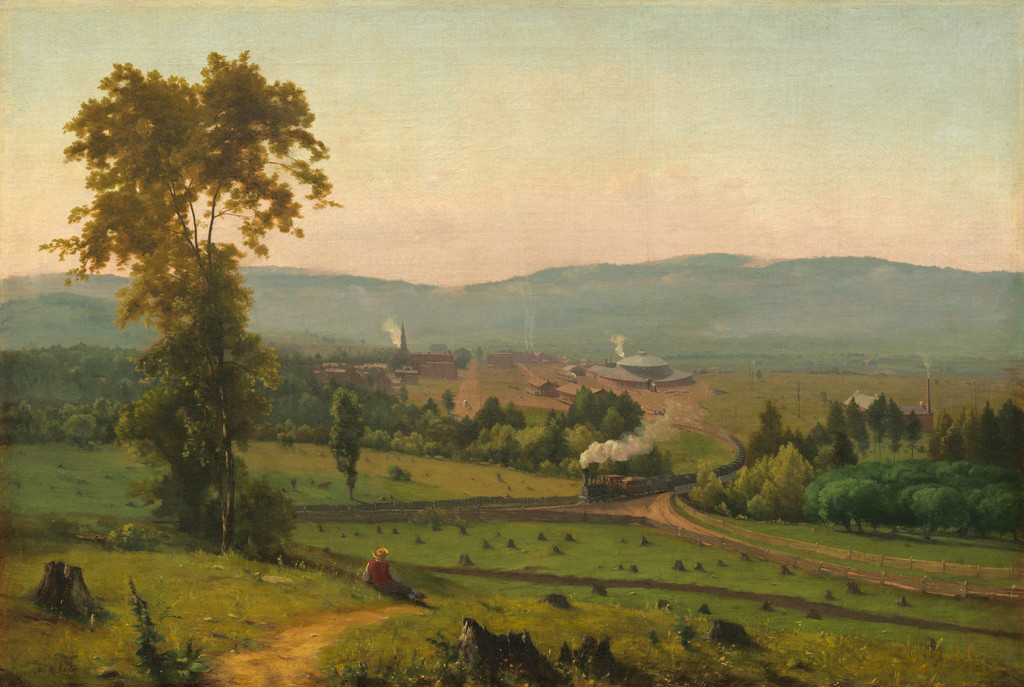
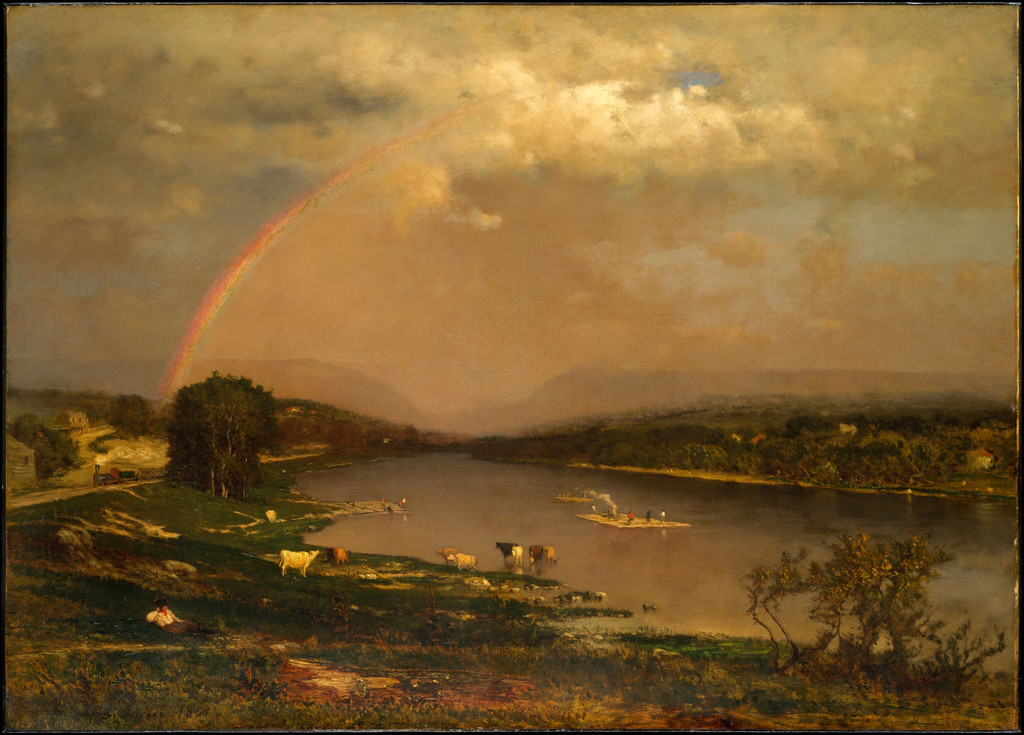
| The Lackawanna Valley by George Inness | c. 1856 | oil on canvas |
| Delaware Water Gap | 1861 | Oil on canvas |
| Delaware Valley | c. 1865–75 | Oil on artist's board |
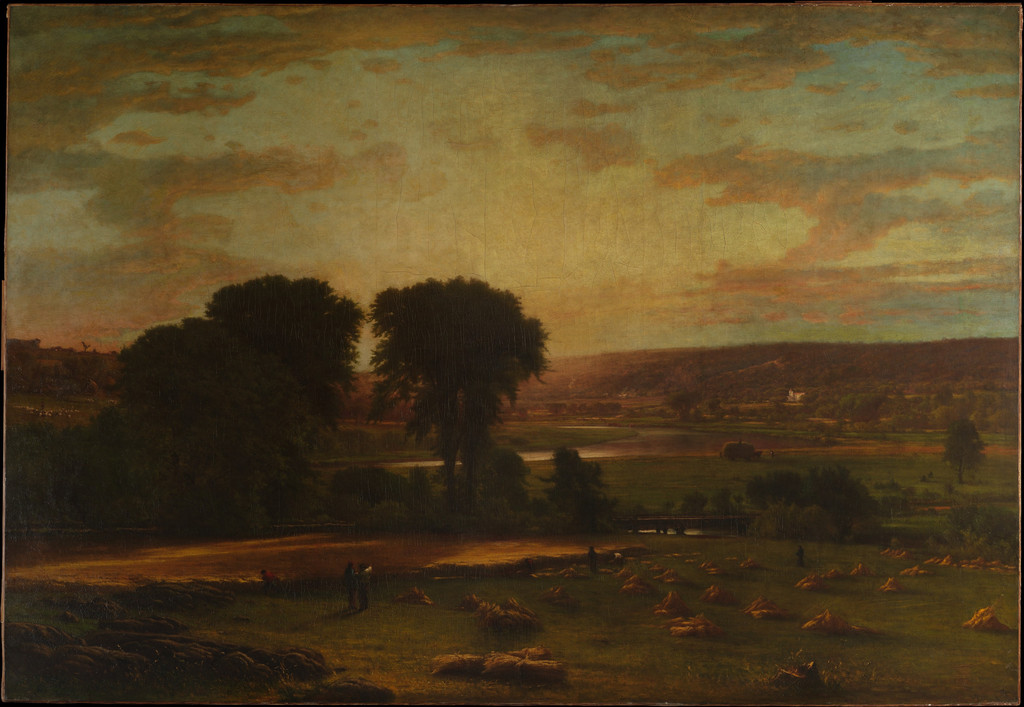
| Peace and Plenty | 1865 | Oil on canvas |
| Evening Landscape | 1867; later reworked | Oil on canvas |
| Summer in the Catskills | 1867 | Oil on canvas |
| The Valley of the Olives | 1867; reworked after 1880 | Oil on canvas |
| The Valley of the Shadow of Death | 1867 | Oil on canvas |
| Visionary Landscape | 1867/1880 | Oil on canvas |
| Catskill Mountains | 1870 | Oil on canvas |
| Across the Campagna | 1872 | Watercolor, gouache, and graphite on off-white wove paper |
| Olive Trees at Tivoli | 1873 | Gouache, watercolor, and graphite on blue wove paper with colored fibers |
| A Marine | c. 1874–75 | Oil on canvas |
| Twilight in Italy — Art Institute of Chicago (1911.44) | 1874 | Oil on panel |
| Pine Grove of the Barberini Villa | 1876 | Oil on canvas |
| The Storm | 1876 | Oil on canvas |
| Autumn Oaks | ca. 1878 | Oil on canvas |
| The Sisters | 1882 | Oil on millboard |
| Harvest, Montclair, New Jersey | 1884 | Oil on canvas |
| Niagara Falls | 1885 | Oil on wood |
| A Silver Morning | 1886 | Oil on canvas |
| Landscape, Sunset | 1887–89 | Oil on canvas |
| September Afternoon | 1887 | Oil on canvas |
| Sunrise | 1887 | Oil on canvas |
| The Mill Stream, Montclair, New Jersey by George Inness | c. 1888 | Oil on canvas |
| Niagara by George Inness | 1889 | oil on canvas |
| The Mill Pond | 1889 | Oil on canvas |
| Sunset in the Valley | 1890 | Oil on canvas |
| The Moon at Night | 1890 | Oil on canvas |
| Twilight in Italy — Art Institute of Chicago (1911.42) | 1890 | Oil on canvas |
| Autumn Woods | 1891–94 | Oil on canvas |
| Moonrise | 1891 | Oil on canvas |
| Spring Blossoms, Montclair, New Jersey | ca. 1891 | Oil and crayon or charcoal on canvas |
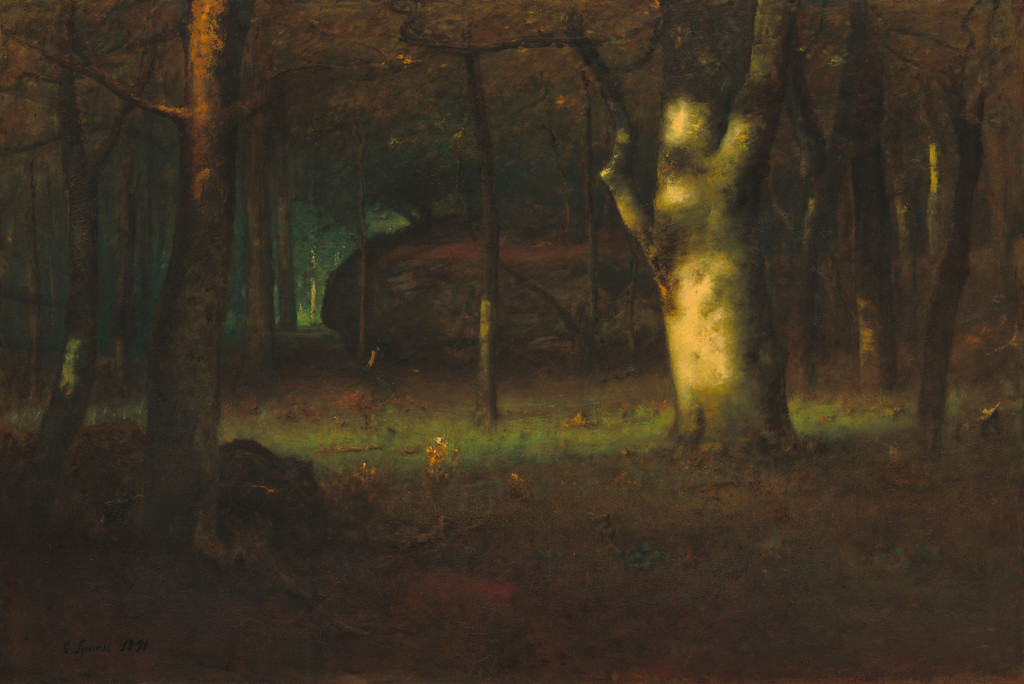
| Sunset in the Woods by George Inness | 1891 | oil on canvas |
| The Home of the Heron — Princeton University Art Museum (y1943-93) | 1891 | Oil on canvas |
| Threatening | 1891 | Oil on canvas |
| Early Morning, Tarpon Springs | 1892 | Oil on canvas |
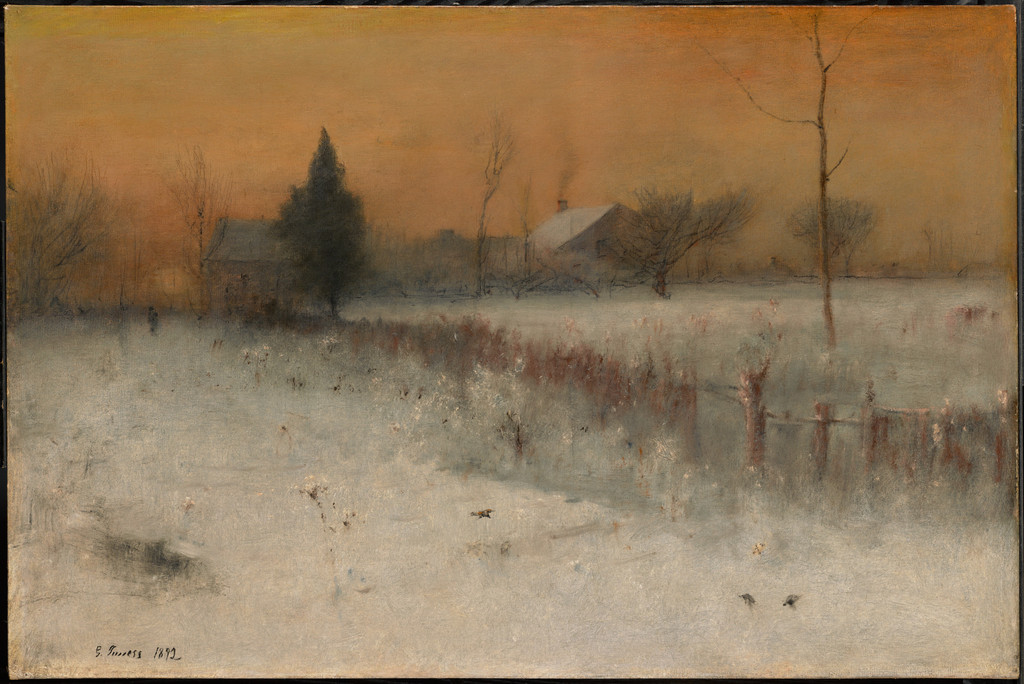
| Home at Montclair by George Inness | 1892 | oil on canvas |
| The Lonely Farm, Nantucket | 1892 | Oil on canvas |
| Afterglow | 1893 | Oil on canvas |
| Sunlit Valley | 1893 | Oil on canvas |
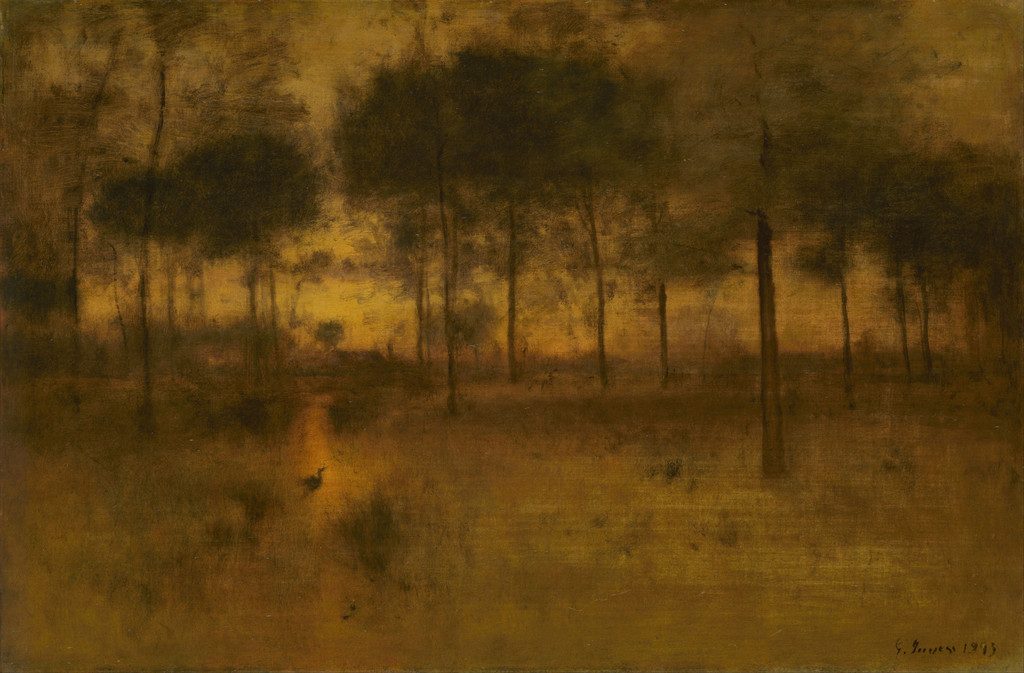
| The Home of the Heron — Art Institute of Chicago (1911.31) | 1893 | Oil on canvas |
| After a Summer Shower | 1894 | Oil on canvas |
| Landscape | n.d. | Watercolor with scraping on ivory wove paper |
Frequently Asked Questions
AIC reports that scholars now consider it Porto d’Anzio, Italy. It was previously thought to show Étretat in Normandy.[1]
The current museum record attributes the painting to George Inness. The reported revision concerns the setting.[1]
The current date is circa 1874–75.[1]
Edward B. Butler gave it in 1913, following the documented Reinhardt and Butler ownership route.[1]
Discussion
Look again at the images and ideas explored in A Marine by George Inness. These editorial prompts invite your observations.
Compare the central rock’s long faces with the smaller stones interrupted by foam. Then look at the light near the horizon. How do those different scales of attention contribute to the seascape’s force?
Reader Insights
How do the coast and sky divide the wide composition?
What becomes different when you compare the painted coast with the Italian work on paper?
How does the museum’s qualified place identification affect your reading?
Join the Conversation
Share a detail, comparison or question about A Marine by George Inness below.
References
- Art Institute of Chicago, A Marine, accession 1913.90. Current object identity, place discussion, handling commentary and provenance.
- Adrienne Baxter Bell, “George Inness (1825–1894),” Metropolitan Museum of Art (2012).
- Metropolitan Museum of Art, Pine Grove of the Barberini Villa, accession 98.16.
- Metropolitan Museum of Art, Olive Trees at Tivoli, accession 1989.287.
- Smithsonian American Art Museum, Niagara, accession 1909.7.31.
- Splash image source.
George Inness, A Marine, c. 1874–75. Oil on canvas. Art Institute of Chicago, 1913.90. Edward B. Butler Collection; Art Institute of Chicago. Image source. Public domain.