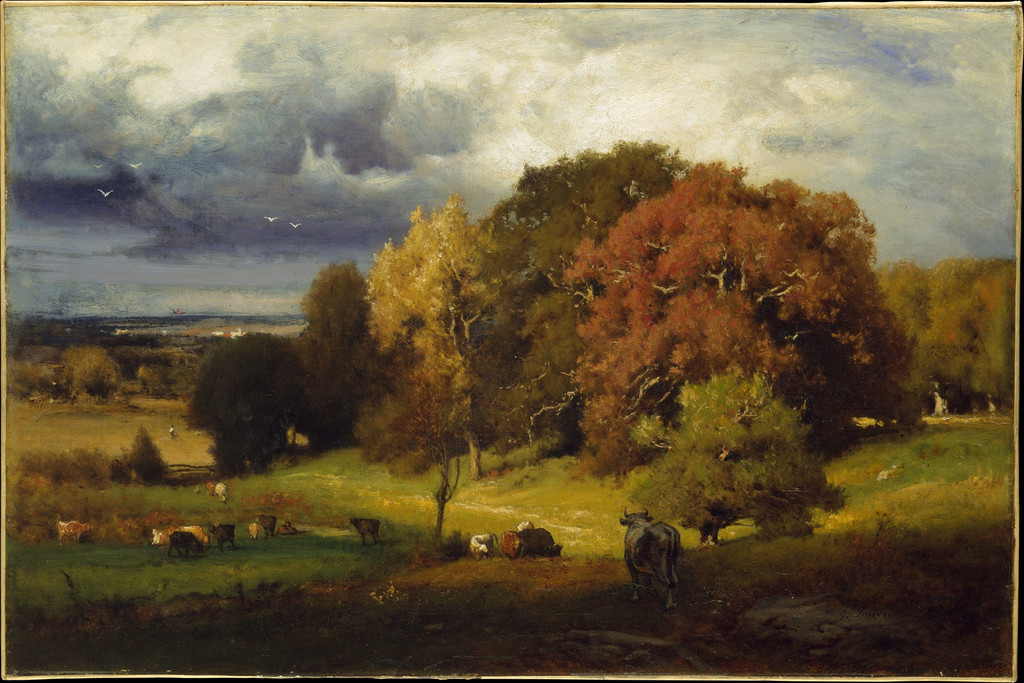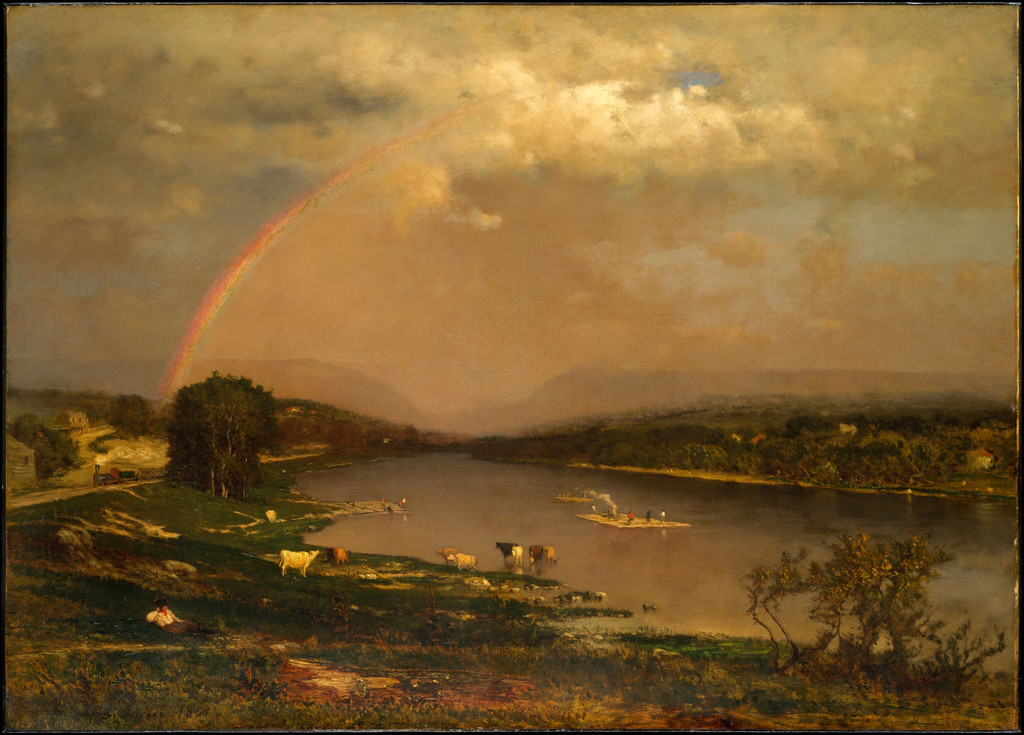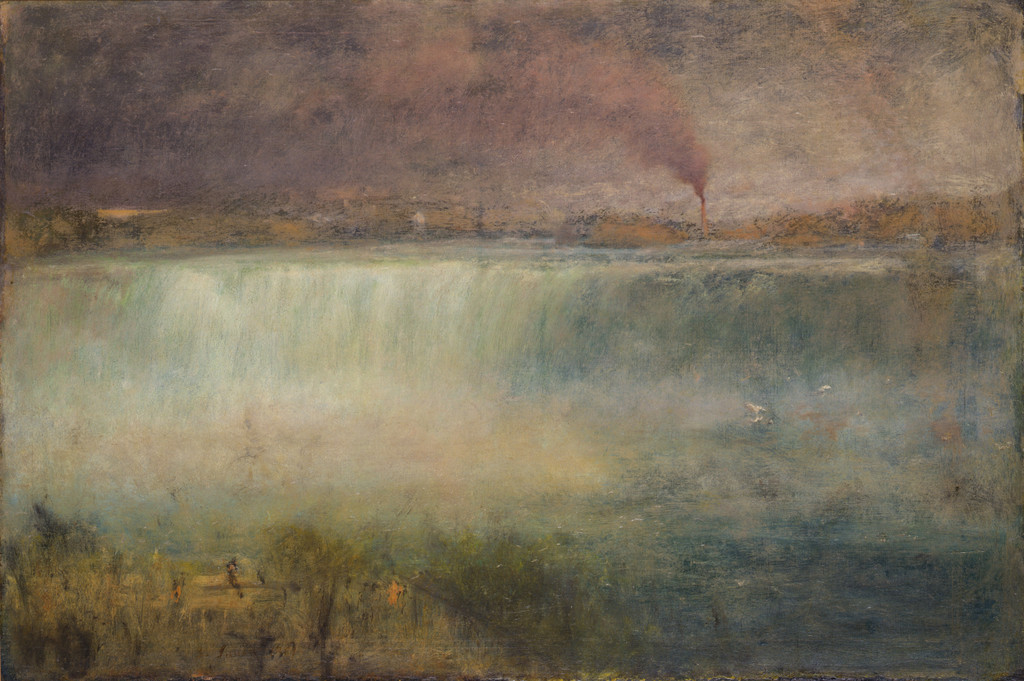
 by Tom Gurney
Tom Gurney BSc (Hons) is an art history expert with over 20 years experience
Email: tomgurney1@gmail.com / Phone: +44 7429 011000
George Inness in Montclair: Introduction
George Inness’s Montclair landscapes vary considerably. A winter snowfield, flowering trees and a stream beside a printing plant offer different subjects within the same New Jersey locality. Their shared place name provides a starting point, but each picture arranges light, figures and buildings differently. Adrienne Baxter Bell distinguishes Inness’s rental there in 1878, purchase in 1884 and permanent residence from 1885. He continued to keep a New York studio.[1]
At a Glance
- First rentalJune 1878
- Property purchaseDecember 1884
- Permanent residenceFebruary 1885
- Other workplaceA retained New York studio
- Selected local worksThe Mill Stream (c. 1888), Spring Blossoms (c. 1891), Home at Montclair (1892)
- Wider late subjectsTarpon Springs and other places visited during continued travel
Contents
- Three dates for the Montclair association
- Winter breadth in Home at Montclair
- Spring colour and visible drawing
- A printing plant beside The Mill Stream
- Familiarity and remembered response
- Small figures in three different spaces
- Florida and the continued late journeys
- The local museum as a route into the work
- Annotated details
Three dates for the Montclair association
Rental, ownership and permanent residence describe different events. The 1878 date marks the beginning of a sustained relationship with the locality, while 1884 and 1885 mark later changes in that relationship. Keeping the three dates distinct avoids making each painting a record of a newly arrived resident.[1]
The distinction also helps the works retain their own chronology. A circa 1888 local stream belongs to a different moment from a snowfield dated 1892, even though both follow permanent residence. Their dates can orient comparison without turning the locality into a fixed style that never changed.
Bell’s retained New York studio is another important part of the picture. Montclair was a home and an enduring source of subjects, but the city remained connected to the artist’s working life.[1] A local title does not independently identify the studio in which every canvas was completed.
For a viewer, the most productive route is consequently through the individual paintings. The chronology establishes the association; the images reveal what Inness made of it. Familiar land could sustain a variety of arrangements, seasons and degrees of recognition.
Annotated Details from George Inness in Montclair
The numbered points identify visible features discussed in this article. Return from each detail to the whole composition. The captions keep each work’s identity, date and medium separate.
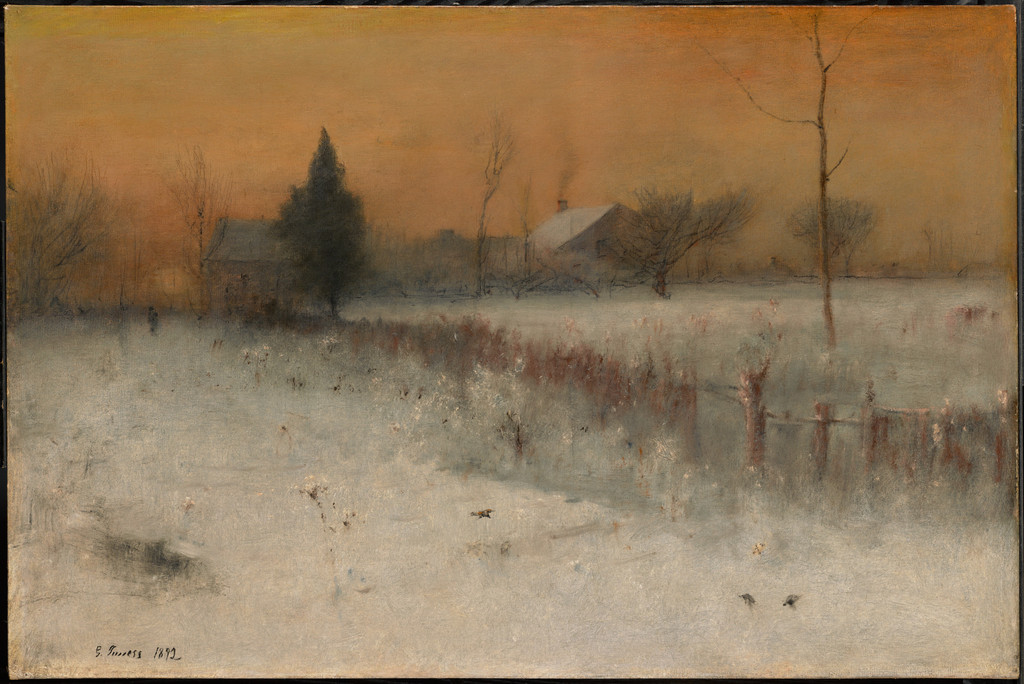
Home at Montclair
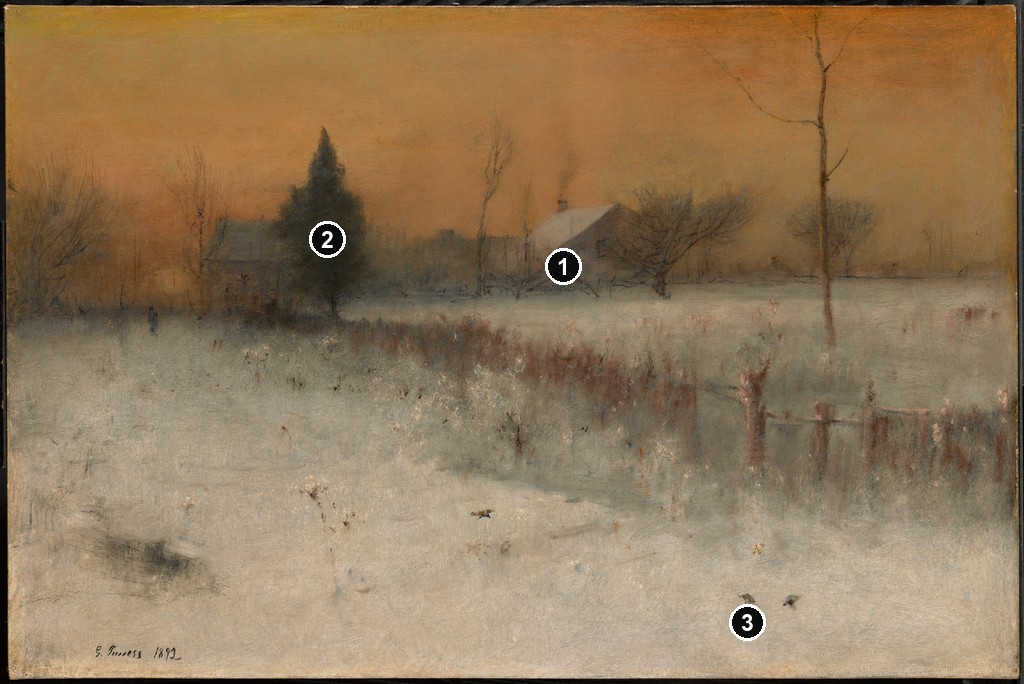
George Inness, Home at Montclair, 1892. Oil on canvas. Clark Art Institute, 1955.10. Sterling and Francine Clark Art Institute. Image source. Public domain.
Spring Blossoms, Montclair, New Jersey
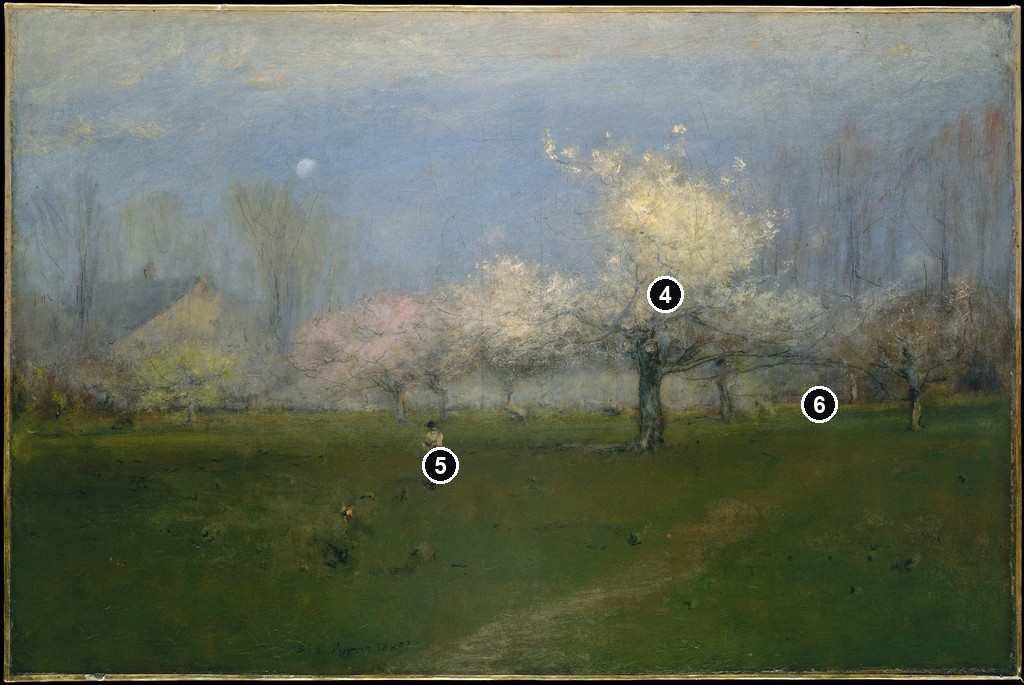
George Inness, Spring Blossoms, Montclair, New Jersey, c. 1891. Oil and crayon or charcoal on canvas. Met, 11.116.4. Gift of George A. Hearn, in memory of Arthur Hoppock Hearn, 1911; Metropolitan Museum of Art. Image source. Public domain.
The Mill Stream, Montclair, New Jersey
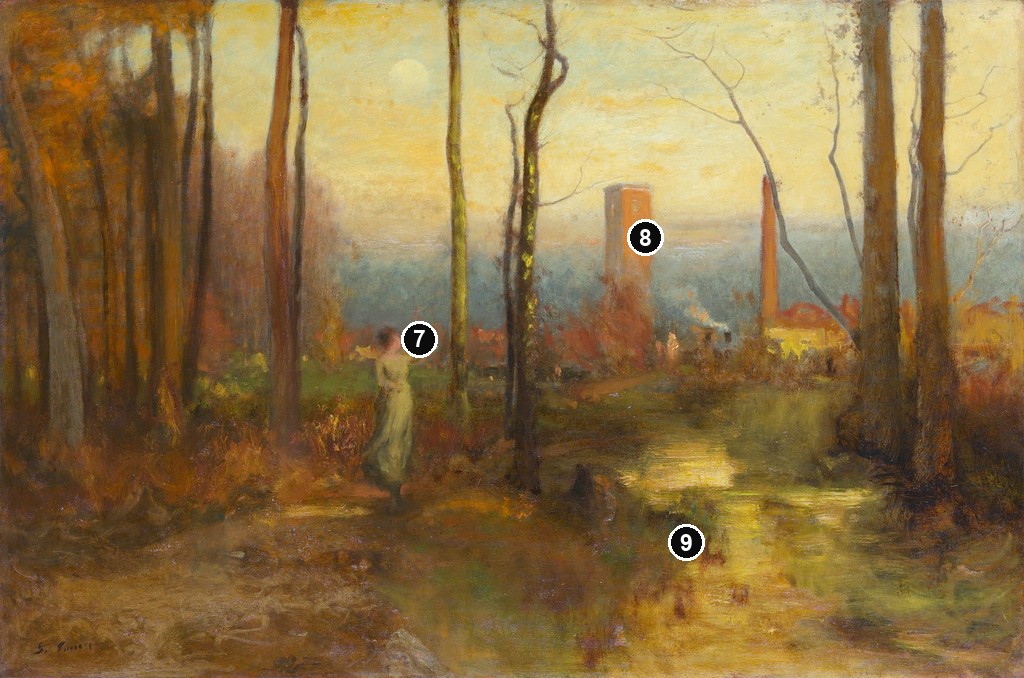
George Inness, The Mill Stream, Montclair, New Jersey, c.1888. Oil on canvas. Minneapolis Institute of Art, 2000.236. Gift of Don and Diana Lee Lucker; Minneapolis Institute of Art. Image source. Public domain.
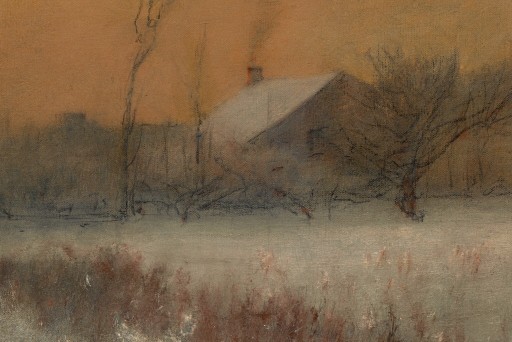
Details from GEORGE INNESS IN MONTCLAIR
Compare the cropped details with the complete images above. Notice how their colours, shapes and positions contribute to the larger compositions.
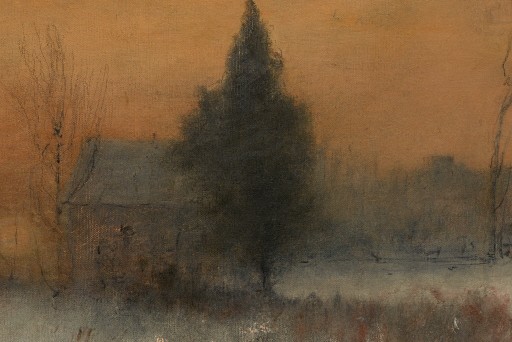
Home at Montclair
Low houses
The houses gather along a low horizon. Their warm walls and roofs remain small above the broad cool field.
Evergreen and bare branches
A dense evergreen stands beside thin bare trees. The different kinds of silhouette organise the quiet middle distance.
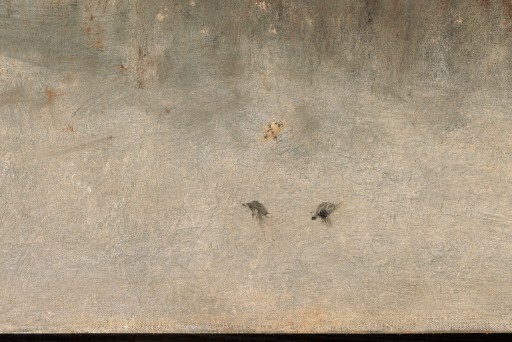
Birds on the snow
Small dark birds interrupt the pale snow. They provide points of recognition within a field that otherwise occupies a large continuous area.
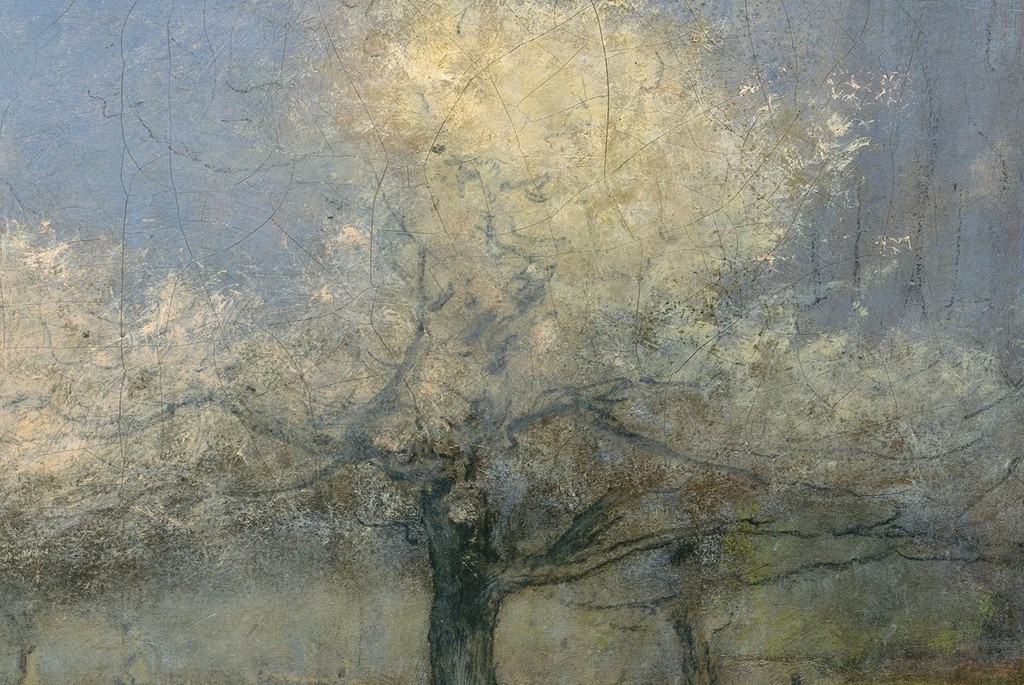
Spring Blossoms, Montclair, New Jersey
Pale blossom
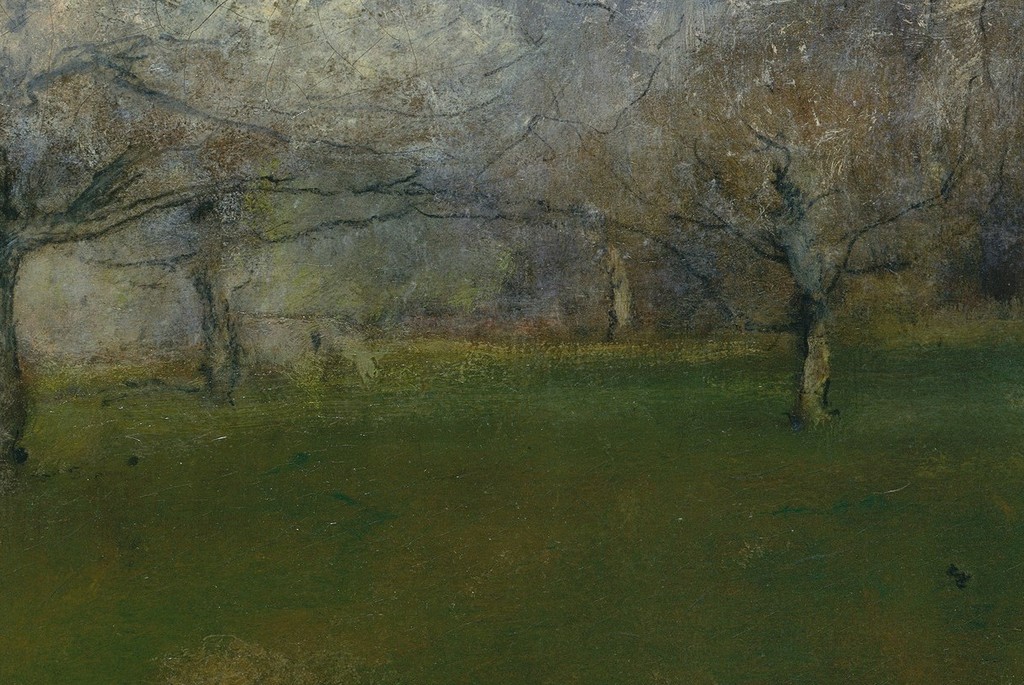
Light blossom spreads around darker branching. Notice where the branch structure remains visible within the flowering mass.
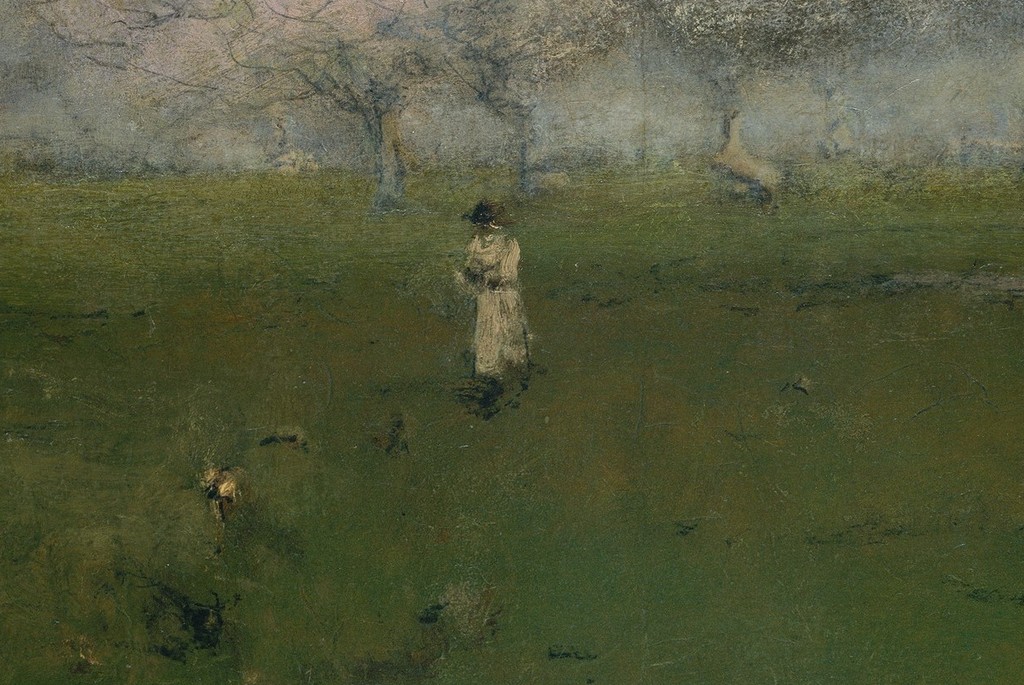
Light-clad figure
A small figure stands against the green field. Its pale clothing connects it with the blossom while preserving a separate human scale.
Dark orchard trunks
Dark trunks and branching punctuate the flowering forms. They keep a graphic structure visible within the softer colour.
The Mill Stream, Montclair, New Jersey
Raised arm
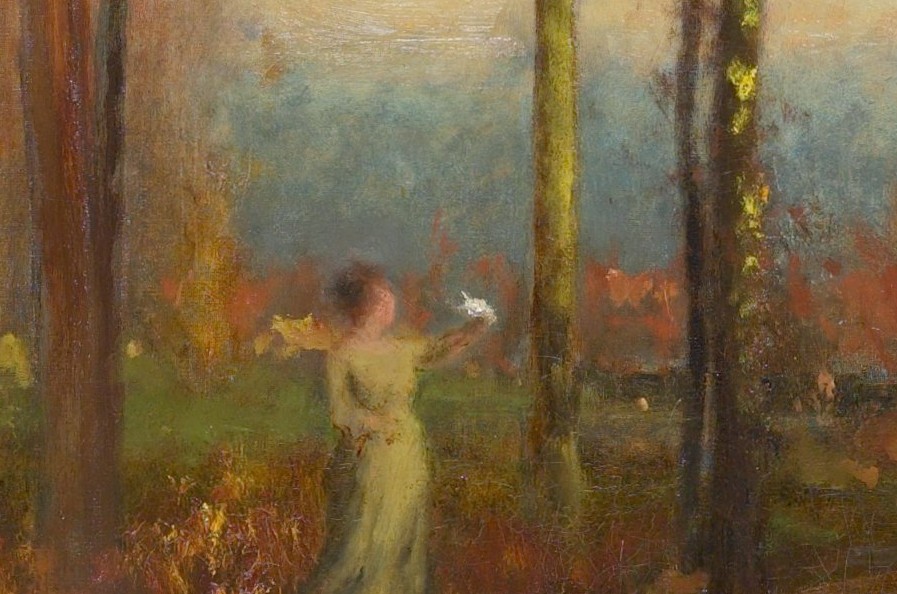
A pale-clad young figure raises an arm near the left bank. The gesture becomes visible among the upright trunks.
Printing-company tower
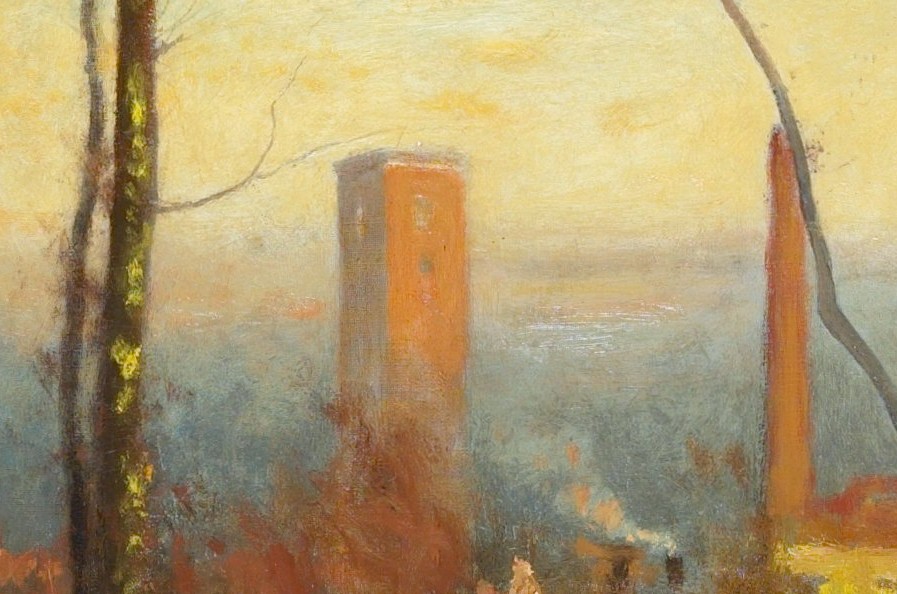
A warm tower and narrow chimney rise behind the trees. Their identifiable architecture remains part of the atmospheric landscape.
Reflected light
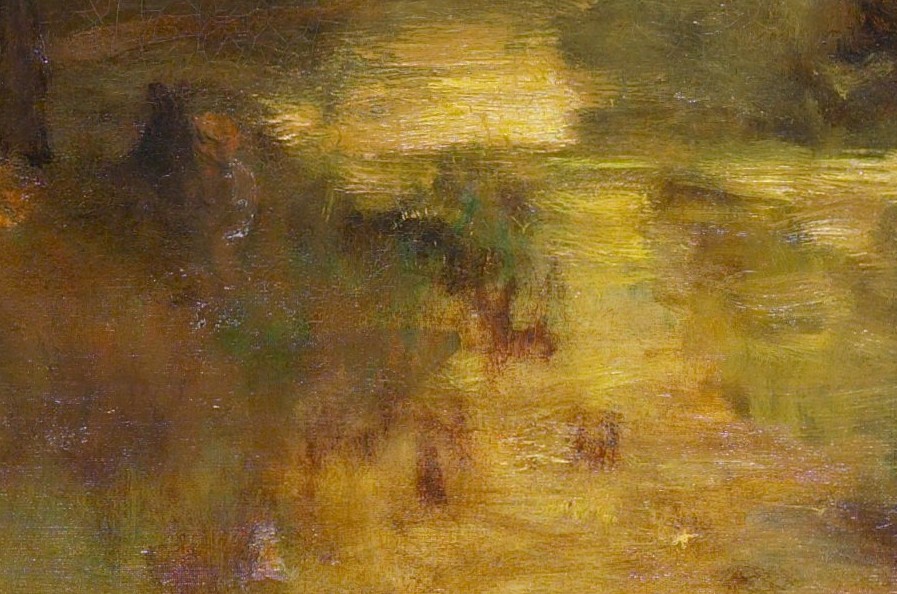
Warm light spreads along the stream beneath the building. The reflections connect the industrial structure with the wooded foreground.
Winter breadth in Home at Montclair
The Clark’s Home at Montclair is dated 1892. Its current account describes winter twilight and thinly applied paint.[2] In the image, a broad cool snowfield lies below a warm orange-peach sky, with houses and trees along the horizon.
Much of the ground remains comparatively open. Small birds interrupt it, while low vegetation and posts appear towards the right. These details make the field inhabited without taking away its breadth. A viewer can move across a large pale interval before settling on a particular object.
The buildings have a different scale from the nearest marks. They lie beyond the field, partly joined to trees and subdued vegetation. Their position makes the open snow feel extended, while preserving the sense of a place shaped by residence.
The trees are unequal. A dark evergreen group provides a compact mass left of centre; taller bare forms let more of the sky show through towards the right. Their difference is important to the picture’s balance. Montclair appears through a particular arrangement of forms rather than a uniform row of recognisable landmarks.
Spring colour and visible drawing
The Met dates Spring Blossoms, Montclair, New Jersey circa 1891 and records oil with crayon or charcoal on canvas.[3] Its alternative identification of the drawing material should remain part of the description.
The scene gives pale colour a different position from the winter picture. Blossom rises above a green field, with a larger flowering tree right of centre and smaller trees extending leftward. A tiny light-clad figure occupies the nearer ground.
Dark branches remain visible through the pale canopy. They provide structure within an atmosphere that is otherwise softly joined. The viewer can attend to the blossom as a mass of colour, then follow the lines within it. Those two routes produce a different experience from looking across the winter snowfield.
A house appears through trees at the left, while a pale disk occupies the sky above. The Met describes blossoms at dusk.[3] The house, figure and light remain small within the scene, but each gives the field and flowering trees another scale of attention.
The winter and spring works therefore share locality while changing the distribution of openness. One places a large pale area on the ground; the other places pale forms within branching trees above it. The difference becomes clearer when their compositions are compared before their general mood is described.
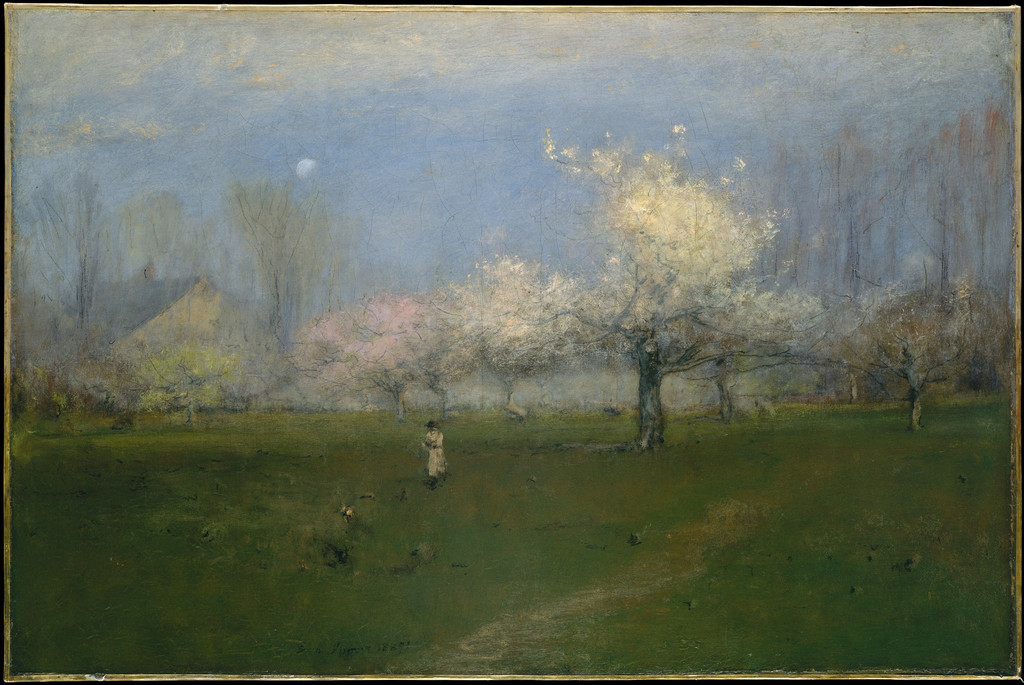
George Inness, Spring Blossoms, Montclair, New Jersey, c. 1891. Oil and crayon or charcoal on canvas. Met, 11.116.4. Gift of George A. Hearn, in memory of Arthur Hoppock Hearn, 1911; Metropolitan Museum of Art. Image source. Public domain.
A printing plant beside The Mill Stream
Mia’s The Mill Stream, Montclair, New Jersey, circa 1888, includes the tower and chimney of Samuel Crump’s printing company. The museum also records the alternative title Crump’s Old Factory.[4] Industrial architecture is part of this local subject.
The tower’s warm colour distinguishes it behind a screen of thin trees. A small figure stands on the nearer left bank, and yellow light spreads through the stream towards the foreground. Water, architecture and trunks share the composition without becoming identical forms.
The upright tower has a visual relation to the trees, while its rectangular face differs from their irregular structure. The stream offers another direction through the scene, moving from the foreground towards the buildings. Those unlike routes make the local landscape more varied.
Mia contrasts a possible present-day reading of industrial encroachment with contemporary approval of the plant as technological improvement.[4] That attributed interpretation raises a question about the factory’s place in the scene; it does not supply a single declaration of Inness’s intention.
The painting makes clear why the locality should not be described only as quiet fields and woods. Industry, habitation and human gesture can enter the atmospheric landscape. A warm tower has a different role from a low winter house, even when both belong to Montclair subjects.
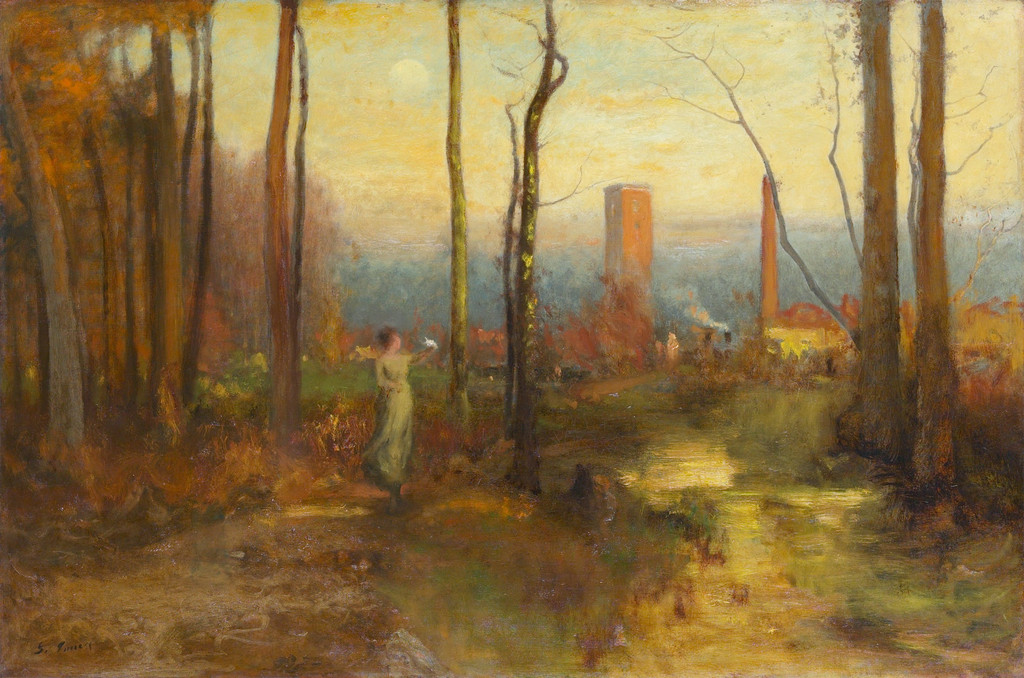
George Inness, The Mill Stream, Montclair, New Jersey, c. 1888. Oil on canvas. Minneapolis Institute of Art, 2000.236. Gift of Don and Diana Lee Lucker; Minneapolis Institute of Art. Image source. Public domain.
Watch: George Inness
Choose a film to explore the artist’s work, its interpretation and its wider setting.
The Montclair Art Museum's George Inness Gallery
Visit the George Inness Gallery at the Montclair Art Museum in this State of the Arts feature.
Watch on YouTubeFamiliarity and remembered response
In his 1917 memoir, George Inness Jr. describes the field behind his father’s house in relation to Home at Montclair. His later critical response emphasises the grandeur he experienced in an apparently unexceptional subject.[5] The memoir records the son’s judgement, alongside recollections of the artist’s ambitions.
That response provides a useful way to approach familiarity. An ordinary field need not offer a spectacular landmark to sustain a substantial painting. The breadth of the snow, low houses and warm sky give the work its own scale of experience.
The three local canvases also show how familiarity can support change. Winter light, flowering branches and factory reflections each direct attention differently. A named place becomes available through selected forms and relationships, rather than through one repeated inventory of everything nearby.
This does not make documentary identity irrelevant. The Clark, Met and Mia works have distinct dates, media and accessions. Their particular records keep comparison precise while the visible arrangements reveal what the common locality alone cannot explain.
Small figures in three different spaces
The human figure in Spring Blossoms stands within an open green field. Its light clothing sets it apart from the ground and gives the trees a larger scale. Its identity remains uncertain, but its place in the composition is clear enough to examine.
The Mill Stream figure stands under nearer trunks with an arm raised. The gesture introduces a different direction from the tower and trees. Light clothing connects the person visually with brighter passages in the scene, while the exact activity remains unresolved.
The winter field offers birds rather than a prominently described foreground person. The change matters: small signs of life can measure the openness of the ground without organising it around a human gesture. The houses provide habitation at another distance.
Considering those differences gives the local works a more specific character. They do not all use one small figure as the same symbol. Their living forms occupy different spaces and guide different routes through the image.
Florida and the continued late journeys
Bell describes winter visits to Tarpon Springs within Inness’s wider late travels.[1] Permanent residence in Montclair therefore coexisted with subjects gathered elsewhere. The home location should not confine the whole late career to New Jersey.
Early Morning, Tarpon Springs, dated 1892 by AIC, makes a tall grove central to an upright canvas.[6] Its tiny red-hatted figure offers a comparison for the smaller people in the Montclair scenes, while the format gives trees a different share of the image.
Follow the Tarpon trunks upward, then return to the spreading branches of Spring Blossoms. The contrast concerns arrangement as well as locality. One grove rises through a pink-blue sky; the other develops pale flowering masses across a wider horizontal field.
The comparison shows why a late style should remain open to variation. Inness could retain an interest in atmosphere while changing the size, spacing and clarity of forms. Montclair was an enduring part of that practice, alongside places reached through continued travel.
The local museum as a route into the work
The Montclair Art Museum provides a gallery commentary by Bell that connects Inness’s house and nearby studio with the corner of Grove and Columbus streets. It also discusses works and artists’ materials later given to the museum.[7] That collection offers a further route into his association with the locality.
The studio address should remain distinct from the precise viewpoint of each painting. A canvas titled Montclair does not automatically identify every house or property boundary in its image. The object-specific articles keep those questions attached to the evidence for each work.
The biography supplies the fuller life chronology, while style and technique examines the different kinds of evidence for handling and spiritual purpose. Together with the local paintings, they give Montclair a role within the larger career without reducing it to one familiar formula.
Artworks directory
A collected selection of 46 individually identified museum objects: 43 paintings and three watercolours. This is not a complete catalogue raisonné. Repeated titles identify separate objects where their institutions or accessions differ. Links lead to a companion article where available, otherwise to the museum record. Unillustrated entries remain included; the original lost New Jerusalem is represented by its three transformed survivors.
| Name | Date | Medium |
|---|---|---|
| Crossing the Ford | 1848 | Oil on canvas |
| The Old Mill | 1849 | Oil on canvas |
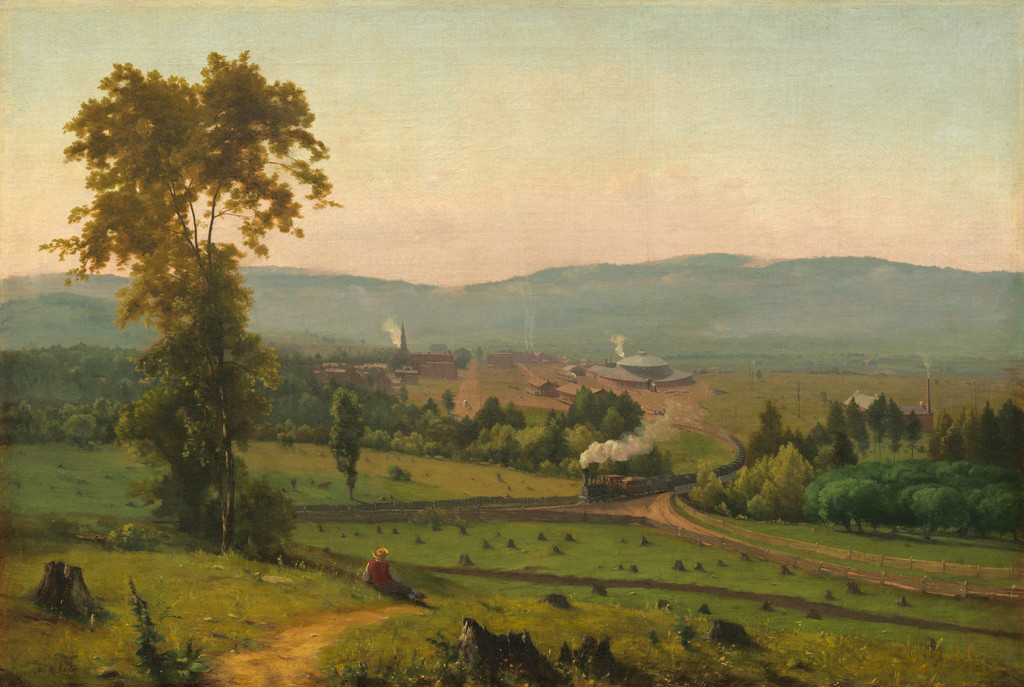
| The Lackawanna Valley by George Inness | c. 1856 | oil on canvas |
| Delaware Water Gap | 1861 | Oil on canvas |
| Delaware Valley | c. 1865–75 | Oil on artist's board |
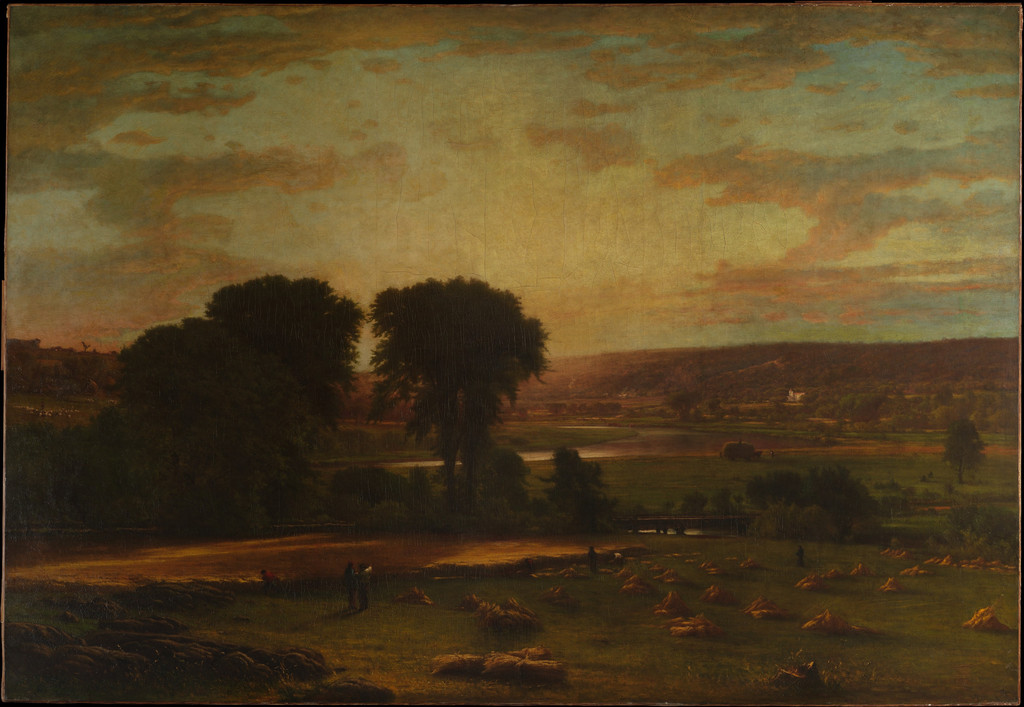
| Peace and Plenty | 1865 | Oil on canvas |
| Evening Landscape | 1867; later reworked | Oil on canvas |
| Summer in the Catskills | 1867 | Oil on canvas |
| The Valley of the Olives | 1867; reworked after 1880 | Oil on canvas |
| The Valley of the Shadow of Death | 1867 | Oil on canvas |
| Visionary Landscape | 1867/1880 | Oil on canvas |
| Catskill Mountains | 1870 | Oil on canvas |
| Across the Campagna | 1872 | Watercolor, gouache, and graphite on off-white wove paper |
| Olive Trees at Tivoli | 1873 | Gouache, watercolor, and graphite on blue wove paper with colored fibers |
| A Marine | c. 1874–75 | Oil on canvas |
| Twilight in Italy — Art Institute of Chicago (1911.44) | 1874 | Oil on panel |
| Pine Grove of the Barberini Villa | 1876 | Oil on canvas |
| The Storm | 1876 | Oil on canvas |
| Autumn Oaks | ca. 1878 | Oil on canvas |
| The Sisters | 1882 | Oil on millboard |
| Harvest, Montclair, New Jersey | 1884 | Oil on canvas |
| Niagara Falls | 1885 | Oil on wood |
| A Silver Morning | 1886 | Oil on canvas |
| Landscape, Sunset | 1887–89 | Oil on canvas |
| September Afternoon | 1887 | Oil on canvas |
| Sunrise | 1887 | Oil on canvas |
| The Mill Stream, Montclair, New Jersey by George Inness | c. 1888 | Oil on canvas |
| Niagara by George Inness | 1889 | oil on canvas |
| The Mill Pond | 1889 | Oil on canvas |
| Sunset in the Valley | 1890 | Oil on canvas |
| The Moon at Night | 1890 | Oil on canvas |
| Twilight in Italy — Art Institute of Chicago (1911.42) | 1890 | Oil on canvas |
| Autumn Woods | 1891–94 | Oil on canvas |
| Moonrise | 1891 | Oil on canvas |
| Spring Blossoms, Montclair, New Jersey | ca. 1891 | Oil and crayon or charcoal on canvas |
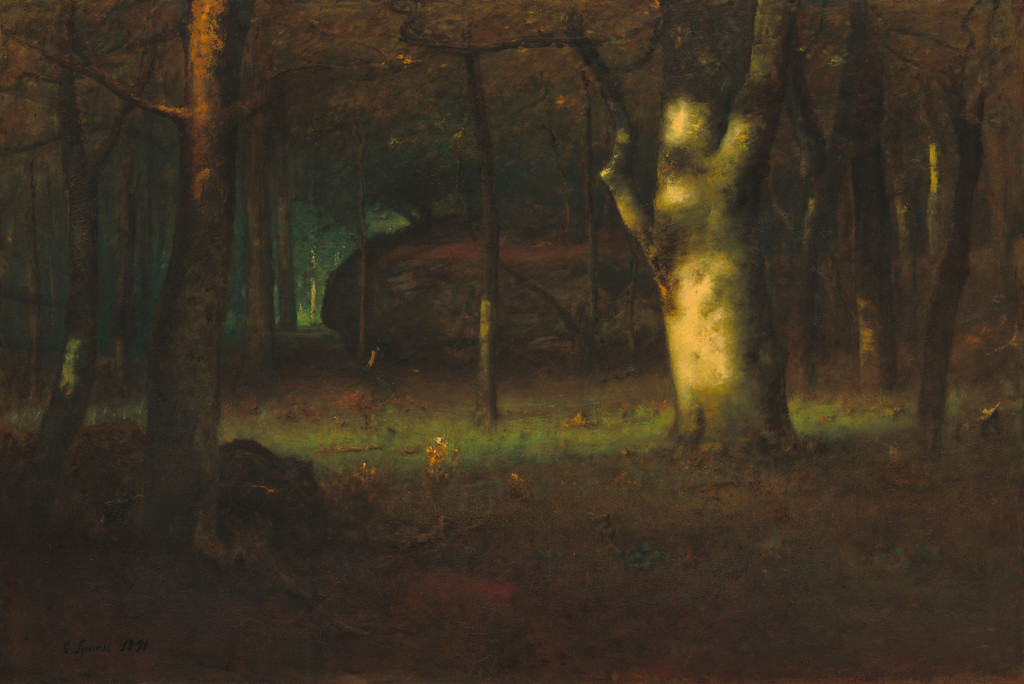
| Sunset in the Woods by George Inness | 1891 | oil on canvas |
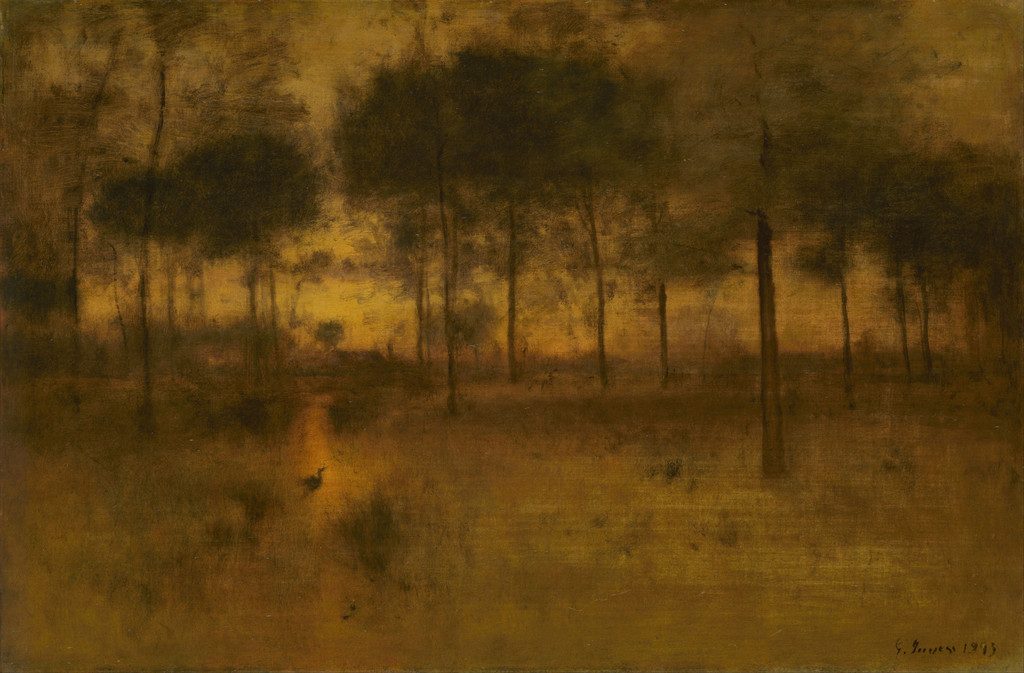
| The Home of the Heron — Princeton University Art Museum (y1943-93) | 1891 | Oil on canvas |
| Threatening | 1891 | Oil on canvas |
| Early Morning, Tarpon Springs | 1892 | Oil on canvas |
| Home at Montclair by George Inness | 1892 | oil on canvas |
| The Lonely Farm, Nantucket | 1892 | Oil on canvas |
| Afterglow | 1893 | Oil on canvas |
| Sunlit Valley | 1893 | Oil on canvas |
| The Home of the Heron — Art Institute of Chicago (1911.31) | 1893 | Oil on canvas |
| After a Summer Shower | 1894 | Oil on canvas |
| Landscape | n.d. | Watercolor with scraping on ivory wove paper |
Frequently Asked Questions
In February 1885, following rental from June 1878 and purchase in December 1884.[1]
No. Home at Montclair shows winter; Spring Blossoms gives another season, while The Mill Stream includes water and industrial architecture.
Mia identifies Samuel Crump’s printing company, including its tower and chimney.[4]
No. Bell records late journeys and winter visits to Tarpon Springs.[1]
Discussion
Look again at the images and ideas explored in George Inness in Montclair. These editorial prompts invite your observations.
Compare where pale light appears in the three local works: snow on the ground, blossom among branches and reflections in water. How does each placement change the space of the landscape?
Reader Insights
Where does reflected or pale light carry the greatest weight?
How do winter ground, blossom and the mill stream organise space differently?
What does the printing plant add to your reading of this local landscape?
Join the Conversation
Share a detail, comparison or question about George Inness in Montclair below.
References
- Adrienne Baxter Bell, “George Inness (1825–1894),” Metropolitan Museum of Art (2012).
- Clark Art Institute, Home at Montclair, accession 1955.10.
- Metropolitan Museum of Art, Spring Blossoms, Montclair, New Jersey, accession 11.116.4.
- Minneapolis Institute of Art, The Mill Stream, Montclair, New Jersey, accession 2000.236.
- George Inness Jr., Life, Art, and Letters of George Inness (1917), printed pp. 245–246. Selected original pages examined; son’s retrospective response distinguished.
- Art Institute of Chicago, Early Morning, Tarpon Springs, accession 1911.32.
- Adrienne Baxter Bell, George Inness gallery commentary, Montclair Art Museum. Accessible transcript examined.
- Splash image source.
George Inness, Home at Montclair, 1892. Oil on canvas. Clark Art Institute, 1955.10. Sterling and Francine Clark Art Institute. Image source. Public domain.