 by Tom Gurney
Tom Gurney BSc (Hons) is an art history expert with over 20 years experience
Email: tomgurney1@gmail.com / Phone: +44 7429 011000
The Mill Stream, Montclair, New Jersey by George Inness: Introduction
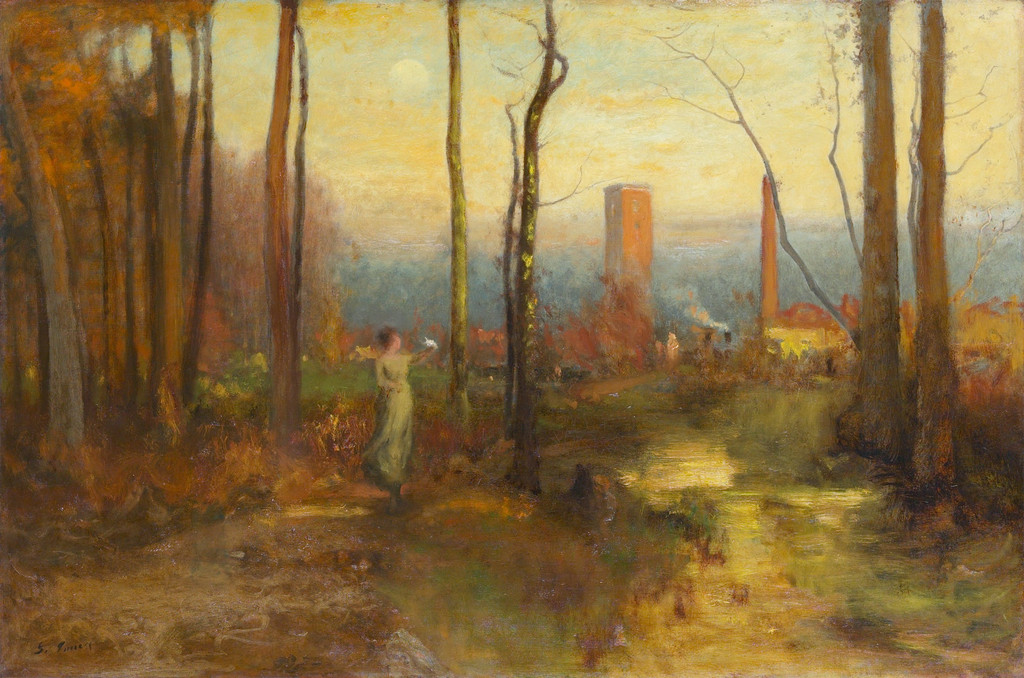
George Inness’s The Mill Stream, Montclair, New Jersey places an industrial tower among slender trees above a yellow-lit stream. A small figure occupies the near bank, while cool blue distance appears behind the warmer buildings. The Minneapolis Institute of Art dates the oil painting circa 1888 and identifies the factory as Samuel Crump’s printing company. Its alternative title, Crump’s Old Factory, draws attention to architecture that the atmospheric scene partly gathers into its surroundings.[1]
At a Glance
- ArtistGeorge Inness (1825–1894)
- TitleThe Mill Stream, Montclair, New Jersey
- Alternative titleCrump’s Old Factory
- DateCirca 1888
- MediumOil on canvas
- Dimensions77.47 × 114.3 cm, canvas
- CollectionMinneapolis Institute of Art
- CreditGift of Don and Diana Lee Lucker
- Accession2000.236
This work across George Inness’s career
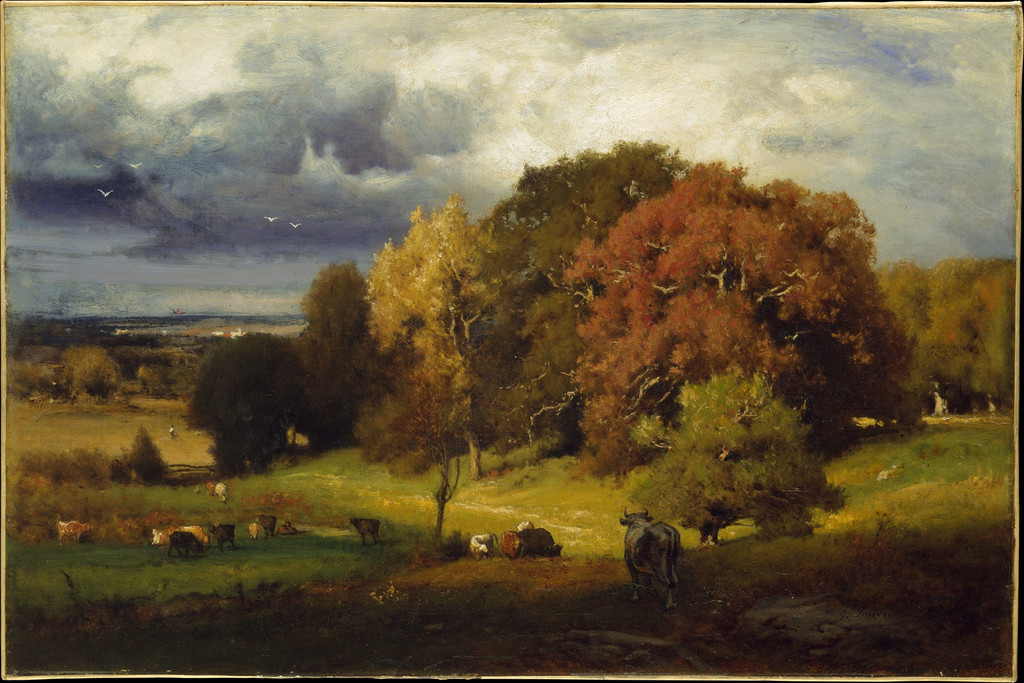
Autumn Oaks by George Inness
ca. 1878Contents
- A stream opening through the trees
- Trunks, tower and chimney
- Warm buildings and cool distance
- A small figure beside the water
- Industry in the museum’s historical interpretation
- Montclair and the late career
- Industrial and seasonal comparisons
- Annotated details
A stream opening through the trees
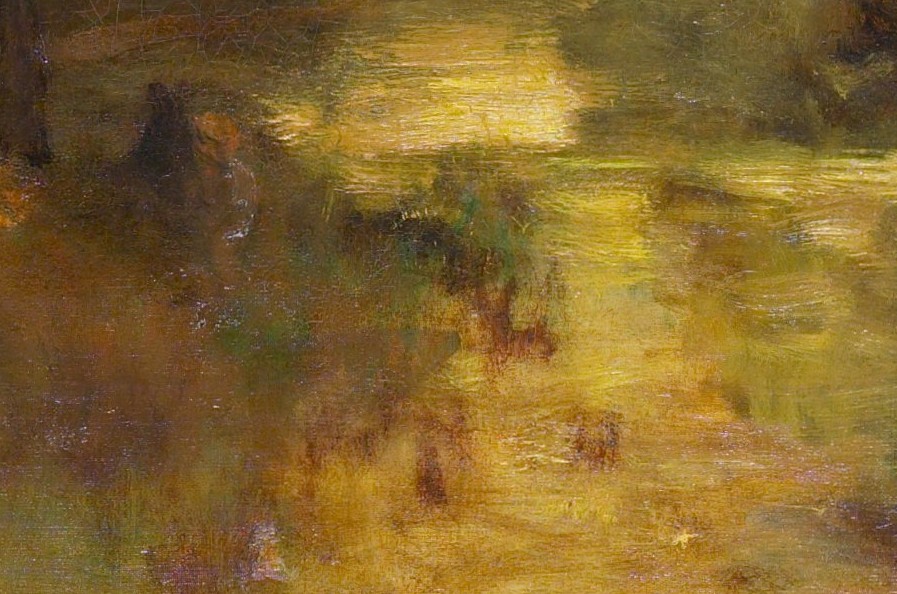
The stream begins near the lower edge and continues towards the factory buildings. Its warm light gives the eye a route into the scene. Darker banks enclose the water, while irregular reflections interrupt its bright surface. The stream is neither a straight stripe nor an empty opening: it carries changes of colour through the composition.
The nearer left bank forms a darker area beneath a dense group of trunks. On the right, the water meets low vegetation and the bases of taller trees. These edges make the central opening feel sheltered, even though light enters from the sky above.
The water broadens towards the foreground, bringing its reflections closer to the viewer. Farther back, the passage becomes less distinct as it approaches the buildings. This transition helps connect near surface and middle distance without making every part of the stream equally clear.
Looking along the water is one useful entrance to the image. Another begins with the trees and then moves inward towards the light between them. The painting supports both routes, allowing the stream to act as a connection within a scene whose strongest forms are often vertical.
Annotated Details from The Mill Stream, Montclair, New Jersey
The numbered points identify visible features discussed in this article. Return from each detail to the whole composition. George Inness, The Mill Stream, Montclair, New Jersey, c.1888. Oil on canvas. Minneapolis Institute of Art, 2000.236. Gift of Don and Diana Lee Lucker; Minneapolis Institute of Art. Image source. Public domain.
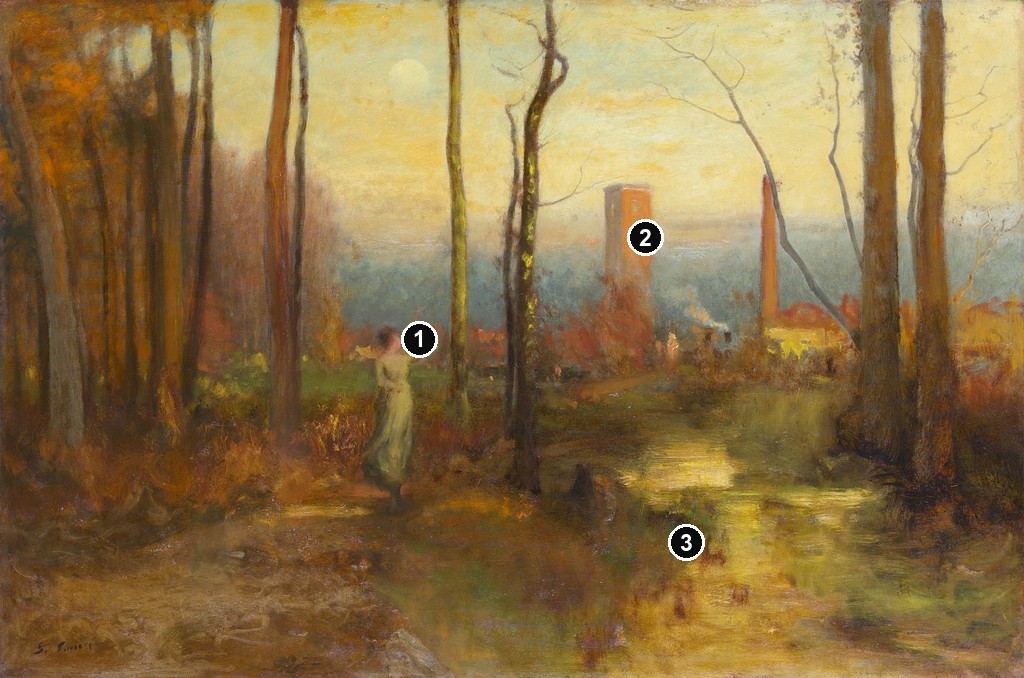
Details from THE MILL STREAM, MONTCLAIR, NEW JERSEY
Compare the cropped details with the complete images above. Notice how their colours, shapes and positions contribute to the larger compositions.
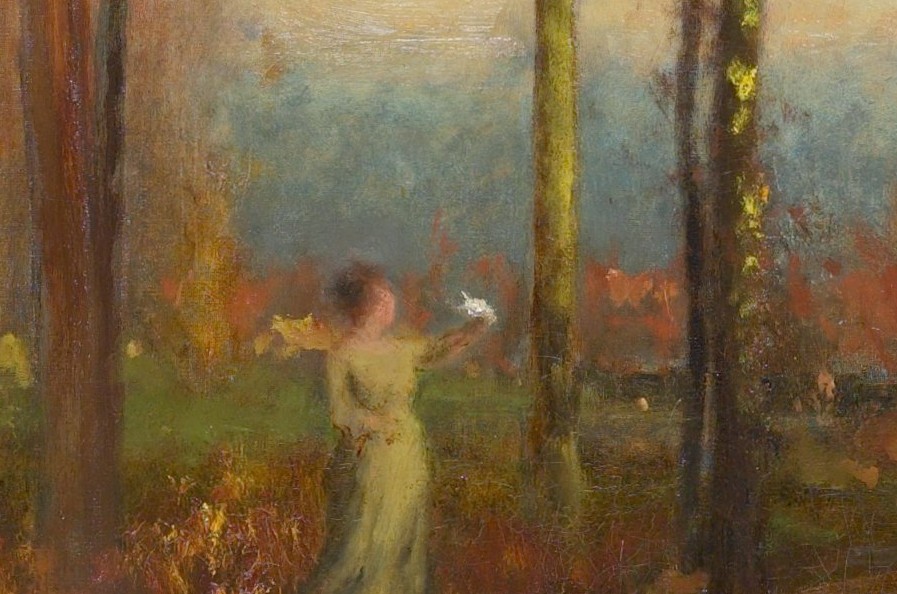
Raised arm
A pale-clad young figure raises an arm near the left bank. The gesture becomes visible among the upright trunks.
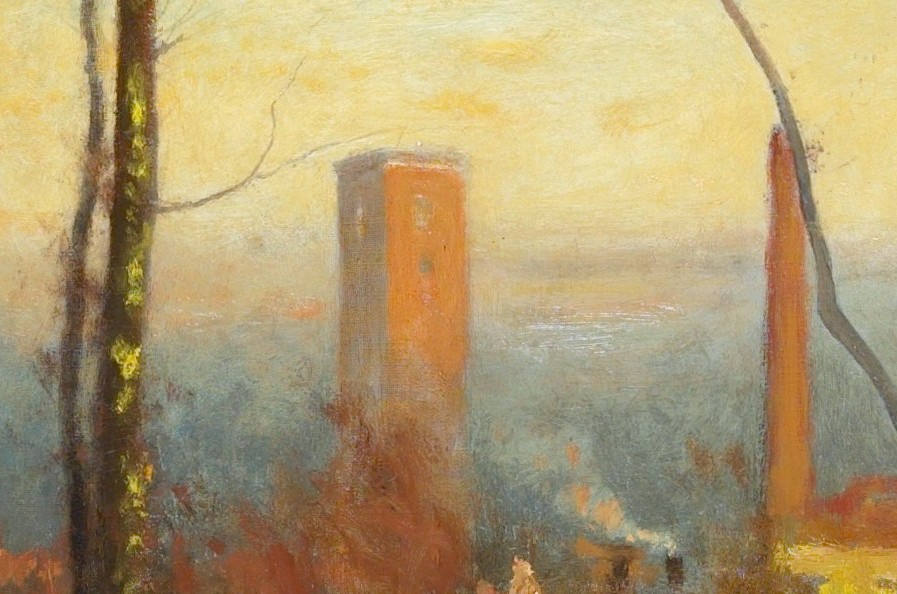
Printing-company tower
A warm tower and narrow chimney rise behind the trees. Their identifiable architecture remains part of the atmospheric landscape.
Reflected light
Warm light spreads along the stream beneath the building. The reflections connect the industrial structure with the wooded foreground.
Trunks, tower and chimney
The trees create a sequence of dark uprights across the picture. Some are gathered closely at the left, while others stand at larger intervals towards the centre and right. Their spacing lets the factory appear through them, rather than setting the buildings in a completely open view.
The tower stands above the lower industrial structures. Its orange face makes it distinguishable against the cooler distance, and its simple rectangular shape contrasts with the uneven trunks. The chimney offers another upright farther to the right. Architecture and trees therefore share a general direction while keeping different forms.
This relation gives the factory a particular visual position. It is clearly present, yet the trees continue to interrupt the view of it. The buildings are seen as part of a layered landscape rather than as an isolated architectural elevation. Their scale can be considered alongside trunks, water and the small foreground figure.
The arrangement becomes clearer if the tower is followed downward towards the lower buildings and then into the water. Warm colour links those areas even where their outlines soften. The factory’s presence extends beyond its visible walls through the surrounding light and reflection.
Warm buildings and cool distance
Yellow and orange occupy much of the sky, architecture and stream, while blue appears behind the buildings. The cooler band helps the tower stand forward. It also creates an interval of distance between the warm industrial forms and the broader sky above.
Warm colour spreads across different materials. It belongs to buildings, vegetation and water without making them identical. The tower remains relatively upright and compact, while reflections are broken and horizontal. The eye can recognise a shared light through these changes in shape.
The trees introduce darker tones that give the warm passages greater force. Their trunks do not need to be described leaf by leaf to structure the scene. They create a screen through which sky, architecture and water can be seen, varying the amount of openness across the canvas.
The left side feels denser than the stream’s brighter central passage. This difference gives the small figure a setting in which light clothing can become noticeable. It also prevents the factory from being the only point of contrast: the near bank and human presence hold attention at a different scale.
A small figure beside the water
The foreground figure stands on the left bank with an arm raised. Pale clothing separates the body from the surrounding browns and greens. The gesture reaches towards a lighter mark, but its exact activity cannot be securely named from the image alone.
The figure’s position contributes more clearly to the composition than an invented story would. It occupies the space under the nearest trunks, close enough to the viewer to establish scale. The factory behind it becomes more distant and substantial by comparison.
The raised arm also breaks the general vertical rhythm. Tower, chimney and trunks rise upward; the gesture extends more laterally into the scene. That small change of direction makes the figure easier to find and brings a different kind of movement into the otherwise quiet bank.
Its light clothing can be followed visually towards the brighter buildings and stream. The figure therefore participates in the distribution of light, even while remaining distinct from the architecture. This connection helps the scene feel continuous across foreground and middle distance.
Watch: George Inness
Choose a film to explore the artist’s work, its interpretation and its wider setting.
The Montclair Art Museum's George Inness Gallery
Visit the George Inness Gallery at the Montclair Art Museum in this State of the Arts feature.
Watch on YouTubeIndustry in the museum’s historical interpretation
Mia’s commentary asks how the factory’s presence might be understood. It contrasts a possible present-day reading of industrial encroachment with contemporary approval of the printing plant as technological improvement. This is the museum’s historical interpretation of the scene, and it should remain attributed.[1]
The distinction opens a useful question rather than supplying a single answer from the artist. How does the painting make the factory belong to the landscape? The warm tower, thin trees and reflected light offer visible evidence to examine. None on its own proves either an industrial celebration or a critique.
The title also gives two possible starting points. The Mill Stream directs attention towards water and the landscape around it. Crump’s Old Factory directs attention towards the buildings. Looking through both titles helps reveal how the same arrangement can support different emphases without changing the objects represented.
The architecture’s presence is therefore essential to the picture’s complexity. An account confined to trees and atmospheric colour would miss a major part of the subject. At the same time, concentrating only on the factory would overlook the ways its forms and light are joined to the water and banks.
Montclair and the late career
Inness began renting in Montclair in 1878, bought the property in 1884 and made it his permanent residence in 1885, while retaining a New York studio. Adrienne Baxter Bell distinguishes those stages of his association with the locality.[2] The circa 1888 canvas belongs to the period after permanent residence began.
The scene shows how a local subject can sustain an atmospheric landscape without depending on a remote mountain or vast wilderness. Water, industrial architecture and thin trees provide sufficient variety for a complex arrangement. The modest scale of the human presence gives the place another register of experience.
The recorded medium is oil on canvas. Its visible handling can be described through softened boundaries and interrupted reflections, but no object-specific technical study has been examined here. Those observations concern the reproduction’s appearance rather than a reconstruction of the paint layers.
The museum’s current credit records the gift of Don and Diana Lee Lucker.[1] Accession 2000.236 provides a stable identity for this work. It also helps distinguish the Minneapolis canvas from Inness’s separately titled The Mill Pond and earlier The Old Mill in Chicago.
Industrial and seasonal comparisons
The Lackawanna Valley, circa 1856, was commissioned for the Delaware, Lackawanna and Western Railroad.[3] Its train, roundhouse and stumps make an earlier comparison for industry within landscape. Here, a printing plant is partly screened by trees, and the stream carries its light into the foreground.
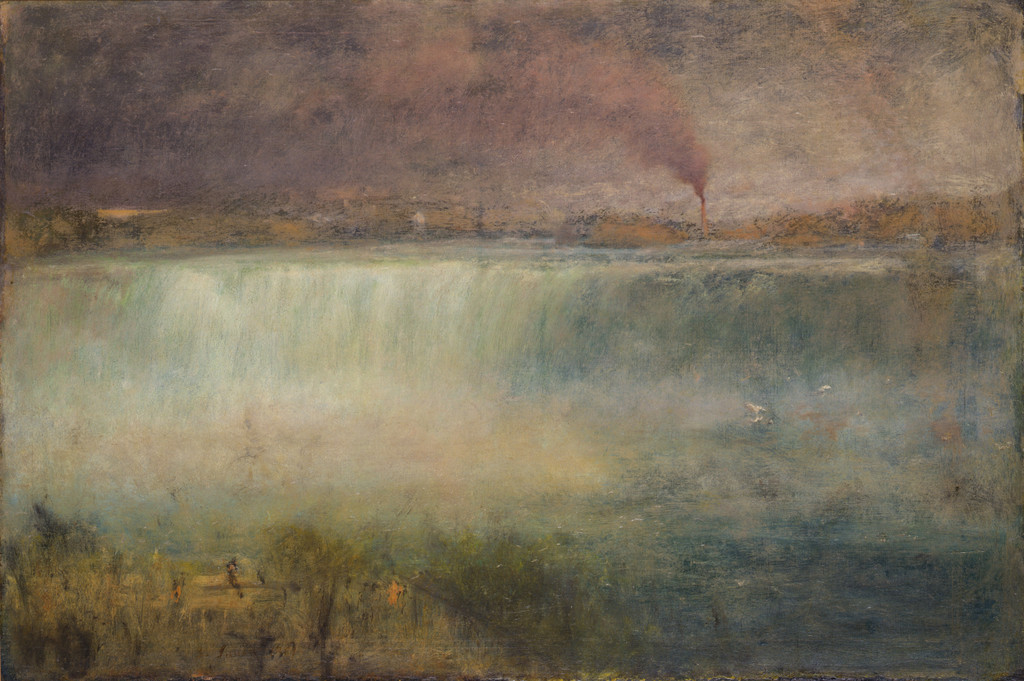
Niagara, dated 1889 by the Smithsonian American Art Museum, includes a smoking mill chimney beside a pale waterfall scene.[4] Compare that small industrial upright with the more prominent tower here. Each changes the experience of the surrounding landscape, while its position and relative size differ.
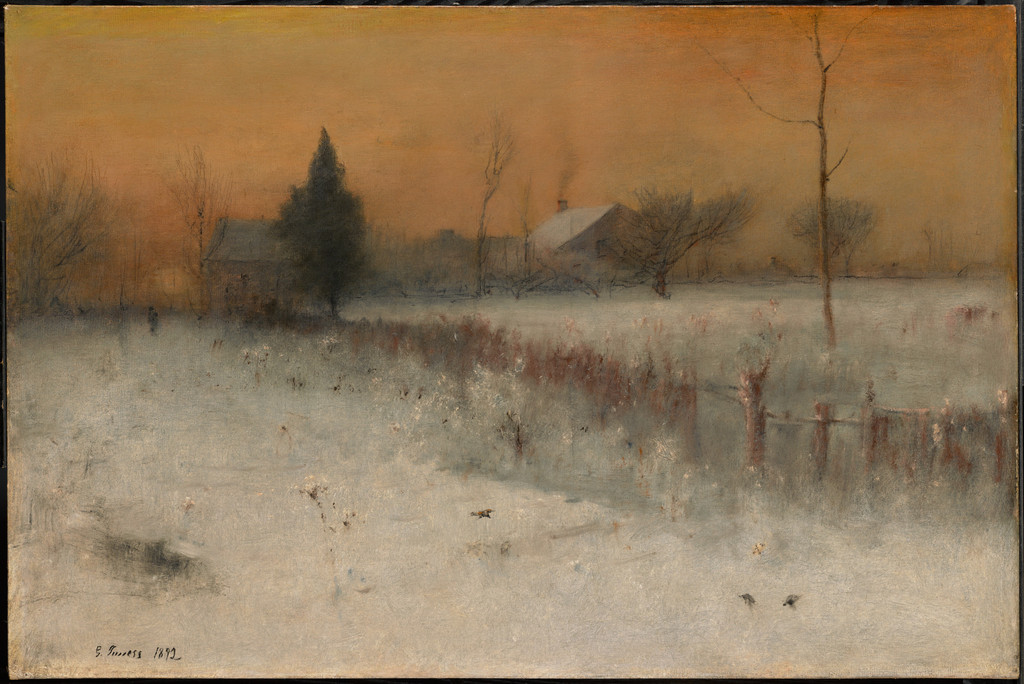
Home at Montclair, 1892, offers a winter contrast in the Clark collection.[5] The houses remain along a low horizon, and a broad snowfield opens in front of them. The factory scene gathers more vertical forms around a narrower stream, making the winter painting’s breadth especially apparent.
These comparisons can guide a final look at the Minneapolis canvas. Follow the figure’s gesture, the orange tower and the reflected light, then look at the darker trees around them. The painting gives industrial architecture a visible place within a landscape whose atmosphere arises from the relation of all those forms.
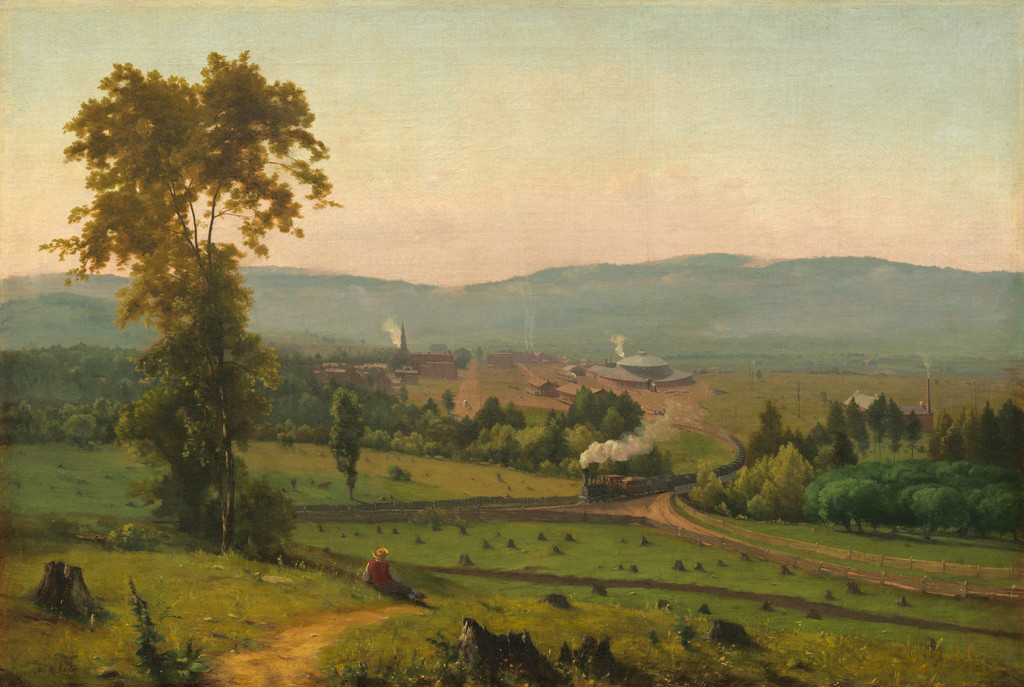
George Inness, The Lackawanna Valley, c. 1856. Oil on canvas. National Gallery of Art, 1945.4.1. Gift of Mrs. Huttleston Rogers; National Gallery of Art. Image source. CC0 / Public domain.
Artworks directory
A collected selection of 46 individually identified museum objects: 43 paintings and three watercolours. This is not a complete catalogue raisonné. Repeated titles identify separate objects where their institutions or accessions differ. Links lead to a companion article where available, otherwise to the museum record. Unillustrated entries remain included; the original lost New Jerusalem is represented by its three transformed survivors.
| Name | Date | Medium |
|---|---|---|
| Crossing the Ford | 1848 | Oil on canvas |
| The Old Mill | 1849 | Oil on canvas |
| The Lackawanna Valley by George Inness | c. 1856 | oil on canvas |
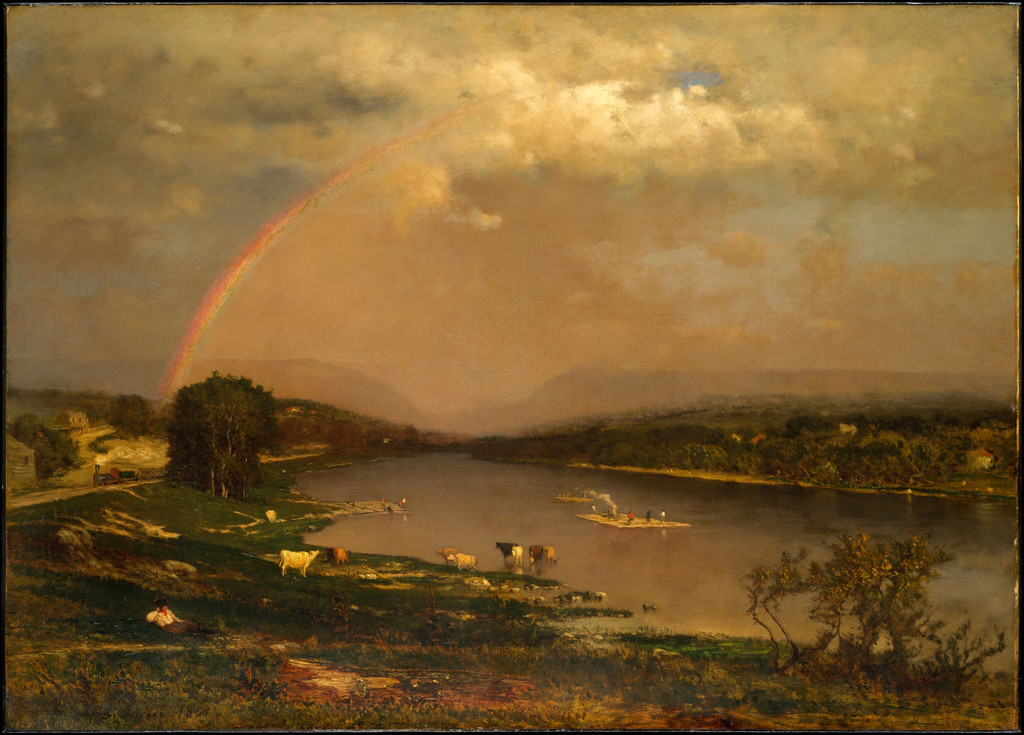
| Delaware Water Gap | 1861 | Oil on canvas |
| Delaware Valley | c. 1865–75 | Oil on artist's board |
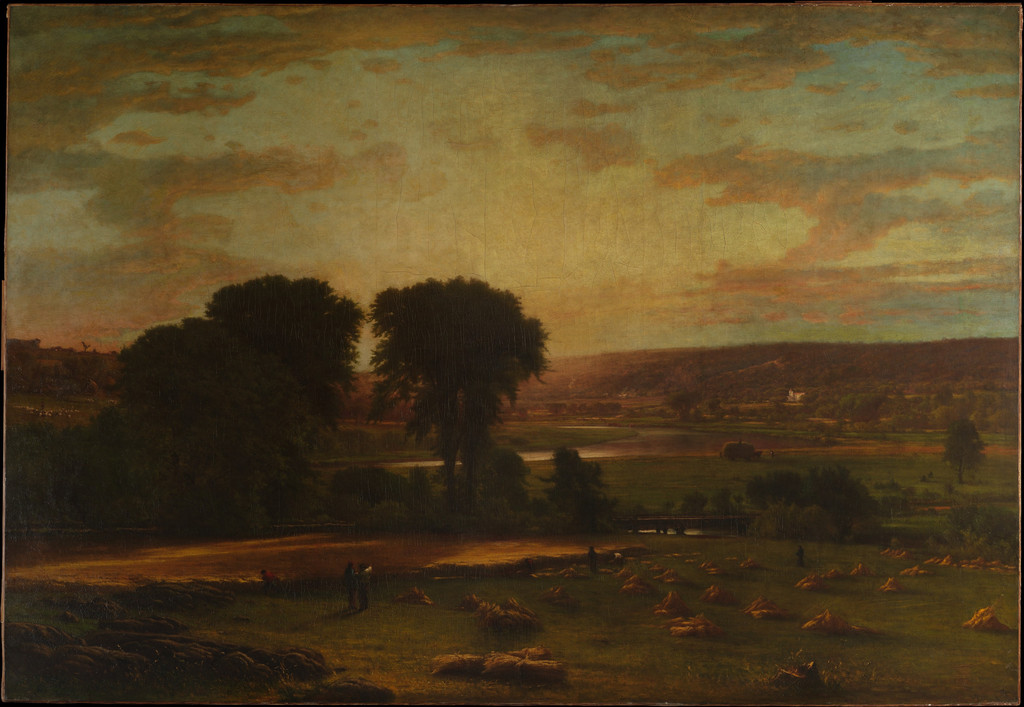
| Peace and Plenty | 1865 | Oil on canvas |
| Evening Landscape | 1867; later reworked | Oil on canvas |
| Summer in the Catskills | 1867 | Oil on canvas |
| The Valley of the Olives | 1867; reworked after 1880 | Oil on canvas |
| The Valley of the Shadow of Death | 1867 | Oil on canvas |
| Visionary Landscape | 1867/1880 | Oil on canvas |
| Catskill Mountains | 1870 | Oil on canvas |
| Across the Campagna | 1872 | Watercolor, gouache, and graphite on off-white wove paper |
| Olive Trees at Tivoli | 1873 | Gouache, watercolor, and graphite on blue wove paper with colored fibers |
| A Marine | c. 1874–75 | Oil on canvas |
| Twilight in Italy — Art Institute of Chicago (1911.44) | 1874 | Oil on panel |
| Pine Grove of the Barberini Villa | 1876 | Oil on canvas |
| The Storm | 1876 | Oil on canvas |
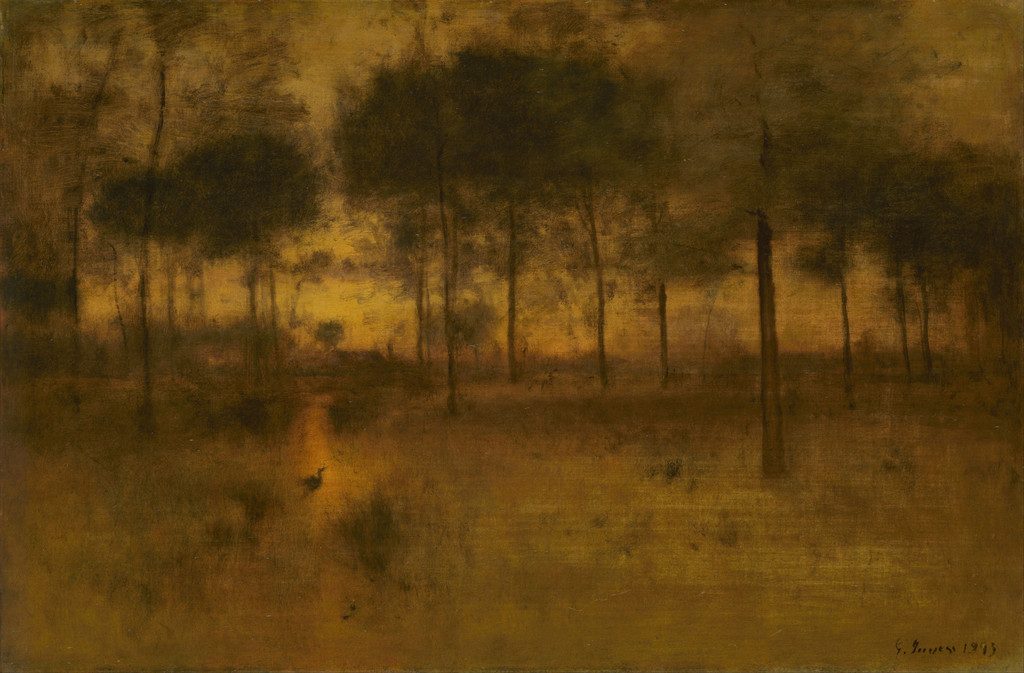
| Autumn Oaks | ca. 1878 | Oil on canvas |
| The Sisters | 1882 | Oil on millboard |
| Harvest, Montclair, New Jersey | 1884 | Oil on canvas |
| Niagara Falls | 1885 | Oil on wood |
| A Silver Morning | 1886 | Oil on canvas |
| Landscape, Sunset | 1887–89 | Oil on canvas |
| September Afternoon | 1887 | Oil on canvas |
| Sunrise | 1887 | Oil on canvas |
| The Mill Stream, Montclair, New Jersey by George Inness | c. 1888 | Oil on canvas |
| Niagara by George Inness | 1889 | oil on canvas |
| The Mill Pond | 1889 | Oil on canvas |
| Sunset in the Valley | 1890 | Oil on canvas |
| The Moon at Night | 1890 | Oil on canvas |
| Twilight in Italy — Art Institute of Chicago (1911.42) | 1890 | Oil on canvas |
| Autumn Woods | 1891–94 | Oil on canvas |
| Moonrise | 1891 | Oil on canvas |
| Spring Blossoms, Montclair, New Jersey | ca. 1891 | Oil and crayon or charcoal on canvas |
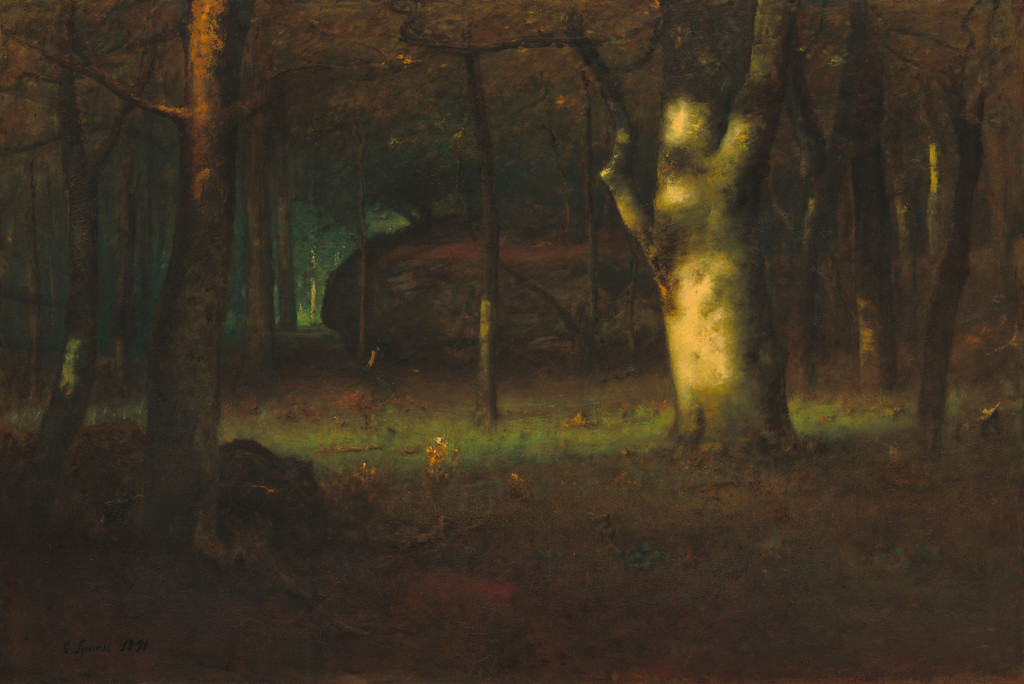
| Sunset in the Woods by George Inness | 1891 | oil on canvas |
| The Home of the Heron — Princeton University Art Museum (y1943-93) | 1891 | Oil on canvas |
| Threatening | 1891 | Oil on canvas |
| Early Morning, Tarpon Springs | 1892 | Oil on canvas |
| Home at Montclair by George Inness | 1892 | oil on canvas |
| The Lonely Farm, Nantucket | 1892 | Oil on canvas |
| Afterglow | 1893 | Oil on canvas |
| Sunlit Valley | 1893 | Oil on canvas |
| The Home of the Heron — Art Institute of Chicago (1911.31) | 1893 | Oil on canvas |
| After a Summer Shower | 1894 | Oil on canvas |
| Landscape | n.d. | Watercolor with scraping on ivory wove paper |
Frequently Asked Questions
Mia identifies Samuel Crump’s printing company, including its tower and chimney.[1]
No. This circa 1888 Montclair canvas is in Minneapolis, accession 2000.236. The Mill Pond is a separate Chicago painting.
The reviewed evidence supplies no object-specific declaration by Inness. Mia contrasts a possible modern critical reading with contemporary approval of the plant.[1]
An arm is raised, but the reproduction does not securely establish the activity or the person’s identity.
Discussion
Look again at the images and ideas explored in The Mill Stream, Montclair, New Jersey by George Inness. These editorial prompts invite your observations.
Begin once with the stream and once with the factory tower. Does the picture feel different? Consider how the trees, reflected light and foreground figure connect those two subjects.
Reader Insights
How do the thin trunks partly screen the printing plant?
What changes when this industrial landscape is compared with the railway valley?
What does the small raised arm contribute to the scene?
Join the Conversation
Share a detail, comparison or question about The Mill Stream, Montclair, New Jersey by George Inness below.
References
- Minneapolis Institute of Art, The Mill Stream, Montclair, New Jersey, accession 2000.236. Current museum record, alternative title, credit and attributed industrial interpretation.
- Adrienne Baxter Bell, “George Inness (1825–1894),” Metropolitan Museum of Art (2012).
- National Gallery of Art, The Lackawanna Valley, accession 1945.4.1.
- Smithsonian American Art Museum, Niagara, accession 1909.7.31.
- Clark Art Institute, Home at Montclair, accession 1955.10.
- Splash image source.
George Inness, The Mill Stream, Montclair, New Jersey, c. 1888. Oil on canvas. Minneapolis Institute of Art, 2000.236. Gift of Don and Diana Lee Lucker; Minneapolis Institute of Art. Image source. Public domain.