 by Tom Gurney
Tom Gurney BSc (Hons) is an art history expert with over 20 years experience
Email: tomgurney1@gmail.com / Phone: +44 7429 011000
The New Jerusalem and Its Surviving Fragments: Introduction
George Inness’s The New Jerusalem survives through three canvases that long appeared to be independent landscapes. The original religious painting was damaged in the 1880 Madison Square Garden accident; the surviving pieces were subsequently repaired and reworked. In the early 2000s, scholar Michael Quick proposed a connection between them, and Walters conservator Eric Gordon investigated it through physical evidence. The resulting identification changed how the paintings could be understood: their present images belong both to a shared earlier work and to later acts of transformation.[1]
At a Glance
- ArtistGeorge Inness (1825–1894)
- Original workThe New Jerusalem, part of The Triumph of the Cross
- Commission1866; series completed in 1867
- MediumOil on canvas
- Later historyDamage in 1880, followed by division and reworking
- Surviving objectsThe Valley of the Olives, Walters 37.112; Visionary Landscape, Walters 37.2775; Evening Landscape, Krannert 1957-18-1
- IdentificationQuick’s hypothesis, tested through Gordon’s investigation
This work across George Inness’s career
The New Jerusalem and Its Surviving Fragments (current article)
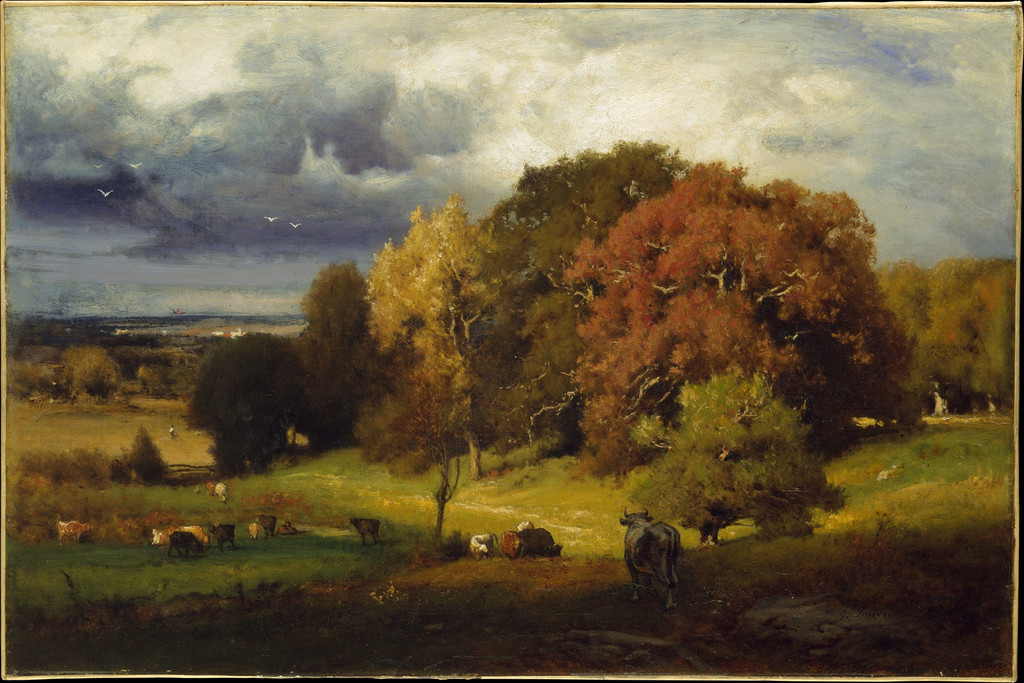
Original completed 1867; fragments reworked after the 1880 accidentAutumn Oaks by George Inness
ca. 1878Contents
- One religious painting and three present objects
- The Triumph of the Cross commission
- Damage in 1880 and a second life for the canvas
- Quick’s hypothesis and Gordon’s investigation
- The Valley of the Olives
- Visionary Landscape
- Evening Landscape at Krannert
- What the technical image can show
- Exhibitions and the limits of reconstruction
- Annotated details
One religious painting and three present objects
The distinction between the original painting and its surviving fragments is essential. The New Jerusalem is the earlier work to which the pieces have been connected. The Valley of the Olives, Visionary Landscape and Evening Landscape are the titles and identities under which the surviving objects are now held. Treating those names as interchangeable would obscure both the original composition and the later life of each canvas.
The Walters identifies The Valley of the Olives as the largest surviving fragment. It also owns Visionary Landscape. Krannert Art Museum holds Evening Landscape. Their present institutional records preserve separate accessions, credits and dimensions, even though the connection between their physical supports has altered their historical meaning.[2][3][4]
This is not a case in which an artist’s attribution has been rejected. The question concerns the relationship among objects recognised as Inness paintings. Their apparent independence concealed an earlier connection, so the research needed to test whether separate-looking landscapes could have originated within one larger canvas.
The difference also affects viewing. Each fragment can be encountered as a landscape with its own balance of sky, ground and architecture. Once its history is known, its edges acquire another significance: they belong to an object altered after damage, rather than necessarily to the original limits of the 1867 composition.
Annotated Details from The New Jerusalem and Its Surviving Fragments
The numbered points identify visible features discussed in this article. Return from each detail to the whole composition. The captions keep each work’s identity, date and medium separate.
The Valley of the Olives
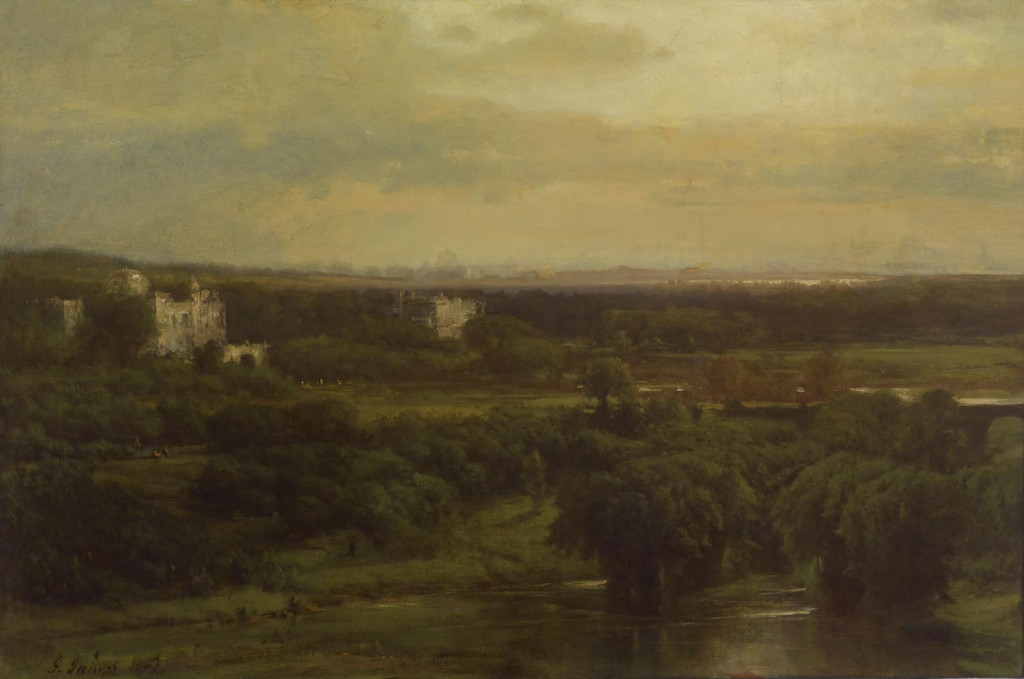
George Inness, The Valley of the Olives, original work 1867, reworked following the 1880 accident. Oil on canvas, 76.3 × 114.5 cm. Walters Art Museum, 37.112. Acquired by Henry Walters, 1895; bequest, 1931; The Walters Art Museum. Image source. CC0 / Public domain.
Visionary Landscape
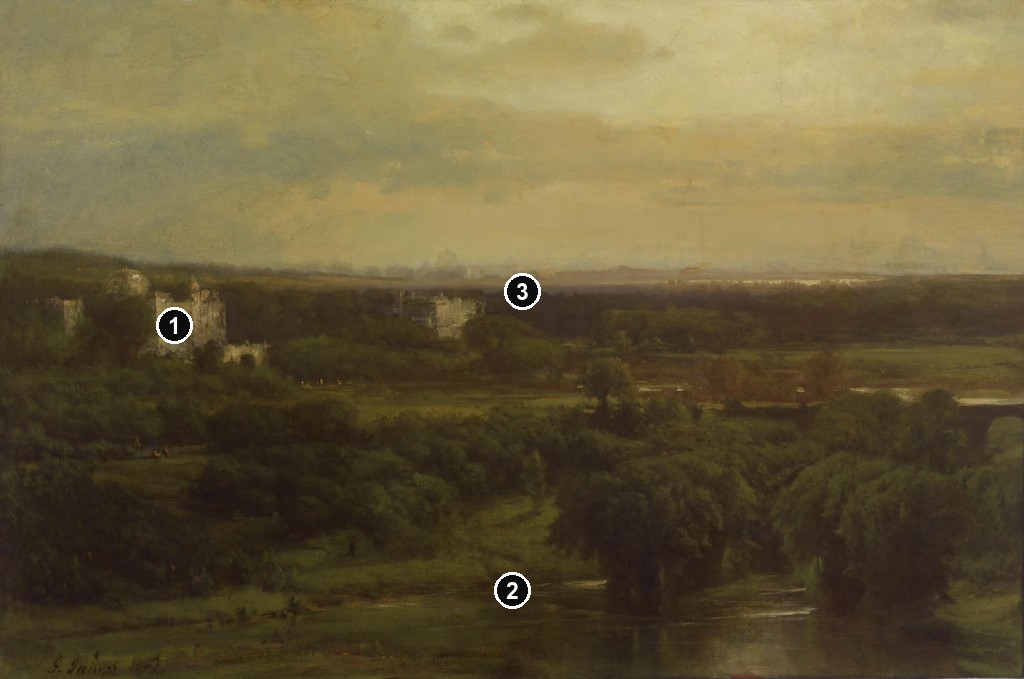
George Inness, Visionary Landscape, 1867/1880. Oil on canvas. Walters Art Museum, 37.2775. Gift of Mr. and Mrs. James M. Myers, 2005; The Walters Art Museum. Image source. CC0 / Public domain.
Evening Landscape (Krannert)
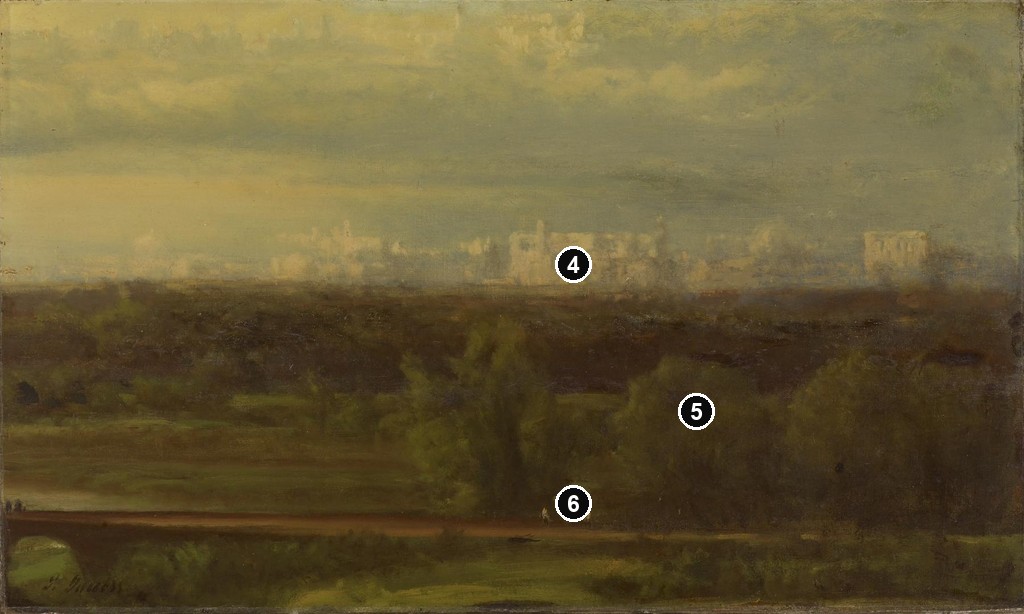
George Inness, Evening Landscape, 1867. Oil on canvas, 36.83 × 66.04 cm. Krannert Art Museum, 1957-18-1. Gift of Mr. and Mrs. Herman E. Cooper; Courtesy Krannert Art Museum, University of Illinois Urbana-Champaign. Image source. Public domain.
.jpg)
Details from THE NEW JERUSALEM AND ITS SURVIVING FRAGMENTS
Compare the cropped details with the complete images above. Notice how their colours, shapes and positions contribute to the larger compositions.
The Valley of the Olives
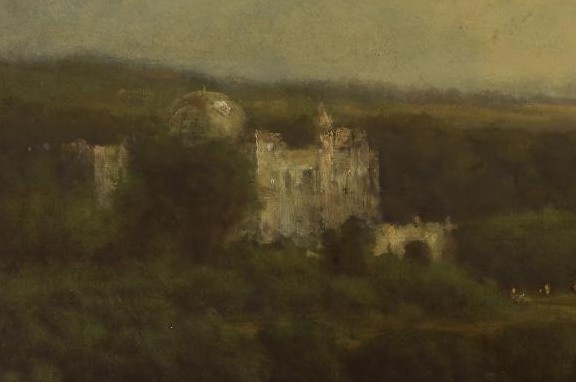
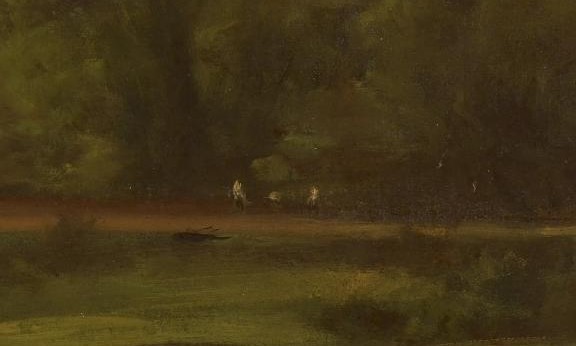
Left-hand buildings
Pale buildings emerge from the dark left vegetation. Their placement differs from the much more extended distant architecture.
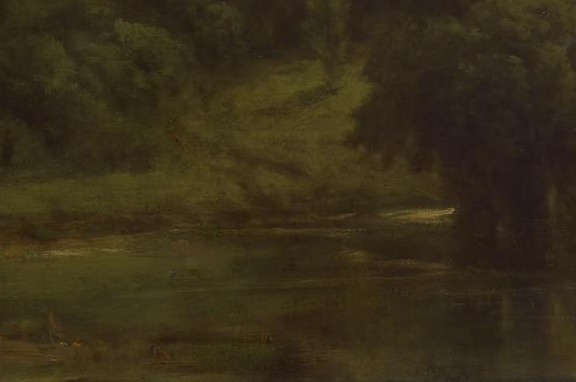
Near water and trees
Trees and reflective water organise the lower landscape. They provide a nearer scale within this reworked survivor.
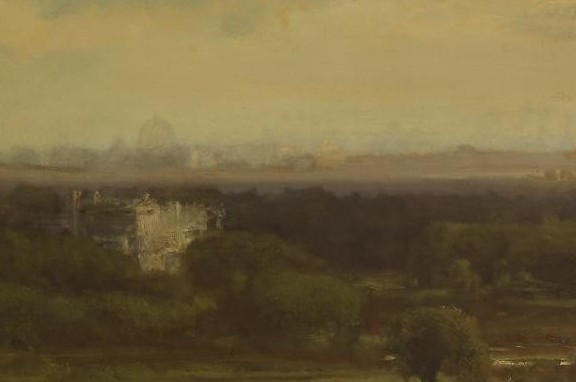
Distant architectural band
Small pale structures extend along the far horizon. The present forms should be read beside the documented history of division and reworking.
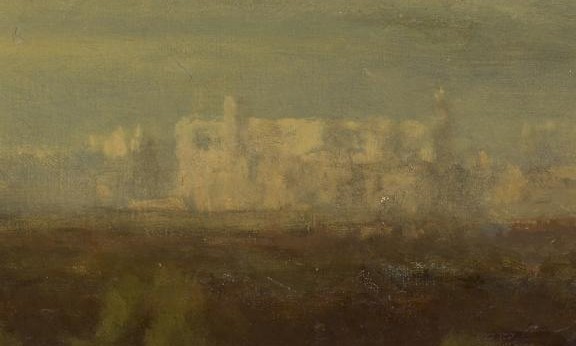
Visionary Landscape
Distant walls
Pale walls and towers occupy a narrow distant band. Their compressed shapes differ from the broader fields and trees below.
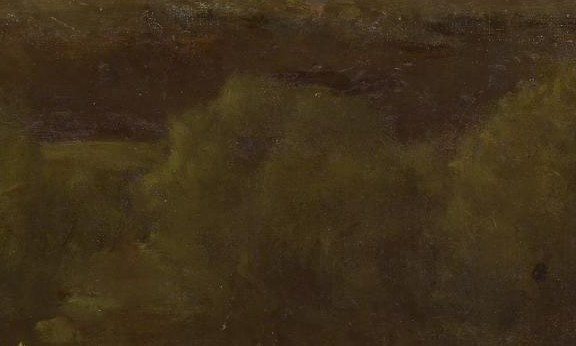
Enclosing trees
Dark trees gather in front of the distant architecture. Their mass partly interrupts the view across the landscape.
Small foreground figures
Small figures appear along the lower landscape. Keep these present visible forms distinct from attempts to reconstruct the whole lost painting.
Evening Landscape (Krannert)
Near pair of figures
A pair of small figures stands in the lower landscape. Their upright forms punctuate the broad surrounding colour.
 Detail 07 near-pair-of-figures.jpg)
Upper figures
Other small figures occupy the upper part of this surviving fragment. Their position must be considered within its present cropped and reworked extent.
 Detail 08 upper-figures.jpg)
Lighted distant ground
Light spreads across a more open passage at the right. Compare the broad colour with the darker vegetation below.
 Detail 09 lighted-distant-ground.jpg)
The Triumph of the Cross commission
The Walters’ discovery account dates the three-part commission to 1866 and relates it to John Bunyan’s The Pilgrim’s Progress and Emanuel Swedenborg’s religious ideas. Bell’s specialist chronology identifies the paintings as completed in 1867. The series used a pilgrim’s journey to give landscape an explicitly spiritual narrative.[1][5]
Here, religious significance is documented for a commissioned sequence. That is a different evidential situation from interpreting a small bird or hazy tree in a later landscape. The subject was organised around a journey and transformation, rather than left to be inferred solely from the general atmosphere of a single image.
The name New Jerusalem also belongs to that context. In the Walters’ account, it is connected with Swedenborg’s understanding of spiritual renewal and a less dogmatic church. The landscape’s historical subject therefore concerns more than a city glimpsed in the distance. Its place within the series shaped the meaning the original work was asked to carry.[1]
Bell places this commission alongside Inness’s religious writing and his baptism into the New Church in 1868. The chronology makes the series part of a sustained engagement, rather than a spiritual interpretation imposed only after his death. It still does not give a complete account of every original figure, colour or architectural detail.[5]
Damage in 1880 and a second life for the canvas
The original painting was lent to an exhibition at Madison Square Garden and suffered severe damage when part of the building collapsed in 1880. The Walters’ current records explain that Inness appears to have divided the damaged canvas into smaller pieces, repairing and repainting them while removing religious references. The article therefore concerns transformed survivors, rather than untouched sections cut from a pristine picture.[2][3]
The transformation creates two related questions. What survives from the earlier work, and what belongs to the reworked landscapes? A date of 1867 can identify original painting activity without implying that every visible passage retains its first appearance. The Walters’ compound dating of Visionary Landscape as 1867/1880 makes that later episode particularly visible in its current identity.[3]
The change in titles reinforces the point. A fragment can be renamed around the landscape it now presents, making the former narrative less apparent. The new name may describe what a viewer can see while concealing the object’s earlier role. Its usefulness as a title does not make it a complete history of the canvas.
For this reason, an apparently coherent present composition cannot establish that it was always independent. Repair and reworking can make new pictorial relationships at new edges. The surviving landscapes need to be viewed both as images in their current form and as material objects carrying evidence of an earlier whole.
Quick’s hypothesis and Gordon’s investigation
The Walters’ 2004 account describes Quick developing the fragment hypothesis in 2002 during research for his catalogue raisonné. He connected the museum’s painting with the Krannert canvas and another work seen in a 1992 Sotheby’s catalogue. The proposal brought dispersed images into a shared historical question before physical comparison tested it.[1]
A resemblance in subject would not have been enough. Many paintings can contain trees, a distant city or evening light. Gordon’s investigation compared the objects themselves, including canvas weave and pigment composition. The Walters reported matching evidence across the three, alongside a study of their complex layers of colour.[1]
These kinds of evidence answer different questions from a visual resemblance. A city motif may suggest a connection; a matching support helps test a material relationship. Pigment and layer findings add another level. Their significance lies in the combination, rather than in treating any one broadly shared feature as automatic proof.
The account consulted here is the museum’s complete discovery release and current collection records. The full conservation postprint was unavailable, so this article does not reconstruct its entire method or claim to have examined all its figures. The museum’s reported findings support the connection; more detailed scientific arguments require the corresponding complete technical publication.
The Valley of the Olives
The largest surviving fragment presents warm clouded sky above a distant city, green slopes and foreground water. Pale domed and vertical architectural forms occupy the left middle distance, while a bridge-like span enters from the right. The scene has enough internal organisation to be read as a landscape even before its fragment history is known.
The water creates a lower area of light, connecting nearer ground with the more distant architecture. Trees interrupt that passage and give the view a succession of spaces. The city is neither so close that every building becomes equally legible nor so distant that its presence disappears. Architecture remains a substantial part of the scene.
Knowing the fragment history changes the significance of these relationships. A viewer can ask which visible intervals once continued beyond the present canvas and how subsequent reworking made the surviving area coherent. The image alone does not answer those questions completely. Its current edges should not be used to invent the exact boundaries of the lost whole.
The Walters records the canvas as 76.3 × 114.5 cm, accession 37.112. Henry Walters bought it in 1895 through W. M. Laffan following the Richard H. Halsted sale, and it passed to the museum through the 1931 bequest. That collection route belongs to this fragment, rather than to all three survivors.[2]
Watch: George Inness
Choose a film to explore the artist’s work, its interpretation and its wider setting.
The Montclair Art Museum's George Inness Gallery
Visit the George Inness Gallery at the Montclair Art Museum in this State of the Arts feature.
Watch on YouTubeVisionary Landscape
Visionary Landscape places a pale distant city above darker green slopes. A reddish horizontal crossing occupies the lower part of the scene, with small light accents near its centre. A large domed form helps make the city recognisable within the softer surrounding architecture.
The arrangement differs from The Valley of the Olives. The crossing gives the nearer scene a more emphatic horizontal movement, while the distant city occupies a comparatively concentrated focus. Looking at the two as present pictures preserves those differences before considering their relationship to an earlier composition.
The current Walters accession is 37.2775. Its provenance records the December 1992 Sotheby’s sale and the later ownership of Mr. and Mrs. James M. Myers, who gave it to the museum in 2005. The 2004 discovery announcement described it as privately owned; that statement belongs to the time of the announcement and should not be repeated as its current location.[3][1]
The object’s compound date is useful alongside that ownership history. It acknowledges original work and later reworking without assigning every visible form to one episode. The current landscape remains evidence of several moments in the object’s life, even where the surface looks continuous to a viewer.
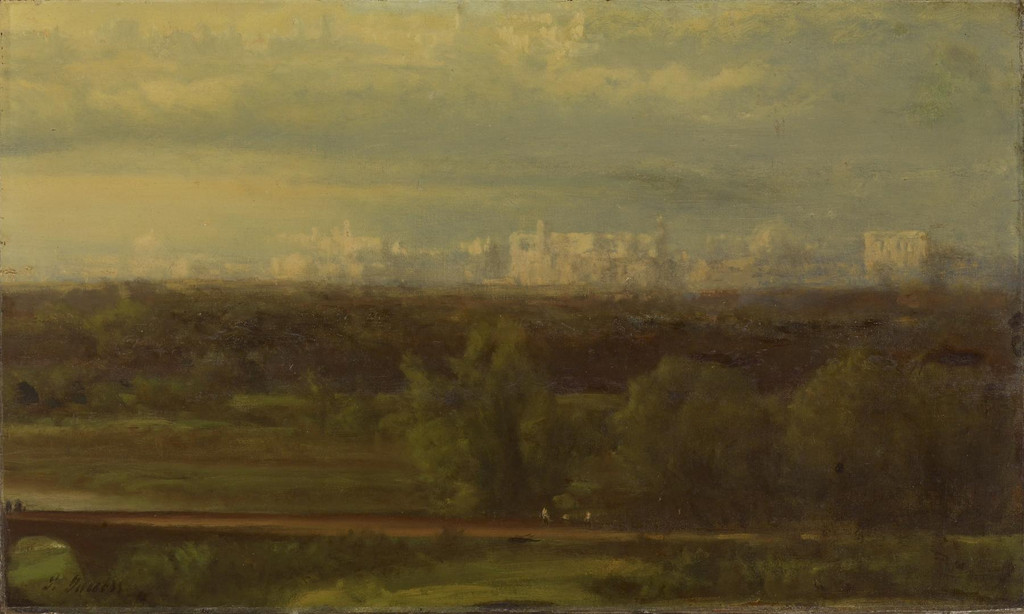
George Inness, Visionary Landscape, 1867/1880. Oil on canvas. Walters Art Museum, 37.2775. Gift of Mr. and Mrs. James M. Myers, 2005; The Walters Art Museum. Image source. CC0 / Public domain.
Evening Landscape at Krannert
Krannert’s Evening Landscape is dominated by a broad green slope and a substantial tree group at the left. Several small warm-coloured figures or accents occupy the ground, while only a narrow darker band appears across the upper edge. Compared with the Walters fragments, the present view gives ground a more extensive role.
The figures make the slope feel inhabited without providing a complete narrative. Their small scale and spacing contribute to the landscape’s depth. The tree group offers a larger near form, so the view can be followed through differences in scale even though much of the composition consists of open ground.
The museum identifies the oil as 1867, accession 1957-18-1, a gift of Mr. and Mrs. Herman E. Cooper. The canvas measures 36.83 × 66.04 cm. These are the work’s dimensions, rather than the larger frame measurements also displayed in the collection record.[4]
The supplied photograph has a different overall colour appearance from the Walters photographs. That difference cannot independently establish how the fragment once matched its neighbours. Lighting, capture and presentation affect reproductions, while the objects themselves have complicated histories. A comparison should preserve those photographic differences rather than manufacture a uniform colour scheme.
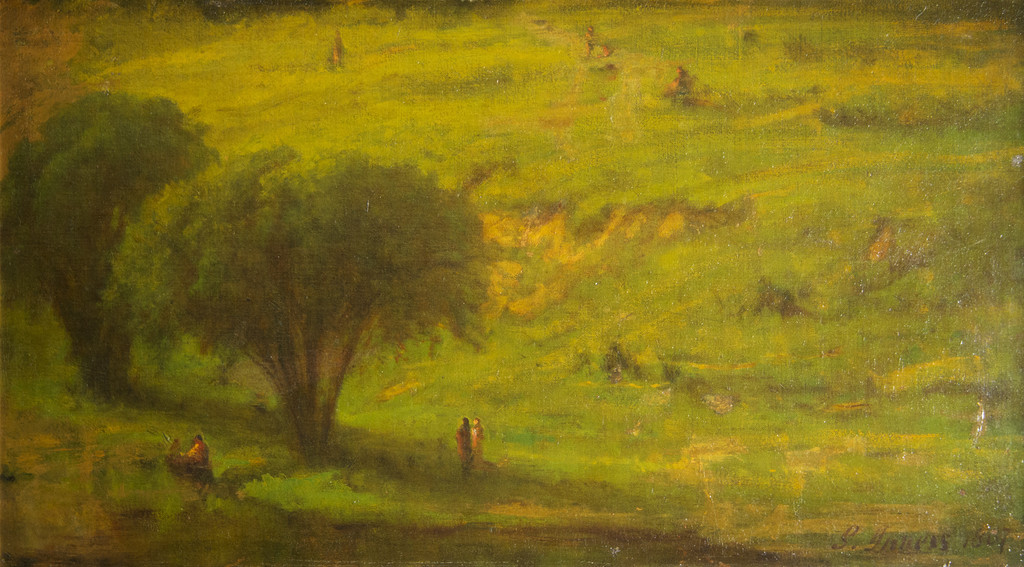
George Inness, Evening Landscape, 1867. Oil on canvas, 36.83 × 66.04 cm. Krannert Art Museum, 1957-18-1. Gift of Mr. and Mrs. Herman E. Cooper; Courtesy Krannert Art Museum, University of Illinois Urbana-Champaign. Image source. Public domain.
What the technical image can show
The Walters supplies a file identified as a 2003 X-ray associated with The Valley of the Olives. It is a vertical monochrome technical view, visibly different in extent and orientation from the horizontal whole-work photograph. It can illustrate that technical records exist for the object, provided its caption identifies the exact file and its limited view.[2]
It cannot, by itself, serve as a reconstruction of The New Jerusalem. Nor should a general article assign specific hidden figures or religious motifs to dark bands and mesh-like patterns without the corresponding technical interpretation. The image records another kind of evidence; understanding it requires the examination context that gives its marks significance.
The same principle applies to the public account of restoration. The Walters described a complex layered surface and an approach intended to preserve distinctions between those layers. That reported account is useful context, but it does not turn the accompanying photograph into a step-by-step demonstration of the work or prove a universal Inness technique.[1]
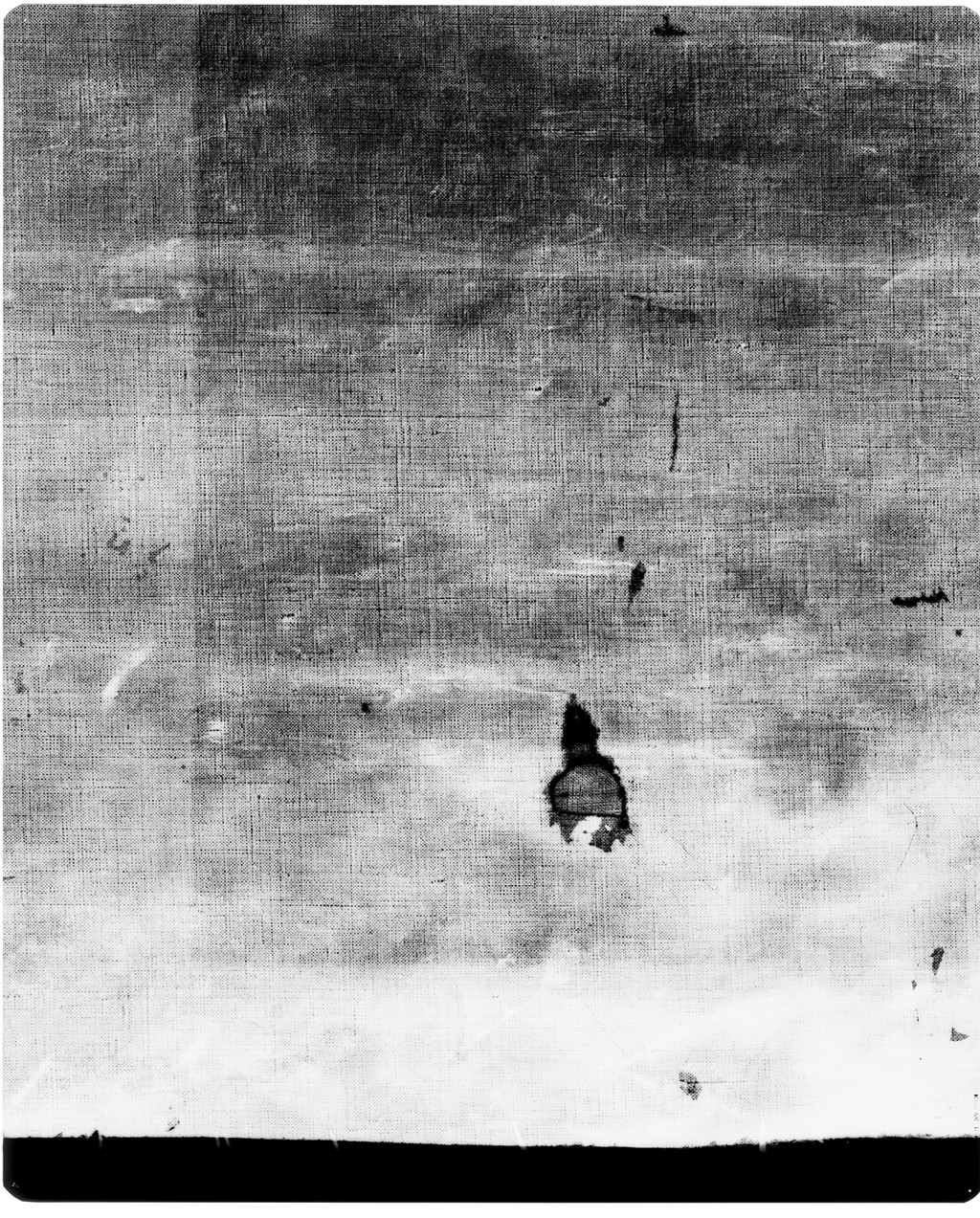
Walters Art Museum, X-ray file CON_37.112_XR_2003.jpg, associated with The Valley of the Olives, accession 37.112. Limited vertical technical view, 2003. The Walters Art Museum; exact supplied technical file released under CC0. Image source. CC0 / Public domain.
Exhibitions and the limits of reconstruction
The Walters brought the three fragments together for its 2004 presentation. Krannert later organised Jerusalem Saved! Inness and the Spiritual Landscape, shown from August 2011 to May 2012. The later exhibition placed the reconnection within a broader study of spiritual landscape and the paintings’ history.[1][6]
Bringing the objects together makes relationships available that separated photographs can only suggest. Their material dimensions, actual colours and corresponding portions can be considered in a shared setting. That is different from assuming that three digital rectangles can simply be arranged into an authoritative lost composition.
The distinction is especially important because the pieces were reworked. A physically supported connection can coexist with losses and changes. Recovering their relationship does not reverse every alteration or provide an untouched photograph of the original religious painting. Reconstruction explains what the surviving evidence permits, while leaving its limits visible.
The related Valley of the Shadow of Death
The Frances Lehman Loeb Art Center at Vassar holds The Valley of the Shadow of Death, dated 1867, accession 1917.1.6. It is a related intact work from The Triumph of the Cross, rather than one of the three fragments discussed above. Its identity helps keep the original three-part series distinct from the three pieces of a single damaged painting.[7][5]
That numerical distinction is easy to lose. Three commissioned paintings do not mean that each surviving fragment represents one complete member of the series. The New Jerusalem fragments all concern a shared original object. The intact Vassar painting supplies a different kind of evidence for the religious sequence.
Together, the records show how art history can change when scholarship and material examination are brought into relation. A hypothesis about dispersed landscapes became a tested account of their common origin. The surviving pictures retain their own titles and current compositions, while the earlier New Jerusalem becomes available for a more informed, carefully limited understanding.
Artworks directory
A collected selection of 46 individually identified museum objects: 43 paintings and three watercolours. This is not a complete catalogue raisonné. Repeated titles identify separate objects where their institutions or accessions differ. Links lead to a companion article where available, otherwise to the museum record. Unillustrated entries remain included; the original lost New Jerusalem is represented by its three transformed survivors.
| Name | Date | Medium |
|---|---|---|
| Crossing the Ford | 1848 | Oil on canvas |
| The Old Mill | 1849 | Oil on canvas |
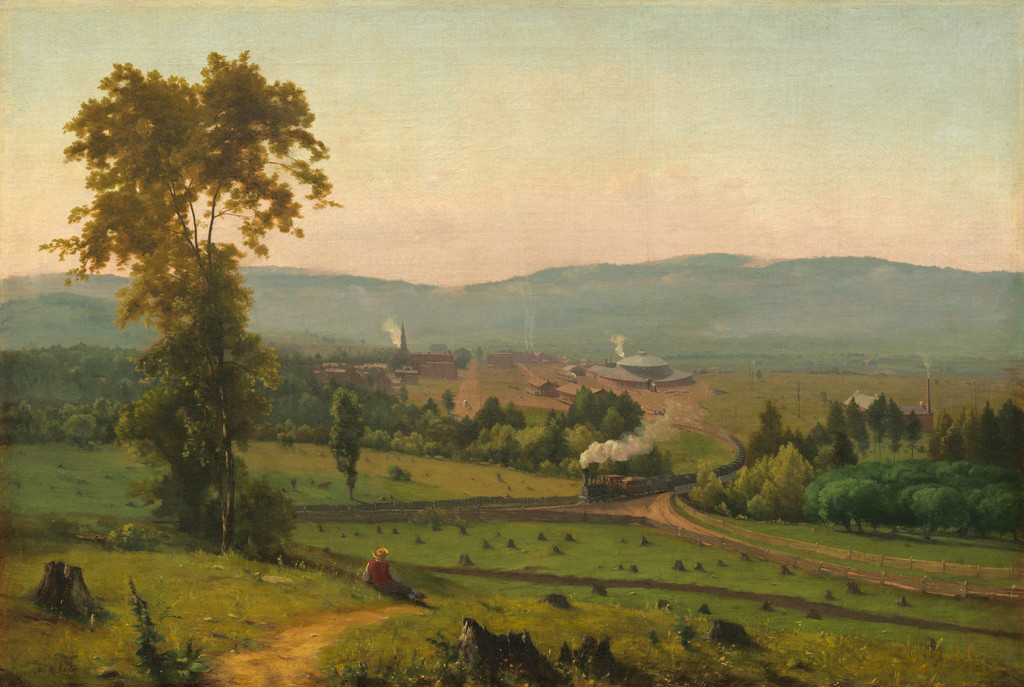
| The Lackawanna Valley by George Inness | c. 1856 | oil on canvas |
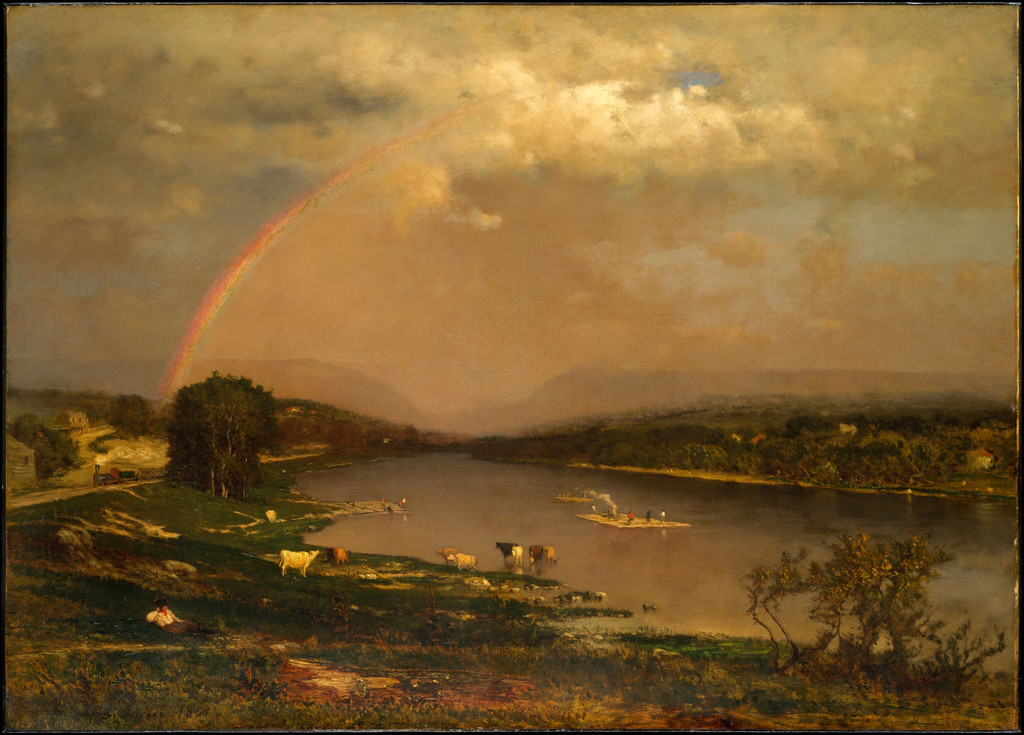
| Delaware Water Gap | 1861 | Oil on canvas |
| Delaware Valley | c. 1865–75 | Oil on artist's board |
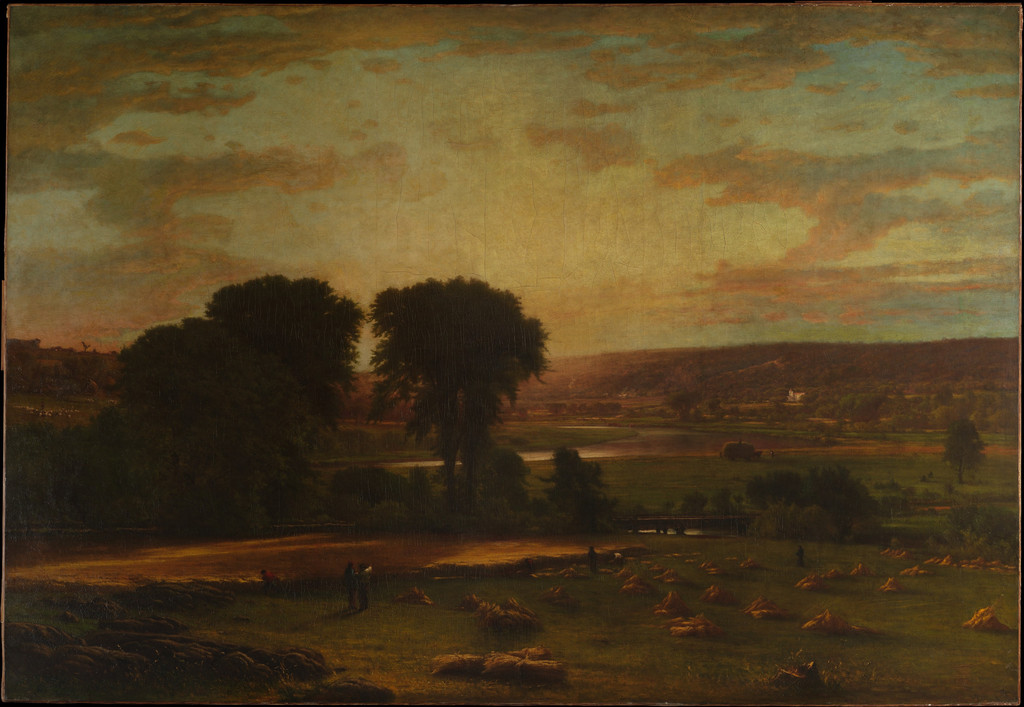
| Peace and Plenty | 1865 | Oil on canvas |
| Evening Landscape | 1867; later reworked | Oil on canvas |
| Summer in the Catskills | 1867 | Oil on canvas |
| The Valley of the Olives | 1867; reworked after 1880 | Oil on canvas |
| The Valley of the Shadow of Death | 1867 | Oil on canvas |
| Visionary Landscape | 1867/1880 | Oil on canvas |
| Catskill Mountains | 1870 | Oil on canvas |
| Across the Campagna | 1872 | Watercolor, gouache, and graphite on off-white wove paper |
| Olive Trees at Tivoli | 1873 | Gouache, watercolor, and graphite on blue wove paper with colored fibers |
| A Marine | c. 1874–75 | Oil on canvas |
| Twilight in Italy — Art Institute of Chicago (1911.44) | 1874 | Oil on panel |
| Pine Grove of the Barberini Villa | 1876 | Oil on canvas |
| The Storm | 1876 | Oil on canvas |
| Autumn Oaks | ca. 1878 | Oil on canvas |
| The Sisters | 1882 | Oil on millboard |
| Harvest, Montclair, New Jersey | 1884 | Oil on canvas |
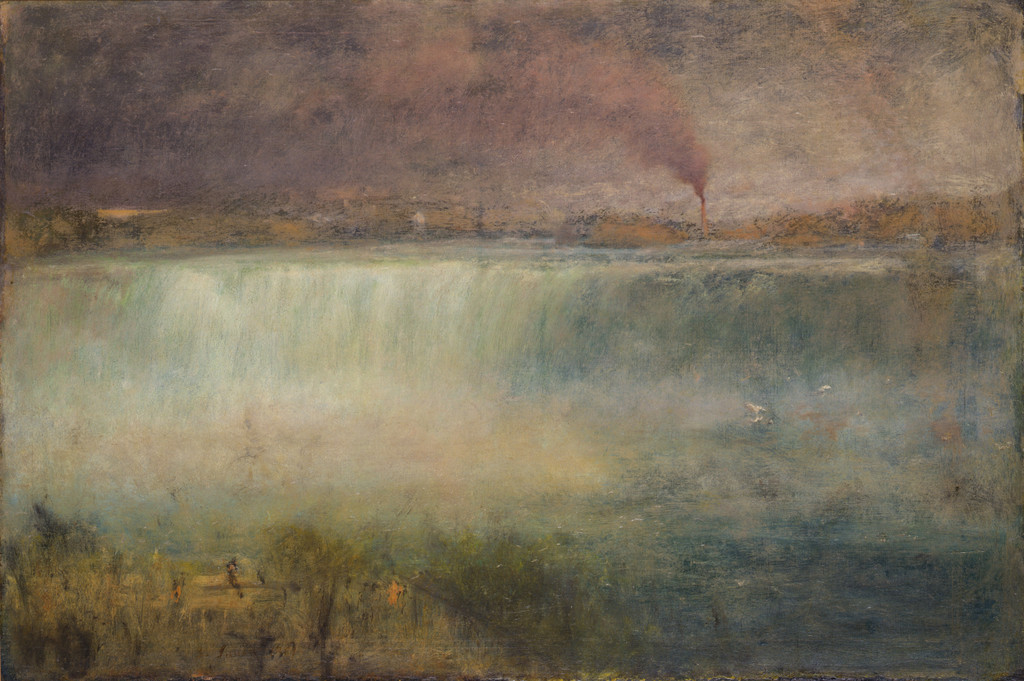
| Niagara Falls | 1885 | Oil on wood |
| A Silver Morning | 1886 | Oil on canvas |
| Landscape, Sunset | 1887–89 | Oil on canvas |
| September Afternoon | 1887 | Oil on canvas |
| Sunrise | 1887 | Oil on canvas |
| The Mill Stream, Montclair, New Jersey by George Inness | c. 1888 | Oil on canvas |
| Niagara by George Inness | 1889 | oil on canvas |
| The Mill Pond | 1889 | Oil on canvas |
| Sunset in the Valley | 1890 | Oil on canvas |
| The Moon at Night | 1890 | Oil on canvas |
| Twilight in Italy — Art Institute of Chicago (1911.42) | 1890 | Oil on canvas |
| Autumn Woods | 1891–94 | Oil on canvas |
| Moonrise | 1891 | Oil on canvas |
| Spring Blossoms, Montclair, New Jersey | ca. 1891 | Oil and crayon or charcoal on canvas |
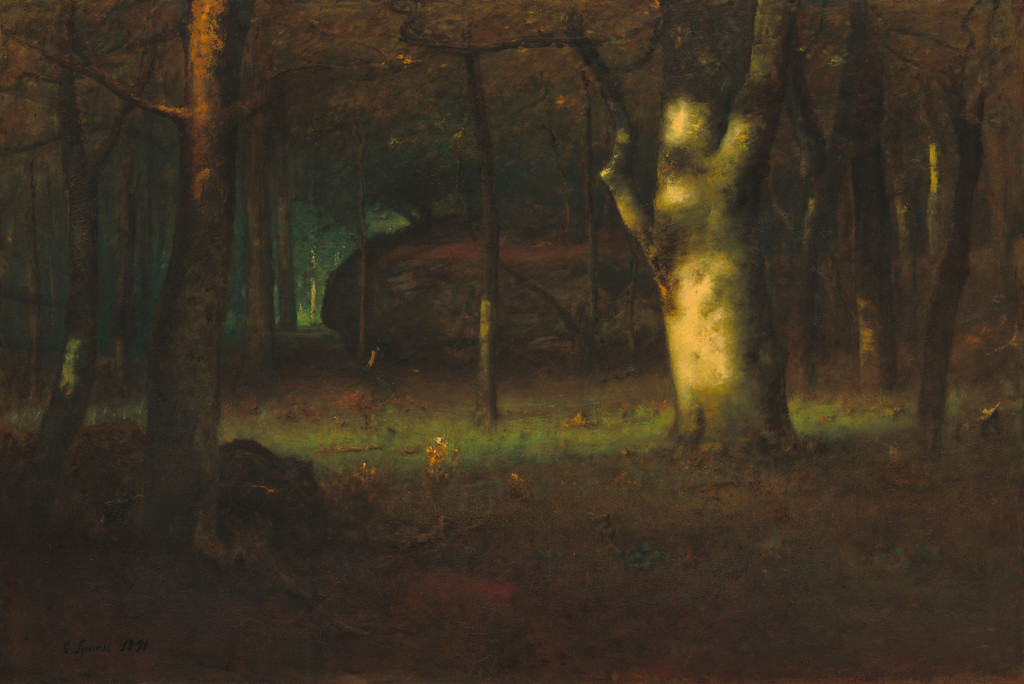
| Sunset in the Woods by George Inness | 1891 | oil on canvas |
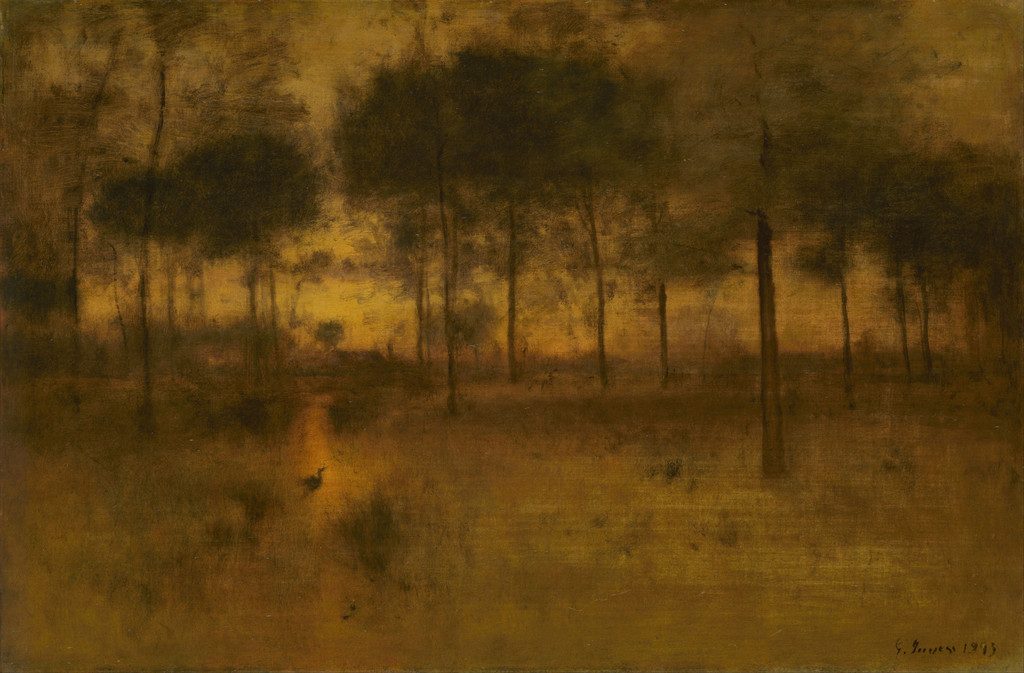
| The Home of the Heron — Princeton University Art Museum (y1943-93) | 1891 | Oil on canvas |
| Threatening | 1891 | Oil on canvas |
| Early Morning, Tarpon Springs | 1892 | Oil on canvas |
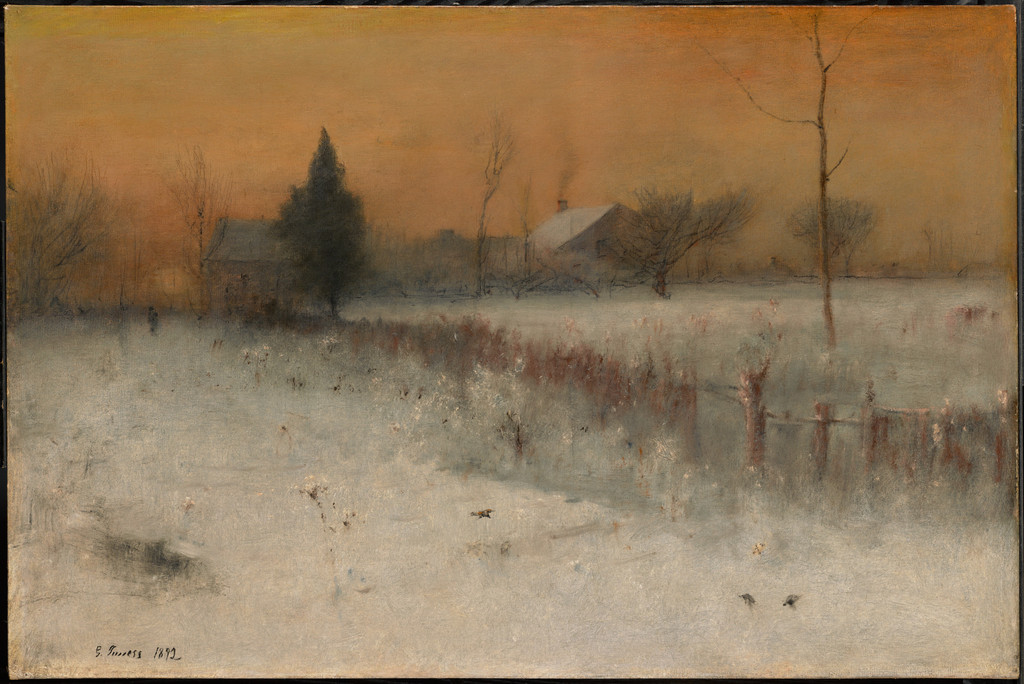
| Home at Montclair by George Inness | 1892 | oil on canvas |
| The Lonely Farm, Nantucket | 1892 | Oil on canvas |
| Afterglow | 1893 | Oil on canvas |
| Sunlit Valley | 1893 | Oil on canvas |
| The Home of the Heron — Art Institute of Chicago (1911.31) | 1893 | Oil on canvas |
| After a Summer Shower | 1894 | Oil on canvas |
| Landscape | n.d. | Watercolor with scraping on ivory wove paper |
Frequently Asked Questions
They come from one original painting, The New Jerusalem. The commission itself comprised three paintings.[1]
Quick proposed the relationship, and Gordon investigated physical evidence including canvas weave and pigments, as reported by the Walters.[1]
The supplied Walters file is a limited technical view associated with one fragment. It should not be presented as an image of the entire lost painting.[2]
Discussion
Look again at the images and ideas explored in The New Jerusalem and Its Surviving Fragments. These editorial prompts invite your observations.
Consider how the fragments change when their history is known. Which visible features still work as parts of independent landscapes? What kinds of evidence would be needed before arranging their photographs into a claimed reconstruction?
Reader Insights
What can be observed in each survivor before reconstructing its earlier history?
How do the three present landscapes differ in scale and arrangement?
What can the limited X-radiograph establish, and where does interpretation require more evidence?
Join the Conversation
Share a detail, comparison or question about The New Jerusalem and Its Surviving Fragments below.
References
- Walters Art Museum, discovery announcement for the New Jerusalem fragments (September 2004). Historical discovery account; its then-private ownership information is updated through current object records.
- Walters Art Museum, The Valley of the Olives, accession 37.112. Current identity, history, provenance and supplied technical-image record.
- Walters Art Museum, Visionary Landscape, accession 37.2775. Current 1867/1880 dating and 2005 gift.
- Krannert Art Museum, Evening Landscape, accession 1957-18-1. Current object record and canvas dimensions.
- Adrienne Baxter Bell, “George Inness (1825–1894),” Metropolitan Museum of Art (2012).
- Krannert Art Museum, Jerusalem Saved! Inness and the Spiritual Landscape (2011–12).
- Frances Lehman Loeb Art Center, Vassar College, The Valley of the Shadow of Death, accession 1917.1.6. Related intact canvas; its restricted museum image download is not reproduced here.
- Splash image source.
George Inness, The Valley of the Olives, original work 1867, reworked following the 1880 accident. Oil on canvas, 76.3 × 114.5 cm. Walters Art Museum, 37.112. Acquired by Henry Walters, 1895; bequest, 1931; The Walters Art Museum. Image source. CC0 / Public domain.