 by Tom Gurney
Tom Gurney BSc (Hons) is an art history expert with over 20 years experience
Email: tomgurney1@gmail.com / Phone: +44 7429 011000
The Home of the Heron by George Inness: Introduction
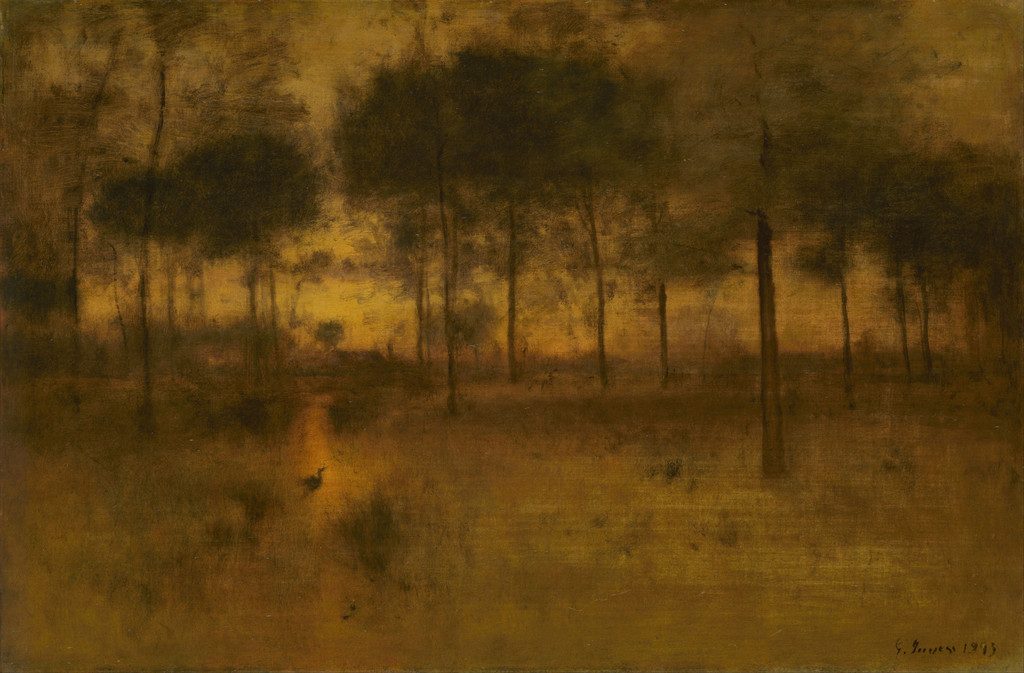
George Inness’s The Home of the Heron makes a small bird the point of recognition within a landscape that seems to dissolve into warm light. Slender trunks divide the golden-brown surroundings, while darker vegetation encloses the brighter opening. The Art Institute of Chicago dates this canvas to 1893 and holds it as part of the Edward B. Butler Collection. Its effect depends on a precise relationship: the bird remains small enough to belong to the setting, yet clear enough to give the viewer somewhere to begin.[1]
At a Glance
- ArtistGeorge Inness (1825–1894)
- TitleThe Home of the Heron
- Date1893
- MediumOil on canvas
- Dimensions76.2 × 115.2 cm
- CollectionArt Institute of Chicago
- CreditEdward B. Butler Collection
- Accession1911.31
This work across George Inness’s career
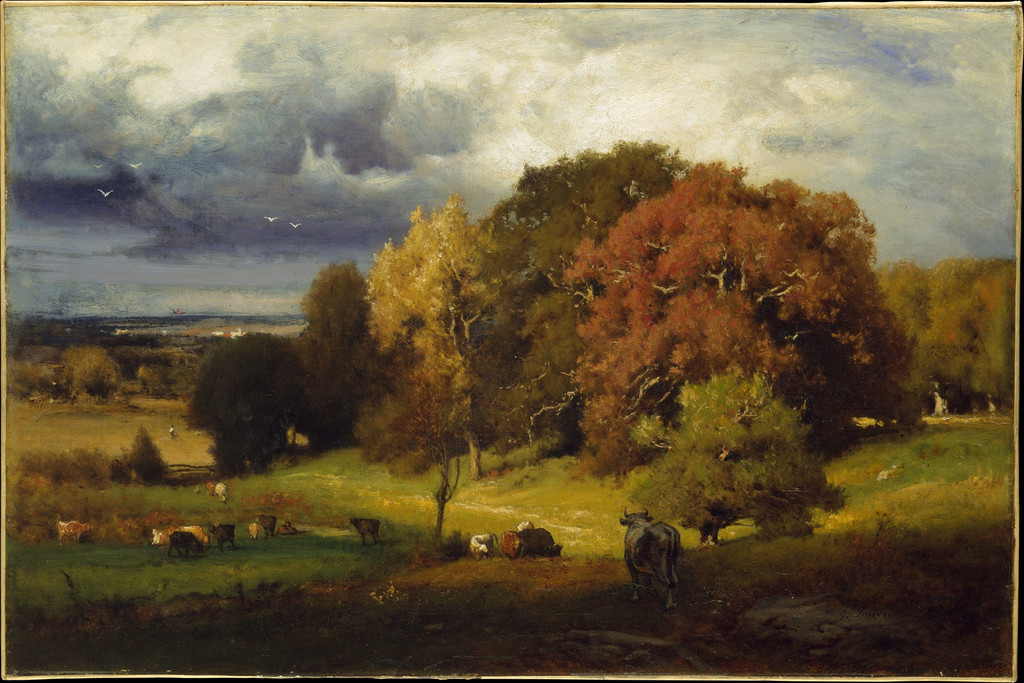
Autumn Oaks by George Inness
ca. 1878Contents
- Finding the bird
- Light emerging through the trees
- Softness as an organised effect
- Florida within the late career
- Another painting with the same title
- A changed title and the Butler gift
- Comparing Tarpon morning and a woodland interior
- Annotated details
Finding the bird
The heron stands low and left of centre, where the warm surroundings meet a darker near area. Its small scale can delay recognition. At first, the viewer may see the landscape as a succession of light and dark masses; locating the bird turns one of those marks into a living presence.
That change is important to the experience of the picture. The bird does not arrive from outside the composition to explain it. It emerges from a region already present in the viewer’s attention. Once recognised, its position helps organise the surrounding space: the nearer ground, the brighter area behind it and the more distant trees acquire a relation to an identifiable inhabitant.
The figure of the bird remains restrained. Enlarging it mentally into the painting’s main spectacle would diminish the role of its surroundings. Its interest lies partly in how little of the canvas it occupies. A modest dark form can hold attention when the nearby colours and degrees of clarity are arranged to support it.
The title encourages that search. It names the animal before many viewers can easily locate it. “Home” then directs attention back towards the setting: the landscape is considered as an inhabited place, rather than merely an attractive arrangement of light. The painting does not show an explanatory nest or supply a detailed account of the bird’s life.
Annotated Details from The Home of the Heron
The numbered points identify visible features discussed in this article. Return from each detail to the whole composition. George Inness, The Home of the Heron, 1893. Oil on canvas, 76.2 × 115.2 cm. Art Institute of Chicago, 1911.31. Edward B. Butler Collection; Art Institute of Chicago. Image source. Public domain.
.jpg)
Details from THE HOME OF THE HERON
Compare the cropped details with the complete images above. Notice how their colours, shapes and positions contribute to the larger compositions.
Small heron
The small dark bird occupies the lower landscape. Returning to it after looking through the trees makes its modest scale more apparent.
 Detail 01 small-heron.jpg)
Slender tree structure
Thin trunks pass through connected warm and cool colour. Some edges remain clear while others join the surroundings.
 Detail 02 slender-tree-structure.jpg)
Soft distant interval
A quieter grey-green interval appears beyond the nearer vegetation. Its softened relationships differ from the darker upright trunks.
 Detail 03 soft-distant-interval.jpg)
Light emerging through the trees
A pale opening lies behind the heron, with darker clustered trees rising towards the upper centre and right. This arrangement makes the near bird easier to distinguish while preserving depth behind it. The light is not confined to a small object; it seems to occupy an interval within the landscape.
Slender trunks divide that interval. Their vertical movement contrasts with the low placement of the bird and the more horizontal near ground. They can be followed individually in places, but their outlines soften as they meet surrounding colour. The landscape feels structured without every boundary having equal emphasis.
The brighter and darker areas are also unequal in shape. The opening invites the eye inward, while the denser foliage partly interrupts that movement. The viewer can sense space beyond the bird without receiving a complete, sharply bounded inventory of its contents. Recognition and uncertainty coexist within the same view.
This is one reason the supplied reproduction should retain its tonal relationships. Increasing contrast to make every tree conspicuous would change the balance between definite and less definite forms. The darker surroundings are part of the arrangement that allows the small bird and warm opening to act together.
Softness as an organised effect
The Art Institute describes the painting through blurred outlines, broad handling and subtle tonal relationships. Its account connects those features with the stillness and mystery of the solitary bird’s setting. The emphasis concerns the viewer’s experience of this work, rather than a laboratory analysis of its paint.[1]
Softness is therefore most useful as a description of relationships, not a diagnosis that the canvas was left unfinished. Some forms are more definite than others. The bird supplies a recognisable accent; the trees and vegetation establish larger intervals and masses. Their different degrees of clarity control the movement of attention.
The near dark area also gives the warmer distance something against which to be experienced. A brighter passage can feel luminous without containing the most forceful possible colour. Its effect depends partly on what surrounds it. Looking across the whole composition reveals more than isolating one attractive golden patch.
No object-specific conservation examination has been consulted for this article. The image supports a close reading of scale, colour and position. It does not independently establish named pigments, the sequence of glazing or a history of later intervention. The technique article distinguishes such visual questions from material findings documented for other works.
Florida within the late career
Adrienne Baxter Bell places Inness’s late work in relation to continued travel and winter stays at Tarpon Springs, Florida. Her specialist account connects those surroundings with his interest in tall trees and atmospheric landscapes. This provides a useful setting for considering the Chicago canvas without establishing an exact site, season or species identification from the painting alone.[2]
The Florida context should not make every detail into a botanical document. The painting’s dominant concern, as experienced through its arrangement, is the relation between a small living presence and a larger environment of light and vegetation. A viewer can attend to that relationship even where a precise geographical viewpoint remains uncertain.
Bell also discusses Inness’s Swedenborgian understanding of a relationship between natural and spiritual realms. That framework helps explain why landscape could carry significance beyond the naming of its objects. It does not justify declaring this particular heron an unequivocal symbol with one fixed meaning.[2]
The distinction preserves the painting’s openness. Its atmosphere can invite contemplation without becoming a coded message that a reader must solve. The bird remains a visible inhabitant and compositional anchor. A spiritual reading is more persuasive when it deepens attention to those features instead of replacing them with an unsupported explanation.
Watch: George Inness
Choose a film to explore the artist’s work, its interpretation and its wider setting.
The Montclair Art Museum's George Inness Gallery
Visit the George Inness Gallery at the Montclair Art Museum in this State of the Arts feature.
Watch on YouTubeAnother painting with the same title
Princeton University Art Museum holds a different The Home of the Heron, dated 1891 and identified by accession y1943-93. Its dimensions, 107 × 94 cm, distinguish it from the wider Chicago canvas. It also has its own collection history and credit. These two works should be identified separately whenever images or facts are compared.[3]
The difference in format is immediately consequential. An upright rectangle and a horizontal one give trees, openings and a small bird different spatial conditions. A shared title establishes a related subject; it does not make the compositions interchangeable or allow the earlier date to be transferred to the Chicago painting.
Exact identity matters particularly when reproductions circulate without museum information. The title alone may not distinguish them. Date, institution and accession provide a compact way to keep the object’s image and documentary record together. Here, all close looking concerns Chicago’s 1893 canvas.
A changed title and the Butler gift
The Art Institute records the painting in the artist’s estate sale of February 1895 as The Sun’s Last Reflection, catalogue number 69. The name offers a different emphasis from the current title. It draws attention to light rather than immediately telling the viewer to locate a bird.[1]
This title is documentary evidence of how the work was listed, rather than proof that one name reveals its only true subject. Both direct attention towards features visible in the painting. Comparing them helps explain how a title can change the order of looking without altering the canvas itself.
The recorded ownership route proceeds through E. W. Bass, Emerson McMillin, Knoedler and Reinhardt Galleries to Edward B. Butler in 1911. Butler gave it to the Art Institute that year. The museum’s credit preserves the final collector’s role in bringing this exact painting into its collection.[1]
The exhibition history needs similar precision. Chicago records participation in the 1985–86 Inness retrospective but explicitly notes that the painting did not go to its final condensed National Gallery stage. A touring exhibition’s overall itinerary is therefore insufficient to prove that this object appeared at every venue.[1]
Comparing Tarpon morning and a woodland interior
Chicago’s Early Morning, Tarpon Springs, dated 1892, provides a useful comparison. Its upright composition carries tall trunks above a small red-hatted figure and low buildings. The tiny human accent and the heron each establish a recognisable presence within a larger environment, while their different formats and colour arrangements create different kinds of attention.[4]
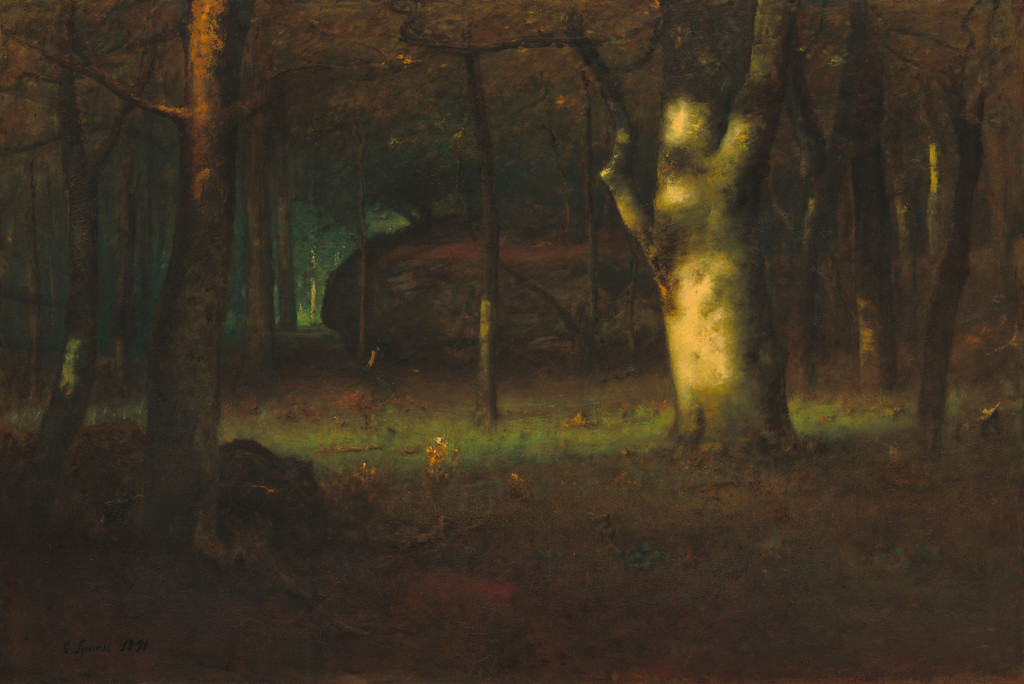
Sunset in the Woods, dated 1891, concentrates attention within denser woodland. Pale trunks and a small opening organise a darker, more enclosed scene. Its documented relation to memory and imagination belongs to a specific artist letter, which should not be transferred to The Home of the Heron as though it described this canvas too.[5][6]
Together, the works demonstrate why “late atmosphere” needs to be made more precise. Upright trunks, a winter or evening light, a small figure and a bird do not produce the same picture in each case. Format, scale and the distribution of clarity determine how the scene is encountered.
Return to the heron after making those comparisons. Its small dark shape sits within a warm opening rather than commanding the canvas through size. The surrounding trees make recognition gradual. The painting’s stillness arises from that organised relationship between a visible inhabitant and a landscape that remains partly elusive.
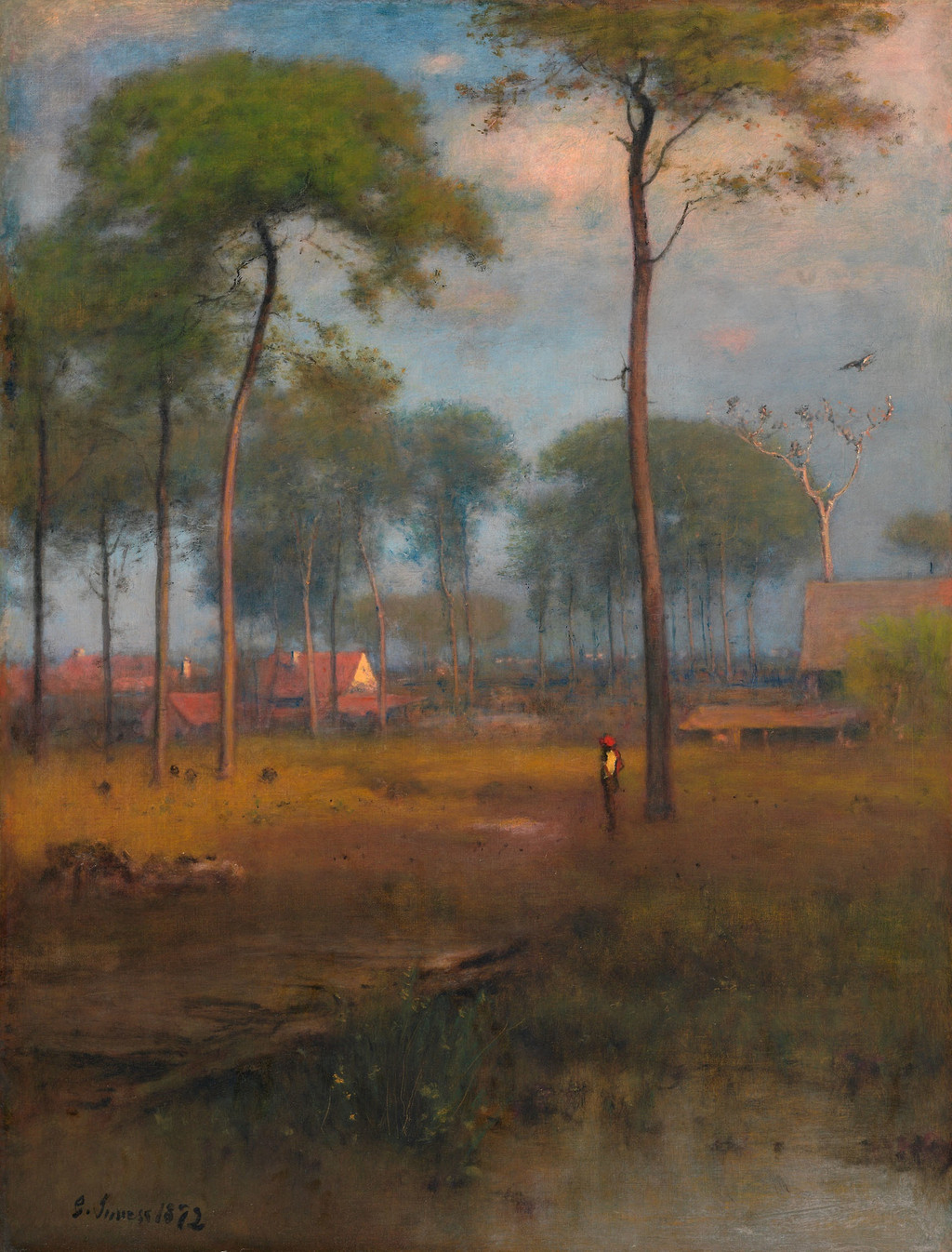
George Inness, Early Morning, Tarpon Springs, 1892. Oil on canvas. Art Institute of Chicago, 1911.32. Edward B. Butler Collection; Art Institute of Chicago. Image source. Public domain.
Artworks directory
A collected selection of 46 individually identified museum objects: 43 paintings and three watercolours. This is not a complete catalogue raisonné. Repeated titles identify separate objects where their institutions or accessions differ. Links lead to a companion article where available, otherwise to the museum record. Unillustrated entries remain included; the original lost New Jerusalem is represented by its three transformed survivors.
| Name | Date | Medium |
|---|---|---|
| Crossing the Ford | 1848 | Oil on canvas |
| The Old Mill | 1849 | Oil on canvas |
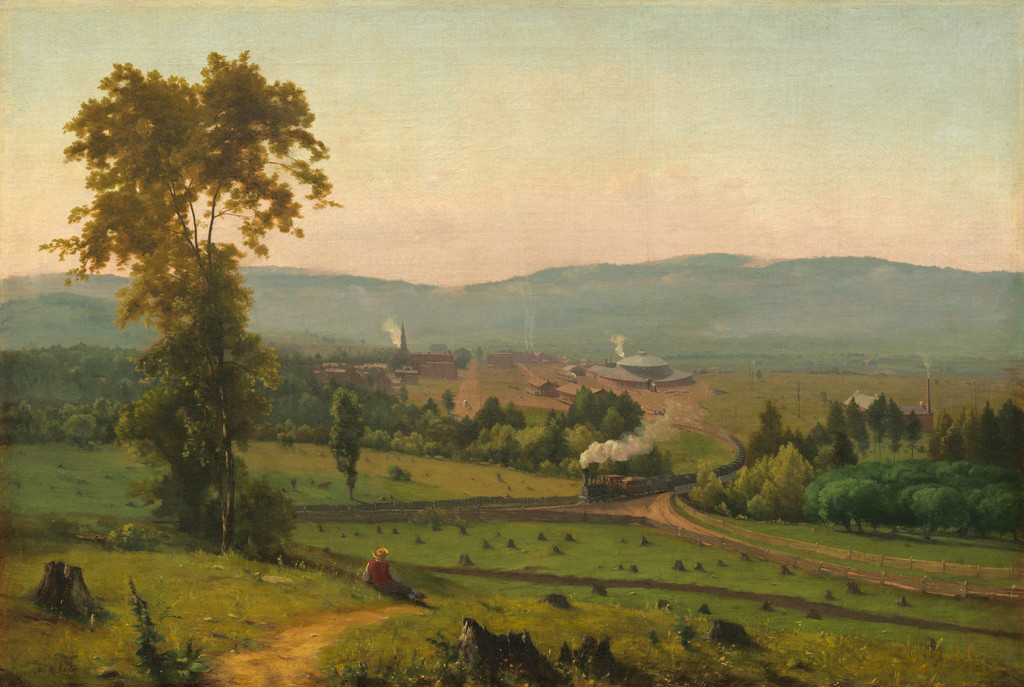
| The Lackawanna Valley by George Inness | c. 1856 | oil on canvas |
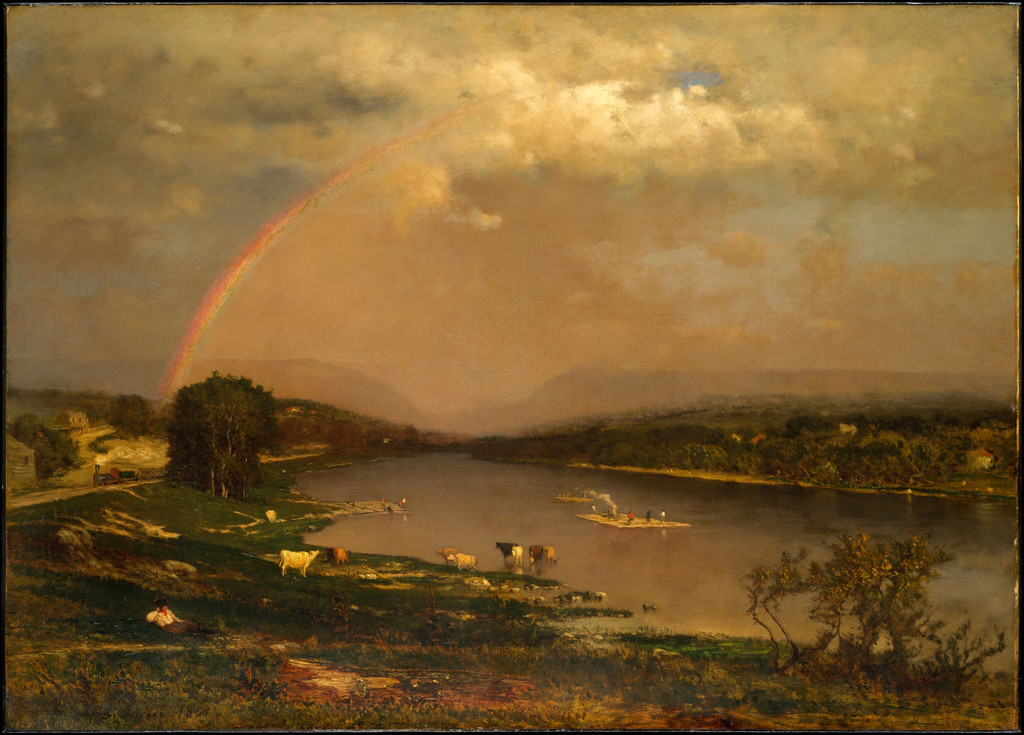
| Delaware Water Gap | 1861 | Oil on canvas |
| Delaware Valley | c. 1865–75 | Oil on artist's board |
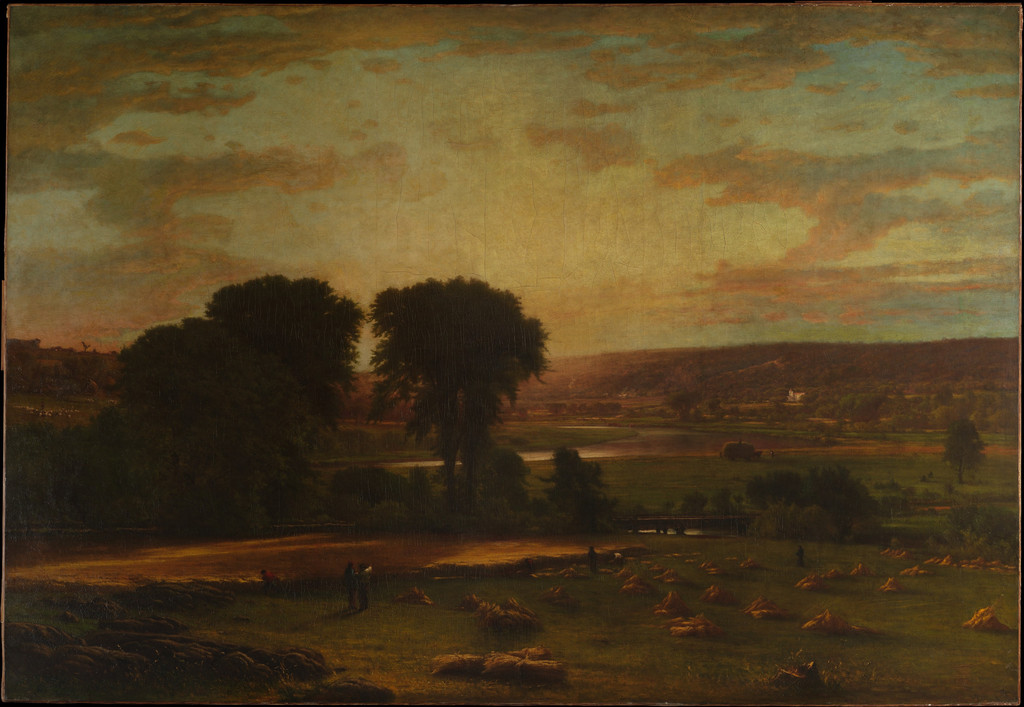
| Peace and Plenty | 1865 | Oil on canvas |
| Evening Landscape | 1867; later reworked | Oil on canvas |
| Summer in the Catskills | 1867 | Oil on canvas |
| The Valley of the Olives | 1867; reworked after 1880 | Oil on canvas |
| The Valley of the Shadow of Death | 1867 | Oil on canvas |
| Visionary Landscape | 1867/1880 | Oil on canvas |
| Catskill Mountains | 1870 | Oil on canvas |
| Across the Campagna | 1872 | Watercolor, gouache, and graphite on off-white wove paper |
| Olive Trees at Tivoli | 1873 | Gouache, watercolor, and graphite on blue wove paper with colored fibers |
| A Marine | c. 1874–75 | Oil on canvas |
| Twilight in Italy — Art Institute of Chicago (1911.44) | 1874 | Oil on panel |
| Pine Grove of the Barberini Villa | 1876 | Oil on canvas |
| The Storm | 1876 | Oil on canvas |
| Autumn Oaks | ca. 1878 | Oil on canvas |
| The Sisters | 1882 | Oil on millboard |
| Harvest, Montclair, New Jersey | 1884 | Oil on canvas |
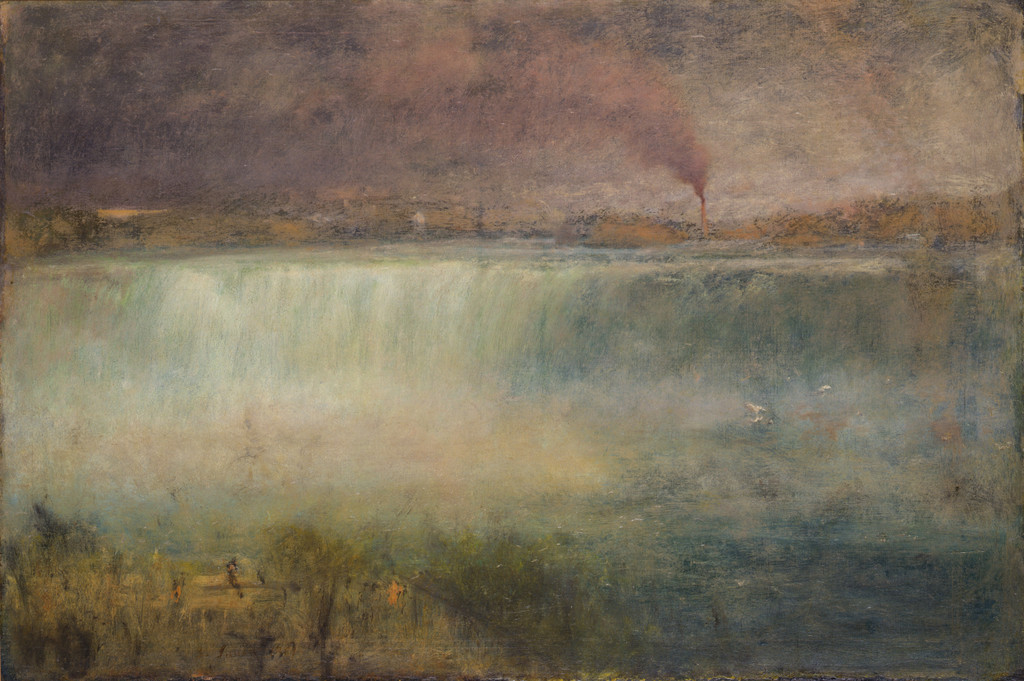
| Niagara Falls | 1885 | Oil on wood |
| A Silver Morning | 1886 | Oil on canvas |
| Landscape, Sunset | 1887–89 | Oil on canvas |
| September Afternoon | 1887 | Oil on canvas |
| Sunrise | 1887 | Oil on canvas |
| The Mill Stream, Montclair, New Jersey by George Inness | c. 1888 | Oil on canvas |
| Niagara by George Inness | 1889 | oil on canvas |
| The Mill Pond | 1889 | Oil on canvas |
| Sunset in the Valley | 1890 | Oil on canvas |
| The Moon at Night | 1890 | Oil on canvas |
| Twilight in Italy — Art Institute of Chicago (1911.42) | 1890 | Oil on canvas |
| Autumn Woods | 1891–94 | Oil on canvas |
| Moonrise | 1891 | Oil on canvas |
| Spring Blossoms, Montclair, New Jersey | ca. 1891 | Oil and crayon or charcoal on canvas |
| Sunset in the Woods by George Inness | 1891 | oil on canvas |
| The Home of the Heron — Princeton University Art Museum (y1943-93) | 1891 | Oil on canvas |
| Threatening | 1891 | Oil on canvas |
| Early Morning, Tarpon Springs | 1892 | Oil on canvas |
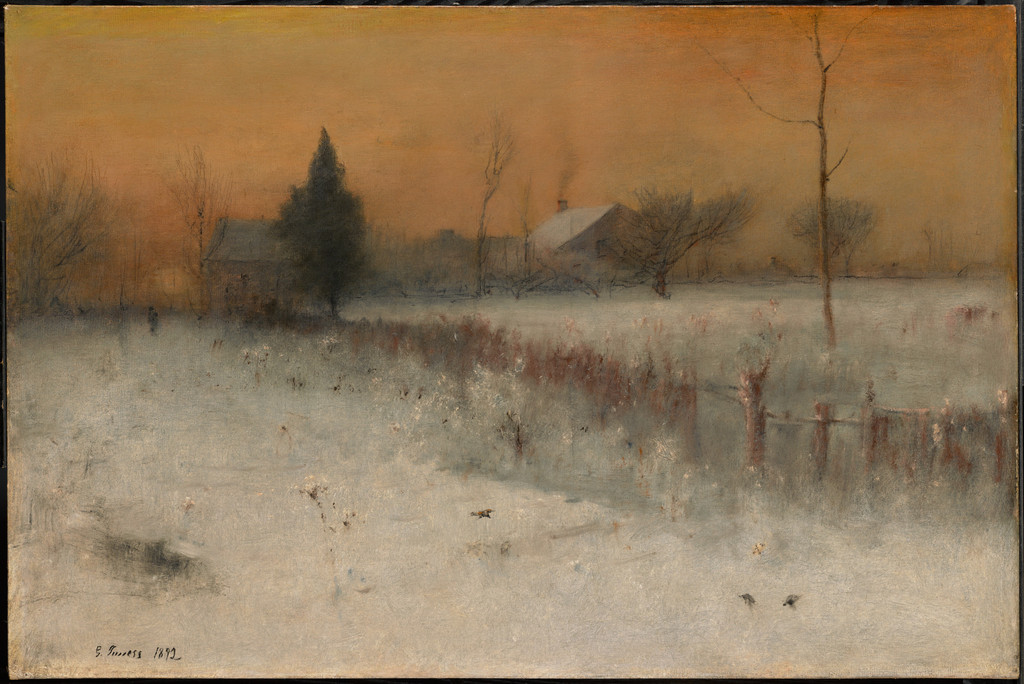
| Home at Montclair by George Inness | 1892 | oil on canvas |
| The Lonely Farm, Nantucket | 1892 | Oil on canvas |
| Afterglow | 1893 | Oil on canvas |
| Sunlit Valley | 1893 | Oil on canvas |
| The Home of the Heron — Art Institute of Chicago (1911.31) | 1893 | Oil on canvas |
| After a Summer Shower | 1894 | Oil on canvas |
| Landscape | n.d. | Watercolor with scraping on ivory wove paper |
Frequently Asked Questions
Look low and left of centre, near the darker foreground and the warm opening behind it. Its small scale is part of the composition’s effect.
Inness’s religious framework is relevant context, but the sources used here do not establish one unequivocal symbolic identity for this bird.[2]
The Art Institute records it in the 1895 estate sale as The Sun’s Last Reflection.[1]
Discussion
Look again at the images and ideas explored in The Home of the Heron by George Inness. These editorial prompts invite your observations.
Begin by looking at the painting without locating the bird, then find it and look again. Which surrounding areas become more legible once that small form is recognised? Compare the effect of the present title with The Sun’s Last Reflection.
Reader Insights
When does the small bird become clear among the trees?
How does the horizontal space differ from the Tarpon Springs grove?
Which relationship remains most noticeable when you step back from the image?
Join the Conversation
Share a detail, comparison or question about The Home of the Heron by George Inness below.
References
- Art Institute of Chicago, The Home of the Heron, accession 1911.31. Current description, exact identity, provenance and exhibition history.
- Adrienne Baxter Bell, “George Inness (1825–1894),” Metropolitan Museum of Art (2012).
- Princeton University Art Museum, The Home of the Heron, accession y1943-93. Separate 1891 canvas.
- Art Institute of Chicago, Early Morning, Tarpon Springs, accession 1911.32.
- National Gallery of Art, Sunset in the Woods, accession 2014.79.43.
- Dorothy W. Phillips, Corcoran collection catalogue, vol.1 (1966), printed p.120. Checked transcription of the artist’s July 23, 1891 letter; the original manuscript was not examined.
- Splash image source.
George Inness, The Home of the Heron, 1893. Oil on canvas, 76.2 × 115.2 cm. Art Institute of Chicago, 1911.31. Edward B. Butler Collection; Art Institute of Chicago. Image source. Public domain.