


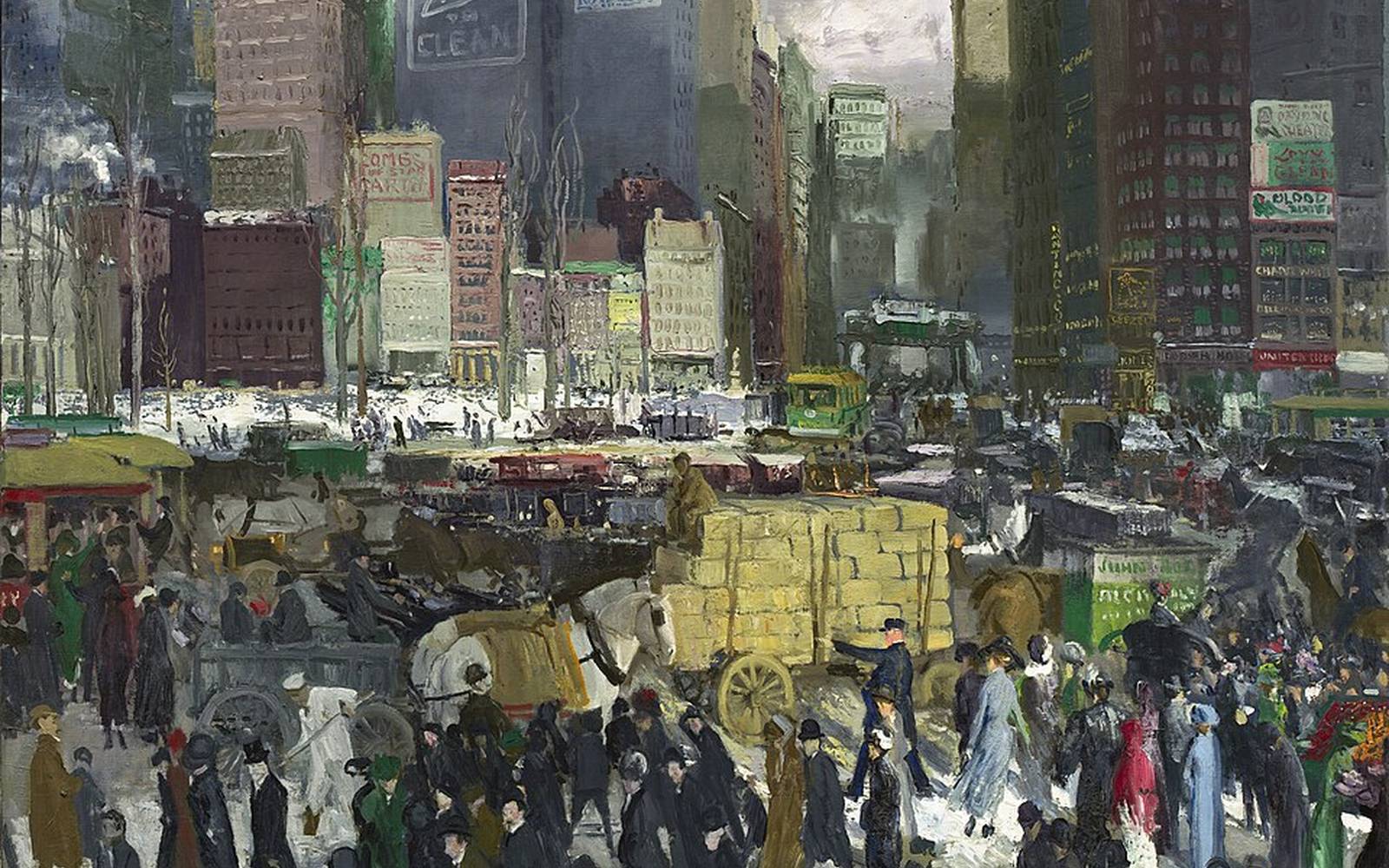
Image reference: George Bellows’s New York.
At a Glance
- Core periodapproximately 1900–c. 1915, with substantial later continuities
- Principal centresPhiladelphia as the formative network; New York as the central subject and exhibition field
- Core artistsRobert Henri, John Sloan, William Glackens, George Luks and Everett Shinn
- Leading younger associateGeorge Bellows
- Major mediapainting, drawing, etching, lithography, newspaper illustration and mural decoration
- Recurring subjectsstreets, crowds, tenements, leisure, theatre, restaurants, construction, children and boxing
- Key exhibitionsThe Eight in 1908, Exhibition of Independent Artists in 1910 and Armory Show in 1913
- Important distinctionThe Eight and the Ashcan School overlap but are not the same group
Contents
- Where it fits
- How the school was named
- Philadelphia beginnings
- Four stages
- Artists to know
- John Sloan
- George Bellows
- Essential works
- How to look
- Artist directory
Where the Ashcan School fits
Robert Henri
Key career periodJohn Sloan
Key career periodWilliam Glackens
Key career periodGeorge Luks
Key career periodEverett Shinn
Key career periodGeorge Bellows
Key career periodTheresa Bernstein
Key career periodEdward Hopper
Key career periodThe Ashcan School made the modern American city worthy of serious art. Its painters found subjects in crowded pavements, tenement backyards, music halls, restaurants, construction pits and illicit boxing clubs. They painted laundry workers, newsboys, drinkers, performers and people passing beneath elevated railways. A dark palette and broad handling often gave these scenes physical urgency.
Yet there was no studio called the Ashcan School, no founding manifesto and no membership roll. The name was applied retrospectively to an interconnected circle of urban realists led by Robert Henri. Its core brought Henri together with four former Philadelphia newspaper illustrators: John Sloan, William Glackens, George Luks and Everett Shinn. George Bellows was the most important younger associate. Their strongest collective identity developed before critics regularly used the word “Ashcan.”
The artists widened subject matter more radically than they transformed pictorial structure. They challenged the convention that American painting should refine, idealise or escape contemporary life. But their realism was selective. Mostly middle-class men, they observed working neighbourhoods without sharing every condition they depicted. They often recorded pleasure and visual excitement more readily than hunger, eviction or organised labour. Their pictures can grant presence while also converting immigrants, women and children into social types.
The movement’s achievement and its limits therefore belong together. Ashcan art is not a transparent window onto New York. It is an active construction of who and what the modern city was allowed to look like.
A school named after the event
The label emerged from ridicule rather than collective choice. Bellows made a drawing captioned Disappointments of the Ash Can in 1915. In 1916, cartoonist Art Young invoked an “ash can” school while attacking realist painters. During the 1930s, curators Holger Cahill and Alfred H. Barr Jr. gave the term wider institutional currency.[1]
That chronology matters. Calling the painters Ashcan can make their development look more unified than it was. Henri mainly painted portraits. Glackens moved toward bright colour and leisure scenes. Shinn favoured theatre and illustration. Sloan became closely identified with neighbourhood observation and etching. Bellows expanded realism into construction sites, sport, portraiture and landscape.
The artists did share friendships, teachers, jobs and exhibitions. The Metropolitan Museum usefully distinguishes their urban realist circle from The Eight, the coalition that challenged academy control in 1908.[2] “School” is therefore most helpful when it names a network and attitude toward contemporary subjects, not a doctrine.
The label’s 1930s success also served a later story. MoMA programmes presented the group as an early revolt against genteel taste and a native beginning for modern American painting.[3] By then, the ash can had become a badge of authenticity. What began as an insult was converted into museum history.
Philadelphia newspapers and the education of an eye
Henri met Glackens, Luks, Shinn and Sloan in Philadelphia during the 1890s. The four younger artists worked for newspapers, sometimes on the same staff, drawing fires, courtrooms, public events and everyday incidents. They became known informally as the Philadelphia Four; with Henri, they form the first Ashcan generation.
Newspaper illustration required speed, but not unfiltered transcription. An artist might sketch at the site, remember a gesture and reconstruct the scene for a deadline. The image needed a clear incident, readable silhouettes and telling detail after mechanical reproduction. Photography increasingly took over factual reportage, yet these habits of compression continued in painting and print.
The press also made art a form of labour. Drawings were assigned, edited, reproduced and discarded according to daily demand. Fine-art ambition developed beside the need to earn a wage. Newspaper clippings, postcards and ephemera reveal how closely the artists’ later city pictures remained linked to contemporary media and social events.[6]
Winslow Homer offered an earlier American model: he too had moved between illustration and painting, and his Civil War reporting demonstrated how graphic economy could survive translation into oil. The Ashcan circle addressed a later mass city whose streets, advertising and entertainment supplied continuously changing material.
Glackens worked at the Philadelphia Record and Press. Sloan moved through commercial design and newspaper departments. Luks combined bravado and graphic talent. Shinn became an artist-reporter whose sense of spectacle continued into theatre and film. Their shared employment created professional familiarity before museums grouped them stylistically.
The network also shaped a younger generation. Stuart Davis’s father was art editor at the Philadelphia Press, where the future Ashcan artists had worked. Davis entered Henri’s school in 1910 and initially painted streets, saloons and theatres in a dark realist language before developing a radically different modernism.[16] Newspaper culture was not merely the movement’s past; it became a channel of transmission.
Robert Henri: teacher, portraitist and organiser
Henri’s most consequential artwork may have been the social structure he created around other artists. He encouraged students to draw their material from the life around them and to value intensity over polished academic finish. His phrase “art for life’s sake” opposed an art sealed off as tasteful refinement.
His sources were not exclusively American. Henri studied in Paris and admired Gustave Courbet, Édouard Manet and Spanish masters. Dark grounds, abrupt highlights and direct address could carry contemporary identity without idealisation. He applied these lessons primarily to portraiture rather than large urban narratives.
Henri selected sitters across class, age and racial categories. The choice could challenge the grand portrait’s traditional association with wealth. It could also place a sitter inside a teacher’s democratic programme. The difference between granting individuality and turning someone into an expressive type must be judged work by work.
As an organiser, Henri opposed the National Academy of Design’s jury system. When works by friends were rejected from the academy’s 1907 annual exhibition, he helped create an independent alternative. The resulting show opened at Macbeth Gallery in February 1908. In 1910, he organised an even broader Exhibition of Independent Artists under the principle “no jury, no prizes.”[4]
Henri also taught Bellows, Edward Hopper, Rockwell Kent and Guy Pène du Bois. A later National Gallery collection history shows how this educational circle became a museum category encompassing teachers, exhibition allies and divergent pupils.[5] Influence did not make them all Ashcan members. It provided permission to treat personal experience as material.
Follow the Ashcan School through four stages
–1900
Philadelphia newspapers and a working network
Henri mentors four press illustrators whose deadlines, reconstructed incidents and graphic labour establish a durable professional and visual connection.
–07
New York becomes subject and method
The circle relocates, walks, sketches and rebuilds the city through restaurants, fountains, backyards, children and rapidly changing public space.
–10
Exhibition independence becomes the shared cause
The Eight challenge jury control in 1908, while the broader 1910 Independents extend the principle of no jury and no prizes beyond one style.
–15
The field expands beyond an Ashcan label
Bellows constructs an impossible New York, the Armory Show broadens modern options and the circle branches into new colour, teaching, publishing and institutions.
The Eight were not eight Ashcan painters
The 1908 exhibition was called Eight American Painters. Henri, Sloan, Glackens, Luks and Shinn participated, but the remaining exhibitors—Arthur B. Davies, Ernest Lawson and Maurice Prendergast—did not share the core circle’s dark urban realism.
Davies painted poetic, Symbolist figures and landscapes. Prendergast used mosaic-like colour in parks, beaches and public leisure. Lawson developed atmospheric urban and suburban landscapes. Their alliance was about exhibition freedom, not one appearance or subject.
Prendergast had already absorbed European Post-Impressionism and joined The Eight because he opposed conservative institutions. His decorative crowds and watercolours expanded the show’s range rather than proving that he secretly belonged to Ashcan realism.[38] Davies likewise painted dreamlike allegory while providing formidable organisational support for newer art.[39]
This distinction changes the meaning of 1908. The exhibition’s radical act was to allow incompatible artists to reach the public without academy approval. Its unity was procedural. A jury could not define American quality in advance.
Spanish scholarship describes the event as a revolution more thematic than stylistic. That formulation works for the Ashcan core, but the complete Eight also made a case for pluralism. Their travelling exhibition presented modern American art as a field of differences.
Ashcan artists to know
Robert Henri
Henri joined European realist sources to contemporary portraiture while his teaching and campaign against jury control gave the circle practical form.
John Sloan
Sloan reconstructed street incidents from walking, memory and newspaper habits, making viewpoints and the ethics of watching central to his city art.
William Glackens
Glackens moved from urban illustration and dark restaurant scenes toward brighter leisure painting without abandoning the network’s institutional ambitions.
George Luks
Luks used forceful paint and caricatural experience to grant sitters presence while exposing the period’s taste for picturesque social difference.
Everett Shinn
Shinn carried press-trained cropping into theatre, vaudeville, murals and film, widening Ashcan modernity beyond the street.
George Bellows
Bellows enlarged Henri’s contemporary realism through city congestion, construction, prizefighting, children, portraiture and landscape.
John Sloan: a spectator in the city
Sloan moved to New York in 1904 and settled first in Chelsea. Newspaper work had trained him to memorise characteristic detail and sketch quickly, but he rarely painted a street canvas entirely before its subject. He gathered incidents during long walks and rebuilt them in the studio.
He described himself as a spectator of life. The phrase captures curiosity and distance. Sloan’s viewer often stands at a threshold: looking down from a window, across a pavement, through restaurant space or beneath elevated tracks. His pictures invite attention to other people while making the ethics of that attention visible.[18]
His diaries, kept intensively from 1906 to 1913, record weather, meals, money, politics, quarrels, exhibitions and motifs. They are invaluable primary evidence, but not a transparent transcript of mind. Entries were selected by the artist and later transcribed and annotated; domestic shorthand concerning Dolly Sloan also exposes the limits and strain of a husband’s record.[9]
Sloan struggled commercially. His commonplace subjects pleased neither conservative collectors nor everyone who wanted avant-garde novelty. The Delaware Art Museum notes that he sold very few paintings for years even while building a respected career in exhibition, illustration and teaching.[8] Urban realism was not guaranteed market success.
Gray and Brass
In Gray and Brass of 1907, a motorcar passes Madison Square. Its wealthy occupants sit within a machine whose metal trim catches attention. Behind or beside them, lower-income figures rest in the park. The painting juxtaposes people who occupy the same public space but not the same mobility.[17]
The car does more than supply a modern object. It creates a horizontal barrier and an economy of looking: passengers may observe people outside while the painter and viewer observe both. Sloan’s broad handling prevents the scene from becoming a diagram of class. Attitude, upholstery, posture and proximity make the contrast.
That ambiguity typifies Ashcan realism. The picture notices inequality without proposing reform. It may satirise nouveau-riche confidence, but it also enjoys the vehicle’s visual flash. Social criticism and metropolitan pleasure coexist.
The fountain and the diary
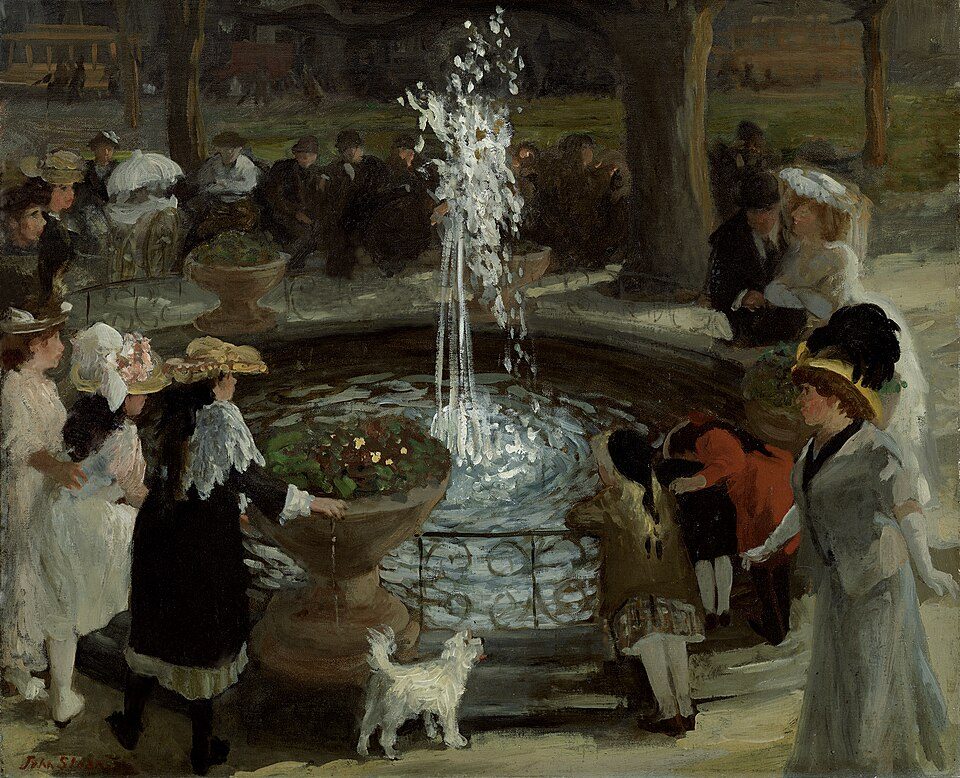
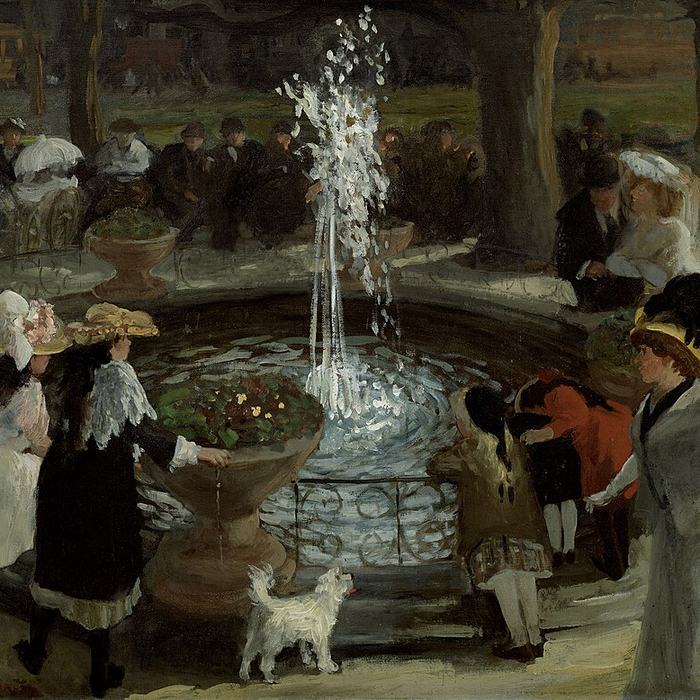
Sloan’s Throbbing Fountain, Madison Square began from a nearby motif he repeatedly watched. In his diary, he described men and women captivated by the water’s sensual force. The Spanish Thyssen guide connects the painting to his long walks, press-trained eye and determination to treat elevated trains, crowds and public squares as serious art.[15]
The fountain rises as a pale, shifting body amid darker pedestrians and buildings. Water is public spectacle, erotic suggestion and compositional pivot. Sloan does not isolate a heroic citizen. Attention circulates among people watching the fountain and a viewer watching them.
Restaurants and bohemia
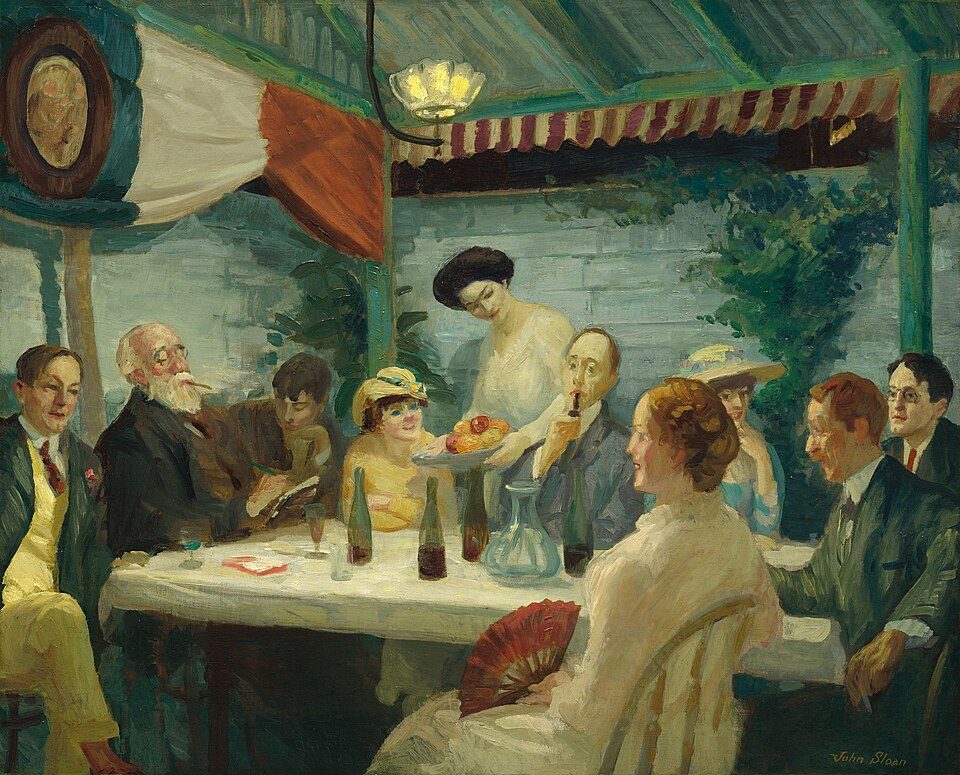
In Yeats at Petitpas’, Sloan assembled a group around the artist and conversationalist John Butler Yeats in the garden dining room of a Chelsea restaurant and boarding house. The large canvas was begun in 1910 and later reconsidered. It combines portrait, restaurant genre and memorial to an intellectual circle.[19]
The people do not merge into an anonymous crowd. Their identities and relationships matter, yet the composition constructs sociability as carefully as a formal portrait. An awning, French flag and crowded table make conversation spatial. The scene reveals another Ashcan city: not only working streets, but bohemian networks in which artists formed reputations.
Windows, backyards and looking without permission
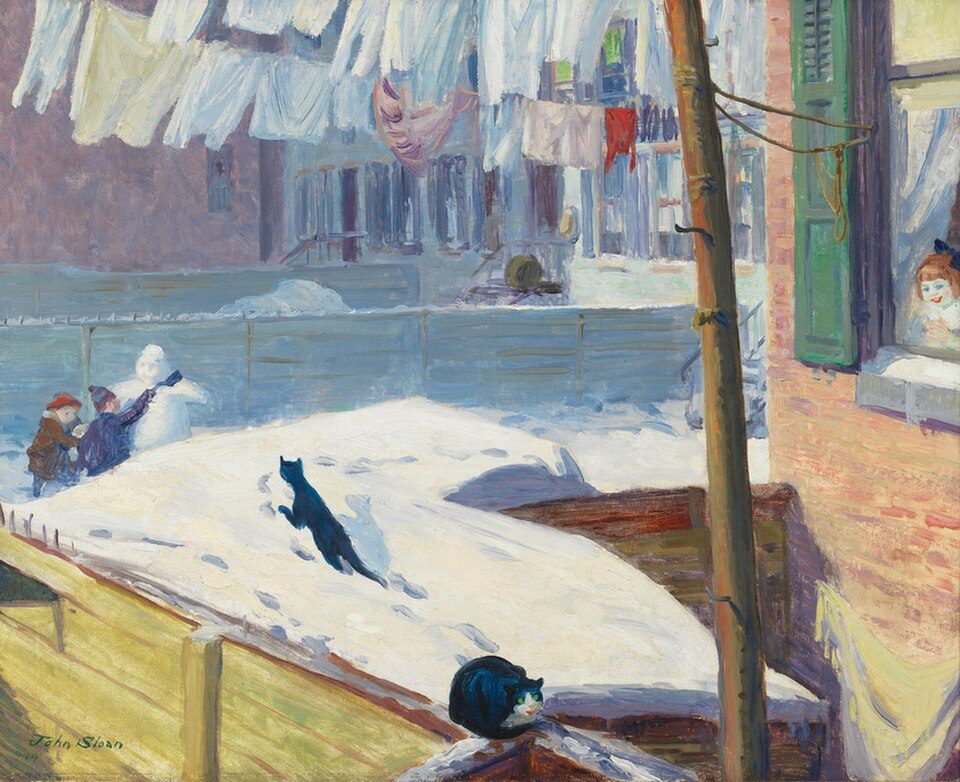
Sloan frequently watched neighbours from upper windows. Backyards, Greenwich Village shows children making a snow figure, laundry, fences and a cat, while another child looks from a window. The picture’s cheerful energy can seem sentimental now, but its attention to a poor neighbourhood and ordinary domestic exterior challenged the hierarchy of acceptable subjects.[20]
The interlocking gazes are important. Sloan observes children who may not know they are being observed; one child watches the others; the viewer inherits his elevated position. The window makes the city available while preserving separation.
Such scenes have been praised as democratic. They can also feel intrusive, especially when women undress, wash or move within private rooms. The artist’s pleasure in unnoticed observation should not be disguised. Realism creates knowledge through a viewpoint that carries power.
Sloan remained an urban painter long after the canonical Ashcan decade. In Sixth Avenue Elevated at Third Street of 1928, young women hurry beneath the railway and before an approaching car. Bobbed hair and shorter skirts connect nightlife to women’s changing work and public independence.[21] The later date resists the idea that urban realism ended in 1913.
Prints and the city in circulation
Etching let Sloan convert observed incidents into reproducible sequences. A copper plate could hold tight detail and deep shadow; impressions entered portfolios and collections at a scale different from painting. Prints also suited irony. An artist could place a viewer close to a private gesture or institutional absurdity.
The wider circle used drawings and prints to record bridges, streets, interiors and crowds. A Brooklyn Museum exhibition included Henri, Sloan, Bellows, Luks, Jerome Myers and others, demonstrating that urban realism extended beyond a canonical six and beyond oil painting.[22]
In Copyist at the Metropolitan Museum, Sloan shows a woman artist working before a framed masterpiece while other figures circulate. The etching makes museum hierarchy itself an urban incident: original and copy, institution and labour, looking and being watched.[50] Its later gift from Gertrude Vanderbilt Whitney also ties graphic satire to the patronage that preserved it.
Print multiplicity did not automatically create a mass audience. Editions required dealers and buyers. Sloan continued illustration to support himself, and his fine prints circulated within an art economy. The same hand could make a commercial image, socialist cartoon and museum-bound etching under different conditions.
George Bellows: the city under pressure
Bellows arrived from Ohio in 1904 and studied with Henri. He never exhibited as one of The Eight, but he carried the teacher’s demand for contemporary vitality into large, physically charged work. His subjects ranged from boxing, street crowds and excavation to portraits, Maine seascapes and family scenes.[13]
His institutional position complicates the rebel story. In 1909, at twenty-seven, he became one of the youngest associate members of the National Academy. Conservative and progressive critics could both value his force.[14] Ashcan affiliation did not require permanent exclusion from the establishment.
Excavating Pennsylvania Station
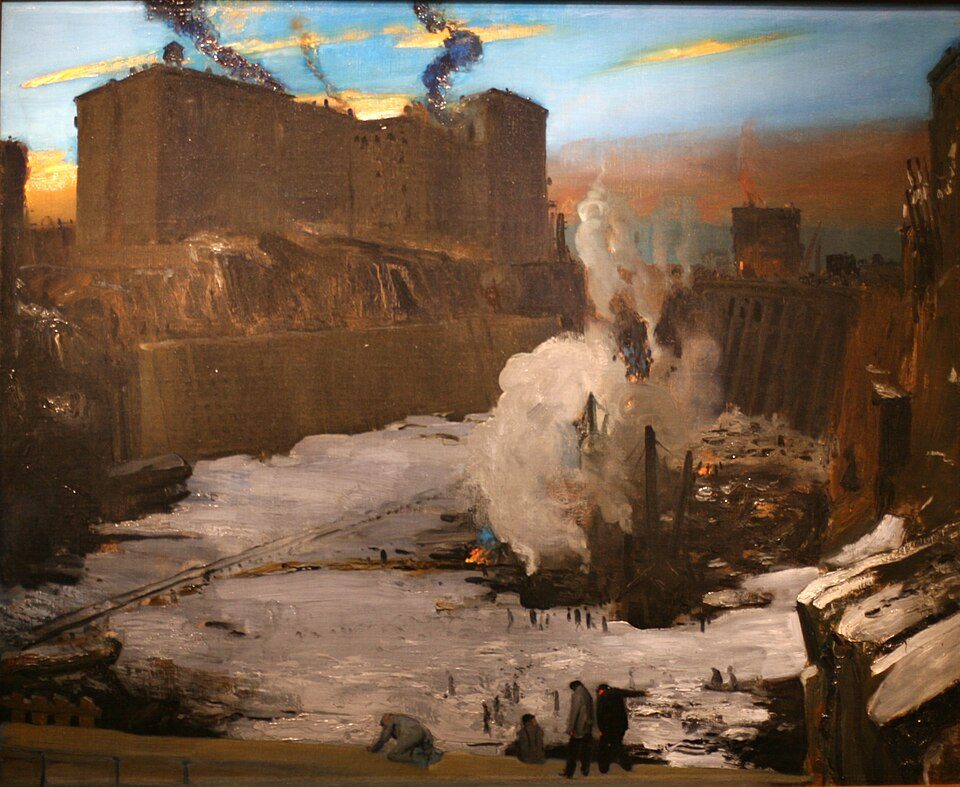
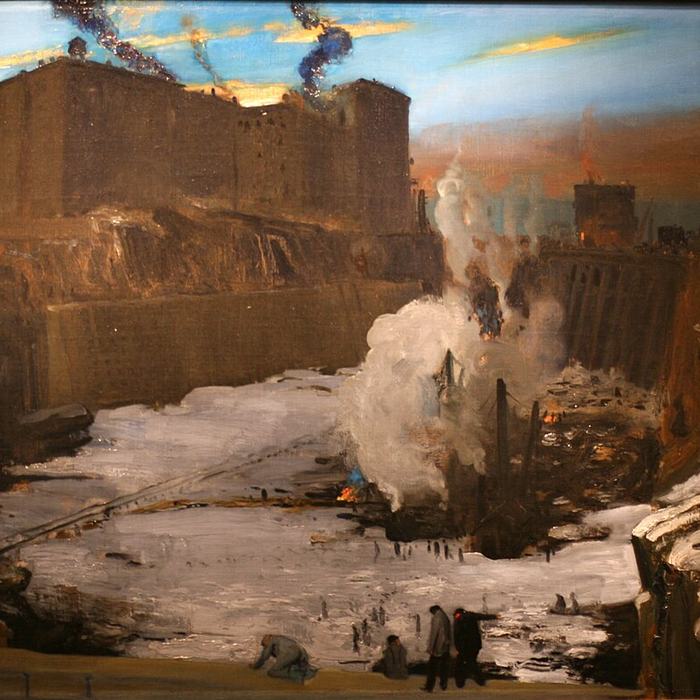
Between 1907 and 1909, Bellows painted the excavation for Pennsylvania Station. The pit represented destruction and creation: blocks of the Tenderloin had been removed so rails and monumental architecture could transform Manhattan.
In the Brooklyn Museum canvas, snow, earth, smoke and machinery form broad, dark masses. Small workers occupy a scale that makes construction seem geological. Loose paint communicates churn, but the view is composed from strong diagonals and tonal blocks.[23]
The work does not function as an engineering record. Machinery and labour are partly swallowed by atmosphere. Nor does it clearly mourn displaced residents. The modern spectacle dominates. Ashcan realism could notice work while celebrating the scale of capital that organised it.
New York as an invented city
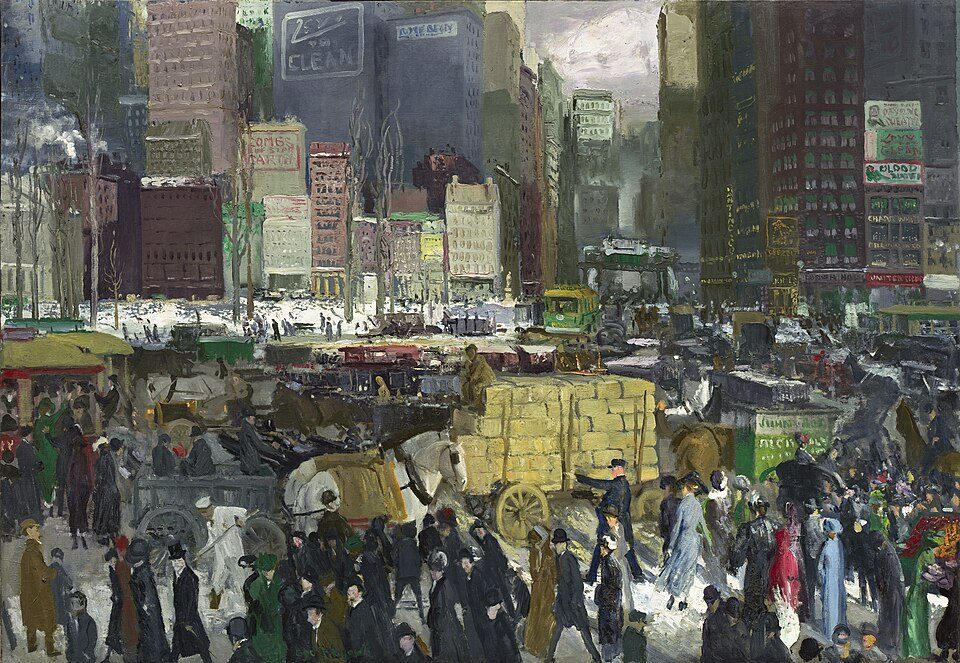
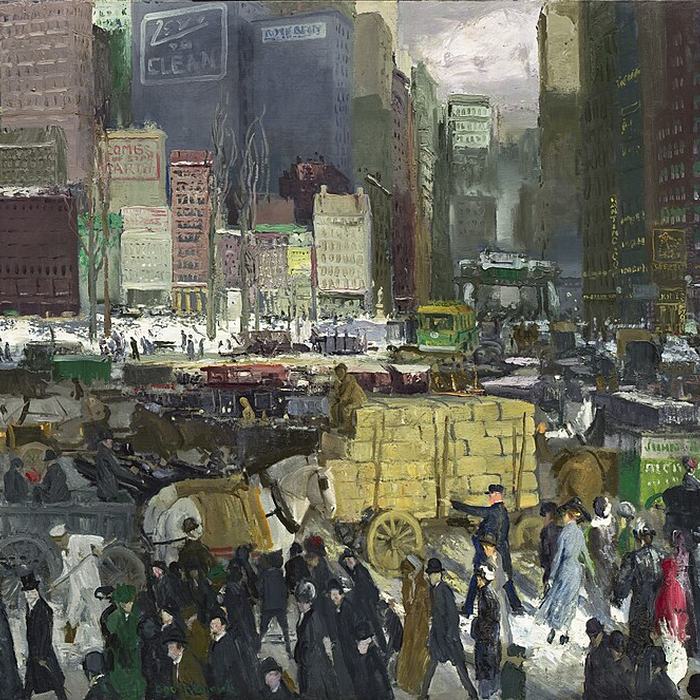
Bellows’s 1911 New York appears to gather everything at once: pedestrians, carts, cars, trolleys, police, signs, smoke and buildings. The supposed site looks toward Madison Square from Broadway and Twenty-Third Street, but the artist combined features from several commercial districts. It is an imaginary composite engineered to maximise congestion.[24]
That fact is central. A convincing city picture need not be topographically accurate. Bellows built experiential truth through impossible density. Buildings cut off sky; vehicles pull in incompatible directions; brush marks make people legible as motion before identity.
The city is exciting and dangerous. A policeman attempts to regulate flow, while bodies risk collision. No single incident governs the canvas. Modern life is represented as competing claims on limited space.
Children by the river
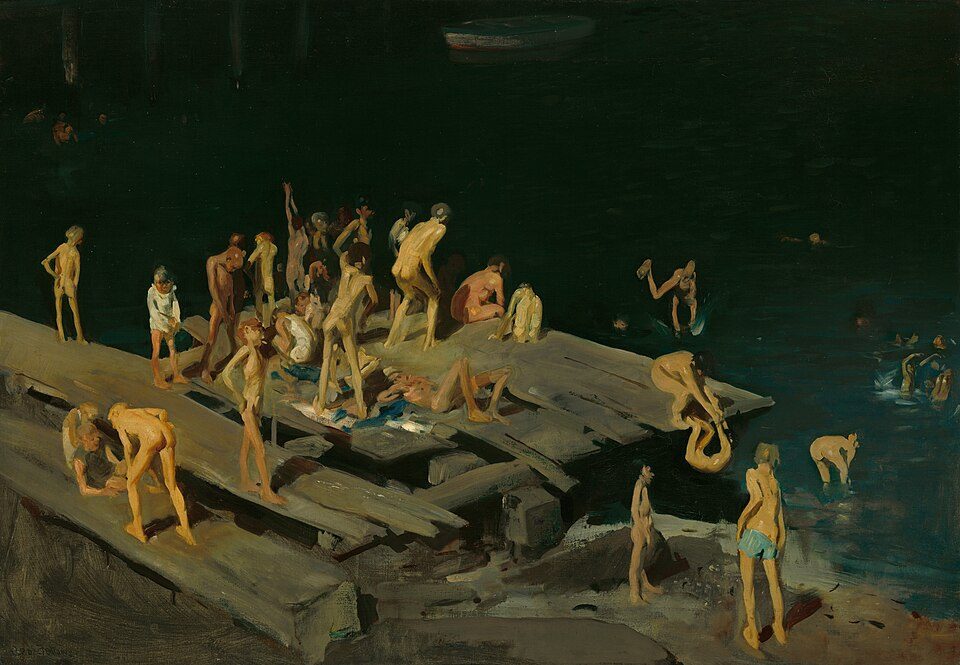
In Forty-two Kids, boys swim, dive, smoke and sprawl around a dilapidated East River wharf. The title uses contemporary slang and treats the group collectively. Critics attacked the anatomy and nudity, while Bellows turned the complaint into a joke about a “naked painting.”[25]
The picture rejects idealised bathing. Bodies are bony, awkward and active; industrial water replaces a pastoral pool. Yet working-class children also become a spectacle of unruly vitality for adult viewers. Their poverty is visible in setting more than analysed as condition.
Named children and the limits of the urban type
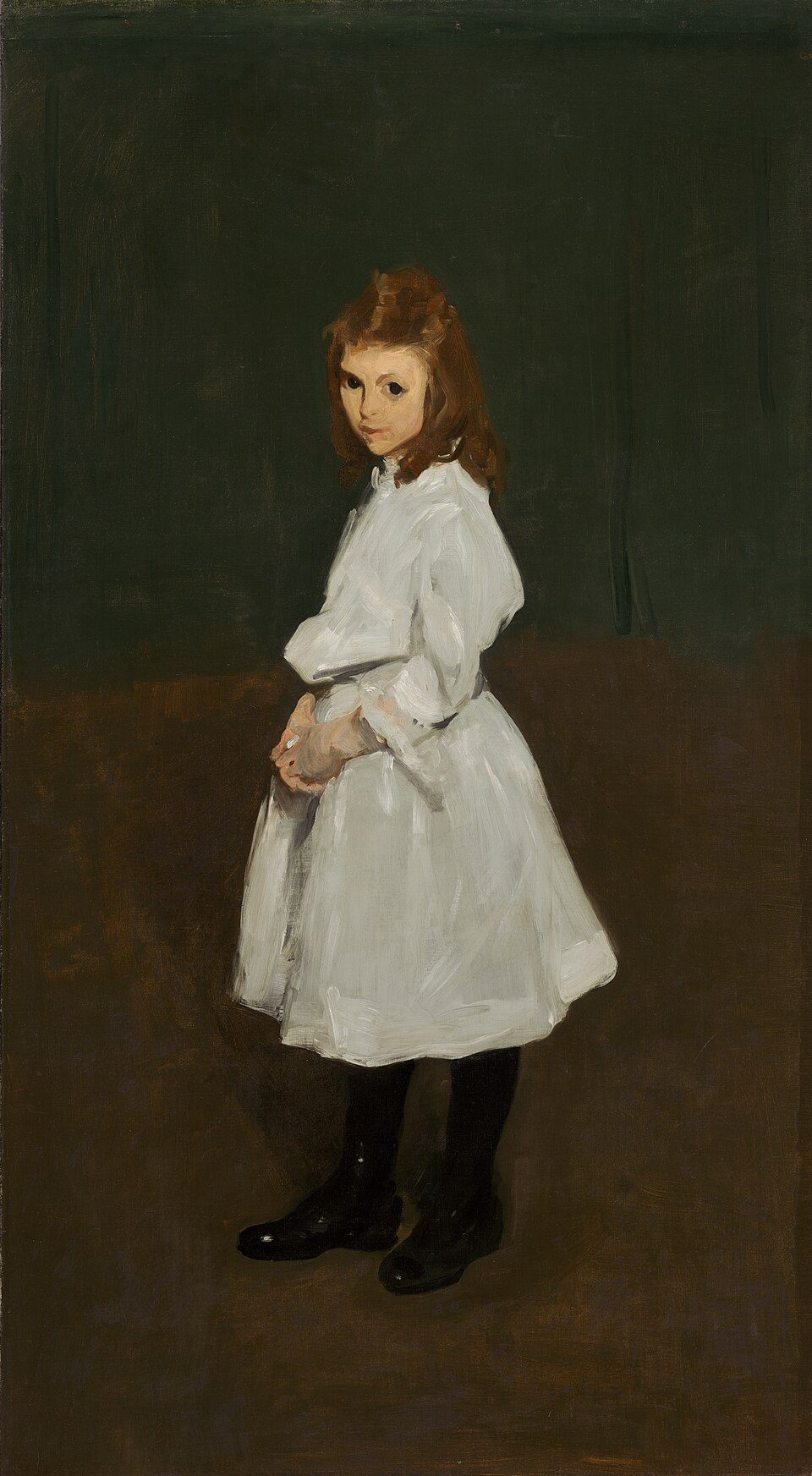
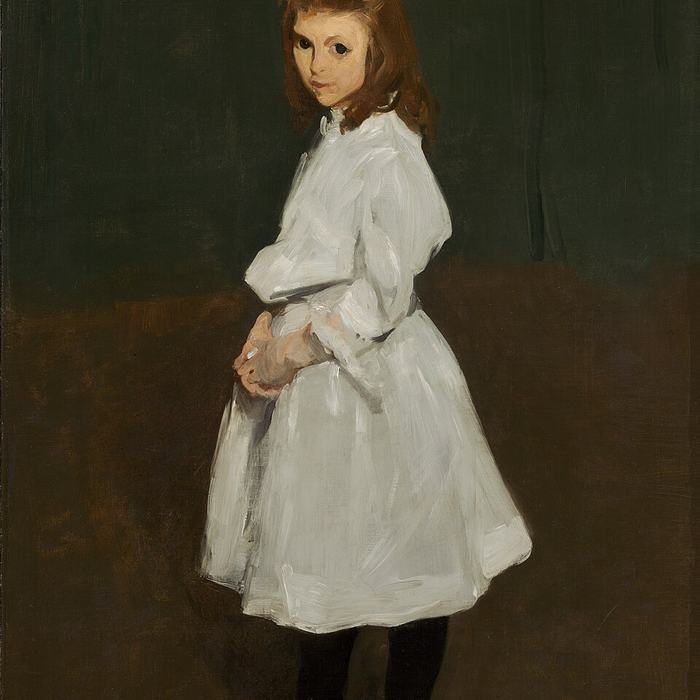
Bellows’s Little Girl in White was first recorded as Little Laundry Girl. The sitter, Queenie Burnett, delivered laundry and posed in the artist’s studio. She stands stiffly in white against darkness, hands folded, large eyes meeting the viewer with evident discomfort.[26]
The portrait borrows the format of elite full-length painting for a child worker. That reversal is socially significant. It does not remove the imbalance between adult artist and young sitter. The change from occupational title to name can restore individuality, yet her difficult labour remains essential context.
Conservation has revealed damage and overpainting in the white dress and background. The object itself has a history of scraping, repair and display. “Blunt realism” reaches viewers through a material surface altered over time.
In The Newsboy, Bellows represented Jimmy Flannigan. Energetic brushwork and direct encounter make him vivid, but enlarged ear, spindly hands and mischievous expression draw on Irish and working-class caricature. Brooklyn Museum interpretation holds individuality and stereotype together rather than choosing one.[27]
The concept of the urban “type” was efficient for newspapers and genre painting. A newsboy, immigrant woman or street child could be recognised quickly. It also reduced a person to social identity. Modern scholarship asks what happens when a named sitter is made to stand for a class or ethnicity.
Boxing, masculinity and race
Bellows’s early boxing pictures were painted when prizefighting was illegal in New York. Private athletic clubs evaded the law by calling spectators and fighters members. The arena brought working-class contestants before an audience that could include men from wealthier social groups.
Club Night establishes the visual system. Harsh illumination isolates two bodies above a dark crowd. Faces emerge as grins and open mouths; the ring becomes a stage. Critics found the subject brutal and the handling exciting. Bellows later dismissed the early canvas, but it provided the foundation for his better-known fights.[28]
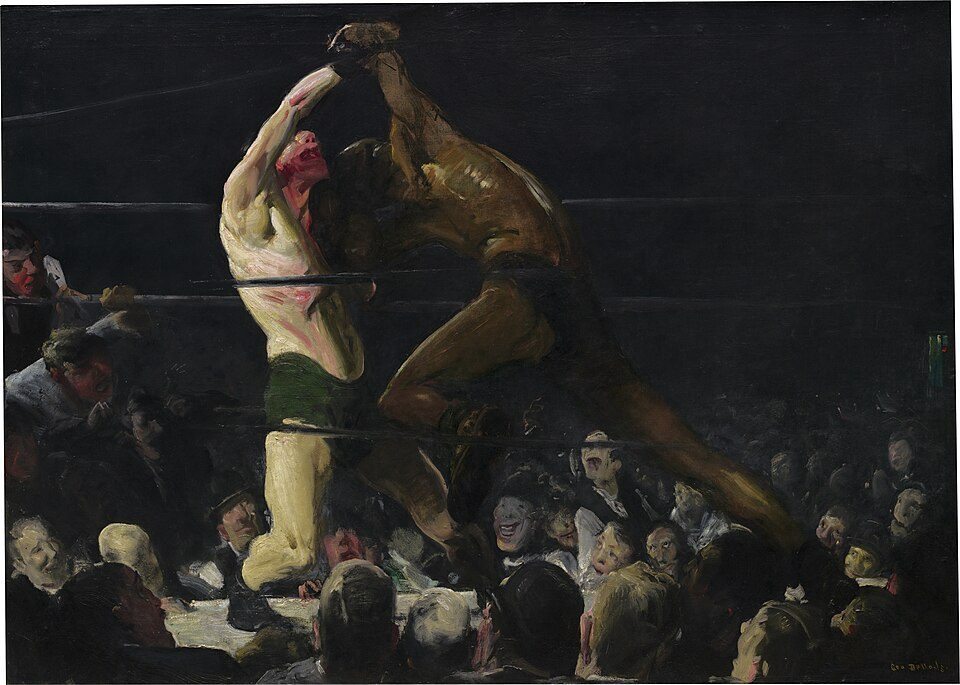
In Both Members of This Club, a Black boxer drives against a bloodied white opponent. The title repeats the legal fiction used to avoid the boxing ban. Painted after Jack Johnson became world heavyweight champion, it confronted white anxiety about Black physical victory during the Jim Crow era.[29]
The Black fighter appears powerful and likely to win. That was provocative social commentary. Yet the painting also makes racialised bodies into violent entertainment, and the surrounding white crowd consumes the contest. Resistance to white supremacy and participation in spectacle coexist.
Bellows removed the stabilising referee found in another fight scene. Bodies knot into a triangle under electric light, while the audience compresses below. The image’s power comes from paint and composition as much as subject. Across later drawings and lithographs, Bellows returned to boxing after its legal status and audience had changed.[30]
The boxing pictures have often supported a “manly” account of Ashcan paint: strong arm, uncompromising subject, muscular brush. That critical language marginalised other urban experience and turned masculinity into a quality standard. The works are better understood as investigations of performance, spectatorship, law and race—not proof that forceful art is naturally male.
Essential works of the Ashcan School
New York
George Bellows · 1911 · A composite city rather than one literal junction, engineered so people, vehicles, signs and architecture compete for space.
Pennsylvania Station Excavation
George Bellows · c. 1907–08 · Excavation becomes a vast modern spectacle in which workers and machinery are partly consumed by snow, smoke and earth.
Forty-two Kids
George Bellows · 1907 · Working-class boys occupy an industrial waterfront with unruly vitality while remaining a spectacle for adult viewers.
Little Girl in White (Queenie Burnett)
George Bellows · 1907 · Queenie Burnett’s name, labour and discomfort complicate the transfer of elite portrait format to a child laundry worker.
Both Members of This Club
George Bellows · 1909 · An interracial prizefight confronts white supremacy while retaining the crowd, violence and racialised spectacle of boxing culture.
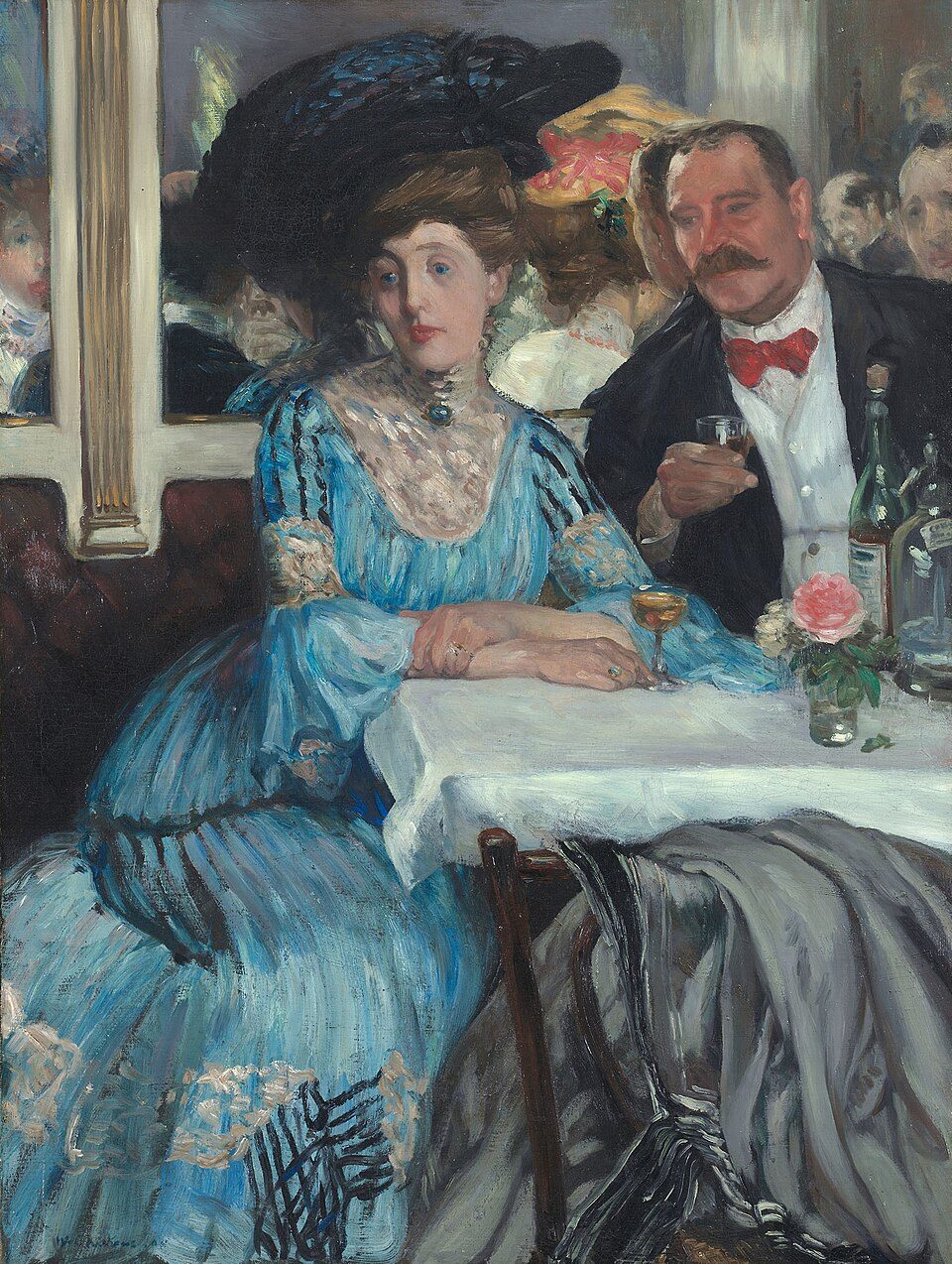
At Mouquin’s
William Glackens · 1905 · Mirror, drink and drifting gazes make fashionable sociability feel both glamorous and emotionally unresolved.
Throbbing Fountain, Madison Square
John Sloan · 1907 · Pale moving water becomes a public, sensual pivot around which the gaze of pedestrians and viewer circulates.
Backyards, Greenwich Village
John Sloan · 1914 · A high window opens ordinary tenement life to art while making the distance and privacy of observation impossible to ignore.
Yeats at Petitpas’
John Sloan · 1910–14 · Restaurant genre and group portrait construct bohemian fellowship through a carefully ordered dining-room space.
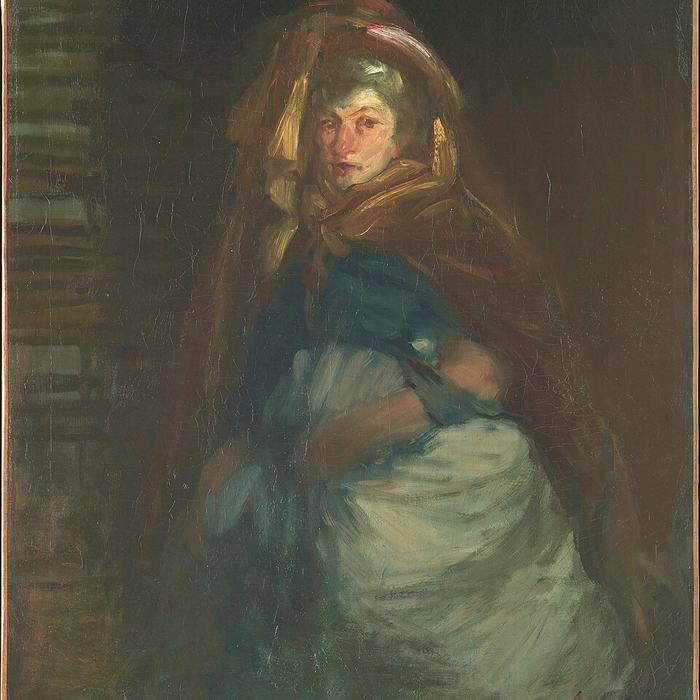
The Old Duchess
George Luks · 1921 · Luks gives an impoverished sitter weight and dignity while period language and mock nobility risk turning her into a picturesque type.
Glackens: drinking, leisure and colour
William Glackens shared Henri’s European travel and newspaper background but did not remain a painter of dark streets. His career moved through illustration, urban leisure, family groups, landscapes and a brighter palette that prompted comparison with Renoir. His wife, Edith Dimock, was also a trained artist, not merely a figure in his social world.[10]
At Mouquin’s
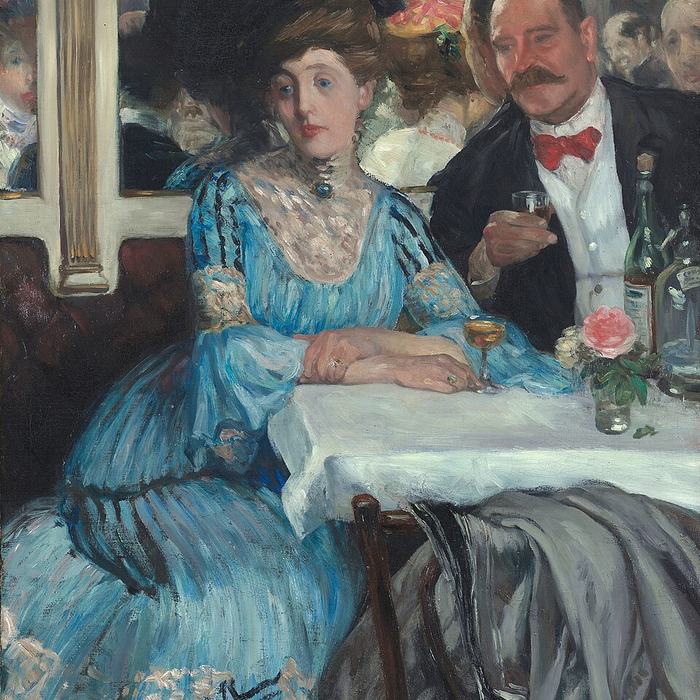
Glackens’s 1905 painting stages a fashionable restaurant. Jeanne-Louise Mouquin sits beside restaurateur James B. Moore, their drinks visible. Reflected in the mirror are Edith Glackens and critic Charles Fitzgerald. The composition therefore joins the represented couple to the artist’s own network.[31]
Jeanne’s gaze drifts away from her companion. Fluid fabric, glass, mirror and alcohol construct glamour, but the social relation remains unresolved. Contemporary viewers could object to men and women drinking together. Modernity appears as pleasure and emotional detachment.
The painting was included in the 1908 exhibition. Its fashionable setting corrects the idea that Ashcan art only pictured refuse or slums. The circle’s city contained leisure across classes, and Glackens often stayed close to his own milieu.
His Luxembourg Gardens makes the point differently. Women converse or sew while children play beneath repeated trees. Made through European travel, it combines rapid observation with an organised leisure space.[32] Ashcan membership did not confine an artist to Manhattan or a black-brown palette.
Glackens later helped organise the 1910 Independents and 1913 Armory Show. He also bought European modern paintings for Albert Barnes. His movement toward colour was not a betrayal of realism but evidence that the circle never had a fixed style.
Luks: dignity, performance and type
George Luks brought newspaper caricature, European museum looking and exuberant self-presentation to the circle. He studied briefly in Düsseldorf and admired Velázquez and Goya. His subjects ranged from impoverished New Yorkers to landscape and portraiture.[11]
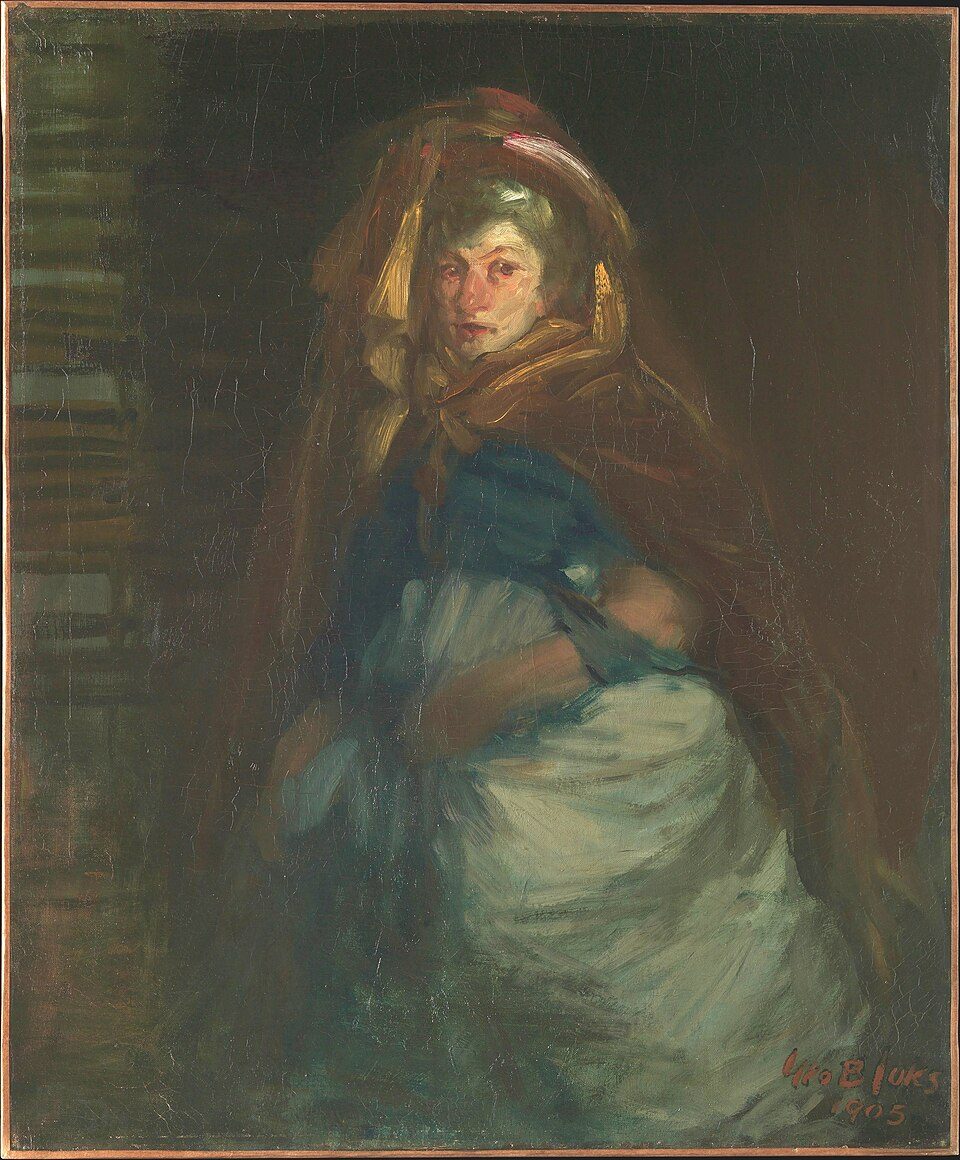
The Old Duchess shows an elderly woman in layered clothing and an elaborate, unstable hat. Thick paint gives her physical weight and presence. She was displayed in The Eight exhibition and could be praised for “distinguished bearing,” yet period description also called her a hag and turned supposed poverty, drinking and bribery into picturesque personality.[34]
The portrait can honour the sitter while participating in slum tourism. Luks’s title grants mock nobility, but it may also make social difference entertaining. Her look and posture resist pity; the surrounding narrative still belongs largely to people who observed her from outside her life.
This tension is central to Ashcan representation. Rejecting idealisation does not automatically produce equality. A forceful likeness can challenge class hierarchy while depending on the market value of “colourful” urban characters.
Shinn: theatre, reportage and the angled view
Everett Shinn continued as illustrator, muralist and designer as well as painter. He worked for Philadelphia and New York papers, created private and civic murals, and later served as an art director in film.[12] His urban modernity was often theatrical.
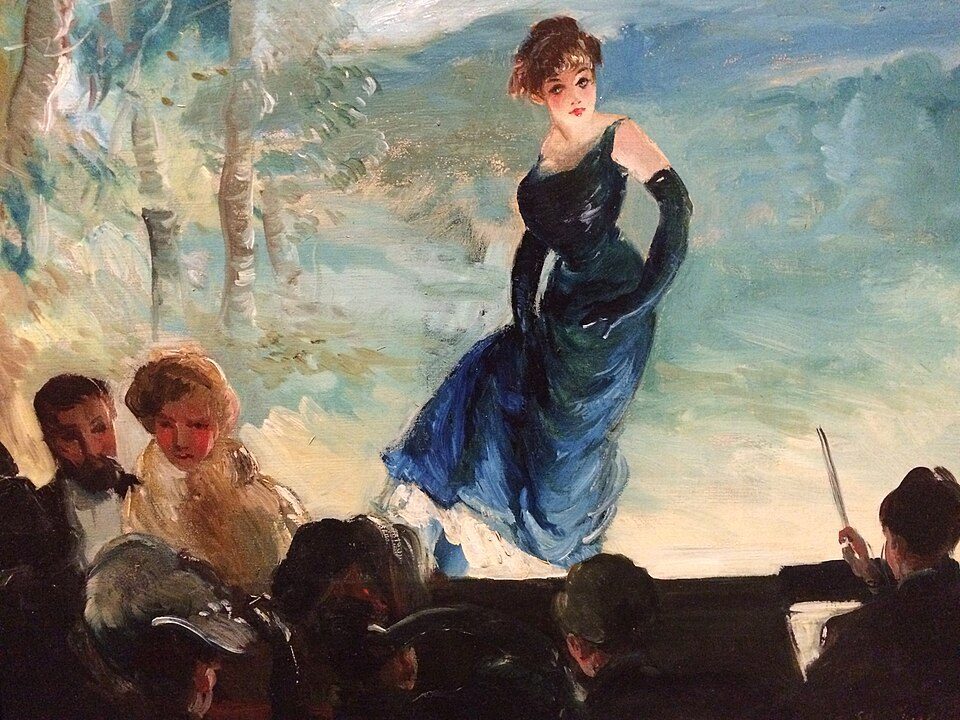
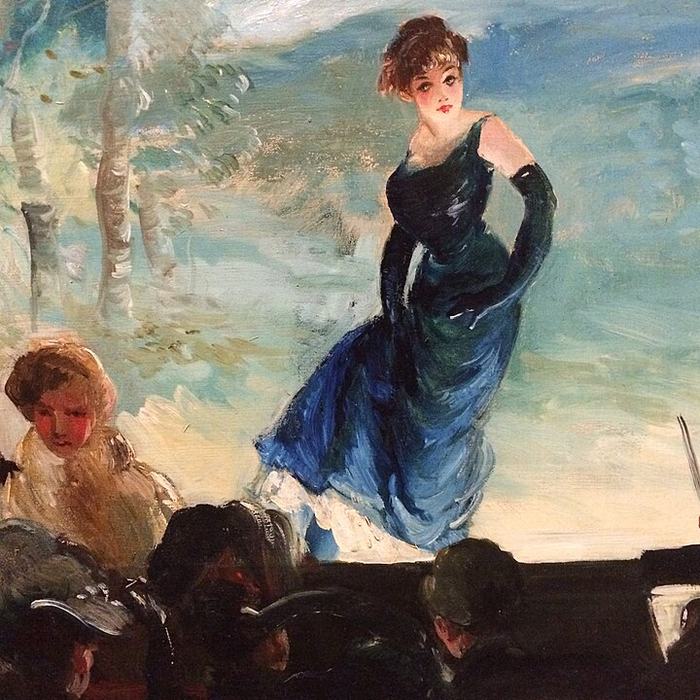
In Spanish Music Hall of 1902, the viewer seems seated among an audience looking toward performers. An oblique angle includes the spectators rather than presenting the stage frontally. Shinn had studied the theatre pictures of Edgar Degas during European travel, adapting their cropped viewpoints to American vaudeville.[33]
The work does not simply document a specific performance. “Spanish” song and dance were packaged for popular entertainment. Stage identity, audience desire and urban commerce meet under artificial light. The artist-reporter turns spectatorship itself into the subject.
Shinn’s theatre scenes complicate the movement’s reputation for street grit. Vaudeville, music hall and decorated interiors belonged to the same mass city as tenements. They also supplied paying commissions and allowed him to move between fine art and entertainment industries.
Women in and around urban realism
The canonical Ashcan core was male, but women participated as artists, organisers, students, patrons, writers, workers and represented city dwellers. Their reduced place in the label reflects institutions as much as absence from urban realism.
Theresa Bernstein trained at the Philadelphia School of Design for Women, moved to New York in 1912 and studied at the Art Students League. She painted parades, parks, concerts, theatres, women at work and leisure with broad, colourful handling. She gained early recognition, but her reputation declined as she devoted energy to promoting her husband and as later abstraction changed critical priorities.[35]
Her Study for Carnegie Hall shows that large crowd and performance subjects were not exclusively male territory.[46] Charcoal builds a female figure as part of a public event, joining observation to the preparation of an ambitious composition.
Edith Dimock exhibited watercolours and shared professional networks with Glackens. Dolly Sloan participated in socialist and bohemian life while appearing in a diary that can reduce her experience to her husband’s worry or code. Women attended art schools in substantial numbers even when teaching and institutional leadership remained harder to obtain.
Gertrude Vanderbilt Whitney combined artistic practice, wealth and patronage. Beginning in 1907, she bought and supported living American art, founded the Whitney Studio in 1914 and eventually established a museum after the Metropolitan declined her collection. Her access was exceptional, but she used it to build alternatives to academy exclusion.
Juliana Force directed the Studio Club’s practical life and became the Whitney Museum’s first director. Exhibitions, lectures, classes, food and financial aid made the club an infrastructure rather than merely a salon. Whitney holdings of Henri, Glackens, Sloan and Luks record the work of these two women as institution builders.[44]
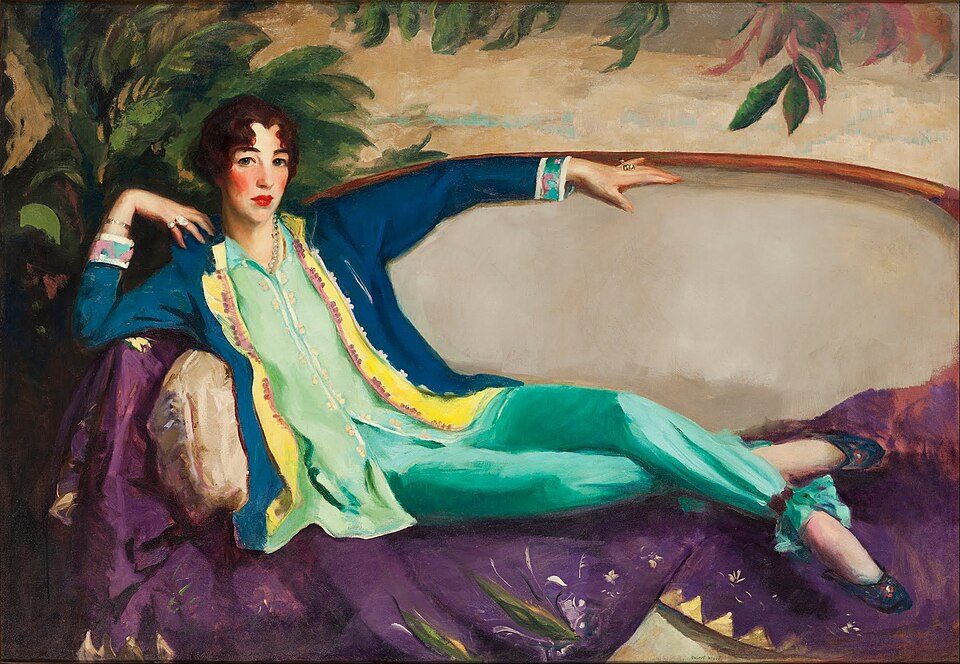
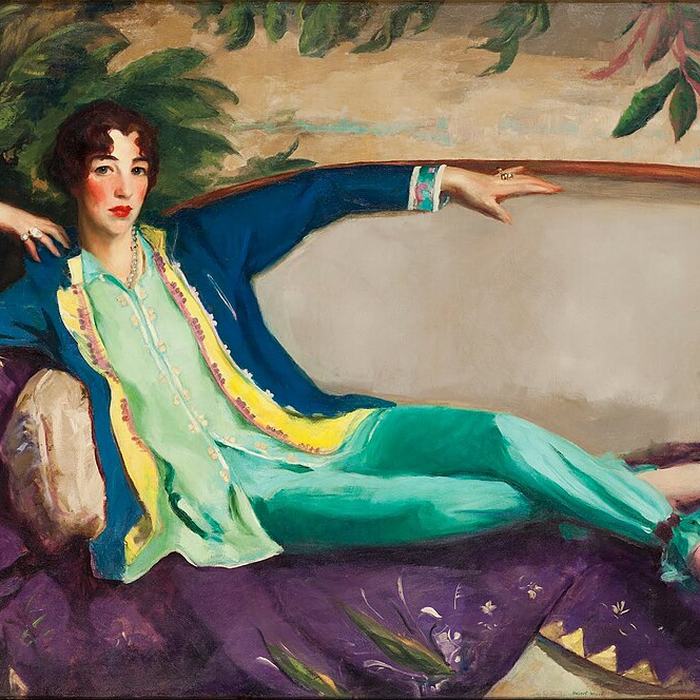
Henri’s 1916 portrait of Whitney presents her reclining in silk trousers, meeting the viewer with confident ease. The image was considered too unconventional for display in her formal home and hung in her studio. Its modernity was jointly produced by sitter-patron and painter, not bestowed by the male artist on a passive woman.[45]
Immigration, race and selective realism
New York’s population expanded through migration, while elevated railways, subways, bridges and redevelopment reorganised daily space. A Smithsonian study guide places Ashcan imagery within that rapid physical and demographic change.[37] Crowds made difference visible, but visibility was never neutral.
Recent research maps Italian, Chinese, Jewish and Irish presences across Ashcan parks, restaurants, markets and tenements. It asks how images constructed race through mobility, exclusion, assimilation and stereotype.[36] This approach moves beyond the claim that the artists simply celebrated “ordinary people.”
Henri’s portraits could dignify sitters from communities excluded from elite representation. Luks painted immigrant neighbourhood figures with commanding scale. Bellows challenged racial power in a boxing image. The same works could use costume, physiognomy, dialect title or caricature to make people legible as types.
Class operated similarly. The artists opposed genteel subjects but generally maintained middle-class lives and enjoyed restaurants, theatre and resorts. They often registered urban hardship gently, avoiding direct treatment of civil unrest and structural poverty. Their realism selected visually animated effects of inequality more readily than causes.
Absence can be as revealing as presence. A crowded canvas may include delivery workers, street sellers and domestic employees without showing the hours, wages or housing arrangements that structure their lives. Construction appears as muscular activity while decisions about demolition and displacement remain elsewhere. Leisure crowds make a city seem shared even when admission prices, segregation and gender codes divide access.
The paintings therefore invite comparison with contemporary reform photography and journalism. Those media also selected and staged evidence, but they might name a housing campaign, document a specific building or argue for legislation. Ashcan paintings more often suspend causes inside an open-ended scene. Their political effect comes through making overlooked experience visible and through the viewer’s response, not through an agreed programme of change.
This selectivity should not be treated as a hidden failure that invalidates every work. All realism frames. The historical task is to identify the frame: to see where sympathy becomes picturesque distance, where attention contests hierarchy and where a lively surface makes hardship consumable. Such distinctions allow individual pictures to differ instead of making “democratic realism” a verdict applied in advance.
This does not make the paintings politically empty. It locates politics in framing. Who is watched through a window? Who becomes amusing? Who has a name? Who can move through public space without explanation? The urban image participates in debates about belonging even when no reform slogan appears.
From independent exhibitions to the Armory Show
The 1910 Exhibition of Independent Artists expanded the argument of 1908. By removing jury and prizes, organisers sought equal access rather than a new official taste. The exhibition included more artists and made procedure itself a reform.
The 1913 International Exhibition of Modern Art, known as the Armory Show, operated on a different scale. Organised by the Association of American Painters and Sculptors, it opened in New York’s Sixty-Ninth Regiment Armory, then travelled to Chicago and Boston.[40] American and European work appeared together.
Davies played a central organisational role, while Glackens, Sloan and other associates exhibited. Viewers encountered Fauvism, Cubism and other European developments with unfamiliar force. The event did not simply replace Ashcan realism overnight. It changed the range of options and the language critics used to define modernity.
A 1938 MoMA catalogue prepared for Paris contrasted Ashcan attention to American reality with an avant-garde modernism stimulated by Europe.[41] The opposition was rhetorically useful but too simple. Henri’s circle already learned from European realists; Davies and Prendergast supported international modernism; Sloan and Glackens responded to new colour.
The Armory Show’s primary-source archive reveals planning, publicity, travel and visitor reaction rather than one sudden conversion. Modern American art developed through institutions and disagreements as much as through stylistic succession.
Hopper, Davis and divergent inheritances
Hopper studied with Henri but remained outside the Ashcan core. He shared the commitment to contemporary life and admired European realists, especially Degas, Manet and Walter Sickert. Spanish museum scholarship locates his formation near the circle while stressing the distinctive, elusive solitude he developed.[47]
His empty rooms and isolated figures show that Henri’s lesson did not require crowded brushwork. Edward Hopper transformed urban observation into duration, distance and withheld narrative. Calling him an Ashcan painter can obscure that transformation.
Stuart Davis followed another route. After seeing the Armory Show, he explored high colour and eventually Cubism. In 1918, a Whitney Studio Club experiment asked artists including Sloan, Luks and Glackens to draw lots for prepared canvases and paint on site; Davis participated in this environment of inherited realism and new formal possibilities.[48]
Later, Sloan encountered Native American art and Mexican muralists in the Southwest, including Diego Rivera. His teaching reached artists as different as Alexander Calder, David Smith and Barnett Newman. Ashcan afterlife is therefore a branching network, not one march toward abstraction.
Sloan’s 1941 etching Sunbathers on the Roof returns humorously to bodies seen in an ordinary urban space. A cat, discarded shoe and closed book turn a private encounter into visual comedy.[49] The date shows how long his habits of watching and narrating survived.
Museums and the construction of an American beginning
Gertrude Whitney’s museum opened in 1931 with a collection rooted in living American art. Its history begins with Ashcan painting and moves through later modern movements.[43] This sequence made urban realism a foundation story.
MoMA’s 1930s account connected Henri, Sloan and Luks to native social meaning and the rediscovery of the American scene.[42] During the Depression, that genealogy made the earlier artists look like predecessors of contemporary social and regional art.
Collections shape membership. A museum may hang Henri, Bellows, Hopper and Prendergast together because their historical relationships matter, even though their styles differ. Gifts by Helen Farr Sloan, Chester Dale and Whitney made some artists and works especially visible. The National Gallery’s construction of “Henri and his circle” openly demonstrates how acquisition produces a network.
The Ashcan School remains a useful name if it prompts questions rather than ending them. It identifies a powerful shift toward ordinary urban subjects, independent exhibition and press-trained observation. It should also direct attention toward the people framed as objects of modern looking and the later institutions that decided which realists represented America.
How to look at Ashcan art
- Identify the viewpoint. Are you on a pavement, above a backyard, inside an audience or at ringside? Position determines social relation.
- Separate observation from construction. A recognisable city can still be assembled from memory, several locations and staged figures.
- Read brushwork as choice. Broad dark paint may create speed or atmosphere; it does not automatically prove honesty or political radicalism.
- Look for newspaper habits. Cropping, incident, gesture and quickly legible type often survive the artists’ illustration work.
- Name people where possible. Queenie Burnett and Jimmy Flannigan are more than laundry girl and newsboy.
- Test the social type. Ask whether dress, body or expression turns class, ethnicity, gender or race into shorthand.
- Reconstruct the exhibition. A work shown with The Eight, in the Independents, at the Armory or in an academy made a different institutional claim.
- Follow the afterlife. Later titles, museum acquisitions and the 1930s category “Ashcan School” affect what the picture now represents.
Where to see Ashcan art
- Whitney Museum of American Art, New York: foundational holdings by Henri, Sloan and Bellows, with the clearest institutional connection to Gertrude Whitney’s patronage.
- Metropolitan Museum of Art, New York: a strong display across painting and print, including Luks’s The Old Duchess and Shinn’s theatre scenes.
- National Gallery of Art, Washington: exceptional Bellows holdings and detailed scholarship on Henri’s circle, Sloan and The Eight.
- Delaware Art Museum, Wilmington: the largest collection of Sloan’s art and archive, indispensable for his diaries, prints and teaching.
- Smithsonian American Art Museum, Washington: broad urban-realist context and important work on social history and race.
- Brooklyn Museum, New York: Bellows’s Penn Station excavation and The Newsboy, alongside works on paper by the wider realist circle.
- Columbus Museum of Art, Ohio: a major centre for Bellows, including archives and works connected to his Ohio origins and New York career.
- New Britain Museum of American Art, Connecticut: American realist holdings that allow Ashcan pictures to be compared with Impressionism, later urban art and Social Realism.
Displays change, especially for light-sensitive works on paper. Check current gallery information before visiting.
Where to see Ashcan art
Works on paper are light-sensitive and displays change. Check current galleries before travelling.
- 01
Whitney Museum of American Art
New York, USA
Foundational Henri, Sloan and Bellows holdings connect the paintings to Gertrude Whitney’s patronage and the museum history that helped establish the label.
Patronage, canon and core artistsVisit collection website - 02
Metropolitan Museum of Art
New York, USA
Painting and print holdings include Luks and Shinn while current interpretation distinguishes the Ashcan circle from The Eight.
The Eight and urban realismVisit collection website - 03
National Gallery of Art
Washington, D.C., USA
Exceptional Bellows holdings and detailed online scholarship support close study of Henri’s circle, Sloan, children, boxing and independent exhibitions.
Bellows and research depthVisit collection website - 04
Delaware Art Museum
Wilmington, USA
The largest concentration of Sloan’s work and archival material makes illustration, diaries, prints, teaching and urban observation visible together.
John Sloan collection and archiveVisit collection website - 05
Smithsonian American Art Museum
Washington, D.C., USA
Broad American realist holdings and research place the group within newspapers, migration, race, women’s urban art and later modernism.
Social history and wider networksVisit collection website - 06
Brooklyn Museum
New York, USA
Pennsylvania Station Excavation and The Newsboy sit beside prints and drawings by a wider urban realist circle.
Bellows and works on paperVisit collection website - 07
Columbus Museum of Art
Columbus, USA
A leading Bellows centre links his Ohio origins, New York subjects, archive and wider career.
George Bellows collectionVisit collection website - 08
New Britain Museum of American Art
New Britain, USA
American realist holdings allow Ashcan work to be compared with Impressionism, later urban painting and Social Realism.
Comparative American realismVisit collection website
Suggested books
- Rebecca Zurier, Robert W. Snyder and Virginia M. Mecklenburg, Metropolitan Lives: The Ashcan Artists and Their New York. A richly contextual account linking art to newspapers, neighbourhoods and urban social history.
- Rebecca Zurier, Picturing the City: Urban Vision and the Ashcan School. A sustained analysis of spectatorship, visual experience and the constructed modern city.
- Bennard B. Perlman, Painters of the Ashcan School: The Immortal Eight. A classic study, best read with the modern distinction between The Eight and the Ashcan core in mind.
- Marianne Doezema, George Bellows and Urban America. Essential for Bellows’s subjects, techniques and social environment.
- Heather Campbell Coyle and Joyce K. Schiller, eds., John Sloan’s New York. A focused guide to Sloan’s urban work, diaries and networks.
Major artists associated with the Ashcan School
| Name | Nationality | Key Works |
|---|---|---|
| Arthur B. Davies | American | Symbolist figures · organiser of The Eight and Armory Show |
| Edith Dimock | American | watercolours · urban and domestic subjects |
| Edward Hopper | American | modern urban interiors · Henri student and divergent inheritor |
| Ernest Lawson | Canadian-American | Harlem River · atmospheric urban landscapes |
| Everett Shinn | American | Spanish Music Hall · theatre and city illustration |
| George Bellows | American | New York · Forty-two Kids · Both Members of This Club |
| George Luks | American | The Old Duchess · immigrant neighbourhood portraits |
| Guy Pène du Bois | American | urban society · criticism and Henri’s circle |
| Jerome Myers | American | Lower East Side streets · urban prints and paintings |
| John Sloan | American | Gray and Brass · Throbbing Fountain · city etchings |
| Maurice Prendergast | Canadian-American | decorative crowds · parks and public leisure |
| Robert Henri | American | Gertrude Vanderbilt Whitney · portraits and teaching |
| Rockwell Kent | American | landscape · printmaking and Henri’s educational circle |
| Stuart Davis | American | early city realism · later Cubist abstraction |
| Theresa Bernstein | Polish-American | Study for Carnegie Hall · crowds, work and leisure |
| William Glackens | American | At Mouquin’s · Luxembourg Gardens |
Frequently Asked Questions
It was a later name for a network of American urban realists centred on Robert Henri and former Philadelphia newspaper illustrators Sloan, Glackens, Luks and Shinn. Bellows was the leading younger associate. It had no formal school building or manifesto.
The label developed from Bellows’s 1915 drawing about an ash can, Art Young’s disparaging 1916 criticism and museum usage in the 1930s. The artists did not choose it during their formative years.
No. Five core Ashcan artists exhibited as members of The Eight. Davies, Lawson and Prendergast joined them to oppose conservative exhibition control but worked in markedly different styles.
No. Bellows did not exhibit in the 1908 show, although he studied with Henri and became the most prominent younger artist associated with Ashcan realism.
It trained artists to move through the city, remember gestures, construct incidents rapidly and make images legible in reproduction. It also meant art was paid labour shaped by deadlines, editors and printing technology.
They observed intensively, but many pictures were reconstructed in studios. Sloan worked from memory and notes; Bellows combined several sites in New York. Realism describes a relationship to contemporary experience, not literal transcription.
Some held progressive or socialist views, especially Sloan, but the paintings are not uniformly reformist. They often celebrated urban vitality and leisure while avoiding direct analysis of poverty, strikes or housing policy.
Dark grounds and strong highlights drew on Henri’s teaching, Manet, Spanish painting and urban artificial light. Several artists later adopted brighter colour. A dark palette is not a membership test.
They gave immigrant neighbourhoods and individuals new visibility, sometimes with dignity and commanding scale. They also used stereotypes, picturesque costume and caricature. Both aspects require attention.
Women were rarely included in the canonical core, but they worked in adjacent urban realism and sustained its institutions. Theresa Bernstein and Edith Dimock were artists; Gertrude Whitney and Juliana Force built exhibition and museum structures.
No. It changed the definition of modernity by placing American art beside European avant-garde work. Ashcan artists continued painting, printing, teaching and organising, often changing palette and subject.
He studied with Henri and shared a commitment to modern American life, but he was not part of the core circle. His mature art transformed realist observation into a distinct language of light, distance and solitude.
Discussion
Which Ashcan picture most changes when you examine the viewer’s social position: Sloan looking from a window, Bellows at ringside, Glackens inside a restaurant or Shinn seated among a theatre audience? Share the work and the detail that reveals how looking is organised.
Reader Insights
Decide whether the image places you on the pavement, above a backyard, inside an audience or at ringside, then ask what that position permits.
Look beyond laundry girl, newsboy or immigrant type whenever evidence restores an individual identity and working history.
Separate the Ashcan circle, The Eight and later museum narratives before treating varied artists as one school.
Join the Conversation
Which Ashcan picture changes most when you examine the viewer’s social position?
References
- The Ashcan School, Metropolitan Museum of Art, View Source
- The Ashcan School The Eight and the New York Art World, Metropolitan Museum of Art, View Source
- Art in America in Modern Times radio programme, Museum of Modern Art, View Source
- Robert Henri, National Gallery of Art, View Source
- Building the Collection Robert Henri and His Circle, National Gallery of Art, View Source
- Metropolitan Lives The Ashcan Artists and Their New York, Smithsonian American Art Museum, View Source
- John Sloan, National Gallery of Art, View Source
- John Sloan, Delaware Art Museum, View Source
- John Sloan Diaries 1906 to 1913, Delaware Art Museum, View Source
- William Glackens, National Gallery of Art, View Source
- George Luks, National Gallery of Art, View Source
- Everett Shinn, Smithsonian American Art Museum, View Source
- George Bellows, Smithsonian American Art Museum, View Source
- George Bellows, National Gallery of Art, View Source
- Un día en Nueva York, Museo Nacional Thyssen-Bornemisza (Spanish; consulted in Spanish), View Source
- The Best of Ask Joan of Art Stuart Davis, Smithsonian American Art Museum, View Source
- Recent Acquisitions 2018 to 2020 Part II, Metropolitan Museum of Art, View Source
- John Sloan, Whitney Museum of American Art, View Source
- Yeats at Petitpas, National Gallery of Art, View Source
- Backyards Greenwich Village, Whitney Museum of American Art, View Source
- Sixth Avenue Elevated at Third Street, Whitney Museum of American Art, View Source
- Urban Views Realist Prints and Drawings by Robert Henri and His Circle, Brooklyn Museum, View Source
- Pennsylvania Station Excavation, Brooklyn Museum, View Source
- New York by George Bellows, National Gallery of Art, View Source
- Forty-two Kids, National Gallery of Art, View Source
- Little Girl in White Queenie Burnett, National Gallery of Art, View Source
- The Newsboy, Brooklyn Museum, View Source
- Club Night, National Gallery of Art, View Source
- Both Members of This Club, National Gallery of Art, View Source
- Bellows The Boxing Pictures, National Gallery of Art, View Source
- At Mouquin's, Art Institute of Chicago, View Source
- Luxembourg Gardens, National Gallery of Art, View Source
- Spanish Music Hall, Metropolitan Museum of Art, View Source
- The Old Duchess, Metropolitan Museum of Art, View Source
- Theresa Bernstein, Smithsonian American Art Museum, View Source
- Mapping Immigrant New York Race and Place in Ashcan Visual Culture, Smithsonian American Art Museum, View Source
- New York City through the Eyes of Its Artists, Smithsonian Institution, View Source
- Maurice Prendergast, National Gallery of Art, View Source
- Arthur B Davies, National Gallery of Art, View Source
- 1913 Armory Show The Story in Primary Sources, Archives of American Art Smithsonian, View Source
- Trois siècles d'art aux États-Unis, Museum of Modern Art ( French and English; consulted in French and English), View Source
- New Horizons in American Art, Museum of Modern Art, View Source
- Whitney History, Whitney Museum of American Art, View Source
- America Is Hard to See Ashcan Studio Club, Whitney Museum of American Art, View Source
- Robert Henri Gertrude Vanderbilt Whitney, Whitney Museum of American Art, View Source
- Study for Carnegie Hall, Smithsonian American Art Museum, View Source
- Hopper formation, Museo Nacional Thyssen-Bornemisza (Spanish; consulted in Spanish), View Source
- Multiple Views, National Gallery of Art, View Source
- Sunbathers on the Roof, Smithsonian American Art Museum, View Source
- Copyist at The Metropolitan Museum, Metropolitan Museum of Art, View Source
- Ashcan School image records, Wikimedia Commons: New York (CC0; National Gallery of Art / Wikimedia Commons), Pennsylvania Station Excavation (Public domain; Brooklyn Museum / Wikimedia Commons), Forty-two Kids (Public domain; National Gallery of Art / Wikimedia Commons), Little Girl in White (Queenie Burnett) (Public domain; National Gallery of Art / Wikimedia Commons), Both Members of This Club (CC0; National Gallery of Art / Wikimedia Commons), At Mouquin’s (Public domain; Art Institute of Chicago / Wikimedia Commons), Throbbing Fountain, Madison Square (Public domain; Museo Nacional Thyssen-Bornemisza / Wikimedia Commons), Backyards, Greenwich Village (Public domain; Whitney Museum of American Art / Wikimedia Commons), Yeats at Petitpas’ (Public domain; National Gallery of Art / Wikimedia Commons), The Old Duchess (Public domain; Metropolitan Museum of Art / Wikimedia Commons), Gertrude Vanderbilt Whitney (Public domain; Whitney Museum of American Art / Google Art Project / Wikimedia Commons), Concert Stage (Public domain in the United States; Wikimedia Commons).

Socialism, illustration and the difference between art and propaganda
Sloan joined the Socialist Party in 1910 and became art editor of The Masses from 1912 to 1916. He produced sharp drawings for radical publications and remained committed to left-wing causes.[7] Yet he resisted the idea that his paintings should be reduced to political messages.
The distinction is practical. A magazine cartoon addressed a current issue through text, reproduction and collective editorial debate. An oil painting entered exhibitions and private ownership through another pace. The same artist could work politically in one medium and ambiguously in another.
His diary records meetings, publishing business, domestic strain and ordinary tasks beside artistic decisions. Politics belonged to life, but life did not form one coherent programme. The Ashcan School should therefore not be renamed Social Realism backward in time.
Bellows also contributed to The Masses. His boxing and child subjects attracted reform-minded interpretations without functioning as direct campaigns. Glackens illustrated a cross-section of society but painted much of his own class. Political commitment, subject and pictorial effect intersected differently for each artist.