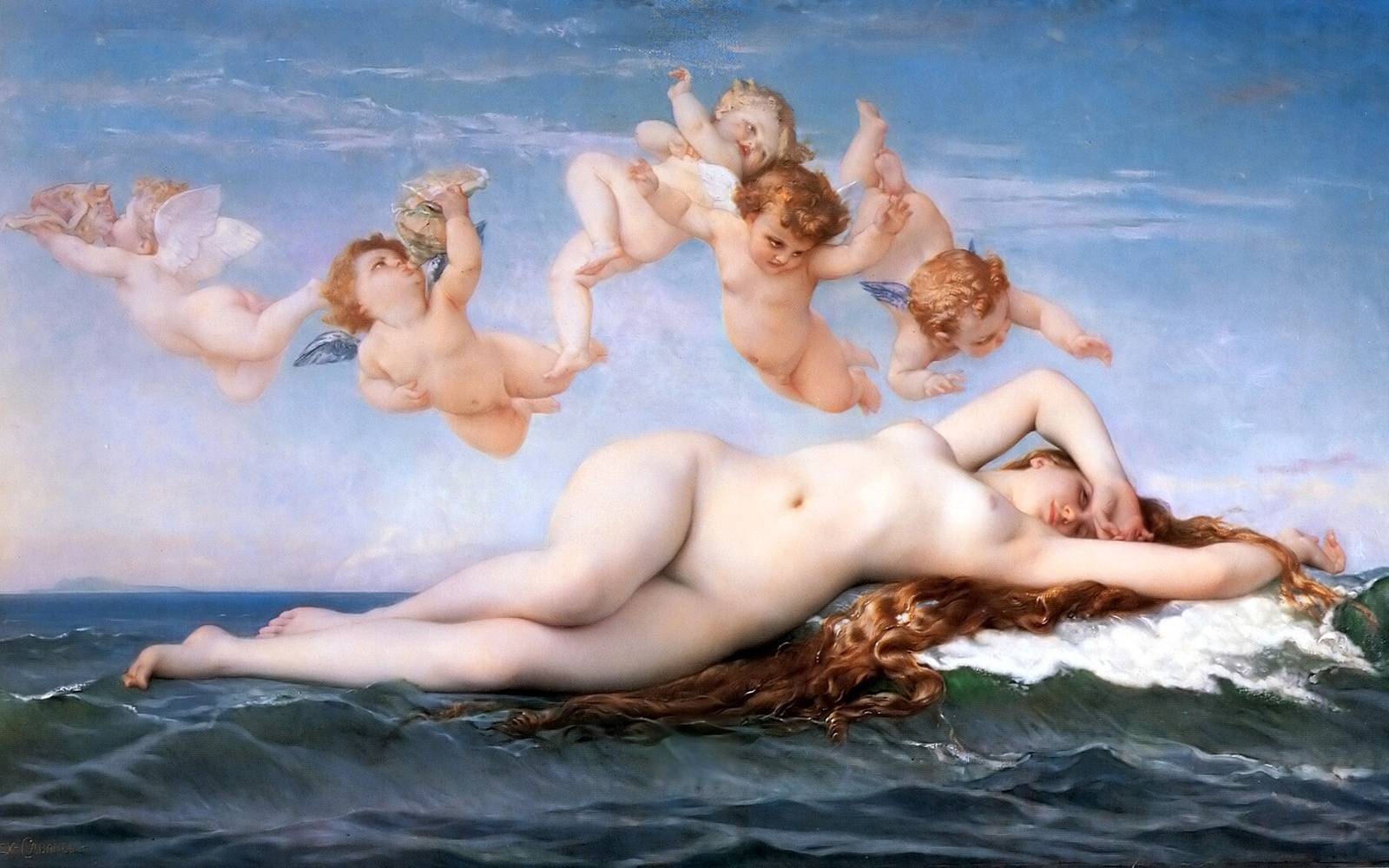
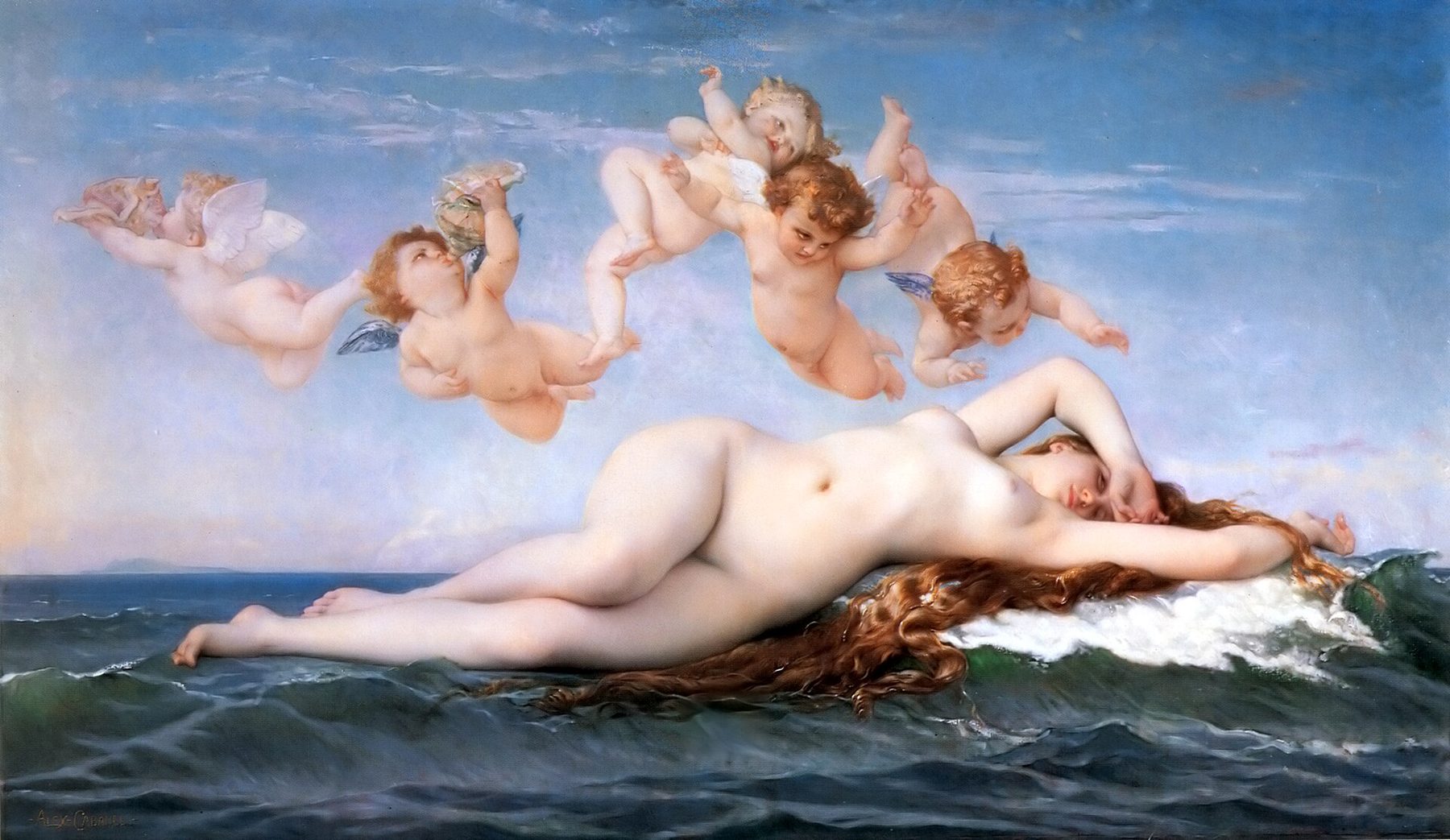
Image reference: Alexandre Cabanel's The Birth of Venus, 1863.
At a Glance
- What it isPainting first shown at the official Paris Salon, especially the large public exhibitions of the eighteenth and nineteenth centuries
- Core periodApproximately 1737–1890, with a particular concentration of influence between the Revolution and the early Third Republic
- Main centreParis, first at the Louvre and later in purpose-built exhibition palaces
- Known forAmbitious scale, legible subjects, highly developed figure drawing, narrative drama, technical finish and competition for public attention
- Not one styleNeoclassicism, Romanticism, Realism, Academic Art, Orientalism, Naturalism and early modern painting all passed through Salon walls
- Central tensionThe Salon broadened public access to contemporary art while distributing opportunity through juries, unequal training and state power
Contents
- Where it fits
- A place becomes an institution
- How artists entered
- The crowded wall
- Four stages
- Artists to know
- Essential works
- Gérôme
- Where to see
- Artist directory
Where Salon Painting fits
Rosa Bonheur
Principal activityAlexandre Cabanel
Principal activityJean-Léon Gérôme
Principal activityWilliam-Adolphe Bouguereau
Principal activityÉdouard Manet
Principal activityFrederic Leighton
Principal activityJules Bastien-Lepage
Principal activityPascal-Adolphe-Jean Dagnan-Bouveret
Principal activitySalon painting is easier to recognise than to define. It brings to mind enormous canvases, immaculate bodies, antique stories and rooms packed from skirting board to cornice. Yet the term originally describes where a work entered public life, not how it looked. A Salon painting was first exhibited at the official Paris Salon; it was often academic because the same institution connected training, prizes, commissions and patronage, but the category included many subjects and manners.[1] The Salon showed polished mythologies and disruptive modern scenes, animal painting and Orientalist spectacle, portraits, landscapes, Naturalism and works by artists later claimed for the avant-garde.
That variety matters. For much of the nineteenth century, the Salon was the most powerful recurring encounter between living artists and a large French public. It could turn months of private labour into a numbered entry, a prominent or disastrous wall position, a newspaper controversy, a state purchase and an international sale. The British Royal Academy operated a comparable annual exhibition and school, but Paris developed its own mixture of bureaucracy, mass entertainment and critical combat.[2] To understand Salon painting is therefore to study an ecosystem: how artists were trained, how juries chose, how pictures competed on crowded walls, how critics narrated the contest and how dealers carried its winners abroad.
A place becomes an institution
The word Salon came from a room. Members of the Royal Academy of Painting and Sculpture displayed work in the Louvre's Salon Carré, a high, ceremonially important gallery whose name became attached to the exhibitions themselves.[3] [4] The Academy had been founded in 1648; its first exhibition took place in 1667. Shows moved through several Louvre spaces before returning regularly to the Salon Carré from 1737. They were not yet the sprawling nineteenth-century events, but they established a durable relationship among official artists, the state, a catalogue and a visiting public.[5]
The Academy did more than arrange a show. It regulated professional status, taught an inherited theory of art and ranked subjects according to the intellectual labour they supposedly required. The official route led through drawing, anatomical knowledge, composition, competitions and, for a few men, the Prix de Rome. History painting stood at the top because it could unite bodies, passions, literature and moral action; portrait, scenes of daily life, landscape, animal painting and still life occupied progressively lower places.[6] [7] This hierarchy never perfectly described what viewers enjoyed or buyers wanted, but it influenced instruction, jury judgment and the scale of public ambition.
By the later eighteenth century, the exhibition was also producing a new kind of audience. Visitors did not simply receive the Academy's verdict. They argued, compared, laughed, admired and read. Printed Salon criticism made contemporary art a recurring public controversy. The spectacle of many works seen at once encouraged writers to construct winners, failures, tendencies and scandals. A painting's reputation could therefore be made through a verbal image circulated far beyond the people who stood before it.
The Revolution altered access. The open Salon of 1791 was much larger than its predecessors, and the Royal Academy was abolished in 1793. Successive governments rebuilt official artistic institutions in different forms, however, because art remained useful to national prestige, public education and political commemoration. The nineteenth-century Salon was not a simple survival from monarchy. It was repeatedly reorganised under republic, empire and restored monarchy, each regime inheriting the useful idea that a public exhibition could identify merit and represent France.
How an artist entered the system
The familiar academic surface began long before paint reached the exhibition canvas. A student might enter a private atelier while trying to gain admission to the École des Beaux-Arts. Training privileged drawing: copies after prints and casts, study from antique sculpture, anatomy and finally the living model. Competitions tested increasingly complicated tasks. The most prestigious prize sent selected painters and sculptors to the French Academy in Rome, where pensioners copied antique and modern masters and completed prescribed works over several years.[8] [9]
This process encouraged planning. A large history painting could begin with small compositional sketches, continue through separate studies of heads and limbs, move to a more resolved painted study or full-scale cartoon, and only then develop through layered colour. “Finish” was not merely an absence of visible brushmarks. It was the result of decisions about contour, transition, texture, focus and the amount of preparatory labour a surface would reveal. Some pictures suppressed nearly every sign of making; others used selective looseness around a sharply described figure. The Salon contained both.
The system was demanding even for a well-connected man, and it was structurally unequal. Women were excluded from free study at the École des Beaux-Arts until 1897. For much of the century, they lacked equivalent access to nude models, the Prix de Rome and the state networks that converted advanced training into monumental commissions.[10] Private schools offered alternatives, but at a price. At the Académie Julian, women paid more and studied separately. Marie Bashkirtseff entered that world in 1877 and began exhibiting at the Salon in 1880; her career shows how the exhibition could supply recognition even while the route toward it remained unequal.[11]
Women did not form a marginal footnote to Parisian art. Painters arrived from Britain, Scandinavia, Russia, the United States and elsewhere to use museums, ateliers, private academies and the Salon as an international proving ground.[12] Some concentrated on portrait, landscape or genre partly because the figure training needed for grand history painting was restricted. Others challenged those boundaries directly. Their presence makes two questions inseparable: who was allowed to master the conventions of public art, and who was represented within them?
A crowded wall changes a picture
Imagine a Salon picture before it entered a modern museum. It did not hang alone on a pale wall with an explanatory label. Thousands of works filled vast galleries, often frame against frame from near the floor to high above the viewer. Artists competed not just for acceptance but for position. A painting placed near eye level—“on the line”—had an advantage; one sent high up the wall could be “skied” and become difficult to inspect.[13] [14] [15]
That setting rewarded immediate intelligibility. A forceful silhouette, a broad light-dark division, brilliant colour, an arrested climax or a monumental size could make a work readable across a crowd. Yet attention alone was not enough. A picture also needed to survive the closer examination of jurors, critics, collectors and fellow artists. Salon painting consequently oscillates between billboard and cabinet: it must call from a distance and then prove itself in skin, fabric, gesture, accessory and expression.
The printed livret gave order to visual excess. A visitor could match a number on the frame to an artist, title and address, while critics used the same catalogue to organise reviews. Medals, honourable mentions and state purchases created another ranking. An established artist could gain privileges, including exemption from repeated jury review. A newcomer might spend years submitting, being refused and trying again. There was no single, unchanging jury, but the structure gave a small group extraordinary influence over visibility.
In 1863, the power became unusually visible. Roughly three thousand of five thousand submitted works were rejected. Napoleon III responded to complaints by authorising a separate Salon des Refusés in part of the Palais de l'Industrie. That episode did not abolish the official Salon, which continued to dominate careers and crowds. Instead, it demonstrated that selection itself could become spectacle. By the 1880s, alternative societies and catalogues multiplied: the Union des Femmes Peintres et Sculpteurs, Salon des Indépendants and Société Nationale des Beaux-Arts each offered a different answer to the official model.[16]
Later histories often turned this complicated field into a boxing match between the Salon and the avant-garde. The Refusés became the moment of liberation, while every accepted painting was made to represent institutional failure. The conflict was real, but the binary is too neat. Research into exhibition culture shows that official and oppositional identities were produced in relation to one another; the Salon was the stage on which “advanced” art became legible as such.[17]
Follow salon painting through four stages
–1862
The Salon becomes a mass public spectacle
Large venues, dense hanging, illustrated criticism and international commerce reward scale, legibility and technical authority across many genres.
–1865
Selection itself becomes the spectacle
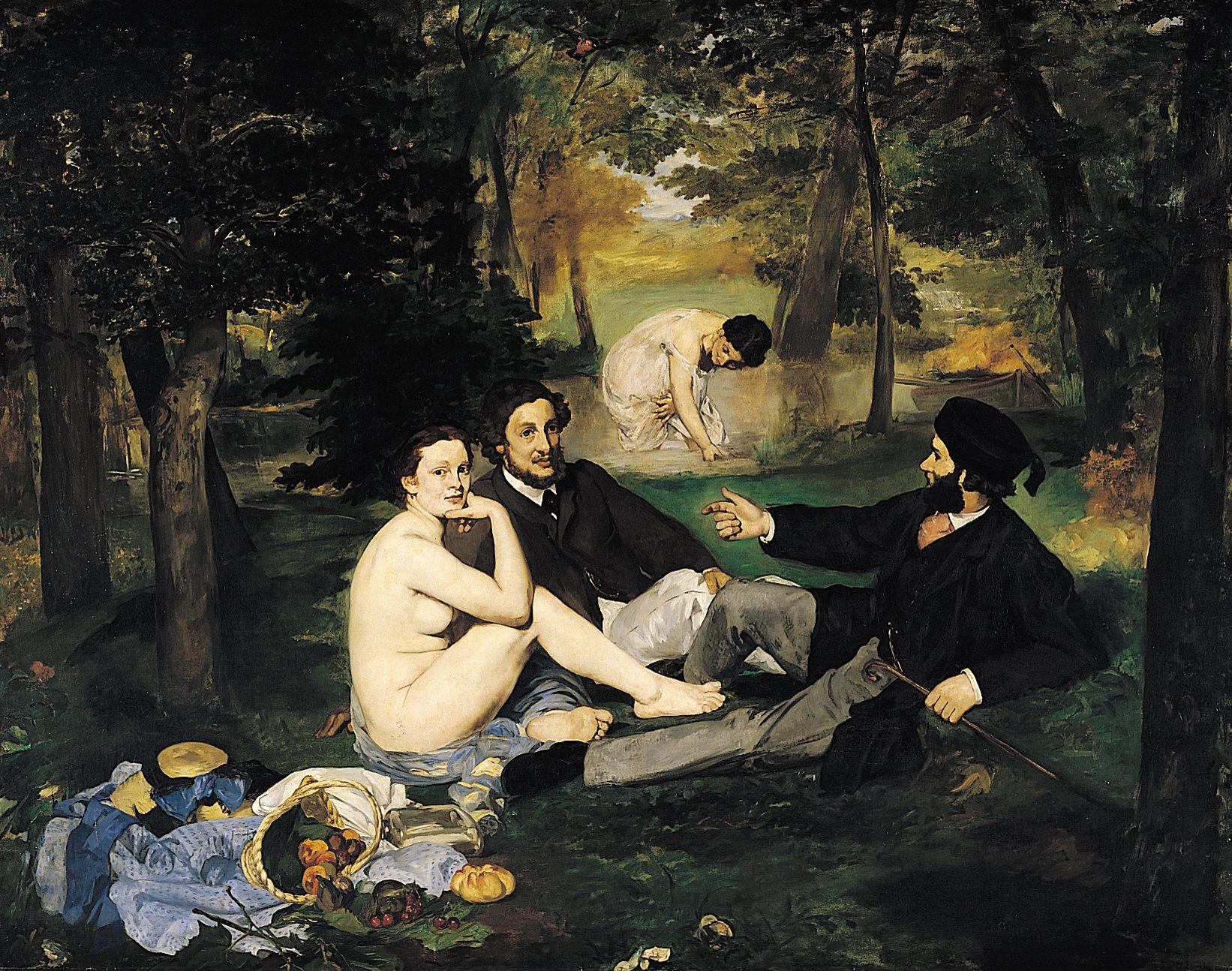
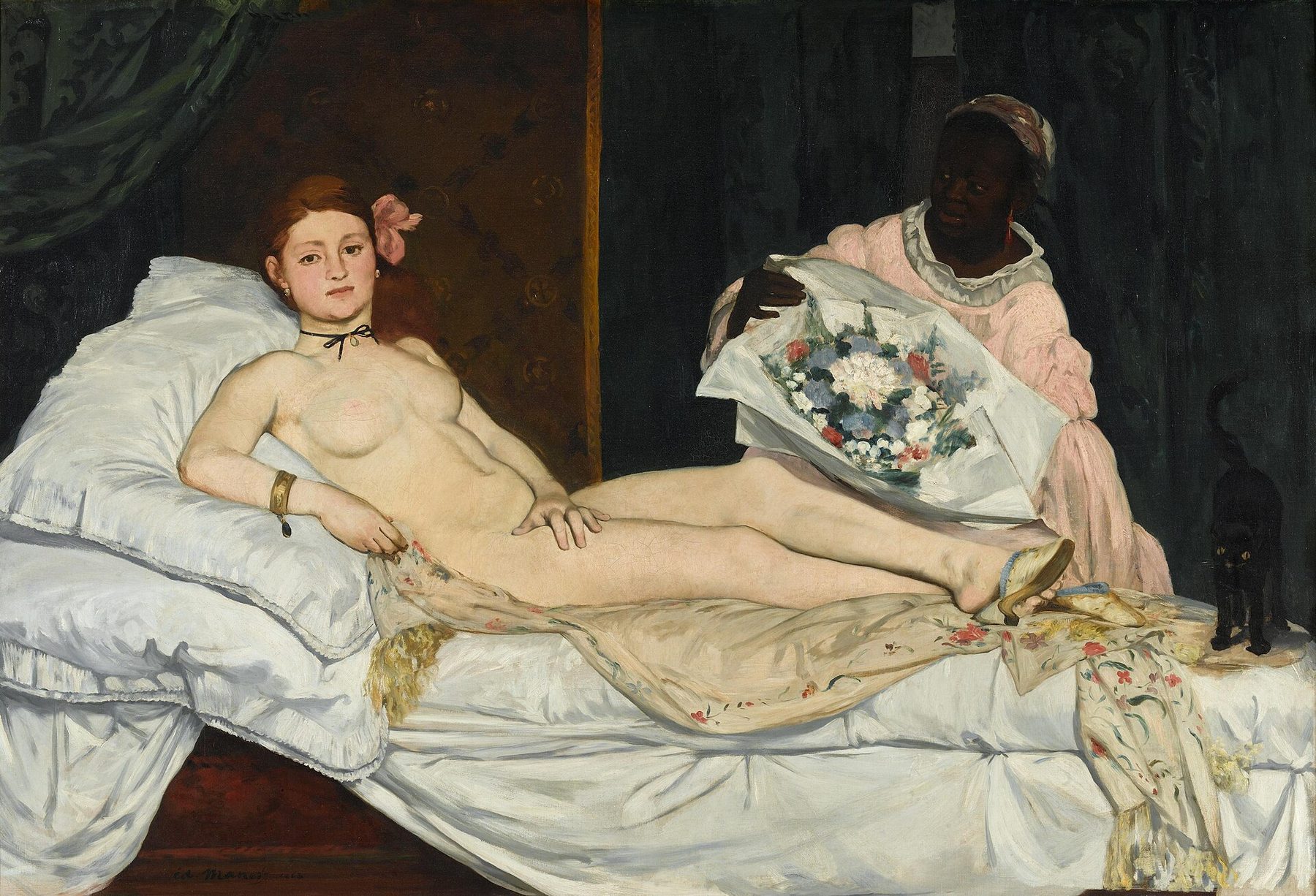
Cabanel's official success, Manet's rejection and Olympia's later acceptance reveal a porous boundary between institutional prestige and disruption.
–1874
Spectacle connects to an international market
Gérôme and Bouguereau combine finish, narrative and reproducible motifs as dealers and collectors carry Salon reputation far beyond Paris.
–1890
Naturalism and rival institutions pluralise the field
Photography, location research, independent exhibitions, artist societies and private galleries end the Salon's near-monopoly without ending Salon painting.
Critics, crowds and the state
The Salon's power rested partly on repetition. It returned on the calendar, gathered an extraordinary quantity of new work and supplied the press with a common subject. A visitor might go once for fashion, celebrity or social spectacle and again to compare judgments. The same picture could be encountered through a catalogue notice, a hostile caricature, a long critical essay and a reproduction in a shop window. Reception accumulated in public rather than issuing from one authority.
By the 1860s, newspapers treated the exhibition as major news. The Salon drew writers who disagreed about the proper relation among drawing, colour, subject and contemporary life. Some defended the grand tradition; others used particular works to demand an art of the present. Criticism was not a commentary added after painting. Artists anticipated it. A provocative title could guide interpretation, a quoted poem could dignify a nude, and a topical subject could enter a political dispute before a reviewer described the brushwork.
The size of the audience made those arguments consequential. In the later Second Empire and early Third Republic, the annual exhibition could attract close to half a million visitors. Thousands of paintings, sculptures and works on paper appeared under one roof, and major newspapers devoted extensive attention to them.[18] The crowd was socially mixed, although leisure, literacy and proximity still shaped access. A public exhibition did not create equal expertise, but it made living art something people could dispute without owning it.
That accessibility coexisted with state management. Government offices could purchase works, award commissions and encourage subjects useful to public memory. A medal might improve an artist's position in later juries and reassure clients. An official purchase could place a painting in a ministry, town hall, church or museum, attaching national value to the jury's recognition. In this system, aesthetic judgment and administration were intertwined, yet officials did not control every response. The public could mock a purchase, critics could condemn a medal winner, and a scandal could make a rejected work more famous than an accepted neighbour.
Political regimes used the Salon differently. The Second Empire favoured splendour and cultural authority, but its exhibitions also contained social observation, religious revival, landscape and competing versions of modern life. The event's thousands of submissions and viewers made it a spectacle of abundance rather than a single visual programme.[14] Even imperial patronage did not produce complete uniformity. Napoleon III could purchase Cabanel's Venus and authorise the public display of rejected works in the same year. Those decisions served taste, legitimacy and crowd management at once.
Critics helped viewers navigate the excess, but they also created durable distortions. A brilliant insult could cling to an artist after the work vanished from sight. The mocking label pompier—often associated with academic history painting—compressed different painters into a type of inflated official art. Conversely, praise for sincerity or modernity could make a work seem independent of the institutions that trained, admitted and publicised its maker. Critical language did not merely reveal categories; it manufactured them.
Caricature supplied another form of close reading. Draftsmen exaggerated the stiff pose of a hero, the pearly flesh of a goddess or the anatomical oddity of an ambitious composition. Humour made specialised disagreement available to a broader audience. It could expose pretension, but it also taught spectators what to ridicule before they had considered the work. The Salon's history therefore belongs to visual satire as well as oil painting.
Artists could answer strategically. Some revised work after criticism, changed titles, sought a different jury, cultivated a sympathetic writer or exhibited privately before trying again. Others sent several pictures across genres, increasing the chance that one would gain favourable placement. A recognised master might enter a monumental public statement alongside smaller saleable canvases. The Salon encouraged artists to think in bodies of work and reputational sequences, not only isolated masterpieces.
The state, press and market were never perfectly aligned. A picture ignored by jurors could find a dealer; a medal winner might remain unsold; a critical scandal could attract curious buyers; a state purchase might later enter storage. This unevenness explains why the Salon could be dominant without being omnipotent. It concentrated opportunity but could not dictate the long afterlife of every object.
The catalogue preserved another kind of afterlife. Even when a canvas was destroyed, renamed or lost, its numbered entry could establish that it once competed, identify the address from which it was sent and connect it to an artist's developing record. Reconstructing an exhibition from these fragments changes the sample. It restores unsuccessful submissions and now-obscure reputations beside the few works museums retained. The Salon then appears less like a parade of agreed masterpieces than a temporary, imperfect survey of professional aspiration.
It also explains the anxiety surrounding each opening. Artists awaited acceptance, then placement, then reviews, then sales. Viewers entered a temporary map of contemporary ambition in which national history, private fantasy, religious belief, political trauma and technical display competed for the same attention. Calling the Salon conservative captures some jury choices but misses the intensity of this annual uncertainty. The institution was powerful precisely because its verdict was public, consequential and never fully secure.
Salon Painting artists to know
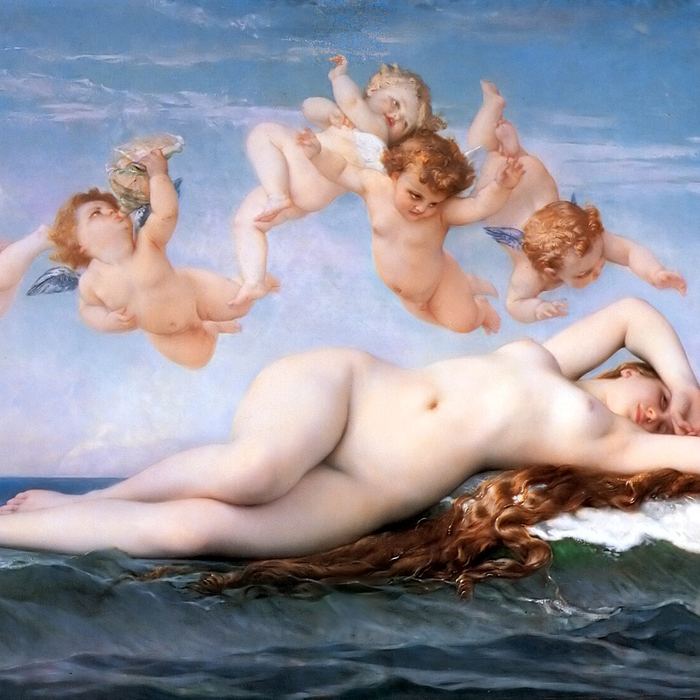
Alexandre Cabanel
Cabanel joined controlled figure drawing and silky modelling to subjects that could command official approval, elite patronage and mass attention.
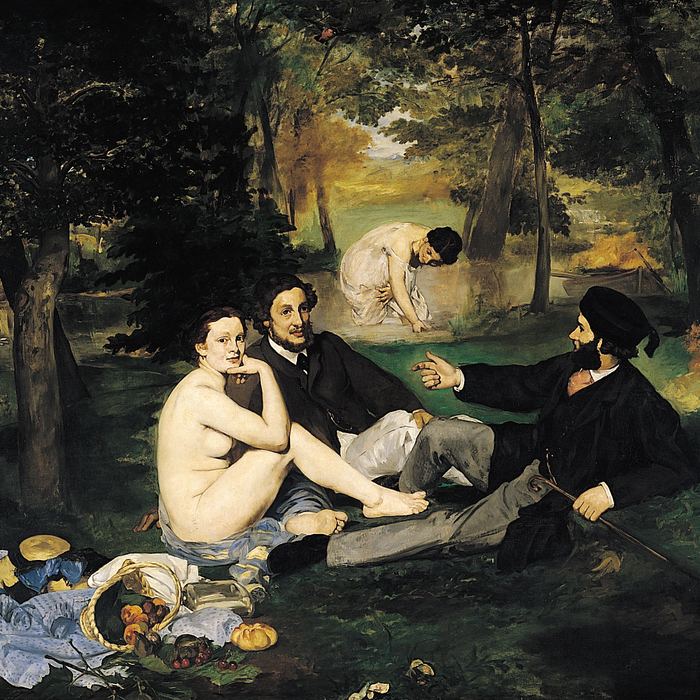
Édouard Manet
Manet used inherited compositions to make modern looking socially explicit, proving that rejection, acceptance and scandal crossed the Salon's borders.
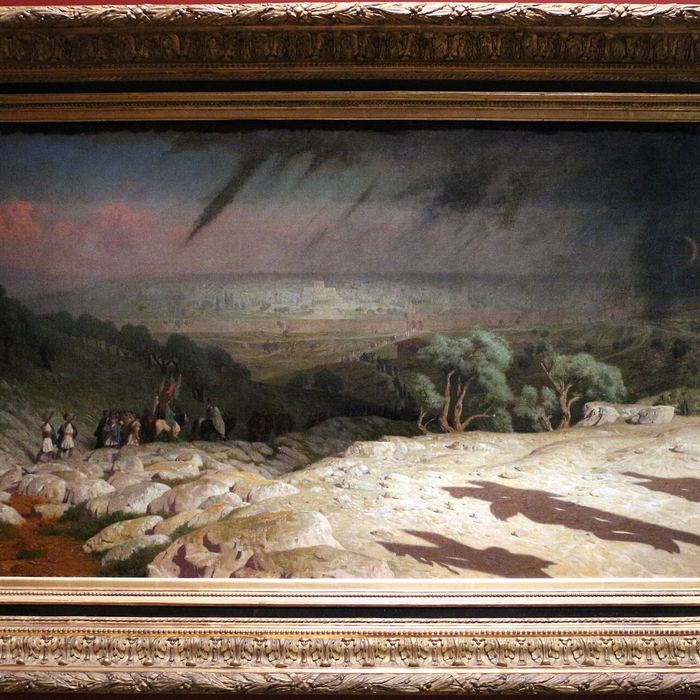
Jean-Léon Gérôme
Gérôme combined research, travel, photographs and studio invention in surfaces whose precision made imagined viewpoints feel witnessed.
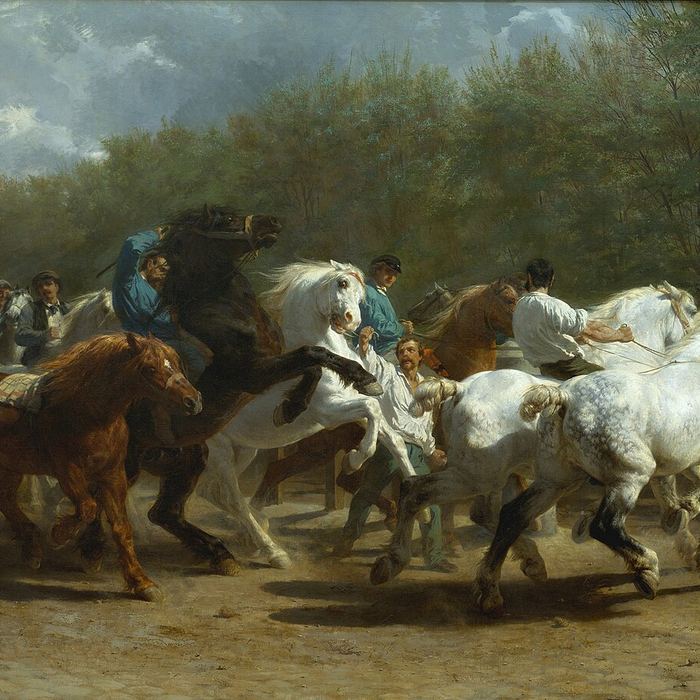
Rosa Bonheur
Bonheur converted sustained observation at a modern market into a monumental challenge to the academic hierarchy of genres.
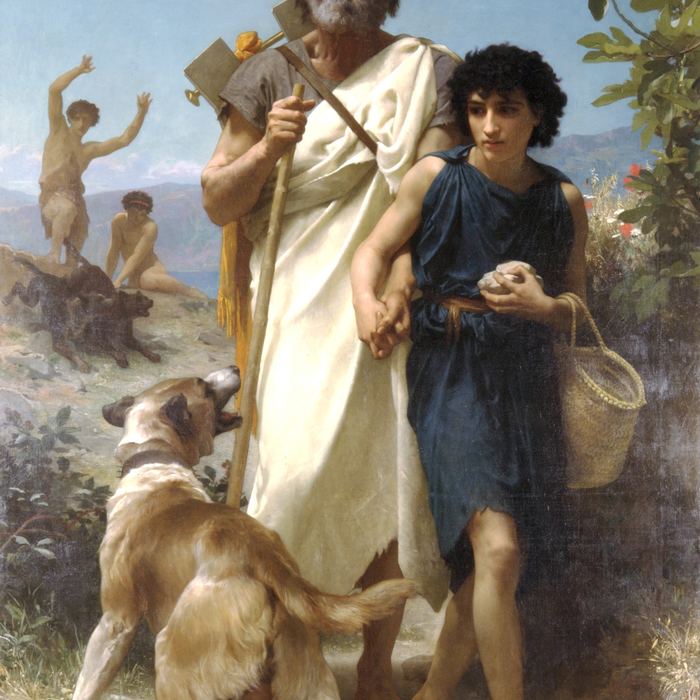
William-Adolphe Bouguereau
Bouguereau's apparently effortless surfaces depended on extensive drawing and revision, while replicas and reproductions extended successful subjects.
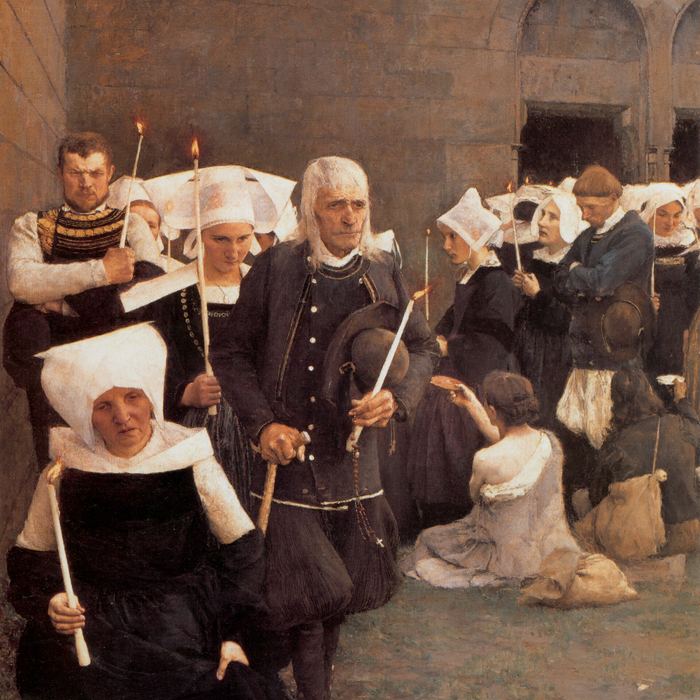
Pascal-Adolphe-Jean Dagnan-Bouveret
Dagnan-Bouveret joined location research, models, photography and refined paint handling to construct the authority of observed contemporary life.
1863: Cabanel inside, Manet across the corridor
No comparison has done more to shape the Salon's reputation than that between Alexandre Cabanel and Édouard Manet in 1863. Cabanel's The Birth of Venus appeared at the official exhibition and was bought by Napoleon III. Manet's Le Déjeuner sur l'herbe, then titled Le Bain, was rejected and became the chief scandal of the Refusés. It is tempting to see two sealed worlds: beauty and repression on one side, truth and freedom on the other. The pictures become more revealing when treated as rival answers to the same problem of the nude.
Cabanel stretches Venus almost the full width of a horizontal canvas. She lies on a thin ridge of sea foam, a body supported by an element that should not bear weight. Her arms curve above and across the head, hiding the forehead while framing closed eyes and parted lips. The pose makes the goddess seem asleep, newly awakened and knowingly displayed at once. Putti hover above with shells and breath; the mythological title turns an erotic body into the origin of beauty.[21]
The technical language is crucial. Pearly flesh shifts through extremely gradual values. Contours soften into the waves without losing anatomical coherence. Brushwork becomes difficult to isolate, so the body appears to arrive as a continuous luminous surface rather than as accumulated paint. A smaller 1875 version preserves the qualities museums identify with academic art: classical mythology, graceful modelling, silky handling and perfected form.[22] The 1863 catalogue entry also located Cabanel within a hierarchy of honour. His awards and status gave the work institutional weight before any visitor formed an opinion.[23]
Manet's picnic also depends on old art. The central grouping recalls an engraving after Raphael, while the broader theme evokes a Venetian pastoral then associated with Giorgione. What disturbed viewers was not ignorance of tradition but its collision with the present. A naked woman sits among clothed modern men without the alibi of goddess, nymph or allegory. Abrupt contrasts replace smooth modelling; figures and landscape refuse the expected integration; the woman's direct look reverses the fantasy of an unobserved body.[19]
The official success and the rejection thus reveal different uses of inheritance. Cabanel naturalises erotic display by placing it outside ordinary time. Manet makes the inherited composition socially immediate and returns the viewer's looking as a problem. But neither picture can stand for an entire exhibition. The official Salon of 1863 contained many kinds of work, and the Refusés contained many forgettable ones. Their afterlives were shaped by later collecting as much as by first reception.
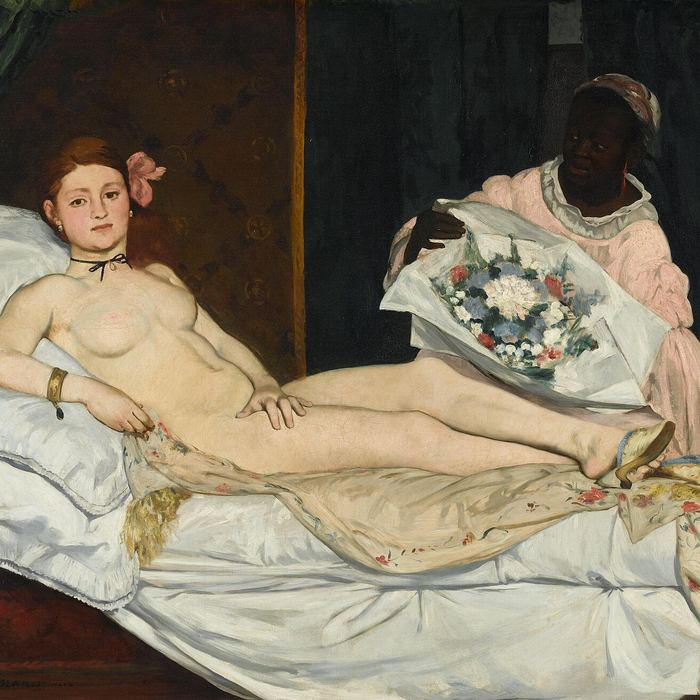
The Salon was not incapable of admitting a challenge. In 1865, Manet's Olympia was accepted and attacked by critics and visitors. Its reclining nude refers to Titian but replaces the distant goddess with a named modern woman, a servant presenting flowers and a black cat at the bed's edge. Admission did not mean approval; scandal could happen inside the institution.[20] Manet continued to seek Salon visibility because no rival offered a comparable public. The porous boundary is more historically useful than a story in which modern painting simply walked out in 1863.
Gérôme and the manufacture of eyewitness truth
Jean-Léon Gérôme understood how a picture could control a crowd. His art joined archaeological detail, sharply staged action and surfaces that seemed to leave no gap between object and representation. He travelled, collected props, used photographs and studied historical sources, but he also combined places, costumes and narratives. The precision of a sandal or wall could persuade viewers that the whole scene was documentary.[24]
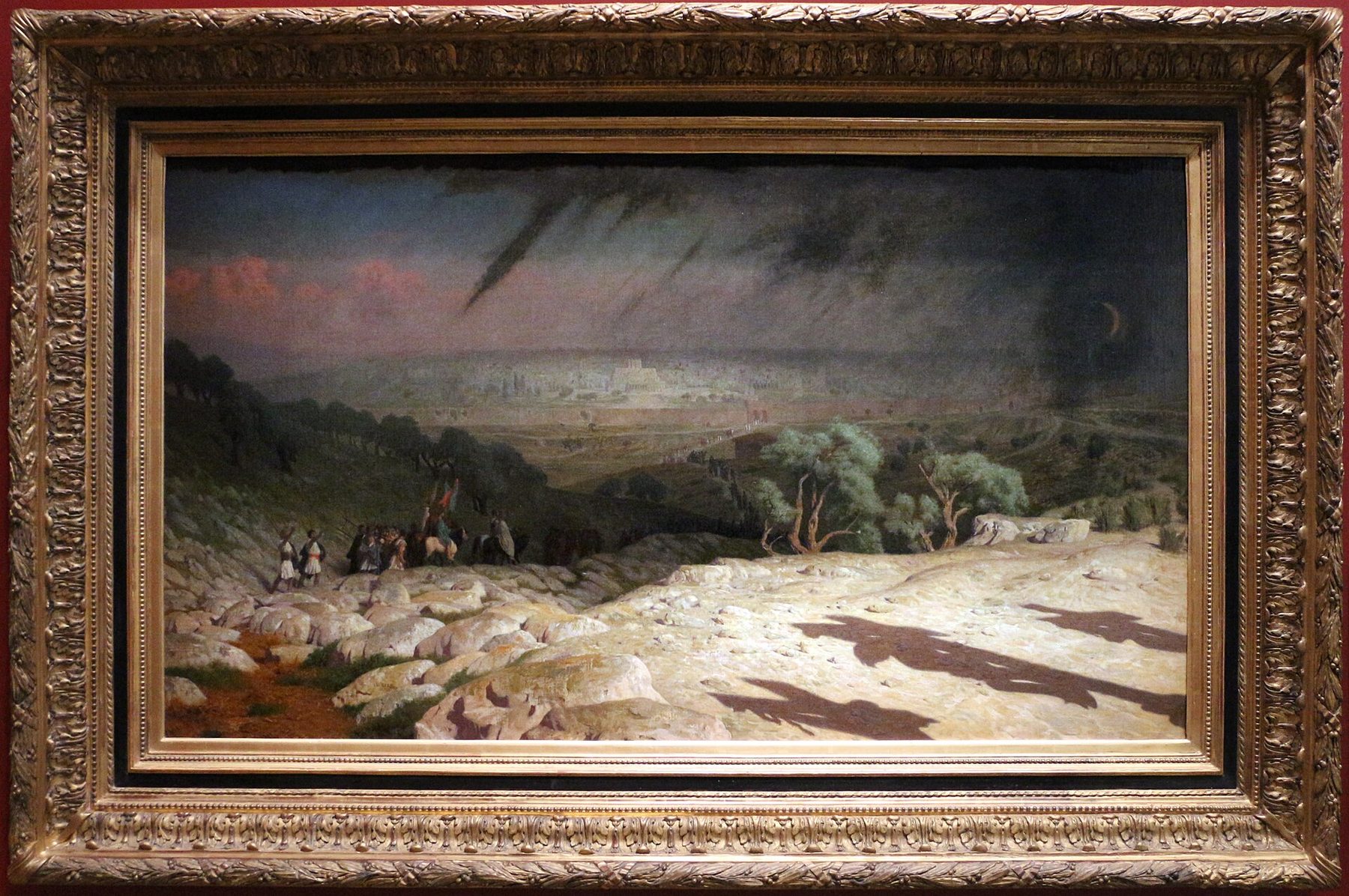
Jerusalem, shown at the Salon of 1867, is a striking example because its central event is absent. The Crucifixion lies outside the frame. Three long shadows cut across a stony foreground; soldiers and spectators retreat toward the distant city; the sky darkens above an apparently measured landscape. Rather than show Christ's body, Gérôme gives evidence of it. The viewer stands close enough to occupy the execution ground and late enough to witness the crowd dispersing.[25]
This is visual ellipsis designed for a competitive wall. From a distance, the diagonal shadows and luminous horizon establish the structure. Up close, topography and costume invite the eye to test plausibility. The picture's authority comes from a productive contradiction: it withholds the sacred spectacle while using material detail to make an imagined viewpoint feel witnessed.
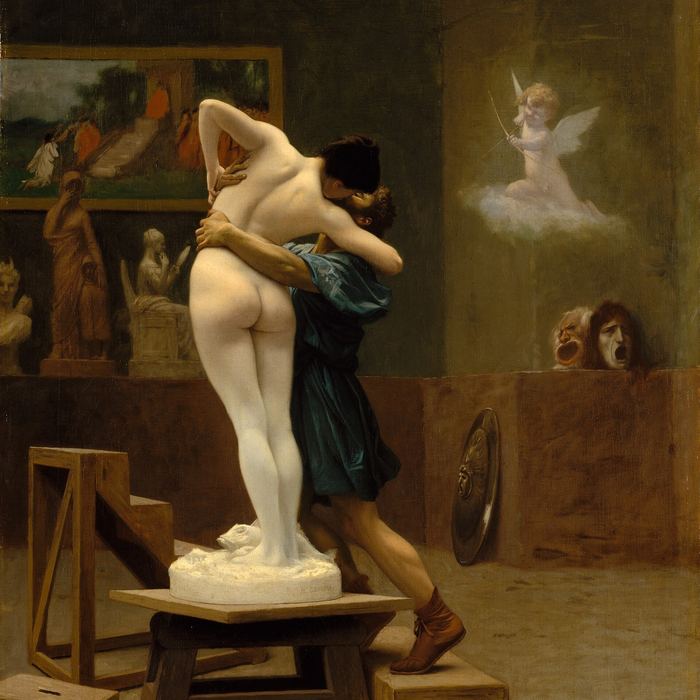
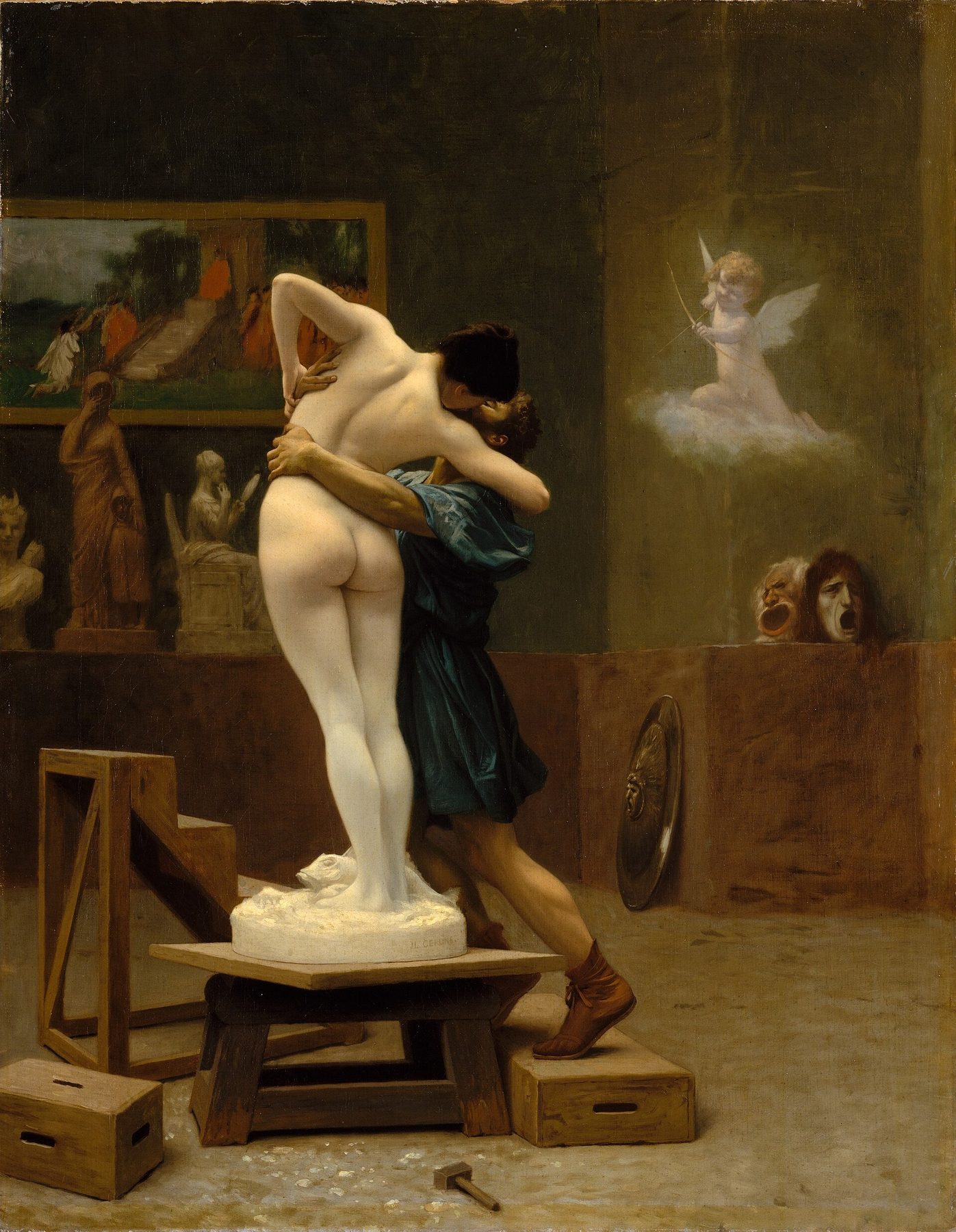
Gérôme repeatedly crossed painting and sculpture. In versions of Pygmalion and Galatea, the sculpted woman comes alive under the artist-lover's kiss. Painted variants rotate the couple as though the spectator were walking around a three-dimensional group.[26] The myth dramatises what Salon illusion promised: inert material transformed into a body so convincing that desire mistakes art for life.
That promise also gives Gérôme's Orientalist paintings their problem. Travel and photography could support specificity, but Western audiences often received composite scenes as transparent knowledge of North Africa or the Middle East. A smooth surface concealed the joins among observation, studio reconstruction, commercial fantasy and colonial expectation. The issue is not that every detail is false. It is that exact detail can lend unequal power the appearance of neutral sight.
The dealer Goupil helped turn that sight into a commodity. Gérôme's Intérieur grec, shown in 1850–51, joined the fashionable Neo-Greek taste to a circulation system of paintings and reproductions.[27] Small images, prints and later photographs carried spectacular antiquity and Orientalist scenes to buyers who never entered the Salon. The finished surface was therefore not only an exhibition language; it translated effectively into reproducible, internationally recognisable motifs.
Rosa Bonheur enlarges animal painting
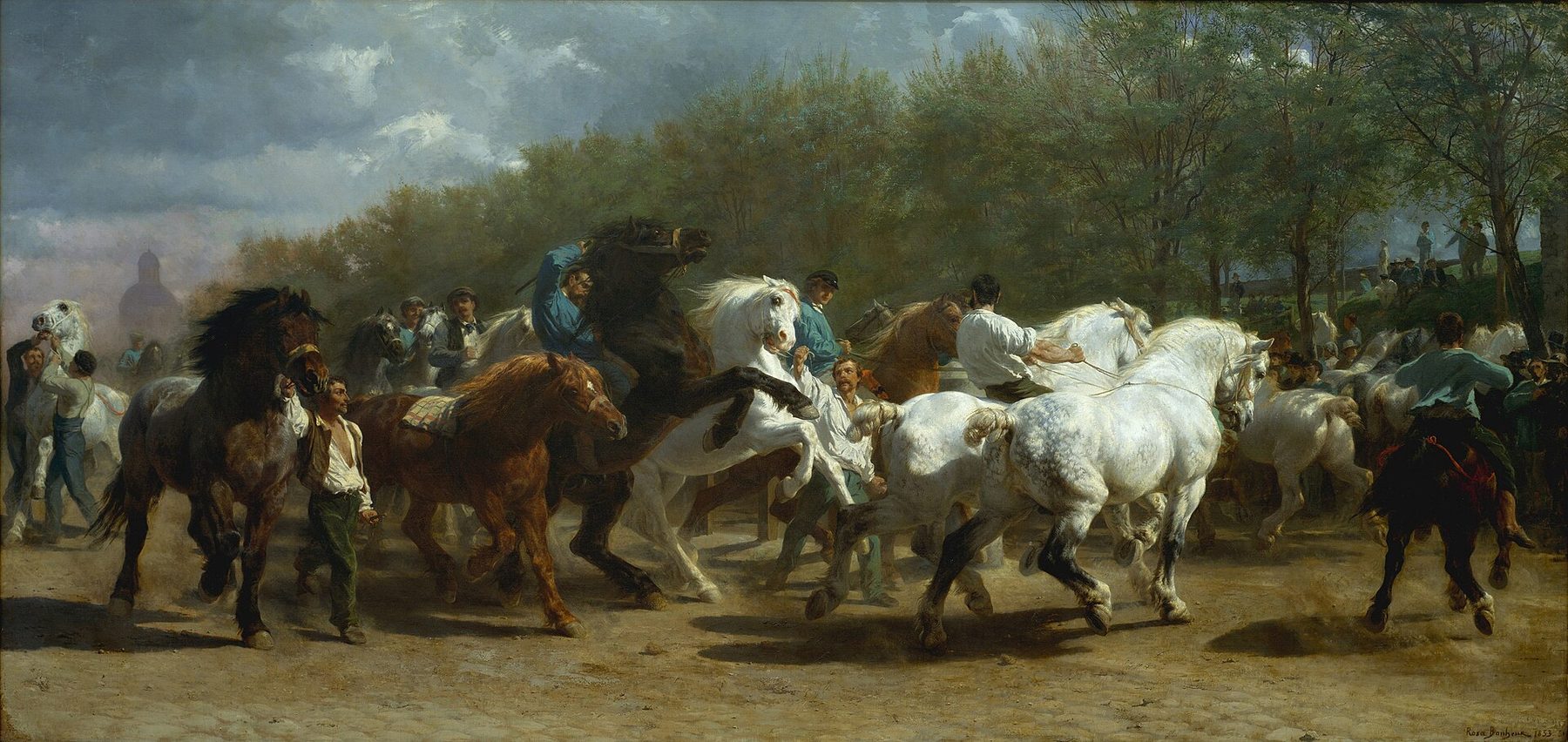
The genre hierarchy placed animal painting below history, but Rosa Bonheur refused the implied scale of that rank. The Horse Fair is more than five metres wide. It shows handlers driving horses around the Paris market near the Salpêtrière, an ordinary commercial site expanded into a public epic.
Bonheur visited the market repeatedly for about eighteen months, drawing animals in motion and wearing trousers so that she could work without attracting the same attention conventional women's dress would have brought. She began the canvas in 1852 for the Salon of 1853, then revised it.[28] The research produced neither a frozen diagram nor a casual street impression. White, grey and black horses surge in a circular movement; handlers lean, pull and ride; hooves disturb the ground while the long building on the left fixes the action in modern Paris.
The canvas borrows authority from antique frieze and Romantic horse painting. Those references are not ornamental. They allow a contemporary animal market to claim the bodily force and formal coherence associated with the grand manner. Its success at the 1853 Salon demonstrated that subject rank could be renegotiated through scale, preparation and intensity.[29]
Bonheur's career also reveals why “official” and “commercial” cannot be separated. The dealer Ernest Gambart acquired and toured The Horse Fair in Britain; the artist's work entered ledgers, reproductions and international collections. She sustained a long professional practice rather than disappearing after a single institutional victory.[30] By the time Cornelius Vanderbilt gave the vast picture to the Metropolitan Museum in 1887, Salon prestige had become part of a transatlantic story.
Gender shaped that achievement without fully explaining it. The market visit required practical negotiation of clothing and public space; academic structures restricted women's access to the highest training. Yet Bonheur did not succeed by imitating a masculine history picture. She made concentrated animal observation carry monumental form. The result exposes the hierarchy's contingency: a supposedly lower genre could command the room when an artist altered its scale and rhetoric.
Bouguereau: finish, feeling and repetition
The name most often used as shorthand for Salon finish is William-Adolphe Bouguereau. His paintings can look effortless, but technical study points in the opposite direction: careful drawing, compositional preparation, revisions hidden beneath the final surface and, for popular subjects, authorised replicas.[34] The invisibility of labour was itself laborious.
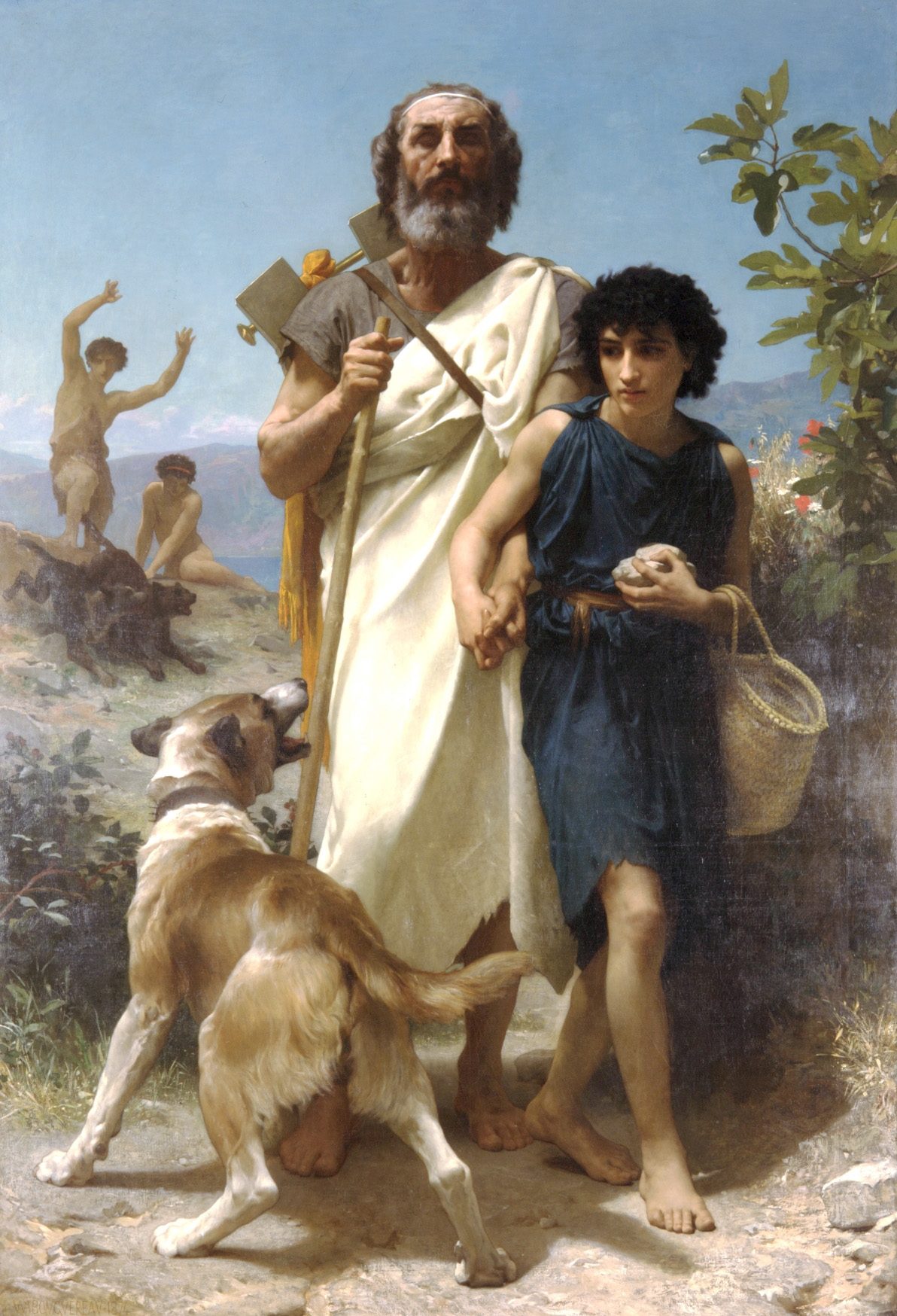
Homer and His Guide, shown at the Salon of 1874, presents the blind poet walking with a youthful guide. Classical subject, balanced grouping, crisp contour and almost imperceptible brushwork made it exemplary of the academic language most associated with the exhibition.[33] Yet the painting did not arrive from a timeless Greece. It competed in the same Paris season as the first independent Impressionist exhibition, amid recovery from war and the Commune. Its quiet image of cultural transmission was as historically situated as a boulevard or railway scene.
Bouguereau's rural subjects reached a wide international market. Breton Brother and Sister was composed in the studio from studies made during travel in Brittany. The children's clothes and setting signal region, but the faces and relation are idealised for buyers who wanted innocence rather than an account of rural hardship.[35] A similar tension runs through his mothers and children. Seamless modelling can create convincing tenderness while isolating the family from political conflict, urban change and the material conditions of care.[38]
The academic nude was both a demonstration and a social arrangement. A work such as Seated Nude makes precise modelling, controlled contour and transitions of light into evidence of professional command.[36] But life study was the stage of education from which women were long restricted. The nude body therefore did two jobs: it became a universal measure of artistic skill while helping preserve unequal access to the profession.
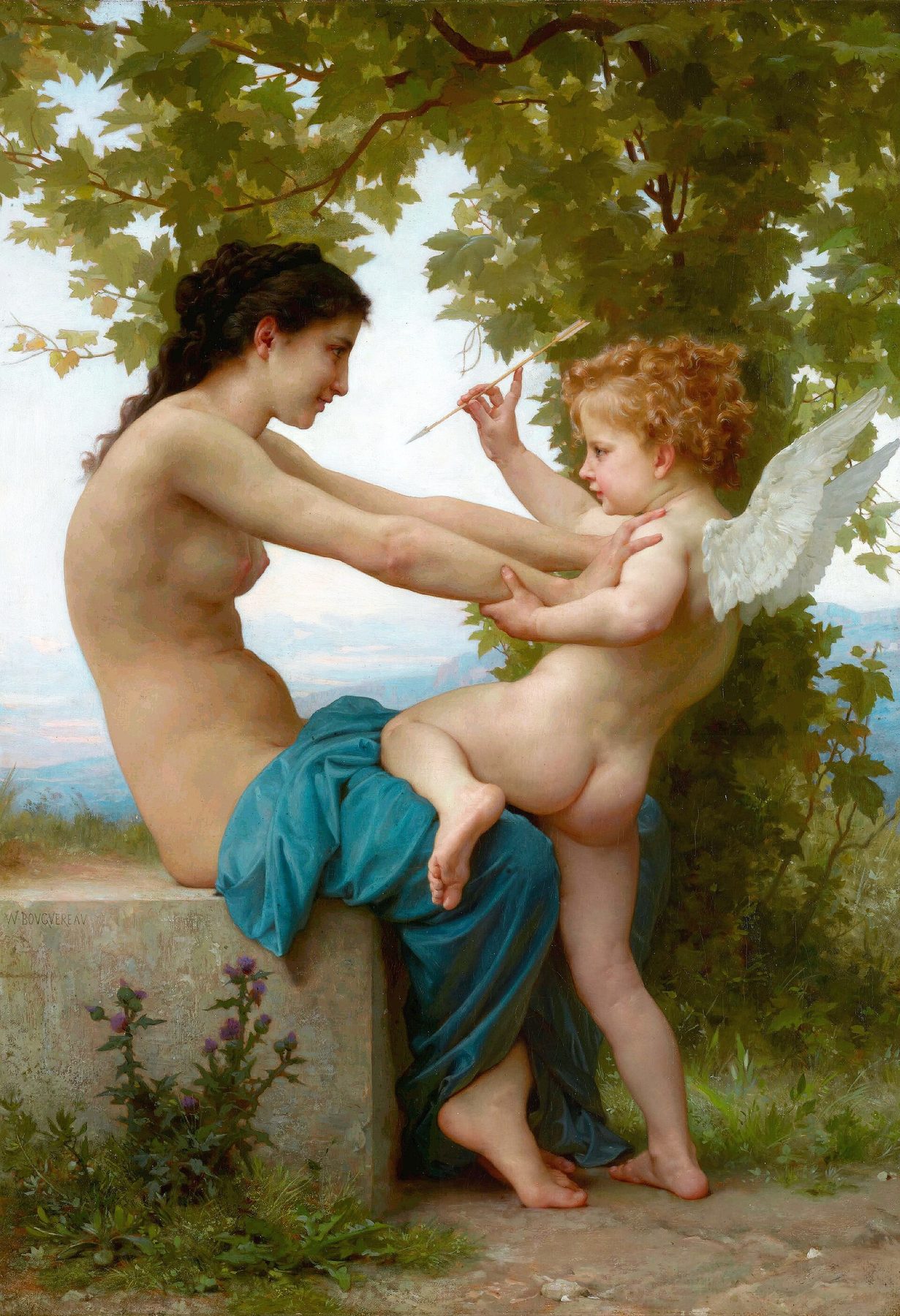
Mythological scenes converted that skill into a marketable eroticism. Bouguereau's A Young Girl Defending Herself against Eros survives in more than one version connected to a Salon picture of 1880.[37] Repetition was not necessarily mechanical copying. A successful subject could be resized or reworked for a new owner, and reproductions could expand its audience. The masterpiece economy—one unique work, one decisive exhibition—coexisted with a commercial economy of variants.
To look closely at Bouguereau is neither to dismiss finish as empty nor to treat technique as innocence. Drawing, modelling and glaze can be extraordinary achievements. They can also make idealisation feel inevitable. The useful question is what the technical control asks a viewer to accept: a mythological permission to look, a rural life without labour, a family without social friction, or a classical past without historical distance.
Naturalism changes the Salon from within
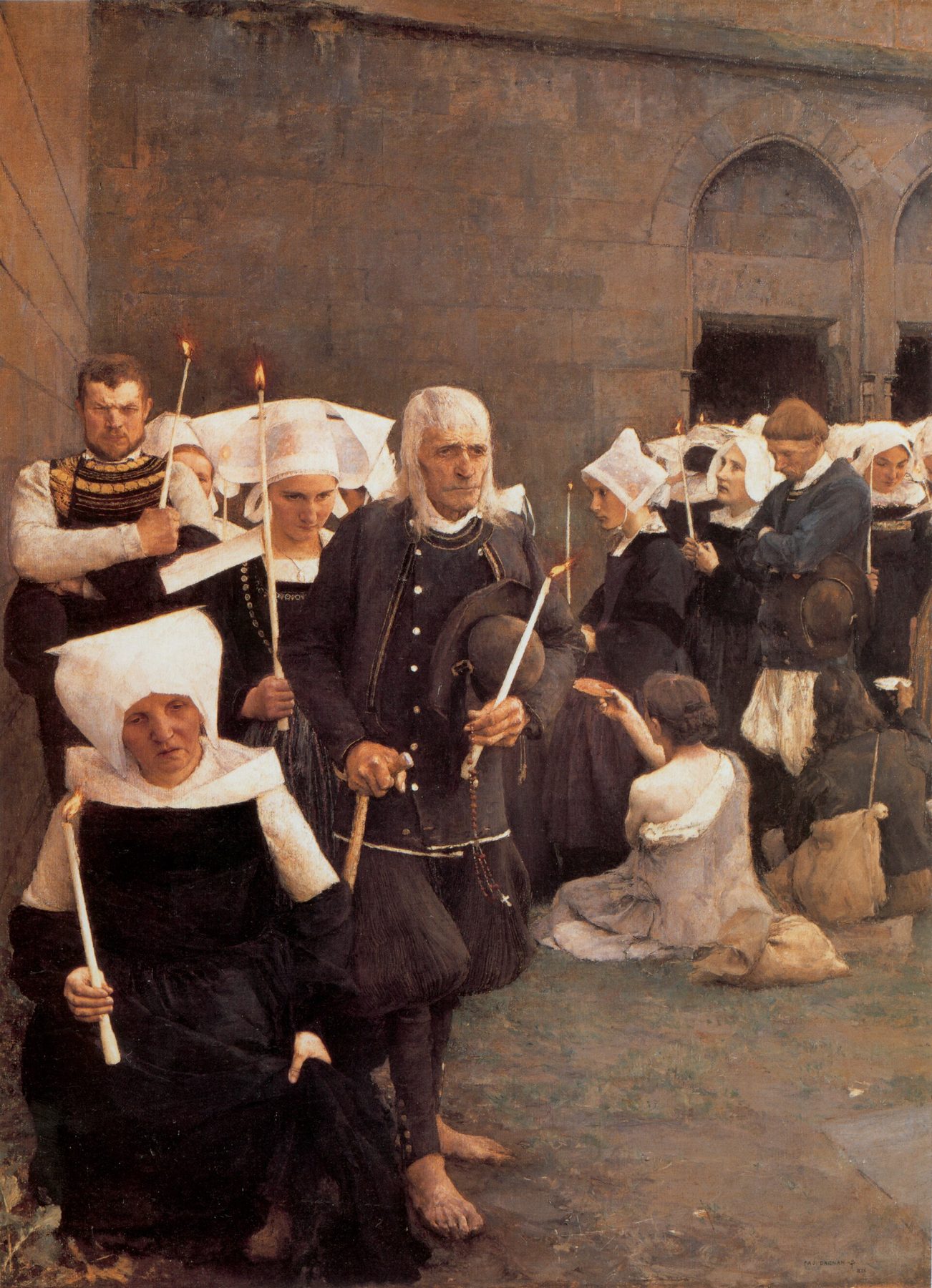
Late-century Salon painting did not remain frozen in Cabanel's Venus. Pascal-Adolphe-Jean Dagnan-Bouveret's The Pardon in Brittany, shown in 1887, represents a religious procession beside a church. Penitents in regional dress pass through cool, subdued light; cropped figures and an oblique route create the feeling that the viewer has encountered an unfolding event. Critics praised its exactitude, and the artist used photographs while preparing the composition.[31]
Research complicates that apparent immediacy. Some models were not Breton; studies were made in different places and media; the painter's wife posed for a prominent figure. The picture was assembled rather than captured.[32] That does not make it fraudulent. It reveals that photographic evidence, location study and studio direction could collaborate to manufacture naturalness.
The distinction matters because modern viewers often oppose academic invention to documentary observation. Dagnan-Bouveret belongs to both. His picture uses asymmetry, contemporary regional life and photographic aids while preserving deliberate composition and a refined surface. Salon Naturalism adapted new technologies and expectations from inside the juried system.
The Salon also admitted works later connected to Symbolism, experimental portraiture and modern urban life. Large-format history painting persisted, but scale no longer belonged to one doctrine. Today, the survival and display of these canvases create practical problems: works designed for enormous halls are difficult to store, conserve and show, which has helped shape what later audiences know.[45]
Dealers, replicas and international buyers
The Salon made reputations, but it was never the whole market. By the mid-nineteenth century, dealers could translate exhibition success into long networks of sale and reproduction. Goupil & Cie specialised in prominent Salon artists including Gérôme and operated through Paris, London, Berlin, Brussels, The Hague and New York. Paintings travelled with engravings and photographs that multiplied recognisable compositions.[39]
The firm's stock books matter because they replace vague claims of popularity with transactional evidence: purchase date, seller, buyer, price and movement through branches.[40] They show an industrialising art world in which dealers managed inventory, coordinated copies and matched subjects to national markets. The New York branch, later associated with Knoedler, met fortunes accumulated through railways, steel, mining and finance.[41]
This international demand changed production. A Paris medal could reassure an American collector; a Goupil reproduction could create desire for an original; a smaller replica could fit a private interior more easily than the Salon canvas. Artists became brands without ceasing to be skilled makers. The Salon supplied a public credential, while the dealer supplied duration, geography and repeat business.
Paris also trained foreign artists. Americans entered the École, Académie Julian and private studios because French credentials could establish a career at home. Their work was judged beside French submissions, reported by newspapers on both sides of the Atlantic and purchased by wealthy compatriots.[15] [49] The system spread methods of figure construction, jury strategy and public exhibition far beyond France.
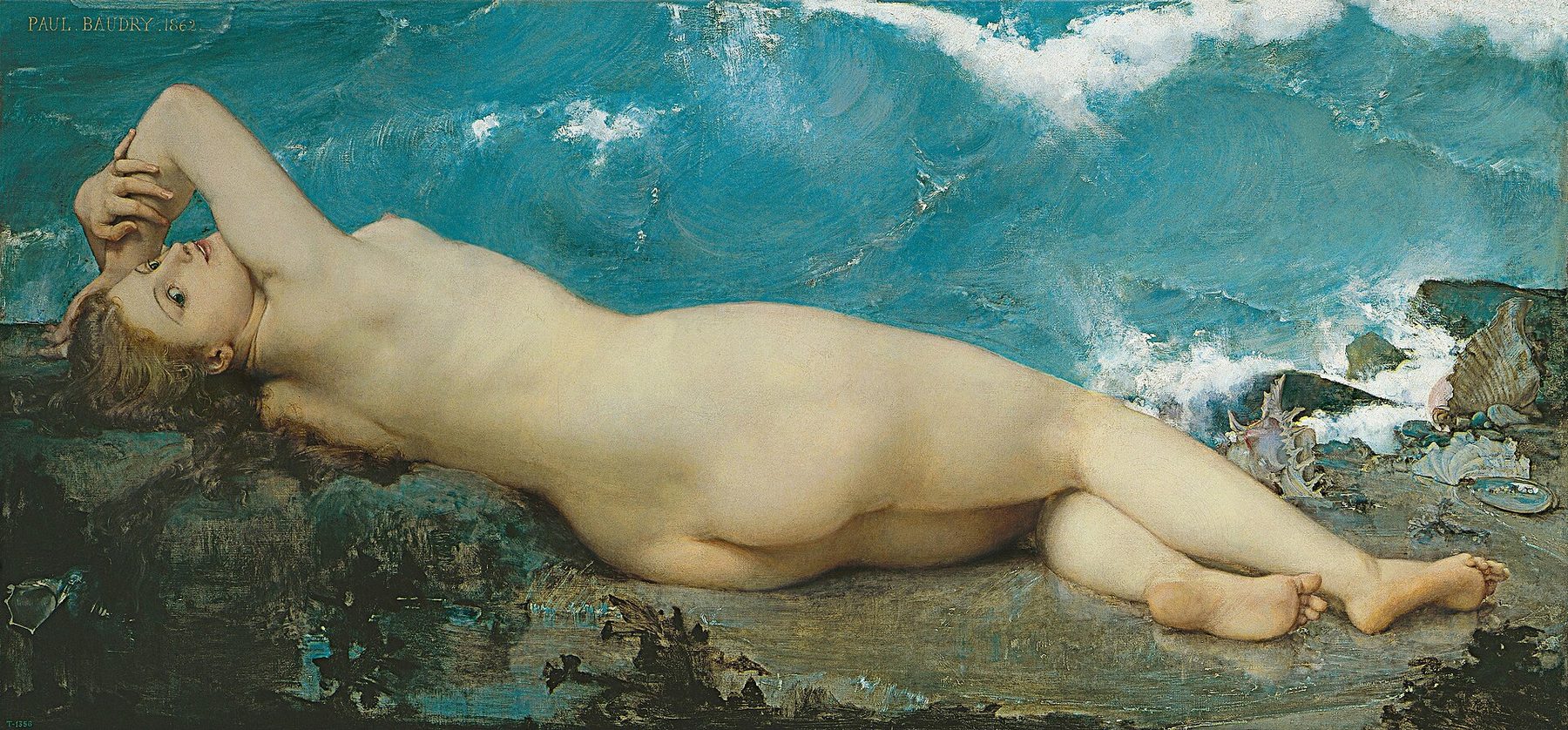
Nor was academic art sealed from national traditions later assigned to modernism. Cabanel, Gérôme, Carolus-Duran and other French painters studied Spanish masters, especially Velázquez. Spanish museum research records visits and copying that crossed the supposed border between academic and advanced art.[46] Paul Baudry's The Pearl and the Wave, a sensuous nude of 1862, likewise moved through international collections and later exhibitions, demonstrating that the “Salon nude” had a European afterlife rather than a purely French one.[47]
Women travelled through the same networks under different constraints. Italian museum research on international self-portraits records women training in private academies, entering Paris exhibitions and winning recognition.[48] Their success does not cancel institutional inequality. It shows how professional artists used every available route and why a history based only on famous male professors produces a false picture of the Salon public.
Paris and the Royal Academy
The Royal Academy in London offers a useful comparison. Founded in 1768, it combined a school, membership, annual exhibition and social prestige. British artists also competed for prominent hanging and press attention, and London collectors valued detailed narrative, portraiture and classical spectacle. The parallel helps explain the careers of Frederic Leighton and Lawrence Alma-Tadema, whose pictures moved between exhibition walls, commissions and richly designed interiors.[50]
Leighton's position as president made him an institutional figure, but his art cannot be reduced to administration. Alma-Tadema used archaeological research, marble surfaces and carefully arranged ancient leisure to make antiquity sensuously present to modern buyers. Their success shared qualities with French Salon painting—finish, legibility, cultivated reference and international commerce—without making the Royal Academy a branch of Paris.
This distinction guards against an overgrown category. “Salon painting” can be used informally for academic exhibition art in many nations, but the historical page needs a centre. The official Paris Salon supplied the name, catalogue structure and central conflict examined here. Other academies belong as parallels and exchanges, not as evidence that every polished nineteenth-century canvas is the same thing.
Not a modernist knockout
In spring 1874, the official Salon and the first independent Impressionist exhibition opened in the same recovering city. Looking at them together restores a shared ecology of war memory, rebuilding, entertainment, criticism and commerce.[42] The difference in immediate scale was enormous. The Salon attracted about half a million visitors; the independent exhibition drew roughly 3,500. Its organisers offered a show without the official jury and prizes, but the event was neither a mass success nor an instant replacement.[43]
The historical victory of Impressionism can obscure how inventive Salon artists appeared to contemporaries. Gérôme, Bouguereau, Bonnat and Henner addressed modern political, religious and social questions in works celebrated in 1874. Newspapers and caricatures produced meaning at both exhibitions, while collectors did not sort themselves into perfectly exclusive camps.[44] Manet showed at the Salon; Degas and others had trained within academic structures; “official” painters experimented with photography and broken narrative.
After 1880, authority dispersed rather than collapsing. The state transferred administration to the Société des Artistes Français. Women organised an exhibiting union. The Salon des Indépendants rejected juries and prizes. The Société Nationale des Beaux-Arts established a rival Salon at the Champ-de-Mars in 1890. Private galleries expanded, and dealers cultivated narrower audiences. No single event could again determine the whole field.
Modern museums then made another selection. Collections built around Impressionism and its successors placed many once-famous Salon painters in reserve or displayed them as conservative background. That reversal is as historical as the original prizes. A balanced view need not pretend that every forgotten success is a masterpiece. It asks why one institution rewarded a work, why another later hid it and what each system wanted art history to become.
How to look at a Salon painting
1. Rebuild the wall
Imagine the work among hundreds of frames. Which decision—scale, colour, silhouette, expression or subject—would have caught attention from a doorway? A museum's generous spacing can hide how aggressively a quiet-looking painting once competed.
2. Identify the claimed genre
Is the picture history, portrait, daily life, landscape, animal painting or still life? Does its size accept that rank or contest it? The Horse Fair gains meaning by giving a lower genre the dimensions of public history.
3. Follow the preparation
Look for evidence of drawing, transfer, underpainting, glazing, scraping and revision. A smooth surface does not mean the picture appeared smoothly. Technical invisibility may be the most carefully constructed effect.
4. Ask what the finish certifies
In Gérôme, precision can certify an imagined eyewitness position. In Cabanel, continuous modelling can naturalise an impossible body on water. In Dagnan-Bouveret, photographic cues can make a staged composition seem encountered.
5. Find the institutional actors
Who taught the artist, sat on the jury, awarded a medal, purchased the work, reviewed it, reproduced it and sold it? A Salon painting's meaning is distributed across that chain rather than contained only within the frame.
6. Examine unequal looking
Who is permitted to observe and who is displayed? Consider women artists barred from nude study, models turned into professional evidence, and colonised cultures presented as accessible spectacle. Technique and power are often visible in the same detail.
7. Compare first and later reception
A famous Salon picture may later have vanished from view; a rejected work may now define its century. Neither verdict is timeless. Compare the needs of the original exhibition with the story told by the modern museum.
Essential works of Salon Painting
The Birth of Venus
Alexandre Cabanel · 1863 · Pearly modelling, an impossible support of sea foam and a mythological title turn erotic display into an official vision of beauty.
Le Déjeuner sur l'herbe
Édouard Manet · 1863 · Old-master structure collides with modern dress, abrupt tones and a direct gaze that removes the expected mythological alibi.
Olympia
Édouard Manet · 1863 · Official acceptance did not prevent scandal: the named modern woman, servant and black cat return the viewer's looking as a problem.
Jerusalem (Golgotha, Consummatum Est)
Jean-Léon Gérôme · 1867 · The Crucifixion remains outside the frame while three shadows, distant figures and precise topography manufacture eyewitness authority.
Pygmalion and Galatea
Jean-Léon Gérôme · c. 1890 · Gérôme rotates the awakening statue and artist-lover through painted variants, making illusion and desire the work's subject.
The Horse Fair
Rosa Bonheur · 1852–1855 · Bonheur gives a contemporary animal market the scale, bodily force and formal coherence associated with history painting.
Homer and His Guide
William-Adolphe Bouguereau · 1874 · Balanced figures, crisp contour and almost imperceptible brushwork present classical cultural transmission in the Salon season of 1874.
The Pardon in Brittany
Pascal-Adolphe-Jean Dagnan-Bouveret · 1886 · Location study, studio models and photography combine to make a carefully assembled procession feel immediately observed.
A Young Girl Defending Herself against Eros
William-Adolphe Bouguereau · 1880 · Controlled anatomy and a playful mythological struggle show how technical finish could support eroticism and repeat-market variants.
The Pearl and the Wave
Paul Baudry · 1862 · A sensuous nude, curling water and polished surface exemplify the international afterlife of the nineteenth-century Salon nude.
Where to see Salon painting
- Musée d'Orsay, Paris: the strongest single destination for French painting from 1848 to 1914, with Cabanel, Gérôme, Manet, Naturalism and the institutional records needed to compare them.
- Musée du Louvre, Paris: visit the Salon Carré to connect the exhibition's name to its architectural origin, then examine earlier Academy art and the genre hierarchy it inherited.
- Petit Palais, Paris: a rich collection of nineteenth-century French painting in a building created for the 1900 Exposition Universelle, useful for seeing official, decorative and modern tendencies together.
- Musée Fabre, Montpellier: particularly important for Cabanel and the regional networks behind a nationally successful academic career.
- Metropolitan Museum of Art, New York: The Horse Fair, Bouguereau, Gérôme, Dagnan-Bouveret and American collecting history make the transatlantic market tangible.
- Clark Art Institute, Williamstown: an unusually concentrated setting for Bouguereau and other nineteenth-century European painters once valued by American collectors.
- Dahesh Museum of Art, New York: devoted to nineteenth-century European academic art and valuable for artists and schools left outside the standard modernist survey.
- Royal Academy of Arts, London: the best institutional comparison, joining historic exhibition culture to the continuing Summer Exhibition.
Where to see Salon Painting
Displays rotate and some works travel or remain in storage. Check the current collection display before travelling.
- 01
Musée d'Orsay
Paris, France
Cabanel, Gérôme, Manet and Naturalist painting can be studied beside institutional records from the exhibition culture that first made them public.
French painting and Salon records, 1848–1914Visit collection website - 02
Musée du Louvre
Paris, France
The Salon Carré connects the exhibition's name to its architectural origin, while Academy collections clarify the inherited hierarchy of genres.
The Salon Carré and Academy foundationsVisit collection website - 03
Petit Palais
Paris, France
Nineteenth-century French painting appears in a building created for the 1900 Exposition Universelle, bringing official, decorative and modern tendencies together.
Official and decorative French artVisit collection website - 04
Musée Fabre
Montpellier, France
Major Cabanel holdings illuminate the regional training and networks behind a nationally successful academic career.
Alexandre Cabanel in depthVisit collection website - 05
Metropolitan Museum of Art
New York, USA
The Horse Fair, Bouguereau, Gérôme and Dagnan-Bouveret make the Salon's transatlantic collecting history tangible.
Core works and American collectingVisit collection website - 06
Clark Art Institute
Williamstown, USA
A concentrated group of Bouguereau and other nineteenth-century European painters preserves tastes once cultivated by American collectors.
Bouguereau and nineteenth-century collectingVisit collection website - 07
Dahesh Museum of Art
New York, USA
Its specialism in nineteenth-century European academic art recovers artists and schools omitted from standard modernist surveys.
Academic art beyond the modernist surveyVisit collection website - 08
Royal Academy of Arts
London, UK
The continuing Summer Exhibition offers the closest institutional comparison to Paris through its school, annual display and public prestige.
British exhibition-system comparisonVisit collection website
Suggested books
- Patricia Mainardi, The End of the Salon. The clearest study of how state administration, artist societies and republican politics transformed the official exhibition during the early Third Republic.
- Harrison C. White and Cynthia A. White, Canvases and Careers: Institutional Change in the French Painting World. A foundational account of the shift from academy-and-Salon control toward a dealer-and-critic system.
- Albert Boime, The Academy and French Painting in the Nineteenth Century. Essential for understanding atelier practice, competition and the material discipline behind academic painting.
- James Harding, Artistes Pompiers: French Academic Art in the 19th Century. A compact introduction to painters once dismissed under a mocking label and the changing fortunes of their work.
- Sylvie Patry and Anne Robbins, eds., Paris 1874: The Impressionist Moment. Places the first independent Impressionist exhibition beside the official Salon rather than repeating a winner's-history separation.
Major artists associated with Salon Painting
| Name | Nationality | Key Works |
|---|---|---|
| Alexandre Cabanel | French | The Birth of Venus · The Death of Moses |
| Alfred Stevens | Belgian | What Is Called Vagrancy · In the Studio |
| Anna Klumpke | American | Portrait of Rosa Bonheur · In the Wash House |
| Antonio Gisbert | Spanish | Execution of Torrijos and His Companions · The Comuneros |
| Carolus-Duran | French | The Lady with the Glove · Mademoiselle de Lancey |
| Elizabeth Jane Gardner | American | The Shepherd David · The Farmer's Daughter |
| Fernand Cormon | French | Cain · A Forge |
| Frederic Leighton | British | Flaming June · Cimabue's Celebrated Madonna |
| Gustave Courbet | French | A Burial at Ornans · The Painter's Studio |
| Henri Fantin-Latour | French | A Studio at Les Batignolles · Homage to Delacroix |
| Henri Gervex | French | Rolla · Before the Operation |
| Jean-François Millet | French | The Gleaners · The Angelus |
| Jean-Louis-Ernest Meissonier | French | 1814, The Campaign of France · The Barricade |
| Jean-Léon Gérôme | French | Jerusalem · Pygmalion and Galatea |
| Jean-Paul Laurens | French | The Excommunication of Robert the Pious · The Last Moments of Maximilian |
| John Everett Millais | British | Ophelia · A Huguenot |
| John Singer Sargent | American | Madame X · Portrait of Carolus-Duran |
| Jules Bastien-Lepage | French | Joan of Arc · Hay Making |
| Lawrence Alma-Tadema | Dutch-British | The Roses of Heliogabalus · The Baths of Caracalla |
| Léon Bonnat | French | Job · Portrait of Victor Hugo |
| Mariano Fortuny | Spanish | The Spanish Wedding · The Choice of a Model |
| Marie Bashkirtseff | Ukrainian-French | The Meeting · In the Studio |
| Mary Cassatt | American | Little Girl in a Blue Armchair · The Child's Bath |
| Pascal-Adolphe-Jean Dagnan-Bouveret | French | The Pardon in Brittany · Breton Women at a Pardon |
| Paul Baudry | French | The Pearl and the Wave · Charlotte Corday |
| Rosa Bonheur | French | The Horse Fair · Ploughing in the Nivernais |
| Thomas Couture | French | Romans in the Decadence of the Empire · The Duel after the Masked Ball |
| Thomas Eakins | American | The Gross Clinic · The Agnew Clinic |
| William-Adolphe Bouguereau | French | Homer and His Guide · A Young Girl Defending Herself against Eros |
| Édouard Manet | French | Le Déjeuner sur l'herbe · Olympia |
Frequently Asked Questions
Not in the strict sense. It is primarily a category based on exhibition history: works first shown at the official Paris Salon. Many were academic, but artists did not share one manifesto, organisation or style.[1]
No. Academic Art describes training, inherited standards and stylistic values. The Salon was an exhibition system in which academic work was powerful but never exclusive. A picture can be academic without having been shown at the Paris Salon, and a Salon picture can challenge academic convention.
Large scale carried the prestige of history painting and helped a work compete in crowded galleries. It could make a biblical, classical, national or even contemporary subject visible from a distance. Not every Salon picture was monumental, but the exhibition rewarded public legibility.[45]
It usually refers to controlled drawing, gradual modelling, coherent anatomy and a surface in which separate brushmarks are difficult to see. It was produced through extensive preparation and layering, not by the absence of technique. Different academic painters handled finish differently.
No. Their relationships with it differed, and several had works accepted at different times. Manet, who did not join the independent Impressionist exhibitions, repeatedly sought official admission. The independents created another venue because Salon acceptance remained uncertain and its terms felt restrictive.
It united an alluring mythological subject with controlled anatomy, pearly modelling and a surface associated with high professional finish. Napoleon III bought it at the 1863 Salon. Its success reflected technical accomplishment, institutional standing, erotic appeal and imperial taste together.[21] [22] [23]
Yes, women exhibited and sometimes won significant recognition. But they did not enter on equal terms: the École excluded them until 1897, nude study was restricted and private alternatives cost more. The Salon could open a public career while the training system narrowed the route toward it.[10] [11] [12]
Artists used different combinations of travel, observation, photographs, objects, models and imagination. The important question is not simply whether a detail is accurate, but how selected details create authority. A precisely painted setting can still combine times, places and colonial assumptions.[24] [25]
Twentieth-century collections and textbooks prioritised modernist innovation, especially Impressionism and its successors. Works once celebrated for scale, narrative or finish no longer served that story and often went into storage. Recent scholarship studies them without assuming that first success or later neglect is a final verdict.[42] [44]
Discussion
Which Salon picture changes most when you imagine it on a crowded nineteenth-century wall rather than isolated in a modern gallery? Consider what first catches your attention, what sustained close looking reveals, and whether knowledge of the jury, critic, buyer or model alters your judgment.
Reader Insights
Imagine the picture among hundreds of frames and identify the decision—scale, colour, silhouette or narrative climax—that first competed for attention.
Trace the artist, teacher, jury, medal, critic, buyer, dealer and reproduction rather than treating institutional meaning as contained only inside the frame.
Set first reception beside the modern museum: official success and later neglect, or rejection and later fame, are both historical selections.
Join the Conversation
Which Salon picture changes most when you imagine it on a crowded nineteenth-century wall rather than isolated in a modern gallery?
References
- Salon paintings. Getty Art & Architecture Thesaurus. View Source
- The Salon and the Royal Academy in the Nineteenth Century. Metropolitan Museum of Art (French and English; consulted in French and English). View Source
- La fabrique des chefs-d’œuvre. Musée du Louvre (French; consulted in French). View Source
- The Salon Carré. Musée du Louvre. View Source
- French Paintings in The Metropolitan Museum of Art from the Early Eighteenth Century through the Revolution. Metropolitan Museum of Art. View Source
- Le Louvre en classe: dossier pédagogique. Musée du Louvre (French; consulted in French). View Source
- Picturing France 1830–1900. National Gallery of Art. View Source
- Picturing France Classroom Guide. National Gallery of Art. View Source
- The French Academy in Rome. Metropolitan Museum of Art (French and English; consulted in French and English). View Source
- Women Artists in Nineteenth-Century France. Metropolitan Museum of Art (German and English; consulted in German and English). View Source
- Qui était Marie Bashkirtseff?. Musée d'Orsay (French; consulted in French). View Source
- Women Artists in Paris 1850–1900. National Gallery of Art. View Source
- Les peintres le Salon la critique 1848–1870. Musée d'Orsay (French; consulted in French). View Source
- Spectaculaire Second Empire 1852–1870. Musée d'Orsay (French; consulted in French). View Source
- Americans in Paris 1860–1900. Metropolitan Museum of Art. View Source
- Répertoire des catalogues de Salons. Musée d'Orsay (French; consulted in French). View Source
- Center 16: Salon des Refusés and Nineteenth-Century Exhibition Culture. National Gallery of Art. View Source
- Manet / Degas. Musée d'Orsay (French; consulted in French). View Source
- Le Déjeuner sur l'herbe. Musée d'Orsay (French; consulted in French). View Source
- Olympia. Musée d'Orsay. View Source
- Naissance de Vénus. Musée d'Orsay (French; consulted in French). View Source
- The Birth of Venus. Metropolitan Museum of Art. View Source
- Salon catalogue entry: Naissance de Vénus. Musée d'Orsay (French; consulted in French). View Source
- Jean-Léon Gérôme 1824–1904: L'histoire en spectacle. Musée d'Orsay (French; consulted in French). View Source
- Jérusalem. Musée d'Orsay (French; consulted in French). View Source
- Pygmalion and Galatea. Metropolitan Museum of Art. View Source
- Intérieur grec. Musée d'Orsay (French; consulted in French). View Source
- Le Marché aux chevaux. Metropolitan Museum of Art (French; consulted in French). View Source
- Rosa Bonheur 1822–1899. Musée d'Orsay (Spanish; consulted in Spanish). View Source
- Rosa Bonheur exhibition booklet. Musée d'Orsay (French; consulted in French). View Source
- The Pardon in Brittany. Metropolitan Museum of Art. View Source
- Some Notes on The Pardon in Brittany by Dagnan-Bouveret. Metropolitan Museum of Art. View Source
- Paris 1874: The Impressionist Moment wall labels. National Gallery of Art. View Source
- Bouguereau and His Circle. Getty Museum. View Source
- Breton Brother and Sister. Metropolitan Museum of Art. View Source
- Seated Nude. Clark Art Institute. View Source
- A Young Girl Defending Herself against Eros. Getty Museum. View Source
- Recent Acquisitions 1993–1994. Metropolitan Museum of Art. View Source
- The Goupil Stock Books Project. Getty Research Institute. View Source
- What's Covered in the Provenance Index. Getty Research Institute. View Source
- M. Knoedler & Co. records approximately 1848–1971. Getty Research Institute. View Source
- Paris 1874: The Impressionist Moment. National Gallery of Art. View Source
- 1874: The Birth of Impressionism. National Gallery of Art. View Source
- Paris 1874: The Impressionist Moment publication. National Gallery of Art. View Source
- Peinture d'histoire: les grands formats. Musée d'Orsay (French; consulted in French). View Source
- Influencia del Museo del Prado en el arte del siglo XIX. Museo Nacional del Prado (Spanish; consulted in Spanish). View Source
- La perla y la ola (fábula persa). Museo Nacional del Prado (Spanish; consulted in Spanish). View Source
- Artiste agli Uffizi. Gallerie degli Uffizi (Italian; consulted in Italian). View Source
- Americans in Paris 1860–1900. Metropolitan Museum of Art (Italian and English; consulted in Italian and English). View Source
- The Marquand Mansion. Metropolitan Museum of Art. View Source
- Salon Painting image records. Wikimedia Commons: The Birth of Venus (Public domain; Musée d'Orsay; Wikimedia Commons), Le Déjeuner sur l'herbe (Public domain; Musée d'Orsay; Wikimedia Commons), Olympia (Public domain; Musée d'Orsay; Wikimedia Commons), Jerusalem (Golgotha, Consummatum Est) (Public domain; Musée d'Orsay; Wikimedia Commons), Pygmalion and Galatea (Public domain; Metropolitan Museum of Art; Wikimedia Commons), The Horse Fair (CC0; Metropolitan Museum of Art; Wikimedia Commons), Homer and His Guide (Public domain; Milwaukee Art Museum; Wikimedia Commons), The Pardon in Brittany (Public domain; Metropolitan Museum of Art; Wikimedia Commons), A Young Girl Defending Herself against Eros (Public domain; J. Paul Getty Museum; Wikimedia Commons), The Pearl and the Wave (Public domain; Museo del Prado; Wikimedia Commons).