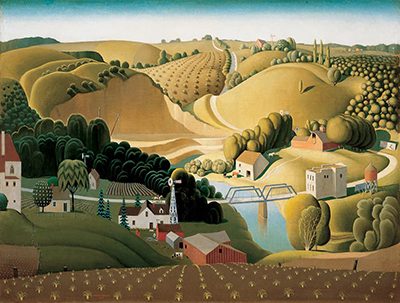
Image reference: Grant Wood’s Stone City, Iowa.
At a Glance
- Core periodlate 1920s through the early 1940s
- Primary regionsIowa, Missouri and Kansas, within a wider national American Scene
- Leading artistsGrant Wood, Thomas Hart Benton and John Steuart Curry
- Major mediapainting, murals, drawing, lithography, illustration and decorative art
- Recurring subjectsfarms, small towns, labour, machinery, weather, folklore, history and public life
- Important patronsmuseums, dealers, magazines, universities and New Deal art programmes
- Formal sourcesNorthern Renaissance art, Mannerism, Neue Sachlichkeit, folk art, cinema, illustration and Mexican muralism
- Important distinctionRegionalism was part of American Scene painting, but the two terms are not synonyms
Contents
- Where it fits
- Movement and crisis
- Names and boundaries
- Four stages
- Artists to know
- Grant Wood
- Thomas Hart Benton
- John Steuart Curry
- Essential works
- Artist directory
Where American Regionalism fits
Thomas Hart Benton
Key career periodGrant Wood
Key career periodJohn Steuart Curry
Key career periodAdolf Dehn
Key career periodMarsden Hartley
Key career periodDoris Lee
Key career periodYasuo Kuniyoshi
Key career periodCharles Burchfield
Key career periodAmerican Regionalism turned local places into a national argument. During the Great Depression, its painters represented rolling farmland, small towns, harvesting, industry, storms, folk legends and public history in forms intended to be immediately legible. The movement promised that American art could grow from ordinary people and particular regions rather than depend on New York taste or imported abstraction.
Thomas Hart Benton, Grant Wood and John Steuart Curry became its celebrated trio. Benton was linked to Missouri, Wood to Iowa and Curry to Kansas. They did not form a society, issue a shared manifesto or paint alike. Benton filled murals with twisting workers and machines. Wood organised faces and hills into unsettling precision. Curry staged bodies against religious ritual, racial violence and dangerous weather.
Their “heartland” was neither isolated nor simply observed. Benton developed his ideas in Paris and New York. Wood learned from Northern Renaissance painting, German realism and design. Curry painted his iconic Kansas tornado while living in Connecticut. Dealers, magazines, federal programmes and museums converted regional identity into a national brand.
That construction gave millions of viewers recognisable art during economic crisis. It also narrowed the ordinary American toward a white, rural and masculine ideal. Farm abundance could conceal tenancy, foreclosure and exhausted land. Murals could acknowledge slavery, lynching and the Ku Klux Klan while still relying on racial types. Regionalism is most revealing when its reassurance and conflict are viewed together.
A movement made during crisis
The stock-market crash of 1929 did not invent American interest in local life. Nineteenth-century landscape and genre painters had already turned national territory, farm work and domestic custom into cultural identity. Thomas Cole made landscape carry historical destiny; Winslow Homer gave work and rural experience durable pictorial form. Regionalists inherited these traditions after industrialisation and urbanisation had changed what “the country” meant.
The Depression made the search urgent. Bank failures, mass unemployment, falling crop prices and ecological crisis damaged any easy belief in progress. Regionalist pictures offered values of labour, self-reliance and community, but they appeared within a much wider art of protest, documentary record, abstraction and cultural recovery. The Met situates the trio’s agrarian claims alongside Native American artists, photographers, Black modernists and political printmakers working through the same decade.[1]
Regionalism is therefore narrower than all realistic American painting. The National Gallery identifies Benton, Wood and Curry as its promoted core while placing their work inside modernism rather than outside it.[2] They opposed what they described as rootless international art, yet their own formal invention depended on international experience.
The artists shared three broad commitments. They valued recognisable subjects; they treated place as a source of authority; and they wanted art to reach viewers beyond an elite avant-garde. None of those commitments required one politics. A scene could celebrate farming, mock inherited prestige, condemn lynching or dramatise industrial power.
Regionalism, American Scene and Social Realism
“American Scene” was the largest umbrella. It could include streets by Edward Hopper, New Mexico subjects, Maine landscapes, industrial towns, southern communities and Midwestern farms. Regionalism became the name most closely attached to the rural and historical work of the central trio. Social Realism tended to emphasise class conflict, unemployment, racial injustice and collective politics.
The boundaries remained porous. Curry’s anti-lynching prints are Regionalist by artist and Social Realist by explicit purpose. Benton’s murals combine celebratory machinery with workers reaching for bread. Wood’s agricultural scenes can look conservative while their uncanny pattern and satire complicate social reassurance.
Milwaukee Art Museum research describes American Scene and Regionalism as public alternatives to European abstraction, but emphasises that their artists addressed industry, racism, mass entertainment and politics and learned from Mexican muralists such as Diego Rivera.[3] Local subject did not mean narrow content.
French scholarship similarly presents the 1930s as a decisive but irreducibly plural formation of American modern art. Regionalism, abstraction and socially engaged realism confronted one another inside the same national search.[4] A Spanish account from the same Musée de l’Orangerie project makes the point explicit: Hopper, O’Keeffe, Wood and other distinct painters operated within overlapping creative centres, not sealed camps.[5]
These distinctions matter because the Regionalists’ own publicity encouraged simple opposition: country against city, America against Europe, common viewer against expert. The actual field was more entangled.
Constructing the heartland
All three leading artists had genuine Midwestern experience. Wood grew up in Iowa; Benton was born in Missouri; Curry came from a Kansas farm. Yet “rootedness” was also a professional identity they cultivated for audiences.
Benton lived mainly in New York between 1912 and 1935. Curry worked as an illustrator, lived in Westport, Connecticut, and taught in New York before becoming artist-in-residence at the University of Wisconsin. Wood’s public image as an Iowa farmer-painter concealed years of decorative work, teaching, commercial commissions and European travel.
The region in a painting is never identical to the place outside it. Artists select buildings, weather, occupations and gestures. They combine sketches, memories, photographs and inherited symbols. A barn can indicate productive agriculture, vanished community or picturesque nostalgia. A ploughed field can represent care of land while omitting who owns it and who is in debt.
Regionalist identity worked partly because national publishing made it visible. The 24 December 1934 issue of Time placed Benton on its cover and discussed a new American art around Benton, Wood and Curry. A magazine produced the apparent authenticity of artists who claimed distance from metropolitan culture.
Follow American Regionalism through four stages
–30
A public breakthrough in remembered places
Curry’s storm and Wood’s Chicago prize turn Midwestern memory into nationally circulated imagery just as economic crisis sharpens the demand for accessible American subjects.
–34
A movement is branded through murals and media
Benton’s panoramic nation, Wood’s patterned landscapes and the promoted trio become a public alternative to imported abstraction—despite the international sources visible in their forms.
–39
Federal art, satire and public contest
New Deal programmes expand audiences and employment while Regionalist works expose disputes over race, sexuality, ancestry, land and who has authority to picture a state or nation.
–50
War, decline and transformation
Global war, the deaths of Wood and Curry and institutional support for abstraction end the trio’s dominance, but Benton’s agriculture and the movement’s reproduced icons continue.
American Regionalist artists to know
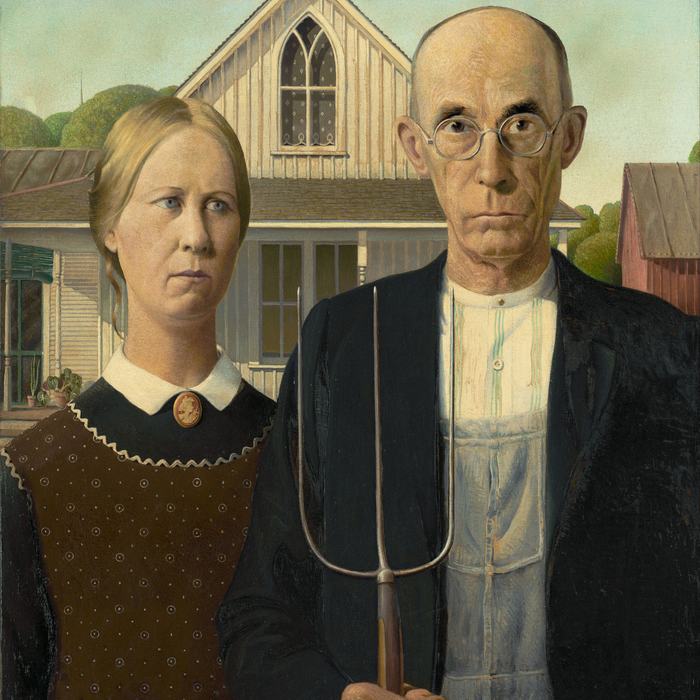
Grant Wood
Wood made meticulously clear surfaces carry ambiguity about family, sexuality, ancestry and national myth. His mature style joined Northern Renaissance and German sources to an intentionally fashioned farmer-painter persona.
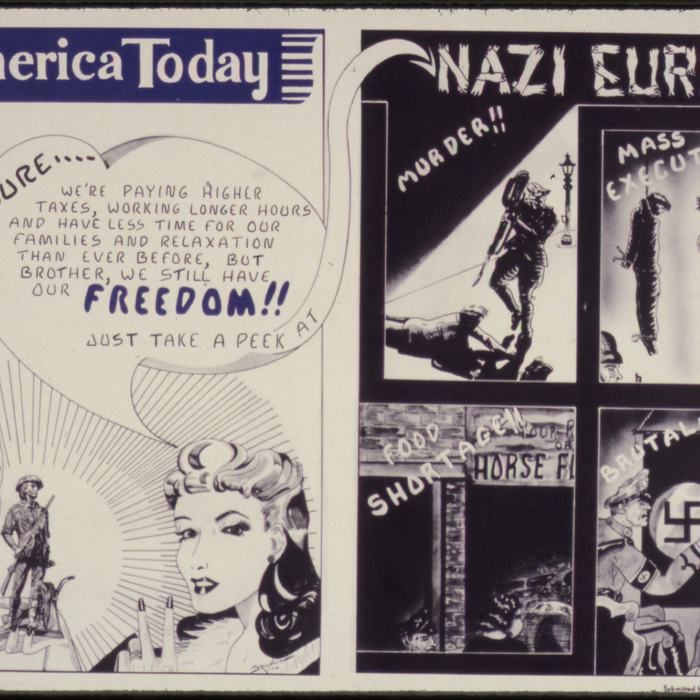
Thomas Hart Benton
Benton’s twisting bodies and rhythmic landscapes turned industry, agriculture, entertainment and public history into forceful narrative. His celebrations of labour remain inseparable from racial typing and disputed civic memory.
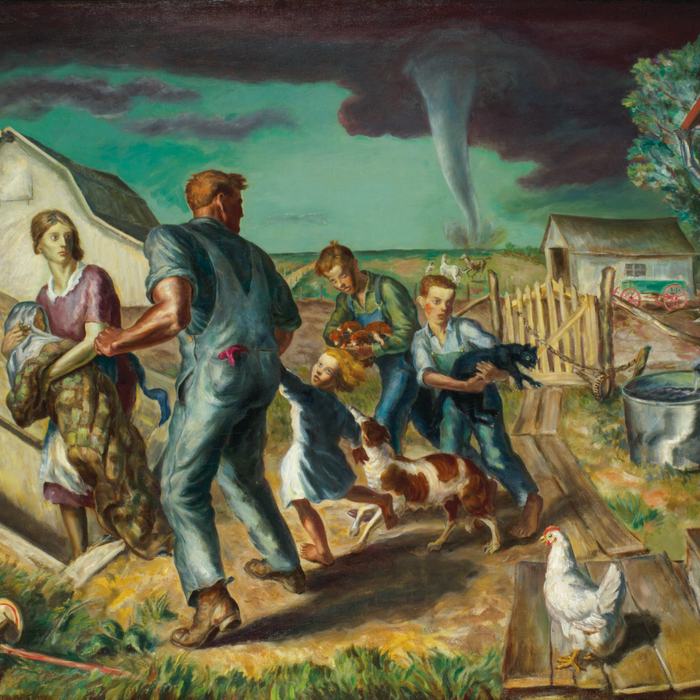
John Steuart Curry
Curry staged crisis with an illustrator’s clarity—from violent weather and circus risk to anti-lynching protest and the unstable heroism of John Brown. His Kansas identity was built through work in several other cities.
Grant Wood: precision, satire and concealment
Grant Wood made the movement’s most famous image and its most unstable surfaces. His paintings appear sharply clear. Faces, forks, roofs and furrows are meticulously edged; hills repeat as smooth volumes; plants become ornamental motifs. That control can suggest honesty and order, but it often produces unease.
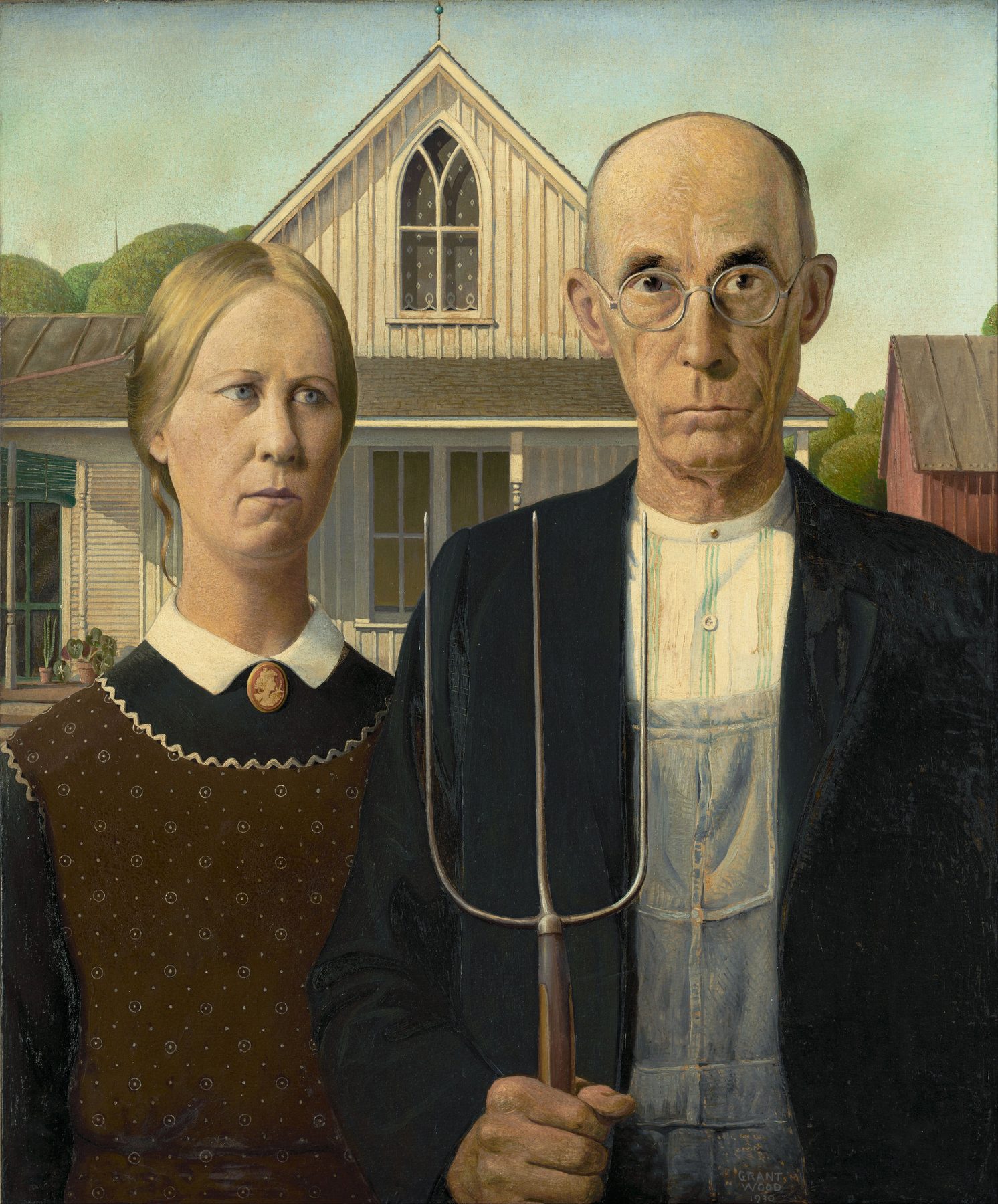
American Gothic
Wood found the Carpenter Gothic house in Eldon, Iowa, and imagined the people who might inhabit it. He asked his dentist, Byron McKeeby, and his sister Nan to pose separately as a farmer and his unmarried daughter. The popular assumption that they are husband and wife is not what the artist specified.
The Art Institute of Chicago awarded the painting a prize when it first appeared in 1930. Its educational study traces repeated shapes: the pitchfork prongs echo the farmer’s overalls and house lines; the woman’s patterned dress relates to the curtain; vertical siding reinforces rigid bodies. Northern Renaissance precision and family photographs inform the frontal arrangement.[6]
No final emotional verdict settles the pair. The man’s mouth is tight, his gaze fixed and his fork close to the viewer. The woman looks aside, with a curl escaping her severe hairstyle. Plants, brooch, apron and church steeple divide gendered domestic and agricultural roles.
Iowa viewers initially objected that Wood had caricatured them. Other audiences saw endurance during the Depression. The picture can support satire, admiration and claustrophobia because its exact detail never explains the relationship. The Whitney retrospective treats Wood’s farmer persona as a fable of its own and finds beneath pastoral harmony the anxiety of a closeted gay artist in a hostile environment.[7]
Sexuality is context, not a master key. It helps explain the pressure surrounding family, masculinity and concealment, but does not turn every window or pitchfork into a private symbol. The stronger claim is that Wood understood identity as something staged through pose, costume and public story.
Europe inside an “American” style
Wood travelled repeatedly to Europe. In 1928 he went to Munich to supervise fabrication of a stained-glass window and encountered the detailed realism of Neue Sachlichkeit. Northern masters such as Jan van Eyck and Hans Memling offered another model for sharp contour, compressed space and symbolic objects.[8]
The irony is productive. Wood’s mature American style crystallised in Germany. He did not copy one European school; he used precise finish to make Midwestern people and land look newly strange. His anti-colonial rhetoric about American culture coexisted with formal dependence on what he had learned abroad.
Wood was guarded when asked about American Gothic. He sometimes redirected attention toward the architecture rather than declaring the figures heroic or ridiculous. Whitney interpretation confirms the house as the starting point and the models’ separate sittings.[9] Evasion helped the image remain adaptable.
Stone City: a real place remade as pattern
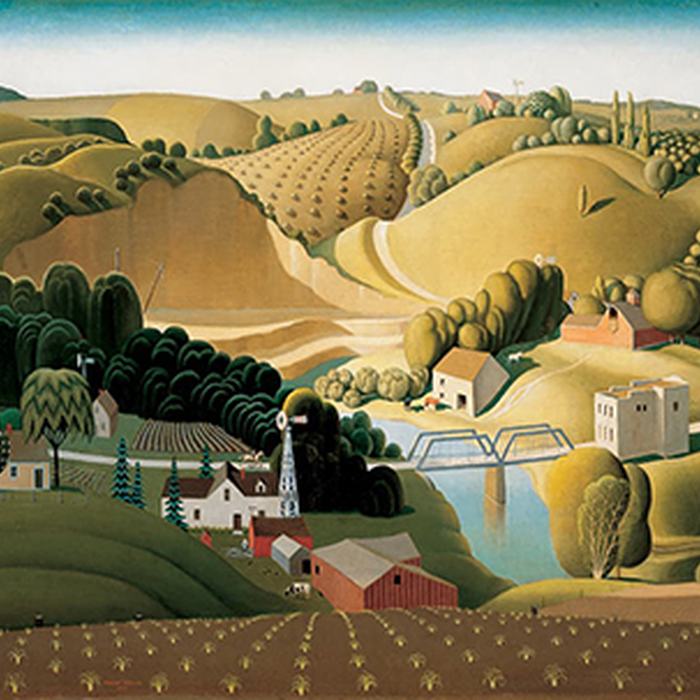
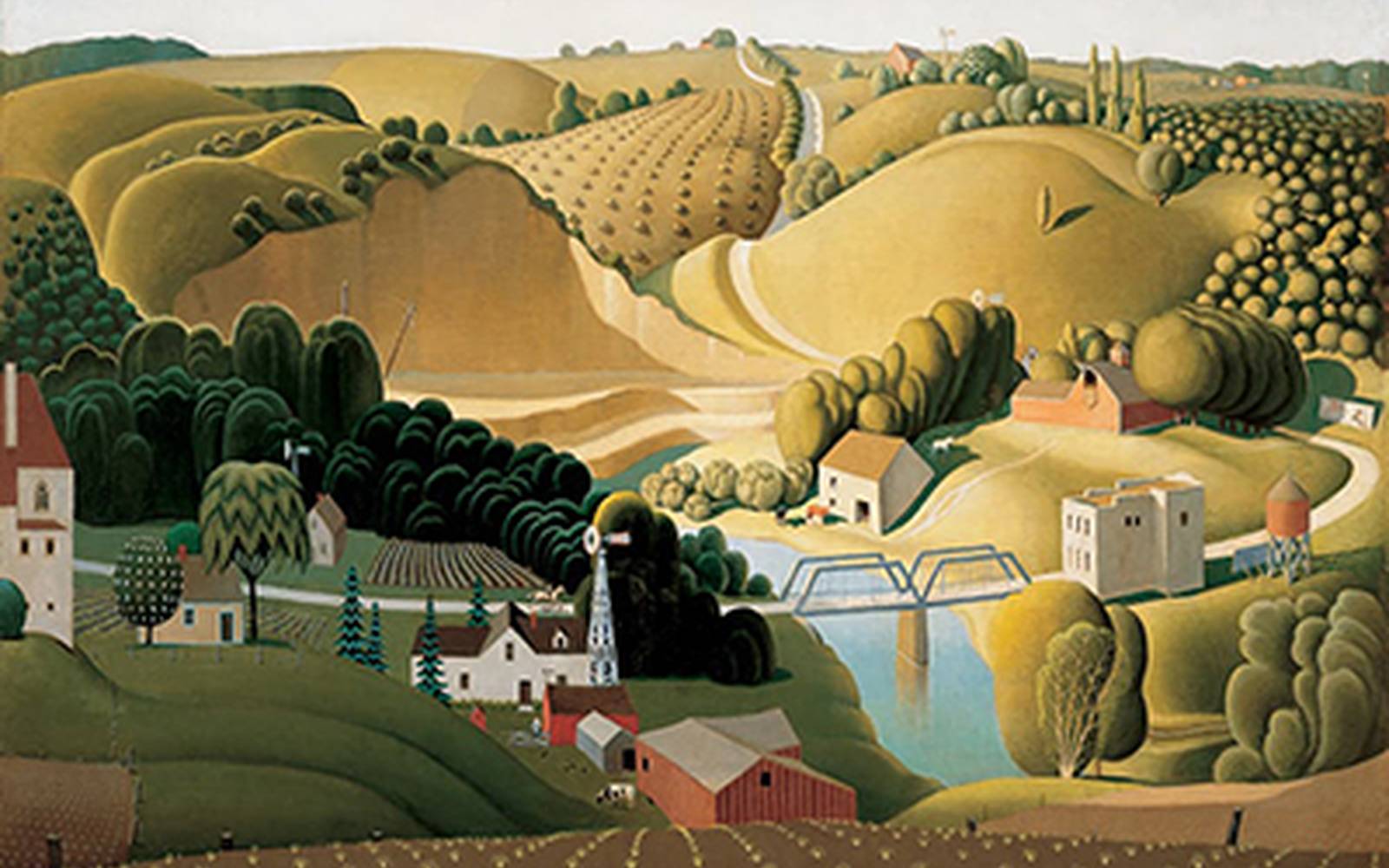
Painted in 1930, Stone City shows an Iowa settlement associated with limestone quarrying. A winding road cuts between rolling hills. Small trees repeat like beads; fields, houses, bridge and vegetation are sharply enumerated from an elevated viewpoint.
The apparent realism is highly artificial. Arts and Crafts design, nineteenth-century maps and Currier and Ives prints contribute to a surface in which every hill becomes ornament. Whitney analysis calls attention to the unnatural repetition that makes the landscape more like a patterned object than a view seen from one position.[10]
The quarry town had experienced industrial rise and decline. Wood selects a cultivated, harmonious version in which economic rupture barely registers. Yet the picture is not simply false. Its decorative compression conveys how a remembered region can feel organised in retrospect.
Land, labour and the barn
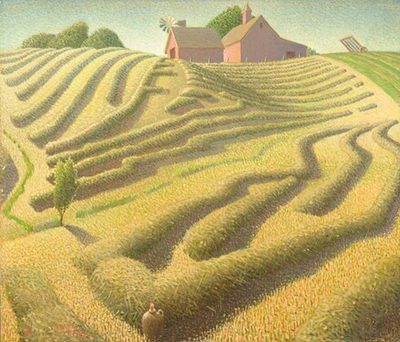
In later landscapes such as Haying, cultivated slopes rise in repeated bands around a barn and small machines. Wood declared the farmer central to the Midwestern scene and protested eastern assumptions that Iowa was provincial. The National Gallery notes how the barn could signify community and stability precisely as older agricultural structures were disappearing.[11]
These landscapes value work but often remove its strain. Fields appear groomed into curves; few bodies bend under labour; weather is controlled. The land resembles a complete design whose ownership, tenancy and foreclosure remain invisible.
Daughters of Revolution
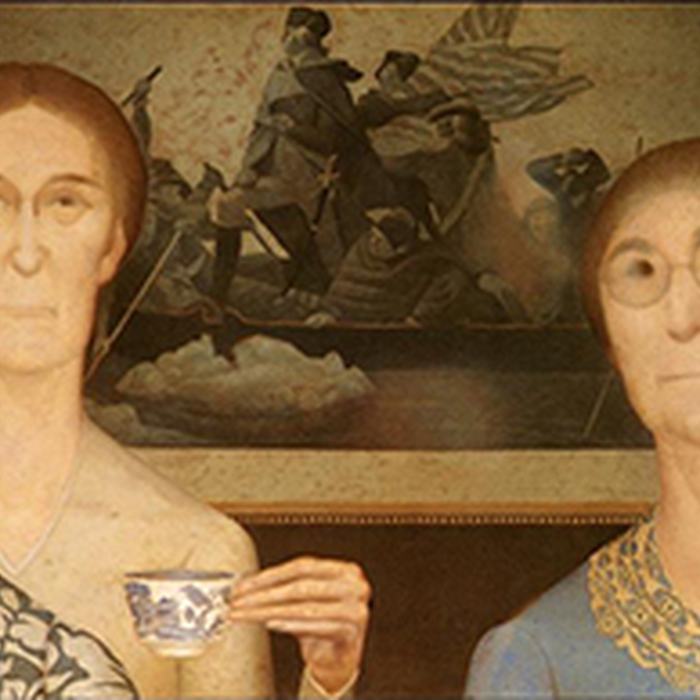
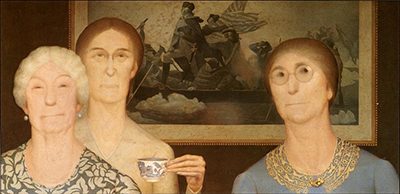
Wood could be far more openly satirical. Daughters of Revolution presents three members of the heritage organisation before a reproduction of Emanuel Leutze’s Washington Crossing the Delaware. Their stiff faces and tiny teacup contrast with the heroic action behind them.
The Daughters had previously objected that Wood’s stained-glass memorial window was fabricated in Germany. He responded by mocking claims to pure American ancestry through an iconic patriotic painting made by a German-born artist and a Chinese-derived ceramic cup. The Whitney identifies ridicule of inherited nobility as the work’s central target, while preserving uncertainty about Wood’s anxious fascination with conservative identity.[12]
Satire belongs inside Regionalism, not outside it. The painting uses local social types and early American decoration to question who claims ownership of the nation.
Public murals and collaborative labour
Wood directed Iowa’s Public Works of Art Project and designed murals for Iowa State College. When Tillage Begins, Other Arts Follow connects agriculture to engineering, science and domestic work. Breaking the Prairie turns the pioneer plough into an origin story for settlement.
Federal support shaped both subject and production. Wood designed the compositions but other artists helped execute them, making the mural a workshop product rather than one solitary hand. His state administrative responsibilities limited his direct painting time.[13]
The pioneer narrative is revealing. It presents cultivation as the beginning of culture, but the prairie was not empty. Indigenous dispossession and ecological transformation are absent from the heroic furrow. Regionalism’s local pride could naturalise settler history.
Sultry Night and the danger of the male body
In Sultry Night, a nude farm worker pours water over himself beside a trough. Wood described the action as a practical memory from rural childhood. The body’s frontal visibility nevertheless triggered accusations of obscenity. The postal service banned the lithograph from mail distribution, and Wood cut the nude figure from the original painting and burned it.[14]
The destruction records social pressure, not just prudish taste. A male body presented for sustained looking threatened the respectable farmer persona that protected Wood. His homosexuality was not publicly acknowledged, and accusation could damage employment and reputation.
The surviving print makes regional masculinity visibly unstable. Farm labour is usually clothed, productive and stoic. Here the worker pauses, exposes himself and becomes an object of beauty. The scandal reveals what the movement’s public ideal required it to suppress.
National history as a staged fable
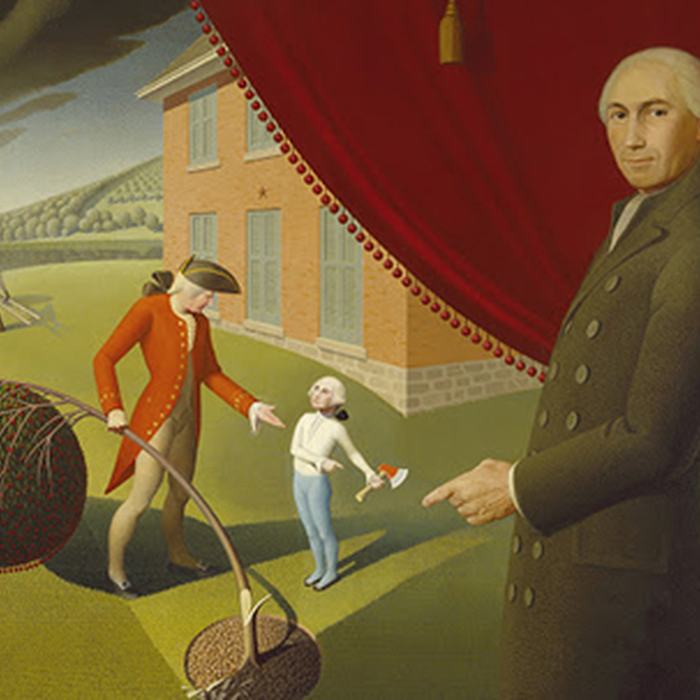
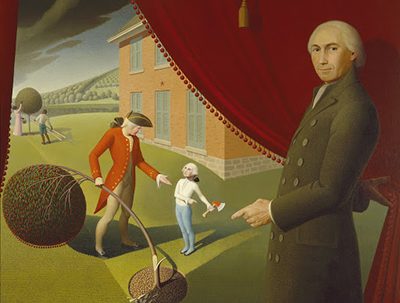
In Parson Weems’ Fable, the biographer pulls aside a theatrical curtain to reveal young George Washington confessing that he cut a cherry tree. The child has the adult president’s face derived from Gilbert Stuart’s familiar portrait. Father, axe, tree and house are displayed as knowingly artificial props.[15]
The event never happened. Wood paints national virtue as a story produced through repetition. The curtain makes viewers complicit: they know the legend is false and still recognise its cultural force.
Regionalism often claimed direct access to ordinary truth. This late work exposes the invented nature of such access. The nation needs images, but images can reveal their own manufacture.
Wood’s Iowa was broader than his canvases. Before fame he designed hotel interiors, advertisements, furniture and decorative objects. Later Iowa artists have reworked roads, agriculture, migration and identity beyond the settled white farm ideal.[16] A region is a changing social field, not a timeless look.
Thomas Hart Benton: the nation as moving panorama
Thomas Hart Benton’s art is the least still of the trio. Bodies twist, machines thrust and landscapes roll like muscle. He organised murals through rhythmic curves that pull one activity into another. The style could make labour heroic and history energetic, but it could also turn people into pantomimed types.
Benton studied in Chicago and Paris and experimented with Synchromist abstraction before committing himself to narrative figuration. He lived in New York for more than two decades, painted major urban commissions and taught at the Art Students League. Only in 1935, after his national fame and Time cover, did he settle permanently in Kansas City.[17]
His Regionalism was national before it became Missouri-centred. Travel sketches supplied cotton fields, mines, subways, dance halls, ranches and industrial plants. European Mannerism helped him elongate bodies, while silent film and popular theatre shaped emphatic gesture. His declared rejection of modernism did not erase these sources.
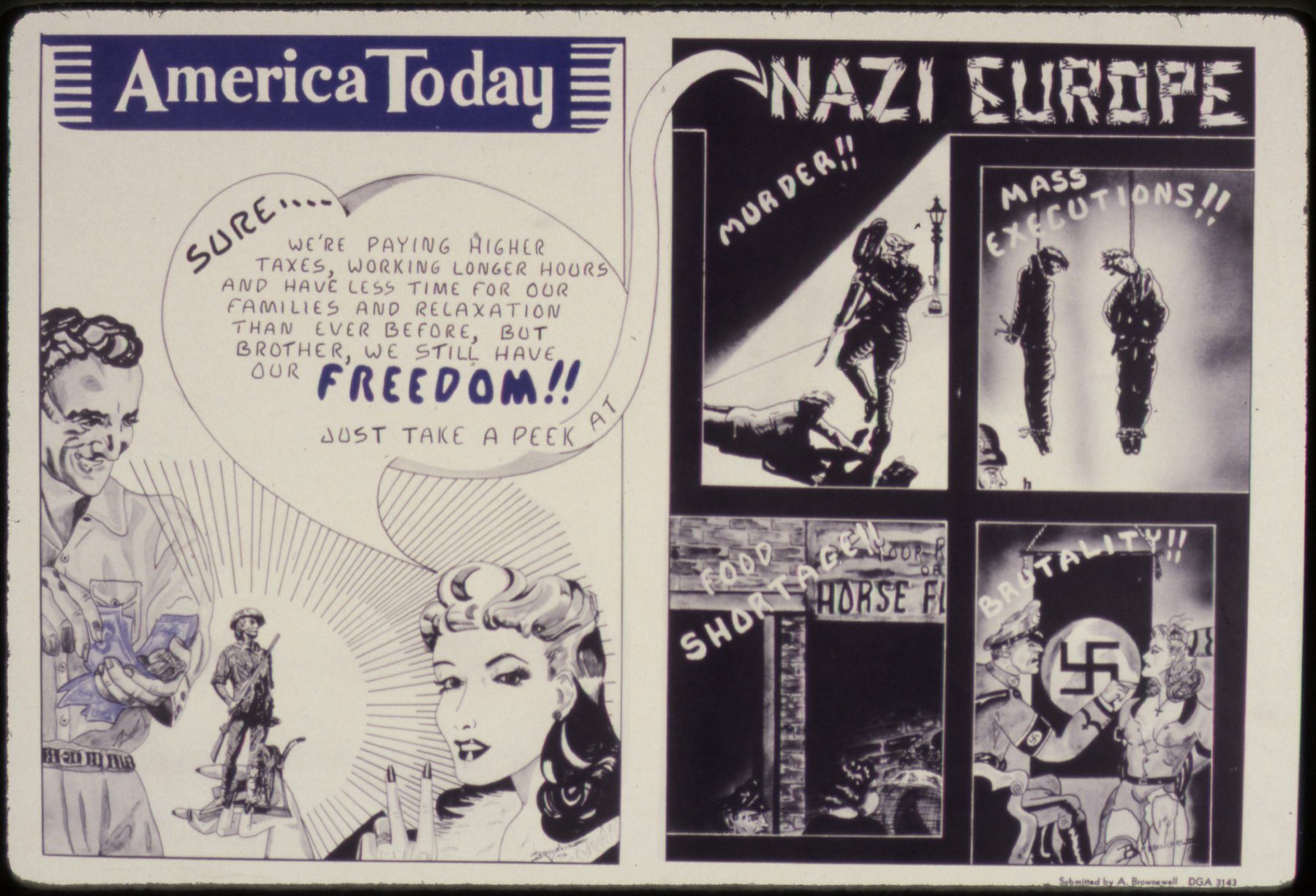
America Today
The room-sized America Today was commissioned for the New School for Social Research in 1930 and completed in 1931. Ten panels wrap a viewer in scenes of the South, Midwest, West and New York. Steelmaking, construction, farming, mining, cinema, drinking and dancing form one restless system.[18]
The mural is not an escape into farms. Its largest panel, Instruments of Power, makes dams, turbines and industrial equipment monumental. Huge workers anchor other panels. Their bodies provide the manual force beneath technology, suggesting that national progress depends upon labour.
The promise is qualified by Outreaching Hands. Hands ask for bread while others hold money, reducing Depression inequality to a compressed emblem. This small panel interrupts the expansive machinery with scarcity. It acknowledges breakdown without overthrowing Benton's faith in productive power.
In Deep South, Black workers harvest and transport cotton. A powerful man tipping a sack becomes a central figure, and the mural acknowledges that southern wealth rests on Black labour and the history of enslavement. Met scholarship also notes that Benton regarded the region as a contradiction of beauty, refinement, misery and degradation.[19]
Monumental scale does not guarantee equality. Black workers are presented through bodily labour, while decision-makers and ownership remain elsewhere. White and Black figures can become physiognomic or occupational types in Benton’s compressed pageant. Recognition of slavery coexists with an outsider’s construction of southern Black life.
Preparatory sketches show how deliberately he built that construction. In a drawing joining the Midwest and Deep South panels, Benton tests the placement of an exhausted Black cotton worker and later changes figures’ direction and scale.[20] The mural is based on travel observation, but it is not documentary accumulation. Bodies are moved to serve the national rhythm.
Aluminium-leaf mouldings divide and connect the panels, echoing the Art Deco architecture of the New School. Space operates like montage: geographically distant scenes meet across designed breaks. Regional difference becomes one modern panorama.
Public history in Indiana
For the 1933 Century of Progress exposition in Chicago, Benton created a vast history of Indiana. He travelled thousands of miles, studied sites and divided the story into parallel sequences of culture and industry. The panels included Indigenous history, settlement, agriculture, factories, labour conflict, women’s rights, the press and the Ku Klux Klan.[21]
Benton demanded freedom to represent negative events as well as celebration. One panel places a Klan rally and burning cross above scenes of press work, firefighting, a Catholic church and a white nurse caring for Black and white children. The imagery was anti-Klan in intention, contrasting white supremacy with investigative journalism and integrated care.[22]
The work remains difficult in a classroom. A burning cross and robed Klansmen can impose harm regardless of their small scale or critical purpose. Indiana University has repeatedly debated display and installed movable screens so instructors can control visibility. Public art does not preserve one historical interpretation unchanged; its site creates new audiences and responsibilities.
Play, satire and the nation
In The Arts of Life in America, Benton shifted from labour toward dance, music, sport and popular performance. Panels represent the South, cities and West, alongside Native arts and political satire. New Britain Museum describes the cycle as an attempt to make indigenous American creativity a source of collective recovery during the Depression.[23]
The category “indigenous” was unstable in Benton's usage. It could mean home-grown popular culture while Native Americans occupied a separate historical panel. Jazz, Black dance and entertainment energise the national scene, but the artist’s exaggerated bodies risk turning cultural contribution into spectacle.
Agrarian order after the Depression
Benton continued rural painting long after Regionalism lost critical dominance. In July Hay of 1943, two workers swing old-fashioned scythes through a dense crop. Bodies and grain bend in the same circulating rhythm. Flemish harvest painting provides an art-historical source, while wartime audiences could see farmers as home-front contributors.[24]
The old tools are deliberate. Mechanised agriculture was already widespread, but Benton represents bodily harmony with land. Nostalgia converts labour into an ordered ritual at the moment industrial war made the nation global.
John Steuart Curry: faith, fear and public justice
John Steuart Curry’s pictures often build toward crisis. Storm clouds descend, baptismal crowds bend toward water, acrobats risk falling and historical figures confront violence. His background in magazine illustration helped him stage a readable climax.
Curry grew up in Kansas, studied in Kansas City, Chicago and briefly Paris, and worked for publications including the Saturday Evening Post. His first major success, Baptism in Kansas, appeared while he lived in Connecticut. He later travelled with the Ringling circus, painted federal commissions and became artist-in-residence at Wisconsin rather than Kansas.[25]
Rootedness again involved distance. Curry used remembered farm structures, stories and family types to build Kansas for eastern exhibitions. His dramatic scenes were no less regional for being constructed elsewhere; their mediation is part of the movement.
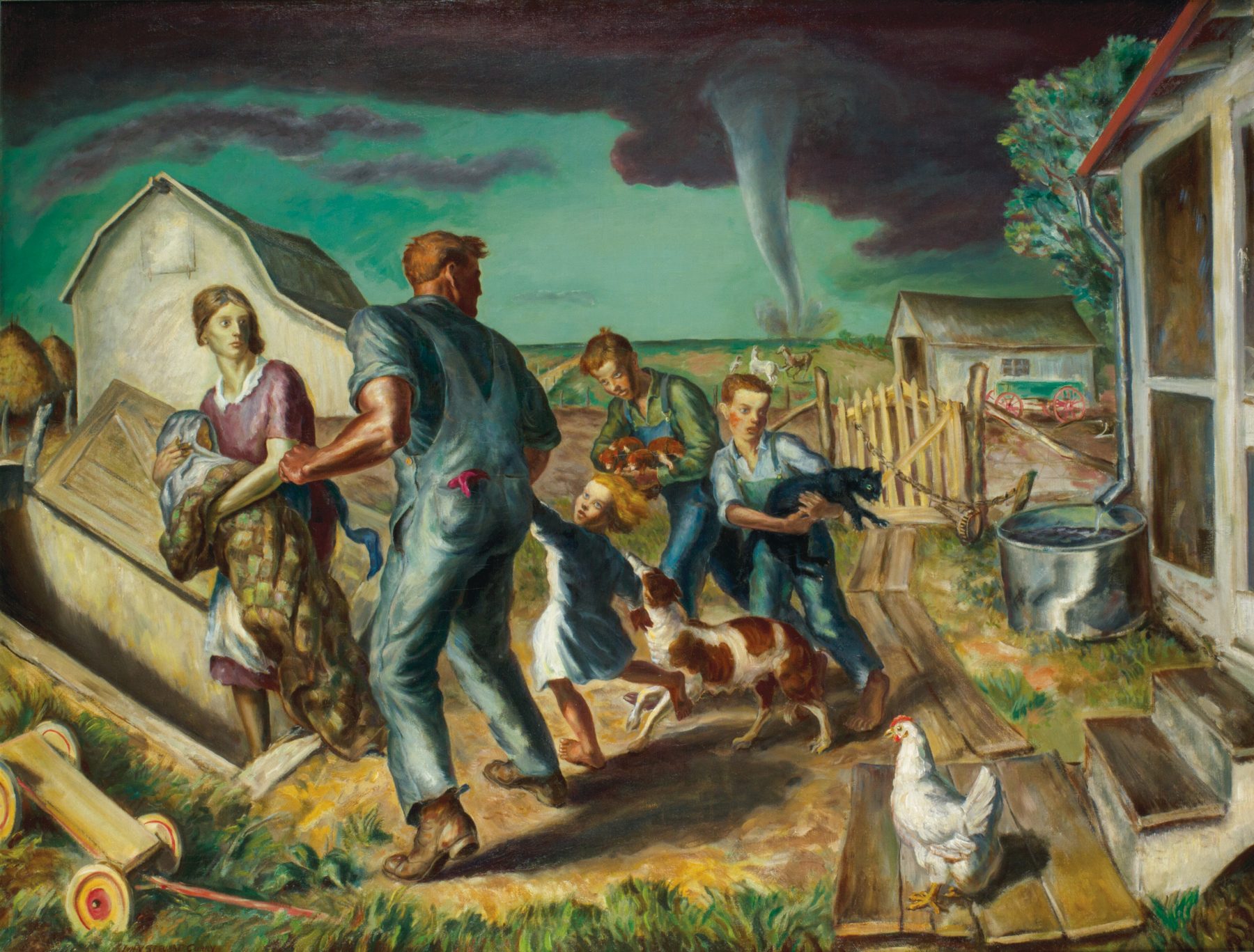
Tornado Over Kansas
Painted in 1929, Tornado Over Kansas shows a family rushing toward a storm cellar as a funnel twists across the horizon. The father leads a child; the mother carries an infant; boys rescue animals. Tilting roof, trees and bodies organise fear around a circular family group.
Curry had not personally seen the depicted tornado. He worked in Connecticut from memories of the farm and accounts of violent storms. Muskegon Museum records how the picture struck a “home chord” for a collector and quickly circulated through exhibitions, magazines and textbooks.[26]
The father’s strong profile and the family’s division of roles can look like a conservative household ideal. Yet control belongs to the storm. Regional virtue is measured through vulnerability, not abundance. Agriculture depends on forces no work ethic can command.
The painting is frequently linked to Dust Bowl imagery, but it predates the worst drought years and shows tornado rather than erosion. Its later reception absorbed disasters that were not its original subject. Icons gather history after they are made.
John Brown and Tragic Prelude
Curry’s murals for the Kansas State Capitol made the abolitionist John Brown a gigantic figure between Union and Confederate forces. Wind tears at his beard; one hand holds a Bible and the other a rifle. A tornado rises behind him as a symbol of the conflict that made Kansas a prelude to civil war.
The large 1939 study shows Brown’s messianic intensity and instability. An enslaved man appears beside him, but the white abolitionist dominates the story.[27] Curry neither calmly sanctifies nor simply condemns Brown. The figure is necessary, frightening and larger than public order.
Kansas patrons objected to this image and other parts of the commission, including storms and livestock they thought made the state look backward. Curry left portions unfinished and refused to sign the murals. Regional inhabitants did not automatically accept the artist who claimed to represent them.
The Fugitive and anti-lynching art
Curry’s 1935 lithograph The Fugitive shows a Black man pressed against a tree while a posse and dog search below. Leaves flicker like flame; his body follows the trunk in a posture recalling crucifixion. The violence has not yet occurred, so dread occupies the whole image.
The print appeared in the NAACP exhibition An Art Commentary on Lynching. Smithsonian interpretation emphasises its refusal to turn the eventual killing into a lurid spectacle; attention remains on the pursued man’s fear and hope.[28]
This work enters Social Realism through explicit political purpose. It also raises questions about white authorship. Curry condemns racist terror, but a Black man’s threatened body still becomes the emotional vehicle through which largely white art audiences confront injustice. Ethical intention and unequal viewpoint must both be considered.
Beyond farms: the circus
Curry spent weeks travelling with Ringling Bros. and Barnum & Bailey in 1932, sketching performers and animals. Circus Elephants compresses massive bodies behind barriers and ropes, making training, confinement and spectacle visible. National Gallery research places it within a larger group of aerialists, clowns and animal scenes.[29]
The circus was a mobile region of its own: workers, immigrants, performers, animals, advertising and temporary architecture travelled between towns. Curry’s interest in it contradicts the idea that Regionalism was confined to stable land.
His institutional career also crossed geography. A 1930 Whitney Studio Club exhibition helped establish him in New York; his Wisconsin residency joined art to agricultural education; Kansas supplied a commission but rejected its final vision.[30] “Kansas artist” names a continuing imaginative claim, not a stationary biography.
Essential American Regionalist works
American Gothic
Grant Wood · 1930 · The movement’s most famous image turns architectural, domestic and agricultural detail into an unresolved balance of endurance, rigidity and satire.
Stone City, Iowa
Grant Wood · 1930 · Wood remakes a real quarry settlement as a patterned, elevated landscape in which road, hills and trees are more designed than simply observed.
Daughters of Revolution
Grant Wood · 1932 · Wood uses Leutze’s patriotic image, a tiny cup and compressed pose to mock inherited prestige and claims of culturally pure American ancestry.
Parson Weems’ Fable
Grant Wood · 1939 · The theatrical curtain and adult Washington face expose a national virtue story as a knowingly manufactured fable.
America Today
Thomas Hart Benton · 1930–31 · Benton’s room-sized panorama joins regions, machines, labour and leisure while the small Outreaching Hands panel interrupts confidence with Depression need.
Tornado Over Kansas
John Steuart Curry · 1929 · Curry constructs family solidarity under a threat no work ethic can control, making vulnerability—not abundance—the measure of regional identity.
Haying
Grant Wood · 1939 · The cultivated slopes and ordered barn dignify agriculture while their patterned completeness keeps tenancy, foreclosure and physical strain largely outside the frame.
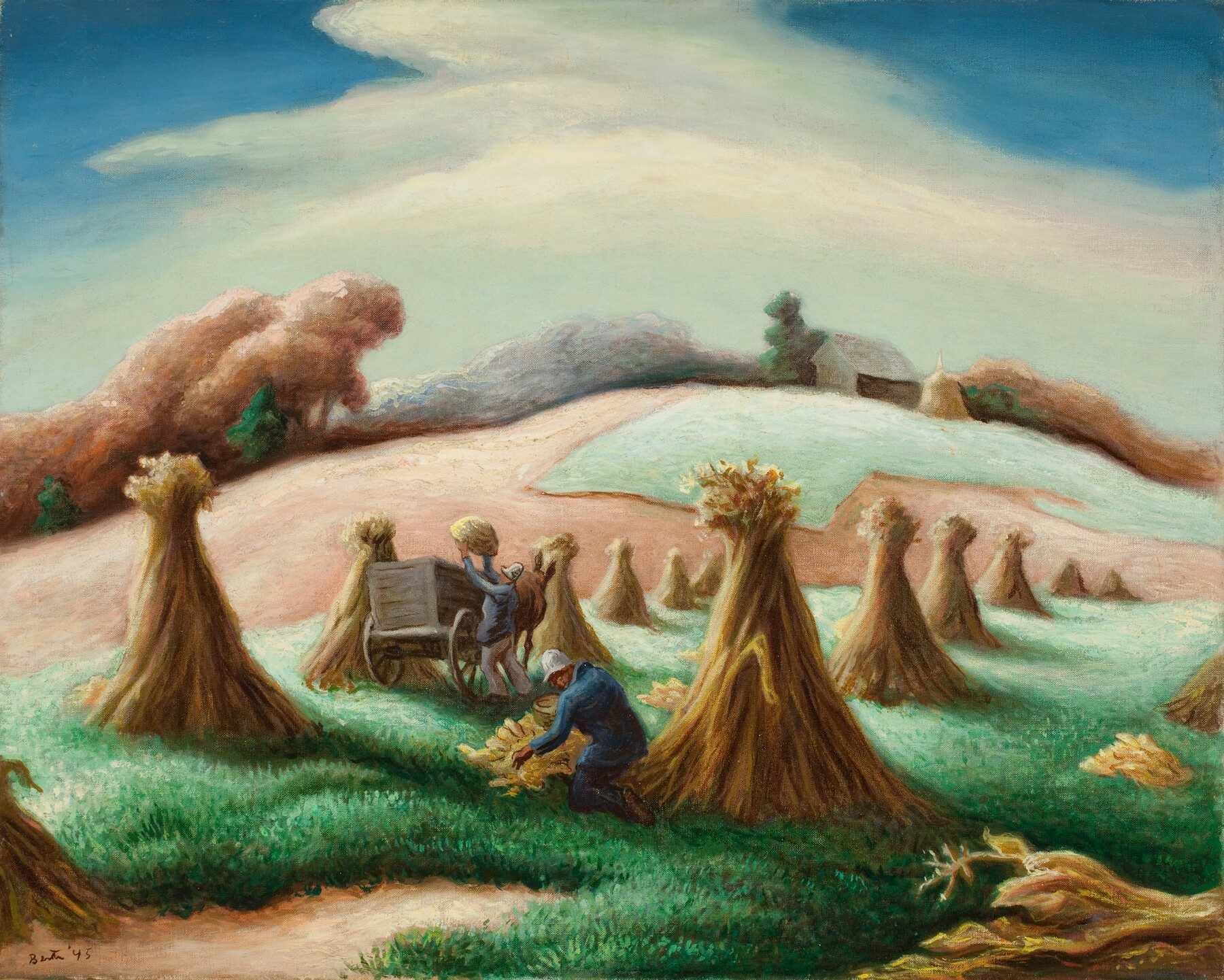
Corn and Winter Wheat
Thomas Hart Benton · 1948 · Benton’s postwar harvest carries Regionalist rhythm and agrarian memory beyond the movement’s peak as critics increasingly promoted abstraction.
New Deal art was larger than Regionalism
Federal art programmes gave the decade an unprecedented public infrastructure. Artists decorated schools, libraries, post offices, hospitals, community centres and government offices. Officials often encouraged recognisable local subjects under the phrase “the American Scene,” which aligned with Regionalist aims.[31]
The programmes were not interchangeable. The Public Works of Art Project ran for only about six months from December 1933 into 1934. It paid professional artists across designated regions and produced portraits, city views, rural landscapes and industry as well as heartland subjects.[32]
The Works Progress Administration’s Federal Art Project began in 1935 and operated on a larger relief basis. At its peak it employed thousands in painting, design, murals, teaching and documentary work. Archives of American Art later recorded hundreds of participant interviews, preserving administrative experience as well as finished objects.[33]
Treasury programmes used competitions and building commissions under different eligibility rules. A post-office mural is not automatically WPA work. Accuracy about programme matters because funding determined selection, pay, materials, site and public control.
Federal culture was political even when a mural did not endorse a party. Rural electrification, dams, construction and public services represented government capacity. National Archives material shows how theatre, murals and documentation could celebrate recovery or trigger attack when they addressed legislation and inequality.[34]
The search for America also reproduced myths. Pioneer murals presented settlement as progress, while Indigenous land loss might remain outside the frame. Native artists did participate in federal programmes, and an Indian Arts and Crafts Board supported markets, though under paternal government structures. New Deal photography likewise ranged from hardship to ordinary leisure.[35]
Printmaking widened access. Curry’s Manhunt, Bernard Steffen’s less romantic Dusty Plowing and hundreds of other lithographs circulated images of labour and racial violence beyond mural sites. The Library of Congress uses these works to identify a darker Regionalist America beneath reassuring farms.[36]
Who was included in the “ordinary” America?
The famous trio were white men, and their national “common people” frequently shared that identity. Women appear as farm wives, mothers, dancers or heritage custodians; Black people appear as field and industrial workers or victims of racial violence; Native people often occupy historical beginnings. These images can grant presence while fixing social roles.
The movement’s wider field complicates the pattern. Doris Lee’s At the Well first resembles a pastoral farm scene, but women fetch water, bathe and manage animals while men remain farther back. Work that a picturesque landscape might treat as atmosphere becomes the composition’s active structure.[37]
Lee trained in Paris and San Francisco, lived in the Woodstock art community and combined folk-art interest with deliberate modern design. She exhibited in major New York venues and became a successful fine and commercial artist. Smithsonian network research places her alongside Yasuo Kuniyoshi and other artists exchanging ideas rather than as an isolated “woman Regionalist.”[38]
Modern surveys have expanded heartland imagery to include Margaret Burroughs, Adolf Dehn and Lee alongside Benton, Curry and Wood.[39] This should not turn every artist of rural life into a Regionalist. It demonstrates that the region contained Black urban experience, immigrant networks, labour politics and female authorship that the canonical brand obscured.
Land itself raises the strongest absence. Regionalist fields tend to be owned, cultivated and visually complete. Tenant farmers, migrant labourers, Indigenous dispossession and Mexican American agricultural work rarely structure the leading images. The soil is made to confirm national continuity even when the Depression exposed broken ownership and exhausted ecology.
The problem is not that every painting must catalogue all conditions. It is that a partial rural experience was promoted as the heart of the nation. Asking who disappears from “ordinary America” reveals the politics of a seemingly neutral barn.
Prints, dealers and popular ownership
Regionalism reached viewers through reproduction as much as original painting. Newspaper photographs made American Gothic famous. Lithographs issued in substantial editions brought ploughing, storms and harvest into middle-class homes. Books and advertising repeated the artists’ linear clarity.
The three leaders had distinct print languages: Benton’s bodies surge through curved space, Curry builds narrative suspense and Wood refines pattern into sharp tonal order. A Georgetown survey of their graphic work notes that an eastern establishment grouped these differences under one label and that Depression audiences often valued an idealised rural escape.[40]
Affordable print does not equal passive propaganda. A domestic viewer could recognise labour, remember a childhood region or question satire. Multiplicity changed the social life of the image. A mural belongs to one building; a lithograph can move, be framed, gifted and compared.
Regionalism was also a market strategy. Dealers could offer cultural authenticity to urban buyers. The supposed revolt against the city depended on city galleries, publishers and collectors.
Regionalism beyond the trio
Marsden Hartley’s late Maine paintings show how widely the desire for regional identity operated. After an international modernist career, Hartley promoted himself as a painter rooted in his native state. The Met calls him a cosmopolitan Regionalist and explains that both conservative critics and Alfred Stieglitz’s avant-garde circle demanded American rootedness.[41]
The example prevents one easy map in which New York modernists opposed provincial realists. Artists across camps sought authority in specific landscapes. O’Keeffe’s New Mexico, Hopper’s New England and Charles Burchfield’s western New York differ from core Regionalism, but all participated in debates about place.
Recent Madison interpretation joins local scenery to avant-garde experiment, social reform and constructed identity.[42] This revision does not make Regionalism secretly abstract. It recognises that realism is also formal organisation.
A National Gallery catalogue describes American Scene, American tendency and Regionalism as overlapping names for a varied representational field. Hopper can stand near these debates while exceeding every group.[43] Terms are tools for comparison, not membership badges imposed on all 1930s realism.
The Art Institute’s America after the Fall similarly placed Wood beside Hopper, O’Keeffe and other incompatible painters searching for modern American form.[44] Their coexistence is historically more accurate than a contest with one winner.
During the decade, Precisionism, Surrealism, geometric abstraction, Social Realism and Regionalism all flourished. Federal nationalism could support several of them, even when public rhetoric demanded one authentic national style.[45] American modernism was plural precisely when arguments about purity became loudest.
War, abstraction and the movement’s afterlife
World War II altered Regionalism’s political landscape. A rhetoric of cultural isolation became difficult to maintain as fascism and global war demanded international attention. Wood died in 1942 and Curry in 1946. Benton survived, but the trio could no longer function as a contemporary brand.
Benton continued painting agriculture. Corn and Winter Wheat of 1948 places two small workers within rolling Missouri fields, shocks and farm buildings. Its carefully researched farming becomes a nostalgic order after mechanised war, while critics increasingly looked toward abstraction.[46]
The Regionalists also widened their wartime imagery. National Gallery research traces panoramic formats in which Benton and Curry connected American land to maps, fronts and violence overseas.[47] The “region” could no longer pretend the globe was elsewhere.
The usual story says Abstract Expressionism defeated Regionalism. Biography is more entangled. Jackson Pollock studied with Benton and modelled for workers in America Today. Benton's rhythmic composition and commitment to large public scale remained part of Pollock’s formation, even as the pupil abandoned narrative figures. A Spanish Thyssen study also connects that training to Pollock’s employment under federal art programmes.[48]
Postwar artists rejected explicit rural anecdote and provincial nationalism, but they inherited government-supported careers, large formats and the demand for an American art with international authority. Met scholarship identifies Regionalism and Social Realism as important conditions against which Abstract Expressionism defined itself, not empty decades before the breakthrough.[49]
Regionalism persisted outside the highest critical fashion. Benton painted murals for decades. Wood’s American Gothic became a reusable composition for satire, advertising and political identity. Curry’s tornado entered textbooks and film. Illustration and later realist painting carried its narrative habits.
Current scholarship extends 1930s culture beyond the trio toward textiles, posters, magazines, women and artists of colour. Art for the Millions emphasises the unprecedented dissemination of art through federal programmes and mass media and the competing claims of race, gender and class.[50] Regionalism now matters less as the single American answer than as one powerful attempt to define who the nation imagined itself to be.
The productive difficulty of belonging
Regionalism remains attractive because it makes place feel knowable. A road bends toward a town, a storm approaches a recognisable farm and workers occupy tools whose use can be understood. These pictures resist the feeling that modern life is too large or abstract for individual experience.
That accessibility can become exclusion when familiarity is treated as ownership. The farmer may stand for the nation while the tenant disappears. The pioneer may establish culture while the people displaced by settlement are kept outside the story. A mural may call itself factual while arranging bodies according to the artist’s inherited categories.
The best Regionalist works do not solve this tension. American Gothic withholds whether belonging is protection or confinement. America Today makes machines glorious while ending with need. Tornado Over Kansas binds family together under a threat no person controls. Tragic Prelude makes historical conviction both heroic and dangerous.
Regionalism’s local method therefore remains useful when it is kept open. A region is not an essence carried by one type of person. It is a changing relation among land, labour, migration, memory and power. Art can give that relation visible form, provided viewers continue asking whose experience has been made central and whose has been converted into background.
How to look at American Regionalism
1. Locate both subject and studio
Find where the depicted farm, town or event belongs, then where the artist actually made the picture. Distance may reveal memory, research and market construction.
2. Identify the label’s scale
Ask whether the work is specifically Regionalist, more broadly American Scene, explicitly Social Realist or simply representational. Do not use the terms interchangeably.
3. Look beneath anti-European rhetoric
Trace Northern Renaissance precision, Mannerist bodies, German realism, Mexican murals, cinema and modern design. Local content can carry international form.
4. Test the apparent realism
Are fields too smooth, bodies enlarged, hills repeated or buildings rearranged? Regionalist pictures often create experiential or symbolic truth through obvious artifice.
5. Follow labour and ownership
Notice who works, who watches and who remains absent. A harvest may celebrate skill while avoiding debt, tenancy, wages or control of land.
6. Read national types critically
The farmer, pioneer, worker and abolitionist are roles as well as individuals. Consider race, gender, sexuality and class inside the supposedly average citizen.
7. Identify the circulation system
Federal commission, magazine, dealer, inexpensive lithograph and museum prize each created a different audience and different constraints.
8. Treat controversy as part of the object
Iowa objections, postal censorship and Kansas mural disputes reveal how regional viewers negotiated the identities artists assigned them.
Where to see American Regionalist art
Displays, works on paper and loans change. Check current galleries before travelling.
- 01
Art Institute of Chicago
Chicago, USA
American Gothic is the indispensable starting point. The museum’s broader 1930s holdings allow Wood’s precision to be compared with urban realism, abstraction and modern design.
American Gothic and 1930s contextVisit collection website - 02
Metropolitan Museum of Art
New York, USA
Benton’s complete America Today, Curry’s John Brown study and Wood’s historical imagery demonstrate how the movement addressed industry, mural scale and national myth.
Benton and CurryVisit collection website - 03
Whitney Museum of American Art
New York, USA
The Whitney’s early role in exhibiting the artists and its holdings of prints and studies make it essential for understanding their New York reception.
Wood research and exhibition historyVisit collection website - 04
Cedar Rapids Museum of Art and Grant Wood Studio
Cedar Rapids, Iowa, USA
Together they connect Wood’s paintings to decorative work, commercial commissions, local networks and the physical studio in which his farmer identity was fashioned.
Grant Wood in IowaVisit collection website - 05
Nelson-Atkins Museum of Art and Thomas Hart Benton Home
Kansas City, Missouri, USA
The museum and preserved home-studio offer the fullest encounter with Benton’s Missouri career, working methods and later landscapes.
Benton’s Missouri careerVisit collection website - 06
Kansas State Capitol
Topeka, Kansas, USA
Curry’s murals must be experienced architecturally. Tragic Prelude and the unfinished commission expose the friction between artist, state history and local audience.
Tragic Prelude in contextVisit collection website - 07
Indiana University Bloomington
Bloomington, Indiana, USA
The dispersed Indiana murals allow sustained study of industry, the Klan, press, labour and the changing ethics of displaying difficult public imagery.
Benton’s Indiana MuralsVisit collection website - 08
Muskegon Museum of Art
Muskegon, Michigan, USA
Tornado Over Kansas shows Curry’s dramatic construction of farm identity and the museum history through which it became a national icon.
Displays and loans change, so check current gallery information before travelling.
Tornado Over KansasVisit collection website
Suggested books
Renegade Regionalists by James M. Dennis
The strongest comparative account of Benton, Wood and Curry as independent modern artists rather than a stylistically uniform conservative bloc.
Grant Wood: The Regionalist Vision by Wanda M. Corn
A foundational study of Wood’s imagery, public identity and relationship to the cultural construction of Iowa.
Thomas Hart Benton: An American Original by Henry Adams
A substantial biography and career study covering Benton’s abstraction, murals, politics, teaching and long afterlife.
Rethinking Regionalism by M. Sue Kendall
Essential for Curry’s Kansas State Capitol commission and the conflict between public representation, patron expectations and artistic independence.
America after the Fall, edited by Judith A. Barter
Places Regionalism inside the full diversity of 1930s American painting rather than treating it as the decade’s only important direction.
Major artists associated with American Regionalism
| Name | Nationality | Key Works |
|---|---|---|
| Grant Wood | American | American Gothic · Stone City, Iowa · Parson Weems’ Fable |
| Thomas Hart Benton | American | America Today · Indiana Murals · July Hay |
| John Steuart Curry | American | Tornado Over Kansas · The Fugitive · Tragic Prelude |
| Doris Lee | American | At the Well · Thanksgiving · Country Wedding |
| Adolf Dehn | American | Minnesota farm lithographs · Lake-country landscapes |
| Margaret Burroughs | American | Black Venus · printmaking and community arts |
| Dale Nichols | American | End of the Hunt · Midwestern farm landscapes |
| Marvin Cone | American | Iowa landscapes · Stone City Art Colony work |
| Alexandre Hogue | American | Dust Bowl · Drouth Survivors |
| Joe Jones | American | Wheat · American Justice |
| Arnold Blanch | American | Woodstock landscapes · New Deal murals |
| Charles Burchfield | American | The Coming of Spring · western New York landscapes |
| Marsden Hartley | American | Maine landscapes · Fishermen’s Last Supper |
| Yasuo Kuniyoshi | Japanese-American | Circus Girl Resting · Woodstock paintings |
| Edward Hopper | American | House by the Railroad · New England scenes |
| Ben Shahn | American | The Passion of Sacco and Vanzetti · New Deal murals |
Frequently Asked Questions
It was a representational movement prominent from the late 1920s through the early 1940s that used local American places, labour, history and folklore to argue for an accessible national art.
Grant Wood, Thomas Hart Benton and John Steuart Curry formed the famous trio. Many other artists made related regional, rural and American Scene work without sharing one programme.
Its branded centre was Midwestern, but regional art existed across the country. The core artists also developed their careers through New York, Chicago, Paris, Munich and Connecticut.
No. American Scene is broader and includes many urban, coastal, southern and western realisms. Regionalism is a prominent current within that larger field.
No. Social Realism usually makes injustice and political conflict more explicit. Curry’s anti-lynching work shows that one artist or object can cross the boundary.
They often attacked European abstraction rhetorically, but their styles used modern distortion and international sources. They belong within modernism’s arguments, not outside modernity.
It supports both readings. Wood’s precise arrangement dignifies endurance while rigid pose and sharp repetition create discomfort. He deliberately avoided closing the ambiguity.
No. Federal programmes supported many styles and communities. They encouraged American subjects, but abstraction, urban realism, Indigenous art, Social Realism and other approaches also appeared.
Not entirely. Benton represented Black labour and Curry opposed lynching. Yet the movement’s ordinary American was often white, and even critical works could use racial types or centre white interpretation.
They placed contested history in civic buildings. Communities disagreed over the Klan, John Brown, labour conflict, storms and whether an artist’s regional image insulted or clarified local identity.
War changed national priorities, Wood and Curry died, and institutions increasingly promoted abstraction as internationally significant American art. Regionalist practices nevertheless continued.
Regionalism shows how art, media and government can turn place into national identity. Its most useful legacy is the question it leaves open: who is included when one region claims to represent a country?
Discussion
Which Regionalist image feels most convincing—and which feels most constructed? Compare its local details with the national story it asks those details to support.
Reader Insights
Compare the depicted place with where the artist actually constructed the work; distance reveals memory, research and market strategy.
Notice who works, who controls the land and which debts, tenancies or displacements a cultivated landscape keeps outside its frame.
Ask how a museum prize, mural commission, magazine cover, dealer or affordable print changed the work’s audience and meaning.
Join the Conversation
Which Regionalist image feels most convincing—and which feels most constructed?
References
- The Art of the Great Depression, Metropolitan Museum of Art, View Source
- Building the Collection Regionalism and Folk Art, National Gallery of Art, View Source
- America Seen Regionalism from the American Art Collection, Milwaukee Art Museum, View Source
- La peinture américaine des années 1930, Musée de l'Orangerie (French; consulted in French), View Source
- La Pintura americana de los años 1930, Musée de l'Orangerie (Spanish; consulted in Spanish), View Source
- American Gothic, Art Institute of Chicago, View Source
- Grant Wood American Gothic and Other Fables, Whitney Museum of American Art, View Source
- Grant Wood, National Gallery of Art, View Source
- American Gothic 1930, Whitney Museum of American Art, View Source
- Stone City 1930, Whitney Museum of American Art, View Source
- Haying 1939, National Gallery of Art, View Source
- Daughters of Revolution 1932, Whitney Museum of American Art, View Source
- When Tillage Begins Other Arts Follow and Breaking the Prairie, Whitney Museum of American Art, View Source
- Sultry Night 1939, Whitney Museum of American Art, View Source
- Parson Weems Fable 1939, Whitney Museum of American Art, View Source
- Iowa Artists Craft Complex Visions of the Rural, National Gallery of Art, View Source
- Thomas Hart Benton, National Gallery of Art, View Source
- America Today, Metropolitan Museum of Art, View Source
- Thomas Hart Benton's America Today, Metropolitan Museum of Art, View Source
- Sketch for Midwest and Deep South, Metropolitan Museum of Art, View Source
- History of the Indiana Murals, Indiana University Bloomington, View Source
- Woodburn Hall 100, Indiana University Bloomington, View Source
- Social Realism Regionalism and Thomas Hart Benton, New Britain Museum of American Art, View Source
- July Hay, Metropolitan Museum of Art, View Source
- John Steuart Curry, National Gallery of Art, View Source
- Tornado Over Kansas, Muskegon Museum of Art, View Source
- John Brown, Metropolitan Museum of Art, View Source
- Oh Freedom John Steuart Curry, Smithsonian American Art Museum, View Source
- Circus Elephants, National Gallery of Art, View Source
- John Steuart Curry, Smithsonian American Art Museum, View Source
- Smithsonian Presents New Deal Paintings from First Federally Funded Art Program, Smithsonian Institution, View Source
- 1934 A New Deal for Artists, Smithsonian American Art Museum, View Source
- The New Deal and the Arts, Archives of American Art Smithsonian, View Source
- A New Deal for the Arts Work Pays America, National Archives, View Source
- A New Deal for the Arts Rediscovering America, National Archives, View Source
- The American Scene Life of the People, Library of Congress, View Source
- At the Well, Smithsonian American Art Museum, View Source
- Kuniyoshi's Circle of Friends, Smithsonian American Art Museum, View Source
- American Regionalism and Images of the Heartland, Fort Wayne Museum of Art, View Source
- Rural America Revisited, Georgetown University Library, View Source
- The Cosmopolitan Regionalist Marsden Hartley's Maine, Metropolitan Museum of Art, View Source
- A Broad Sweep of Sky, Madison Museum of Contemporary Art, View Source
- Twentieth-Century American Art The Ebsworth Collection, National Gallery of Art, View Source
- America after the Fall 1930s exhibition history, Art Institute of Chicago, View Source
- American Art The Edith and Milton Lowenthal Collection, Metropolitan Museum of Art, View Source
- Corn and Winter Wheat 1948, National Gallery of Art, View Source
- The Panorama and the Globe, National Gallery of Art, View Source
- Jackson Pollock, Museo Nacional Thyssen-Bornemisza (Spanish; consulted in Spanish), View Source
- Abstract Expressionism, Metropolitan Museum of Art (Spanish; consulted in Spanish), View Source
- Art for the Millions American Culture and Politics in the 1930s, Metropolitan Museum of Art, View Source
- American Regionalism image records, Wikimedia Commons: American Gothic (Public domain; Art Institute of Chicago / Wikimedia Commons), Stone City, Iowa (Approved legacy image fallback; Existing TheHistoryOfArt.org Grant Wood cluster), Daughters of Revolution (Approved legacy image fallback; Existing TheHistoryOfArt.org Grant Wood cluster), Parson Weems’ Fable (Approved legacy image fallback; Existing TheHistoryOfArt.org Grant Wood cluster), America Today (Public domain; National Archives and Records Administration / Wikimedia Commons), Tornado Over Kansas (Public domain in the United States; Muskegon Museum of Art / Wikimedia Commons), Haying (Approved legacy image fallback; Existing TheHistoryOfArt.org Grant Wood cluster), Corn and Winter Wheat (National Gallery of Art open-access image; National Gallery of Art, Washington).