Image reference: Archibald Motley’s Blues.
At a Glance
- Core periodapproximately 1918–c. 1935, with important continuities into the 1940s and beyond
- Symbolic centreHarlem, New York
- Other major centresChicago, Washington, Philadelphia, Boston, Nashville and Paris
- Alternative namethe New Negro Movement or New Negro Renaissance
- Major mediapainting, sculpture, photography, murals, drawing, printmaking, book and magazine illustration
- Recurring themesmigration, self-definition, African heritage, history, portraiture, urban life, music, labour and liberation
- Key figuresAaron Douglas, Augusta Savage, Meta Warrick Fuller, Archibald Motley, Laura Wheeler Waring, James Van Der Zee, Richmond Barthé and Palmer Hayden
- Important distinctionit was a connected cultural movement, not one organised school or uniform style
Contents
- Where it fits
- Movement and geography
- Why “New Negro” mattered
- Four stages
- Artists to know
- Aaron Douglas
- Augusta Savage
- Essential works
- How to look
- Artist directory
Where the Harlem Renaissance fits
Meta Warrick Fuller
Key career periodJames Van Der Zee
Key career periodLaura Wheeler Waring
Key career periodArchibald Motley
Key career periodAugusta Savage
Key career periodAaron Douglas
Key career periodRichmond Barthé
Key career periodPalmer Hayden
Key career periodThe Harlem Renaissance changed who could stand at the centre of modern art. During the years between the First World War and the middle of the 1930s, Black painters, sculptors, photographers and illustrators represented themselves as makers of history rather than as objects in someone else’s racial story. They pictured elders and children, workers and scholars, fashionable couples and crowded streets. They translated biblical liberation, African diasporic memory, jazz rhythm and migration into new visual forms.
Harlem was the movement’s symbolic capital, but not its boundary. Artists worked in Chicago, Philadelphia, Washington, Boston, Nashville and Paris. Their images travelled through magazines, books, exhibitions, schools and Black newspapers. Some used radical silhouettes and geometric pattern; others preferred naturalistic portraits, classical modelling, studio photography or vivid scenes of leisure. The movement had no single visual style.
What held this varied work together was an argument about presence. Black life was not peripheral to the modern world. It generated modernity—through migration, urban culture, education, political organisation, music, publishing and art. Yet that claim had to be made within segregated institutions. White patrons could provide prizes and travel while deciding what counted as representative. Nightclubs marketed Black performance to white tourists. Museums often ignored the art, leaving historically Black colleges, libraries and families to preserve it.
The Harlem Renaissance is therefore both an artistic flowering and a history of cultural infrastructure. Its enduring achievement lies in pictures and objects, but also in the networks that allowed Black artists to teach, publish, collect, exhibit and remember.
A renaissance made through movement
The familiar chronology begins near the end of the First World War and runs into the mid-1930s. During those years the Great Migration brought hundreds of thousands of African Americans from the South toward northern and midwestern cities. The movement had begun earlier and continued later, but wartime industrial demand accelerated it. Harlem became a dense centre of Black-owned businesses, churches, newspapers, clubs and intellectual life. Cleveland, Chicago, Los Angeles and other cities developed related cultures.[1]
Migration was not a simple journey from oppression to freedom. Northern cities offered jobs, schools and political possibilities, but also housing segregation, discriminatory employment and racial violence. Black military service during the war intensified the contradiction. Men returned from defending democracy abroad to face white supremacy at home. The Red Summer of 1919 made that violence stark.
Within this context, art could announce modern citizenship without pretending equality had arrived. The Metropolitan Museum’s transatlantic account describes the Renaissance as the first African American-led movement of international modern art. Its central subjects were modern Black cities and everyday Black life, whether painted in Harlem, Chicago or Paris.[2] That definition prevents two common errors: making the movement merely a local episode and treating Black art as a sidebar to an otherwise white modernism.
Harlem was both real place and metaphor. It contained publishers, nightclubs, patrons and meeting rooms. Yet the phrase “Harlem Renaissance” gradually came to gather work made elsewhere. The New Negro formulation travelled through Washington salons, Philadelphia schools, HBCU collections and the Black press. The Met’s Harlem Is Everywhere research stresses that Howard, Fisk, Hampton and other historically Black institutions preserved art when major museums did not collect it.[3] Geography here is a network of custody as well as production.
The Renaissance also crossed artistic disciplines. Literature supplied some of its most visible public voices, but poetry, music, dance and theatre were not a decorative background for visual art. They shared publishers, audiences, clubs and arguments. Racial uplift, individual expression and social protest moved between forms and later informed the Black Arts Movement.[4]
The Library of Congress collections make this ecology tangible. A magazine cover may sit beside a photograph, musical manuscript, playbill or letter; one artist’s portrait could introduce another writer’s essay.[5] Visual art did not simply illustrate literature. Reproductive design helped define how the movement appeared to its own public.
Why “New Negro” mattered
Alain Locke’s 1925 anthology The New Negro became the era’s most influential statement. The phrase did not describe a biological or fixed type. It named a change in self-understanding: a refusal to accept inherited caricature and social intimidation. Locke joined essays, poetry, fiction, music, history and visual art to present Black culture as both diasporic inheritance and contemporary creation.
That claim emerged from wider historical work. Carter G. Woodson founded institutions for the study of Black history and in 1926 established Negro History Week. Arthur Schomburg argued that people denied a past were being denied evidence of achievement. Their recovery of documents, books and biography gave the New Negro a history deeper than immediate fashion.[6]
Schomburg’s own life widens the map. Born in Puerto Rico, active in Cuban and Puerto Rican independence circles and later central to African American scholarship in New York, he assembled a multilingual library of the African diaspora. A Spanish-language National Park Service study identifies his collecting and teaching as an intellectual foundation of the Harlem Renaissance.[7] “Black history” was already Atlantic and Caribbean, not narrowly national.
Locke’s programme did not command agreement. W. E. B. Du Bois emphasised racial uplift and insisted that art participated in political struggle. Langston Hughes defended artists’ freedom to represent beauty, ugliness and ordinary life without adjusting themselves to white taste or a Black middle-class ideal. Younger writers and artists differed over sexuality, class, dialect and respectability. The Renaissance was productive partly because its central terms were contested.
“New Negro” can also sound as though previous Black culture had been passive or absent. It was neither. Spirituals, crafts, churches, abolitionist print, Reconstruction politics and earlier artists supplied essential foundations. The language is best understood as an assertion of a new public formation—not a claim that Black creativity began in 1925.
Africa, ancestry and the modern city
African art acquired special importance within New Negro thought. Locke urged artists to recognise African sculpture and design as sources of form and historical pride. New York museums and galleries were displaying African objects at the same moment that European and American avant-garde artists claimed them as catalysts of modernism.[8]
Those encounters were unequal. European artists such as Henri Matisse and Constantin Brancusi often approached African objects through the modernist category of the “primitive,” severed from original makers, uses and cultures. Black artists could instead use African heritage to oppose racist assertions that Africa had no civilisation. Yet they too often encountered objects through Western museums, photographs or broad stylistic summaries.
Consequently, a mask-like profile or Egyptian motif does not automatically prove detailed knowledge of one African tradition. “Africa” could become a composite ancestral sign. The political direction differed from colonial primitivism, but the visual language still involved translation, selection and sometimes generalisation.
This tension appears in Palmer Hayden’s Fétiche et Fleurs, which combines a Fang head, Kuba textile and European still-life format. It also appears in Aaron Douglas’s flat profiles, which have been read as both Africanising and modernist. Rather than demand pure sources, viewers should ask who is claiming what history, through which objects, for which audience.
Magazines made the movement visible
The Crisis, Opportunity, The Messenger, Fire!!, Survey Graphic and other periodicals created a public before most galleries offered sustained support. Covers and illustrations moved cheaply across cities. Reproduced in black and white, they rewarded strong silhouette, controlled pattern and forms that survived reduction.
The German-born artist Winold Reiss played an important but complicated role. He produced vivid pastel portraits of Black writers and intellectuals for The New Negro and mentored Aaron Douglas after Douglas arrived in New York. The Library of Congress archive includes portraits of Langston Hughes, W. E. B. Du Bois and others, showing how Reiss helped form the anthology’s visual identity.[9]
Reiss’s position was neither outside the movement nor equivalent to Black self-representation. His collaboration opened professional routes and resisted degrading caricature. At the same time, a white artist and editor participated in deciding how New Negro identity would be framed. His portraits could make individual sitters vivid while the anthology sometimes arranged them as representative cultural types.
Douglas learned from Reiss’s graphic simplification but made it his own. Magazine work was not a lesser preliminary to “real” painting. It trained him to organise a page, combine text and image and communicate historical argument to a dispersed audience. The National Gallery’s overview places graphic art, sculpture, painting, photography and magazines within one Black avant-garde.[10]
Follow the Harlem Renaissance through four stages
–24
Migration, memory and a new public formation
Growing urban institutions, Black historical recovery and diasporic networks make culture a vehicle for modern citizenship before the familiar label has settled.
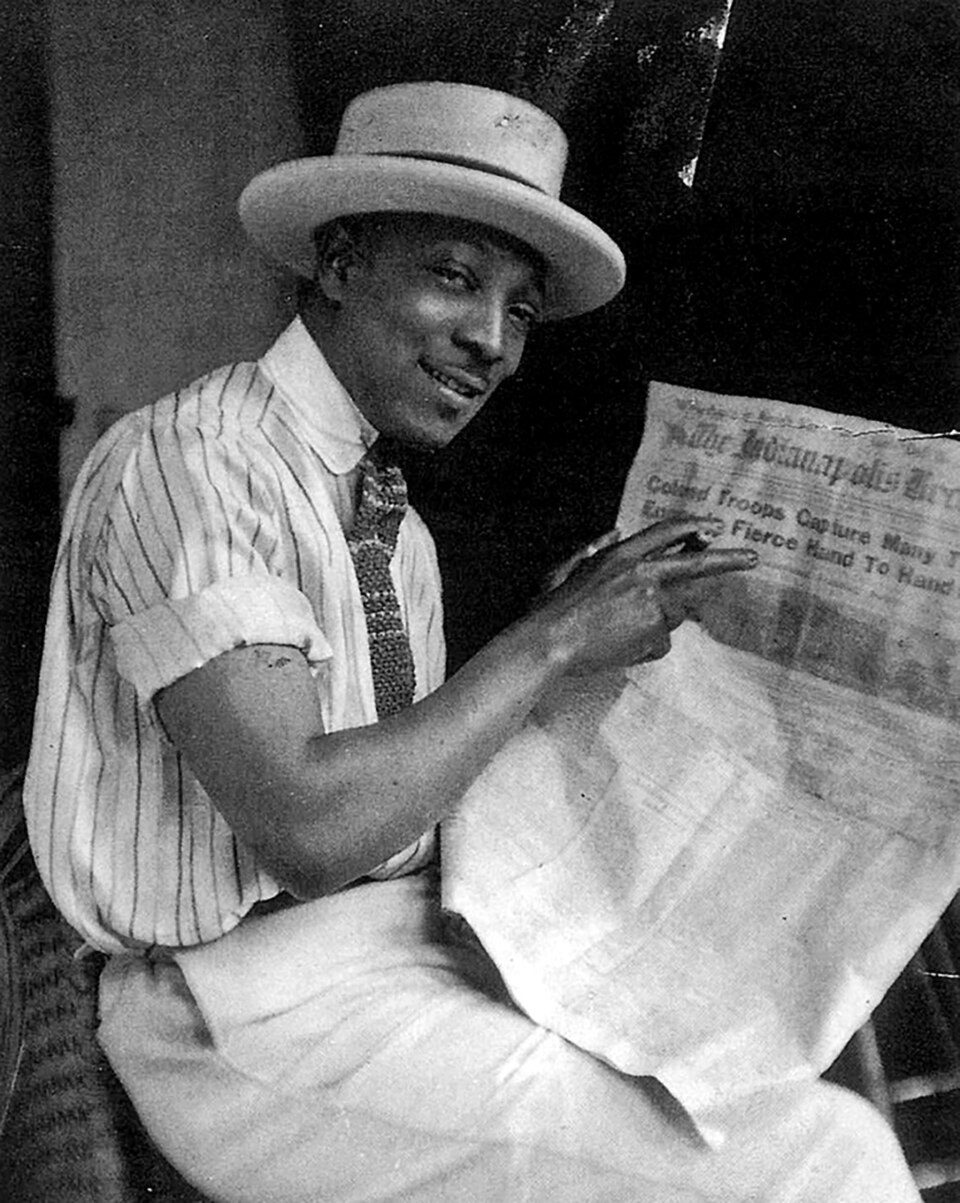
–29
The New Negro becomes a visual field
Books, magazines, competitions, portraits and studios give the movement a reproducible public identity while artists reject any single compulsory style.
–35
Murals, patronage and many modernisms
Douglas enlarges historical narrative, photographers and portraitists consolidate archives, and the Depression begins to change how artistic labour is supported.
–41
Federal workshops and historical continuities
Community art centres, federal programmes and younger history painters carry Renaissance methods beyond a neat endpoint into public teaching and serial narrative.
Harlem Renaissance artists to know
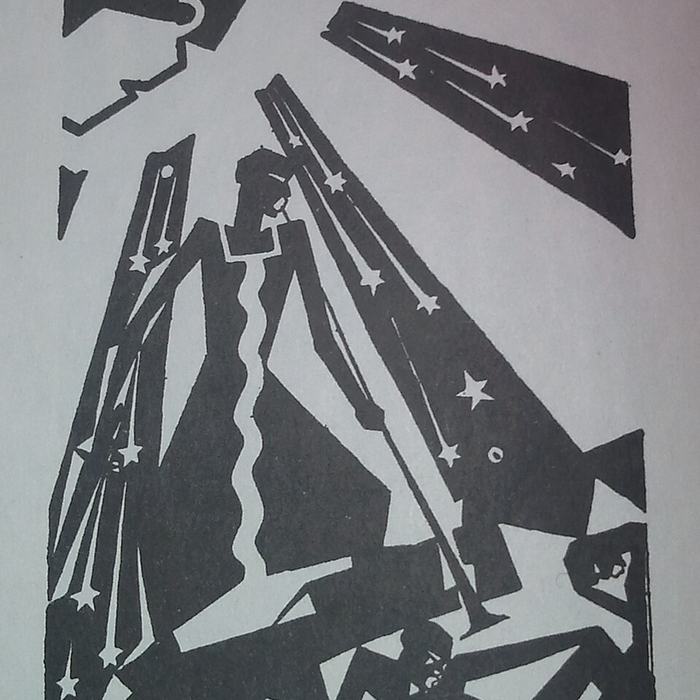
Aaron Douglas
Douglas made reproductive graphics and monumental historical painting equally central, translating diaspora, biblical liberation and modern design into a lucid narrative language.
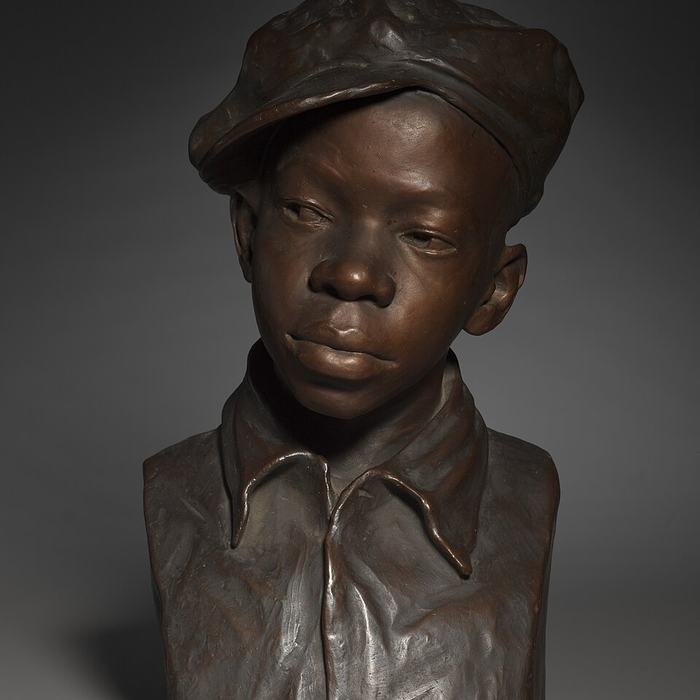
Augusta Savage
Savage’s modelling, studios and advocacy made artists as well as objects; her career reveals how teaching and institutional struggle formed the movement’s infrastructure.
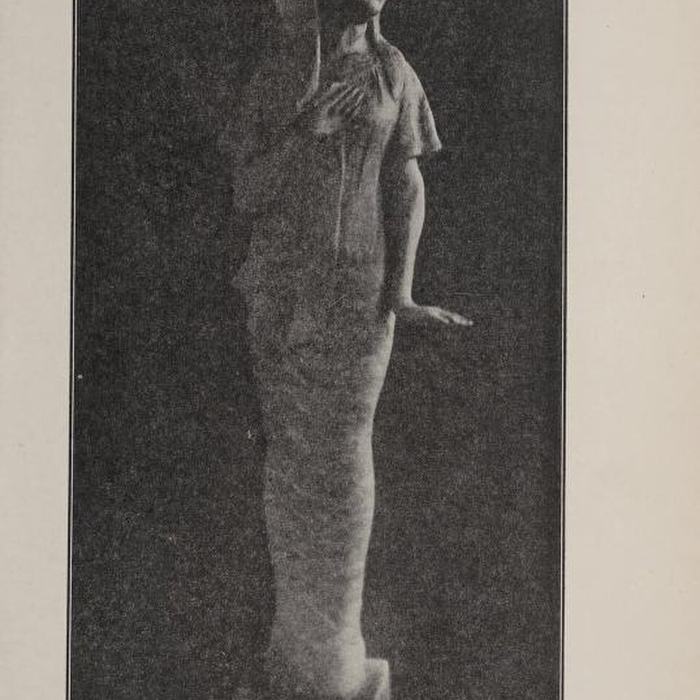
Meta Warrick Fuller
Fuller joined Pan-African awakening, expressive form and anti-lynching protest while working against the losses imposed by fragile materials and restricted commissions.
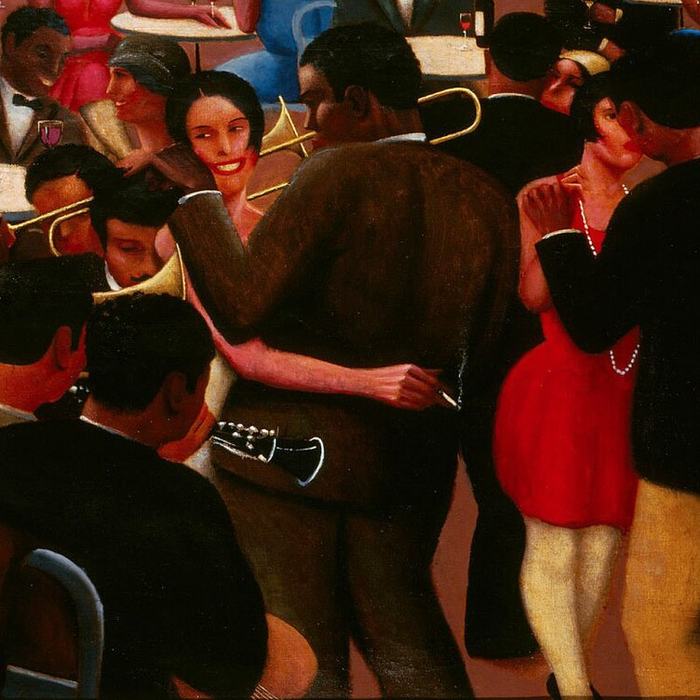
Archibald Motley
Motley’s family portraits and chromatic crowds prove the Renaissance was polycentric, while his typologies keep colourism and representation open to scrutiny.
Laura Wheeler Waring
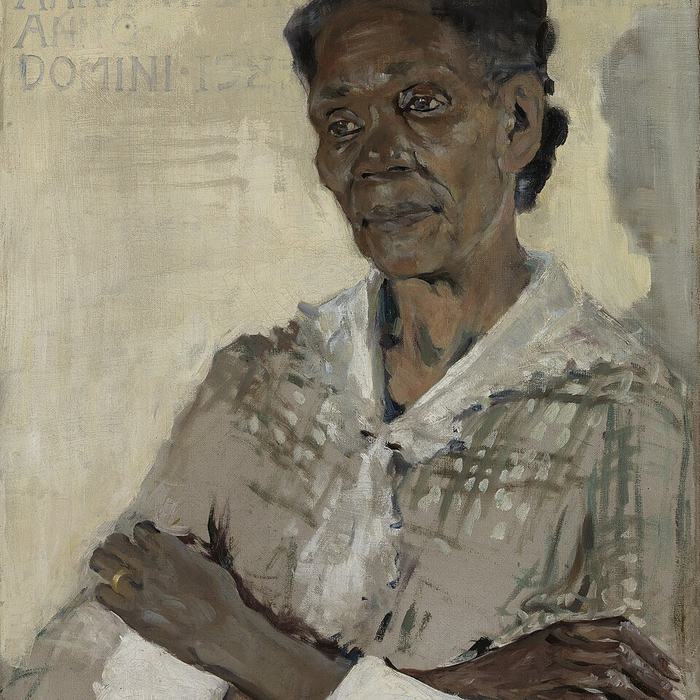
Waring used naturalistic portraiture to give named sitters institutional duration, joining Paris training and Philadelphia teaching to New Negro historical memory.
James Van Der Zee
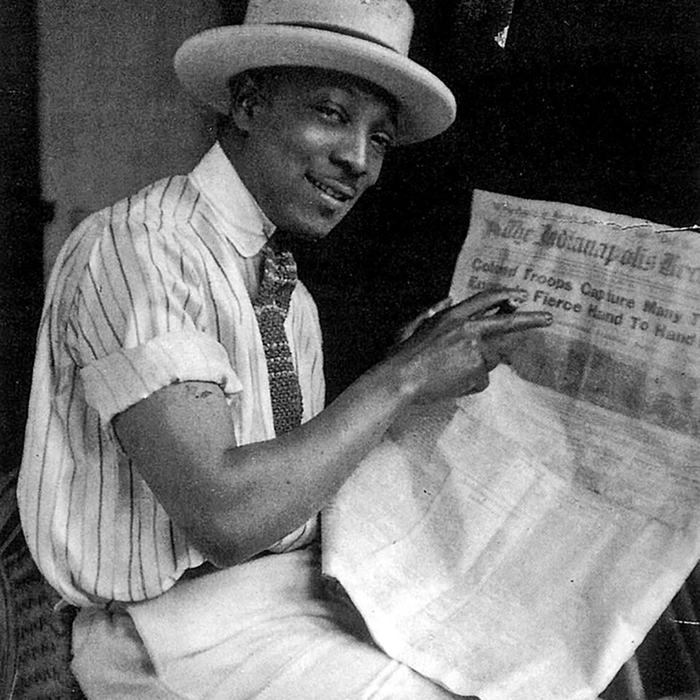
Van Der Zee and his clients constructed aspiration, family, profession and memory through lighting, staging, retouching and the material craft of the photographic print.
Aaron Douglas and history in silhouette
Aaron Douglas became the movement’s most recognisable visual stylist, but his success should not be mistaken for a compulsory Harlem Renaissance look. His figures often appear in profile as dark, flattened silhouettes. Concentric circles send light across the page; diagonals become beams, paths or barriers. Egyptian profile, African sculpture, Art Deco design and Cubism are transformed into a lucid narrative system.
Let My People Go
In Let My People Go, Moses kneels before a radiant star while mounted soldiers and spears press from behind. The biblical story of Exodus becomes an image of enslavement and liberation. Bands of light pass through the darkness, giving revelation a geometric rather than naturalistic form.[11]
Silhouette seems anonymous, yet anonymity is used collectively rather than imposed as caricature. Bodies become a people moving through history. The compressed space works like stage design or a printed emblem: it does not describe a particular landscape but makes oppression and deliverance immediately legible.
The painting was made in 1935–39 after an earlier illustration for James Weldon Johnson’s God’s Trombones. Its movement between book and easel challenges the hierarchy that places unique paintings above reproducible design. Douglas’s artistic field included prints, dust jackets, magazine pages, murals and canvases. A major retrospective has shown how Cubist rhythm, Art Deco, African imagery and Black history operated across all these media.[12]
Douglas came from Topeka, studied at the University of Nebraska and taught before moving to Harlem in 1925. He worked with Reiss and contributed to The Crisis. Later study in Paris and decades of teaching at Fisk University made his career a route between New York publishing, European modernism and HBCU education.[13]
Murals as public history
Murals allowed Douglas to expand the page into architectural space. His Aspects of Negro Life cycle for the 135th Street branch of the New York Public Library narrated an arc from African life through enslavement, emancipation, migration and modern labour. The sequence refuses a story that begins with bondage. It also refuses a triumphant ending: industrial machinery and urban culture arrive with continuing struggle.
In a 1936 mural for the Texas Centennial, chained figures fill the lower area while a distant star cuts through darkness. The star can signal escape and the future, but history remains crowded by ships, weapons and labour. National Gallery interpretation emphasises the transatlantic slave trade and the work’s deliberate storytelling.[14]
The public commission creates a difficult setting. A state celebration invited a Black artist to represent Black history within a segregated society. Douglas used the opportunity to put enslavement at the centre of regional history rather than offer decorative reconciliation.
The Judgment Day
The Judgment Day also began as a book illustration before becoming a large painting. A monumental preacher stands above small figures while an angel sounds a trumpet. A bolt of light divides those rising toward salvation from those falling away. The composition translates a sermon tradition into modern graphic order.[15]
The preacher’s oversized hand and foot give the body architectural authority. Repeated circles suggest sound spreading through space. Douglas did not simply combine “African” and “modern” features; he made a reproductive form capable of carrying voice, rhythm and collective memory into a museum-scale object.
Meta Warrick Fuller: awakening and historical grief
Meta Warrick Fuller belonged to an earlier generation than Douglas and Savage. She studied in Philadelphia and Paris, where Auguste Rodin encouraged her interest in expressive sculpture. Returning to the United States, she confronted restricted commissions and the combined exclusions of race and gender. Her allegorical work supplied a visual bridge between turn-of-the-century Black historical pageantry and New Negro modernism.
Ethiopia
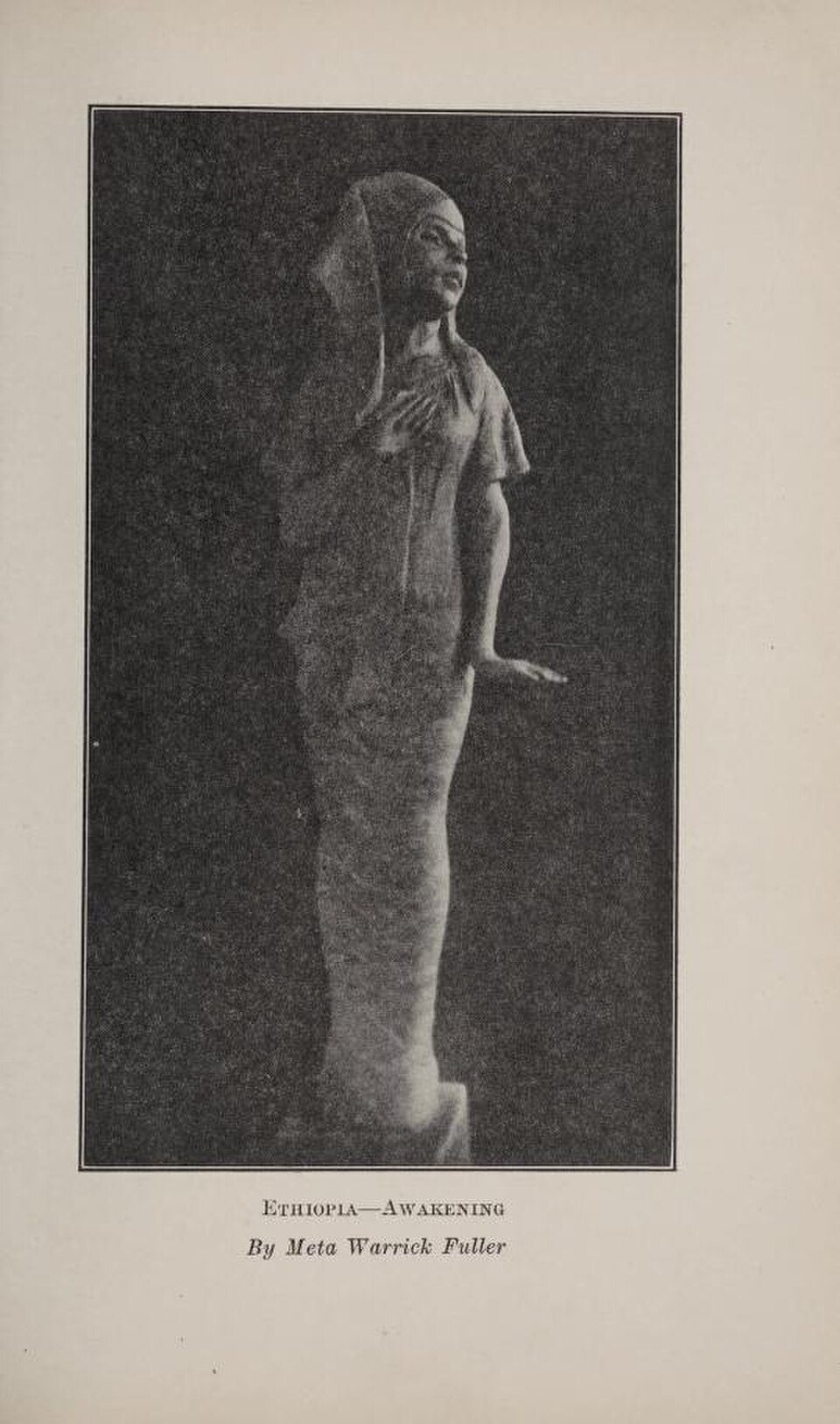
Fuller’s Ethiopia of about 1921 is a standing female figure whose lower body remains wrapped like a mummy while her upper body twists awake. One hand reaches downward; the other presses near her heart. A pharaonic headdress joins ancient Egypt to modern Black consciousness. Commissioned in relation to the America’s Making Exposition, the sculpture presented emancipation as an incomplete awakening rather than an effortless rebirth.[16]
The title drew on Ethiopia’s long symbolic role in Black religious and Pan-African thought. At a time when European colonial rule covered much of Africa, Ethiopia could signify ancient civilisation and resistance. The work does not portray one contemporary Ethiopian woman. It personifies a continent and diaspora through a body becoming mobile.
That personification is powerful and vulnerable. Woman becomes the bearer of collective ancestry, while her individual identity disappears into allegory. Plaster painted to resemble metal also tells a material story: Black sculptors often lacked funds for durable bronze casting. Survival depended on families and institutions recognising fragile works as important.
German scholarship has recovered Fuller as a pioneering artist who trained internationally, received an early federal commission and nevertheless slipped from conventional modern-art histories.[17] Her relative absence was not evidence of minor achievement. It resulted partly from lost objects, limited exhibitions and a canon built without her.
Fuller also made Mary Turner (A Silent Protest Against Mob Violence) after the 1918 lynching of a pregnant Black woman in Georgia. Its direct response to racial terror complicates any notion that Renaissance art pursued beauty by withdrawing from politics. Allegory, mourning and protest could occupy the same sculptural practice.
Augusta Savage: making artists as well as objects
Augusta Savage’s career reveals how teaching can be a movement’s central medium. Born in Florida, she came to New York and studied at Cooper Union. Her ability brought recognition, yet racial discrimination repeatedly obstructed training and commissions. When a summer programme at Fontainebleau rejected her because white students objected to sharing classes with a Black woman, Savage publicly challenged the decision.
She later studied in Paris and returned to Harlem, where she developed studios, advocacy groups and classes. The Savage Studio of Arts and Crafts grew into the federally supported Harlem Community Art Center, of which she became the first director. Her pupils and associates included figures who would shape later American art. Smithsonian history rightly treats this educational labour as a principal work of the Renaissance.[18]
Gamin
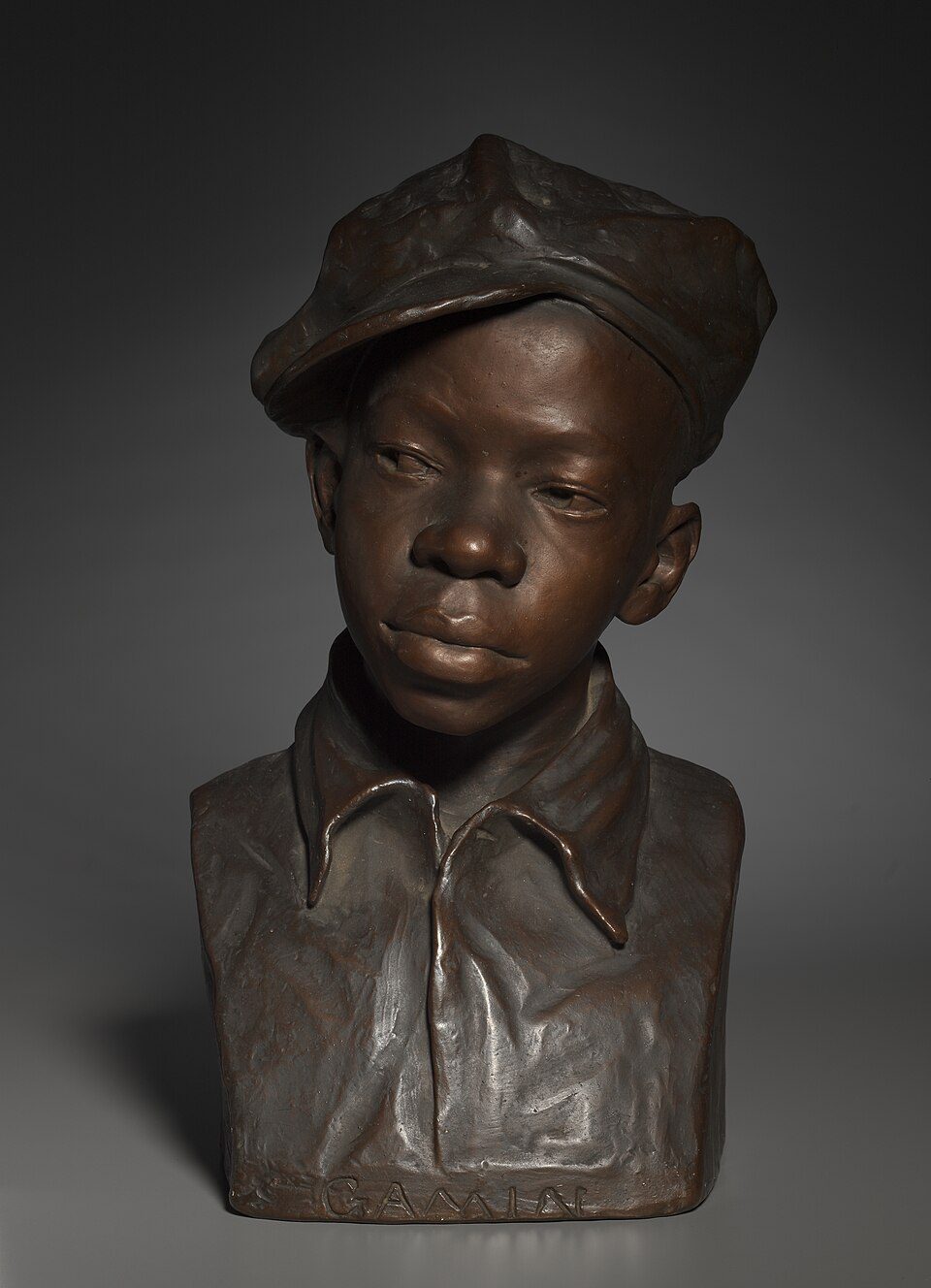
Gamin, made around 1929, presents Savage’s nephew Ellis Ford in a soft cap associated with newsboys and working children. His head tilts slightly; narrowed eyes and pursed lips suggest concentration beyond easy sentiment. The French title can mean street child, but the named family relationship counters the anonymous “urchin” type.[19]
Savage modelled a Black child with specificity at a moment when commercial culture circulated dehumanising images. The surface is tender without being smooth or idealised. Painted plaster imitates bronze, and multiple casts allowed the work to circulate more widely than a unique sculpture. Again, a less expensive material served both necessity and access.
A monument that disappeared
For the 1939 New York World’s Fair, Savage created a monumental sculpture inspired by the song Lift Every Voice and Sing. She called it by that title, though the fair promoted it as The Harp. A line of Black singers formed the instrument’s strings, while a kneeling figure held music like a sounding board. The human body became collective music and architecture.
The work occupied a prominent fair site but was made in plaster and destroyed when the exposition ended. Small souvenir versions and photographs preserve its form. Its loss should not be narrated as romantic ephemerality. It reflects an exhibition system unwilling to fund permanent casting and storage for an ambitious Black woman’s monument.[20]
Savage left the Harlem Community Art Center before the fair and opened the Salon of Contemporary Negro Art, seeking a commercial space dedicated to Black artists. Neither project achieved long-term financial stability. Her legacy persists through Gamin, surviving photographs and the careers she enabled. To measure her only by extant sculpture would repeat the institutional logic that made so much of her work disappear.
Portraiture as historical claim
Portraiture answered racist caricature by insisting on character, profession, family and interior life. It could make sitters visible as individuals, but it also carried expectations of racial uplift. Artists had to decide whether modern Black identity should appear respectable, cosmopolitan, ordinary, glamorous, wounded or deliberately difficult.
Archibald Motley’s grandmother
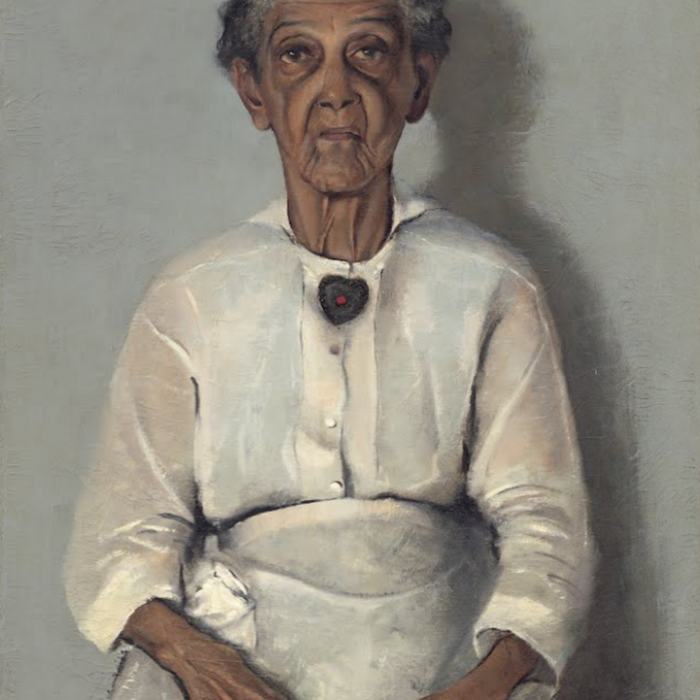
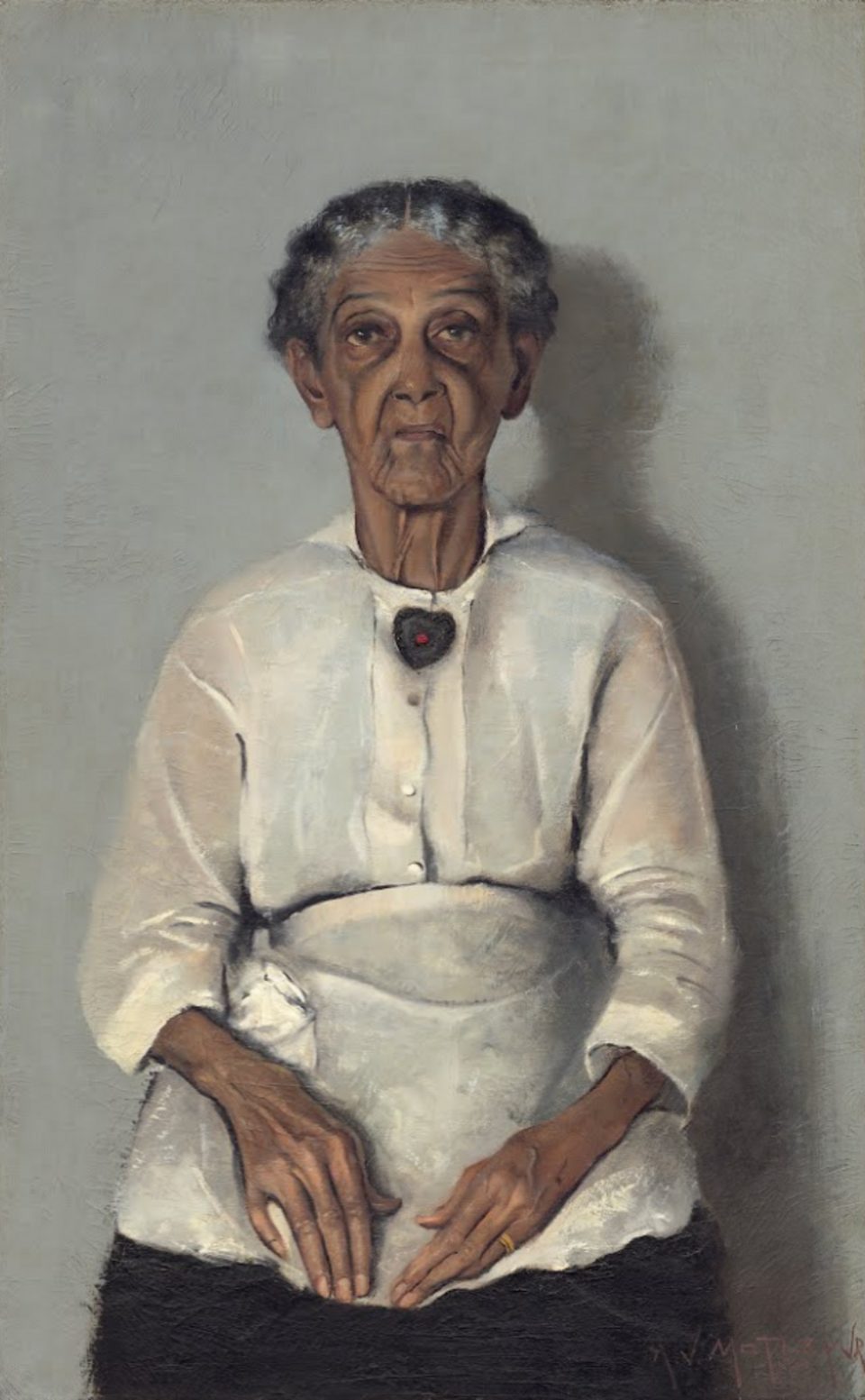
Archibald Motley worked principally in Chicago, an essential reminder that Renaissance geography exceeded Harlem. In Portrait of My Grandmother of 1922, Emily Sims Motley sits upright against a pale ground, her hands resting on a white apron. Fine wrinkles, grey hair and a direct gaze produce neither idealisation nor caricature. Born enslaved, she had lived through emancipation, Reconstruction and migration.[21]
The portrait’s quietness is historical. A heart-shaped brooch and wedding ring mark intimate life; worn hands suggest labour without turning her into a generic worker. A faint shadow behind the figure can be read formally as volume and metaphorically as the continuing presence of slavery, though that second meaning remains an interpretation.
Motley trained at the School of the Art Institute of Chicago and became known for portraits and scenes of Bronzeville. His New York exhibitions connected him to Renaissance institutions, but his subjects came from another Black metropolis. The Met’s account of Uncle Bob places portraiture beside his better-known urban crowds and makes his Chicago location integral to the larger movement.[22]
Crowds, colour and nightlife
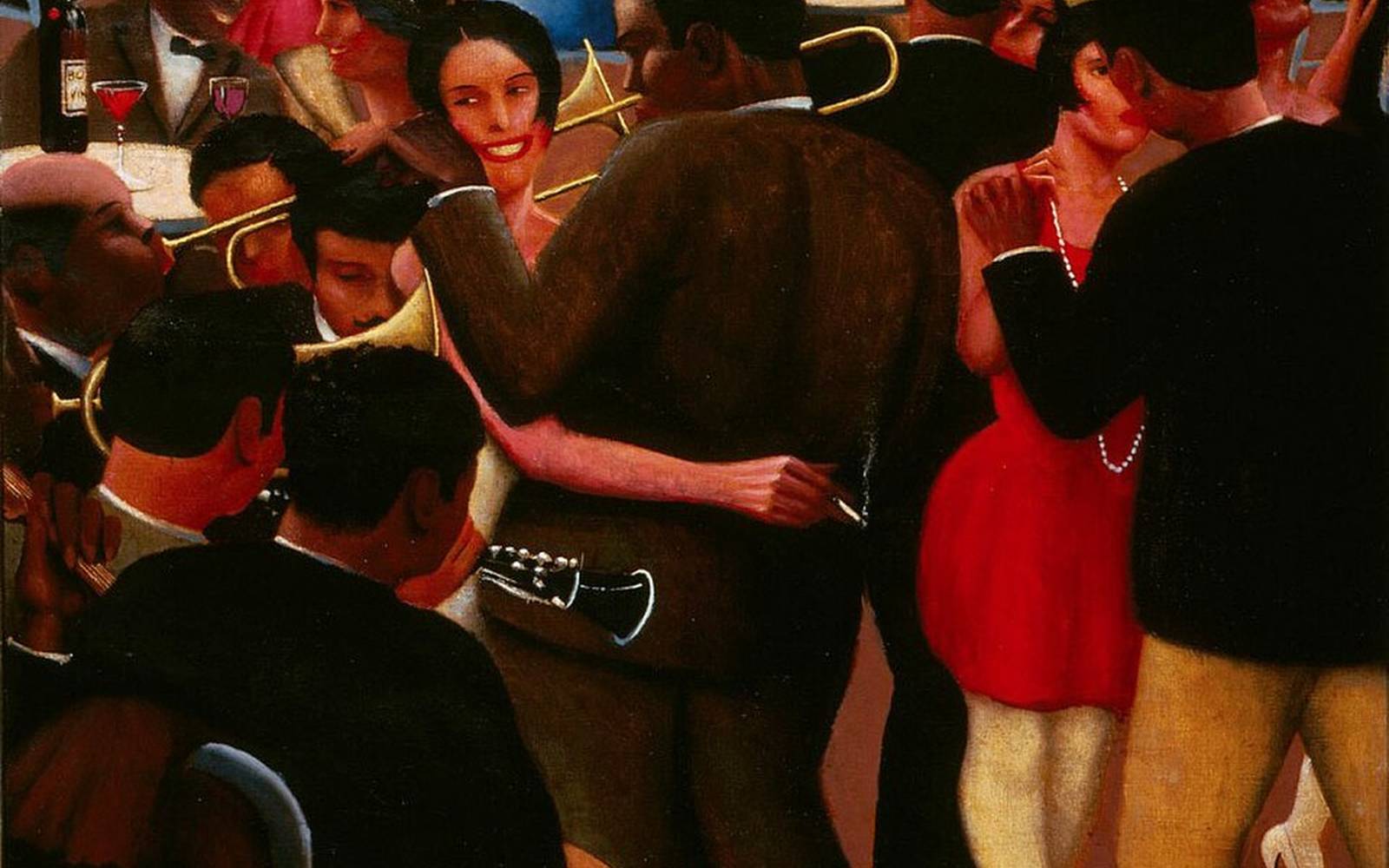
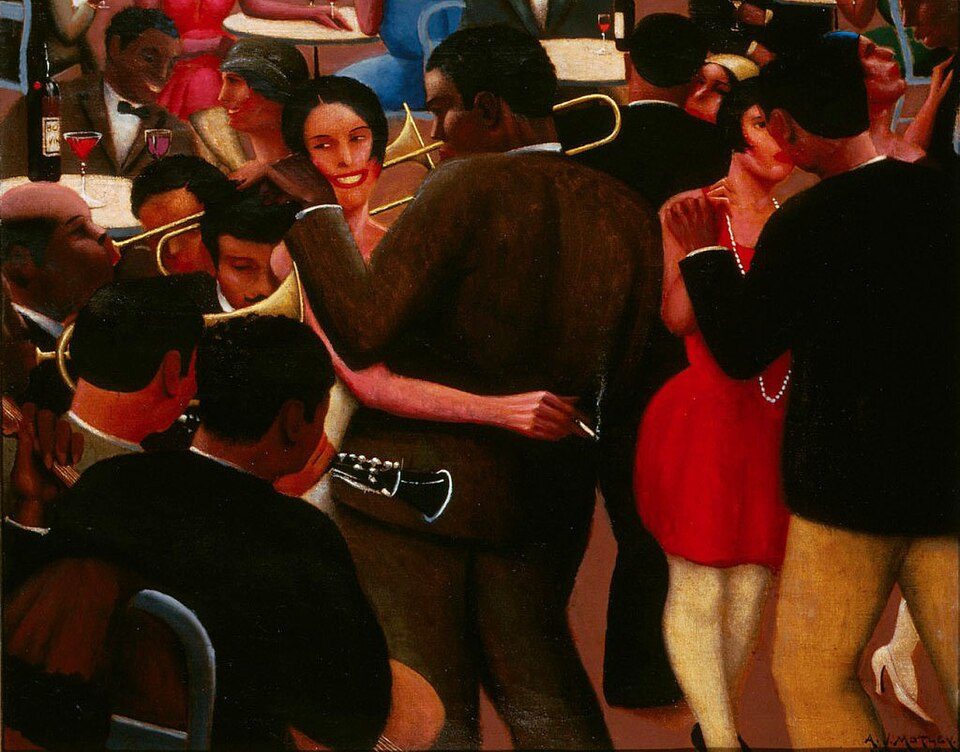
Motley’s nightlife paintings use saturated colour, compressed space and repeated bodies to convey music as a visual rhythm. Couples dance, cars and police redirect movement, faces emerge from violet or amber light. The images are not records of one instant. They arrange types, gestures and sightlines into a social theatre.
The pleasure is genuine, but so are the contradictions. Clubs and house parties supported musicians and supplied spaces of Black sociability. Gambling and informal economies could offer opportunity while risking money needed for rent or food. Met research on music and nightlife emphasises participation, emotion and economic uncertainty, and notes that Motley’s work remained centred on Chicago rather than Harlem.[23]
Motley also used tonal gradations and titles to explore racial mixture. His portraits have been praised for representing a broad Black middle class, but their classification of skin colour can echo colourism. Viewers should attend to how individuality competes with typology, especially when a title makes complexion the dominant identity.
Laura Wheeler Waring: accomplishment and interior presence
Laura Wheeler Waring trained in Philadelphia, studied in Paris and taught for decades at the Cheyney Training School for Teachers. She painted landscapes and still lifes as well as portraits, yet her likenesses of distinguished African Americans became central to her reputation.[24]
Waring’s naturalism can appear conservative beside Douglas’s radical graphic form. That comparison assumes formal experiment is the only measure of modernity. In a racist visual culture, a large, carefully worked portrait of a Black educator, singer or professional claimed institutional duration. It expected the sitter to be remembered by name.
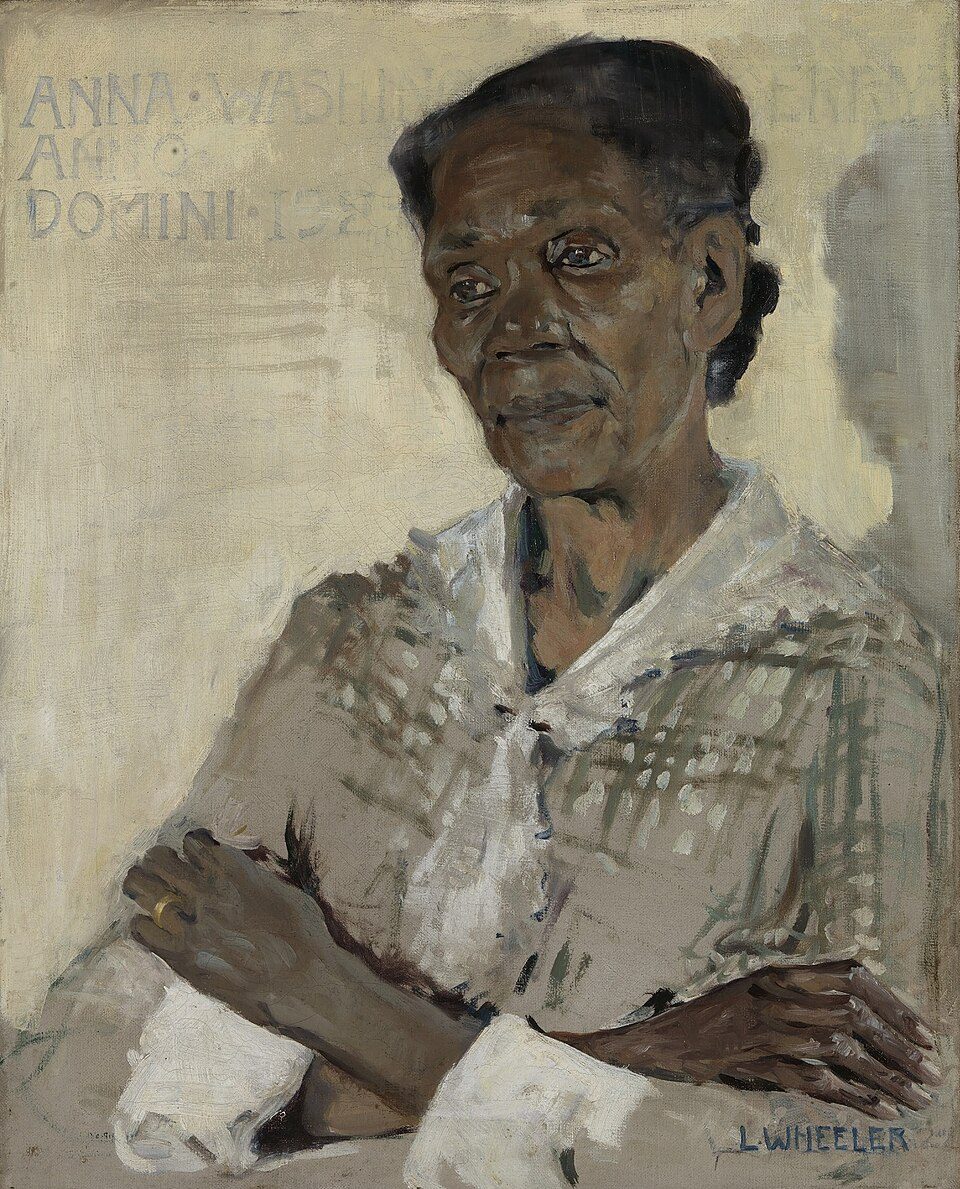
Her 1927 portrait of Anna Washington Derry presents an elderly woman frontally, with close attention to expression, clothing and age. The work entered exhibition through the Harmon Foundation, connecting intimate likeness to a national prize system.[25] Derry is neither anonymous type nor allegory. Her presence depends on Waring’s slow observation.
Waring’s later portrait of Marian Anderson carries another history. In 1939 the Daughters of the American Revolution denied Anderson the use of Constitution Hall because she was Black; she instead sang to a vast integrated crowd at the Lincoln Memorial. A German museum essay uses the portrait to connect Waring’s controlled colour and sitter’s concentrated face to that struggle over public visibility.[26]
Naturalistic portraiture did not simply copy appearances. It constructed a public memory capable of entering schools, homes and galleries. The scarcity of major commissions for Black sitters made each object participate in building an archive.
Richmond Barthé: the body in motion
Richmond Barthé began as a painter at the School of the Art Institute of Chicago but discovered that modelling offered a more direct way to study bodies. Moving to New York in 1929, he made sculpture of dancers, religious subjects and Black historical figures. Travel in the Caribbean and Europe later widened his practice.[27]
His figures often combine observed movement with a refined, elongated classicism. Dance is not an exotic accessory; it gives sculptural form to balance, tension and transition. His representations of male dancers also belong to a queer history of the Renaissance, though museum labels have not always named it.
Blackberry Woman
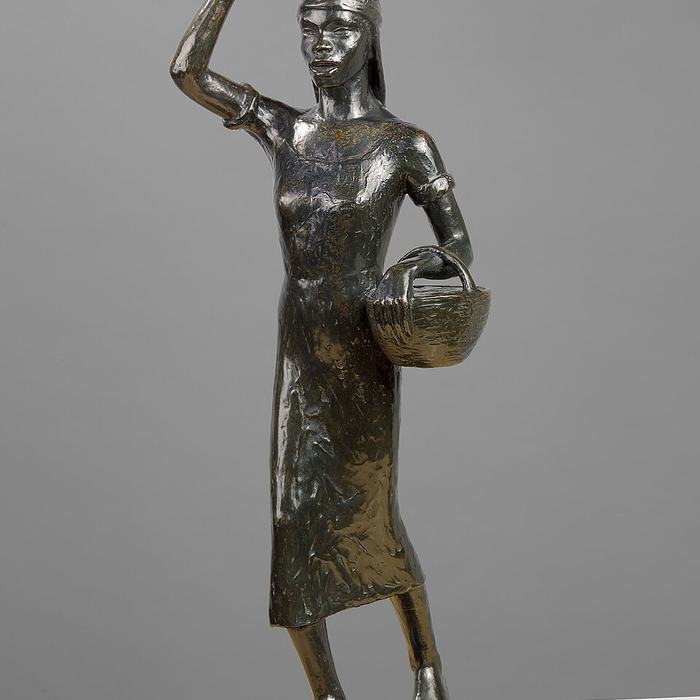
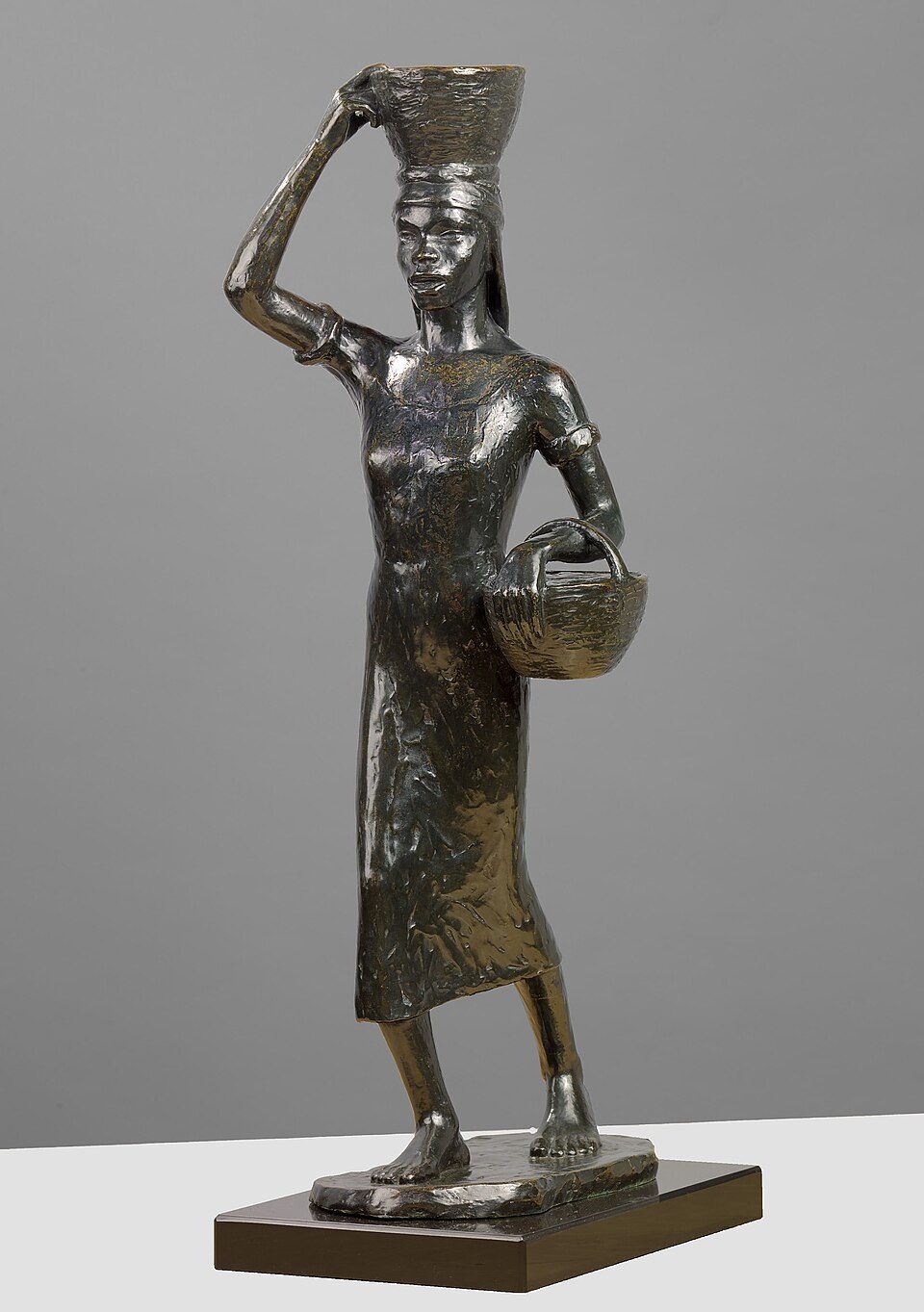
Blackberry Woman depicts a standing market seller carrying goods. The figure is frontal, contained and physically steady. Smithsonian interpretation connects the form to West African sculptural precedent and the subject to market women Barthé had known in Mississippi.[28]
The title is more troubled. It recalls Wallace Thurman’s novel The Blacker the Berry, which addresses colour prejudice within Black communities. “Blackberry” can invoke deep skin colour while turning a woman into a racialised type. Barthé grants her dignity and strength, yet the work cannot be separated from a language that measured Black women by complexion and labour.
Her contained posture rejects caricatured motion. At the same time, the artist and collector can aestheticise poverty. A responsible reading holds these forces together: the sculpture gives a working woman monumental presence while its title and market participate in systems that categorised her.
Palmer Hayden and the argument over representation
Palmer Hayden trained in New York and Paris, received Harmon Foundation support and worked for federal art programmes. His still lifes could place African objects within European modernist formats; his later figure scenes adopted flattened space, strong outline and a consciously direct narrative style.[29]
Critics often called this work “primitive,” a term that collapsed self-taught art, African form and racist assumptions about ability. Hayden had formal training. His simplified perspective was a choice, though choices are not immune from criticism.
The Janitor Who Paints
In The Janitor Who Paints, an artist works in a cramped room containing a bed, broom, feather duster, stove and family figures. Art and service labour occupy the same space. Hayden explained that his friend Cloyd Boykin was known as a janitor even though he was an artist; Hayden himself had supported painting through manual jobs.[30]
The picture protests an economy that recognises the Black worker’s occupation but not his creative identity. Yet its original exaggerated features drew criticism for resembling minstrel caricature. Hayden later repainted parts of the canvas. The revision makes the object a record of argument: protest intention did not cancel the visual language viewers found demeaning.
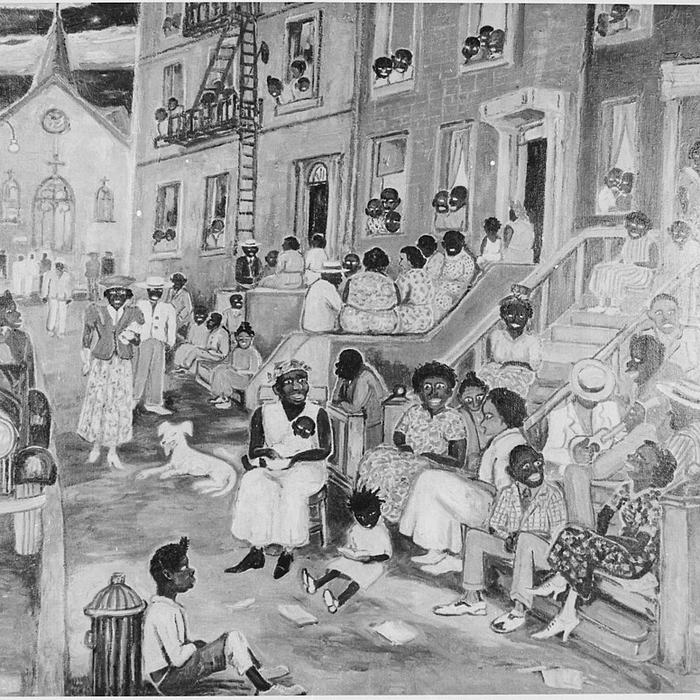
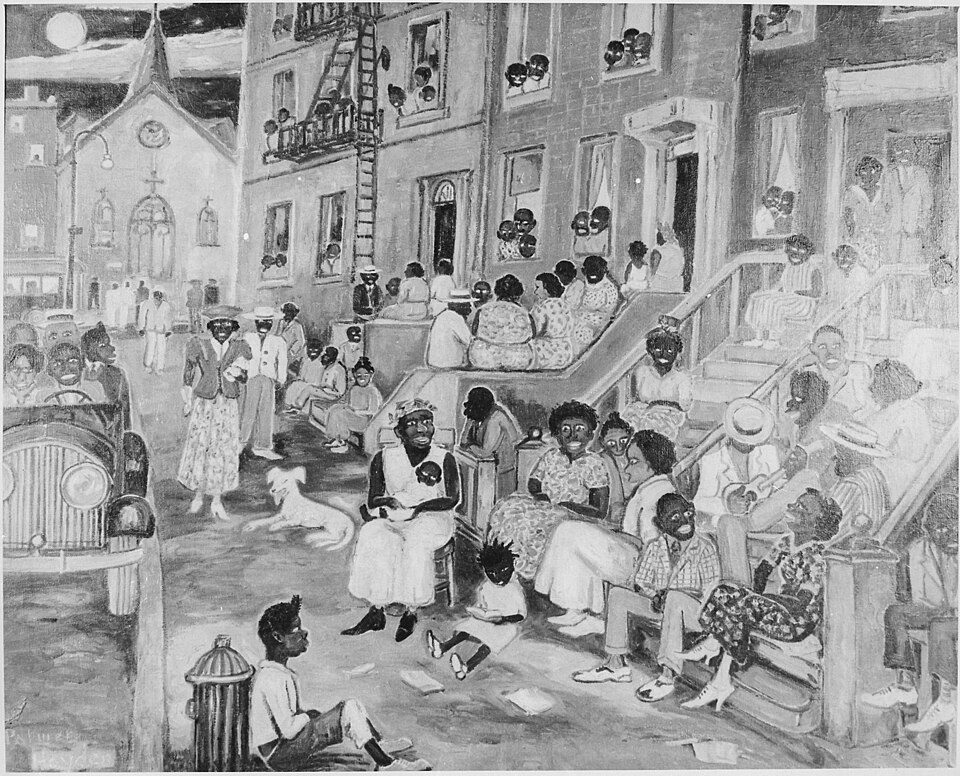
His Midsummer Night in Harlem produced a similar dispute. A crowd gathers outdoors during oppressive heat, turning tenement space into collective life. Art historian James Porter saw stereotyped faces where Hayden insisted on a new folk expression. Neither intention nor criticism should be dismissed. The issue is how a Black artist could use exaggeration after caricature had made exaggeration dangerous.
The debate also exposes a bias in movement scholarship. Researchers looking for an emblematic New Negro modernism have privileged Douglas’s geometry while neglecting naturalistic portraits, still lifes and landscapes by Douglas, Waring, Motley, Hayden and Lois Mailou Jones. Smithsonian research calls this a “quiet renaissance” hidden by expectations of stylistic militancy.[31] Plurality is not an absence of purpose.
James Van Der Zee: Harlem enters the studio
James Van Der Zee’s photographs are often described as documents of Harlem, but his studio was a place of invention. Clients selected clothes and occupations they wanted remembered. Painted backdrops, furniture, flowers and architectural props created settings. Retouching softened surfaces or added detail. Double exposure and photomontage could join people, memories and hopes that were not present before one lens at one moment.
Van Der Zee operated a commercial studio for decades and became the pre-eminent portrait photographer of Harlem in the 1920s and 1930s. Families, soldiers, church groups, celebrities, athletes and business owners passed through it. Yet wide art-world recognition came only after his inclusion in the Met’s controversial 1969 exhibition Harlem on My Mind.[32]
Studio portraiture was collaborative, though not equal in every respect. The photographer controlled lighting, plate, print and retouching. Clients brought bodies, clothing, desires and money. The resulting image records an agreement about how a life should face the future.
Business and collective identity
In a luncheon portrait made for Madame C. J. Walker’s beauty-school organisation, rows of women gather around carefully laid tables. The scene registers Black enterprise, professional training and female association. It is also staged: seating, dress and frontal presentation make commercial success visible as collective order.[33]
A photograph of a Chicago Defender newsboy truck takes the studio practice into the street. The newspaper urged southern readers to migrate and connected Black communities across regions. Van Der Zee’s image joins vehicle, workers and masthead into an emblem of communication.[34] Modern Black identity circulated through distribution networks as well as cultural salons.
In Drug Store Soda Fountain, mirrors, signs, glass and a tiled commercial interior multiply visual information. Prohibition increased the importance of soda fountains as social spaces, and the proprietor’s business stands as part of Harlem’s public life. Reflections enlarge the room; only one worker looks directly toward the camera.[35]
These commissioned images complicate the opposition between art and commerce. A business owner wanted a useful record. Van Der Zee organised light and reflective surfaces with aesthetic intelligence. The photograph’s social history and formal structure are inseparable.
Retouching, desire and truth
In a studio nude with applied colour, the model adopts a pose drawn from classical Venus imagery. Drapery and painted background distance the scene from an ordinary room. Colour applied to the print intensifies skin, fabric or atmosphere.[36] Rather than expose a body as unmediated fact, the photograph constructs access through art history and studio craft.
Retouching has sometimes been described as falsification. That judgement assumes the untouched negative is the only truthful photograph. Van Der Zee’s clients wanted images that expressed aspiration, mourning, affection or social standing. A composite memorial could make an absent or dead relative visibly present. The transformation is itself evidence of what a family wished to preserve.
The scale of the surviving archive—tens of thousands of photographs and negatives—shows how much Harlem life passed through the studio. The Met and Studio Museum in Harlem now share stewardship of the archive, an arrangement that joins conservation resources to an institution rooted in Black artistic culture.[37]
Technical examination makes authorship more complex. Negatives, papers, applied media and retouching reveal repeated interventions, some by studio assistants. Conservation research can recover handwork that reproduction hides.[38] A Van Der Zee portrait is a photographic object, not merely an image floating free of its print.
Essential Harlem Renaissance works
Midsummer Night in Harlem
Palmer Hayden · 1936 · A Harlem crowd fills the street with collective life while the deliberately exaggerated faces keep the work inside the movement’s unresolved debate over folk expression and caricature.
Blues
Archibald Motley · 1929 · Motley turns a Paris nightclub into compressed colour and rhythm, locating Black transatlantic modernity in pleasure, performance and social encounter.
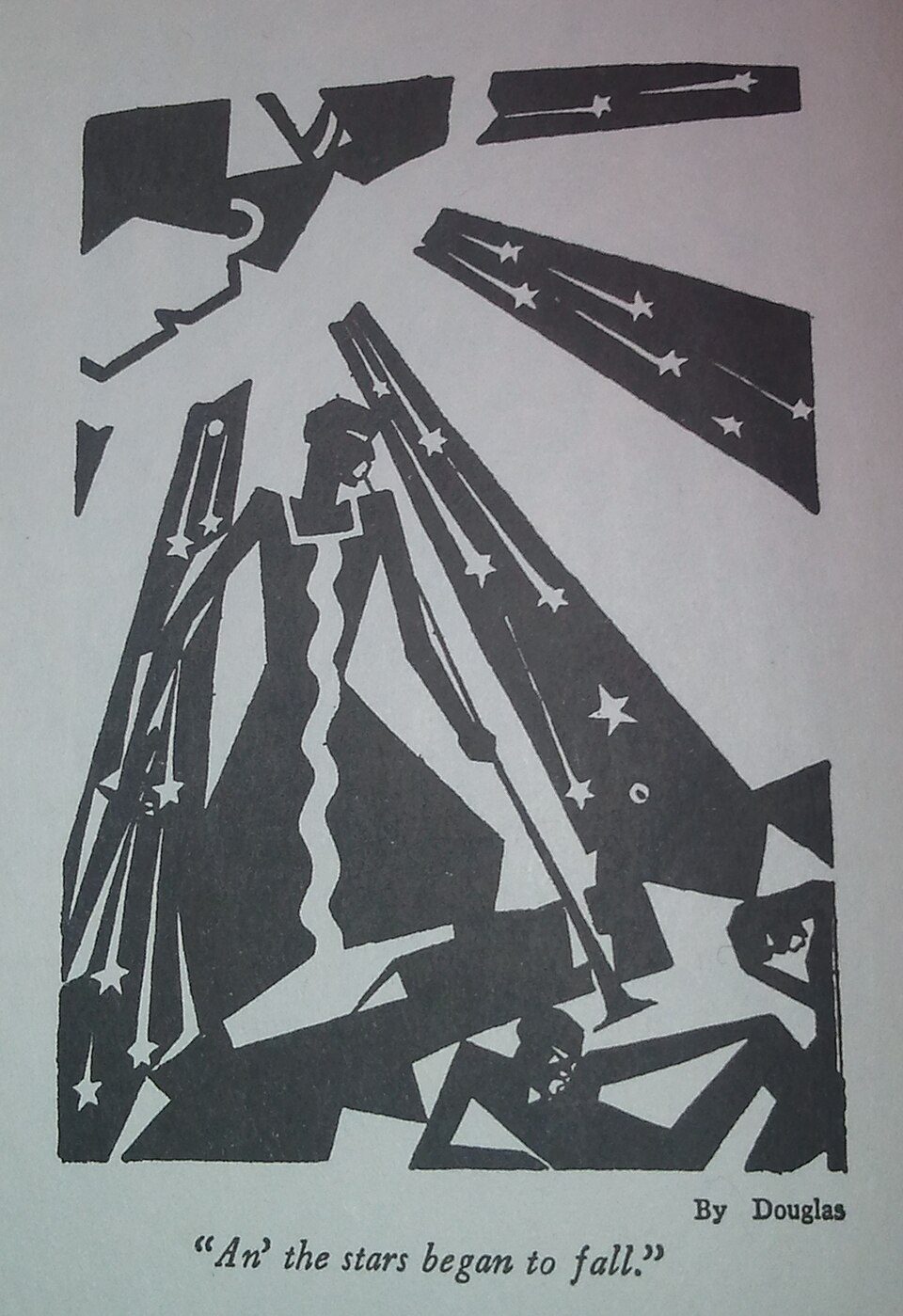
An’ the Stars Began to Fall
Aaron Douglas · 1925 · Douglas’s 1925 illustration makes silhouette, radiating light and repeated diagonals carry spiritual history through the reproducible page.
Ethiopia Awakening
Meta Warrick Fuller · c. 1921 · Fuller personifies diasporic emancipation as a body still partly bound, joining ancient Egyptian form to an unfinished political awakening.
Gamin
Augusta Savage · c. 1929 · Savage’s named nephew Ellis Ford receives alert, individual presence through a widely circulated painted-plaster bust that resists the anonymous street-child type.
Portrait of My Grandmother
Archibald Motley · 1922 · Motley presents Emily Sims Motley, born enslaved, as an individual historical witness whose age, labour and family life remain fully visible.
Anna Washington Derry
Laura Wheeler Waring · 1927 · Waring’s naturalism makes patient looking a modern historical strategy, preserving an elderly sitter by name within national exhibition circuits.
Blackberry Woman
Richmond Barthé · modelled by 1930, cast 1932 · Barthé grants a market worker monumental steadiness while the sculpture’s title and collecting history retain the era’s tensions around labour, type and colourism.
Patronage: opportunity with conditions
The Harlem Renaissance depended on institutions that gave uneven access to money, publicity and exhibition. The Harmon Foundation offered awards, organised touring shows and supported travel. Carnegie funding enabled study. Magazines held competitions. White collectors bought work that mainstream museums ignored.
These resources mattered. A prize could fund months abroad or make an artist visible in several cities. Yet “Negro art” competitions also framed artists primarily through race, sometimes expecting work to demonstrate uplift or recognisable heritage. The Harmon archive contains award files, correspondence, publicity plans, exhibition records and negotiations with Locke, revealing patronage as a system rather than a series of generous gifts.[39]
Artists learned to work within and against those terms. Waring accepted portrait commissions; Hayden used prizes to travel; Savage demanded fair access; Douglas served publishers and public agencies. White support could coexist with condescension, and Black cultural organisations could still contain class and gender hierarchies.
Levi C. Hubert’s contemporary essay “The Whites Invade Harlem” attacked a particularly visible form of consumption. Downtown visitors entered clubs, publishers sought novelty and patrons treated Black artists as specimens of a fashionable cultural moment.[40] His criticism shows that participants recognised the problem at the time; it is not a judgement invented by later scholarship.
The Cotton Club made the contradiction notorious. Black musicians and dancers performed for largely white audiences under segregated admission and plantation-themed décor. White tourism supplied income and national exposure while turning Harlem into an exotic entertainment district. A club scene may therefore picture Black creative power inside a business structured by racial inequality.
Patronage should not be reduced to a simple choice between exploitation and autonomy. Few artists have complete independence from markets. The specific question is who set the category, selected the work, controlled the venue and kept the object afterward.
Queer Harlem was not outside the Renaissance
Nightlife opened spaces in which gender and sexuality could be performed with unusual visibility. Drag balls drew large crowds. Gladys Bentley sang in men’s clothing and built a public persona around sexual and gender nonconformity. Writers and artists formed friendships, salons and partnerships that did not always enter official biographies.
Alain Locke was gay, as were several writers and artists in his networks. A National Park Service study places Locke’s Washington and Harlem relationships beside queer performers, clubs and drag-ball sites.[41] This evidence changes how cultural infrastructure is understood. Queer life was not a private exception to the Renaissance; it helped constitute its salons, nightlife and intellectual exchange.
Richmond Barthé’s dancer sculptures gain another dimension in that history. Their sustained attention to male beauty, performance and touch can be considered alongside the artist’s sexuality without claiming every form is autobiographical code. Queer context expands interpretation; it does not reduce art to disclosure.
Black queer women built institutions as well. Lucy Diggs Slowe, Howard University’s first dean of women, lived with educator and playwright Mary Burrill. Their Washington home supported a partnership publicly concealed within the conventions of female companionship but recognised within Black queer networks.[42] The story connects domestic space, education and theatre to the broader New Negro geography.
Visibility remained dangerous. Police raids, employment discrimination and moral regulation shaped what could be represented openly. White tourists might consume gender variance onstage while Black queer people remained vulnerable outside the club. The exuberance of nightlife should be read with the laws and surveillance that gave it stakes.
The colour line and international modernism
The Renaissance spoke internationally because the colour line did. Black American artists travelled to Paris seeking training and relative freedom, though Europe was not free of racism. African and Caribbean intellectuals encountered the work through print. Jazz crossed the Atlantic with soldiers and performers. Anticolonial politics connected Ethiopia, Egypt, Haiti and the United States in artistic imagination.
French scholarship at the Musée du quai Branly situates Harlem Renaissance art within nearly a century and a half of images made across racial division and resistance.[43] That broad frame is useful when it does not dissolve local difference. Jim Crow, French colonialism and Caribbean colour hierarchies were related systems, not interchangeable experiences.
European modernism was equally entangled. Douglas and Hayden used formal lessons circulating through Paris and New York, but they directed those forms toward Black history. Käthe Kollwitz offers a parallel instance of graphic compression serving grief and social struggle, while Diego Rivera demonstrates how mural scale could make history public. Neither is a source that explains the Renaissance by substitution. Comparison clarifies the shared modern question of how form can carry collective experience.
Jacob Lawrence and the history series
Jacob Lawrence was a child during the movement’s early years, but Harlem institutions trained him. He studied with Charles Alston, Augusta Savage and James Lesesne Wells. Libraries and lectures exposed him to Carter Woodson and Arthur Schomburg. Before the age of twenty-five he created serial narratives about Toussaint Louverture, Frederick Douglass, Harriet Tubman and Black migration.[44]
Lawrence’s tempera panels use repeated colour, angular figures and compressed rooms. A history series asks viewers to move from one image to the next, carrying forms and ideas across gaps. The method resembles a book or film sequence more than a single heroic mural.
The Migration Series of 1941 transforms the population movement underlying the Renaissance into sixty panels. Crowds queue at stations, labour agents recruit workers, southern violence drives departure and northern housing reproduces inequality. Text and image share the telling. The series is a culmination and transition: born from Harlem teaching and historical study, it belongs to a younger artist working beyond the conventional endpoint.
Romare Bearden and the movement as inheritance
Romare Bearden’s childhood home hosted writers, musicians and political figures including Du Bois, Hughes, Duke Ellington and Douglas. Such domestic salons made cultural movements through meals, conversation, mentoring and introductions as much as through official organisations.[45]
Bearden later developed collage from photographs, printed fragments and painted colour, using broken scale to represent memory and Black urban life. He also helped form the Spiral group during the civil-rights era and supported institutions including the Studio Museum in Harlem.[46] His career demonstrates that the Renaissance survived as method: diasporic history, collaborative networks and Black institution-building could be remade without repeating 1920s style.
Faith Ringgold later revisited the era in story quilts. A Harlem Renaissance party can gather Locke, Hughes, Fuller and others around disputes over individual art and political responsibility.[47] The fabric format makes history domestic, portable and narrated by a Black woman’s voice. It refuses the museum’s monopoly on how movements are remembered.
Later artists such as Jean-Michel Basquiat worked in a very different New York, yet his fusion of Black history, anatomy, text and art-world critique belongs to a lineage in which self-representation and exclusion remain inseparable. Influence here is not a single visual motif. It is the continued demand that Black modernity be recognised as constitutive of art history.
The Depression changed the movement
The 1929 market crash damaged Harlem businesses, magazines and private patronage. Unemployment deepened the unequal conditions under which artists were already working. It is tempting to give the Renaissance a clean ending at that date, but artistic networks did not vanish when one funding model collapsed.
Federal art programmes offered another, imperfect infrastructure. The Works Progress Administration and Treasury projects paid artists to make murals, prints, paintings and community classes. Bureaucratic categories and short-lived budgets constrained them, yet the programmes helped sustain Charles Alston, Palmer Hayden, James Lesesne Wells and others. The Harlem Community Art Center made instruction and workshop equipment available beyond private academies.
Printmaking was especially important. A carved block or prepared plate could produce multiple impressions, making art more portable and potentially more affordable. Wells and Alston connected graphic technique to political and historical subjects. The same reproductive logic that had made 1920s magazines powerful now supported Depression-era workshops.
The era’s tone also shifted. Images of labour, poverty and collective action became more explicit. A Time of Crisis places New Negro city life within Depression activism and the growing demand that art confront social justice.[48] This change was not a rejection of the Renaissance. It developed possibilities already present in Fuller’s anti-lynching sculpture, Douglas’s histories and the movement’s publishing culture.
Museums, preservation and delayed recognition
The afterlife of the Harlem Renaissance exposes how canons are built. HBCUs, families, libraries and Black museums protected paintings, archives and photographs that major institutions did not seek. Fragile sculpture disappeared; magazine art was treated as ephemera; naturalistic portraits were judged insufficiently modern.
Mainstream collecting has expanded, but late acquisition is evidence of former neglect as well as present commitment. In 2015 the Met acquired Let My People Go as its first major Harlem Renaissance painting. Recent exhibitions have placed Black artists in transatlantic modernism rather than a segregated specialist room. Broader Smithsonian collection histories now trace diverse styles from the Renaissance through civil-rights-era art, rejecting the idea of one authentic Black aesthetic.[49]
The museum record also includes conspicuous failure. In 1969 the Met mounted Harlem on My Mind without displaying paintings, drawings or sculpture by Black artists. Photographs by Van Der Zee and others were enlarged as environmental material rather than consistently treated as autonomous works. Black artists organised the Black Emergency Cultural Coalition and protested the exhibition.[50]
The controversy produced visibility for Van Der Zee but showed the cost of treating a living community as sociological content. A museum could claim to present Harlem while withholding authority from Harlem’s artists. Later institutional self-critique matters, but it does not convert the exhibition into a success.
How to look at Harlem Renaissance art
1. Begin with the object’s route
Ask where the work was made, published, taught and preserved. A Chicago painting can belong to the movement through exhibition and ideas; a Harlem object may have survived only because an HBCU or family protected it.
2. Identify the medium’s audience
A magazine illustration addressed thousands of readers. A studio portrait served a paying client and descendants. A mural occupied a library or state building. Each audience altered the artist’s choices.
3. Separate ancestry from generic “African style”
Look for named objects, cultures or historical references. If the source remains broad, describe it as a diasporic or Pan-African claim rather than pretending exact lineage.
4. Treat silhouette and naturalism as equal strategies
Douglas’s geometry does not make Waring’s portrait old-fashioned. One turns collective history into emblem; the other gives a sitter durable individual presence.
5. Ask who fashioned the portrait
Clothing, pose, hairstyle, props and retouching may express the sitter’s intention as well as the artist’s design. Studio glamour can be a form of agency, not evidence against documentary value.
6. Look for the institution behind the image
Prizes, journals, schools and federal programmes made work possible. Their categories also influenced subjects, titles and reception.
7. Read pleasure with power
Nightlife, dancing and fashion are not frivolous. They show community and freedom. They may also reveal segregation, tourism, colourism, policing and commercial spectacle.
8. Notice what is absent or lost
Destroyed plaster, uncollected illustrations and neglected archives shape what now appears representative. Survival is never a neutral sample of past achievement.
Where to see Harlem Renaissance art
Schomburg Center for Research in Black Culture, New York
The former 135th Street library is both a historic site and a working archive. Its collections connect art to books, manuscripts, theatre, photographs and the intellectual labour that built Black history.
Metropolitan Museum of Art, New York
The Met holds major Douglas and Van Der Zee material and has recently reframed the movement through transatlantic modernism. Its own 1969 exhibition history also makes it a place to study museum exclusion.
National Gallery of Art, Washington
Motley’s Portrait of My Grandmother, Douglas works, Barthé sculpture and Van Der Zee photographs allow close comparison across media.
Smithsonian American Art Museum, Washington
Strong holdings in Savage, Waring, Hayden, Barthé and later Black American art make institutional range visible. Object research is particularly useful for materials and biography.
National Museum of African American History and Culture, Washington
Fuller’s Ethiopia and broader social-history collections place visual art within migration, performance, publishing and political struggle.
Howard University Gallery of Art, Washington
Howard’s collections and teaching history show why HBCUs were makers and custodians of Black modernism, not secondary repositories.
Hampton University Museum, Virginia
Hampton collected African American art at a time when many mainstream museums did not. Its holdings make the movement’s institutional geography tangible.
Art Institute of Chicago, Chicago
Motley’s training and Chicago’s Bronzeville culture broaden the story beyond Manhattan. The museum offers a strong route into the city’s independent Renaissance.
Displays and loans change. Check each institution’s current gallery information before travelling.
Where to see Harlem Renaissance art
Displays, works on paper and loans change. Check current galleries before travelling.
- 01
Schomburg Center for Research in Black Culture
New York, USA
The historic 135th Street library and its archives join visual art to books, manuscripts, theatre, photographs and Black historical scholarship.
Archives, publishing and institutional historyVisit collection website - 02
Metropolitan Museum of Art
New York, USA
Douglas and Van Der Zee holdings support transatlantic comparison while the museum’s 1969 exhibition history exposes earlier institutional exclusion.
Douglas, Van Der Zee and museum historyVisit collection website - 03
National Gallery of Art
Washington, D.C., USA
Motley, Douglas, Barthé and Van Der Zee allow close comparison across painting, sculpture, graphic narrative and photography.
Cross-media close lookingVisit collection website - 04
Smithsonian American Art Museum
Washington, D.C., USA
Strong Savage, Waring, Hayden and Barthé holdings make stylistic plurality, materials and artist biography especially visible.
Sculpture, portraiture and researchVisit collection website - 05
National Museum of African American History and Culture
Washington, D.C., USA
Fuller’s Ethiopia and broad social-history collections restore migration, publishing, performance and political struggle around the art.
Art within social historyVisit collection website - 06
Howard University Gallery of Art
Washington, D.C., USA
Howard’s collection and teaching history demonstrate how HBCUs made and preserved Black modernism rather than merely receiving it later.
HBCU collecting and teachingVisit collection website - 07
Hampton University Museum
Hampton, Virginia, USA
Longstanding African American art holdings make the movement’s institutional geography and preservation history tangible.
Early collection stewardshipVisit collection website - 08
Art Institute of Chicago
Chicago, USA
Motley’s training and the visual culture of Bronzeville open the movement beyond Manhattan and into an independent Black metropolis.
Chicago and Archibald MotleyVisit collection website
Suggested books
The Harlem Renaissance and Transatlantic Modernism, edited by Denise Murrell
The major catalogue for understanding visual artists as leaders of international modernism rather than illustrations to a literary movement. Especially useful on geography, portraiture and museum recovery.
The New Negro: The Life of Alain Locke by Jeffrey C. Stewart
A substantial biography that places Locke’s editing, philosophy, sexuality, patronage and contradictions inside the networks he helped organise.
Aaron Douglas: Art, Race, and the Harlem Renaissance by Amy Helene Kirschke
A focused study of Douglas’s graphic design, murals and negotiations with race, modernism and patronage.
A Small Nation of People by Deborah Willis
Uses the photographic archive associated with W. E. B. Du Bois to recover Black portraiture, self-presentation and visual evidence around the foundations of the New Negro era.
Exhibiting Blackness by Bridget R. Cooks
Essential for understanding how American art museums have displayed, excluded and categorised African American art, including the consequences of Harlem on My Mind.
Major artists associated with the Harlem Renaissance
| Name | Nationality | Key Works |
|---|---|---|
| Aaron Douglas | American | An’ the Stars Began to Fall · Let My People Go · Aspects of Negro Life |
| Archibald Motley | American | Portrait of My Grandmother · Blues · Bronzeville nightlife |
| Augusta Savage | American | Gamin · Lift Every Voice and Sing · Harlem Community Art Center |
| Beauford Delaney | American | Harlem portraits · street scenes · later abstraction |
| Charles Alston | American | murals · portraits · Harlem Art Workshop |
| Gwendolyn Bennett | American | illustration · portrait drawing · Opportunity editorial work |
| Hale Woodruff | American | murals · prints · HBCU teaching |
| Jacob Lawrence | American | Toussaint L’Ouverture series · The Migration Series |
| James Lesesne Wells | American | block prints · history subjects · Howard University teaching |
| James Van Der Zee | American | studio portraits · Harlem businesses · church and social groups |
| Laura Wheeler Waring | American | Anna Washington Derry · Marian Anderson · landscapes and still lifes |
| Lois Mailou Jones | American | textile design · portraiture · African and diasporic subjects |
| Malvin Gray Johnson | American | Self-Portrait · Negro Masks · urban modernism |
| Meta Warrick Fuller | American | Ethiopia Awakening · Mary Turner · historical pageantry |
| Palmer Hayden | American | Midsummer Night in Harlem · The Janitor Who Paints · Fétiche et Fleurs |
| Richmond Barthé | American | Blackberry Woman · dancers · Black historical figures |
| Sargent Claude Johnson | American | Forever Free · masks · sculpture and printmaking |
| William H. Johnson | American | street scenes · folk modernism · historical subjects |
| Winold Reiss | German-American | The New Negro portraits · pastel portraiture · Douglas mentorship |
| Selma Burke | American | portrait sculpture · Harlem Artists Guild · community arts education |
Frequently Asked Questions
It was a broad flowering of Black literature, music, performance and visual art from roughly the end of the First World War through the mid-1930s. It joined cultural production to migration, urban institutions, historical recovery and claims to modern citizenship.
No. Harlem was the symbolic and organisational centre, but Chicago, Washington, Philadelphia, Boston, Nashville, Paris and HBCUs were crucial. “Harlem” names both a neighbourhood and a network.
It is closer to the language of Locke and many participants and emphasises self-definition. Harlem Renaissance remains more familiar. Both are useful if their differences are explained.
No. Douglas’s silhouettes, Waring’s naturalism, Savage’s modelling, Motley’s saturated crowds and Van Der Zee’s studio photography are all central. Connection came through subjects, institutions and arguments rather than one appearance.
It offered evidence of sophisticated ancestral cultures and a visual resource for diasporic identity. Engagement was often mediated through Western museums and broad categories, so references should not be assigned to specific African traditions without evidence.
Aaron Douglas supplied the era’s most recognisable graphic language, but no single artist represents the whole movement. Savage’s teaching, Van Der Zee’s portrait studio, Fuller’s allegory and Motley’s Chicago scenes were differently fundamental.
Women were sculptors, painters, teachers, organisers, patrons, sitters and writers. Fuller, Savage, Waring and Lois Mailou Jones made major work, while gender and race restricted training, commissions, preservation and later recognition.
Not consistently by museums, but Van Der Zee’s lighting, staging, retouching and printing were highly creative. His clients also helped construct the image through clothing, pose and purpose.
Both effects could operate together. Funding, prizes and publication opened real opportunities, while patrons and juries shaped categories, publicity and taste. Artists negotiated rather than simply accepted those terms.
No. Du Bois emphasised art’s responsibility to racial struggle; Hughes defended individual expression; Locke promoted cultural transformation and ancestral sources. Class, sexuality, respectability and style remained disputed.
The Depression damaged magazines and private support, but federal programmes, community workshops and younger artists continued the work. It changed the institutional basis and tone more than it produced an instant ending.
It established Black modernity as a central art-historical subject and created durable models of archive, school, magazine, historical series and artist-led institution. Its debates over representation and museum authority remain active.
Discussion
Which work most changes your idea of the Harlem Renaissance: a Douglas illustration, Savage sculpture, Waring portrait, Motley street scene or Van Der Zee photograph? Consider not only what it looks like, but where it was made, how it circulated and who preserved it.
Reader Insights
Trace where a work was made, published, taught, exhibited and preserved before assuming that Harlem alone explains its history.
Ask whether a magazine page, studio print, plaster cast or mural addressed a different public from a unique easel painting.
Look for the school, archive, patron, press, club or federal programme that enabled the work—and the terms it imposed.
Join the Conversation
Which work most changes your idea of the Harlem Renaissance, and why?
References
- A New African American Identity The Harlem Renaissance, National Museum of African American History and Culture, View Source
- The Harlem Renaissance and Transatlantic Modernism, Metropolitan Museum of Art, View Source
- Harlem Is Everywhere Episode 1 The New Negro, Metropolitan Museum of Art, View Source
- The Power of Poetry New Negro Renaissance to Black Arts Movement, National Museum of African American History and Culture, View Source
- Harlem Renaissance Research Guide, Library of Congress, View Source
- Carter G Woodson A Life in Black History, Library of Congress, View Source
- Tradiciones Intelectuales Arturo Schomburg, National Park Service (Spanish; consulted in Spanish), View Source
- African Art New York and the Avant-Garde, Metropolitan Museum of Art, View Source
- Ready for Research The Winold Reiss Collection, Library of Congress, View Source
- Harlem Renaissance, National Gallery of Art, View Source
- Let My People Go, Metropolitan Museum of Art, View Source
- Aaron Douglas African American Modernist, Smithsonian American Art Museum, View Source
- Aaron Douglas, National Gallery of Art, View Source
- Storytelling Aaron Douglas, National Gallery of Art, View Source
- The Judgment Day, National Gallery of Art, View Source
- Ethiopia, Smithsonian Institution, View Source
- Was es heisst Kuenstlerin zu sein, Schirn Kunsthalle Frankfurt (German; consulted in German), View Source
- Renaissance Woman Augusta Savage, Smithsonian Institution, View Source
- Gamin, Smithsonian American Art Museum, View Source
- Oh Freedom Augusta Savage, Smithsonian American Art Museum, View Source
- Portrait of My Grandmother, National Gallery of Art, View Source
- Uncle Bob, Metropolitan Museum of Art, View Source
- Harlem Is Everywhere Episode 4 Music and Nightlife, Metropolitan Museum of Art, View Source
- Laura Wheeler Waring, Smithsonian American Art Museum, View Source
- Anna Washington Derry, Smithsonian American Art Museum, View Source
- Wir sehen rot, Schirn Kunsthalle Frankfurt (German; consulted in German), View Source
- Richmond Barthe, Smithsonian American Art Museum, View Source
- Blackberry Woman, Smithsonian American Art Museum, View Source
- Palmer Hayden, Smithsonian American Art Museum, View Source
- The Janitor Who Paints, Smithsonian American Art Museum, View Source
- A Quiet Renaissance, Smithsonian American Art Museum, View Source
- Unity Athletic and Social Club, Metropolitan Museum of Art, View Source
- Luncheon of Madame C J Walker Beauty School, Metropolitan Museum of Art, View Source
- Chicago Defender Newsboy Truck, Metropolitan Museum of Art, View Source
- Drug Store Soda Fountain, Metropolitan Museum of Art, View Source
- Nude with Applied Colour, Metropolitan Museum of Art, View Source
- Recent Acquisitions A Selection 2020 to 2022, Metropolitan Museum of Art, View Source
- James Van Der Zee Portrait Photographs Technical Insights, National Gallery of Art, View Source
- Harmon Foundation Records, Library of Congress, View Source
- The Whites Invade Harlem, Levi C Hubert and Library of Congress, View Source
- LGBTQ African American Historic Places, National Park Service, View Source
- Slowe Burrill House, National Park Service, View Source
- The Color Line, Musée du quai Branly Jacques Chirac (French; consulted in French), View Source
- Strongmen Jacob Lawrence and Lou Stovall, National Museum of African American History and Culture, View Source
- Romare Bearden, Smithsonian American Art Museum, View Source
- Romare Bearden A Centennial Celebration, Metropolitan Museum of Art, View Source
- Bitter Nest Part II Harlem Renaissance Party, Smithsonian American Art Museum, View Source
- A Time of Crisis, Metropolitan Museum of Art, View Source
- African American Art Harlem Renaissance Civil Rights Era and Beyond, Smithsonian American Art Museum, View Source
- Harlem on Whose Mind The Met and Civil Rights, Metropolitan Museum of Art, View Source
- Harlem Renaissance image records, Wikimedia Commons: Midsummer Night in Harlem (Public domain mark / NARA; National Archives and Records Administration / Wikimedia Commons), Blues (Public domain in the United States; Wikimedia Commons), An’ the Stars Began to Fall (Public domain in the United States; The New Negro / Wikimedia Commons), Ethiopia Awakening (Public domain in the United States; Internet Archive / Wikimedia Commons), Gamin (CC0 1.0; Cleveland Museum of Art / Wikimedia Commons), Portrait of My Grandmother (Public domain in the United States; National Gallery of Art / Wikimedia Commons), Anna Washington Derry (Public domain in the United States; Smithsonian American Art Museum / Wikimedia Commons), Blackberry Woman (CC0 1.0 / public domain dedication; Smithsonian American Art Museum / Wikimedia Commons), Self-portrait (Public domain in the United States; James Van Der Zee / Wikimedia Commons).