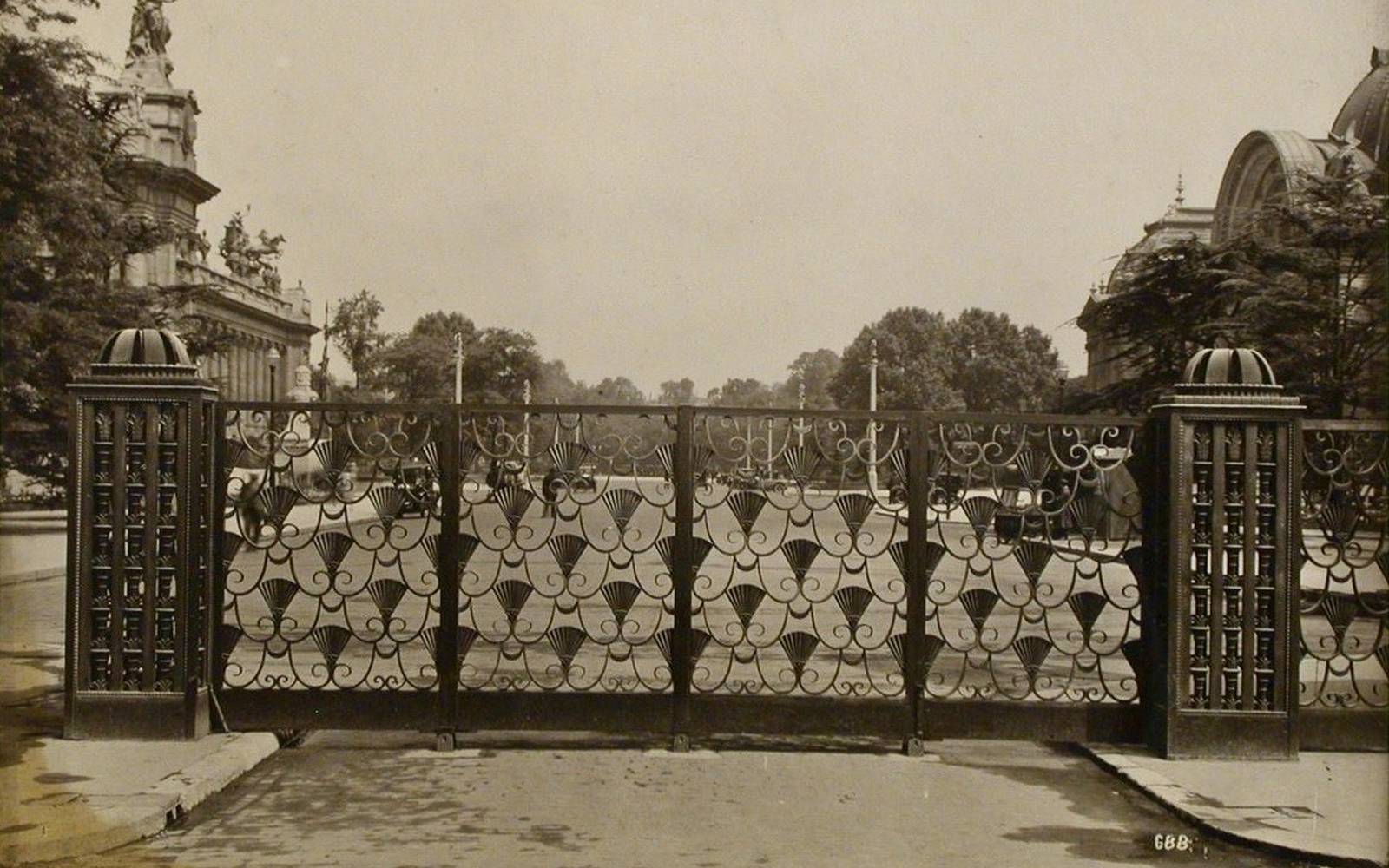
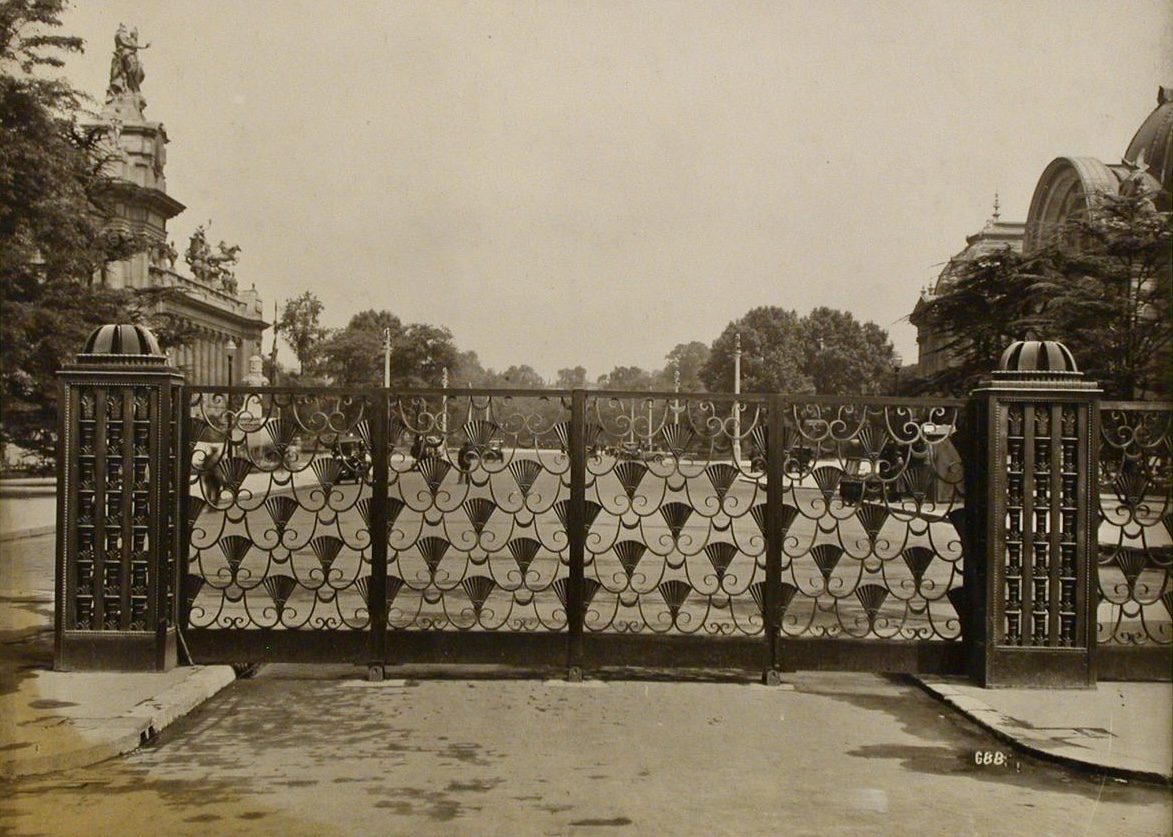
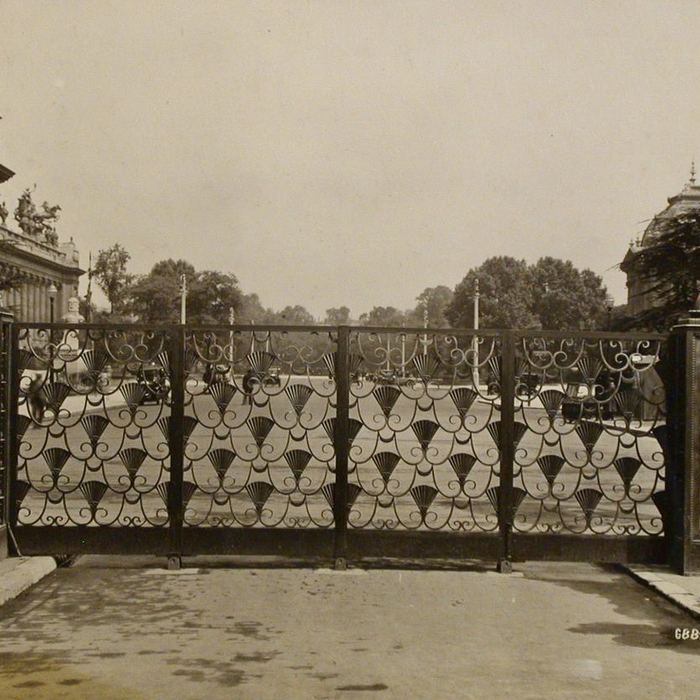
Image reference: Edgar Brandt's Porte d'honneur at the 1925 Paris exhibition.
At a Glance
- Core periodabout 1910–1939
- High pointthe 1925 International Exhibition of Modern Decorative and Industrial Arts in Paris
- Origins of the namea later abbreviation of *arts décoratifs* in the exhibition title
- Major centresParis, New York, London, Vienna, Berlin, Miami, Chicago, Mumbai, Shanghai, Sydney, Havana and many others
- Known forstepped geometry, stylised nature, symmetry, bold silhouettes, expensive craft, reflective surfaces, machine imagery and streamlining
- Mediaarchitecture, interiors, furniture, glass, ceramics, metalwork, jewellery, fashion, graphics, painting, sculpture, film, vehicles and household products
- Important designersJacques-Émile Ruhlmann, Jean Dunand, Eileen Gray, René Lalique, Armand-Albert Rateau, Pierre Chareau, Robert Mallet-Stevens and Donald Deskey
- Important artists and image-makersTamara de Lempicka, Jean Dupas, Sonia Delaunay, Aaron Douglas, Cassandre, Erté and the Martel brothers
- Important distinctionStreamline Moderne is a related 1930s development, not a synonym for all Art Deco
- Central contradictionArt Deco joined elite luxury to the dream—and eventually the reality—of modern design for a mass public
Contents
- Where it fits
- What is Art Deco?
- Paris 1925
- Four stages
- Artists and designers
- Global sources
- New York architecture
- International adaptations
- Essential works
- Where to see Art Deco
Where Art Deco fits
Ruhlmann
Principal activityJean Dunand
Principal activityEileen Gray
Principal activityRené Lalique
Principal activitySonia Delaunay
Principal activityTamara de Lempicka
Principal activityAaron Douglas
Principal activityDonald Deskey
Principal activityArt Deco gave modern life a polished surface. Its stepped skyscrapers, lacquered cabinets, geometric jewellery, streamlined trains and cinematic interiors made speed, electricity, travel and urban glamour visible. Yet the movement was never one style, one nation or one social programme. A hand-built desk of rare wood and a moulded plastic radio can both be Art Deco even though their materials, makers, buyers and ideas of modernity are very different.
The name is retrospective. Designers of the 1910s, 1920s and 1930s spoke of style moderne, modern decorative art or simply contemporary design. “Art Deco” was derived from the title of the 1925 Paris Exposition Internationale des Arts Décoratifs et Industriels Modernes, but the abbreviation became established only during the revivals and exhibitions of the 1960s. The term now gathers a plural field: geometric and floral, luxurious and mass-produced, handcrafted and machine-shaped, metropolitan and locally adapted.[1]
What is Art Deco?
Art Deco is best understood as a way of synthesising old and new. Designers reduced flowers, fountains, animals and bodies to clear outlines and repeated motifs. They turned Cubist facets, Futurist motion and machine parts into decoration. At the same time, they revived cabinetmaking, lacquer, metal inlay and stone carving associated with courtly luxury. Modernity could therefore look like a steel tower, a black-and-gold screen, an ivory-handled dressing table or a bright Bakelite clock.
No committee decided which forms belonged. There was no membership card or manifesto. The label includes national schools and rival positions whose practitioners sometimes rejected one another. French decorators defended cultivated ornament; functionalists argued for standardisation; American industrial designers enclosed machinery in aerodynamic shells; Indian architects adapted reinforced concrete and nautical curves to tropical apartment life. The movement's unity lies in these repeated negotiations among decoration, technology, material and desire.
The practical date range of about 1910 to 1939 captures its major development. Important experiments began before the First World War. The Paris fair of 1925 brought them together at a moment of international confidence. The economic crash of 1929 changed buyers and materials, and the 1930s produced restrained geometry and streamlining beside continued luxury work. The Second World War disrupted trade, production and the pleasure industries that had carried Deco around the world. Later revivals do not erase this interwar centre.[49]
From Art Nouveau to a harder modern line
Art Deco inherited more from Art Nouveau than its sharp geometry suggests. Designers retained plants, insects, women and the ideal of an integrated interior, but they compressed the whiplash curve into a fan, zigzag, stepped fountain or repeated border. The more geometric Art Nouveau of Vienna, Glasgow and the Wiener Werkstätte offered direct precedents. Josef Hoffmann's grids and Koloman Moser's flat patterns could move almost seamlessly into 1920s design.[1]
French tradition mattered just as much. Eighteenth-century cabinetmakers had perfected veneering, delicate proportions, gilt-bronze mounts and complete rooms for elite patrons. Ruhlmann and his peers stripped away some historical detail while retaining rare materials, exact craft and the status of the ensemblier who coordinated an interior. Art Deco luxury was not the opposite of tradition; it was tradition edited into a modern silhouette.[19]
Avant-garde painting provided another vocabulary. Cubism made objects faceted and space shallow. Orphism supplied circular rhythm and simultaneous colour. Futurism and Vorticism suggested diagonals, force and speed. Constructivism and De Stijl offered grids and abstract geometry. These movements were often grouped loosely as “Cubist” by commercial designers, then translated onto fabric, metal, posters and furniture.[5]
The transfer worked in both directions. Robert Delaunay and Sonia Delaunay investigated colour in painting, books, clothing and interiors; Georges Braque brought tactile illusion and decorative pattern into Cubism; Fernand Léger found monumental clarity in pipes, gears and manufactured objects. Art Deco did not merely borrow a finished avant-garde style. It helped make experimental form part of ordinary visual culture.
The Ballets Russes added saturated colour, costume and theatrical exoticism. Paul Poiret's fashion house, Atelier Martine and illustrators such as Georges Lepape showed before 1914 that clothing, perfume, parties, interiors and print could form one commercial identity. The war interrupted this culture without wiping it away. When Paris returned to luxury production in the 1920s, the foundations were already present.
A short timeline
- 1909–14: Ballets Russes productions, Poiret's fashion and early geometric decorative experiments reshape Parisian taste.
- 1912: French designers discuss a new decorative style; plans develop for an international fair.
- 1914–18: the First World War postpones the planned 1915 exhibition and transforms economies and social roles.
- 1919–24: Ruhlmann, Dunand, Gray, Süe et Mare, Lalique and others develop mature postwar work.
- 1922: the discovery of Tutankhamun's tomb intensifies Egyptian Revival motifs.
- 1925: the Paris exhibition gives decorative modernism a vast international stage.
- 1927: ocean liner Île de France carries French modern interiors across the Atlantic.
- 1928–30: the Chrysler Building converts the automobile and stainless steel into skyscraper imagery.
- 1929: the Wall Street crash begins a severe international economic contraction.
- 1931: the Empire State Building opens; Paris stages the Colonial Exposition.
- 1932: Radio City Music Hall opens with Donald Deskey's modern interiors.
- 1933–34: Chicago's Century of Progress fair promotes industry, colour and future living during the Depression.
- 1935: the Normandie enters service as a floating synthesis of French luxury design.
- 1937: the Paris International Exposition brings Deco monumentality, modernist architecture and political rivalry together.
- 1939: the New York World's Fair presents a streamlined corporate future as war begins in Europe.
Follow Art Deco through four stages
–1918
Decorative modernism takes shape
Vienna, Paris fashion, luxury craft, the Ballets Russes and avant-garde geometry establish a plural vocabulary before war postpones the planned exhibition.
–1925
Paris concentrates competing modernities
Postwar designers mature their work before the 1925 exhibition brings luxury interiors, retail spectacle, reinforced concrete and functionalist critique together.
–1931
The movement becomes international
Ocean liners, magazines, skyscrapers and transatlantic exchange carry the field beyond Paris while local makers transform it for new cities and markets.
–1939
Mass markets and streamlining
Depression economics, new metals and plastics, cinema, fairs and aerodynamic casing shift the promise from rare craft toward public spectacle and serial goods.
Paris 1925: the fair that later named the movement
The 1925 exhibition was conceived long before the date on its gates. French decorative-arts organisations had pressed the government for an international display, and a fair was planned for 1915. War made that impossible. When it finally opened on 28 April 1925, the event represented both recovery and accumulated debate over what modern design should be.[8]
Its territory stretched across central Paris around the Grand Palais and Les Invalides and along both banks of the Seine. More than two hundred temporary structures held national displays, French regional pavilions, department stores, workshops, luxury manufacturers and ideal interiors. The site was a city of competing promises: domestic comfort, elite collecting, technological service, national craft and radical architecture.[11]
Rules required objects to be modern and excluded straightforward copies of old styles. That demand was less clear in practice. A cabinet might avoid Louis XVI ornament while relying on eighteenth-century construction; a pavilion could use reinforced concrete but retain a classical plan. The fair made “modern” the central question without producing one answer.
France intended a demonstration of national leadership. Luxury trades had economic as well as cultural importance, and organisers wanted French manufacturers to dominate new international markets. Twenty-one countries participated, mostly European, with China, Japan and Turkey also represented. French colonies and mandated territories appeared inside a colonial classification rather than as equal nations. Germany was absent for political and economic reasons.[8]
The United States mounted no official pavilion. American organisers had struggled to identify work meeting the French requirement of modern originality. The absence was embarrassing, but it did not mean American designers ignored the fair. Museum curators, businesspeople, architects and department-store buyers attended, bought objects and returned with a sharpened ambition to create a distinct American modern design.[18]
The Collector's Pavilion
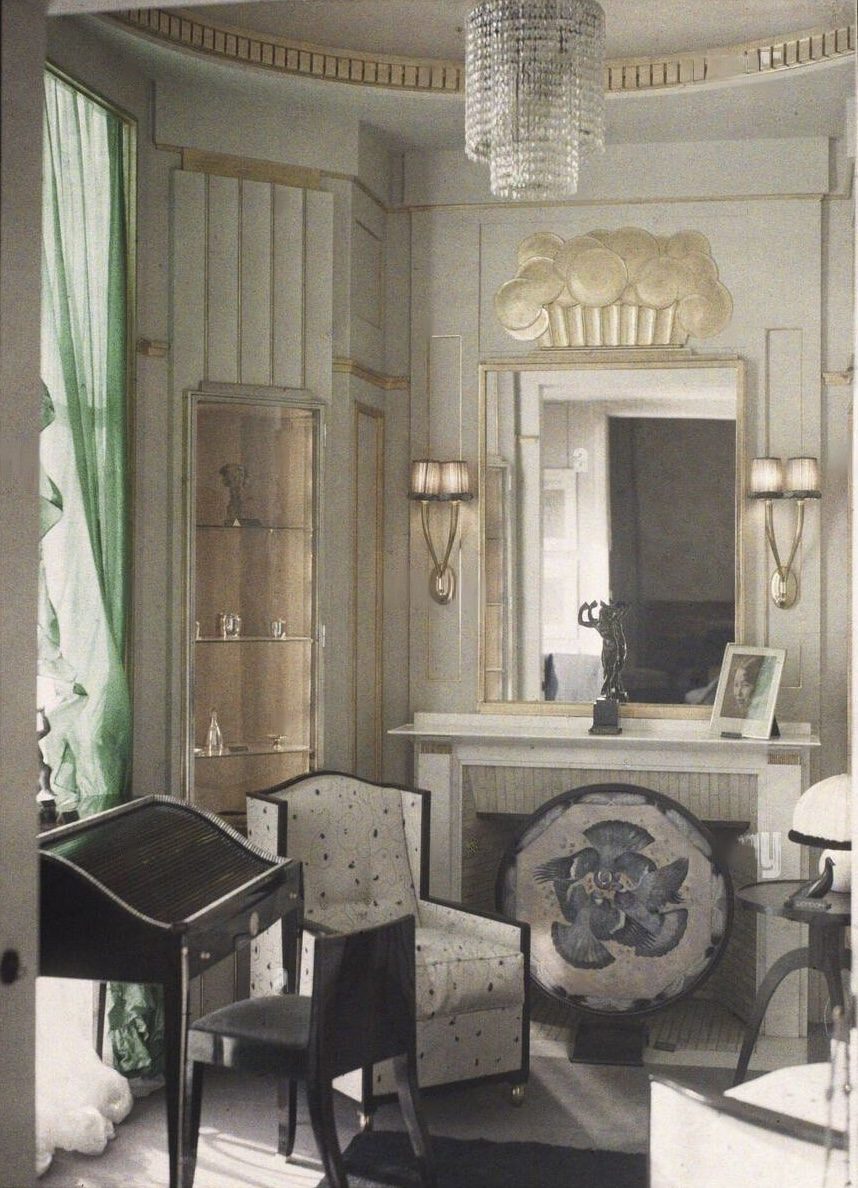
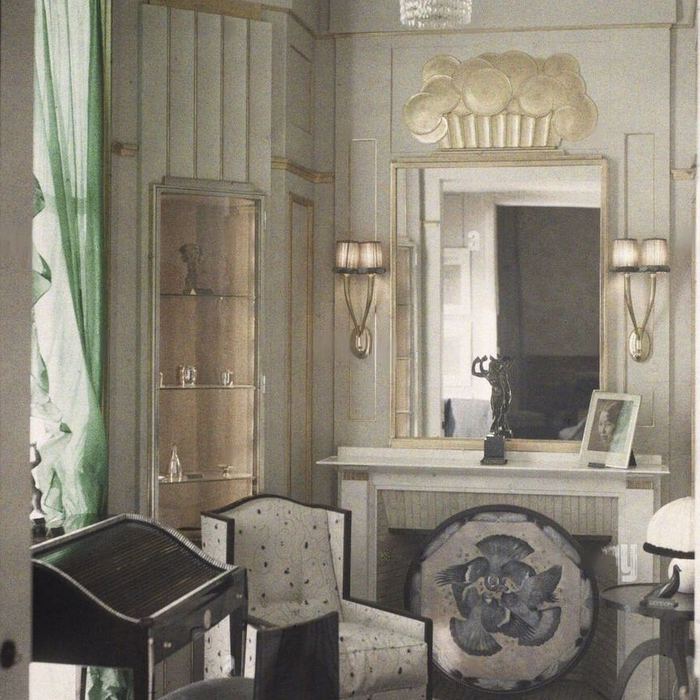
Jacques-Émile Ruhlmann's Hôtel du Collectionneur, with architecture by Pierre Patout, became the fair's emblem of cultivated wealth. The building imagined the residence of a modern patron. Furniture, carpets, sculpture, painting, metalwork and textiles formed a complete environment rather than a trade display. Ruhlmann's tapering legs, quiet expanses of veneer and fine metal mounts disciplined rooms filled with precious material.[13]
The pavilion's modernity was selective. Its buyers were affluent, its workmanship exacting and its materials costly. It suggested that French luxury could remain internationally authoritative by changing its outline without abandoning rarity. Critics admired its coherence while questioning whether such rooms answered the needs of postwar society.
Department stores and the modern customer
The great Paris department stores built their own pavilions. Galeries Lafayette, Printemps, Le Bon Marché and the Louvre presented interiors and products under house design studios. Retailers could place experimental form within an accessible spectacle even when individual rooms remained expensive. The fair connected modern design with the act of shopping.
This relationship explains Art Deco's speed of diffusion. Visitors might not buy a Ruhlmann cabinet, but they could encounter its silhouette in a catalogue, cinema set, fabric or cheaper suite. Display converted rare craft into reproducible aspiration.
Mallet-Stevens and concrete modernity
Robert Mallet-Stevens's Pavilion of Tourism and Information represented a different kind of polish. A tall reinforced-concrete clock tower, glazed hall, communications facilities and automobile garage made modern services part of the architecture. Jan and Joël Martel, Louis Barillet, Jacques Le Chevallier, Francis Jourdain and Pierre Chareau contributed sculpture, glass, fittings and light. Collaboration remained central, but the language was close to abstract construction.[12] [13] Architectural journals helped carry such experimental rooms and buildings beyond their original sites; L'Architecture vivante, published from 1923 to 1933, made the decade's competing modernisms visible as an ongoing international conversation.[48]
The pavilion demonstrated why the boundary between Art Deco and architectural Modernism is porous. Its ornament grew from structure, signage, technology and carefully placed art rather than from historical trim. Reinforced concrete allowed thin projecting planes and a new scale of temporary spectacle.
The Esprit Nouveau challenge
Le Corbusier and Pierre Jeanneret's Pavillon de l'Esprit Nouveau opposed the fair's dominant luxury. Standardised components, built-in furniture and a model apartment argued that modern housing should arise from industry and rational use. The pavilion displayed Léger's painting and modern art, but it rejected the decorator's complete room as an expensive costume.[24]
This was not a minor disagreement within one style. It was a dispute over who modern design served and how it should be made. Yet later histories sometimes place the same tubular chair or geometric room in both Deco and Modernist narratives. Actual practice crossed the border critics tried to police.
Triumph and criticism
The fair attracted enormous attention, but contemporary critics objected to its cost, temporary construction and weak social purpose. It celebrated “industrial” arts while much of its admired work depended on hand labour. It presented modern life through apartments for wealthy collectors, luxury transport and consumer fantasy. The Musée des Arts Décoratifs now treats these contradictions as integral to the event rather than defects outside the story.[10]
Paris 1925 was therefore neither the birth of Art Deco nor a unified declaration. It was a concentrated international argument whose later fame gave an existing field a convenient name. The broader Parisian setting matters as much as the fair: galleries, magazines, theatres and private interiors made the city a laboratory in which decorative arts, painting, fashion and architecture continually crossed.[23]
The makers of French Art Deco
Jacques-Émile Ruhlmann: luxury refined
Ruhlmann had begun exhibiting furniture before the war and established his interior business with Laurent after it. He favoured simple volumes, tapering legs and surfaces of Macassar ebony, amboyna, amaranth and other richly figured woods. Ivory or metal might mark a handle or edge. The form looks restrained because the material does much of the visual work.[2]
His furniture could contain plywood cores and modern workshop organisation while preserving the aura of hand-finished uniqueness. That combination is characteristic: technical modernity supported an elite object whose cultural prestige came from craft. The Met's early acquisition of his furniture recognised this as contemporary achievement rather than decorative nostalgia.[18]
Jean Dunand: lacquer, metal and the surface as depth
Swiss-born Jean Dunand trained as a sculptor and metalworker in Paris. He learned lacquer technique through the Japanese artisan Seizo Sugawara and developed screens, panels, furniture and vessels with layered lacquer, gold or silver leaf, crushed eggshell and worked metal. Light seems to sit within these surfaces rather than merely strike them.
Dunand's work also exposes the politics of exoticism. African Woman combines lacquered wood and oxidised copper in a highly stylised profile.[22] The technical control is extraordinary, but the anonymous subject functions as a decorative type. Admiration for African form and the market's appetite for racial difference cannot be separated.
Eileen Gray: from lacquer room to responsive architecture
Irish-born Eileen Gray learned lacquer in London and Paris, created remarkable screens and furniture and opened Galerie Jean Désert in 1922. Her spaces did not follow one house style. She combined lacquer, wool, wood, metal and abstract rugs in sensory arrangements that critics found difficult to classify.[14]
By the later 1920s she was designing in aluminium, tubular steel, cork and glass. Furniture for E1027 could fold, pivot, store objects or mediate privacy. Her dressing-screen combines mirror, storage, aluminium, cork and glass while belonging to the architecture of the room.[15] Gray's path from decorative luxury to responsive Modernist space is evidence against treating Art Deco and functionalism as sealed camps.
René Lalique: nature remade for industry
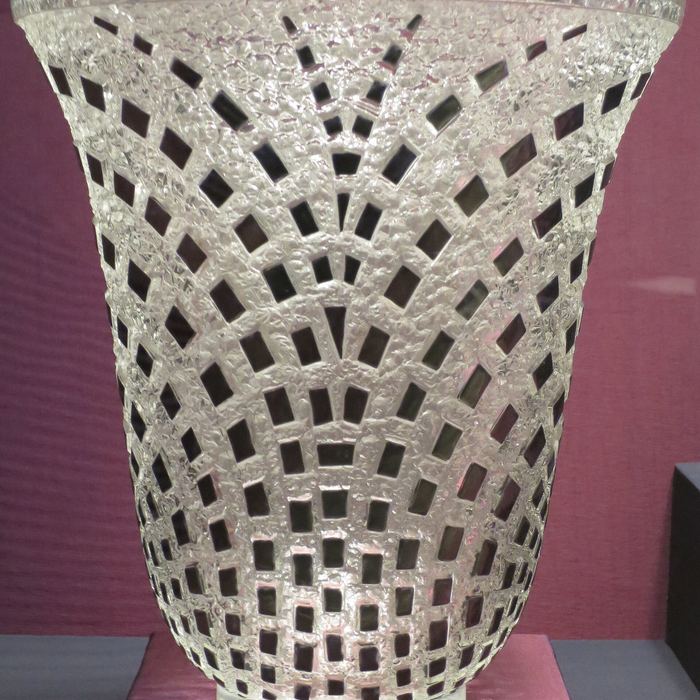
René Lalique began as an innovative Art Nouveau jeweller, then made glass the centre of his practice. Moulded vases, perfume bottles, car mascots, lamps and architectural panels simplified women, birds, fish and plants into relief patterns. Frosted and clear passages changed as a viewer moved.
Serial production mattered. Lalique used industrial glassmaking to place designed objects in many more homes, even while limited versions and major commissions retained prestige. Art Deco could expand luxury through multiplication, not only through cheaper imitation.[17]
Artists and designers to know
Jacques-Émile Ruhlmann
Ruhlmann refined eighteenth-century craft into severe modern silhouettes whose rare veneers and exact finish defined elite French Deco.
Jean Dunand
Dunand made lacquer, metal leaf and eggshell into deep reflective surfaces while his figurative work exposes the movement's colonial visual politics.
Eileen Gray
Gray moved from sumptuous lacquer to adaptable furniture and architecture, demonstrating how porous the border between Deco and Modernism could be.
René Lalique
Lalique transformed stylised nature through moulded glass, carrying designed luxury from singular jewellery into serial objects and architecture.
Tamara de Lempicka
Lempicka's enamelled bodies, faceted modelling and constructed cosmopolitan identity made her the movement's defining painter without creating a uniform school.
Aaron Douglas
Douglas used silhouettes, radiating circles and geometric fragmentation to organise Black history and liberation within the Harlem Renaissance.
Fashion, jewellery and the printed modern body
Fashion made Art Deco mobile. The looser, shorter silhouette of the 1920s allowed fringe, beadwork and geometric panels to respond to movement. By the 1930s, bias-cut gowns produced long continuous curves. Jeanne Lanvin could combine one saturated colour with a collar structured from triangles and squares; the garment became architecture around the body.[4]
Jewellery moved between abstraction and global reference. Raymond Templier looked to wheels, streets and machinery, composing silver, lacquer and enamel as small architecture. Platinum allowed jewellers to hold diamonds with less visible metal. Black onyx, white stone and icy geometry created a palette associated with electric night and modern dress.[4]
Cartier used Persian, Indian, Chinese and Egyptian sources alongside abstract form. At the 1925 fair it displayed with couturiers in the Pavilion of Elegance, linking jewellery to an entire performed identity. A ceremonial Indian necklace or carved Asian object could be transformed through Parisian settings and international marketing, raising questions of translation, patronage and unequal access as well as invention.[6]
Sonia Delaunay carried simultaneous colour from painting into coats, textiles, furniture, cars and printed portfolios. Her 1925 publication arranged designs as a public artistic statement rather than a private dressmaker's notebook.[20] Clothing became a moving composition, and the distinction between artist and designer became deliberately unstable.
Pochoir printing made colour unusually dense and precise. Stencils applied one pigment at a time to fashion plates and albums. Georges Barbier, Erté and their peers placed elongated figures in imaginary stages whose furniture, costume and typography shared a rhythm. These publications were luxury objects, but reproductions and advertising broadcast their silhouettes far beyond their first readers.[46]
Posters, travel and the image of speed
An Art Deco poster had to work at a station, on a street or in a magazine. Designers enlarged one feature—a ship's prow, a locomotive, a resort skyline—and suppressed detail. Diagonal perspective, block lettering and bands of smoke made movement readable before the viewer could study the words.[5]
Cassandre's posters are the defining examples. In Nord Express, rails become a steep fan beneath an engine reduced to cylinder and circle. In Normandie, the ship's bow rises like an architecture too large for the sheet. The viewer does not see transport neutrally; scale and cropping promise power, order and privileged passage.
Ocean liners were themselves designed advertisements. First-class passengers moved through coordinated cabins, dining rooms, salons, clothes and tableware while posters sold speed and cosmopolitan ease.[7] The hierarchy of accommodation was essential. A liner could symbolise democratic technological progress while materialising sharp divisions among travellers and labourers.
The French Normandie, launched in 1935, concentrated work by Dunand, Lalique, Ruhlmann, Jean Dupas, Christofle, Daum and others. Dupas's vast reverse-painted glass panels narrated navigation in gold, silver and palladium tones. This was total design on the move, but the most spectacular spaces belonged to first class.[17]
Painting and sculpture
Art Deco did not have a single school of easel painting. Its strongest painterly affinities lie in hard contour, shallow depth, classicised bodies and polished surface. These features also belong to other interwar realisms, Purism and mural traditions, so the label should be used with evidence rather than by resemblance alone.
Tamara de Lempicka became its defining portrait painter. Her figures are modelled as interlocking rounded planes, with skin resembling enamel or polished stone. Drapery folds like metal; city buildings press into shallow backgrounds. Self-Portrait in the Green Bugatti turns the artist into a compact image of control, fashion and automobile speed even though the car was commissioned imagery rather than a transparent document of her life.
Lempicka's portraits negotiate gender and performance. Women can appear self-possessed, desiring and visibly constructed for the gaze at once. Her Jewish heritage, Polish and Russian origins, Parisian career, bisexual relationships and later American identity complicate the fantasy of a universal “modern woman.” Recent museum scholarship places this self-fashioning at the centre of her work.[47]
Decorative painting and sculpture often belonged to buildings or objects. Jean Dupas designed murals and glass panels; Alfred Janniot carved monumental reliefs; Jan and Joël Martel reduced trees, dancers and animals to faceted rhythms. Demétre Chiparus's dancers, often made in bronze and ivory, fused expensive material with stage exoticism. Paul Manship's simplified classical figures brought a related language into American public art.
The key is setting. A figure on a cabinet, cinema facade or skyscraper entrance does not function like a free-standing museum sculpture. Its scale, material and subject help tell users what kind of place they have entered.
Global sources, colonial systems
Art Deco designers searched widely for forms they considered capable of renewing Western design. Egyptian relief, African sculpture and textiles, Japanese lacquer, Chinese jade, Indian jewellery, Persian pattern and Mesoamerican architecture entered a vast visual archive. The process generated striking hybrids, but it operated through colonial possession, archaeological extraction, commercial display and unequal naming.[3]
Tutankhamun's tomb, discovered in 1922, accelerated an Egyptian fashion already centuries old. Lotus flowers, scarabs, pyramids, sun disks and hieroglyph-like borders appeared on jewellery, cinema fronts and household objects. The event did not “invent” Egyptian Revival; Napoleon's expedition, museum collecting, the Suez Canal and earlier excavations had repeatedly placed Egypt in European and American public culture.[21]
French policy made colonial resources explicit. Government and industry encouraged decorators to use rare woods, ivory, shagreen, lacquer techniques and craft labour available through colonies in Africa and Asia. The 1931 Colonial Exposition turned empire into a popular spectacle. “Exotic” material could certify luxury while the people and ecosystems from which it came disappeared behind the designer's name.[16]
Images of Josephine Baker reveal the complexity. Baker was an American-born Black performer who achieved extraordinary agency and celebrity in Paris. Her dancing, fashion and self-presentation shaped modern performance. At the same time, white designers and audiences repeatedly turned her body into an anonymous emblem of tropical instinct and erotic difference. Glass figurines and advertisements could celebrate a star while fixing a racial fantasy.
This is why appropriation should be analysed by route and use. A named collaboration with a Japanese lacquer master, a designer's study of an ancient object, a colonial ivory supply and a racial caricature are not the same act. They belong to one connected history, but ethical clarity requires their differences.
Aaron Douglas and a Black modern Art Deco language
The phrase “Jazz Age” often makes Black music into the soundtrack for white fashion. A fuller account recognises Harlem as a centre of intellectual, literary, political, musical and visual modernity. Radio, recordings and nightclubs spread jazz internationally, but musicians worked within segregation and unequal entertainment markets.[30]
Aaron Douglas transformed the available vocabulary rather than merely entering it. He combined flat silhouettes, concentric circles, sharp diagonals, Egyptian profile, African sources and Cubist fragmentation. In book illustrations, murals and paintings, these forms narrate enslavement, migration, spiritual endurance and collective liberation. The result became a visual signature of the Harlem Renaissance.[41]
In The Judgment Day, a monumental Black Gabriel stands between earth and sea while light radiates in bands. The geometry amplifies sound and revelation. In Into Bondage, chained figures move toward ships as a distant star cuts through oppression. Art Deco clarity is not an applied look here; it is a political instrument for organising historical time.[42]
Douglas's work also clarifies the difference between European primitivism and diasporic reclamation. He studied African art within debates about Black identity and the “New Negro,” using it to construct a modern lineage. That project was not free from mediation, but its purpose and power relations differ fundamentally from an anonymous African motif on a luxury screen.
New York: the skyscraper as Art Deco machine
American designers absorbed Paris but did not remain dependent on it. The United States became a vast market for interiors, film, fashion and consumer products. European émigrés brought techniques and ideas; Americans studied abroad; museums bought contemporary work; department stores staged modern rooms. Transatlantic exchange flowed in both directions.[50]
The skyscraper gave American Deco its most public form. New York zoning rules encouraged setbacks, producing towers that narrowed as they rose. Designers could turn the required massing into stepped drama. Metal, coloured stone, elevator doors, lighting and lobby murals made technology ornamental.
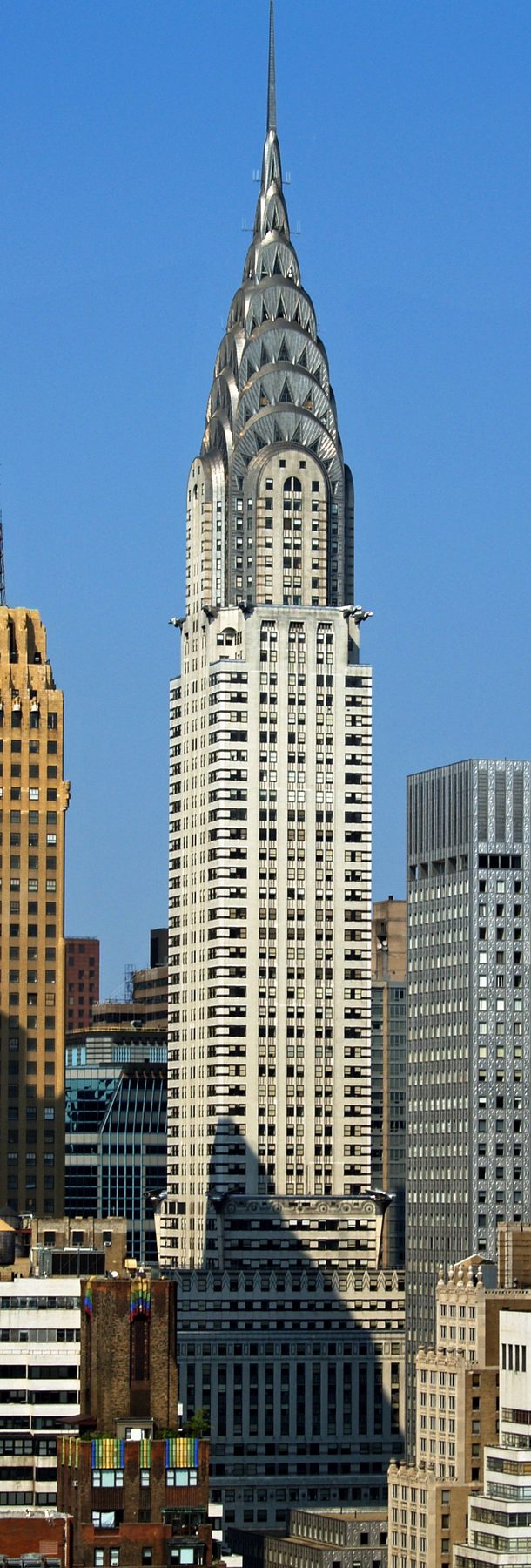
Chrysler Building
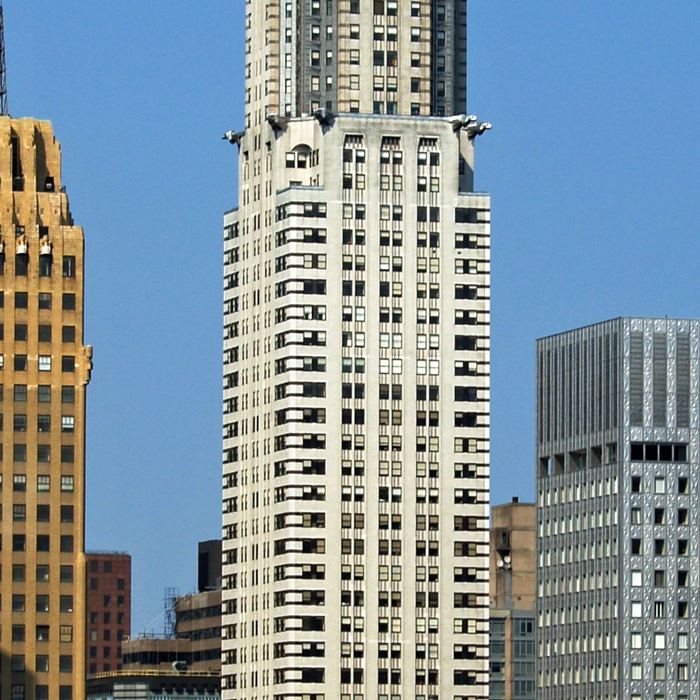
William Van Alen designed the Chrysler Building as corporate portrait. Completed in 1930, it briefly became the world's tallest building after a 185-foot spire was assembled secretly inside and raised through the roof. Stainless Nirosta steel made the crown gleam. Triangular windows, radiating arches and repeated chevrons convert a setback tower into a mechanical jewel.[31]
Automobile imagery is built into the exterior: eagle-like hood ornaments project from corners, wheel and radiator motifs wrap upper levels, and polished metal advertises industrial precision. These features do not make the structure itself automotive. They give business architecture a recognisable machine identity.
Empire State Building
Shreve, Lamb & Harmon's Empire State Building opened in 1931 after exceptionally rapid construction. Its limestone shaft and setbacks are more restrained than the Chrysler crown. The drama lies in scale, vertical repetition and the conversion of a steel frame into an apparently effortless silhouette.[32]
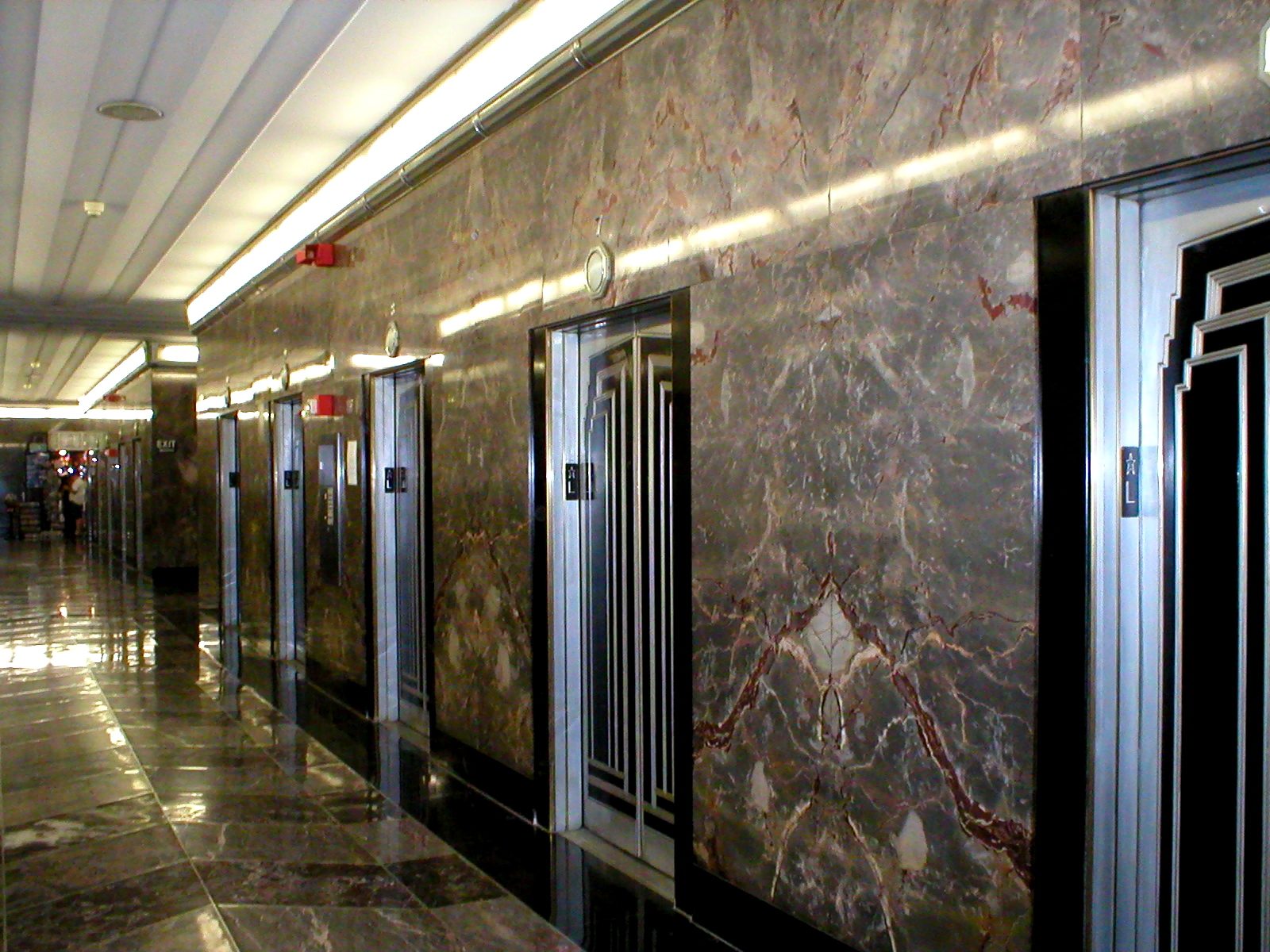
The Fifth Avenue lobby supplies the concentrated Deco interior: marble, aluminium, gold, gears, sunbursts and a ceiling image of the building make entry a ceremony of industry. The tower's observation decks and film appearances then turned corporate real estate into a mass tourist icon.
Rockefeller Center and Radio City
Rockefeller Center developed during the Depression as a coordinated complex of offices, broadcasting, shops, theatre, plazas and public art. Raymond Hood led the architectural team. Murals and reliefs repeatedly address labour, communication, science and the progress of humanity.[33] The complex is less an ornamental object than a planned “city within a city.”
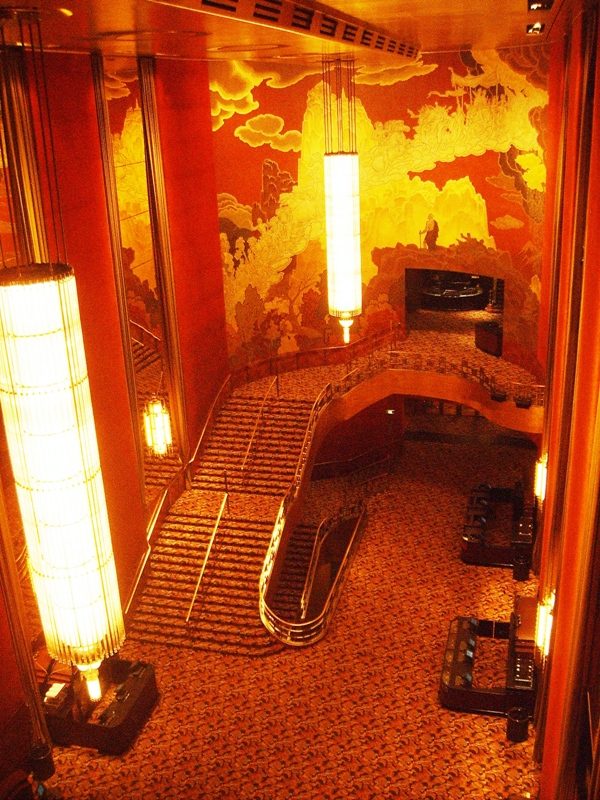
Donald Deskey's Radio City Music Hall interiors bring abstraction into public entertainment. Aluminium wall coverings, Bakelite, cork, tubular steel and Cubist-derived carpets replaced the rococo setting originally imagined for the theatre. Deskey called the compromise “modern rococo”: spectacular enough for a palace of entertainment, materially adapted to American industry.[27]
Public scale matters. French luxury rooms were translated into spaces used by thousands, though access and seating still followed commercial hierarchy. American Deco made modern design part of urban routine through offices, elevators, cinemas and shopfronts.
The Depression and the move toward streamlining
The 1929 crash did not end Art Deco overnight. It changed which objects seemed plausible and which messages designers emphasised. Rare woods and hand lacquer continued for wealthy clients, but aluminium, chrome, plate glass, stamped metal and plastics became increasingly prominent. Manufacturers sought forms that could attract buyers in a constricted market.
Bakelite and related phenolic plastics could be moulded into coloured cases for radios, clocks, cameras and small appliances. Rounded shells simplified manufacture and hid mechanical components. The material offered a new consumer magic: one smooth object could appear hygienic, efficient and futuristic at a modest price.[29]
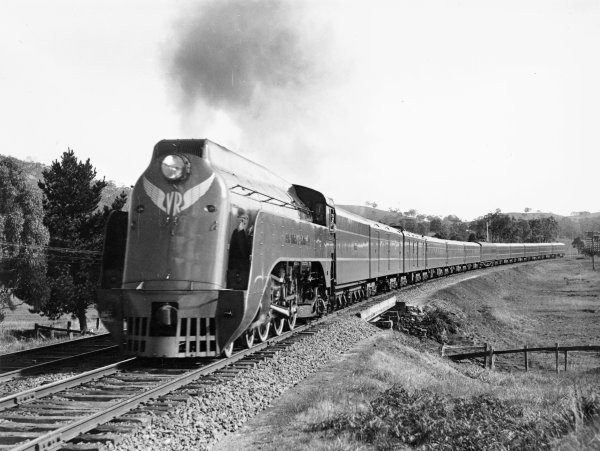
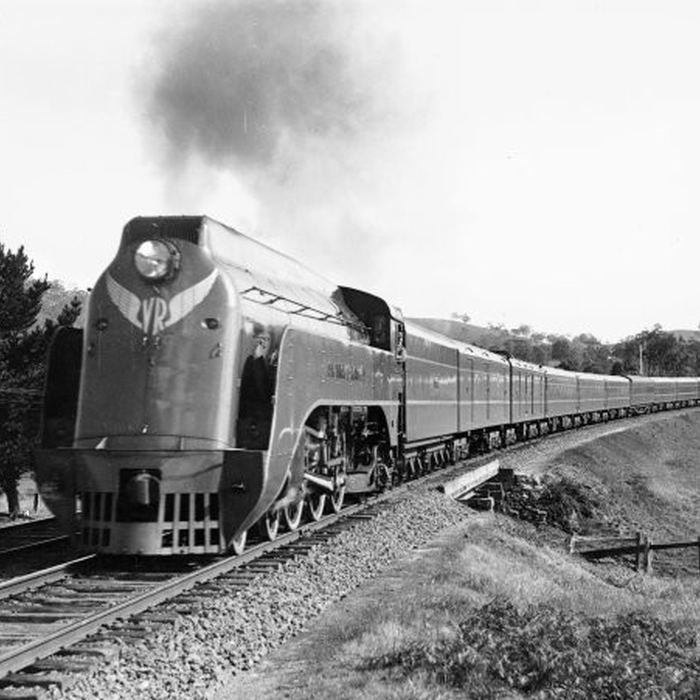
Streamlining developed from the aerodynamics of aircraft, boats and trains. Teardrop profiles, rounded corners and continuous horizontal bands suggested reduced drag. Industrial designers such as Raymond Loewy, Walter Dorwin Teague and Henry Dreyfuss worked across vehicles, products, graphics and corporate identity. Loewy's casing for Pennsylvania Railroad locomotives turned exposed machinery into a silver bullet.[28]
Function and image must be separated. A locomotive nose could genuinely affect airflow; a streamlined pencil sharpener could not become faster. In both cases the curve sold efficiency. The style offered motion to objects that remained still.
Cooper Hewitt traces a transition from the zigzag and ornamental metalwork of the late 1920s toward sober streamlining and modern classicism during the Depression.[26] This is why Streamline Moderne belongs within Art Deco's later history but should not stand for the entire movement.
World's fairs and designed futures
Chicago's 1933–34 Century of Progress fair opened while the Depression was causing mass unemployment. Built along the lakefront, its temporary structures used brilliant colour, electric light and unconventional form to distinguish the new fair from the white neoclassicism of 1893.[35]
Model homes, transport displays and metal furniture presented industry as a route out of crisis. Many Americans first saw aluminium and tubular-steel domestic furniture in coherent rooms there. The fair encouraged manufacturers and consumers to imagine industrial material inside the home rather than only in an office or factory.[34]
The vision was selective. World's fairs frequently marginalised or stereotyped communities while claiming universal progress. Their futures reflected corporate and national priorities. Still, the fair's reach helped move modern design from specialist discourse into mass experience.
The 1939 New York World's Fair continued that process through streamlining, television, automobiles and the “World of Tomorrow.” Designers wrapped corporate exhibits in smooth curves and monumental symbols. By then Art Deco's earlier handcrafted richness and the new industrial future coexisted uneasily.
Mumbai and the invention of Indo-Deco
Art Deco did not spread as a fixed package from Paris to passive receivers. Mumbai provides one of the strongest demonstrations. Development around Oval Maidan and Marine Drive during the 1930s placed new apartment blocks and cinemas opposite Victorian Gothic public buildings. Reinforced concrete enabled quick construction, curved balconies and larger openings.[37]
Local architects adapted Deco to climate and social life. Deep balconies, rounded corners, sunshades and ventilation addressed heat and monsoon conditions. Plaster relief, terrazzo, coloured tile and wood used available industries. Lotus forms, temple imagery, tropical plants and Indian symbols joined ocean-liner curves and speed lines. The result is often called Indo-Deco.[38]
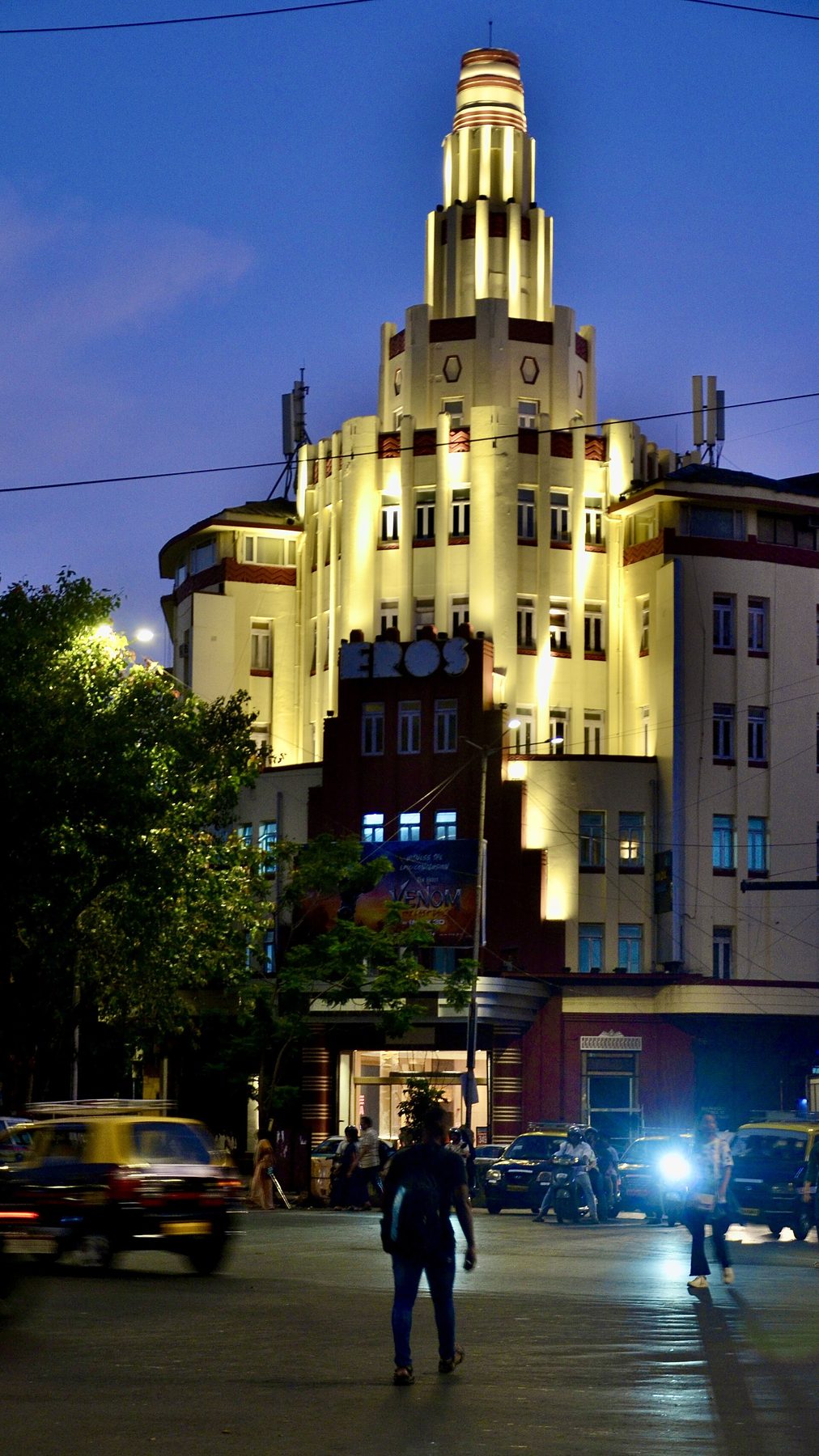
Cinemas such as the Eros and Regal made the style inseparable from film culture. Apartment names and entrance lettering helped create neighbourhood identity. These buildings were products of colonial Bombay and global capital, yet they also became part of the modern city approaching independence. Calling them copies would miss the agency of Indian architects, patrons, craftspeople and residents.
Sydney, Miami and Latin American print routes
Australian manufacturer Ernest Wunderlich visited the 1925 fair and returned with new ideas for stamped-metal ceilings, walls and architectural fittings. Staff designers George Paterson and Ralph Ferris translated geometric form into locally manufactured products used across Sydney.[39] This route—from fair observation to industrial production—differs from importing one French cabinet.
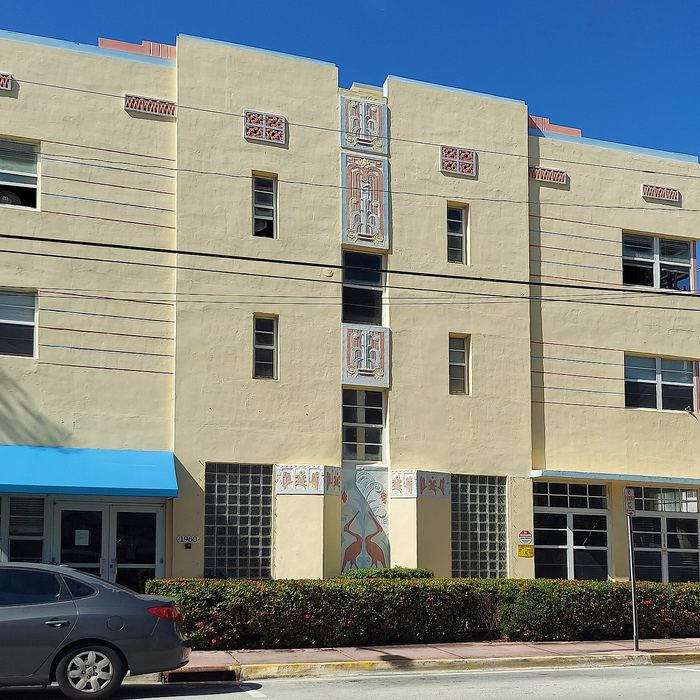
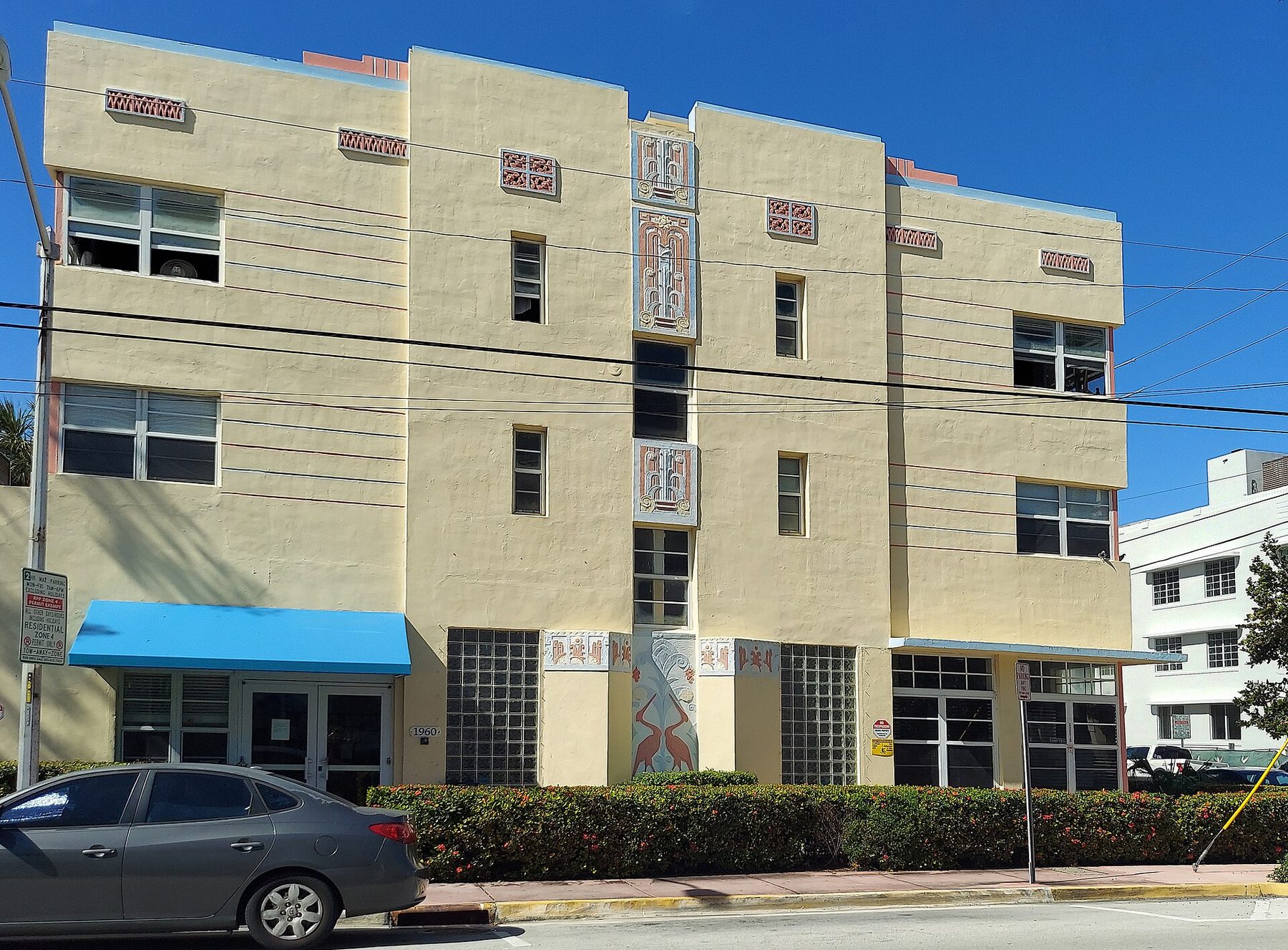
Miami Beach developed another adaptation. Small hotels and apartment buildings used pastel stucco, rounded corners, portholes, eyebrow sunshades and horizontal bands. Nautical streamlining suited tourism, climate and a modest urban scale. The Wolfsonian describes the American path from European luxury toward a mass-market style spectacularly realised there in the 1930s.[36]
Cuban magazines carried Art Deco through typography, illustration, advertising and cover design. American print networks mattered, but Havana's designers worked within local modernist politics and an economy whose cultural ambition exceeded the reach of industrial development. Research on these magazines warns against equating visual modernity with uniform economic modernisation.[43]
Comparable local transformations appeared in Mexico City, Buenos Aires, Rio de Janeiro, Casablanca, Shanghai and Napier. Ports, cinemas, department stores, professional migration and magazines were often more important than direct contact with Paris. The more closely each route is studied, the less useful a simple centre-and-periphery model becomes.
In Mexico, monumental public art also intersected with Deco architecture and framing. Diego Rivera worked within very different political traditions, yet commissions in the United States placed machine-age muralism inside Rockefeller Center's contested programme. The relationship is one of contact and conflict, not movement membership.
Art Deco, modern realism and neighbouring movements
Interwar artists across the United States pursued clear contours, solid bodies and ordered city or rural forms. Some works by Grant Wood and Edward Hopper share Art Deco's hard-edged clarity, but they belong primarily to American Regionalism and modern realism. Similarity of silhouette alone is not enough to reclassify them.
Art Deco overlaps Purism, Bauhaus, Constructivism, De Stijl and the International Style. It usually differs by keeping decoration, surface, luxury and publicity central. Functionalists wanted form to arise from use and standardisation; Deco designers were more willing to make a practical object carry historical allusion or theatrical identity.
Contemporary critics sharpened the opposition. MoMA's 1932 International Style catalogue dismissed “modernistic” zigzags and chevrons as another applied fashion.[25] French decorators, in turn, could regard functionalist rooms as culturally impoverished. Eileen Gray, Mallet-Stevens and many others make the binary unstable because their work moved between both positions.
German collections are especially useful for comparison. The Bröhan Museum places French Ruhlmann and Süe et Mare furniture beside German ceramics, metalwork, Scandinavian objects and functionalist production.[44] The shared period contains many solutions to modern life, not one evolutionary ladder from ornament to purity.
How to recognise Art Deco
Art Deco cannot be identified by zigzags alone. Use these questions instead.
- What has been simplified? A flower, body, fountain or machine may be reduced to a repeated contour.
- How is the silhouette organised? Look for stepped crowns, fans, chevrons, circles, tall verticals and rounded streamlining.
- Does ornament sit on the surface or shape the object? A pattern may be applied, while a cabinet's taper or radio's shell makes decoration structural.
- How does light behave? Lacquer, chrome, glass, gold leaf, polished stone and satin create different kinds of reflection.
- Is the material rare or industrial? Ebony and ivory imply a different economy from aluminium and Bakelite.
- How was it made? Hand inlay, moulded glass, stamped metal and reinforced concrete each produce their own forms.
- What modern experience is being advertised? Speed, hygiene, electricity, nightlife, travel and urban height recur.
- Which past or culture is being invoked? Identify Egyptian, African, Asian, Mesoamerican, classical or eighteenth-century sources rather than calling them generically exotic.
- Who is named and who disappears? Designer, craftsperson, model, performer, colonised maker and industrial worker may receive unequal credit.
- Who could use the object or space? Compare a collector's pavilion, first-class liner salon, cinema lobby and inexpensive plastic radio.
The German description of Art Deco as elegance joined to geometry is useful only if its range is preserved: curved streamline, broken zigzag, historical revival and adapted non-European form all sit inside the field.[45]
Essential works and designs
Porte d'honneur at the 1925 Paris exhibition
Edgar Brandt · 1925 · Brandt's monumental metal entrance announced modern decorative art as both national display and urban spectacle.
Boudoir from the Hôtel du Collectionneur
Jacques-Émile Ruhlmann and Pierre Patout · 1925 · Ruhlmann's coordinated boudoir joined rare materials, disciplined geometry and the ideal of the cultivated collector.
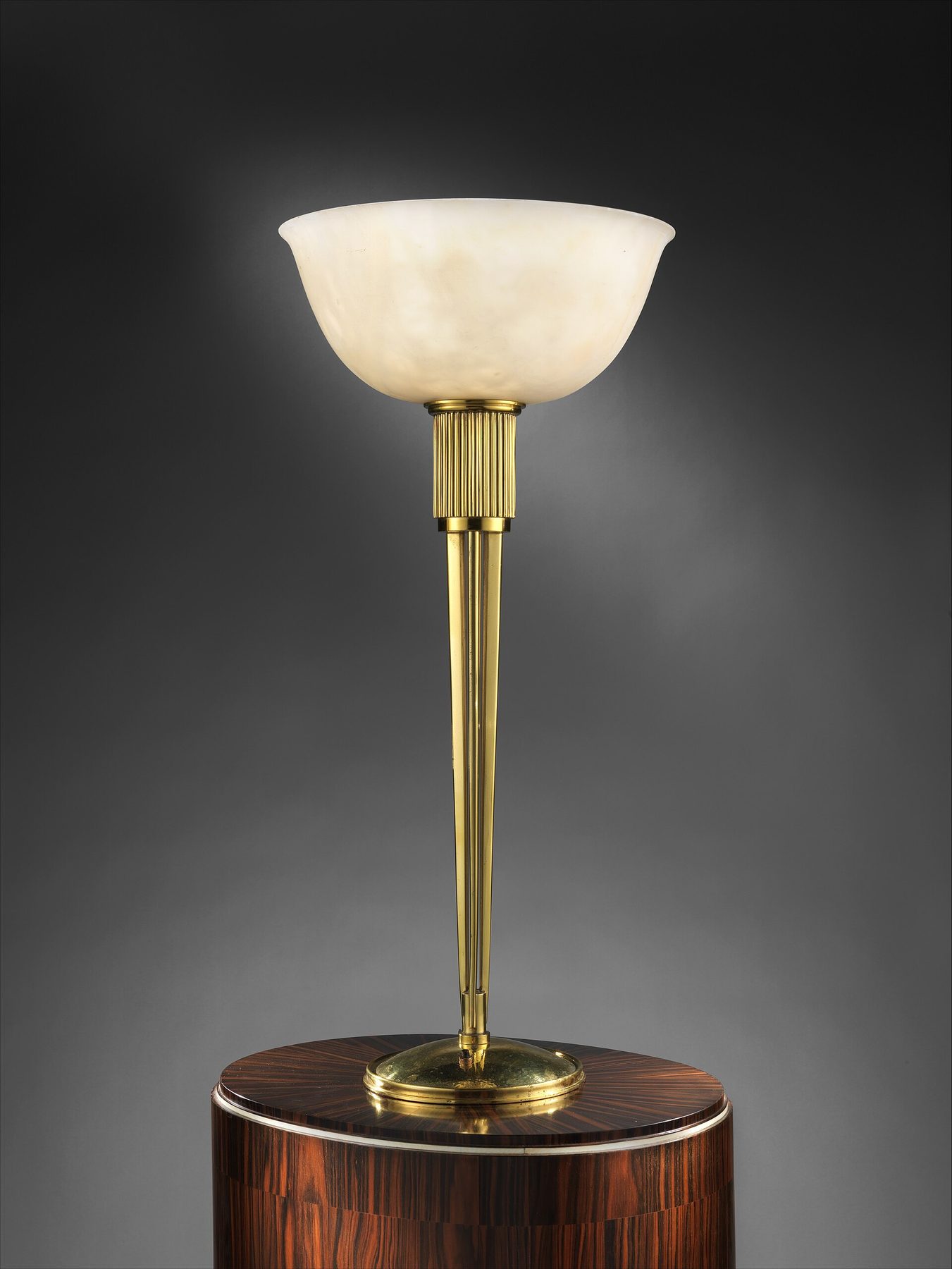
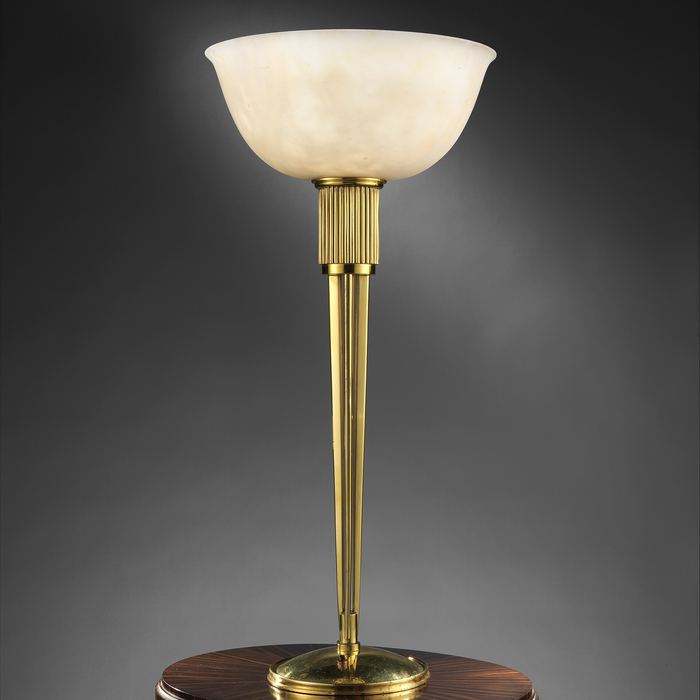
Lamp
Jacques-Émile Ruhlmann · c. 1925 · A restrained silhouette lets finish, proportion and material carry the visual effect rather than applied historical ornament.
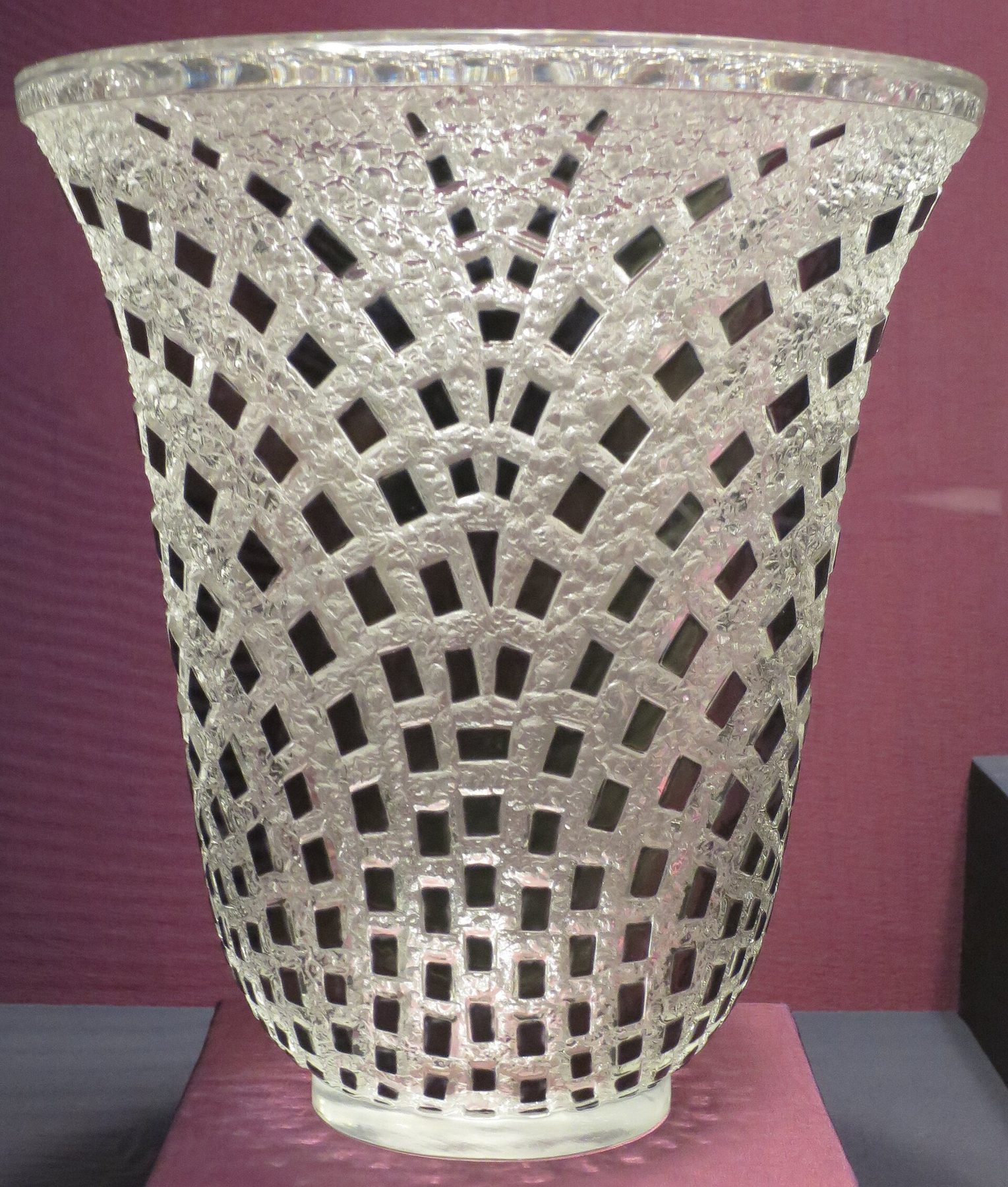
Damiers Vase
René Lalique · c. 1920s · Moulded glass turned repeating relief and changing light into a reproducible form of modern luxury.
Chrysler Building
William Van Alen · 1928–1930 · Van Alen converted setbacks, stainless steel and automobile emblems into a corporate machine-age crown.
Empire State Building elevator bank
Shreve, Lamb & Harmon · 1930–1931 · Metal, geometry and repeated verticals make entry into the tower a ceremony of industry and ascent.
Radio City Music Hall
Edward Durell Stone and Donald Deskey · 1932 · Architecture and Deskey's interiors brought modern materials and abstract pattern to mass entertainment.
Eros Cinema, Mumbai
Shorabji Bhedwar · 1938 · Mumbai's cinema architecture adapted Deco geometry, reinforced concrete and local urban culture rather than copying Paris.
Art Deco building, Miami Beach
Unknown architect · 1930s · Pastel stucco, rounded corners and horizontal bands translate streamlined modernity to tourism and climate.
Spirit of Progress
Victorian Railways · 1937 · The train's rounded casing and continuous line made aerodynamic efficiency and the image of speed inseparable.
Where to see Art Deco
Musée des Arts Décoratifs, Paris
The museum's furniture, glass, jewellery, fashion, posters and documentation of the 1925 fair provide the strongest introduction to French Art Deco. Its centenary research treats the movement as polyphonic—geometric or abundant, precious or restrained—rather than a single luxury formula.[9]
Victoria and Albert Museum, London
The V&A collection is exceptional for cross-media comparison. Ruhlmann furniture, Lanvin fashion, posters, glass, jewellery and mass-market objects show how form changed with scale and buyer. The 1910–1939 framework developed for its international exhibition remains especially helpful.[40]
Metropolitan Museum of Art, New York
The Met began collecting modern French decorative arts during the 1920s. Ruhlmann, Dunand, Lalique, Süe et Mare and material from the Normandie can be studied as contemporary museum acquisitions rather than later nostalgia.[16]
Cooper Hewitt, Smithsonian Design Museum, New York
Industrial drawings, textiles, posters, Radio City archives and consumer products make Cooper Hewitt ideal for following the American shift from European luxury to public interiors and streamlining. Its collections expose the design process behind a finished surface.
Bröhan Museum, Berlin
The museum places French Art Deco beside German, Scandinavian and Czech work and beside functionalism. Its illustration holdings also show how pochoir magazines and advertising made glamour reproducible and influential.[46]
Wolfsonian–FIU and Miami Beach
The Wolfsonian's propaganda, industrial design, graphics and decorative arts give Art Deco its social and political context. Nearby Miami Beach allows visitors to see how modest hotels, climate and tourism created an urban version quite unlike Parisian collector interiors.
Mumbai
The Art Deco ensembles around Oval Maidan and Marine Drive are best understood on foot. Balconies, lettering, entrance lobbies, cinemas, local motifs and street continuity reveal Indo-Deco as lived architecture rather than an imported facade.
Powerhouse Museum and Australian city collections
Sydney's material helps explain local manufacture. Architectural panels, domestic goods and fair-related records reveal how Deco entered ordinary construction through firms such as Wunderlich.
Museums, collections and cities to explore
Decorative objects and works on paper may rotate, while buildings can have restricted interiors. Check current access before travelling.
- 01
Musée des Arts Décoratifs
Paris, France
Furniture, glass, jewellery, fashion, posters and the 1925 exhibition archive form the strongest French overview.
French Art DecoVisit collection website - 02
Victoria and Albert Museum
London, UK
Cross-media holdings connect fashion, furniture, graphics, jewellery and mass-market design.
International surveyVisit collection website - 03
Metropolitan Museum of Art
New York, USA
Early acquisitions by Ruhlmann, Dunand, Lalique and others reveal Art Deco as contemporary design rather than later nostalgia.
French decorative artsVisit collection website - 04
Cooper Hewitt, Smithsonian Design Museum
New York, USA
Drawings, posters, textiles and product design follow the shift from luxury to streamlining.
Design processVisit collection website - 05
Bröhan Museum
Berlin, Germany
French, German, Scandinavian and Czech objects allow direct comparison with functionalism.
European designVisit collection website - 06
The Wolfsonian–FIU
Miami Beach, USA
Decorative arts, propaganda and industrial design sit beside Miami Beach's living architectural district.
Architecture and societyVisit collection website - 07
Mumbai Art Deco ensembles
Mumbai, India
Oval Maidan, Marine Drive and the cinema district make Indo-Deco legible at urban scale.
Indo-Deco cityscapeVisit collection website - 08
Powerhouse Museum
Sydney, Australia
Architectural metalwork and manufacturing records show how Deco entered local construction and domestic life.
Australian productionVisit collection website
Five books for further reading
Art Deco 1910–1939 — Charlotte Benton, Tim Benton and Ghislaine Wood, editors
The broadest single survey, spanning architecture, fashion, painting, transport and regional forms. Its long chronology is particularly useful for understanding why the movement neither began nor ended in 1925.
French Art Deco — Jared Goss
A clear, object-led study grounded in the Metropolitan Museum's collection. It is especially strong on Ruhlmann, Dunand, Rateau, Lalique, luxury materials and the role of early museum collecting.
Art Deco: 1910–1939 — Ghislaine Wood
An accessible visual introduction that preserves the movement's international range. It works well as a companion while visiting museum collections.
The Jazz Age: American Style in the 1920s — Sarah D. Coffin and Stephen Harrison, with Emily Marshall Orr
The best account of American transatlantic exchange, émigré designers, department stores, industrial materials and the many visual modernisms hidden inside the phrase “Jazz Age.”
Mumbai Art Deco: Architecture and Design — Navin Ramani
An important corrective to Paris-and-New-York histories. It shows how architects and patrons created a climatic, cinematic and locally meaningful Deco cityscape in Mumbai.
Major artists and designers directory
| Name | Nationality | Key Works |
|---|---|---|
| A. M. Cassandre | French, born Ukraine | Nord Express · Normandie |
| Aaron Douglas | American | The Judgment Day · Into Bondage |
| Alfred Janniot | French | Palais de la Porte Dorée reliefs · Palais de Tokyo reliefs |
| Armand-Albert Rateau | French | Lanvin apartment · Fontainebleau furniture |
| Demétre Chiparus | Romanian-French | Danseuse au cerceau · Egyptian Dancer |
| Donald Deskey | American | Radio City Music Hall interiors · Widdicomb furniture |
| Eileen Gray | Irish | Brick Screen · E1027 |
| Erté | Russian-French | Harper's Bazaar covers · Symphony in Black |
| Georges Barbier | French | Falbalas et Fanfreluches · fashion illustrations |
| Henry Dreyfuss | American | Model 302 telephone · Twentieth Century Limited |
| Jacques-Émile Ruhlmann | French | Hôtel du Collectionneur · Tibittant desk |
| Jan and Joël Martel | French | Tourism Pavilion trees · concrete garden sculpture |
| Jean Dunand | French, born Switzerland | African Woman · Normandie lacquer panels |
| Jean Dupas | French | Normandie glass panels · Bordeaux murals |
| Jeanne Lanvin | French | Robe de style · geometric evening dress |
| Paul Manship | American | Prometheus · Flight of Europa |
| Paul Poiret | French | Atelier Martine · fashion and perfume interiors |
| Pierre Chareau | French | Maison de Verre · furniture and lighting |
| Raymond Loewy | French-American | S1 locomotive · corporate product design |
| Raymond Templier | French | geometric platinum jewellery · machine-age brooches |
| René Lalique | French | Damiers Vase · glass car mascots |
| Robert Mallet-Stevens | French | Pavilion of Tourism · Villa Noailles |
| Shorabji Bhedwar | Indian | Eros Cinema · Mumbai commercial architecture |
| Sonia Delaunay | French, born Ukraine | Simultaneous Dresses · textile portfolios |
| Tamara de Lempicka | Polish | Self-Portrait in the Green Bugatti · Portrait of Madame M. |
| William Van Alen | American | Chrysler Building · Childs Restaurant facade |
Frequently Asked Questions
It was derived from the title of the 1925 Paris International Exhibition of Modern Decorative and Industrial Arts. The shortened term was popularised retrospectively in the 1960s rather than used consistently by the original designers.
No. Important work by Poiret, Ruhlmann, Gray, Süe et Mare and others appeared in the 1910s. The fair was a culmination and global publicity event.
No. Art Deco inherited stylised nature and total design from Art Nouveau but usually favoured firmer geometry, symmetry and machine-age imagery. The transition was gradual, and designers such as Lalique worked in both.
No. Zigzags appear in many cultures and periods. Date, object type, materials, maker, setting and related motifs are needed before applying the label.
French designers wanted modern work to rival historic court craftsmanship and support national luxury industries. Rare woods, lacquer, ivory, metal inlay and hand labour made that ambition visible. Other branches later pursued affordable serial goods.
Sometimes. Lalique glass, stamped metal, textiles, posters, plastics and radios reached large markets. Ruhlmann furniture and Dunand lacquer could remain rare. The movement includes both economies.
Faceted forms, shallow space, intersecting planes and geometric rhythm moved from avant-garde painting into jewellery, posters, textiles, sculpture and interiors. Designers selected and softened Cubist strategies for different uses.
It is a 1930s mode associated with aerodynamics, rounded corners, horizontal bands and smooth shells. It overlaps later Art Deco but is more restrained and speed-oriented than the earlier zigzag and luxury phases.
Skyscraper scale, corporate identity, entertainment architecture, industrial materials and mass-market products became especially important. American design developed through transatlantic exchange rather than simple French imitation.
The term describes Indian adaptations, especially Mumbai's apartment buildings and cinemas, that joined Deco geometry and reinforced concrete with local motifs, climate-responsive balconies, materials and urban life.
Identify the specific source and route. Some designs emerged through study or collaboration; others relied on colonial extraction, anonymous stereotypes or racial fantasy. Tutankhamun fashion also belongs to a much longer Western Egyptian Revival.
The Depression weakened luxury markets and encouraged cheaper, more restrained design. Functionalist criticism grew, streamlining changed the visual language, and the Second World War disrupted international production and consumption. The style later returned through preservation and revival.
Discussion
Which Art Deco promise feels most powerful today: the rare object perfected by hand, the skyscraper as a symbol of urban ambition, the streamlined product made for millions or the regional adaptations that transformed an international vocabulary? And how should museums preserve the movement's glamour while making its labour, class divisions and colonial sources equally visible?
Reader Insights
Compare rare veneer and hand lacquer with stamped metal, glass and moulded plastic before treating all Deco as one economy.
Identify the Egyptian, African, Asian or Mesoamerican route instead of using “exotic” as a neutral description.
A zigzag or chrome surface is not enough: date, maker, production method, setting and intended user all matter.
Join the Conversation
Which Art Deco promise remains most compelling: craft, height, speed or regional reinvention?
References
- An Introduction to Art Deco. Victoria and Albert Museum. View Source
- Art Deco in the Home. Victoria and Albert Museum. View Source
- Art Deco's Global Influences. Victoria and Albert Museum. View Source
- Art Deco Fashion. Victoria and Albert Museum. View Source
- Art Deco Printmakers. Victoria and Albert Museum. View Source
- About the Cartier Exhibition. Victoria and Albert Museum. View Source
- The Art of the Ocean Liner Travel Poster. Victoria and Albert Museum. View Source
- L'exposition de 1925. Musée des Arts Décoratifs Paris (French; consulted in French). View Source
- 1925–2025: One Hundred Years of Art Deco. Musée des Arts Décoratifs Paris. View Source
- L'Union centrale des Arts décoratifs et la modernité. Musée des Arts Décoratifs Paris (French; consulted in French). View Source
- L'Exposition internationale des arts décoratifs et industriels modernes de 1925. Cité de l'architecture et du patrimoine (French; consulted in French). View Source
- 1925 quand l'Art Déco séduit le monde. Cité de l'architecture et du patrimoine (French; consulted in French). View Source
- Paris 1925: L'Art déco et ses architectes. Cité de l'architecture et du patrimoine (French; consulted in French). View Source
- Eileen Gray. Centre Pompidou (French; consulted in French). View Source
- Coiffeuse-paravent. Centre Pompidou (French; consulted in French). View Source
- French Art Deco. Metropolitan Museum of Art. View Source
- Art Deco Paris. Metropolitan Museum of Art. View Source
- The Philanthropist and the Curator. Metropolitan Museum of Art. View Source
- The Decorative Arts of the Twentieth Century. Metropolitan Museum of Art. View Source
- Exploring Art Deco Textile and Fashion Designs. Metropolitan Museum of Art. View Source
- Egyptian Revival. Metropolitan Museum of Art. View Source
- African Woman by Jean Dunand. Metropolitan Museum of Art. View Source
- Paris 1920s. Museum of Modern Art. View Source
- Art of the Twenties. Museum of Modern Art. View Source
- Modern Architecture: International Exhibition 1932. Museum of Modern Art. View Source
- Design Revolutions: Art Deco to Streamline. Cooper Hewitt Smithsonian Design Museum. View Source
- Radio City Music Hall: A Celebration of American Modern Design. Cooper Hewitt Smithsonian Design Museum. View Source
- Fast as a Silver Bullet. Cooper Hewitt Smithsonian Design Museum. View Source
- Hero to Zero: A History of Plastics. Cooper Hewitt Smithsonian Design Museum. View Source
- Harlem in the Jazz Age. Cooper Hewitt Smithsonian Design Museum. View Source
- Chrysler Building Landmark Designation Report. New York City Landmarks Preservation Commission. View Source
- Architecture and Design of the NYC Skyline Icon. Empire State Building. View Source
- Art and History at Rockefeller Center. Rockefeller Center. View Source
- Shaping the Modern: American Decorative Arts 1917–65. Art Institute of Chicago. View Source
- A Century of Progress International Exposition Site Plan. Art Institute of Chicago. View Source
- Deco: Luxury to Mass Market. Wolfsonian–Florida International University. View Source
- Victorian Gothic and Art Deco Ensembles of Mumbai. UNESCO World Heritage Centre. View Source
- ICOMOS Evaluation: Victorian and Art Deco Ensemble of Mumbai. UNESCO World Heritage Centre and ICOMOS. View Source
- Art Deco Window. Powerhouse Museum Sydney. View Source
- Art Deco 1910–1939. National Gallery of Victoria. View Source
- Aaron Douglas. National Gallery of Art. View Source
- Aaron Douglas: African American Modernist. Smithsonian American Art Museum. View Source
- The Influence of American Art Deco Graphic Design on Cuban Magazines. National Gallery of Art Center for Advanced Study in the Visual Arts. View Source
- Sammlung: Art Deco and Functionalism. Bröhan Museum (German; consulted in German). View Source
- Art Deco: Eleganz und Geometrie. Bröhan Museum (German; consulted in German). View Source
- Glamour und Geometrie: Art Deco in der Illustration. Bröhan Museum (German; consulted in German). View Source
- Tamara de Lempicka. Fine Arts Museums of San Francisco. View Source
- L'Architecture vivante 1923–1933. Cité de l'architecture et du patrimoine (French; consulted in French). View Source
- 1925–2025: One Hundred Years of Art Deco Exhibition Guide. Musée des Arts Décoratifs Paris. View Source
- The Jazz Age: American Style in the 1920s. Cleveland Museum of Art. View Source
- Art Deco image records. Wikimedia Commons: Porte d'honneur at the 1925 Paris exhibition (Public domain; Unknown photographer), Boudoir from the Hôtel du Collectionneur (Public domain; Unknown photographer), Lamp (CC0; Metropolitan Museum of Art Open Access), Damiers Vase (Public domain; Wmpearl), Chrysler Building (Public domain; David Shankbone; retouched by Overand), Empire State Building elevator bank (CC BY-SA 3.0; Fletcher6), Radio City Music Hall (CC BY 2.0; hmerinomx), Eros Cinema, Mumbai (CC BY 4.0; Harshil s mehta), Art Deco building, Miami Beach (CC BY 4.0; P. Hughes), Spirit of Progress (Public domain; John L. Buckland).