


 by Tom Gurney
Tom Gurney BSc (Hons) is an art history expert with over 20 years experience
Page Created on September 22, 2026 / Page Updated on September 22, 2026
Email: tomgurney1@gmail.com / Phone: +44 7429 011000
Introduction
Georgia O’Keeffe made one of the most recognisable bodies of work in twentieth-century American art, but recognition can narrow an artist.[24] Enlarged flowers and bleached bones have become shorthand for a career that also encompassed radical charcoal drawings, watercolours, New York towers, Lake George barns and leaves, abstract oils, adobe walls, aerial rivers and immense fields of cloud. Across those subjects, O’Keeffe’s achievement lies less in a fixed repertory of icons than in a disciplined way of converting sustained looking into shape, interval, scale and colour.
Her career lasted for more than six decades. It developed through academic training, art education, the experimental circle around Alfred Stieglitz, repeated work in New York and at Lake George, annual journeys to New Mexico and, eventually, permanent life at Ghost Ranch and Abiquiú. It also unfolded inside arguments about gender, sexuality, national identity, regional culture, abstraction and celebrity. O’Keeffe participated in those arguments, resisted several of their assumptions and carefully shaped how her work would be exhibited and remembered.
At a Glance
- ArtistGeorgia O’Keeffe
- SubjectGeorgia O’Keeffe
- Artistic contextAmerican modernism
Contents
- Training, Pollitzer and the 291 breakthrough
- A career built through recurring exhibitions
- Abstraction, objectivity and materials
- Lake George as a working landscape
- Flowers and imposed meanings
- New York and the vertical city
- Inside and outside the Stieglitz circle
- New Mexico as inhabited history
- Bones, shells and changing scale
- Houses, studios and constructed simplicity
- Travel, flight and enlarged space
- Technical research and conservation
- Exhibitions and reputation
- Sight loss and continuing authorship
- Stewarding the Stieglitz collection
- Feminism, refusal and public image
- Catalogue, archive and continuing research
- How to look at O’Keeffe now
Training, Pollitzer and the 291 breakthrough
O’Keeffe was born on 15 November 1887 near Sun Prairie, Wisconsin, the second of seven children. She studied at the School of the Art Institute of Chicago in 1905–06 and at the Art Students League in New York in 1907–08. This education trained her to model form and observe objects within an academic tradition. Winning the League’s William Merritt Chase still-life prize in 1908 shows that she could succeed within that system before she became dissatisfied with it.[1][3]
Her later encounter with the ideas of Arthur Wesley Dow gave her another way to organise an image. Dow’s teaching emphasised relationships among line, tonal mass and colour rather than the accurate imitation of a subject. O’Keeffe met those principles through courses for art teachers while supporting herself as an educator in Virginia, South Carolina and Texas. The change was neither instantaneous nor an escape from technique. Academic observation and compositional experiment remained available to her together.[1][2]
In 1915, while teaching at Columbia College in South Carolina, she began the charcoal drawings that she later treated as a decisive new beginning. Black pigment, white paper and a restricted vocabulary of curves, spirals, verticals and swelling forms allowed her to test how little was needed to make an image feel expansive, compressed, balanced or unstable. The drawings were not preparatory outlines for later paintings. They were independent works in which touch, pressure, erasure and the exposed support carried meaning.[2][10]
O’Keeffe sent several charcoals to her friend Anita Pollitzer in New York. Pollitzer took them to Alfred Stieglitz, the photographer, publisher and proprietor of the gallery known as 291. Stieglitz included drawings in a group exhibition in May 1916 and presented a solo exhibition the following year. In 1918, with his financial support, O’Keeffe left her teaching post in Texas and moved to New York.[1][2][3]
This sequence is often compressed into a discovery story in which Stieglitz recognises a previously unknown genius. That formulation obscures Pollitzer’s action, O’Keeffe’s years of training and teaching, and the deliberate experiments that made the drawings possible. Stieglitz supplied an unusually influential exhibition platform, access to collectors and critics, and sustained promotion. O’Keeffe supplied the work and continued to determine its direction. Their professional and personal lives became deeply connected.
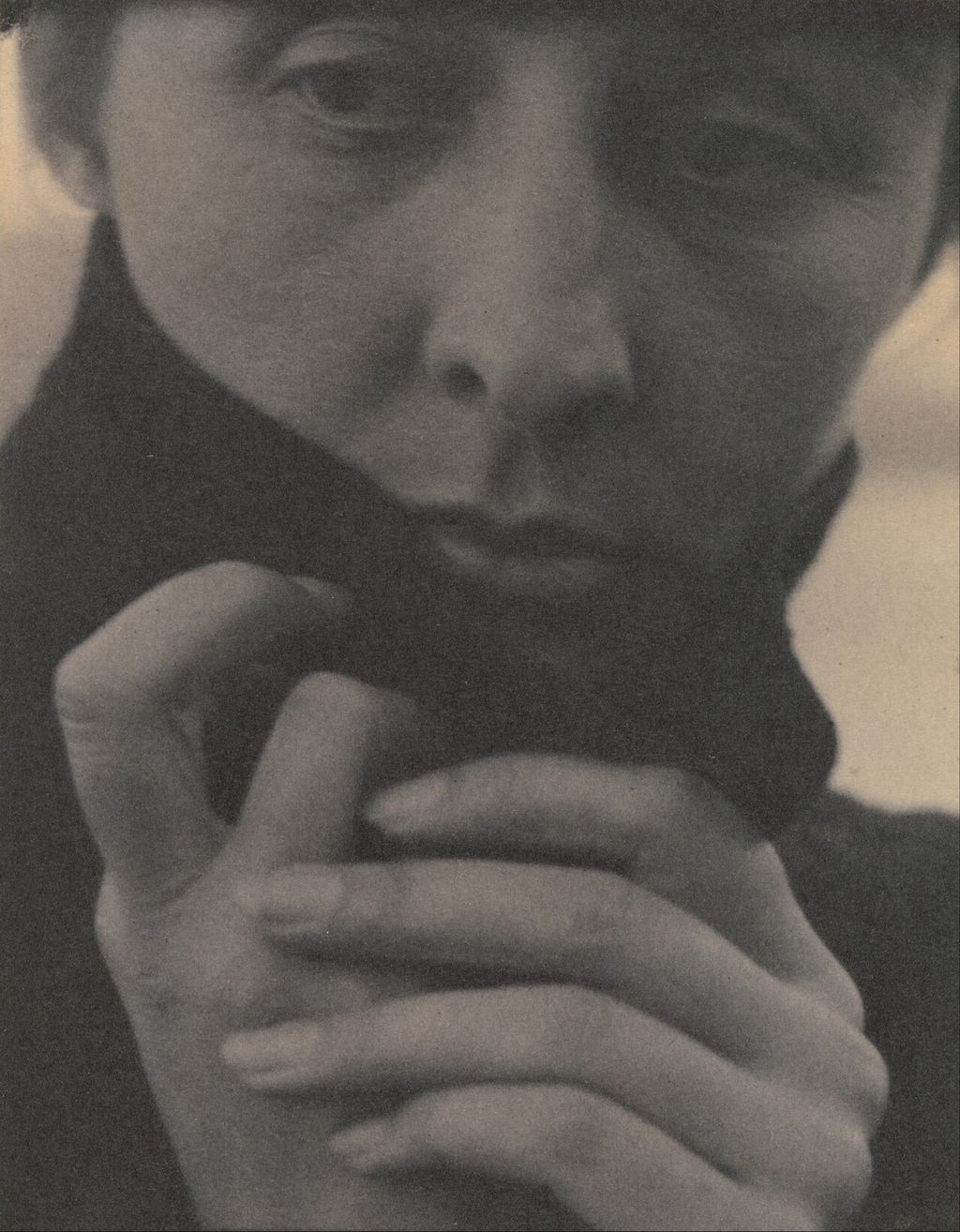
They began living together after her move and married in 1924. Stieglitz photographed O’Keeffe repeatedly, eventually producing a portrait sequence of more than three hundred images. The photographs made her face, hands, torso and public identity unusually visible. They also encouraged critics to approach her paintings through the body and the couple’s intimate life. That history matters because it shaped reception, but a photograph of the artist cannot serve as a code that unlocks every painted form.
A career built through recurring exhibitions
The gallery history after 291 explains how O’Keeffe became both critically visible and commercially successful. Stieglitz presented her work at the Anderson Galleries, the Intimate Gallery and, from 1929, An American Place. The sequence matters because the annual exhibition became a rhythm of production and reception. Recent work was grouped, titled, priced and reviewed; photographs, catalogues and press language then gave it a public frame.[2][18] An exhibition is never a transparent window onto everything an artist has made.
O’Keeffe and Stieglitz selected works and arranged relationships among them. A flower might appear beside an abstraction, a city painting or a Lake George landscape. The juxtaposition could encourage formal comparison, while a catalogue title could stabilise the identity of a work that had circulated under a number or a looser description. The economic structure also deserves attention. Regular exhibitions provided sales, but dependence on one dealer entwined artistic decisions with an intimate relationship.
Letters and business records show that O’Keeffe understood prices, owners and exhibition histories rather than standing outside the market. Her Abiquiú Notebooks later recorded titles, dimensions, owners and displays, often with photographs intended to remove ambiguity.[13] After Stieglitz died, O’Keeffe worked with Edith Halpert and the Downtown Gallery. The change placed her within another major institution of American modern art and altered the practical management of works. It also demonstrates that the career did not end with the gallery system that had first promoted it.
Abstraction, objectivity and materials
O’Keeffe used both observed subjects and non-representational forms throughout her career. MoMA’s account of her practice distinguishes two terms she employed: “objectivity” for close attention to the external world, and “abstraction” for giving visual form to thoughts and experience. Works such as Abstraction Blue make the categories collide. Folded colour may suggest petals, bodies, landscape and pure spatial pressure without settling into one identity.[4]
The Whitney Museum’s 2009–10 exhibition Georgia O’Keeffe: Abstraction assembled more than 125 paintings, drawings, watercolours and sculptures to correct the assumption that abstraction belonged only to her youth. Her abstract output diminished after 1930 but returned with different force in the 1940s and provided a precedent for younger painters.[6] The argument is significant: flowers and landscapes did not replace abstraction.
Observed forms gave her another field in which abstraction could operate. Series were central to this method. O’Keeffe repeated a curve, flower, hill, door or aerial river while changing scale, colour, crop and support. MoMA’s 2023 exhibition To See Takes Time reunited sequences on paper that are often dispersed. It showed an artist developing an image through recurrence rather than moving directly from first impression to definitive statement.
Between 1915 and 1918 she made an exceptional concentration of works on paper, yet later flower studies, portraits and aerial views demonstrate that drawing remained active across the career.[10] The variety of media is central to the variety of looking. Charcoal can move from a hard contour to a broad, rubbed darkness; erasure can return light to the sheet. Graphite supports fine adjustment and portable observation. Watercolour stains rather than covers, making speed, pooling and the absorbency of paper visible.
Pastel produces saturated, friable colour that sits on the surface. Oil permits opaque revision, extended edges and carefully levelled fields. O’Keeffe moved among these properties rather than treating a drawing as a lesser painting. In the early watercolours, repeated sunsets and plains could be remade quickly enough to register changing light. The charcoal Specials depend on the resistance between black material and white paper.
Later pastels exploit colour without the gloss or layered depth of oil. The difference affects conservation as well as appearance: paper darkens, watercolour is vulnerable to light and pastel particles can be disturbed.[10][16] Scale also changes with medium. A compact watercolour may record a sequence across several sheets, while a large oil gives one selected form bodily presence. The cloud paintings extend that logic to mural-like dimensions.
When a motif moves from a sketch to a canvas, it is not simply enlarged. Edges, intervals, pigment density and the viewer’s physical distance all change. This attention to medium helps separate O’Keeffe’s work from the vague idea of “simplification”. A form that appears simple may be the result of repeated drawings, colour trials and revised proportions. Reduction is an operation performed through material decisions.
Lake George as a working landscape
From 1918 through the 1920s, O’Keeffe divided much of her time between New York and the Stieglitz family property at Lake George in the Adirondacks. Lake George supplied barns, trees, hills, fruit, leaves and cultivated flowers. It was also a social and domestic setting shaped by the Stieglitz family, visitors and the rhythms of seasonal work.
My Shanty, Lake George of 1922 makes a modest studio building into a severe block beneath trees and hills. Duncan Phillips acquired the painting in 1926. The Phillips Collection preserves both contemporary language about its solitude and O’Keeffe’s later recollection that she adopted a deliberately sombre palette to show the men in Stieglitz’s circle that she could paint in the manner they approved.[20] Her account is retrospective and pointedly ironic.
It turns the picture into evidence of strategic participation in a gendered artistic conversation. The work also resists a simple split between representation and abstraction. Wall, roof and door are legible, but their geometry gains force through the diffuse vegetation and rolling forms around them. The building is both a particular studio and a set of weighted rectangles. That double status characterises much of O’Keeffe’s observed work.
Flowers and imposed meanings
O’Keeffe began making the magnified flower paintings that established her popular reputation during the 1920s. Enlarging a bloom changed the conditions of looking. A small object associated with decoration or domestic attention occupied a canvas at a scale usually granted to more prestigious subjects. Cropping interrupted botanical completeness.
Petal edges became boundaries between colour fields, while dark centres and folds created ambiguous depths. The pictures were quickly interpreted through sexuality. Stieglitz’s photographic portraits and the wider popularity of psychoanalytic language helped critics connect floral interiors to the female body. O’Keeffe repeatedly objected to viewers attaching their own sexual associations to what she had painted.
Museum scholarship now treats that objection as part of the works’ reception rather than as permission either to erase erotic readings or to impose them as the single truth.[21] A fuller analysis begins with the particular picture. What flower is named? Is the title contemporary? How close is the crop?
Does the work belong to a numbered series? How do colour and negative space differ from related versions? Who exhibited and acquired it? Sexual interpretation is then one documented historical response among questions of optics, scale, advertising, photography, botany, serial variation and the gendered hierarchy of subjects.
O’Keeffe’s flowers were radical partly because they made acts of looking difficult to dismiss. The familiar subject attracted attention, then denied the quick glance that familiarity usually receives. Their later reproduction on posters, cards and merchandise increased recognition while often stripping away differences among individual canvases.
New York and the vertical city
O’Keeffe’s New York paintings emerged from direct experience of a city remaking its skyline. Towers, hotel windows, artificial illumination and narrow views from high rooms offered structures unlike Lake George’s horizontal land. Works such as New York, Night, Radiator Building—Night, New York and New York Street with Moon use vertical compression and brilliant points of light to make architecture both material and theatrical.
The city paintings complicate the idea that O’Keeffe belonged naturally to flowers and landscape while modern architecture was an exception. The Detroit Institute of Arts’ 2026–27 exhibition Georgia O’Keeffe: Architecture is the first to treat her built environments across several decades as a continuous field. It connects Manhattan skyscrapers to Lake George farm buildings and New Mexico adobe structures through geometry, line, colour and personal use.[19]
Centre Pompidou’s 2021 retrospective likewise placed the New York towers within a long trajectory from early abstraction to rural and desert subjects. Its French curatorial account treats O’Keeffe as an inventor of American modernism whose work crossed rather than occupied one category.[7] The international view is useful because it unsettles the regional legend of an artist belonging only to the Southwest.
Inside and outside the Stieglitz circle
O’Keeffe worked in proximity to John Marin, Arthur Dove, Marsden Hartley, Charles Demuth, Paul Strand and other artists supported or exhibited by Stieglitz. Shared interests included abstraction, landscape, photography, modern architecture and the search for an art understood as distinctively American. Proximity did not produce a uniform style. Dove’s organic abstractions and O’Keeffe’s early non-objective work invite comparison, but influence cannot be reduced to one-way borrowing.
Marin’s city and landscape structures, Demuth’s precision and Hartley’s New Mexico experience likewise provide context rather than templates. O’Keeffe’s serial concentration, controlled surfaces and shifts of scale remained her own solutions. European modernism entered this network through exhibitions and reproductions. The Centre Pompidou account points to the significance of Camera Work and its publication of material related to Kandinsky. O’Keeffe could therefore encounter arguments about spiritual and abstract art without travelling to Europe in the period.[7]
Cubism, photography and Symbolism were part of the available visual field, but her pictures seldom conform to one imported programme. The phrase “American modernism” is most useful when it names an institutional and historical question rather than a national essence. Artists and dealers were asking how work made in the United States could participate in international modernity while responding to its own cities, landscapes and publics. O’Keeffe’s movement among Manhattan, Lake George, Texas and New Mexico made that question geographical as well as formal.
New Mexico as inhabited history
O’Keeffe first visited northern New Mexico in 1929. She returned for extended periods, purchased a house at Ghost Ranch in 1940, acquired the ruined Abiquiú compound in 1945 and made New Mexico her permanent home in 1949, three years after Stieglitz’s death.[1][3][14] The landscape offered distinct formations and routes: the Black Place, the White Place, Cerro Pedernal, the Chama River valley, hills near Alcalde and views around Ghost Ranch.
O’Keeffe carried bones, stones, shells and other objects into her studios, rearranging them across paintings rather than merely transcribing where they were found. Crosses, churches, adobe walls, ladders and doors belonged to living religious and architectural histories. Calling the setting an empty wilderness repeats a colonial fantasy. The Abiquiú house stands within a complex history of Pueblo, Hispano, Spanish colonial and Catholic occupation.
Museum property research traces the site to land associated with the Pueblo of Santo Tomás Apóstol de Abiquiú, later partition and local family ownership before O’Keeffe bought it from the Catholic Church.[27] The house itself combined regional adobe construction with alterations that O’Keeffe and Maria Chabot directed. This context changes how the paintings are described. A wall, church or cross cannot be reduced to timeless form even when O’Keeffe simplifies it. Formal selection operates upon a place with residents, property relations, religious meanings and contested histories.
The Museum’s 2025–26 exhibition Tewa Nangeh/Tewa Country makes that correction more specific. Artist Jason Garcia/Okuu Pín (Santa Clara Pueblo) and museum curator Bess Murphy developed it with artists, scholars and culture bearers from the six Tewa Pueblos of northern New Mexico, whose continuous presence the phrase “O’Keeffe Country” can erase.[31] This is not an invitation to treat her landscapes as records of Tewa experience. It requires her claims of possession and solitude to be read against living Indigenous sovereignty, knowledge and art.
Bones, shells and changing scale
Animal skulls, antlers, pelvis bones and shells entered O’Keeffe’s work during the New Mexico years, sometimes combined with flowers, distant hills or bands of colour. Popular accounts often assign them a ready symbolism of death. The objects can certainly carry associations of mortality, but O’Keeffe also approached them as structures: cavities framing distance, arcs interrupting a horizon, pale surfaces against intense sky and hard edges joined to softer organic forms. In Ram’s Head, White Hollyhock—Hills and Ram’s Head, Blue Morning Glory, bone, bloom and landscape occupy incompatible scales while remaining optically precise. The construction is not a natural still life.
It is a composite that asks how objects gathered by hand can reorganise a far larger territory. Shells offered related problems of interior and exterior. Their curves could be paired with hills or developed towards abstraction. The recurrence of openings, folds and spirals across flowers, shells, pelvis bones and non-objective paintings does not prove one universal symbol. It demonstrates that O’Keeffe found formal problems capable of migration from one subject to another.
Houses, studios and constructed simplicity
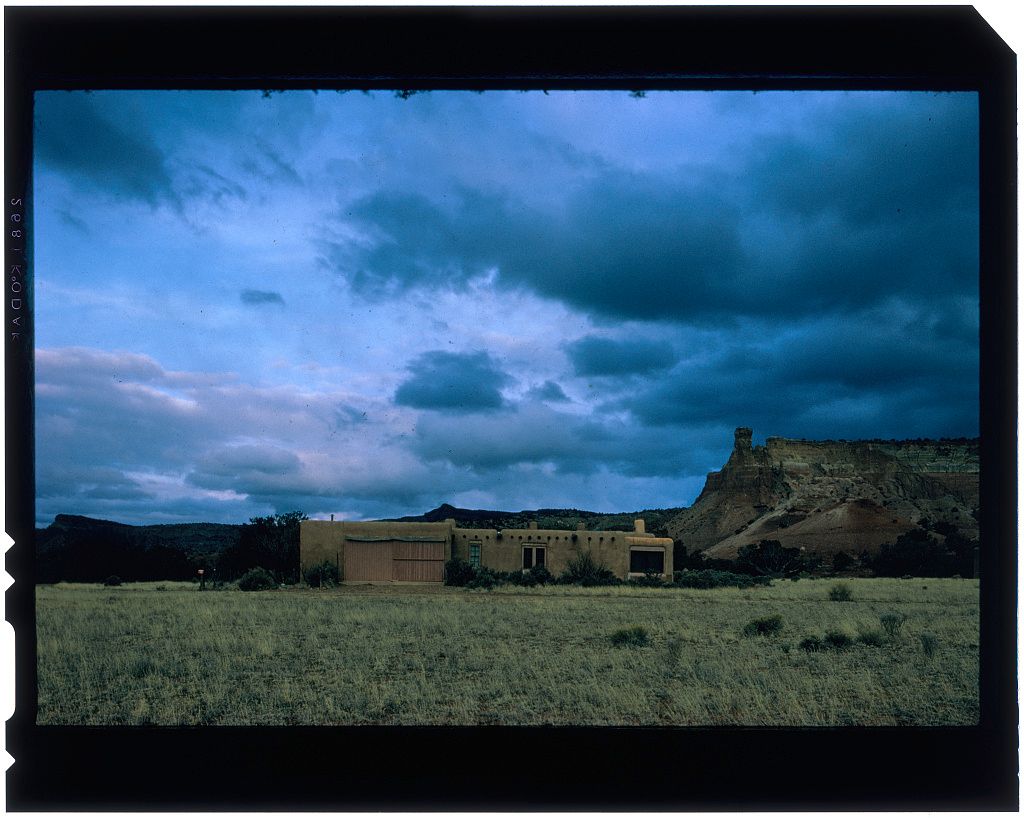
O’Keeffe’s Ghost Ranch and Abiquiú homes served different needs. Ghost Ranch was a summer property on twelve acres at the edge of a much larger ranch. It offered direct views towards cliffs and Pedernal but was poorly suited to winter. The larger Abiquiú compound had water, a garden and year-round practicality.[14]
She bought the Abiquiú property in a ruined state and supervised a four-year restoration carried out with Maria Chabot. Modern windows, carefully proportioned rooms and controlled surfaces transformed vernacular structures into working and living spaces. The dark patio door that first attracted her became a repeated painted subject.
Museum research compares the slow simplification of the houses with her artistic practice: observation, selection, refinement and precise materials.[26] The homes should not be treated as neutral containers for a solitary genius. Their preservation records the labour of builders, gardeners, assistants and local families as well as O’Keeffe’s design decisions. Historic-property oral histories add knowledge that conventional art catalogues often omit.
Painting did not exhaust the later studio practice. O’Keeffe made photographs over roughly three decades, from about 1940 to 1965; an exhibition assembled approximately ninety-five of them in sequences that reveal repeated exposures and small compositional variations.[32] The catalogue record cautions against describing these images merely as aids for paintings. She treated photography as an independent extension of her modernist vision, using framing, serial comparison and close observation in ways that illuminate, without simply duplicating, the habits visible in her work on paper and canvas.
Travel, flight and enlarged space
O’Keeffe travelled internationally during the 1950s and 1960s. Views from aeroplanes generated new subjects: winding rivers, roads, horizon bands and banks of cloud. MoMA describes her sketching rivers seen during a 1959 journey and later converting their courses into black bands across paper.[4] The perspective collapses topography into line without abandoning observation.
The cloud paintings pushed that aerial experience towards monumentality. Sky Above Clouds IV, completed in 1965, spreads repeated white forms across a canvas large enough to exceed ordinary domestic scale. Repetition creates distance, but the upper band of sky and narrow horizon keep the field from becoming a purely decorative pattern.
These late works are sometimes linked to hard-edge abstraction or Minimalism. The comparison can clarify their reduced shapes and serial fields, yet chronology matters. O’Keeffe arrived at them through decades of observing landscape, cropping forms and developing sequences. She was not simply following a younger movement. Travel also altered the archive of forms available to her.
Museum records preserve itineraries, maps and labelled travel boxes containing ephemera from journeys.[13] Peaks, rivers and deserts seen in Peru, Japan and elsewhere entered drawings and paintings selectively. They should not be absorbed into a generic story of “the exotic”. Each work requires a date, route and source record where those survive.
Randall C. Griffin’s 2025 study of the late work challenges the lingering assumption that O’Keeffe’s major achievement ended before or soon after the Second World War. It treats the Abiquiú walls, aerial rivers, Arizona canyons, clouds and Washington Monument pictures as ambitious postwar sequences informed by contemporary artistic and political conditions.[33] Its attention to race, class, gender, Indigeneity, spirituality and ecology does not make every canvas an illustration of those subjects. It restores the late work to historical argument and tests the self-contained desert legend against overlooked photographs, letters and objects.
Technical research and conservation
O’Keeffe’s smooth surfaces can make the paintings appear inevitable, as if an enlarged form arrived fully resolved. Technical study shows labour and planning. For its 2021 retrospective, the Museo Nacional Thyssen-Bornemisza examined five paintings dated between 1921 and 1957 in collaboration with the O’Keeffe Museum. Imaging and materials analysis reconstructed layers, alterations and aspects of her colour procedure. Researchers found careful preparation and a concern for the long-term appearance of the works.[8]
The studio’s roughly 320 colour-reference cards provide another kind of evidence. They indicate sustained comparison and a working memory for mixtures rather than colour chosen casually at the easel.[9] Infrared and surface examination can reveal underdrawing, reserved grounds or adjusted contours that the finished image suppresses. Conservation continues that research. The O’Keeffe Museum uses scientific analysis and has collaborated on lighting designed to reduce damage to light-sensitive works.[16]
Its formal examination programme may include multispectral and three-dimensional imaging, analysis of canvas or paper, grounds, paint additions and signs of ageing.[17] Studies of small protrusions in some paint films show that even the most controlled surface may change chemically over time. Technical findings must remain object-specific. Evidence that one painting uses a lead-white matrix or has a revised contour is not proof about every canvas. Its broader value is methodological: the work should be read as a made and ageing material object, not only as an image.
Exhibitions and reputation
O’Keeffe’s reputation was formed through a long exhibition history. Stieglitz showed her drawings in 1916 and mounted annual presentations that positioned new work within the American modernist circle. The exhibitions created markets and critical narratives, including gendered ones that she later contested.[2][18] In 1946, the Museum of Modern Art presented its first retrospective devoted to a woman artist. The exhibition was chronological and included early abstractions, flowers and New Mexico landscapes; O’Keeffe took part in its preparation.[5]
The event established museum authority around a career that was still developing. Later exhibitions revised the picture. The Whitney retrospective of 1970 addressed a generation encountering her through feminism and renewed interest in American modernism. The National Gallery’s 1987 centennial assembled seventy-five paintings and forty-five works on paper and travelled to Chicago, Dallas and the Metropolitan Museum.[22] The Whitney’s 2009 abstraction exhibition argued against the flower-centred canon.
The 2016 Tate-led retrospective and the 2021–22 Madrid, Paris and Basel project expanded European attention.[7][23] MoMA’s 2023 exhibition foregrounded works on paper, while the DIA’s 2026 exhibition isolates architecture as a career-long concern.[10][19] No single retrospective simply reveals the complete artist. Each selects a problem and reorganises the oeuvre around it. Exhibition history is therefore part of interpretation.
Sight loss and continuing authorship
O’Keeffe’s central vision deteriorated in the early 1970s. The museum chronology identifies 1972 as the year of her last unassisted oil painting, while recording continued work in oil with help until 1977, in watercolour and charcoal until 1978, and in graphite until 1984.[2] These distinctions prevent the inaccurate statement that blindness abruptly ended the career. Assistants, particularly Juan Hamilton, enabled aspects of the late practice.
Assistance could involve preparing materials, helping translate an instruction into physical action or supporting publication and travel. Authorship must be described through the available record rather than decided by a simplistic rule that only an unaided hand can make an artwork. Memory became increasingly important. Familiar doors, clouds, rivers and abstract forms could be revisited when sight no longer permitted the same kind of observation. The late work belongs to a history of adaptation as well as disability.
Stewarding the Stieglitz collection
After Stieglitz’s death, O’Keeffe did more than settle a private estate. She distributed major groups of his collection to public institutions, helping determine where an account of American modernism would be preserved and studied. In November 1949 she gave 101 works to Fisk University, a historically Black university in Nashville.[28] Another large gift went to the Art Institute of Chicago, connecting her early education there with one of the principal institutional holdings of Stieglitz-circle art.
These decisions belong to O’Keeffe’s career because they show her operating as a custodian, organiser and historical actor. The gifts dispersed paintings, drawings and photographs rather than consolidating them into one memorial collection. They also created later questions about conservation, display and institutional responsibility. A 1961 report by the artist and conservator Felrath Hines documented treatment of the Fisk group, evidence that the collection immediately acquired a material history beyond its transfer.[28]
Feminism, refusal and public image
O’Keeffe’s relationship to feminism cannot be reduced to whether she accepted a label. She worked in institutions and markets that routinely described art by women as an expression of sex. She resisted critics who treated her work as essentially female, yet her professional independence and public visibility became important to women across generations. Linda Grasso’s historical study follows this relationship from the 1910s through the 1970s using fan letters, women’s organisations, radio transcripts and college programmes.[29] That evidence widens the record beyond famous critics.
It shows an artist’s cultural meaning being made by readers, students and women’s networks as well as museums. The feminist art movement’s renewed attention during the 1970s strengthened O’Keeffe’s position as a precedent, even when her own statements complicated the role assigned to her. Smithsonian scholarship accordingly describes contemporary gendered criticism, O’Keeffe’s pointed resistance and her place among the few women in the Stieglitz circle.[30] The productive question is not whether every painting is feminist in subject. It is how a woman built and defended a long public practice within systems that repeatedly made gender the explanation for her work.
Catalogue, archive and continuing research
O’Keeffe’s catalogue is not closed. Barbara Buhler Lynes’s two-volume 1999 catalogue raisonné documented 2,029 numbered works. Access O’Keeffe now turns that foundation into an updateable digital research system, adding institutional records, revised ownership, exhibition histories, visual descriptions and material from more than 130 organisations.[11][12][25] The distinction matters for individual artwork pages.
Titles, dates, locations and even attribution histories can change as records are reconciled. A legacy URL or older printed caption is a lead, not final authority. The archive is equally extensive. The Georgia O’Keeffe Papers occupy forty-two linear feet and contain the Abiquiú Notebooks, business records, correspondence, house and property files, travel material, writings, clippings and photographs.[13]
A separate museum group of 232 letters to Stieglitz from 1933–44 represents only part of more than 5,000 letters exchanged between them; the larger correspondence is held principally at Yale.[15] Archives do not remove interpretation. A letter may record an immediate observation, an argument, a sales decision or a performance for its recipient. Used with object and exhibition records, however, such documents make it possible to distinguish contemporary evidence from myths repeated later.
How to look at O’Keeffe now
Begin with the object rather than the icon. Establish the preferred title, date, support, dimensions, collection and catalogue record. Look for serial relatives. Ask what the crop excludes, how colour areas meet, whether the support remains visible and how the scale changes the subject.
Then locate the work. A Lake George barn, Manhattan tower and Abiquiú wall may share geometry while belonging to different social and historical worlds. Place is not decorative background. It includes property, work, architecture, cultivation, community and movement.
Finally, locate the interpretation. Who first called a flower sexual, a barn spiritual, a skull national or a cloud abstract? Was the claim made by O’Keeffe, Stieglitz, a contemporary critic, a later curator or a popular writer? Attribution makes disagreement visible.
O’Keeffe’s art remains powerful because it does not require a choice between close observation and abstraction. She selected from the world, changed scale, repeated forms and made experience materially exact. The famous subjects are entrances into that practice. They are not its limits.
Discussion
Which piece of evidence most changes the way you read Georgia O’Keeffe?
Reader Insights
Which visible detail most changes your reading of Georgia O’Keeffe?
How do medium, setting and documented history shape the encounter?
What remains uncertain when documented fact is separated from interpretation?
Join the Conversation
Share your reading of Georgia O’Keeffe below.
References
- Georgia O’Keeffe Museum, “About Georgia O’Keeffe”, View Source
- Access O’Keeffe, “Artist’s Chronology”, View Source
- National Gallery of Art, “Georgia O’Keeffe”, View Source
- Museum of Modern Art, “Georgia O’Keeffe”, View Source
- Museum of Modern Art, “Georgia O’Keeffe”, 14 May–25 August 1946, View Source
- Whitney Museum of American Art, “Georgia O’Keeffe: Abstraction”, View Source
- Centre Pompidou, “Georgia O’Keeffe”, 2021, View Source
- Museo Nacional Thyssen-Bornemisza, “Georgia O’Keeffe in the Thyssen-Bornemisza Collections”, View Source
- Museo Nacional Thyssen-Bornemisza, “El taller de Georgia O’Keeffe”, View Source
- Museum of Modern Art, “Georgia O’Keeffe: To See Takes Time”, View Source
- Georgia O’Keeffe Museum, “Access O’Keeffe Project Documentation”, View Source
- Access O’Keeffe, “Information for Researchers”, View Source
- Access O’Keeffe, “Georgia O’Keeffe Papers, 1914–1991”, View Source
- Georgia O’Keeffe Museum, “Georgia O’Keeffe’s Homes”, View Source
- Georgia O’Keeffe Museum Archives, “Letters to Alfred Stieglitz, 1933–1944”, View Source
- Georgia O’Keeffe Museum, “Conservation”, View Source
- Georgia O’Keeffe Museum, “Artwork Research Support”, View Source
- Georgia O’Keeffe Museum, Exhibiting O’Keeffe, View Source
- Detroit Institute of Arts, “Georgia O’Keeffe: Architecture”, View Source
- The Phillips Collection, “My Shanty, Lake George”, View Source
- Georgia O’Keeffe Museum, “The Shared Journeys of Jean Toomer and Georgia O’Keeffe”, View Source
- National Gallery of Art, “Georgia O’Keeffe 1887–1986”, View Source
- Fondation Beyeler, Georgia O’Keeffe press dossier, 2022, View Source
- Metropolitan Museum of Art, “Georgia O’Keeffe (1887–1986)”, View Source
- Georgia O’Keeffe Museum, “A Scholar’s Mark on the Art World: Barbara Buhler Lynes and O’Keeffe’s Catalogue Raisonné”, View Source
- Georgia O’Keeffe Museum, “Georgia O’Keeffe at Home”, View Source
- Georgia O’Keeffe Museum Archives, “Historic Properties Department: Larsen Abiquiú Research”, View Source
- Georgia O’Keeffe Museum, “The Stieglitz Collection at Fisk University”, View Source
- Smithsonian Libraries and Archives, Linda M. Grasso, Equal under the Sky: Georgia O’Keeffe and Twentieth-Century Feminism, View Source
- Smithsonian American Art Museum, “Georgia O’Keeffe”, View Source
- Georgia O’Keeffe Museum, “Tewa Nangeh/Tewa Country”, 7 November 2025–1 November 2026, View Source
- Access O’Keeffe, “Georgia O’Keeffe: Photographer”, 2021–23 touring-exhibition record, View Source
- Randall C. Griffin, Georgia O’Keeffe: The Late Work, Yale University Press, 2025, View Source