


 by Tom Gurney
Tom Gurney BSc (Hons) is an art history expert with over 20 years experience
Page Created on September 22, 2026 / Page Updated on September 22, 2026
Email: tomgurney1@gmail.com / Phone: +44 7429 011000
Introduction
Two yellow flowers crowd a canvas only ten inches high. The larger head enters from the left and is cut by two edges; the smaller one presses in from the upper right. Their dark centres face the viewer, but neither plant has a visible stem. Orange, salmon and reddish-brown fill the little space remaining between petals. Georgia O’Keeffe’s Sunflower makes an intimate support feel packed beyond its capacity.
The painting is usually dated 1940–1942, a range rather than a convenient approximation. A backing inscription names 1940. Two archival records name 1942, while another gives “1942?”. The picture was probably included in O’Keeffe’s 1943 exhibition at An American Place, yet even its checklist number is not absolutely secure. Those disagreements make the work a useful case study in how an apparently simple flower painting acquires an exacting documentary history.[1][2]
At a Glance
- ArtistGeorgia O’Keeffe
- ArtworkSunflower
- Artistic contextAmerican modernism
Contents
- Object identity
- Small scale and monumental effect
- Anatomy and the absent plant
- The sunflower sequence
- Place and disputed date
- Physical record and inaccessible reverse
- The 1943 debut
- Archives and several kinds of memory
- Enlargement and colour as structure
- Edge, ground and photographic analogy
- Technical limits
- Sexual readings and O’Keeffe’s response
- Cultivation and cultural time
- Mid-century exhibitions
- Ownership after Toronto
- Abilene, private ownership and catalogue limits
- Unknowns
- Why Sunflower matters
Object identity
- Artist: Georgia O’Keeffe (1887–1986)
- Title: Sunflower
- Date: 1940–1942
- Medium: oil on canvas
- Dimensions: 10 × 12 inches (25.4 × 30.5 cm)
- Catalogue raisonné: CR 1010
- Collection: private collection
- Signature: none observed during the recorded 1946 examination[1]
The title is supported by the Whitney Archive, Downtown Gallery Archive, O’Keeffe’s Abiquiú Notebooks, a backing inscription and the checklist for her 1943 exhibition. That convergence makes Sunflower considerably firmer than many titles supplied after an artist’s death. The date is a different matter. The Smithsonian’s national art inventory independently indexes the same object as an oil on canvas dated “1940/1942” and cites catalogue number 1010.[1][26]
Small scale and monumental effect
The format is horizontal. A large sunflower occupies most of the left and lower field. Its yellow rays bend and overlap around a dark, roughly circular centre whose mottled surface shifts among brown, olive and green-black. The flower continues beyond the left edge, while its lower rays disappear below the canvas. A second, smaller head enters from the upper right.
Its outer petals are cropped at the top and right. The two centres sit on a descending diagonal, but the heads do not behave as distant and near versions of one form. The smaller flower remains large enough to press against the frame. Small green leaves emerge behind the left flower, though they do not assemble into a complete plant. There is no vase, soil, horizon or blue sky. The background changes from lighter salmon-orange near the centre to deeper red-brown towards the upper left, supplying warmth and pressure rather than a clearly measured setting.[1] O’Keeffe is often described as making flowers enormous. CR 1010 complicates that description.
Its actual canvas is small enough to hold close to the body. Monumentality arises from proportion: two heads occupy nearly the whole field, and the larger one is denied a complete circumference. The result is neither a botanical plate nor a conventional still life. A scientific illustration would normally preserve the specimen’s boundaries and show diagnostic structures. A tabletop arrangement would offer some container or surrounding room.
Here, cropping removes both kinds of context. The work asks the viewer to oscillate between recognition and visual incident. Yellow rays remain legible as petals, yet their repeated wedges form a rotating band. The central disks remain parts of flowers, yet their broken marks create dense, granular fields. Representation and abstraction do not cancel one another; each sharpens the other.
Anatomy and the absent plant
O’Keeffe’s decision to include two flowers changes the logic of attention. Many of her flower paintings organise a single bloom as an encounter. In Sunflower, the eye must negotiate unequal partners. The large head establishes the dominant rhythm; the smaller one repeats and compresses it. Their relationship is not narrative in any demonstrable sense.
Nothing establishes that one is parent and one child, that they were cut from the same plant, or that they were observed together. Such suggestions may arise from scale, but the picture supplies no documentary answer. What can be said is formal. The smaller head prevents the salmon ground from becoming empty. Its rays overlap the large flower’s zone without merging completely into it.
The diagonal between the centres keeps the composition moving from lower left to upper right, while the cropping sends that movement beyond the support. A sunflower head is not one flower in the strict botanical sense. Members of the Asteraceae form composite inflorescences. Broad ray florets ring numerous smaller disk florets, which are gathered into the central head.
Kew describes the common sunflower, Helianthus annuus, as an annual native from the south-western United States to Mexico; the National Park Service explains the distinction between ray and disk flowers within the family.[18][19] This anatomy helps explain O’Keeffe’s visual structure. The outer rays can be painted as long, relatively broad colour planes. The centre demands a much tighter accumulation of marks.
Each head therefore contains two tempos: an outward flare and an inward concentration. The painting should not, however, be assigned confidently to Helianthus annuus. The title secures the ordinary category “sunflower”, but the cropped flowers show too little stem, leaf and habitat to establish a species or cultivar. O’Keeffe was making a painting, not preserving a diagnostic herbarium specimen.
The sunflower sequence
O’Keeffe had approached the subject repeatedly but not continuously. Two small works of 1921 are both titled Sunflower. CR 355 places a yellow and red head with a dark centre and green leaves against blue. CR 356 uses an oval board and sets a brown-yellow flower and leaves against white. Their compact supports anticipate the intimacy of CR 1010, though neither uses its two-headed horizontal compression.[4][5]
In 1935 she painted Sunflower, New Mexico I and Sunflower, New Mexico II. Each is a twenty-by-sixteen-inch vertical canvas. Both show a single head with stem and leaves against blue. The Cleveland Museum of Art describes the first as unusual among O’Keeffe’s close flower images because the entire plant stands within a landscape-like environment. The museum received it as O’Keeffe’s bequest.[6][7][8]
Those paintings attach “New Mexico” to their titles. CR 1010 does not. Although its date range overlaps O’Keeffe’s long New Mexico seasons, calling it Sunflower, New Mexico would merge distinct works and exceed the documentation. The closest dated predecessor is A Sunflower from Maggie of 1937. Its title refers to Margaret Johnson, a friend who supplied the flower.
The fifteen-by-twenty-inch canvas shows one head, stem and leaves against a pale orange-pink ground. That warm ground offers a useful comparison with CR 1010, but the earlier painting still presents a relatively complete plant.[9] The 1937 canvas also has a documented conservation label referring to a 1962 copolymer treatment. CR 1010 has no comparable public treatment record.
Evidence belonging to one sunflower cannot be transferred to another simply because subject and artist match.[9] The Museum of Fine Arts, Boston later deaccessioned A Sunflower from Maggie in 2022 to help fund its acquisition of a painting by Remedios Varo. That institutional decision is part of the comparison work’s history, not CR 1010’s provenance. It demonstrates how separate O’Keeffe sunflowers have entered very different museum and market lives.[10]
Place and disputed date
The date range spans several working seasons. In 1940 O’Keeffe spent June through December at Ghost Ranch, bought the house there in October and worked around the White and Black Places before returning to New York. In 1941 she again spent much of May through November in New Mexico. Maria Chabot managed the Ghost Ranch house and accompanied her on painting excursions.[3]
O’Keeffe travelled west again in June 1942, visited the Santo Domingo Corn Dance and worked at the White Place before returning to New York in December. She and Alfred Stieglitz then moved to 59 East 54th Street. In January 1943 she installed her Art Institute of Chicago retrospective; in March Stieglitz opened the annual exhibition at An American Place.[3] This movement offers plausible settings but no proven one.
The backing date could mean the painting was made in 1940; the archive date could place it in 1942. It might have been begun in one region and finished in another. Access O’Keeffe specifically warns that O’Keeffe sometimes transported and reworked paintings between New Mexico and New York.[2] The backing inscription reads “Sunflower – 1940 / by Georgia O’Keeffe / Okd by Alfred Stieglitz”. A second label identifies An American Place at 509 Madison Avenue.
Against that physical record, the Downtown Gallery Archive and Abiquiú Notebooks date the work 1942, while the Whitney Archive proposes “1942?”.[1] The Whitney and Abiquiú notes add an argument: no sunflower appears in the documented 1941 or 1942 exhibitions, and the picture is probably number 4 in the 1943 show, which included works made in 1942 and 1943. This supports a 1942 dating but does not erase the 1940 inscription.[1]
Archival categories can drift. A work may be recorded by the year it was inventoried, offered or exhibited rather than begun. An inscription can also be added after execution or copied from an earlier record. No located evidence establishes when this backing inscription was written or by whom. The range is therefore a disciplined conclusion: it preserves the conflict instead of selecting the most convenient date.
Physical record and inaccessible reverse
The Whitney Archive says the painting was examined at An American Place in March 1946 and records “No signature”. That statement is stronger than an inference from a digital image because it derives from an object examination.[1] The stretcher and reverse were inaccessible when the catalogue raisonné information was compiled. Only the backing inscriptions were transcribed.
Their inaccessibility matters: dealer labels, transport marks, canvas stamps or handwritten notes might clarify date, exhibition or ownership.[1] The current record cannot establish whether the canvas remains on its original stretcher, whether the backing is original to its first display, or whether any hidden inscription survives. A private collection can preserve an object carefully while still limiting public scholarly access.
The 1943 debut
The painting was probably shown in Georgia O’Keeffe: Paintings—1942–1943, held at An American Place between 27 March and 22 May 1943 under Alfred Stieglitz’s direction. The catalogue raisonné’s note identifies CR 1010 as probable checklist number 4 rather than declaring the match certain.[1][11] The timing was significant. O’Keeffe had just received her first major retrospective at the Art Institute of Chicago in January. The New York presentation then returned attention to new work.
Sunflower, if correctly identified, appeared within a show whose title itself asserted recent production.[3][11] The backing’s An American Place label supports the gallery connection. It does not by itself prove checklist number 4, because the work was also examined at the gallery in 1946. The best formulation therefore combines confidence and reserve: the painting belonged to the gallery’s records and probably debuted in the 1943 exhibition. The sequence of events changes how the small canvas enters public history.
The Chicago retrospective surveyed O’Keeffe’s achievement across decades; the An American Place show announced work described as belonging to 1942 and 1943. If CR 1010 was number 4, viewers met it as a recent painting immediately after a major institution had framed O’Keeffe historically.[3][11] That juxtaposition resists a tidy division between an “early” flower painter and a “later” New Mexico artist. A sunflower could return beside paintings made after years of bones, crosses, hills and desert forms. Recurrence did not mean repetition.
The incomplete double head differs sharply from the single flowers and fuller plants of the 1920s and 1930s. The 1943 catalogue context may also help explain why the archive preferred 1942. Exhibition records often organise pictures according to the body of work being presented. Yet the backing’s 1940 date remains object evidence. Neither context is self-validating, and no surviving public document records O’Keeffe explicitly resolving the discrepancy.
Archives and several kinds of memory
The Georgia O’Keeffe Papers contain annual work files, exhibition material and the Abiquiú Notebooks. Those notebooks were compiled with Doris Bry and use individual fact sheets, often with reference photographs, to stabilise identities across changing owners and titles. The archive is therefore a structured research instrument rather than a diary written at the moment of every painting.[12] The Whitney Archive arose from another documentation campaign, the Downtown Gallery maintained dealer records after Edith Halpert became O’Keeffe’s representative, and the backing preserves a physical statement attached to the object.
Each source remembers a different administrative moment.[1][2] Agreement among them can produce a strong identification. Disagreement can reveal how a work moved through studio, gallery and catalogue systems. For CR 1010, the title converges while the date does not. That distinction is more informative than calling the records simply inconsistent.
Enlargement and colour as structure
In her 1926 statement O’Keeffe argued that people rarely took time truly to see a flower, and that she painted what a flower was to her at a scale that would make others see it. The statement explains a practice of attention rather than a rule that every canvas must be physically huge.[21] CR 1010 is an instructive test. Its support is small, yet the cropped heads make ordinary viewing distance feel extremely close. Enlargement is relational: the flower grows in proportion to the frame and to the viewer’s visual field.
The Georgia O’Keeffe Museum connects her cropping and shifts of scale to photographic ways of framing. The Museo Nacional Thyssen-Bornemisza likewise observes in Spanish that some sharp-focus, close-cropped flower pictures recall photographic enlargement.[22][23] These are useful historical and formal comparisons. No located evidence proves that O’Keeffe used a photograph to design this particular canvas. Yellow carries most of the picture’s light.
O’Keeffe varies it rather than laying down two uniform rings: some rays are lemon-bright, others warmer and ochre-inflected, and shadows deepen towards orange or brown. The central disks answer with low-value greens and browns. The background does more than contrast with yellow. Its salmon and red-brown hues are neighbours of the petals’ warmer passages. Flower and ground therefore separate through value, edge and texture as well as hue.
Small green leaves act as cool interruptions. The large flower’s centre is not geometrically smooth. Its uneven boundary and mottled surface prevent the head from becoming a decorative target. The smaller centre repeats the dark circular mass but with a tighter scale. Repetition gives the painting unity; unequal size keeps it from symmetry.
Edge, ground and photographic analogy
Every side of the canvas participates in the design. The left and bottom edges cut the large flower; the top and right edges cut the smaller one. The frame does not contain two finished emblems. It selects a fragment from a field imagined as continuing outside it. The interval between the heads is equally deliberate.
A wedge of warm ground separates the yellow masses and preserves the identity of each bloom. Elsewhere, petals approach closely enough that the flowers seem to press into one another’s space. The composition is held between contact and separation. This pressure distinguishes cropping from mere omission. A missing stem is not simply information withheld; it redirects attention towards the radial construction of the heads.
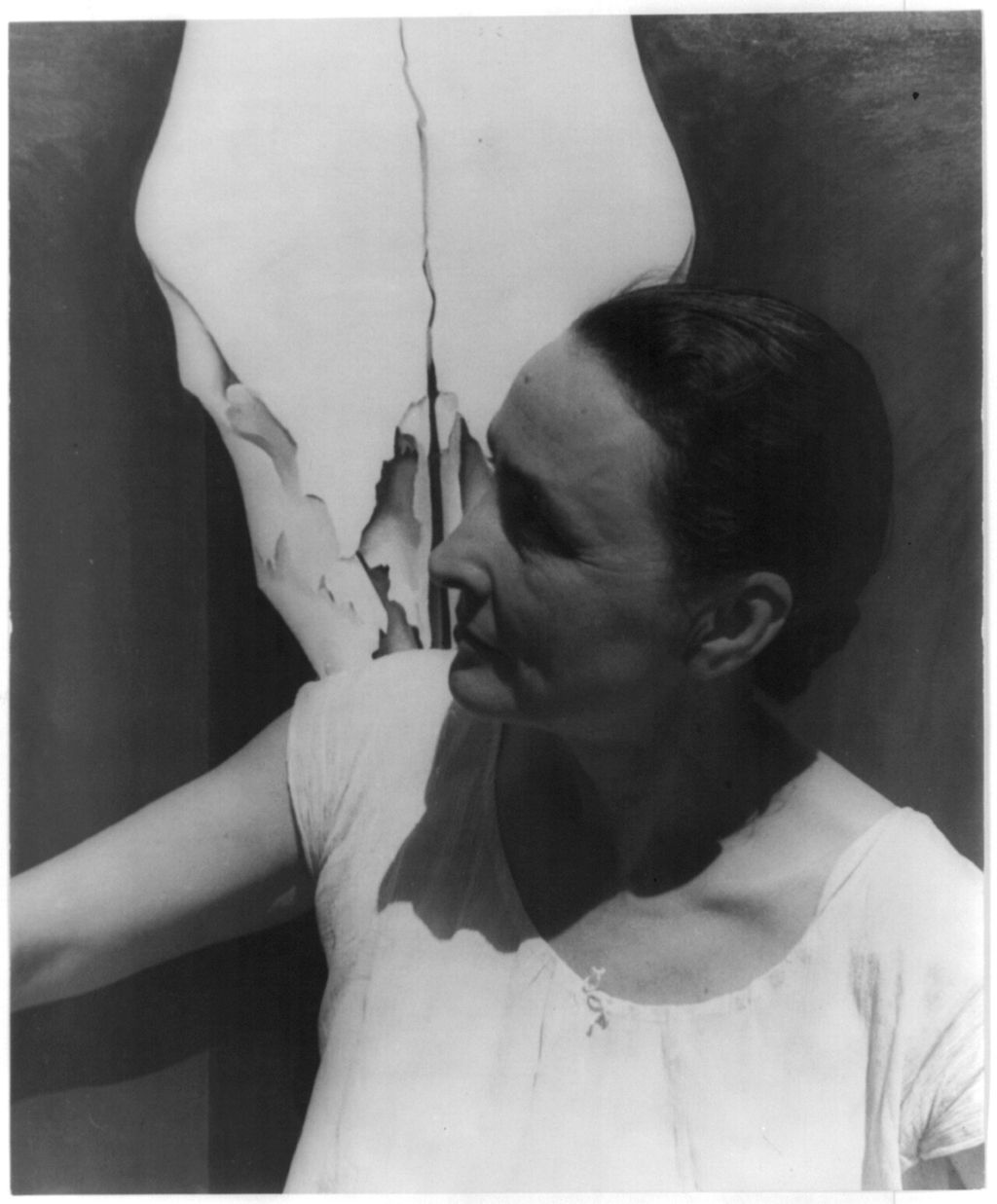
Likewise, the absent horizon prevents viewers from calculating distance. The smaller bloom may be physically smaller, farther away or both. O’Keeffe allows pictorial scale to remain ambiguous. O’Keeffe’s close association with photographers makes a photographic comparison historically tempting. Alfred Stieglitz photographed natural forms and repeatedly photographed O’Keeffe; Paul Strand’s direct compositions were also central to their circle.
Cropping, enlarged detail and abrupt framing belonged to the visual culture in which her flowers were received. Museum interpretation often describes her floral framing through the language of the camera. That comparison clarifies why CR 1010 feels like a selected view rather than a centred botanical study.[22][23] But analogy is not genealogy: no located photograph matches the two sunflower heads, and no archive record says that a camera supplied the composition. O’Keeffe could achieve radical cropping through direct observation, drawing, adjustment on the canvas or remembered arrangement. The work’s photographic quality is a way of describing its appearance, not proof of its material source.
Technical limits
Object-specific public information is sparse: oil on canvas, dimensions, no observed signature, backing inscriptions and inaccessible stretcher and reverse. No located conservation file for CR 1010 publishes pigments, layer structure, infrared imaging, X-radiography, varnish history, treatment or present condition.[1] Research at the Museo Nacional Thyssen-Bornemisza offers a broader account of O’Keeffe’s studio practice.
Examination of works in its collections found fine graphite or charcoal planning lines, while reconstructed studio material includes commercial tube paints and hundreds of colour cards used to test mixtures and luminosity.[24][25] That evidence illuminates habits available to O’Keeffe during the period. It cannot prove that CR 1010 contains a graphite drawing, a particular pigment or an additive. General knowledge becomes responsible interpretation only when its boundary is stated.
Sexual readings and O’Keeffe’s response
Magnified flowers had been sexualised by critics since O’Keeffe’s early exhibitions. In 1939 she objected that viewers placed their own associations on her flowers and then wrote as if she shared them. The distinction was between a viewer’s response and an artist’s documented intention.[21] Sunflower can invite bodily or psychological metaphors, especially because cropping turns petals and centres into enveloping forms.
Such interpretations belong to reception history. They should not be installed as the painting’s secret subject. The two-headed construction also resists the standard sexualising script developed around single irises, calla lilies or dark floral interiors. Its strongest operations are multiplication, edge pressure, repeated texture and the contrast between yellow rays and dense disks.
Cultivation and cultural time
The common sunflower has a human history far older than modern American painting. United States Department of Agriculture material notes that Indigenous peoples cultivated wild sunflower in North America thousands of years ago. The plant’s later global movement as food, oil crop and ornamental should not obscure that history.[20] CR 1010 does not depict cultivation, harvest or Indigenous knowledge directly.
It shows no field, seed use or named community. The history is relevant because “sunflower” can otherwise sound like a timeless decorative category detached from place and people. At the same time, a broad cultural history should not swallow the object. The painting’s documentary record supplies no evidence that O’Keeffe intended an ethnobotanical statement. Historical context explains the plant’s significance; it does not manufacture iconography.
Mid-century exhibitions
Access O’Keeffe records the painting at the Dennis Hotel in Atlantic City, New Jersey, from 1 February to 1 March 1955. This resolves the location left unstated in the object’s condensed exhibition history, although the exhibition title remains unknown and no located checklist securely reconstructs the show.[13] The painting returned through the Downtown Gallery to O’Keeffe in 1955.
The alignment of exhibition and ownership dates suggests active management of the work, but it does not establish whether the transfer happened before or after the display.[1] In 1957 it appeared in another exhibition of unknown title at Felix Henry Landau in Los Angeles, California. The institutional record gives 1 April as both opening and closing date.[14]
That span may represent a one-day event or an incomplete date field, and it should not be silently expanded into a conventional month-long exhibition. The location is now secure even though the title and duration are not. These fragmentary entries remain meaningful because they show that the painting circulated publicly between its An American Place history and its Canadian ownership, while also revealing how much mid-century exhibition documentation remains unresolved.
Ownership after Toronto
By 1959 the work belonged to M. B. Kaplansky in Toronto. No reliable public source located for this first pass identifies the acquisition terms, the collector’s full biography or the circumstances in which the painting left Canada.[1] It appeared at Sotheby Parke Bernet in New York on 23 May 1974 as lot 81 in sale 3644, Important Eighteenth, Nineteenth and Twentieth Century American Paintings, Watercolors & Drawings. The Georgia O’Keeffe Museum Library preserves a copy of the catalogue.[17]
That copy contains attached ephemera, including a 10 May 1974 letter from Doris Bry to O’Keeffe concerning works in the auction, a handwritten O’Keeffe note and an annotated list. The public library record does not transcribe the letter or assign every annotation to CR 1010. It establishes artist-side awareness of the sale material, not the content of a private exchange.[17] No reliable public result, estimate or consignor for lot 81 was located. Those omissions should remain visible rather than filled with unverified market data.
The provenance next places Sunflower with Fenn Galleries in Santa Fe in 1974 and in a private collection in New Castle, Maine, by 1975. It later passed again through Fenn Galleries, Gerald Peters Gallery in Santa Fe and John Berggruen Gallery in San Francisco, all by 1980.[1] This sequence maps a broad path from New York to Toronto, back to New York, then through Santa Fe, Maine and San Francisco. It also shows how established regional dealers helped circulate O’Keeffe’s work as her national reputation expanded.
The current catalogue stops at “private collection”. It does not publish the present owner, acquisition date or subsequent transfers. Privacy is part of the object’s present condition of knowledge, not evidence that the work has disappeared. The dealer sequence also warns against reading every movement as a completed sale. Parentheses in catalogue provenance normally identify dealers or agents, but they do not always disclose whether a work was owned outright, held on consignment or returned.
CR 1010 demonstrably moved through commercial custody; the exact legal form of each passage is not published.[1] O’Keeffe’s own re-entry into the chain in 1955 is especially significant. It shows that a work could return from the market to the artist and then be placed again. Provenance is not a straight ascent from studio to permanent owner. Here it loops through Downtown Gallery and O’Keeffe before continuing to Toronto.
Abilene, private ownership and catalogue limits
From 17 September to 2 October 1977, Sunflower appeared in an exhibition titled Georgia O’Keeffe at First State Bank. Access O’Keeffe gives the venue and dates but not the city on its current exhibition page.[15] The exhibition history of O’Keeffe’s Blue I independently identifies the same First State Bank show as taking place in Abilene, Texas. That cross-object evidence securely supplies the location without asking CR 1010’s sparse record to do more than it can.[16] A bank exhibition differs from the museum retrospective now associated with canonical O’Keeffe reception.
It signals the varied civic and commercial spaces in which her work was shown during her lifetime. The painting was then held by a Maine private collection, according to its published provenance.[1] Access O’Keeffe is an evolving digital catalogue, but its researcher guidance draws a crucial distinction. Public-collection records were reviewed with holding institutions in 2023–25; private-collection entries generally preserve the information published in Barbara Buhler Lynes’s 1999 catalogue raisonné unless new evidence has emerged.[2]
CR 1010 therefore combines a recently maintained digital interface with an older research horizon. Its core fields were updated on 26 August 2026, but the private work fell outside the 2023–25 survey conducted with public holding institutions.[1][2] The update is evidence of active catalogue maintenance, not of a newly verified owner, condition report or post-1999 provenance. The catalogue also explains that the Whitney Archive and Abiquiú Notebooks were assembled from artist, gallery and later research records, each capable of error or ambiguity. Inscriptions can be especially valuable, but they too require interpretation. The 1940–42 range embodies that methodology.[2]
Unknowns
No located evidence identifies where the sunflower heads were gathered, whether they came from one plant, whether O’Keeffe worked from living flowers, dried specimens, drawings, memory or a photograph, or how many sittings the canvas required. No public technical report identifies underdrawing, revisions, pigments or treatment, and the original frame is undocumented. The 1943 checklist match remains probable; the Dennis Hotel show lacks a recovered title; the Landau entry has an uncertain duration; and the 1974 auction result and consignor remain unpublished in the sources consulted. These gaps do not weaken the painting. They define the border between looking, documentation and speculation.
Why Sunflower matters
CR 1010 compresses several decades of O’Keeffe’s flower practice into an unusually small, forceful object. It recalls the compact sunflower boards of 1921, rejects the full vertical plants of 1935 and intensifies the warm ground of the 1937 Maggie painting. Two cropped heads replace one complete specimen.[4][6][9] Its scale exposes a basic principle of her work: a flower need not occupy a physically large canvas to reorganise vision. Cropping can make ten by twelve inches feel boundless. Colour can establish space without a horizon. Botanical structure can become abstraction without losing the identity of the plant.
The work also matters as a documentary puzzle. A 1940 backing inscription, 1942 archive dates and a probable 1943 debut refuse to settle into a single neat year. Responsible interpretation preserves that friction. Sunflower is both an immediate act of looking and an object whose history remains partly hidden behind its backing and private ownership.
Discussion
Which piece of evidence most changes the way you read Sunflower?
Reader Insights
Which visible detail most changes your reading of Sunflower?
How do medium, setting and documented history shape the encounter?
What remains uncertain when documented fact is separated from interpretation?
Join the Conversation
Share your reading of Sunflower below.
References
- Access O’Keeffe, Sunflower, 1940–1942, CR 1010 — View Source
- Access O’Keeffe, “Information for Researchers.” — View Source
- Access O’Keeffe, artist chronology, 1940–43 — View Source
- Access O’Keeffe, Sunflower, 1921, CR 355 — View Source
- Access O’Keeffe, Sunflower, 1921, CR 356 — View Source
- Access O’Keeffe, Sunflower, New Mexico I, 1935, CR 867 — View Source
- Cleveland Museum of Art, Sunflower, New Mexico, I — View Source
- Access O’Keeffe, Sunflower, New Mexico II, 1935, CR 868 — View Source
- Access O’Keeffe, A Sunflower from Maggie, 1937, CR 922 — View Source
- Museum of Fine Arts, Boston, Remedios Varo acquisition and deaccession announcement — View Source
- Access O’Keeffe, Georgia O’Keeffe: Paintings—1942–1943 — View Source
- Georgia O’Keeffe Museum Archives, Georgia O’Keeffe Papers finding aid — View Source
- Access O’Keeffe, Dennis Hotel exhibition, 1955 — View Source
- Access O’Keeffe, Felix Henry Landau exhibition, 1957 — View Source
- Access O’Keeffe, First State Bank exhibition, 1977 — View Source
- Christie’s, Blue I, exhibition history — View Source
- Georgia O’Keeffe Museum Library, Sotheby Parke Bernet sale 3644 catalogue record — View Source
- Kew, Plants of the World Online, Helianthus annuus — View Source
- National Park Service, “Composite Family.” — View Source
- USDA Forest Service, crop wild relatives framework — View Source
- Georgia O’Keeffe Museum, “In Her Words.” — View Source
- Georgia O’Keeffe Museum, “Music for the Eyes.” — View Source
- Museo Nacional Thyssen-Bornemisza, Georgia O’Keeffe exhibition release — View Source
- Museo Nacional Thyssen-Bornemisza, “El taller de Georgia O’Keeffe.” — View Source
- Museo Nacional Thyssen-Bornemisza, technical research on O’Keeffe — View Source
- Smithsonian Institution Research Information System, Sunflower record — View Source