


 by Tom Gurney
Tom Gurney BSc (Hons) is an art history expert with over 20 years experience
Page Created on September 22, 2026 / Page Updated on September 22, 2026
Email: tomgurney1@gmail.com / Phone: +44 7429 011000
Introduction
Georgia O’Keeffe’s life is often compressed into a familiar arc: a Wisconsin farm childhood, discovery by Alfred Stieglitz, enormous flowers and eventual solitude in New Mexico. The documented biography is more complex. It includes rigorous training, years of paid teaching, carefully sustained friendships, an artist’s management of exhibitions and prices, recurrent illness, a long-distance marriage, property restoration, international travel, the stewardship of a major modern-art collection and creative adaptation to sight loss.
The fullest chronology now comes from records rather than legend. Access O’Keeffe builds on Barbara Buhler Lynes’s catalogue raisonné and its checking of correspondence, exhibition catalogues and earlier scholarly chronologies.[1] Archives in Santa Fe, New York, Washington and New Haven preserve different parts of the life. Together they show an artist who repeatedly shaped her circumstances rather than merely finding the one place or subject for which she was destined.
At a Glance
- ArtistGeorgia O’Keeffe
- SubjectGeorgia O’Keeffe Biography
- Artistic contextAmerican modernism
Contents
- 1887–1908: family, decision and training
- 1908–16: interruption, teaching and Dow
- 1916–18: Pollitzer, 291 and Texas
- 1918–24: New York, Lake George and marriage
- 1924–28: flowers, towers and success
- 1929: the first New Mexico journey
- 1930–34: breakdown and recovery
- 1935–40: bones, Hawai‘i and Ghost Ranch
- 1941–45: war, retrospective and Abiquiú
- 1946–49: bereavement, estate and permanent move
- 1950–69: travel, houses and aerial space
- Household, work and constructed simplicity
- 1970–78: retrospective, sight and assistance
- 1977–86: honours and final years
- Archives and revised biography
- A life across several places
1887–1908: family, decision and training
Georgia Totto O’Keeffe was born on 15 November 1887 on a dairy farm near Sun Prairie, Wisconsin. She was the first daughter and second of seven children born to Francis Calyxtus O’Keeffe and Ida Totto O’Keeffe.[1] The family’s agricultural setting later encouraged biographers to make childhood nature the single source of her art. It was one experience among several: domestic education, Catholic and public schooling, family movement and access to drawing lessons also shaped her.
O’Keeffe later recalled deciding while young that she would become an artist. The decision did not provide a direct route. The family moved to Williamsburg, Virginia, and she completed high school at Chatham Episcopal Institute in 1905. Entering professional art required training, money and work at a time when women could study in art schools but faced narrower expectations in the profession. O’Keeffe enrolled at the School of the Art Institute of Chicago in 1905.
Illness interrupted her second year, but the period gave her academic instruction in drawing and painting. She then attended the Art Students League in New York in 1907–08, studying with William Merritt Chase. Her oil still life Dead Rabbit with Copper Pot won the League’s Chase prize and funded summer study at Lake George.[2][3] Winning within an academic system is important to the biography. O’Keeffe did not turn to abstraction because she lacked representational skill.
She could model objects convincingly and secure recognition for doing so. Her later dissatisfaction concerned what that method allowed her to express. Financial pressure interrupted full-time study. She worked as a commercial artist in Chicago and then moved into teaching. These years can disappear between school and the famous charcoals, yet earning a living through visual work and education made her practice possible.
1908–16: interruption, teaching and Dow
After the Chase prize, O’Keeffe did not proceed directly into a New York exhibiting career. Family finances deteriorated, and she left the League. Commercial work in Chicago offered income but not the artistic life she had imagined. Illness and changes in the family’s circumstances added to the interruption.[1] She later described a period in which she stopped painting because the academic method no longer seemed capable of producing work that was hers.
Such statements were made retrospectively and formed part of her own origin story. The documented sequence is more useful than a dramatic renunciation: academic success, paid visual work, teaching, exposure to new educational theory and then sustained private experiment. Her return through art education also placed technique inside a social profession. Public-school and college teaching connected drawing to curriculum, design and the training of other people’s perception. O’Keeffe’s later insistence on learning to see did not emerge only in the studio; it had a pedagogical history.
O’Keeffe attended summer courses at the University of Virginia between 1912 and 1916. Alon Bement introduced her to the compositional teaching associated with Arthur Wesley Dow, which emphasised line, tonal mass and colour relations.[7] She later studied at Teachers College, Columbia University, where Dow taught. The ideas mattered both to her art and her employment. O’Keeffe was an educator working within progressive debates about how art should be taught.
She taught in Amarillo, at Columbia College in South Carolina and at West Texas State Normal College in Canyon. Teaching drawing and design required her to articulate visual relationships for students while testing them in her own work. In the autumn of 1915, while teaching in South Carolina, she began a series of charcoal abstractions. She treated them as a fresh start: a restriction to black and white through which she could determine which lines and masses felt necessary. The sheets became the first sustained body of work through which she recognised a personal direction.[1][4]
1916–18: Pollitzer, 291 and Texas
O’Keeffe sent charcoals to her friend Anita Pollitzer. Pollitzer took them to Alfred Stieglitz at 291 in New York on New Year’s Day 1916. Stieglitz included drawings in a group exhibition that May, before O’Keeffe had authorised a solo presentation, and gave her a one-person show in 1917.[1] Meanwhile, O’Keeffe moved to Canyon to head the art department at West Texas State Normal College. The young college employed her to teach drawing and fashion design.
The Texas plains, Palo Duro Canyon and changing light entered watercolours whose colour and spatial openness differed from the charcoals.[5][6] Local accounts of the Canyon years combine documents with anecdotes recorded much later. West Texas A&M’s research guide explicitly distinguishes newer archival scholarship from a 1990 booklet that had only one first-hand interview and included plausible but possibly apocryphal stories.[5] That caution is useful: the Texas period was formative without needing a legend of instant self-discovery.
O’Keeffe and Stieglitz began an intense correspondence. In 1918, after illness and leave from teaching, she resigned her post and accepted his offer to support a year devoted to painting. She moved to New York in June. Stieglitz left his wife Emmeline and began living with O’Keeffe. He also started photographing her extensively.[1]
1918–24: New York, Lake George and marriage
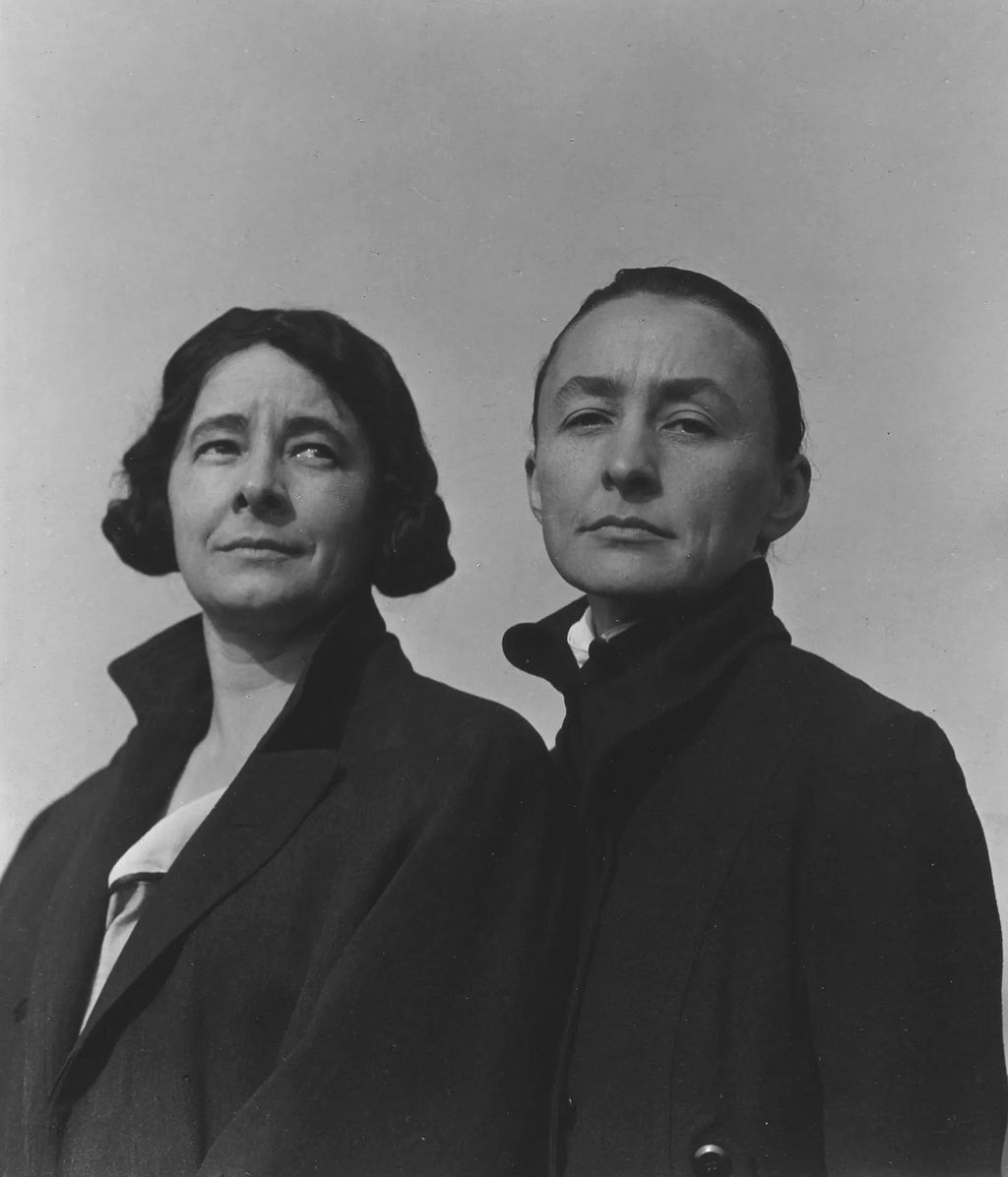
O’Keeffe occupied a studio apartment in New York and spent extended summers at the Stieglitz family estate at Lake George. The two settings produced different but connected work: abstractions, flowers, leaves, fruit, barns, hills and, increasingly, the architecture of Manhattan. Stieglitz exhibited and sold the work while constructing a public image around the artist. His photographs included clothed studies, close views of face and hands, and nudes. When he exhibited the portrait sequence in 1921, reviewers frequently connected O’Keeffe’s paintings to the photographed body.
The resulting sexualised criticism became one of the most persistent pressures on her reception.[20][25] O’Keeffe was not passive within the partnership. She made, selected and discussed works, followed exhibitions and sales, maintained other friendships and argued with interpretations. The daily or near-daily correspondence during periods of separation records affection, aesthetic exchange, practical negotiation and conflict. Stieglitz’s divorce became final in 1924, and he and O’Keeffe married that December.
Marriage formalised a relationship already central to their work, but it did not create a conventional shared household. Their lives continued to include studios, separations, summer travel and correspondence. The marriage is often narrated through either romance or domination. The archive supports neither simple account. O’Keeffe and Stieglitz exchanged aesthetic judgements, descriptions of weather and work, financial information, affection, anger and accounts of health.
When separated, writing was part of the relationship’s daily structure.[11][13] Their ages, reputations and positions were unequal. Stieglitz was twenty-three years older and controlled the galleries through which O’Keeffe initially reached collectors. He also made and exhibited nude photographs that shaped how critics perceived her. At the same time, O’Keeffe developed considerable commercial standing, travelled independently and increasingly established working seasons apart from him.
Distance became structural after 1929. Stieglitz remained tied to New York and Lake George while O’Keeffe repeatedly chose New Mexico. Letters did not merely compensate for separation; they allowed the pair to sustain different geographies. The biography therefore cannot be divided into a Stieglitz period followed by independence. Dependence and autonomy coexisted and changed over three decades.
1924–28: flowers, towers and success
By the middle of the 1920s, O’Keeffe was recognised as a leading American modernist. She produced the close flower paintings that became commercially and critically prominent while also painting New York architecture and Lake George subjects. Her annual exhibitions at the Anderson Galleries and the Intimate Gallery created a regular public cycle.[1][3] The market could be theatrical. In 1928 Stieglitz announced a $25,000 sale of six calla-lily paintings to Mitchell Kennerley, though the buyer’s financial problems prevented completion.[1]
The episode shows how reported price and realised transaction can differ. It also indicates the publicity surrounding O’Keeffe’s position. Exhibitions also gave works public identities. Stieglitz’s galleries moved from 291 to the Anderson Galleries, the Intimate Gallery and An American Place. Titles, sequences and critical essays framed new production each year.
The system offered continuity rare for an American artist, but it concentrated interpretation and commerce in one circle. O’Keeffe followed that machinery. Later business files and the Abiquiú Notebooks recorded owners, dimensions, exhibition appearances and reference photographs.[23] Her management of such information challenges the image of an artist indifferent to practical affairs. She and Stieglitz took rooms high in the Shelton Hotel in 1928.
Commercial-gallery visibility was joined by museum recognition before the famous retrospectives. The Brooklyn Museum held O’Keeffe’s first museum exhibition in 1927 and subsequently acquired works from that presentation.[30] This date complicates a chronology centred only on Stieglitz’s rooms and the landmark surveys of 1943 and 1946. A museum setting placed her paintings before a different public and began the institutional collecting history while she was still negotiating flower imagery, New York architecture and the critical persona attached to both.
The view supported paintings of illuminated buildings and narrow urban space. These works countered critics who wanted to confine her to flowers or feminine nature. Stieglitz’s health was already unstable. O’Keeffe nursed him after a severe angina attack in 1928. Care, work and the strain of their relationship belong beside accounts of artistic success.
1929: the first New Mexico journey
In April 1929 O’Keeffe travelled west with the artist Rebecca Strand. They stayed initially in Taos as guests of Mabel Dodge Luhan, who provided studio space. O’Keeffe then explored a wider region, meeting writers, artists and residents and working from adobe buildings, crosses, hills and desert formations.[1][11] The journey did not mark an immediate permanent escape. She returned to New York and continued spending time at Lake George.
New Mexico became one part of a divided geography that she revisited almost annually. Telegrams and letters kept Stieglitz informed as O’Keeffe travelled. The correspondence records enthusiasm for new terrain alongside continuing attachment to the marriage.[12] It also shows that New Mexico was a network of friendships and practical arrangements, not only an encounter between one artist and an empty landscape.
1930–34: breakdown and recovery
The early 1930s brought continued exhibitions and important New Mexico paintings, but also severe personal strain. O’Keeffe stopped painting for more than a year and was hospitalised in 1933 following what contemporary records describe as a nervous breakdown. The term belongs to the period and should not be converted into a modern diagnosis without medical evidence.[12][23] Several pressures converged: work, the marriage, Stieglitz’s relationship with Dorothy Norman and the failure of a mural commission for Radio City Music Hall.
Correspondence to the filmmaker Henwar Rodakiewicz documents doubts, depression, vulnerability and illness more directly than polished later biographies.[11] Recovery involved time away, friends and renewed work. O’Keeffe travelled to Bermuda and returned gradually to painting. The episode matters because the myth of relentless independence can make illness look like an embarrassing exception. It was part of a life in which self-direction coexisted with dependence, exhaustion and care.
1935–40: bones, Hawai‘i and Ghost Ranch
By the middle of the decade, O’Keeffe was again working steadily. She combined bones, flowers and distant landscape, testing scale and spatial discontinuity. The pictures did not simply record objects where she found them; collected forms were brought to the studio and rearranged. In 1939 the Hawaiian Pineapple Company commissioned her to produce images for advertising. She travelled to Hawaii, drawing and painting landscapes and plants.
The commission is sometimes reduced to the story that a pineapple was delivered only after she returned to New York. Her Hawaiian work was broader than a single commercial subject and extended her practice beyond the mainland.[11] O’Keeffe purchased a house at Ghost Ranch in 1940. The property gave her a summer base near cliffs and views towards Cerro Pedernal. It was not suitable for comfortable year-round residence, and she continued to move between New Mexico and New York.[16]
1941–45: war, retrospective and Abiquiú
During the early 1940s, O’Keeffe’s letters and friendships connected New Mexico work with wartime uncertainty and Stieglitz’s failing health. Maria Chabot lived with her at Ghost Ranch for several years and later supervised restoration of the Abiquiú house. The Maria Chabot Archive preserves correspondence, photographs and film that document this shared history and the labour behind the properties.[18] In January 1943 the Art Institute of Chicago opened O’Keeffe’s first major museum retrospective, Georgia O’Keeffe: Paintings 1915–1941. It was also the museum’s first solo exhibition for a woman.[9][10]
The retrospective placed decades of work into an institutional narrative while the artist was still producing major new pictures. O’Keeffe acquired the ruined Abiquiú compound from the Catholic Church in 1945. The site had a history reaching through the Pueblo of Santo Tomás Apóstol de Abiquiú land grant, partition and local family ownership.[17] For four years she oversaw restoration, with Chabot managing work on the ground. The house offered water, garden space and winter shelter that Ghost Ranch lacked.
1946–49: bereavement, estate and permanent move
Stieglitz suffered a fatal stroke in July 1946. O’Keeffe returned to New York and kept vigil with friends including Rodakiewicz. His death ended a relationship of roughly three decades but created enormous administrative work. As executor, she had to organise photographs, papers and an art collection accumulated across Stieglitz’s career.[12] MoMA opened its O’Keeffe retrospective in May 1946, shortly before his death.
It was the museum’s first retrospective devoted to a woman artist, and O’Keeffe was closely involved in preparation.[8] The coincidence of retrospective recognition and bereavement makes 1946 a turning point without making it a clean break. O’Keeffe distributed the Stieglitz collection among museums and archives. Yale received the main archive in a context where the Beinecke’s American literature holdings could connect it with papers of modernist contemporaries.[14]
The Art Institute of Chicago received a group that ultimately approached four hundred works, including 244 photographs.[20] In 1949 O’Keeffe also gave 101 works to Fisk University and travelled there to oversee installation.[19] She moved permanently to New Mexico in June 1949, typically spending winter and spring at Abiquiú and summer and autumn at Ghost Ranch.[1] Permanent residence therefore still involved movement between two distinct houses.
1950–69: travel, houses and aerial space
The 1950s and 1960s were not a quiet retirement. O’Keeffe travelled internationally, visiting countries in Asia, Latin America and the Middle East. Itineraries, maps and travel boxes survive among her papers.[15][23] Flight itself became a source of form: rivers and roads seen from aircraft turned into long bands across drawings and paintings. Her commercial structure also changed after Stieglitz.
Edith Halpert of the Downtown Gallery became her exclusive agent in 1950, and Doris Bry assumed that role in 1963.[1][4] The succession matters because it separates O’Keeffe’s mature market from the familiar story of discovery at 291. She continued to help organise and install exhibitions, rather than withdrawing from the practical work of a career.
Travel widened an already extensive social world. O’Keeffe maintained relationships with photographers, writers, curators, neighbours and former students. Ansel Adams belonged to the New Mexico network; curators such as Daniel Catton Rich helped connect work and collections to museums. Friends assisted with transport, property, exhibitions and health.
Solitude was a valued working condition, not social isolation. She continued refining her two houses. At Abiquiú, modern windows, spare interiors, garden and courtyard were integrated with the older adobe compound. The famous patio door became a repeated subject. At Ghost Ranch, direct views towards cliffs and Pedernal structured daily looking.[16]
She also became a photographer rather than remaining only the camera’s subject. Research for the 2021 MFA Houston exhibition identified more than four hundred images attributable to O’Keeffe, many made from the mid-1950s onward.[31] She recomposed the same view by changing angle, orientation, light or season, photographing such subjects as a Hawaiian stone arch, the Chama River, a kiva ladder, jimsonweed and her dogs. The practice belongs to the biography of later work because it records a fresh medium pursued after she had already achieved international standing as a painter.
Household, work and constructed simplicity
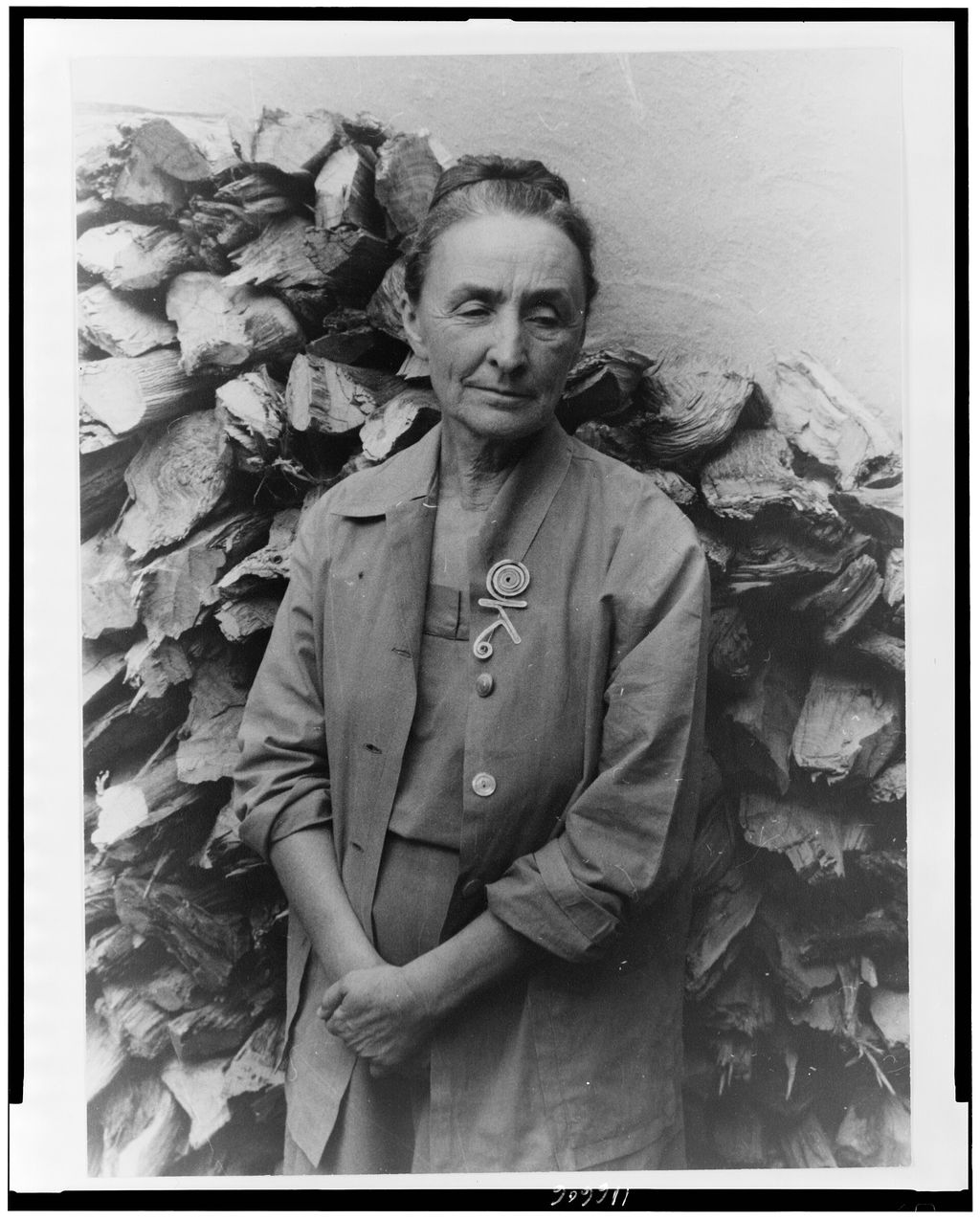
Photographs of O’Keeffe in black or white clothes and spare adobe rooms helped create an image of austere self-sufficiency. The houses were carefully designed, but they were not effortless extensions of personality. Restoration, food production, cleaning, transport and studio work depended on other people. Maria Chabot managed the reconstruction at Abiquiú; local families worked in the houses and garden; assistants and friends supported travel and late practice.[18] The archive records ordinary systems behind the visual legend.
Property files contain repairs, appliances and plans. Recipe files and garden records document food as daily labour and social exchange. Travel boxes preserve tickets, maps and ephemera. Business papers retain receipts, painting lists and correspondence with dealers.[15][23] These materials matter because they return time, expense and collaboration to interiors often photographed as perfect still lives.
O’Keeffe also used clothing and photography deliberately. Severe tailoring, wrapped dresses and restrained colour distinguished her public presence from both bohemian costume and conventional feminine display. Stieglitz’s portraits initiated that visibility, but later photographers and O’Keeffe’s own choices sustained it. The Brooklyn Museum’s display of wardrobe, paintings and portraits confirmed how consistently she managed that public identity across New York and New Mexico.[30] The famous persona was therefore imposed in part and fashioned in part. Domestic order supported work.
Stones, shells and bones were stored, handled and recombined; windows framed selected views; gardens supplied plants and food. The boundary between studio, home and subject was porous without making every possession a symbol. Cloud paintings developed the aerial viewpoint at increasing scale. In 1965 O’Keeffe completed Sky Above Clouds IV, her largest work, in a garage at Ghost Ranch.[4] Its repeated white forms convert a view from flight into a field that is observed, abstract and architectural in size.
MoMA’s collection history shows that the late aerial subjects continued the same movement between observation and abstraction found in the 1915 charcoals.[21] The biographical distance between a young teacher looking across Texas and an older traveller looking down from an aircraft is large; the practice of converting spatial experience into sequences provides continuity. Museum exhibitions continued. Her first major retrospective had been Chicago in 1943, followed by MoMA in 1946. These and later surveys gradually shifted O’Keeffe from current modernist to historical figure, though she resisted being treated as finished.
That resistance is supported by recent scholarship rather than reputation alone. Randall C. Griffin’s 2025 study uses previously neglected paintings, photographs, letters and possessions to place O’Keeffe’s work from the end of the Second World War into the early 1980s within postwar American culture.[33] The patio walls and doors, aerial rivers, Arizona canyons, cloud fields and Washington Monument pictures become sustained series engaging modernism and questions of ecology, spirituality, race, class, gender and Indigeneity. The biography consequently requires several productive late decades, not a long epilogue after New Mexico fame.
1970–78: retrospective, sight and assistance
The Whitney Museum mounted a major retrospective in 1970. It introduced O’Keeffe’s work to audiences shaped by the women’s movement, new abstraction and revisionist histories of American modernism. Her status as an independent woman artist became increasingly important even though she resisted readings that made gender the essence of her pictures.[25] Early in 1971 she lost central vision to macular degeneration. Institutional chronology records 1972 as the year of her last unassisted oil painting.
She continued working in oil with assistance until 1977, in watercolour and charcoal without assistance until 1978, and in graphite until 1984.[4] These distinctions replace the inaccurate story that blindness ended work at once. O’Keeffe met the potter Juan Hamilton in 1973. He became an assistant, travelling companion and close friend, helping with practical work, publication and later projects. The relationship attracted scrutiny because of their age difference and his eventual place in her estate.
A responsible biography states documented roles and avoids converting dependence into either scandal or sainthood. Hamilton also introduced O’Keeffe to clay. Pottery gave her a tactile, three-dimensional process as central vision failed, extending late practice beyond the better-known assisted paintings and drawings. The Spanish-language artist record of the Museo Nacional Thyssen-Bornemisza treats this experimentation as part of her final creative period, rather than as a footnote to disability.[26]
Attribution and assistance still need to be established object by object: the existence of collaboration does not make every late work either wholly unaided or merely delegated. Her illustrated book Georgia O’Keeffe appeared in 1976. Like any autobiography, it is both evidence and self-presentation. O’Keeffe selected works and shaped a retrospective voice rather than simply recording an unmediated life.
1977–86: honours and final years
President Gerald Ford awarded O’Keeffe the Presidential Medal of Freedom in 1977. In 1985 she received the National Medal of Arts.[3] These honours capped a longer institutional record: the Women’s National Press Club gave her its achievement award for art in 1946, she became a Fellow of the American Academy of Arts and Sciences in 1966, and Wisconsin presented its Governor’s Award for Creativity in the Arts that year.[28] The sequence registers changing kinds of recognition, from women journalists and a learned academy to state and federal honours.
Declining sight changed the means of work, while assistants supported drawing and other creative activity. She returned to known forms from memory and remained involved in publications and the care of her work. Archival restrictions on some medical records until 2059 are a reminder that not every late-life question can or should be answered from public evidence.[23] O’Keeffe lived at Abiquiú until March 1984, when she moved with Hamilton and his family to Sol y Sombra in Santa Fe to be nearer medical facilities. Her sister Anita Young died in 1985.
O’Keeffe died at St Vincent’s Hospital on 6 March 1986, aged ninety-eight.[4] Her ashes were scattered at Cerro Pedernal according to her wishes. Her death did not freeze a settled reputation. The National Gallery’s centennial exhibition opened in 1987 and brought together seventy-five paintings and forty-five works on paper before travelling to Chicago, Dallas and New York.[24] It joined art with selected letters, reinforcing the importance of O’Keeffe’s own language while also contributing to the posthumous construction of an authoritative voice.
The Georgia O’Keeffe Foundation, established in 1989, distributed works and property and supported research before dissolving in 2006. The Georgia O’Keeffe Museum had opened in Santa Fe in 1997 and later assumed responsibility for the houses and major archival material.[2][22] These institutions made the life unusually visible, but their records continue to grow and to revise earlier accounts. International reception also remained unfinished. A jointly organised 2021–22 survey travelled from Madrid to Paris and Basel.
The Thyssen-Bornemisza called its Madrid presentation Spain’s first O’Keeffe retrospective, while the Centre Pompidou described the Paris stage as the first in France and assembled about one hundred paintings, drawings and photographs.[27][29] Those dates qualify any assumption that O’Keeffe’s canonical standing in the United States produced an equally early or complete European exhibition history. The French interpretation also placed her successively within American modernism, the cultural search of the 1930s and the hard-edge abstraction of the 1960s, demonstrating how a biography changes when viewed through a different national historiography.[29]
Archives and revised biography
The biographical record is dispersed. The Georgia O’Keeffe Papers comprise forty-two linear feet of notebooks, business files, correspondence, property material, travel records, writings, photographs and clippings.[23] The museum’s 232 letters to Stieglitz from 1933–44 form only a fraction of the more than 5,000 letters the couple exchanged.[13] The Library of Congress holds 157 items, comprising 618 images, from O’Keeffe and Stieglitz to Rodakiewicz. The letters cover 1929–47 and were scientifically authenticated before acquisition.[11]
Yale holds the principal Stieglitz–O’Keeffe archive and has added manuscripts on painting, eyesight, travel, domestic life and other subjects.[14][15] Access O’Keeffe connects such records with the 2,029 works published in the 1999 catalogue raisonné and with updated information from institutional owners.[22] Titles, dates, provenance and exhibition histories can therefore be revised as evidence emerges. Different archives preserve different relationships. Letters to Stieglitz register the marriage from within; letters to Rodakiewicz address a trusted friend and describe doubts, commissions, travel and illness in another voice.
Business files document transactions that intimate letters may ignore. Oral histories preserve memories of employees and neighbours but require attention to the date of recollection. Copyright and privacy also shape what can be known. O’Keeffe’s unpublished writings remain protected, and some medical files are restricted. The existence of a folder does not make all of its contents publicly quotable.
A responsible biography uses finding aids to map evidence, quotes sparingly and distinguishes open records from inference. This structure changes the biography. O’Keeffe is not only the subject of photographs and recollections. She appears as a teacher, correspondent, employer, traveller, property owner, executor, donor, record keeper and author. Each role adds context without explaining the paintings away.
A life across several places
No single location contains O’Keeffe. Wisconsin belongs to family and childhood; Chicago and New York to formal education; Virginia, South Carolina and Texas to teaching and experiment; Lake George to sustained seasonal work; Manhattan to galleries and architecture; New Mexico to friendships, property, landscape and permanent residence. Movement among these places was not a search that ended when she found the desert. It was a working pattern. Even after settling in New Mexico, O’Keeffe travelled widely and transformed aerial experience into new images.
Nor can a life centred in northern New Mexico be told only through O’Keeffe’s sense of belonging. The Museum’s 2025–26 Tewa Nangeh/Tewa Country project sets her art and belongings beside contributions by contemporary makers, scholars and knowledge holders from the region’s six Tewa Pueblos.[32] Their continuing presence exposes what the familiar phrase “O’Keeffe Country” leaves out. Biography must therefore hold her attachment to the region beside Tewa histories, sovereignty and creativity rather than turning personal possession into historical fact.
Her biography is therefore best understood through repeated acts of selection. She chose what to study, which works to exhibit, when to leave, what properties to rebuild, how to divide the Stieglitz estate and how to narrate her past. Constraints of money, health, gender, marriage and disability remained real. The achievement was not freedom from circumstance, but an unusually sustained capacity to make form and a public life within it.
Discussion
Which piece of evidence most changes the way you read Georgia O’Keeffe Biography?
Reader Insights
Which visible detail most changes your reading of Georgia O’Keeffe Biography?
How do medium, setting and documented history shape the encounter?
What remains uncertain when documented fact is separated from interpretation?
Join the Conversation
Share your reading of Georgia O’Keeffe Biography below.
References
- Access O’Keeffe, “Artist’s Chronology”, View Source
- Georgia O’Keeffe Museum, “About Georgia O’Keeffe”, View Source
- National Gallery of Art, “Georgia O’Keeffe”, View Source
- Georgia O’Keeffe Museum, “Timeline”, View Source
- West Texas A&M University, “Resources on Georgia O’Keeffe in Texas”, View Source
- West Texas A&M University, “O’Keeffe’s Wartime Texas Letters”, View Source
- University of Virginia, “The Virginia Years: The Untold Story of Georgia O’Keeffe’s Time at UVA”, View Source
- Museum of Modern Art, “Georgia O’Keeffe”, 1946, View Source
- Art Institute of Chicago, “Case 7: Georgia O’Keeffe”, View Source
- Art Institute of Chicago, “Window on the West: The Path toward Abstraction”, View Source
- Library of Congress, “About the Georgia O’Keeffe and Alfred Stieglitz Correspondence”, View Source
- Library of Congress, “Curator’s Note on the Context of the Correspondence”, View Source
- Georgia O’Keeffe Museum Archives, “Letters to Alfred Stieglitz, 1933–1944”, View Source
- Beinecke Rare Book and Manuscript Library, “The Stieglitz Archive at Yale University”, View Source
- Beinecke Rare Book and Manuscript Library, Revisiting the Past—Imagining the Future, View Source
- Georgia O’Keeffe Museum, “Georgia O’Keeffe’s Homes”, View Source
- Georgia O’Keeffe Museum Archives, “Historic Properties Department: Larsen Abiquiú Research”, View Source
- Georgia O’Keeffe Museum Archives, “Maria Chabot Archive”, View Source
- Georgia O’Keeffe Museum, “The Stieglitz Collection at Fisk University”, View Source
- Art Institute of Chicago, “The Alfred Stieglitz Collection and the Art Institute of Chicago”, View Source
- Museum of Modern Art, “Georgia O’Keeffe”, View Source
- Georgia O’Keeffe Museum, “Access O’Keeffe Project Documentation”, View Source
- Access O’Keeffe, “Georgia O’Keeffe Papers, 1914–1991”, View Source
- National Gallery of Art, “Georgia O’Keeffe 1887–1986”, View Source
- Smithsonian American Art Museum, “Georgia O’Keeffe”, View Source
- Museo Nacional Thyssen-Bornemisza, “O’Keeffe, Georgia”, View Source
- Museo Nacional Thyssen-Bornemisza, “Georgia O’Keeffe”, 2021 exhibition, View Source
- Georgia O’Keeffe Museum Archives, “Awards”, View Source
- Centre Pompidou, “Georgia O’Keeffe”, 2021 exhibition, View Source
- Brooklyn Museum, “Georgia O’Keeffe: Living Modern”, 2017, View Source
- Museum of Fine Arts, Houston, “A trove of Georgia O’Keeffe’s photographs on view for the first time”, 21 July 2021, View Source
- Georgia O’Keeffe Museum, “Tewa Nangeh/Tewa Country”, 7 November 2025–1 November 2026, View Source
- Randall C. Griffin, Georgia O’Keeffe: The Late Work, Yale University Press, 2025, View Source