


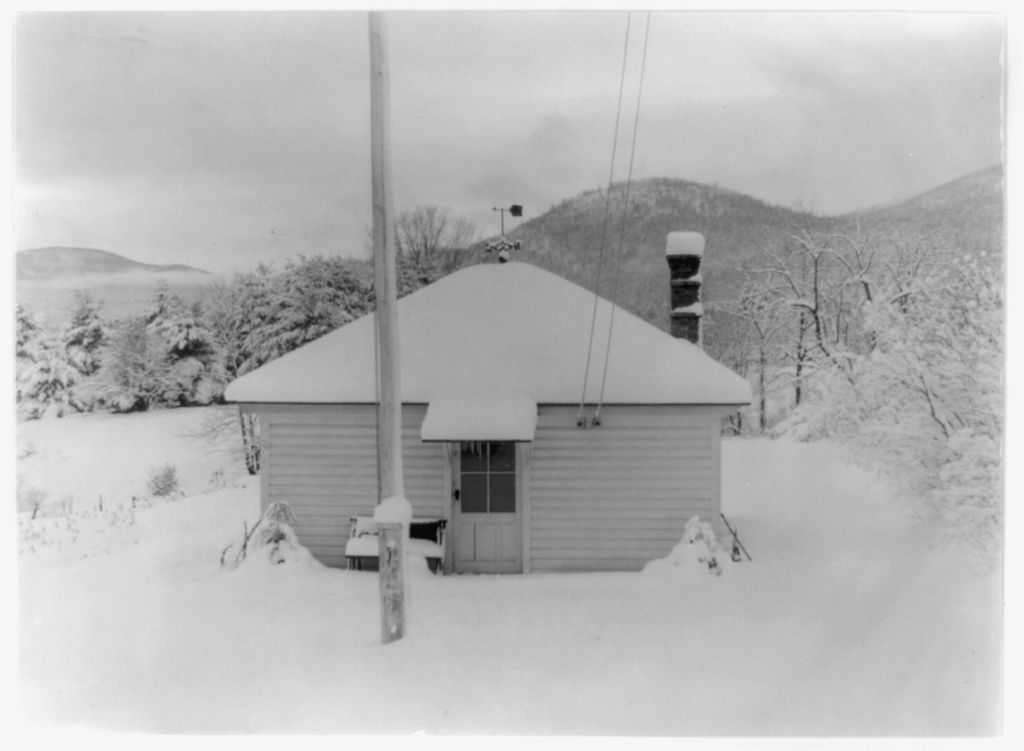
 by Tom Gurney
Tom Gurney BSc (Hons) is an art history expert with over 20 years experience
Page Created on September 22, 2026 / Page Updated on September 22, 2026
Email: tomgurney1@gmail.com / Phone: +44 7429 011000
Introduction
Georgia O’Keeffe spent part of most years from 1918 to the mid-1930s at the Stieglitz family estate on Lake George in New York’s Adirondacks. These were not idle intervals between the more famous New York and New Mexico chapters. She made more than two hundred paintings and works on paper there, including landscapes, trees, leaves, fruit, vegetables, barns and abstractions. Lake George coincided with her emergence as a professional artist, her annual exhibitions under Alfred Stieglitz’s direction and the development of methods she carried elsewhere.[1][2][3]
The place has often been narrated as a restrictive family retreat from which O’Keeffe wanted to escape. The 2013–14 exhibition Modern Nature: Georgia O’Keeffe and Lake George, organised by the Hyde Collection with the Georgia O’Keeffe Museum, challenged that reduction. It reunited fifty-five works and treated the estate as a productive system of gardens, orchard, pasture, woods, buildings, lake views and studio labour.[2][3][4] Reconsidering Lake George changes the shape of O’Keeffe’s career: New Mexico did not replace an artistic void but followed a sustained eastern practice.
At a Glance
- ArtistGeorgia O’Keeffe
- SubjectGeorgia O’Keeffe at Lake George
- Artistic contextAmerican modernism
Contents
- Lake George, work and land history
- Genres, seasons and serial return
- Autumn leaves and split supports
- Lake George Autumn and Apple Family
- Abstraction, barns and date ranges
- Technical evidence in Yellow Hickory Leaves
- Canadian Barn and Early Moonrise
- Oak leaves and later mountains
- White Canadian Barn and unstable titles
- My Shanty and self-fashioning
- Starlight and recovered storms
- Cultivated nature and barns
- Photography and influence
- Gender, household and agency
- Exhibitions and recovered importance
- Trees and technical construction
- From the Lake
- Lake George within the career
Lake George, work and land history
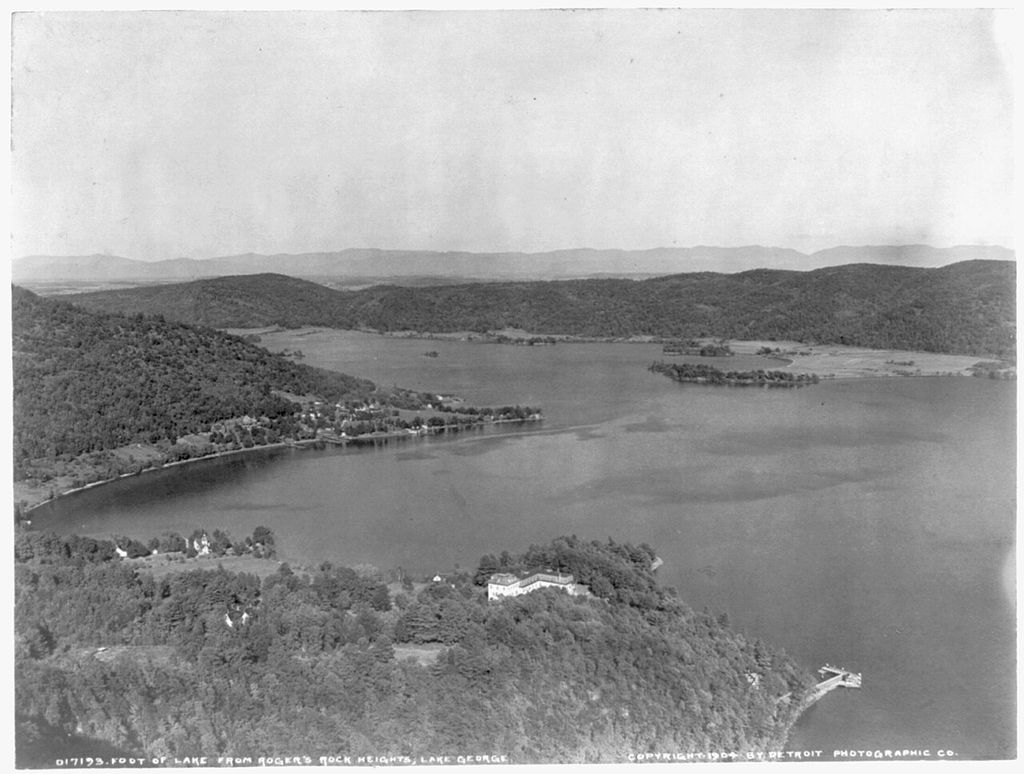
The thirty-six-acre property stood north of Lake George village on the western shore of the lake’s southern basin. O’Keeffe arrived there in 1918, the year she moved to New York, and usually worked through summer and autumn before taking canvases back to the city for finishing and spring exhibition.[3] Place and production were therefore connected to a calendar: growth, harvest, changing foliage, shifting weather, transport, studio revision and gallery display.
The estate was also a family environment. O’Keeffe lived among Stieglitz relatives and visitors rather than in uninterrupted solitude. She converted a small weathered building beyond the farmhouse into the “shanty”, a studio that let her work apart from the main household.[24] The desire for privacy was real, but it coexisted with dependence on a maintained farm, domestic routines and the social and commercial network centred on Stieglitz.
Lake George was neither wilderness newly encountered by artists nor simply a fashionable resort. National Park Service research places the Adirondacks within overlapping Mohawk, Oneida, Mahican and Abenaki histories. The region could function as shared hunting country, described by Haudenosaunee historian Rick Hill through the “Dish with One Spoon” principle, and its woods, waterways and seasonal resources supported travel, hunting, fishing and maple-sugar making.[5]
European names record successive colonial claims. The lake had Indigenous names before the French Lac du Saint-Sacrement and the British “Lake George”, bestowed in honour of George II in 1755.[6] O’Keeffe’s paintings do not illustrate this history, but an account of her “modern nature” should not imply an uninhabited landscape. Empty views are compositional selections made within already named and contested country.
Genres, seasons and serial return
Lake George gave O’Keeffe an unusually dense range of nearby subjects. Modern Nature counted at least twenty-five tree compositions and about twenty-nine leaf canvases, alongside fruit, flowers, vegetables, barns, lake views and colour-filled abstractions.[2] The number matters because it defeats a postcard image of one mountain-and-water motif repeated without change. Movement among scales was central. She could look across a lake, isolate the end wall of a barn, arrange ten apples on cloth or enlarge two leaves until they exceeded the canvas.
These are connected acts of framing. The difference between landscape, still life and abstraction often lies less in subject than in distance, crop and the size assigned to a form. The estate’s annual cycle made repetition informative. Leaves changed colour and condition; orchard fruit ripened; bare trees reorganised familiar space; water reflected different skies. O’Keeffe did not need to seek a wholly new motif each year.
She could test what recurrence did to memory and attention. Serial titles require care. Similar works may differ in date, collection and physical scale, while one title may have accumulated through inscriptions, Stieglitz labels, gallery ledgers and later cataloguing. The Access O’Keeffe catalogue raisonné provides the controlling object framework, but current owner research can add technical and provenance evidence.[1] A thematic account must retain those distinctions rather than turning a series into one composite image.
Autumn leaves and split supports
Autumn Leaves (1924; CR 464) is a 20¼-by-16⅜-inch oil on canvas in the Columbus Museum of Art.[7] Large brown, red and pale leaves occupy the upright field. The alternate title Autumn Leaves – Lake George, N.Y. securely locates it, and an An American Place label carries the place, date and medium. Its material history is exceptional. Anthurium (1923; CR 422) was painted on the reverse and did not exist as a separate object until conservator Julius Lowy divided the two sides in 1979.[7][8]
What now appear as two canvases once shared one support. That fact complicates any linear account of O’Keeffe moving neatly from tropical flower to autumn foliage; economy, reuse and later conservation physically altered the catalogue. The leaf surface has also been varnished, although O’Keeffe often valued matte paint. Reproduction can therefore misstate both texture and colour. The work’s identity lies in its object history as well as in its enlarged motif.
Lake George Autumn and Apple Family
The title Lake George Autumn is attached to distinct works. CR 392, dated 1922, is a 15-by-27-inch oil in a private collection. Orange, yellow and red trees form a narrow foreground beneath dark blue mountains and pale sky.[9] A backing first carried 1927 before that year was crossed out; inclusion in the 1923 Anderson Galleries exhibition supports 1922. CR 607, dated 1927, is a broader 17-by-32-inch oil in the Milwaukee Art Museum.[10]
It has its own Stieglitz label, exhibition history and provenance through the artist’s estate and foundation. A further 1922 canvas, Appendix II 32, measures 16 by 27 inches and has an uncertain present location; it appeared in Modern Nature and was sold at Christie’s in 2024.[11] The legacy heading cannot responsibly be assigned to one without matching its image or dimensions. The shared title records continued attention to autumn colour, while the catalogue numbers preserve three separate objects. Date conflicts in inscriptions are evidence of record-making, not permission to blend their biographies.
Apple Family – 2 (1920; CR 315), often called Apple Family II, is an 8⅛-by-10⅛-inch oil on canvas in the Georgia O’Keeffe Museum.[12] Ten apples of different sizes and colours crowd a white cloth. The tiny support makes their closeness striking: enlargement here is relative to a small picture rather than achieved through a mural-sized canvas. A backing inscription appears to date the work 1920, whereas Whitney, Downtown Gallery and Abiquiú records placed similar apples around 1921. The catalogue retains 1920 with the uncertainty visible.[12]
The painting was shown in Stieglitz’s 1923 presentation of one hundred O’Keeffe works. Fruit gathered on the property thus entered the same professional exhibition machinery as ambitious abstractions. Still-life language should not detach the apples from cultivation. Orchard, picking, storage, household use and artistic arrangement precede the finished composition. The work is an image of selected produce and of the estate’s managed nature.
Abstraction, barns and date ranges
Lake George, Coat and Red (1919; CR 289) is a 27⅜-by-23¼-inch oil on canvas at the Museum of Modern Art, given by the Georgia O’Keeffe Foundation.[13] A twisting black form curls around a small pale blue-white circle; red semicircles and a field shifting through green, yellow and red resist straightforward topographical reading. The catalogue records “No signature. Abstraction”, yet the title was written by O’Keeffe on the backing and survives in archival sources.[13]
“Lake George” does not turn every form into a literal hill or shore. It anchors a work whose coat, colour and place remain associatively rather than illustratively related. This is evidence against dividing the Lake George production into descriptive nature on one side and placeless abstraction on the other. Its provenance remained with O’Keeffe until her death, then passed through her estate and foundation to MoMA in 1994.
The late institutional gift contrasts with works sold or acquired during the 1920s and shows how O’Keeffe’s own holdings shaped the public record. Ends of Barns (1922–24; CR 404) is a 16-by-22-inch oil in the Museum of Fine Arts, Boston.[14] Two reddish-purple barns set at right angles meet near the centre; black roofs, yellow ground and pale sky convert farm buildings into interlocking planes without making them unrecognisable. The date range comes from conflicting physical inscriptions.
The stretcher says “Oct 30 – 1922”, while the backing reads “Ends of Barns – 24?”; the catalogue therefore uses 1922–24, and the MFA favours 1922.[14] This is an evidential interval, not imprecision to be silently corrected. The support records stages of preparation and later naming. The work stayed outside the most familiar early exhibitions and was sold by the Downtown Gallery to William H. Lane in 1957, entering the MFA through partial gift and purchase in 1990. Its museum history exemplifies the delayed institutional circulation of some Lake George subjects.
Technical evidence in Yellow Hickory Leaves
Yellow Hickory Leaves with Daisy (1928; CR 642) is a large 29⅞-by-39⅞-inch oil in the Art Institute of Chicago, given by O’Keeffe through the Alfred Stieglitz Collection in 1965.[15] Yellow leaves radiate from a central point while a small white daisy sits below them. The asymmetry between dominant foliage and diminutive flower makes scale relational rather than botanically literal. Current conservation research provides unusually rich material evidence.
The pre-primed linen has a double white preparation; analysis identified titanium dioxide below and a more medium-rich, calcium-sulphate layer above. Infrared examination reveals underdrawing, probably involving graphite with black chalk or charcoal, and imaging supports cadmium yellow for the main leaves.[15] The thin, matte paint was left unvarnished. That intended surface is also fragile. Poor adhesion between ground layers has produced cupping, cracking, cleavage and losses, prompting repeated consolidation from 1983 through 2019 and further examination in 2025.[15]
The technical record dismantles the idea that bold colour equals materially simple execution. It also explains why conservation state must qualify comparisons among reproductions. The verso bears O’Keeffe’s name and the date 10 October 1928 in yellow paint. Exhibition labels document the title across the 1929 Intimate Gallery show and later Art Institute presentations. Object, archive and scientific examination converge more securely here than they do for many Lake George works.
Canadian Barn and Early Moonrise
Canadian Barn (1932; CR 810) is a 9-by-12-inch oil in a private collection.[16] A white barn with black roof and open black door occupies a strip of green beneath blue sky. The backing inscription “Canadian Barn – 32” and archival records secure its title and year; a 1948 conservation label records application of a butyl methacrylate polymer.[16] This painting belongs chronologically to the Lake George years but geographically to O’Keeffe’s 1932 journey to the Gaspé Peninsula in Québec.
The distinction is crucial. A thematic page may use it to show how barn forms travelled across her practice, but should not call it a building on the Stieglitz estate. The legacy migration grouped period and place more loosely than the catalogue permits. Its compact format also differs from the panoramic Canadian barns. The cropped corner, open door and strong tonal blocks turn one end of a utilitarian structure into a concentrated spatial problem.
Lake George Early Moonrise (1930; CR 723) is approximately 23½ by 35½ inches and belongs to the Neuberger Museum of Art.[17] Green hills and pale trees occupy the foreground; the lake reflects moonlight below blue-green mountains, with the moon visible in a narrow band of sky. The records preserve three useful differences. Spring was a Downtown Gallery title, while the owner calls the painting Lake George by Early Moonrise.
Gallery dates ranged from about 1925 to 1929, but O’Keeffe’s white-painted verso inscription supports 1930. The catalogue lists oil on canvas, while the Neuberger identifies oil and gouache on canvas.[17] These variants should be stated, because title, chronology and medium each affect interpretation. The painting passed through Alfred Stieglitz and dealer Albert Duveen before Roy and Marie Neuberger acquired it in 1953. Its inclusion in Modern Nature reconnected an institutional object to the site-specific group from which collection history had separated it.
Oak leaves and later mountains
Oak Leaves, Pink and Grey (1929; CR 677) is a 33⅛-by-18-inch oil at the Frederick R. Weisman Art Museum, University of Minnesota.[18][19] Two overlapping leaves extend beyond the narrow upright canvas. Pink, red and brown gradients in the upper leaf and pale veins in the darker lower leaf turn ageing foliage into a large, layered structure. The catalogue uses British “Grey”, while the owner page uses American “Gray”; both name the same object. It was shown in the 1930 An American Place exhibition and bought from Stieglitz’s gallery by the university in 1936.[18]
That early museum purchase gives the work a public history distinct from leaves retained by O’Keeffe or circulating privately. The owner interprets maturity, decay and renewal and relates the close view to photography.[19] Those are useful reception frameworks rather than demonstrated private intentions. Cropping certainly resembles a camera’s selective field, but O’Keeffe also learned compositional simplification through Arthur Wesley Dow. The painting’s scale and edges are firm evidence; fixed symbolic meaning remains interpretive.
Mountains and Lake (1961) is a 30-by-40-inch oil in the Georgia O’Keeffe Museum, accession 2006.5.365.[20] Green and blue mountain forms fill the canvas, with an egg-shaped lake at lower left. It was made almost three decades after O’Keeffe’s regular Lake George residence ended and belongs to the late work, not the Lake George years. The title alone cannot relocate it. The museum’s current reproduction record does not identify the lake as Lake George, and the legacy consolidation gives no primary evidence for doing so.[20]
It may remain on this page as a historiographic correction and a comparison: lake-and-mountain vocabulary persisted or returned, but chronological resemblance is not site identification. Treating it as a Lake George painting would turn a migration choice into art-historical fact. A Turkish scholarly discussion describes its elevated viewpoint and contrasts the green-blue terrain with New Mexico’s red hills.[21] That multilingual reception demonstrates the work’s broader landscape association, but it likewise does not establish Lake George as the subject.
White Canadian Barn and unstable titles
White Canadian Barn, No. 2 (1932; CR 807), a 12-by-30-inch oil in the Metropolitan Museum of Art, stretches a low white wall and dark pitched roof between two black doorways.[22] The narrow support intensifies the building’s lateral extension, while thin bands of grass and sky prevent the façade from becoming a wholly abstract rectangle. Again, “Canadian” refers to the Gaspé journey, not the Stieglitz property. Alternate titles include White Barn (Canadian) No. 2, White Barn, White Canadian Barn No. II and the Met’s White Canadian Barn II.[22]
Exhibition records contain further uncertainty over which numbered barn appeared in 1933. Rather than choosing the shortest familiar caption, the catalogue keeps the series problem visible. The work was placed on extended loan to the Met by 1949 and entered the collection in 1964 as O’Keeffe’s gift within the Alfred Stieglitz Collection.[22] Its exhibition history extends through Europe, the Soviet Union, Japan and Canada, helping transform a regional building study into an internationally circulating example of American modernism.
My Shanty and self-fashioning
My Shanty (1922; CR 367) is a 20½-by-27⅛-inch oil in the Phillips Collection.[23][24] A dark red, sun-scorched building stands between trees, with mountains and clouded sky beyond. O’Keeffe had the structure adapted as a work space in 1920 to gain distance from the farmhouse. Her later recollection frames its low-toned palette as a playful answer to people who claimed she could handle only clear, light colours—she wanted to show she could make the sombre kind of painting associated with male artists.[24]
The remark is both process evidence and retrospective self-fashioning. It identifies gendered criticism while giving the canvas an intentional polemical role. Duncan Phillips bought the work after its 1923 display, making it an early institutional acquisition. The title’s possessive “My” describes use and identification, even though the building stood within Stieglitz family property. Studio autonomy was created inside a shared estate.
Starlight and recovered storms
Lake George (1922; CR 394) reduces the scene to dark mountain, water and reflection on a 24-by-32-inch canvas now in the Georgia O’Keeffe Museum.[25] The mirrored form can be read as landscape or as an almost symmetrical abstract design. Archival dates varied, but O’Keeffe identified it as about 1922 and the Downtown Gallery record supports that year. Starlight Night, Lake George (1922; CR 393), a 16-by-24-inch oil in private hands, adds yellow stars and two lights across deep blue-green water.[26] A backing inscription establishes title and date.
The tiny lights imply habitation along the shore, an important counterpoint to descriptions of the image as untouched night. Together the paintings show that simplification does not eliminate place. Reflection fuses mountain and water; light punctures darkness; title and inscription keep location attached to a near-abstract arrangement. Storm Cloud, Lake George became a key case in the interpretation of O’Keeffe’s surfaces. Accumulated glossy varnish had darkened the painting enough for viewers to understand it as a nocturne.
Conservation removed later coatings and revealed an afternoon storm, as well as what researchers identify as O’Keeffe’s earliest known experiment with matte-textured paint.[27][28] The change is epistemic, not cosmetic. Mood, time of day and even the history of technique depended on treatment evidence. During exhibition the museum displayed part of the canvas conserved and part untreated, allowing viewers to see how material history mediates interpretation. Any general account of Lake George colour should therefore distinguish present surface from artist-applied paint.
Cultivated nature and barns
Apple paintings, pear still lifes, vegetables and magnified flowers came from a productive estate rather than an abstract abundance. The Fine Arts Museums of San Francisco notes that O’Keeffe found subjects in gardens and orchards and made a sequence of still lifes between 1920 and 1924.[29] Picking and arranging converted cultivated food into a studio object. The phrase “modern nature” is useful precisely because these works move between natural growth and human management.
Orchard trees are planted; vegetables are tended; barns store tools and produce; canvases travel back to Manhattan. O’Keeffe’s crop hides much of this infrastructure, but historical interpretation should restore it without pretending the pictures are agricultural documents. The legacy group combines barns painted at the family estate with Canadian subjects from 1932. Formal continuities explain the attraction: gable, roof, door and wall can be translated into compressed planes.
Geography still matters. Ends of Barns emerges from Lake George, while Canadian Barn and White Canadian Barn, No. 2 belong to the Gaspé Peninsula.[14][16][22] This comparison reveals travel rather than sameness. O’Keeffe carried a developed architectural eye from one rural place to another and changed format, crop and scale. Calling all three “Lake George barns” would erase the very mobility the series demonstrates.
Photography and influence
O’Keeffe worked within an intensely photographic circle. Stieglitz photographed her, the estate and its environment; Paul Strand and other photographers were part of the same network. Close cropping, enlarged botanical forms and high or compressed views invite comparison with the camera. Influence should not be reduced to one-directional borrowing.
The Lake George works and photographs developed through conversation, shared motifs and rival claims for modern vision. The catalogue’s installation photographs also serve a different function: they document how Stieglitz arranged O’Keeffe’s paintings for early audiences.[7][9][12][18] A photograph can be visual influence, object evidence or exhibition record, depending on context.
The photographic archive also corrects the estate’s rustic image. Stieglitz’s father had bought Oaklawn, a grand Queen Anne summer house, in the 1880s within a resort area frequented by wealthy New Yorkers.[37][40] After the family sold that lakeside villa in 1920, relatives shifted to the farmhouse on the hill. O’Keeffe’s shanty and farm subjects emerged within this change of domestic scale, but the wider history remained one of urban privilege, property and seasonal retreat. Simplicity was cultivated inside an established family estate.
Stieglitz made Lake George a working photographic site, bringing supplies from New York and printing in the kitchen, a small barn and outdoors.[37] His subjects included family, friends, servants, buildings, hills, clouds and ageing trees; MoMA’s survey describes this quotidian material as among his most personal and radical work.[38] The overlap with O’Keeffe’s trees, barns and weather is therefore environmental as well as formal. Both artists depended on the same maintained place, even though paint and photographic exposure organised time and surface differently.
O’Keeffe was also a photographer at Lake George. An archival double exposure, now attributed to her and dated about 1923, superimposes or pairs Stieglitz with a horizontal view of the house.[39] The museum revised its earlier unknown-photographer description after comparative research by Lisa Volpe. This small print does not prove that a particular canvas derives from a camera image. It does establish active photographic experimentation decades before O’Keeffe’s better-known 1950s photographs and makes “photographic influence” a question of practice, not merely proximity to Stieglitz.
Gender, household and agency
Lake George’s productivity did not make the household uncomplicated. O’Keeffe negotiated expectations within Stieglitz’s family, sought a separate studio and moved work between country and city. Her remark about painting My Shanty “like the men” records awareness that critics gendered palette and authority.[24]
Yet a simple captivity narrative also removes agency. More than two hundred works, sustained serial experiments and annual exhibition preparation show purposeful labour.[2] The stronger interpretation allows both conditions to stand: domestic and relational pressures shaped her summers, and she made the estate into a highly productive centre.
Exhibitions and recovered importance
Stieglitz’s 1923 exhibition of one hundred works gave Lake George still lifes, landscapes and abstractions a major public platform. Later dispersal made the site less visible as a coherent body: paintings entered Columbus, Boston, Chicago, Milwaukee, Minneapolis, New York and private collections.[7][10][14][15][18][22] Modern Nature reversed that fragmentation by bringing fifty-five works together at the Hyde Collection, Georgia O’Keeffe Museum and de Young Museum.[3] Its catalogue joined curatorial, university and museum scholarship, and attendance transformed the Hyde’s institutional history.[4]
The exhibition did not merely revive neglected pictures; it changed the career narrative by demonstrating that Lake George was prolific and experimental. The 2021–22 Madrid, Paris and Basel retrospective subsequently included Lake George leaves and landscapes within an international account of O’Keeffe. The Spanish checklist identifies Autumn Leaves – Lake George, N.Y. and Oak Leaves, Pink and Grey with bilingual titles and metric dimensions.[30] French and German venues placed them in a career stretching from early abstraction through New Mexico and late work.[31][32]
Trees and technical construction
O’Keeffe’s tree paintings range from recognisable trunks in landscape to forms that approach abstraction. Autumn Trees – The Maple (1924; CR 474), a 36-by-30-inch oil in the Georgia O’Keeffe Museum, centres a grey trunk and branching limbs within red, grey and green planes.[33] The title came through gallery, notebook, inscription and exhibition records, yet the catalogue warns that the Abiquiú notebooks confused this surviving canvas with another Autumn Trees – The Maple that O’Keeffe destroyed.
Even a well-documented title can cover both a present object and an absent one. Technical examination makes the surviving canvas unusually concrete. Graphite underdrawing appears at boundaries; stiff paint forms raised ridges, brighter passages use multiple layers, and wiping, thinning and dry brushing create translucent values. Analysis identified zinc white, cadmium orange, red ochre, possible alizarin, ultramarine, chrome-bearing green and bone black in different regions.[33] Small areas of exposed priming are consequences of brushwork rather than paint loss.
The image’s apparent organic flow was built through distinct materials and subtractive handling. Grey Tree, Lake George (1925; CR 512), also 36 by 30 inches, belongs to the Metropolitan Museum of Art.[34][35] Its pale branching form interlocks with grey, green and brown surroundings until tree and atmosphere become difficult to separate. Historical labels called it Gray Tree, Maple Tree, The Maple and even carried unrelated birch wording.
The current title is a catalogue resolution across inconsistent records, not an uncontested name present from the first moment. The tree pictures make “portrait” a useful but limited metaphor. O’Keeffe distinguished species and seasonal condition, then reorganised them through scale, colour and edge. They are neither botanical diagrams nor free abstractions. Their force comes from keeping those modes in tension.
From the Lake
From the Lake, No. I (1924; CR 470), a 36-by-30-inch oil in the Des Moines Art Center, consists of diagonal blue, brown, pale yellow and grey-white forms.[36] The title and series number secure a relation to Lake George, although the painting does not supply a conventional shore-and-horizon view. Blue can read as water, brown as mountain and grey as storm, while the shapes also operate independently as directional pressures.
The work demonstrates why “abstraction” should describe a method rather than the absence of place. O’Keeffe translated weather, water and land into enlarged, moving relations. The series title accumulated variants—Roman and Arabic numerals, hyphen and no hyphen—across Whitney, Downtown Gallery and Abiquiú sources.[36] Those administrative changes do not alter the object, but they matter when distinguishing it from later numbered versions.
Its provenance is equally mobile. The painting remained with O’Keeffe until 1960, passed through the Downtown Gallery and several private owners, and entered the Des Moines Art Center in 1984.[36] Retrospectives have alternately placed it within landscape, abstraction and New York modernism. Each frame emphasises a real aspect, but none alone accounts for the work’s origin in looking from and around the lake.
Lake George within the career
First identify the object. Check year, catalogue number, dimensions, medium, support and current collection; a shared title may conceal several paintings. Read inscriptions and exhibition evidence before resolving a date. Ask whether “Lake George” appears in an artist-associated title or has been supplied through later thematic grouping. Then identify the scale of attention.
Is the work a distant view, a reflection, one building face, gathered produce or a leaf enlarged beyond its edges? Examine material history: reused support, underdrawing, varnish, fragile ground or later coating. Finally, restore the estate’s systems—family, farm, studio, transport and exhibition—and the deeper Indigenous and colonial history of the land. Lake George was where O’Keeffe connected sustained looking to professional rhythm. A harvested apple could become an intimate colour structure; leaves could become monumental; barns could move towards abstraction; water could mirror mountains into a single shape.
The shanty gave physical form to the need for working autonomy, while the annual return to New York converted summer production into public reputation. The period also teaches caution. Conservation can change afternoon into apparent night; a title can refer to three autumn canvases; a Canadian barn can be mislocated by a period heading; a 1961 lake can be drawn into Lake George without evidence. Treating such corrections as part of interpretation makes the achievement larger, not smaller. The Lake George years become a record of work: repeated, material, socially situated and central to American modernism.
Discussion
Which piece of evidence most changes the way you read Georgia O’Keeffe at Lake George?
Reader Insights
Which visible detail most changes your reading of Georgia O’Keeffe at Lake George?
How do medium, setting and documented history shape the encounter?
What remains uncertain when documented fact is separated from interpretation?
Join the Conversation
Share your reading of Georgia O’Keeffe at Lake George below.
References
- Access O’Keeffe digital catalogue raisonné. View Source
- Georgia O’Keeffe Museum, Modern Nature: Georgia O’Keeffe and Lake George. View Source
- Access O’Keeffe, Modern Nature exhibition record. View Source
- Hyde Collection, Erin Coe and Modern Nature. View Source
- National Park Service, Adirondacks: Native Americans. View Source
- National Park Service, Adirondacks: Europeans and American Colonists. View Source
- Access O’Keeffe, Autumn Leaves. View Source
- Access O’Keeffe, Anthurium. View Source
- Access O’Keeffe, Lake George Autumn, CR 392. View Source
- Access O’Keeffe, Lake George Autumn, CR 607. View Source
- Access O’Keeffe, Lake George Autumn, Appendix II 32. View Source
- Access O’Keeffe, Apple Family – 2. View Source
- Access O’Keeffe, Lake George, Coat and Red. View Source
- Access O’Keeffe, Ends of Barns. View Source
- Access O’Keeffe, Yellow Hickory Leaves with Daisy. View Source
- Access O’Keeffe, Canadian Barn. View Source
- Access O’Keeffe, Lake George Early Moonrise. View Source
- Access O’Keeffe, Oak Leaves, Pink and Grey. View Source
- Weisman Art Museum, Oak Leaves, Pink and Gray. View Source
- Georgia O’Keeffe Museum, Mountains and Lake. View Source
- Neslihan Özgenç Erdoğdu, Turkish-language discussion of O’Keeffe and nature. View Source
- Access O’Keeffe, White Canadian Barn, No. 2. View Source
- The Phillips Collection, My Shanty. View Source
- Access O’Keeffe, My Shanty. View Source
- Access O’Keeffe, Lake George, CR 394. View Source
- Access O’Keeffe, Starlight Night, Lake George. View Source
- Georgia O’Keeffe Museum, Storm Cloud, Lake George conservation. View Source
- Georgia O’Keeffe Museum, conservation release for Storm Cloud. View Source
- Fine Arts Museums of San Francisco, Three Pears. View Source
- Museo Nacional Thyssen-Bornemisza, Georgia O’Keeffe exhibition checklist. View Source
- Centre Pompidou, Georgia O’Keeffe retrospective. View Source
- Fondation Beyeler, Georgia O’Keeffe retrospective. View Source
- Access O’Keeffe, Autumn Trees – The Maple. View Source
- Access O’Keeffe, Grey Tree, Lake George. View Source
- Metropolitan Museum of Art, Grey Tree, Lake George. View Source
- Access O’Keeffe, From the Lake, No. I. View Source
- Art Institute of Chicago, The Alfred Stieglitz Collection: Lake George. View Source
- Museum of Modern Art, Alfred Stieglitz at Lake George. View Source
- Georgia O’Keeffe Museum Archives, Stieglitz at Lake George, circa 1923. View Source
- National Gallery of Art, Lake George, Oaklawn. View Source