


 by Tom Gurney
Tom Gurney BSc (Hons) is an art history expert with over 20 years experience
Page Created on September 22, 2026 / Page Updated on September 22, 2026
Email: tomgurney1@gmail.com / Phone: +44 7429 011000
Introduction
Georgia O’Keeffe’s Ram’s Head, White Hollyhock – Hills makes an impossible encounter look inevitable. A horned skull hangs against a mass of grey cloud. A white flower floats beside it, while a low chain of russet hills runs across the bottom of the canvas. Bone, bloom, weather and land belong to different scales and kinds of space, yet O’Keeffe locks them into a single, lucid design.[1][4]
The picture is often described as a desert emblem or a dreamlike statement about life and death. Both approaches recognise part of its power, but neither accounts for its documentary richness. O’Keeffe later explained that the painting grew from repeated attempts to understand the hills, a view transformed by rain, and objects gathered close at hand. Its meaning begins with that process of assembly: observed things were remembered, resized and made to coexist.[1][2]
At a Glance
- ArtistGeorgia O’Keeffe
- ArtworkRam’s Head, White Hollyhock—Hills
- Artistic contextAmerican modernism
Contents
- Object identity
- An encounter in three registers
- Bone and flower
- Constructed scale and impossible space
- “Pieces from what is around”
- Titles, punctuation and date
- Ghost Ranch in 1935
- What the bones meant to O’Keeffe
- Surrealism and interpretive restraint
- Land, presence and the myth of emptiness
- A developing bone-and-flower series
- Frame, surface and visible making
- Two conservation interventions
- The 1936 exhibition and early reception
- From national survey to international icon
- Later exhibitions and multilingual reception
- Provenance and Brooklyn museum life
- How to look at the painting
Object identity
- Artist: Georgia O’Keeffe (1887–1986)
- Authoritative title: Ram’s Head, White Hollyhock – Hills
- Date: 1935
- Medium: oil on canvas
- Catalogue raisonné: CR 852
- Dimensions: 30 × 36 inches (76.2 × 91.4 cm)
- Collection: Brooklyn Museum
- Accession: 1992.11.28
- Credit: bequest of Edith and Milton Lowenthal[1][3]
Brooklyn also uses the expanded title Ram’s Head, White Hollyhock-Hills (Ram’s Head and White Hollyhock, New Mexico). The destination page’s em dash before Hills differs slightly from the catalogue’s spaced dash, but both identify CR 852. Catalogue number and accession matter because the motifs recur in other paintings and because period reproductions repeatedly altered the title. That precision prevents a familiar image from becoming a generic emblem.[1][3]
An encounter in three registers
The canvas is horizontal, but the central skull turns it into a structure of vertical descent. Its horns arc from the middle towards the upper corners, nearly spanning the picture. The cranium narrows through eye sockets and nasal passages before ending above the hills. That downward movement is met by the hills’ repeated peaks, as though the land were a distant echo of the horned form.[1]
Three spatial registers remain visible. The rust-coloured hills make a narrow foreground strip; pale grey bands behind them suggest receding atmosphere; darker and lighter clouds fill most of the field. Skull and flower do not rest within this recession. They hover in front of it, crisply enlarged and exempt from gravity, casting no shadow and sharing no measurable distance with the terrain below.[1][4]
The composition is almost bilateral, but not quite. Each horn sweeps upward, yet their bends, highlights and broken tips differ. The white bloom beside the left horn root adds a bright circular interruption without a counterpart on the right. O’Keeffe uses balance as a living adjustment rather than a mirror, allowing the picture to feel ceremonial and unsettled at once.
O’Keeffe’s 1976 account begins with the least spectacular part of the painting: the little hills. She had watched them for weeks, painted them repeatedly, climbed and ridden over them, and tried to work from her car in bright sunlight. Those efforts failed in her own judgement. Only when rain placed the hills farther away from her window did she find the view she needed.[1][2]
That memory explains the broad grey atmosphere more precisely than a generic description of a storm. Rain changed distance, light and colour; it made known terrain appear remote. The hills do not fill the canvas as topographical information. They are compressed into a rhythmic, receding lower edge, while bands of mist or falling weather separate their saturated earth colours from the suspended objects above.[1]
Her account also distinguishes familiarity from pictorial success. Walking and riding across the land supplied bodily knowledge, but closeness did not automatically make a painting. The rainy view simplified the terrain into linked curves and intervals. O’Keeffe’s landscape therefore arose through repeated contact followed by optical estrangement, a process in which weather helped turn a place she knew intimately into a form she could use.
Bone and flower
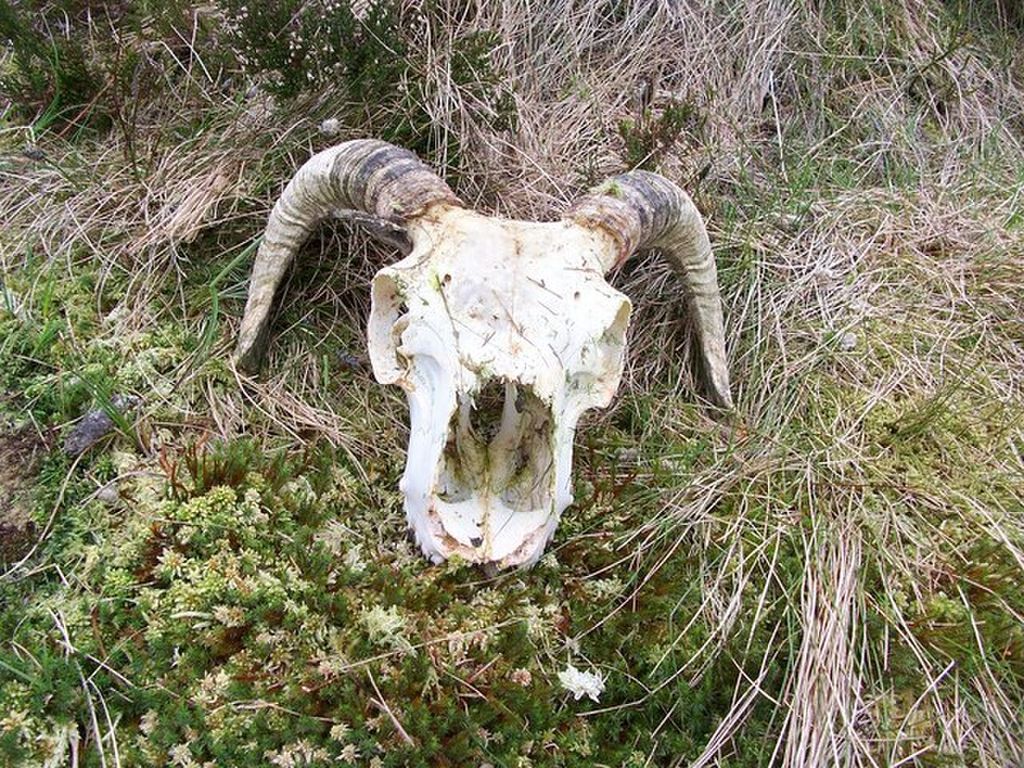
The skull is rendered with more internal articulation than the distant land. Warm cream, ochre and brown describe its worn surface, broken edges and recessed cavities. Dark accents within the sockets and nasal opening make the pale bone feel both solid and perforated. The horns shift from brown to near-black along their lower edges, then catch thin highlights that clarify their long curves.[1][7]
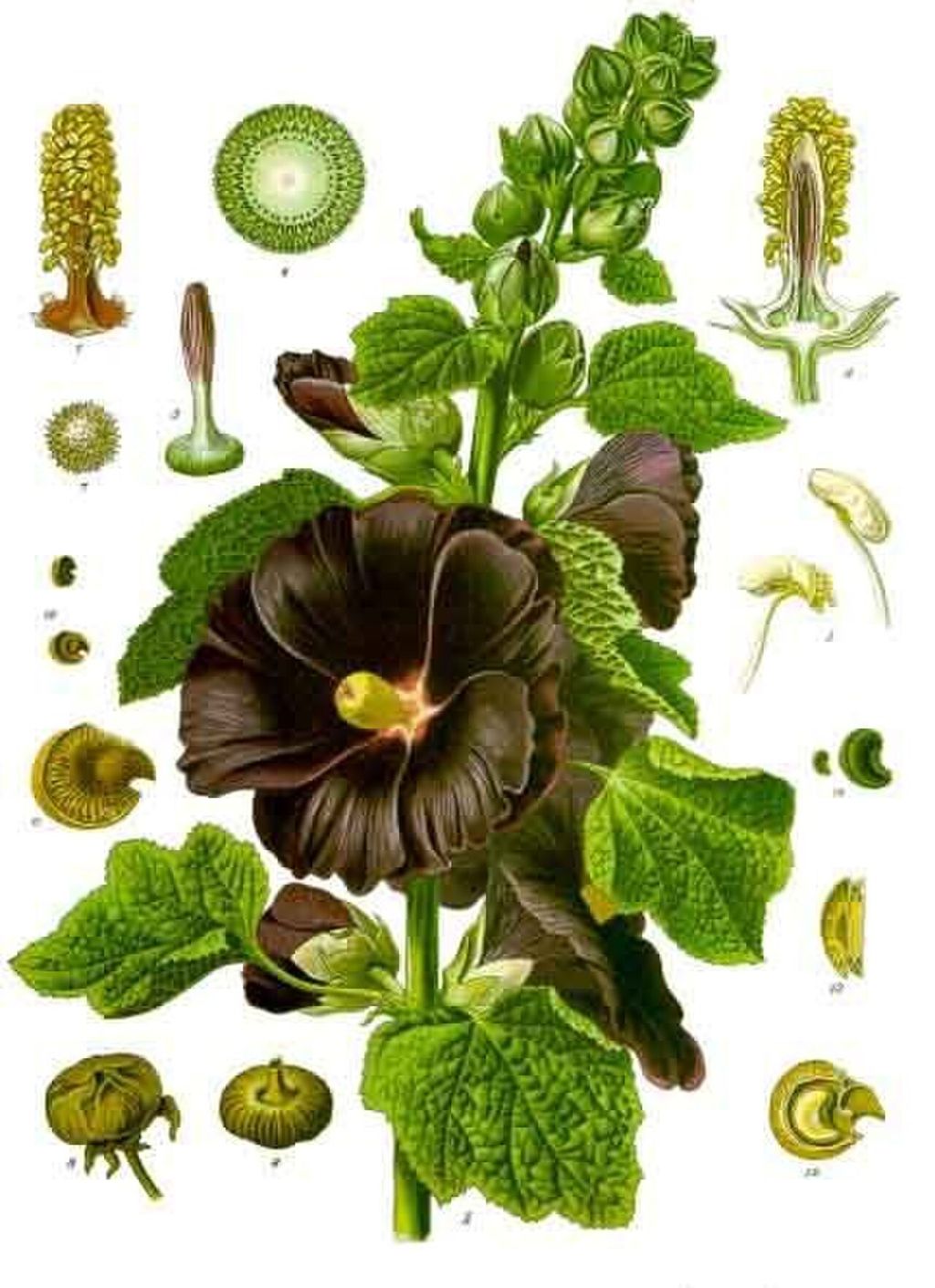
The hollyhock behaves differently. Seen frontally, it forms a shallow disc of overlapping white petals around a yellow-green centre. Its softness is stated through rounded edges and close tonal transitions rather than exhaustive botanical detail. The flower overlaps neither horn nor skull decisively; it sits beside the left horn root, close enough to form a pair and separate enough to preserve its own contour.[1]
The title identifies the bloom as a hollyhock, but the painting cannot serve as a herbarium specimen. Kew recognises Alcea rosea as the common cultivated hollyhock, a temperate biennial or perennial widely introduced beyond its probable origin as a Turkish cultigen, including into New Mexico. That history suits a garden flower, yet species identification remains conditional because O’Keeffe simplified the blossom and left no object-specific botanical record.[27]
Constructed scale and impossible space
The skull is too large for the landscape beneath it, and the flower is nearly large enough to rival the cranium. These discrepancies prevent the canvas from functioning as conventional still life or ordinary landscape. O’Keeffe did not place objects on a tabletop or show a skull lying on the ground. She built a visual field in which each element keeps the scale required for its formal and emotional work.[4][7]
The horns turn enlargement into architecture. They make a shallow vault across the upper canvas and direct attention back towards the central split of the skull. The flower provides a smaller circular pause inside that span. Below, the hills divide the lower edge into repeated triangular and rounded units, translating the great horn curves into a more compressed terrestrial rhythm.
Negative space is equally active. Cloud enters between the horns, pale atmosphere surrounds the skull and the hill line remains separated from the suspended bone. These intervals stop the assembled objects becoming a single emblem with fixed boundaries. The viewer repeatedly moves from thing to gap, from near detail to far terrain, and from physical recognition to the awareness that the pictured space cannot exist.[7][14]
“Pieces from what is around”
O’Keeffe said that she could not remember where she found the head or the hollyhock. Flowers grew among vegetables in the garden between the house and the hills, and she thought she probably picked the bloom while walking past. Her concluding phrase is the clearest surviving account of the painting’s method: “My paintings sometimes grow by pieces from what is around.”[1][2]
The sentence opposes the idea that the canvas transcribes a single visionary instant. Hills, weather, skull and flower could have entered the design at different moments. Memory joined to direct observation, and studio arrangement joined to a view through a window. The painting’s extraordinary conjunction becomes more deliberate, not less, once its components are understood as selected fragments.[1]
The account was published about forty years after the work was made. Its candour strengthens it: O’Keeffe admits forgetting the origins of two central objects and remembers a sequence of failed landscapes rather than an effortless revelation. Even so, retrospective testimony is not a dated studio diary. It establishes how she later understood the work while leaving the precise order of sketches, sittings and revisions undocumented.
Titles, punctuation and date
The preferred title is supported by the Whitney Archive and the checklist for O’Keeffe’s 1936 exhibition at An American Place. A backing inscription reads “Rams Head – Hollyhock / & Little Hills / 1935”, and a partial gallery label remains part of the object record. When examined at An American Place in March 1946, the painting was recorded as unsigned. These material traces outweigh later shorthand.[1]
Other archival titles rearrange the relation among the motifs. The Downtown Gallery used Ram’s Head – Hollyhock & Little Hills and Ram’s Head with White Hollyhock – Hills. O’Keeffe’s Abiquiú Notebooks record Ram’s Head – White Hollyhock – Little Hills, N.Mex., while Stieglitz titled a photograph Ram’s Head & White Hollyhock, New Mexico. Commas, dashes, “with” and “and” variously present a list, a conjunction or an assembled scene.[1][3]
Periodicals made the record still more fluid. A 1936 newspaper called it Ram’s Horn, White Hollyhock, Hills; later publications used Ram’s Head White Hollyhock Hills New Mexico, Ram’s Head—Hollyhock New Mexico and Ram’s Head and White Flower. Each variant shifts attention among anatomy, botany and place. These are evidence of reception, not equally authoritative replacements for the catalogue title.[1]
The backing and catalogue establish 1935. The 1959 Moscow list gave 1936, perhaps confusing exhibition year with execution, while a current Brooklyn shop page gives 1946 despite reproducing O’Keeffe’s account and frame history. Those later dates should be preserved as metadata cautions rather than silently deleted. Neither outweighs the owner-verified record, the 1936 exhibition title or the physical backing inscription.[1][2][18]
Ghost Ranch in 1935
O’Keeffe first reached New Mexico in 1929 and visited Ghost Ranch in 1934. In 1935 she travelled west in July, stayed first at Garland’s ranch and moved to a room at Ghost Ranch after 2 August. The pattern was seasonal: periods of work in New Mexico followed by return to New York, where Stieglitz exhibited the resulting paintings.[5][16]
The chronology corrects a common shorthand. O’Keeffe did not own the Rancho de los Burros house in 1935. Ghost Ranch records that she later rented the more isolated residence and bought the house with seven acres in 1940. CR 852 belongs to her early engagement with the site, before ownership and fourteen years before New Mexico became her permanent home.[5]
The phrase “the hills at Ghost Ranch” therefore names a viewed landscape, not private property. Her account places a vegetable and flower garden between the house and the hills, while the picture reduces that lived environment to a few chosen elements. Garden cultivation, a temporary room, ranch operations and repeated movement through the terrain sit behind an image that contains no building, road, worker or resident.[1][5]
What the bones meant to O’Keeffe
Animal bones entered O’Keeffe’s work after her early New Mexico journeys. She collected them, carried or shipped them east and used them in paintings made within a life still divided between western summers and New York studios. Their movement between regions matters to the paintings’ construction. Stieglitz also photographed her handling a horse skull, making bones part of the public image constructed around artist and subject.[7][9]
O’Keeffe’s later statement resists treating every skull as a simple emblem of death. She described bleached bones as symbols of the desert, beautiful and strangely more living than animals, cutting towards something keenly alive within a vast, empty and severe landscape. The paradox was deliberate rather than incidental. The language joins death’s material remains to intensity, endurance and formal clarity.[7][8]
Mortality nevertheless remains part of what viewers bring to the canvas. A skull beside a flower recalls vanitas traditions in which hard remains outlast fragile bloom. CR 852 complicates that inherited opposition: the flower does not visibly wilt, the skull spreads like a living winged structure, and the land below appears shaped by time yet coloured with warmth and vegetation. Death and life cross rather than occupy tidy sides.[1][15]
Surrealism and interpretive restraint
The painting’s levitation, scale shifts and conjunction of unrelated things explain why museums describe it as surreal or quasi-surreal. The O’Keeffe Museum calls the image surreal, while Whitney and Metropolitan scholarship use similar language for closely related bone-and-landscape compositions. Such terms describe an effect rather than settle an affiliation: ordinary objects meet in a space that refuses ordinary physics.[4][13][14]
They do not prove that O’Keeffe joined a Surrealist movement or followed a particular European model. Her own explanation emphasises local observation, repeated landscape work and the gathering of nearby things. Chronology and method therefore matter as much as resemblance. The picture can share Surrealism’s unsettling juxtaposition while arriving through a personal method of selection, enlargement and compositional equivalence.[1][7]
Biographical interpretation also requires restraint. A 1936 New Yorker review treated O’Keeffe’s recent paintings as autobiographical and called the ram’s-head picture the exhibition’s epitome, with horns like wings against wind-swept grey cloud. That contemporary response shows how quickly the canvas became a summary of the artist. It does not turn every object into a coded episode from her private life.[15]
Land, presence and the myth of emptiness
O’Keeffe’s language of a vast and empty desert records a powerful personal experience, but “empty” is not a neutral history of northern New Mexico. Ghost Ranch now acknowledges that it stands on unceded Tewa territory and names ancestral relationships extending through Nambe, Ohkay Owingeh, Picuris, Pojoaque, San Ildefonso, Santa Clara, Taos and Tesuque, with neighbouring Jicarilla Apache, Navajo Nation, Southern Ute and Genízaro histories.[6]
The painting contains no people and very little trace of habitation. That absence helps create its concentrated, timeless atmosphere, yet it should be understood as a compositional decision. The land was not without communities, cultivation, ranching, travel or contested ownership. Even the hollyhock probably came from a planted garden, quietly contradicting any belief that every element arose in untouched wilderness.[1][5][6]
Recent museum interpretation of a related O’Keeffe skull landscape asks how the celebrated idea of “O’Keeffe Country” can romanticise the Southwest and suppress Indigenous presence. That critique cannot be copied mechanically onto CR 852, whose site and imagery differ. It does establish a responsible question: whose histories disappear when a painted landscape is praised chiefly for looking unoccupied?[14][31]
A developing bone-and-flower series
CR 852 belongs to a sequence rather than an isolated invention. In Horse’s Skull with White Rose of 1931, a frontal skull fills a narrow black field and a small white rose rests on its forehead. The stark ground and near-symmetry make bone and flower into a compressed vertical icon, without the weather and landscape that later complicate CR 852.[10]
The paintings of 1936 test further changes. Ram’s Skull with Brown Leaves sets a horned skull and two dry leaves against white, while Summer Days suspends a deer skull and colourful flowers above distant hills. One removes landscape; the other multiplies flowers and extends the levitating arrangement. Their titles, labels and exhibition histories also show that the motif circulated through changing language and markets.[11][13]
In From the Faraway, Nearby of 1937, an enlarged deer skull and doubled antlers hover above a compressed landscape, turning anatomical alteration and spatial gulf into the main event. Ram’s Head, Blue Morning Glory of 1938 returns to bone and one bloom against a pale field. Museum research identifies its likely specimen as a Spanish goat skull, but that zoological finding belongs to CR 940 and cannot identify CR 852’s different head.[12][14]
Across these works, O’Keeffe changed ground, horizon, species, flower, number, orientation and degree of anatomical invention. The recurrence is therefore analytical rather than formulaic. CR 852 is distinctive because rain-filled landscape, garden bloom and horned bone retain equal claims on attention, making it both a synthesis of earlier motifs and a point from which later combinations could develop.[4][7]
Frame, surface and visible making
The paint surface combines broad atmospheric transitions with firmer object edges. Clouds are built from interlocking greys and whites, while thin value shifts model the skull’s cavities and horns. The hills use warmer, more compact colour shapes punctuated by dark shrubs. Reproduction can show these relations, but it cannot establish pigment composition, underdrawing, layer sequence or the present state of the surface.[1]
The frame contributes another documented layer of design. Brooklyn’s shop states that in the mid-1930s George Of made scalloped and punched sheet-metal frames for some O’Keeffe paintings, inspired by vernacular tinware made by Hispanic artists and artisans in the Southwest. A Brooklyn public FAQ says O’Keeffe designed this painting’s striking frame. Together they suggest artist-directed design realised through specialist fabrication, although no full object-level frame report is public.[2][22]
That collaboration deserves care because the frame can alter the object’s cultural register. Sheet metal connects modernist control to regional craft traditions, while the museum’s wording acknowledges Hispanic makers behind the broader vernacular source. It would be too strong to claim a direct copy of one historic frame or workshop. The surviving public evidence supports influence, design involvement and fabrication context, not a complete genealogy.[2]
The 2021 Madrid loan supplies a rare practical detail. Spain’s state-guarantee order records framed dimensions of 94 by 109.2 by 5.1 centimetres and specifies that a clamshell-style frame would be installed instead of the original.[32] The document does not explain whether conservation, transport or display requirements prompted the substitution. It does prove that the celebrated original frame did not accompany the canvas in the form described for that venue, separating the painting’s travel history from the frame’s.
Two conservation interventions
Access O’Keeffe records two treatments made during the artist’s lifetime. In June 1948, Keck sprayed the painting with a butyl methacrylate polymer. In May 1958, the surface was removed with petroleum benzine and the work was sprayed again with butyl methacrylate polymer. These labels provide unusually exact dates, material terminology and a sequence of removal followed by reapplication.[1]
Sheldon Keck was a leading paintings conservator associated with the Brooklyn Museum; in the same period he treated major modern canvases, including Picasso’s Les Demoiselles d’Avignon. Synthetic coatings were valued because a varnish can modify saturation and gloss while protecting a painted surface. Their use also became part of a wider mid-century effort to develop alternatives to ageing natural resins.[28][29]
Later research on naturally aged synthetic picture varnishes found that butyl methacrylate coatings could remain removable, sometimes requiring relatively polar solvents, while raising questions about paint sensitivity and future ageing. That research explains why the treatment labels matter but cannot diagnose CR 852 today. The public record gives no current coating analysis, ultraviolet image, cross-section, condition map or recent treatment report.[1][30]
The 1936 exhibition and early reception
Stieglitz presented the canvas in Georgia O’Keeffe: Exhibition of Recent Paintings, 1935 at An American Place in January 1936. The title linked the display to the previous year’s work, helping explain why later sources could confuse exhibition year and execution date. O’Keeffe’s western subjects arrived before New York audiences as newly organised evidence of a summer’s sustained looking.[1][16]
The contemporary New Yorker review singled out CR 852 as the show’s epitome. Its description noticed the horns’ wing-like spread, grey weather and white flower, effectively reading composition before iconography. Yet the review also treated the pictures as autobiography and linked them to the artist’s physical and emotional life, an approach that made O’Keeffe’s person inseparable from her objects.[15]
The painting’s titles in newspapers and magazines show how reproduction reshaped that first reception. “Ram’s horn” displaced “head”; “white flower” replaced “hollyhock”; “New Mexico” sometimes replaced the little hills. Each simplification made the image easier to name while changing what counted as central. The catalogue’s recovery of these variants allows their history to remain visible without granting them equal authority.[1]
From national survey to international icon
CR 852 entered the 1940 Carnegie Survey of American Painting, where the Smithsonian record identifies it as catalogue number 283. It then appeared in the 1941–42 annual exhibition, A Decade of American Painting: 1931–1940, Smith College’s 1949 Ten Women Who Paint and a 1953 O’Keeffe exhibition in Dallas. These settings alternately framed it as contemporary achievement, decade history, women’s art and an individual career.[1][3]
In 1959 the Whitney included it in The Museum and Its Friends: Eighteen Living American Artists. That exhibition travelled to Israel, while the same year the painting also represented American art in Moscow. The Congressional Record list calls it Ram’s Head, White Hollyhock and Little Hills, dates it 1936 and names Milton Lowenthal as lender. The record is authoritative for the loan and government presentation, not for execution date.[17][18]
The Moscow exhibition turned the painting into cultural diplomacy during the Cold War. Smithsonian archives preserve records of comment books, press material, government correspondence and reactions connected with the exchange. CR 852 consequently operated beyond a history of O’Keeffe alone: it became one selected image of modern American culture presented to Soviet audiences, with private ownership made unusually visible in the official list.[18][19]
Later exhibitions and multilingual reception
After the Lowenthal collection display of 1962 and Brandeis’s tenth-anniversary Creative Arts Awards exhibition in 1966, the documented record pauses for decades. Its revival in Georgia O’Keeffe: Living Modern placed the painting beside clothing and photography. Brooklyn’s 2017 exhibition examined how O’Keeffe shaped her public identity and then travelled in related forms through 2020, turning a familiar canvas into evidence about image-making as well as painted style.[1][20]
The 2021–22 retrospective carried the work through Madrid, Paris and Riehen. Museo Thyssen listed the Brooklyn loan and translated the title as Cabeza de carnero, malva real blanca. Colinas (Cabeza de carnero y malva real blanca, Nuevo México). “Malva real” locates the flower within Spanish botanical language, while the parenthesis preserves Brooklyn’s expanded title rather than erasing its documentary double.[23][24]
The Centre Pompidou described its presentation as the first French O’Keeffe retrospective and situated her between American modernism, landscape and later hard-edge abstraction. Fondation Beyeler extended the European tour into Switzerland. These institutions did not merely repeat an American icon; they repositioned the painting inside different national histories of modernism, translation and the long twentieth-century career.[25][26]
Provenance and Brooklyn museum life
The work remained with O’Keeffe until at least 1948. Access O’Keeffe then states that Downtown Galleries had acquired it by 14 May 1958, while Edith and Milton Lowenthal purchased it from the gallery on 19 April. Because the transaction date precedes the “by” date, the entries are best reported together as archival wording rather than forced into a false sequence.[1]
The Lowenthals lent the painting internationally and included it within a collection of American modernism. They bequeathed it to the Brooklyn Museum in 1992, producing accession number 1992.11.28. Brooklyn’s institutional history describes the wider bequest as enriching its collection in 1993. Accession year and institutional reception can differ without requiring one of the two records to be discarded.[1][3][21]
Lisa Mintz Messinger’s 1996 study of the Lowenthal collection identifies CR 852 as the couple’s only O’Keeffe and a relatively late addition, acquired in 1958 and exhibited at the Whitney the following year.[33] That evidence turns a terse ownership line into a collecting decision: the painting entered an established American-art ensemble, then almost immediately resumed a public exhibition life. Its singularity within the collection may also explain why later accounts used it to represent the Lowenthals’ modernist holdings.
Brooklyn gives the painting a particularly layered home. O’Keeffe’s first solo museum exhibition had taken place there in 1927, decades before the bequest. The museum later made CR 852 central to Living Modern and refers visitors to it from a live discussion of Brooklyn Bridge. Catalogue, display, commerce, education and informal visitor dialogue now all contribute to the work’s public identity.[20][22]
How to look at the painting
Begin with the hills rather than the skull. Follow their low peaks from left to right and notice how dark shrubs interrupt the rust and brown. Then move upward through the pale bands of rain towards the clouds. The landscape becomes smaller as the atmosphere expands, recreating the distance O’Keeffe remembered discovering from her window.[1][2]
Next trace each horn from the skull’s centre to its broken tip. Compare their unequal bends and the dark undersides that give them lift. Look at the white flower only after following those curves; its compact circular form now appears as a deliberate counterweight rather than decoration. Finally, examine the skull’s cavities and the cloud visible around it, where solid form depends on open space.
Hold the records beside the image. The 1935 backing corrects later dates; O’Keeffe’s account identifies an assembled method; the conservation labels reveal a surface with its own history; land acknowledgement unsettles the fiction of an empty Southwest. Ram’s Head, White Hollyhock – Hills remains compelling because these histories do not close it. They make its apparent simplicity more exact, and its impossible meeting of bone, bloom, rain and land more fully visible.[1][6][30]
Discussion
Which piece of evidence most changes the way you read Ram’s Head, White Hollyhock—Hills?
Reader Insights
Which visible detail most changes your reading of Ram’s Head, White Hollyhock—Hills?
How do medium, setting and documented history shape the encounter?
What remains uncertain when documented fact is separated from interpretation?
Join the Conversation
Share your reading of Ram’s Head, White Hollyhock—Hills below.
References
- Access O’Keeffe, “Ram’s Head, White Hollyhock – Hills, 1935,” CR 852, Georgia O’Keeffe Museum, accessed 20 September 2026, View Source.
- Brooklyn Museum shop, “Ram’s Head, White Hollyhock-Hills Print by Georgia O’Keeffe,” accessed 20 September 2026, View Source.
- Smithsonian Institution, “Ram’s Head, White Hollyhock - Hills, (painting),” Inventories of American Painting and Sculpture, View Source.
- Georgia O’Keeffe Museum, “Music for the Eyes: A New Georgia O’Keeffe Experience,” View Source.
- Ghost Ranch, “Georgia O’Keeffe and Ghost Ranch,” View Source.
- Ghost Ranch, 2026 catalogue and land acknowledgement, View Source.
- Lisa M. Messinger, Georgia O’Keeffe, Metropolitan Museum of Art Bulletin 42, no. 2 (Autumn 1984), View Source.
- Georgia O’Keeffe Museum, “The Natural World,” View Source.
- National Gallery of Art, Alfred Stieglitz, “Georgia O’Keeffe—Hands and Horse Skull,” View Source.
- Access O’Keeffe, “Horse’s Skull with White Rose, 1931,” CR 777, View Source.
- Access O’Keeffe, “Ram’s Skull with Brown Leaves, 1936,” CR 881, View Source.
- Access O’Keeffe, “Ram’s Head, Blue Morning Glory, 1938,” CR 940, View Source.
- Whitney Museum of American Art, “Georgia O’Keeffe, Summer Days, 1936,” View Source.
- Metropolitan Museum of Art, “From the Faraway, Nearby,” 1937, View Source.
- The New Yorker, “Autobiographies in Paint,” 11 January 1936, View Source.
- Georgia O’Keeffe Museum, “Timeline,” View Source.
- Whitney Museum of American Art, “The Museum and Its Friends: Eighteen Living American Artists Selected by the Friends of the Whitney Museum,” 5 March–12 April 1959, View Source.
- United States Congress, Congressional Record—Senate, 4 June 1959, p. 9796, View Source.
- Smithsonian Institution Archives, “National Museum of American Art, Office of Program Support, Records,” including American National Exhibition materials, View Source.
- Brooklyn Museum, “Georgia O’Keeffe: Living Modern,” 3 March–23 July 2017, View Source.
- Brooklyn Museum, institutional history, 1992–93 and the Edith and Milton Lowenthal bequest, View Source.
- Brooklyn Museum, “Brooklyn Bridge,” live visitor FAQ including Ram’s Head, White Hollyhock-Hills, View Source.
- Museo Nacional Thyssen-Bornemisza, “Georgia O’Keeffe: Works at the Exhibition,” View Source.
- Museo Nacional Thyssen-Bornemisza, Georgia O’Keeffe: Selección de obras / Selection of Works, January 2021, View Source.
- Centre Pompidou, “Georgia O’Keeffe,” 8 September–6 December 2021, View Source.
- Fondation Beyeler, Georgia O’Keeffe press kit, 2022, View Source.
- Kew Science, Plants of the World Online, “Alcea rosea L.,” View Source.
- Smithsonian Museum Conservation Institute, “Painting Varnishes,” View Source.
- Museum of Modern Art, “Les Demoiselles d’Avignon: Analysis & Previous Treatments—1948,” View Source.
- Suzanne Quillen Lomax and Sarah L. Fisher, “An Investigation of the Removability of Naturally Aged Synthetic Picture Varnishes,” Journal of the American Institute for Conservation 29, no. 2 (1990), 181–91, View Source.
- Metropolitan Museum of Art, “Revisiting ‘O’Keeffe Country’,” View Source.
- Spanish Ministry of Culture and Sport, Order CUD/210/2021 granting the state guarantee for Georgia O’Keeffe: The Painter’s Lens, 3 March 2021, pp. 1–4, View Source.
- Lisa Mintz Messinger, American Art: The Edith and Milton Lowenthal Collection, Metropolitan Museum of Art Bulletin 54, no. 1 (Summer 1996), p. 35, View Source.