


 by Tom Gurney
Tom Gurney BSc (Hons) is an art history expert with over 20 years experience
Page Created on September 22, 2026 / Page Updated on September 22, 2026
Email: tomgurney1@gmail.com / Phone: +44 7429 011000
Introduction
Georgia O’Keeffe’s Ram’s Head, Blue Morning Glory sets three sharply different forms against a pale field. A bleached skull drops towards the lower edge, two ochre horns extend almost to the upper corners, and beside the right horn a blue flower opens frontally like a small disc of sky. The painting is often reduced to an opposition between death and life. That reading is possible, but it is not enough. O’Keeffe enlarged a hard collected object and a short-lived flower, removed any stable landscape and made their scale ambiguous, turning things gathered in New Mexico into an invented pictorial space.[1][2][3]
At a Glance
- ArtistGeorgia O’Keeffe
- ArtworkRam’s Head, Blue Morning Glory
- Artistic contextAmerican modernism
Contents
- Object identity
- Skull, flower and unequal balance
- Scale, field and suspended space
- Title, taxonomy and source object
- Reverse documentation and date
- New Mexico, Ghost Ranch and collecting bones
- O’Keeffe’s account of flowers and bones
- The morning-glory and paired-object sequences
- American imagery, Surrealism and mortality
- Colour, surface and technical limits
- Exhibition and ownership history
- Foundation gift and reunion with the skull
- Later exhibitions
- Regional history and settler perspective
- Correcting the legacy account
- Close looking and continuing force
Object identity
- Artist: Georgia O’Keeffe (1887–1986)
- Title: Ram’s Head, Blue Morning Glory
- Date: 1938
- Medium: oil on canvas
- Dimensions: 20 × 30 inches (50.8 × 76.2 cm)
- Catalogue raisonné: CR 940
- Collection: Georgia O’Keeffe Museum
- Accession: 2007.1.24
- Credit: Gift of The Burnett Foundation[1]
The canvas is horizontal, a proportion that gives the horns room to stretch laterally. Its width does not create a conventional landscape. There is no horizon, ground line or distant landmark. Instead, the format behaves like a shallow display field whose edges actively measure the span of the collected form.
Skull, flower and unequal balance
The horns arrive before the skull. They arc across almost the full width, darkening at their undersides and tapering towards the top corners. The skull hangs below their junction. Its eye sockets, nasal openings and broken lower edge form small dark interruptions within a largely white-grey structure. The morning glory is the most saturated element, so the eye repeatedly leaves the dominant bone structure to test the smaller burst of colour.
Its blue circle sits immediately beside the right horn, with a white star opening towards a yellow centre. Bone, horn and flower touch visually without obeying ordinary physical scale. The skull is slightly left of centre, while the flower adds weight on the right. The left horn is longer and broader in its downward curve; the right horn rises more steeply. This produces balance without mirror symmetry.
The flower answers the mass of the left horn, while the skull’s vertical descent stabilises the horizontal spread. The painting can feel still at first. Following each curve reveals a more active structure: horn against edge, flower against horn, skull against the lower margin and shadows against the pale ground. Each horn approaches an upper corner but stops short of it. Their tips point outward and upward, directing attention beyond the skull while keeping the entire form contained.
The left horn changes direction several times. It descends from its tip, widens, then turns into the skull. The right horn begins in deeper brown, passes behind the flower and rises in a longer taper. These are not simple decorative arabesques. Differences in thickness, colour and curvature make the paired horns behave as two related structures rather than one symmetrical emblem. Their unequal trajectories keep the composition from settling into heraldic stillness.
The central bone is comparatively small. O’Keeffe gives more area to the horns than to the cranium and muzzle, while grey-violet shadows articulate the eye sockets and broken edges. A thin brown-red accent at the lowest point prevents the white form from dissolving into the background. The skull is carefully recognisable but selectively simplified: neither a clinical anatomical plate nor an undifferentiated symbol. Particular cavities and fractures matter to the painting’s rhythm. Beside them, the frontal morning glory forms a near-circle divided by darker radial seams, shifting from cyan at its edge towards pale blue and white at the throat.
A narrow yellow ring encircles the centre. That warm point is tiny, yet its saturation makes it visible from across the composition. The flower overlaps the inner right horn. It may seem pinned to the skull, floating in front of it or occupying a separate plane. The painting never fully resolves which. That unresolved overlap concentrates the spatial puzzle in the very place where its two named subjects meet.
Scale, field and suspended space
A real horned skull and morning-glory bloom differ greatly in size, yet here the flower is large enough to compete with the cranium. No hand, table, wall fixture or horizon establishes scale. Enlargement works relationally: the flower is measured against the horn, and the horn against the canvas. O’Keeffe had used close framing to make flowers monumental; in CR 940 she brings that strategy into contact with a bone already enlarged by isolation.[7][25] The background shifts through cream, pink-grey and cooler grey, with visible brush transitions and soft shadows below portions of the horns and skull.
They suggest that the objects project from or hover close to a surface, even while the lack of mounting hardware denies a clear wall display. The field therefore performs two tasks. It clears distractions from the objects and supplies just enough tonal depth to make their spatial relation uncertain. The painting has often been discussed with O’Keeffe’s skulls that float over New Mexico landscapes.
CR 940 removes the landscape and retains the suspension. Shadows imply proximity to a plane; the skull’s downward orientation recalls a wall-mounted specimen; the flower breaks that reading by appearing unnaturally large and unsupported. The image is constructed rather than documentary. Its strangeness comes from precisely painted things placed in a relation that ordinary observation cannot settle. Recognition supplies certainty at the level of objects while placement removes it at the level of space.
Title, taxonomy and source object
The present title is supported by two backing inscriptions, the Whitney Archive, the Abiquiú Notebooks and the checklist for O’Keeffe’s 1939 exhibition.[1] The Downtown Gallery Archive used Ram’s Head and Blue Morning Glory. The difference between a comma and “and” is small but meaningful. One lists two motifs compactly; the other announces their conjunction. Neither version, however, tells the viewer whether to read a still life, an emblem or an imagined encounter.
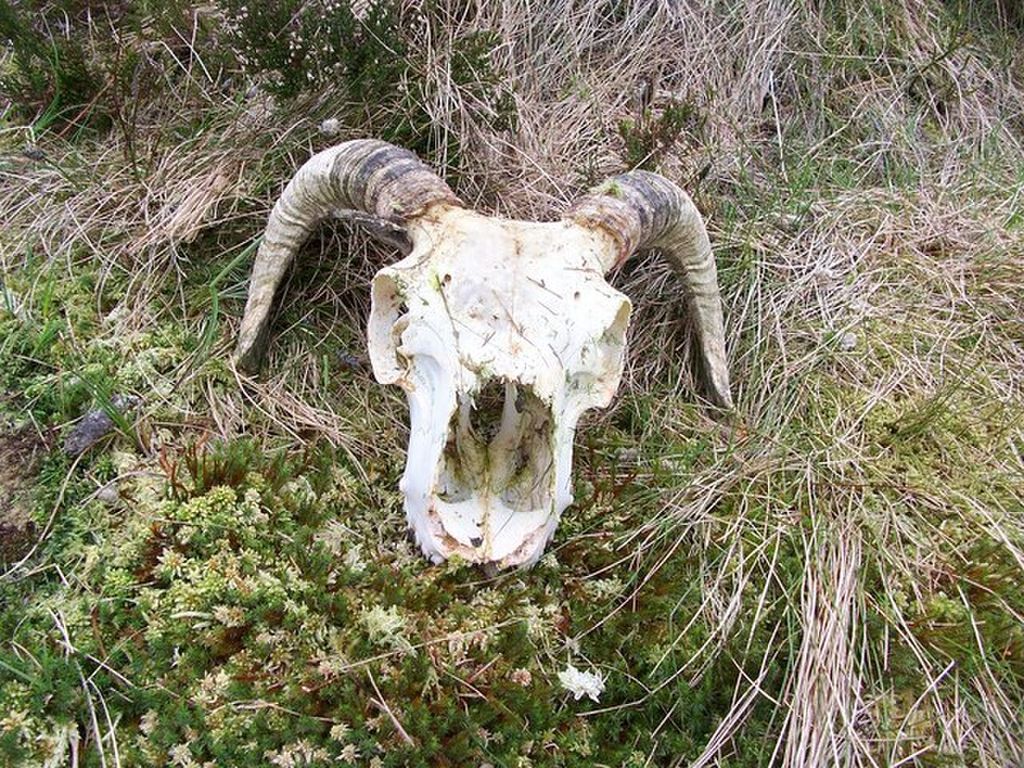
The catalogue preserves Ram’s Head, Blue Morning Glory because it has the widest documentary support. The title describes objects without explaining what their combination means. In 2019 the Georgia O’Keeffe Museum reunited the painting with the skull likely used to make it. Museum research now identifies that object as the skull of a Spanish goat.[2][19] This does not require retitling the painting.
Ram’s Head is the documented historic title supplied through O’Keeffe’s own archive and Stieglitz’s gallery record. The distinction matters. A responsible account can preserve the artwork’s title while reporting that zoological identification has changed. It should not silently treat “ram” and “goat” as interchangeable. The Museum describes the surviving skull as likely inspiration, wording that preserves the difference between a persuasive visual association and a demonstrated studio record.
Displaying object and painting together enables viewers to compare horn curvature, broken bone and proportion.[2] “Likely” remains an evidentiary limit. The painting transforms scale, orientation, colour and spatial setting, and public material does not provide a forensic match report. The reunion is strongest as working-method evidence: O’Keeffe kept natural objects, handled and arranged them, and could return to their forms over time.
Reverse documentation and date
Authorised reverse photographs show a board covering the canvas back. A handwritten An American Place label gives the title, date, gallery address and O’Keeffe’s name; another hand repeats the title and 1938.[1] Later labels and numbers record handling and sale. A Christie’s sticker corresponds to the 25 April 2002 auction, sale 1043, lot 43.[1][5] These photographs document the backing rather than the original canvas verso.
The current Access O’Keeffe entry states that the stretcher and verso are inaccessible, a boundary that should prevent claims about unseen inscriptions or canvas condition.[1] Christie’s catalogued the painting as signed and dated “Georgia O’Keeffe 1938” and described the original reverse label.[5] The current museum catalogue publishes the backing evidence but does not expose the canvas verso. Visible labels must therefore carry the documentary argument without being mistaken for a complete physical examination.
The 1938 date is also consistent with its inclusion as number 13 in the January–March 1939 exhibition of oils and pastels at An American Place.[1][5] Access O’Keeffe warns that exhibition dates alone do not always prove the year of manufacture. Here several documentary channels converge, so 1938 is firmer than a date inferred only from a subsequent show.[21]
New Mexico, Ghost Ranch and collecting bones
O’Keeffe began extended visits to New Mexico in 1929. For roughly two decades she generally spent part of the year there and returned east, making New Mexico her permanent home only in 1949.[7][20][25] That chronology corrects a common error. Ram’s Head, Blue Morning Glory was not a statement made after she had ended her New York life and left Stieglitz behind.
It emerged from a repeated movement between regions: collecting and observing in the Southwest, painting across seasons, and exhibiting new work in Stieglitz’s New York gallery. O’Keeffe first visited Ghost Ranch in 1934. She stayed there in later summers and used the house called Rancho de los Burros before buying it in 1940.[14][20] The surrounding badlands, cliffs, arroyos and distant Pedernal supplied subjects and a terrain for walking.
She gathered bones during those excursions and arranged them around her living and working spaces.[14] CR 940 belongs to that Ghost Ranch decade, but it does not depict a particular documented view. The pale field converts regional material into a studio construction. O’Keeffe’s bone practice was established well before 1938. After a 1931 New Mexico visit she shipped a barrel of bones east.
Stieglitz photographed her hands holding a horse skull after her return to Lake George.[6] She called the bones “trash” in correspondence, a deliberately ordinary word for objects that provoked comment once brought indoors.[5] Collection altered their status. Weathered remains encountered outdoors became portable forms that could be held, photographed, stored, arranged and painted repeatedly. Their movement between desert, household and gallery is part of their modern meaning.
O’Keeffe’s account of flowers and bones
For the 1939 exhibition, O’Keeffe wrote that she had wanted to paint the desert but did not know how and could not remain with it long enough. She brought home bleached bones as her “symbols of the desert”.[3][4] She described them as beautiful and, paradoxically, more living than walking animals. The claim refuses the easy assumption that every skull in her work functions primarily as a memento of death.
Their sharpness reached what she felt was keenly alive in a landscape that was vast, empty and without kindness.[3] This statement is primary evidence for her bone imagery. It explains why death’s remains could signify intensity rather than simple extinction. In a 1930 interview, O’Keeffe said that bones and flowers ran together in her mind when she thought of the desert.
She admired the bleached white bones and paired them with artificial flowers she saw locally.[3] That comment predates CR 940 by eight years. It establishes that the conjunction was an enduring artistic problem, not a symbolism invented by later critics. It still does not assign one universal meaning to every pairing. Different flowers, skulls, backgrounds and formats produce different relations. The artist’s general statement opens interpretation, but close comparison must still determine what this particular canvas does.
The morning-glory and paired-object sequences
O’Keeffe explored morning glories separately before joining one to this skull. Blue Morning-Glories, New Mexico (CR 862) is a 36 × 30-inch canvas with blue and pink-lavender flowers in a green-white field.[8] The small Blue Morning Glories (CR 863) measures only 12 1/4 × 9 inches and carries an earlier flower painting on its reverse.[9] Another Blue Morning Glory (CR 874) places one bloom in a circular reflective vase.
Archive and correspondence evidence date it to 1935–36.[10] A separate 1934 Blue Morning Glory is the earliest of four known blue-morning-glory works made through 1936. The group followed O’Keeffe’s regular New Mexico visits, where blue morning glory grows as a perennial.[28] CR 940 is therefore a return to an established regional flower rather than its first discovery. The Museum archive also catalogues a white Fence Morning Glory (Ipomoea ochracea) photographed in Hawai‘i in March 1939, after this canvas was painted.[31] Its precise label cannot be transferred backwards to the blue flower in CR 940.
The earlier morning-glory paintings investigate flowers, containers, pairs and enlargement. CR 940 takes the frontal blue disc from that visual vocabulary and makes it one element in a composite. The blossom becomes smaller relative to the whole canvas but more intense against the restrained bone palette. Its circular geometry also contrasts with the irregular skull and tapering horns. This is not a decline from flower painting into illustration.
O’Keeffe uses a familiar subject to disturb the scale and identity of another familiar subject. The conjunction of two unlike blooms also had a history. Black Petunia and White Morning Glory I from 1926 set a dark petunia against a pale morning glory at large scale.[11] The work now titled White Flower was also documented as Black Petunia & White Morning-Glory III and Morning Glory with Black.
Its title history shows how a pairing can later be remembered through one dominant form.[12] These paintings trained attention on adjacency: pale and dark, open and folded, one bloom interrupting another. CR 940 transfers that relational method from flower to bone. In 1931 O’Keeffe painted horse and cow skulls with white or calico roses. Those works make CR 940 part of a sustained investigation rather than an isolated flash of symbolic invention.
The works join bleached anatomical structure to cultivated or artificial floral colour.[5][6] The skull is not always embedded in landscape. It may be isolated against black, placed against striped colour or combined with blossoms as an arranged still life. CR 940 therefore belongs to an established series of experiments. Its distinctive move is the broad horn span, blue circular flower and near-white, horizonless space.
American imagery, Surrealism and mortality
O’Keeffe’s Cow’s Skull: Red, White, and Blue used national colours at a moment when artists and writers debated a distinctly American art. The Met reads its title and palette as a satirical comment on that ambition.[13] Bone imagery could thus carry regional and national questions without becoming straightforward patriotic illustration. CR 940 is quieter, replacing the declarative tricolour with a pale field and a single blue accent while retaining an American regional subject.
It has no flag palette, yet a New Mexico object, a locally associated flower and a New York exhibition still place it inside debates about what American modernism might use as subject matter. Critics have called O’Keeffe’s hovering skulls surreal because recognisable objects meet across discontinuous scale and space.[4][7] She did not need to become a doctrinaire Surrealist for that comparison to matter.
In the 1930s, Surrealism made unexpected conjunction and metamorphosis newly visible within international modernism. CR 940 shares the logic of encounter: skull, flower and pale plane retain their identities while their relation feels dreamlike. The label describes a formal effect, not proof of membership in a movement. The skull and fresh bloom readily invite a mortality-and-renewal interpretation. Their conjunction also participates in the period taste for objects whose ordinary categories become unstable when brought together.
Hard bone appears durable; the morning glory is known for an opening that does not last. That reading has a long reception history, and the contrast is visibly present. It becomes too narrow when presented as the painting’s decoded message. O’Keeffe’s own words reverse the expected hierarchy by calling bones intensely alive. The flower does not simply stand for life while the skull stands for death; each form complicates the other.[3]
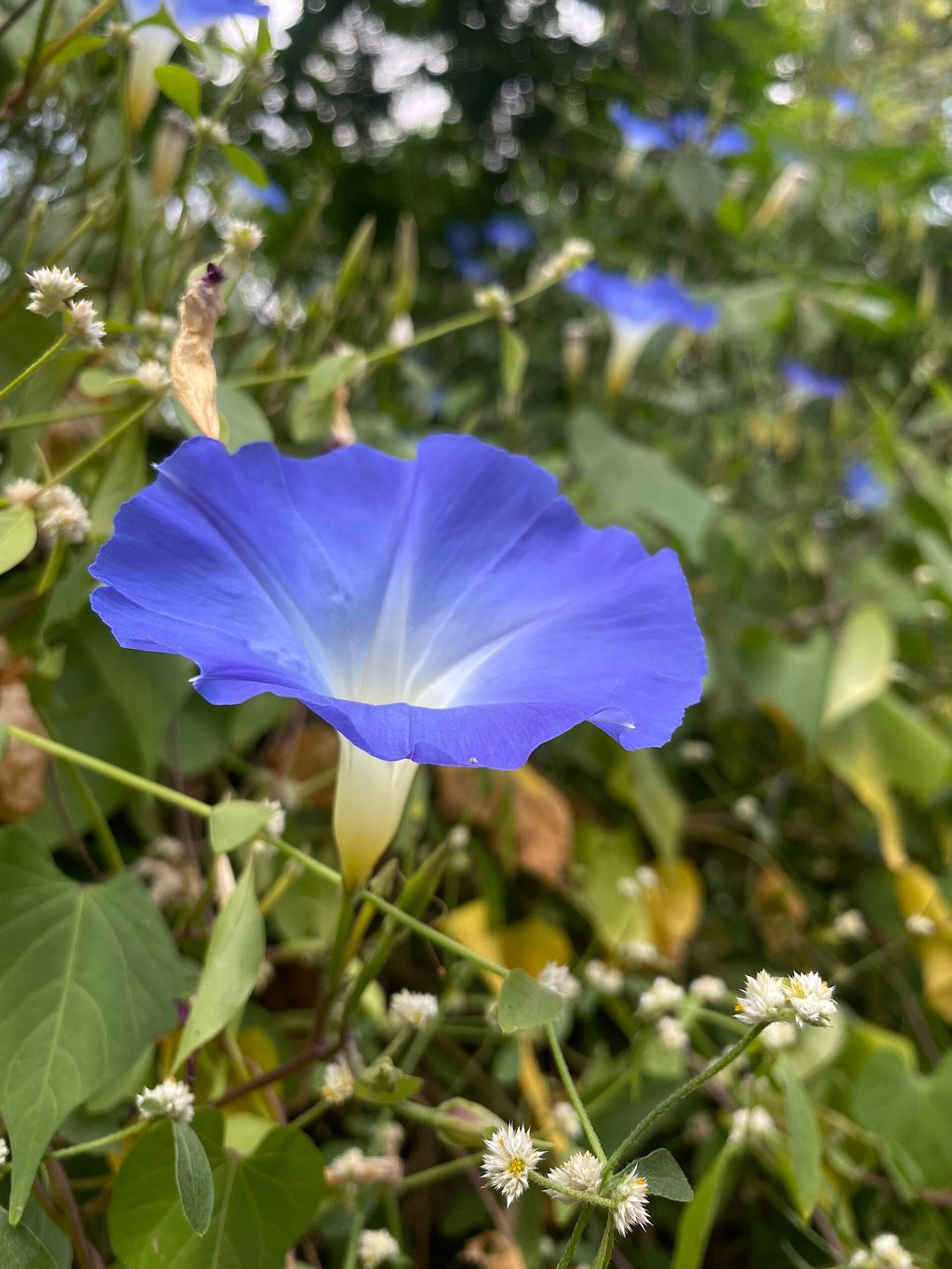
No checked archival or institutional source identifies a specific symbolic language for the blue morning glory in this painting. Colour, frontal presentation and radial fold are observable. Rebirth, transience, mourning or spiritual awakening are possible associations, but they should be attributed to interpretation rather than to O’Keeffe’s documented intention. The species also remains unverified in the public record. A generic botanical name in the title cannot support a precise cultivar or habitat claim.
Colour, surface and technical limits
The blue bloom does more than represent a flower. It cools the entire canvas and makes the ochre horns appear warmer. Its white throat connects chromatically with the skull and background, while its yellow centre echoes the horns in miniature. Colour therefore binds the supposedly opposed objects. The painting’s restricted scheme also makes small changes important: violet-grey cavities, pinkish ground, reddish lower accent and the transition from turquoise to deeper blue.
The horns nearly touch the frame, producing pressure without cropping. The skull approaches the lower boundary, while the flower remains fully visible. O’Keeffe’s placement lets viewers perceive each silhouette. Nothing overlaps the outer edges, and the principal forms can almost be read as cut-outs. Yet tonal modelling and cast-like shadows resist total flatness. The border is therefore both a graphic constraint and a pressure zone around forms that retain bodily volume.
The canvas oscillates between emblem, still life and shallow relief. The authorised image suggests thin, controlled paint, soft background modulation and carefully stepped transitions on the horns and petals.[1] Edges vary. The flower is crisply bounded in places; the skull dissolves into the pale field at others; the horn shadows soften as they move away from the form. That modulation gives the restrained surface much of its spatial animation.
These are visual observations from reproduction. They do not establish pigment identity, layer sequence, medium additives or the condition of the original surface. The public record identifies oil on canvas but supplies no object-specific ground analysis, x-radiograph, infrared image, pigment results, varnish history or treatment narrative.[1][22] Even the apparent thinness and smoothness of the paint should remain a description of the published image, not a claim about unseen layer structure.
Research across O’Keeffe’s paintings has examined commercial primings and metal-soap protrusions, while Spanish technical studies show how imaging and materials analysis can recover working process.[23][24] Those studies establish relevant questions, not answers for CR 940. No deterioration mechanism should be assigned to this canvas without examination evidence. The reverse photograph shows a substantial brown backing board within a wooden structure, pierced by semicircular hand openings.
Labels and lost-label residues accumulate across it.[1] The construction protects the canvas but also hides information. The stretcher, tacking margins and original verso cannot be assessed from the public photographs. The visual record is valuable precisely because it reveals those limits. Documentation can show that evidence is inaccessible rather than tempt a reconstruction. Here, the limits of access are themselves part of an accurate object history.
Exhibition and ownership history
Stieglitz presented O’Keeffe’s recent oils and pastels at An American Place from 22 January to 17 March 1939, with himself recorded as curator.[29] CR 940 appeared as number 13.[1][5] O’Keeffe’s brochure statement made the bone paintings intelligible as her response to the desert, joining recent objects to a verbal account in her own voice.[3] A contemporary review counted twenty-one paintings and two pastels, all but one made during the previous year, so the exhibition presented 1938 as a concentrated body of current work rather than a retrospective survey.[30]
Robert M. Coates’s January 1939 review divided O’Keeffe’s established concerns into desert and flowers, judging the desert works more powerful while continuing to read her art through vague sexual suggestion.[30] CR 940 complicates his division because a desert bone and a flower occupy the same canvas. The review therefore documents two things at once: a critic recognised the subjects around which O’Keeffe’s public identity had formed, yet interpreted even their broad significance through a sexual frame she repeatedly resisted. That period response belongs to the painting’s history without becoming its governing explanation.
The show occurred shortly before O’Keeffe’s 1939 Hawaiian journey, so the blue flower in CR 940 should not be retroactively treated as a Hawaiian subject. Christie’s traced the painting from An American Place to a private New York collection in 1939, and then to Margaret Altschul Lang in 1985.[5] The anonymous owner leaves part of the chain unnamed, yet the record indicates that the picture left the gallery in its exhibition year and remained outside a public museum for decades. A familiar reproduced image was, for much of its history, a privately held object. Lang’s estate offered it at Christie’s New York on 25 April 2002 as lot 43.
The catalogue estimated $800,000 to $1.2 million.[5][26] A secondary auction archive records a realised price of $3,419,500.[26] The figure documents market reception, not artistic quality. The Georgia O’Keeffe Museum included the work in a 2002 fifth-anniversary presentation of acquisitions and promised gifts. The sequence suggests institutional access soon after the sale, although the public sources do not fully document the intermediary transaction.[1]
Foundation gift and reunion with the skull
The Museum records The Burnett Foundation as donor in 2007.[1] The gift converted a work with a long private history into a collection object available for repeated study, conservation and thematic display. The exact path from the 2002 purchaser to the Foundation remains a useful research question. It should not be filled by assuming that the auction buyer and donor were necessarily the same legal entity.
In The Natural World, on view from 8 November 2019 to 16 August 2022, the O’Keeffe Museum placed CR 940 with the Spanish goat skull believed to have inspired it.[2][19] The display shifted interpretation from symbolism alone to material practice, allowing visitors to compare what O’Keeffe retained, changed and exaggerated. Handheld magnifiers, archival photographs, notes and touch components extended the enquiry beyond conventional wall labels.[2] The museum distinguished a one-to-one bone-and-painting comparison from looser forms of inspiration elsewhere in the exhibition, a useful caution against treating every collected object as a literal model.
Later exhibitions
The 2014–15 exhibition brought CR 940 into a larger account of the Ghost Ranch environment. It joined landscapes, bones, flowers and later works that use pelvic openings to frame distance.[1][14] The show treated collecting and walking as parts of studio practice. Bones were stacked on the patio, hung on walls and arranged indoors before becoming painted forms.[14] CR 940 contains no named view, but within that exhibition it demonstrated how Ghost Ranch could remain present through gathered matter rather than topographic description.
From 2016 to 2017 the painting travelled with O’Keeffe, Preston, Cossington Smith: Making Modernism to Heide, QAGOMA and the Art Gallery of New South Wales.[1][17][18] The exhibition placed O’Keeffe beside Margaret Preston and Grace Cossington Smith, three artists who developed modern forms through distinct locations, subjects and careers. QAGOMA called CR 940 one of O’Keeffe’s memorable skull-and-flower images. Its Australian display loosened a purely national account and allowed viewers to compare how modernism took form across different settler societies.[17]
The 2023–25 O’Keeffe and Moore exhibition travelled through San Diego, Albuquerque, Montreal and Boston.[1][15][16] More than one hundred paintings and sculptures were accompanied by reconstructions of both studios using original found objects, tools and furnishings, turning comparison into an account of working environments as well as finished art.[15] O’Keeffe and Moore had met in 1946, when his Museum of Modern Art retrospective followed hers by only a few months, but the exhibition did not document a sustained exchange or direct influence. Its argument rested on parallel habits of collecting, enlargement, apertures and transformation.[15]
Regional history and settler perspective
O’Keeffe encountered living Hispano and Indigenous communities as well as land, buildings and cultural objects in northern New Mexico. A 2012–14 museum exhibition framed her engagement with the region as respectful and examined her paintings of architecture, land and katsina tihu together.[27] More recent Indigenous-led scholarship has asked harder questions about what her images omit and how an artist’s mobility differs from the histories of people whose homelands she entered.[4] These frameworks belong to different moments in O’Keeffe historiography; neither permits the legacy page’s unsupported claim that the skull in CR 940 was an important Hopi symbol. The likely source is a Spanish goat skull.
It should not be converted into Hopi iconography merely because O’Keeffe also painted katsina tihu or travelled in Indigenous homelands. Recent Met scholarship on From the Faraway, Nearby asks how O’Keeffe’s removal and imaginative relocation of a skull can register settler entitlement within Diné homelands.[4] That argument is object-specific but raises a question relevant to the broader bone practice: who is permitted to gather, rename and make a region’s material stand for an individual vision? Applying the question to CR 940 requires care. It expands historical awareness without pretending that one curatorial reading exhausts this different painting.
O’Keeffe valued distance and described the desert’s vastness, yet the region was neither empty of people nor outside history. The painting’s blank field can encourage viewers to imagine a timeless, vacant Southwest. Its making and circulation instead involved ranch property, transport east, Stieglitz’s gallery, private collectors, conservators and museums. Recognising those systems does not diminish the canvas. It replaces mythic isolation with a more accurate account of how a modern artwork moved through places and institutions.
Correcting the legacy account
The former page treated the work as an allegory of O’Keeffe closing her New York life, leaving her husband and flourishing after a permanent New Mexico move. In 1938 she still lived between New Mexico and New York; Stieglitz exhibited the work in 1939; she did not settle permanently in New Mexico until 1949.[1][20][25] It also called Oriental Poppies a later painting, although that work dates to 1927, and attached an unsupported Hopi meaning to the horned skull. Those errors cannot be migrated into the new manuscript.
Close looking and continuing force
Begin at the yellow centre of the flower and follow the white rays into blue. Then trace the right horn behind it, noting where blue and ochre meet. Move across the horn junction and down through the skull’s openings. Compare the sharp dark cavities with the softer shadows on the pale field. This route makes the eye alternate between openings inside the skull and shadows cast outside it.
Finally, follow both horns to their tips. The tour shows that the work is organised by curves and tonal intervals as much as by symbolic objects. Ram’s Head, Blue Morning Glory holds unlike things together without explaining them away. Bone can be dead matter and O’Keeffe’s sign of desert vitality. The flower can answer it without serving as a simple corrective or promise of renewal.
A flower can be botanically recognisable and geometrically disruptive. The title names the encounter; the archive dates it; the surviving skull grounds it in collected matter. None of these removes its spatial uncertainty. Its strength lies in that sustained uncertainty. The canvas turns looking, gathering and arranging into a relation that remains precise, strange and open. Its evidence rewards attention because each apparent explanation leaves another visual fact in play.
Discussion
Which piece of evidence most changes the way you read Ram’s Head, Blue Morning Glory?
Reader Insights
Which visible detail most changes your reading of Ram’s Head, Blue Morning Glory?
How do medium, setting and documented history shape the encounter?
What remains uncertain when documented fact is separated from interpretation?
Join the Conversation
Share your reading of Ram’s Head, Blue Morning Glory below.
References
- Access O’Keeffe, Ram’s Head, Blue Morning Glory, 1938, CR 940. View Source
- Georgia O’Keeffe Museum, The Natural World. View Source
- Access O’Keeffe, “In Her Words.” View Source
- Metropolitan Museum of Art, From the Faraway, Nearby. View Source
- Christie’s, Ram’s Head, Blue Morning Glory, lot record. View Source
- National Gallery of Art, Alfred Stieglitz, Georgia O’Keeffe—Hands and Horse Skull. View Source
- Metropolitan Museum of Art, “Georgia O’Keeffe (1887–1986).” View Source
- Access O’Keeffe, Blue Morning-Glories, New Mexico, 1935, CR 862. View Source
- Access O’Keeffe, Blue Morning Glories, 1935, CR 863. View Source
- Access O’Keeffe, Blue Morning Glory, 1935–36, CR 874. View Source
- Access O’Keeffe, Black Petunia and White Morning Glory I, 1926, CR 559. View Source
- Access O’Keeffe, White Flower, 1926, CR 561. View Source
- Metropolitan Museum of Art, Cow’s Skull: Red, White, and Blue. View Source
- Georgia O’Keeffe Museum, Georgia O’Keeffe: Ghost Ranch Views. View Source
- San Diego Museum of Art, O’Keeffe and Moore. View Source
- Musée des beaux-arts de Montréal, Georgia O’Keeffe et Henry Moore : géants de l’art moderne. View Source
- QAGOMA, O’Keeffe, Preston and Cossington Smith Opens at QAG. View Source
- Heide Museum of Modern Art, Making Modernism: O’Keeffe, Preston, Cossington Smith. View Source
- Georgia O’Keeffe Museum, “Fresh Explorations in the O’Keeffe Museum Galleries.” View Source
- Georgia O’Keeffe Museum, artist timeline. View Source
- Access O’Keeffe, “Information for Researchers.” View Source
- Georgia O’Keeffe Museum, “Conservation and Technical Documentation.” View Source
- npj Heritage Science, “The influence of commercial primed canvases in the manifestation of metal soaps protrusions in Georgia O’Keeffe’s oil paintings.” View Source
- Museo Nacional Thyssen-Bornemisza, O’Keeffe technical study. View Source
- Georgia O’Keeffe Museum, “About Georgia O’Keeffe.” View Source
- LotSearch, Georgia O’Keeffe auction archive. View Source
- Georgia O’Keeffe Museum, Georgia O’Keeffe in New Mexico: Architecture, Katsinam, and the Land, exhibition record. View Source
- Christie’s, Blue Morning Glory, 1934, lot record. View Source
- Access O’Keeffe, Georgia O’Keeffe: Exhibition of Oils and Pastels, 1939. View Source
- Robert M. Coates, “Whitney Annual—O’Keeffe—Kuniyoshi,” The New Yorker, 28 January 1939. View Source
- Georgia O’Keeffe Museum Archives, “Flowers,” including Fence Morning Glory (Ipomoea ochracea), March 1939. View Source