


 by Tom Gurney
Tom Gurney BSc (Hons) is an art history expert with over 20 years experience
Page Created on September 22, 2026 / Page Updated on September 22, 2026
Email: tomgurney1@gmail.com / Phone: +44 7429 011000
At a Glance
- ArtistGeorgia O’Keeffe
- ArtworkBella Donna
- Artistic contextAmerican modernism
Contents
- Two white flowers, two directions
- The extended-loan canvas
- A title that does not settle the plant
- What the image permits us to see
- Overlap without a vase or stem
- Hawai‘i before the canvas
- The pineapple she did not paint there
- Hawai‘i was not an empty paradise
- Jimson weed remembered in another climate
- One bloom faces us, one turns away
- The 1940 An American Place debut
- A provenance that begins with family
- Exhibitions remake the flower
- From flower painting to modern abstraction
- Advertising, autonomy and contradiction
- The series and its limits
- Later fame and mediated colour
- Looking after the name fails
Two white flowers, two directions
Georgia O’Keeffe’s Bella Donna fills a vertical canvas with two immense white flowers that behave differently despite their close contact. The lower bloom opens towards us, its green and violet throat surrounding a small pale star of reproductive parts. Above it, the second flower tilts away, hiding its centre while its folded trumpet rises into a narrow band of blue, so one bloom discloses what the other withholds.[1]
Their pale forms occupy almost every edge. Petals are cropped at the sides and base, while only slender passages of blue and dark green remain at the top and upper corners. O’Keeffe does not place two botanical specimens against a stable background; she turns their overlapping cups into the picture’s space, making the viewer look across ridges, hollows and curling margins as though travelling through a white landscape.
The painting was made in 1939 after O’Keeffe’s journey to Hawai‘i, but even its subject name is unstable. Catalogue evidence, a Stieglitz inscription and O’Keeffe’s later recollection disagree about spelling, date and plant identity.[1] That uncertainty does not diminish the picture; it shows why title, visual resemblance, botanical taxonomy and travel history must be tested separately before they are combined into a single story.
The extended-loan canvas
The Georgia O’Keeffe Museum displays Bella Donna on extended loan from a private collection as L.1997.3.3. It is oil on canvas, dated 1939, measures 36 1/4 by 30 1/8 inches—92.1 by 76.5 centimetres—and carries catalogue raisonné number 966.[1][2] Its near-metre height allows the cropped flowers to confront the viewer bodily while remaining smaller than several of O’Keeffe’s monumental late canvases.
The public catalogue identifies no accessible signature or inscription on the original canvas because the stretcher and verso could not be examined. Instead, a backing carried Stieglitz’s black-ink notation naming An American Place, misspelling the subject “Ditura – Hawaii”, giving 1938 in parentheses and crediting O’Keeffe.[1] The backing is historical evidence, but its wrong year and spelling prevent it from functioning as an infallible label.
No object-specific conservation report is published in the Access record. The painting did appear in the 2006 touring exhibition Georgia O’Keeffe: Color and Conservation, but exhibition participation alone does not prove that any technical findings apply to this canvas.[1] Pigments, underdrawing, varnish, later coating and alteration must therefore remain undescribed beyond what the accessible surface image permits.
A title that does not settle the plant
The catalogue raisonné title Bella Donna comes from O’Keeffe’s Abiquiú Notebooks.[1] Alternate forms include Datura – Hawaii and Belladonna – Hāna, while later exhibition labels used Belladonna Hāna (Two Jimson Weeds). O’Keeffe’s 1978 book called it Two Jimson Weeds Bella Donna Hāna, compressing location, two common plant names and a description into one retrospective title.[1]
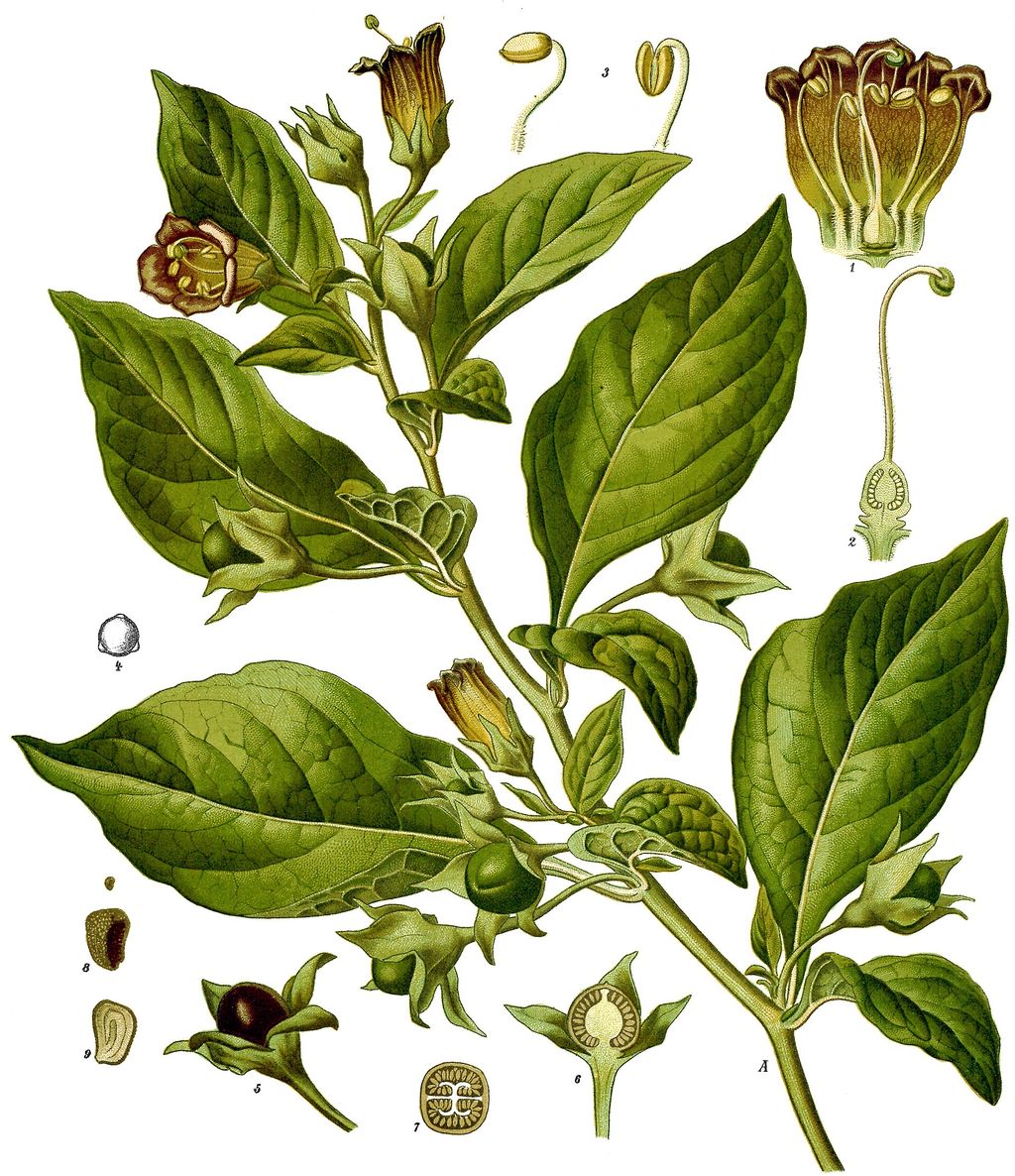
Those words are not botanical equivalents. True belladonna or deadly nightshade is Atropa bella-donna, a Eurasian and North African plant with relatively small purple-brown flowers and glossy dark berries.[15] Jimson weeds belong to Datura, whose conspicuous trumpet flowers resemble the forms O’Keeffe repeatedly painted; Datura and Atropa share the nightshade family but are distinct genera.[14][15]
The catalogue raisonné observes that the flowers closely resemble her 1930s jimson-weed paintings and suggests that poor vision by 1979 may explain her late mistitling.[1] This is a scholarly hypothesis, not proof of a particular species. The safest identification is documentary and visual: the work is titled Bella Donna, yet probably depicts a white trumpet-form flower related in appearance to O’Keeffe’s established Datura motif.
A later account by Patricia Jennings Morriss, who accompanied O’Keeffe on Maui when she was twelve, supplies a plausible origin for the unstable name. She remembered O’Keeffe noticing a flowering shrub on the road towards Kīpahulu, comparing it with jimson weed and asking her to pick blossoms after Jennings said local people called it belladonna.[24][25] The recollection connects plant, title and Hāna, but its retrospective character still counsels against turning a common name into a scientific identification.
What the image permits us to see
The lower bloom presents a five-part rhythm around a deep throat. Its broad lobes roll forward and outward, with one long lower-right edge curling into a hook and another folding back at lower left. Cool grey-green shadow describes the turns without a hard outline, while a muted violet ring and dark green centre draw the eye down to a pale, star-like cluster.
The upper flower is harder to reconstruct. Its body rises behind the lower bloom, then spreads into several pale planes whose overlaps lead towards an unseen opening near the upper edge. On the right, a tubular curl reveals a teal interior and a narrow cream rim; on the left, another turned edge exposes shadow, creating a lateral balance between two hollow forms that never become exact mirror images.
White is the painting’s principal structure rather than a blank colour. Cream, pale grey, green-white, lavender-grey and faint blue model the petals, while the darker throat makes surrounding light seem fuller. O’Keeffe uses small temperature differences to separate overlapping forms, so volume emerges through colour relations rather than through conventional outlines or a strong directional cast shadow.
Overlap without a vase or stem
No stem, leaf cluster, vessel or tabletop explains how the flowers are held. A dark green strip appears at the upper right and small green intervals survive beside the petals, but they do not reconstruct a complete plant. By excluding supporting anatomy, O’Keeffe frees the two blossoms from ordinary scale and turns their meeting into the composition’s principal event.
The lower bloom overlaps the upper across a wide horizontal zone, yet their pale surfaces make the boundary difficult to follow. Grey seams and changing curves gradually reveal which form passes in front. That delayed sorting gives the painting depth without a deep setting: space opens inside the flowers and between their folds, while the canvas as a whole remains compressed near the picture plane.
Cropping increases the pressure. Petals leave the canvas at both sides and the bottom, implying that the visible field is only a selection from larger forms. The thin blue band at the top behaves less like an expansive sky than a release from the flowers’ density, a distant cool interval against which their pale scale can register.[1][23]
Hawai‘i before the canvas
In the summer of 1938 the advertising agency N. W. Ayer arranged for O’Keeffe to travel at the expense of the Hawaiian Pineapple Company, associated with Dole. She left in late January 1939 and spent roughly nine weeks in the islands before returning to New York in April.[3][5] Institutional accounts place her on O‘ahu, Maui, Hawai‘i and Kaua‘i, encountering coasts, rainforests, valleys and cultivated plants.[4][5]
The commission promised tropical subject matter at a moment when O’Keeffe was already established and frequently pressed for work. She did not simply record corporate agriculture. Her Hawai‘i pictures included waterfalls, volcanic terrain, fishhooks, papaya trees and blossoms such as hibiscus, plumeria, heliconia and white trumpet flowers, building a group in which place exceeded the advertised commodity.[4][6]
An O’Keeffe Museum archive photograph locates her near the natural stone arch at Leho‘ula Beach, ‘Aleamai, Hāna, Maui.[7] The photograph does not show the painted flowers, but it confirms her presence in the landscape named by later titles. Jennings’s memoir and a later interview place the flower encounter on the road towards Kīpahulu and say that she picked blossoms for O’Keeffe, who painted them that afternoon in the Jennings family’s guest cottage.[24][25]
That eyewitness history materially sharpens the work’s geography and making sequence, although it was recorded decades after the event rather than in a surviving 1939 studio note. Jennings’s account is especially valuable because it restores a named local intermediary to a story often reduced to O’Keeffe’s solitary discovery. It also explains how a vernacular plant name could enter the documentary record without establishing whether the shrub was Datura, Brugmansia or another white-flowered member of the nightshade family.
The pineapple she did not paint there
The Hawaiian Pineapple Company expected two images for fruit-juice advertising, yet the works O’Keeffe initially supplied were a tropical flower and a papaya-tree landscape.[6] None of the paintings produced from direct island experience showed a pineapple. Only after she returned did Dole send a plant to her New York apartment, where she completed the required Pineapple Bud at the company’s insistence.[3][4][5]
This episode has often been told as charming independence, but the Honolulu Museum calls it a private protest.[6] O’Keeffe accepted travel funded by a commercial and colonial agricultural enterprise, then used the opportunity to choose subjects beyond its central crop. Her refusal was limited rather than absolute: she ultimately fulfilled the commission, and Dole retained at least Crab’s Claw Ginger Hawaii through the original transaction.[8]
Bella Donna was not the advertisement delivered to the company, and its provenance contains no Dole ownership.[1] That distinction matters because “commission picture” can imply a direct corporate object when the painting belongs instead to the larger body generated by the trip. The funding conditions shaped access to Hawai‘i, but they did not dictate every canvas’s ownership, subject, exhibition history or eventual commercial use.
Hawai‘i was not an empty paradise
Later institutional interpretation has tried to move beyond the touristic category of an exotic island. A New York Botanical Garden panel joined museum curators, a Bishop Museum historian and a Native Hawaiian cultural adviser to consider relationships among people, plants and place.[19] That framework reminds viewers that the flora O’Keeffe encountered existed within cultivated, introduced and Indigenous histories rather than as scenery awaiting an outsider’s discovery.
Sascha T. Scott’s peer-reviewed account presses the issue further, arguing that O’Keeffe’s travel and paintings were structured by colonialism and that Dole advertising helped naturalise United States conquest.[26] Scott traces James Dole’s pineapple empire to land dispossession and the oppression of Native Hawaiians by missionary, commercial and political power. Bella Donna did not become one of the commissioned advertisements, but the sponsored journey that made its Hāna encounter possible operated within that same territorial economy.
Many plants associated with the series were introduced ornamentals or crops. Datura metel and several Brugmansia taxa are recorded as introduced in Hawai‘i, while true Atropa bella-donna belongs naturally to Europe, North Africa and western Asia.[14][15][16] None of those distribution records identifies the painted specimen, but they prevent the title “Hawaiian flower” from being mistaken for proof of endemic island status or origin.
The painting offers almost no cultural or ecological setting from which such histories could be read. Its narrow blue band suggests outdoor light or sea, yet the close crop removes land, labour and community. Recognising that absence does not require rejecting the work; it situates its powerful act of selection within the asymmetries of a mainland artist’s sponsored visit to an occupied and commercially marketed island territory.
Jimson weed remembered in another climate
O’Keeffe had painted jimson weed repeatedly in New Mexico before visiting Hawai‘i. The catalogue raisonné specifically relates CR 966 to works numbered 785, 815 and 994, all of which established the white trumpet as a vehicle for enlargement and spiralling form.[1][11] The resemblance means the island encounter activated an existing visual problem rather than introducing a wholly new subject language.
That continuity complicates the claim that the work records an unfamiliar tropical species. The museum’s authorised print description calls the plant deadly nightshade and a cousin of jimson weed, while the catalogue considers the late name potentially mistaken.[1][2] The conflict should remain visible because institutional pages can preserve different layers of knowledge, especially when a familiar common name has greater public recognition than a cautious taxonomic account.
Repetition also changes what “place” means. A form first explored in New Mexico could be recognised again in Hāna, remembered after return and recomposed in New York. The resulting picture belongs to Hawai‘i through journey, title and series, but its visual genealogy crosses regions; locality resides in accumulated attention and memory as much as in a single session before a plant.
One bloom faces us, one turns away
The two flowers create an encounter based on orientation. The lower centre is plainly visible, while the upper opening remains beyond the top bloom’s folded body. This difference stops the pair from reading as a decorative repeat; they become alternate propositions about looking, one organised around access and radial depth, the other around surface, concealment and the imagination of a hidden interior.
Scale intensifies the relation because the lower throat lies near the canvas centre and can operate like a target or pupil, although the tiny pale reproductive cluster resists complete abstraction. The upper bloom denies an equivalent centre, shifting attention to edges and overlaps. O’Keeffe makes recognition alternate with uncertainty rather than moving steadily from an abstract shape to a fully explained flower.
Sexual readings may arise from openings, folds and reproductive anatomy, as they did throughout O’Keeffe’s reception. In January 1939, immediately before travelling, she contributed an exhibition statement rejecting Freudian interpretations imposed on her flowers.[3] That chronology makes it especially careless to present bodily association as her coded intention, though it does not erase the sensuous experience of the painted forms.
At first glance the flowers can appear uniformly ivory. Sustained looking reveals cool blue-grey at the upper seams, greener shadows in the lower petals, lavender around the throat and warmer cream along projecting rims. These changes keep the two blooms distinct even where pale planes overlap, allowing colour temperature to do the work that a darker outline would have made explicit.
The surrounding blue shifts from pale turquoise at the top to a stronger middle blue beneath it. A dark emerald band interrupts the upper-right corner and reappears in small edge fragments, connecting background and floral interior. Rather than placing white objects before a flat blue screen, O’Keeffe circulates blue and green through shadows, throat and setting so the whole field participates in one restrained atmosphere.
The surface image also shows restrained directional brushwork and slight tonal mottling, but digital reproduction cannot establish texture, gloss or layer order. A 2026 television reproduction reportedly required an artist to paint over a canvas print to match the original’s elusive shading.[22] That anecdote concerns replication rather than conservation, yet it underscores how much the painting depends on colour differences easy to flatten in reproduction.
The 1940 An American Place debut
The painting first entered the documented exhibition record in O’Keeffe’s 1940 oils-and-pastels show at An American Place.[1] Stieglitz’s backing inscription names the gallery’s 509 Madison Avenue address, though it gives the erroneous year 1938.[1] The discrepancy shows why physical labels require comparison with catalogues, chronology and later catalogue-raisonné research rather than automatic deference.
The show brought the recent Hawai‘i paintings before a New York public after O’Keeffe had returned and completed the demanded pineapple. Viewers therefore encountered the islands through a studio-edited group rather than a travel diary shown in sequence. Bella Donna’s absence of recognisable landmarks made its Hawai‘i identity depend heavily on title and its place among related works.
The exhibition also followed O’Keeffe’s explicit rejection of Freudian flower criticism in January 1939.[3] When the white blooms appeared the next year, they entered a reception already contested by the artist. Their scale and openings invited familiar associations, but the immediate historical context included her effort to redirect attention towards the things she had actually made and seen.
A provenance that begins with family
The public provenance begins with O’Keeffe’s sister Anita Young in the 1970s, not with the artist or a 1940 buyer.[1] After Young’s death in 1985, the work passed to her estate and then the Robert R. Young Foundation. Sotheby’s offered it in New York on 3 December 1987 as lot 8, after which Gerald Peters Gallery and a private collection appear in the chain.[1]
The missing interval between 1940 and the 1970s is material to any ownership history. O’Keeffe may have retained the painting before transferring it to her sister, but the current public record does not state when or how that happened. A responsible provenance preserves the blank rather than converting a plausible family transfer into a dated fact unsupported by a published document.
Since 1997 it has been associated publicly with the Georgia O’Keeffe Museum as an extended loan while remaining privately owned.[1] This arrangement explains why the work can function as a collection highlight without appearing as a museum acquisition. The accession-style loan number records custody and display, not a transfer of title, a distinction obscured when the museum is casually described as owning the original.
Exhibitions remake the flower
After its 1940 debut, the painting appeared in a 1963 exhibition of newly elected members and award recipients, then re-emerged in Georgia O’Keeffe Paintings of Hawai‘i at the Honolulu Academy of Arts in 1990.[1][18] That landmark exhibition gathered the island series five decades after its first showing and produced a seventy-nine-page catalogue by Jennifer Saville.[18]
It anchored the Georgia O’Keeffe Museum’s inaugural display in 1997 and An Expanding Collection the following year, then travelled in The Poetry of Things to Dallas, Washington and San Francisco.[1] Subsequent contexts paired it with framing, conservation, Paul Strand, Andy Warhol, Marsden Hartley and contemporary art, evidence that the same flower can serve histories of material presentation, photography, serial imagery and wider modernist exchange.
In 2014 it appeared in Georgia O’Keeffe and Ansel Adams: The Hawaii Pictures, which compared two artists’ island encounters without claiming they travelled together.[1][9] The 2018–19 Visions of Hawai‘i project reassembled twenty paintings and paired them with a living conservatory landscape and cultural programmes.[17][19][20][21] Such displays expanded context while also risking a spectacle of tropical abundance that the painting itself withholds.
From flower painting to modern abstraction
The legacy page presents O’Keeffe chiefly as the twentieth century’s most famous painter of flowers, then compares her generally with Cézanne and Dürer. Those broad rankings add little to this object. A more useful question is how Bella Donna uses recognisable floral anatomy to produce an experience in which colour, scale and overlap can be understood before a species is named.
The Georgia O’Keeffe Museum uses the canvas in an activity about abstraction, asking viewers to interpret later oils through relations among form and colour.[12] That educational framing is justified by the image’s structure, but it should not erase the plant. The throat, curled corolla and paired blooms keep returning the eye to organic growth even when the canvas is read as a field of pale interlocking shapes.
Its modernism lies in sustaining both modes. The work neither copies a specimen with botanical completeness nor dissolves into non-referential design. It selects and enlarges enough observed structure for the flower to remain active, then removes scale cues and support until the viewer must negotiate the canvas through visual relations rather than through ordinary garden recognition.
Advertising, autonomy and contradiction
O’Keeffe’s Hawai‘i journey cannot be described as either pure corporate commission or pure escape. Advertising money enabled movement across four islands, but her chosen subjects exceeded the client’s pineapple economy.[4][6] When Dole insisted, she made the required image in Manhattan from a shipped plant, an outcome that joins resistance, compromise and commercial fulfilment rather than delivering a simple triumph of artistic independence over patronage.
The story also belongs to the history of manufactured Hawai‘i imagery. A national campaign sought an already famous modernist to lend distinction to pineapple products, while O’Keeffe’s pictures offered close flowers and dramatic landforms compatible with mainland ideas of tropical abundance.[6] Her refusal to paint plantations or workers shifted attention from industry, but it did not step outside the promotional system that financed the trip.
Bella Donna makes that contradiction unusually quiet. There is no logo, commodity or labourer, and the possible horizon is reduced to a blue strip. The painting can feel private and absorptive despite originating within sponsored travel, demonstrating how artistic autonomy operates through choices made inside material conditions, not through the absence of patrons, markets or institutional framing.
The series and its limits
Institutional accounts usually describe twenty completed Hawai‘i canvases, although the broader 1939 output also included drawings and works completed after return.[4][20] The group ranges from specific named places such as ‘Īao Valley to flowers whose settings are almost entirely cropped away. Treating it as one uniform tropical suite obscures those differences in scale, mobility, subject and documentary certainty.
Bella Donna with Pink Torch Ginger Bud, CR 967, is much smaller at 19 by 16 inches and sets a white trumpet beside a pink-green ginger bud against sea and sky.[13] Its backing includes a 1935 date contradicted by the archives’ 1939 dating, while a 1948 Keck label records sprayed butyl methacrylate polymer.[13] Those facts belong to CR 967 and must not be transferred to the larger CR 966.
Crab’s Claw Ginger Hawaii, CR 963, carries O’Keeffe’s own verso title and passed through Dole by commission.[8] Hibiscus with Plumeria is now at the Smithsonian, and Waterfall—No. III—‘Īao Valley is held in Honolulu.[4][10] Comparing their subjects and ownership reveals how one sponsored trip generated corporate, private and museum histories rather than a single intact commission set.
Later fame and mediated colour
In 2025 Bella Donna acquired an unexpected popular-cultural life through the television series Pluribus. A character pauses before it in a replica Georgia O’Keeffe Museum and takes inspiration from the encounter.[22] The production constructed the museum interior in Albuquerque, selected about a dozen paintings and six photographs for reproduction, and worked with museum staff on placement and orientation.[22]
The on-screen canvas was not the original. Colour matching proved difficult enough that a painter applied pigment over a printed canvas to make the replica more convincing.[22] This process is a useful contemporary reception record because it turns the painting’s subtle whites and greens into a practical production problem, but no judgement about the original’s materials should be derived from a prop made for cameras.
Its cameo also changes audience scale. A privately owned painting on extended museum loan reached viewers far beyond Santa Fe through a fictional encounter staged elsewhere. The episode adds no authority to its interpretation, yet it demonstrates how museums and paintings circulate through replicas, licensing and narrative, creating public familiarity that may precede any direct sight of the actual surface.
Looking after the name fails
Begin at the lower throat and move outwards along one lobe at a time. Notice where green shifts into violet-grey, where cream becomes cooler, and where a petal edge turns back without a drawn contour. This route makes the flower’s structure legible while showing that “white” is an accumulation of delicately related colours rather than a single unmodulated substance.
Then try to find the upper flower’s centre without assuming that every curve must lead there. Each fold seems to direct the eye towards an opening, yet the opening remains hidden beyond the visible arrangement. Comparing that refusal with the lower bloom’s exposed throat clarifies why two flowers were necessary: O’Keeffe made orientation, concealment and access—not simple repetition—the pair’s governing differences.
Finally, return to the title without forcing it to resolve the plant. Bella Donna, Datura, “two jimson weeds” and Hāna all belong to the documentary history, while true deadly nightshade conflicts with the visible trumpet form.[1][15] The painting’s strength survives that failure of naming because its exact subject is not only a taxon; it is the act of seeing pale organic forms expand, overlap and remain partly unknown.
Discussion
Which piece of evidence most changes the way you read Bella Donna?
Reader Insights
Which visible detail most changes your reading of Bella Donna?
How do medium, setting and documented history shape the encounter?
What remains uncertain when documented fact is separated from interpretation?
Join the Conversation
Share your reading of Bella Donna below.
References
- Georgia O’Keeffe Museum, Access O’Keeffe, “Bella Donna, 1939”, CR 966: View Source
- Georgia O’Keeffe Museum Custom Prints, “Bella Donna, 1939”: View Source
- Georgia O’Keeffe Museum, Access O’Keeffe, “Artist’s Chronology”: View Source
- Smithsonian American Art Museum, “Hibiscus with Plumeria”: View Source
- Smithsonian American Art Museum, “Cross Currents: Georgia O’Keeffe and the Perfect Pineapple”: View Source
- Honolulu Museum of Art, “Pineapples express(ed)—or not: Georgia O’Keeffe’s private protest in Hawai‘i”: View Source
- Georgia O’Keeffe Museum Archives, “Georgia O’Keeffe in Hawaii, 1939”: View Source
- Georgia O’Keeffe Museum, Access O’Keeffe, “Crab’s Claw Ginger Hawaii, 1939”, CR 963: View Source
- Georgia O’Keeffe Museum, “Georgia O’Keeffe and Ansel Adams: The Hawai‘i Pictures”: View Source
- Honolulu Museum of Art, “Modern and Contemporary Art”: View Source
- Georgia O’Keeffe Museum, “Meant to Be Broken”: View Source
- Georgia O’Keeffe Museum, “Creative Activity: Abstract Watercolors”: View Source
- Georgia O’Keeffe Museum, Access O’Keeffe, “Bella Donna with Pink Torch Ginger Bud, 1939”, CR 967: View Source
- Royal Botanic Gardens, Kew, Plants of the World Online, “Datura L.”: View Source
- Royal Botanic Gardens, Kew, Plants of the World Online, “Atropa bella-donna L.”: View Source
- Royal Botanic Gardens, Kew, Plants of the World Online, “Brugmansia Pers.”: View Source
- New York Botanical Garden, “Past Exhibitions: Georgia O’Keeffe: Visions of Hawai‘i”: View Source
- Smithsonian Libraries and Archives, Jennifer Saville, Georgia O’Keeffe: Paintings of Hawai‘i: View Source
- New York Botanical Garden, “Georgia O’Keeffe and Hawai‘i: A Sense of Place”: View Source
- Memphis Brooks Museum of Art, “Georgia O’Keeffe: Visions of Hawai‘i”: View Source
- Georgia O’Keeffe Museum, Access O’Keeffe, “Georgia O’Keeffe: Visions of Hawai‘i”: View Source
- Georgia O’Keeffe Museum, “From Canvas to Camera”: View Source
- Google Arts & Culture and Georgia O’Keeffe Museum, “Bella Donna”: View Source
- Patricia Jennings and Maria Ausherman, Georgia O’Keeffe’s Hawai‘i (Koa Books, 2011), Native Books Hawai‘i record: View Source
- Jeanne Cooper, “Georgia O’Keeffe’s visit to Hawaii”, SFGATE, 30 December 2011, interview with Patricia Jennings: View Source
- Sascha T. Scott, “Georgia O’Keeffe’s Hawai‘i? Decolonizing the History of American Modernism”, American Art 34, no. 2 (2020), pp. 26–53: View Source