


 by Tom Gurney
Tom Gurney BSc (Hons) is an art history expert with over 20 years experience
Page Created on September 22, 2026 / Page Updated on September 22, 2026
Email: tomgurney1@gmail.com / Phone: +44 7429 011000
Introduction
Georgia O’Keeffe’s New York pictures overturn the familiar division between an artist of flowers and desert nature and a city made by steel, stone, smoke and electricity. Between 1925 and 1930 she painted streets, skyscrapers and views from the Shelton Hotel in oil, pastel and drawing. She returned to urban architecture in 1949 with Brooklyn Bridge, a painting closely tied to her final departure for New Mexico. These works are neither a minor detour nor a failed attempt to join a masculine skyscraper tradition.
They apply the same serial attention, shifts of scale and tension between recognition and abstraction found throughout her career.[2][3] The 2024–25 exhibition Georgia O’Keeffe: “My New Yorks” was the first museum project to investigate this urban body of work as a sustained field. It assembled approximately twenty-five paintings and numerous works on paper, placing upward views of towers beside panoramas seen from high rooms.[2][6][7] That reconstruction matters because isolated reproductions can make each cityscape appear exceptional; together they reveal a deliberate, multiyear investigation.
At a Glance
- ArtistGeorgia O’Keeffe
- SubjectGeorgia O’Keeffe’s New York Cityscapes
- Artistic contextAmerican modernism
Contents
- The Shelton Hotel and “My New Yorks”
- A woman painting the zoning-era skyscraper
- Photography and the high-window view
- Street with Moon: drawing and painting
- The Shelton sequence
- City Night and Radiator Building
- Ritz Tower and the East River
- Viewpoint, atmosphere and electric night
- Critical resistance and self-definition
- Architecture and public image
- Exhibition, disappearance and rediscovery
- Brooklyn Bridge: return and departure
- Bridge drawings and duplicate records
- Provenance and the institutional city
- Technique and conservation
- Late return to City Night
- How to look at the cityscapes
- New York within the whole career
The Shelton Hotel and “My New Yorks”
O’Keeffe and Alfred Stieglitz moved into the Shelton Hotel in November 1924. The recently completed building on Lexington Avenue was then described as the world’s tallest residential hotel. High rooms offered a transformed relation to Manhattan: streets compressed into channels, the East River became a plane of colour, rooftops replaced the conventional horizon, and clouds could be observed from within the vertical city.[2] They first lived below the thirtieth floor and moved higher in 1927.
Room numbers and dates preserved on backing labels help distinguish views made from different positions. The apartment was home, studio, observation platform and social sign: inhabiting a skyscraper meant participating materially in the city’s modern architecture rather than merely seeing it from the pavement.[12][13] O’Keeffe called these pictures “my New Yorks”, a possessive phrase that claims a field already crowded by photographers, Precisionist painters, architects and commercial illustrators.
The group includes night streets, towers viewed from below, the Shelton itself, river panoramas and related drawings. It moves between close architectural mass and vast distance.[2][7] The works also test media and scale. A small graphite study can assign colour words before an oil exists; a narrow canvas can turn a tower into a vertical thrust; a horizontal river view can spread industrial geography across four feet. Seriality makes the city mutable rather than fixed.
A woman painting the zoning-era skyscraper
The skyscraper was routinely presented as an emblem of modern American power, enterprise and masculine engineering. O’Keeffe later recalled being told that painting New York was an impossible idea and that even men had not done it well.[14] The discouragement was aesthetic and gendered. Critics already treated her abstractions and flowers as expressions of womanhood; the tall commercial tower seemed to belong to another category. Her response was not simply to imitate the hard geometry of male contemporaries.
Buildings in her canvases bend into light, disappear behind cloud, press against narrow supports and alternate with organic smoke. The recent Thyssen and Chicago scholarship situates the cityscapes within her struggle to be judged as a painter rather than a representative of sex.[23][25] New York’s 1916 zoning resolution encouraged setbacks so that tall buildings would preserve light and air at street level. By the mid-1920s, stepped silhouettes, towers and shafts had become both material facts and images of futurity.
The Shelton’s massing belonged to that changing skyline. O’Keeffe does not explain regulation in paint, but her views register its spatial results. Towers rise as faceted volumes; gaps expose narrow skies; distant roofs descend in terraces. Looking up makes regulation monumental, while looking down converts the city into an organised surface. Historical context clarifies the geometry without reducing the works to architectural diagrams.[4][6]
Photography and the high-window view
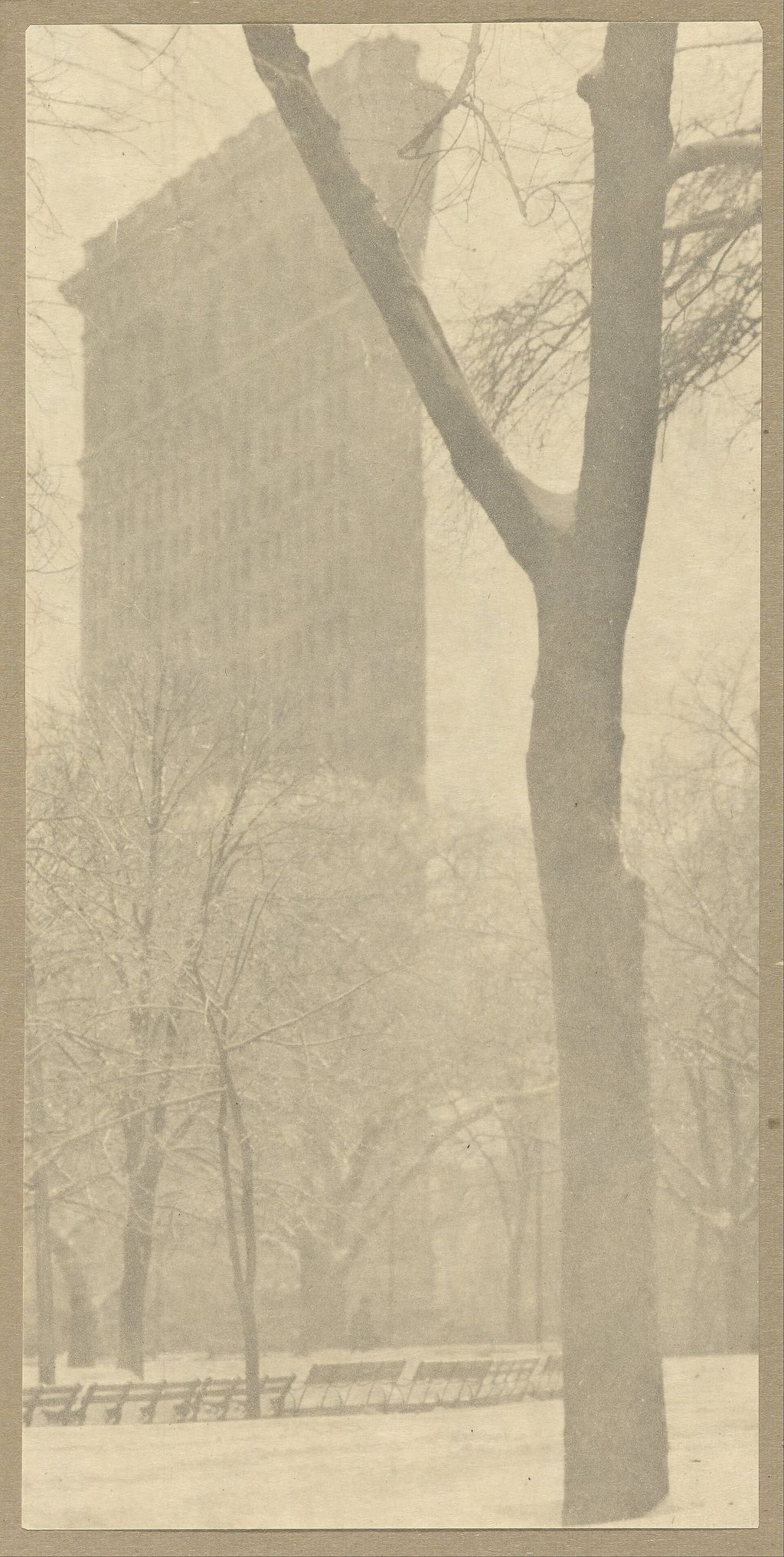
Stieglitz photographed New York from windows at An American Place and from the Shelton apartment. Straight photography emphasised clean description and graphic structure, and his circle included Paul Strand, whose work joined urban abstraction to direct photographic seeing.[10][26] O’Keeffe shared the high viewpoint and the crop, yet paint altered their effects.
She could compress distance, simplify traffic, relocate tonal emphasis and give light a palpable colour. A photograph’s exposure captures an interval; an oil accumulates decisions. The useful comparison concerns a shared modern practice of framing, serial observation and unusual vantage, not dependence on a single photograph.
Street with Moon: drawing and painting
New York Street with Moon dates from 1925 and is a 48-by-30-inch oil now in the Carmen Thyssen collection.[14] A dark building rises from pavement level; a moon enters behind cloud; a streetlamp and red traffic signal establish modern illumination. O’Keeffe later called it her first New York street painting and connected it to the excitement of seeing the city from the Shelton period.
The canvas combines several scales of light: moon, lamp, signal and atmospheric glow. The traffic signal is tiny but chromatically decisive. Architecture does not eliminate nature; cloud and moon penetrate the canyon of walls. The scene therefore refuses the easy opposition between city and landscape that later shaped O’Keeffe’s reputation.[23][24] The related 1925 graphite drawing is catalogue raisonné number 482, on medium-thick, smooth white wove paper with an Eaton’s watermark.[15]
The catalogue title is derived from its relation to the oil rather than from an artist inscription. Written notes—“dark”, “purple”, “pink”—assign colour within a monochrome plan. Those annotations show drawing functioning as visual memory and instruction. The study is not a reduced copy of the canvas; it fixes the disposition of building, moon and streetlight while leaving chromatic execution for paint. Its paper history also corrects the myth that a finished-looking oil arose directly from an unmediated sensation.
The Shelton sequence
Shelton Hotel, N.Y., No. I is a 1926 oil on canvas, 32 by 17 inches, in a private collection.[11] Alternate records call it The Shelton, New York No. I or use the Arabic numeral 1. A tall grey tower occupies most of the narrow support, while strips of blue and cloud remain at its sides. The dimensions matter. The canvas is not merely vertical; its unusually restricted width forces the building and image to share a bodily proportion.
Windows alternate between blue and white, so the façade registers sky rather than standing apart from it. The serial “No. I” also signals that the Shelton was treated as a problem to revisit, not as one definitive portrait. The Shelton with Sunspots, N.Y. was painted in 1926 and is now at the Art Institute of Chicago.[9] O’Keeffe recalled seeing the sun create an optical illusion like a bite taken from the tower, with spots crossing building and sky.
She also said that she painted from the upper left towards the lower right without returning and destroyed other Shelton canvases she considered inferior. Her recollection invites technical testing. Conservation found a medium-weight canvas with a warm white ground, paint forms brought up to their neighbours, freehand architectural lines and ridges made by pressing a flat-ferrule brush. Infrared examination did not reveal an underdrawing, although the lack of major changes could imply preparation elsewhere.[9]
The surface now carries treatment history: a 1946 cleaning and synthetic spray coating, later wax-resin lining, scattered filled losses and a heavy glossy varnish. The “sunspots” are therefore both a represented visual disturbance and passages whose present sheen is not wholly original. The sun in The Shelton with Sunspots does not simply illuminate a stable object. It erodes an edge and scatters yellow discs, making optical perception compete with structural fact.
The tower seems simultaneously solid and temporarily dissolved. This is central to O’Keeffe’s urban modernism. Stone, glass and steel are never immune to weather, glare, smoke or night. Her buildings can be massive without becoming inert. Light becomes an agent that edits the city in real time.[4][5]
City Night and Radiator Building
City Night, 1926, is an oil on canvas measuring 48 by 30 inches, now at the Minneapolis Institute of Art.[16] Massive black and grey walls rise on both sides, leaving a narrow blue interval and distant white buildings. A lamp at the bottom anchors the viewer near street level.
Its title history—Street, New York No. II, New York Night and New York Canyons—records shifting emphasis. “Canyon” imports landscape vocabulary into architecture, but the analogy should not erase labour, property and infrastructure. The image’s oppression comes from constructed scale. A lighting firm later used a reproduction as a Christmas card, an apt commercial afterlife for a painting in which artificial light negotiates darkness.[16]
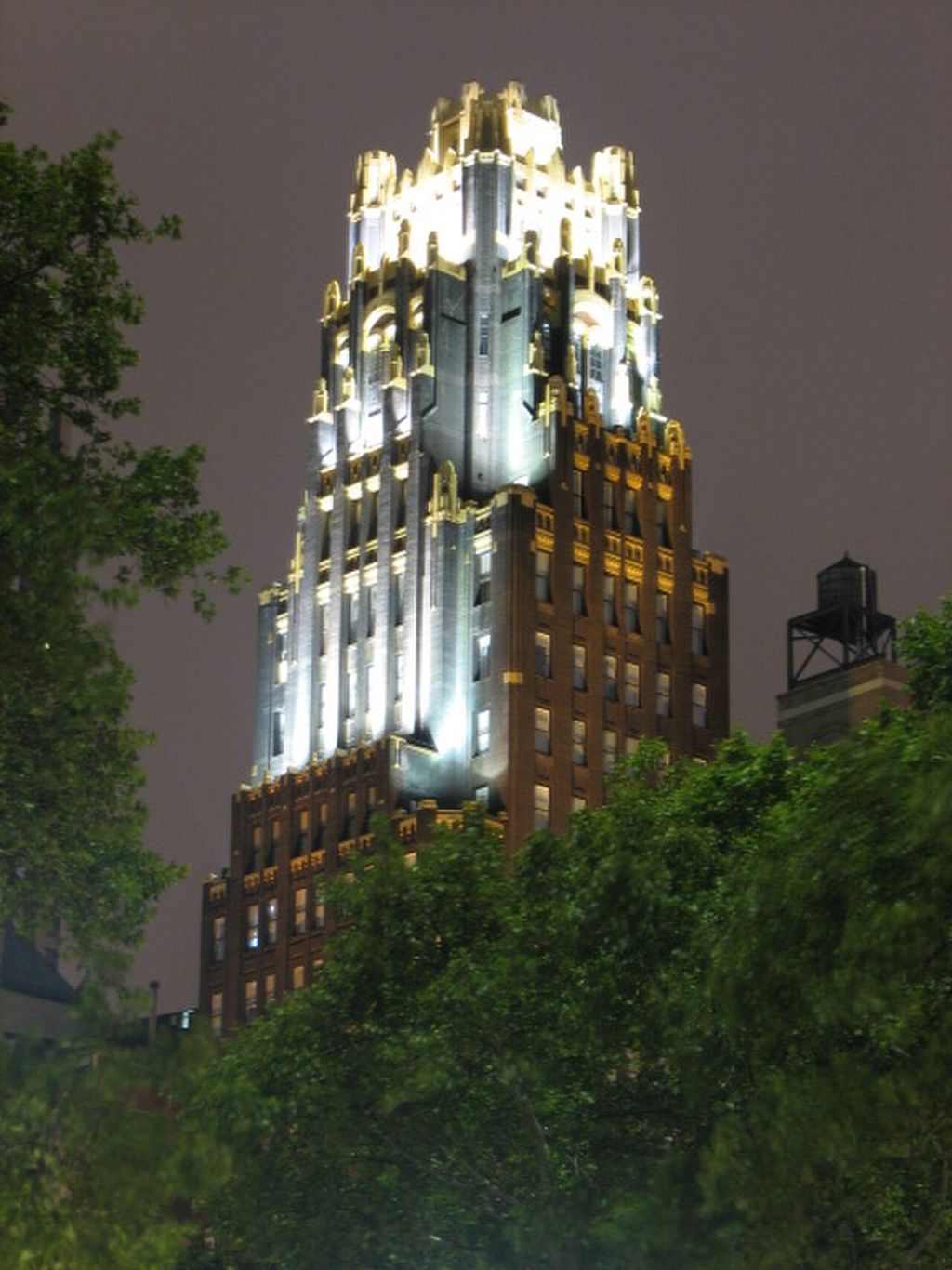
The 1927 Radiator Bldg – Night, New York presents the black-and-gold American Radiator Building against blue night, steam and searchlights.[17] Red neon-like lettering spells Alfred Stieglitz across a neighbouring roof. The inscription turns the skyline into an intimate dedication while borrowing the language of urban advertising. The work is now co-owned by Fisk University and Crystal Bridges, a result of the history of the Alfred Stieglitz Collection.[17]
That ownership links a celebrated icon to Stieglitz’s effort to place modern art at Fisk, a historically Black university, and to later negotiations over collection stewardship. Provenance expands the cityscape beyond Manhattan’s commercial mythology. Formally, solid tower and organic vapour resist separation. Searchlights echo natural beams; windows make geometry flicker; lettering joins private name to public spectacle. The painting stages modern New York as both machine and atmosphere.
New York—Night of 1926 makes representation less obvious.[35] Its narrow 32½-by-12-inch canvas carries white and grey fields crossed by radiating lines and a diagonal band that shifts from blue-white to yellow. “Madison Avenue” survives as an alternate title, while archives once misdated the work 1927 and confused it with a larger painting. Correspondence identifies Hunt Henderson’s purchase through references to a “white abstraction” and helps resolve the error. The record shows why even an apparently non-objective canvas belongs within the documented New York group.
Ritz Tower and the East River
Ritz Tower is a 1928 oil on canvas, 40¼ by 14 inches, purchased by the Georgia O’Keeffe Museum in 2018.[18] A very narrow support makes the cylindrical, stepped building climb through bands of cloud and moonlit sky. Illuminated windows puncture its shadow. A backing inscription dates the work 1925, while the catalogue assigns 1928 on the basis of archives and its appearance in the 1929 exhibition.
The discrepancy should remain visible. Historical inscriptions are evidence, but they can be mistaken, added later or refer to conception rather than completion. Catalogue reasoning, rather than the newest-looking label, controls the published date.[18] East River No. I was begun in December 1927 and finished in April 1928, according to a backing fragment that also identifies room 3003.[13]
The canvas includes river, roofs, brilliant sky, sun and scattered sunspots. Its production therefore crossed several months, contradicting any assumption that a high-window view was simply transcribed in one sitting. The date range invites a composite reading. Weather, light and remembered structure could be revised into one image. Its early ownership by Stieglitz’s brother Leo and subsequent descent through the family establish a provenance different from the major museum cityscapes.
The 1928 East River from the 30th Story of the Shelton Hotel is a horizontal oil, roughly 30 by 48 inches, now at the New Britain Museum of American Art.[12] The blue river cuts across industrial banks, boats and smokestacks beneath a narrow sky. Alternate titles include East River from the Shelton No. VII, placing the work inside a larger sequence. The high viewpoint compresses industry into pattern without making it disappear.
Chimneys and river traffic identify a working waterway, while atmospheric haze softens the opposite bank. It is not a pristine landscape seen above the city; it is a landscape produced through commerce, transport and pollution. The backing records a 1929 exhibition and several institutional destinations. A note “For Philadelphia Museum of Art” did not determine its eventual home, reminding us that planned placements and actual provenance can diverge.[12]
A different East River from the Shelton Hotel, also dated 1928, belongs to the Metropolitan Museum of Art.[31] At 12 by 32 inches it converts the view towards Long Island City into a low panoramic strip. Factory chimneys release dark smoke across a subdued river and sky. The Met reads this inhospitable industrial atmosphere as evidence of growing dissatisfaction with urban life. That interpretation fits the image and later biography, but the object record establishes only what was painted; mood and motive remain reasoned deductions rather than inscriptions.
The river subject continued on paper in 1932. O’Keeffe Museum research identifies East River as an 18⅜-by-24-inch charcoal, while the reverse of the same sheet carries Untitled (New York), a vertical skyline in charcoal.[32][33] Recto and verso therefore preserve two orientations and two urban structures in one physical object. They should not be counted as independent sheets. The pairing also makes city and river mutually contingent: turning the paper changes a horizontal atmospheric view into a compressed vertical architecture without leaving New York.
Viewpoint, atmosphere and electric night
The city series repeatedly reverses perspective. Street pictures make buildings exceed the body; Shelton views allow the eye to command blocks and waterways. Neither position is neutral. Looking up can dramatise corporate scale; looking down can transform inhabited districts into abstract arrangement. Recent scholarship asks what and whom the elevated view excludes.
From a luxury hotel, the city can appear orderly and distant from street life. The My New Yorks review in Panorama calls for attention to race, gender, coloniality and environment within American modernism.[8] That does not invalidate O’Keeffe’s formal achievement; it locates the viewing position inside social geography. O’Keeffe’s city air is active. Smoke stacks mark the East River; vapour crosses the Radiator Building; clouds interrupt the Shelton and Ritz Tower.
These elements blur natural and industrial atmosphere, sometimes making it impossible to decide whether a white passage is cloud, steam or light. The ambiguity is visually productive and historically charged. Coal-burning buildings, factories, river transport and electric display made the 1920s skyline. A modern cityscape that attends only to architecture misses the air through which architecture was seen. Night allowed O’Keeffe to reduce buildings to slabs while making windows, lamps, signals and signs unusually intense.
Artificial illumination supplies structure rather than decoration. A single streetlight fixes the bottom of City Night; red lettering reorganises Radiator Building; windows measure the Ritz Tower. Electricity also joined art to advertising and corporate display. The city’s visual field was commercially produced. O’Keeffe could appropriate that field without painting a conventional billboard scene: her Stieglitz sign transforms a private relationship into the syntax of publicity.[16][17]
Critical resistance and self-definition
Contemporary and later accounts often explain the cityscapes as O’Keeffe proving that she could paint a “masculine” subject. The historical sexism is real, but the formulation can reproduce the hierarchy it describes. Skyscrapers are not inherently male, and flowers are not inherently female. More useful is the evidence that O’Keeffe selected New York against discouragement and refused the limits critics built around her. The urban pictures share formal procedures with flowers and landscapes: cropping, enlargement, serial revision, close colour relations and movement towards abstraction.[2][23][25]
Exhibition history gives that resistance a specific institutional form. In 1925 Stieglitz declined to include New York Street with Moon in Seven Americans, although he displayed O’Keeffe’s leaves, vegetables and rural subjects.[8] The 2024 exhibition placed the withheld cityscape beside works from the earlier show, making visible both his control as dealer and husband and her persistence with the urban theme. This was more than critics assigning gender after publication: the gatekeeping affected which version of O’Keeffe contemporary audiences were permitted to see.
Recent scholarship also asks who disappears when Manhattan becomes pure mass and atmosphere. Sascha Scott connects the empty towers to the visual erasure of Kanien’kehá:ka ironworkers who helped build New York’s skyscrapers, while Adrienne Brown places O’Keeffe’s metropolitan forms in dialogue with Aaron Douglas’s late-1920s cities.[8] No evidence proves that O’Keeffe and Douglas met, so the comparison describes parallel modernisms rather than direct influence. It corrects an art history that too often isolated white modernism from Harlem Renaissance networks while keeping claims of contact properly limited.
Architecture and public image
The New York group belongs to a longer architectural practice rather than standing alone between flowers and desert. O’Keeffe painted Lake George barns, adobe churches, walls, patios and doors as well as towers and bridges. The Detroit Institute of Arts’ architecture exhibition gathers roughly thirty-five works from the 1920s to the 1960s to make that continuity explicit.[28] The comparison changes how the New Yorks look. A façade may function as a plane divided by aperture; a doorway or arch can concentrate sky; a building can be cropped until it becomes an abstract relation of mass and void.
Materials and histories remain different—the corporate skyscraper cannot be equated with Pueblo or Hispano building traditions—but the recurrence of enclosure, opening and edge establishes a sustained visual problem. O’Keeffe’s urban years were also years in which photographs and exhibitions consolidated a public persona. Living Modern showed how clothing, pose, domestic space and art were coordinated rather than accidental. Its New York section pairs the black-and-white palette of her dress with paintings and photographs without claiming that one mechanically caused the other.[27]
This history matters to the cityscapes because their blacks, whites and greys were viewed alongside Stieglitz’s portraits of an artist presented as austere, independent and modern. O’Keeffe participated in shaping that image while resisting the meanings others imposed on it. A black tower and a black dress can belong to the same visual culture, but they are different objects with different functions. The relation is public self-fashioning, not a secret code.
The 1932 Manhattan makes the continuity between architecture, flowers and public commission unusually concrete.[34] This 84-by-48-inch canvas compresses overlapping skyscraper forms in white, pink, red and grey, punctuated by three roses. O’Keeffe submitted it, with a related drawing, to the Radio City Music Hall mural competition and received the commission, then withdrew when construction delays compromised the time available for execution. The surviving painting is therefore both an autonomous cityscape and evidence of an unrealised architectural setting at an ambitious bodily scale.
Its archive complicates any tidy claim that she abandoned New York after 1930. A Whitney note records an intention to destroy the large panel, yet it survived; an alternate title, Skyscrapers, circulated in 1932.[34] The small related ink-and-graphite study and the monumental oil show another change of scale, while the roses interrupt the supposed division between feminine flower and masculine tower. Here both motifs occupy one surface because the mural problem required synthesis, not because one subject secretly symbolises the other.
Exhibition, disappearance and rediscovery
Individual New York pictures entered major exhibitions from the 1920s onward, yet the group was seldom treated as a central career-long problem. Some remained private; some titles changed; works on paper were less frequently reproduced. The dominance of flowers and New Mexico further narrowed the public image.
The 2024–25 Chicago and Atlanta exhibition changed the frame by gathering paintings, pastels and drawings together.[2][3][6] “Rediscovery” should not imply that the objects had vanished. It describes a historiographic shift: museums finally asked what becomes visible when the city works are allowed to define one another.
Brooklyn Bridge: return and departure
O’Keeffe painted Brooklyn Bridge in 1949, after Stieglitz’s death and while closing her New York life before settling permanently in New Mexico. It is oil on board, nearly 48 by 36 inches, now at the Brooklyn Museum.[18][19] Two pointed arches open onto blue sky; dark masonry and a grid of cables create a close, asymmetric structure. The bridge had long served American artists and writers as an engineering monument, civic emblem and modern cathedral.[22] O’Keeffe avoided the panoramic profile.
Her crop places the viewer within the architecture, where cables and openings matter more than river or skyline. Brooklyn Museum research describes repeated Sunday drives across the bridge and preliminary studies of the Gothic forms.[20] Calling the painting a farewell is supported by chronology and museum interpretation, but it remains an interpretation rather than an artist-supplied subtitle. The paired arches have been read as a double portrait or gateway. Those readings are possible because the form carries separation and connection at once; none should be presented as documented intention.
Bridge drawings and duplicate records
The preparatory Brooklyn Bridge is a 1949 charcoal on brown paper, 62⅞ by 36 inches, catalogue raisonné number 1170, also at the Brooklyn Museum.[21] Its alternate museum title is Preparatory Study for Brooklyn Bridge. O’Keeffe inscribed it “Brooklyn Bridge 49 — Not very good”, unusually preserving her dissatisfaction. Conservation evidence makes the sheet more valuable than a simple preliminary image. Horizontal creases and upper pinholes suggest attachment to a surface.
Numerous central vertical creases may record folding for symmetry or transfer to the primed board; other folds may come from rolling. Japanese-paper hinges, adhesive traces and charcoal’s friability document later care as well as studio handling.[21] The drawing is larger than the finished painting in height. Preparation here is architectural: O’Keeffe worked through the bridge at bodily scale before compressing it onto board. The inherited path /untitled-brooklyn-bridge/ does not identify a separate catalogue object.
Current catalogue and Brooklyn Museum evidence support one 1949 charcoal, CR 1170, whose accepted title is Brooklyn Bridge and whose alternate title is Preparatory Study for Brooklyn Bridge.[21] The legacy word “Untitled” probably arose from an old caption or incomplete metadata. Consolidating it with the drawing preserves the search route while preventing an invented seventh cityscape. Both /brooklyn-bridge-drawing/ and /untitled-brooklyn-bridge/ are therefore satisfied by the preceding documented section and this explicit identity correction.
Provenance and the institutional city
The New York pictures travelled through distinct networks. The Shelton with Sunspots moved from O’Keeffe through Alma Morgenthau Wertheim and the Block collection to Chicago. Radiator Building entered the Stieglitz Collection at Fisk and later joint ownership with Crystal Bridges. Brooklyn Bridge came to Brooklyn through Mary Childs Draper, while its study was a gift from dealer and O’Keeffe specialist Doris Bry.[9][17][19][21]
These histories matter because they shape availability, conservation and interpretation. A private Shelton canvas, a jointly owned icon and two related Brooklyn objects do not meet the public under the same conditions. The digital catalogue raisonné’s network of more than 130 institutions makes those dispersed histories comparable without pretending that all records are equally complete.[1][30]
Technique and conservation
The cityscapes look engineered, but the technical record for The Shelton with Sunspots finds the long forms drawn freehand rather than against a ruler.[9] Paint was pushed into small ridges at edges; neighbouring shapes met with little overlap; brush stiffness changed between glowing and geometric areas. This combination clarifies O’Keeffe’s precision. It was achieved through trained hand, sequence and pressure, not through mechanical drafting.
Drawings could organise colour and transfer, while paint retained physical decisions. Architecture became a means of testing touch against geometry. Dark city pictures are vulnerable to heavy varnish, grime and retouching. A glossy coating can deepen blacks while flattening distinctions among blue, grey and brown; lining can alter texture; filled losses around pale areas can change the rhythm of light.
The Chicago record documents all of these pressures in The Shelton with Sunspots.[9] Works on paper pose different risks. Charcoal can transfer, crease and abrade; old tape and hinges leave residues. The Brooklyn drawing’s folds may be evidence of O’Keeffe’s transfer method, accidental storage damage or both.[21] Conservation must preserve that ambiguity rather than “correcting” every irregularity.
Late return to City Night
In the 1970s O’Keeffe revisited the City Night composition in a much larger oil, approximately 84 by 48 inches, painted with Belarmino Lopez’s assistance.[29] Four stars and a hazy moon enter the blue interval between dark buildings. The late work is neither a facsimile nor evidence that the 1920s series never ended.
It demonstrates how an earlier design could become a memory structure under changed working conditions. Naming the assistance avoids the romantic fiction of solitary production, while recognising that O’Keeffe directed the image. The return also complicates the idea that New Mexico permanently replaced New York in her imagination.
How to look at the cityscapes
First establish viewpoint. Are you at pavement level, inside the tower, across the street or looking from the thirtieth floor? Then locate the horizon—or notice its absence. Follow the relation between architecture and atmosphere: which edges remain stable, and which are altered by cloud, sun, steam or night? Next check dimensions and medium.
A narrow private canvas, a four-foot oil and a full-scale charcoal produce different bodily encounters. Read labels for room numbers, changed titles and date disputes. Finally, separate a documented observation from a later metaphor. The Brooklyn Bridge may feel like a cathedral or farewell, but its catalogue evidence, material construction and provenance should remain visible beneath those meanings.
O’Keeffe’s 1976 recollections are essential testimony, but they were written about events half a century earlier and often shape a concise career narrative. Backing inscriptions can conflict with catalogue dating. Museum labels can propose symbolic readings that are not artist statements. Exhibition reviews reflect current concerns and should be identified as such.[8][9][18][20]
The strongest account triangulates object record, conservation, archival label, exhibition history and formal analysis. It also avoids replacing the old stereotype of “flower painter” with a new totalising claim that the city was her true modern subject. Her achievement lies partly in making such categories permeable.
New York within the whole career
O’Keeffe’s 1949 move is often narrated as an escape from the city into authentic nature. The paintings resist that simplification. She developed New Mexico subjects while maintaining a New York life; she painted the Brooklyn Bridge at the threshold of departure; decades later she returned to City Night. Her visual language crossed geography.[20][29] Skyscraper, bridge, flower, bone and mountain all became structures through selection and scale.
Their contexts differ profoundly, but the same artist tested how much could be removed before a subject lost identity. The cityscapes belong at the centre of that enquiry. The “New Yorks” establish O’Keeffe as an artist of modern urban perception. Height changes geography, electricity changes night, speed changes framing, and gender changes what critics permit a painter to claim.
She answered those conditions without surrendering architecture to pure geometry or atmosphere to sentiment. The works are also documents of self-definition. Against a market eager to identify her with flowers and a critical culture eager to identify form with femaleness, O’Keeffe made towers, rivers and streets her own. The result is not a denial of nature but a metropolis in which matter, air and light continuously remake one another.
Discussion
Which piece of evidence most changes the way you read Georgia O’Keeffe’s New York Cityscapes?
Reader Insights
Which visible detail most changes your reading of Georgia O’Keeffe’s New York Cityscapes?
How do medium, setting and documented history shape the encounter?
What remains uncertain when documented fact is separated from interpretation?
Join the Conversation
Share your reading of Georgia O’Keeffe’s New York Cityscapes below.
References
- Access O’Keeffe digital catalogue raisonné. View Source
- Georgia O’Keeffe Museum, “My New Yorks” curator talk. View Source
- Access O’Keeffe, “My New Yorks” exhibition record. View Source
- Art Institute of Chicago, Georgia O’Keeffe: A Closer Look. View Source
- Art Institute of Chicago, Una mirada más cercana. View Source
- High Museum of Art, “My New Yorks”. View Source
- Rijksmuseum library, Georgia O’Keeffe: My New Yorks. View Source
- Panorama, review of Georgia O’Keeffe: “My New Yorks”. View Source
- Access O’Keeffe, The Shelton with Sunspots, N.Y.. View Source
- Art Institute of Chicago, Alfred Stieglitz Collection: New York Views. View Source
- Access O’Keeffe, Shelton Hotel, N.Y., No. I. View Source
- Access O’Keeffe, East River from the 30th Story of the Shelton Hotel. View Source
- Access O’Keeffe, East River No. I. View Source
- Access O’Keeffe, New York Street with Moon. View Source
- Access O’Keeffe, Untitled (New York Street with Moon). View Source
- Access O’Keeffe, City Night. View Source
- Access O’Keeffe, Radiator Bldg – Night, New York. View Source
- Access O’Keeffe, Ritz Tower. View Source
- Access O’Keeffe, Brooklyn Bridge painting. View Source
- Brooklyn Museum, Brooklyn Bridge. View Source
- Access O’Keeffe, Brooklyn Bridge preparatory charcoal. View Source
- Brooklyn Museum, The Bridge as Icon. View Source
- Museo Thyssen-Bornemisza, Georgia O’Keeffe catalogue selections. View Source
- Museo Thyssen-Bornemisza, Georgia O’Keeffe press dossier. View Source
- Georgia O’Keeffe Museum, Exhibiting O’Keeffe. View Source
- Metropolitan Museum of Art, Alfred Stieglitz and American Photography. View Source
- Brooklyn Museum, Georgia O’Keeffe: Living Modern. View Source
- Detroit Institute of Arts, Georgia O’Keeffe: Architecture. View Source
- Access O’Keeffe, Untitled (City Night). View Source
- Georgia O’Keeffe Museum, Access O’Keeffe institutional network. View Source
- Metropolitan Museum of Art, East River from the Shelton Hotel. View Source
- Georgia O’Keeffe Museum, From the Curator: East River, 1932. View Source
- Access O’Keeffe, Untitled (New York), 1932. View Source
- Access O’Keeffe, Manhattan, 1932. View Source
- Access O’Keeffe, New York—Night, 1926. View Source