



 by Tom Gurney
Tom Gurney BSc (Hons) is an art history expert with over 20 years experience
Email: tomgurney1@gmail.com / Phone: +44 7429 011000
Nighthawks: Introduction
A bright diner occupies the corner of a dark street. Three customers sit at a counter while a server bends towards them. The broad window lets us see their clothes, cups and gestures with unusual clarity, yet offers no obvious way to join them. Edward Hopper's Nighthawks makes visibility and access into different experiences.
Hopper painted the oil on canvas in 1942. Measuring 33⅛ by 60 inches, or 84.1 by 152.4 centimetres, it belongs to the Art Institute of Chicago, which acquired it that year for the Friends of American Art Collection. [1] At five feet wide, the painting can give its four small figures a substantial architectural setting without making any one of them a portrait's dominant presence.
The image is immediately recognisable, but its recognisability can make it difficult to see freshly. We remember a lonely diner, perhaps before noticing how much colour, equipment and carefully measured space the scene contains. The painting becomes more interesting when its individual decisions replace that shorthand.
At a Glance
- ArtistEdward Hopper [1]
- Date1942 [1]
- Mediumoil on canvas [1]
- Collection / recordThe Art Institute of Chicago [1]
- Accession1942.51 [1]
This work across Edward Hopper’s career
American Village
1912Soir Bleu
1914Automat
1927New York Movie
1939Morning Sun
1952Two Comedians
1966Contents
- The corner, glass and counter
- A room that changes as the eye travels
- Four figures with different roles
- Gestures without an exchange of words
- Light extending into the street
- Two façades and a city beyond the counter
- Where was the diner?
- Drawing the room, objects and bodies
- A drawing that could still change the painting
- A wartime winter in the studio
The corner, glass and counter
The diner is a long wedge whose curved end turns towards the spectator. Its roof and counter create two strong horizontal bands, while the window frames interrupt them with narrow verticals. The curve makes the building feel continuous around the corner, even though the view stops at the edges of the canvas.
Glass occupies much of the front. It is not represented as a heavily reflective surface filled with images of the street. We can look through it and take in the interior as a largely uninterrupted arrangement. The few structural divisions become especially important because so little else prevents the eye from travelling across the scene.
The counter is a second enclosure within the windowed shell. Its broad reddish-brown surface separates the seated customers from the server, while its returning edge gives the interior a depth that the long front alone would not provide. The figures share a room but occupy different positions within its working arrangement.
The back-facing customer sits near the curved end. To the right, a man and woman are close together on the far side of the counter. Farther right again, the server bends into the group. These positions turn a small number of bodies into a sequence across the canvas, with intervals of counter and equipment between them.
No customer entrance from the street is shown. There is, however, an ochre interior door at the back right. The distinction matters: the picture withholds a clear route for the spectator, rather than depicting a building with no door of any kind. Cropping and viewpoint can make a space inaccessible to us without requiring impossible architecture.
That missing route affects how we look. The eye can enter the room more easily than an imagined body can. We can trace the counter and inspect a cup, but cannot follow a visible path from our pavement into a seat. The scene gives the spectator visual proximity while maintaining physical separation.
A room that changes as the eye travels
The diner can look almost flat when it is first recognised as a bright band across the painting. Following its edges produces a less settled experience. The roof moves diagonally towards the right, the near window turns around the left-hand corner, and the counter returns through the room. These are several descriptions of depth operating inside one conspicuously horizontal image.
The curved end is crucial. A rectangular room viewed directly from across a street could present its occupants like figures on a stage. Here the rounded glazing pulls part of that stage towards us. The back-facing customer's coat occupies the turn, making a human body coincide with the point where the architecture changes direction. We meet his back before looking along the more distant counter towards the pair.
Farther right, the room seems to open around the server. The bright wall behind him and the vessels beside his shoulder make a different spatial arrangement from the narrow, dark area near the curved end. Although all four people occupy a continuous establishment, they do not appear equally near to its boundaries. Hopper uses the building to give different bodies different amounts of surrounding space.
The window uprights then draw that changing room back towards the surface of the canvas. They are thin enough to leave most of the interior visible, but emphatic enough to divide a continuous view into unequal intervals. Looking across them is rather like looking through a series of openings whose frames never become separate pictures. The eye repeatedly passes a boundary without encountering a new scene.
This movement helps explain why the diner holds attention after its subject is familiar. From a distance, it is a single brilliantly legible shape. At closer range, we begin to negotiate its receding surfaces, overlaps and interrupted alignments. Recognising a diner takes less time than following the relation between its turning edges. The picture's clarity does not eliminate spatial complexity. It makes that complexity available without announcing it as a problem to solve.
Four figures with different roles
The man with his back towards us is the most firmly closed figure. His hat and coat make a dark shape against the lighted interior. We cannot inspect his expression, and the orientation of his shoulders places him within the diner rather than addressing the street.
He is separate from the close pair, but the painting does not tell us whether he knows them. A gap on a counter can be socially meaningful without proving that two people are strangers. It can also be an ordinary interval between customers using the same public place.
The man in the pair wears a dark suit and hat. His body inclines towards the counter, and his hand lies close to the woman's. Their nearness creates a possible connection, but the arrangement remains quieter than an unmistakable embrace or a clearly staged quarrel.
The woman's red dress gives the group its strongest concentrated colour. Her pale arm rises towards a small object she holds near her face. The gesture invites curiosity because it is specific enough to notice and too small to explain an entire story. Naming the object confidently from a reproduction would supply more certainty than the painted detail permits.
The server is different again. His white clothing connects him to the bright room, and his bent body suggests work behind the counter. His face turns into the space occupied by the customers. Service provides a practical reason for these people to be together even when their personal relationships remain unknown.
This distinction between worker and customers is essential. There are four figures, but not four diners seated in equivalent positions. The counter gives them unequal roles. What might first look like a general assembly of isolated people is also an ordinary business transaction whose exact moment has been left unresolved.
Small objects contribute to that moment. Cups stand near the customers; dispensers and napkin holders organise the working surface; two tall metal urns rise at the right. They make the establishment convincing without covering the counter in the disorder of a busy meal. The people have somewhere recognisable to be, although we do not see what brought each of them there.
Gestures without an exchange of words
The customers' stillness is sometimes described as though Hopper had simply removed expression from otherwise conventional figures. Their bodies are more carefully differentiated than that account suggests. The back-facing man presents a closed upper shape; the facing man inclines into the counter; the woman brings one arm upwards; the server bends and turns. Each has a different relation to the horizontal surface that holds the group together.
The counter consequently works as a measure of gesture. A hand rests on it, an elbow approaches it, a torso leans towards it, and work takes place behind it. Its nearly unbroken edge lets us compare these small departures from a common level. Without that steady reference, the gestures would be less conspicuous. What appears at first to be a severely restricted range of action becomes a sequence of distinct physical attitudes.
The nearness of the pair's hands deserves attention for the same reason. The small interval between them is much less than the expanse separating the pair from the back-facing customer. Yet physical distance is not a reliable transcript of emotional distance. The hands have been placed within a field where every small gap is visible; their proximity prompts us to look for a connection that the painting does not conclusively name.
White clothing gives the server a different kind of emphasis. His body joins the lit wall and ceiling more readily than the men's dark jackets do. A customer can withdraw behind a hat and a broad coat, whereas the server's uniform remains conspicuous within the establishment he maintains. The contrast makes occupation part of the image's structure. Serving and waiting are not simply interchangeable ways of being alone.
The people also direct attention unevenly. We can inspect some faces but not all, and no figure clearly returns our gaze from the pavement. Their absorption leaves us free to examine them, while denying the ordinary acknowledgement that would turn an encounter into a meeting. The viewer's exclusion is thus made by bodies as well as glass. Even an imagined open door would not make these four people immediately available to us.
Light extending into the street
The interior's pale yellow brightness meets greenish areas of pavement and window framing. Across the street, a reddish upper storey sits above dark green shopfronts. The painting's night is therefore full of colour. It is not simply a black background surrounding a white rectangle.
The lit ceiling is a broad surface rather than a collection of conspicuous lamps. Its brightness gives the room continuity from one end to the other. The people and objects stand within that field, with strong differences of light and dark still making hats, sleeves and faces distinct.
Outside, the pavement opens into an unusually empty foreground. Light spreads across it, and the diner's dark base makes a heavy curved boundary near the bottom of the scene. This area gives the spectator room to stand, but supplies no pedestrians with whom to share the position.
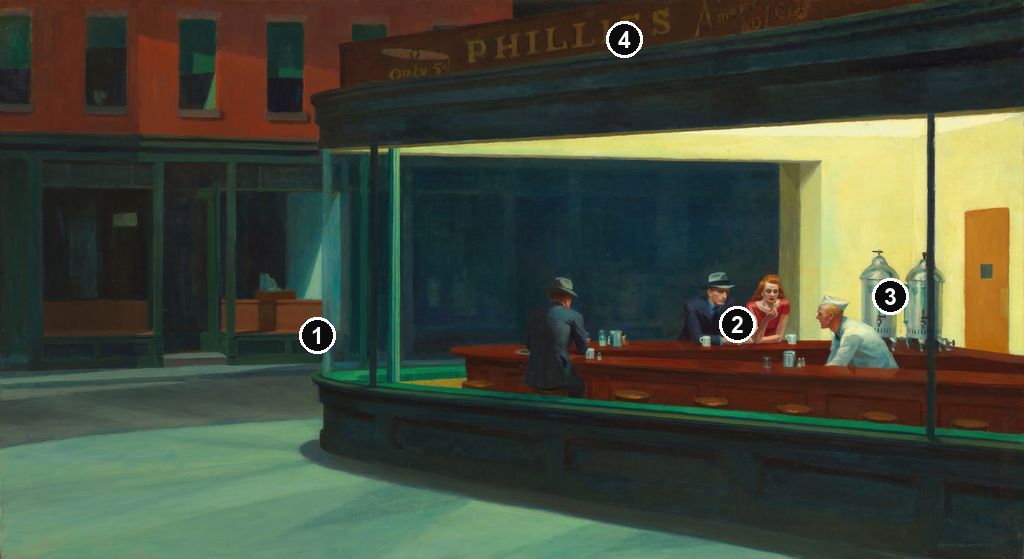
The building opposite is subdued rather than wholly erased. Windows, a doorway and a small counter with a cash register can be distinguished. These traces imply other commercial activity without showing it underway. Hopper makes one establishment brilliant and another comparatively withdrawn, so the street contains different degrees of visibility.
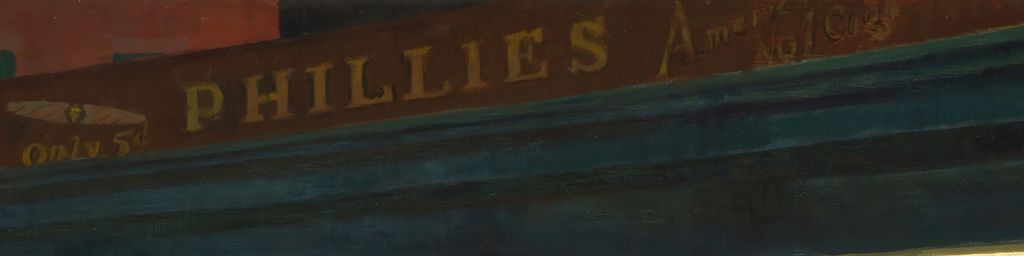
The advertising above the diner belongs to that commercial world. Phillies refers to cigars; it does not establish that the restaurant itself was called Phillies. The sign helps place the scene among ordinary things offered for sale, even though the painting has become much more famous than the business it imagines.
The light does not stop exactly at the glass. It reaches the street and makes the enclosure noticeable from outside. That extension complicates a simple opposition between a warm interior and a hostile exterior. The room excludes our body while its brightness reaches towards our position.
Two façades and a city beyond the counter
The darkened shops opposite the diner often disappear from memory when the image is recalled. In the painting they occupy an extensive, carefully organised area. The upper brickwork gives way to lower storefront glazing; vertical supports interrupt long horizontal divisions; a small pale shape sits inside the central shop. The diner is not an isolated object placed against an undifferentiated night. It faces another commercial frontage with its own arrangement of openings and surfaces.
Colour connects the two sides of the street. Red-brown architecture appears behind the diner, whose own counter and upper sign carry related warm tones. Greens recur in the shopfronts, pavement and window framing. The brightest establishment and its darker neighbour belong to one limited range of colour, even while their illumination is sharply unequal. The continuity holds the street together without making its buildings equally accessible.
The windows upstairs add another difference of scale. They are small, repeated and too dark to inspect. Below them, shop glazing describes a more public level of the building; across the street, the large diner window exposes an entire room. The painting moves between possible domestic interiors, commercial display and an occupied place of service. Not all urban privacy takes the same architectural form.
The pavement supplies the interval in which those differences can be compared. Its emptiness is an active area of the design: without a moving crowd or a parked vehicle, there is nothing to interrupt the relation between the two façades. It lets the diner appear as an object seen from outside while keeping the opposite building present behind it. The street's social use has been reduced so its spatial role can become unusually clear.
That reduction should be considered alongside the four visible people. The city has not been emptied completely; activity has been concentrated in one place. A small pool of occupation faces a larger area whose use is harder to determine. The painting therefore distinguishes degrees of activity and visibility rather than merely dividing the scene into people and emptiness.
Where was the diner?
Hopper related the scene to a restaurant on Greenwich Avenue where two streets met. The Art Institute also records his explanation that he enlarged and simplified the restaurant. [2] A place he had seen was a source for the painting, rather than a guarantee that the canvas preserves one building unchanged.
This is why attempts to locate a single exact diner can become misleading. A street corner may offer the right acute angle while its windows, scale or surroundings differ from the painting. Such differences need not mean the source was irrelevant. They may be evidence of the alterations that made a remembered place work as a composition.
The finished building has a remarkably effective shape for Hopper's purposes. Its pointed corner lets the spectator see across several figures at once. Its glazing offers a broad view without a large central wall blocking the group. Its long counter creates space around the bodies. A literal property record would not necessarily provide those conditions so clearly.
The Art Institute's current description explicitly distinguishes the painting from a realistic transcription of an actual place. [1] That does not make the view detached from New York. It makes the city a source of forms and encounters that can be selected, altered and joined.

Compare: Automat, 1927.
Annotated Details from Nighthawks
The numbered points identify visible features discussed in this article. Return from each detail to the whole composition. Nighthawks
Details from NIGHTHAWKS
Compare the cropped details with the complete images above. Notice how their colours, shapes and positions contribute to the larger compositions.
The window boundary
The broad glass reveals the counter while the corner and dark pavement keep our viewpoint outside.
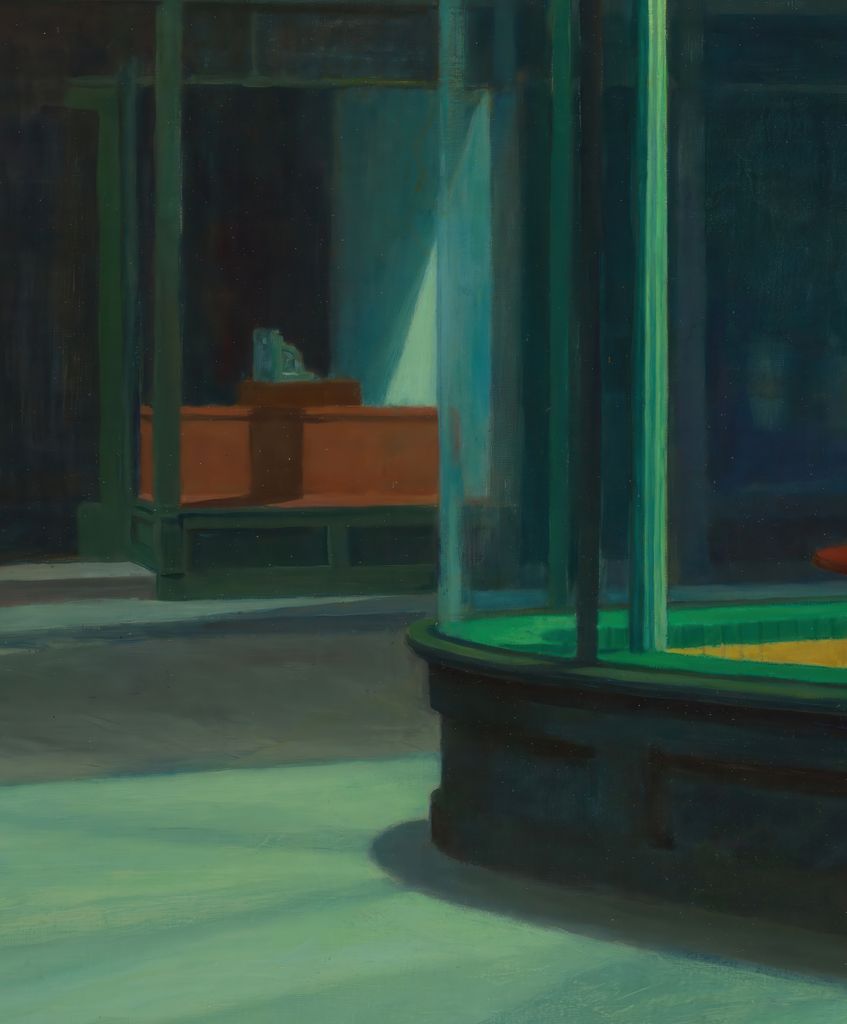
Two customers at the corner
The man and woman sit close together, but their faces and hands direct attention along different paths.
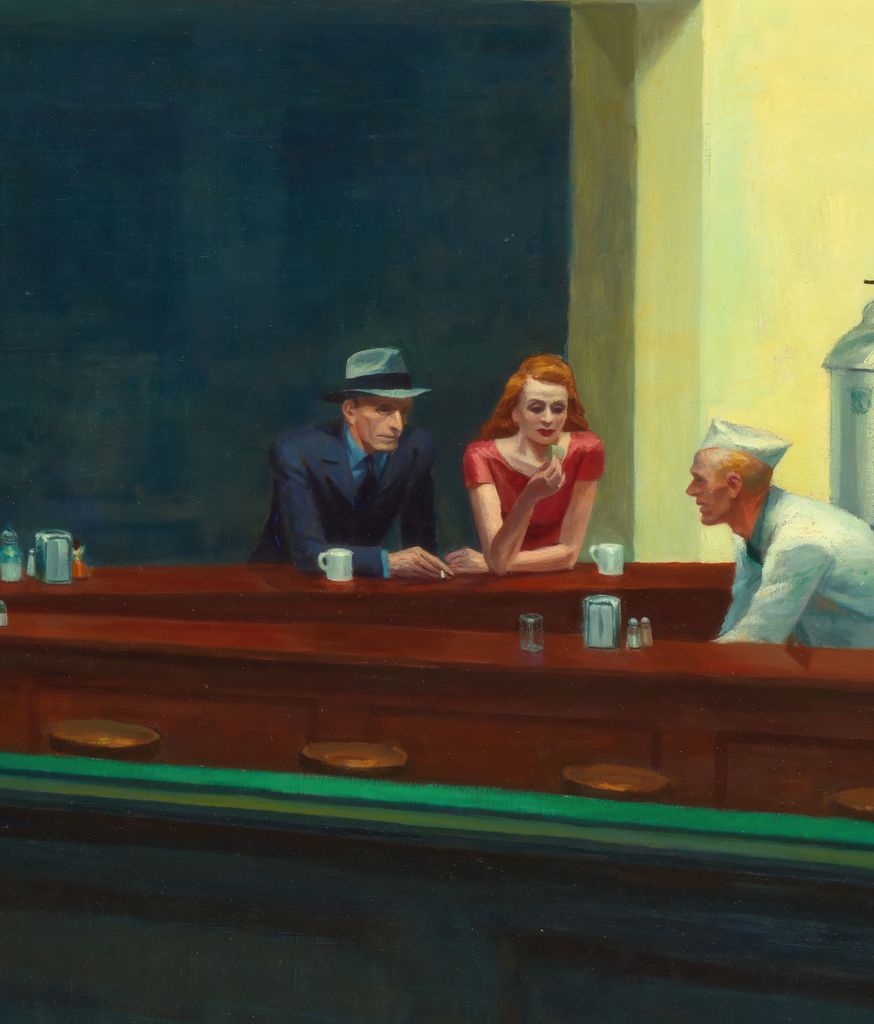
Coffee equipment
Two tall urns stand behind the server. Their repeated upright forms contrast with the long sweep of the counter.
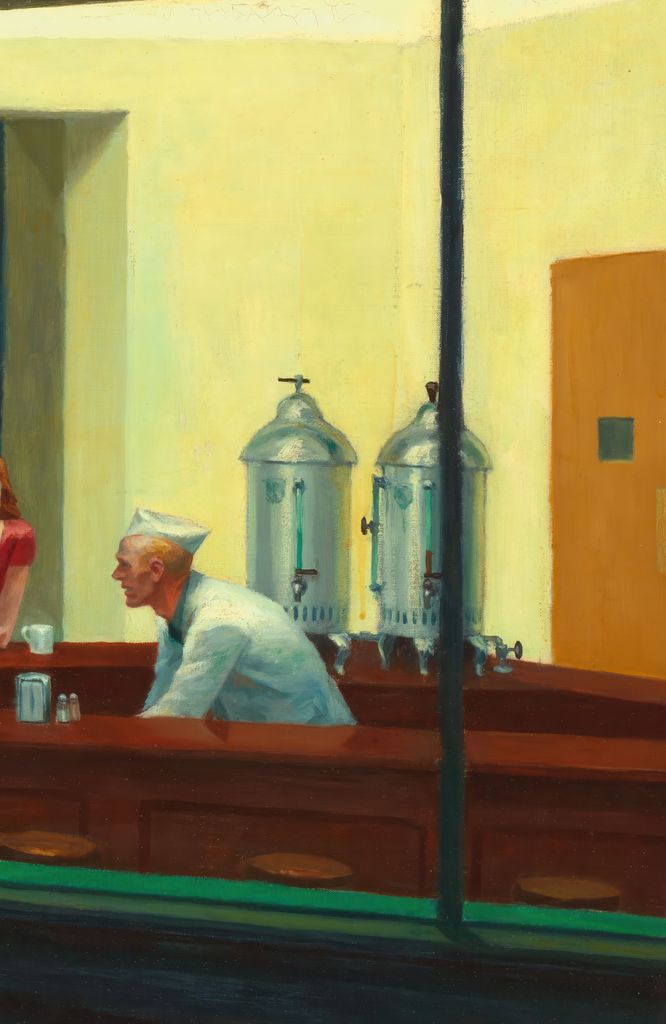
The painted sign
PHILLIES belongs to the cigar advertisement above the window. It does not establish the name of the diner.
Drawing the room, objects and bodies
The surviving drawings make those decisions tangible. In one Whitney study, accession 70.193, a strongly defined back-facing customer sits within an economical sketch of the window, counter and neighbouring architecture. Another small sheet, accession 70.192, studies three urns and a separate tap detail. A larger figure sheet, accession 70.256, combines a woman at a table with separate arms and hands. The museum dates these drawings to 1941 or 1942. [3]
Each sheet addresses a different scale of the problem. The architectural sketch tests the large enclosure. The urn drawing attends to cylindrical forms, lids and spouts. The figure sheet explores how a bent arm, a resting forearm and a hand holding something can make a body convincing within a restrained scene.
The urn study is particularly useful beside the painting. Its three vessels have an emphatic presence on the small piece of paper. In the canvas, two rise behind the server's shoulder. Close observation did not oblige Hopper to copy every part of a study into the finished work.
The separate hand and arm studies likewise help explain the woman's gesture without settling her thoughts. A pose can be developed through repeated looking and drawing, then become ambiguous when placed in a larger social setting. The physical specificity of an arm does not automatically produce a complete psychological story.
A more developed composition drawing, Whitney accession 2011.65, brings the street and diner into a dark, strongly contrasted whole. It includes the customer group and server, with the latter looking down rather than raising his head as in the painting. The Whitney featured the sheet in its 2013 exhibition Hopper Drawing, which brought the canvas together with the nineteen preparatory drawings then known. [4]
The difference in the server's position is consequential. Looking down ties a figure closely to a task beneath or upon the counter. Raising the head opens a possible relation with the people nearby. A small adjustment can change how the entire room seems to communicate without altering its principal architecture.
The drawings also resist the idea of a scene captured at once like a quick photograph. The composition was worked through at the level of the broad window and at the level of a rumple, tap or hand. The canvas's stillness is not a shortage of decisions. It is an effect those decisions make possible.
A drawing that could still change the painting
The dark composition sheet, accession 2011.65, is particularly revealing when its lights are examined before its figures. Pale chalk does not simply outline the diner's architecture. It establishes areas of brightness against the worked darkness of the paper. The glow can be studied as a distribution of values before it becomes the relation of yellow, green, red and blue in the finished canvas.
In the Whitney's 2013 guide, Carter Foster emphasised the sheet's subtle changes of viewpoint and its contrast between bright interior and dark street. The museum also allowed that this late drawing might have been made after painting had begun. [5] That possibility complicates the familiar idea of a preparatory drawing as a complete design finished before the painter touches a canvas.
A drawing can be a place to reconsider a problem already encountered in paint. It can isolate the relation of one light to another, compress the setting into a smaller format, or make a figure's position easier to compare with the whole. The surviving sheet does not have to be a miniature instruction manual in order to be an important part of the work's development.
Its scale changes the act of looking. Within a relatively small piece of paper, the artist could take in the entire street and diner with little movement of the eye. In the five-foot-wide painting, an urn, a hat and an area of pavement become more widely separated. A relation that works at drawing scale still has to hold when the image expands into an object with a different bodily presence.
This gives the detailed studies an additional purpose. Enlarging the whole composition would not automatically provide a convincing sleeve or a particular curve on an urn. The smaller observations could supply forms that remained useful when the larger tonal design had been decided. Detail and overall arrangement were different kinds of knowledge, brought together rather than produced by one uninterrupted act of copying.
The sheets should consequently be compared in both directions. They illuminate choices in the canvas, but the canvas also helps us see which questions each sheet concentrates upon. The urn page is more intelligible as a study of equipment when we know how small the vessels will become within the final room. Their later modest scale makes the earlier concentration on them more striking.
A wartime winter in the studio
Gail Levin's study of Nighthawks places its making amid the anxiety following Pearl Harbor. Jo Hopper's letter of 17 December 1941 describes the new canvas as only just begun; on 22 January 1942 she reported its completion. She also recorded that Edward posed for the two male customers using a mirror and that she posed for the woman. [6]
These letters give the production a historical interval and identify modelling practices. They do not turn the painted people into portraits of a particular evening in the couple's lives. A model supplies a body and a pose; the finished character belongs to the setting the artist constructs.
Levin interprets Hopper's concentration as a refuge from war anxiety and examines affinities between his work and Surrealism. [6] Her account is valuable because it challenges the assumption that recognisable architecture must exclude a more complicated inner life. The psychological explanation remains an interpretation, however, rather than a statement Hopper wrote into the painting.
The canvas contains no soldier, bomb or newspaper headline identifying an incident in the war. Its empty street can be considered in relation to wartime fear without being treated as a documentary view of a particular blackout. Historical circumstances and represented events are different kinds of evidence.
The same distinction applies to film. The broad window, angled corner and concentrated light can resemble a carefully organised movie shot. Such a comparison illuminates the painting's visual construction. It does not, by itself, prove that one named film provided the composition or that a violent event is about to follow.
Hopper's later comment about urban loneliness also needs its uncertainty preserved. As the Art Institute records, he conceded that the loneliness of a large city might have entered the painting unconsciously. [1] A retrospective possibility is different from a declared plan to make every object a fixed symbol of isolation.
Endurance as a later historical reading
Louis Shadwick's 2026 biography excerpt proposes a reading of the bright diner as an image of endurance during the anxious winter of 1941–42. He sets the sustained light against Jo's reports of blackout preparations and Edward's concentrated work. This is an interpretation of the painting's relation to its historical circumstances, rather than a newly recovered declaration of purpose by Hopper. [7]
The proposal is worth considering because it changes the direction of an otherwise familiar response. Light need not merely expose customers to the gaze of an unseen person. It can also sustain a place in which ordinary actions continue: sitting, drinking, working and waiting. A room can be open for use while remaining difficult for the spectator to enter imaginatively.
The painting does not choose between those functions for us. The glass protects the interior from the weather while displaying its occupants. The brightness makes service possible while leaving the surrounding street comparatively obscure. The same architectural decisions support both a reassuring reading of continued communal life and a less comfortable reading of people made conspicuous in darkness.
There is a historical difference between experiencing such an image in early 1942 and encountering its reproduction decades later. A contemporary viewer brought immediate circumstances that subsequent viewers may need to reconstruct. A later viewer brings a long history of cinematic and commercial reuses that the first audience could not have known. Neither position is neutral, and neither is identical to the artist's own account of making the work.
Keeping these positions distinct allows the wartime evidence to sharpen the picture without turning it into an illustrated slogan. The diner remains a commercial room with four particular figures. No single historical explanation accounts for every cup, angle or gesture. Its place in a wartime winter matters because ordinary visible details could acquire urgency within that winter, not because the painting contains a code in which every object names an event.
Brightness as a material problem
In his 1959 interview with John Morse, Hopper recalled using zinc white in one area of Nighthawks to obtain a brighter, less warm white. He associated that area with cracking or scaling and subsequent repair, while identifying his account as a recollection. [8]
This is a useful reminder that the painted glow was made with physical materials. The room looks illuminated, but its brightness depends on relations among coloured passages on canvas. A painter could pursue an effect of light through a particular white pigment as well as through the placing of pale areas beside dark ones.
The interview does not identify a complete pigment map or establish precisely which visible passage contained the zinc white. It should not be converted into a claim that the whole ceiling or every pale object was made with the same material. An artist's later memory and a conservator's examination answer different questions.
That difference also protects close looking. Material change and treatment belong to the object we see now. A small surface irregularity need not be a deliberate expressive mark, just as a smooth reproduction cannot reveal all the decisions and subsequent history contained in the paint.

Compare: Chop Suey, 1929.
The difference between a glowing room and luminous paint
Standing back from the picture, the brightest part seems to be the room itself. Looking more slowly, brightness breaks into several kinds of painted surface. The ceiling is broad and nearly continuous; the server's shirt is interrupted by his posture; the woman's exposed arm is narrow and angled; a cup occupies a very small pale area. Their shared light does not make them interchangeable.
The distinction is particularly clear where a pale object meets a dark one. A shirt beside a jacket, an urn against the back wall and a tabletop beside a sleeve each establish a different edge. Some transitions make a body solid; others help a vessel stand out; still others describe a boundary that recedes away from us. The image's illumination depends on many local relationships held within one dominant contrast.
Darkness is similarly varied. The back-facing coat has a human outline and slight internal changes. The diner's base is a long architectural band. The shop windows opposite have their own frames and recesses. Reducing all three to a general symbol of night would obscure the different things they allow the viewer to recognise. Hopper makes dark passages descriptive even where they disclose very little activity.
The five-foot width changes how these distinctions can be taken in. From a distance, the pale room asserts itself before individual equipment can be inspected. Closer viewing allows the counter's small objects to emerge, but also makes the expanse of pavement more difficult to ignore. We cannot give every part of the canvas the same attention at once. The eye alternates between the force of the whole and the particularity of its elements.
A reproduction changes that alternation. On a small screen, the diner can be grasped almost instantly as an emblem. Colour, contrast and cropping may vary between reproductions, and the actual separation of one painted object from another is reduced. The reproduced image can still communicate the composition powerfully, but its familiarity should not be mistaken for an exhaustive encounter with the canvas. Some of the work's restraint becomes more remarkable when its objects have room to remain both clear and small.
The purchase and an early judgment
The painting reached the Art Institute through Hopper's dealer, Frank Rehn, in 1942. Levin reports that the purchase involved the museum's earlier Hopper canvas Compartment C, Car 293 as part of the exchange. [6] Its acquisition was therefore part of an existing relationship between artist and museum, rather than a discovery of an entirely unknown painter.
On 13 May 1942, Hopper wrote appreciatively to director Daniel Catton Rich about the acquisition and placed Nighthawks among his best achievements. The Art Institute publishes the passage in its account of the work. [2] The letter supplies an unusually direct indication of how highly he valued the result.
That judgment is distinct from the painting's later popularity. Hopper could recognise an achievement in expressing what he wanted before its image circulated in the extraordinary range of forms familiar today. The original canvas's scale, paint and spatial arrangement preceded its life as a readily repeated cultural sign.
The museum showed it in its 1942 annual exhibition, and its record documents later appearances in Hopper retrospectives and other major exhibitions. [1] Repeated public encounters helped establish the scene as something viewers could recognise quickly and then use to explore meanings of their own.
Hope, absence and the limits of universality
One influential response sees the diner as a place of possible connection. In her 24 March 2020 essay, Art Institute curator Sarah Kelly Oehler proposes that its brightness and small gathering could be understood as a source of hope within a threatening world. She presents the possibility as a question, rather than an answer that abolishes the painting's ambiguity. [9]
That reading directs attention towards what the people share. They occupy the same lit room, use the same counter and participate in a recognisable social arrangement. Even if no obvious conversation is underway, they have not been placed in four separate buildings. Their proximity can matter as much as their inwardness.
A different question concerns who has been included in this apparently representative city scene. Art historian Carmenita Higginbotham argues that the absence of urban crowds and the figures' racial homogeneity narrow the picture's relation to the diverse city around Hopper. She examines how viewers supply personal narratives to fill its omissions. [10]
Her argument is a useful qualification of claims that the painting simply represents everyone. The four figures are particular choices within a particular setting. A widely shared response to them does not make the depicted group a comprehensive account of New York's inhabitants or working life.
These approaches ask different questions of the same design. Oehler considers the possibility of community within the enclosure. Higginbotham examines the social limits of what the enclosure contains. Neither question requires a hidden fifth person or a newly discovered story. Each changes how the visible group is understood.
The painting's ability to support such debate is partly formal. The figures are distinct enough to prompt interest but insufficiently explained to settle the viewer's response. Their gestures remain available for interpretation, while the architecture keeps the composition coherent through changes in the stories audiences bring to it.
Daylight before the night street
Early Sunday Morning makes a useful comparison precisely because it contains no gathering around a counter. A long, low shopfront stretches across its canvas, with upper windows and closed-looking businesses below. The building itself supplies the image's repeated divisions. In Nighthawks, a comparable kind of frontage has receded across the street, and a new architectural shape has taken command of the foreground.
The change affects where the spectator seems to stand. The earlier painting presents a façade across a relatively shallow interval, so attention moves along it. The diner's corner gives Nighthawks a more complex route: towards the curved window, along the counter and through to the far side. Both pictures organise the viewer's progress, but one largely extends laterally while the other brings a lighted interior forward from a darker street.
The shopfront comparison was drawn explicitly by Foster in the Whitney's drawing exhibition. He related the two paintings through changing times of day, memory and the urban environment. [5] It is a comparison of motifs, not evidence that the same building appears twice at two precisely documented hours.
The difference in human presence is equally instructive. A barber pole and a hydrant give the earlier street small upright forms with which the observer can identify. In the diner, bodies have entered the architecture, yet their presence does not make the setting fully legible as a social episode. Empty buildings can suggest possible occupation; occupied buildings can withhold an intelligible relationship. Hopper's interest in the city extends across both conditions.
The comparison also qualifies the habit of treating his pictures as interchangeable images of solitude. Morning sunlight along a shopfront, artificial light enclosing a group and a theatre's separated areas of illumination create different experiences. What recurs is a sustained attention to how a built setting distributes access and attention. The emotional effect develops through those particular arrangements, rather than being applied in advance to every quiet street.
An image that can be returned to
The composition has also invited more literal re-creations. In 2013 the Whitney marked Hopper Drawing with a life-size window installation in the Flatiron Building's prow. [4] Moving the scene into an actual urban window made its relation to display and outside spectators especially direct.
Reworkings can substitute new people or give the group an explicit narrative, but the scene's recognisability survives because its structure is so strong. A long lighted room, a curved counter, a back-facing sitter and a close pair provide a framework in which the meaning of a changed figure can register at once.
That familiarity can make the original look like the beginning of a story we already know. Returning to its details interrupts the habit. The pale hand beside a dark sleeve, the repeated small cups and the empty intervals along the counter remain less settled than the idea of a famous lonely diner suggests.
Automat offers another kind of enclosure: one diner sits before a dark window whose reflected lights make the surrounding room difficult to reconstruct. Chop Suey brings daylight, several tables and a conspicuous sign into the social space. Nighthawks places the spectator outside the glass and makes the room's continuous brightness the means of seeing people we cannot easily join.
Drug Store provides a further comparison through a commercial window lighting an otherwise quiet street. The inhabited diner develops that encounter without supplying a completed event. Light makes the establishment available to the eye; the figures make it worth lingering.
Look again at the curve where the counter and window turn near the back-facing man. The lines invite the eye around the corner, past his coat and towards the close pair. We can follow that route repeatedly. The painting's people remain within the room, while our own position stays on the pavement.
An incident that never becomes an illustration
Hopper knew how to make an unmistakable event legible. His commercial illustration “What's this? . . . Don't, don't—Hannah!”, published in Scribner's Magazine in 1925, depicts an attempted killing. The Whitney's account distinguishes its explicit melodrama from the more restrained uncertainty of the mature paintings. [5] His later choice to leave a diner scene unresolved was made by an artist who had experience supplying the opposite kind of image.
An illustration for a story has an external sequence to answer to. The pictured moment can be understood through an action that precedes it, a character's identity or a consequence supplied by the accompanying words. Nighthawks provides no comparable passage. Its title names the late-night people collectively without assigning a separate narrative role to each one. The counterman does not become a named protagonist, and the back-facing customer is not identified as an arriving or departing character.
The image nevertheless offers the materials from which a story could begin. People are gathered in a public establishment; their expressions are partly hidden; the street is almost empty; bright light makes the visible action unusually conspicuous. A viewer can connect those conditions into a possible encounter. The painting remains effective because it supplies enough physical specificity to encourage that effort without rewarding it with a final explanation.
This is a demanding balance. If the people were wholly schematic, their circumstances might not hold our interest. If an emphatic action explained their gathering, we would spend more time following its consequences. Hopper gives the figures sufficiently particular bodies and sufficiently restrained actions to keep those two possibilities in play. A small movement of the server's head can matter because the rest of the design is so controlled.
The stories viewers invent belong to the painting’s reception and remain answerable to its visible details. A proposed quarrel, crime or romance should be tested against what actually appears on the counter and in the figures' poses. The test rarely ends imagination; it makes imagination more attentive. We return from an invented event to a painted interval between two hands, and find that the interval still deserves to be looked at.
Artworks and studies directory
This researched directory includes finished works and separately identified studies. It is not a complete catalogue raisonné. Linked titles open the articles; unlinked studies are identified by their collection accessions. Watercolours retain their recorded media, and original prints remain distinct from reproductions.
| Name | Date | Medium |
|---|---|---|
| (Bridge and Embankment) (70.1298) | 1906 | Oil on wood |
| (Jo Sketching at Good Harbor Beach) (70.1129) | 1923–1924 | Watercolor and fabricated chalk on paper |
| (Manhattan Bridge) (70.1098) | 1925–1926 | Watercolor and graphite pencil on paper |
| (Rooftops) (70.1114) | 1926 | Watercolor and graphite pencil on paper |
| (Seated Male Model, Bent Over) (70.1277) | c. 1902–1903 | Oil on canvas |
| (Self-Portrait) (70.1254) | 1903–1906 | Oil on canvas |
| (Solitary Figure in a Theater) (70.1418) | c. 1902–1904 | Oil on board |
| 5 A.M. | 1937 | oil on canvas |
| Adam's House | 1928 | watercolour and charcoal on paper |
| American Village | 1912 | Oil on canvas |
| Apartment Houses | 1923 | oil on canvas |
| Approaching a City | 1946 | oil on canvas |
| August in the City | 1945 | oil on canvas |
| Automat | 1927 | oil on canvas |
| Barber Shop | 1931 | oil on canvas |
| Blackwell's Island | 1928 | oil on canvas |
| Bridge on the Seine | 1909 | Oil on canvas |
| Bridle Path | 1939 | oil on canvas |
| Burly Cobb's House South Truro | 1930–1933 | oil on canvas |
| Cape Cod Evening | 1939 | oil on canvas |
| Cape Cod Morning | 1950 | oil on canvas |
| Chair Car | 1965 | oil on canvas |
| Chop Suey | 1929 | oil on canvas |
| City Roofs | 1932 | Oil on canvas |
| Coast Guard Station | 1929 | oil on canvas |
| Compartment C, Car 293 | 1938 | oil on canvas |
| Conference at Night | 1949 | oil on canvas |
| Corn Hill | 1930 | oil on canvas |
| Dawn in Pennsylvania | 1942 | oil on canvas |
| Drug Store | 1927 | oil on canvas |
| Early Sunday Morning | 1930 | Oil on canvas |
| East Side Interior (70.1020) | 1922 | Etching |
| East Wind Over Weehawken | 1934 | oil on canvas |
| El Palacio | 1946 | Watercolor and graphite pencil on paper |
| Eleven A.M. | 1926 | oil on canvas |
| Evening Wind | 1921 | etching |
| Excursion into Philosophy | 1959 | oil on canvas |
| First Row Orchestra | 1951 | oil on canvas |
| Freight Car at Truro | 1931 | watercolour over graphite on paper |
| Gas | 1940 | oil on canvas |
| Girl at a Sewing Machine | c. 1921 | oil on canvas |
| Gloucester Harbor | 1912 | Oil on canvas |
| Ground Swell | 1939 | oil on canvas |
| Haskell's House | 1924 | watercolour over graphite on paperboard |
| High Noon | 1949 | oil on canvas |
| Hill and Houses Cape Elizabeth Maine | 1927 | watercolour over graphite pencil |
| Hills South Truro | 1930 | oil on canvas |
| Hotel by a Railroad | 1952 | oil on canvas |
| Hotel Lobby | 1943 | oil on canvas |
| Hotel Room | 1931 | oil on canvas |
| Hotel Window | 1955 | oil on canvas |
| House by the Railroad | 1925 | oil on canvas |
| House by the Squam River | 1926 | watercolour over graphite on paper |
| Le Bistro or The Wine Shop | 1909 | Oil on canvas |
| Le Pont des Arts | 1907 | Oil on canvas |
| Le Pont Royal | 1909 | Oil on canvas |
| Le Quai des Grands Augustins | 1909 | Oil on canvas |
| Lighthouse and Buildings Portland Head | 1927 | watercolour over graphite pencil on paper |
| Lighthouse Hill | 1927 | oil painting |
| Manhattan Bridge Loop | 1928 | oil on canvas |
| Model Sitting | c. 1902 | oil painting; support not asserted |
| Morning Sun | 1952 | oil on canvas |
| New York Movie | 1939 | oil on canvas |
| New York New Haven and Hartford | 1931 | oil on canvas |
| New York Office | 1962 | oil on canvas |
| New York Pavements | 1924–1925 | oil on canvas |
| New York Restaurant | c. 1922 | oil on canvas |
| Night Windows | 1928 | oil on canvas |
| Nighthawks | 1942 | oil on canvas |
| October on Cape Cod | 1946 | oil on canvas |
| Office at Night | 1940 | oil on canvas |
| Office in a Small City | 1953 | oil on canvas |
| Pennsylvania Coal Town | 1947 | oil on canvas |
| People in the Sun | 1960 | oil on canvas |
| Portrait of Orleans | 1950 | oil on canvas |
| Queensborough Bridge | 1913 | Oil on canvas |
| Railroad Sunset | 1929 | Oil on canvas |
| Railroad Train | 1908 | oil on canvas |
| Road in Maine | 1914 | oil on canvas |
| Room in Brooklyn | 1932 | oil on canvas |
| Room in New York | 1932 | oil on canvas |
| Rooms by the Sea | 1951 | oil on canvas |
| Rooms for Tourists | 1945 | oil on canvas |
| Route 6 Eastham | 1941 | oil on canvas |
| Second Story Sunlight | 1960 | Oil on canvas |
| Self-Portrait | 1925–1930 | Oil on canvas |
| Self-Portrait with Hat (70.1903) | c. 1918, posthumous print | Drypoint |
| Seven A.M. | 1948 | Oil on canvas |
| Soir Bleu | 1914 | oil on canvas |
| South Carolina Morning | 1955 | Oil on canvas |
| Stairway at 48 Rue de Lille Paris | 1906 | Oil on wood |
| Study for 5 A.M. (70.153) | 1937 | Fabricated chalk on paper |
| Study for 5 A.M. (70.429) | 1937 | Fabricated chalk and graphite pencil on paper |
| Study for Approaching a City (70.869) | 1946 | Fabricated chalk and charcoal on paper |
| Study for August in the City (70.158a-b) | 1945 | Fabricated chalk on paper |
| Study for August in the City (70.159) | 1945 | Fabricated chalk on paper |
| Study for Bridle Path (70.220) | 1939 | Fabricated chalk on paper |
| Study for Bridle Path (70.235) | 1939 | Fabricated chalk on paper |
| Study for Compartment C, Car 293 (70.430) | 1938 | Fabricated chalk on paper |
| Study for Compartment C, Car 293 (70.431a-b) | 1938 | Fabricated chalk and charcoal on paper |
| Study for Conference at Night (70.170) | 1949 | Fabricated chalk on paper (recto); Typewriter ink on paper (verso) |
| Study for Conference at Night (70.174) | 1949 | Fabricated chalk on paper ( recto); Typewriter ink on paper (verso) |
| Study for East Wind over Weehawken (70.249) | 1934 | Graphite pencil on paper |
| Study for East Wind over Weehawken (70.252) | 1934 | Fabricated chalk and charcoal on paper |
| Study for Evening Wind (70.343a-b) | 1921 | Fabricated chalk on paper |
| Study for First Row Orchestra (70.841) | 1951 | Fabricated chalk and charcoal on paper |
| Study for Gas (70.263) | 1940 | Fabricated chalk on paper |
| Study for Ground Swell (70.339) | 1939 | Fabricated chalk, charcoal and graphite pencil on paper |
| Study for Hotel by a Railroad (70.199) | 1952 | Fabricated chalk on paper |
| Study for Hotel by a Railroad (70.427) | 1952 | Fabricated chalk on paper |
| Study for Hotel by a Railroad (70.428) | 1952 | Fabricated chalk on paper |
| Study for Hotel Lobby (70.117) | 1942 | Fabricated chalk and graphite pencil on paper |
| Study for Hotel Lobby (70.839) | 1942 | Fabricated chalk and charcoal on paper |
| Study for Hotel Window (70.161) | 1955 | Fabricated chalk, graphite pencil and colored pencil on paper |
| Study for Morning Sun (70.243) | 1952 | Fabricated chalk on paper |
| Study for Morning Sun (70.244) | 1952 | Fabricated chalk on paper |
| Study for Morning Sun (70.290) | 1952 | Fabricated chalk on paper |
| Study for Morning Sun (70.291) | 1952 | Fabricated chalk and graphite pencil on paper |
| Study for New York Movie (70.273) | 1939 | Fabricated chalk on paper |
| Study for New York Movie (70.274a-b) | 1938 or 1939 | Fabricated chalk and charcoal on paper (recto); Fabricated chalk on paper (verso) |
| Study for New York Movie (70.455) | 1939 | Fabricated chalk and charcoal on paper |
| Study for New York Office (70.822) | 1962 | Fabricated chalk on paper |
| Study for Nighthawks (70.192) | 1941 or 1942 | Fabricated chalk on paper |
| Study for Nighthawks (70.193) | 1941 or 1942 | Fabricated chalk on paper |
| Study for Office at Night (70.340) | 1940 | Fabricated chalk and charcoal on paper |
| Study for Office at Night (70.341) | 1940 | Fabricated chalk and graphite pencil on paper |
| Study for Pennsylvania Coal Town (70.198) | 1947 | Fabricated chalk on paper |
| Study for Pennsylvania Coal Town (70.229) | 1947 | Fabricated chalk and charcoal on paper |
| Study for Rooms for Tourists (70.438) | 1945 | Fabricated chalk and charcoal on paper |
| Study for Rooms for Tourists (70.848) | 1945 | Fabricated chalk and charcoal on paper |
| Study for Route 6, Eastham (70.369) | 1941 | Fabricated chalk and graphite pencil on paper |
| Study for Route 6, Eastham (70.854) | 1941 | Fabricated chalk and graphite pencil on paper |
| Study for South Carolina Morning (70.162a-b) | 1955 | Fabricated chalk on paper (recto and verso) |
| Study for The Sheridan Theatre (70.969) | 1937 | Graphite pencil on paper |
| Study for Two on the Aisle (70.128) | 1927 | Fabricated chalk on paper |
| Study for Two on the Aisle (70.129) | 1927 | Fabricated chalk on paper |
| Study for Yawl Riding a Swell (70.439) | 1935 | Fabricated chalk and graphite pencil on paper |
| Summer Evening | 1947 | oil on canvas |
| Summer Interior | 1909 | Oil on canvas |
| Sun in an Empty Room | 1963 | oil on canvas |
| Sunlight in a Cafeteria | 1958 | oil on canvas |
| Sunlight on Brownstones | 1956 | oil on canvas |
| Tables for Ladies | 1930 | oil on canvas |
| The Bootleggers | 1925 | oil on canvas |
| The Camel's Hump | 1931 | oil on canvas |
| The Circle Theatre | 1936 | oil on canvas |
| The City | 1927 | oil on canvas |
| The Lighthouse at Two Lights | 1929 | oil on canvas |
| The Long Leg | 1935 | oil on canvas |
| The Mansard Roof | 1923 | watercolour over graphite on paper |
| The Sheridan Theatre | 1937 | oil on canvas |
| Tramp Steamer | 1908 | oil on canvas |
| Two Comedians | 1966 | oil on canvas |
| Two on the Aisle | 1927 | oil on canvas |
| Valley of the Seine | 1909 | Oil on canvas |
| Western Motel | 1957 | oil on canvas |
Frequently Asked Questions
Edward Hopper made Nighthawks in 1942. [1]
The recorded medium is oil on canvas. [1]
A bright diner occupies the corner of a dark street. Three customers sit at a counter while a server bends towards them. The broad window lets us see their clothes, cups and gestures with unusual clarity, yet offers no obvious way to join them. Edward Hopper's Nighthawks makes visibility and access into different experiences.
Discussion
Look again at the images and ideas explored in Nighthawks. These editorial prompts invite your observations.
Reader Insights
Which boundary, gesture or change of light first holds your attention in Nighthawks?
Compare Automat with Nighthawks. Which visual difference matters most to your reading?
Which detail would you look at again after reading “Light extending into the street”?
Join the Conversation
Share a detail, comparison or question about Nighthawks below.
References
- Art Institute of Chicago, Nighthawks, 1942, current collection data, accession 1942.51; and the museum's archived object entry. Dimensions, medium, credit, interpretation, provenance and exhibition history. View source 1. View source 2.
- Art Institute of Chicago, “Nighthawks”, thematic essay. Hopper's account of enlargement and simplification, and his letter to Daniel Catton Rich of 13 May 1942, are transmitted through the museum. View source.
- Whitney Museum of American Art, Studies for Nighthawks, 1941 or 1942: 70.193, architectural composition; 70.192, urns; 70.256, woman and arms/hands. Current object records and drawings. View source 1. View source 2. View source 3.
- Whitney Museum of American Art, Hopper Drawing, exhibition account, 23 May–6 October 2013, including drawing 2011.65 and the Flatiron installation; exhibition announcement, 21 February 2013, PDF pp. 1–4, including the nineteen studies then known. View source 1. View source 2.
- Whitney Museum of American Art, Hopper Drawing, published guide transcript, 2013, selected stops 302, 309, 309.2, 310 and 312. Carter Foster and narrator on illustration, day/night comparison and the late composition drawing; text consulted, not a claim of video viewing. View source.
- Gail Levin, “Edward Hopper's Nighthawks, Surrealism, and the War”, Art Institute of Chicago Museum Studies 22, no. 2 (1996), pp. 180–195, notes p. 200. Complete selected essay; correspondence and diary accounts are cited as transmitted there. View source.
- Louis Shadwick, “The Story Behind Edward Hopper’s Iconic Painting, ‘Nighthawks’”, Literary Hub, 26 October 2026, author excerpt from Edward Hopper: A Life (Yale University Press, 2026). Complete available excerpt consulted; the complete biography was not consulted. View source.
- John Morse, oral-history interview with Edward Hopper, 17 June 1959, Archives of American Art transcript hosted by Edward Hopper House, especially PDF pp. 2–3. Hopper's retrospective account of zinc white and repair. View source.
- Sarah Kelly Oehler, “Nighthawks as Hope: A Curator Muses on Edward Hopper and Crisis”, Art Institute of Chicago, 24 March 2020. Complete curator's essay. View source.
- Carmenita Higginbotham, “What's missing from Edward Hopper's ‘Nighthawks’ painting?”, PBS American Masters, 19 January 2024. Complete essay, including the editorial correction identifying Phillies as a cigar advertisement. View source.
- Collection or catalogue record, American Village, 1912; medium and identity as discussed in the linked article. View source.
- Collection or catalogue record, Soir Bleu, 1914; medium and identity as discussed in the linked article. View source.
- Collection or catalogue record, House by the Railroad, 1925; medium and identity as discussed in the linked article. View source.
- Collection or catalogue record, Automat, 1927; medium and identity as discussed in the linked article. View source.
- Collection or catalogue record, Early Sunday Morning, 1930; medium and identity as discussed in the linked article. View source.
- Collection or catalogue record, New York Movie, 1939; medium and identity as discussed in the linked article. View source.
- Collection or catalogue record, Nighthawks, 1942; medium and identity as discussed in the linked article. View source.
- Collection or catalogue record, Morning Sun, 1952; medium and identity as discussed in the linked article. View source.
- Collection or catalogue record, Second Story Sunlight, 1960; medium and identity as discussed in the linked article. View source.
- Collection or catalogue record, Two Comedians, 1966; medium and identity as discussed in the linked article. View source.
- Whitney Museum of American Art, Study for Route 6, Eastham, 1941, accession 70.854; exact object record. View source.
- Whitney Museum of American Art, Study for Conference at Night, 1949, accession 70.170; exact object record. View source.
- Whitney Museum of American Art, Study for First Row Orchestra, 1951, accession 70.841; exact object record. View source.
- Whitney Museum of American Art, (Bridge and Embankment), 1906, accession 70.1298; exact object record. View source.
- Whitney Museum of American Art, (Seated Male Model, Bent Over), c. 1902–1903, accession 70.1277; exact object record. View source.
- Whitney Museum of American Art, Study for Morning Sun, 1952, accession 70.244; exact object record. View source.
- Whitney Museum of American Art, Study for Morning Sun, 1952, accession 70.243; exact object record. View source.
- Whitney Museum of American Art, Study for Two on the Aisle, 1927, accession 70.128; exact object record. View source.
- Whitney Museum of American Art, Study for New York Office, 1962, accession 70.822; exact object record. View source.
- Whitney Museum of American Art, Study for Two on the Aisle, 1927, accession 70.129; exact object record. View source.
- Whitney Museum of American Art, Study for Pennsylvania Coal Town, 1947, accession 70.229; exact object record. View source.
- Whitney Museum of American Art, (Rooftops), 1926, accession 70.1114; exact object record. View source.
- Whitney Museum of American Art, Study for South Carolina Morning, 1955, accession 70.162a-b; exact object record. View source.
- Whitney Museum of American Art, (Self-Portrait), 1903–1906, accession 70.1254; exact object record. View source.
- Whitney Museum of American Art, (Manhattan Bridge), 1925–1926, accession 70.1098; exact object record. View source.
- Whitney Museum of American Art, (Solitary Figure in a Theater), c. 1902–1904, accession 70.1418; exact object record. View source.
- Whitney Museum of American Art, Study for Approaching a City, 1946, accession 70.869; exact object record. View source.
- Whitney Museum of American Art, Study for August in the City, 1945, accession 70.159; exact object record. View source.
- Whitney Museum of American Art, Study for Compartment C, Car 293, 1938, accession 70.430; exact object record. View source.
- Whitney Museum of American Art, Study for Compartment C, Car 293, 1938, accession 70.431a-b; exact object record. View source.
- Whitney Museum of American Art, Study for East Wind over Weehawken, 1934, accession 70.252; exact object record. View source.
- Whitney Museum of American Art, Study for East Wind over Weehawken, 1934, accession 70.249; exact object record. View source.
- Whitney Museum of American Art, Study for Evening Wind, 1921, accession 70.343a-b; exact object record. View source.
- Whitney Museum of American Art, Study for The Sheridan Theatre, 1937, accession 70.969; exact object record. View source.
- Whitney Museum of American Art, Study for New York Movie, 1939, accession 70.455; exact object record. View source.
- Whitney Museum of American Art, Study for New York Movie, 1939, accession 70.273; exact object record. View source.
- Whitney Museum of American Art, Study for New York Movie, 1938 or 1939, accession 70.274a-b; exact object record. View source.
- Whitney Museum of American Art, Study for 5 A.M., 1937, accession 70.153; exact object record. View source.
- Whitney Museum of American Art, Study for 5 A.M., 1937, accession 70.429; exact object record. View source.
- Whitney Museum of American Art, (Jo Sketching at Good Harbor Beach), 1923–1924, accession 70.1129; exact object record. View source.
- Whitney Museum of American Art, Study for August in the City, 1945, accession 70.158a-b; exact object record. View source.
- Whitney Museum of American Art, Study for Morning Sun, 1952, accession 70.291; exact object record. View source.
- Whitney Museum of American Art, Study for Morning Sun, 1952, accession 70.290; exact object record. View source.
- Whitney Museum of American Art, Study for Office at Night, 1940, accession 70.340; exact object record. View source.
- Whitney Museum of American Art, Study for Office at Night, 1940, accession 70.341; exact object record. View source.
- Whitney Museum of American Art, Study for Hotel by a Railroad, 1952, accession 70.427; exact object record. View source.
- Whitney Museum of American Art, Study for Hotel by a Railroad, 1952, accession 70.199; exact object record. View source.
- Whitney Museum of American Art, Study for Hotel by a Railroad, 1952, accession 70.428; exact object record. View source.
- Whitney Museum of American Art, Study for Hotel Lobby, 1942, accession 70.117; exact object record. View source.
- Whitney Museum of American Art, Study for Hotel Lobby, 1942, accession 70.839; exact object record. View source.
- Whitney Museum of American Art, Study for Conference at Night, 1949, accession 70.174; exact object record. View source.
- Whitney Museum of American Art, Study for Hotel Window, 1955, accession 70.161; exact object record. View source.
- Whitney Museum of American Art, Study for Pennsylvania Coal Town, 1947, accession 70.198; exact object record. View source.
- Whitney Museum of American Art, Study for Route 6, Eastham, 1941, accession 70.369; exact object record. View source.
- Whitney Museum of American Art, Study for Bridle Path, 1939, accession 70.220; exact object record. View source.
- Whitney Museum of American Art, Study for Bridle Path, 1939, accession 70.235; exact object record. View source.
- Whitney Museum of American Art, Study for Ground Swell, 1939, accession 70.339; exact object record. View source.
- Whitney Museum of American Art, Study for Yawl Riding a Swell, 1935, accession 70.439; exact object record. View source.
- Whitney Museum of American Art, Study for Rooms for Tourists, 1945, accession 70.848; exact object record. View source.
- Whitney Museum of American Art, Study for Rooms for Tourists, 1945, accession 70.438; exact object record. View source.
- Whitney Museum of American Art, Study for Nighthawks, 1941 or 1942, accession 70.193; exact object record. View source.
- Whitney Museum of American Art, Study for Nighthawks, 1941 or 1942, accession 70.192; exact object record. View source.
- Whitney Museum of American Art, Study for Gas, 1940, accession 70.263; exact object record. View source.
- Whitney Museum of American Art, Self-Portrait with Hat, c. 1918, posthumous print, accession 70.1903; exact object record. View source.
- Whitney Museum of American Art, East Side Interior, 1922, accession 70.1020; exact object record. View source.
- Art Institute of Chicago, Selected Chronology for Edward Hopper; training, travels, exhibitions, New York and Truro chronology. View source.
- Emily C. Burns, Spectral figures: Edward Hopper’s empty Paris, chapter 5 in Empty Spaces: Confronting Emptiness in National, Cultural and Urban Histories, 2019; complete chapter and notes consulted. View source.
- Charles Brock, Regionalism and Folk Art, National Gallery of Art; complete essay and two notes consulted. View source.


