 by Tom Gurney
Tom Gurney BSc (Hons) is an art history expert with over 20 years experience
Email: tomgurney1@gmail.com / Phone: +44 7429 011000
Office in a Small City: Introduction
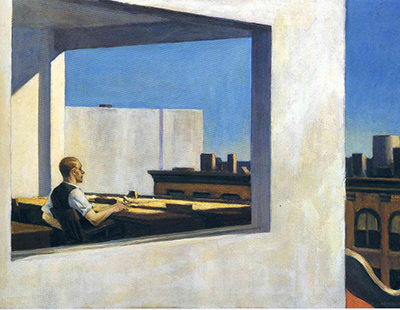
A man sits at a desk inside a large rectangular opening. Beyond him are rooftops, a pale blank wall and blue sky. A broad white pier divides his office from a second view at the right, where an older building's arched windows rise below the horizon. Edward Hopper's Office in a Small City gives one worker an expansive outlook while making the architecture around him unusually substantial.
The Metropolitan Museum of Art dates the oil on canvas to 1953 and records it as accession 53.183, acquired through the George A. Hearn Fund that year. Its current dimensions are 71.4 × 102.2 × 2.2 cm. The museum's account preserves Jo Hopper's description of its subject as a man enclosed by concrete walls. [1] Her phrase points to the physical relationship that dominates the image: a small seated body within a much larger building.
At a Glance
- ArtistEdward Hopper [1]
- Date1953 [1]
- Mediumoil on canvas [1]
- Collection / recordThe Metropolitan Museum of Art [1]
- Accession53.183 [1]
This work across Edward Hopper’s career
American Village
1912Soir Bleu
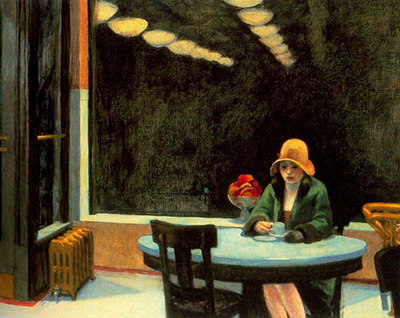
1914Automat
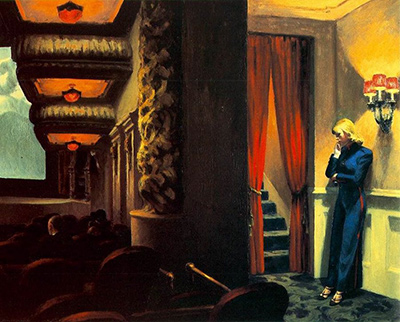
1927New York Movie
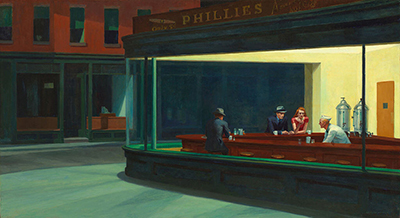
1939Nighthawks
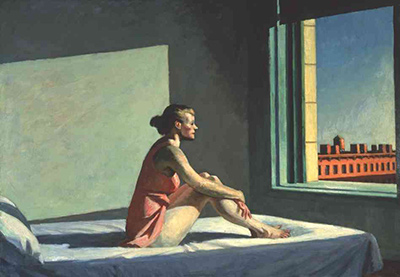
1942Morning Sun
1952Two Comedians
1966Contents
- A façade close to the spectator
- Two frames and a divided outlook
- The figure at the desk
- A pause whose duration remains uncertain
- Looking over roofs
- New construction and older windows
- The city appears in unequal pieces
- Sun on the wall, shade above the man
- The thickness of the white opening
- A composition considered on paper
A façade close to the spectator
The white wall occupies much of the foreground. We see its broad surface around the opening and the depth of the structure at its edges. The office is presented through architecture that remains firmly between the spectator and the worker.
The large opening resembles a picture within the picture. Its horizontal lower edge supports the visual grouping of man, desk and distant roofs, while its top and left side contain the space above him. Hopper makes the façade a frame substantial enough to compete with what it reveals.
At the right, the broad vertical pier separates this opening from another view. The man does not occupy the centre of an unobstructed panorama. His position is displaced towards the left by a structure that determines how much of the office and city can be seen at once.
The corner also creates an ambiguity of enclosure. The building offers large areas of apparent openness, yet the surrounding wall is heavy and emphatic. The worker has a view, but the spectator remains aware of the structure holding him in place.
Two frames and a divided outlook
The canvas gives the spectator an outer limit, then the building supplies another frame inside it. The man occupies that inner rectangle. His office is visible through a constructed opening whose pale edges are large enough to demand attention of their own.
The right-hand view complicates the arrangement. It is part of the same city setting, but it has no comparable human occupant in the visible area. We can move between a view organized around a person and another concerned chiefly with buildings and sky.
The broad pier makes the transition abrupt. It does not function like a thin line dividing adjacent scenes. Its illuminated face has substantial width and a shaded return, reminding us that it is a piece of construction with depth. The eye has to cross that material presence to resume looking outwards.
The two openings consequently offer different scales of access. At the left, a seated profile and desk provide a close measure of office life. At the right, the smaller windows of another facade imply interiors whose occupants cannot be seen. The building presents one worker distinctly while allowing the wider city to remain relatively anonymous.
This is also a painting of interruption. A broad outlook appears possible, yet the nearest wall repeatedly directs and limits it. The view's expansiveness and the building's weight are experienced together, rather than resolved by deciding that the room is simply open or closed.
The figure at the desk
The man appears in profile, facing towards the right. His light shirt and darker waistcoat make his torso and arms legible against the room's shaded areas. The chair gives his seated body a compact position near the bottom of the opening.
The desk stretches in front of him towards the window. Papers and small objects establish a working surface, but they do not identify a firm, a transaction or the exact nature of his employment. Office work is present as a setting and arrangement of things rather than as a completed task we can follow.
His head is directed across the desk towards the view. The painting does not show the concentration of someone bending closely over a document. His upright profile gives outward attention a place within the working day.
The small scale of the body matters. The desk, chair and man could form a conventional office portrait if brought closer and given more of the canvas. Hopper instead allows the wall and openings to dominate. A person becomes one element within a large arrangement of built surfaces.
A pause whose duration remains uncertain
The man's hands and arms remain near the desk, so his outward attention does not make him appear detached from the furniture. The body still has a working position. Looking away can occur within that position without becoming a narrated departure from it.
The profile is small enough to resist a detailed psychological reading. Its direction is clearer than its expression. We recognize a person looking across the desk, but do not receive the facial information that a close portrait might make available.
The surrounding surfaces enlarge the interval. Sky and wall occupy far more of the image than the visible paperwork. The spectator can spend time with those areas without progressing through a task the man has been shown completing.
The desk remains significant nevertheless. It gives the figure a specific kind of support and helps identify the space as an office rather than a bare lookout. The title's working environment survives even when the person's immediate attention seems to extend beyond it.
This gives the pause its particular character. It belongs to a place intended for activity, while its length and purpose remain unmeasured. Hopper makes that condition visible through posture and scale, rather than supplying a clock or a caption about what happens next.
Looking over roofs
The view beyond the worker is modest despite the breadth of the opening. Rooftops and a largely blank neighbouring wall fill much of the distance. The scene offers the ordinary structures of a city rather than a recognisable monument or celebrated skyline.
A low roofline carries small dark uprights against the sky. These details give the distance an uneven edge without breaking the broad simplicity of the composition. They also establish a scale different from the thick, close framing of the office.
The pale wall beyond the man repeats something of the foreground façade's colour and solidity. Architecture faces architecture across the gap. The office looks outward onto another building that offers comparatively little to inspect.
Blue sky remains visible above the roofs and beside the pier. Its open colour contrasts with the constructed rectangles below, but it does not dissolve the city into a limitless distance. Buildings repeatedly interrupt the view.
New construction and older windows
The building at the right has a more articulated façade. Arched window tops, darker outlines and reddish-brown surfaces distinguish it from the plain white office structure. Hopper gives two kinds of urban architecture different visual characters.
Smooth, broad planes stand beside smaller repeated openings and warmer masonry. The eye moves between a large modern-looking frame and an older-looking façade within its view.
The central pier keeps those parts separate. It blocks a substantial area through which the city might otherwise continue, making the architecture of the office a positive presence rather than merely the edge of a view.
At the lower right, a sloping roof introduces another diagonal. It points into the denser arrangement of buildings while countering the broad horizontal sill. A small fragment of construction helps prevent the scene from settling into a pattern of rectangles alone.
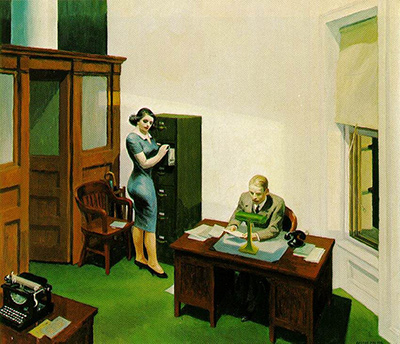
Compare: Office at Night, 1940.
The city appears in unequal pieces
The central opening contains a relatively plain neighbouring surface, while the view at the right contains a more articulated building. The difference makes the two parts of the city feel unequal in information as well as in size. One offers a broad plane; another gives repeated arches and darker recesses.
The small rooftop projections establish a line between those buildings and the sky. Their uneven heights prevent the distance from becoming a completely uniform band. At the same time, their limited scale keeps them subordinate to the nearer office frame.
The viewpoint also leaves the street unavailable. We cannot follow a pedestrian below, identify a business sign or use a junction to locate the building. The city is encountered through the parts visible above and across neighbouring roofs.
That restriction matters to the figure's relation with it. The man has an outlook, but the painting does not turn that outlook into a complete map of social activity. Built surfaces meet his view more conspicuously than other people do.
The result is an urban setting made from a few highly specific relations. Smooth and articulated facades, nearby and distant edges, broad sky and small roof details provide variety without requiring a recognizable skyline.
Sun on the wall, shade above the man
Light gives the white surfaces different weights. The front wall is bright, while the upper interior and the depth around the opening are darker. We can understand the thickness of the architecture through the change from illuminated face to shaded recess.
The desk catches a warmer passage of light. It brings the man's immediate surroundings into relation with the sunny exterior, even though the upper part of the office remains comparatively cool and shaded.
The sky's blue strengthens that coolness. Against the pale façade, it reads as a clear area beyond the building, while related darker tones within the opening keep the office from appearing wholly detached from the outdoors.
These relationships make the setting feel exposed and sheltered at the same time. The worker occupies a room with a broad outlook; the surrounding construction remains close and tangible to us. Light makes the depth of the opening visible while leaving the broad face of the pier emphatic.
The thickness of the white opening
The pale facade can seem almost blank at first, yet its depth is made through narrow changes of tone. The front face catches more light; the return towards the interior becomes darker. At the upper edge, a still deeper band gives the opening a firm limit above the man.
These differences keep the large frame from reading as a white border pasted around another picture. The opening belongs to a building whose surfaces face different directions. Their unequal illumination lets the viewer understand construction while still feeling the force of a broad, simplified colour area.
The desk participates in that relation at a smaller scale. Its surface is more visible than its underside and occupies a different light from the upper room. The man's immediate place of work therefore has a geometry of its own within the larger aperture.
The older building at the right supplies a useful comparison. Its smaller dark openings repeat, while the foreground office gives us one much larger view. The relation between wall and void is being considered at two architectural scales in a single canvas.
Colour joins those scales without making them uniform. The warm desk and neighbouring masonry answer one another, while the blue sky separates their upper edges from the office's pale frame. These warm and cool passages connect otherwise separated parts of the city.
A composition considered on paper
A drawing published by Modernism Inc. through Artsy is identified as Study for Office in a Small City, 1953, pencil on paper, measuring 7½ × 10 inches. Its view already includes the seated profile, desk, large opening, central pier and neighbouring building with arched windows. [2]
The drawing gives these elements a more searching appearance. Repeated strokes pass over the edges of the opening and the desk, while overlapping contours test the figure's position. The architecture is being assembled through lines that remain visible as alternatives and adjustments.
A few broad planes can look inevitable once completed in colour. The drawing makes their proportions and placement a visibly active concern. The width of the pier changes the view; the desk's height changes the seated figure's relation to the opening.
The right-hand building is useful in this respect. Its arched openings establish a contrast with the office's rectangle even in a drawing without the finished painting's colour relationships. The architectural difference belongs to the construction of the subject, not only to its eventual palette.
The sheet does not provide a complete account of every stage. It supplies one surviving comparison through which the painting's decisions become easier to see: a worker and city organised around a strongly framed view.
Watch: Edward Hopper’s Life and Art
Explore Hopper’s paintings and the places behind them in these museum films. Choose a film below.
From Cape Cod to New York
The Met's account records that Hopper began the painting on Cape Cod during the summer and completed it in New York in late October 1953. It was his only oil painting that year. [1] The city subject therefore developed across more than one working location.
That history cautions against identifying the scene with whatever Hopper could see directly outside one studio at one moment. The painting's final city is a composition he could continue working on after a move, rather than a view requiring him to remain before an unchanged site.
Its title is similarly general. A small city establishes a scale and kind of setting, but does not identify an actual address or name the building. The particularity comes from the relations of wall, desk, man and neighbouring roofs.
The museum acquired the painting shortly after completion. [1] Its accession number and fund credit locate that early institutional history more precisely than the anonymous office can be located on a map.
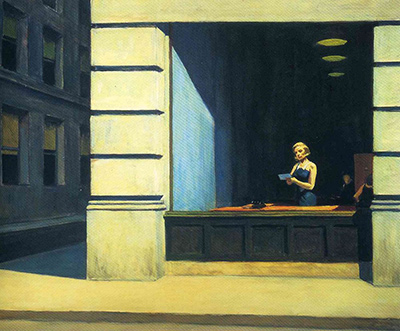
Compare: New York Office, 1962.
A solitary office in its later critical setting
The Met's Jessica Murphy places the picture within Hopper's continuing attention to isolation during the prosperity of postwar America. In her 2007 essay, the work becomes an example of individual experience remaining difficult despite a wider public atmosphere of optimism. [3] This is a historical interpretation of the painting's setting and figure, rather than a report about a particular employee.
Its usefulness lies in the difference of scales it proposes. A city can be economically active while one person experiences a quiet interval within it. The large white construction and the small body make those scales available for comparison without depicting a workplace dispute.
The same painting can also support attention to the pleasure of an outlook. The open blue and the strength of the light are substantial parts of the image. Taking isolation seriously does not require treating every bright passage as ironic or assuming the man dislikes being alone.
The painting's 1953 date locates its making, while the relation of a worker to his surroundings remains less explicitly resolved. Historical context gives that relation further questions; the actual arrangement determines which questions the image can sustain.
A worker interpreted through his setting
Gail Levin reads the man's stillness and separation from colleagues as part of Hopper's treatment of modern office life. Her discussion emphasises the contrast between his outward view and an environment that can feel isolating. [4]
The interpretation follows a real feature of the painting: one worker is visible within a large, sparsely described space. His expression does not, however, give a complete account of how he experiences his job. Boredom, resignation or a pleasant pause remain readings of the posture and setting.
The architecture does much of the work that a narrative might otherwise do. It determines the body's scale, separates him from the spectator and divides his outlook into distinct areas. The picture can sustain an argument about modern work through those relationships without showing a dispute or a demanding employer.
Victoria Chang tries several kinds of boss
Victoria Chang makes the question of rank explicit in her poem Edward Hopper's Office in a Small City, published in New England Review in 2012. Her speaker tries alternatives: the man may be a boss or have one, may be making decisions about employees, or may be occupied by something much less readily named. The poem presses the scene towards questions of profit, hiring, firing and the treatment of people as rearrangeable forms. [5]
The response draws force from information the painting leaves unresolved. A desk and an elevated view can suggest authority, but the man remains small within the surrounding architecture. The position is conspicuous without making his power measurable. Chang uses that uncertainty as a place for verbal invention.
Her pace also differs from the image's. The poem's clauses continue through alternatives and revisions, making thought move rapidly around the seated figure. The painting holds the profile and desk in place. Looking from one medium to the other makes the difference between a fixed posture and an unfolding speculation especially apparent.
The poem does not have to be treated as a solution to the scene. Its proposed decisions are part of a later work, rather than events legible in the papers on the painted desk. It makes a strong social response by demonstrating how much can be imagined from a small visible position.
The geometrical language is particularly apt. The canvas presents a body among rectangles and broad planes; the poem asks what follows when people are thought of as shapes that can be reassigned. A formal feature becomes available for a different kind of argument about work.
Returning to the painting after the poem can make the man's scale newly conspicuous. His body is distinctly present, yet the opening remains much larger. That relation can be examined without deciding that he possesses all the authority suggested by his place above the roofs.
Quiet read during a different moment
The Met placed Office in a Small City within another context in its April 2020 Art for Solace feature. A section on finding quiet brought the painting into a discussion of urban stillness during social distancing. [6] The setting demonstrates how the circumstances of viewing can change the questions a familiar image receives.
A solitary office may be read through loneliness, concentration, respite or the unfamiliar quiet of a city. The painting does not need to change for those responses to move in emphasis. The body, light and surrounding walls provide a stable arrangement through which later experience can be considered.
This history of response also makes the small-city title more interesting. It names a kind of setting without giving a street or a firm. The particular office remains convincing enough for different readers to bring their own knowledge of work and looking to it.
Other offices and other viewpoints
Office at Night gives two figures a denser room of desk, files, partition and several kinds of light. Here one man occupies a much more open-looking setting, but the surrounding wall retains a strong enclosing role.
New York Office returns the spectator to the street outside a large office window. Its prominent standing woman is seen through a façade at ground level, while Office in a Small City raises our attention towards a worker above neighbouring roofs.
The group in Conference at Night makes interpersonal exchange a visible possibility. This painting removes that immediate group and lets the man's relation to the view become central.
Look again at the white pier, then at the narrow profile of the worker beside it. The city can be seen through a large opening, yet the wall remains the nearer and larger presence. Hopper makes the distance between those scales the subject of an ordinary office day.
Artworks and studies directory
This researched directory includes finished works and separately identified studies. It is not a complete catalogue raisonné. Linked titles open the articles; unlinked studies are identified by their collection accessions. Watercolours retain their recorded media, and original prints remain distinct from reproductions.
| Name | Date | Medium |
|---|---|---|
| (Bridge and Embankment) (70.1298) | 1906 | Oil on wood |
| (Jo Sketching at Good Harbor Beach) (70.1129) | 1923–1924 | Watercolor and fabricated chalk on paper |
| (Manhattan Bridge) (70.1098) | 1925–1926 | Watercolor and graphite pencil on paper |
| (Rooftops) (70.1114) | 1926 | Watercolor and graphite pencil on paper |
| (Seated Male Model, Bent Over) (70.1277) | c. 1902–1903 | Oil on canvas |
| (Self-Portrait) (70.1254) | 1903–1906 | Oil on canvas |
| (Solitary Figure in a Theater) (70.1418) | c. 1902–1904 | Oil on board |
| 5 A.M. | 1937 | oil on canvas |
| Adam's House | 1928 | watercolour and charcoal on paper |
| American Village | 1912 | Oil on canvas |
| Apartment Houses | 1923 | oil on canvas |
| Approaching a City | 1946 | oil on canvas |
| August in the City | 1945 | oil on canvas |
| Automat | 1927 | oil on canvas |
| Barber Shop | 1931 | oil on canvas |
| Blackwell's Island | 1928 | oil on canvas |
| Bridge on the Seine | 1909 | Oil on canvas |
| Bridle Path | 1939 | oil on canvas |
| Burly Cobb's House South Truro | 1930–1933 | oil on canvas |
| Cape Cod Evening | 1939 | oil on canvas |
| Cape Cod Morning | 1950 | oil on canvas |
| Chair Car | 1965 | oil on canvas |
| Chop Suey | 1929 | oil on canvas |
| City Roofs | 1932 | Oil on canvas |
| Coast Guard Station | 1929 | oil on canvas |
| Compartment C, Car 293 | 1938 | oil on canvas |
| Conference at Night | 1949 | oil on canvas |
| Corn Hill | 1930 | oil on canvas |
| Dawn in Pennsylvania | 1942 | oil on canvas |
| Drug Store | 1927 | oil on canvas |
| Early Sunday Morning | 1930 | Oil on canvas |
| East Side Interior (70.1020) | 1922 | Etching |
| East Wind Over Weehawken | 1934 | oil on canvas |
| El Palacio | 1946 | Watercolor and graphite pencil on paper |
| Eleven A.M. | 1926 | oil on canvas |
| Evening Wind | 1921 | etching |
| Excursion into Philosophy | 1959 | oil on canvas |
| First Row Orchestra | 1951 | oil on canvas |
| Freight Car at Truro | 1931 | watercolour over graphite on paper |
| Gas | 1940 | oil on canvas |
| Girl at a Sewing Machine | c. 1921 | oil on canvas |
| Gloucester Harbor | 1912 | Oil on canvas |
| Ground Swell | 1939 | oil on canvas |
| Haskell's House | 1924 | watercolour over graphite on paperboard |
| High Noon | 1949 | oil on canvas |
| Hill and Houses Cape Elizabeth Maine | 1927 | watercolour over graphite pencil |
| Hills South Truro | 1930 | oil on canvas |
| Hotel by a Railroad | 1952 | oil on canvas |
| Hotel Lobby | 1943 | oil on canvas |
| Hotel Room | 1931 | oil on canvas |
| Hotel Window | 1955 | oil on canvas |
| House by the Railroad | 1925 | oil on canvas |
| House by the Squam River | 1926 | watercolour over graphite on paper |
| Le Bistro or The Wine Shop | 1909 | Oil on canvas |
| Le Pont des Arts | 1907 | Oil on canvas |
| Le Pont Royal | 1909 | Oil on canvas |
| Le Quai des Grands Augustins | 1909 | Oil on canvas |
| Lighthouse and Buildings Portland Head | 1927 | watercolour over graphite pencil on paper |
| Lighthouse Hill | 1927 | oil painting |
| Manhattan Bridge Loop | 1928 | oil on canvas |
| Model Sitting | c. 1902 | oil painting; support not asserted |
| Morning Sun | 1952 | oil on canvas |
| New York Movie | 1939 | oil on canvas |
| New York New Haven and Hartford | 1931 | oil on canvas |
| New York Office | 1962 | oil on canvas |
| New York Pavements | 1924–1925 | oil on canvas |
| New York Restaurant | c. 1922 | oil on canvas |
| Night Windows | 1928 | oil on canvas |
| Nighthawks | 1942 | oil on canvas |
| October on Cape Cod | 1946 | oil on canvas |
| Office at Night | 1940 | oil on canvas |
| Office in a Small City | 1953 | oil on canvas |
| Pennsylvania Coal Town | 1947 | oil on canvas |
| People in the Sun | 1960 | oil on canvas |
| Portrait of Orleans | 1950 | oil on canvas |
| Queensborough Bridge | 1913 | Oil on canvas |
| Railroad Sunset | 1929 | Oil on canvas |
| Railroad Train | 1908 | oil on canvas |
| Road in Maine | 1914 | oil on canvas |
| Room in Brooklyn | 1932 | oil on canvas |
| Room in New York | 1932 | oil on canvas |
| Rooms by the Sea | 1951 | oil on canvas |
| Rooms for Tourists | 1945 | oil on canvas |
| Route 6 Eastham | 1941 | oil on canvas |
| Second Story Sunlight | 1960 | Oil on canvas |
| Self-Portrait | 1925–1930 | Oil on canvas |
| Self-Portrait with Hat (70.1903) | c. 1918, posthumous print | Drypoint |
| Seven A.M. | 1948 | Oil on canvas |
| Soir Bleu | 1914 | oil on canvas |
| South Carolina Morning | 1955 | Oil on canvas |
| Stairway at 48 Rue de Lille Paris | 1906 | Oil on wood |
| Study for 5 A.M. (70.153) | 1937 | Fabricated chalk on paper |
| Study for 5 A.M. (70.429) | 1937 | Fabricated chalk and graphite pencil on paper |
| Study for Approaching a City (70.869) | 1946 | Fabricated chalk and charcoal on paper |
| Study for August in the City (70.158a-b) | 1945 | Fabricated chalk on paper |
| Study for August in the City (70.159) | 1945 | Fabricated chalk on paper |
| Study for Bridle Path (70.220) | 1939 | Fabricated chalk on paper |
| Study for Bridle Path (70.235) | 1939 | Fabricated chalk on paper |
| Study for Compartment C, Car 293 (70.430) | 1938 | Fabricated chalk on paper |
| Study for Compartment C, Car 293 (70.431a-b) | 1938 | Fabricated chalk and charcoal on paper |
| Study for Conference at Night (70.170) | 1949 | Fabricated chalk on paper (recto); Typewriter ink on paper (verso) |
| Study for Conference at Night (70.174) | 1949 | Fabricated chalk on paper ( recto); Typewriter ink on paper (verso) |
| Study for East Wind over Weehawken (70.249) | 1934 | Graphite pencil on paper |
| Study for East Wind over Weehawken (70.252) | 1934 | Fabricated chalk and charcoal on paper |
| Study for Evening Wind (70.343a-b) | 1921 | Fabricated chalk on paper |
| Study for First Row Orchestra (70.841) | 1951 | Fabricated chalk and charcoal on paper |
| Study for Gas (70.263) | 1940 | Fabricated chalk on paper |
| Study for Ground Swell (70.339) | 1939 | Fabricated chalk, charcoal and graphite pencil on paper |
| Study for Hotel by a Railroad (70.199) | 1952 | Fabricated chalk on paper |
| Study for Hotel by a Railroad (70.427) | 1952 | Fabricated chalk on paper |
| Study for Hotel by a Railroad (70.428) | 1952 | Fabricated chalk on paper |
| Study for Hotel Lobby (70.117) | 1942 | Fabricated chalk and graphite pencil on paper |
| Study for Hotel Lobby (70.839) | 1942 | Fabricated chalk and charcoal on paper |
| Study for Hotel Window (70.161) | 1955 | Fabricated chalk, graphite pencil and colored pencil on paper |
| Study for Morning Sun (70.243) | 1952 | Fabricated chalk on paper |
| Study for Morning Sun (70.244) | 1952 | Fabricated chalk on paper |
| Study for Morning Sun (70.290) | 1952 | Fabricated chalk on paper |
| Study for Morning Sun (70.291) | 1952 | Fabricated chalk and graphite pencil on paper |
| Study for New York Movie (70.273) | 1939 | Fabricated chalk on paper |
| Study for New York Movie (70.274a-b) | 1938 or 1939 | Fabricated chalk and charcoal on paper (recto); Fabricated chalk on paper (verso) |
| Study for New York Movie (70.455) | 1939 | Fabricated chalk and charcoal on paper |
| Study for New York Office (70.822) | 1962 | Fabricated chalk on paper |
| Study for Nighthawks (70.192) | 1941 or 1942 | Fabricated chalk on paper |
| Study for Nighthawks (70.193) | 1941 or 1942 | Fabricated chalk on paper |
| Study for Office at Night (70.340) | 1940 | Fabricated chalk and charcoal on paper |
| Study for Office at Night (70.341) | 1940 | Fabricated chalk and graphite pencil on paper |
| Study for Pennsylvania Coal Town (70.198) | 1947 | Fabricated chalk on paper |
| Study for Pennsylvania Coal Town (70.229) | 1947 | Fabricated chalk and charcoal on paper |
| Study for Rooms for Tourists (70.438) | 1945 | Fabricated chalk and charcoal on paper |
| Study for Rooms for Tourists (70.848) | 1945 | Fabricated chalk and charcoal on paper |
| Study for Route 6, Eastham (70.369) | 1941 | Fabricated chalk and graphite pencil on paper |
| Study for Route 6, Eastham (70.854) | 1941 | Fabricated chalk and graphite pencil on paper |
| Study for South Carolina Morning (70.162a-b) | 1955 | Fabricated chalk on paper (recto and verso) |
| Study for The Sheridan Theatre (70.969) | 1937 | Graphite pencil on paper |
| Study for Two on the Aisle (70.128) | 1927 | Fabricated chalk on paper |
| Study for Two on the Aisle (70.129) | 1927 | Fabricated chalk on paper |
| Study for Yawl Riding a Swell (70.439) | 1935 | Fabricated chalk and graphite pencil on paper |
| Summer Evening | 1947 | oil on canvas |
| Summer Interior | 1909 | Oil on canvas |
| Sun in an Empty Room | 1963 | oil on canvas |
| Sunlight in a Cafeteria | 1958 | oil on canvas |
| Sunlight on Brownstones | 1956 | oil on canvas |
| Tables for Ladies | 1930 | oil on canvas |
| The Bootleggers | 1925 | oil on canvas |
| The Camel's Hump | 1931 | oil on canvas |
| The Circle Theatre | 1936 | oil on canvas |
| The City | 1927 | oil on canvas |
| The Lighthouse at Two Lights | 1929 | oil on canvas |
| The Long Leg | 1935 | oil on canvas |
| The Mansard Roof | 1923 | watercolour over graphite on paper |
| The Sheridan Theatre | 1937 | oil on canvas |
| Tramp Steamer | 1908 | oil on canvas |
| Two Comedians | 1966 | oil on canvas |
| Two on the Aisle | 1927 | oil on canvas |
| Valley of the Seine | 1909 | Oil on canvas |
| Western Motel | 1957 | oil on canvas |
Frequently Asked Questions
Edward Hopper made Office in a Small City in 1953. [1]
The recorded medium is oil on canvas. [1]
A man sits at a desk inside a large rectangular opening. Beyond him are rooftops, a pale blank wall and blue sky. A broad white pier divides his office from a second view at the right, where an older building's arched windows rise below the horizon. Edward Hopper's Office in a Small City gives one worker an expansive outlook while making the architecture around him unusually substantial.
Discussion
Look again at the images and ideas explored in Office in a Small City. These editorial prompts invite your observations.
Reader Insights
Which boundary, gesture or change of light first holds your attention in Office in a Small City?
Compare Office at Night with Office in a Small City. Which visual difference matters most to your reading?
Which detail would you look at again after reading “Looking over roofs”?
Join the Conversation
Share a detail, comparison or question about Office in a Small City below.
References
- The Metropolitan Museum of Art, Office in a Small City, 1953, accession 53.183; collection metadata and account of its completion and acquisition. View source.
- Modernism Inc., Study for Office in a Small City, 1953, pencil on paper, published dealer record and image through Artsy. View source.
- Jessica Murphy, “Edward Hopper (1882–1967)”, Heilbrunn Timeline of Art History, The Metropolitan Museum of Art, June 2007, concluding discussion linked to Office in a Small City; attributed postwar-isolation interpretation. View source.
- Gail Levin, “The Office Image in the Visual Arts,” Arts Magazine, September 1984, pp. 98–103, especially p. 102.
- Victoria Chang, “Edward Hopper's Office in a Small City”, New England Review, 33, no. 1, Spring 2012; complete publisher-hosted poem examined, paraphrased here as a later creative response with no verse quotation. View source.
- Stephanie L. Herdrich and The Digital Editors, “Art for Solace: Winslow Homer's The Veteran in a New Field and More”, The Metropolitan Museum of Art, 17 April 2020, “Finding Quiet” section; published reception context, not a claim to have watched its linked video. View source.
- Collection or catalogue record, American Village, 1912; medium and identity as discussed in the linked article. View source.
- Collection or catalogue record, Soir Bleu, 1914; medium and identity as discussed in the linked article. View source.
- Collection or catalogue record, House by the Railroad, 1925; medium and identity as discussed in the linked article. View source.
- Collection or catalogue record, Automat, 1927; medium and identity as discussed in the linked article. View source.
- Collection or catalogue record, Early Sunday Morning, 1930; medium and identity as discussed in the linked article. View source.
- Collection or catalogue record, New York Movie, 1939; medium and identity as discussed in the linked article. View source.
- Collection or catalogue record, Nighthawks, 1942; medium and identity as discussed in the linked article. View source.
- Collection or catalogue record, Morning Sun, 1952; medium and identity as discussed in the linked article. View source.
- Collection or catalogue record, Second Story Sunlight, 1960; medium and identity as discussed in the linked article. View source.
- Collection or catalogue record, Two Comedians, 1966; medium and identity as discussed in the linked article. View source.
- Whitney Museum of American Art, Study for Route 6, Eastham, 1941, accession 70.854; exact object record. View source.
- Whitney Museum of American Art, Study for Conference at Night, 1949, accession 70.170; exact object record. View source.
- Whitney Museum of American Art, Study for First Row Orchestra, 1951, accession 70.841; exact object record. View source.
- Whitney Museum of American Art, (Bridge and Embankment), 1906, accession 70.1298; exact object record. View source.
- Whitney Museum of American Art, (Seated Male Model, Bent Over), c. 1902–1903, accession 70.1277; exact object record. View source.
- Whitney Museum of American Art, Study for Morning Sun, 1952, accession 70.244; exact object record. View source.
- Whitney Museum of American Art, Study for Morning Sun, 1952, accession 70.243; exact object record. View source.
- Whitney Museum of American Art, Study for Two on the Aisle, 1927, accession 70.128; exact object record. View source.
- Whitney Museum of American Art, Study for New York Office, 1962, accession 70.822; exact object record. View source.
- Whitney Museum of American Art, Study for Two on the Aisle, 1927, accession 70.129; exact object record. View source.
- Whitney Museum of American Art, Study for Pennsylvania Coal Town, 1947, accession 70.229; exact object record. View source.
- Whitney Museum of American Art, (Rooftops), 1926, accession 70.1114; exact object record. View source.
- Whitney Museum of American Art, Study for South Carolina Morning, 1955, accession 70.162a-b; exact object record. View source.
- Whitney Museum of American Art, (Self-Portrait), 1903–1906, accession 70.1254; exact object record. View source.
- Whitney Museum of American Art, (Manhattan Bridge), 1925–1926, accession 70.1098; exact object record. View source.
- Whitney Museum of American Art, (Solitary Figure in a Theater), c. 1902–1904, accession 70.1418; exact object record. View source.
- Whitney Museum of American Art, Study for Approaching a City, 1946, accession 70.869; exact object record. View source.
- Whitney Museum of American Art, Study for August in the City, 1945, accession 70.159; exact object record. View source.
- Whitney Museum of American Art, Study for Compartment C, Car 293, 1938, accession 70.430; exact object record. View source.
- Whitney Museum of American Art, Study for Compartment C, Car 293, 1938, accession 70.431a-b; exact object record. View source.
- Whitney Museum of American Art, Study for East Wind over Weehawken, 1934, accession 70.252; exact object record. View source.
- Whitney Museum of American Art, Study for East Wind over Weehawken, 1934, accession 70.249; exact object record. View source.
- Whitney Museum of American Art, Study for Evening Wind, 1921, accession 70.343a-b; exact object record. View source.
- Whitney Museum of American Art, Study for The Sheridan Theatre, 1937, accession 70.969; exact object record. View source.
- Whitney Museum of American Art, Study for New York Movie, 1939, accession 70.455; exact object record. View source.
- Whitney Museum of American Art, Study for New York Movie, 1939, accession 70.273; exact object record. View source.
- Whitney Museum of American Art, Study for New York Movie, 1938 or 1939, accession 70.274a-b; exact object record. View source.
- Whitney Museum of American Art, Study for 5 A.M., 1937, accession 70.153; exact object record. View source.
- Whitney Museum of American Art, Study for 5 A.M., 1937, accession 70.429; exact object record. View source.
- Whitney Museum of American Art, (Jo Sketching at Good Harbor Beach), 1923–1924, accession 70.1129; exact object record. View source.
- Whitney Museum of American Art, Study for August in the City, 1945, accession 70.158a-b; exact object record. View source.
- Whitney Museum of American Art, Study for Morning Sun, 1952, accession 70.291; exact object record. View source.
- Whitney Museum of American Art, Study for Morning Sun, 1952, accession 70.290; exact object record. View source.
- Whitney Museum of American Art, Study for Office at Night, 1940, accession 70.340; exact object record. View source.
- Whitney Museum of American Art, Study for Office at Night, 1940, accession 70.341; exact object record. View source.
- Whitney Museum of American Art, Study for Hotel by a Railroad, 1952, accession 70.427; exact object record. View source.
- Whitney Museum of American Art, Study for Hotel by a Railroad, 1952, accession 70.199; exact object record. View source.
- Whitney Museum of American Art, Study for Hotel by a Railroad, 1952, accession 70.428; exact object record. View source.
- Whitney Museum of American Art, Study for Hotel Lobby, 1942, accession 70.117; exact object record. View source.
- Whitney Museum of American Art, Study for Hotel Lobby, 1942, accession 70.839; exact object record. View source.
- Whitney Museum of American Art, Study for Conference at Night, 1949, accession 70.174; exact object record. View source.
- Whitney Museum of American Art, Study for Hotel Window, 1955, accession 70.161; exact object record. View source.
- Whitney Museum of American Art, Study for Pennsylvania Coal Town, 1947, accession 70.198; exact object record. View source.
- Whitney Museum of American Art, Study for Route 6, Eastham, 1941, accession 70.369; exact object record. View source.
- Whitney Museum of American Art, Study for Bridle Path, 1939, accession 70.220; exact object record. View source.
- Whitney Museum of American Art, Study for Bridle Path, 1939, accession 70.235; exact object record. View source.
- Whitney Museum of American Art, Study for Ground Swell, 1939, accession 70.339; exact object record. View source.
- Whitney Museum of American Art, Study for Yawl Riding a Swell, 1935, accession 70.439; exact object record. View source.
- Whitney Museum of American Art, Study for Rooms for Tourists, 1945, accession 70.848; exact object record. View source.
- Whitney Museum of American Art, Study for Rooms for Tourists, 1945, accession 70.438; exact object record. View source.
- Whitney Museum of American Art, Study for Nighthawks, 1941 or 1942, accession 70.193; exact object record. View source.
- Whitney Museum of American Art, Study for Nighthawks, 1941 or 1942, accession 70.192; exact object record. View source.
- Whitney Museum of American Art, Study for Gas, 1940, accession 70.263; exact object record. View source.
- Whitney Museum of American Art, Self-Portrait with Hat, c. 1918, posthumous print, accession 70.1903; exact object record. View source.
- Whitney Museum of American Art, East Side Interior, 1922, accession 70.1020; exact object record. View source.
- Art Institute of Chicago, Selected Chronology for Edward Hopper; training, travels, exhibitions, New York and Truro chronology. View source.
- Emily C. Burns, Spectral figures: Edward Hopper’s empty Paris, chapter 5 in Empty Spaces: Confronting Emptiness in National, Cultural and Urban Histories, 2019; complete chapter and notes consulted. View source.
- Charles Brock, Regionalism and Folk Art, National Gallery of Art; complete essay and two notes consulted. View source.