 by Tom Gurney
Tom Gurney BSc (Hons) is an art history expert with over 20 years experience
Email: tomgurney1@gmail.com / Phone: +44 7429 011000
Hotel Lobby: Introduction
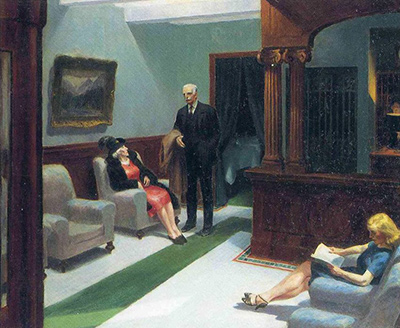
A green stripe crosses a pale floor towards a dark wooden reception desk. An older woman sits beside a standing man on one side of it; a younger woman reads in an armchair on the other. Behind the desk, a small illuminated face introduces a fourth person who is much easier to overlook. Edward Hopper's Hotel Lobby makes a public interior feel divided into distinct areas of attention.
The Indianapolis Museum of Art at Newfields records the painting as an oil on canvas of 1943, accession 47.4, in the William Ray Adams Memorial Collection. The canvas measures 32¼ × 40¾ inches. [1] Reception furniture, seating, passages and a lift grille give the hotel a working arrangement, even while the occupants remain suspended between possible activities.
At a Glance
- ArtistEdward Hopper [1]
- Date1943 [1]
- Mediumoil on canvas [1]
- Collection / recordIndianapolis Museum of Art at Newfields [1]
- Accession47.4 [1]
This work across Edward Hopper’s career
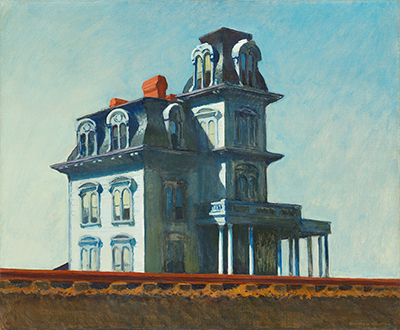
American Village
1912Soir Bleu
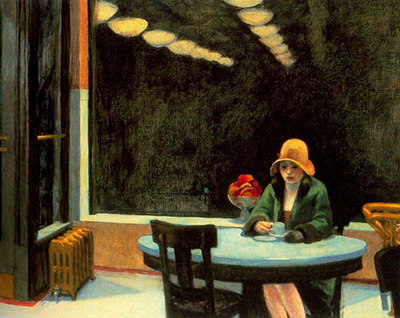
1914Automat
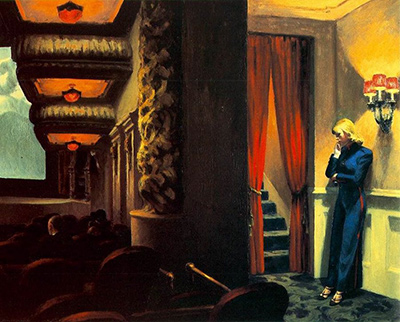
1927New York Movie
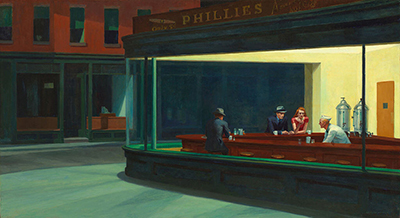
1939Nighthawks
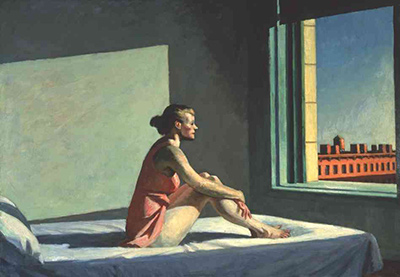
1942Morning Sun
1952Two Comedians
1966Contents
- Following the green stripe
- The woman and the standing man
- The reader in the foreground
- Finding the clerk
- Woodwork, openings and light
- A different occupant in a drawing
- What examination of the canvas adds
- The Hopes and the museum
- From a room to a public interior
Following the green stripe
The stripe is one of the picture's most effective guides. It starts close to the spectator and runs diagonally into the room, bringing the eye towards the reception area. The pale floor around it makes its colour and changing direction especially conspicuous.
This band is both part of the furnishing and a division between people. The older pair occupy the left-hand side, while the reader sits nearer the foreground at the right. The stripe connects the visible room to the desk without joining the figures in a shared action.
The desk gives that movement a destination. Its substantial wooden front and columns make it the lobby's most elaborate structure. It is a place where a visitor could approach a member of staff, but no guest is shown completing a transaction.
A narrow coloured border around its base reinforces the sense of an enclosure within the larger room. Hopper creates an interior with its own smaller territories: seats for waiting, a route across the floor, and a desk that separates staff from guests.
The arrangement gives us an unusual view of circulation. We can imagine entering, crossing the floor or moving towards another part of the hotel. The painting holds all those possibilities at the stage before they become a visible event.
The woman and the standing man
At the left, the older woman's red dress supplies a warm accent among cooler walls and upholstery. Her hat and outer clothing give her a different appearance from the younger reader in a short-sleeved blue dress. The contrast is visible without requiring a precise account of where either woman intends to go.
The seated woman's head turns towards the man beside her. He stands in dark clothing, with a coat over one arm, and directs his face more towards the space in front of him. Their differing orientations make their proximity noticeable.
They may be companions, as their adjacent positions suggest. Yet the picture supplies no spoken exchange. Whether the woman expects a response, has just finished speaking, or is simply looking towards him remains open to interpretation.
The coat adds bulk to the man's outline and occupies part of the interval between the bodies. It is an ordinary carried garment that also affects the shape of their grouping. Hopper makes a practical detail contribute to the organisation of the figures.
Behind them hangs an elaborately framed landscape. Its smaller pictured world contrasts with the room's occupied foreground. The guests sit and stand below a view that offers no actual route out of the hotel.
The reader in the foreground
The younger woman sits closer to us, turned across her chair with a book open before her. Her pale legs extend into the light, and her blond hair stands out against the darker furnishings. Reading gives her a task distinct from the older pair's less clearly defined pause.
The book creates a small area of attention within the larger public space. She can remain visible to other people while directing her own gaze towards its pages. Hopper gives us access to her posture without making the text readable.
Her position also changes our experience of the room's scale. We look down towards the chair and extended legs, while the standing man and reception architecture rise farther back. The view does not feel like the simple outlook of someone seated at the same height as the reader.
Newfields suggests that the elevated viewpoint may relate to Hopper's familiarity with watching theatre from a balcony. [1] It is a useful comparison for the sense of figures arranged below an observer, rather than proof that this lobby reproduces a particular theatre or hotel.
Finding the clerk
The face behind the desk changes the room once we notice it. The lobby contains three guests and a member of staff, rather than only the conspicuous groupings in the seating area. Newfields identifies the partly concealed figure as the desk clerk. [1]
The clerk's limited visibility contrasts with the reader's exposed position in the foreground. One body is largely hidden within a structure; another is displayed through an open arrangement of chair, dress and legs. This difference invites questions about watching and being watched.
The face does not, however, establish a definite object of attention. The desk and lighting make the figure difficult to read. A claim that the clerk is looking at a particular guest goes beyond what the small visible area can securely tell us.
A hotel desk is a place where an employee observes arrivals and responds to guests. Hopper makes that function present without giving us a check-in, a request for a key or a completed conversation.
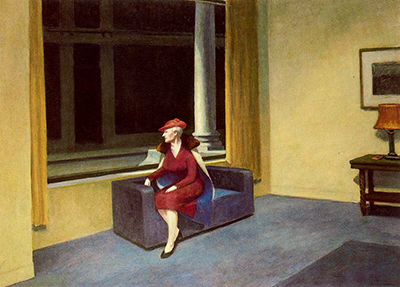
Compare: Hotel Window, 1955.
Woodwork, openings and light
The reception area's columns and upper framing make a strong vertical structure. Their warm brown tones contrast with the cooler wall and floor, giving the desk visual weight even where much of it remains dark.
A dark opening behind the older pair and the grille farther right suggest routes towards other parts of the building. They extend the hotel beyond the lobby without revealing the rooms reached by those passages. This is a place between the street and more private accommodation.
The ceiling contributes to its enclosure. Its horizontal and diagonal divisions lead across the upper part of the image, while strong changes of brightness make the architecture feel heavier in some places than others. Light defines the setting as actively as the outlines of furniture do.
The floor contains the broadest pale area, setting off the green stripe and the shadows around the chairs. Above it, smaller highlights pick out the landscape frame, parts of the desk structure and the faces. The illumination gives different portions of the room different degrees of exposure.
Newfields's interpretation links the lighting, rug and architecture with the separation of the occupants. [1] The effect depends on visible arrangements: proximity does not produce a shared direction of looking, and a common room does not become a common activity.
Watch: Edward Hopper’s Life and Art
Explore Hopper’s paintings and the places behind them in these museum films. Choose a film below.
A different occupant in a drawing
A Whitney Museum composition study, accession 70.117, dates to 1942 and combines fabricated chalk with graphite pencil. The ceiling, reception structure, floor division and left-hand figures already establish much of the lobby's organisation. At the right, however, a seated man occupies the area later given to the young reader. [2]
The drawing makes the eventual choice of occupant significant. The arrangement of seats was not merely waiting for colour to complete it; the identities and poses within it could change. The study also contains additional exploratory lines and a less settled figure at the far left.
Another Whitney sheet, accession 70.839, concentrates on a woman reading in an upholstered chair. Dated 1942, it uses fabricated chalk and charcoal on an irregular sheet. The open book, extended crossed legs, strapped shoes and chair with a fringed lower edge are all available for close inspection. [3]
The figure drawing gives the reader a material history separate from the larger room. Hands, book and chair are considered together, while the surrounding architecture is absent. The fringed edge differs from the firmer painted chair, showing a furnishing being changed around the posed figure.
The dates distinguish preparatory work from the museum's 1943 date for the oil. They also allow us to see two scales of thinking: the distribution of people across a lobby and the detailed arrangement of one reading body.
What examination of the canvas adds
In her museum monograph Paper to Paint, Harriet G. Warkel discusses ten known preparatory sketches while acknowledging that their order is uncertain. She records Jo Hopper posing for the female figures and describes changes between the drawings and the final cast of occupants. [4]
Warkel also reports X-ray and infrared examination. The findings include an adjustment to the reader's head, dark-blue outlining and evidence of partial underdrawing. Microscopic examination indicated that the clerk was painted after the lamp in that area. These findings clarify stages of making without establishing why Hopper added the figure. [4]
Her account distinguishes physical evidence from the many stories that the finished room can prompt. An alteration beneath the surface can establish a changed position; it cannot by itself establish a character's private motives. The drawings and technical findings make the painting's decisions more traceable while leaving its encounter unresolved.
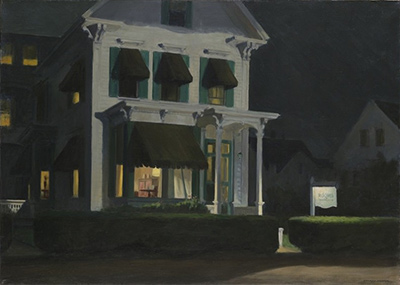
Compare: Rooms for Tourists, 1945.
The Hopes and the museum
The painting passed from Hopper to Frank K. M. Rehn Gallery in 1943. Newfields's provenance cites the record book for delivery on 4 January that year, and a bill of sale dated 27 July 1944 for its purchase by Henry R. and Sarahanne Hope. [1]
The Hopes gave it to the John Herron Art Institute in 1947 as part of the William Ray Adams Memorial Collection. Sarahanne was Adams's daughter. The work's present Newfields identity continues that Indianapolis collection history. [1]
Its later exhibition history has repeatedly returned to the relation between drawings and painting, including the 2008 exhibition Edward Hopper: Paper to Paint and the 2013 Hopper Drawing exhibition. It also appeared in Edward Hopper and the American Hotel at the Virginia Museum of Fine Arts in 2019–20 and Newfields in 2020. [1]
Those different settings bring different aspects of the canvas forward. A drawing exhibition makes its revisions prominent; an exhibition about hotels encourages attention to the social uses of this intermediate public room. The painted details can sustain both approaches.
From a room to a public interior
Hotel Room gives one traveller a more private enclosure with a bed, luggage and timetable. Hotel Lobby brings several people into a shared area where staying, leaving, reading and approaching a desk are all possible.
Hotel Window offers another arrangement of hotel seating and looking. Here the reception desk and patterned floor make the practical organisation of the lobby especially prominent.
The partitioned space of New York Movie provides a useful comparison for bodies held within elaborate public architecture. In the lobby, the floor stripe takes over some of the work of separating areas and directing the eye.
Follow that stripe again towards the dark desk, then return to the book and the older woman's turned head. The painting gives several forms of attention a common setting. Its architecture holds them together without making them resolve into one conversation.
Artworks and studies directory
This researched directory includes finished works and separately identified studies. It is not a complete catalogue raisonné. Linked titles open the articles; unlinked studies are identified by their collection accessions. Watercolours retain their recorded media, and original prints remain distinct from reproductions.
| Name | Date | Medium |
|---|---|---|
| (Bridge and Embankment) (70.1298) | 1906 | Oil on wood |
| (Jo Sketching at Good Harbor Beach) (70.1129) | 1923–1924 | Watercolor and fabricated chalk on paper |
| (Manhattan Bridge) (70.1098) | 1925–1926 | Watercolor and graphite pencil on paper |
| (Rooftops) (70.1114) | 1926 | Watercolor and graphite pencil on paper |
| (Seated Male Model, Bent Over) (70.1277) | c. 1902–1903 | Oil on canvas |
| (Self-Portrait) (70.1254) | 1903–1906 | Oil on canvas |
| (Solitary Figure in a Theater) (70.1418) | c. 1902–1904 | Oil on board |
| 5 A.M. | 1937 | oil on canvas |
| Adam's House | 1928 | watercolour and charcoal on paper |
| American Village | 1912 | Oil on canvas |
| Apartment Houses | 1923 | oil on canvas |
| Approaching a City | 1946 | oil on canvas |
| August in the City | 1945 | oil on canvas |
| Automat | 1927 | oil on canvas |
| Barber Shop | 1931 | oil on canvas |
| Blackwell's Island | 1928 | oil on canvas |
| Bridge on the Seine | 1909 | Oil on canvas |
| Bridle Path | 1939 | oil on canvas |
| Burly Cobb's House South Truro | 1930–1933 | oil on canvas |
| Cape Cod Evening | 1939 | oil on canvas |
| Cape Cod Morning | 1950 | oil on canvas |
| Chair Car | 1965 | oil on canvas |
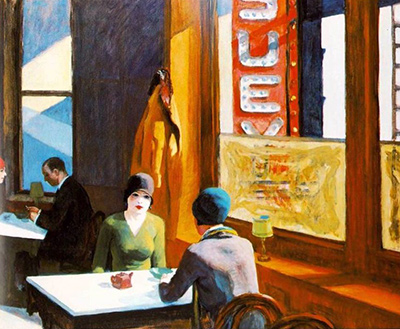
| Chop Suey | 1929 | oil on canvas |
| City Roofs | 1932 | Oil on canvas |
| Coast Guard Station | 1929 | oil on canvas |
| Compartment C, Car 293 | 1938 | oil on canvas |
| Conference at Night | 1949 | oil on canvas |
| Corn Hill | 1930 | oil on canvas |
| Dawn in Pennsylvania | 1942 | oil on canvas |
| Drug Store | 1927 | oil on canvas |
| Early Sunday Morning | 1930 | Oil on canvas |
| East Side Interior (70.1020) | 1922 | Etching |
| East Wind Over Weehawken | 1934 | oil on canvas |
| El Palacio | 1946 | Watercolor and graphite pencil on paper |
| Eleven A.M. | 1926 | oil on canvas |
| Evening Wind | 1921 | etching |
| Excursion into Philosophy | 1959 | oil on canvas |
| First Row Orchestra | 1951 | oil on canvas |
| Freight Car at Truro | 1931 | watercolour over graphite on paper |
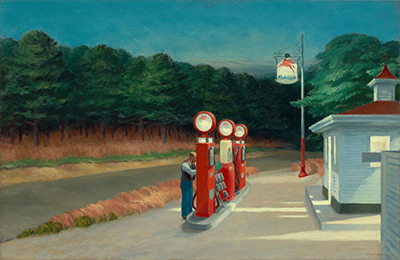
| Gas | 1940 | oil on canvas |
| Girl at a Sewing Machine | c. 1921 | oil on canvas |
| Gloucester Harbor | 1912 | Oil on canvas |
| Ground Swell | 1939 | oil on canvas |
| Haskell's House | 1924 | watercolour over graphite on paperboard |
| High Noon | 1949 | oil on canvas |
| Hill and Houses Cape Elizabeth Maine | 1927 | watercolour over graphite pencil |
| Hills South Truro | 1930 | oil on canvas |
| Hotel by a Railroad | 1952 | oil on canvas |
| Hotel Lobby | 1943 | oil on canvas |
| Hotel Room | 1931 | oil on canvas |
| Hotel Window | 1955 | oil on canvas |
| House by the Railroad | 1925 | oil on canvas |
| House by the Squam River | 1926 | watercolour over graphite on paper |
| Le Bistro or The Wine Shop | 1909 | Oil on canvas |
| Le Pont des Arts | 1907 | Oil on canvas |
| Le Pont Royal | 1909 | Oil on canvas |
| Le Quai des Grands Augustins | 1909 | Oil on canvas |
| Lighthouse and Buildings Portland Head | 1927 | watercolour over graphite pencil on paper |
| Lighthouse Hill | 1927 | oil painting |
| Manhattan Bridge Loop | 1928 | oil on canvas |
| Model Sitting | c. 1902 | oil painting; support not asserted |
| Morning Sun | 1952 | oil on canvas |
| New York Movie | 1939 | oil on canvas |
| New York New Haven and Hartford | 1931 | oil on canvas |
| New York Office | 1962 | oil on canvas |
| New York Pavements | 1924–1925 | oil on canvas |
| New York Restaurant | c. 1922 | oil on canvas |
| Night Windows | 1928 | oil on canvas |
| Nighthawks | 1942 | oil on canvas |
| October on Cape Cod | 1946 | oil on canvas |
| Office at Night | 1940 | oil on canvas |
| Office in a Small City | 1953 | oil on canvas |
| Pennsylvania Coal Town | 1947 | oil on canvas |
| People in the Sun | 1960 | oil on canvas |
| Portrait of Orleans | 1950 | oil on canvas |
| Queensborough Bridge | 1913 | Oil on canvas |
| Railroad Sunset | 1929 | Oil on canvas |
| Railroad Train | 1908 | oil on canvas |
| Road in Maine | 1914 | oil on canvas |
| Room in Brooklyn | 1932 | oil on canvas |
| Room in New York | 1932 | oil on canvas |
| Rooms by the Sea | 1951 | oil on canvas |
| Rooms for Tourists | 1945 | oil on canvas |
| Route 6 Eastham | 1941 | oil on canvas |
| Second Story Sunlight | 1960 | Oil on canvas |
| Self-Portrait | 1925–1930 | Oil on canvas |
| Self-Portrait with Hat (70.1903) | c. 1918, posthumous print | Drypoint |
| Seven A.M. | 1948 | Oil on canvas |
| Soir Bleu | 1914 | oil on canvas |
| South Carolina Morning | 1955 | Oil on canvas |
| Stairway at 48 Rue de Lille Paris | 1906 | Oil on wood |
| Study for 5 A.M. (70.153) | 1937 | Fabricated chalk on paper |
| Study for 5 A.M. (70.429) | 1937 | Fabricated chalk and graphite pencil on paper |
| Study for Approaching a City (70.869) | 1946 | Fabricated chalk and charcoal on paper |
| Study for August in the City (70.158a-b) | 1945 | Fabricated chalk on paper |
| Study for August in the City (70.159) | 1945 | Fabricated chalk on paper |
| Study for Bridle Path (70.220) | 1939 | Fabricated chalk on paper |
| Study for Bridle Path (70.235) | 1939 | Fabricated chalk on paper |
| Study for Compartment C, Car 293 (70.430) | 1938 | Fabricated chalk on paper |
| Study for Compartment C, Car 293 (70.431a-b) | 1938 | Fabricated chalk and charcoal on paper |
| Study for Conference at Night (70.170) | 1949 | Fabricated chalk on paper (recto); Typewriter ink on paper (verso) |
| Study for Conference at Night (70.174) | 1949 | Fabricated chalk on paper ( recto); Typewriter ink on paper (verso) |
| Study for East Wind over Weehawken (70.249) | 1934 | Graphite pencil on paper |
| Study for East Wind over Weehawken (70.252) | 1934 | Fabricated chalk and charcoal on paper |
| Study for Evening Wind (70.343a-b) | 1921 | Fabricated chalk on paper |
| Study for First Row Orchestra (70.841) | 1951 | Fabricated chalk and charcoal on paper |
| Study for Gas (70.263) | 1940 | Fabricated chalk on paper |
| Study for Ground Swell (70.339) | 1939 | Fabricated chalk, charcoal and graphite pencil on paper |
| Study for Hotel by a Railroad (70.199) | 1952 | Fabricated chalk on paper |
| Study for Hotel by a Railroad (70.427) | 1952 | Fabricated chalk on paper |
| Study for Hotel by a Railroad (70.428) | 1952 | Fabricated chalk on paper |
| Study for Hotel Lobby (70.117) | 1942 | Fabricated chalk and graphite pencil on paper |
| Study for Hotel Lobby (70.839) | 1942 | Fabricated chalk and charcoal on paper |
| Study for Hotel Window (70.161) | 1955 | Fabricated chalk, graphite pencil and colored pencil on paper |
| Study for Morning Sun (70.243) | 1952 | Fabricated chalk on paper |
| Study for Morning Sun (70.244) | 1952 | Fabricated chalk on paper |
| Study for Morning Sun (70.290) | 1952 | Fabricated chalk on paper |
| Study for Morning Sun (70.291) | 1952 | Fabricated chalk and graphite pencil on paper |
| Study for New York Movie (70.273) | 1939 | Fabricated chalk on paper |
| Study for New York Movie (70.274a-b) | 1938 or 1939 | Fabricated chalk and charcoal on paper (recto); Fabricated chalk on paper (verso) |
| Study for New York Movie (70.455) | 1939 | Fabricated chalk and charcoal on paper |
| Study for New York Office (70.822) | 1962 | Fabricated chalk on paper |
| Study for Nighthawks (70.192) | 1941 or 1942 | Fabricated chalk on paper |
| Study for Nighthawks (70.193) | 1941 or 1942 | Fabricated chalk on paper |
| Study for Office at Night (70.340) | 1940 | Fabricated chalk and charcoal on paper |
| Study for Office at Night (70.341) | 1940 | Fabricated chalk and graphite pencil on paper |
| Study for Pennsylvania Coal Town (70.198) | 1947 | Fabricated chalk on paper |
| Study for Pennsylvania Coal Town (70.229) | 1947 | Fabricated chalk and charcoal on paper |
| Study for Rooms for Tourists (70.438) | 1945 | Fabricated chalk and charcoal on paper |
| Study for Rooms for Tourists (70.848) | 1945 | Fabricated chalk and charcoal on paper |
| Study for Route 6, Eastham (70.369) | 1941 | Fabricated chalk and graphite pencil on paper |
| Study for Route 6, Eastham (70.854) | 1941 | Fabricated chalk and graphite pencil on paper |
| Study for South Carolina Morning (70.162a-b) | 1955 | Fabricated chalk on paper (recto and verso) |
| Study for The Sheridan Theatre (70.969) | 1937 | Graphite pencil on paper |
| Study for Two on the Aisle (70.128) | 1927 | Fabricated chalk on paper |
| Study for Two on the Aisle (70.129) | 1927 | Fabricated chalk on paper |
| Study for Yawl Riding a Swell (70.439) | 1935 | Fabricated chalk and graphite pencil on paper |
| Summer Evening | 1947 | oil on canvas |
| Summer Interior | 1909 | Oil on canvas |
| Sun in an Empty Room | 1963 | oil on canvas |
| Sunlight in a Cafeteria | 1958 | oil on canvas |
| Sunlight on Brownstones | 1956 | oil on canvas |
| Tables for Ladies | 1930 | oil on canvas |
| The Bootleggers | 1925 | oil on canvas |
| The Camel's Hump | 1931 | oil on canvas |
| The Circle Theatre | 1936 | oil on canvas |
| The City | 1927 | oil on canvas |
| The Lighthouse at Two Lights | 1929 | oil on canvas |
| The Long Leg | 1935 | oil on canvas |
| The Mansard Roof | 1923 | watercolour over graphite on paper |
| The Sheridan Theatre | 1937 | oil on canvas |
| Tramp Steamer | 1908 | oil on canvas |
| Two Comedians | 1966 | oil on canvas |
| Two on the Aisle | 1927 | oil on canvas |
| Valley of the Seine | 1909 | Oil on canvas |
| Western Motel | 1957 | oil on canvas |
Frequently Asked Questions
Edward Hopper made Hotel Lobby in 1943. [1]
The recorded medium is oil on canvas. [1]
A green stripe crosses a pale floor towards a dark wooden reception desk. An older woman sits beside a standing man on one side of it; a younger woman reads in an armchair on the other. Behind the desk, a small illuminated face introduces a fourth person who is much easier to overlook. Edward Hopper's Hotel Lobby makes a public interior feel divided into distinct areas of attention.
Discussion
Look again at the images and ideas explored in Hotel Lobby. These editorial prompts invite your observations.
Reader Insights
Which boundary, gesture or change of light first holds your attention in Hotel Lobby?
Compare Hotel Window with Hotel Lobby. Which visual difference matters most to your reading?
Which detail would you look at again after reading “The reader in the foreground”?
Join the Conversation
Share a detail, comparison or question about Hotel Lobby below.
References
- Indianapolis Museum of Art at Newfields, Hotel Lobby, 1943, accession 47.4; collection metadata, provenance with archival citations, gallery label and exhibition history. View source.
- Whitney Museum of American Art, Study for Hotel Lobby, 1942, fabricated chalk and graphite pencil on paper, accession 70.117. View source.
- Whitney Museum of American Art, Study for Hotel Lobby, 1942, fabricated chalk and charcoal on paper, accession 70.839. View source.
- Harriet G. Warkel, Paper to Paint: Edward Hopper's Hotel Lobby, Indianapolis Museum of Art monograph, text reprinted with permission in Resource Library, 5 August 2009. Preparatory work and technical findings reported by the curator. View source.
- Collection or catalogue record, American Village, 1912; medium and identity as discussed in the linked article. View source.
- Collection or catalogue record, Soir Bleu, 1914; medium and identity as discussed in the linked article. View source.
- Collection or catalogue record, House by the Railroad, 1925; medium and identity as discussed in the linked article. View source.
- Collection or catalogue record, Automat, 1927; medium and identity as discussed in the linked article. View source.
- Collection or catalogue record, Early Sunday Morning, 1930; medium and identity as discussed in the linked article. View source.
- Collection or catalogue record, New York Movie, 1939; medium and identity as discussed in the linked article. View source.
- Collection or catalogue record, Nighthawks, 1942; medium and identity as discussed in the linked article. View source.
- Collection or catalogue record, Morning Sun, 1952; medium and identity as discussed in the linked article. View source.
- Collection or catalogue record, Second Story Sunlight, 1960; medium and identity as discussed in the linked article. View source.
- Collection or catalogue record, Two Comedians, 1966; medium and identity as discussed in the linked article. View source.
- Whitney Museum of American Art, Study for Route 6, Eastham, 1941, accession 70.854; exact object record. View source.
- Whitney Museum of American Art, Study for Conference at Night, 1949, accession 70.170; exact object record. View source.
- Whitney Museum of American Art, Study for First Row Orchestra, 1951, accession 70.841; exact object record. View source.
- Whitney Museum of American Art, (Bridge and Embankment), 1906, accession 70.1298; exact object record. View source.
- Whitney Museum of American Art, (Seated Male Model, Bent Over), c. 1902–1903, accession 70.1277; exact object record. View source.
- Whitney Museum of American Art, Study for Morning Sun, 1952, accession 70.244; exact object record. View source.
- Whitney Museum of American Art, Study for Morning Sun, 1952, accession 70.243; exact object record. View source.
- Whitney Museum of American Art, Study for Two on the Aisle, 1927, accession 70.128; exact object record. View source.
- Whitney Museum of American Art, Study for New York Office, 1962, accession 70.822; exact object record. View source.
- Whitney Museum of American Art, Study for Two on the Aisle, 1927, accession 70.129; exact object record. View source.
- Whitney Museum of American Art, Study for Pennsylvania Coal Town, 1947, accession 70.229; exact object record. View source.
- Whitney Museum of American Art, (Rooftops), 1926, accession 70.1114; exact object record. View source.
- Whitney Museum of American Art, Study for South Carolina Morning, 1955, accession 70.162a-b; exact object record. View source.
- Whitney Museum of American Art, (Self-Portrait), 1903–1906, accession 70.1254; exact object record. View source.
- Whitney Museum of American Art, (Manhattan Bridge), 1925–1926, accession 70.1098; exact object record. View source.
- Whitney Museum of American Art, (Solitary Figure in a Theater), c. 1902–1904, accession 70.1418; exact object record. View source.
- Whitney Museum of American Art, Study for Approaching a City, 1946, accession 70.869; exact object record. View source.
- Whitney Museum of American Art, Study for August in the City, 1945, accession 70.159; exact object record. View source.
- Whitney Museum of American Art, Study for Compartment C, Car 293, 1938, accession 70.430; exact object record. View source.
- Whitney Museum of American Art, Study for Compartment C, Car 293, 1938, accession 70.431a-b; exact object record. View source.
- Whitney Museum of American Art, Study for East Wind over Weehawken, 1934, accession 70.252; exact object record. View source.
- Whitney Museum of American Art, Study for East Wind over Weehawken, 1934, accession 70.249; exact object record. View source.
- Whitney Museum of American Art, Study for Evening Wind, 1921, accession 70.343a-b; exact object record. View source.
- Whitney Museum of American Art, Study for The Sheridan Theatre, 1937, accession 70.969; exact object record. View source.
- Whitney Museum of American Art, Study for New York Movie, 1939, accession 70.455; exact object record. View source.
- Whitney Museum of American Art, Study for New York Movie, 1939, accession 70.273; exact object record. View source.
- Whitney Museum of American Art, Study for New York Movie, 1938 or 1939, accession 70.274a-b; exact object record. View source.
- Whitney Museum of American Art, Study for 5 A.M., 1937, accession 70.153; exact object record. View source.
- Whitney Museum of American Art, Study for 5 A.M., 1937, accession 70.429; exact object record. View source.
- Whitney Museum of American Art, (Jo Sketching at Good Harbor Beach), 1923–1924, accession 70.1129; exact object record. View source.
- Whitney Museum of American Art, Study for August in the City, 1945, accession 70.158a-b; exact object record. View source.
- Whitney Museum of American Art, Study for Morning Sun, 1952, accession 70.291; exact object record. View source.
- Whitney Museum of American Art, Study for Morning Sun, 1952, accession 70.290; exact object record. View source.
- Whitney Museum of American Art, Study for Office at Night, 1940, accession 70.340; exact object record. View source.
- Whitney Museum of American Art, Study for Office at Night, 1940, accession 70.341; exact object record. View source.
- Whitney Museum of American Art, Study for Hotel by a Railroad, 1952, accession 70.427; exact object record. View source.
- Whitney Museum of American Art, Study for Hotel by a Railroad, 1952, accession 70.199; exact object record. View source.
- Whitney Museum of American Art, Study for Hotel by a Railroad, 1952, accession 70.428; exact object record. View source.
- Whitney Museum of American Art, Study for Hotel Lobby, 1942, accession 70.117; exact object record. View source.
- Whitney Museum of American Art, Study for Hotel Lobby, 1942, accession 70.839; exact object record. View source.
- Whitney Museum of American Art, Study for Conference at Night, 1949, accession 70.174; exact object record. View source.
- Whitney Museum of American Art, Study for Hotel Window, 1955, accession 70.161; exact object record. View source.
- Whitney Museum of American Art, Study for Pennsylvania Coal Town, 1947, accession 70.198; exact object record. View source.
- Whitney Museum of American Art, Study for Route 6, Eastham, 1941, accession 70.369; exact object record. View source.
- Whitney Museum of American Art, Study for Bridle Path, 1939, accession 70.220; exact object record. View source.
- Whitney Museum of American Art, Study for Bridle Path, 1939, accession 70.235; exact object record. View source.
- Whitney Museum of American Art, Study for Ground Swell, 1939, accession 70.339; exact object record. View source.
- Whitney Museum of American Art, Study for Yawl Riding a Swell, 1935, accession 70.439; exact object record. View source.
- Whitney Museum of American Art, Study for Rooms for Tourists, 1945, accession 70.848; exact object record. View source.
- Whitney Museum of American Art, Study for Rooms for Tourists, 1945, accession 70.438; exact object record. View source.
- Whitney Museum of American Art, Study for Nighthawks, 1941 or 1942, accession 70.193; exact object record. View source.
- Whitney Museum of American Art, Study for Nighthawks, 1941 or 1942, accession 70.192; exact object record. View source.
- Whitney Museum of American Art, Study for Gas, 1940, accession 70.263; exact object record. View source.
- Whitney Museum of American Art, Self-Portrait with Hat, c. 1918, posthumous print, accession 70.1903; exact object record. View source.
- Whitney Museum of American Art, East Side Interior, 1922, accession 70.1020; exact object record. View source.
- Art Institute of Chicago, Selected Chronology for Edward Hopper; training, travels, exhibitions, New York and Truro chronology. View source.
- Emily C. Burns, Spectral figures: Edward Hopper’s empty Paris, chapter 5 in Empty Spaces: Confronting Emptiness in National, Cultural and Urban Histories, 2019; complete chapter and notes consulted. View source.
- Charles Brock, Regionalism and Folk Art, National Gallery of Art; complete essay and two notes consulted. View source.