



 by Tom Gurney
Tom Gurney BSc (Hons) is an art history expert with over 20 years experience
Email: tomgurney1@gmail.com / Phone: +44 7429 011000
Edward Hopper Paintings: Introduction
Edward Hopper's paintings offer several different ways into the same body of work. A bright café interior leads towards questions about people in public. A lighthouse directs attention towards buildings and terrain. A train compartment places a figure inside a moving world. Following these subjects across time reveals changes that a small group of famous images can conceal.
Oil painting and watercolour both have substantial places in that story. They involve different surfaces and kinds of handling, but their subjects overlap: architecture, landscape, light and the position of a person within a larger setting. Prints and drawings extend the work in other directions and have their own histories.
The most productive comparisons often begin with a shared feature. Two pictures can contain a window and give the viewer opposite positions. Two houses can be painted a year apart and belong to different media. A road can carry the eye into a landscape, while another route blocks access to a building. The differences make the familiar subjects more precise.
For a wider comparison, explore the famous American artists whose landscapes, portraits and scenes of everyday life form the larger setting for Hopper’s work.
At a Glance
Contents
- The early French pictures show a range of approaches
- A small coastal panel changes the idea of Hopper's surface
- Houses can dominate or measure a landscape
- Urban views change with the spectator's position
- Apartment Houses puts work behind the window
- Restaurants organise public life in different ways
- Rooms give figures different relationships with the outside
- High Noon gives the doorway a body
- Performance includes the people who are waiting
- Standing, sitting and the support a room provides
The early French pictures show a range of approaches
Three early works provide a useful sequence: Stairway at 48 rue de Lille, Paris of 1906, Le Bistro or The Wine Shop of 1909, and Soir Bleu of 1914. The Whitney's records identify the first as oil on wood and the other two as oils on canvas. [1]
Stairway compresses the view into a narrow interior. Steps, railings and dark recesses make the route turn within a small rectangle. The architecture is close enough to inspect, but difficult to grasp as part of a complete building.
Bistro expands towards a river landscape. Two figures at a table occupy one edge of a scene whose broad open ground leads towards trees and a bridge. The image alternates between a close human encounter and an extensive setting.
In Soir Bleu, the people become much more prominent. Differences of costume, pose and facial treatment distribute attention across the wide canvas. A café setting supports a more theatrical gathering.
The sequence is not a simple record of three journeys. The Whitney's exhibition research identifies Bistro as a work made from memory in New York, while Soir Bleu was also painted after the European visits. [2] French subjects could be reconstructed and enlarged after the artist's return.
Explore Hopper’s paintings


Two Comedians
Explore the painting and its history.

A small coastal panel changes the idea of Hopper's surface
The Whitney's Blackhead, Monhegan, dated 1916–1919, is a small oil on wood rather than a large, smoothly organised interior. Its rocky foreground, dark left-hand mass and blue water are described through conspicuous strokes. The museum identifies this particular work as accession 70.1668, distinguishing it from other paintings of the same subject. [3]
The foreground does not offer one continuous route into the scene. Broad rocky forms meet at different angles, with dark clefts interrupting their warmer faces. Ochre, orange and greenish passages turn across the surface. The direction of the marks helps make the changes feel physical.
Beyond them, a larger headland occupies the upper part of the view. Its greener top and broken faces have a different weight from the nearby rocks. The distinction between those distances remains clear even though both are built from relatively broad handling.
Water opens an interval at the right. Blue paint and small white passages at the shore give it a rhythm unlike the land. The image can be recognised through that contrast before the viewer follows individual strokes in either area.
This is a useful painting to know alongside Nighthawks. The later counter, glass and walls give a different kind of clarity, but neither work suppresses the problem of how a surface is made. One distributes the scene through active rocky planes; the other organises it through architecture and the controlled placement of people.
The small support also changes the encounter. Close looking can take in the entire coastal arrangement while remaining aware of individual marks. Its significance does not depend on treating it as a preliminary version of a larger picture. It presents a complete set of relations at the scale of a panel.
Houses can dominate or measure a landscape
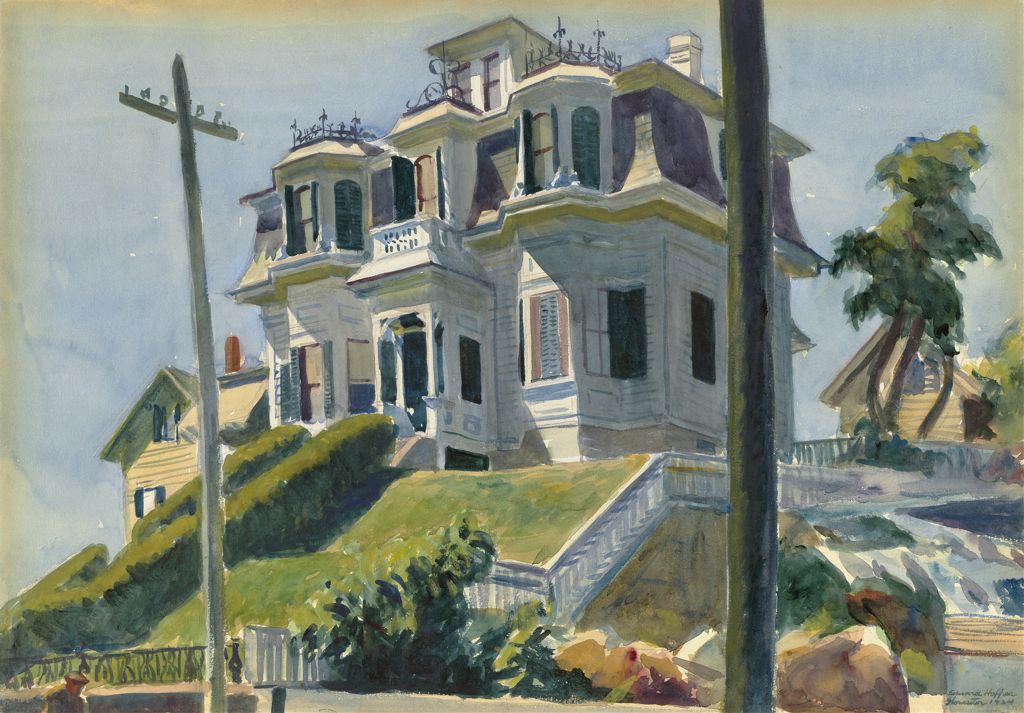
Hopper's architectural paintings vary markedly in the relation between building and ground. Haskell's House, a 1924 watercolour over graphite, and the 1925 oil House by the Railroad make a particularly revealing pair. The watercolour's light paper surface and the oil's opaque construction offer different ways to give a building substance. [4]
In Haskell's House, the house has a clear relation to the surrounding land. Its roof and walls can be read through changes of light, while the small figure near the foreground gives a measure of human occupation. The building belongs to a scene that extends around it.
House by the Railroad creates a more imposing encounter. The railway stretches across the lower image and conceals the building's footing. Upper walls and elaborate roof forms remain available for inspection, while the ordinary route towards the house becomes uncertain.
The comparison shows why the presence of an old house does not settle a picture's meaning. Distance, cropping and the surface beneath the building can make it approachable, remote or unexpectedly monumental. Architecture supplies the subject; its placement changes the encounter.
Watercolour also gives the first picture a different material character. The relation between transparent colour, drawn structure and light paper differs from the opaque construction of the oil. A shared interest in buildings can therefore support different kinds of pictorial work.
Urban views change with the spectator's position
The city paintings repeatedly shift the viewer above, beside or outside their subjects. Night Windows, dated 1928, and Early Sunday Morning, dated 1930, turn buildings into two very different kinds of access. [5]
Night Windows brings lit openings close to the picture's edges. We see part of a figure and fragments of an interior, with the exterior wall holding them together. The limited view encourages the eye to reconstruct more than it has actually been shown.
Early Sunday Morning holds us across the street from a row of shops and apartments. The repeated windows establish a broad, frontal rhythm. Small differences among curtains and shades imply separate interiors without allowing us to inspect them.
One painting exposes a fragment of private life; the other makes occupation largely indirect. Both depend on the facade's openings, but their distances produce different expectations. Being nearer does not necessarily mean understanding more.
These urban views are useful alongside the broader panoramas. A long building or wall can send attention towards the edges, suggesting a city continuing beyond the frame. A cropped window can make that same continuation feel immediate and inaccessible.
Apartment Houses puts work behind the window
Apartment Houses, painted in 1923, offers a concentrated urban interior before Hopper's later restaurant and office paintings. The Pennsylvania Academy of the Fine Arts acquired it in 1925, identifying it as his first oil to enter a museum collection. [6]
A woman in a blue dress and pale apron occupies the left part of the visible room. Her body bends towards a surface partly concealed by the near edge. The white bow at her back and the darker shoes make small, definite accents within the closely furnished space.
The view is organised through architecture at more than one distance. A large pale division stands near the centre, while the main opening gives access to the worker, chair and floor. Another window at the right supplies a narrower and more distant glimpse. The painting makes the building's surfaces conspicuous before allowing the room to become a complete interior.
The green armchair has an important place within that organisation. Its upholstered volume occupies the space beside and behind the woman, adding a substantial object that differs from the flatter wall and window frames. Warm floor colour gives the lowest part of the room another temperature.
The figure's apparent task distinguishes this domestic scene from a person simply posed beside a window. Even without knowing a name or exact employment arrangement, we can recognise bodily attention directed towards work. The room is a place being used and maintained.
Comparing it with Office at Night makes a shift of viewpoint and professional setting clear. One offers a restricted glimpse through architecture; the other exposes much of a workplace from above. In both, the furniture helps establish what the people can do, but the distribution of access is different.
The 1925 acquisition also deserves its precise place in the career. It precedes the Museum of Modern Art's acquisition of House by the Railroad in 1930. The first museum oil, the first painting in one museum's collection and a first exhibition are distinct events, each contributing differently to recognition.
Restaurants organise public life in different ways
Four restaurant paintings give a compact view of Hopper's changing arrangements: Automat of 1927, Chop Suey of 1929, Tables for Ladies of 1930 and Nighthawks of 1942. Their dates span fifteen years, allowing changes within a recurring subject to become visible. [7]
In Automat, a cup and a small table establish a close area around a single customer. Reflected lights in the dark window open a much larger visual space behind her. The cafe's public character survives even though no companion or worker appears beside the woman.
Chop Suey gives an exterior sign a commanding role. Its cropped letters press towards the window, bringing the restaurant's public identity into the diners' space. Bright patches of colour connect figures and surroundings without making every relationship equally clear.
Tables for Ladies foregrounds work. Food on display, the waitress and the cashier create several areas of activity, with customers further inside. The room's invitation depends on people arranging and maintaining it.
In Nighthawks, the long counter joins customers and server within a glass enclosure. The dark pavement outside makes their bright interior unusually exposed. The view is comprehensive in some respects, yet it leaves our own entry unresolved.
The differences are more useful than a single explanation applied to all four. Table, sign, display and counter each give public eating a distinct visual structure.

Compare: Early Sunday Morning, 1930.
Rooms give figures different relationships with the outside
A window can illuminate a room, provide a view or direct a figure's attention towards something the spectator cannot see. Hopper varies those functions through the career. Summer Interior dates from 1909, Room in Brooklyn from 1932 and Morning Sun from 1952. [8]
Summer Interior brings the body and room into close relation. Light reaches the floor, while bed, wall and figure occupy a tightly contained setting. The cropped architecture makes the visible portion feel consequential without completing the room around it.
Room in Brooklyn looks towards a seated woman whose attention is directed away from us. The interior has a different measure of calm and distance, with the window and the buildings beyond organising a relationship between two spaces.
Morning Sun concentrates on a figure seated on a bed within an unusually spare interior. The body, the field of light and the window become major forms, making small changes in their distances easy to notice.
Across the three works, the outside world remains important even where it is only partly visible. Light supplies one connection. A figure's gaze supplies another. The viewer may understand the room's structure without sharing the person's exact point of attention.
High Noon gives the doorway a body
In the 1949 High Noon, now at the Dayton Art Institute, a white house occupies most of a wide canvas. A woman stands in its dark doorway, wearing a blue robe. Her body is small beside the façade, but it gives the building an immediate human focus. [9]
The house has a large gable at the left and smaller dormers rising from the long roof. Red appears in the chimney and lower foundation. Those warm elements hold distant parts of the structure together, while the cooler blue robe has a more concentrated place within the opening.
The light gives the pale wall several different roles. It can be a broad area, a set of horizontal clapboards and a receiver of the large shadow cast by the projecting structure. The diagonal shadow brings a strong division down towards the doorway without becoming detached from the architecture that produces it.
The windows offer other kinds of disclosure. Curtains and shades partly regulate their openings, while a lower interior fragment can be made out through the left window. The doorway exposes the figure more directly and conceals much of the room behind her. Different apertures provide unequal amounts of information.
Dayton's account reproduces Jo's description of a small paper house Hopper made to examine how light would fall. The model adds a practical dimension to the apparently straightforward sunlight. A convincing effect could be developed through a constructed object as well as a remembered place. [9]
The picture can be compared with Cape Cod Morning, where another woman occupies a projecting part of a house. The positions ask different things of the body. A lean towards a window sends attention outwards; a figure held within a dark door occupies a threshold. The shared combination of woman, building and daylight does not supply a single repeated story.
Performance includes the people who are waiting
Theatre and cinema offered Hopper more than a stage or a screen. Their foyers, stairs, seats and rails could give waiting or working people a significant place. The Sheridan Theatre of 1937 and First Row Orchestra of 1951 are two distinct examples. [10]
In The Sheridan Theatre, curved architecture helps organise the visitor's position. Rails and artificial light make the interior a subject in its own right. The building becomes part of the experience surrounding a performance.
First Row Orchestra turns attention towards seats, spectators and the edge of a stage. The title establishes a precise relationship to the performance space, while the composition gives surrounding architecture a considerable role.
The much later Two Comedians, dated 1966 by the Whitney's guide, brings the performers themselves into view. [11] Two costumed people occupy a broad space before an audience we do not see.
Comparing these works makes the spectator's position especially clear. We may look at a visitor, share part of an audience's space or face performers directly. Hopper's interest extends across the whole arrangement through which people watch and are watched.
Standing, sitting and the support a room provides
Following bodies across the paintings reveals another useful set of differences. The woman in Automat has a chair and table close around her. The usher in New York Movie stands in a passage, with the stairs offering a possible route nearby. The seated figure in Morning Sun meets the larger horizontal form of a bed.
These are not merely different furnishings around interchangeable people. A table gives hands a surface and concentrates attention at a particular height. A bed can support a folded body and make the legs part of one compact shape. Standing leaves more of a figure's relation to the floor visible.
The setting also determines how much movement seems available. A stool has a different relation to a counter from a theatre seat facing a screen. A doorway can make one step appear consequential. A person in a train compartment occupies a small stable interior within a larger movement that the painting need not show directly.
Such comparisons help keep the figures specific without requiring complete biographies. The body has weight, direction and support. Those physical relations can establish much of an encounter before a viewer decides whether to call it lonely, restful or expectant.
They are especially useful where clothing and faces have been simplified. An elbow, a lowered head or the angle of a knee can remain decisive because the surrounding structure gives it a clear place. The painting's human content is distributed through the room as well as concentrated in the person.
Transport can show a machine, a passenger or an arrival
Railway subjects provide another route through the paintings. Compartment C, Car 293 of 1938 and Approaching a City of 1946 give travel very different forms. The former is organised around a passenger compartment, the latter around tracks and the entrance to a city. [12]
In Compartment C, Car 293, a seated reader has a defined interior position. The surrounding upholstery and window establish an enclosed place within a journey. The traveller can attend to something close while the view outside belongs to movement.
Approaching a City removes the passenger from view. Railway, retaining wall, buildings and tunnel describe an approach whose destination is only partly available. The city is encountered through a threshold.
Western Motel, painted in 1957, provides a further variation through a roadside room. [13] Luggage and a view towards a car connect the interior with travel, while the woman's position gives it a concentrated human presence.
These pictures show why a transport subject need not be primarily a portrait of machinery. Reading, waiting and arriving can be as important as the vehicle. Architecture and furnishings give a journey a temporary place in which to be experienced.
Compare: Ground Swell, 1939.
Coastal paintings include terrain, weather and human activity
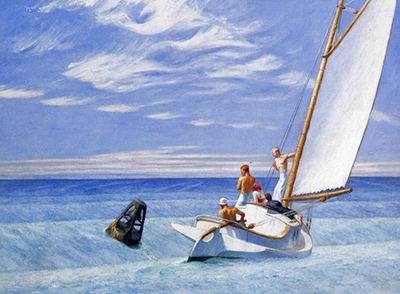
The coastal work changes the scale of those relationships. Lighthouse Hill of 1927 places buildings beyond a substantial foreground. The Long Leg of 1935 and Ground Swell of 1939 make boats central to much larger expanses of water and sky. [14]
Lighthouse Hill makes the tower's height depend on the uneven land around it. A dark slope delays the eye before it reaches the bright structures. The lighthouse is both a familiar coastal object and one part of an arrangement of masses.
In The Long Leg, a pale sail gives the scene a strong diagonal. Its small sailor rewards closer looking at the junction of sail and hull. The boat's movement belongs to a person working within the setting.
Ground Swell gives the crew a more conspicuous presence. The figures' common attention towards a buoy connects human activity with an object in the sea. The composition remains clear on a large scale while offering a specific encounter within it.
The landscapes can therefore change considerably when the figures are noticed. A person may be small in relation to a hill or a sail without being absent. Scale can make occupation easy to overlook, and close looking can alter an image remembered mainly for its large shapes.
Size and medium change the work of a familiar shape
A window in a small watercolour can be established through a few dark marks. In a large oil, the same kind of opening can support broader changes of colour and more extended edges. The object is familiar in both, but the scale of attention differs.
The comparison between Blackhead, Monhegan and Ground Swell makes this particularly clear outside architecture. One brings the painter close to a rocky surface on a small panel. The other distributes sail, people and buoy across a much wider marine field. The sea has a different share of each image and a different relation to the viewer.
Watercolour supplies another set of possibilities. The paper can remain visible through colour or between marks, while drawing can carry a relatively fine structural line. An oil can achieve its light through more opaque paint. A pale wall is consequently made through different material relations even when the two images look similar at first.
Surface also changes within a single medium. The strokes in the coastal panel are conspicuous, while a larger interior may organise attention through more continuous areas. It is more useful to describe those actual differences than to make all oils slow and smooth or all watercolours rapid and unfinished.
Reproductions can conceal the contrast by making every work the same size on a screen. A panel a few handspans across and a broad canvas may appear beside one another as equal rectangles. Checking dimensions restores part of the original encounter, especially when a small figure seems surprisingly hard to see.
The original also has edges, a support and a physical presentation. Cropping can make an opening seem larger or remove the margin around a printed image. The familiar subject remains, but the balance through which Hopper placed it may have changed.
Late paintings make fewer elements carry more
Hopper's later work frequently sharpens the importance of broad surfaces and isolated openings. Rooms by the Sea, dated 1951, and Sun in an Empty Room, dated 1963, make a strong pair despite the years between them. [15]
In Rooms by the Sea, a doorway places bright water next to an interior with unsettling immediacy. Wall, floor and door remain recognisable. Their relationship makes an ordinary understanding of the room difficult to maintain.
Sun in an Empty Room gives light, wall and floor nearly the whole responsibility for the scene. A visible person is no longer needed for the space to feel charged with the possibility of occupation. The illumination makes some surfaces emphatic while leaving others comparatively withdrawn.
Chair Car, painted in 1965, brings passengers back into an interior organised through chairs, windows and large light shapes. [16] The figures do not dissolve into the design; their different positions give the shared room its human variations.
Looking across these later pictures, simplification is a flexible practice. It can remove a figure, enlarge a patch of light or concentrate attention on the relation between an opening and the surface around it. The resulting paintings ask different questions with relatively few major elements.
A late figure can still complicate a simplified room
Simplification did not follow a straight path towards the permanent removal of people. Sun in an Empty Room gives light and architecture almost the entire canvas. Chair Car, made afterwards, brings several people into a shared interior, while Two Comedians gives a paired gesture a wide stage.
The differences matter to a view of the late career. A painter can remove figures to test one arrangement, then restore them when another needs their scale and direction. A broad wall or floor is not an announcement that human subjects have been abandoned.
The simplified setting can make a small action more consequential. Joined hands become unusually visible against a dark backdrop. A passenger's position can interrupt a large area of light. The amount of detail has changed, but the relation between person and surrounding surface remains active.
This is also a useful way to compare early and late work. Apartment Houses gives architecture a prominent intervening position while allowing a working figure a restricted glimpse. The late pictures can reduce the number of divisions and still preserve that unequal access. Continuity lies in a question repeatedly reconsidered, rather than in one unchanged design.
Comparisons keep the wider work visible
The career becomes richer when these paths intersect. A diner window can be compared with the window of a railway compartment. A theatre rail can change the way we notice a counter. A cropped house can prepare the eye for a room whose continuation has been withheld.
Chronology helps, but it does not make each later picture an improvement on the last. Early works can have a density and searching quality that remain compelling beside the mature clarity. Watercolours can provide a different kind of immediacy from slowly developed oils. A small print can concentrate an effect that a large canvas distributes across several forms.
The surviving studies provide another kind of comparison. The Whitney's drawing exhibition showed how observations, figure studies and alternative arrangements relate to finished works. [17] What appears certain on canvas could have been worked through in several forms on paper.
The individual paintings remain worth returning to after such comparisons. A close figure, a distant tower, transparent colour and opaque paint require different kinds of attention. A broad knowledge of Hopper's work can begin with a handful of images, then expand through the differences those images make visible elsewhere.
Artworks and studies directory
This researched directory includes finished works and separately identified studies. It is not a complete catalogue raisonné. Linked titles open the articles; unlinked studies are identified by their collection accessions. Watercolours retain their recorded media, and original prints remain distinct from reproductions.
| Name | Date | Medium |
|---|---|---|
| (Bridge and Embankment) (70.1298) | 1906 | Oil on wood |
| (Jo Sketching at Good Harbor Beach) (70.1129) | 1923–1924 | Watercolor and fabricated chalk on paper |
| (Manhattan Bridge) (70.1098) | 1925–1926 | Watercolor and graphite pencil on paper |
| (Rooftops) (70.1114) | 1926 | Watercolor and graphite pencil on paper |
| (Seated Male Model, Bent Over) (70.1277) | c. 1902–1903 | Oil on canvas |
| (Self-Portrait) (70.1254) | 1903–1906 | Oil on canvas |
| (Solitary Figure in a Theater) (70.1418) | c. 1902–1904 | Oil on board |
| 5 A.M. | 1937 | oil on canvas |
| Adam's House | 1928 | watercolour and charcoal on paper |
| American Village | 1912 | Oil on canvas |
| Apartment Houses | 1923 | oil on canvas |
| Approaching a City | 1946 | oil on canvas |
| August in the City | 1945 | oil on canvas |
| Automat | 1927 | oil on canvas |
| Barber Shop | 1931 | oil on canvas |
| Blackwell's Island | 1928 | oil on canvas |
| Bridge on the Seine | 1909 | Oil on canvas |
| Bridle Path | 1939 | oil on canvas |
| Burly Cobb's House South Truro | 1930–1933 | oil on canvas |
| Cape Cod Evening | 1939 | oil on canvas |
| Cape Cod Morning | 1950 | oil on canvas |
| Chair Car | 1965 | oil on canvas |
| Chop Suey | 1929 | oil on canvas |
| City Roofs | 1932 | Oil on canvas |
| Coast Guard Station | 1929 | oil on canvas |
| Compartment C, Car 293 | 1938 | oil on canvas |
| Conference at Night | 1949 | oil on canvas |
| Corn Hill | 1930 | oil on canvas |
| Dawn in Pennsylvania | 1942 | oil on canvas |
| Drug Store | 1927 | oil on canvas |
| Early Sunday Morning | 1930 | Oil on canvas |
| East Side Interior (70.1020) | 1922 | Etching |
| East Wind Over Weehawken | 1934 | oil on canvas |
| El Palacio | 1946 | Watercolor and graphite pencil on paper |
| Eleven A.M. | 1926 | oil on canvas |
| Evening Wind | 1921 | etching |
| Excursion into Philosophy | 1959 | oil on canvas |
| First Row Orchestra | 1951 | oil on canvas |
| Freight Car at Truro | 1931 | watercolour over graphite on paper |
| Gas | 1940 | oil on canvas |
| Girl at a Sewing Machine | c. 1921 | oil on canvas |
| Gloucester Harbor | 1912 | Oil on canvas |
| Ground Swell | 1939 | oil on canvas |
| Haskell's House | 1924 | watercolour over graphite on paperboard |
| High Noon | 1949 | oil on canvas |
| Hill and Houses Cape Elizabeth Maine | 1927 | watercolour over graphite pencil |
| Hills South Truro | 1930 | oil on canvas |
| Hotel by a Railroad | 1952 | oil on canvas |
| Hotel Lobby | 1943 | oil on canvas |
| Hotel Room | 1931 | oil on canvas |
| Hotel Window | 1955 | oil on canvas |
| House by the Railroad | 1925 | oil on canvas |
| House by the Squam River | 1926 | watercolour over graphite on paper |
| Le Bistro or The Wine Shop | 1909 | Oil on canvas |
| Le Pont des Arts | 1907 | Oil on canvas |
| Le Pont Royal | 1909 | Oil on canvas |
| Le Quai des Grands Augustins | 1909 | Oil on canvas |
| Lighthouse and Buildings Portland Head | 1927 | watercolour over graphite pencil on paper |
| Lighthouse Hill | 1927 | oil painting |
| Manhattan Bridge Loop | 1928 | oil on canvas |
| Model Sitting | c. 1902 | oil painting; support not asserted |
| Morning Sun | 1952 | oil on canvas |
| New York Movie | 1939 | oil on canvas |
| New York New Haven and Hartford | 1931 | oil on canvas |
| New York Office | 1962 | oil on canvas |
| New York Pavements | 1924–1925 | oil on canvas |
| New York Restaurant | c. 1922 | oil on canvas |
| Night Windows | 1928 | oil on canvas |
| Nighthawks | 1942 | oil on canvas |
| October on Cape Cod | 1946 | oil on canvas |
| Office at Night | 1940 | oil on canvas |
| Office in a Small City | 1953 | oil on canvas |
| Pennsylvania Coal Town | 1947 | oil on canvas |
| People in the Sun | 1960 | oil on canvas |
| Portrait of Orleans | 1950 | oil on canvas |
| Queensborough Bridge | 1913 | Oil on canvas |
| Railroad Sunset | 1929 | Oil on canvas |
| Railroad Train | 1908 | oil on canvas |
| Road in Maine | 1914 | oil on canvas |
| Room in Brooklyn | 1932 | oil on canvas |
| Room in New York | 1932 | oil on canvas |
| Rooms by the Sea | 1951 | oil on canvas |
| Rooms for Tourists | 1945 | oil on canvas |
| Route 6 Eastham | 1941 | oil on canvas |
| Second Story Sunlight | 1960 | Oil on canvas |
| Self-Portrait | 1925–1930 | Oil on canvas |
| Self-Portrait with Hat (70.1903) | c. 1918, posthumous print | Drypoint |
| Seven A.M. | 1948 | Oil on canvas |
| Soir Bleu | 1914 | oil on canvas |
| South Carolina Morning | 1955 | Oil on canvas |
| Stairway at 48 Rue de Lille Paris | 1906 | Oil on wood |
| Study for 5 A.M. (70.153) | 1937 | Fabricated chalk on paper |
| Study for 5 A.M. (70.429) | 1937 | Fabricated chalk and graphite pencil on paper |
| Study for Approaching a City (70.869) | 1946 | Fabricated chalk and charcoal on paper |
| Study for August in the City (70.158a-b) | 1945 | Fabricated chalk on paper |
| Study for August in the City (70.159) | 1945 | Fabricated chalk on paper |
| Study for Bridle Path (70.220) | 1939 | Fabricated chalk on paper |
| Study for Bridle Path (70.235) | 1939 | Fabricated chalk on paper |
| Study for Compartment C, Car 293 (70.430) | 1938 | Fabricated chalk on paper |
| Study for Compartment C, Car 293 (70.431a-b) | 1938 | Fabricated chalk and charcoal on paper |
| Study for Conference at Night (70.170) | 1949 | Fabricated chalk on paper (recto); Typewriter ink on paper (verso) |
| Study for Conference at Night (70.174) | 1949 | Fabricated chalk on paper ( recto); Typewriter ink on paper (verso) |
| Study for East Wind over Weehawken (70.249) | 1934 | Graphite pencil on paper |
| Study for East Wind over Weehawken (70.252) | 1934 | Fabricated chalk and charcoal on paper |
| Study for Evening Wind (70.343a-b) | 1921 | Fabricated chalk on paper |
| Study for First Row Orchestra (70.841) | 1951 | Fabricated chalk and charcoal on paper |
| Study for Gas (70.263) | 1940 | Fabricated chalk on paper |
| Study for Ground Swell (70.339) | 1939 | Fabricated chalk, charcoal and graphite pencil on paper |
| Study for Hotel by a Railroad (70.199) | 1952 | Fabricated chalk on paper |
| Study for Hotel by a Railroad (70.427) | 1952 | Fabricated chalk on paper |
| Study for Hotel by a Railroad (70.428) | 1952 | Fabricated chalk on paper |
| Study for Hotel Lobby (70.117) | 1942 | Fabricated chalk and graphite pencil on paper |
| Study for Hotel Lobby (70.839) | 1942 | Fabricated chalk and charcoal on paper |
| Study for Hotel Window (70.161) | 1955 | Fabricated chalk, graphite pencil and colored pencil on paper |
| Study for Morning Sun (70.243) | 1952 | Fabricated chalk on paper |
| Study for Morning Sun (70.244) | 1952 | Fabricated chalk on paper |
| Study for Morning Sun (70.290) | 1952 | Fabricated chalk on paper |
| Study for Morning Sun (70.291) | 1952 | Fabricated chalk and graphite pencil on paper |
| Study for New York Movie (70.273) | 1939 | Fabricated chalk on paper |
| Study for New York Movie (70.274a-b) | 1938 or 1939 | Fabricated chalk and charcoal on paper (recto); Fabricated chalk on paper (verso) |
| Study for New York Movie (70.455) | 1939 | Fabricated chalk and charcoal on paper |
| Study for New York Office (70.822) | 1962 | Fabricated chalk on paper |
| Study for Nighthawks (70.192) | 1941 or 1942 | Fabricated chalk on paper |
| Study for Nighthawks (70.193) | 1941 or 1942 | Fabricated chalk on paper |
| Study for Office at Night (70.340) | 1940 | Fabricated chalk and charcoal on paper |
| Study for Office at Night (70.341) | 1940 | Fabricated chalk and graphite pencil on paper |
| Study for Pennsylvania Coal Town (70.198) | 1947 | Fabricated chalk on paper |
| Study for Pennsylvania Coal Town (70.229) | 1947 | Fabricated chalk and charcoal on paper |
| Study for Rooms for Tourists (70.438) | 1945 | Fabricated chalk and charcoal on paper |
| Study for Rooms for Tourists (70.848) | 1945 | Fabricated chalk and charcoal on paper |
| Study for Route 6, Eastham (70.369) | 1941 | Fabricated chalk and graphite pencil on paper |
| Study for Route 6, Eastham (70.854) | 1941 | Fabricated chalk and graphite pencil on paper |
| Study for South Carolina Morning (70.162a-b) | 1955 | Fabricated chalk on paper (recto and verso) |
| Study for The Sheridan Theatre (70.969) | 1937 | Graphite pencil on paper |
| Study for Two on the Aisle (70.128) | 1927 | Fabricated chalk on paper |
| Study for Two on the Aisle (70.129) | 1927 | Fabricated chalk on paper |
| Study for Yawl Riding a Swell (70.439) | 1935 | Fabricated chalk and graphite pencil on paper |
| Summer Evening | 1947 | oil on canvas |
| Summer Interior | 1909 | Oil on canvas |
| Sun in an Empty Room | 1963 | oil on canvas |
| Sunlight in a Cafeteria | 1958 | oil on canvas |
| Sunlight on Brownstones | 1956 | oil on canvas |
| Tables for Ladies | 1930 | oil on canvas |
| The Bootleggers | 1925 | oil on canvas |
| The Camel's Hump | 1931 | oil on canvas |
| The Circle Theatre | 1936 | oil on canvas |
| The City | 1927 | oil on canvas |
| The Lighthouse at Two Lights | 1929 | oil on canvas |
| The Long Leg | 1935 | oil on canvas |
| The Mansard Roof | 1923 | watercolour over graphite on paper |
| The Sheridan Theatre | 1937 | oil on canvas |
| Tramp Steamer | 1908 | oil on canvas |
| Two Comedians | 1966 | oil on canvas |
| Two on the Aisle | 1927 | oil on canvas |
| Valley of the Seine | 1909 | Oil on canvas |
| Western Motel | 1957 | oil on canvas |
Frequently Asked Questions
Three early works provide a useful sequence: Stairway at 48 rue de Lille, Paris of 1906, Le Bistro or The Wine Shop of 1909, and Soir Bleu of 1914. The Whitney's records identify the first as oil on wood and the other two as oils on canvas. [1]
The coastal work changes the scale of those relationships. Lighthouse Hill of 1927 places buildings beyond a substantial foreground. The Long Leg of 1935 and Ground Swell of 1939 make boats central to much larger expanses of water and sky. [14]
The career becomes richer when these paths intersect. A diner window can be compared with the window of a railway compartment. A theatre rail can change the way we notice a counter. A cropped house can prepare the eye for a room whose continuation has been withheld.
Discussion
Look again at the images and ideas explored in Edward Hopper Paintings. These editorial prompts invite your observations.
Reader Insights
Which two paintings would you compare first, and what visual question would guide the comparison?
Compare Early Sunday Morning with Ground Swell. Which visual difference matters most to your reading?
Which detail would you look at again after reading “Urban views change with the spectator's position”?
Join the Conversation
Share a detail, comparison or question about Edward Hopper Paintings below.
References
- Whitney Museum of American Art, Stairway at 48 rue de Lille, Paris,1906; Le Bistro or The Wine Shop,1909; Soir Bleu,1914, current records. View source 1. View source 2. View source 3.
- Whitney Museum of American Art, Edward Hopper's New York: exhibition labels,2022, PDF p.7, Bistro; Museo Nacional Thyssen-Bornemisza, Hopper: Training and Influences,2012, Soir Bleu entry. View source 1. View source 2.
- Whitney Museum of American Art, (Blackhead, Monhegan), 1916–1919, accession 70.1668, oil on wood. Current record and actual complete painting inspected; this specific panel is distinguished from other works of the same title. View source.
- National Gallery of Art, Haskell's House,1924; Museum of Modern Art, House by the Railroad,1925. View source 1. View source 2.
- Museum of Modern Art, Night Windows,1928; Whitney Museum of American Art, Early Sunday Morning,1930. View source 1. View source 2.
- Pennsylvania Academy of the Fine Arts, Apartment Houses, 1923, accession 1925.5, John Lambert Fund. Current acquisition account and complete actual painting inspected. The record’s erroneous 1923 date for Hopper’s move to Greenwich Village is not followed. View source.
- Des Moines Art Center, September–December2022 newsletter, Automat,1927; Christie's, Chop Suey,1929; Metropolitan Museum of Art, Tables for Ladies,1930; Art Institute of Chicago, Nighthawks,1942. View source 1. View source 2. View source 3. View source 4.
- Whitney Museum of American Art, Summer Interior,1909, and 2022 exhibition labels, Room in Brooklyn,1932, and Morning Sun,1952. View source 1. View source 2.
- Dayton Art Institute, High Noon, 1949, accession 1971.7. Complete museum description and actual painting inspected; Jo’s paper-model account is transmitted through the museum rather than an independently read ledger. Erroneous artist lifetime dates in the image credit are excluded. View source.
- Newark Museum of Art, The Sheridan Theatre,1937; Smithsonian Institution, First Row Orchestra,1951, Hirshhorn Museum and Sculpture Garden. View source 1. View source 2.
- Whitney Museum of American Art, Two Comedians,1966,2022 exhibition guide. View source.
- Art Institute of Chicago, Selected Chronology,1938, Compartment C, Car293; Gail Levin, Edward Hopper: A Catalogue Raisonné, oils index,1995, p.383,O-306; Phillips Collection, Approaching a City,1946. View source 1. View source 2. View source 3.
- Yale University Art Gallery, Western Motel,1957, accession1961.18.32. View source.
- Dallas Museum of Art, Lighthouse Hill,1927; The Huntington, The Long Leg,1935; National Gallery of Art, Ground Swell,1939, scholarly entry. View source 1. View source 2. View source 3.
- Yale University Art Gallery, Rooms by the Sea,1951; Crystal Bridges Museum of American Art, Sun in an Empty Room,1963, promised gift. View source 1. View source 2.
- Christie's, Chair Car,1965,2005 sale catalogue. View source.
- Whitney Museum of American Art, Hopper Drawing,2013, exhibition account and selected studies. View source.
- Whitney Museum of American Art, Study for Route 6, Eastham, 1941, accession 70.854; exact object record. View source.
- Whitney Museum of American Art, Study for Conference at Night, 1949, accession 70.170; exact object record. View source.
- Whitney Museum of American Art, Study for First Row Orchestra, 1951, accession 70.841; exact object record. View source.
- Whitney Museum of American Art, (Bridge and Embankment), 1906, accession 70.1298; exact object record. View source.
- Whitney Museum of American Art, (Seated Male Model, Bent Over), c. 1902–1903, accession 70.1277; exact object record. View source.
- Whitney Museum of American Art, Study for Morning Sun, 1952, accession 70.244; exact object record. View source.
- Whitney Museum of American Art, Study for Morning Sun, 1952, accession 70.243; exact object record. View source.
- Whitney Museum of American Art, Study for Two on the Aisle, 1927, accession 70.128; exact object record. View source.
- Whitney Museum of American Art, Study for New York Office, 1962, accession 70.822; exact object record. View source.
- Whitney Museum of American Art, Study for Two on the Aisle, 1927, accession 70.129; exact object record. View source.
- Whitney Museum of American Art, Study for Pennsylvania Coal Town, 1947, accession 70.229; exact object record. View source.
- Whitney Museum of American Art, (Rooftops), 1926, accession 70.1114; exact object record. View source.
- Whitney Museum of American Art, Study for South Carolina Morning, 1955, accession 70.162a-b; exact object record. View source.
- Whitney Museum of American Art, (Self-Portrait), 1903–1906, accession 70.1254; exact object record. View source.
- Whitney Museum of American Art, (Manhattan Bridge), 1925–1926, accession 70.1098; exact object record. View source.
- Whitney Museum of American Art, (Solitary Figure in a Theater), c. 1902–1904, accession 70.1418; exact object record. View source.
- Whitney Museum of American Art, Study for Approaching a City, 1946, accession 70.869; exact object record. View source.
- Whitney Museum of American Art, Study for August in the City, 1945, accession 70.159; exact object record. View source.
- Whitney Museum of American Art, Study for Compartment C, Car 293, 1938, accession 70.430; exact object record. View source.
- Whitney Museum of American Art, Study for Compartment C, Car 293, 1938, accession 70.431a-b; exact object record. View source.
- Whitney Museum of American Art, Study for East Wind over Weehawken, 1934, accession 70.252; exact object record. View source.
- Whitney Museum of American Art, Study for East Wind over Weehawken, 1934, accession 70.249; exact object record. View source.
- Whitney Museum of American Art, Study for Evening Wind, 1921, accession 70.343a-b; exact object record. View source.
- Whitney Museum of American Art, Study for The Sheridan Theatre, 1937, accession 70.969; exact object record. View source.
- Whitney Museum of American Art, Study for New York Movie, 1939, accession 70.455; exact object record. View source.
- Whitney Museum of American Art, Study for New York Movie, 1939, accession 70.273; exact object record. View source.
- Whitney Museum of American Art, Study for New York Movie, 1938 or 1939, accession 70.274a-b; exact object record. View source.
- Whitney Museum of American Art, Study for 5 A.M., 1937, accession 70.153; exact object record. View source.
- Whitney Museum of American Art, Study for 5 A.M., 1937, accession 70.429; exact object record. View source.
- Whitney Museum of American Art, (Jo Sketching at Good Harbor Beach), 1923–1924, accession 70.1129; exact object record. View source.
- Whitney Museum of American Art, Study for August in the City, 1945, accession 70.158a-b; exact object record. View source.
- Whitney Museum of American Art, Study for Morning Sun, 1952, accession 70.291; exact object record. View source.
- Whitney Museum of American Art, Study for Morning Sun, 1952, accession 70.290; exact object record. View source.
- Whitney Museum of American Art, Study for Office at Night, 1940, accession 70.340; exact object record. View source.
- Whitney Museum of American Art, Study for Office at Night, 1940, accession 70.341; exact object record. View source.
- Whitney Museum of American Art, Study for Hotel by a Railroad, 1952, accession 70.427; exact object record. View source.
- Whitney Museum of American Art, Study for Hotel by a Railroad, 1952, accession 70.199; exact object record. View source.
- Whitney Museum of American Art, Study for Hotel by a Railroad, 1952, accession 70.428; exact object record. View source.
- Whitney Museum of American Art, Study for Hotel Lobby, 1942, accession 70.117; exact object record. View source.
- Whitney Museum of American Art, Study for Hotel Lobby, 1942, accession 70.839; exact object record. View source.
- Whitney Museum of American Art, Study for Conference at Night, 1949, accession 70.174; exact object record. View source.
- Whitney Museum of American Art, Study for Hotel Window, 1955, accession 70.161; exact object record. View source.
- Whitney Museum of American Art, Study for Pennsylvania Coal Town, 1947, accession 70.198; exact object record. View source.
- Whitney Museum of American Art, Study for Route 6, Eastham, 1941, accession 70.369; exact object record. View source.
- Whitney Museum of American Art, Study for Bridle Path, 1939, accession 70.220; exact object record. View source.
- Whitney Museum of American Art, Study for Bridle Path, 1939, accession 70.235; exact object record. View source.
- Whitney Museum of American Art, Study for Ground Swell, 1939, accession 70.339; exact object record. View source.
- Whitney Museum of American Art, Study for Yawl Riding a Swell, 1935, accession 70.439; exact object record. View source.
- Whitney Museum of American Art, Study for Rooms for Tourists, 1945, accession 70.848; exact object record. View source.
- Whitney Museum of American Art, Study for Rooms for Tourists, 1945, accession 70.438; exact object record. View source.
- Whitney Museum of American Art, Study for Nighthawks, 1941 or 1942, accession 70.193; exact object record. View source.
- Whitney Museum of American Art, Study for Nighthawks, 1941 or 1942, accession 70.192; exact object record. View source.
- Whitney Museum of American Art, Study for Gas, 1940, accession 70.263; exact object record. View source.
- Whitney Museum of American Art, Self-Portrait with Hat, c. 1918, posthumous print, accession 70.1903; exact object record. View source.
- Whitney Museum of American Art, East Side Interior, 1922, accession 70.1020; exact object record. View source.
- Art Institute of Chicago, Selected Chronology for Edward Hopper; training, travels, exhibitions, New York and Truro chronology. View source.
- Emily C. Burns, Spectral figures: Edward Hopper’s empty Paris, chapter 5 in Empty Spaces: Confronting Emptiness in National, Cultural and Urban Histories, 2019; complete chapter and notes consulted. View source.
- Charles Brock, Regionalism and Folk Art, National Gallery of Art; complete essay and two notes consulted. View source.
- Collection or catalogue record, American Village, 1912; medium and identity as discussed in the linked article. View source.
- Collection or catalogue record, Soir Bleu, 1914; medium and identity as discussed in the linked article. View source.
- Collection or catalogue record, House by the Railroad, 1925; medium and identity as discussed in the linked article. View source.
- Collection or catalogue record, Automat, 1927; medium and identity as discussed in the linked article. View source.
- Collection or catalogue record, Early Sunday Morning, 1930; medium and identity as discussed in the linked article. View source.
- Collection or catalogue record, New York Movie, 1939; medium and identity as discussed in the linked article. View source.
- Collection or catalogue record, Nighthawks, 1942; medium and identity as discussed in the linked article. View source.
- Collection or catalogue record, Morning Sun, 1952; medium and identity as discussed in the linked article. View source.
- Collection or catalogue record, Second Story Sunlight, 1960; medium and identity as discussed in the linked article. View source.
- Collection or catalogue record, Two Comedians, 1966; medium and identity as discussed in the linked article. View source.