 by Tom Gurney
Tom Gurney BSc (Hons) is an art history expert with over 20 years experience
Email: tomgurney1@gmail.com / Phone: +44 7429 011000
House by 'Squam River, Gloucester: Introduction
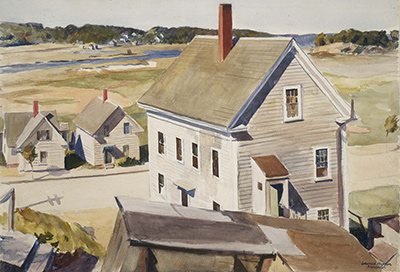
The roof is almost at eye level. A red chimney rises above it, while the pale walls below carry dark windows and a sharply angled shadow. Beyond the house, Edward Hopper opens a much longer view across land and water. The contrast between this close building and the distance behind it gives House by 'Squam River, Gloucester its unusual scale: we seem near enough to examine a roof, yet high enough to look across a substantial stretch of town and landscape.
Hopper painted the watercolour in 1926. It belongs to the Museum of Fine Arts, Boston, accession 48.719, through the bequest of John T. Spaulding. The museum's catalogue contribution gives its dimensions as 34.3 × 48.4 cm. [1] The National Gallery of Art's 2007 exhibition checklist describes the medium more fully as watercolour over graphite on paper. [2]
These compact dimensions contain several distinct kinds of space. A cropped roof presses against the bottom of the picture. The main house rises just beyond it. Smaller buildings descend towards the left, while horizontal bands draw the eye into the distance. The painting offers the pleasure of a broad view and continually brings us back to what stands immediately in front of us.
At a Glance
- ArtistEdward Hopper [1]
- Date1926 [1]
- Mediumwatercolour over graphite on paper [1]
- Collection / recordMuseum of Fine Arts, Boston [1]
- Accession48.719 [1]
This work across Edward Hopper’s career
American Village
1912Soir Bleu
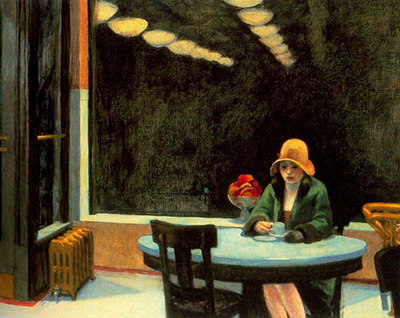
1914Automat
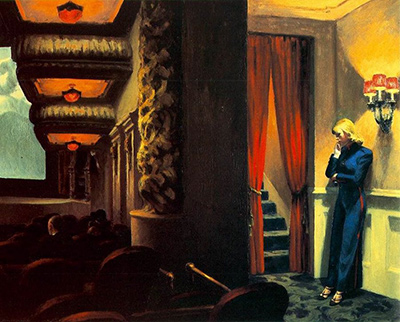
1927New York Movie
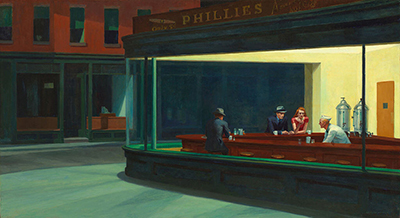
1939Nighthawks
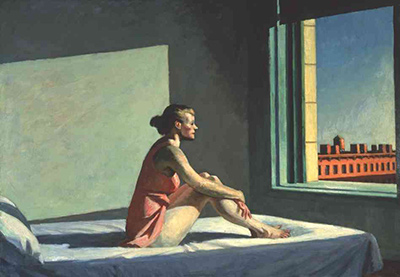
1942Morning Sun
1952Two Comedians
1966Contents
- Looking across the roofs
- A house seen from two sides
- Chimney, canopy and shadow
- A long view held behind the building
- Watercolour with firm architecture
- What the title tells us about the place
- Gloucester and the architectural watercolours
Looking across the roofs
The viewpoint makes the house's roof a major surface. Its slope occupies a broad area of muted colour, allowing us to see its shape before examining the walls. The roof's long diagonal leads towards the gable at right, where another slant turns down in the opposite direction. Between them, the building becomes a clear arrangement of intersecting planes.
We are looking from above the level of the neighbouring road. That height changes the relationship between buildings. The smaller houses at left display their roofs prominently, while portions of their walls remain visible below. The principal house seems to rise past them, partly because of its size and partly because Hopper has placed it so close to the spectator.
The roof in the immediate foreground complicates the view. It crosses the lower image and hides part of the main building's base. Rather than supplying an unobstructed prospect from a distant hill, Hopper makes us look past another structure. The obstruction gives the scene a sense of proximity: we occupy a place among buildings, with a view available through and over them.
It also helps establish depth without a dramatic vanishing point. The lower roof is cut by the frame; the house beyond is more complete; the smaller buildings and distant land recede in successive stages. Each part gives a different measure of nearness. The eye can travel a considerable distance without losing its connection to the foreground.
A house seen from two sides
The main building is both imposing and easy to grasp. Its long side extends leftwards, while the gable end faces more towards us at right. The meeting of these two walls gives the house volume. Their different values make the corner readable even where the pale surfaces approach one another in colour.
Horizontal clapboard marks help hold the walls together. They run across the broad surfaces, giving the light structure a fine internal rhythm. Against them, the windows appear as darker interruptions. Hopper varies their shapes and surrounding tones enough to make the elevations feel specific without opening the rooms inside.
The windows also establish scale. Without them, the main roof and wall might become an almost abstract arrangement of triangles and rectangles. Their repeated human-sized proportions bring the structure back into the world of domestic architecture. They suggest how large the wall is while leaving the life behind it unseen.
The smaller houses at left offer variations on the same basic elements. Sloping roofs, pale walls and red chimneys reappear at a reduced scale. Their different angles prevent the scene from becoming a monotonous row. The repetition makes the principal building feel part of a town, even as its size gives it a commanding place in the composition.
The gaps between buildings matter too. Small wedges of darker colour separate one form from another. The road supplies a broader horizontal interval across the lower left. These openings keep the architecture legible as a collection of distinct volumes, rather than a continuous mass.
Chimney, canopy and shadow
The tall red chimney supplies a strong vertical through the roof. Its colour sets it apart from the muted grey-green surface around it, and its narrowness makes the roof seem broader. Near the upper edge, the chimney also connects the house with the small strip of sky. A single accent helps unite several levels of the picture.
Red returns in the smaller chimneys at left. These repetitions are much less emphatic, but they allow the eye to move between the dominant house and its neighbours. The colour becomes a quiet thread through the townscape. It is concentrated enough to attract attention without spreading across every surface.
On the gable wall, the little entrance canopy produces another sharp arrangement. Its slant repeats the larger roof slopes above, while its shadow extends down the pale wall. The shadow gives a relatively small feature considerable reach. What might otherwise be a minor doorway becomes a point where the building's planes, light and depth are especially easy to read.
This passage also changes the pace of looking. The large roof can be understood quickly as one shape. Around the canopy, the eye has to distinguish the projecting surface, the darker space beneath and the shadow falling beyond. Hopper moves from a broad architectural statement to a compact sequence of overlapping forms.
The painting's brightness comes through such differences. Pale walls are set beside dark openings; a roof edge meets a narrow shaded strip; one side of a building appears distinct from the other. The house feels illuminated because its parts respond differently to the light. Its solidity emerges from those relationships.
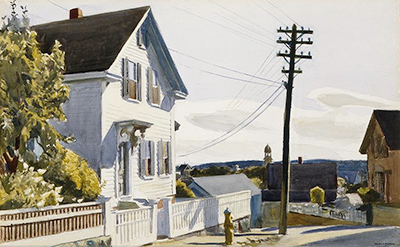
Compare: Adam's House, 1928.
A long view held behind the building
Beyond the near architecture, the picture becomes more horizontal. Bands of pale land and blue water cross the upper left and continue towards the distance. The eye can follow them laterally with a freedom unavailable around the crowded foreground roofs. They offer a breathing space within a composition otherwise full of angled surfaces.
The distant dark vegetation helps establish a boundary near the top. Only a thin area of sky remains above it. This is a landscape in which most of the space belongs to the earth and the structures on it. The high viewpoint lets us see further across the ground, rather than giving us a vast sky overhead.
The main house interrupts that sweep. Its roof and gable rise into the distant bands, preventing a single continuous reading of the landscape. We repeatedly alternate between a broad geographical view and a near architectural one. The interruption is central to the painting's character: the place is discovered around the building that gives it a focus.
The far houses and patches of colour are much smaller and less emphatic than the principal structure. That difference allows distance to develop without an abrupt change of subject. We remain within a built and worked landscape, but its details become less individually insistent as they recede.
Watch: Edward Hopper’s Life and Art
Explore Hopper’s paintings and the places behind them in these museum films. Choose a film below.
Watercolour with firm architecture
Hopper gives the buildings a clear structure while allowing considerable variation within their surfaces. The roof contains changes of tone that keep its large slope active. Along the walls, light colour and darker linear marks work together. The smaller houses receive enough definition to establish their angles, while the distant landscape is handled in broader intervals.
The result is a useful balance between precision and openness. The major edges tell us where the architecture turns. Within those boundaries, variations in colour stop the surfaces becoming blank shapes. The picture's firm construction does not depend on a uniform degree of detail everywhere.
The paper's modest size contributes to the encounter. Looking from one end of the sheet to the other, we can compare a near roof, a tall house and distant water within a single field of attention. The painting condenses a layered view without requiring every element to carry equal emphasis. The main building remains the measure against which the rest of the landscape can be judged.
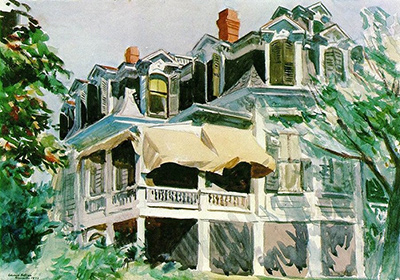
Compare: The Mansard Roof, 1923.
What the title tells us about the place
The title identifies the work with Gloucester and the 'Squam River. It should be kept distinct from Hopper's Houses of 'Squam Light, Gloucester, a watercolour of 1923. The 2007 National Gallery checklist lists the two separately, with the 1926 river view lent by the Museum of Fine Arts, Boston. Similar names describe different pictures. [2]
The exact sight line has also attracted local investigation. In a 2012 account, Catherine Ryan credits Kathy and Jeff Weaver with identifying a view past Centennial towards the landscape later occupied by Newell Stadium and Gloucester High School. Ryan explains that this challenged her earlier expectation of a view in the direction of Annisquam. Her account is a later identification of the landscape, and a useful reminder that a familiar place-name need not settle the painter's precise position. [3]
Gloucester and the architectural watercolours
By 1926, Gloucester had become an important place in Hopper's development as a watercolourist. The Art Institute's chronology records his productive summer there in 1923 and the inclusion of six watercolours in a Brooklyn Museum exhibition that November. He returned to Gloucester in 1924, and worked there again during the summer and autumn of 1926. The river view belongs within this sustained engagement with the area. [4]
The earlier Mansard Roof, dated 1923, provides a rewarding companion. Its elaborate roof profile and architectural projections give the building a different rhythm from the simpler gabled house here. Both paintings make the upper parts of buildings important enough to organize an entire scene. The 2007 checklist identifies The Mansard Roof as watercolour over graphite and records its place in the Brooklyn Museum collection. [2]
Comparing such subjects brings out Hopper's sensitivity to the shape of a view. A roof can form a dominant silhouette, establish a strong diagonal or cut across the distance. A house can be a near object, a landmark further away or a means of measuring the slope of a town. The architectural subject offers many possibilities within an apparently ordinary setting.
In House by 'Squam River, the principal building does several of these jobs at once. It gives the eye a solid volume to examine, interrupts the distant landscape and links the foreground roofs with the land beyond. Following its chimney upwards or its long wall towards the left sends us back into the surrounding scene. Hopper makes the house the point from which a wider place becomes visible.
Artworks and studies directory
This researched directory includes finished works and separately identified studies. It is not a complete catalogue raisonné. Linked titles open the articles; unlinked studies are identified by their collection accessions. Watercolours retain their recorded media, and original prints remain distinct from reproductions.
| Name | Date | Medium |
|---|---|---|
| (Bridge and Embankment) (70.1298) | 1906 | Oil on wood |
| (Jo Sketching at Good Harbor Beach) (70.1129) | 1923–1924 | Watercolor and fabricated chalk on paper |
| (Manhattan Bridge) (70.1098) | 1925–1926 | Watercolor and graphite pencil on paper |
| (Rooftops) (70.1114) | 1926 | Watercolor and graphite pencil on paper |
| (Seated Male Model, Bent Over) (70.1277) | c. 1902–1903 | Oil on canvas |
| (Self-Portrait) (70.1254) | 1903–1906 | Oil on canvas |
| (Solitary Figure in a Theater) (70.1418) | c. 1902–1904 | Oil on board |
| 5 A.M. | 1937 | oil on canvas |
| Adam's House | 1928 | watercolour and charcoal on paper |
| American Village | 1912 | Oil on canvas |
| Apartment Houses | 1923 | oil on canvas |
| Approaching a City | 1946 | oil on canvas |
| August in the City | 1945 | oil on canvas |
| Automat | 1927 | oil on canvas |
| Barber Shop | 1931 | oil on canvas |
| Blackwell's Island | 1928 | oil on canvas |
| Bridge on the Seine | 1909 | Oil on canvas |
| Bridle Path | 1939 | oil on canvas |
| Burly Cobb's House South Truro | 1930–1933 | oil on canvas |
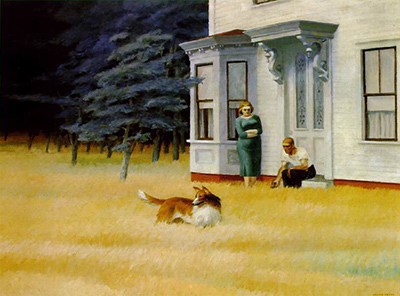
| Cape Cod Evening | 1939 | oil on canvas |
| Cape Cod Morning | 1950 | oil on canvas |
| Chair Car | 1965 | oil on canvas |
| Chop Suey | 1929 | oil on canvas |
| City Roofs | 1932 | Oil on canvas |
| Coast Guard Station | 1929 | oil on canvas |
| Compartment C, Car 293 | 1938 | oil on canvas |
| Conference at Night | 1949 | oil on canvas |
| Corn Hill | 1930 | oil on canvas |
| Dawn in Pennsylvania | 1942 | oil on canvas |
| Drug Store | 1927 | oil on canvas |
| Early Sunday Morning | 1930 | Oil on canvas |
| East Side Interior (70.1020) | 1922 | Etching |
| East Wind Over Weehawken | 1934 | oil on canvas |
| El Palacio | 1946 | Watercolor and graphite pencil on paper |
| Eleven A.M. | 1926 | oil on canvas |
| Evening Wind | 1921 | etching |
| Excursion into Philosophy | 1959 | oil on canvas |
| First Row Orchestra | 1951 | oil on canvas |
| Freight Car at Truro | 1931 | watercolour over graphite on paper |
| Gas | 1940 | oil on canvas |
| Girl at a Sewing Machine | c. 1921 | oil on canvas |
| Gloucester Harbor | 1912 | Oil on canvas |
| Ground Swell | 1939 | oil on canvas |
| Haskell's House | 1924 | watercolour over graphite on paperboard |
| High Noon | 1949 | oil on canvas |
| Hill and Houses Cape Elizabeth Maine | 1927 | watercolour over graphite pencil |
| Hills South Truro | 1930 | oil on canvas |
| Hotel by a Railroad | 1952 | oil on canvas |
| Hotel Lobby | 1943 | oil on canvas |
| Hotel Room | 1931 | oil on canvas |
| Hotel Window | 1955 | oil on canvas |
| House by the Railroad | 1925 | oil on canvas |
| House by the Squam River | 1926 | watercolour over graphite on paper |
| Le Bistro or The Wine Shop | 1909 | Oil on canvas |
| Le Pont des Arts | 1907 | Oil on canvas |
| Le Pont Royal | 1909 | Oil on canvas |
| Le Quai des Grands Augustins | 1909 | Oil on canvas |
| Lighthouse and Buildings Portland Head | 1927 | watercolour over graphite pencil on paper |
| Lighthouse Hill | 1927 | oil painting |
| Manhattan Bridge Loop | 1928 | oil on canvas |
| Model Sitting | c. 1902 | oil painting; support not asserted |
| Morning Sun | 1952 | oil on canvas |
| New York Movie | 1939 | oil on canvas |
| New York New Haven and Hartford | 1931 | oil on canvas |
| New York Office | 1962 | oil on canvas |
| New York Pavements | 1924–1925 | oil on canvas |
| New York Restaurant | c. 1922 | oil on canvas |
| Night Windows | 1928 | oil on canvas |
| Nighthawks | 1942 | oil on canvas |
| October on Cape Cod | 1946 | oil on canvas |
| Office at Night | 1940 | oil on canvas |
| Office in a Small City | 1953 | oil on canvas |
| Pennsylvania Coal Town | 1947 | oil on canvas |
| People in the Sun | 1960 | oil on canvas |
| Portrait of Orleans | 1950 | oil on canvas |
| Queensborough Bridge | 1913 | Oil on canvas |
| Railroad Sunset | 1929 | Oil on canvas |
| Railroad Train | 1908 | oil on canvas |
| Road in Maine | 1914 | oil on canvas |
| Room in Brooklyn | 1932 | oil on canvas |
| Room in New York | 1932 | oil on canvas |
| Rooms by the Sea | 1951 | oil on canvas |
| Rooms for Tourists | 1945 | oil on canvas |
| Route 6 Eastham | 1941 | oil on canvas |
| Second Story Sunlight | 1960 | Oil on canvas |
| Self-Portrait | 1925–1930 | Oil on canvas |
| Self-Portrait with Hat (70.1903) | c. 1918, posthumous print | Drypoint |
| Seven A.M. | 1948 | Oil on canvas |
| Soir Bleu | 1914 | oil on canvas |
| South Carolina Morning | 1955 | Oil on canvas |
| Stairway at 48 Rue de Lille Paris | 1906 | Oil on wood |
| Study for 5 A.M. (70.153) | 1937 | Fabricated chalk on paper |
| Study for 5 A.M. (70.429) | 1937 | Fabricated chalk and graphite pencil on paper |
| Study for Approaching a City (70.869) | 1946 | Fabricated chalk and charcoal on paper |
| Study for August in the City (70.158a-b) | 1945 | Fabricated chalk on paper |
| Study for August in the City (70.159) | 1945 | Fabricated chalk on paper |
| Study for Bridle Path (70.220) | 1939 | Fabricated chalk on paper |
| Study for Bridle Path (70.235) | 1939 | Fabricated chalk on paper |
| Study for Compartment C, Car 293 (70.430) | 1938 | Fabricated chalk on paper |
| Study for Compartment C, Car 293 (70.431a-b) | 1938 | Fabricated chalk and charcoal on paper |
| Study for Conference at Night (70.170) | 1949 | Fabricated chalk on paper (recto); Typewriter ink on paper (verso) |
| Study for Conference at Night (70.174) | 1949 | Fabricated chalk on paper ( recto); Typewriter ink on paper (verso) |
| Study for East Wind over Weehawken (70.249) | 1934 | Graphite pencil on paper |
| Study for East Wind over Weehawken (70.252) | 1934 | Fabricated chalk and charcoal on paper |
| Study for Evening Wind (70.343a-b) | 1921 | Fabricated chalk on paper |
| Study for First Row Orchestra (70.841) | 1951 | Fabricated chalk and charcoal on paper |
| Study for Gas (70.263) | 1940 | Fabricated chalk on paper |
| Study for Ground Swell (70.339) | 1939 | Fabricated chalk, charcoal and graphite pencil on paper |
| Study for Hotel by a Railroad (70.199) | 1952 | Fabricated chalk on paper |
| Study for Hotel by a Railroad (70.427) | 1952 | Fabricated chalk on paper |
| Study for Hotel by a Railroad (70.428) | 1952 | Fabricated chalk on paper |
| Study for Hotel Lobby (70.117) | 1942 | Fabricated chalk and graphite pencil on paper |
| Study for Hotel Lobby (70.839) | 1942 | Fabricated chalk and charcoal on paper |
| Study for Hotel Window (70.161) | 1955 | Fabricated chalk, graphite pencil and colored pencil on paper |
| Study for Morning Sun (70.243) | 1952 | Fabricated chalk on paper |
| Study for Morning Sun (70.244) | 1952 | Fabricated chalk on paper |
| Study for Morning Sun (70.290) | 1952 | Fabricated chalk on paper |
| Study for Morning Sun (70.291) | 1952 | Fabricated chalk and graphite pencil on paper |
| Study for New York Movie (70.273) | 1939 | Fabricated chalk on paper |
| Study for New York Movie (70.274a-b) | 1938 or 1939 | Fabricated chalk and charcoal on paper (recto); Fabricated chalk on paper (verso) |
| Study for New York Movie (70.455) | 1939 | Fabricated chalk and charcoal on paper |
| Study for New York Office (70.822) | 1962 | Fabricated chalk on paper |
| Study for Nighthawks (70.192) | 1941 or 1942 | Fabricated chalk on paper |
| Study for Nighthawks (70.193) | 1941 or 1942 | Fabricated chalk on paper |
| Study for Office at Night (70.340) | 1940 | Fabricated chalk and charcoal on paper |
| Study for Office at Night (70.341) | 1940 | Fabricated chalk and graphite pencil on paper |
| Study for Pennsylvania Coal Town (70.198) | 1947 | Fabricated chalk on paper |
| Study for Pennsylvania Coal Town (70.229) | 1947 | Fabricated chalk and charcoal on paper |
| Study for Rooms for Tourists (70.438) | 1945 | Fabricated chalk and charcoal on paper |
| Study for Rooms for Tourists (70.848) | 1945 | Fabricated chalk and charcoal on paper |
| Study for Route 6, Eastham (70.369) | 1941 | Fabricated chalk and graphite pencil on paper |
| Study for Route 6, Eastham (70.854) | 1941 | Fabricated chalk and graphite pencil on paper |
| Study for South Carolina Morning (70.162a-b) | 1955 | Fabricated chalk on paper (recto and verso) |
| Study for The Sheridan Theatre (70.969) | 1937 | Graphite pencil on paper |
| Study for Two on the Aisle (70.128) | 1927 | Fabricated chalk on paper |
| Study for Two on the Aisle (70.129) | 1927 | Fabricated chalk on paper |
| Study for Yawl Riding a Swell (70.439) | 1935 | Fabricated chalk and graphite pencil on paper |
| Summer Evening | 1947 | oil on canvas |
| Summer Interior | 1909 | Oil on canvas |
| Sun in an Empty Room | 1963 | oil on canvas |
| Sunlight in a Cafeteria | 1958 | oil on canvas |
| Sunlight on Brownstones | 1956 | oil on canvas |
| Tables for Ladies | 1930 | oil on canvas |
| The Bootleggers | 1925 | oil on canvas |
| The Camel's Hump | 1931 | oil on canvas |
| The Circle Theatre | 1936 | oil on canvas |
| The City | 1927 | oil on canvas |
| The Lighthouse at Two Lights | 1929 | oil on canvas |
| The Long Leg | 1935 | oil on canvas |
| The Mansard Roof | 1923 | watercolour over graphite on paper |
| The Sheridan Theatre | 1937 | oil on canvas |
| Tramp Steamer | 1908 | oil on canvas |
| Two Comedians | 1966 | oil on canvas |
| Two on the Aisle | 1927 | oil on canvas |
| Valley of the Seine | 1909 | Oil on canvas |
| Western Motel | 1957 | oil on canvas |
Frequently Asked Questions
Edward Hopper made House by the Squam River in 1926. [1]
The recorded medium is watercolour over graphite on paper. [1]
The roof is almost at eye level. A red chimney rises above it, while the pale walls below carry dark windows and a sharply angled shadow. Beyond the house, Edward Hopper opens a much longer view across land and water. The contrast between this close building and the distance behind it gives House by 'Squam River, Gloucester its unusual scale: we seem near enough to examine a roof, yet high enough to look across a substantial stretch of town and landscape.
Discussion
Look again at the images and ideas explored in House by 'Squam River, Gloucester. These editorial prompts invite your observations.
Reader Insights
Which boundary, gesture or change of light first holds your attention in House by the Squam River?
Compare Adam's House with House by the Squam River. Which visual difference matters most to your reading?
Which detail would you look at again after reading “Chimney, canopy and shadow”?
Join the Conversation
Share a detail, comparison or question about House by 'Squam River, Gloucester below.
References
- Museum of Fine Arts, Boston, House by 'Squam River, Gloucester, museum-supplied AMICA catalogue record, 1926, watercolour, 34.3 × 48.4 cm, accession 48.719, Bequest of John T. Spaulding. View source.
- National Gallery of Art, Edward Hopper, exhibition checklist, updated 6 September 2007, cat. 28, House by 'Squam River, Gloucester; cat. 22, The Mansard Roof; cat. 25, Houses of 'Squam Light, Gloucester. View source.
- Catherine Ryan, “Another Edward Hopper Gloucester Match”, 2012, crediting Kathy and Jeff Weaver for the sight-line identification. View source.
- The Art Institute of Chicago, “Selected Chronology for Edward Hopper (1882–1967)”, entries for 1923, 1924 and 1926. View source.
- Collection or catalogue record, American Village, 1912; medium and identity as discussed in the linked article. View source.
- Collection or catalogue record, Soir Bleu, 1914; medium and identity as discussed in the linked article. View source.
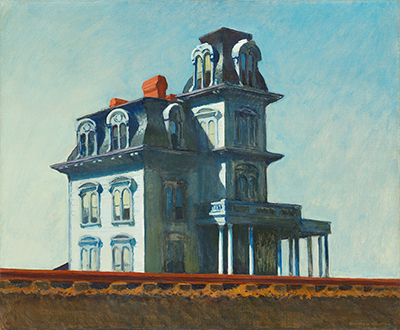
- Collection or catalogue record, House by the Railroad, 1925; medium and identity as discussed in the linked article. View source.
- Collection or catalogue record, Automat, 1927; medium and identity as discussed in the linked article. View source.
- Collection or catalogue record, Early Sunday Morning, 1930; medium and identity as discussed in the linked article. View source.
- Collection or catalogue record, New York Movie, 1939; medium and identity as discussed in the linked article. View source.
- Collection or catalogue record, Nighthawks, 1942; medium and identity as discussed in the linked article. View source.
- Collection or catalogue record, Morning Sun, 1952; medium and identity as discussed in the linked article. View source.
- Collection or catalogue record, Second Story Sunlight, 1960; medium and identity as discussed in the linked article. View source.
- Collection or catalogue record, Two Comedians, 1966; medium and identity as discussed in the linked article. View source.
- Whitney Museum of American Art, Study for Route 6, Eastham, 1941, accession 70.854; exact object record. View source.
- Whitney Museum of American Art, Study for Conference at Night, 1949, accession 70.170; exact object record. View source.
- Whitney Museum of American Art, Study for First Row Orchestra, 1951, accession 70.841; exact object record. View source.
- Whitney Museum of American Art, (Bridge and Embankment), 1906, accession 70.1298; exact object record. View source.
- Whitney Museum of American Art, (Seated Male Model, Bent Over), c. 1902–1903, accession 70.1277; exact object record. View source.
- Whitney Museum of American Art, Study for Morning Sun, 1952, accession 70.244; exact object record. View source.
- Whitney Museum of American Art, Study for Morning Sun, 1952, accession 70.243; exact object record. View source.
- Whitney Museum of American Art, Study for Two on the Aisle, 1927, accession 70.128; exact object record. View source.
- Whitney Museum of American Art, Study for New York Office, 1962, accession 70.822; exact object record. View source.
- Whitney Museum of American Art, Study for Two on the Aisle, 1927, accession 70.129; exact object record. View source.
- Whitney Museum of American Art, Study for Pennsylvania Coal Town, 1947, accession 70.229; exact object record. View source.
- Whitney Museum of American Art, (Rooftops), 1926, accession 70.1114; exact object record. View source.
- Whitney Museum of American Art, Study for South Carolina Morning, 1955, accession 70.162a-b; exact object record. View source.
- Whitney Museum of American Art, (Self-Portrait), 1903–1906, accession 70.1254; exact object record. View source.
- Whitney Museum of American Art, (Manhattan Bridge), 1925–1926, accession 70.1098; exact object record. View source.
- Whitney Museum of American Art, (Solitary Figure in a Theater), c. 1902–1904, accession 70.1418; exact object record. View source.
- Whitney Museum of American Art, Study for Approaching a City, 1946, accession 70.869; exact object record. View source.
- Whitney Museum of American Art, Study for August in the City, 1945, accession 70.159; exact object record. View source.
- Whitney Museum of American Art, Study for Compartment C, Car 293, 1938, accession 70.430; exact object record. View source.
- Whitney Museum of American Art, Study for Compartment C, Car 293, 1938, accession 70.431a-b; exact object record. View source.
- Whitney Museum of American Art, Study for East Wind over Weehawken, 1934, accession 70.252; exact object record. View source.
- Whitney Museum of American Art, Study for East Wind over Weehawken, 1934, accession 70.249; exact object record. View source.
- Whitney Museum of American Art, Study for Evening Wind, 1921, accession 70.343a-b; exact object record. View source.
- Whitney Museum of American Art, Study for The Sheridan Theatre, 1937, accession 70.969; exact object record. View source.
- Whitney Museum of American Art, Study for New York Movie, 1939, accession 70.455; exact object record. View source.
- Whitney Museum of American Art, Study for New York Movie, 1939, accession 70.273; exact object record. View source.
- Whitney Museum of American Art, Study for New York Movie, 1938 or 1939, accession 70.274a-b; exact object record. View source.
- Whitney Museum of American Art, Study for 5 A.M., 1937, accession 70.153; exact object record. View source.
- Whitney Museum of American Art, Study for 5 A.M., 1937, accession 70.429; exact object record. View source.
- Whitney Museum of American Art, (Jo Sketching at Good Harbor Beach), 1923–1924, accession 70.1129; exact object record. View source.
- Whitney Museum of American Art, Study for August in the City, 1945, accession 70.158a-b; exact object record. View source.
- Whitney Museum of American Art, Study for Morning Sun, 1952, accession 70.291; exact object record. View source.
- Whitney Museum of American Art, Study for Morning Sun, 1952, accession 70.290; exact object record. View source.
- Whitney Museum of American Art, Study for Office at Night, 1940, accession 70.340; exact object record. View source.
- Whitney Museum of American Art, Study for Office at Night, 1940, accession 70.341; exact object record. View source.
- Whitney Museum of American Art, Study for Hotel by a Railroad, 1952, accession 70.427; exact object record. View source.
- Whitney Museum of American Art, Study for Hotel by a Railroad, 1952, accession 70.199; exact object record. View source.
- Whitney Museum of American Art, Study for Hotel by a Railroad, 1952, accession 70.428; exact object record. View source.
- Whitney Museum of American Art, Study for Hotel Lobby, 1942, accession 70.117; exact object record. View source.
- Whitney Museum of American Art, Study for Hotel Lobby, 1942, accession 70.839; exact object record. View source.
- Whitney Museum of American Art, Study for Conference at Night, 1949, accession 70.174; exact object record. View source.
- Whitney Museum of American Art, Study for Hotel Window, 1955, accession 70.161; exact object record. View source.
- Whitney Museum of American Art, Study for Pennsylvania Coal Town, 1947, accession 70.198; exact object record. View source.
- Whitney Museum of American Art, Study for Route 6, Eastham, 1941, accession 70.369; exact object record. View source.
- Whitney Museum of American Art, Study for Bridle Path, 1939, accession 70.220; exact object record. View source.
- Whitney Museum of American Art, Study for Bridle Path, 1939, accession 70.235; exact object record. View source.
- Whitney Museum of American Art, Study for Ground Swell, 1939, accession 70.339; exact object record. View source.
- Whitney Museum of American Art, Study for Yawl Riding a Swell, 1935, accession 70.439; exact object record. View source.
- Whitney Museum of American Art, Study for Rooms for Tourists, 1945, accession 70.848; exact object record. View source.
- Whitney Museum of American Art, Study for Rooms for Tourists, 1945, accession 70.438; exact object record. View source.
- Whitney Museum of American Art, Study for Nighthawks, 1941 or 1942, accession 70.193; exact object record. View source.
- Whitney Museum of American Art, Study for Nighthawks, 1941 or 1942, accession 70.192; exact object record. View source.
- Whitney Museum of American Art, Study for Gas, 1940, accession 70.263; exact object record. View source.
- Whitney Museum of American Art, Self-Portrait with Hat, c. 1918, posthumous print, accession 70.1903; exact object record. View source.
- Whitney Museum of American Art, East Side Interior, 1922, accession 70.1020; exact object record. View source.
- Art Institute of Chicago, Selected Chronology for Edward Hopper; training, travels, exhibitions, New York and Truro chronology. View source.
- Emily C. Burns, Spectral figures: Edward Hopper’s empty Paris, chapter 5 in Empty Spaces: Confronting Emptiness in National, Cultural and Urban Histories, 2019; complete chapter and notes consulted. View source.
- Charles Brock, Regionalism and Folk Art, National Gallery of Art; complete essay and two notes consulted. View source.