 by Tom Gurney
Tom Gurney BSc (Hons) is an art history expert with over 20 years experience
Email: tomgurney1@gmail.com / Phone: +44 7429 011000
Posters and Reproductions: Introduction
A reproduction of an Edward Hopper painting can make its arrangement familiar through daily looking. The important choice is often how much of the arrangement survives. A poster that keeps the whole scene offers a different experience from a cropped detail, even when both are made from the same painting.
Start with the image rather than the frame. Check whether the reproduction includes the full composition, how large the printed image will be, and whether any border is included in the advertised size. These simple distinctions help preserve the relationships that make a Hopper recognisable: an interval of pavement, the edge of a room or a road continuing beyond a figure.
At a Glance
Contents
- Full composition or selected detail?
- Why two horizontal paintings need different proportions
- Image size, paper size and framed size
- Choosing a useful scale
- Paper, finish and the room around it
- What a printing description can establish
- Reproductions and Hopper's original prints
- Framing and display
- A final comparison before choosing
Full composition or selected detail?
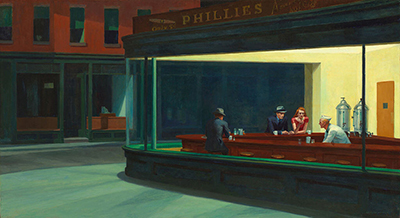
In Nighthawks, the people occupy only a small part of the canvas. The surrounding diner, curved counter and empty street establish how we encounter them. Cropping closely around the man and woman can make their nearness more prominent while removing much of the spectator's position outside the glass.
A detail can be rewarding when it is presented as a detail. It lets a hand, cup or passage of colour receive concentrated attention. The problem arises when a cropped image is described or displayed as though it preserves the whole painting.
Gas offers a different example. The red pumps are conspicuous, but their diagonal relationship to the road and small white building is essential to the scene. A crop that concentrates on the attendant can remove the contrast between a stopping place and the continuing route.
Before choosing, compare all four edges with an owning museum's image. Look for missing foreground, a shortened stretch of sky or an object cut more tightly than in the original. The people may remain intact while the space that gives them their position has changed substantially.
Why two horizontal paintings need different proportions
Nighthawks measures 152.4 cm wide by 84.1 cm high, a width-to-height ratio of about 1.81. [1] Gas measures 102.2 cm wide by 66.7 cm high, a ratio of about 1.53. [2] Both are horizontal paintings, but they are not interchangeable rectangles.
Suppose each complete image is printed forty centimetres wide. Keeping its proportions would make Nighthawks about 22.1 cm high and Gas about 26.1 cm high. These are illustrative image dimensions, not the sizes of particular products. They show why the same width produces different heights.
Forcing both into one identical image rectangle requires a change. The supplier might crop an edge, leave a border or stretch the image. A border can preserve the complete composition; cropping selects part of it; stretching alters shapes throughout it. Knowing which treatment is proposed is more useful than choosing by a familiar frame size alone.
The effects can be seen in small details. A circular pump head becomes oval if one dimension is stretched. A long diner becomes more compact if its width is reduced without a corresponding change in height. Even where the alteration is subtle, it changes the relationships Hopper used.
Image size, paper size and framed size
A stated poster size may refer to the complete sheet. The image can occupy a smaller area within it, particularly where there is a white border or a line of text. A framed product adds another set of dimensions around that sheet.
Ask for the printed image's width and height, the paper's width and height, and the frame's outside dimensions. A mount opening creates a further boundary: its overlap can conceal a narrow strip of the image or paper unless that has been allowed for.
These distinctions matter when comparing two reproductions advertised at the same size. One may give the painting a larger visible area; another may reserve more room for a title, museum information or an exhibition design. Neither arrangement is automatically unsuitable, but the resulting object will look different on a wall.
An exhibition poster also has a design of its own. Typography, margins and institutional information can be part of its appeal. Decide whether you want that complete graphic object or primarily a reproduction of the painting, since enlarging the image alone may remove the features that make it an exhibition poster.
Choosing a useful scale
The size of a reproduction changes the distance at which its details become legible. A small Nighthawks can make the diner read quickly as a band of light. A larger image lets the cups, hand gestures and separate urns become easier to inspect from farther away.
Enlargement does not automatically reveal more information. It can also make the limits of the source image more apparent. An indistinct hand remains indistinct if a low-detail source is simply printed larger. A clear preview of a small area is useful when judging how an enlargement may look.
Consider the place from which you expect to see the picture. An image across a room needs to establish its main shapes at that distance. One beside a chair can reward closer attention. Measuring the intended space and marking a proposed outline on the wall can make those differences more concrete than a screen thumbnail does.
The original's scale provides context rather than a requirement. Nighthawks is five feet wide; a domestic reproduction can be much smaller while retaining its proportions. [1] What matters is understanding how the change affects your encounter with the scene.
Compare: Nighthawks, 1942.
Paper, finish and the room around it
The finished reproduction combines an image with a particular surface. A textured paper can make its own grain visible in a pale wall or sky. A smoother surface can make that area look more continuous. These are differences in the reproduced object, rather than evidence of Hopper's original support.
A glossy finish can catch reflections from a window or lamp; a matte finish will present a different surface under the same conditions. The frame's glazing adds another reflective layer. A reproduction that looks clear in a product photograph may be harder to see when placed opposite a bright window.
Colour comparisons also need a consistent setting. Two images viewed under different lamps, or on screens with different brightness settings, do not provide a controlled comparison. A sample viewed in the intended room can answer a more useful question: how does this particular print look where it will be seen?
Museum images provide a helpful reference for major colour relationships and the complete composition. They do not make every screen or printed sheet identical to the original painting. Look for obvious shifts in the relation between light and dark, or between large colour areas, before treating a small difference in hue as decisive.
Watch: Edward Hopper’s Life and Art
Explore Hopper’s paintings and the places behind them in these museum films. Choose a film below.
What a printing description can establish
Paper and ink should be described together. The Library of Congress notes that the stability of pigment-based inkjet output depends on appropriate matching paper and conditions of storage. [3] A general claim of permanence is therefore less informative than a specific description of the materials and the conditions under which they were assessed.
The same word can cover very different products. An art print might be a new reproduction on paper, an older exhibition poster or an original work made through printmaking. A detailed description should identify the process and what image or matrix it reproduces.
Ask whether a signature is reproduced within the image or separately applied. A printed facsimile of Hopper's painted signature belongs to the reproduction. Its visibility does not make the sheet a personally signed work by him.
A carefully made reproduction makes a painting available for regular looking. Clear information about its materials and authorship helps you assess the object on that basis.
Reproductions and Hopper's original prints
Hopper's original etchings and drypoints involve a different relationship between image and process. For example, MoMA records its Night Shadows as a 1921 design published in December 1924 by The New Republic, with Peter Platt as printer. [4] That sheet belongs to a printing history connected with Hopper's matrix, rather than a later photograph of one of his paintings.
A reproduction of Night Shadows is another object again. It can show the composition clearly while reproducing the appearance of ink and paper through a different printing process. It should be described accordingly, even though the title remains the same.
Etchings and Prints explains plates, states, impressions and posthumous printing in more detail. The distinction helps when searching for a favourite image: the same title can lead to objects with very different histories and purposes.
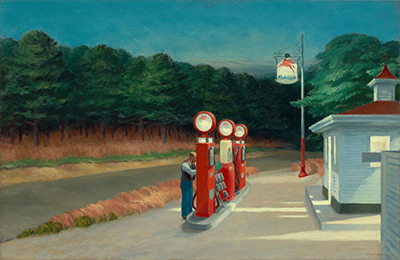
Compare: Gas, 1940.
Framing and display
For paper reproductions you want to retain, the Library of Congress recommends stable framing materials, separation between the object and glazing, and a position away from direct sunlight and strong heat sources. [5] A mount or spacers can provide the separation; the complete frame needs enough depth to accommodate the package.
UV-filtering glazing can reduce one part of the exposure, but it does not make all light harmless. The Library's paper guidance stresses that visible light also contributes to damage. [3] No framing description should be read as a promise that a print will remain unchanged indefinitely.
The frame also affects the immediate appearance. A narrow mount can keep the picture close to its surroundings; a wider one gives it more visual separation. Compare options with the whole composition visible, so a decorative decision does not accidentally become an unnoticed crop.
A final comparison before choosing
At the intended viewing distance, the space around Hopper's people should still contribute to the scene. The curve of the Nighthawks counter and the road beside the Gas pumps help determine how we approach their figures. Keeping those relationships visible gives a reproduction more to offer than the isolated detail that first attracts attention.
Clear information about crop, image size, materials and presentation makes that choice easier. A suitable reproduction gives the scene enough room for its small details and larger spatial relationships to work together.
Artworks and studies directory
This researched directory includes finished works and separately identified studies. It is not a complete catalogue raisonné. Linked titles open the articles; unlinked studies are identified by their collection accessions. Watercolours retain their recorded media, and original prints remain distinct from reproductions.
| Name | Date | Medium |
|---|---|---|
| (Bridge and Embankment) (70.1298) | 1906 | Oil on wood |
| (Jo Sketching at Good Harbor Beach) (70.1129) | 1923–1924 | Watercolor and fabricated chalk on paper |
| (Manhattan Bridge) (70.1098) | 1925–1926 | Watercolor and graphite pencil on paper |
| (Rooftops) (70.1114) | 1926 | Watercolor and graphite pencil on paper |
| (Seated Male Model, Bent Over) (70.1277) | c. 1902–1903 | Oil on canvas |
| (Self-Portrait) (70.1254) | 1903–1906 | Oil on canvas |
| (Solitary Figure in a Theater) (70.1418) | c. 1902–1904 | Oil on board |
| 5 A.M. | 1937 | oil on canvas |
| Adam's House | 1928 | watercolour and charcoal on paper |
| American Village | 1912 | Oil on canvas |
| Apartment Houses | 1923 | oil on canvas |
| Approaching a City | 1946 | oil on canvas |
| August in the City | 1945 | oil on canvas |
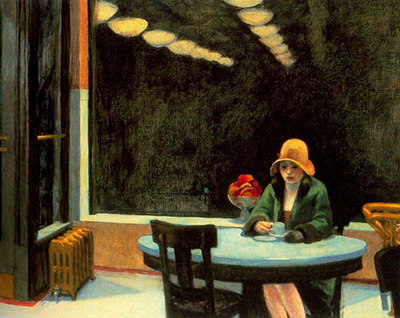
| Automat | 1927 | oil on canvas |
| Barber Shop | 1931 | oil on canvas |
| Blackwell's Island | 1928 | oil on canvas |
| Bridge on the Seine | 1909 | Oil on canvas |
| Bridle Path | 1939 | oil on canvas |
| Burly Cobb's House South Truro | 1930–1933 | oil on canvas |
| Cape Cod Evening | 1939 | oil on canvas |
| Cape Cod Morning | 1950 | oil on canvas |
| Chair Car | 1965 | oil on canvas |
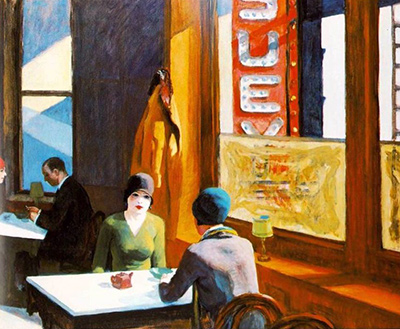
| Chop Suey | 1929 | oil on canvas |
| City Roofs | 1932 | Oil on canvas |
| Coast Guard Station | 1929 | oil on canvas |
| Compartment C, Car 293 | 1938 | oil on canvas |
| Conference at Night | 1949 | oil on canvas |
| Corn Hill | 1930 | oil on canvas |
| Dawn in Pennsylvania | 1942 | oil on canvas |
| Drug Store | 1927 | oil on canvas |
| Early Sunday Morning | 1930 | Oil on canvas |
| East Side Interior (70.1020) | 1922 | Etching |
| East Wind Over Weehawken | 1934 | oil on canvas |
| El Palacio | 1946 | Watercolor and graphite pencil on paper |
| Eleven A.M. | 1926 | oil on canvas |
| Evening Wind | 1921 | etching |
| Excursion into Philosophy | 1959 | oil on canvas |
| First Row Orchestra | 1951 | oil on canvas |
| Freight Car at Truro | 1931 | watercolour over graphite on paper |
| Gas | 1940 | oil on canvas |
| Girl at a Sewing Machine | c. 1921 | oil on canvas |
| Gloucester Harbor | 1912 | Oil on canvas |
| Ground Swell | 1939 | oil on canvas |
| Haskell's House | 1924 | watercolour over graphite on paperboard |
| High Noon | 1949 | oil on canvas |
| Hill and Houses Cape Elizabeth Maine | 1927 | watercolour over graphite pencil |
| Hills South Truro | 1930 | oil on canvas |
| Hotel by a Railroad | 1952 | oil on canvas |
| Hotel Lobby | 1943 | oil on canvas |
| Hotel Room | 1931 | oil on canvas |
| Hotel Window | 1955 | oil on canvas |
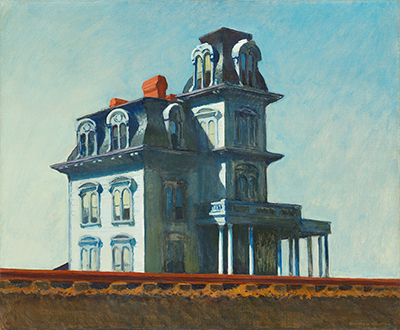
| House by the Railroad | 1925 | oil on canvas |
| House by the Squam River | 1926 | watercolour over graphite on paper |
| Le Bistro or The Wine Shop | 1909 | Oil on canvas |
| Le Pont des Arts | 1907 | Oil on canvas |
| Le Pont Royal | 1909 | Oil on canvas |
| Le Quai des Grands Augustins | 1909 | Oil on canvas |
| Lighthouse and Buildings Portland Head | 1927 | watercolour over graphite pencil on paper |
| Lighthouse Hill | 1927 | oil painting |
| Manhattan Bridge Loop | 1928 | oil on canvas |
| Model Sitting | c. 1902 | oil painting; support not asserted |
| Morning Sun | 1952 | oil on canvas |
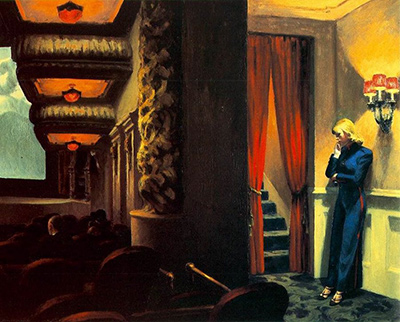
| New York Movie | 1939 | oil on canvas |
| New York New Haven and Hartford | 1931 | oil on canvas |
| New York Office | 1962 | oil on canvas |
| New York Pavements | 1924–1925 | oil on canvas |
| New York Restaurant | c. 1922 | oil on canvas |
| Night Windows | 1928 | oil on canvas |
| Nighthawks | 1942 | oil on canvas |
| October on Cape Cod | 1946 | oil on canvas |
| Office at Night | 1940 | oil on canvas |
| Office in a Small City | 1953 | oil on canvas |
| Pennsylvania Coal Town | 1947 | oil on canvas |
| People in the Sun | 1960 | oil on canvas |
| Portrait of Orleans | 1950 | oil on canvas |
| Queensborough Bridge | 1913 | Oil on canvas |
| Railroad Sunset | 1929 | Oil on canvas |
| Railroad Train | 1908 | oil on canvas |
| Road in Maine | 1914 | oil on canvas |
| Room in Brooklyn | 1932 | oil on canvas |
| Room in New York | 1932 | oil on canvas |
| Rooms by the Sea | 1951 | oil on canvas |
| Rooms for Tourists | 1945 | oil on canvas |
| Route 6 Eastham | 1941 | oil on canvas |
| Second Story Sunlight | 1960 | Oil on canvas |
| Self-Portrait | 1925–1930 | Oil on canvas |
| Self-Portrait with Hat (70.1903) | c. 1918, posthumous print | Drypoint |
| Seven A.M. | 1948 | Oil on canvas |
| Soir Bleu | 1914 | oil on canvas |
| South Carolina Morning | 1955 | Oil on canvas |
| Stairway at 48 Rue de Lille Paris | 1906 | Oil on wood |
| Study for 5 A.M. (70.153) | 1937 | Fabricated chalk on paper |
| Study for 5 A.M. (70.429) | 1937 | Fabricated chalk and graphite pencil on paper |
| Study for Approaching a City (70.869) | 1946 | Fabricated chalk and charcoal on paper |
| Study for August in the City (70.158a-b) | 1945 | Fabricated chalk on paper |
| Study for August in the City (70.159) | 1945 | Fabricated chalk on paper |
| Study for Bridle Path (70.220) | 1939 | Fabricated chalk on paper |
| Study for Bridle Path (70.235) | 1939 | Fabricated chalk on paper |
| Study for Compartment C, Car 293 (70.430) | 1938 | Fabricated chalk on paper |
| Study for Compartment C, Car 293 (70.431a-b) | 1938 | Fabricated chalk and charcoal on paper |
| Study for Conference at Night (70.170) | 1949 | Fabricated chalk on paper (recto); Typewriter ink on paper (verso) |
| Study for Conference at Night (70.174) | 1949 | Fabricated chalk on paper ( recto); Typewriter ink on paper (verso) |
| Study for East Wind over Weehawken (70.249) | 1934 | Graphite pencil on paper |
| Study for East Wind over Weehawken (70.252) | 1934 | Fabricated chalk and charcoal on paper |
| Study for Evening Wind (70.343a-b) | 1921 | Fabricated chalk on paper |
| Study for First Row Orchestra (70.841) | 1951 | Fabricated chalk and charcoal on paper |
| Study for Gas (70.263) | 1940 | Fabricated chalk on paper |
| Study for Ground Swell (70.339) | 1939 | Fabricated chalk, charcoal and graphite pencil on paper |
| Study for Hotel by a Railroad (70.199) | 1952 | Fabricated chalk on paper |
| Study for Hotel by a Railroad (70.427) | 1952 | Fabricated chalk on paper |
| Study for Hotel by a Railroad (70.428) | 1952 | Fabricated chalk on paper |
| Study for Hotel Lobby (70.117) | 1942 | Fabricated chalk and graphite pencil on paper |
| Study for Hotel Lobby (70.839) | 1942 | Fabricated chalk and charcoal on paper |
| Study for Hotel Window (70.161) | 1955 | Fabricated chalk, graphite pencil and colored pencil on paper |
| Study for Morning Sun (70.243) | 1952 | Fabricated chalk on paper |
| Study for Morning Sun (70.244) | 1952 | Fabricated chalk on paper |
| Study for Morning Sun (70.290) | 1952 | Fabricated chalk on paper |
| Study for Morning Sun (70.291) | 1952 | Fabricated chalk and graphite pencil on paper |
| Study for New York Movie (70.273) | 1939 | Fabricated chalk on paper |
| Study for New York Movie (70.274a-b) | 1938 or 1939 | Fabricated chalk and charcoal on paper (recto); Fabricated chalk on paper (verso) |
| Study for New York Movie (70.455) | 1939 | Fabricated chalk and charcoal on paper |
| Study for New York Office (70.822) | 1962 | Fabricated chalk on paper |
| Study for Nighthawks (70.192) | 1941 or 1942 | Fabricated chalk on paper |
| Study for Nighthawks (70.193) | 1941 or 1942 | Fabricated chalk on paper |
| Study for Office at Night (70.340) | 1940 | Fabricated chalk and charcoal on paper |
| Study for Office at Night (70.341) | 1940 | Fabricated chalk and graphite pencil on paper |
| Study for Pennsylvania Coal Town (70.198) | 1947 | Fabricated chalk on paper |
| Study for Pennsylvania Coal Town (70.229) | 1947 | Fabricated chalk and charcoal on paper |
| Study for Rooms for Tourists (70.438) | 1945 | Fabricated chalk and charcoal on paper |
| Study for Rooms for Tourists (70.848) | 1945 | Fabricated chalk and charcoal on paper |
| Study for Route 6, Eastham (70.369) | 1941 | Fabricated chalk and graphite pencil on paper |
| Study for Route 6, Eastham (70.854) | 1941 | Fabricated chalk and graphite pencil on paper |
| Study for South Carolina Morning (70.162a-b) | 1955 | Fabricated chalk on paper (recto and verso) |
| Study for The Sheridan Theatre (70.969) | 1937 | Graphite pencil on paper |
| Study for Two on the Aisle (70.128) | 1927 | Fabricated chalk on paper |
| Study for Two on the Aisle (70.129) | 1927 | Fabricated chalk on paper |
| Study for Yawl Riding a Swell (70.439) | 1935 | Fabricated chalk and graphite pencil on paper |
| Summer Evening | 1947 | oil on canvas |
| Summer Interior | 1909 | Oil on canvas |
| Sun in an Empty Room | 1963 | oil on canvas |
| Sunlight in a Cafeteria | 1958 | oil on canvas |
| Sunlight on Brownstones | 1956 | oil on canvas |
| Tables for Ladies | 1930 | oil on canvas |
| The Bootleggers | 1925 | oil on canvas |
| The Camel's Hump | 1931 | oil on canvas |
| The Circle Theatre | 1936 | oil on canvas |
| The City | 1927 | oil on canvas |
| The Lighthouse at Two Lights | 1929 | oil on canvas |
| The Long Leg | 1935 | oil on canvas |
| The Mansard Roof | 1923 | watercolour over graphite on paper |
| The Sheridan Theatre | 1937 | oil on canvas |
| Tramp Steamer | 1908 | oil on canvas |
| Two Comedians | 1966 | oil on canvas |
| Two on the Aisle | 1927 | oil on canvas |
| Valley of the Seine | 1909 | Oil on canvas |
| Western Motel | 1957 | oil on canvas |
Frequently Asked Questions
In Nighthawks, the people occupy only a small part of the canvas. The surrounding diner, curved counter and empty street establish how we encounter them. Cropping closely around the man and woman can make their nearness more prominent while removing much of the spectator's position outside the glass.
A stated poster size may refer to the complete sheet. The image can occupy a smaller area within it, particularly where there is a white border or a line of text. A framed product adds another set of dimensions around that sheet.
Paper and ink should be described together. The Library of Congress notes that the stability of pigment-based inkjet output depends on appropriate matching paper and conditions of storage. [3] A general claim of permanence is therefore less informative than a specific description of the materials and the conditions under which they were assessed.
Discussion
Look again at the images and ideas explored in Posters and Reproductions. These editorial prompts invite your observations.
Reader Insights
Which part of a painting’s arrangement would be lost in a tightly cropped reproduction?
Compare Nighthawks with Gas. Which visual difference matters most to your reading?
Which detail would you look at again after reading “Image size, paper size and framed size”?
Join the Conversation
Share a detail, comparison or question about Posters and Reproductions below.
References
- Art Institute of Chicago, Nighthawks, current collection data, accession 1942.51; archived object entry. Original dimensions used for the explicitly hypothetical scale comparison. View source 1. View source 2.
- Museum of Modern Art, Gas, 1940, object 577.1943. Original canvas dimensions; the comparison does not specify a commercial poster size. View source.
- Library of Congress, Paper Collections: Frequently Asked Questions, especially printing inks, UV-filtering glazing and light exposure. Complete FAQ read; linked testing reports are not independently assessed here. View source.
- Museum of Modern Art, Night Shadows, 1921, published December 1924, object 959.1940. Original etching, publisher and printer distinguished from a reproduction of the image. View source.
- Library of Congress, Preservation Guidelines for Matting and Framing, complete short guidance. Stable materials, spacing from glazing and display location; the linked longer conservation publications were not the sources consulted. View source.
- Whitney Museum of American Art, Study for Route 6, Eastham, 1941, accession 70.854; exact object record. View source.
- Whitney Museum of American Art, Study for Conference at Night, 1949, accession 70.170; exact object record. View source.
- Whitney Museum of American Art, Study for First Row Orchestra, 1951, accession 70.841; exact object record. View source.
- Whitney Museum of American Art, (Bridge and Embankment), 1906, accession 70.1298; exact object record. View source.
- Whitney Museum of American Art, (Seated Male Model, Bent Over), c. 1902–1903, accession 70.1277; exact object record. View source.
- Whitney Museum of American Art, Study for Morning Sun, 1952, accession 70.244; exact object record. View source.
- Whitney Museum of American Art, Study for Morning Sun, 1952, accession 70.243; exact object record. View source.
- Whitney Museum of American Art, Study for Two on the Aisle, 1927, accession 70.128; exact object record. View source.
- Whitney Museum of American Art, Study for New York Office, 1962, accession 70.822; exact object record. View source.
- Whitney Museum of American Art, Study for Two on the Aisle, 1927, accession 70.129; exact object record. View source.
- Whitney Museum of American Art, Study for Pennsylvania Coal Town, 1947, accession 70.229; exact object record. View source.
- Whitney Museum of American Art, (Rooftops), 1926, accession 70.1114; exact object record. View source.
- Whitney Museum of American Art, Study for South Carolina Morning, 1955, accession 70.162a-b; exact object record. View source.
- Whitney Museum of American Art, (Self-Portrait), 1903–1906, accession 70.1254; exact object record. View source.
- Whitney Museum of American Art, (Manhattan Bridge), 1925–1926, accession 70.1098; exact object record. View source.
- Whitney Museum of American Art, (Solitary Figure in a Theater), c. 1902–1904, accession 70.1418; exact object record. View source.
- Whitney Museum of American Art, Study for Approaching a City, 1946, accession 70.869; exact object record. View source.
- Whitney Museum of American Art, Study for August in the City, 1945, accession 70.159; exact object record. View source.
- Whitney Museum of American Art, Study for Compartment C, Car 293, 1938, accession 70.430; exact object record. View source.
- Whitney Museum of American Art, Study for Compartment C, Car 293, 1938, accession 70.431a-b; exact object record. View source.
- Whitney Museum of American Art, Study for East Wind over Weehawken, 1934, accession 70.252; exact object record. View source.
- Whitney Museum of American Art, Study for East Wind over Weehawken, 1934, accession 70.249; exact object record. View source.
- Whitney Museum of American Art, Study for Evening Wind, 1921, accession 70.343a-b; exact object record. View source.
- Whitney Museum of American Art, Study for The Sheridan Theatre, 1937, accession 70.969; exact object record. View source.
- Whitney Museum of American Art, Study for New York Movie, 1939, accession 70.455; exact object record. View source.
- Whitney Museum of American Art, Study for New York Movie, 1939, accession 70.273; exact object record. View source.
- Whitney Museum of American Art, Study for New York Movie, 1938 or 1939, accession 70.274a-b; exact object record. View source.
- Whitney Museum of American Art, Study for 5 A.M., 1937, accession 70.153; exact object record. View source.
- Whitney Museum of American Art, Study for 5 A.M., 1937, accession 70.429; exact object record. View source.
- Whitney Museum of American Art, (Jo Sketching at Good Harbor Beach), 1923–1924, accession 70.1129; exact object record. View source.
- Whitney Museum of American Art, Study for August in the City, 1945, accession 70.158a-b; exact object record. View source.
- Whitney Museum of American Art, Study for Morning Sun, 1952, accession 70.291; exact object record. View source.
- Whitney Museum of American Art, Study for Morning Sun, 1952, accession 70.290; exact object record. View source.
- Whitney Museum of American Art, Study for Office at Night, 1940, accession 70.340; exact object record. View source.
- Whitney Museum of American Art, Study for Office at Night, 1940, accession 70.341; exact object record. View source.
- Whitney Museum of American Art, Study for Hotel by a Railroad, 1952, accession 70.427; exact object record. View source.
- Whitney Museum of American Art, Study for Hotel by a Railroad, 1952, accession 70.199; exact object record. View source.
- Whitney Museum of American Art, Study for Hotel by a Railroad, 1952, accession 70.428; exact object record. View source.
- Whitney Museum of American Art, Study for Hotel Lobby, 1942, accession 70.117; exact object record. View source.
- Whitney Museum of American Art, Study for Hotel Lobby, 1942, accession 70.839; exact object record. View source.
- Whitney Museum of American Art, Study for Conference at Night, 1949, accession 70.174; exact object record. View source.
- Whitney Museum of American Art, Study for Hotel Window, 1955, accession 70.161; exact object record. View source.
- Whitney Museum of American Art, Study for Pennsylvania Coal Town, 1947, accession 70.198; exact object record. View source.
- Whitney Museum of American Art, Study for Route 6, Eastham, 1941, accession 70.369; exact object record. View source.
- Whitney Museum of American Art, Study for Bridle Path, 1939, accession 70.220; exact object record. View source.
- Whitney Museum of American Art, Study for Bridle Path, 1939, accession 70.235; exact object record. View source.
- Whitney Museum of American Art, Study for Ground Swell, 1939, accession 70.339; exact object record. View source.
- Whitney Museum of American Art, Study for Yawl Riding a Swell, 1935, accession 70.439; exact object record. View source.
- Whitney Museum of American Art, Study for Rooms for Tourists, 1945, accession 70.848; exact object record. View source.
- Whitney Museum of American Art, Study for Rooms for Tourists, 1945, accession 70.438; exact object record. View source.
- Whitney Museum of American Art, Study for Nighthawks, 1941 or 1942, accession 70.193; exact object record. View source.
- Whitney Museum of American Art, Study for Nighthawks, 1941 or 1942, accession 70.192; exact object record. View source.
- Whitney Museum of American Art, Study for Gas, 1940, accession 70.263; exact object record. View source.
- Whitney Museum of American Art, Self-Portrait with Hat, c. 1918, posthumous print, accession 70.1903; exact object record. View source.
- Whitney Museum of American Art, East Side Interior, 1922, accession 70.1020; exact object record. View source.
- Art Institute of Chicago, Selected Chronology for Edward Hopper; training, travels, exhibitions, New York and Truro chronology. View source.
- Emily C. Burns, Spectral figures: Edward Hopper’s empty Paris, chapter 5 in Empty Spaces: Confronting Emptiness in National, Cultural and Urban Histories, 2019; complete chapter and notes consulted. View source.
- Charles Brock, Regionalism and Folk Art, National Gallery of Art; complete essay and two notes consulted. View source.
- Collection or catalogue record, American Village, 1912; medium and identity as discussed in the linked article. View source.
- Collection or catalogue record, Soir Bleu, 1914; medium and identity as discussed in the linked article. View source.
- Collection or catalogue record, House by the Railroad, 1925; medium and identity as discussed in the linked article. View source.
- Collection or catalogue record, Automat, 1927; medium and identity as discussed in the linked article. View source.
- Collection or catalogue record, Early Sunday Morning, 1930; medium and identity as discussed in the linked article. View source.
- Collection or catalogue record, New York Movie, 1939; medium and identity as discussed in the linked article. View source.
- Collection or catalogue record, Nighthawks, 1942; medium and identity as discussed in the linked article. View source.
- Collection or catalogue record, Morning Sun, 1952; medium and identity as discussed in the linked article. View source.
- Collection or catalogue record, Second Story Sunlight, 1960; medium and identity as discussed in the linked article. View source.
- Collection or catalogue record, Two Comedians, 1966; medium and identity as discussed in the linked article. View source.