 by Tom Gurney
Tom Gurney BSc (Hons) is an art history expert with over 20 years experience
Email: tomgurney1@gmail.com / Phone: +44 7429 011000
Approaching a City: Introduction
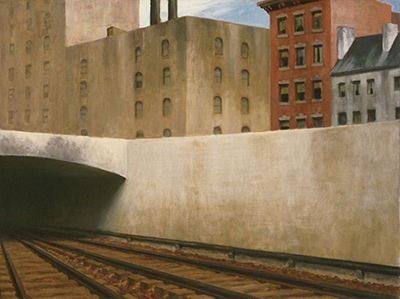
Railway tracks converge towards a dark opening at the left. Above them, a long pale wall supports a group of closely packed buildings: a massive industrial block, a taller red façade and a smaller house with a steep roof. Only a little sky remains. Edward Hopper's Approaching a City presents arrival from an unusually low position, where the city first appears as an accumulation of walls and the way forward disappears into shadow.
The painting dates from 1946 and belongs to the Phillips Collection in Washington, which acquired it in 1947. The museum records oil on canvas, 27⅛ by 36 inches, approximately 68.9 × 91.4 cm, object number 0923. [1] Its proportions are broad enough to include several kinds of building, but close enough to make the retaining wall and tunnel feel immediately in front of us.
At a Glance
- ArtistEdward Hopper [1]
- Date1946 [1]
- Mediumoil on canvas [1]
- Collection / recordThe Phillips Collection [1]
- Accession0923 [1]
This work across Edward Hopper’s career
American Village
1912Soir Bleu
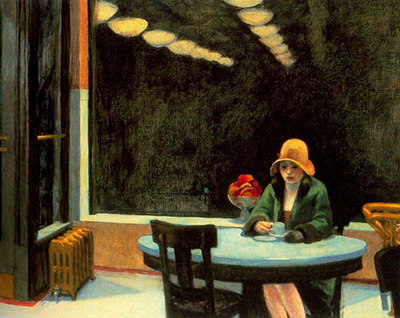
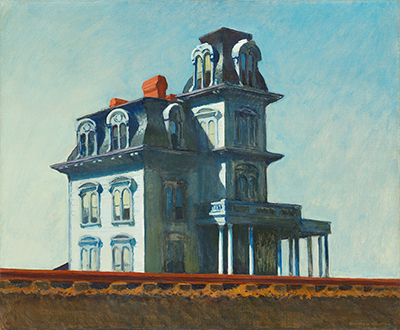
1914Automat
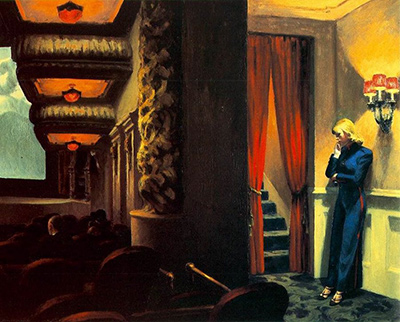
1927New York Movie
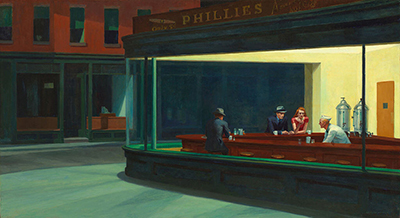
1939Nighthawks
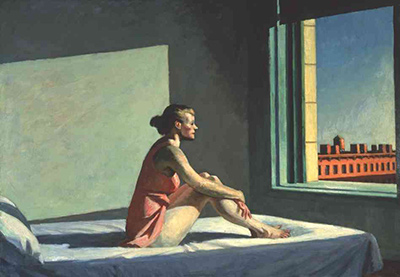
1942Morning Sun
1952Two Comedians
1966Contents
- Arrival from below street level
- The retaining wall
- The dark opening
- Several kinds of city building
- A New York starting point
- The 1946 drawing
- Light, colour and enclosure
- From acquisition to a later exhibition
- Two other thresholds
Arrival from below street level
The viewpoint is central to the painting's effect. We are below the buildings' normal entrances and shopfronts, looking along a railway cutting rather than standing on a city street. The wall conceals the lower portions of the architecture, so the city is encountered through upper façades, rooflines and chimneys.
This changes the information available. Street names, signs and doorways usually help a visitor understand a neighbourhood at ground level. Hopper gives little access to those details. The buildings remain recognizable as different architectural types, but their addresses and uses are harder to establish.
The tracks provide the clearest direction. Their narrow lines begin near the lower edge and draw together towards the left, carrying the eye into the dark portal. The spectator can imagine movement along them even though no train is visible. A route is supplied by the ground itself.
The surrounding architecture makes that imagined passage more concentrated. We cannot turn freely into a side street or look through the buildings. The railway cutting has already selected a direction, and the tunnel makes its continuation inaccessible to sight. Arrival is experienced as a view forward whose next stage is concealed.
The retaining wall
The wall occupies much of the middle and lower right. Its pale, weathered-looking surface is broader and less interrupted than the façades above it. Subtle changes of tone suggest differences across the plane without breaking its overall continuity.
Its upper edge is particularly effective. The long line separates the closely gathered architecture from the comparatively open railway cutting. Buildings of different colours and heights seem to rest above one extensive boundary. The wall makes them into a group while preventing their individual lower edges from becoming fully visible.
Towards the left, the surface turns into the structure over the tunnel. The junction brings a broad horizontal mass into contact with the dark opening beneath. Light on the upper face makes the shadow seem deeper, while the portal's curve differs from the straight wall extending towards the right.
The wall is therefore more than a background to the rails. It is an obstacle to one kind of looking and a guide for another. We can follow its length and surface, but cannot see through it to the ordinary activity of the streets above. It gives the city a physical edge before offering any sense of its interior life.
The dark opening
The tunnel enters from the left boundary, where its full extent cannot be seen. Its darkness occupies a considerable area beside the lighter retaining wall. The contrast makes it immediately legible as an opening, yet the lack of detail within it leaves the continuation of the route uncertain.
The rails point into that obscurity. Their convergence establishes a destination for the eye without providing a visible object at the end. Looking is drawn towards a place where looking becomes less informative. The painting can therefore imply progress while withholding the next view.
The portal also changes the balance of the composition. Most of the architecture rises above or to the right, while the most concentrated darkness lies low and left. The two areas do not mirror each other. A dense city group confronts a partly empty opening, and the track connects the spectator to the latter.
The Phillips relates this arrangement to Hopper's interest in the sensations of entering and leaving cities. Its account transmits his wish to evoke a combination of curiosity, visual interest and fear. [1] That explanation belongs to this painting's documented reception and helps connect its ordinary infrastructure with the uncertainty of an unfamiliar arrival.
In the original 1959 interview, Morse also asked about the painting's solid geometric forms. Hopper accepted their presence but described their effect as partly unintentional, returning to the feeling of approaching the city as his main concern. That reply leaves room to examine the composition without treating every formal relationship as a separately declared intention. [1]
Several kinds of city building
The largest block has relatively plain walls with regular rows of narrow arched windows. Its substantial bulk dominates the left and centre. A few roof structures and chimneys rise above it, but much of its force comes from repetition and uninterrupted masonry.
The red building towards the right is narrower and taller in appearance. Its rectangular windows have a different spacing and shape. The warmer colour separates it from the paler industrial mass, introducing another architectural rhythm without opening a clear gap between them.
At the far right, the smaller pale house brings in a steep, dark roof and dormer forms. Its scale and silhouette differ markedly from the broad industrial building. Yet Hopper has packed the types close together, allowing their differences to be registered within one compressed skyline.
The city consequently appears layered in time as well as in space. Different building forms coexist rather than being reduced to one uniform style. The larger block can dominate the scene without eliminating the smaller, older-looking roof at the edge.
This variety also gives the upper half several directions. The industrial windows repeat across broad walls; the red façade rises in a tighter vertical sequence; the roof at the right introduces steep diagonals. The retaining wall beneath holds those competing movements within a steadier horizontal frame.
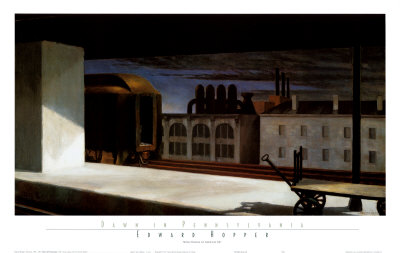
Compare: Dawn in Pennsylvania, 1942.
A New York starting point
The Whitney's 2022 exhibition identified the railway tunnel beneath Park Avenue at East Ninety-seventh Street as the painting's starting point. It is an approach to Grand Central Terminal, a place where commuter tracks pass from an open cutting into a covered route. [2] The real location helps explain the unusual relation between low rails, retaining walls and buildings above.
It does not make the canvas a literal architectural record. Curator Kim Conaty's essay distinguishes Hopper's on-site observations from the city he eventually painted. Comparing the work with historical photographs, she explains that the finished buildings are a selected combination of architectural types rather than a faithful lineup of the structures at the site. [3]
The title accommodates that transformation. Hopper called the work Approaching a City, allowing an observed New York threshold to become a more general experience of urban arrival. Specific infrastructure supports the view, while the altered buildings make its identity less dependent on one address.
The painting's anonymity is consequently constructed. It is not the result of ignoring architecture or making every form vague. The windows, roofs and walls are quite definite. Hopper has chosen which kinds of specificity to retain and which identifying details to leave outside the view.
Watch: Edward Hopper’s Life and Art
Explore Hopper’s paintings and the places behind them in these museum films. Choose a film below.
The 1946 drawing
A preparatory drawing in the Whitney collection, accession 70.869, preserves the relationship among tunnel, tracks, wall and upper buildings. The museum dates the irregular sheet to 1946 and identifies fabricated chalk and charcoal on paper. [4] Dark strokes establish the portal at the lower left, while long lines carry the wall and rails towards it.
The upper architecture is more broken and insistently industrial than the finished skyline. Roof equipment, dark blocks and narrow uprights crowd the upper edge. A relatively tall structure stands at the right, its shaded face adding weight above the wall. The drawing records a complicated group rather than a clean succession of a few easily distinguished building types.
In the oil, colour helps separate the larger units. The pale industrial block, red façade and light house form clearer intervals, even though they remain close together. The wall is also steadier as a broad surface, with less emphasis on the drawing's overlapping strokes.
The tunnel-and-wall relationship survives the transformation. It is the spatial basis around which the upper scene can be revised. This makes the drawing valuable as evidence of both continuity and change: Hopper retained a forceful approach while reorganizing the city above it.
Conaty relates the preparatory work to Hopper's drawing trip in January 1946, drawing on Josephine Hopper's diary as published by Gail Levin. [3] The surviving sheet gives that written account a concrete visual companion. Observation supplied material for the painting, while the final arrangement brought a different order to it.
Light, colour and enclosure
The scene has daylight, but it is not an expansive outdoor panorama. The buildings and retaining wall occupy so much of the view that the sky becomes a narrow, interrupted passage. Its cooler colour helps distinguish the roofline without relieving the weight of the architecture.
Light falls unevenly across the larger masses. Some walls are warmer and more exposed; other faces remain subdued. The red building supplies a concentrated colour contrast, while the pale retaining wall gives the foreground a quieter range. These differences make the city group legible even when the painting withholds a street-level view.
The darkest area is reserved for the tunnel. It is not simply another shaded façade, because the tracks lead directly into it and its inner surface quickly becomes unreadable. The surrounding daylight makes that loss of visibility more acute. We approach a dark interior from a place where the outer structures can still be examined.
The painting's emotional force can begin with this ordinary change of visual conditions. A traveller moves from an open view into an enclosed route, passing beneath a city that remains only partly visible. Hopper gives that transition a concentrated form without adding a visible passenger whose expression would explain how to respond.
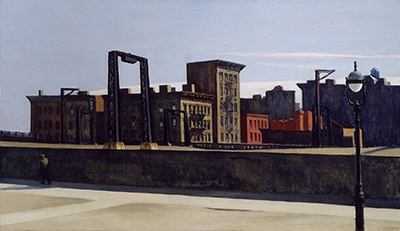
Compare: Manhattan Bridge Loop, 1928.
From acquisition to a later exhibition
The Phillips acquired the canvas in 1947, the year after it was painted. [1] Its early entry into a museum collection gives the work a history distinct from the later fame of its New York location. The painting was already a public collection object before the extensive later attention to Hopper's drawings and urban sources.
In 2022, Edward Hopper's New York placed it at the entrance to the Whitney's exhibition. [2] The choice made the railway approach a useful introduction to a show concerned with the artist's city: a familiar kind of arrival into a view that is at once observed and remade.
The painting's usefulness in that setting follows from its own structure. It gives the visitor a direction into the city, but resists an immediate panorama of celebrated landmarks. Ordinary walls and buildings carry the experience. The tunnel makes entry compelling while keeping what comes next beyond sight.
Two other thresholds
Manhattan Bridge Loop also uses a long wall to divide the spectator from a group of buildings. There, the foreground and wall encourage a strongly lateral movement across the canvas. In Approaching a City, the rails make recession more urgent, directing the eye into a single dark passage.
Dawn in Pennsylvania places the spectator among station structures, with a pale platform between a cropped carriage and a baggage cart. Its dark canopy frames a view of industrial façades. The 1946 painting brings the imagined traveller closer to a continuation of the route, while removing the platform equipment that anchors the earlier scene.
These changes make the tunnel's simplicity especially effective. A few rails converge, a wall turns, and daylight gives way to darkness. Above, several kinds of building hold the city's accumulated weight. Hopper has made an arrival out of the exact point at which the way ahead can no longer be seen.
Artworks and studies directory
This researched directory includes finished works and separately identified studies. It is not a complete catalogue raisonné. Linked titles open the articles; unlinked studies are identified by their collection accessions. Watercolours retain their recorded media, and original prints remain distinct from reproductions.
| Name | Date | Medium |
|---|---|---|
| (Bridge and Embankment) (70.1298) | 1906 | Oil on wood |
| (Jo Sketching at Good Harbor Beach) (70.1129) | 1923–1924 | Watercolor and fabricated chalk on paper |
| (Manhattan Bridge) (70.1098) | 1925–1926 | Watercolor and graphite pencil on paper |
| (Rooftops) (70.1114) | 1926 | Watercolor and graphite pencil on paper |
| (Seated Male Model, Bent Over) (70.1277) | c. 1902–1903 | Oil on canvas |
| (Self-Portrait) (70.1254) | 1903–1906 | Oil on canvas |
| (Solitary Figure in a Theater) (70.1418) | c. 1902–1904 | Oil on board |
| 5 A.M. | 1937 | oil on canvas |
| Adam's House | 1928 | watercolour and charcoal on paper |
| American Village | 1912 | Oil on canvas |
| Apartment Houses | 1923 | oil on canvas |
| Approaching a City | 1946 | oil on canvas |
| August in the City | 1945 | oil on canvas |
| Automat | 1927 | oil on canvas |
| Barber Shop | 1931 | oil on canvas |
| Blackwell's Island | 1928 | oil on canvas |
| Bridge on the Seine | 1909 | Oil on canvas |
| Bridle Path | 1939 | oil on canvas |
| Burly Cobb's House South Truro | 1930–1933 | oil on canvas |
| Cape Cod Evening | 1939 | oil on canvas |
| Cape Cod Morning | 1950 | oil on canvas |
| Chair Car | 1965 | oil on canvas |
| Chop Suey | 1929 | oil on canvas |
| City Roofs | 1932 | Oil on canvas |
| Coast Guard Station | 1929 | oil on canvas |
| Compartment C, Car 293 | 1938 | oil on canvas |
| Conference at Night | 1949 | oil on canvas |
| Corn Hill | 1930 | oil on canvas |
| Dawn in Pennsylvania | 1942 | oil on canvas |
| Drug Store | 1927 | oil on canvas |
| Early Sunday Morning | 1930 | Oil on canvas |
| East Side Interior (70.1020) | 1922 | Etching |
| East Wind Over Weehawken | 1934 | oil on canvas |
| El Palacio | 1946 | Watercolor and graphite pencil on paper |
| Eleven A.M. | 1926 | oil on canvas |
| Evening Wind | 1921 | etching |
| Excursion into Philosophy | 1959 | oil on canvas |
| First Row Orchestra | 1951 | oil on canvas |
| Freight Car at Truro | 1931 | watercolour over graphite on paper |
| Gas | 1940 | oil on canvas |
| Girl at a Sewing Machine | c. 1921 | oil on canvas |
| Gloucester Harbor | 1912 | Oil on canvas |
| Ground Swell | 1939 | oil on canvas |
| Haskell's House | 1924 | watercolour over graphite on paperboard |
| High Noon | 1949 | oil on canvas |
| Hill and Houses Cape Elizabeth Maine | 1927 | watercolour over graphite pencil |
| Hills South Truro | 1930 | oil on canvas |
| Hotel by a Railroad | 1952 | oil on canvas |
| Hotel Lobby | 1943 | oil on canvas |
| Hotel Room | 1931 | oil on canvas |
| Hotel Window | 1955 | oil on canvas |
| House by the Railroad | 1925 | oil on canvas |
| House by the Squam River | 1926 | watercolour over graphite on paper |
| Le Bistro or The Wine Shop | 1909 | Oil on canvas |
| Le Pont des Arts | 1907 | Oil on canvas |
| Le Pont Royal | 1909 | Oil on canvas |
| Le Quai des Grands Augustins | 1909 | Oil on canvas |
| Lighthouse and Buildings Portland Head | 1927 | watercolour over graphite pencil on paper |
| Lighthouse Hill | 1927 | oil painting |
| Manhattan Bridge Loop | 1928 | oil on canvas |
| Model Sitting | c. 1902 | oil painting; support not asserted |
| Morning Sun | 1952 | oil on canvas |
| New York Movie | 1939 | oil on canvas |
| New York New Haven and Hartford | 1931 | oil on canvas |
| New York Office | 1962 | oil on canvas |
| New York Pavements | 1924–1925 | oil on canvas |
| New York Restaurant | c. 1922 | oil on canvas |
| Night Windows | 1928 | oil on canvas |
| Nighthawks | 1942 | oil on canvas |
| October on Cape Cod | 1946 | oil on canvas |
| Office at Night | 1940 | oil on canvas |
| Office in a Small City | 1953 | oil on canvas |
| Pennsylvania Coal Town | 1947 | oil on canvas |
| People in the Sun | 1960 | oil on canvas |
| Portrait of Orleans | 1950 | oil on canvas |
| Queensborough Bridge | 1913 | Oil on canvas |
| Railroad Sunset | 1929 | Oil on canvas |
| Railroad Train | 1908 | oil on canvas |
| Road in Maine | 1914 | oil on canvas |
| Room in Brooklyn | 1932 | oil on canvas |
| Room in New York | 1932 | oil on canvas |
| Rooms by the Sea | 1951 | oil on canvas |
| Rooms for Tourists | 1945 | oil on canvas |
| Route 6 Eastham | 1941 | oil on canvas |
| Second Story Sunlight | 1960 | Oil on canvas |
| Self-Portrait | 1925–1930 | Oil on canvas |
| Self-Portrait with Hat (70.1903) | c. 1918, posthumous print | Drypoint |
| Seven A.M. | 1948 | Oil on canvas |
| Soir Bleu | 1914 | oil on canvas |
| South Carolina Morning | 1955 | Oil on canvas |
| Stairway at 48 Rue de Lille Paris | 1906 | Oil on wood |
| Study for 5 A.M. (70.153) | 1937 | Fabricated chalk on paper |
| Study for 5 A.M. (70.429) | 1937 | Fabricated chalk and graphite pencil on paper |
| Study for Approaching a City (70.869) | 1946 | Fabricated chalk and charcoal on paper |
| Study for August in the City (70.158a-b) | 1945 | Fabricated chalk on paper |
| Study for August in the City (70.159) | 1945 | Fabricated chalk on paper |
| Study for Bridle Path (70.220) | 1939 | Fabricated chalk on paper |
| Study for Bridle Path (70.235) | 1939 | Fabricated chalk on paper |
| Study for Compartment C, Car 293 (70.430) | 1938 | Fabricated chalk on paper |
| Study for Compartment C, Car 293 (70.431a-b) | 1938 | Fabricated chalk and charcoal on paper |
| Study for Conference at Night (70.170) | 1949 | Fabricated chalk on paper (recto); Typewriter ink on paper (verso) |
| Study for Conference at Night (70.174) | 1949 | Fabricated chalk on paper ( recto); Typewriter ink on paper (verso) |
| Study for East Wind over Weehawken (70.249) | 1934 | Graphite pencil on paper |
| Study for East Wind over Weehawken (70.252) | 1934 | Fabricated chalk and charcoal on paper |
| Study for Evening Wind (70.343a-b) | 1921 | Fabricated chalk on paper |
| Study for First Row Orchestra (70.841) | 1951 | Fabricated chalk and charcoal on paper |
| Study for Gas (70.263) | 1940 | Fabricated chalk on paper |
| Study for Ground Swell (70.339) | 1939 | Fabricated chalk, charcoal and graphite pencil on paper |
| Study for Hotel by a Railroad (70.199) | 1952 | Fabricated chalk on paper |
| Study for Hotel by a Railroad (70.427) | 1952 | Fabricated chalk on paper |
| Study for Hotel by a Railroad (70.428) | 1952 | Fabricated chalk on paper |
| Study for Hotel Lobby (70.117) | 1942 | Fabricated chalk and graphite pencil on paper |
| Study for Hotel Lobby (70.839) | 1942 | Fabricated chalk and charcoal on paper |
| Study for Hotel Window (70.161) | 1955 | Fabricated chalk, graphite pencil and colored pencil on paper |
| Study for Morning Sun (70.243) | 1952 | Fabricated chalk on paper |
| Study for Morning Sun (70.244) | 1952 | Fabricated chalk on paper |
| Study for Morning Sun (70.290) | 1952 | Fabricated chalk on paper |
| Study for Morning Sun (70.291) | 1952 | Fabricated chalk and graphite pencil on paper |
| Study for New York Movie (70.273) | 1939 | Fabricated chalk on paper |
| Study for New York Movie (70.274a-b) | 1938 or 1939 | Fabricated chalk and charcoal on paper (recto); Fabricated chalk on paper (verso) |
| Study for New York Movie (70.455) | 1939 | Fabricated chalk and charcoal on paper |
| Study for New York Office (70.822) | 1962 | Fabricated chalk on paper |
| Study for Nighthawks (70.192) | 1941 or 1942 | Fabricated chalk on paper |
| Study for Nighthawks (70.193) | 1941 or 1942 | Fabricated chalk on paper |
| Study for Office at Night (70.340) | 1940 | Fabricated chalk and charcoal on paper |
| Study for Office at Night (70.341) | 1940 | Fabricated chalk and graphite pencil on paper |
| Study for Pennsylvania Coal Town (70.198) | 1947 | Fabricated chalk on paper |
| Study for Pennsylvania Coal Town (70.229) | 1947 | Fabricated chalk and charcoal on paper |
| Study for Rooms for Tourists (70.438) | 1945 | Fabricated chalk and charcoal on paper |
| Study for Rooms for Tourists (70.848) | 1945 | Fabricated chalk and charcoal on paper |
| Study for Route 6, Eastham (70.369) | 1941 | Fabricated chalk and graphite pencil on paper |
| Study for Route 6, Eastham (70.854) | 1941 | Fabricated chalk and graphite pencil on paper |
| Study for South Carolina Morning (70.162a-b) | 1955 | Fabricated chalk on paper (recto and verso) |
| Study for The Sheridan Theatre (70.969) | 1937 | Graphite pencil on paper |
| Study for Two on the Aisle (70.128) | 1927 | Fabricated chalk on paper |
| Study for Two on the Aisle (70.129) | 1927 | Fabricated chalk on paper |
| Study for Yawl Riding a Swell (70.439) | 1935 | Fabricated chalk and graphite pencil on paper |
| Summer Evening | 1947 | oil on canvas |
| Summer Interior | 1909 | Oil on canvas |
| Sun in an Empty Room | 1963 | oil on canvas |
| Sunlight in a Cafeteria | 1958 | oil on canvas |
| Sunlight on Brownstones | 1956 | oil on canvas |
| Tables for Ladies | 1930 | oil on canvas |
| The Bootleggers | 1925 | oil on canvas |
| The Camel's Hump | 1931 | oil on canvas |
| The Circle Theatre | 1936 | oil on canvas |
| The City | 1927 | oil on canvas |
| The Lighthouse at Two Lights | 1929 | oil on canvas |
| The Long Leg | 1935 | oil on canvas |
| The Mansard Roof | 1923 | watercolour over graphite on paper |
| The Sheridan Theatre | 1937 | oil on canvas |
| Tramp Steamer | 1908 | oil on canvas |
| Two Comedians | 1966 | oil on canvas |
| Two on the Aisle | 1927 | oil on canvas |
| Valley of the Seine | 1909 | Oil on canvas |
| Western Motel | 1957 | oil on canvas |
Frequently Asked Questions
Edward Hopper made Approaching a City in 1946. [1]
The recorded medium is oil on canvas. [1]
Railway tracks converge towards a dark opening at the left. Above them, a long pale wall supports a group of closely packed buildings: a massive industrial block, a taller red façade and a smaller house with a steep roof. Only a little sky remains. Edward Hopper's Approaching a City presents arrival from an unusually low position, where the city first appears as an accumulation of walls and the way forward disappears into shadow.
Discussion
Look again at the images and ideas explored in Approaching a City. These editorial prompts invite your observations.
Reader Insights
Which boundary, gesture or change of light first holds your attention in Approaching a City?
Compare Dawn in Pennsylvania with Approaching a City. Which visual difference matters most to your reading?
Which detail would you look at again after reading “The dark opening”?
Join the Conversation
Share a detail, comparison or question about Approaching a City below.
References
- The Phillips Collection, Approaching a City, 1946, object 0923, acquired 1947; current object metadata and interpretation, including Hopper's account of the sensations of arrival. See also Oral history interview with Edward Hopper, 1959 June 17, conducted by John D. Morse, Archives of American Art, Smithsonian Institution, for the original arrival and geometric-form discussion. View source 1. View source 2.
- Whitney Museum of American Art, Edward Hopper's New York, exhibition labels, 2022, entrance, PDF p. 3; site, transformed architecture and exhibition placement. View source.
- Kim Conaty, “Approaching a City: Hopper and New York”, 2022, online catalogue excerpt and notes, especially note 13. Josephine Hopper's diary evidence is cited through Conaty and Gail Levin's published biography. View source.
- Whitney Museum of American Art, Study for Approaching a City, 1946, fabricated chalk and charcoal on paper, accession 70.869; object record and drawing. View source.
- Collection or catalogue record, American Village, 1912; medium and identity as discussed in the linked article. View source.
- Collection or catalogue record, Soir Bleu, 1914; medium and identity as discussed in the linked article. View source.
- Collection or catalogue record, House by the Railroad, 1925; medium and identity as discussed in the linked article. View source.
- Collection or catalogue record, Automat, 1927; medium and identity as discussed in the linked article. View source.
- Collection or catalogue record, Early Sunday Morning, 1930; medium and identity as discussed in the linked article. View source.
- Collection or catalogue record, New York Movie, 1939; medium and identity as discussed in the linked article. View source.
- Collection or catalogue record, Nighthawks, 1942; medium and identity as discussed in the linked article. View source.
- Collection or catalogue record, Morning Sun, 1952; medium and identity as discussed in the linked article. View source.
- Collection or catalogue record, Second Story Sunlight, 1960; medium and identity as discussed in the linked article. View source.
- Collection or catalogue record, Two Comedians, 1966; medium and identity as discussed in the linked article. View source.
- Whitney Museum of American Art, Study for Route 6, Eastham, 1941, accession 70.854; exact object record. View source.
- Whitney Museum of American Art, Study for Conference at Night, 1949, accession 70.170; exact object record. View source.
- Whitney Museum of American Art, Study for First Row Orchestra, 1951, accession 70.841; exact object record. View source.
- Whitney Museum of American Art, (Bridge and Embankment), 1906, accession 70.1298; exact object record. View source.
- Whitney Museum of American Art, (Seated Male Model, Bent Over), c. 1902–1903, accession 70.1277; exact object record. View source.
- Whitney Museum of American Art, Study for Morning Sun, 1952, accession 70.244; exact object record. View source.
- Whitney Museum of American Art, Study for Morning Sun, 1952, accession 70.243; exact object record. View source.
- Whitney Museum of American Art, Study for Two on the Aisle, 1927, accession 70.128; exact object record. View source.
- Whitney Museum of American Art, Study for New York Office, 1962, accession 70.822; exact object record. View source.
- Whitney Museum of American Art, Study for Two on the Aisle, 1927, accession 70.129; exact object record. View source.
- Whitney Museum of American Art, Study for Pennsylvania Coal Town, 1947, accession 70.229; exact object record. View source.
- Whitney Museum of American Art, (Rooftops), 1926, accession 70.1114; exact object record. View source.
- Whitney Museum of American Art, Study for South Carolina Morning, 1955, accession 70.162a-b; exact object record. View source.
- Whitney Museum of American Art, (Self-Portrait), 1903–1906, accession 70.1254; exact object record. View source.
- Whitney Museum of American Art, (Manhattan Bridge), 1925–1926, accession 70.1098; exact object record. View source.
- Whitney Museum of American Art, (Solitary Figure in a Theater), c. 1902–1904, accession 70.1418; exact object record. View source.
- Whitney Museum of American Art, Study for Approaching a City, 1946, accession 70.869; exact object record. View source.
- Whitney Museum of American Art, Study for August in the City, 1945, accession 70.159; exact object record. View source.
- Whitney Museum of American Art, Study for Compartment C, Car 293, 1938, accession 70.430; exact object record. View source.
- Whitney Museum of American Art, Study for Compartment C, Car 293, 1938, accession 70.431a-b; exact object record. View source.
- Whitney Museum of American Art, Study for East Wind over Weehawken, 1934, accession 70.252; exact object record. View source.
- Whitney Museum of American Art, Study for East Wind over Weehawken, 1934, accession 70.249; exact object record. View source.
- Whitney Museum of American Art, Study for Evening Wind, 1921, accession 70.343a-b; exact object record. View source.
- Whitney Museum of American Art, Study for The Sheridan Theatre, 1937, accession 70.969; exact object record. View source.
- Whitney Museum of American Art, Study for New York Movie, 1939, accession 70.455; exact object record. View source.
- Whitney Museum of American Art, Study for New York Movie, 1939, accession 70.273; exact object record. View source.
- Whitney Museum of American Art, Study for New York Movie, 1938 or 1939, accession 70.274a-b; exact object record. View source.
- Whitney Museum of American Art, Study for 5 A.M., 1937, accession 70.153; exact object record. View source.
- Whitney Museum of American Art, Study for 5 A.M., 1937, accession 70.429; exact object record. View source.
- Whitney Museum of American Art, (Jo Sketching at Good Harbor Beach), 1923–1924, accession 70.1129; exact object record. View source.
- Whitney Museum of American Art, Study for August in the City, 1945, accession 70.158a-b; exact object record. View source.
- Whitney Museum of American Art, Study for Morning Sun, 1952, accession 70.291; exact object record. View source.
- Whitney Museum of American Art, Study for Morning Sun, 1952, accession 70.290; exact object record. View source.
- Whitney Museum of American Art, Study for Office at Night, 1940, accession 70.340; exact object record. View source.
- Whitney Museum of American Art, Study for Office at Night, 1940, accession 70.341; exact object record. View source.
- Whitney Museum of American Art, Study for Hotel by a Railroad, 1952, accession 70.427; exact object record. View source.
- Whitney Museum of American Art, Study for Hotel by a Railroad, 1952, accession 70.199; exact object record. View source.
- Whitney Museum of American Art, Study for Hotel by a Railroad, 1952, accession 70.428; exact object record. View source.
- Whitney Museum of American Art, Study for Hotel Lobby, 1942, accession 70.117; exact object record. View source.
- Whitney Museum of American Art, Study for Hotel Lobby, 1942, accession 70.839; exact object record. View source.
- Whitney Museum of American Art, Study for Conference at Night, 1949, accession 70.174; exact object record. View source.
- Whitney Museum of American Art, Study for Hotel Window, 1955, accession 70.161; exact object record. View source.
- Whitney Museum of American Art, Study for Pennsylvania Coal Town, 1947, accession 70.198; exact object record. View source.
- Whitney Museum of American Art, Study for Route 6, Eastham, 1941, accession 70.369; exact object record. View source.
- Whitney Museum of American Art, Study for Bridle Path, 1939, accession 70.220; exact object record. View source.
- Whitney Museum of American Art, Study for Bridle Path, 1939, accession 70.235; exact object record. View source.
- Whitney Museum of American Art, Study for Ground Swell, 1939, accession 70.339; exact object record. View source.
- Whitney Museum of American Art, Study for Yawl Riding a Swell, 1935, accession 70.439; exact object record. View source.
- Whitney Museum of American Art, Study for Rooms for Tourists, 1945, accession 70.848; exact object record. View source.
- Whitney Museum of American Art, Study for Rooms for Tourists, 1945, accession 70.438; exact object record. View source.
- Whitney Museum of American Art, Study for Nighthawks, 1941 or 1942, accession 70.193; exact object record. View source.
- Whitney Museum of American Art, Study for Nighthawks, 1941 or 1942, accession 70.192; exact object record. View source.
- Whitney Museum of American Art, Study for Gas, 1940, accession 70.263; exact object record. View source.
- Whitney Museum of American Art, Self-Portrait with Hat, c. 1918, posthumous print, accession 70.1903; exact object record. View source.
- Whitney Museum of American Art, East Side Interior, 1922, accession 70.1020; exact object record. View source.
- Art Institute of Chicago, Selected Chronology for Edward Hopper; training, travels, exhibitions, New York and Truro chronology. View source.
- Emily C. Burns, Spectral figures: Edward Hopper’s empty Paris, chapter 5 in Empty Spaces: Confronting Emptiness in National, Cultural and Urban Histories, 2019; complete chapter and notes consulted. View source.
- Charles Brock, Regionalism and Folk Art, National Gallery of Art; complete essay and two notes consulted. View source.