 by Tom Gurney
Tom Gurney BSc (Hons) is an art history expert with over 20 years experience
Email: tomgurney1@gmail.com / Phone: +44 7429 011000
Room in Brooklyn: Introduction
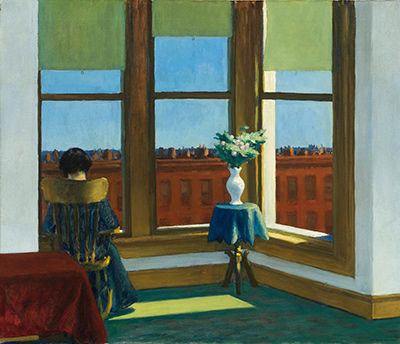
A back-turned woman sits before three tall windows. Beside her, a white vase of flowers stands on a small table covered with blue cloth. Beyond the glass lie brick buildings, rooflines and clear blue sky; below, a long patch of sunlight reaches across the green floor. Edward Hopper's Room in Brooklyn gives an ordinary interior a remarkably open outward view while keeping its seated occupant's face concealed.
The painting dates from 1932 and belongs to the Museum of Fine Arts, Boston. Its museum-contributed catalogue records oil on canvas, approximately 74 × 86.4 cm, accession 35.66, The Hayden Collection—Charles Henry Hayden Fund. [1] The composition gives almost equal importance to the room's few objects and the large window structure surrounding them.
At a Glance
- ArtistEdward Hopper [1]
- Date1932 [1]
- Mediumoil on canvas [1]
- Collection / recordMuseum of Fine Arts, Boston [1]
- Accession35.66 [1]
This work across Edward Hopper’s career
American Village
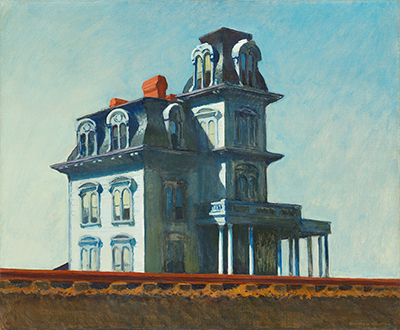
1912Soir Bleu
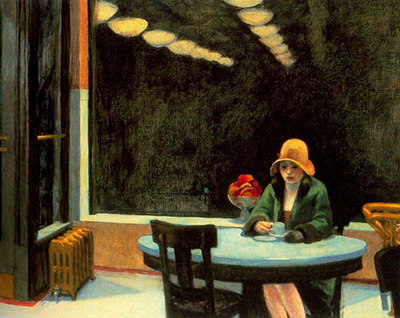
1914Automat
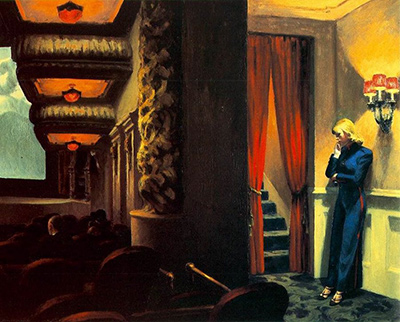
1927New York Movie
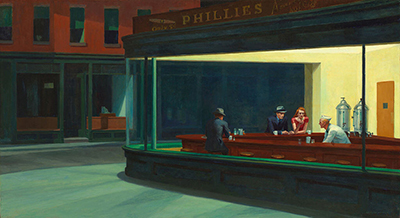
1939Nighthawks
1942Morning Sun
1952Two Comedians
1966Contents
- A figure whose back remains towards us
- Three windows and unequal blinds
- Buildings and sky beyond
- The flower table
- Light on the floor
- A Brooklyn view deliberately simplified
- Looking out and being visible
- Early exhibition and later collection
- Other rooms, other directions of attention
A figure whose back remains towards us
The woman sits near the left window, low within the tall opening. Her dark head and blue clothing stand against the lighter view, with the chair's broad upper rail crossing beneath her hair. The pose does not turn towards the spectator or offer a readable expression.
This position makes orientation more important than portrait detail. We understand the figure's relationship with the windows through the direction of the chair and the body's placement before them. The face remains outside the available view, leaving the scene to be understood through posture and surroundings.
The chair itself is unusually conspicuous. Its warm wooden back contains narrow vertical members below the broader upper part. These divisions echo the taller window uprights, but on a much smaller scale. The seated body is encountered through one structure while facing another.
The blue clothing is not a single flat patch. Small lighter marks give it a varied surface, while the chair's bars interrupt parts of its outline. The figure remains physically present within a scene where straight architectural lines might otherwise dominate.
Its low position also leaves a substantial area of window above. The room does not close tightly around the person's head. Sky, blind and frame continue upwards, making the seated occupant one part of a much taller arrangement.
Three windows and unequal blinds
The bay of windows supplies the painting's main structure. Strong wooden uprights divide the view, with lower horizontal bars establishing a further sequence across the glass. The side openings turn away from the central one, giving the window group a shallow spatial enclosure rather than one flat face.
Green roller blinds cover the upper portions at different heights. Their lower edges interrupt the blue sky unevenly, creating a second set of horizontal divisions within the larger frame. The variation is small but important: the windows share a design without becoming identical rectangles.
The blinds also bring a muted colour into contact with the stronger exterior blue. Their surfaces are comparatively plain, while the building façades below contain rows of smaller openings. The eye moves between broad coverings, open sky and repeated architectural detail at different distances.
The right-hand frame catches particularly bright light. Its pale inner edge stands close to the vase and table, giving that side of the interior a strong vertical accent. The window's construction remains visible even where the view beyond is most open.
Hopper therefore gives the glass two roles. It allows the exterior to occupy a large share of the picture, but its surrounding frame continually divides that exterior into selected portions. The city arrives through the architecture of the room.
Buildings and sky beyond
A warm brick building stretches across the lower part of the outward view. Repeated windows and a darker roofline give it a clear urban character, while small chimney and roof forms vary the horizon above it. The façade is close enough to distinguish as architecture, but too distant to offer an interior narrative of its own.
Its height within the window is carefully chosen. The top of the building leaves a broad band of sky above, so the room receives an outward opening that feels extensive. A much taller block immediately outside would have altered the balance between enclosure and air.
The warm exterior colour answers the wooden frames and chair. The stronger blue sky, by contrast, differs from the room's greener floor and blinds. Hopper connects inside and outside through some colours while keeping them distinct through others.
The building's smaller windows create another layer of openings within the view. We look through large panes towards a façade containing many smaller ones. This repetition makes the room part of an urban environment in which views can cross between buildings, even though no opposite observer is represented.
The painting does not need a conspicuous landmark to establish that environment. Brickwork, rooftops, sky and the relative height of the view are sufficient. Their ordinary character gives the room a connection with the city without making recognition of one famous structure its main purpose.
The flower table
The small table stands to the right of the woman, near the junction of the windows. A blue cloth spreads over its top and hangs in pointed folds, leaving a narrow support and feet visible below. The cloth's shape makes a compact group of diagonals within the window's more upright framework.
The white vase has a rounded body and narrower neck. Its pale surface stands against the warmer building and darker stems behind, making it one of the clearest small objects in the room. The flowers rise in a looser arrangement, with white blossoms and green leaves breaking away from the vessel's firmer contour.
This group has a different kind of detail from the figure. The woman withholds a face; the flowers offer small, scattered light marks that can be examined without developing into a portrait. Both occupy the lower window area, but they reward different kinds of attention.
Their relative positions also help balance the composition. The seated figure gathers towards the left, while the table and vase hold a smaller area nearer the middle-right. The open floor between and around them keeps the room from feeling densely furnished.
The vase's curved light shape, rising stems and blue support make it an effective presence within the architectural grid. Hopper gives the room a small concentration of organic form without allowing it to dissolve the larger geometry.
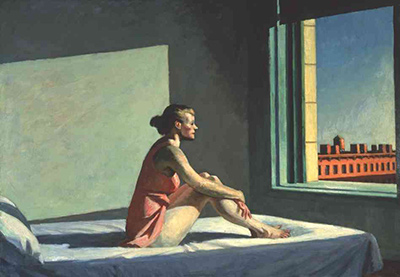
Compare: Morning Sun, 1952.
Light on the floor
The floor is a broad green field beneath the windows. A lighter patch of sunlight crosses it near the chair, with a more definite edge than the subtler variations elsewhere. This passage connects the unseen space in front of the spectator with the window area beyond.
The patch is especially visible because so little interrupts the ground. The chair and small table have comparatively narrow points of contact, leaving enough floor exposed for light to become a major shape. The room's emptier area is therefore active rather than simply unpainted subject matter.
At the lower left, red-covered furniture enters from outside the canvas. Only part of it is visible, supplying a warmer, heavier mass beside the open floor. The crop suggests a room extending behind or around the spectator's position.
Light brings several of these parts into relation. It touches the frame, makes the vase pale and clear, and creates a defined area on the floor. The room's stillness is supported by a precise distribution of illumination rather than an absence of visual events.
Watch: Edward Hopper’s Life and Art
Explore Hopper’s paintings and the places behind them in these museum films. Choose a film below.
A Brooklyn view deliberately simplified
The Whitney's 2022 exhibition label transmits Josephine Hopper's note that Edward omitted the Brooklyn Bridge and other local detail to avoid clutter in the finished work. [2] The place-specific title therefore accompanies a scene whose recognizable features were deliberately selected.
This helps explain why the outward view can feel clear without becoming topographically comprehensive. The brick façade and sky provide a firm urban setting; additional landmarks would have introduced stronger competing identities and shapes. The finished painting keeps its attention near the figure, flower table and window grid.
The omission also gives the interior more importance. A celebrated bridge could have drawn attention through the windows towards a distant subject. Here, the exterior remains substantial but comparatively even, allowing the white vase and back-turned head to retain their own prominence.
The written account concerns a compositional choice, not a complete explanation of the sitter. It supports an understanding of the painting as an edited arrangement of a real kind of place. The human situation remains less explicitly documented than the decision about what to leave out.
Looking out and being visible
The Whitney interprets the work through the two-way nature of urban windows. By day they offer a view, while a lit interior after dark could expose its occupants to the buildings opposite. [2] That account describes a possibility inherent in the setting, rather than an event shown taking place in this daylight scene.
The painting gives the idea a visible basis through its repeated openings. The room's large panes face a building with windows of its own. The spectator's close view of the seated person is part of the same urban pattern in which interiors can become visible from elsewhere.
Yet the large frame also makes an experience of outward looking available. Sky occupies broad areas above the roofs, and the flower table catches the light beside the seated figure. The setting can suggest openness and privacy concerns at the same time, without requiring them to become one fixed emotional response.
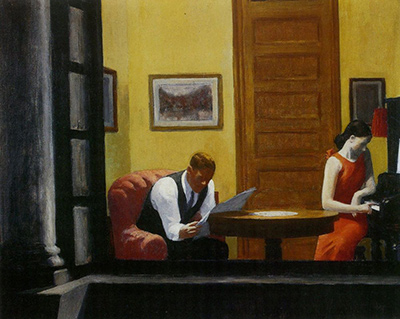
Compare: Room in New York, 1932.
Early exhibition and later collection
The Museum of Modern Art included Room in Brooklyn as number 24 in its 1933 Hopper retrospective, identifying Frank K. M. Rehn Gallery as its collection at that time. [3] The catalogue places the recently painted room within an early major account of his work.
The present Boston record belongs to a later chapter, identifying the Hayden Collection and Charles Henry Hayden Fund. [1] Its inclusion in Edward Hopper's New York in 2022–23 brought the canvas into a further examination of how he turned the city's ordinary spaces into concentrated compositions. [2]
Other rooms, other directions of attention
Eleven A.M. places a nude figure in profile close to a bright window, with the blue chair and foreground lamp strongly present around the body. Room in Brooklyn turns its figure away from the spectator and gives the exterior much more room above and beside the person.
Girl at a Sewing Machine concentrates attention around hands, cloth and a small dark machine. Its window supports an activity within the room. Here, the still figure and separate flower table leave the broad window bay itself as the dominant construction.
In Apartment Houses, the spectator looks into domestic work from outside a window. The Brooklyn painting gives an apparently internal position, with a further city visible beyond. Hopper makes those different positions consequential through what is exposed, what is cropped and how much of the world remains available through the glass.
Artworks and studies directory
This researched directory includes finished works and separately identified studies. It is not a complete catalogue raisonné. Linked titles open the articles; unlinked studies are identified by their collection accessions. Watercolours retain their recorded media, and original prints remain distinct from reproductions.
| Name | Date | Medium |
|---|---|---|
| (Bridge and Embankment) (70.1298) | 1906 | Oil on wood |
| (Jo Sketching at Good Harbor Beach) (70.1129) | 1923–1924 | Watercolor and fabricated chalk on paper |
| (Manhattan Bridge) (70.1098) | 1925–1926 | Watercolor and graphite pencil on paper |
| (Rooftops) (70.1114) | 1926 | Watercolor and graphite pencil on paper |
| (Seated Male Model, Bent Over) (70.1277) | c. 1902–1903 | Oil on canvas |
| (Self-Portrait) (70.1254) | 1903–1906 | Oil on canvas |
| (Solitary Figure in a Theater) (70.1418) | c. 1902–1904 | Oil on board |
| 5 A.M. | 1937 | oil on canvas |
| Adam's House | 1928 | watercolour and charcoal on paper |
| American Village | 1912 | Oil on canvas |
| Apartment Houses | 1923 | oil on canvas |
| Approaching a City | 1946 | oil on canvas |
| August in the City | 1945 | oil on canvas |
| Automat | 1927 | oil on canvas |
| Barber Shop | 1931 | oil on canvas |
| Blackwell's Island | 1928 | oil on canvas |
| Bridge on the Seine | 1909 | Oil on canvas |
| Bridle Path | 1939 | oil on canvas |
| Burly Cobb's House South Truro | 1930–1933 | oil on canvas |
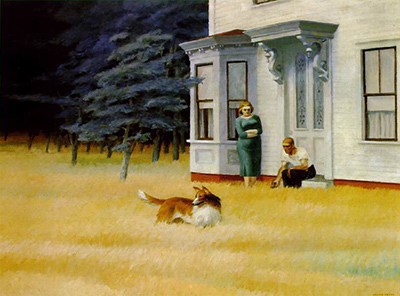
| Cape Cod Evening | 1939 | oil on canvas |
| Cape Cod Morning | 1950 | oil on canvas |
| Chair Car | 1965 | oil on canvas |
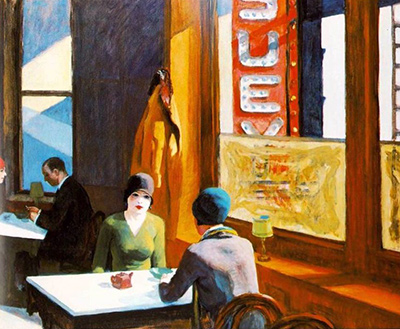
| Chop Suey | 1929 | oil on canvas |
| City Roofs | 1932 | Oil on canvas |
| Coast Guard Station | 1929 | oil on canvas |
| Compartment C, Car 293 | 1938 | oil on canvas |
| Conference at Night | 1949 | oil on canvas |
| Corn Hill | 1930 | oil on canvas |
| Dawn in Pennsylvania | 1942 | oil on canvas |
| Drug Store | 1927 | oil on canvas |
| Early Sunday Morning | 1930 | Oil on canvas |
| East Side Interior (70.1020) | 1922 | Etching |
| East Wind Over Weehawken | 1934 | oil on canvas |
| El Palacio | 1946 | Watercolor and graphite pencil on paper |
| Eleven A.M. | 1926 | oil on canvas |
| Evening Wind | 1921 | etching |
| Excursion into Philosophy | 1959 | oil on canvas |
| First Row Orchestra | 1951 | oil on canvas |
| Freight Car at Truro | 1931 | watercolour over graphite on paper |
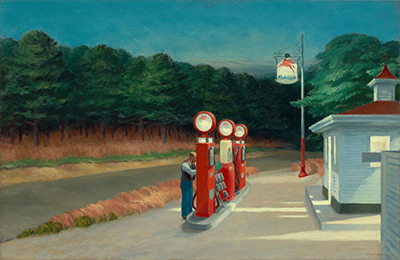
| Gas | 1940 | oil on canvas |
| Girl at a Sewing Machine | c. 1921 | oil on canvas |
| Gloucester Harbor | 1912 | Oil on canvas |
| Ground Swell | 1939 | oil on canvas |
| Haskell's House | 1924 | watercolour over graphite on paperboard |
| High Noon | 1949 | oil on canvas |
| Hill and Houses Cape Elizabeth Maine | 1927 | watercolour over graphite pencil |
| Hills South Truro | 1930 | oil on canvas |
| Hotel by a Railroad | 1952 | oil on canvas |
| Hotel Lobby | 1943 | oil on canvas |
| Hotel Room | 1931 | oil on canvas |
| Hotel Window | 1955 | oil on canvas |
| House by the Railroad | 1925 | oil on canvas |
| House by the Squam River | 1926 | watercolour over graphite on paper |
| Le Bistro or The Wine Shop | 1909 | Oil on canvas |
| Le Pont des Arts | 1907 | Oil on canvas |
| Le Pont Royal | 1909 | Oil on canvas |
| Le Quai des Grands Augustins | 1909 | Oil on canvas |
| Lighthouse and Buildings Portland Head | 1927 | watercolour over graphite pencil on paper |
| Lighthouse Hill | 1927 | oil painting |
| Manhattan Bridge Loop | 1928 | oil on canvas |
| Model Sitting | c. 1902 | oil painting; support not asserted |
| Morning Sun | 1952 | oil on canvas |
| New York Movie | 1939 | oil on canvas |
| New York New Haven and Hartford | 1931 | oil on canvas |
| New York Office | 1962 | oil on canvas |
| New York Pavements | 1924–1925 | oil on canvas |
| New York Restaurant | c. 1922 | oil on canvas |
| Night Windows | 1928 | oil on canvas |
| Nighthawks | 1942 | oil on canvas |
| October on Cape Cod | 1946 | oil on canvas |
| Office at Night | 1940 | oil on canvas |
| Office in a Small City | 1953 | oil on canvas |
| Pennsylvania Coal Town | 1947 | oil on canvas |
| People in the Sun | 1960 | oil on canvas |
| Portrait of Orleans | 1950 | oil on canvas |
| Queensborough Bridge | 1913 | Oil on canvas |
| Railroad Sunset | 1929 | Oil on canvas |
| Railroad Train | 1908 | oil on canvas |
| Road in Maine | 1914 | oil on canvas |
| Room in Brooklyn | 1932 | oil on canvas |
| Room in New York | 1932 | oil on canvas |
| Rooms by the Sea | 1951 | oil on canvas |
| Rooms for Tourists | 1945 | oil on canvas |
| Route 6 Eastham | 1941 | oil on canvas |
| Second Story Sunlight | 1960 | Oil on canvas |
| Self-Portrait | 1925–1930 | Oil on canvas |
| Self-Portrait with Hat (70.1903) | c. 1918, posthumous print | Drypoint |
| Seven A.M. | 1948 | Oil on canvas |
| Soir Bleu | 1914 | oil on canvas |
| South Carolina Morning | 1955 | Oil on canvas |
| Stairway at 48 Rue de Lille Paris | 1906 | Oil on wood |
| Study for 5 A.M. (70.153) | 1937 | Fabricated chalk on paper |
| Study for 5 A.M. (70.429) | 1937 | Fabricated chalk and graphite pencil on paper |
| Study for Approaching a City (70.869) | 1946 | Fabricated chalk and charcoal on paper |
| Study for August in the City (70.158a-b) | 1945 | Fabricated chalk on paper |
| Study for August in the City (70.159) | 1945 | Fabricated chalk on paper |
| Study for Bridle Path (70.220) | 1939 | Fabricated chalk on paper |
| Study for Bridle Path (70.235) | 1939 | Fabricated chalk on paper |
| Study for Compartment C, Car 293 (70.430) | 1938 | Fabricated chalk on paper |
| Study for Compartment C, Car 293 (70.431a-b) | 1938 | Fabricated chalk and charcoal on paper |
| Study for Conference at Night (70.170) | 1949 | Fabricated chalk on paper (recto); Typewriter ink on paper (verso) |
| Study for Conference at Night (70.174) | 1949 | Fabricated chalk on paper ( recto); Typewriter ink on paper (verso) |
| Study for East Wind over Weehawken (70.249) | 1934 | Graphite pencil on paper |
| Study for East Wind over Weehawken (70.252) | 1934 | Fabricated chalk and charcoal on paper |
| Study for Evening Wind (70.343a-b) | 1921 | Fabricated chalk on paper |
| Study for First Row Orchestra (70.841) | 1951 | Fabricated chalk and charcoal on paper |
| Study for Gas (70.263) | 1940 | Fabricated chalk on paper |
| Study for Ground Swell (70.339) | 1939 | Fabricated chalk, charcoal and graphite pencil on paper |
| Study for Hotel by a Railroad (70.199) | 1952 | Fabricated chalk on paper |
| Study for Hotel by a Railroad (70.427) | 1952 | Fabricated chalk on paper |
| Study for Hotel by a Railroad (70.428) | 1952 | Fabricated chalk on paper |
| Study for Hotel Lobby (70.117) | 1942 | Fabricated chalk and graphite pencil on paper |
| Study for Hotel Lobby (70.839) | 1942 | Fabricated chalk and charcoal on paper |
| Study for Hotel Window (70.161) | 1955 | Fabricated chalk, graphite pencil and colored pencil on paper |
| Study for Morning Sun (70.243) | 1952 | Fabricated chalk on paper |
| Study for Morning Sun (70.244) | 1952 | Fabricated chalk on paper |
| Study for Morning Sun (70.290) | 1952 | Fabricated chalk on paper |
| Study for Morning Sun (70.291) | 1952 | Fabricated chalk and graphite pencil on paper |
| Study for New York Movie (70.273) | 1939 | Fabricated chalk on paper |
| Study for New York Movie (70.274a-b) | 1938 or 1939 | Fabricated chalk and charcoal on paper (recto); Fabricated chalk on paper (verso) |
| Study for New York Movie (70.455) | 1939 | Fabricated chalk and charcoal on paper |
| Study for New York Office (70.822) | 1962 | Fabricated chalk on paper |
| Study for Nighthawks (70.192) | 1941 or 1942 | Fabricated chalk on paper |
| Study for Nighthawks (70.193) | 1941 or 1942 | Fabricated chalk on paper |
| Study for Office at Night (70.340) | 1940 | Fabricated chalk and charcoal on paper |
| Study for Office at Night (70.341) | 1940 | Fabricated chalk and graphite pencil on paper |
| Study for Pennsylvania Coal Town (70.198) | 1947 | Fabricated chalk on paper |
| Study for Pennsylvania Coal Town (70.229) | 1947 | Fabricated chalk and charcoal on paper |
| Study for Rooms for Tourists (70.438) | 1945 | Fabricated chalk and charcoal on paper |
| Study for Rooms for Tourists (70.848) | 1945 | Fabricated chalk and charcoal on paper |
| Study for Route 6, Eastham (70.369) | 1941 | Fabricated chalk and graphite pencil on paper |
| Study for Route 6, Eastham (70.854) | 1941 | Fabricated chalk and graphite pencil on paper |
| Study for South Carolina Morning (70.162a-b) | 1955 | Fabricated chalk on paper (recto and verso) |
| Study for The Sheridan Theatre (70.969) | 1937 | Graphite pencil on paper |
| Study for Two on the Aisle (70.128) | 1927 | Fabricated chalk on paper |
| Study for Two on the Aisle (70.129) | 1927 | Fabricated chalk on paper |
| Study for Yawl Riding a Swell (70.439) | 1935 | Fabricated chalk and graphite pencil on paper |
| Summer Evening | 1947 | oil on canvas |
| Summer Interior | 1909 | Oil on canvas |
| Sun in an Empty Room | 1963 | oil on canvas |
| Sunlight in a Cafeteria | 1958 | oil on canvas |
| Sunlight on Brownstones | 1956 | oil on canvas |
| Tables for Ladies | 1930 | oil on canvas |
| The Bootleggers | 1925 | oil on canvas |
| The Camel's Hump | 1931 | oil on canvas |
| The Circle Theatre | 1936 | oil on canvas |
| The City | 1927 | oil on canvas |
| The Lighthouse at Two Lights | 1929 | oil on canvas |
| The Long Leg | 1935 | oil on canvas |
| The Mansard Roof | 1923 | watercolour over graphite on paper |
| The Sheridan Theatre | 1937 | oil on canvas |
| Tramp Steamer | 1908 | oil on canvas |
| Two Comedians | 1966 | oil on canvas |
| Two on the Aisle | 1927 | oil on canvas |
| Valley of the Seine | 1909 | Oil on canvas |
| Western Motel | 1957 | oil on canvas |
Frequently Asked Questions
Edward Hopper made Room in Brooklyn in 1932. [1]
The recorded medium is oil on canvas. [1]
A back-turned woman sits before three tall windows. Beside her, a white vase of flowers stands on a small table covered with blue cloth. Beyond the glass lie brick buildings, rooflines and clear blue sky; below, a long patch of sunlight reaches across the green floor. Edward Hopper's Room in Brooklyn gives an ordinary interior a remarkably open outward view while keeping its seated occupant's face concealed.
Discussion
Look again at the images and ideas explored in Room in Brooklyn. These editorial prompts invite your observations.
Reader Insights
Which boundary, gesture or change of light first holds your attention in Room in Brooklyn?
Compare Morning Sun with Room in Brooklyn. Which visual difference matters most to your reading?
Which detail would you look at again after reading “Buildings and sky beyond”?
Join the Conversation
Share a detail, comparison or question about Room in Brooklyn below.
References
- Museum of Fine Arts, Boston, Room in Brooklyn, museum-contributed AMICA record, 1932, accession 35.66, The Hayden Collection—Charles Henry Hayden Fund; medium, dimensions and collection identity, corroborated by the 2022 Whitney exhibition caption. View source.
- Whitney Museum of American Art, Edward Hopper's New York, exhibition labels, 2022, Room in Brooklyn, PDF p. 23, printed label 17; two-way visibility and Josephine Hopper's account of the omitted Brooklyn Bridge, cited through the museum's label. View source.
- Museum of Modern Art, Edward Hopper, 1933, catalogue no. 24, printed p. 27. View source.
- Collection or catalogue record, American Village, 1912; medium and identity as discussed in the linked article. View source.
- Collection or catalogue record, Soir Bleu, 1914; medium and identity as discussed in the linked article. View source.
- Collection or catalogue record, House by the Railroad, 1925; medium and identity as discussed in the linked article. View source.
- Collection or catalogue record, Automat, 1927; medium and identity as discussed in the linked article. View source.
- Collection or catalogue record, Early Sunday Morning, 1930; medium and identity as discussed in the linked article. View source.
- Collection or catalogue record, New York Movie, 1939; medium and identity as discussed in the linked article. View source.
- Collection or catalogue record, Nighthawks, 1942; medium and identity as discussed in the linked article. View source.
- Collection or catalogue record, Morning Sun, 1952; medium and identity as discussed in the linked article. View source.
- Collection or catalogue record, Second Story Sunlight, 1960; medium and identity as discussed in the linked article. View source.
- Collection or catalogue record, Two Comedians, 1966; medium and identity as discussed in the linked article. View source.
- Whitney Museum of American Art, Study for Route 6, Eastham, 1941, accession 70.854; exact object record. View source.
- Whitney Museum of American Art, Study for Conference at Night, 1949, accession 70.170; exact object record. View source.
- Whitney Museum of American Art, Study for First Row Orchestra, 1951, accession 70.841; exact object record. View source.
- Whitney Museum of American Art, (Bridge and Embankment), 1906, accession 70.1298; exact object record. View source.
- Whitney Museum of American Art, (Seated Male Model, Bent Over), c. 1902–1903, accession 70.1277; exact object record. View source.
- Whitney Museum of American Art, Study for Morning Sun, 1952, accession 70.244; exact object record. View source.
- Whitney Museum of American Art, Study for Morning Sun, 1952, accession 70.243; exact object record. View source.
- Whitney Museum of American Art, Study for Two on the Aisle, 1927, accession 70.128; exact object record. View source.
- Whitney Museum of American Art, Study for New York Office, 1962, accession 70.822; exact object record. View source.
- Whitney Museum of American Art, Study for Two on the Aisle, 1927, accession 70.129; exact object record. View source.
- Whitney Museum of American Art, Study for Pennsylvania Coal Town, 1947, accession 70.229; exact object record. View source.
- Whitney Museum of American Art, (Rooftops), 1926, accession 70.1114; exact object record. View source.
- Whitney Museum of American Art, Study for South Carolina Morning, 1955, accession 70.162a-b; exact object record. View source.
- Whitney Museum of American Art, (Self-Portrait), 1903–1906, accession 70.1254; exact object record. View source.
- Whitney Museum of American Art, (Manhattan Bridge), 1925–1926, accession 70.1098; exact object record. View source.
- Whitney Museum of American Art, (Solitary Figure in a Theater), c. 1902–1904, accession 70.1418; exact object record. View source.
- Whitney Museum of American Art, Study for Approaching a City, 1946, accession 70.869; exact object record. View source.
- Whitney Museum of American Art, Study for August in the City, 1945, accession 70.159; exact object record. View source.
- Whitney Museum of American Art, Study for Compartment C, Car 293, 1938, accession 70.430; exact object record. View source.
- Whitney Museum of American Art, Study for Compartment C, Car 293, 1938, accession 70.431a-b; exact object record. View source.
- Whitney Museum of American Art, Study for East Wind over Weehawken, 1934, accession 70.252; exact object record. View source.
- Whitney Museum of American Art, Study for East Wind over Weehawken, 1934, accession 70.249; exact object record. View source.
- Whitney Museum of American Art, Study for Evening Wind, 1921, accession 70.343a-b; exact object record. View source.
- Whitney Museum of American Art, Study for The Sheridan Theatre, 1937, accession 70.969; exact object record. View source.
- Whitney Museum of American Art, Study for New York Movie, 1939, accession 70.455; exact object record. View source.
- Whitney Museum of American Art, Study for New York Movie, 1939, accession 70.273; exact object record. View source.
- Whitney Museum of American Art, Study for New York Movie, 1938 or 1939, accession 70.274a-b; exact object record. View source.
- Whitney Museum of American Art, Study for 5 A.M., 1937, accession 70.153; exact object record. View source.
- Whitney Museum of American Art, Study for 5 A.M., 1937, accession 70.429; exact object record. View source.
- Whitney Museum of American Art, (Jo Sketching at Good Harbor Beach), 1923–1924, accession 70.1129; exact object record. View source.
- Whitney Museum of American Art, Study for August in the City, 1945, accession 70.158a-b; exact object record. View source.
- Whitney Museum of American Art, Study for Morning Sun, 1952, accession 70.291; exact object record. View source.
- Whitney Museum of American Art, Study for Morning Sun, 1952, accession 70.290; exact object record. View source.
- Whitney Museum of American Art, Study for Office at Night, 1940, accession 70.340; exact object record. View source.
- Whitney Museum of American Art, Study for Office at Night, 1940, accession 70.341; exact object record. View source.
- Whitney Museum of American Art, Study for Hotel by a Railroad, 1952, accession 70.427; exact object record. View source.
- Whitney Museum of American Art, Study for Hotel by a Railroad, 1952, accession 70.199; exact object record. View source.
- Whitney Museum of American Art, Study for Hotel by a Railroad, 1952, accession 70.428; exact object record. View source.
- Whitney Museum of American Art, Study for Hotel Lobby, 1942, accession 70.117; exact object record. View source.
- Whitney Museum of American Art, Study for Hotel Lobby, 1942, accession 70.839; exact object record. View source.
- Whitney Museum of American Art, Study for Conference at Night, 1949, accession 70.174; exact object record. View source.
- Whitney Museum of American Art, Study for Hotel Window, 1955, accession 70.161; exact object record. View source.
- Whitney Museum of American Art, Study for Pennsylvania Coal Town, 1947, accession 70.198; exact object record. View source.
- Whitney Museum of American Art, Study for Route 6, Eastham, 1941, accession 70.369; exact object record. View source.
- Whitney Museum of American Art, Study for Bridle Path, 1939, accession 70.220; exact object record. View source.
- Whitney Museum of American Art, Study for Bridle Path, 1939, accession 70.235; exact object record. View source.
- Whitney Museum of American Art, Study for Ground Swell, 1939, accession 70.339; exact object record. View source.
- Whitney Museum of American Art, Study for Yawl Riding a Swell, 1935, accession 70.439; exact object record. View source.
- Whitney Museum of American Art, Study for Rooms for Tourists, 1945, accession 70.848; exact object record. View source.
- Whitney Museum of American Art, Study for Rooms for Tourists, 1945, accession 70.438; exact object record. View source.
- Whitney Museum of American Art, Study for Nighthawks, 1941 or 1942, accession 70.193; exact object record. View source.
- Whitney Museum of American Art, Study for Nighthawks, 1941 or 1942, accession 70.192; exact object record. View source.
- Whitney Museum of American Art, Study for Gas, 1940, accession 70.263; exact object record. View source.
- Whitney Museum of American Art, Self-Portrait with Hat, c. 1918, posthumous print, accession 70.1903; exact object record. View source.
- Whitney Museum of American Art, East Side Interior, 1922, accession 70.1020; exact object record. View source.
- Art Institute of Chicago, Selected Chronology for Edward Hopper; training, travels, exhibitions, New York and Truro chronology. View source.
- Emily C. Burns, Spectral figures: Edward Hopper’s empty Paris, chapter 5 in Empty Spaces: Confronting Emptiness in National, Cultural and Urban Histories, 2019; complete chapter and notes consulted. View source.
- Charles Brock, Regionalism and Folk Art, National Gallery of Art; complete essay and two notes consulted. View source.