 by Tom Gurney
Tom Gurney BSc (Hons) is an art history expert with over 20 years experience
Email: tomgurney1@gmail.com / Phone: +44 7429 011000
Etchings and Prints: Introduction
Edward Hopper's original prints are works he developed for a printing plate, rather than photographs of his paintings transferred to paper. Their lines, dark areas and exposed paper belong to the way the images were conceived. A black-and-white Evening Wind is not a painting awaiting colour: its contrasts are the substance of the work.
Printmaking was also important to Hopper's emergence as an artist. Carol Troyen describes the medium as a place where he tested subjects and relationships that would continue in his paintings, while insisting that the prints deserve attention as finished works in their own right. [1] Understanding how they were made helps explain both their independent force and their relation to the better-known canvases.
At a Glance
Contents
- The plate, the ink and the paper
- Drypoint and the character of a line
- States, proofs and impressions
- White paper is part of the image
- Night Shadows: a street seen from above
- Cattle cross the railway in American Landscape
- Windows and the domestic interior
- France and the landscape beyond the city
- The Catboat makes movement through lines
- The same design can have different object descriptions
The plate, the ink and the paper
Etching is an intaglio process: ink retained in recessed lines is transferred from a metal plate to paper. An acid-resistant coating, called a ground, protects the plate while the artist draws through it with a needle. Acid then bites the exposed metal. After the ground is removed, the plate can be inked and wiped. Damp paper receives the ink under pressure in a rolling press. [2]
The printed line therefore involves several decisions. Drawing determines where the ground is opened; biting affects the recess; inking and wiping affect what reaches the paper. A line that looks immediate in the finished sheet can be the result of a considered sequence.
The print reverses the design on the plate. Pressure can also leave an indentation around the plate's edge, known as the plate mark. [2] The metal matrix, its printed image and the larger sheet are related objects with different dimensions. Museum descriptions often record more than one measurement for precisely that reason.
Paper margins, the plate boundary and the concentration of ink all contribute to the physical object. A book reproduction that crops them away presents a different encounter with the image.
Original prints
Drypoint and the character of a line
Drypoint also belongs to intaglio, but a sharp point cuts directly into the metal rather than drawing through an acid-resistant coating. The displaced metal can remain as a raised burr beside the line. It holds ink and can create the soft, dense edge associated with the process. [3]
The distinction matters because a dark printed passage does not identify its technique on sight. Closely spaced etched lines, retained surface ink and drypoint burr can produce different kinds of darkness. A small digital reproduction may flatten those differences into a similar-looking patch.
Hopper used both etching and drypoint. The owning museum's medium is therefore more useful than a casual caption that calls every monochrome sheet an etching. It identifies the kind of mark-making involved without requiring a viewer to diagnose the plate from a screen.
The process also makes a simple count of copies inadequate as an account of a print. The matrix's condition and the way it is printed can affect the resulting line. A named image may survive through sheets whose dates, printing histories and appearances differ.
States, proofs and impressions
An impression is an individual sheet printed from a matrix. A state identifies a stage in the matrix's development. Getty's cataloguing guidance distinguishes a change to the plate from differences in inking: added or removed lines can create a new state, while a darker wiping of the same plate does not automatically do so. [4]
A surviving proof can show an image before a later addition or revision. Comparing its lines and open areas with a later state reveals where the artist extended, removed or strengthened the design. The earlier image makes those decisions visible.
The Philadelphia Museum of Art's 2005 Hopper exhibition brought drawings together with progressive proofs, describing some plates as undergoing as many as eight revisions. Its account identified twenty-six published prints as the core of the museum's comprehensive holdings. [5] Those figures describe particular categories and examples; they do not mean that every Hopper print has eight states or that twenty-six sheets represent every plate he ever made.
Looking between states asks a precise question: what changed in the image? Looking between impressions of one state asks another: how did the printing change its appearance? Keeping the questions separate allows a small difference to become informative rather than confusing.
White paper is part of the image
The paper supplies the lightest areas of a monochrome intaglio print. A bright window or pavement can emerge through the contrast between relatively open paper and adjacent inked marks. Light does not have to be painted in with a pale pigment.
Lines can gather into dense bands or separate enough for the support to remain visible between them. Crossing directions increase the density of a dark area. A change in spacing can turn a wall, deepen a recess or give a floor a different orientation without changing the ink's colour.
The wiping of the plate offers another variable. A printer may retain a thin layer of ink on its surface to create tone, rather than clearing every area equally. [2] That means an apparently grey passage may involve more than a network of individual lines.
Troyen emphasises Hopper's interest in strong black ink and bright paper, and the reception of those choices as part of his modern approach. [1] Their significance becomes apparent in the images themselves. A light area can be both a piece of paper and the convincing source of illumination within a room.
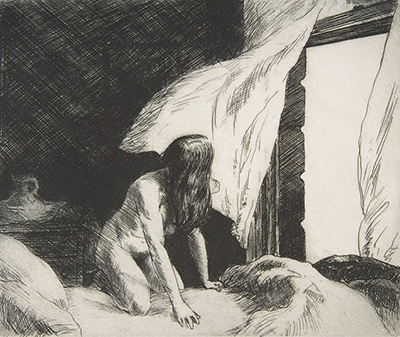
Compare: Evening Wind, 1921.
Night Shadows: a street seen from above
Night Shadows offers a particularly clear example. A small pedestrian crosses a largely open area of pavement below a high viewpoint. The building at the upper right is cut by the image's edges, while a long dark band stretches across the street. The person's smaller shadow gives the human figure a second shape nearby.
Hopper varies the density and direction of his lines across these areas. The pavement does not need a separate grey ink to recede; relatively open passages stand against densely worked architecture and shadow. The high view turns familiar street features into an unusually emphatic arrangement.
MoMA dates the design to 1921 but identifies its impression as belonging to an edition published in December 1924. Its record names The New Republic as publisher, Peter Platt as printer and an edition of approximately 500. [6] This is an important exception to the claim that every Hopper print was personally printed by him in a very small edition.
The example also shows why one date cannot always explain a sheet. The conception of the image and the production of an edition can be separated by years. A complete description should preserve both when they are known.
Cattle cross the railway in American Landscape
American Landscape, dated 1920, demonstrates how much Hopper could do beyond the nocturnal city. In the Whitney's impression, three cattle are distributed between the near embankment and the railway crossing. A pale farmhouse rises beyond the tracks, backed by a dark band of vegetation. Above it lies a large, relatively open area of paper. [7]
The animals approach the rail line in different stages. The nearest bodies fill a substantial part of the lower view and are cut by its edge, while the more distant animal has reached the upper level. Their ungainly rear views give the route a physical specificity that a picturesque distant herd would lack.
The railway establishes a firm horizontal interruption. It belongs to a system designed for movement, yet no train is present. The cattle cross it according to another rhythm. Their rounded bodies and changing inclinations make the engineered line seem more emphatic.
The farmhouse is light enough to stand apart from the dark vegetation. Its angled roofs provide another set of straight edges, but it does not become the sole destination of the image. Animals, embankment, railway and building divide attention among several scales.
Different kinds of line help keep those areas distinct. The near bank is worked with directional strokes that make its rise apparent. Dense marks gather into the distant vegetation. The house needs a comparatively small number of edges to remain legible against that darkness.
The open sky has a different function from a bright window in an interior. It gives the whole lower arrangement room to sit within the sheet. Its scale makes the dark horizon a narrow band, rather than allowing foliage to fill the print from top to bottom.
The scene contains both rural occupation and modern infrastructure. Calling it an American landscape does not require one to displace the other. The image gains much of its interest from the awkward way they meet.
Windows and the domestic interior
In East Side Interior, the light comes from a window beside a woman at a sewing machine. Dark furniture and surrounding walls press close to the brighter opening. A baby carriage occupies the foreground, making the room's limited space more densely furnished than its window alone might suggest.
The Whitney dates the etching to 1922. Its published account reproduces Hopper's later explanation that the subject came from remembered glimpses of East Side rooms during his walks, while rejecting an intended ideological statement about poverty. [8] That retrospective account identifies a source and a limit to his stated intention; it does not prevent viewers from considering the social setting.
Evening Wind uses a related vocabulary differently. Its nude figure, bed and moving curtain make the opening to the outside more active. The baby carriage belongs to East Side Interior, and should not be carried into the other print simply because both show a woman near a window.
The comparison reveals how much variety the small monochrome interiors contain. A work space, a resting body, a curtain and a window can be arranged to direct attention in different ways. Their kinship does not make them interchangeable scenes of a single emotion.
France and the landscape beyond the city
Hopper's prints also reached beyond New York interiors. The Met identifies Aux Fortifications, an etching of 1923, with memories of the Belleville area of Paris. The date belongs to the later print, not to a new Paris visit in that year. [9]
Troyen's study places architecture, rural landscapes and coastal subjects alongside the streets and domestic rooms. [1] This broader range helps prevent the medium from being reduced to an exercise in urban darkness. The same attention to edges, intervals and illumination could address very different surroundings.
The range also changes the relationship between print and painting. A rural building need not be a rehearsal for one identifiable later canvas. Printmaking gave Hopper a way to investigate how a roof, an open field or a route could organise a small rectangle of paper.
Where a later painting uses a related subject, the comparison is most useful at the level of decisions. Does light divide the space in a similar way? Does a foreground feature interrupt access? Is a person close enough to be read individually? Such questions reveal continuity without making every print a preliminary study for something else.
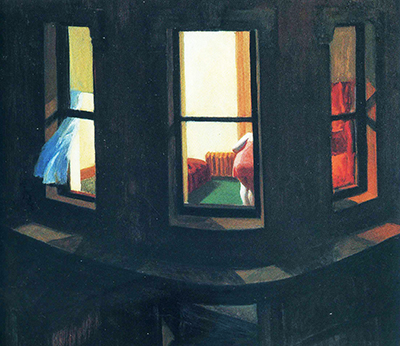
Compare: Night Windows, 1928.
The Catboat makes movement through lines
In The Catboat of 1922, the view follows a vessel from behind. Its stern is close, the sail extends beyond the upper edge, and dark wooded land occupies much of the distance. Three men have different positions within the boat, with the nearer seated figure helping make its scale tangible. The Whitney catalogues its impression as an etching, accession 70.1008. [10]
The sail is especially important to the arrangement. Its long diagonal and the mast interrupt the darker background, while relatively open paper keeps much of the fabric light. The boom gives the lower edge another strong direction. Together they make the vessel's tilt legible before we inspect the smaller details of its handling.
The hull curves towards the spectator. A group of close lines describes its built surface, changing direction as the form turns. Small strokes across the water give the surrounding area a less stable texture. The boat is solid enough to occupy space and angled enough to seem in motion.
The shore is made through a different density of marks. Tangled curves and dark passages allow the foliage to remain continuous without giving every tree an equally explicit contour. This sets the pale sail against a broad background rather than a collection of individually named objects.
The people connect these large structures with practical activity. They occupy the vessel rather than appearing as passengers in a separate portrait. Their placement helps explain its balance and direction, while faces remain secondary to bodies, equipment and the angle of the boat.
This is a particularly useful print to set beside the later Ground Swell. Both involve a sailing group, but the spectator's position differs. Here we follow closely behind; the later oil presents the boat and buoy from another angle across a larger field of water. Related subjects allow different kinds of access.
Colour is not missing from the etching in the sense of an unfinished stage. The distinction among pale sail, dark woods and lively water is already a complete visual argument. Adding a blue sea or green shore would create further relations rather than complete an absent requirement.
Watch: Edward Hopper’s Life and Art
Explore Hopper’s paintings and the places behind them in these museum films. Choose a film below.
The same design can have different object descriptions
The owning institutions' records for The Catboat also put printmaking terminology to work. MoMA identifies Hopper as both publisher and printer of its edition and records an edition of one hundred. Cornell's impression is described more specifically as etching, drypoint and plate tone on ivory wove paper. These descriptions concern particular holdings and should not be made into an undifferentiated account of every sheet. [11]
The comparison is useful because a familiar image can encourage us to overlook the object carrying it. A reproduction may show the same vessel and woodland while omitting the paper's colour, margins and physical surface. The title identifies a design; the museum record helps identify an impression.
MoMA's printer credit can be compared with the later published edition of Night Shadows. The latter names Peter Platt and The New Republic. One securely attributed printing history does not establish that Hopper personally pulled every impression of every image.
Nor does a difference in wording automatically mean that one museum has identified a different composition. A fuller medium description may record features that a shorter catalogue field does not spell out. Direct examination and the institution's research are needed to resolve such details, rather than a judgement based on the darkness of a web image.
The specific record provides a basis for explaining a soft line as drypoint or a grey area as retained plate tone. The image and the material description can then inform one another.
Recognition before the painting breakthrough
The Art Institute's chronology records Hopper taking up printmaking in 1915 and consigning prints to Frank Rehn in 1921. In 1923, East Side Interior received the Logan Prize at the Chicago Society of Etchers exhibition and entered the Art Institute's collection. The Met bought fifteen etchings in 1925. [12] These events show the medium's place in his developing public career.
The principal period of activity in the late 1910s and early 1920s should be distinguished from his final plates and from later printing. MoMA's account extends his production of etchings and drypoints to 1928. [6] A gradual shift towards painting is more accurate than a single date after which no print-related activity occurred.
The successes were not simply evidence that he had found a temporary commercial substitute. Museums and critics encountered the compositions as works deserving attention. Their continued interest rests on the strong visual choices within the sheets, as well as their place in the story of an eventual famous painter.
A published print has an audience beyond a single owner
The ability to make several impressions gave Hopper's images a different circulation from an oil painting. One composition could be acquired by several collectors and institutions. Its success did not have to depend on a buyer taking possession of the only painted surface.
That circulation also makes comparisons possible across collections. The same design may be encountered through sheets with different margins, paper descriptions, states or printing dates. The repetition is part of the medium's history, while the differences preserve the particularity of individual objects.
The surviving inscriptions on prints can add another layer. A title identifies the composition; a dedication addresses a recipient; an edition indication relates the sheet to a wider group. None should be assumed merely because it appears on another institution's impression.
The distinction matters especially when an exhibition places prints beside drawings. A drawing may be a single experiment towards an image that will later circulate. A progressive proof can record a stage of the matrix. A finished impression can present the work to an audience. Their visual kinship does not make their purposes identical.
This is one reason the prints can illuminate Hopper's development without becoming a collection of rehearsals. They were forms through which the artist sought viewers, received recognition and made works available. Their concentrated designs were public achievements in their own medium.
Lifetime designs and later impressions
The Whitney's Self-Portrait with Hat makes another distinction necessary. Its record gives about 1918 for the design and explicitly identifies the drypoint impression as posthumous. [13] A plate made during an artist's life can therefore be encountered through a sheet printed after his death.
This is different from a photographic reproduction of the print. One concerns a later impression from the matrix; the other reproduces the appearance of an existing image through another process. Both can carry the same title in a search result, but their descriptions should explain what they are.
For close study, record the title, process, image or plate size, sheet size, state and known printing date. Those details help identify the particular object being discussed. A signature or an old-looking piece of paper cannot replace that object history on its own.
For an image to hang as a reproduction, the practical questions differ: crop, image size, paper, colour and presentation become central. Posters and Reproductions considers those choices. Calling the objects accurately makes it easier to enjoy either without confusing their relationship to Hopper's work.
Looking closely changes the apparent scale
From a distance, American Landscape can seem built from a dark horizontal band, a pale sky and a few compact forms. Nearby, separate strokes describe the cows' bodies, the bank and the roof. The print sustains those two experiences without requiring one to replace the other.
The Catboat works differently. The sail supplies an immediately readable diagonal, but its fine lines become more active as we approach. The water's texture also separates from the larger dark background. A small image can consequently contain several distinct speeds of looking.
The paper surrounding the plate helps establish that experience. It keeps the printed rectangle visible as an image within a larger object, giving the eye a place to rest outside the denser marks. A tightly cropped reproduction can make the scene feel more like a continuous window and conceal this relation.
That change of presentation is particularly consequential for a bright sky or sail. Within a sheet, the lightest area can be compared with the unprinted margin. In a reproduction, both may be replaced by the white of a screen or a book page. The viewer can still study the design, but the physical comparison has changed.
Returning to the oils after looking closely at these sheets, the clarity of Hopper's larger forms can feel newly deliberate. The prints demonstrate how much a few strong divisions can organise. Their own varied marks show that clarity need not mean a surface without complexity.
Returning from ink to paint
The bright windows of the etchings offer a useful route into paintings such as Night Windows and Morning Sun. Their colour adds new relationships, but the distribution of light, dark and withheld space remains consequential.
The comparison can also work in reverse. Knowing the large canvases may make the small scale of an etching surprising. A room, a street or a figure can gain intensity through concentration, with a few centimetres of paper holding an expansive suggestion of space.
Hopper's original prints reward that change in viewing distance. The image is recognisable from across a room; nearby, separate lines become visible inside its darkness. The bright window is still convincing as light, but it is also paper left open among inked marks. Both experiences belong to the work.
Artworks and studies directory
This researched directory includes finished works and separately identified studies. It is not a complete catalogue raisonné. Linked titles open the articles; unlinked studies are identified by their collection accessions. Watercolours retain their recorded media, and original prints remain distinct from reproductions.
| Name | Date | Medium |
|---|---|---|
| (Bridge and Embankment) (70.1298) | 1906 | Oil on wood |
| (Jo Sketching at Good Harbor Beach) (70.1129) | 1923–1924 | Watercolor and fabricated chalk on paper |
| (Manhattan Bridge) (70.1098) | 1925–1926 | Watercolor and graphite pencil on paper |
| (Rooftops) (70.1114) | 1926 | Watercolor and graphite pencil on paper |
| (Seated Male Model, Bent Over) (70.1277) | c. 1902–1903 | Oil on canvas |
| (Self-Portrait) (70.1254) | 1903–1906 | Oil on canvas |
| (Solitary Figure in a Theater) (70.1418) | c. 1902–1904 | Oil on board |
| 5 A.M. | 1937 | oil on canvas |
| Adam's House | 1928 | watercolour and charcoal on paper |
| American Village | 1912 | Oil on canvas |
| Apartment Houses | 1923 | oil on canvas |
| Approaching a City | 1946 | oil on canvas |
| August in the City | 1945 | oil on canvas |
| Automat | 1927 | oil on canvas |
| Barber Shop | 1931 | oil on canvas |
| Blackwell's Island | 1928 | oil on canvas |
| Bridge on the Seine | 1909 | Oil on canvas |
| Bridle Path | 1939 | oil on canvas |
| Burly Cobb's House South Truro | 1930–1933 | oil on canvas |
| Cape Cod Evening | 1939 | oil on canvas |
| Cape Cod Morning | 1950 | oil on canvas |
| Chair Car | 1965 | oil on canvas |
| Chop Suey | 1929 | oil on canvas |
| City Roofs | 1932 | Oil on canvas |
| Coast Guard Station | 1929 | oil on canvas |
| Compartment C, Car 293 | 1938 | oil on canvas |
| Conference at Night | 1949 | oil on canvas |
| Corn Hill | 1930 | oil on canvas |
| Dawn in Pennsylvania | 1942 | oil on canvas |
| Drug Store | 1927 | oil on canvas |
| Early Sunday Morning | 1930 | Oil on canvas |
| East Side Interior (70.1020) | 1922 | Etching |
| East Wind Over Weehawken | 1934 | oil on canvas |
| El Palacio | 1946 | Watercolor and graphite pencil on paper |
| Eleven A.M. | 1926 | oil on canvas |
| Evening Wind | 1921 | etching |
| Excursion into Philosophy | 1959 | oil on canvas |
| First Row Orchestra | 1951 | oil on canvas |
| Freight Car at Truro | 1931 | watercolour over graphite on paper |
| Gas | 1940 | oil on canvas |
| Girl at a Sewing Machine | c. 1921 | oil on canvas |
| Gloucester Harbor | 1912 | Oil on canvas |
| Ground Swell | 1939 | oil on canvas |
| Haskell's House | 1924 | watercolour over graphite on paperboard |
| High Noon | 1949 | oil on canvas |
| Hill and Houses Cape Elizabeth Maine | 1927 | watercolour over graphite pencil |
| Hills South Truro | 1930 | oil on canvas |
| Hotel by a Railroad | 1952 | oil on canvas |
| Hotel Lobby | 1943 | oil on canvas |
| Hotel Room | 1931 | oil on canvas |
| Hotel Window | 1955 | oil on canvas |
| House by the Railroad | 1925 | oil on canvas |
| House by the Squam River | 1926 | watercolour over graphite on paper |
| Le Bistro or The Wine Shop | 1909 | Oil on canvas |
| Le Pont des Arts | 1907 | Oil on canvas |
| Le Pont Royal | 1909 | Oil on canvas |
| Le Quai des Grands Augustins | 1909 | Oil on canvas |
| Lighthouse and Buildings Portland Head | 1927 | watercolour over graphite pencil on paper |
| Lighthouse Hill | 1927 | oil painting |
| Manhattan Bridge Loop | 1928 | oil on canvas |
| Model Sitting | c. 1902 | oil painting; support not asserted |
| Morning Sun | 1952 | oil on canvas |
| New York Movie | 1939 | oil on canvas |
| New York New Haven and Hartford | 1931 | oil on canvas |
| New York Office | 1962 | oil on canvas |
| New York Pavements | 1924–1925 | oil on canvas |
| New York Restaurant | c. 1922 | oil on canvas |
| Night Windows | 1928 | oil on canvas |
| Nighthawks | 1942 | oil on canvas |
| October on Cape Cod | 1946 | oil on canvas |
| Office at Night | 1940 | oil on canvas |
| Office in a Small City | 1953 | oil on canvas |
| Pennsylvania Coal Town | 1947 | oil on canvas |
| People in the Sun | 1960 | oil on canvas |
| Portrait of Orleans | 1950 | oil on canvas |
| Queensborough Bridge | 1913 | Oil on canvas |
| Railroad Sunset | 1929 | Oil on canvas |
| Railroad Train | 1908 | oil on canvas |
| Road in Maine | 1914 | oil on canvas |
| Room in Brooklyn | 1932 | oil on canvas |
| Room in New York | 1932 | oil on canvas |
| Rooms by the Sea | 1951 | oil on canvas |
| Rooms for Tourists | 1945 | oil on canvas |
| Route 6 Eastham | 1941 | oil on canvas |
| Second Story Sunlight | 1960 | Oil on canvas |
| Self-Portrait | 1925–1930 | Oil on canvas |
| Self-Portrait with Hat (70.1903) | c. 1918, posthumous print | Drypoint |
| Seven A.M. | 1948 | Oil on canvas |
| Soir Bleu | 1914 | oil on canvas |
| South Carolina Morning | 1955 | Oil on canvas |
| Stairway at 48 Rue de Lille Paris | 1906 | Oil on wood |
| Study for 5 A.M. (70.153) | 1937 | Fabricated chalk on paper |
| Study for 5 A.M. (70.429) | 1937 | Fabricated chalk and graphite pencil on paper |
| Study for Approaching a City (70.869) | 1946 | Fabricated chalk and charcoal on paper |
| Study for August in the City (70.158a-b) | 1945 | Fabricated chalk on paper |
| Study for August in the City (70.159) | 1945 | Fabricated chalk on paper |
| Study for Bridle Path (70.220) | 1939 | Fabricated chalk on paper |
| Study for Bridle Path (70.235) | 1939 | Fabricated chalk on paper |
| Study for Compartment C, Car 293 (70.430) | 1938 | Fabricated chalk on paper |
| Study for Compartment C, Car 293 (70.431a-b) | 1938 | Fabricated chalk and charcoal on paper |
| Study for Conference at Night (70.170) | 1949 | Fabricated chalk on paper (recto); Typewriter ink on paper (verso) |
| Study for Conference at Night (70.174) | 1949 | Fabricated chalk on paper ( recto); Typewriter ink on paper (verso) |
| Study for East Wind over Weehawken (70.249) | 1934 | Graphite pencil on paper |
| Study for East Wind over Weehawken (70.252) | 1934 | Fabricated chalk and charcoal on paper |
| Study for Evening Wind (70.343a-b) | 1921 | Fabricated chalk on paper |
| Study for First Row Orchestra (70.841) | 1951 | Fabricated chalk and charcoal on paper |
| Study for Gas (70.263) | 1940 | Fabricated chalk on paper |
| Study for Ground Swell (70.339) | 1939 | Fabricated chalk, charcoal and graphite pencil on paper |
| Study for Hotel by a Railroad (70.199) | 1952 | Fabricated chalk on paper |
| Study for Hotel by a Railroad (70.427) | 1952 | Fabricated chalk on paper |
| Study for Hotel by a Railroad (70.428) | 1952 | Fabricated chalk on paper |
| Study for Hotel Lobby (70.117) | 1942 | Fabricated chalk and graphite pencil on paper |
| Study for Hotel Lobby (70.839) | 1942 | Fabricated chalk and charcoal on paper |
| Study for Hotel Window (70.161) | 1955 | Fabricated chalk, graphite pencil and colored pencil on paper |
| Study for Morning Sun (70.243) | 1952 | Fabricated chalk on paper |
| Study for Morning Sun (70.244) | 1952 | Fabricated chalk on paper |
| Study for Morning Sun (70.290) | 1952 | Fabricated chalk on paper |
| Study for Morning Sun (70.291) | 1952 | Fabricated chalk and graphite pencil on paper |
| Study for New York Movie (70.273) | 1939 | Fabricated chalk on paper |
| Study for New York Movie (70.274a-b) | 1938 or 1939 | Fabricated chalk and charcoal on paper (recto); Fabricated chalk on paper (verso) |
| Study for New York Movie (70.455) | 1939 | Fabricated chalk and charcoal on paper |
| Study for New York Office (70.822) | 1962 | Fabricated chalk on paper |
| Study for Nighthawks (70.192) | 1941 or 1942 | Fabricated chalk on paper |
| Study for Nighthawks (70.193) | 1941 or 1942 | Fabricated chalk on paper |
| Study for Office at Night (70.340) | 1940 | Fabricated chalk and charcoal on paper |
| Study for Office at Night (70.341) | 1940 | Fabricated chalk and graphite pencil on paper |
| Study for Pennsylvania Coal Town (70.198) | 1947 | Fabricated chalk on paper |
| Study for Pennsylvania Coal Town (70.229) | 1947 | Fabricated chalk and charcoal on paper |
| Study for Rooms for Tourists (70.438) | 1945 | Fabricated chalk and charcoal on paper |
| Study for Rooms for Tourists (70.848) | 1945 | Fabricated chalk and charcoal on paper |
| Study for Route 6, Eastham (70.369) | 1941 | Fabricated chalk and graphite pencil on paper |
| Study for Route 6, Eastham (70.854) | 1941 | Fabricated chalk and graphite pencil on paper |
| Study for South Carolina Morning (70.162a-b) | 1955 | Fabricated chalk on paper (recto and verso) |
| Study for The Sheridan Theatre (70.969) | 1937 | Graphite pencil on paper |
| Study for Two on the Aisle (70.128) | 1927 | Fabricated chalk on paper |
| Study for Two on the Aisle (70.129) | 1927 | Fabricated chalk on paper |
| Study for Yawl Riding a Swell (70.439) | 1935 | Fabricated chalk and graphite pencil on paper |
| Summer Evening | 1947 | oil on canvas |
| Summer Interior | 1909 | Oil on canvas |
| Sun in an Empty Room | 1963 | oil on canvas |
| Sunlight in a Cafeteria | 1958 | oil on canvas |
| Sunlight on Brownstones | 1956 | oil on canvas |
| Tables for Ladies | 1930 | oil on canvas |
| The Bootleggers | 1925 | oil on canvas |
| The Camel's Hump | 1931 | oil on canvas |
| The Circle Theatre | 1936 | oil on canvas |
| The City | 1927 | oil on canvas |
| The Lighthouse at Two Lights | 1929 | oil on canvas |
| The Long Leg | 1935 | oil on canvas |
| The Mansard Roof | 1923 | watercolour over graphite on paper |
| The Sheridan Theatre | 1937 | oil on canvas |
| Tramp Steamer | 1908 | oil on canvas |
| Two Comedians | 1966 | oil on canvas |
| Two on the Aisle | 1927 | oil on canvas |
| Valley of the Seine | 1909 | Oil on canvas |
| Western Motel | 1957 | oil on canvas |
Frequently Asked Questions
Etching is an intaglio process: ink retained in recessed lines is transferred from a metal plate to paper. An acid-resistant coating, called a ground, protects the plate while the artist draws through it with a needle. Acid then bites the exposed metal. After the ground is removed, the plate can be inked and wiped. Damp paper receives the ink under pressure in a rolling press. [2]
Drypoint also belongs to intaglio, but a sharp point cuts directly into the metal rather than drawing through an acid-resistant coating. The displaced metal can remain as a raised burr beside the line. It holds ink and can create the soft, dense edge associated with the process. [3]
Night Shadows offers a particularly clear example. A small pedestrian crosses a largely open area of pavement below a high viewpoint. The building at the upper right is cut by the image's edges, while a long dark band stretches across the street. The person's smaller shadow gives the human figure a second shape nearby.
Discussion
Look again at the images and ideas explored in Etchings and Prints. These editorial prompts invite your observations.
Reader Insights
Which etched line or area of plate tone most changes the balance between light and dark?
Compare Evening Wind with Night Windows. Which visual difference matters most to your reading?
Which detail would you look at again after reading “States, proofs and impressions”?
Join the Conversation
Share a detail, comparison or question about Etchings and Prints below.
References
- Carol Troyen, “‘Dramas of the human predicament’: Edward Hopper's Prints”, Notes from a Scholar, Menconi+Schoelkopf, n.d., complete eleven-page essay and notes 1–19. Early reception, materials and relationship with painting; original historical reviews are transmitted through the essay. View source.
- Metropolitan Museum of Art, “Etching,” Materials and Techniques, 21 December 2018, complete English text. Ground, acid, inking, wiping, press, reversal and plate mark; embedded demonstration videos were not independently viewed. View source.
- Wendy Thompson, “The Printed Image in the West: Drypoint”, Metropolitan Museum of Art, October 2003, complete essay. Direct incision and ink-retaining burr; general discussion does not establish a fixed edition limit for Hopper. View source.
- Getty Research Institute, “State,” Categories for the Description of Works of Art, definition, general discussion and state-description guidance. Changes to a matrix distinguished from variations in inking. View source.
- Philadelphia Museum of Art, At the Window: Etchings by Edward Hopper, 9 April–31 July 2005, complete exhibition account. Published prints, progressive proofs and revisions; its erroneous 1940 date for Nighthawks is not followed. View source.
- Museum of Modern Art, Night Shadows, 1921, published December 1924, object 959.1940. Current edition, publisher, printer and dimensions; 2013 label and Jennifer Roberts's 2004 excerpt. Complete impression inspected; the excerpt's magazine-name error is not repeated. View source.
- Whitney Museum of American Art, American Landscape, 1920, accession 31.690. Complete current record and actual full-sheet image inspected. The discussion concerns this impression rather than assuming every institutional sheet has identical measurements or inscriptions. View source.
- Whitney Museum of American Art, East Side Interior, 1922, accession 70.1020. Complete current record and image; Hopper's 1956 explanation is transmitted through the museum, not an independently consulted letter. View source.
- Metropolitan Museum of Art, Aux Fortifications, 1923, accession 25.31.5. Current metadata and complete interpretation of the remembered French subject. View source.
- Whitney Museum of American Art, The Catboat, 1922, accession 70.1008. Current record and actual full sheet inspected. The automatically generated description’s reference to two people rowing is not followed. View source.
- Museum of Modern Art, The Catboat, 1922, object 960.1940, edition, publisher and printer fields; Herbert F. Johnson Museum of Art, Cornell University, Catboat, 1922, object 96.035.005, etching, drypoint and plate tone on ivory wove paper. Current institutional descriptions, not an assertion that every impression has the same printing history. View source 1. View source 2.
- Art Institute of Chicago, selected Hopper chronology, 1915–1925 entries. Early dealer association, Logan Prize and museum acquisitions. View source.
- Whitney Museum of American Art, Self-Portrait with Hat, c. 1918, posthumous print, accession 70.1903. Drypoint and the later status of this particular impression. View source.
- Whitney Museum of American Art, Study for Route 6, Eastham, 1941, accession 70.854; exact object record. View source.
- Whitney Museum of American Art, Study for Conference at Night, 1949, accession 70.170; exact object record. View source.
- Whitney Museum of American Art, Study for First Row Orchestra, 1951, accession 70.841; exact object record. View source.
- Whitney Museum of American Art, (Bridge and Embankment), 1906, accession 70.1298; exact object record. View source.
- Whitney Museum of American Art, (Seated Male Model, Bent Over), c. 1902–1903, accession 70.1277; exact object record. View source.
- Whitney Museum of American Art, Study for Morning Sun, 1952, accession 70.244; exact object record. View source.
- Whitney Museum of American Art, Study for Morning Sun, 1952, accession 70.243; exact object record. View source.
- Whitney Museum of American Art, Study for Two on the Aisle, 1927, accession 70.128; exact object record. View source.
- Whitney Museum of American Art, Study for New York Office, 1962, accession 70.822; exact object record. View source.
- Whitney Museum of American Art, Study for Two on the Aisle, 1927, accession 70.129; exact object record. View source.
- Whitney Museum of American Art, Study for Pennsylvania Coal Town, 1947, accession 70.229; exact object record. View source.
- Whitney Museum of American Art, (Rooftops), 1926, accession 70.1114; exact object record. View source.
- Whitney Museum of American Art, Study for South Carolina Morning, 1955, accession 70.162a-b; exact object record. View source.
- Whitney Museum of American Art, (Self-Portrait), 1903–1906, accession 70.1254; exact object record. View source.
- Whitney Museum of American Art, (Manhattan Bridge), 1925–1926, accession 70.1098; exact object record. View source.
- Whitney Museum of American Art, (Solitary Figure in a Theater), c. 1902–1904, accession 70.1418; exact object record. View source.
- Whitney Museum of American Art, Study for Approaching a City, 1946, accession 70.869; exact object record. View source.
- Whitney Museum of American Art, Study for August in the City, 1945, accession 70.159; exact object record. View source.
- Whitney Museum of American Art, Study for Compartment C, Car 293, 1938, accession 70.430; exact object record. View source.
- Whitney Museum of American Art, Study for Compartment C, Car 293, 1938, accession 70.431a-b; exact object record. View source.
- Whitney Museum of American Art, Study for East Wind over Weehawken, 1934, accession 70.252; exact object record. View source.
- Whitney Museum of American Art, Study for East Wind over Weehawken, 1934, accession 70.249; exact object record. View source.
- Whitney Museum of American Art, Study for Evening Wind, 1921, accession 70.343a-b; exact object record. View source.
- Whitney Museum of American Art, Study for The Sheridan Theatre, 1937, accession 70.969; exact object record. View source.
- Whitney Museum of American Art, Study for New York Movie, 1939, accession 70.455; exact object record. View source.
- Whitney Museum of American Art, Study for New York Movie, 1939, accession 70.273; exact object record. View source.
- Whitney Museum of American Art, Study for New York Movie, 1938 or 1939, accession 70.274a-b; exact object record. View source.
- Whitney Museum of American Art, Study for 5 A.M., 1937, accession 70.153; exact object record. View source.
- Whitney Museum of American Art, Study for 5 A.M., 1937, accession 70.429; exact object record. View source.
- Whitney Museum of American Art, (Jo Sketching at Good Harbor Beach), 1923–1924, accession 70.1129; exact object record. View source.
- Whitney Museum of American Art, Study for August in the City, 1945, accession 70.158a-b; exact object record. View source.
- Whitney Museum of American Art, Study for Morning Sun, 1952, accession 70.291; exact object record. View source.
- Whitney Museum of American Art, Study for Morning Sun, 1952, accession 70.290; exact object record. View source.
- Whitney Museum of American Art, Study for Office at Night, 1940, accession 70.340; exact object record. View source.
- Whitney Museum of American Art, Study for Office at Night, 1940, accession 70.341; exact object record. View source.
- Whitney Museum of American Art, Study for Hotel by a Railroad, 1952, accession 70.427; exact object record. View source.
- Whitney Museum of American Art, Study for Hotel by a Railroad, 1952, accession 70.199; exact object record. View source.
- Whitney Museum of American Art, Study for Hotel by a Railroad, 1952, accession 70.428; exact object record. View source.
- Whitney Museum of American Art, Study for Hotel Lobby, 1942, accession 70.117; exact object record. View source.
- Whitney Museum of American Art, Study for Hotel Lobby, 1942, accession 70.839; exact object record. View source.
- Whitney Museum of American Art, Study for Conference at Night, 1949, accession 70.174; exact object record. View source.
- Whitney Museum of American Art, Study for Hotel Window, 1955, accession 70.161; exact object record. View source.
- Whitney Museum of American Art, Study for Pennsylvania Coal Town, 1947, accession 70.198; exact object record. View source.
- Whitney Museum of American Art, Study for Route 6, Eastham, 1941, accession 70.369; exact object record. View source.
- Whitney Museum of American Art, Study for Bridle Path, 1939, accession 70.220; exact object record. View source.
- Whitney Museum of American Art, Study for Bridle Path, 1939, accession 70.235; exact object record. View source.
- Whitney Museum of American Art, Study for Ground Swell, 1939, accession 70.339; exact object record. View source.
- Whitney Museum of American Art, Study for Yawl Riding a Swell, 1935, accession 70.439; exact object record. View source.
- Whitney Museum of American Art, Study for Rooms for Tourists, 1945, accession 70.848; exact object record. View source.
- Whitney Museum of American Art, Study for Rooms for Tourists, 1945, accession 70.438; exact object record. View source.
- Whitney Museum of American Art, Study for Nighthawks, 1941 or 1942, accession 70.193; exact object record. View source.
- Whitney Museum of American Art, Study for Nighthawks, 1941 or 1942, accession 70.192; exact object record. View source.
- Whitney Museum of American Art, Study for Gas, 1940, accession 70.263; exact object record. View source.
- Whitney Museum of American Art, Self-Portrait with Hat, c. 1918, posthumous print, accession 70.1903; exact object record. View source.
- Whitney Museum of American Art, East Side Interior, 1922, accession 70.1020; exact object record. View source.
- Art Institute of Chicago, Selected Chronology for Edward Hopper; training, travels, exhibitions, New York and Truro chronology. View source.
- Emily C. Burns, Spectral figures: Edward Hopper’s empty Paris, chapter 5 in Empty Spaces: Confronting Emptiness in National, Cultural and Urban Histories, 2019; complete chapter and notes consulted. View source.
- Charles Brock, Regionalism and Folk Art, National Gallery of Art; complete essay and two notes consulted. View source.
- Collection or catalogue record, American Village, 1912; medium and identity as discussed in the linked article. View source.
- Collection or catalogue record, Soir Bleu, 1914; medium and identity as discussed in the linked article. View source.
- Collection or catalogue record, House by the Railroad, 1925; medium and identity as discussed in the linked article. View source.
- Collection or catalogue record, Automat, 1927; medium and identity as discussed in the linked article. View source.
- Collection or catalogue record, Early Sunday Morning, 1930; medium and identity as discussed in the linked article. View source.
- Collection or catalogue record, New York Movie, 1939; medium and identity as discussed in the linked article. View source.
- Collection or catalogue record, Nighthawks, 1942; medium and identity as discussed in the linked article. View source.
- Collection or catalogue record, Morning Sun, 1952; medium and identity as discussed in the linked article. View source.
- Collection or catalogue record, Second Story Sunlight, 1960; medium and identity as discussed in the linked article. View source.
- Collection or catalogue record, Two Comedians, 1966; medium and identity as discussed in the linked article. View source.