by Tom Gurney
Tom Gurney BSc (Hons) is an art history expert with over 20 years experience
Email: tomgurney1@gmail.com / Phone: +44 7429 011000
Hopper and Cinema: Introduction
Edward Hopper's connection with cinema begins inside the movie house. He watched films, studied theatre architecture and painted people whose attention was directed towards, or away from, a performance. It extends into the way his pictures frame a room, interrupt a view and make an ordinary pause feel consequential. Later filmmakers have responded to those arrangements through lighting, constructed sets and new stories.
These connections operate at different levels. A painted cinema is a subject Hopper observed. A comparison between one of his compositions and a film frame is an interpretation. A filmmaker's account of deliberately using his work is evidence of a particular creative response. Keeping those levels clear makes the relationship more interesting, because it allows us to see exactly what passes between painting and film.
At a Glance
Contents
- Moviegoing as part of a working life
- The audience becomes the spectacle
- Three kinds of looking in New York Movie
- The film remains a small part of the painted cinema
- Why a still painting can suggest a film
- A frame is a position as well as a boundary
- Night, windows and the limits of a noir comparison
- A resemblance can change when a film moves
- Ed Lachman makes Morning Sun into a set
- Gustav Deutsch builds a new story
Moviegoing as part of a working life
Edward and Josephine Hopper made performances part of their New York routine. The Whitney's Sanborn Hopper Archive preserves annotated ticket stubs and records of their theatre-going. In the museum's 2022 guide, David Crane discusses their attention to sets, lighting and seating positions, including their frequent choice of balcony seats. [1]
Those habits offered more than a supply of entertainment. A theatre gave them a room designed around looking: passages led to seats, curtains controlled access to the stage, and lights made selected bodies or objects conspicuous. The audience had a position within that system, sometimes high above it, sometimes close to its front edge.
Jo brought her own experience of performance to their shared life. The Whitney describes her earlier acting with the Washington Square Players and her active participation in the poses and characters developed for Edward's paintings. [1] The connection between painting and theatre therefore includes work done in the studio as well as evenings spent in an auditorium.
New York Movie makes that relationship particularly concrete. Its cinema combines studies of several buildings with figures for which Jo posed. Observation of public interiors and the private staging of a model came together in a painted room that had no single architectural source. [2]
The audience becomes the spectacle
In Two on the Aisle, a closed curtain occupies the upper part of the view. A man stands between the seats, a woman bends towards her place, and another reads a programme in a box. The performance we have come to expect remains unavailable, while the audience's adjustments become the clearest action.
First Row Orchestra develops a quieter interval. A large blue curtain and long pale stage front take up most of the canvas. The people gathered at one side are small by comparison, with a programme giving one of them an immediate object of attention.
The two pictures turn waiting into something visible. Clothes, chairs, paper and the edge of the stage give it material form. Their restrained human activity is set against a building designed for larger and more public actions.
The Sheridan Theatre moves into the lobby. A back-turned woman leans at a balustrade beneath curved galleries and warm electric fixtures. The room in which people circulate around a film becomes the painting's principal attraction. No screen is needed for the cinema to be recognizable as a place with its own habits of looking.
These works expand the subject beyond the projected image. Moviegoing includes arriving, finding a seat, reading, pausing and looking across a public interior. Hopper gives those modest activities a pictorial presence usually reserved for the event they surround.
Three kinds of looking in New York Movie
New York Movie contains a screen, people watching it and an usher standing near the stairs. A heavy wall and decorated column divide the auditorium from the brightly lit side passage. The film is underway, but the employee's lowered head directs attention elsewhere.
The spectator of the painting has a third position. We see more of the room and usher than the seated audience appears to notice, while receiving only a fragment of their screen. The image distributes access unevenly: the film belongs to their direction of looking, the standing worker to ours.
Hopper developed this arrangement through drawings of the Globe, Palace, Republic and Strand theatres. The Whitney identifies fifty-three surviving studies associated with the painting. [2] The finished architecture was assembled through selection, allowing separate spaces to support different kinds of attention.
This construction has an affinity with filmmaking. A convincing room can be made from parts chosen for what a scene needs, and lighting can make one figure conspicuous while leaving others less available. The painting's effect depends on an organized view rather than the completeness of a floor plan.
Art historian Viola Rühse reads the usher's separate position through cinema labour and the difference between a glamorous public setting and the work required to manage it. [3] The interpretation draws attention to a specific role. It leaves room for other responses to the gesture, light and divided interior.
The film remains a small part of the painted cinema
In New York Movie, the screen is one illuminated area among several. It has an important function within the depicted building, but it occupies relatively little of the canvas. Hopper asks us to look at people looking at an image whose content is much less accessible to us than the surrounding room.
This reverses the normal priority of a cinema visit. A paying audience directs attention forwards and accepts the auditorium as a support for the film. The painting makes that support conspicuous. Seats, decorative architecture, an aisle and the usher's passage can receive more sustained examination than the projected scene.
The screen's smallness also limits attempts to make its identification explain everything. A suggested film title may be an interesting historical proposal. The division between the usher and audience is already legible through architecture, posture and illumination, even when the film cannot be securely named.
The painting gives the viewer a freedom the seated customers do not appear to exercise. We can leave the screen, inspect the stairs, follow the column upwards and return to the usher. No edit forces those changes of attention, and the film within the picture never advances to another shot.
That is one reason a picture of moviegoing is not equivalent to a film still. It contains several simultaneous systems of looking. The spectators have one object, the employee has a role within the room, and we have a composition in which both can be considered together.
Why a still painting can suggest a film
A cropped view invites us to imagine a continuation. The stairs in New York Movie lead beyond the visible room; a theatre curtain conceals a space that could open; the visitor in The Sheridan Theatre looks across an interior whose lower area is largely hidden. Each picture gives the unseen a structural place.
The effect is different from simply illustrating a dramatic incident. Hopper often supplies enough physical information to make an encounter believable while leaving the cause or next action uncertain. A person has a pose, a room has a route, and the viewer begins to consider what might happen around them.
Lighting strengthens that invitation. A bright person beside a dark passage can seem available for a closer view, while a glowing interior beyond glass can feel close and inaccessible at the same time. Differences in illumination establish relationships before a complete narrative exists.
Robert Hobbs uses the analogy of a camera to discuss the observer implied by Hopper's pictures. His account emphasizes how a selected viewpoint can place us near an intimate scene while keeping us apart from its occupants. [4] This is a critical way of describing the paintings' effects, rather than evidence that each canvas copies a particular camera shot.
A film normally gives such a view a duration and a sequence. A painting allows our attention to move back and forth without requiring the next event. Its capacity to suggest a story is partly sustained by its freedom to leave that story unresolved.
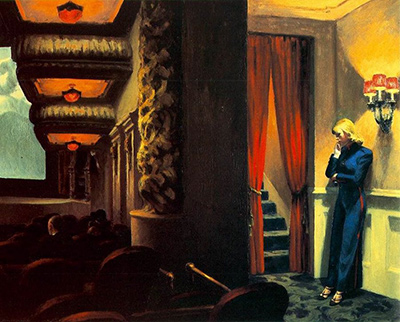
Compare: New York Movie, 1939.
A frame is a position as well as a boundary
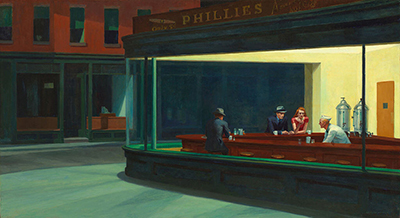
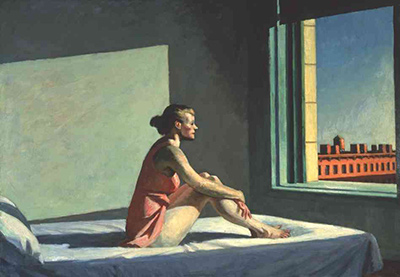
The analogy with a camera becomes more useful when we ask where a camera would have to stand. The exterior view in Nighthawks makes glass part of the encounter. The interior view in Morning Sun puts us on the woman's side of the window while keeping her view unavailable. Each position creates a different relation between viewer and subject.
A filmmaker adapting either image has to make that relation practical. A camera outside the diner must look through or reproduce the effect of the glass. One inside a bedroom has to choose which portions of the wall, bed and opening remain in view. A shift to show a face may reveal an area that the painting deliberately excludes.
The difficulty is not simply matching furniture. Painted perspective can make several surfaces convincing from one position without guaranteeing that they form a room convenient for filming from every angle. Building a set exposes the amount of design contained in an apparently ordinary interior.
The boundary also determines what sound might imply. A film could let an unseen street enter through traffic noise, or make activity in an adjoining room audible before it becomes visible. Those additions would give the off-screen world a particular presence. The painting permits us to imagine such a world without specifying its soundtrack.
Silence in this context is consequently a metaphor for a viewer's experience of a static image. A painted diner does not document that nobody spoke. Film can choose an actual duration of quiet, while a canvas makes no equivalent recording of elapsed sound.
Night, windows and the limits of a noir comparison
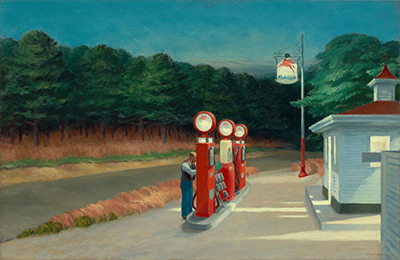
In Nighthawks, the bright diner gathers people within a glass enclosure while the darker street holds the spectator outside. In Gas, red pumps and a small attendant occupy a roadside clearing beside trees and a road that turns away. Both images can encourage the expectation of a story through contrasts between light, shelter and surrounding darkness.
That expectation helps explain the attraction of comparing Hopper with film noir. Yet the historical sequence requires care. Nick James, writing for Sight and Sound, discusses the retrospective naming of noir in 1946 and the conventional classic span associated with films from 1941 to 1958. [5] Hopper's theatre pictures of 1927 and 1937, and New York Movie of 1939, already contain selected views and strongly differentiated artificial light.
An affinity with noir can therefore describe a way of looking without establishing a simple chain in which Hopper learned those effects from a later, fully formed category. Earlier cinema, stage design, painting and the city's own illuminated spaces offered overlapping resources. Evidence for one particular borrowing needs to be tied to that work and date.
Nor does a dark setting supply a crime. The people in Nighthawks occupy a diner; the attendant in Gas stands beside pumps. Suspense is one response to the distance, light and restricted view, rather than a hidden incident the spectator has successfully uncovered.
The useful comparison asks what the images do: where they place the viewer, how they direct attention, and what they withhold. Those questions remain productive even when no exact film source can be demonstrated.
A resemblance can change when a film moves
Ron Peck's 1981 documentary Edward Hopper made cinema comparisons part of its account of the painter. A contemporary review by Tim Pulleine, reproduced in the BFI's programme notes, describes its use of film stills and its discussion with Gail Levin. Pulleine also questions one isolated comparison because the surrounding film's atmosphere differs from the apparent resemblance of the chosen frame. [6]
That reservation identifies a practical problem. A still can make two images look closely related by removing movement, sound and the shots before and after it. The comparison may be visually illuminating while becoming less convincing as an account of the whole film.
Colour adds another complication. A dark reproduction may exaggerate shadow; a monochrome still may suppress the colour relationships that mattered to the original image. The format in which two works are placed beside one another can help manufacture the similarity it appears merely to reveal.
The frequently reported connection between House by the Railroad and the house in Hitchcock's Psycho belongs to the reception of Hopper's architecture in film. The Walker Art Center describes the association as reported influence. [7] It is more precise to preserve that wording than to turn every comparable steep roof, raised house or dark window into a confirmed direct quotation.
Hopper's painted house has a particular relation to the railway line cutting across its foreground. A film can take up a building's appearance and give it new actions, inhabitants and narrative functions. Even a documented visual debt would be the beginning of a transformation, rather than proof that the painting contains the later story.
Ed Lachman makes Morning Sun into a set
In 2012, the Museo Thyssen-Bornemisza made the relation between painting and cinema a physical part of its Hopper exhibition. Ed Lachman recreated Morning Sun as a three-dimensional set in the final room. The museum's account identified the installation as an opportunity to examine the painting's relation to cinematic construction. [8]
In a contemporary interview with Andrea G. Bermejo, Lachman described his interest in translating a seemingly realistic painting into a staged space, including its figure and lighting. He also discussed projecting possible views for the woman, while acknowledging that the original painting does not tell us exactly what she sees. [9]
That distinction is central to the project. Choosing an exterior view supplies new material. It does not recover a lost reverse shot concealed within Hopper's canvas. The adaptation tests an invitation made by the image, then has to accept responsibility for its own answer.
The museum's small installation photographs show a figure seen through a framed opening and a wider view of the constructed setting. Even at that modest scale, they make the apparatus of looking more explicit than it is in a reproduction of the painting. The visitor can recognise a bounded image and an object occupying gallery space.
The live body also changes the problem. A painted pose can remain suspended indefinitely. A person maintaining it has to balance, breathe and make small adjustments. The differences matter even if an installation aims to resemble the canvas closely: the figure has become a performer rather than a stable arrangement of painted forms.
Light changes with that translation too. A painter can assign a passage of colour to a wall or body. A staged reconstruction needs surfaces and illumination that produce a convincing relationship for the chosen spectator or camera. Similar appearance can result from a materially different construction.
Lachman's experiment is thus more revealing as an inquiry than as a promise to make the painting real. It makes visible how many decisions are needed to turn one convincing flat image into an environment, and how readily those decisions can create a new work.
Watch: Edward Hopper’s Life and Art
Explore Hopper’s paintings and the places behind them in these museum films. Choose a film below.
Gustav Deutsch builds a new story
Gustav Deutsch's Shirley—Visions of Reality of 2013 gives a more explicit form to the encounter. The Berlinale Forum programme describes thirteen Hopper paintings woven into the life of a fictional actress, with interior monologues and historical sound material. [10] The film supplies a continuing character where the separate paintings leave different people and situations open.
In a 2012 interview with Karin Schiefer, Deutsch explains that he invented events around the moments depicted in the paintings. He describes a demanding construction process with Hanna Schimek: colour studies, built spaces and a camera position constrained by the painted viewpoint. [11] These are statements about his own adaptation, not recovered explanations of Hopper's subjects.
The method makes a revealing demand on the source image. A chair or doorway that works from one painted position may become awkward when built as an object an actor must use. The transition from a convincing flat arrangement to a habitable set exposes the difference between pictorial space and ordinary room construction.
Deutsch also explains why he left out Nighthawks: its exterior viewpoint would have put his camera outside the glass, at odds with the inward monologue he wanted to give the woman. [11] A painting's apparent invitation to storytelling can thus become a practical limit when a filmmaker chooses how to enter it.
It also changes time. The paintings can hold an unexplained gesture indefinitely; a film must decide how long the person remains still, what can be heard and what happens next. An interior monologue can make a character's thoughts explicit in a way the painted face never does.
Deutsch's fictional actress is therefore a new creation. Her history gives the chosen images connections that belong to the film's political and personal narrative. The paintings provide poses, spaces and visual tensions from which that story can be developed, while retaining their independent meanings outside it.
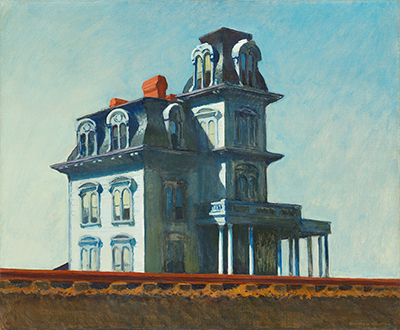
Compare: House by the Railroad, 1925.
A continuing character changes the separate paintings
Deutsch's use of an actress gives his adaptation a continuity that Hopper's individual figures do not possess. A viewer can carry knowledge from one scene into another: memories, commitments, relationships and expectations accumulate around the character. The separate canvases offer no equivalent guarantee that their women belong to one life.
That new continuity can make a familiar pose feel different. A person sitting on a bed may now be waiting for an event the film has established. A look towards a window may answer a voice or a remembered conversation. The adaptation gives causes and consequences to gestures that the painting leaves more open.
It also makes costume and setting part of a historical progression. The same character can pass through changing rooms and years, allowing an audience to read differences as episodes in an unfolding life. In the paintings, related furniture or similar clothing can remain formal recurrences without becoming evidence of one fictional biography.
The transition gives the filmmaker both an opportunity and a constraint. A composed scene can provide an unusually strong visual destination. Reaching it requires a choice of what comes before, how long the pose lasts and how the character moves away. Those connecting decisions account for much of the adaptation's meaning.
Recognising them does not diminish the film's engagement with Hopper. It makes the exchange more precise. The paintings supply selected configurations; the film gives them a new temporal and personal architecture.
Wim Wenders and the pursuit of atmosphere
Wim Wenders offers a different account in his director's note for Two or Three Things I Know about Edward Hopper, a 3D installation commissioned for the Fondation Beyeler's 2020 exhibition. He recalls seeing Hopper at the Whitney and MoMA in the 1970s and describes the lasting effect of the paintings' colour, light and concentrated moments. [12]
His stated aim is to make a world with a related atmosphere rather than reproduce individual canvases exactly. [12] The distinction matters because it describes an acknowledged response without requiring every scene to be matched to one source painting.
Atmosphere can involve several relationships at once: a figure's scale within a setting, a patch of artificial light beside a darker exterior, a route continuing out of view, or the pause before an encounter becomes clear. A filmmaker can respond to that arrangement while changing the place, people and events.
Wenders's statement also supplies evidence stronger than a critic noticing a resemblance after the fact. He identifies Hopper as important to his own sensibility and explains the kind of response he intends. That does not settle every proposed comparison within his earlier films, but it gives the broader connection a direct creative basis.
Film texture, glass and a director's image book
A 2017 conversation with Todd Haynes and Ed Lachman in DGA Quarterly offers a useful account of how visual references enter filmmaking. Haynes describes preparing image books to communicate with his collaborators. They also discuss retaining visible film texture in Mildred Pierce and Carol, and the importance of looking through glass and frames within frames. This particular interview does not name Hopper; it supplies a practical comparison rather than proof of a specific borrowing. [13]
The distinction helps when Hopper's name is used to describe a film's general appearance. A finished image can emerge from numerous references, material choices and collaborations. A similar window or colour may be one part of that process rather than the whole explanation.
The filmmakers' emphasis on texture also complicates comparisons made through a clean digital still. Grain, focus and movement can make a filmed surface feel unstable or difficult to penetrate. A painting has a different physical surface, whose brushwork and colour relationships may disappear in the small reproduction placed beside the still.
The term painterly therefore needs a specific object. It can refer to a colour arrangement, a visibly worked surface, a composition or a quality of illumination. Those are related possibilities, but they are not the same achievement. A film can borrow a spatial relation while developing a very different texture.
Collaboration further changes the analogy with a single painter. A director's reference book may guide costume, set design and photography, while an actor gives the pose its moment-to-moment character. Hopper's own work also involved modelling and preparation, but the division of labour in a film has its own scale and practical demands.
Attending to those differences makes influence less like the transfer of a ready-made atmosphere. A visual reference becomes useful because several people find ways to make it operate within another medium.
Planning leaves room for an accident
The same DGA conversation includes Haynes and Lachman's discussion of a moment in Wonderstruck when an unexpectedly bright exposure became valuable to the scene. Their account joins extensive preparation with the need to recognise a useful event during production. [13]
This offers another productive comparison with Hopper's studies. A plan does not remove every later choice. The artist can investigate an arrangement on paper and still change a form while painting; filmmakers can prepare a visual language and encounter light that alters what a shot can do.
The outcomes nevertheless remain different. A painter can return to a section of the canvas, placing new marks among existing ones. A filmed performance is recorded over time and may need another take, another exposure or an editorial decision. Similar-looking control can involve quite different opportunities to revise.
That difference affects what we should expect from a close comparison. Matching the position of a window is only a beginning. We can also ask how the image was arrived at, which parts could be changed afterwards, and what happened when a person had to occupy its space.
For Hopper, the surviving drawing can restore alternatives to a familiar composition. For a film, a collaborator's account can reveal how an image emerged from planning and circumstance. Neither kind of evidence requires us to invent a hidden story inside the final work.
Returning to the paintings
The cinema connection is most useful when it sharpens looking at the canvas. In New York Movie, follow the separation between screen, audience and usher. In The Sheridan Theatre, trace how the visitor's body meets the curved rail beneath artificial lights. In Gas, consider how the road's turn and the edge of the trees limit the view beyond the station.
Each arrangement gives the viewer a position and makes some parts of the scene easier to know than others. Filmmakers can respond by adding time, sound, movement or a continuing character. The resulting work makes choices that the painting leaves available.
A pause in front of a Hopper can therefore resemble the anticipation before a film's next shot, but it can also last differently. We can return from the person to the wall, from the bright interior to the street, or from a closed curtain to a reader's programme. The painting continues to offer those routes of attention while its people remain where Hopper placed them.
Artworks and studies directory
This researched directory includes finished works and separately identified studies. It is not a complete catalogue raisonné. Linked titles open the articles; unlinked studies are identified by their collection accessions. Watercolours retain their recorded media, and original prints remain distinct from reproductions.
| Name | Date | Medium |
|---|---|---|
| (Bridge and Embankment) (70.1298) | 1906 | Oil on wood |
| (Jo Sketching at Good Harbor Beach) (70.1129) | 1923–1924 | Watercolor and fabricated chalk on paper |
| (Manhattan Bridge) (70.1098) | 1925–1926 | Watercolor and graphite pencil on paper |
| (Rooftops) (70.1114) | 1926 | Watercolor and graphite pencil on paper |
| (Seated Male Model, Bent Over) (70.1277) | c. 1902–1903 | Oil on canvas |
| (Self-Portrait) (70.1254) | 1903–1906 | Oil on canvas |
| (Solitary Figure in a Theater) (70.1418) | c. 1902–1904 | Oil on board |
| 5 A.M. | 1937 | oil on canvas |
| Adam's House | 1928 | watercolour and charcoal on paper |
| American Village | 1912 | Oil on canvas |
| Apartment Houses | 1923 | oil on canvas |
| Approaching a City | 1946 | oil on canvas |
| August in the City | 1945 | oil on canvas |
| Automat | 1927 | oil on canvas |
| Barber Shop | 1931 | oil on canvas |
| Blackwell's Island | 1928 | oil on canvas |
| Bridge on the Seine | 1909 | Oil on canvas |
| Bridle Path | 1939 | oil on canvas |
| Burly Cobb's House South Truro | 1930–1933 | oil on canvas |
| Cape Cod Evening | 1939 | oil on canvas |
| Cape Cod Morning | 1950 | oil on canvas |
| Chair Car | 1965 | oil on canvas |
| Chop Suey | 1929 | oil on canvas |
| City Roofs | 1932 | Oil on canvas |
| Coast Guard Station | 1929 | oil on canvas |
| Compartment C, Car 293 | 1938 | oil on canvas |
| Conference at Night | 1949 | oil on canvas |
| Corn Hill | 1930 | oil on canvas |
| Dawn in Pennsylvania | 1942 | oil on canvas |
| Drug Store | 1927 | oil on canvas |
| Early Sunday Morning | 1930 | Oil on canvas |
| East Side Interior (70.1020) | 1922 | Etching |
| East Wind Over Weehawken | 1934 | oil on canvas |
| El Palacio | 1946 | Watercolor and graphite pencil on paper |
| Eleven A.M. | 1926 | oil on canvas |
| Evening Wind | 1921 | etching |
| Excursion into Philosophy | 1959 | oil on canvas |
| First Row Orchestra | 1951 | oil on canvas |
| Freight Car at Truro | 1931 | watercolour over graphite on paper |
| Gas | 1940 | oil on canvas |
| Girl at a Sewing Machine | c. 1921 | oil on canvas |
| Gloucester Harbor | 1912 | Oil on canvas |
| Ground Swell | 1939 | oil on canvas |
| Haskell's House | 1924 | watercolour over graphite on paperboard |
| High Noon | 1949 | oil on canvas |
| Hill and Houses Cape Elizabeth Maine | 1927 | watercolour over graphite pencil |
| Hills South Truro | 1930 | oil on canvas |
| Hotel by a Railroad | 1952 | oil on canvas |
| Hotel Lobby | 1943 | oil on canvas |
| Hotel Room | 1931 | oil on canvas |
| Hotel Window | 1955 | oil on canvas |
| House by the Railroad | 1925 | oil on canvas |
| House by the Squam River | 1926 | watercolour over graphite on paper |
| Le Bistro or The Wine Shop | 1909 | Oil on canvas |
| Le Pont des Arts | 1907 | Oil on canvas |
| Le Pont Royal | 1909 | Oil on canvas |
| Le Quai des Grands Augustins | 1909 | Oil on canvas |
| Lighthouse and Buildings Portland Head | 1927 | watercolour over graphite pencil on paper |
| Lighthouse Hill | 1927 | oil painting |
| Manhattan Bridge Loop | 1928 | oil on canvas |
| Model Sitting | c. 1902 | oil painting; support not asserted |
| Morning Sun | 1952 | oil on canvas |
| New York Movie | 1939 | oil on canvas |
| New York New Haven and Hartford | 1931 | oil on canvas |
| New York Office | 1962 | oil on canvas |
| New York Pavements | 1924–1925 | oil on canvas |
| New York Restaurant | c. 1922 | oil on canvas |
| Night Windows | 1928 | oil on canvas |
| Nighthawks | 1942 | oil on canvas |
| October on Cape Cod | 1946 | oil on canvas |
| Office at Night | 1940 | oil on canvas |
| Office in a Small City | 1953 | oil on canvas |
| Pennsylvania Coal Town | 1947 | oil on canvas |
| People in the Sun | 1960 | oil on canvas |
| Portrait of Orleans | 1950 | oil on canvas |
| Queensborough Bridge | 1913 | Oil on canvas |
| Railroad Sunset | 1929 | Oil on canvas |
| Railroad Train | 1908 | oil on canvas |
| Road in Maine | 1914 | oil on canvas |
| Room in Brooklyn | 1932 | oil on canvas |
| Room in New York | 1932 | oil on canvas |
| Rooms by the Sea | 1951 | oil on canvas |
| Rooms for Tourists | 1945 | oil on canvas |
| Route 6 Eastham | 1941 | oil on canvas |
| Second Story Sunlight | 1960 | Oil on canvas |
| Self-Portrait | 1925–1930 | Oil on canvas |
| Self-Portrait with Hat (70.1903) | c. 1918, posthumous print | Drypoint |
| Seven A.M. | 1948 | Oil on canvas |
| Soir Bleu | 1914 | oil on canvas |
| South Carolina Morning | 1955 | Oil on canvas |
| Stairway at 48 Rue de Lille Paris | 1906 | Oil on wood |
| Study for 5 A.M. (70.153) | 1937 | Fabricated chalk on paper |
| Study for 5 A.M. (70.429) | 1937 | Fabricated chalk and graphite pencil on paper |
| Study for Approaching a City (70.869) | 1946 | Fabricated chalk and charcoal on paper |
| Study for August in the City (70.158a-b) | 1945 | Fabricated chalk on paper |
| Study for August in the City (70.159) | 1945 | Fabricated chalk on paper |
| Study for Bridle Path (70.220) | 1939 | Fabricated chalk on paper |
| Study for Bridle Path (70.235) | 1939 | Fabricated chalk on paper |
| Study for Compartment C, Car 293 (70.430) | 1938 | Fabricated chalk on paper |
| Study for Compartment C, Car 293 (70.431a-b) | 1938 | Fabricated chalk and charcoal on paper |
| Study for Conference at Night (70.170) | 1949 | Fabricated chalk on paper (recto); Typewriter ink on paper (verso) |
| Study for Conference at Night (70.174) | 1949 | Fabricated chalk on paper ( recto); Typewriter ink on paper (verso) |
| Study for East Wind over Weehawken (70.249) | 1934 | Graphite pencil on paper |
| Study for East Wind over Weehawken (70.252) | 1934 | Fabricated chalk and charcoal on paper |
| Study for Evening Wind (70.343a-b) | 1921 | Fabricated chalk on paper |
| Study for First Row Orchestra (70.841) | 1951 | Fabricated chalk and charcoal on paper |
| Study for Gas (70.263) | 1940 | Fabricated chalk on paper |
| Study for Ground Swell (70.339) | 1939 | Fabricated chalk, charcoal and graphite pencil on paper |
| Study for Hotel by a Railroad (70.199) | 1952 | Fabricated chalk on paper |
| Study for Hotel by a Railroad (70.427) | 1952 | Fabricated chalk on paper |
| Study for Hotel by a Railroad (70.428) | 1952 | Fabricated chalk on paper |
| Study for Hotel Lobby (70.117) | 1942 | Fabricated chalk and graphite pencil on paper |
| Study for Hotel Lobby (70.839) | 1942 | Fabricated chalk and charcoal on paper |
| Study for Hotel Window (70.161) | 1955 | Fabricated chalk, graphite pencil and colored pencil on paper |
| Study for Morning Sun (70.243) | 1952 | Fabricated chalk on paper |
| Study for Morning Sun (70.244) | 1952 | Fabricated chalk on paper |
| Study for Morning Sun (70.290) | 1952 | Fabricated chalk on paper |
| Study for Morning Sun (70.291) | 1952 | Fabricated chalk and graphite pencil on paper |
| Study for New York Movie (70.273) | 1939 | Fabricated chalk on paper |
| Study for New York Movie (70.274a-b) | 1938 or 1939 | Fabricated chalk and charcoal on paper (recto); Fabricated chalk on paper (verso) |
| Study for New York Movie (70.455) | 1939 | Fabricated chalk and charcoal on paper |
| Study for New York Office (70.822) | 1962 | Fabricated chalk on paper |
| Study for Nighthawks (70.192) | 1941 or 1942 | Fabricated chalk on paper |
| Study for Nighthawks (70.193) | 1941 or 1942 | Fabricated chalk on paper |
| Study for Office at Night (70.340) | 1940 | Fabricated chalk and charcoal on paper |
| Study for Office at Night (70.341) | 1940 | Fabricated chalk and graphite pencil on paper |
| Study for Pennsylvania Coal Town (70.198) | 1947 | Fabricated chalk on paper |
| Study for Pennsylvania Coal Town (70.229) | 1947 | Fabricated chalk and charcoal on paper |
| Study for Rooms for Tourists (70.438) | 1945 | Fabricated chalk and charcoal on paper |
| Study for Rooms for Tourists (70.848) | 1945 | Fabricated chalk and charcoal on paper |
| Study for Route 6, Eastham (70.369) | 1941 | Fabricated chalk and graphite pencil on paper |
| Study for Route 6, Eastham (70.854) | 1941 | Fabricated chalk and graphite pencil on paper |
| Study for South Carolina Morning (70.162a-b) | 1955 | Fabricated chalk on paper (recto and verso) |
| Study for The Sheridan Theatre (70.969) | 1937 | Graphite pencil on paper |
| Study for Two on the Aisle (70.128) | 1927 | Fabricated chalk on paper |
| Study for Two on the Aisle (70.129) | 1927 | Fabricated chalk on paper |
| Study for Yawl Riding a Swell (70.439) | 1935 | Fabricated chalk and graphite pencil on paper |
| Summer Evening | 1947 | oil on canvas |
| Summer Interior | 1909 | Oil on canvas |
| Sun in an Empty Room | 1963 | oil on canvas |
| Sunlight in a Cafeteria | 1958 | oil on canvas |
| Sunlight on Brownstones | 1956 | oil on canvas |
| Tables for Ladies | 1930 | oil on canvas |
| The Bootleggers | 1925 | oil on canvas |
| The Camel's Hump | 1931 | oil on canvas |
| The Circle Theatre | 1936 | oil on canvas |
| The City | 1927 | oil on canvas |
| The Lighthouse at Two Lights | 1929 | oil on canvas |
| The Long Leg | 1935 | oil on canvas |
| The Mansard Roof | 1923 | watercolour over graphite on paper |
| The Sheridan Theatre | 1937 | oil on canvas |
| Tramp Steamer | 1908 | oil on canvas |
| Two Comedians | 1966 | oil on canvas |
| Two on the Aisle | 1927 | oil on canvas |
| Valley of the Seine | 1909 | Oil on canvas |
| Western Motel | 1957 | oil on canvas |
Frequently Asked Questions
Edward and Josephine Hopper made performances part of their New York routine. The Whitney's Sanborn Hopper Archive preserves annotated ticket stubs and records of their theatre-going. In the museum's 2022 guide, David Crane discusses their attention to sets, lighting and seating positions, including their frequent choice of balcony seats. [1]
New York Movie contains a screen, people watching it and an usher standing near the stairs. A heavy wall and decorated column divide the auditorium from the brightly lit side passage. The film is underway, but the employee's lowered head directs attention elsewhere.
Wim Wenders offers a different account in his director's note for Two or Three Things I Know about Edward Hopper, a 3D installation commissioned for the Fondation Beyeler's 2020 exhibition. He recalls seeing Hopper at the Whitney and MoMA in the 1970s and describes the lasting effect of the paintings' colour, light and concentrated moments. [12]
Discussion
Look again at the images and ideas explored in Hopper and Cinema. These editorial prompts invite your observations.
Reader Insights
Which change would be necessary to turn one of these still scenes into a moving sequence?
Compare New York Movie with House by the Railroad. Which visual difference matters most to your reading?
Which detail would you look at again after reading “Three kinds of looking in New York Movie”?
Join the Conversation
Share a detail, comparison or question about Hopper and Cinema below.
References
- Whitney Museum of American Art, Edward Hopper's New York, guide, 2022, stop 511, “Performances,” transcript with David Crane; theatre-going, annotated ticket stubs, seating and Jo's acting background. View source.
- Whitney Museum of American Art, Edward Hopper's New York, exhibition labels, 2022, PDF pp. 52–58; theatre sources, fifty-three New York Movie studies and figure staging. View source.
- Viola Rühse, “Edward Hopper's Cinema Paintings: Film Palace Nostalgia, Usherette's Disillusionment, and Bomb Threats”, Boletín de Arte, no. 20, September 2020, e023, pp. 9–10; attributed interpretation of cinema labour. View source.
- Robert Hobbs, Edward Hopper, New York, Harry N. Abrams, 1987, introduction, pp. 9–20; the observer and camera analogy. View source.
- Nick James, “Twenty-first century noir”, Sight and Sound, updated 27 November 2020; introductory discussion of the category's naming and conventional chronology. View source.
- Tim Pulleine, review of Ron Peck's Edward Hopper, Monthly Film Bulletin, April 1981, reproduced in BFI Southbank programme notes, 9 February 2023; film-still comparisons and the reviewer's qualification. View source.
- Walker Art Center, “Art as a Reflection of Society”, 9 April 2014; the reported House by the Railroad–Psycho association. View source.
- Museo Thyssen-Bornemisza, Recreation of Hopper’s painting Morning Sun, 2012, complete exhibition account and two small installation photographs. The photographs, rather than a visit or full moving-image recording, support the limited visual discussion. View source.
- Andrea G. Bermejo, “¿Adónde mira la mujer del cuadro?”, Cinemanía, 8 June 2012, complete published interview with Ed Lachman. His account of making the installation is distinguished from his more speculative claims about Hopper’s sources and subjects. View source.
- Anna Hoffmann, Shirley—Visions of Reality, Berlinale Forum programme, 2013; the fictional actress, thirteen paintings and narrative form. View source.
- Karin Schiefer, interview with Gustav Deutsch, 2012, in Berlinale Forum 2013 catalogue, pp. 140–43; the director's own account of adaptation, construction, colour work with Hanna Schimek and camera position. View source.
- Wim Wenders, director's note for Two or Three Things I Know about Edward Hopper, reproduced by the Onassis Foundation; the 2020 Fondation Beyeler commission and Wenders's account of his response to Hopper. View source.
- Robert Abele, “Recreating the Past with Light, Texture and Tone”, DGA Quarterly, Fall 2017, complete interview with Todd Haynes and Ed Lachman. The interview discusses image books, film texture, glass and an exposure in Wonderstruck; it does not itself identify Hopper as a source. View source.
- Whitney Museum of American Art, Study for Route 6, Eastham, 1941, accession 70.854; exact object record. View source.
- Whitney Museum of American Art, Study for Conference at Night, 1949, accession 70.170; exact object record. View source.
- Whitney Museum of American Art, Study for First Row Orchestra, 1951, accession 70.841; exact object record. View source.
- Whitney Museum of American Art, (Bridge and Embankment), 1906, accession 70.1298; exact object record. View source.
- Whitney Museum of American Art, (Seated Male Model, Bent Over), c. 1902–1903, accession 70.1277; exact object record. View source.
- Whitney Museum of American Art, Study for Morning Sun, 1952, accession 70.244; exact object record. View source.
- Whitney Museum of American Art, Study for Morning Sun, 1952, accession 70.243; exact object record. View source.
- Whitney Museum of American Art, Study for Two on the Aisle, 1927, accession 70.128; exact object record. View source.
- Whitney Museum of American Art, Study for New York Office, 1962, accession 70.822; exact object record. View source.
- Whitney Museum of American Art, Study for Two on the Aisle, 1927, accession 70.129; exact object record. View source.
- Whitney Museum of American Art, Study for Pennsylvania Coal Town, 1947, accession 70.229; exact object record. View source.
- Whitney Museum of American Art, (Rooftops), 1926, accession 70.1114; exact object record. View source.
- Whitney Museum of American Art, Study for South Carolina Morning, 1955, accession 70.162a-b; exact object record. View source.
- Whitney Museum of American Art, (Self-Portrait), 1903–1906, accession 70.1254; exact object record. View source.
- Whitney Museum of American Art, (Manhattan Bridge), 1925–1926, accession 70.1098; exact object record. View source.
- Whitney Museum of American Art, (Solitary Figure in a Theater), c. 1902–1904, accession 70.1418; exact object record. View source.
- Whitney Museum of American Art, Study for Approaching a City, 1946, accession 70.869; exact object record. View source.
- Whitney Museum of American Art, Study for August in the City, 1945, accession 70.159; exact object record. View source.
- Whitney Museum of American Art, Study for Compartment C, Car 293, 1938, accession 70.430; exact object record. View source.
- Whitney Museum of American Art, Study for Compartment C, Car 293, 1938, accession 70.431a-b; exact object record. View source.
- Whitney Museum of American Art, Study for East Wind over Weehawken, 1934, accession 70.252; exact object record. View source.
- Whitney Museum of American Art, Study for East Wind over Weehawken, 1934, accession 70.249; exact object record. View source.
- Whitney Museum of American Art, Study for Evening Wind, 1921, accession 70.343a-b; exact object record. View source.
- Whitney Museum of American Art, Study for The Sheridan Theatre, 1937, accession 70.969; exact object record. View source.
- Whitney Museum of American Art, Study for New York Movie, 1939, accession 70.455; exact object record. View source.
- Whitney Museum of American Art, Study for New York Movie, 1939, accession 70.273; exact object record. View source.
- Whitney Museum of American Art, Study for New York Movie, 1938 or 1939, accession 70.274a-b; exact object record. View source.
- Whitney Museum of American Art, Study for 5 A.M., 1937, accession 70.153; exact object record. View source.
- Whitney Museum of American Art, Study for 5 A.M., 1937, accession 70.429; exact object record. View source.
- Whitney Museum of American Art, (Jo Sketching at Good Harbor Beach), 1923–1924, accession 70.1129; exact object record. View source.
- Whitney Museum of American Art, Study for August in the City, 1945, accession 70.158a-b; exact object record. View source.
- Whitney Museum of American Art, Study for Morning Sun, 1952, accession 70.291; exact object record. View source.
- Whitney Museum of American Art, Study for Morning Sun, 1952, accession 70.290; exact object record. View source.
- Whitney Museum of American Art, Study for Office at Night, 1940, accession 70.340; exact object record. View source.
- Whitney Museum of American Art, Study for Office at Night, 1940, accession 70.341; exact object record. View source.
- Whitney Museum of American Art, Study for Hotel by a Railroad, 1952, accession 70.427; exact object record. View source.
- Whitney Museum of American Art, Study for Hotel by a Railroad, 1952, accession 70.199; exact object record. View source.
- Whitney Museum of American Art, Study for Hotel by a Railroad, 1952, accession 70.428; exact object record. View source.
- Whitney Museum of American Art, Study for Hotel Lobby, 1942, accession 70.117; exact object record. View source.
- Whitney Museum of American Art, Study for Hotel Lobby, 1942, accession 70.839; exact object record. View source.
- Whitney Museum of American Art, Study for Conference at Night, 1949, accession 70.174; exact object record. View source.
- Whitney Museum of American Art, Study for Hotel Window, 1955, accession 70.161; exact object record. View source.
- Whitney Museum of American Art, Study for Pennsylvania Coal Town, 1947, accession 70.198; exact object record. View source.
- Whitney Museum of American Art, Study for Route 6, Eastham, 1941, accession 70.369; exact object record. View source.
- Whitney Museum of American Art, Study for Bridle Path, 1939, accession 70.220; exact object record. View source.
- Whitney Museum of American Art, Study for Bridle Path, 1939, accession 70.235; exact object record. View source.
- Whitney Museum of American Art, Study for Ground Swell, 1939, accession 70.339; exact object record. View source.
- Whitney Museum of American Art, Study for Yawl Riding a Swell, 1935, accession 70.439; exact object record. View source.
- Whitney Museum of American Art, Study for Rooms for Tourists, 1945, accession 70.848; exact object record. View source.
- Whitney Museum of American Art, Study for Rooms for Tourists, 1945, accession 70.438; exact object record. View source.
- Whitney Museum of American Art, Study for Nighthawks, 1941 or 1942, accession 70.193; exact object record. View source.
- Whitney Museum of American Art, Study for Nighthawks, 1941 or 1942, accession 70.192; exact object record. View source.
- Whitney Museum of American Art, Study for Gas, 1940, accession 70.263; exact object record. View source.
- Whitney Museum of American Art, Self-Portrait with Hat, c. 1918, posthumous print, accession 70.1903; exact object record. View source.
- Whitney Museum of American Art, East Side Interior, 1922, accession 70.1020; exact object record. View source.
- Art Institute of Chicago, Selected Chronology for Edward Hopper; training, travels, exhibitions, New York and Truro chronology. View source.
- Emily C. Burns, Spectral figures: Edward Hopper’s empty Paris, chapter 5 in Empty Spaces: Confronting Emptiness in National, Cultural and Urban Histories, 2019; complete chapter and notes consulted. View source.
- Charles Brock, Regionalism and Folk Art, National Gallery of Art; complete essay and two notes consulted. View source.
- Collection or catalogue record, American Village, 1912; medium and identity as discussed in the linked article. View source.
- Collection or catalogue record, Soir Bleu, 1914; medium and identity as discussed in the linked article. View source.
- Collection or catalogue record, House by the Railroad, 1925; medium and identity as discussed in the linked article. View source.
- Collection or catalogue record, Automat, 1927; medium and identity as discussed in the linked article. View source.
- Collection or catalogue record, Early Sunday Morning, 1930; medium and identity as discussed in the linked article. View source.
- Collection or catalogue record, New York Movie, 1939; medium and identity as discussed in the linked article. View source.
- Collection or catalogue record, Nighthawks, 1942; medium and identity as discussed in the linked article. View source.
- Collection or catalogue record, Morning Sun, 1952; medium and identity as discussed in the linked article. View source.
- Collection or catalogue record, Second Story Sunlight, 1960; medium and identity as discussed in the linked article. View source.
- Collection or catalogue record, Two Comedians, 1966; medium and identity as discussed in the linked article. View source.