 by Tom Gurney
Tom Gurney BSc (Hons) is an art history expert with over 20 years experience
Email: tomgurney1@gmail.com / Phone: +44 7429 011000
Summer Interior: Introduction
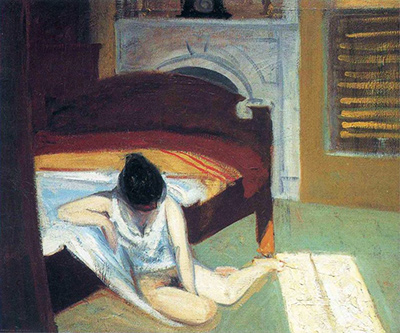
A partly clothed woman sits on the floor beside a bed. Her head is lowered, one arm rests against the bedding, and the other reaches down between her bent legs. A long pale passage extends across the floor at the right, while a dark vertical form cuts into the foreground at the left. Edward Hopper's Summer Interior brings the spectator close to a private room without explaining the circumstances of its occupant.
The Whitney Museum of American Art dates the oil on canvas to 1909 and records dimensions of 61.6 × 74.1 cm. It belongs to the Josephine N. Hopper Bequest, accession 70.1197. [1] The relatively small canvas contains a surprisingly complicated arrangement of body, bedding and furniture, with strong differences between what is immediately exposed and what remains hidden.
At a Glance
- ArtistEdward Hopper [1]
- Date1909 [1]
- MediumOil on canvas [1]
- Collection / recordWhitney Museum of American Art [1]
- Accession70.1197 [1]
This work across Edward Hopper’s career
American Village
1912Soir Bleu
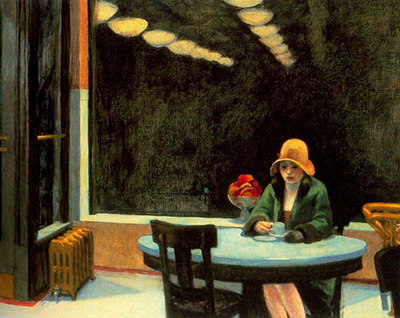
1914Automat
1927New York Movie
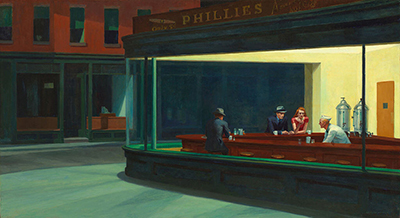
1939Nighthawks
1942Morning Sun
1952Two Comedians
1966Contents
- A body low in the room
- Bed frame and bedding
- Fireplace, clock and blind
- Pale cloth and the light across the floor
- The dark interruption at the left
- An early interior in 1909
- A later theatrical response
- Other bodies beside beds and windows
A body low in the room
The woman's position makes the floor an important part of the subject. She is not seated upright on the bed or standing clearly apart from it. Her body occupies the narrow area beside its edge, with bent knees and arms bringing several changes of direction into the foreground.
One arm is supported by the bed, joining the figure to the white bedding above. The other slopes down towards the lower body and floor. This unequal distribution of support gives the pose its particular character. The person and furniture cannot be considered as separate objects placed neatly beside one another.
The lowered head concentrates the upper body into a dark shape. Hair conceals much of the face, limiting the information available through expression. The posture is specific, but the painting does not supply a corresponding explanation of thought or feeling.
The white upper garment has a different texture from the exposed skin. Small folds and darker marks interrupt its lighter surface, while the arms and legs are broader and more continuous in tone. These distinctions keep the body legible within the surrounding pale fabric.
Bed frame and bedding
The wooden bed is one of the painting's largest dark forms. Its reddish-brown head curves across the middle, with a substantial post at the right. The curved upper edge differs from the straighter wall and floor divisions, giving the furniture a strong shape of its own.
A warm yellow cover lies above the white bedding. Reddish lines near its edge introduce a narrow pattern within a broad area of colour. The difference between the cover and the whiter folds helps separate the upper sleeping surface from the fabric that descends towards the figure.
That descending fabric joins several parts of the picture. It passes from the bed towards the woman's arm and lower position, making a lighter route through the darker furniture. Its uneven folds contrast with the more firmly bounded wooden frame.
The bed is also cropped at the left. We cannot see it as a complete piece of furniture or determine the room's full arrangement from its position. Hopper has chosen a close portion, enough to give the body support and the interior scale while leaving the remainder outside the frame.
The furniture does not become merely a backdrop to the person. Its weight and colour compete for attention, and its edge determines how the body can be seen. The painting's tension begins in that physical relationship before any narrative is attached to it.
Fireplace, clock and blind
Behind the bed, a pale fireplace surround introduces another curve. Its arch is partly concealed by the darker wooden head, allowing two curved forms of different colour and scale to overlap. The juxtaposition makes the room feel furnished rather than arranged for an unobstructed architectural survey.
A dark clock stands on the mantel, with a small circular face interrupting its shape. Other small objects occupy the shelf around it. They locate an ordinary domestic level above the larger masses of bed and figure without providing a clear account of the hour or the room's owner.
At the right, a slatted blind fills a rectangular opening. Its repeated narrow bands differ from the fireplace's arch and the bed's rounded head. Selected lighter edges make the slats visible within a darker field, introducing a compact rhythm behind the open foreground.
The room therefore contains several distinct kinds of repetition and curve. The blind has close horizontal divisions; the fireplace and bed offer broader arcs; the mantel holds smaller isolated objects. Hopper can make the background specific without giving each item equal prominence.
The blind also limits the connection with outside space. There is no extensive landscape through which the spectator can escape the room's close arrangement. The effect of light is more available than a view of its surroundings.
Compare: Eleven A.M., 1926.
Pale cloth and the light across the floor
White and cream passages occur in several places: the bedding, the garment, the fireplace surround and the broad light area at the lower right. Their relationship is central to how the picture holds together. Similar colours belong to different materials and depths, requiring the eye to distinguish them through edge, texture and overlap.
The bedding has irregular folds. The fireplace is more firmly bounded and upright. The long pale area on the floor has straighter divisions, setting a different direction beside the bent body. These changes make light a means of organizing the room rather than a single bright decoration applied to it.
The floor's cooler greenish colour remains visible around the paler passage. It gives the lower half a different character from the warm wooden bed and yellow cover. The figure occupies the point where those colour areas meet, tying the foreground to the furniture behind.
Hopper's paint remains visibly varied. The pale surround contains cooler and warmer touches, while darker strokes help articulate the garment and furnishings. The room is recognizable, but it is not rendered with an identical finish across every surface.
This matters to the painting's intimacy. Close looking brings attention to the act of making forms visible: a curved dark edge, a folded light surface, a small change in flesh colour. The scene can be considered through those material differences even when its narrative remains uncertain.
Watch: Edward Hopper’s Life and Art
Explore Hopper’s paintings and the places behind them in these museum films. Choose a film below.
The dark interruption at the left
The near left edge is occupied by a deep vertical passage that partly blocks the bed and surrounding space. Its closeness gives the spectator an obstructed position. We seem to look past something into the room rather than standing in the middle of a completely open interior.
The crop also makes the light area at the right more emphatic. One side is interrupted by a heavy dark form, while the other exposes floor, bent leg and pale surface. The imbalance makes the room feel selected at an angle rather than centred for a portrait.
The figure consequently has two different kinds of surrounding space. The bed presses close behind and to one side, while the floor opens further towards the right. Her low pose connects those unequal areas without turning them into a symmetrical arrangement.
The painting keeps the spectator near enough to inspect the room but gives no social explanation for that nearness. No other figure is shown acknowledging our position. The relationship is established by the composition itself: close, partial and difficult to convert into a settled encounter.
An early interior in 1909
The date places Summer Interior between Hopper's early European journeys. The Art Institute of Chicago's chronology records his first Paris stay in 1906–07, a return in 1909 and a final visit in 1910. [2] These years involved varied subjects and settings, rather than an already fixed repetition of the later city interiors for which he became famous.
The painting shows several concerns that would persist: an ordinary room, a figure whose face remains difficult to read, a strong architectural frame and light that shapes the space. Those continuities can be recognized without assuming that every later meaning was already fully determined in 1909.
The Whitney's record includes the canvas in Hopper Drawing in 2013. [1] Its later exhibition history places the early interior within broader examinations of Hopper's construction of figures and spaces, even though the canvas itself remains a finished oil painting rather than a preparatory drawing.
Compare: Evening Wind, 1921.
A later theatrical response
The Edward Hopper House's 2019 programme Hopper Scenes, a Second Act included Summer Interior as the basis for a dramatic text by Dan Hanchrow. The project, developed with Rehabilitation Through the Arts and Diana Green, imagined scenes inspired by Hopper's paintings. [3]
This later response demonstrates how readily the room can invite storytelling. A performer or writer can give the silent figure a voice and invent a surrounding life. Those creative additions belong to the new work. The painting itself supplies a pose, a place and a set of visual relationships from which different stories can begin.
The distinction leaves room for emotional responses without treating one invented event as recovered fact. The lowered head and unusual position beside the bed may feel consequential, but the canvas does not specify what has just happened. Its capacity to hold attention is partly bound to that difference between the clarity of the scene and the uncertainty of its circumstances.
Other bodies beside beds and windows
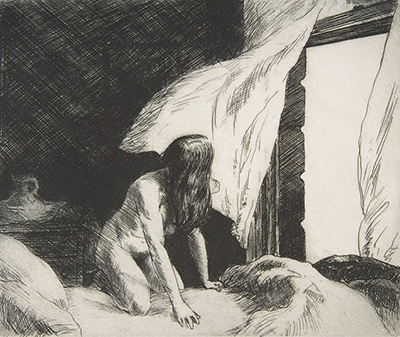
In Evening Wind, the 1921 etching, a kneeling woman turns towards a window as a curtain crosses the space above. Dark lines and white paper give that bedroom a more concentrated contrast, with the curtain introducing a visible disturbance. Summer Interior keeps its movement closer to the low body, folds and adjoining floor.
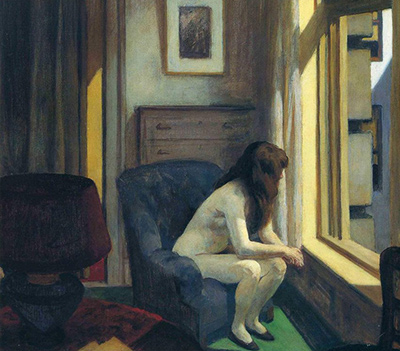
Eleven A.M. places a nude figure in an upholstered chair beside a bright window. Its seated position gives the body a more clearly defined support, while a red lamp, curtains and other furniture surround it. The 1909 painting makes the relation between person, bed and floor less settled and more immediately physical.
The pale fireplace arch behind the dark bed offers a useful point from which to reconsider the whole scene. One structure overlaps another, just as cloth overlaps furniture and the figure joins the bed's edge to the floor. Hopper gives those contacts enough specificity to make the room compelling while leaving its human situation open.
Artworks and studies directory
This researched directory includes finished works and separately identified studies. It is not a complete catalogue raisonné. Linked titles open the articles; unlinked studies are identified by their collection accessions. Watercolours retain their recorded media, and original prints remain distinct from reproductions.
| Name | Date | Medium |
|---|---|---|
| (Bridge and Embankment) (70.1298) | 1906 | Oil on wood |
| (Jo Sketching at Good Harbor Beach) (70.1129) | 1923–1924 | Watercolor and fabricated chalk on paper |
| (Manhattan Bridge) (70.1098) | 1925–1926 | Watercolor and graphite pencil on paper |
| (Rooftops) (70.1114) | 1926 | Watercolor and graphite pencil on paper |
| (Seated Male Model, Bent Over) (70.1277) | c. 1902–1903 | Oil on canvas |
| (Self-Portrait) (70.1254) | 1903–1906 | Oil on canvas |
| (Solitary Figure in a Theater) (70.1418) | c. 1902–1904 | Oil on board |
| 5 A.M. | 1937 | oil on canvas |
| Adam's House | 1928 | watercolour and charcoal on paper |
| American Village | 1912 | Oil on canvas |
| Apartment Houses | 1923 | oil on canvas |
| Approaching a City | 1946 | oil on canvas |
| August in the City | 1945 | oil on canvas |
| Automat | 1927 | oil on canvas |
| Barber Shop | 1931 | oil on canvas |
| Blackwell's Island | 1928 | oil on canvas |
| Bridge on the Seine | 1909 | Oil on canvas |
| Bridle Path | 1939 | oil on canvas |
| Burly Cobb's House South Truro | 1930–1933 | oil on canvas |
| Cape Cod Evening | 1939 | oil on canvas |
| Cape Cod Morning | 1950 | oil on canvas |
| Chair Car | 1965 | oil on canvas |
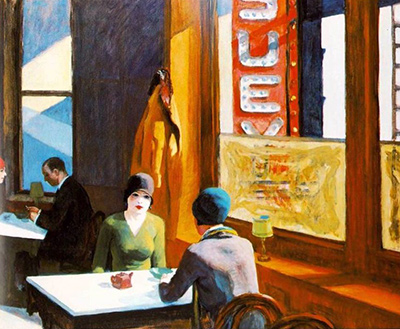
| Chop Suey | 1929 | oil on canvas |
| City Roofs | 1932 | Oil on canvas |
| Coast Guard Station | 1929 | oil on canvas |
| Compartment C, Car 293 | 1938 | oil on canvas |
| Conference at Night | 1949 | oil on canvas |
| Corn Hill | 1930 | oil on canvas |
| Dawn in Pennsylvania | 1942 | oil on canvas |
| Drug Store | 1927 | oil on canvas |
| Early Sunday Morning | 1930 | Oil on canvas |
| East Side Interior (70.1020) | 1922 | Etching |
| East Wind Over Weehawken | 1934 | oil on canvas |
| El Palacio | 1946 | Watercolor and graphite pencil on paper |
| Eleven A.M. | 1926 | oil on canvas |
| Evening Wind | 1921 | etching |
| Excursion into Philosophy | 1959 | oil on canvas |
| First Row Orchestra | 1951 | oil on canvas |
| Freight Car at Truro | 1931 | watercolour over graphite on paper |
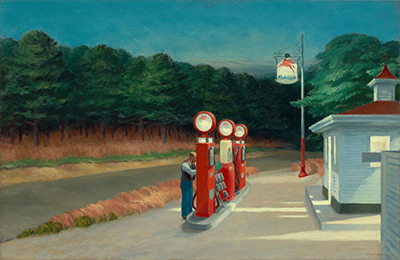
| Gas | 1940 | oil on canvas |
| Girl at a Sewing Machine | c. 1921 | oil on canvas |
| Gloucester Harbor | 1912 | Oil on canvas |
| Ground Swell | 1939 | oil on canvas |
| Haskell's House | 1924 | watercolour over graphite on paperboard |
| High Noon | 1949 | oil on canvas |
| Hill and Houses Cape Elizabeth Maine | 1927 | watercolour over graphite pencil |
| Hills South Truro | 1930 | oil on canvas |
| Hotel by a Railroad | 1952 | oil on canvas |
| Hotel Lobby | 1943 | oil on canvas |
| Hotel Room | 1931 | oil on canvas |
| Hotel Window | 1955 | oil on canvas |
| House by the Railroad | 1925 | oil on canvas |
| House by the Squam River | 1926 | watercolour over graphite on paper |
| Le Bistro or The Wine Shop | 1909 | Oil on canvas |
| Le Pont des Arts | 1907 | Oil on canvas |
| Le Pont Royal | 1909 | Oil on canvas |
| Le Quai des Grands Augustins | 1909 | Oil on canvas |
| Lighthouse and Buildings Portland Head | 1927 | watercolour over graphite pencil on paper |
| Lighthouse Hill | 1927 | oil painting |
| Manhattan Bridge Loop | 1928 | oil on canvas |
| Model Sitting | c. 1902 | oil painting; support not asserted |
| Morning Sun | 1952 | oil on canvas |
| New York Movie | 1939 | oil on canvas |
| New York New Haven and Hartford | 1931 | oil on canvas |
| New York Office | 1962 | oil on canvas |
| New York Pavements | 1924–1925 | oil on canvas |
| New York Restaurant | c. 1922 | oil on canvas |
| Night Windows | 1928 | oil on canvas |
| Nighthawks | 1942 | oil on canvas |
| October on Cape Cod | 1946 | oil on canvas |
| Office at Night | 1940 | oil on canvas |
| Office in a Small City | 1953 | oil on canvas |
| Pennsylvania Coal Town | 1947 | oil on canvas |
| People in the Sun | 1960 | oil on canvas |
| Portrait of Orleans | 1950 | oil on canvas |
| Queensborough Bridge | 1913 | Oil on canvas |
| Railroad Sunset | 1929 | Oil on canvas |
| Railroad Train | 1908 | oil on canvas |
| Road in Maine | 1914 | oil on canvas |
| Room in Brooklyn | 1932 | oil on canvas |
| Room in New York | 1932 | oil on canvas |
| Rooms by the Sea | 1951 | oil on canvas |
| Rooms for Tourists | 1945 | oil on canvas |
| Route 6 Eastham | 1941 | oil on canvas |
| Second Story Sunlight | 1960 | Oil on canvas |
| Self-Portrait | 1925–1930 | Oil on canvas |
| Self-Portrait with Hat (70.1903) | c. 1918, posthumous print | Drypoint |
| Seven A.M. | 1948 | Oil on canvas |
| Soir Bleu | 1914 | oil on canvas |
| South Carolina Morning | 1955 | Oil on canvas |
| Stairway at 48 Rue de Lille Paris | 1906 | Oil on wood |
| Study for 5 A.M. (70.153) | 1937 | Fabricated chalk on paper |
| Study for 5 A.M. (70.429) | 1937 | Fabricated chalk and graphite pencil on paper |
| Study for Approaching a City (70.869) | 1946 | Fabricated chalk and charcoal on paper |
| Study for August in the City (70.158a-b) | 1945 | Fabricated chalk on paper |
| Study for August in the City (70.159) | 1945 | Fabricated chalk on paper |
| Study for Bridle Path (70.220) | 1939 | Fabricated chalk on paper |
| Study for Bridle Path (70.235) | 1939 | Fabricated chalk on paper |
| Study for Compartment C, Car 293 (70.430) | 1938 | Fabricated chalk on paper |
| Study for Compartment C, Car 293 (70.431a-b) | 1938 | Fabricated chalk and charcoal on paper |
| Study for Conference at Night (70.170) | 1949 | Fabricated chalk on paper (recto); Typewriter ink on paper (verso) |
| Study for Conference at Night (70.174) | 1949 | Fabricated chalk on paper ( recto); Typewriter ink on paper (verso) |
| Study for East Wind over Weehawken (70.249) | 1934 | Graphite pencil on paper |
| Study for East Wind over Weehawken (70.252) | 1934 | Fabricated chalk and charcoal on paper |
| Study for Evening Wind (70.343a-b) | 1921 | Fabricated chalk on paper |
| Study for First Row Orchestra (70.841) | 1951 | Fabricated chalk and charcoal on paper |
| Study for Gas (70.263) | 1940 | Fabricated chalk on paper |
| Study for Ground Swell (70.339) | 1939 | Fabricated chalk, charcoal and graphite pencil on paper |
| Study for Hotel by a Railroad (70.199) | 1952 | Fabricated chalk on paper |
| Study for Hotel by a Railroad (70.427) | 1952 | Fabricated chalk on paper |
| Study for Hotel by a Railroad (70.428) | 1952 | Fabricated chalk on paper |
| Study for Hotel Lobby (70.117) | 1942 | Fabricated chalk and graphite pencil on paper |
| Study for Hotel Lobby (70.839) | 1942 | Fabricated chalk and charcoal on paper |
| Study for Hotel Window (70.161) | 1955 | Fabricated chalk, graphite pencil and colored pencil on paper |
| Study for Morning Sun (70.243) | 1952 | Fabricated chalk on paper |
| Study for Morning Sun (70.244) | 1952 | Fabricated chalk on paper |
| Study for Morning Sun (70.290) | 1952 | Fabricated chalk on paper |
| Study for Morning Sun (70.291) | 1952 | Fabricated chalk and graphite pencil on paper |
| Study for New York Movie (70.273) | 1939 | Fabricated chalk on paper |
| Study for New York Movie (70.274a-b) | 1938 or 1939 | Fabricated chalk and charcoal on paper (recto); Fabricated chalk on paper (verso) |
| Study for New York Movie (70.455) | 1939 | Fabricated chalk and charcoal on paper |
| Study for New York Office (70.822) | 1962 | Fabricated chalk on paper |
| Study for Nighthawks (70.192) | 1941 or 1942 | Fabricated chalk on paper |
| Study for Nighthawks (70.193) | 1941 or 1942 | Fabricated chalk on paper |
| Study for Office at Night (70.340) | 1940 | Fabricated chalk and charcoal on paper |
| Study for Office at Night (70.341) | 1940 | Fabricated chalk and graphite pencil on paper |
| Study for Pennsylvania Coal Town (70.198) | 1947 | Fabricated chalk on paper |
| Study for Pennsylvania Coal Town (70.229) | 1947 | Fabricated chalk and charcoal on paper |
| Study for Rooms for Tourists (70.438) | 1945 | Fabricated chalk and charcoal on paper |
| Study for Rooms for Tourists (70.848) | 1945 | Fabricated chalk and charcoal on paper |
| Study for Route 6, Eastham (70.369) | 1941 | Fabricated chalk and graphite pencil on paper |
| Study for Route 6, Eastham (70.854) | 1941 | Fabricated chalk and graphite pencil on paper |
| Study for South Carolina Morning (70.162a-b) | 1955 | Fabricated chalk on paper (recto and verso) |
| Study for The Sheridan Theatre (70.969) | 1937 | Graphite pencil on paper |
| Study for Two on the Aisle (70.128) | 1927 | Fabricated chalk on paper |
| Study for Two on the Aisle (70.129) | 1927 | Fabricated chalk on paper |
| Study for Yawl Riding a Swell (70.439) | 1935 | Fabricated chalk and graphite pencil on paper |
| Summer Evening | 1947 | oil on canvas |
| Summer Interior | 1909 | Oil on canvas |
| Sun in an Empty Room | 1963 | oil on canvas |
| Sunlight in a Cafeteria | 1958 | oil on canvas |
| Sunlight on Brownstones | 1956 | oil on canvas |
| Tables for Ladies | 1930 | oil on canvas |
| The Bootleggers | 1925 | oil on canvas |
| The Camel's Hump | 1931 | oil on canvas |
| The Circle Theatre | 1936 | oil on canvas |
| The City | 1927 | oil on canvas |
| The Lighthouse at Two Lights | 1929 | oil on canvas |
| The Long Leg | 1935 | oil on canvas |
| The Mansard Roof | 1923 | watercolour over graphite on paper |
| The Sheridan Theatre | 1937 | oil on canvas |
| Tramp Steamer | 1908 | oil on canvas |
| Two Comedians | 1966 | oil on canvas |
| Two on the Aisle | 1927 | oil on canvas |
| Valley of the Seine | 1909 | Oil on canvas |
| Western Motel | 1957 | oil on canvas |
Frequently Asked Questions
Edward Hopper made Summer Interior in 1909. [1]
The recorded medium is Oil on canvas. [1]
A partly clothed woman sits on the floor beside a bed. Her head is lowered, one arm rests against the bedding, and the other reaches down between her bent legs. A long pale passage extends across the floor at the right, while a dark vertical form cuts into the foreground at the left. Edward Hopper's Summer Interior brings the spectator close to a private room without explaining the circumstances of its occupant.
Discussion
Look again at the images and ideas explored in Summer Interior. These editorial prompts invite your observations.
Reader Insights
Which boundary, gesture or change of light first holds your attention in Summer Interior?
Compare Eleven A.M. with Summer Interior. Which visual difference matters most to your reading?
Which detail would you look at again after reading “Fireplace, clock and blind”?
Join the Conversation
Share a detail, comparison or question about Summer Interior below.
References
- Whitney Museum of American Art, Summer Interior, 1909, accession 70.1197; current object metadata and exhibition history. View source.
- Art Institute of Chicago, Edward Hopper: Selected Chronology, European visits of 1906–07, 1909 and 1910. View source.
- Edward Hopper House Museum & Study Center, Hopper Scenes, a Second Act, programme for 9 June 2019, project description and credit for Dan Hanchrow's Summer Interior text. View source.
- Collection or catalogue record, American Village, 1912; medium and identity as discussed in the linked article. View source.
- Collection or catalogue record, Soir Bleu, 1914; medium and identity as discussed in the linked article. View source.
- Collection or catalogue record, House by the Railroad, 1925; medium and identity as discussed in the linked article. View source.
- Collection or catalogue record, Automat, 1927; medium and identity as discussed in the linked article. View source.
- Collection or catalogue record, Early Sunday Morning, 1930; medium and identity as discussed in the linked article. View source.
- Collection or catalogue record, New York Movie, 1939; medium and identity as discussed in the linked article. View source.
- Collection or catalogue record, Nighthawks, 1942; medium and identity as discussed in the linked article. View source.
- Collection or catalogue record, Morning Sun, 1952; medium and identity as discussed in the linked article. View source.
- Collection or catalogue record, Second Story Sunlight, 1960; medium and identity as discussed in the linked article. View source.
- Collection or catalogue record, Two Comedians, 1966; medium and identity as discussed in the linked article. View source.
- Whitney Museum of American Art, Study for Route 6, Eastham, 1941, accession 70.854; exact object record. View source.
- Whitney Museum of American Art, Study for Conference at Night, 1949, accession 70.170; exact object record. View source.
- Whitney Museum of American Art, Study for First Row Orchestra, 1951, accession 70.841; exact object record. View source.
- Whitney Museum of American Art, (Bridge and Embankment), 1906, accession 70.1298; exact object record. View source.
- Whitney Museum of American Art, (Seated Male Model, Bent Over), c. 1902–1903, accession 70.1277; exact object record. View source.
- Whitney Museum of American Art, Study for Morning Sun, 1952, accession 70.244; exact object record. View source.
- Whitney Museum of American Art, Study for Morning Sun, 1952, accession 70.243; exact object record. View source.
- Whitney Museum of American Art, Study for Two on the Aisle, 1927, accession 70.128; exact object record. View source.
- Whitney Museum of American Art, Study for New York Office, 1962, accession 70.822; exact object record. View source.
- Whitney Museum of American Art, Study for Two on the Aisle, 1927, accession 70.129; exact object record. View source.
- Whitney Museum of American Art, Study for Pennsylvania Coal Town, 1947, accession 70.229; exact object record. View source.
- Whitney Museum of American Art, (Rooftops), 1926, accession 70.1114; exact object record. View source.
- Whitney Museum of American Art, Study for South Carolina Morning, 1955, accession 70.162a-b; exact object record. View source.
- Whitney Museum of American Art, (Self-Portrait), 1903–1906, accession 70.1254; exact object record. View source.
- Whitney Museum of American Art, (Manhattan Bridge), 1925–1926, accession 70.1098; exact object record. View source.
- Whitney Museum of American Art, (Solitary Figure in a Theater), c. 1902–1904, accession 70.1418; exact object record. View source.
- Whitney Museum of American Art, Study for Approaching a City, 1946, accession 70.869; exact object record. View source.
- Whitney Museum of American Art, Study for August in the City, 1945, accession 70.159; exact object record. View source.
- Whitney Museum of American Art, Study for Compartment C, Car 293, 1938, accession 70.430; exact object record. View source.
- Whitney Museum of American Art, Study for Compartment C, Car 293, 1938, accession 70.431a-b; exact object record. View source.
- Whitney Museum of American Art, Study for East Wind over Weehawken, 1934, accession 70.252; exact object record. View source.
- Whitney Museum of American Art, Study for East Wind over Weehawken, 1934, accession 70.249; exact object record. View source.
- Whitney Museum of American Art, Study for Evening Wind, 1921, accession 70.343a-b; exact object record. View source.
- Whitney Museum of American Art, Study for The Sheridan Theatre, 1937, accession 70.969; exact object record. View source.
- Whitney Museum of American Art, Study for New York Movie, 1939, accession 70.455; exact object record. View source.
- Whitney Museum of American Art, Study for New York Movie, 1939, accession 70.273; exact object record. View source.
- Whitney Museum of American Art, Study for New York Movie, 1938 or 1939, accession 70.274a-b; exact object record. View source.
- Whitney Museum of American Art, Study for 5 A.M., 1937, accession 70.153; exact object record. View source.
- Whitney Museum of American Art, Study for 5 A.M., 1937, accession 70.429; exact object record. View source.
- Whitney Museum of American Art, (Jo Sketching at Good Harbor Beach), 1923–1924, accession 70.1129; exact object record. View source.
- Whitney Museum of American Art, Study for August in the City, 1945, accession 70.158a-b; exact object record. View source.
- Whitney Museum of American Art, Study for Morning Sun, 1952, accession 70.291; exact object record. View source.
- Whitney Museum of American Art, Study for Morning Sun, 1952, accession 70.290; exact object record. View source.
- Whitney Museum of American Art, Study for Office at Night, 1940, accession 70.340; exact object record. View source.
- Whitney Museum of American Art, Study for Office at Night, 1940, accession 70.341; exact object record. View source.
- Whitney Museum of American Art, Study for Hotel by a Railroad, 1952, accession 70.427; exact object record. View source.
- Whitney Museum of American Art, Study for Hotel by a Railroad, 1952, accession 70.199; exact object record. View source.
- Whitney Museum of American Art, Study for Hotel by a Railroad, 1952, accession 70.428; exact object record. View source.
- Whitney Museum of American Art, Study for Hotel Lobby, 1942, accession 70.117; exact object record. View source.
- Whitney Museum of American Art, Study for Hotel Lobby, 1942, accession 70.839; exact object record. View source.
- Whitney Museum of American Art, Study for Conference at Night, 1949, accession 70.174; exact object record. View source.
- Whitney Museum of American Art, Study for Hotel Window, 1955, accession 70.161; exact object record. View source.
- Whitney Museum of American Art, Study for Pennsylvania Coal Town, 1947, accession 70.198; exact object record. View source.
- Whitney Museum of American Art, Study for Route 6, Eastham, 1941, accession 70.369; exact object record. View source.
- Whitney Museum of American Art, Study for Bridle Path, 1939, accession 70.220; exact object record. View source.
- Whitney Museum of American Art, Study for Bridle Path, 1939, accession 70.235; exact object record. View source.
- Whitney Museum of American Art, Study for Ground Swell, 1939, accession 70.339; exact object record. View source.
- Whitney Museum of American Art, Study for Yawl Riding a Swell, 1935, accession 70.439; exact object record. View source.
- Whitney Museum of American Art, Study for Rooms for Tourists, 1945, accession 70.848; exact object record. View source.
- Whitney Museum of American Art, Study for Rooms for Tourists, 1945, accession 70.438; exact object record. View source.
- Whitney Museum of American Art, Study for Nighthawks, 1941 or 1942, accession 70.193; exact object record. View source.
- Whitney Museum of American Art, Study for Nighthawks, 1941 or 1942, accession 70.192; exact object record. View source.
- Whitney Museum of American Art, Study for Gas, 1940, accession 70.263; exact object record. View source.
- Whitney Museum of American Art, Self-Portrait with Hat, c. 1918, posthumous print, accession 70.1903; exact object record. View source.
- Whitney Museum of American Art, East Side Interior, 1922, accession 70.1020; exact object record. View source.
- Art Institute of Chicago, Selected Chronology for Edward Hopper; training, travels, exhibitions, New York and Truro chronology. View source.
- Emily C. Burns, Spectral figures: Edward Hopper’s empty Paris, chapter 5 in Empty Spaces: Confronting Emptiness in National, Cultural and Urban Histories, 2019; complete chapter and notes consulted. View source.
- Charles Brock, Regionalism and Folk Art, National Gallery of Art; complete essay and two notes consulted. View source.