 by Tom Gurney
Tom Gurney BSc (Hons) is an art history expert with over 20 years experience
Email: tomgurney1@gmail.com / Phone: +44 7429 011000
Room in New York: Introduction
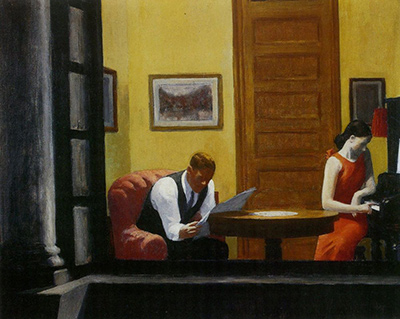
Through a dark window frame, a man reads a newspaper while a woman touches the keys of a piano. They share a small, brightly lit room, but their attention moves in different directions. Edward Hopper's Room in New York lets us see the furnishings and the two figures with unusual clarity while keeping their relationship uncertain.
The Sheldon Museum of Art records the work as an oil on canvas of 1932, accession H–166.1936, in the University of Nebraska–Lincoln collection through the Anna R. and Frank M. Hall Charitable Trust. [1] The title names a city and an interior without identifying an address, an occasion or the people who occupy it.
At a Glance
- ArtistEdward Hopper [1]
- Date1932 [1]
- Mediumoil on canvas [1]
- Collection / recordSheldon Museum of Art [1]
- AccessionH-166.1936 [1]
This work across Edward Hopper’s career
American Village
1912Soir Bleu
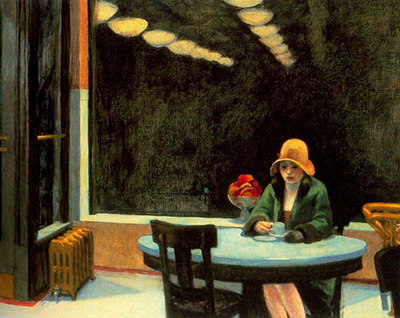
1914Automat
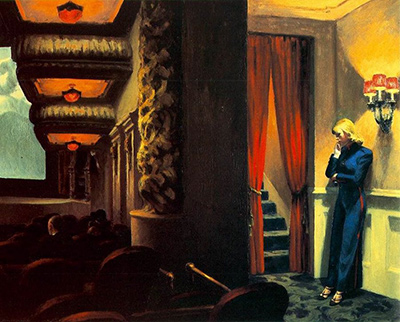
1927New York Movie
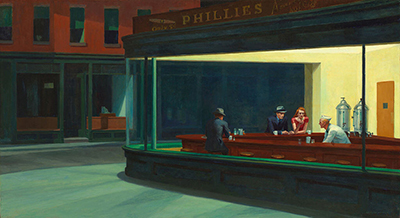
1939Nighthawks
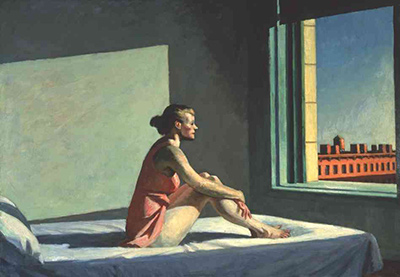
1942Morning Sun
1952Two Comedians
1966Contents
- An opening in the city
- The part of the room we cannot occupy
- The reader on the left
- One finger at the piano
- White sleeves, bare arms and unequal gestures
- A table between two figures
- An earlier scene of reading
- Looking closely at the 1912 illustration
- Other painters in the room
- A music lesson with a different relationship
An opening in the city
The window establishes our position before we begin to interpret the figures. Dark framing and a narrow area of exterior masonry separate the lit room from the place where we look. The view is close enough to reveal domestic details, but it remains a view from outside.
This boundary gives the composition two different kinds of access. We can inspect the man's white sleeves, the woman's red dress and the shape of the table. We cannot enter through the painted opening or learn what preceded this moment. We see more furnishings than a passing glance would allow, while knowing less about the occupants than a guest might.
Hopper recalled in 1935 that the idea had developed from glimpses of lighted interiors during night walks. He emphasised that the picture combined many impressions rather than representing one particular house or street. [1] The recollection makes the anonymous title appropriate: the room belongs to an experience of looking through the city, even though its final arrangement was made in the studio.
The dark exterior frame also intensifies the colour within. The red dress, warm wall and upholstery seem more concentrated beside it. There is little surrounding cityscape to dilute the encounter; one opening occupies almost all our attention.
The part of the room we cannot occupy
The near sill runs across the bottom of the view, with its angled surface catching a little light. At the left, the rounded column and stacked masonry blocks give the building's exterior a substantial thickness. We look past materials that belong to the street side before reaching the inhabitants.
This close framing is uneven. The architecture intrudes strongly on the left, while the piano is cut off on the right. The room's occupants sit within a view that has already been narrowed for us. We have enough information to understand their positions without seeing the whole wall, floor or instrument.
The sill is especially effective because its lower strip is almost empty. It occupies the foreground without offering the personal objects we might expect in a domestic view. A clear boundary separates our position from the more densely furnished interior beyond.
There is no exchanged look with the spectator. Both people attend downwards or sideways, and neither seems to acknowledge the opening through which we see them. Their absorption makes the view feel uninvited, although the painting cannot tell us whether an actual passerby could have stood in precisely this position.
The result depends on the combination of closeness and obstruction. If the outer masonry disappeared, the scene would approach a conventional interior. If it concealed much more, we would lose the bodies' relationship. Hopper gives the window just enough weight to keep us conscious of how we are looking.
The reader on the left
The man bends over an open newspaper. White sleeves and shirtfront stand out against his dark waistcoat, making the angle of his upper body easy to follow. His head inclines towards the paper rather than towards the other occupant.
The newspaper creates a smaller light plane within the composition. It rises from his hands at an angle, interrupting the table and enclosing his immediate area of attention. We recognise an activity without being able to read a headline or identify a reported event.
The upholstered chair gives him a settled place in the room. Its curved form differs from the harder rectangles of the wall and door behind him. Chair, body and newspaper form a compact group on the left, although his forward lean prevents it from appearing completely relaxed.
Nothing in the picture establishes whether he has been reading for a minute or an hour. His absorption is visible; boredom, deliberate avoidance or preoccupation with a particular piece of news are possible explanations supplied by viewers. The painting makes the posture available without confirming its cause.
One finger at the piano
The woman sits to the right of the table and turns towards the piano. Her red dress gives her a strong colour identity, while the pale arms and neck connect her to the brighter passages of the man's shirt. The two figures differ in orientation but remain related through the painting's distribution of light.
Her hand reaches towards the keys. Jo Hopper's description in the couple's record book, reproduced by Gail Levin, identifies a one-finger picking action. Levin also records completion of the painting on 24 February 1932. [2] This small gesture is more particular than the broad statement that the woman is giving a performance.
The hand invites an imagined sound. A single key might interrupt the reader's concentration, occupy a pause, or have no connection with him at all. We cannot hear its duration or force. Hopper gives us the visible possibility of sound within a picture that remains silent.
Her turned head and shoulders also make the body less settled than its seated position might suggest. She belongs to the table's group while reaching towards a separate instrument. That divided orientation helps create the impression of two people sharing an environment without sharing an activity.
White sleeves, bare arms and unequal gestures
The figures' pale arms create a connection across the room that their attention does not visibly supply. The man's sleeves form a broad light shape on the left; the woman's exposed shoulder and bent forearm make a narrower one on the right. The correspondence is carried by colour and position rather than by an exchanged gesture.
Their hands do different kinds of work. His hold the newspaper in a concentrated group near the table's edge. Hers are distributed between the body's seated position and the keyboard. The reader gathers an object towards himself, while the woman turns and extends part of her body towards a second piece of furniture.
These distinctions make the interval between them active. The table does not simply separate two symmetrical figures. It sits between a compact forward bend and a sideways turn. Even the two heads incline at different angles, preventing the pair from becoming a matched demonstration of one mood.
The contrast between newspaper and piano is also a contrast between kinds of attention. Reading can be followed silently without involving another person. A struck key can be heard by anyone in the room. The picture brings private concentration and a potentially shared sound into a space where no spoken exchange is represented.
That possibility does not establish an attempt to interrupt. A single note might be deliberate, distracted or incidental. What matters visually is that Hopper has selected a gesture from which an imagined sound can arise, then withheld the reader's response.
A table between two figures
The round table extends across the central foreground. Its curved edge links the left and right sides, bringing the occupants into one domestic arrangement. At the same time, its broad surface fills the interval between them.
Hopper uses this simple object to make proximity complicated. The figures are not in separate rooms. A shared piece of furniture places them within conversational distance, yet the newspaper and piano direct attention away from a common centre.
The table's ellipse also contrasts with the rectangles surrounding it. Behind the man and woman, framed pictures and a closed panelled door establish a more rigid order. The curved furniture and turning bodies sit within that architectural grid.
The door is especially emphatic. Its tall vertical shape occupies the wall between the figures, extending the division above the tabletop. It can be read as a barrier, but it also remains an ordinary domestic door whose construction helps organise the painting. A symbolic interpretation grows from its placement rather than replacing the visible object.
The framed pictures add smaller rectangles on either side. They make the wall inhabited and decorated while repeating the enclosure of the larger window through which we look. Hopper gives the room a succession of frames, from the building's opening down to the pictures within it.
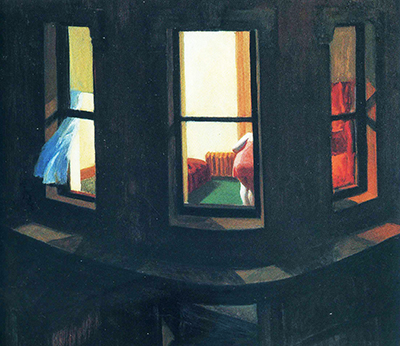
Compare: Night Windows, 1928.
An earlier scene of reading
Levin identifies a striking predecessor in Hopper's commercial illustration for Carroll D. Murphy's What Makes Men Buy?, published in System in September 1912. The illustration shows a newspaper-reading man with a female companion at a table. [2] The subject had entered Hopper's work twenty years before the oil painting.
The comparison helps explain both continuity and change. The early illustration already groups a reader, another person and a table within an ordered interior. In Room in New York, the woman turns towards the piano, and the window separates us more decisively from the scene.
The oil therefore develops an existing arrangement rather than merely repeating it. An image once associated with a business article becomes a domestic situation without an explanatory text. The details remain familiar, while their combination makes the relationship harder to resolve.
The earlier illustration also cautions against treating the painting as a transcription of one private evening. Hopper had long worked with the visual possibilities of a reader and companion. Observation, remembered compositions and the needs of the new canvas could all contribute to its final form.
Looking closely at the 1912 illustration
The earlier System illustration becomes more revealing when its arrangement is inspected rather than reduced to a list of shared objects. Reproduced in Levin's essay, it shows a woman facing more towards the spectator while the reader occupies the left. A large framed image hangs behind both figures, and the tablecloth makes a broad light passage across their shared setting. [2]
In the oil, the woman's turn towards the keyboard changes the direction of the scene. She no longer presents the same frontal presence beside the reader. The tabletop has also become a darker, more exposed ellipse, and the central door divides the wall where the illustration provides an encompassing picture.
The most consequential addition may be the exterior viewpoint. A window has become the organising frame around a grouping that the illustration allows us to see more directly. That change alters our relationship to the people even before we decide what they might feel about one another.
Commercial illustration supplied a context in which an image accompanied a printed argument. The later painting separates its scene from such an explanatory function. The reader and companion remain recognisable, but their association with a business article no longer determines what the spectator should understand.
The twenty-year interval between the two works is therefore more than a striking recurrence. It lets us see familiar components taking on different tasks: a newspaper can remain in the man's hands while a changed wall, a changed bodily direction and an added threshold make the whole encounter less readily explained.
Other painters in the room
Levin compares the reader and circular table with Degas's Uncle and Niece, and the separation of attention with the figures in L'Absinthe. She also relates the woman's bowed head at the instrument to Jan Steen's The Harpsichord Lesson. [2] These comparisons locate Hopper's interior within a longer history of figures occupied with reading, music and one another.
They are useful because they point to observable relationships: a head inclined towards an activity, a table joining people, and architecture framing an encounter. They need not become claims that Hopper copied a complete scene from any one predecessor.
Music gives the Steen comparison a particular limit. A lesson supplies roles and a recognisable exchange between people. Hopper's woman touches the keys without such an explicit relationship. The subject of music remains, but the circumstances around it are withheld.
Degas's example similarly opens questions rather than solving them. The presence of two people and a shared interior does not tell us what has passed between them. Hopper makes the city's window view an additional source of distance between the spectator and that knowledge.
Watch: Edward Hopper’s Life and Art
Explore Hopper’s paintings and the places behind them in these museum films. Choose a film below.
A music lesson with a different relationship
Jan Steen's The Harpsichord Lesson provides a particularly useful test of how far a visual comparison can go. The Wallace Collection's account identifies a would-be music teacher whose interest in the younger woman exceeds instruction. In the painting itself, he leans towards her and points at an open book above the keys. [3]
The two people are linked by the instrument and the older man's conspicuous movement towards it. The woman's bowed head and hands can be compared with Hopper's pianist, but the surrounding action is different. Steen gives the second figure a direct relation to her activity; Hopper gives his man a newspaper of his own.
The difference matters more than a superficial resemblance between women seated at keyboards. In Steen, a gesture across the instrument supplies an encounter that can be interpreted in relation to the figures' ages and the objects around them. In Hopper, the man's hands remain occupied elsewhere. The piano does not become the common focus of the room.
Architecture changes the comparison too. Steen's richly described interior contains a hanging key and a framed picture above the pair. Hopper's taller central door has a heavier separating role, while his exterior opening places an additional boundary between figures and spectator.
There is no need to transfer Steen's implied courtship into the New York room. The comparison helps us identify something Hopper has left out: a plainly directed interaction around the instrument. The woman's gesture consequently has room to suggest several kinds of pause, rather than taking its meaning from an unmistakable exchange with a teacher.
Different accounts of the silence
The painting did not receive one unchanging interpretation. Levin traces responses from Royal Cortissoz's 1932 emphasis on everyday banality to later critics who found a more troubling separation between the figures. She also discusses Charles Burchfield's attention to silence in Hopper's work. [2]
These responses demonstrate how readily a domestic arrangement can become a statement about a relationship. A newspaper and a piano can be ordinary activities within a comfortable evening, or signs of withdrawal from a shared life. The visible evidence supports discussion without deciding between every proposed story.
Levin's own essay considers the painting in relation to the Hoppers' marriage and to gendered expectations about reading and music. [2] That is an interpretation of the image, rather than proof that the painted figures reenact a documented disagreement between Edward and Jo.
The absence of an exchanged glance can sustain these arguments. It gives them a visible starting point without confirming a particular history for the occupants.
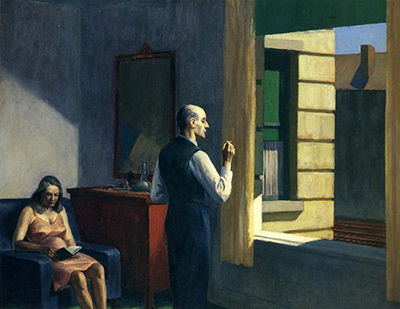
Compare: Hotel by a Railroad, 1952.
Colour, stage and a later painter's response
For the Whitney's 2022 exhibition, artist Jane Dickson described the window as a kind of proscenium. She also drew attention to the tension between the red furnishings and dress, the wall colour and the large door behind the figures. [4] Her response locates the scene's pressure in its construction as well as its subject.
The red chair and red dress occupy separate sides of the image. They create a colour relationship that runs across the table even as the bodies turn in different directions. One red area belongs to furniture around a seated man; the other belongs to clothing following a woman's torso and legs. Repetition does not make the two passages identical.
The brighter wall throws the brown door into greater prominence. Its stacked panels make a sequence of enclosed shapes rising above the central table. This is a large object in a room with two relatively small heads, and it continues beyond the upper edge of our glimpse. Its apparent scale gives the background an insistence that the quieter framed pictures do not have.
The small dark red lampshade near the piano adds another link between colour and activity. It helps define the instrument's area without revealing an extensive source of light. The brightest effects still arrive as patches on wall, sleeves, bare arms and paper, rather than as a view of a dazzling fitting.
Dickson's stage comparison does not require a play to have supplied the scene. It describes the way an opening establishes a position for watching and architecture makes the action legible. Here the action is slight enough that colour and spatial division can become as consequential as the newspaper or the hand at the keys.
Finding a place in Nebraska
Sheldon's account records the painting's appearance at the University of Nebraska in March 1936, in the forty-sixth annual exhibition of the Nebraska Art Association. The acquisition records anticipated Hopper's future standing among American artists. [5]
That early purchase gave the image a public life beyond the anonymous city room it depicts. The museum identity does not explain the couple, but it records the confidence with which this particular arrangement of figures, furniture and light entered a collection.
Sheldon also loaned the painting to the 2019 exhibition Edward Hopper and the American Hotel. [5] Its inclusion shows how the scene can contribute to a wider examination of interiors and temporary encounters without establishing that this room is a hotel.
An empty tabletop with a possible shared use
The table's broad surface contains no conspicuous meal or elaborate centrepiece. A dining arrangement might gather hands, plates and glances towards one action; this tabletop offers a common centre that neither figure visibly makes the subject of attention.
Its curved edge remains continuous between them, however. The table still joins their positions within a plausible domestic grouping. The central support and the shaded area beneath it give the ellipse weight, keeping it from appearing merely as a dividing line drawn across the canvas.
This combination makes the room less easily described as a diagram of separation. The people share furniture, illumination and a small enclosure. Their difference lies in what they are doing at this moment. The things that could support conversation remain present even when conversation is not shown.
The newspaper's unreadable surface contributes to the same effect. A headline might give the evening an external subject or date; its absence leaves the act of reading more prominent than the news. The piano keys identify another activity whose particular sound remains unavailable. Each occupation is visible without a complete account of its occasion.
Looking through another window
In Night Windows, the exterior viewpoint gives us a more fragmentary view of a single person. Room in New York makes a two-person domestic arrangement legible, so that the separation between their activities becomes part of the subject.
Hotel by a Railroad also gives a woman something to read while a man directs his attention elsewhere. There the window belongs to the occupants' surroundings. Here it first belongs to our act of looking in.
Return to the woman's hand, then to the newspaper and the table between them. A small motion and a steady act of reading can occupy the same room without becoming a conversation. Hopper builds that interval from objects we know well and leaves us outside its explanation.
Artworks and studies directory
This researched directory includes finished works and separately identified studies. It is not a complete catalogue raisonné. Linked titles open the articles; unlinked studies are identified by their collection accessions. Watercolours retain their recorded media, and original prints remain distinct from reproductions.
| Name | Date | Medium |
|---|---|---|
| (Bridge and Embankment) (70.1298) | 1906 | Oil on wood |
| (Jo Sketching at Good Harbor Beach) (70.1129) | 1923–1924 | Watercolor and fabricated chalk on paper |
| (Manhattan Bridge) (70.1098) | 1925–1926 | Watercolor and graphite pencil on paper |
| (Rooftops) (70.1114) | 1926 | Watercolor and graphite pencil on paper |
| (Seated Male Model, Bent Over) (70.1277) | c. 1902–1903 | Oil on canvas |
| (Self-Portrait) (70.1254) | 1903–1906 | Oil on canvas |
| (Solitary Figure in a Theater) (70.1418) | c. 1902–1904 | Oil on board |
| 5 A.M. | 1937 | oil on canvas |
| Adam's House | 1928 | watercolour and charcoal on paper |
| American Village | 1912 | Oil on canvas |
| Apartment Houses | 1923 | oil on canvas |
| Approaching a City | 1946 | oil on canvas |
| August in the City | 1945 | oil on canvas |
| Automat | 1927 | oil on canvas |
| Barber Shop | 1931 | oil on canvas |
| Blackwell's Island | 1928 | oil on canvas |
| Bridge on the Seine | 1909 | Oil on canvas |
| Bridle Path | 1939 | oil on canvas |
| Burly Cobb's House South Truro | 1930–1933 | oil on canvas |
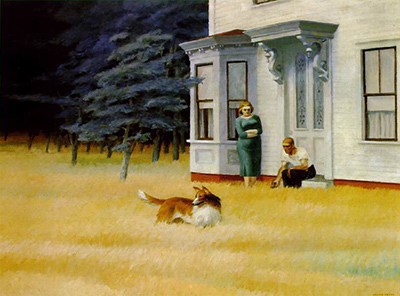
| Cape Cod Evening | 1939 | oil on canvas |
| Cape Cod Morning | 1950 | oil on canvas |
| Chair Car | 1965 | oil on canvas |
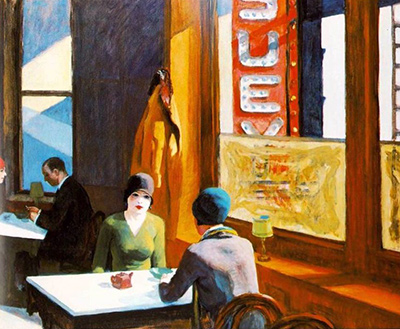
| Chop Suey | 1929 | oil on canvas |
| City Roofs | 1932 | Oil on canvas |
| Coast Guard Station | 1929 | oil on canvas |
| Compartment C, Car 293 | 1938 | oil on canvas |
| Conference at Night | 1949 | oil on canvas |
| Corn Hill | 1930 | oil on canvas |
| Dawn in Pennsylvania | 1942 | oil on canvas |
| Drug Store | 1927 | oil on canvas |
| Early Sunday Morning | 1930 | Oil on canvas |
| East Side Interior (70.1020) | 1922 | Etching |
| East Wind Over Weehawken | 1934 | oil on canvas |
| El Palacio | 1946 | Watercolor and graphite pencil on paper |
| Eleven A.M. | 1926 | oil on canvas |
| Evening Wind | 1921 | etching |
| Excursion into Philosophy | 1959 | oil on canvas |
| First Row Orchestra | 1951 | oil on canvas |
| Freight Car at Truro | 1931 | watercolour over graphite on paper |
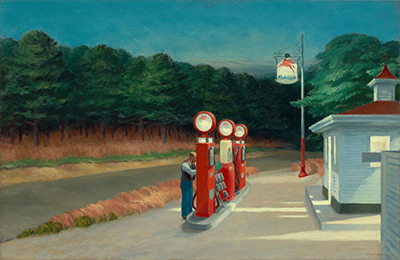
| Gas | 1940 | oil on canvas |
| Girl at a Sewing Machine | c. 1921 | oil on canvas |
| Gloucester Harbor | 1912 | Oil on canvas |
| Ground Swell | 1939 | oil on canvas |
| Haskell's House | 1924 | watercolour over graphite on paperboard |
| High Noon | 1949 | oil on canvas |
| Hill and Houses Cape Elizabeth Maine | 1927 | watercolour over graphite pencil |
| Hills South Truro | 1930 | oil on canvas |
| Hotel by a Railroad | 1952 | oil on canvas |
| Hotel Lobby | 1943 | oil on canvas |
| Hotel Room | 1931 | oil on canvas |
| Hotel Window | 1955 | oil on canvas |
| House by the Railroad | 1925 | oil on canvas |
| House by the Squam River | 1926 | watercolour over graphite on paper |
| Le Bistro or The Wine Shop | 1909 | Oil on canvas |
| Le Pont des Arts | 1907 | Oil on canvas |
| Le Pont Royal | 1909 | Oil on canvas |
| Le Quai des Grands Augustins | 1909 | Oil on canvas |
| Lighthouse and Buildings Portland Head | 1927 | watercolour over graphite pencil on paper |
| Lighthouse Hill | 1927 | oil painting |
| Manhattan Bridge Loop | 1928 | oil on canvas |
| Model Sitting | c. 1902 | oil painting; support not asserted |
| Morning Sun | 1952 | oil on canvas |
| New York Movie | 1939 | oil on canvas |
| New York New Haven and Hartford | 1931 | oil on canvas |
| New York Office | 1962 | oil on canvas |
| New York Pavements | 1924–1925 | oil on canvas |
| New York Restaurant | c. 1922 | oil on canvas |
| Night Windows | 1928 | oil on canvas |
| Nighthawks | 1942 | oil on canvas |
| October on Cape Cod | 1946 | oil on canvas |
| Office at Night | 1940 | oil on canvas |
| Office in a Small City | 1953 | oil on canvas |
| Pennsylvania Coal Town | 1947 | oil on canvas |
| People in the Sun | 1960 | oil on canvas |
| Portrait of Orleans | 1950 | oil on canvas |
| Queensborough Bridge | 1913 | Oil on canvas |
| Railroad Sunset | 1929 | Oil on canvas |
| Railroad Train | 1908 | oil on canvas |
| Road in Maine | 1914 | oil on canvas |
| Room in Brooklyn | 1932 | oil on canvas |
| Room in New York | 1932 | oil on canvas |
| Rooms by the Sea | 1951 | oil on canvas |
| Rooms for Tourists | 1945 | oil on canvas |
| Route 6 Eastham | 1941 | oil on canvas |
| Second Story Sunlight | 1960 | Oil on canvas |
| Self-Portrait | 1925–1930 | Oil on canvas |
| Self-Portrait with Hat (70.1903) | c. 1918, posthumous print | Drypoint |
| Seven A.M. | 1948 | Oil on canvas |
| Soir Bleu | 1914 | oil on canvas |
| South Carolina Morning | 1955 | Oil on canvas |
| Stairway at 48 Rue de Lille Paris | 1906 | Oil on wood |
| Study for 5 A.M. (70.153) | 1937 | Fabricated chalk on paper |
| Study for 5 A.M. (70.429) | 1937 | Fabricated chalk and graphite pencil on paper |
| Study for Approaching a City (70.869) | 1946 | Fabricated chalk and charcoal on paper |
| Study for August in the City (70.158a-b) | 1945 | Fabricated chalk on paper |
| Study for August in the City (70.159) | 1945 | Fabricated chalk on paper |
| Study for Bridle Path (70.220) | 1939 | Fabricated chalk on paper |
| Study for Bridle Path (70.235) | 1939 | Fabricated chalk on paper |
| Study for Compartment C, Car 293 (70.430) | 1938 | Fabricated chalk on paper |
| Study for Compartment C, Car 293 (70.431a-b) | 1938 | Fabricated chalk and charcoal on paper |
| Study for Conference at Night (70.170) | 1949 | Fabricated chalk on paper (recto); Typewriter ink on paper (verso) |
| Study for Conference at Night (70.174) | 1949 | Fabricated chalk on paper ( recto); Typewriter ink on paper (verso) |
| Study for East Wind over Weehawken (70.249) | 1934 | Graphite pencil on paper |
| Study for East Wind over Weehawken (70.252) | 1934 | Fabricated chalk and charcoal on paper |
| Study for Evening Wind (70.343a-b) | 1921 | Fabricated chalk on paper |
| Study for First Row Orchestra (70.841) | 1951 | Fabricated chalk and charcoal on paper |
| Study for Gas (70.263) | 1940 | Fabricated chalk on paper |
| Study for Ground Swell (70.339) | 1939 | Fabricated chalk, charcoal and graphite pencil on paper |
| Study for Hotel by a Railroad (70.199) | 1952 | Fabricated chalk on paper |
| Study for Hotel by a Railroad (70.427) | 1952 | Fabricated chalk on paper |
| Study for Hotel by a Railroad (70.428) | 1952 | Fabricated chalk on paper |
| Study for Hotel Lobby (70.117) | 1942 | Fabricated chalk and graphite pencil on paper |
| Study for Hotel Lobby (70.839) | 1942 | Fabricated chalk and charcoal on paper |
| Study for Hotel Window (70.161) | 1955 | Fabricated chalk, graphite pencil and colored pencil on paper |
| Study for Morning Sun (70.243) | 1952 | Fabricated chalk on paper |
| Study for Morning Sun (70.244) | 1952 | Fabricated chalk on paper |
| Study for Morning Sun (70.290) | 1952 | Fabricated chalk on paper |
| Study for Morning Sun (70.291) | 1952 | Fabricated chalk and graphite pencil on paper |
| Study for New York Movie (70.273) | 1939 | Fabricated chalk on paper |
| Study for New York Movie (70.274a-b) | 1938 or 1939 | Fabricated chalk and charcoal on paper (recto); Fabricated chalk on paper (verso) |
| Study for New York Movie (70.455) | 1939 | Fabricated chalk and charcoal on paper |
| Study for New York Office (70.822) | 1962 | Fabricated chalk on paper |
| Study for Nighthawks (70.192) | 1941 or 1942 | Fabricated chalk on paper |
| Study for Nighthawks (70.193) | 1941 or 1942 | Fabricated chalk on paper |
| Study for Office at Night (70.340) | 1940 | Fabricated chalk and charcoal on paper |
| Study for Office at Night (70.341) | 1940 | Fabricated chalk and graphite pencil on paper |
| Study for Pennsylvania Coal Town (70.198) | 1947 | Fabricated chalk on paper |
| Study for Pennsylvania Coal Town (70.229) | 1947 | Fabricated chalk and charcoal on paper |
| Study for Rooms for Tourists (70.438) | 1945 | Fabricated chalk and charcoal on paper |
| Study for Rooms for Tourists (70.848) | 1945 | Fabricated chalk and charcoal on paper |
| Study for Route 6, Eastham (70.369) | 1941 | Fabricated chalk and graphite pencil on paper |
| Study for Route 6, Eastham (70.854) | 1941 | Fabricated chalk and graphite pencil on paper |
| Study for South Carolina Morning (70.162a-b) | 1955 | Fabricated chalk on paper (recto and verso) |
| Study for The Sheridan Theatre (70.969) | 1937 | Graphite pencil on paper |
| Study for Two on the Aisle (70.128) | 1927 | Fabricated chalk on paper |
| Study for Two on the Aisle (70.129) | 1927 | Fabricated chalk on paper |
| Study for Yawl Riding a Swell (70.439) | 1935 | Fabricated chalk and graphite pencil on paper |
| Summer Evening | 1947 | oil on canvas |
| Summer Interior | 1909 | Oil on canvas |
| Sun in an Empty Room | 1963 | oil on canvas |
| Sunlight in a Cafeteria | 1958 | oil on canvas |
| Sunlight on Brownstones | 1956 | oil on canvas |
| Tables for Ladies | 1930 | oil on canvas |
| The Bootleggers | 1925 | oil on canvas |
| The Camel's Hump | 1931 | oil on canvas |
| The Circle Theatre | 1936 | oil on canvas |
| The City | 1927 | oil on canvas |
| The Lighthouse at Two Lights | 1929 | oil on canvas |
| The Long Leg | 1935 | oil on canvas |
| The Mansard Roof | 1923 | watercolour over graphite on paper |
| The Sheridan Theatre | 1937 | oil on canvas |
| Tramp Steamer | 1908 | oil on canvas |
| Two Comedians | 1966 | oil on canvas |
| Two on the Aisle | 1927 | oil on canvas |
| Valley of the Seine | 1909 | Oil on canvas |
| Western Motel | 1957 | oil on canvas |
Frequently Asked Questions
Edward Hopper made Room in New York in 1932. [1]
The recorded medium is oil on canvas. [1]
Through a dark window frame, a man reads a newspaper while a woman touches the keys of a piano. They share a small, brightly lit room, but their attention moves in different directions. Edward Hopper's Room in New York lets us see the furnishings and the two figures with unusual clarity while keeping their relationship uncertain.
Discussion
Look again at the images and ideas explored in Room in New York. These editorial prompts invite your observations.
Reader Insights
Which boundary, gesture or change of light first holds your attention in Room in New York?
Compare Night Windows with Room in New York. Which visual difference matters most to your reading?
Which detail would you look at again after reading “One finger at the piano”?
Join the Conversation
Share a detail, comparison or question about Room in New York below.
References
- Sheldon Museum of Art, Room in New York, 1932, accession H–166.1936; includes Hopper's retrospective account of the subject's origin. View source.
- Gail Levin, “Symbol and Reality in Edward Hopper's ‘Room in New York’”, Arts Magazine, January 1982, pp. 148–153. Includes the 1912 illustration, comparisons, critical reception and transmitted record-book evidence. View source.
- The Wallace Collection, Music at the Wallace Collection, The Harpsichord Lesson, full reproduction and accompanying account, PDF pp. 6–7; and the museum’s collection description of Jan Steen’s painting, dated 1660. View source 1. View source 2.
- Whitney Museum of American Art, Edward Hopper’s New York, 2022, stop 509, Room in New York, Jane Dickson transcript; discussion of the window, colour and architecture. View source.
- Sheldon Museum of Art, “Edward Hopper”, acquisition, March 1936 exhibition and 2019 loan history. View source.
- Collection or catalogue record, American Village, 1912; medium and identity as discussed in the linked article. View source.
- Collection or catalogue record, Soir Bleu, 1914; medium and identity as discussed in the linked article. View source.
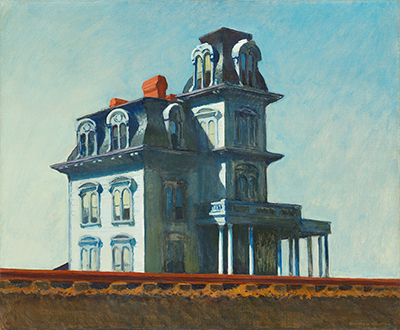
- Collection or catalogue record, House by the Railroad, 1925; medium and identity as discussed in the linked article. View source.
- Collection or catalogue record, Automat, 1927; medium and identity as discussed in the linked article. View source.
- Collection or catalogue record, Early Sunday Morning, 1930; medium and identity as discussed in the linked article. View source.
- Collection or catalogue record, New York Movie, 1939; medium and identity as discussed in the linked article. View source.
- Collection or catalogue record, Nighthawks, 1942; medium and identity as discussed in the linked article. View source.
- Collection or catalogue record, Morning Sun, 1952; medium and identity as discussed in the linked article. View source.
- Collection or catalogue record, Second Story Sunlight, 1960; medium and identity as discussed in the linked article. View source.
- Collection or catalogue record, Two Comedians, 1966; medium and identity as discussed in the linked article. View source.
- Whitney Museum of American Art, Study for Route 6, Eastham, 1941, accession 70.854; exact object record. View source.
- Whitney Museum of American Art, Study for Conference at Night, 1949, accession 70.170; exact object record. View source.
- Whitney Museum of American Art, Study for First Row Orchestra, 1951, accession 70.841; exact object record. View source.
- Whitney Museum of American Art, (Bridge and Embankment), 1906, accession 70.1298; exact object record. View source.
- Whitney Museum of American Art, (Seated Male Model, Bent Over), c. 1902–1903, accession 70.1277; exact object record. View source.
- Whitney Museum of American Art, Study for Morning Sun, 1952, accession 70.244; exact object record. View source.
- Whitney Museum of American Art, Study for Morning Sun, 1952, accession 70.243; exact object record. View source.
- Whitney Museum of American Art, Study for Two on the Aisle, 1927, accession 70.128; exact object record. View source.
- Whitney Museum of American Art, Study for New York Office, 1962, accession 70.822; exact object record. View source.
- Whitney Museum of American Art, Study for Two on the Aisle, 1927, accession 70.129; exact object record. View source.
- Whitney Museum of American Art, Study for Pennsylvania Coal Town, 1947, accession 70.229; exact object record. View source.
- Whitney Museum of American Art, (Rooftops), 1926, accession 70.1114; exact object record. View source.
- Whitney Museum of American Art, Study for South Carolina Morning, 1955, accession 70.162a-b; exact object record. View source.
- Whitney Museum of American Art, (Self-Portrait), 1903–1906, accession 70.1254; exact object record. View source.
- Whitney Museum of American Art, (Manhattan Bridge), 1925–1926, accession 70.1098; exact object record. View source.
- Whitney Museum of American Art, (Solitary Figure in a Theater), c. 1902–1904, accession 70.1418; exact object record. View source.
- Whitney Museum of American Art, Study for Approaching a City, 1946, accession 70.869; exact object record. View source.
- Whitney Museum of American Art, Study for August in the City, 1945, accession 70.159; exact object record. View source.
- Whitney Museum of American Art, Study for Compartment C, Car 293, 1938, accession 70.430; exact object record. View source.
- Whitney Museum of American Art, Study for Compartment C, Car 293, 1938, accession 70.431a-b; exact object record. View source.
- Whitney Museum of American Art, Study for East Wind over Weehawken, 1934, accession 70.252; exact object record. View source.
- Whitney Museum of American Art, Study for East Wind over Weehawken, 1934, accession 70.249; exact object record. View source.
- Whitney Museum of American Art, Study for Evening Wind, 1921, accession 70.343a-b; exact object record. View source.
- Whitney Museum of American Art, Study for The Sheridan Theatre, 1937, accession 70.969; exact object record. View source.
- Whitney Museum of American Art, Study for New York Movie, 1939, accession 70.455; exact object record. View source.
- Whitney Museum of American Art, Study for New York Movie, 1939, accession 70.273; exact object record. View source.
- Whitney Museum of American Art, Study for New York Movie, 1938 or 1939, accession 70.274a-b; exact object record. View source.
- Whitney Museum of American Art, Study for 5 A.M., 1937, accession 70.153; exact object record. View source.
- Whitney Museum of American Art, Study for 5 A.M., 1937, accession 70.429; exact object record. View source.
- Whitney Museum of American Art, (Jo Sketching at Good Harbor Beach), 1923–1924, accession 70.1129; exact object record. View source.
- Whitney Museum of American Art, Study for August in the City, 1945, accession 70.158a-b; exact object record. View source.
- Whitney Museum of American Art, Study for Morning Sun, 1952, accession 70.291; exact object record. View source.
- Whitney Museum of American Art, Study for Morning Sun, 1952, accession 70.290; exact object record. View source.
- Whitney Museum of American Art, Study for Office at Night, 1940, accession 70.340; exact object record. View source.
- Whitney Museum of American Art, Study for Office at Night, 1940, accession 70.341; exact object record. View source.
- Whitney Museum of American Art, Study for Hotel by a Railroad, 1952, accession 70.427; exact object record. View source.
- Whitney Museum of American Art, Study for Hotel by a Railroad, 1952, accession 70.199; exact object record. View source.
- Whitney Museum of American Art, Study for Hotel by a Railroad, 1952, accession 70.428; exact object record. View source.
- Whitney Museum of American Art, Study for Hotel Lobby, 1942, accession 70.117; exact object record. View source.
- Whitney Museum of American Art, Study for Hotel Lobby, 1942, accession 70.839; exact object record. View source.
- Whitney Museum of American Art, Study for Conference at Night, 1949, accession 70.174; exact object record. View source.
- Whitney Museum of American Art, Study for Hotel Window, 1955, accession 70.161; exact object record. View source.
- Whitney Museum of American Art, Study for Pennsylvania Coal Town, 1947, accession 70.198; exact object record. View source.
- Whitney Museum of American Art, Study for Route 6, Eastham, 1941, accession 70.369; exact object record. View source.
- Whitney Museum of American Art, Study for Bridle Path, 1939, accession 70.220; exact object record. View source.
- Whitney Museum of American Art, Study for Bridle Path, 1939, accession 70.235; exact object record. View source.
- Whitney Museum of American Art, Study for Ground Swell, 1939, accession 70.339; exact object record. View source.
- Whitney Museum of American Art, Study for Yawl Riding a Swell, 1935, accession 70.439; exact object record. View source.
- Whitney Museum of American Art, Study for Rooms for Tourists, 1945, accession 70.848; exact object record. View source.
- Whitney Museum of American Art, Study for Rooms for Tourists, 1945, accession 70.438; exact object record. View source.
- Whitney Museum of American Art, Study for Nighthawks, 1941 or 1942, accession 70.193; exact object record. View source.
- Whitney Museum of American Art, Study for Nighthawks, 1941 or 1942, accession 70.192; exact object record. View source.
- Whitney Museum of American Art, Study for Gas, 1940, accession 70.263; exact object record. View source.
- Whitney Museum of American Art, Self-Portrait with Hat, c. 1918, posthumous print, accession 70.1903; exact object record. View source.
- Whitney Museum of American Art, East Side Interior, 1922, accession 70.1020; exact object record. View source.
- Art Institute of Chicago, Selected Chronology for Edward Hopper; training, travels, exhibitions, New York and Truro chronology. View source.
- Emily C. Burns, Spectral figures: Edward Hopper’s empty Paris, chapter 5 in Empty Spaces: Confronting Emptiness in National, Cultural and Urban Histories, 2019; complete chapter and notes consulted. View source.
- Charles Brock, Regionalism and Folk Art, National Gallery of Art; complete essay and two notes consulted. View source.