 by Tom Gurney
Tom Gurney BSc (Hons) is an art history expert with over 20 years experience
Email: tomgurney1@gmail.com / Phone: +44 7429 011000
Le Quai des Grands Augustins: Introduction
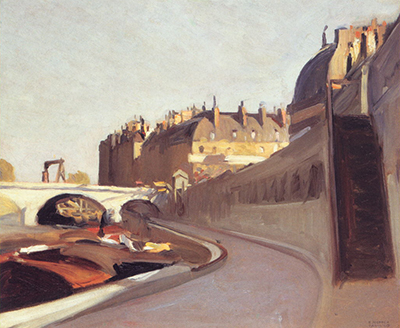
The path begins close to us, turns beside the water and disappears towards a bridge. On its right, a high wall follows the same curve; on its left, dark and rust-coloured boats fill the edge of the river. Edward Hopper's Le Quai des Grands Augustins makes the lower embankment into a route the eye can follow, while the city rises at another level above it.
The Whitney Museum of American Art dates this oil on canvas to 1909. Measuring 60.2 × 73 cm, it belongs to the museum through Josephine N. Hopper's bequest, accession 70.1173. Its French title identifies the quay, or riverside embankment, as the subject. The emphasis falls on the spaces beside and below the city as much as on the buildings themselves. [1]
The wide foreground gives us a place within the scene. We seem to stand on the lower path, with a wall close at our right and the moored vessels to our left. The bridge offers a destination in the distance. Hopper makes this ordinary piece of river infrastructure feel extensive through a carefully directed view.
At a Glance
- ArtistEdward Hopper [1]
- Date1909 [1]
- MediumOil on canvas [1]
- Collection / recordWhitney Museum of American Art [1]
- Accession70.1173 [1]
This work across Edward Hopper’s career
American Village
1912Soir Bleu
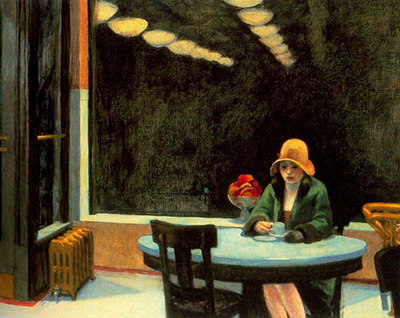
1914Automat
1927New York Movie
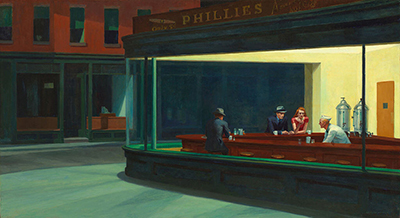
1939Nighthawks
1942Morning Sun
1952Two Comedians
1966Contents
- The path draws the eye around a bend
- A city on several levels
- The steep staircase at the right
- Boats along the river edge
- Roofs, bridge and sky
- Light along the lower quay
- An earlier version with trees
- Returning to a familiar riverside
The path draws the eye around a bend
The curve is the painting's organizing movement. From the bottom edge, the pale ground sweeps inward and towards the left, narrowing as it approaches the bridge. The long turn gives the space a continuous direction without the rigid pull of a straight road towards a central vanishing point.
The river edge defines one side of that movement. A narrow pale border separates the path from the boats and water. Its change of direction is easy to follow, even where small details become less distinct. The line gives the foreground both a boundary and a route into the picture.
The wall supplies the other side. Broad near us and more compressed in the distance, it helps turn the path into a long channel between river and city. The two boundaries do not meet at a single sharp point. They guide attention around a bend, allowing the view to remain open beyond what can be seen directly.
Hopper gives the near ground relatively little incident. Its broad surface contains changes of pink, grey and cream, but few objects to interrupt the route. That openness makes the distant boats, bridge and small human mark more noticeable. The viewer can approach them through an area of comparative visual quiet.
A city on several levels
The scene is organized vertically as well as horizontally. The water occupies the lowest level at left. The path runs just above it. The retaining wall rises towards the upper street and the buildings behind. These levels make the riverbank feel constructed for several different kinds of use.
The wall's large face is especially prominent. It extends from the near right towards the middle distance, carrying a sequence of rectangular divisions and darker patches. Their repetition helps us measure its length. The intervals become smaller as the wall recedes, reinforcing the movement already established by the curve.
Above it, the buildings form a denser edge. Roofs and chimneys gather against the sky, while changes of façade create small shifts in depth. The city feels close overhead, even though its upper street remains outside our immediate route. We occupy a lower space running alongside it.
The separation changes the character of the view. A broad prospect from the upper bank might allow us to look down over boats and river together. Hopper places the high wall beside us instead. It gives the city a substantial boundary and makes the lower path an environment in its own right.
The steep staircase at the right
Near the foreground, a dark staircase rises beside the wall. Its strong upward direction interrupts the path's longer, gentler curve. One route leads onwards beside the water; the other offers a steep connection with the level above.
The steps are compressed into a narrow area. Repeated dark and light marks suggest their succession without opening a broad view of the destination. Their density contrasts with the much quieter foreground path. Hopper places two very different rhythms of movement side by side.
The staircase also changes the scale of the wall. A large retaining surface can feel abstract when considered alone. Steps give it a practical human measure: a height that has to be climbed in repeated intervals. The connection makes the difference between lower quay and upper city physically imaginable.
Its darkness balances the boats at left. The foreground therefore has substantial dark shapes on both sides, while the pale path opens between them. The arrangement helps hold the viewer within the route, giving the curve a clear visual channel through the painting.
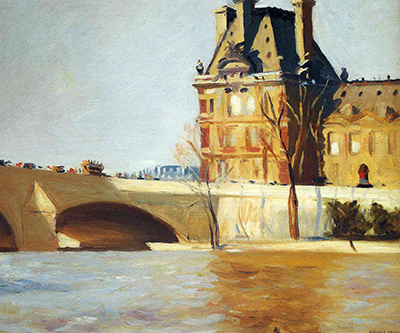
Compare: Le Pont Royal, 1909.
Boats along the river edge
The moored vessels introduce strong warm colour. Rust-red and brown surfaces run beside dark openings and the river's cooler passages. Their long shapes occupy the lower left, with some cut by the frame. They make the water's edge feel close and partly obstructed.
The cropping is effective. We cannot inspect each vessel as a complete object from bow to stern. Instead, we encounter a sequence of surfaces and gaps alongside the path. The boats become part of the near riverside environment, extending beyond the limited view.
Their colour also gives the left foreground enough force to answer the large wall. Where the masonry supplies a continuous pale plane, the vessels break into separate warm and dark shapes. The two sides remain different but visually comparable in weight.
A tiny red figure near the more distant boats brings another measure to the scene. Its scale makes the surrounding structures seem larger, while its colour connects with the warmer passages nearby. Hopper can suggest a place used by people without distributing a crowd throughout it.
The river itself remains only partly available. Boats and the near edge take up much of the foreground, while the bridge interrupts the distance. We experience the water through the built and moored forms around it. The painting is a view along a working riverside, with its particular equipment and routes shaping what can be seen.
Roofs, bridge and sky
Beyond the wall, the buildings make an irregular skyline. Small chimneys and changes of roof slope repeat across the upper distance. At right, a large curved roof form gives the architecture a more emphatic mass. The wall and stair below seem attached to a city that continues above and behind them.
The bridge sits lower and further left. Its pale upper surface contrasts with the dark arches beneath. Those curves echo the broader turn of the path without simply repeating it. One leads the eye along the riverbank; the others frame small passages across the water.
The relatively large sky opens above the left side. Its pale colour grants space around the distant bridge, while the buildings gather more densely towards the right. The composition therefore changes as we move across it: open sky and water at one side, enclosed route and rising architecture at the other.
This uneven distribution gives the painting its sense of direction. The foreground path turns towards the more open portion of the scene. The high wall stays close at our side. Hopper makes the act of looking ahead feel different from looking up or sideways.
Watch: Edward Hopper’s Life and Art
Explore Hopper’s paintings and the places behind them in these museum films. Choose a film below.
Light along the lower quay
The colour remains restrained across much of the image. Pale stone, muted roofs and a cool sky form a quiet setting for the stronger boat reds. The ground contains enough warm pink to connect with those accents without becoming equally intense.
The staircase and wall create several kinds of shadow. A narrow dark passage can imply depth beside the steps, while broader changes along the masonry describe its turning surface. Hopper uses differences of value to keep the architecture legible as the curve carries it away from us.
The paint handling varies with the subject. Long boundaries define the quay's direction; small touches animate the skyline; broader passages describe the open foreground and sky. The scene depends on their coordination. Its route feels clear even where individual surfaces remain loosely described.
This is part of the painting's economy. The lower path does not need a pattern of paving stones to become convincing. Its width, colour and boundaries establish a usable surface. The nearby stair and boats supply the more concentrated details through which we judge its place within the riverbank.
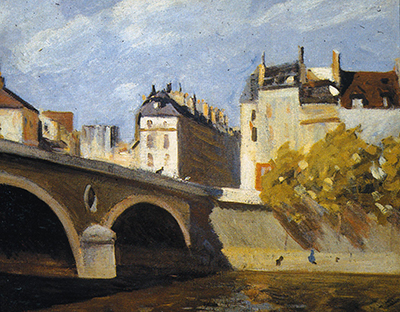
Compare: Bridge on the Seine, 1909.
An earlier version with trees
Hopper had already painted another view called Le Quai des Grands Augustins with Tree. The Whitney dates that separate oil on canvas to 1907 and records it as accession 70.1226. It measures 60.5 × 73.7 cm, close in size to the later work but with a markedly different distribution of forms. [2]
In the earlier picture, tall tree trunks rise through the right foreground. Their foliage reaches beyond the upper edge, and their shadows fall across the path. A boat sits near the bend, with the river opening more broadly to the left. The trees provide a strong vertical screen before the buildings beyond.
In the 1909 painting, the wall and steep stair have a more commanding presence. The continuous masonry plane follows the path further into the foreground, while the boats occupy a larger area at left. The route remains curved, but the balance between open river, vegetation and built surface has changed.
The comparison makes Hopper's selectivity tangible. Similar elements can be retained while their prominence changes: a bridge, a bend, a moored vessel, a high bank and distant roofs. The two paintings offer different experiences of moving through the setting. One is punctuated by near tree trunks; the other is directed by the long wall.
Their relationship is more useful than treating one as a preliminary version of the other. Each has a complete arrangement of its own. The earlier canvas helps us recognize the choices that make the later view distinctive, particularly its emphasis on masonry, stairs and the narrow interval beside the river.
Returning to a familiar riverside
The dates span Hopper's first Paris journey and his return. The Art Institute of Chicago's chronology places the initial stay in 1906–07 and the next Paris visit in 1909. The pair of quay paintings gives a concrete example of a subject recurring within those years. [3]
Here, the path offers a particularly strong invitation. The river and wall hold us on either side, while the staircase opens an alternative direction upwards. The city is encountered through the practical routes along its edge, and the painting gives an ordinary bend in the quay the absorbing scale of a place to explore.
Artworks and studies directory
This researched directory includes finished works and separately identified studies. It is not a complete catalogue raisonné. Linked titles open the articles; unlinked studies are identified by their collection accessions. Watercolours retain their recorded media, and original prints remain distinct from reproductions.
| Name | Date | Medium |
|---|---|---|
| (Bridge and Embankment) (70.1298) | 1906 | Oil on wood |
| (Jo Sketching at Good Harbor Beach) (70.1129) | 1923–1924 | Watercolor and fabricated chalk on paper |
| (Manhattan Bridge) (70.1098) | 1925–1926 | Watercolor and graphite pencil on paper |
| (Rooftops) (70.1114) | 1926 | Watercolor and graphite pencil on paper |
| (Seated Male Model, Bent Over) (70.1277) | c. 1902–1903 | Oil on canvas |
| (Self-Portrait) (70.1254) | 1903–1906 | Oil on canvas |
| (Solitary Figure in a Theater) (70.1418) | c. 1902–1904 | Oil on board |
| 5 A.M. | 1937 | oil on canvas |
| Adam's House | 1928 | watercolour and charcoal on paper |
| American Village | 1912 | Oil on canvas |
| Apartment Houses | 1923 | oil on canvas |
| Approaching a City | 1946 | oil on canvas |
| August in the City | 1945 | oil on canvas |
| Automat | 1927 | oil on canvas |
| Barber Shop | 1931 | oil on canvas |
| Blackwell's Island | 1928 | oil on canvas |
| Bridge on the Seine | 1909 | Oil on canvas |
| Bridle Path | 1939 | oil on canvas |
| Burly Cobb's House South Truro | 1930–1933 | oil on canvas |
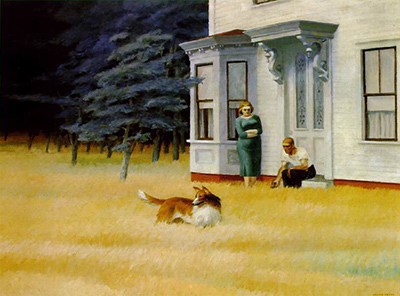
| Cape Cod Evening | 1939 | oil on canvas |
| Cape Cod Morning | 1950 | oil on canvas |
| Chair Car | 1965 | oil on canvas |
| Chop Suey | 1929 | oil on canvas |
| City Roofs | 1932 | Oil on canvas |
| Coast Guard Station | 1929 | oil on canvas |
| Compartment C, Car 293 | 1938 | oil on canvas |
| Conference at Night | 1949 | oil on canvas |
| Corn Hill | 1930 | oil on canvas |
| Dawn in Pennsylvania | 1942 | oil on canvas |
| Drug Store | 1927 | oil on canvas |
| Early Sunday Morning | 1930 | Oil on canvas |
| East Side Interior (70.1020) | 1922 | Etching |
| East Wind Over Weehawken | 1934 | oil on canvas |
| El Palacio | 1946 | Watercolor and graphite pencil on paper |
| Eleven A.M. | 1926 | oil on canvas |
| Evening Wind | 1921 | etching |
| Excursion into Philosophy | 1959 | oil on canvas |
| First Row Orchestra | 1951 | oil on canvas |
| Freight Car at Truro | 1931 | watercolour over graphite on paper |
| Gas | 1940 | oil on canvas |
| Girl at a Sewing Machine | c. 1921 | oil on canvas |
| Gloucester Harbor | 1912 | Oil on canvas |
| Ground Swell | 1939 | oil on canvas |
| Haskell's House | 1924 | watercolour over graphite on paperboard |
| High Noon | 1949 | oil on canvas |
| Hill and Houses Cape Elizabeth Maine | 1927 | watercolour over graphite pencil |
| Hills South Truro | 1930 | oil on canvas |
| Hotel by a Railroad | 1952 | oil on canvas |
| Hotel Lobby | 1943 | oil on canvas |
| Hotel Room | 1931 | oil on canvas |
| Hotel Window | 1955 | oil on canvas |
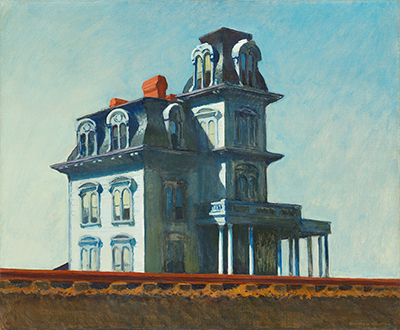
| House by the Railroad | 1925 | oil on canvas |
| House by the Squam River | 1926 | watercolour over graphite on paper |
| Le Bistro or The Wine Shop | 1909 | Oil on canvas |
| Le Pont des Arts | 1907 | Oil on canvas |
| Le Pont Royal | 1909 | Oil on canvas |
| Le Quai des Grands Augustins | 1909 | Oil on canvas |
| Lighthouse and Buildings Portland Head | 1927 | watercolour over graphite pencil on paper |
| Lighthouse Hill | 1927 | oil painting |
| Manhattan Bridge Loop | 1928 | oil on canvas |
| Model Sitting | c. 1902 | oil painting; support not asserted |
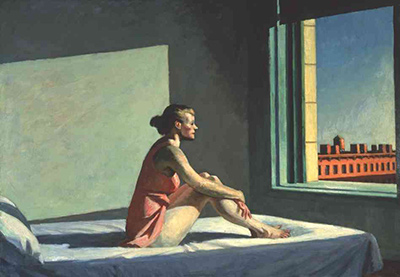
| Morning Sun | 1952 | oil on canvas |
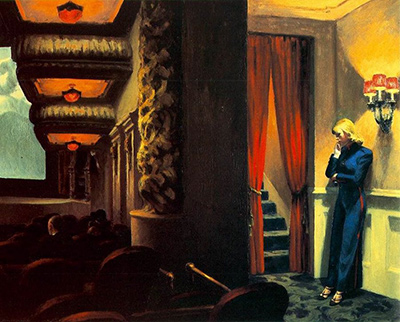
| New York Movie | 1939 | oil on canvas |
| New York New Haven and Hartford | 1931 | oil on canvas |
| New York Office | 1962 | oil on canvas |
| New York Pavements | 1924–1925 | oil on canvas |
| New York Restaurant | c. 1922 | oil on canvas |
| Night Windows | 1928 | oil on canvas |
| Nighthawks | 1942 | oil on canvas |
| October on Cape Cod | 1946 | oil on canvas |
| Office at Night | 1940 | oil on canvas |
| Office in a Small City | 1953 | oil on canvas |
| Pennsylvania Coal Town | 1947 | oil on canvas |
| People in the Sun | 1960 | oil on canvas |
| Portrait of Orleans | 1950 | oil on canvas |
| Queensborough Bridge | 1913 | Oil on canvas |
| Railroad Sunset | 1929 | Oil on canvas |
| Railroad Train | 1908 | oil on canvas |
| Road in Maine | 1914 | oil on canvas |
| Room in Brooklyn | 1932 | oil on canvas |
| Room in New York | 1932 | oil on canvas |
| Rooms by the Sea | 1951 | oil on canvas |
| Rooms for Tourists | 1945 | oil on canvas |
| Route 6 Eastham | 1941 | oil on canvas |
| Second Story Sunlight | 1960 | Oil on canvas |
| Self-Portrait | 1925–1930 | Oil on canvas |
| Self-Portrait with Hat (70.1903) | c. 1918, posthumous print | Drypoint |
| Seven A.M. | 1948 | Oil on canvas |
| Soir Bleu | 1914 | oil on canvas |
| South Carolina Morning | 1955 | Oil on canvas |
| Stairway at 48 Rue de Lille Paris | 1906 | Oil on wood |
| Study for 5 A.M. (70.153) | 1937 | Fabricated chalk on paper |
| Study for 5 A.M. (70.429) | 1937 | Fabricated chalk and graphite pencil on paper |
| Study for Approaching a City (70.869) | 1946 | Fabricated chalk and charcoal on paper |
| Study for August in the City (70.158a-b) | 1945 | Fabricated chalk on paper |
| Study for August in the City (70.159) | 1945 | Fabricated chalk on paper |
| Study for Bridle Path (70.220) | 1939 | Fabricated chalk on paper |
| Study for Bridle Path (70.235) | 1939 | Fabricated chalk on paper |
| Study for Compartment C, Car 293 (70.430) | 1938 | Fabricated chalk on paper |
| Study for Compartment C, Car 293 (70.431a-b) | 1938 | Fabricated chalk and charcoal on paper |
| Study for Conference at Night (70.170) | 1949 | Fabricated chalk on paper (recto); Typewriter ink on paper (verso) |
| Study for Conference at Night (70.174) | 1949 | Fabricated chalk on paper ( recto); Typewriter ink on paper (verso) |
| Study for East Wind over Weehawken (70.249) | 1934 | Graphite pencil on paper |
| Study for East Wind over Weehawken (70.252) | 1934 | Fabricated chalk and charcoal on paper |
| Study for Evening Wind (70.343a-b) | 1921 | Fabricated chalk on paper |
| Study for First Row Orchestra (70.841) | 1951 | Fabricated chalk and charcoal on paper |
| Study for Gas (70.263) | 1940 | Fabricated chalk on paper |
| Study for Ground Swell (70.339) | 1939 | Fabricated chalk, charcoal and graphite pencil on paper |
| Study for Hotel by a Railroad (70.199) | 1952 | Fabricated chalk on paper |
| Study for Hotel by a Railroad (70.427) | 1952 | Fabricated chalk on paper |
| Study for Hotel by a Railroad (70.428) | 1952 | Fabricated chalk on paper |
| Study for Hotel Lobby (70.117) | 1942 | Fabricated chalk and graphite pencil on paper |
| Study for Hotel Lobby (70.839) | 1942 | Fabricated chalk and charcoal on paper |
| Study for Hotel Window (70.161) | 1955 | Fabricated chalk, graphite pencil and colored pencil on paper |
| Study for Morning Sun (70.243) | 1952 | Fabricated chalk on paper |
| Study for Morning Sun (70.244) | 1952 | Fabricated chalk on paper |
| Study for Morning Sun (70.290) | 1952 | Fabricated chalk on paper |
| Study for Morning Sun (70.291) | 1952 | Fabricated chalk and graphite pencil on paper |
| Study for New York Movie (70.273) | 1939 | Fabricated chalk on paper |
| Study for New York Movie (70.274a-b) | 1938 or 1939 | Fabricated chalk and charcoal on paper (recto); Fabricated chalk on paper (verso) |
| Study for New York Movie (70.455) | 1939 | Fabricated chalk and charcoal on paper |
| Study for New York Office (70.822) | 1962 | Fabricated chalk on paper |
| Study for Nighthawks (70.192) | 1941 or 1942 | Fabricated chalk on paper |
| Study for Nighthawks (70.193) | 1941 or 1942 | Fabricated chalk on paper |
| Study for Office at Night (70.340) | 1940 | Fabricated chalk and charcoal on paper |
| Study for Office at Night (70.341) | 1940 | Fabricated chalk and graphite pencil on paper |
| Study for Pennsylvania Coal Town (70.198) | 1947 | Fabricated chalk on paper |
| Study for Pennsylvania Coal Town (70.229) | 1947 | Fabricated chalk and charcoal on paper |
| Study for Rooms for Tourists (70.438) | 1945 | Fabricated chalk and charcoal on paper |
| Study for Rooms for Tourists (70.848) | 1945 | Fabricated chalk and charcoal on paper |
| Study for Route 6, Eastham (70.369) | 1941 | Fabricated chalk and graphite pencil on paper |
| Study for Route 6, Eastham (70.854) | 1941 | Fabricated chalk and graphite pencil on paper |
| Study for South Carolina Morning (70.162a-b) | 1955 | Fabricated chalk on paper (recto and verso) |
| Study for The Sheridan Theatre (70.969) | 1937 | Graphite pencil on paper |
| Study for Two on the Aisle (70.128) | 1927 | Fabricated chalk on paper |
| Study for Two on the Aisle (70.129) | 1927 | Fabricated chalk on paper |
| Study for Yawl Riding a Swell (70.439) | 1935 | Fabricated chalk and graphite pencil on paper |
| Summer Evening | 1947 | oil on canvas |
| Summer Interior | 1909 | Oil on canvas |
| Sun in an Empty Room | 1963 | oil on canvas |
| Sunlight in a Cafeteria | 1958 | oil on canvas |
| Sunlight on Brownstones | 1956 | oil on canvas |
| Tables for Ladies | 1930 | oil on canvas |
| The Bootleggers | 1925 | oil on canvas |
| The Camel's Hump | 1931 | oil on canvas |
| The Circle Theatre | 1936 | oil on canvas |
| The City | 1927 | oil on canvas |
| The Lighthouse at Two Lights | 1929 | oil on canvas |
| The Long Leg | 1935 | oil on canvas |
| The Mansard Roof | 1923 | watercolour over graphite on paper |
| The Sheridan Theatre | 1937 | oil on canvas |
| Tramp Steamer | 1908 | oil on canvas |
| Two Comedians | 1966 | oil on canvas |
| Two on the Aisle | 1927 | oil on canvas |
| Valley of the Seine | 1909 | Oil on canvas |
| Western Motel | 1957 | oil on canvas |
Frequently Asked Questions
Edward Hopper made Le Quai des Grands Augustins in 1909. [1]
The recorded medium is Oil on canvas. [1]
The path begins close to us, turns beside the water and disappears towards a bridge. On its right, a high wall follows the same curve; on its left, dark and rust-coloured boats fill the edge of the river. Edward Hopper's Le Quai des Grands Augustins makes the lower embankment into a route the eye can follow, while the city rises at another level above it.
Discussion
Look again at the images and ideas explored in Le Quai des Grands Augustins. These editorial prompts invite your observations.
Reader Insights
Which boundary, gesture or change of light first holds your attention in Le Quai des Grands Augustins?
Compare Le Pont Royal with Le Quai des Grands Augustins. Which visual difference matters most to your reading?
Which detail would you look at again after reading “The steep staircase at the right”?
Join the Conversation
Share a detail, comparison or question about Le Quai des Grands Augustins below.
References
- Whitney Museum of American Art, Le Quai des Grands Augustins, 1909, oil on canvas, 60.2 × 73 cm, accession 70.1173, Josephine N. Hopper Bequest. View source.
- Whitney Museum of American Art, (Le Quai des Grands Augustins with Tree), 1907, oil on canvas, 60.5 × 73.7 cm, accession 70.1226, Josephine N. Hopper Bequest. View source.
- The Art Institute of Chicago, “Selected Chronology for Edward Hopper (1882–1967)”, entries for 1906–1907 and 1909. View source.
- Collection or catalogue record, American Village, 1912; medium and identity as discussed in the linked article. View source.
- Collection or catalogue record, Soir Bleu, 1914; medium and identity as discussed in the linked article. View source.
- Collection or catalogue record, House by the Railroad, 1925; medium and identity as discussed in the linked article. View source.
- Collection or catalogue record, Automat, 1927; medium and identity as discussed in the linked article. View source.
- Collection or catalogue record, Early Sunday Morning, 1930; medium and identity as discussed in the linked article. View source.
- Collection or catalogue record, New York Movie, 1939; medium and identity as discussed in the linked article. View source.
- Collection or catalogue record, Nighthawks, 1942; medium and identity as discussed in the linked article. View source.
- Collection or catalogue record, Morning Sun, 1952; medium and identity as discussed in the linked article. View source.
- Collection or catalogue record, Second Story Sunlight, 1960; medium and identity as discussed in the linked article. View source.
- Collection or catalogue record, Two Comedians, 1966; medium and identity as discussed in the linked article. View source.
- Whitney Museum of American Art, Study for Route 6, Eastham, 1941, accession 70.854; exact object record. View source.
- Whitney Museum of American Art, Study for Conference at Night, 1949, accession 70.170; exact object record. View source.
- Whitney Museum of American Art, Study for First Row Orchestra, 1951, accession 70.841; exact object record. View source.
- Whitney Museum of American Art, (Bridge and Embankment), 1906, accession 70.1298; exact object record. View source.
- Whitney Museum of American Art, (Seated Male Model, Bent Over), c. 1902–1903, accession 70.1277; exact object record. View source.
- Whitney Museum of American Art, Study for Morning Sun, 1952, accession 70.244; exact object record. View source.
- Whitney Museum of American Art, Study for Morning Sun, 1952, accession 70.243; exact object record. View source.
- Whitney Museum of American Art, Study for Two on the Aisle, 1927, accession 70.128; exact object record. View source.
- Whitney Museum of American Art, Study for New York Office, 1962, accession 70.822; exact object record. View source.
- Whitney Museum of American Art, Study for Two on the Aisle, 1927, accession 70.129; exact object record. View source.
- Whitney Museum of American Art, Study for Pennsylvania Coal Town, 1947, accession 70.229; exact object record. View source.
- Whitney Museum of American Art, (Rooftops), 1926, accession 70.1114; exact object record. View source.
- Whitney Museum of American Art, Study for South Carolina Morning, 1955, accession 70.162a-b; exact object record. View source.
- Whitney Museum of American Art, (Self-Portrait), 1903–1906, accession 70.1254; exact object record. View source.
- Whitney Museum of American Art, (Manhattan Bridge), 1925–1926, accession 70.1098; exact object record. View source.
- Whitney Museum of American Art, (Solitary Figure in a Theater), c. 1902–1904, accession 70.1418; exact object record. View source.
- Whitney Museum of American Art, Study for Approaching a City, 1946, accession 70.869; exact object record. View source.
- Whitney Museum of American Art, Study for August in the City, 1945, accession 70.159; exact object record. View source.
- Whitney Museum of American Art, Study for Compartment C, Car 293, 1938, accession 70.430; exact object record. View source.
- Whitney Museum of American Art, Study for Compartment C, Car 293, 1938, accession 70.431a-b; exact object record. View source.
- Whitney Museum of American Art, Study for East Wind over Weehawken, 1934, accession 70.252; exact object record. View source.
- Whitney Museum of American Art, Study for East Wind over Weehawken, 1934, accession 70.249; exact object record. View source.
- Whitney Museum of American Art, Study for Evening Wind, 1921, accession 70.343a-b; exact object record. View source.
- Whitney Museum of American Art, Study for The Sheridan Theatre, 1937, accession 70.969; exact object record. View source.
- Whitney Museum of American Art, Study for New York Movie, 1939, accession 70.455; exact object record. View source.
- Whitney Museum of American Art, Study for New York Movie, 1939, accession 70.273; exact object record. View source.
- Whitney Museum of American Art, Study for New York Movie, 1938 or 1939, accession 70.274a-b; exact object record. View source.
- Whitney Museum of American Art, Study for 5 A.M., 1937, accession 70.153; exact object record. View source.
- Whitney Museum of American Art, Study for 5 A.M., 1937, accession 70.429; exact object record. View source.
- Whitney Museum of American Art, (Jo Sketching at Good Harbor Beach), 1923–1924, accession 70.1129; exact object record. View source.
- Whitney Museum of American Art, Study for August in the City, 1945, accession 70.158a-b; exact object record. View source.
- Whitney Museum of American Art, Study for Morning Sun, 1952, accession 70.291; exact object record. View source.
- Whitney Museum of American Art, Study for Morning Sun, 1952, accession 70.290; exact object record. View source.
- Whitney Museum of American Art, Study for Office at Night, 1940, accession 70.340; exact object record. View source.
- Whitney Museum of American Art, Study for Office at Night, 1940, accession 70.341; exact object record. View source.
- Whitney Museum of American Art, Study for Hotel by a Railroad, 1952, accession 70.427; exact object record. View source.
- Whitney Museum of American Art, Study for Hotel by a Railroad, 1952, accession 70.199; exact object record. View source.
- Whitney Museum of American Art, Study for Hotel by a Railroad, 1952, accession 70.428; exact object record. View source.
- Whitney Museum of American Art, Study for Hotel Lobby, 1942, accession 70.117; exact object record. View source.
- Whitney Museum of American Art, Study for Hotel Lobby, 1942, accession 70.839; exact object record. View source.
- Whitney Museum of American Art, Study for Conference at Night, 1949, accession 70.174; exact object record. View source.
- Whitney Museum of American Art, Study for Hotel Window, 1955, accession 70.161; exact object record. View source.
- Whitney Museum of American Art, Study for Pennsylvania Coal Town, 1947, accession 70.198; exact object record. View source.
- Whitney Museum of American Art, Study for Route 6, Eastham, 1941, accession 70.369; exact object record. View source.
- Whitney Museum of American Art, Study for Bridle Path, 1939, accession 70.220; exact object record. View source.
- Whitney Museum of American Art, Study for Bridle Path, 1939, accession 70.235; exact object record. View source.
- Whitney Museum of American Art, Study for Ground Swell, 1939, accession 70.339; exact object record. View source.
- Whitney Museum of American Art, Study for Yawl Riding a Swell, 1935, accession 70.439; exact object record. View source.
- Whitney Museum of American Art, Study for Rooms for Tourists, 1945, accession 70.848; exact object record. View source.
- Whitney Museum of American Art, Study for Rooms for Tourists, 1945, accession 70.438; exact object record. View source.
- Whitney Museum of American Art, Study for Nighthawks, 1941 or 1942, accession 70.193; exact object record. View source.
- Whitney Museum of American Art, Study for Nighthawks, 1941 or 1942, accession 70.192; exact object record. View source.
- Whitney Museum of American Art, Study for Gas, 1940, accession 70.263; exact object record. View source.
- Whitney Museum of American Art, Self-Portrait with Hat, c. 1918, posthumous print, accession 70.1903; exact object record. View source.
- Whitney Museum of American Art, East Side Interior, 1922, accession 70.1020; exact object record. View source.
- Art Institute of Chicago, Selected Chronology for Edward Hopper; training, travels, exhibitions, New York and Truro chronology. View source.
- Emily C. Burns, Spectral figures: Edward Hopper’s empty Paris, chapter 5 in Empty Spaces: Confronting Emptiness in National, Cultural and Urban Histories, 2019; complete chapter and notes consulted. View source.
- Charles Brock, Regionalism and Folk Art, National Gallery of Art; complete essay and two notes consulted. View source.