


 by Tom Gurney
Tom Gurney BSc (Hons) is an art history expert with over 20 years experience
Email: tomgurney1@gmail.com / Phone: +44 7429 011000
Drawings and Working Process: Introduction
Edward Hopper's paintings can look remarkably settled. A counter turns cleanly around a corner, a window divides a wall, and a person's hand occupies a small but consequential position. His drawings reveal how many different questions could precede that apparent certainty.
A sheet might investigate an entire street or only a pair of shoes. It might collect details from a real building, work through a body supplied by a model, or bring several elements into a possible composition. Drawing allowed observation and invention to operate at different scales before they were joined on canvas.
The Whitney's 2013 exhibition Hopper Drawing, organised by Carter E. Foster, made this relationship a central subject. The museum reported holdings of more than 2,500 drawings through Jo Hopper's bequest and paired groups of studies with paintings. [1] The scale of that surviving material makes drawing essential to understanding Hopper's work, rather than an occasional preliminary activity.
At a Glance
Contents
- A practice developed through training
- A sheet has a scale of its own
- Going out to look, returning to arrange
- Drawing the body into a role
- Colour instructions beside a charcoal figure
- Objects can receive as much attention as people
- Several kinds of drawing for one landscape
- A second boat that did not enter Ground Swell
- Working towards a composition
- Making a house and a figure fit together
A practice developed through training
Hopper's education at the New York School of Art, recorded in the Art Institute of Chicago's chronology as 1900–1905, gave him sustained experience of drawing. [2] The Whitney's account emphasises life classes and the study of the nude figure, followed by continued drawing at the Whitney Studio Club in the 1920s. [1]
This training helps explain a feature that is easy to overlook in the finished paintings. A quiet figure still needs a convincing weight, a relation between head and shoulders, and a body that can sit or stand within the surrounding space. Stillness does not remove the problem of constructing a pose.
Drawing also provided a way to attend to things that a painting might make small. A hand could be studied on a sheet large enough to examine its turn, then become a few centimetres within a room. The concentrated attention paid to that detail need not remain conspicuous in the completed canvas.
In her study of drawing in Hopper's art, Gail Levin describes a practice extending from observed facts towards imagined arrangements. [3] The two activities can coexist. A carefully examined object can enter a space that the artist has altered substantially.
Paintings developed through drawing


A sheet has a scale of its own
A drawing can give a small object the whole attention of a sheet. A hand, an arm or a piece of equipment may occupy more space on the paper than its counterpart does in the completed painting. This temporary enlargement allows Hopper to work on a local problem without carrying all the surrounding architecture with it.
The change of scale is useful when looking at the Nighthawks studies. Hands that become small interruptions along the counter can be considered as substantial shapes in their own right. Their bends, contacts and intervals have to remain legible when they return to the wider setting. Drawing tests both the form itself and how much information the painting will eventually need.
A study with several versions on one sheet makes a different demand. We have to resist treating every mark as part of one imagined body. Repeated hands or heads can be successive trials, adjoining observations or different aspects of an idea. The page holds alternatives beside one another, whereas the painting normally gives each character a single position.
Blank paper is part of this working space. It separates experiments and allows a figure to remain unattached to a complete setting. A finished oil may organise such a body through a bed, a counter or a window; the study can first ask whether a shoulder, elbow and hand establish the necessary direction.
Going out to look, returning to arrange
New York Movie is a particularly rich example. Hopper examined several theatres while developing the 1939 canvas. The Whitney's later exhibition account identifies more than fifty surviving sketches, including studies of architecture and the figure who became the usher. [4]
The finished painting presents a coherent interior, but the research involved comparisons among actual places. A stairway, lighting fixture or stretch of decorative architecture could be considered separately from the overall room. The painting's credibility does not depend on every feature having occupied the same site in precisely that relationship.
This distinction matters when trying to find Hopper's subjects on a map. A real building can explain an observed detail without becoming a complete blueprint for the canvas. Drawings show that the act of looking could supply parts for an arrangement whose final organisation belonged to the studio.
They also make the scale of the task visible. Constructing a theatre meant attending to sightlines, seats, walls and passages as well as to a human figure. A few small adjustments in those relationships could change how a person seemed separated from the audience.
Drawing the body into a role
Jo Hopper's modelling was an active part of this process. The Whitney's 2022 labels describe her participation in scene staging, noting how studies preserve her individual features before later drawings transform them into more generalised characters. [4]
A model's body and a painted person's identity are therefore different things. Jo could supply the turn of an arm or the weight of a standing pose without the finished picture becoming a literal record of her life. Costume and placement within the room helped create a character.
Studies for New York Movie examine the figure, clothing and feet at different levels of detail. [4] Such attention explains why a seemingly small feature can feel decisive in a restrained painting. A shoe helps establish a foot's direction; the foot helps establish a stance; the stance affects the entire body's relation to the room.
The process also complicates the idea of an entirely solitary invention. Edward made the marks, but the scene could involve Jo's physical work, theatrical experience and discussion. Recognising that participation adds a practical dimension to the drawings rather than reducing them to illustrations of a marriage.
Colour instructions beside a charcoal figure
Not every drawing's most useful information is carried by its dark marks. In a study for Morning Sun, the Whitney's accession 70.291, Hopper also supplied written colour indications. These include distinctions between warmer and cooler passages around the figure and bed. The words accompany a monochrome arrangement rather than trying to replace it. [5]
The combination reveals two problems being held apart. A drawn contour establishes where an arm or torso turns. A written reminder can preserve a relative temperature that charcoal alone cannot record. The artist does not need to complete a small colour painting to keep both kinds of information available.
These notes also help prevent a misleading account of Hopper's light. The body is not simply bright wherever it faces a window and uniformly dark everywhere else. Reflected colour, cooler transitions and warmer shadows can complicate that division. A note directs attention towards such relationships while leaving their eventual painted balance unresolved.
The drawing is therefore neither a monochrome version of a finished oil nor a complete set of instructions from which anyone could reproduce it. Its abbreviated words and marks belong to a painter who would continue making decisions. We can use them to identify concerns without pretending that they record every step.
Objects can receive as much attention as people
The studies for Nighthawks range from the architecture of the diner to the equipment behind its counter. One small Whitney sheet concentrates on three urns and a tap detail. A separate sheet studies a woman with individual arms and hands, while another tests the wider arrangement of diner and street. [6]
The changes are modest enough to be informative. Three urns appear in the equipment study; two stand in the painting. In the developed composition drawing, the server looks down; in the canvas, his raised head creates a different possible relation with the customers.
These differences show why a preparatory drawing should not be treated as an instruction that the painter was obliged to obey. It made one solution visible, allowing it to be retained, reduced or changed. Close attention to an object did not require the entire study to survive unchanged.
The urns also resist a hierarchy in which human expression is the only significant subject. Their cylinders, lids and spouts contribute to the room's spatial balance. A piece of equipment can be worth studying because of how it will organise the space around a person.

Compare: New York Movie, 1939.
Several kinds of drawing for one landscape
Gas shows the range of work that can support one painting. A fabricated-chalk sheet studies pumps and a hanging sign. A larger charcoal and white-chalk drawing brings the attendant, equipment, road, building and woods into a tonal composition. Another sheet examines foliage together with a curved bracket and lamp. [7]
The sheets address different questions. What makes a pump recognisable? How can a lit forecourt stand against dark trees? How do small clusters of leaves build a larger mass? The finished canvas needs answers to all three, even though it presents them together.
The foliage study is particularly useful beside the equipment. It shows that the woods were not simply an atmospheric screen added around carefully observed machinery. Growing and manufactured forms could both receive close attention, with their different contours contributing to the final contrast.
The catalogue medium also deserves care. Fabricated chalk, charcoal and graphite are distinct terms in the museum records; calling every black mark pencil would lose information. The stated materials identify a sheet more accurately than a general impression of its colour in a reproduction.
A second boat that did not enter Ground Swell
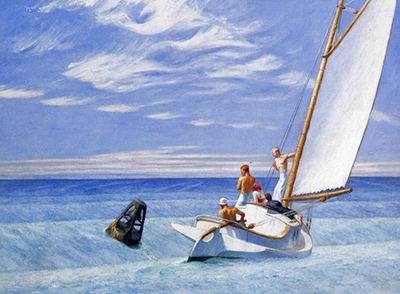
Two studies associated with Ground Swell show why omissions deserve close attention. In the drawing catalogued as 70.860, a smaller framed arrangement includes another boat at the left. The principal boat lies to its right, with the buoy occupying an interval between them. The companion sheet 70.859 gives a different balance of boat, buoy and surrounding space. Both are reproduced in the National Gallery of Art's account of the painting. [8]
The additional vessel would have created another centre of human activity. It also would have changed how the buoy separates or joins parts of the marine scene. In the finished painting, the buoy addresses one main group of sailors across open water. The removal of the other boat gives that relation a greater share of the picture's attention.
This is more consequential than tidying a busy arrangement. An additional boat supplies a possible destination for looks, an alternative scale and another implied course through the water. Taking it out changes what the sailors' pause can mean to a viewer.
The accession numbers do not establish a sequence of decisions. Nor does the simpler image automatically have to be the later one. What the surviving sheets securely demonstrate is that Hopper considered a configuration with a second vessel and painted a configuration without it. The difference is worth examining even where the precise order remains uncertain.
The drawn frame around the small arrangement is also instructive. It sets a local boundary within a larger sheet, distinguishing the proposed picture from the paper on which the artist was trying it. We can see the field being selected before it becomes a canvas.
Working towards a composition
Two studies for Cape Cod Evening offer a different comparison. An early drawing and a gridded composition place figures, dog, house and trees into related but differing arrangements. The Whitney identifies them as 1939 studies for the painting. [9]
The grid supplies a visible division across the image. It makes positions easier to compare within a larger rectangle, but its presence alone does not reconstruct every act of transfer to canvas. The drawing gives evidence of organising space, rather than a complete filmed sequence of painting.
What matters most in comparison is the relation among the parts. The distance between an adult and the dog, the position of a tree or the amount of space around a figure changes the scene's balance. A composition can become more coherent while its implied human relationships become less easily explained.
The marks remain valuable even where they are abbreviated. A few strokes can establish a body sufficiently for the artist to judge its position.
Watch: Edward Hopper’s Life and Art
Explore Hopper’s paintings and the places behind them in these museum films. Choose a film below.
Making a house and a figure fit together
The studies for Cape Cod Morning examine another problem of proportion. Two sheets in the Provincetown Art Association and Museum collection, reproduced in the Edward Hopper House's 2026 catalogue preview, give different emphasis to the tall projecting window, the lower architecture and the small figure. Their numbers distinguish the works in that collection; they should not be read as a secure timetable of their making. [10]
In one arrangement the projecting structure has a particularly strong upright reach. In the other, darker lower diagonals give more weight to the building beneath the window. These shifts affect how firmly the woman seems held within the house and how forcefully her posture reaches towards the exterior.
The difference between a figure study and an architectural study becomes less clear here. The woman's size matters because of the window. The window's height matters because of the body inside it. Neither can be settled completely in isolation from the other.
Comparing the sheets with the painting also makes the intervening outdoor space more significant. A landscape need not be filled with numerous objects to require preparation. The relative widths of house, trees and open ground determine how far a human gesture seems to travel.
The studies are especially valuable when we allow them to remain different images. Their rougher edges and stronger local accents are not simply mistakes waiting for correction. They show possibilities that the oil organises differently.
Drawings do not always establish the order of decisions
The two studies for Rooms for Tourists test the inn by day and by night. Both are dated 1945. Foster's Whitney commentary leaves open when the decision to make the final painting nocturnal occurred. [11]
That uncertainty is useful. A viewer can compare how daylight and artificial light organise the building without claiming that one sheet necessarily followed the other. Accession numbers identify collection objects; they do not provide a sequence of studio decisions.
The same caution applies more broadly. Some drawings are dated approximately, and a sheet can contain observations serving different purposes. A surviving group may preserve only part of the work. Its richness should not tempt us to fill every gap with an invented chronology.
Comparison remains productive within those limits. We can ask what each version makes more visible, which edges become emphatic, and how the setting changes around the figures. Those questions concern effects the sheets actually show.

Compare: Nighthawks, 1942.
A room studied from its own edges
The recto of Yale's Two Studies for Rooms by the Sea, dated 1951, places a very different sort of scene on paper. The drawing is reproduced in the public preview for the 2026 Hopper and Susan Chen exhibition. Repeated architectural lines, the position of a wall picture and a diagonal passage across the floor help establish an interior that must also accommodate an opening towards water. [10]
Looking at this face of the sheet, we can follow how the room's edges organise the whole proposal. Uprights establish divisions; sloping marks carry the eye from the furnished part of the interior towards the brighter opening. Short horizontal indications beyond the doorway suggest the water without developing it as a separate landscape.
The relation between room and sea is thus a matter of adjacency as well as perspective. How close should water appear to the threshold? How large should the bright floor area become? How much of an adjoining furnished room can remain visible? The study makes those questions tangible through a few connected marks.
It cannot, by itself, tell us the exact order in which each was answered. The title also identifies more than one study, while a recto reproduction shows only one side of the physical object. Keeping that distinction clear allows a close comparison without turning a selected image into a claim to have examined the whole sheet.
A ledger thumbnail is a different kind of drawing
Not every small version of a painting was made before it. The Whitney explains that Hopper drew miniature records of completed works in ledger books, with Jo adding descriptions and information about exhibitions, sales and buyers. The museum credits Artist's Ledger—Book III to both Edward and Josephine Nivison Hopper. [12]
These thumbnails look backwards. Their purpose was to preserve and identify compositions after completion, rather than to test a possible painting. Treating one as a preparatory sketch would reverse its relationship to the work it records.
Jo's written contributions have their own range. A date or sale entry can document a transaction; an imagined name or anecdote can show how the couple talked about a figure. Both can be historically revealing, but they do not establish the same kind of fact about the painted scene.
The distinction is especially helpful when a quotation from a ledger circulates without its context. A witty character description may enrich our understanding of the studio's imaginative life. It need not become the biography of a real person depicted on canvas.
Different records preserve different decisions
Hopper's drawings belong to a wider body of surviving evidence. The Whitney's research portal brings together information about the Edward and Josephine Hopper Research Collection and the Sanborn Hopper Archive. Correspondence, photographs and other documents can preserve the circumstances in which art was made, exhibited or collected. They do not all perform the same task as a preparatory drawing. [13]
A letter to a curator may describe a finished painting for an audience the artist wishes to persuade. A compositional study can test a placement without making a verbal argument. A ledger may summarise a work after completion so that it can be recognised and tracked. Reading them together is productive because their purposes differ.
The same applies to a drawing's later title. A museum can identify a sheet through a related painting and an archive can supply a date range, yet neither necessarily turns every visible mark into a securely dated decision. Material evidence and cataloguing knowledge have to support one another.
For a visitor, a useful way to begin is to choose one change that can actually be seen: the extra boat in Ground Swell, the relative height of the bay window in Cape Cod Morning, or the arrangement of floor and opening in Rooms by the Sea. That specific difference opens the process more effectively than imagining a complete account of everything the artist thought.
Seeing the sheets beside the paintings
The large surviving archive makes repeated comparison possible, but the drawings deserve more than a search for ingredients retained in oils. A sheet can have its own concentration, rhythm and scale. A tightly studied hand and a broad sweep of charcoal ask for different kinds of attention even when both relate to one finished work.
Once we know Nighthawks, an urn sketch may look like an inevitable step towards the painting. Examining the third vessel or the server's different head position restores a sense of alternatives. The familiar result was one arrangement among possibilities tested on paper.
This is the particular value of Hopper's working drawings. They connect sustained observation with choices whose outcomes were not fixed from the start. The clear window, quiet pose and empty interval in a painting remain clear and quiet; the sheets let us see how much thinking they can contain.
Artworks and studies directory
This researched directory includes finished works and separately identified studies. It is not a complete catalogue raisonné. Linked titles open the articles; unlinked studies are identified by their collection accessions. Watercolours retain their recorded media, and original prints remain distinct from reproductions.
| Name | Date | Medium |
|---|---|---|
| (Bridge and Embankment) (70.1298) | 1906 | Oil on wood |
| (Jo Sketching at Good Harbor Beach) (70.1129) | 1923–1924 | Watercolor and fabricated chalk on paper |
| (Manhattan Bridge) (70.1098) | 1925–1926 | Watercolor and graphite pencil on paper |
| (Rooftops) (70.1114) | 1926 | Watercolor and graphite pencil on paper |
| (Seated Male Model, Bent Over) (70.1277) | c. 1902–1903 | Oil on canvas |
| (Self-Portrait) (70.1254) | 1903–1906 | Oil on canvas |
| (Solitary Figure in a Theater) (70.1418) | c. 1902–1904 | Oil on board |
| 5 A.M. | 1937 | oil on canvas |
| Adam's House | 1928 | watercolour and charcoal on paper |
| American Village | 1912 | Oil on canvas |
| Apartment Houses | 1923 | oil on canvas |
| Approaching a City | 1946 | oil on canvas |
| August in the City | 1945 | oil on canvas |
| Automat | 1927 | oil on canvas |
| Barber Shop | 1931 | oil on canvas |
| Blackwell's Island | 1928 | oil on canvas |
| Bridge on the Seine | 1909 | Oil on canvas |
| Bridle Path | 1939 | oil on canvas |
| Burly Cobb's House South Truro | 1930–1933 | oil on canvas |
| Cape Cod Evening | 1939 | oil on canvas |
| Cape Cod Morning | 1950 | oil on canvas |
| Chair Car | 1965 | oil on canvas |
| Chop Suey | 1929 | oil on canvas |
| City Roofs | 1932 | Oil on canvas |
| Coast Guard Station | 1929 | oil on canvas |
| Compartment C, Car 293 | 1938 | oil on canvas |
| Conference at Night | 1949 | oil on canvas |
| Corn Hill | 1930 | oil on canvas |
| Dawn in Pennsylvania | 1942 | oil on canvas |
| Drug Store | 1927 | oil on canvas |
| Early Sunday Morning | 1930 | Oil on canvas |
| East Side Interior (70.1020) | 1922 | Etching |
| East Wind Over Weehawken | 1934 | oil on canvas |
| El Palacio | 1946 | Watercolor and graphite pencil on paper |
| Eleven A.M. | 1926 | oil on canvas |
| Evening Wind | 1921 | etching |
| Excursion into Philosophy | 1959 | oil on canvas |
| First Row Orchestra | 1951 | oil on canvas |
| Freight Car at Truro | 1931 | watercolour over graphite on paper |
| Gas | 1940 | oil on canvas |
| Girl at a Sewing Machine | c. 1921 | oil on canvas |
| Gloucester Harbor | 1912 | Oil on canvas |
| Ground Swell | 1939 | oil on canvas |
| Haskell's House | 1924 | watercolour over graphite on paperboard |
| High Noon | 1949 | oil on canvas |
| Hill and Houses Cape Elizabeth Maine | 1927 | watercolour over graphite pencil |
| Hills South Truro | 1930 | oil on canvas |
| Hotel by a Railroad | 1952 | oil on canvas |
| Hotel Lobby | 1943 | oil on canvas |
| Hotel Room | 1931 | oil on canvas |
| Hotel Window | 1955 | oil on canvas |
| House by the Railroad | 1925 | oil on canvas |
| House by the Squam River | 1926 | watercolour over graphite on paper |
| Le Bistro or The Wine Shop | 1909 | Oil on canvas |
| Le Pont des Arts | 1907 | Oil on canvas |
| Le Pont Royal | 1909 | Oil on canvas |
| Le Quai des Grands Augustins | 1909 | Oil on canvas |
| Lighthouse and Buildings Portland Head | 1927 | watercolour over graphite pencil on paper |
| Lighthouse Hill | 1927 | oil painting |
| Manhattan Bridge Loop | 1928 | oil on canvas |
| Model Sitting | c. 1902 | oil painting; support not asserted |
| Morning Sun | 1952 | oil on canvas |
| New York Movie | 1939 | oil on canvas |
| New York New Haven and Hartford | 1931 | oil on canvas |
| New York Office | 1962 | oil on canvas |
| New York Pavements | 1924–1925 | oil on canvas |
| New York Restaurant | c. 1922 | oil on canvas |
| Night Windows | 1928 | oil on canvas |
| Nighthawks | 1942 | oil on canvas |
| October on Cape Cod | 1946 | oil on canvas |
| Office at Night | 1940 | oil on canvas |
| Office in a Small City | 1953 | oil on canvas |
| Pennsylvania Coal Town | 1947 | oil on canvas |
| People in the Sun | 1960 | oil on canvas |
| Portrait of Orleans | 1950 | oil on canvas |
| Queensborough Bridge | 1913 | Oil on canvas |
| Railroad Sunset | 1929 | Oil on canvas |
| Railroad Train | 1908 | oil on canvas |
| Road in Maine | 1914 | oil on canvas |
| Room in Brooklyn | 1932 | oil on canvas |
| Room in New York | 1932 | oil on canvas |
| Rooms by the Sea | 1951 | oil on canvas |
| Rooms for Tourists | 1945 | oil on canvas |
| Route 6 Eastham | 1941 | oil on canvas |
| Second Story Sunlight | 1960 | Oil on canvas |
| Self-Portrait | 1925–1930 | Oil on canvas |
| Self-Portrait with Hat (70.1903) | c. 1918, posthumous print | Drypoint |
| Seven A.M. | 1948 | Oil on canvas |
| Soir Bleu | 1914 | oil on canvas |
| South Carolina Morning | 1955 | Oil on canvas |
| Stairway at 48 Rue de Lille Paris | 1906 | Oil on wood |
| Study for 5 A.M. (70.153) | 1937 | Fabricated chalk on paper |
| Study for 5 A.M. (70.429) | 1937 | Fabricated chalk and graphite pencil on paper |
| Study for Approaching a City (70.869) | 1946 | Fabricated chalk and charcoal on paper |
| Study for August in the City (70.158a-b) | 1945 | Fabricated chalk on paper |
| Study for August in the City (70.159) | 1945 | Fabricated chalk on paper |
| Study for Bridle Path (70.220) | 1939 | Fabricated chalk on paper |
| Study for Bridle Path (70.235) | 1939 | Fabricated chalk on paper |
| Study for Compartment C, Car 293 (70.430) | 1938 | Fabricated chalk on paper |
| Study for Compartment C, Car 293 (70.431a-b) | 1938 | Fabricated chalk and charcoal on paper |
| Study for Conference at Night (70.170) | 1949 | Fabricated chalk on paper (recto); Typewriter ink on paper (verso) |
| Study for Conference at Night (70.174) | 1949 | Fabricated chalk on paper ( recto); Typewriter ink on paper (verso) |
| Study for East Wind over Weehawken (70.249) | 1934 | Graphite pencil on paper |
| Study for East Wind over Weehawken (70.252) | 1934 | Fabricated chalk and charcoal on paper |
| Study for Evening Wind (70.343a-b) | 1921 | Fabricated chalk on paper |
| Study for First Row Orchestra (70.841) | 1951 | Fabricated chalk and charcoal on paper |
| Study for Gas (70.263) | 1940 | Fabricated chalk on paper |
| Study for Ground Swell (70.339) | 1939 | Fabricated chalk, charcoal and graphite pencil on paper |
| Study for Hotel by a Railroad (70.199) | 1952 | Fabricated chalk on paper |
| Study for Hotel by a Railroad (70.427) | 1952 | Fabricated chalk on paper |
| Study for Hotel by a Railroad (70.428) | 1952 | Fabricated chalk on paper |
| Study for Hotel Lobby (70.117) | 1942 | Fabricated chalk and graphite pencil on paper |
| Study for Hotel Lobby (70.839) | 1942 | Fabricated chalk and charcoal on paper |
| Study for Hotel Window (70.161) | 1955 | Fabricated chalk, graphite pencil and colored pencil on paper |
| Study for Morning Sun (70.243) | 1952 | Fabricated chalk on paper |
| Study for Morning Sun (70.244) | 1952 | Fabricated chalk on paper |
| Study for Morning Sun (70.290) | 1952 | Fabricated chalk on paper |
| Study for Morning Sun (70.291) | 1952 | Fabricated chalk and graphite pencil on paper |
| Study for New York Movie (70.273) | 1939 | Fabricated chalk on paper |
| Study for New York Movie (70.274a-b) | 1938 or 1939 | Fabricated chalk and charcoal on paper (recto); Fabricated chalk on paper (verso) |
| Study for New York Movie (70.455) | 1939 | Fabricated chalk and charcoal on paper |
| Study for New York Office (70.822) | 1962 | Fabricated chalk on paper |
| Study for Nighthawks (70.192) | 1941 or 1942 | Fabricated chalk on paper |
| Study for Nighthawks (70.193) | 1941 or 1942 | Fabricated chalk on paper |
| Study for Office at Night (70.340) | 1940 | Fabricated chalk and charcoal on paper |
| Study for Office at Night (70.341) | 1940 | Fabricated chalk and graphite pencil on paper |
| Study for Pennsylvania Coal Town (70.198) | 1947 | Fabricated chalk on paper |
| Study for Pennsylvania Coal Town (70.229) | 1947 | Fabricated chalk and charcoal on paper |
| Study for Rooms for Tourists (70.438) | 1945 | Fabricated chalk and charcoal on paper |
| Study for Rooms for Tourists (70.848) | 1945 | Fabricated chalk and charcoal on paper |
| Study for Route 6, Eastham (70.369) | 1941 | Fabricated chalk and graphite pencil on paper |
| Study for Route 6, Eastham (70.854) | 1941 | Fabricated chalk and graphite pencil on paper |
| Study for South Carolina Morning (70.162a-b) | 1955 | Fabricated chalk on paper (recto and verso) |
| Study for The Sheridan Theatre (70.969) | 1937 | Graphite pencil on paper |
| Study for Two on the Aisle (70.128) | 1927 | Fabricated chalk on paper |
| Study for Two on the Aisle (70.129) | 1927 | Fabricated chalk on paper |
| Study for Yawl Riding a Swell (70.439) | 1935 | Fabricated chalk and graphite pencil on paper |
| Summer Evening | 1947 | oil on canvas |
| Summer Interior | 1909 | Oil on canvas |
| Sun in an Empty Room | 1963 | oil on canvas |
| Sunlight in a Cafeteria | 1958 | oil on canvas |
| Sunlight on Brownstones | 1956 | oil on canvas |
| Tables for Ladies | 1930 | oil on canvas |
| The Bootleggers | 1925 | oil on canvas |
| The Camel's Hump | 1931 | oil on canvas |
| The Circle Theatre | 1936 | oil on canvas |
| The City | 1927 | oil on canvas |
| The Lighthouse at Two Lights | 1929 | oil on canvas |
| The Long Leg | 1935 | oil on canvas |
| The Mansard Roof | 1923 | watercolour over graphite on paper |
| The Sheridan Theatre | 1937 | oil on canvas |
| Tramp Steamer | 1908 | oil on canvas |
| Two Comedians | 1966 | oil on canvas |
| Two on the Aisle | 1927 | oil on canvas |
| Valley of the Seine | 1909 | Oil on canvas |
| Western Motel | 1957 | oil on canvas |
Frequently Asked Questions
Hopper's education at the New York School of Art, recorded in the Art Institute of Chicago's chronology as 1900–1905, gave him sustained experience of drawing. [2] The Whitney's account emphasises life classes and the study of the nude figure, followed by continued drawing at the Whitney Studio Club in the 1920s. [1]
The two studies for Rooms for Tourists test the inn by day and by night. Both are dated 1945. Foster's Whitney commentary leaves open when the decision to make the final painting nocturnal occurred. [11]
Not every small version of a painting was made before it. The Whitney explains that Hopper drew miniature records of completed works in ledger books, with Jo adding descriptions and information about exhibitions, sales and buyers. The museum credits Artist's Ledger—Book III to both Edward and Josephine Nivison Hopper. [12]
Discussion
Look again at the images and ideas explored in Drawings and Working Process. These editorial prompts invite your observations.
Reader Insights
Which study most clearly shows a choice that was changed in the finished painting?
Compare New York Movie with Nighthawks. Which visual difference matters most to your reading?
Which detail would you look at again after reading “Drawing the body into a role”?
Join the Conversation
Share a detail, comparison or question about Drawings and Working Process below.
References
- Whitney Museum of American Art, Hopper Drawing, 2013, complete exhibition account; exhibition announcement, 21 February 2013, PDF pp. 1–4. Training, archive, exhibition scale and relation between observation and invention; figures are reported at that date. View source 1. View source 2.
- Art Institute of Chicago, selected Hopper chronology, 1900–1905 education entry. This range is retained rather than the conflicting endpoint in the 2013 release. View source.
- Gail Levin, “The Role of Drawing in the Art of Edward Hopper,” in A Window into the World of Edward and Josephine Hopper, 1996 edition, pp. 14–25 and notes 1–10. Complete scanned essay body, figures and endnotes consulted; underlying quoted archive sources are not thereby independently inspected. View source.
- Whitney Museum of American Art, Edward Hopper's New York, guide stop 512, 2022, complete published transcript; exhibition labels, PDF pp. 52, 57 and 60; New York Movie studies 70.455 and 70.273. Theatre research, later count of fifty-three sketches, figure studies and Jo's active staging. View source 1. View source 2. View source 3. View source 4.
- Whitney Museum of American Art, Study for Morning Sun, 70.291, 1952; complete reproduced sheet and written colour indications inspected. The current record and transcription should be consulted with the drawing; the notes are not a pigment recipe. View source.
- Whitney Museum of American Art, Nighthawks studies: urns, 70.192; woman and arms/hands, 70.256; architectural arrangement, 70.193; developed composition 2011.65 reproduced in the 2013 exhibition account. Complete selected drawings inspected. View source 1. View source 2. View source 3. View source 4.
- Whitney Museum of American Art, Gas studies: equipment, 70.225; tonal composition, 70.300; foliage, bracket and lamp, 70.263. Current media and complete selected sheets inspected. View source 1. View source 2. View source 3.
- Adam Greenhalgh, “Ground Swell, 1939”, American Paintings, 1900–1945, National Gallery of Art, 2016, figs. 9–10, Whitney studies 70.859 and 70.860. The two actual reproduced compositions were inspected; catalogue numbers do not establish their chronological order. View source.
- Whitney Museum of American Art, Cape Cod Evening studies: 70.180 and 70.338, 1939. Current records and complete drawings inspected; grid visible in the latter. View source 1. View source 2.
- Edward Hopper House Museum & Study Center, Susan Chen: Rooms by the Sea public catalogue preview, 2026, selected spreads only: PDF pp. 10, 14 and 21 and checklist pp. 28–30. Actual reproductions of the Yale Rooms by the Sea recto and two PAAM Cape Cod Morning studies inspected; reverse of the Yale sheet not inspected. View source.
- Whitney Museum of American Art, Study for Rooms for Tourists, 70.848, complete Carter Foster transcript and daylight image; night study, 70.438, 1945. The order of the day/night decision remains unresolved in the museum's account. View source 1. View source 2.
- Whitney Museum of American Art, Edward Hopper and Josephine Nivison Hopper, Artist's Ledger—Book III, 1924–1967, accession 96.210, Gift of Lloyd Goodrich. Complete current record explaining the retrospective thumbnails and joint record-keeping; not a claim that every ledger leaf was inspected. View source.
- Whitney Museum of American Art, Edward and Josephine Hopper resources, institutional descriptions of the Research Collection and Sanborn Hopper Archive. These collection descriptions do not constitute inspection of every underlying document. View source.
- Whitney Museum of American Art, Study for Route 6, Eastham, 1941, accession 70.854; exact object record. View source.
- Whitney Museum of American Art, Study for Conference at Night, 1949, accession 70.170; exact object record. View source.
- Whitney Museum of American Art, Study for First Row Orchestra, 1951, accession 70.841; exact object record. View source.
- Whitney Museum of American Art, (Bridge and Embankment), 1906, accession 70.1298; exact object record. View source.
- Whitney Museum of American Art, (Seated Male Model, Bent Over), c. 1902–1903, accession 70.1277; exact object record. View source.
- Whitney Museum of American Art, Study for Morning Sun, 1952, accession 70.244; exact object record. View source.
- Whitney Museum of American Art, Study for Morning Sun, 1952, accession 70.243; exact object record. View source.
- Whitney Museum of American Art, Study for Two on the Aisle, 1927, accession 70.128; exact object record. View source.
- Whitney Museum of American Art, Study for New York Office, 1962, accession 70.822; exact object record. View source.
- Whitney Museum of American Art, Study for Two on the Aisle, 1927, accession 70.129; exact object record. View source.
- Whitney Museum of American Art, Study for Pennsylvania Coal Town, 1947, accession 70.229; exact object record. View source.
- Whitney Museum of American Art, (Rooftops), 1926, accession 70.1114; exact object record. View source.
- Whitney Museum of American Art, Study for South Carolina Morning, 1955, accession 70.162a-b; exact object record. View source.
- Whitney Museum of American Art, (Self-Portrait), 1903–1906, accession 70.1254; exact object record. View source.
- Whitney Museum of American Art, (Manhattan Bridge), 1925–1926, accession 70.1098; exact object record. View source.
- Whitney Museum of American Art, (Solitary Figure in a Theater), c. 1902–1904, accession 70.1418; exact object record. View source.
- Whitney Museum of American Art, Study for Approaching a City, 1946, accession 70.869; exact object record. View source.
- Whitney Museum of American Art, Study for August in the City, 1945, accession 70.159; exact object record. View source.
- Whitney Museum of American Art, Study for Compartment C, Car 293, 1938, accession 70.430; exact object record. View source.
- Whitney Museum of American Art, Study for Compartment C, Car 293, 1938, accession 70.431a-b; exact object record. View source.
- Whitney Museum of American Art, Study for East Wind over Weehawken, 1934, accession 70.252; exact object record. View source.
- Whitney Museum of American Art, Study for East Wind over Weehawken, 1934, accession 70.249; exact object record. View source.
- Whitney Museum of American Art, Study for Evening Wind, 1921, accession 70.343a-b; exact object record. View source.
- Whitney Museum of American Art, Study for The Sheridan Theatre, 1937, accession 70.969; exact object record. View source.
- Whitney Museum of American Art, Study for New York Movie, 1939, accession 70.455; exact object record. View source.
- Whitney Museum of American Art, Study for New York Movie, 1939, accession 70.273; exact object record. View source.
- Whitney Museum of American Art, Study for New York Movie, 1938 or 1939, accession 70.274a-b; exact object record. View source.
- Whitney Museum of American Art, Study for 5 A.M., 1937, accession 70.153; exact object record. View source.
- Whitney Museum of American Art, Study for 5 A.M., 1937, accession 70.429; exact object record. View source.
- Whitney Museum of American Art, (Jo Sketching at Good Harbor Beach), 1923–1924, accession 70.1129; exact object record. View source.
- Whitney Museum of American Art, Study for August in the City, 1945, accession 70.158a-b; exact object record. View source.
- Whitney Museum of American Art, Study for Morning Sun, 1952, accession 70.291; exact object record. View source.
- Whitney Museum of American Art, Study for Morning Sun, 1952, accession 70.290; exact object record. View source.
- Whitney Museum of American Art, Study for Office at Night, 1940, accession 70.340; exact object record. View source.
- Whitney Museum of American Art, Study for Office at Night, 1940, accession 70.341; exact object record. View source.
- Whitney Museum of American Art, Study for Hotel by a Railroad, 1952, accession 70.427; exact object record. View source.
- Whitney Museum of American Art, Study for Hotel by a Railroad, 1952, accession 70.199; exact object record. View source.
- Whitney Museum of American Art, Study for Hotel by a Railroad, 1952, accession 70.428; exact object record. View source.
- Whitney Museum of American Art, Study for Hotel Lobby, 1942, accession 70.117; exact object record. View source.
- Whitney Museum of American Art, Study for Hotel Lobby, 1942, accession 70.839; exact object record. View source.
- Whitney Museum of American Art, Study for Conference at Night, 1949, accession 70.174; exact object record. View source.
- Whitney Museum of American Art, Study for Hotel Window, 1955, accession 70.161; exact object record. View source.
- Whitney Museum of American Art, Study for Pennsylvania Coal Town, 1947, accession 70.198; exact object record. View source.
- Whitney Museum of American Art, Study for Route 6, Eastham, 1941, accession 70.369; exact object record. View source.
- Whitney Museum of American Art, Study for Bridle Path, 1939, accession 70.220; exact object record. View source.
- Whitney Museum of American Art, Study for Bridle Path, 1939, accession 70.235; exact object record. View source.
- Whitney Museum of American Art, Study for Ground Swell, 1939, accession 70.339; exact object record. View source.
- Whitney Museum of American Art, Study for Yawl Riding a Swell, 1935, accession 70.439; exact object record. View source.
- Whitney Museum of American Art, Study for Rooms for Tourists, 1945, accession 70.848; exact object record. View source.
- Whitney Museum of American Art, Study for Rooms for Tourists, 1945, accession 70.438; exact object record. View source.
- Whitney Museum of American Art, Study for Nighthawks, 1941 or 1942, accession 70.193; exact object record. View source.
- Whitney Museum of American Art, Study for Nighthawks, 1941 or 1942, accession 70.192; exact object record. View source.
- Whitney Museum of American Art, Study for Gas, 1940, accession 70.263; exact object record. View source.
- Whitney Museum of American Art, Self-Portrait with Hat, c. 1918, posthumous print, accession 70.1903; exact object record. View source.
- Whitney Museum of American Art, East Side Interior, 1922, accession 70.1020; exact object record. View source.
- Art Institute of Chicago, Selected Chronology for Edward Hopper; training, travels, exhibitions, New York and Truro chronology. View source.
- Emily C. Burns, Spectral figures: Edward Hopper’s empty Paris, chapter 5 in Empty Spaces: Confronting Emptiness in National, Cultural and Urban Histories, 2019; complete chapter and notes consulted. View source.
- Charles Brock, Regionalism and Folk Art, National Gallery of Art; complete essay and two notes consulted. View source.
- Collection or catalogue record, American Village, 1912; medium and identity as discussed in the linked article. View source.
- Collection or catalogue record, Soir Bleu, 1914; medium and identity as discussed in the linked article. View source.
- Collection or catalogue record, House by the Railroad, 1925; medium and identity as discussed in the linked article. View source.
- Collection or catalogue record, Automat, 1927; medium and identity as discussed in the linked article. View source.
- Collection or catalogue record, Early Sunday Morning, 1930; medium and identity as discussed in the linked article. View source.
- Collection or catalogue record, New York Movie, 1939; medium and identity as discussed in the linked article. View source.
- Collection or catalogue record, Nighthawks, 1942; medium and identity as discussed in the linked article. View source.
- Collection or catalogue record, Morning Sun, 1952; medium and identity as discussed in the linked article. View source.
- Collection or catalogue record, Second Story Sunlight, 1960; medium and identity as discussed in the linked article. View source.
- Collection or catalogue record, Two Comedians, 1966; medium and identity as discussed in the linked article. View source.


