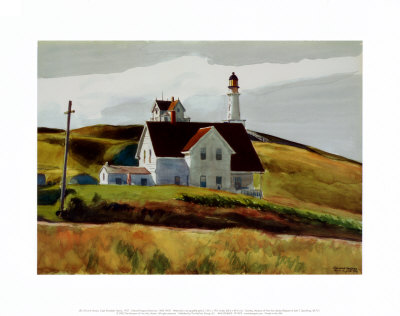
 by Tom Gurney
Tom Gurney BSc (Hons) is an art history expert with over 20 years experience
Email: tomgurney1@gmail.com / Phone: +44 7429 011000
Hill and Houses, Cape Elizabeth, Maine: Introduction
The lighthouse stands behind a roof, sharing the skyline with a smaller house and a leaning utility pole. Closer to us, a broad pale building occupies the middle of the view. Edward Hopper's Hill and Houses, Cape Elizabeth, Maine presents a coastal landmark through the everyday buildings around it. We arrive at the tower gradually, looking past a fence, a dark roof and a rising strip of ground.
Hopper made the watercolour in 1927. The Museum of Fine Arts, Boston holds it as part of the bequest of John T. Spaulding, accession 48.721. Its museum-contributed catalogue record identifies watercolour over graphite pencil. The sheet belongs to the same productive Maine summer as several of Hopper's better-known views of lighthouse architecture. [1]
At a Glance
- ArtistEdward Hopper [1]
- Date1927 [1]
- Mediumwatercolour over graphite pencil [1]
- Collection / recordMuseum of Fine Arts, Boston [1]
- Accession48.721 [1]
This work across Edward Hopper’s career
American Village
1912Soir Bleu
1914Automat
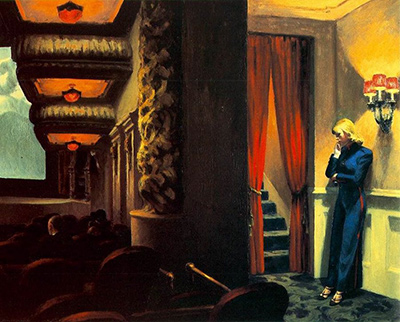
1927New York Movie
1939Nighthawks
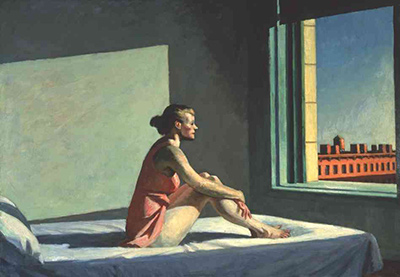
1942Morning Sun
1952Two Comedians
1966Contents
- Looking uphill through the houses
- A second upright at the left
- Grey clouds and illuminated ground
- Watercolour and architectural structure
- Cape Elizabeth in 1927
- Neighbouring lighthouse views
Looking uphill through the houses
The nearer house provides the largest architectural shape. Its dark roof stretches across the composition, with a steep central gable projecting towards us. Below that gable, the pale wall is divided by small windows and a doorway. The building feels substantial because we can see several of its faces, each turned differently towards the light.
The little structure at its left extends the group along the ground. Its low roof almost disappears against the larger wall behind it. This overlap makes it possible to read the buildings as a connected cluster, though their precise uses remain outside the picture's immediate concern.
A white fence supplies another change of scale. Its repeated uprights are much smaller than the house's windows, and its unevenly emphasized line follows the edge of the settled ground. It marks a boundary we can understand from everyday experience: a place close to a dwelling, beyond which the hillside continues.
Behind this house, a second building rises near the crest. Its roof and upper windows appear above the foreground structure. The interruption is important. Hopper does not give us each building separately with a complete outline. We piece together the higher ground from what remains visible between and above the closer forms.
The lighthouse occupies a further interval. Its pale shaft rises beyond the nearer roof, ending in a dark lantern with a warm reddish accent. The low buildings partly conceal its base. Instead of standing independently from top to bottom, it belongs to this sequence of overlapping habitation.
The title suits that arrangement. Hill and Houses describes the larger fabric of the place, leaving the lighthouse to be discovered within it. The slope has as much influence on the composition as the tower: it determines which roofs can be seen, which walls are hidden and how the eye travels upwards.
A second upright at the left
The utility pole prevents the lighthouse from being the picture's only vertical accent. It stands close to the left edge, darker, thinner and less regular than the white tower. Its crosspiece is set at an angle, and its base belongs to the nearer ground.
The two uprights consequently establish different distances. The pole feels accessible and ordinary; the lighthouse rises further back, above the houses. They are also different kinds of construction. One is a narrow timber-like line, the other an enclosed architectural volume. Hopper includes both in the same field without making them equivalent.
This pairing helps distribute attention across the width of the sheet. Without the pole, the tower would exert a stronger pull towards the right of centre. With it, the left side has its own pointed interruption of the sky. The buildings and land occupy the space between these unequal markers.
The pole also complicates any purely picturesque reading of the site. It belongs to a landscape used and connected by people, as do the fence and the small outbuilding. The lighthouse is the most distinctive feature, but the less imposing structures determine how we encounter it.
Grey clouds and illuminated ground
A long grey cloud crosses the upper edge. Beneath it, the sky remains lighter, with cooler bands passing behind the upper house and lighthouse. This is a very different setting from the uninterrupted blue sky associated with many reproductions of Hopper's lighthouses.
The ground is warmer. Yellow-green slopes, rusty grass and a dark exposed-looking bank build a series of horizontal passages below the houses. The large roof introduces an especially deep red-brown, close enough to black to make the walls appear brighter.
The contrast does not require every surface to be equally illuminated. One face of the nearer house is cooler and duller than the light wall beside it. A projecting roof shades the surfaces below, while the hillside changes colour as it turns away from the light. These differences keep the landscape dimensional under the broad cloud.
The cloud has weight because its lower edge extends so far across the sheet. The lighthouse's small lantern interrupts that breadth, but does not overcome it. Buildings, hill and weather share the view. We can look at the scene as a meeting of three different sorts of shape: the angular houses, the curving ground and the extended mass of cloud.
The foreground is less tightly enclosed than the architectural centre. Individual marks suggest stalks or rough growth, with patches of ochre passing into green. These variations give the lower edge a looser texture. Against them, the windows and roof lines appear more deliberate and compact.
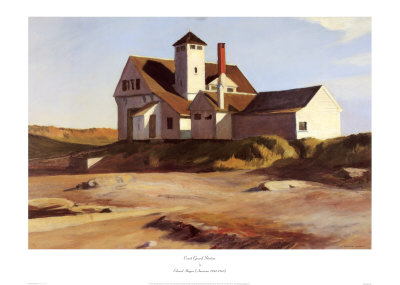
Compare: Coast Guard Station, 1929.
Watch: Edward Hopper’s Life and Art
Explore Hopper’s paintings and the places behind them in these museum films. Choose a film below.
Watercolour and architectural structure
The medium permits both broad colour and precise interruption. A large area of sky can remain relatively open, while a few dark accents identify the lantern, windows or roof junctions. The nearer house is made legible through the relation between such accents and its lighter wall surfaces.
The catalogue's reference to graphite establishes a drawing medium beneath or alongside the watercolour. It does not tell us the order in which every visible mark was made. [1] What the finished picture shows is a strong concern with the boundaries between forms: the edge of a gable, the slope behind a roof and the narrow gap of sky around the lighthouse.
Those boundaries do not all behave alike. Architecture generally has a firmer outline; the ground breaks into irregular patches; the cloud is broader and softer. The changing edges help us move between the picture's different materials without requiring exhaustive detail.
The museum's own print catalogue also identifies it as a watercolour on paper. [2] Its impact comes from the clear division and overlapping of forms, with enough variation of colour to keep the view responsive to weather.
Cape Elizabeth in 1927
The Hoppers' mobility had expanded by this summer. Bowdoin's account of their Maine journeys explains that the purchase of a car in 1927 helped them explore Cape Elizabeth, where they stayed until late September. The district supplied subjects for both watercolours and oils in 1927 and again in 1929. [3]
That history helps place Hill and Houses within a sustained encounter with the area. Hopper was able to look at the coast from more than one position and to return to its buildings in different arrangements. Here, the viewpoint gives the houses a stronger role than the landmark they partly obscure.
The work was included as catalogue number 39 in the 2007 Hopper retrospective, which brought together paintings, prints and watercolours. [4] The drawing and washing of a hillside subject offered a different scale of work from the broad canvases, while developing the same attention to light striking built surfaces.
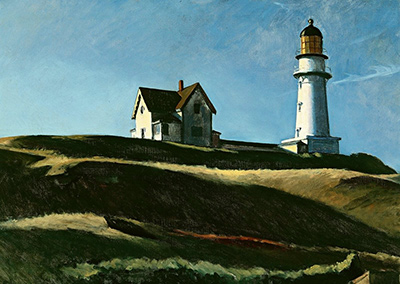
Compare: Lighthouse Hill, 1927.
Neighbouring lighthouse views
In Lighthouse Hill, also painted in 1927, the house and tower stand apart on an exposed ridge. The Dallas Museum of Art identifies that oil with Two Lights in Cape Elizabeth. [5] Its greater separation between the buildings makes each silhouette more self-contained. In Hill and Houses, the closer roof interrupts the view, and the settlement is more closely layered.
The later Lighthouse at Two Lights raises the tower above the viewer in a more emphatic upward composition. Here, the eye is repeatedly brought back down: first to the dark roof, then to the fence and rough foreground. The landscape does not resolve into one monumental upright.
A third comparison, Lighthouse and Buildings, Portland Head, opens a view towards the sea. In Hill and Houses, no broad expanse of water explains the lighthouse's function. The title, tower and coastal context provide that knowledge, while the visible scene remains absorbed in the hillside.
The white fence is a useful place to finish looking. Small and easily passed over, it marks the scale of the nearer house and stretches across its frontage. Above it rise a dark roof, a second dwelling, the lighthouse and the grey sky. Hopper has brought these very different distances into one compact view of inhabited ground.
Artworks and studies directory
This researched directory includes finished works and separately identified studies. It is not a complete catalogue raisonné. Linked titles open the articles; unlinked studies are identified by their collection accessions. Watercolours retain their recorded media, and original prints remain distinct from reproductions.
| Name | Date | Medium |
|---|---|---|
| (Bridge and Embankment) (70.1298) | 1906 | Oil on wood |
| (Jo Sketching at Good Harbor Beach) (70.1129) | 1923–1924 | Watercolor and fabricated chalk on paper |
| (Manhattan Bridge) (70.1098) | 1925–1926 | Watercolor and graphite pencil on paper |
| (Rooftops) (70.1114) | 1926 | Watercolor and graphite pencil on paper |
| (Seated Male Model, Bent Over) (70.1277) | c. 1902–1903 | Oil on canvas |
| (Self-Portrait) (70.1254) | 1903–1906 | Oil on canvas |
| (Solitary Figure in a Theater) (70.1418) | c. 1902–1904 | Oil on board |
| 5 A.M. | 1937 | oil on canvas |
| Adam's House | 1928 | watercolour and charcoal on paper |
| American Village | 1912 | Oil on canvas |
| Apartment Houses | 1923 | oil on canvas |
| Approaching a City | 1946 | oil on canvas |
| August in the City | 1945 | oil on canvas |
| Automat | 1927 | oil on canvas |
| Barber Shop | 1931 | oil on canvas |
| Blackwell's Island | 1928 | oil on canvas |
| Bridge on the Seine | 1909 | Oil on canvas |
| Bridle Path | 1939 | oil on canvas |
| Burly Cobb's House South Truro | 1930–1933 | oil on canvas |
| Cape Cod Evening | 1939 | oil on canvas |
| Cape Cod Morning | 1950 | oil on canvas |
| Chair Car | 1965 | oil on canvas |
| Chop Suey | 1929 | oil on canvas |
| City Roofs | 1932 | Oil on canvas |
| Coast Guard Station | 1929 | oil on canvas |
| Compartment C, Car 293 | 1938 | oil on canvas |
| Conference at Night | 1949 | oil on canvas |
| Corn Hill | 1930 | oil on canvas |
| Dawn in Pennsylvania | 1942 | oil on canvas |
| Drug Store | 1927 | oil on canvas |
| Early Sunday Morning | 1930 | Oil on canvas |
| East Side Interior (70.1020) | 1922 | Etching |
| East Wind Over Weehawken | 1934 | oil on canvas |
| El Palacio | 1946 | Watercolor and graphite pencil on paper |
| Eleven A.M. | 1926 | oil on canvas |
| Evening Wind | 1921 | etching |
| Excursion into Philosophy | 1959 | oil on canvas |
| First Row Orchestra | 1951 | oil on canvas |
| Freight Car at Truro | 1931 | watercolour over graphite on paper |
| Gas | 1940 | oil on canvas |
| Girl at a Sewing Machine | c. 1921 | oil on canvas |
| Gloucester Harbor | 1912 | Oil on canvas |
| Ground Swell | 1939 | oil on canvas |
| Haskell's House | 1924 | watercolour over graphite on paperboard |
| High Noon | 1949 | oil on canvas |
| Hill and Houses Cape Elizabeth Maine | 1927 | watercolour over graphite pencil |
| Hills South Truro | 1930 | oil on canvas |
| Hotel by a Railroad | 1952 | oil on canvas |
| Hotel Lobby | 1943 | oil on canvas |
| Hotel Room | 1931 | oil on canvas |
| Hotel Window | 1955 | oil on canvas |
| House by the Railroad | 1925 | oil on canvas |
| House by the Squam River | 1926 | watercolour over graphite on paper |
| Le Bistro or The Wine Shop | 1909 | Oil on canvas |
| Le Pont des Arts | 1907 | Oil on canvas |
| Le Pont Royal | 1909 | Oil on canvas |
| Le Quai des Grands Augustins | 1909 | Oil on canvas |
| Lighthouse and Buildings Portland Head | 1927 | watercolour over graphite pencil on paper |
| Lighthouse Hill | 1927 | oil painting |
| Manhattan Bridge Loop | 1928 | oil on canvas |
| Model Sitting | c. 1902 | oil painting; support not asserted |
| Morning Sun | 1952 | oil on canvas |
| New York Movie | 1939 | oil on canvas |
| New York New Haven and Hartford | 1931 | oil on canvas |
| New York Office | 1962 | oil on canvas |
| New York Pavements | 1924–1925 | oil on canvas |
| New York Restaurant | c. 1922 | oil on canvas |
| Night Windows | 1928 | oil on canvas |
| Nighthawks | 1942 | oil on canvas |
| October on Cape Cod | 1946 | oil on canvas |
| Office at Night | 1940 | oil on canvas |
| Office in a Small City | 1953 | oil on canvas |
| Pennsylvania Coal Town | 1947 | oil on canvas |
| People in the Sun | 1960 | oil on canvas |
| Portrait of Orleans | 1950 | oil on canvas |
| Queensborough Bridge | 1913 | Oil on canvas |
| Railroad Sunset | 1929 | Oil on canvas |
| Railroad Train | 1908 | oil on canvas |
| Road in Maine | 1914 | oil on canvas |
| Room in Brooklyn | 1932 | oil on canvas |
| Room in New York | 1932 | oil on canvas |
| Rooms by the Sea | 1951 | oil on canvas |
| Rooms for Tourists | 1945 | oil on canvas |
| Route 6 Eastham | 1941 | oil on canvas |
| Second Story Sunlight | 1960 | Oil on canvas |
| Self-Portrait | 1925–1930 | Oil on canvas |
| Self-Portrait with Hat (70.1903) | c. 1918, posthumous print | Drypoint |
| Seven A.M. | 1948 | Oil on canvas |
| Soir Bleu | 1914 | oil on canvas |
| South Carolina Morning | 1955 | Oil on canvas |
| Stairway at 48 Rue de Lille Paris | 1906 | Oil on wood |
| Study for 5 A.M. (70.153) | 1937 | Fabricated chalk on paper |
| Study for 5 A.M. (70.429) | 1937 | Fabricated chalk and graphite pencil on paper |
| Study for Approaching a City (70.869) | 1946 | Fabricated chalk and charcoal on paper |
| Study for August in the City (70.158a-b) | 1945 | Fabricated chalk on paper |
| Study for August in the City (70.159) | 1945 | Fabricated chalk on paper |
| Study for Bridle Path (70.220) | 1939 | Fabricated chalk on paper |
| Study for Bridle Path (70.235) | 1939 | Fabricated chalk on paper |
| Study for Compartment C, Car 293 (70.430) | 1938 | Fabricated chalk on paper |
| Study for Compartment C, Car 293 (70.431a-b) | 1938 | Fabricated chalk and charcoal on paper |
| Study for Conference at Night (70.170) | 1949 | Fabricated chalk on paper (recto); Typewriter ink on paper (verso) |
| Study for Conference at Night (70.174) | 1949 | Fabricated chalk on paper ( recto); Typewriter ink on paper (verso) |
| Study for East Wind over Weehawken (70.249) | 1934 | Graphite pencil on paper |
| Study for East Wind over Weehawken (70.252) | 1934 | Fabricated chalk and charcoal on paper |
| Study for Evening Wind (70.343a-b) | 1921 | Fabricated chalk on paper |
| Study for First Row Orchestra (70.841) | 1951 | Fabricated chalk and charcoal on paper |
| Study for Gas (70.263) | 1940 | Fabricated chalk on paper |
| Study for Ground Swell (70.339) | 1939 | Fabricated chalk, charcoal and graphite pencil on paper |
| Study for Hotel by a Railroad (70.199) | 1952 | Fabricated chalk on paper |
| Study for Hotel by a Railroad (70.427) | 1952 | Fabricated chalk on paper |
| Study for Hotel by a Railroad (70.428) | 1952 | Fabricated chalk on paper |
| Study for Hotel Lobby (70.117) | 1942 | Fabricated chalk and graphite pencil on paper |
| Study for Hotel Lobby (70.839) | 1942 | Fabricated chalk and charcoal on paper |
| Study for Hotel Window (70.161) | 1955 | Fabricated chalk, graphite pencil and colored pencil on paper |
| Study for Morning Sun (70.243) | 1952 | Fabricated chalk on paper |
| Study for Morning Sun (70.244) | 1952 | Fabricated chalk on paper |
| Study for Morning Sun (70.290) | 1952 | Fabricated chalk on paper |
| Study for Morning Sun (70.291) | 1952 | Fabricated chalk and graphite pencil on paper |
| Study for New York Movie (70.273) | 1939 | Fabricated chalk on paper |
| Study for New York Movie (70.274a-b) | 1938 or 1939 | Fabricated chalk and charcoal on paper (recto); Fabricated chalk on paper (verso) |
| Study for New York Movie (70.455) | 1939 | Fabricated chalk and charcoal on paper |
| Study for New York Office (70.822) | 1962 | Fabricated chalk on paper |
| Study for Nighthawks (70.192) | 1941 or 1942 | Fabricated chalk on paper |
| Study for Nighthawks (70.193) | 1941 or 1942 | Fabricated chalk on paper |
| Study for Office at Night (70.340) | 1940 | Fabricated chalk and charcoal on paper |
| Study for Office at Night (70.341) | 1940 | Fabricated chalk and graphite pencil on paper |
| Study for Pennsylvania Coal Town (70.198) | 1947 | Fabricated chalk on paper |
| Study for Pennsylvania Coal Town (70.229) | 1947 | Fabricated chalk and charcoal on paper |
| Study for Rooms for Tourists (70.438) | 1945 | Fabricated chalk and charcoal on paper |
| Study for Rooms for Tourists (70.848) | 1945 | Fabricated chalk and charcoal on paper |
| Study for Route 6, Eastham (70.369) | 1941 | Fabricated chalk and graphite pencil on paper |
| Study for Route 6, Eastham (70.854) | 1941 | Fabricated chalk and graphite pencil on paper |
| Study for South Carolina Morning (70.162a-b) | 1955 | Fabricated chalk on paper (recto and verso) |
| Study for The Sheridan Theatre (70.969) | 1937 | Graphite pencil on paper |
| Study for Two on the Aisle (70.128) | 1927 | Fabricated chalk on paper |
| Study for Two on the Aisle (70.129) | 1927 | Fabricated chalk on paper |
| Study for Yawl Riding a Swell (70.439) | 1935 | Fabricated chalk and graphite pencil on paper |
| Summer Evening | 1947 | oil on canvas |
| Summer Interior | 1909 | Oil on canvas |
| Sun in an Empty Room | 1963 | oil on canvas |
| Sunlight in a Cafeteria | 1958 | oil on canvas |
| Sunlight on Brownstones | 1956 | oil on canvas |
| Tables for Ladies | 1930 | oil on canvas |
| The Bootleggers | 1925 | oil on canvas |
| The Camel's Hump | 1931 | oil on canvas |
| The Circle Theatre | 1936 | oil on canvas |
| The City | 1927 | oil on canvas |
| The Lighthouse at Two Lights | 1929 | oil on canvas |
| The Long Leg | 1935 | oil on canvas |
| The Mansard Roof | 1923 | watercolour over graphite on paper |
| The Sheridan Theatre | 1937 | oil on canvas |
| Tramp Steamer | 1908 | oil on canvas |
| Two Comedians | 1966 | oil on canvas |
| Two on the Aisle | 1927 | oil on canvas |
| Valley of the Seine | 1909 | Oil on canvas |
| Western Motel | 1957 | oil on canvas |
Frequently Asked Questions
Edward Hopper made Hill and Houses Cape Elizabeth Maine in 1927. [1]
The recorded medium is watercolour over graphite pencil. [1]
The lighthouse stands behind a roof, sharing the skyline with a smaller house and a leaning utility pole. Closer to us, a broad pale building occupies the middle of the view. Edward Hopper's Hill and Houses, Cape Elizabeth, Maine presents a coastal landmark through the everyday buildings around it. We arrive at the tower gradually, looking past a fence, a dark roof and a rising strip of ground.
Discussion
Look again at the images and ideas explored in Hill and Houses, Cape Elizabeth, Maine. These editorial prompts invite your observations.
Reader Insights
Which boundary, gesture or change of light first holds your attention in Hill and Houses Cape Elizabeth Maine?
Compare Coast Guard Station with Hill and Houses Cape Elizabeth Maine. Which visual difference matters most to your reading?
Which detail would you look at again after reading “Grey clouds and illuminated ground”?
Join the Conversation
Share a detail, comparison or question about Hill and Houses, Cape Elizabeth, Maine below.
References
- Museum of Fine Arts, Boston, museum-contributed AMICA record, Hill and Houses, Cape Elizabeth, Maine, 1927, accession 48.721; medium and Spaulding bequest. View source.
- Museum of Fine Arts, Boston, MFA Prints artwork caption, confirming date, watercolour on paper, collection, bequest and accession. Reproduction print sizes are not dimensions of the original artwork. View source.
- Bowdoin College Museum of Art, A Guide to Hopper's Maine, 2011, Cape Elizabeth section. View source.
- National Gallery of Art, Edward Hopper exhibition checklist, updated 6 September 2007, cat. 39. View source.
- Dallas Museum of Art, Lighthouse Hill, 1927, accession 1958.9; commentary by Sue Canterbury, January 2018. View source.
- Collection or catalogue record, American Village, 1912; medium and identity as discussed in the linked article. View source.
- Collection or catalogue record, Soir Bleu, 1914; medium and identity as discussed in the linked article. View source.
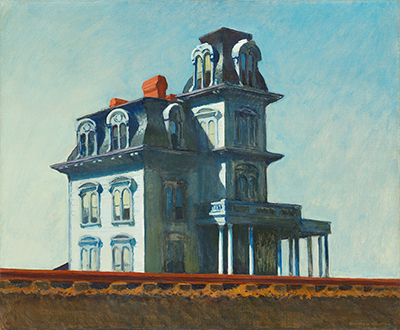
- Collection or catalogue record, House by the Railroad, 1925; medium and identity as discussed in the linked article. View source.
- Collection or catalogue record, Automat, 1927; medium and identity as discussed in the linked article. View source.
- Collection or catalogue record, Early Sunday Morning, 1930; medium and identity as discussed in the linked article. View source.
- Collection or catalogue record, New York Movie, 1939; medium and identity as discussed in the linked article. View source.
- Collection or catalogue record, Nighthawks, 1942; medium and identity as discussed in the linked article. View source.
- Collection or catalogue record, Morning Sun, 1952; medium and identity as discussed in the linked article. View source.
- Collection or catalogue record, Second Story Sunlight, 1960; medium and identity as discussed in the linked article. View source.
- Collection or catalogue record, Two Comedians, 1966; medium and identity as discussed in the linked article. View source.
- Whitney Museum of American Art, Study for Route 6, Eastham, 1941, accession 70.854; exact object record. View source.
- Whitney Museum of American Art, Study for Conference at Night, 1949, accession 70.170; exact object record. View source.
- Whitney Museum of American Art, Study for First Row Orchestra, 1951, accession 70.841; exact object record. View source.
- Whitney Museum of American Art, (Bridge and Embankment), 1906, accession 70.1298; exact object record. View source.
- Whitney Museum of American Art, (Seated Male Model, Bent Over), c. 1902–1903, accession 70.1277; exact object record. View source.
- Whitney Museum of American Art, Study for Morning Sun, 1952, accession 70.244; exact object record. View source.
- Whitney Museum of American Art, Study for Morning Sun, 1952, accession 70.243; exact object record. View source.
- Whitney Museum of American Art, Study for Two on the Aisle, 1927, accession 70.128; exact object record. View source.
- Whitney Museum of American Art, Study for New York Office, 1962, accession 70.822; exact object record. View source.
- Whitney Museum of American Art, Study for Two on the Aisle, 1927, accession 70.129; exact object record. View source.
- Whitney Museum of American Art, Study for Pennsylvania Coal Town, 1947, accession 70.229; exact object record. View source.
- Whitney Museum of American Art, (Rooftops), 1926, accession 70.1114; exact object record. View source.
- Whitney Museum of American Art, Study for South Carolina Morning, 1955, accession 70.162a-b; exact object record. View source.
- Whitney Museum of American Art, (Self-Portrait), 1903–1906, accession 70.1254; exact object record. View source.
- Whitney Museum of American Art, (Manhattan Bridge), 1925–1926, accession 70.1098; exact object record. View source.
- Whitney Museum of American Art, (Solitary Figure in a Theater), c. 1902–1904, accession 70.1418; exact object record. View source.
- Whitney Museum of American Art, Study for Approaching a City, 1946, accession 70.869; exact object record. View source.
- Whitney Museum of American Art, Study for August in the City, 1945, accession 70.159; exact object record. View source.
- Whitney Museum of American Art, Study for Compartment C, Car 293, 1938, accession 70.430; exact object record. View source.
- Whitney Museum of American Art, Study for Compartment C, Car 293, 1938, accession 70.431a-b; exact object record. View source.
- Whitney Museum of American Art, Study for East Wind over Weehawken, 1934, accession 70.252; exact object record. View source.
- Whitney Museum of American Art, Study for East Wind over Weehawken, 1934, accession 70.249; exact object record. View source.
- Whitney Museum of American Art, Study for Evening Wind, 1921, accession 70.343a-b; exact object record. View source.
- Whitney Museum of American Art, Study for The Sheridan Theatre, 1937, accession 70.969; exact object record. View source.
- Whitney Museum of American Art, Study for New York Movie, 1939, accession 70.455; exact object record. View source.
- Whitney Museum of American Art, Study for New York Movie, 1939, accession 70.273; exact object record. View source.
- Whitney Museum of American Art, Study for New York Movie, 1938 or 1939, accession 70.274a-b; exact object record. View source.
- Whitney Museum of American Art, Study for 5 A.M., 1937, accession 70.153; exact object record. View source.
- Whitney Museum of American Art, Study for 5 A.M., 1937, accession 70.429; exact object record. View source.
- Whitney Museum of American Art, (Jo Sketching at Good Harbor Beach), 1923–1924, accession 70.1129; exact object record. View source.
- Whitney Museum of American Art, Study for August in the City, 1945, accession 70.158a-b; exact object record. View source.
- Whitney Museum of American Art, Study for Morning Sun, 1952, accession 70.291; exact object record. View source.
- Whitney Museum of American Art, Study for Morning Sun, 1952, accession 70.290; exact object record. View source.
- Whitney Museum of American Art, Study for Office at Night, 1940, accession 70.340; exact object record. View source.
- Whitney Museum of American Art, Study for Office at Night, 1940, accession 70.341; exact object record. View source.
- Whitney Museum of American Art, Study for Hotel by a Railroad, 1952, accession 70.427; exact object record. View source.
- Whitney Museum of American Art, Study for Hotel by a Railroad, 1952, accession 70.199; exact object record. View source.
- Whitney Museum of American Art, Study for Hotel by a Railroad, 1952, accession 70.428; exact object record. View source.
- Whitney Museum of American Art, Study for Hotel Lobby, 1942, accession 70.117; exact object record. View source.
- Whitney Museum of American Art, Study for Hotel Lobby, 1942, accession 70.839; exact object record. View source.
- Whitney Museum of American Art, Study for Conference at Night, 1949, accession 70.174; exact object record. View source.
- Whitney Museum of American Art, Study for Hotel Window, 1955, accession 70.161; exact object record. View source.
- Whitney Museum of American Art, Study for Pennsylvania Coal Town, 1947, accession 70.198; exact object record. View source.
- Whitney Museum of American Art, Study for Route 6, Eastham, 1941, accession 70.369; exact object record. View source.
- Whitney Museum of American Art, Study for Bridle Path, 1939, accession 70.220; exact object record. View source.
- Whitney Museum of American Art, Study for Bridle Path, 1939, accession 70.235; exact object record. View source.
- Whitney Museum of American Art, Study for Ground Swell, 1939, accession 70.339; exact object record. View source.
- Whitney Museum of American Art, Study for Yawl Riding a Swell, 1935, accession 70.439; exact object record. View source.
- Whitney Museum of American Art, Study for Rooms for Tourists, 1945, accession 70.848; exact object record. View source.
- Whitney Museum of American Art, Study for Rooms for Tourists, 1945, accession 70.438; exact object record. View source.
- Whitney Museum of American Art, Study for Nighthawks, 1941 or 1942, accession 70.193; exact object record. View source.
- Whitney Museum of American Art, Study for Nighthawks, 1941 or 1942, accession 70.192; exact object record. View source.
- Whitney Museum of American Art, Study for Gas, 1940, accession 70.263; exact object record. View source.
- Whitney Museum of American Art, Self-Portrait with Hat, c. 1918, posthumous print, accession 70.1903; exact object record. View source.
- Whitney Museum of American Art, East Side Interior, 1922, accession 70.1020; exact object record. View source.
- Art Institute of Chicago, Selected Chronology for Edward Hopper; training, travels, exhibitions, New York and Truro chronology. View source.
- Emily C. Burns, Spectral figures: Edward Hopper’s empty Paris, chapter 5 in Empty Spaces: Confronting Emptiness in National, Cultural and Urban Histories, 2019; complete chapter and notes consulted. View source.
- Charles Brock, Regionalism and Folk Art, National Gallery of Art; complete essay and two notes consulted. View source.