 by Tom Gurney
Tom Gurney BSc (Hons) is an art history expert with over 20 years experience
Email: tomgurney1@gmail.com / Phone: +44 7429 011000
Road in Maine: Introduction
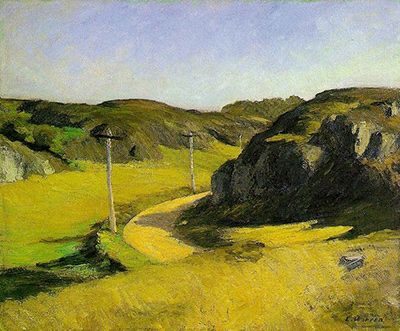
The road turns just before it reaches the dark rock. Its pale curve passes between a bright grassy field and a large shadowed outcrop, then narrows towards a gap in the hills. Two utility poles mark the route at different distances. Edward Hopper's Road in Maine makes a modest bend in the landscape feel consequential through the scale of the ground beside it.
The Whitney Museum of American Art dates the oil on canvas to 1914. It measures 61.6 × 74.3 cm and entered the collection through Josephine N. Hopper's bequest, accession 70.1201. The picture combines an emphatic natural form with the slight but unmistakable signs of a route maintained for human use. [1]
At a Glance
- ArtistEdward Hopper [1]
- Date1914 [1]
- Mediumoil on canvas [1]
- Collection / recordWhitney Museum of American Art [1]
- Accession70.1201 [1]
This work across Edward Hopper’s career
American Village
1912Soir Bleu
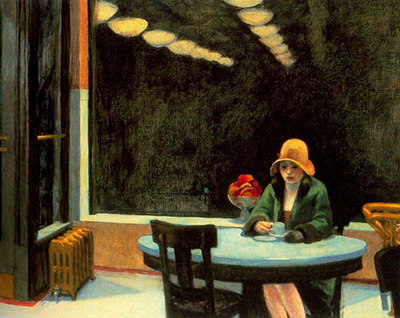
1914Automat
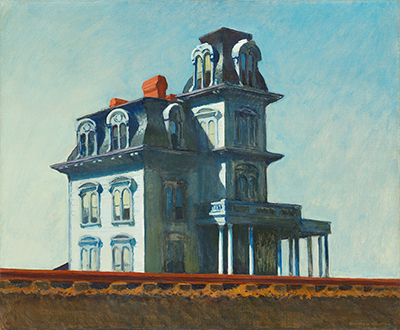
1927New York Movie
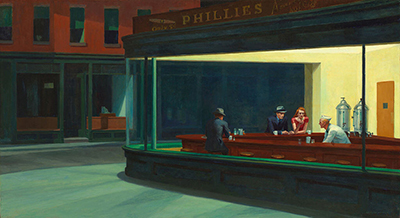
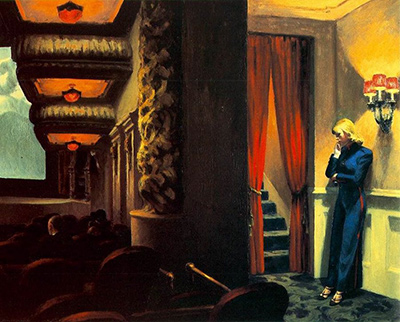
1939Nighthawks
1942Morning Sun
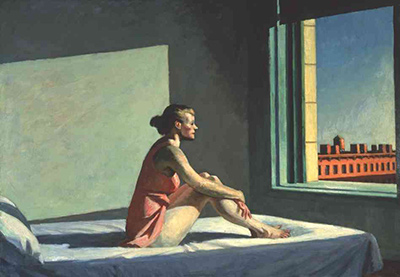
1952Two Comedians
1966Contents
- The road turns out of sight
- The outcrop claims the right side
- A shadow reaches across the ground
- Two poles supply a human measure
- Yellow-green ground and a cooler sky
- Ogunquit and the first Maine summers
- Rock studies and a distinct composition
The road turns out of sight
The pale strip bends through the lower middle of the painting. Its width changes as it moves away, becoming narrower near the further pole. This gradual compression gives the scene depth, even though the surrounding hills keep the view relatively enclosed.
The curve has two effects. It leads the eye into the picture and turns it around the rock. The destination remains hidden, so the route is understood through its course rather than through a building or settlement at its end. The bend itself becomes the event that organizes the scene.
Light strengthens its shape. The road has a warm yellow tone close to the brightness of the surrounding grass, but its smoother passage and clearer boundaries keep it distinct. Where it meets the dark outcrop, the contrast grows sharper. A slight strip of ground can become highly visible when placed beside a large shadow.
The road also changes the scale of the hills. Seen alone, the rolling forms might be difficult to measure. A usable route and its poles give us a more familiar set of proportions. We can begin to imagine how large the rock is and how far the path travels before disappearing.
The outcrop claims the right side
The rock is the picture's heaviest form. It rises from the near ground and occupies much of the right half, with its upper edge close to the horizon of the surrounding hills. Its dark face stands firmly against the luminous field and pale sky.
The surface is broken into sloping and upright passages. Grey, green and brown marks suggest changes of plane, while small lighter areas catch along its edge. These variations make the outcrop feel substantial without turning it into a catalogue of geological details.
Its outline is irregular but coherent. The top slopes, rises and falls in a sequence distinct from the gentler ground behind. The side towards the road is especially forceful, creating a dark boundary that the pale route has to pass beside. The landscape seems to determine the course available through it.
The mass also anchors the painting visually. The left side has a broader area of open grass; the right gathers concentrated darkness and rougher changes of surface. The road occupies the interval between them. Hopper balances a large, dense object against a more expansive field of light.
A shadow reaches across the ground
The outcrop's influence extends beyond its own surface. A broad shadow spreads across part of the road and foreground, connecting the rock with a lower dark shape. Its reach makes the sunlit grass seem brighter and gives the ground a stronger pattern.
The shadow changes the path's appearance as it passes through. The same route can be read as a bright ribbon in one section and a more subdued surface in another. This alternation helps the road remain part of the landscape, subject to its forms and light.
At left, a darker band curves through the grass near the nearer pole. Its shape helps carry the eye back towards the bend. The painting's movement is therefore distributed across several elements: road edge, shadow and changing slope. They guide attention in related directions without duplicating one another exactly.
The contrast gives the work a particular intensity. Brightness and darkness occupy broad areas, so their meeting is felt before small details are examined. The scene can be grasped quickly as a strong arrangement, then explored through the variations within each mass.
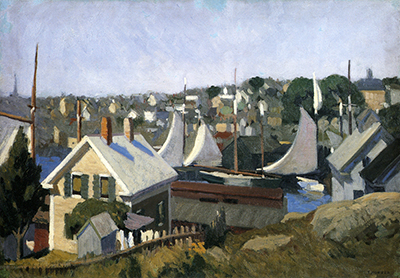
Compare: Gloucester Harbor, 1912.
Two poles supply a human measure
The utility poles are slender beside the rock, but they play a decisive role. The nearer one stands towards the left of the bend, with a crossarm breaking its vertical line. The second appears smaller and further away. Their relationship makes distance easy to judge.
The pair also introduces a measured repetition into the uneven terrain. Hills and outcrop turn irregularly; the poles rise as narrow uprights. They indicate an organized route through a landscape whose larger forms follow a different order.
Their small scale is part of their effectiveness. A substantial building would change the scene's balance and supply an obvious destination. The poles can register human use while leaving the ground and sky dominant. They connect the visible road with a wider network that extends beyond the image.
Watch: Edward Hopper’s Life and Art
Explore Hopper’s paintings and the places behind them in these museum films. Choose a film below.
Yellow-green ground and a cooler sky
The grass carries some of the painting's most vivid colour. Broad yellow-green areas spread across the left and lower foreground, setting off the darker outcrop. Changes of green and ochre give the slopes a varied surface while preserving their overall brightness.
The near ground contains many small directional marks. Further back, larger passages describe the rolling hills. The difference lets the foreground feel close without requiring an exact rendering of individual blades. Hopper adjusts the density of the surface as the land recedes.
The sky offers a cooler field above. Pale blue and lilac balance the warmer earth, while soft shifts keep it from becoming a single flat tone. The uneven hill line separates the two broad zones. Against this comparatively open upper area, the rock's silhouette becomes especially clear.
Colour and structure reinforce one another. The warm road belongs with the grass, but its curve gives it a distinct purpose. The darker rock belongs with the shadow, yet its rising face makes it a separate volume. The painting gains clarity from these related colours taking different forms.
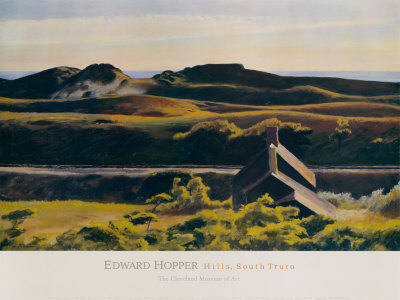
Compare: Hills South Truro, 1930.
Ogunquit and the first Maine summers
Bowdoin College Museum of Art places Road in Maine within Hopper's early work at Ogunquit. Its account records his first Maine visit in 1914 and his return the following summer. Across those two summers, he made seven oils. The road painting belongs to a period when the area's ground, rocks and coastal views supplied concentrated subjects for his attention. [2]
Ogunquit already offered different artistic communities. Bowdoin describes Charles Woodbury's school, founded in 1898, and Hamilton Easter Field's more modern school, established in 1911. Hopper encountered this setting while remaining affiliated with neither school. That distinction leaves room for his independent selection of an unassuming road and the large forms around it. [2]
The road subject should also be kept within its own chronology. The Art Institute of Chicago records Hopper's purchase of his first automobile in 1927, more than a decade after this painting. A road could interest him well before the later motoring journeys associated with so many of his New England subjects. [3]
The picture itself supplies no vehicle. It offers the route as a visual and bodily possibility, with the nearer pole and curving ground establishing a position from which a traveller might proceed. The experience can remain close to walking pace, where a bend and a rock are large enough to shape the whole encounter.
Rock studies and a distinct composition
Hopper's Square Rock, Ogunquit, also dated 1914, provides a useful companion. The Fondation Beyeler's 2020 exhibition guide describes that separate work as an early oil study of coastal rocks and changing light. A large rock interrupts the sea view and becomes a major sculptural presence within the image. [4]
In Road in Maine, the outcrop has a similarly commanding scale, but the path changes the way it is encountered. The viewer is given a route alongside it. The mass becomes something to pass, while the poles and bend establish a sequence through the land.
Bowdoin singles out the road painting for its graphic simplicity, relating that quality to Hopper's later compositions. The observation is useful because it directs attention towards the large, readily grasped relationships already present: pale curve, dark rock, bright field and thin uprights. [2]
Those relationships give the work its particular force in its own right. The road remains small, but its turn orders the view. The outcrop remains dark, but its size makes the light around it more expansive. Hopper makes a short stretch of Maine terrain feel complete through the interaction of a few strongly chosen forms.
Artworks and studies directory
This researched directory includes finished works and separately identified studies. It is not a complete catalogue raisonné. Linked titles open the articles; unlinked studies are identified by their collection accessions. Watercolours retain their recorded media, and original prints remain distinct from reproductions.
| Name | Date | Medium |
|---|---|---|
| (Bridge and Embankment) (70.1298) | 1906 | Oil on wood |
| (Jo Sketching at Good Harbor Beach) (70.1129) | 1923–1924 | Watercolor and fabricated chalk on paper |
| (Manhattan Bridge) (70.1098) | 1925–1926 | Watercolor and graphite pencil on paper |
| (Rooftops) (70.1114) | 1926 | Watercolor and graphite pencil on paper |
| (Seated Male Model, Bent Over) (70.1277) | c. 1902–1903 | Oil on canvas |
| (Self-Portrait) (70.1254) | 1903–1906 | Oil on canvas |
| (Solitary Figure in a Theater) (70.1418) | c. 1902–1904 | Oil on board |
| 5 A.M. | 1937 | oil on canvas |
| Adam's House | 1928 | watercolour and charcoal on paper |
| American Village | 1912 | Oil on canvas |
| Apartment Houses | 1923 | oil on canvas |
| Approaching a City | 1946 | oil on canvas |
| August in the City | 1945 | oil on canvas |
| Automat | 1927 | oil on canvas |
| Barber Shop | 1931 | oil on canvas |
| Blackwell's Island | 1928 | oil on canvas |
| Bridge on the Seine | 1909 | Oil on canvas |
| Bridle Path | 1939 | oil on canvas |
| Burly Cobb's House South Truro | 1930–1933 | oil on canvas |
| Cape Cod Evening | 1939 | oil on canvas |
| Cape Cod Morning | 1950 | oil on canvas |
| Chair Car | 1965 | oil on canvas |
| Chop Suey | 1929 | oil on canvas |
| City Roofs | 1932 | Oil on canvas |
| Coast Guard Station | 1929 | oil on canvas |
| Compartment C, Car 293 | 1938 | oil on canvas |
| Conference at Night | 1949 | oil on canvas |
| Corn Hill | 1930 | oil on canvas |
| Dawn in Pennsylvania | 1942 | oil on canvas |
| Drug Store | 1927 | oil on canvas |
| Early Sunday Morning | 1930 | Oil on canvas |
| East Side Interior (70.1020) | 1922 | Etching |
| East Wind Over Weehawken | 1934 | oil on canvas |
| El Palacio | 1946 | Watercolor and graphite pencil on paper |
| Eleven A.M. | 1926 | oil on canvas |
| Evening Wind | 1921 | etching |
| Excursion into Philosophy | 1959 | oil on canvas |
| First Row Orchestra | 1951 | oil on canvas |
| Freight Car at Truro | 1931 | watercolour over graphite on paper |
| Gas | 1940 | oil on canvas |
| Girl at a Sewing Machine | c. 1921 | oil on canvas |
| Gloucester Harbor | 1912 | Oil on canvas |
| Ground Swell | 1939 | oil on canvas |
| Haskell's House | 1924 | watercolour over graphite on paperboard |
| High Noon | 1949 | oil on canvas |
| Hill and Houses Cape Elizabeth Maine | 1927 | watercolour over graphite pencil |
| Hills South Truro | 1930 | oil on canvas |
| Hotel by a Railroad | 1952 | oil on canvas |
| Hotel Lobby | 1943 | oil on canvas |
| Hotel Room | 1931 | oil on canvas |
| Hotel Window | 1955 | oil on canvas |
| House by the Railroad | 1925 | oil on canvas |
| House by the Squam River | 1926 | watercolour over graphite on paper |
| Le Bistro or The Wine Shop | 1909 | Oil on canvas |
| Le Pont des Arts | 1907 | Oil on canvas |
| Le Pont Royal | 1909 | Oil on canvas |
| Le Quai des Grands Augustins | 1909 | Oil on canvas |
| Lighthouse and Buildings Portland Head | 1927 | watercolour over graphite pencil on paper |
| Lighthouse Hill | 1927 | oil painting |
| Manhattan Bridge Loop | 1928 | oil on canvas |
| Model Sitting | c. 1902 | oil painting; support not asserted |
| Morning Sun | 1952 | oil on canvas |
| New York Movie | 1939 | oil on canvas |
| New York New Haven and Hartford | 1931 | oil on canvas |
| New York Office | 1962 | oil on canvas |
| New York Pavements | 1924–1925 | oil on canvas |
| New York Restaurant | c. 1922 | oil on canvas |
| Night Windows | 1928 | oil on canvas |
| Nighthawks | 1942 | oil on canvas |
| October on Cape Cod | 1946 | oil on canvas |
| Office at Night | 1940 | oil on canvas |
| Office in a Small City | 1953 | oil on canvas |
| Pennsylvania Coal Town | 1947 | oil on canvas |
| People in the Sun | 1960 | oil on canvas |
| Portrait of Orleans | 1950 | oil on canvas |
| Queensborough Bridge | 1913 | Oil on canvas |
| Railroad Sunset | 1929 | Oil on canvas |
| Railroad Train | 1908 | oil on canvas |
| Road in Maine | 1914 | oil on canvas |
| Room in Brooklyn | 1932 | oil on canvas |
| Room in New York | 1932 | oil on canvas |
| Rooms by the Sea | 1951 | oil on canvas |
| Rooms for Tourists | 1945 | oil on canvas |
| Route 6 Eastham | 1941 | oil on canvas |
| Second Story Sunlight | 1960 | Oil on canvas |
| Self-Portrait | 1925–1930 | Oil on canvas |
| Self-Portrait with Hat (70.1903) | c. 1918, posthumous print | Drypoint |
| Seven A.M. | 1948 | Oil on canvas |
| Soir Bleu | 1914 | oil on canvas |
| South Carolina Morning | 1955 | Oil on canvas |
| Stairway at 48 Rue de Lille Paris | 1906 | Oil on wood |
| Study for 5 A.M. (70.153) | 1937 | Fabricated chalk on paper |
| Study for 5 A.M. (70.429) | 1937 | Fabricated chalk and graphite pencil on paper |
| Study for Approaching a City (70.869) | 1946 | Fabricated chalk and charcoal on paper |
| Study for August in the City (70.158a-b) | 1945 | Fabricated chalk on paper |
| Study for August in the City (70.159) | 1945 | Fabricated chalk on paper |
| Study for Bridle Path (70.220) | 1939 | Fabricated chalk on paper |
| Study for Bridle Path (70.235) | 1939 | Fabricated chalk on paper |
| Study for Compartment C, Car 293 (70.430) | 1938 | Fabricated chalk on paper |
| Study for Compartment C, Car 293 (70.431a-b) | 1938 | Fabricated chalk and charcoal on paper |
| Study for Conference at Night (70.170) | 1949 | Fabricated chalk on paper (recto); Typewriter ink on paper (verso) |
| Study for Conference at Night (70.174) | 1949 | Fabricated chalk on paper ( recto); Typewriter ink on paper (verso) |
| Study for East Wind over Weehawken (70.249) | 1934 | Graphite pencil on paper |
| Study for East Wind over Weehawken (70.252) | 1934 | Fabricated chalk and charcoal on paper |
| Study for Evening Wind (70.343a-b) | 1921 | Fabricated chalk on paper |
| Study for First Row Orchestra (70.841) | 1951 | Fabricated chalk and charcoal on paper |
| Study for Gas (70.263) | 1940 | Fabricated chalk on paper |
| Study for Ground Swell (70.339) | 1939 | Fabricated chalk, charcoal and graphite pencil on paper |
| Study for Hotel by a Railroad (70.199) | 1952 | Fabricated chalk on paper |
| Study for Hotel by a Railroad (70.427) | 1952 | Fabricated chalk on paper |
| Study for Hotel by a Railroad (70.428) | 1952 | Fabricated chalk on paper |
| Study for Hotel Lobby (70.117) | 1942 | Fabricated chalk and graphite pencil on paper |
| Study for Hotel Lobby (70.839) | 1942 | Fabricated chalk and charcoal on paper |
| Study for Hotel Window (70.161) | 1955 | Fabricated chalk, graphite pencil and colored pencil on paper |
| Study for Morning Sun (70.243) | 1952 | Fabricated chalk on paper |
| Study for Morning Sun (70.244) | 1952 | Fabricated chalk on paper |
| Study for Morning Sun (70.290) | 1952 | Fabricated chalk on paper |
| Study for Morning Sun (70.291) | 1952 | Fabricated chalk and graphite pencil on paper |
| Study for New York Movie (70.273) | 1939 | Fabricated chalk on paper |
| Study for New York Movie (70.274a-b) | 1938 or 1939 | Fabricated chalk and charcoal on paper (recto); Fabricated chalk on paper (verso) |
| Study for New York Movie (70.455) | 1939 | Fabricated chalk and charcoal on paper |
| Study for New York Office (70.822) | 1962 | Fabricated chalk on paper |
| Study for Nighthawks (70.192) | 1941 or 1942 | Fabricated chalk on paper |
| Study for Nighthawks (70.193) | 1941 or 1942 | Fabricated chalk on paper |
| Study for Office at Night (70.340) | 1940 | Fabricated chalk and charcoal on paper |
| Study for Office at Night (70.341) | 1940 | Fabricated chalk and graphite pencil on paper |
| Study for Pennsylvania Coal Town (70.198) | 1947 | Fabricated chalk on paper |
| Study for Pennsylvania Coal Town (70.229) | 1947 | Fabricated chalk and charcoal on paper |
| Study for Rooms for Tourists (70.438) | 1945 | Fabricated chalk and charcoal on paper |
| Study for Rooms for Tourists (70.848) | 1945 | Fabricated chalk and charcoal on paper |
| Study for Route 6, Eastham (70.369) | 1941 | Fabricated chalk and graphite pencil on paper |
| Study for Route 6, Eastham (70.854) | 1941 | Fabricated chalk and graphite pencil on paper |
| Study for South Carolina Morning (70.162a-b) | 1955 | Fabricated chalk on paper (recto and verso) |
| Study for The Sheridan Theatre (70.969) | 1937 | Graphite pencil on paper |
| Study for Two on the Aisle (70.128) | 1927 | Fabricated chalk on paper |
| Study for Two on the Aisle (70.129) | 1927 | Fabricated chalk on paper |
| Study for Yawl Riding a Swell (70.439) | 1935 | Fabricated chalk and graphite pencil on paper |
| Summer Evening | 1947 | oil on canvas |
| Summer Interior | 1909 | Oil on canvas |
| Sun in an Empty Room | 1963 | oil on canvas |
| Sunlight in a Cafeteria | 1958 | oil on canvas |
| Sunlight on Brownstones | 1956 | oil on canvas |
| Tables for Ladies | 1930 | oil on canvas |
| The Bootleggers | 1925 | oil on canvas |
| The Camel's Hump | 1931 | oil on canvas |
| The Circle Theatre | 1936 | oil on canvas |
| The City | 1927 | oil on canvas |
| The Lighthouse at Two Lights | 1929 | oil on canvas |
| The Long Leg | 1935 | oil on canvas |
| The Mansard Roof | 1923 | watercolour over graphite on paper |
| The Sheridan Theatre | 1937 | oil on canvas |
| Tramp Steamer | 1908 | oil on canvas |
| Two Comedians | 1966 | oil on canvas |
| Two on the Aisle | 1927 | oil on canvas |
| Valley of the Seine | 1909 | Oil on canvas |
| Western Motel | 1957 | oil on canvas |
Frequently Asked Questions
Edward Hopper made Road in Maine in 1914. [1]
The recorded medium is oil on canvas. [1]
The road turns just before it reaches the dark rock. Its pale curve passes between a bright grassy field and a large shadowed outcrop, then narrows towards a gap in the hills. Two utility poles mark the route at different distances. Edward Hopper's Road in Maine makes a modest bend in the landscape feel consequential through the scale of the ground beside it.
Discussion
Look again at the images and ideas explored in Road in Maine. These editorial prompts invite your observations.
Reader Insights
Which boundary, gesture or change of light first holds your attention in Road in Maine?
Compare Gloucester Harbor with Road in Maine. Which visual difference matters most to your reading?
Which detail would you look at again after reading “A shadow reaches across the ground”?
Join the Conversation
Share a detail, comparison or question about Road in Maine below.
References
- Whitney Museum of American Art, (Road in Maine), 1914, oil on canvas, 61.6 × 74.3 cm, accession 70.1201, Josephine N. Hopper Bequest. View source.
- Bowdoin College Museum of Art, “A Guide to Hopper's Maine”, digital exhibition Edward Hopper's Maine, 2011, “Ogunquit” section. View source.
- The Art Institute of Chicago, “Selected Chronology for Edward Hopper (1882–1967)”, entry for 1927. View source.
- Fondation Beyeler, Edward Hopper, English exhibition guide, 2020, entry for Square Rock, Ogunquit, 1914. View source.
- Collection or catalogue record, American Village, 1912; medium and identity as discussed in the linked article. View source.
- Collection or catalogue record, Soir Bleu, 1914; medium and identity as discussed in the linked article. View source.
- Collection or catalogue record, House by the Railroad, 1925; medium and identity as discussed in the linked article. View source.
- Collection or catalogue record, Automat, 1927; medium and identity as discussed in the linked article. View source.
- Collection or catalogue record, Early Sunday Morning, 1930; medium and identity as discussed in the linked article. View source.
- Collection or catalogue record, New York Movie, 1939; medium and identity as discussed in the linked article. View source.
- Collection or catalogue record, Nighthawks, 1942; medium and identity as discussed in the linked article. View source.
- Collection or catalogue record, Morning Sun, 1952; medium and identity as discussed in the linked article. View source.
- Collection or catalogue record, Second Story Sunlight, 1960; medium and identity as discussed in the linked article. View source.
- Collection or catalogue record, Two Comedians, 1966; medium and identity as discussed in the linked article. View source.
- Whitney Museum of American Art, Study for Route 6, Eastham, 1941, accession 70.854; exact object record. View source.
- Whitney Museum of American Art, Study for Conference at Night, 1949, accession 70.170; exact object record. View source.
- Whitney Museum of American Art, Study for First Row Orchestra, 1951, accession 70.841; exact object record. View source.
- Whitney Museum of American Art, (Bridge and Embankment), 1906, accession 70.1298; exact object record. View source.
- Whitney Museum of American Art, (Seated Male Model, Bent Over), c. 1902–1903, accession 70.1277; exact object record. View source.
- Whitney Museum of American Art, Study for Morning Sun, 1952, accession 70.244; exact object record. View source.
- Whitney Museum of American Art, Study for Morning Sun, 1952, accession 70.243; exact object record. View source.
- Whitney Museum of American Art, Study for Two on the Aisle, 1927, accession 70.128; exact object record. View source.
- Whitney Museum of American Art, Study for New York Office, 1962, accession 70.822; exact object record. View source.
- Whitney Museum of American Art, Study for Two on the Aisle, 1927, accession 70.129; exact object record. View source.
- Whitney Museum of American Art, Study for Pennsylvania Coal Town, 1947, accession 70.229; exact object record. View source.
- Whitney Museum of American Art, (Rooftops), 1926, accession 70.1114; exact object record. View source.
- Whitney Museum of American Art, Study for South Carolina Morning, 1955, accession 70.162a-b; exact object record. View source.
- Whitney Museum of American Art, (Self-Portrait), 1903–1906, accession 70.1254; exact object record. View source.
- Whitney Museum of American Art, (Manhattan Bridge), 1925–1926, accession 70.1098; exact object record. View source.
- Whitney Museum of American Art, (Solitary Figure in a Theater), c. 1902–1904, accession 70.1418; exact object record. View source.
- Whitney Museum of American Art, Study for Approaching a City, 1946, accession 70.869; exact object record. View source.
- Whitney Museum of American Art, Study for August in the City, 1945, accession 70.159; exact object record. View source.
- Whitney Museum of American Art, Study for Compartment C, Car 293, 1938, accession 70.430; exact object record. View source.
- Whitney Museum of American Art, Study for Compartment C, Car 293, 1938, accession 70.431a-b; exact object record. View source.
- Whitney Museum of American Art, Study for East Wind over Weehawken, 1934, accession 70.252; exact object record. View source.
- Whitney Museum of American Art, Study for East Wind over Weehawken, 1934, accession 70.249; exact object record. View source.
- Whitney Museum of American Art, Study for Evening Wind, 1921, accession 70.343a-b; exact object record. View source.
- Whitney Museum of American Art, Study for The Sheridan Theatre, 1937, accession 70.969; exact object record. View source.
- Whitney Museum of American Art, Study for New York Movie, 1939, accession 70.455; exact object record. View source.
- Whitney Museum of American Art, Study for New York Movie, 1939, accession 70.273; exact object record. View source.
- Whitney Museum of American Art, Study for New York Movie, 1938 or 1939, accession 70.274a-b; exact object record. View source.
- Whitney Museum of American Art, Study for 5 A.M., 1937, accession 70.153; exact object record. View source.
- Whitney Museum of American Art, Study for 5 A.M., 1937, accession 70.429; exact object record. View source.
- Whitney Museum of American Art, (Jo Sketching at Good Harbor Beach), 1923–1924, accession 70.1129; exact object record. View source.
- Whitney Museum of American Art, Study for August in the City, 1945, accession 70.158a-b; exact object record. View source.
- Whitney Museum of American Art, Study for Morning Sun, 1952, accession 70.291; exact object record. View source.
- Whitney Museum of American Art, Study for Morning Sun, 1952, accession 70.290; exact object record. View source.
- Whitney Museum of American Art, Study for Office at Night, 1940, accession 70.340; exact object record. View source.
- Whitney Museum of American Art, Study for Office at Night, 1940, accession 70.341; exact object record. View source.
- Whitney Museum of American Art, Study for Hotel by a Railroad, 1952, accession 70.427; exact object record. View source.
- Whitney Museum of American Art, Study for Hotel by a Railroad, 1952, accession 70.199; exact object record. View source.
- Whitney Museum of American Art, Study for Hotel by a Railroad, 1952, accession 70.428; exact object record. View source.
- Whitney Museum of American Art, Study for Hotel Lobby, 1942, accession 70.117; exact object record. View source.
- Whitney Museum of American Art, Study for Hotel Lobby, 1942, accession 70.839; exact object record. View source.
- Whitney Museum of American Art, Study for Conference at Night, 1949, accession 70.174; exact object record. View source.
- Whitney Museum of American Art, Study for Hotel Window, 1955, accession 70.161; exact object record. View source.
- Whitney Museum of American Art, Study for Pennsylvania Coal Town, 1947, accession 70.198; exact object record. View source.
- Whitney Museum of American Art, Study for Route 6, Eastham, 1941, accession 70.369; exact object record. View source.
- Whitney Museum of American Art, Study for Bridle Path, 1939, accession 70.220; exact object record. View source.
- Whitney Museum of American Art, Study for Bridle Path, 1939, accession 70.235; exact object record. View source.
- Whitney Museum of American Art, Study for Ground Swell, 1939, accession 70.339; exact object record. View source.
- Whitney Museum of American Art, Study for Yawl Riding a Swell, 1935, accession 70.439; exact object record. View source.
- Whitney Museum of American Art, Study for Rooms for Tourists, 1945, accession 70.848; exact object record. View source.
- Whitney Museum of American Art, Study for Rooms for Tourists, 1945, accession 70.438; exact object record. View source.
- Whitney Museum of American Art, Study for Nighthawks, 1941 or 1942, accession 70.193; exact object record. View source.
- Whitney Museum of American Art, Study for Nighthawks, 1941 or 1942, accession 70.192; exact object record. View source.
- Whitney Museum of American Art, Study for Gas, 1940, accession 70.263; exact object record. View source.
- Whitney Museum of American Art, Self-Portrait with Hat, c. 1918, posthumous print, accession 70.1903; exact object record. View source.
- Whitney Museum of American Art, East Side Interior, 1922, accession 70.1020; exact object record. View source.
- Art Institute of Chicago, Selected Chronology for Edward Hopper; training, travels, exhibitions, New York and Truro chronology. View source.
- Emily C. Burns, Spectral figures: Edward Hopper’s empty Paris, chapter 5 in Empty Spaces: Confronting Emptiness in National, Cultural and Urban Histories, 2019; complete chapter and notes consulted. View source.
- Charles Brock, Regionalism and Folk Art, National Gallery of Art; complete essay and two notes consulted. View source.