


 by Tom Gurney
Tom Gurney BSc (Hons) is an art history expert with over 20 years experience
Email: tomgurney1@gmail.com / Phone: +44 7429 011000
Haskell's House: Introduction
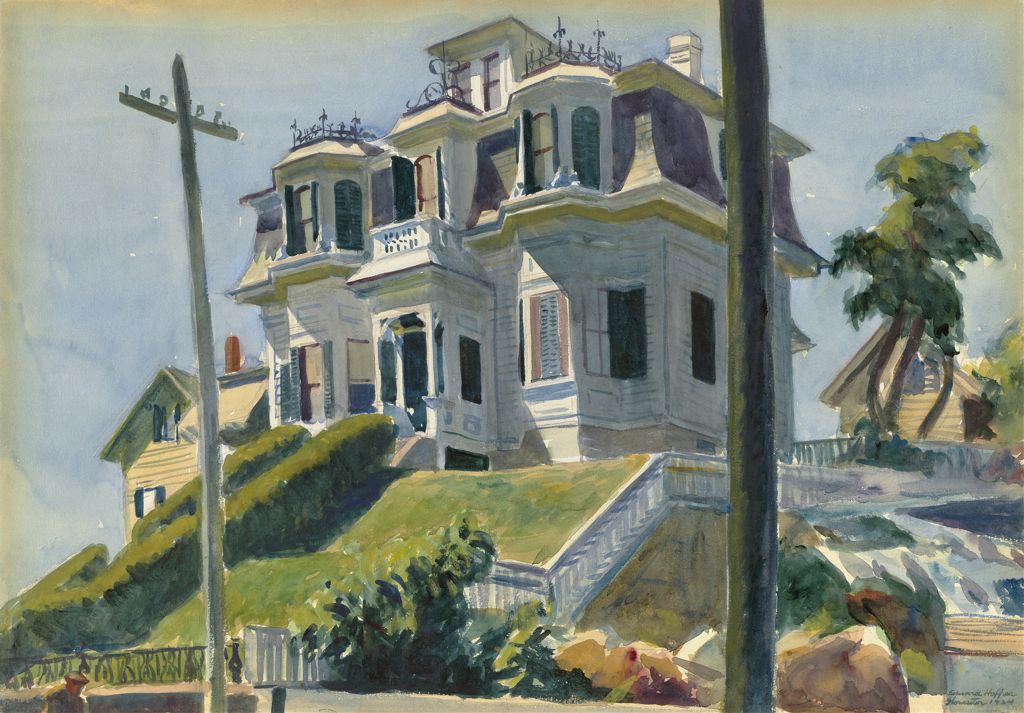
Two utility poles stand between us and an elaborate white house. The nearer pole on the right runs beyond the top of the picture; the slimmer one at the left carries a crossarm against the sky. Between them, bays, shutters, dark roof slopes and delicate ironwork make the building a densely articulated subject. Edward Hopper's Haskell's House combines architectural splendour with the interruptions of an ordinary street view.
Hopper made the work in Gloucester, Massachusetts, in 1924, recording the place and year in the inscription at the lower right. The National Gallery of Art identifies it as watercolour over graphite on paperboard, measuring 34.3 × 49.5 cm. It entered the collection in 1996 as a gift of Herbert A. Goldstone, accession 1996.130.2. [1]
At a Glance
- ArtistEdward Hopper [1]
- Date1924 [1]
- Mediumwatercolour over graphite on paperboard [1]
- Collection / recordNational Gallery of Art [1]
- Accession1996.130.2 [1]
This work across Edward Hopper’s career
American Village
1912Soir Bleu
1914Automat
1927New York Movie
1939Nighthawks
1942Morning Sun
1952Two Comedians
1966Contents
- A house seen from below
- Bays within bays
- The dark roof and its pale edges
- The poles interrupt the view
- Fences, hedges and changing levels
- Watercolour on paperboard
- Bellows, Rehn and the museum history
- Looking back towards the street
- Annotated details
A house seen from below
The ground rises steeply towards the entrance. A bright lawn occupies the lower slope, with clipped-looking hedges on either side of the central approach. At the right, a white fence follows a change of level above a retaining wall. The house is placed well above the street rather than sitting immediately beside the spectator.
That height changes our encounter with its façade. We look up towards the projecting bays and the roof, while the nearer ground conceals parts of the lower structure. The entrance appears at the top of the approach, a dark opening within a narrow porch.
The building is not shown squarely from the front. Its right-hand side extends away from us, and the projecting bay turns into a different light. This oblique view allows the façade to be understood through several connected planes. A purely frontal view would flatten much of that interplay.
The neighbouring houses help establish the terrain. Smaller yellow buildings appear to either side, partly hidden by the slope and main structure. Their fragmentary presence makes the central house look larger without disconnecting it from a populated neighbourhood.
A small figure wearing a hat is cut by the lower-left edge. It is easy to overlook beside the building's detail, yet its scale is useful. The figure belongs to the street level from which we look upwards. Nothing in the picture requires us to identify the person or connect them with the house's ownership.
Bays within bays
The house's projecting windows give the façade an unusually rich sequence of turns. A bay has its own front and angled sides, and each face receives a different amount of light. These smaller planes repeat within the larger body of the house.
The right-hand projection is particularly prominent. Its pale front is accompanied by cooler shaded surfaces, while a strong diagonal shadow crosses part of the lower wall. Above it, a dormer-like group emerges from the dark roof. The building seems to push outwards at several levels.
At the left, another projection answers it without appearing exactly identical. The viewpoint changes the proportions, and the surrounding shutters and shadows produce a different pattern. Repetition makes the façade coherent, while variation gives the eye reasons to move between its parts.
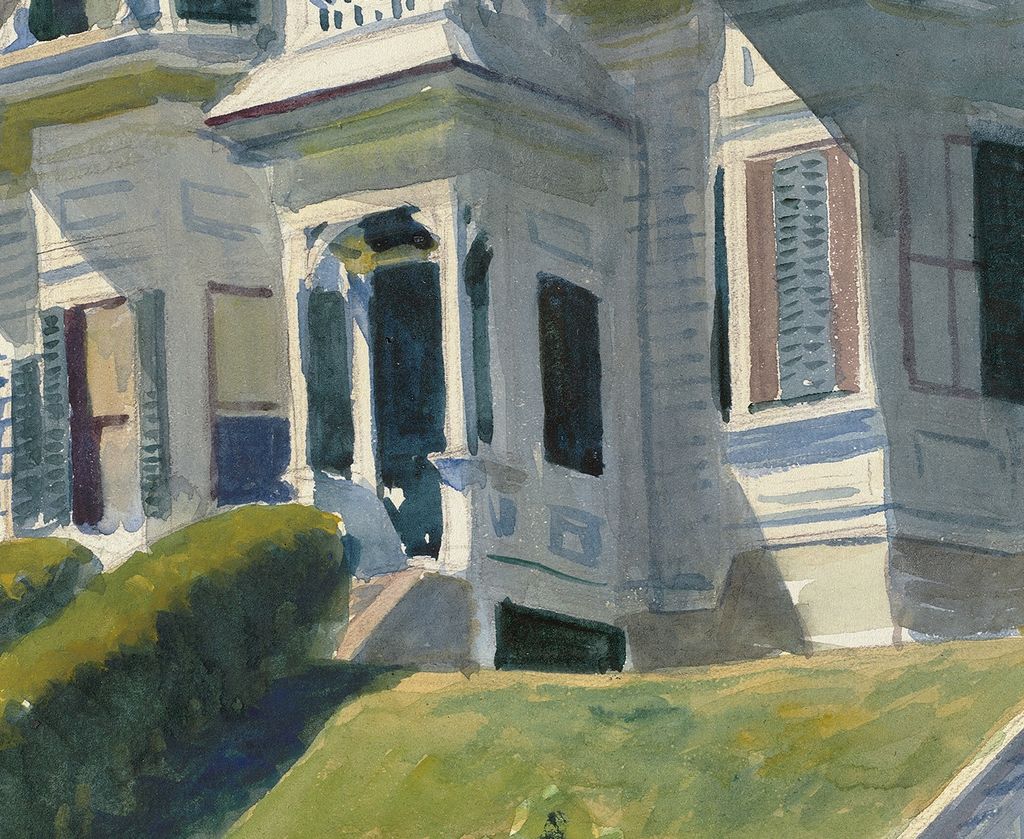
The narrow central entrance offers a quieter interval. Its dark doorway and small porch are held between the broader projections. Above it, further windows and trim continue the upward movement. The building has a discernible centre, though its many projecting forms keep it from feeling simply symmetrical.
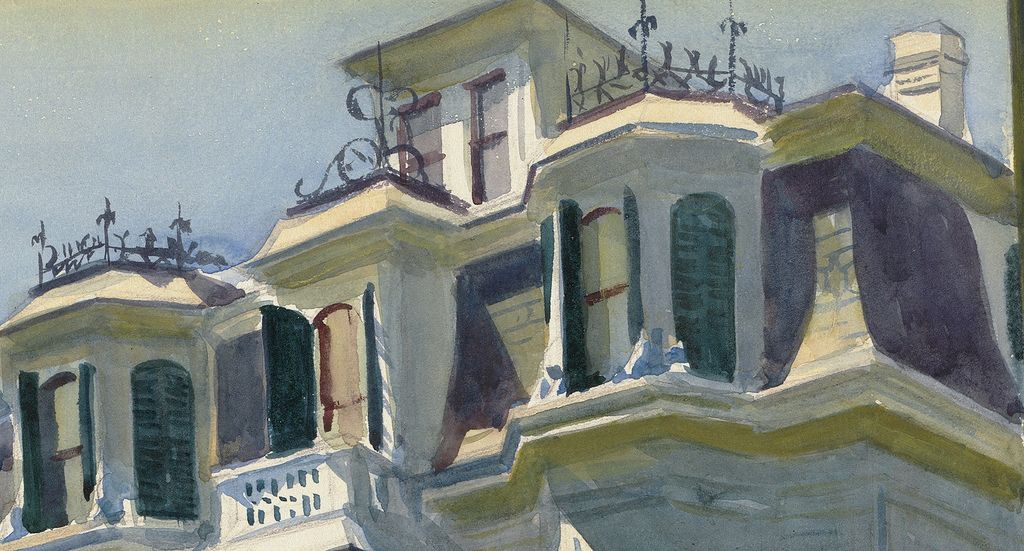
At the highest level, a small rectangular feature and decorative cresting interrupt the roofline. Their thin, dark marks are set against a relatively open sky. This ornamental detail feels particularly delicate after the weight of the bays below.
The dark roof and its pale edges
The mansard roof is one of the work's strongest colour fields. Deep violet, grey and blue tones surround the upper windows, contrasting with the lighter trim and shutters. These dark passages gather the building's many projections into a more continuous upper mass.
Pale cornices repeatedly break that mass. They turn around corners and project above openings, sometimes reading as narrow horizontal bands and sometimes as angled edges. Their brightness makes the construction legible even where the roof itself is dark.
The shutters add a different kind of detail. Several appear green, with small marks suggesting their slatted surfaces. Their upright shapes frame the windows and answer the broader vertical bays. They remain practical attachments as well as elements in a pattern.
Ornament is not confined to the roof. Moulded surrounds and small decorative accents appear around the openings below. Hopper includes enough of them to make the building distinctive, but does not distribute the same degree of detail everywhere. The more open walls and lawn give these concentrated passages room to register.
Local researcher Catherine Ryan reports that Edward and Jo called the building the Wedding Cake House. Her Gloucester catalogue identifies its site near Main and Prospect Streets and distinguishes this 1924 view from the related 1923 Gloucester Mansions. The nickname suits the tiers and elaborate trim, though the work's formal title remains Haskell's House. [2]

Compare: The Mansard Roof, 1923.
The poles interrupt the view
The two poles are conspicuously unequal. The one at the left is relatively slender and ends within the sky, where its crossarm spreads sideways. The one at the right is much broader and continues beyond the picture's upper edge. Its closeness makes it an emphatic dark stripe.
That right-hand pole partly conceals the house. It passes in front of a section of the roof and wall, making the spectator look around it imaginatively. The interruption gives the view the character of a particular position on a street, where objects do not arrange themselves to provide an unobstructed architectural portrait.
The pole also divides the composition. To its left is most of the main house; to its right, a smaller yellow building, a tree, the fence and descending ground open a separate passage. The division is strong, but the continuing surfaces of land and fence connect the two sides.
The slimmer pole has another effect. Its slightly uneven silhouette stands against the sky and partly overlaps the lower left of the architectural group. It frames one side of the house without neatly matching the large upright at the right.
Together, the poles introduce plain utilitarian forms beside the decorative building. We can notice that difference without deciding that the entire picture is a verdict on modernity. Their immediate pictorial role is concrete: they obstruct, frame, divide and help measure the space between the spectator and the house.
Watch: Edward Hopper’s Life and Art
Explore Hopper’s paintings and the places behind them in these museum films. Choose a film below.
Annotated Details from Haskell's House
The numbered points identify visible features discussed in this article. Return from each detail to the whole composition. Haskell's House, 1924
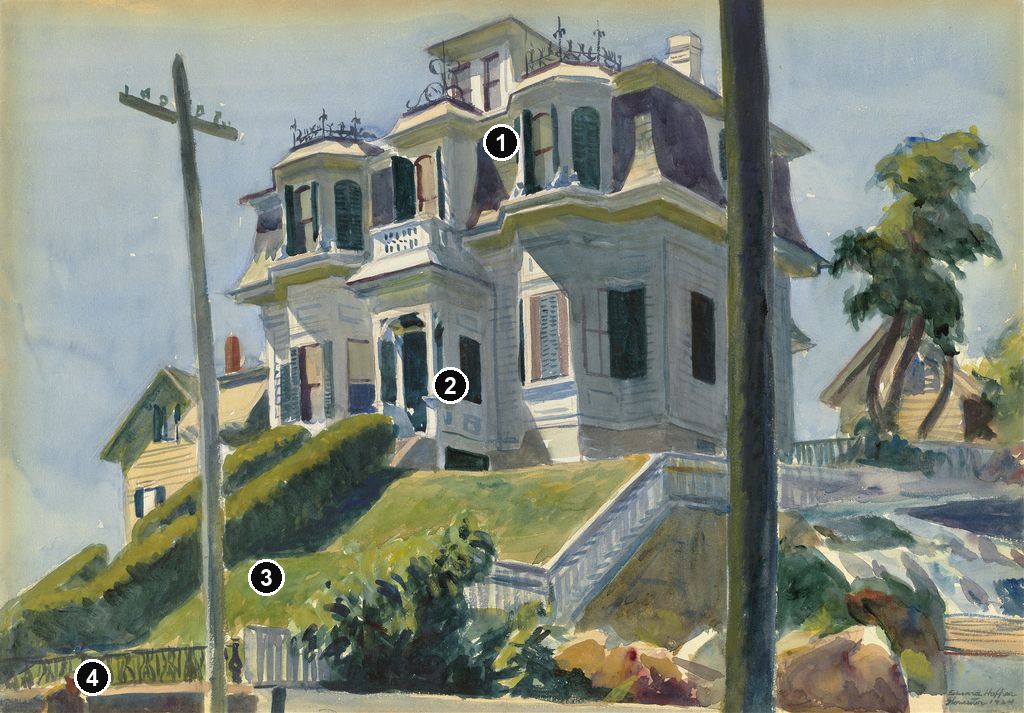
Details from HASKELL'S HOUSE
Compare the cropped details with the complete images above. Notice how their colours, shapes and positions contribute to the larger compositions.
Roofline and cornice
Dormers, railings and projecting cornices break the roof into a sequence of small changes in direction.
The entrance
Steps and a projecting doorway concentrate the building’s geometry near its centre. Lighter and darker washes distinguish adjacent surfaces.
Fence and planted slope
The repeated fence uprights lead across the lower view while plants interrupt their regular rhythm.
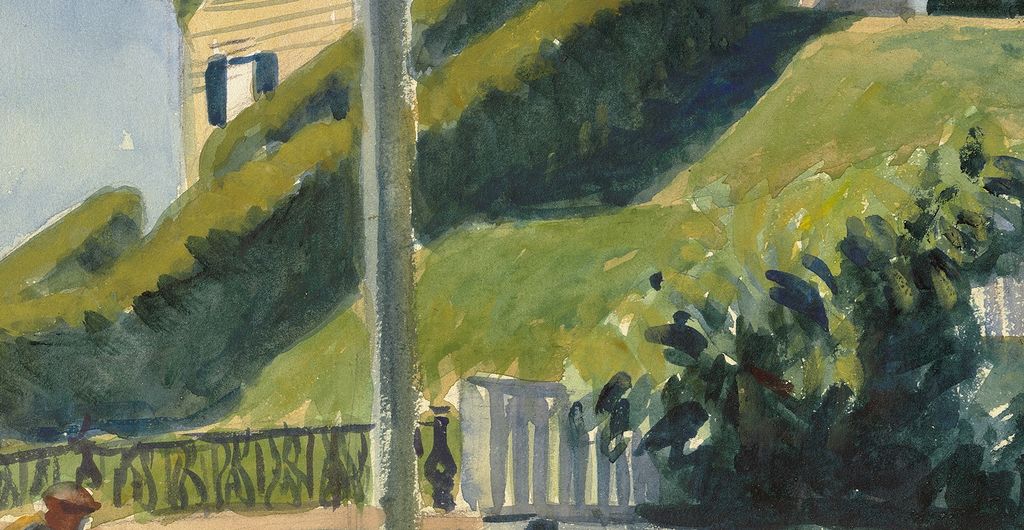
A small figure
A tiny figure near the lower-left edge gives a human scale to the house, fence and slope. It is easy to overlook in a small reproduction.
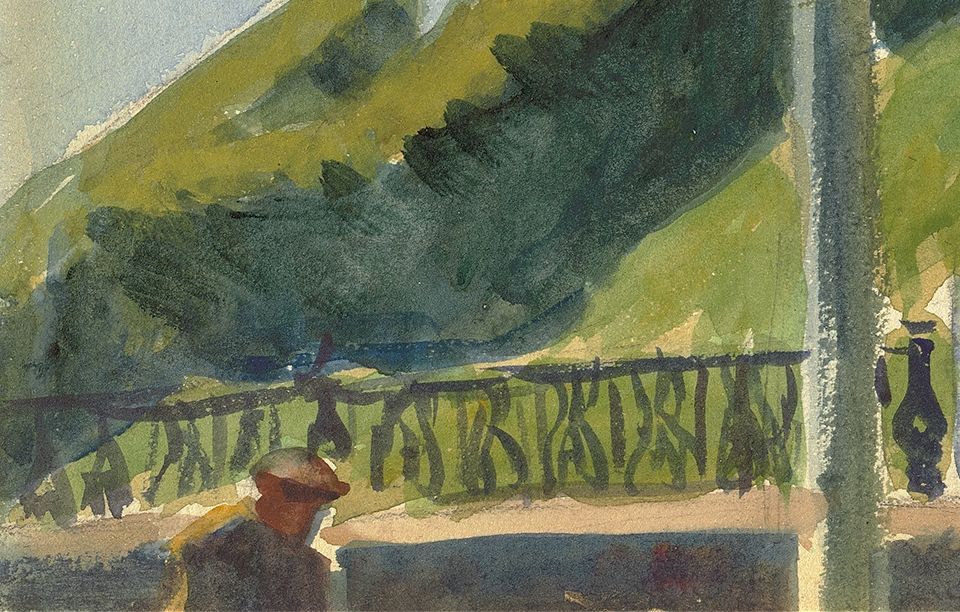
Fences, hedges and changing levels
The white fence deserves a separate look. At the lower right it follows the boundary of the raised ground, its repeated narrow uprights giving the slope a visible measure. A gate-like section turns across the foreground, while the retaining wall beneath establishes a firmer edge.
These lines bring the architectural rhythm into the landscape. The house's repeated windows and shutters are larger and more elaborate; the fence translates repetition into a simpler series. Its changing direction also makes the lie of the ground easier to follow.
The hedges around the approach operate differently. Their rounded forms are fuller and less sharply divided. They make the entrance route apparent without showing every step, and their deep shadows set off the light ground nearby.
At the bottom edge, vegetation breaks into freer marks, with a few warmer passages among the greens. These areas are closer to us and less formally ordered than the house. Their looseness answers the foliage of the tree on the right, bringing the eye back down after its ascent through the roof.
The result is a carefully differentiated foreground. Street, figure, pole, fence, wall, vegetation and raised lawn occupy different distances. The house's prominence depends on that sequence of intervening things.
Watercolour on paperboard
The medium allows extensive variation within a nominally white building. Warm pale washes, cooler shaded areas and much darker accents describe the turning walls. Hopper makes the house bright without leaving it uniformly blank.
Some broad passages show variations within a wash. Other marks are narrow and deliberate, especially around ironwork, shutter slats and window surrounds. The distinction keeps the ornament from looking mechanically inscribed over an inert surface.
The catalogue identifies paperboard as the support and graphite as part of the work. [1] Drawing and colour work together in the finished image, allowing delicate marks to coexist with broad areas of wash.
A dark roof passage, for example, is not merely background behind a dormer. Its shape determines how brightly the pale edge appears. A light wall is similarly defined by the shadow falling across it. Colour and boundary continually help establish one another.

Compare: Adam's House, 1928.
Bellows, Rehn and the museum history
Haskell's House was shown at Frank K. M. Rehn's New York gallery in 1924. The National Gallery's provenance records that it passed through Rehn's gallery to the artist George Bellows, then to Emma Story Bellows, before later ownership by the Goldstones and its acquisition by the National Gallery in 1996. [1]
Bellows's place in that history matters. Another American painter collected this watercolour relatively early in Hopper's public career. The picture's first audiences included fellow artists as well as the wider market developing around his New England work.
The year also brought a personal change. Edward and Jo married in July 1924 and spent their honeymoon in Gloucester. Their return followed the success of the previous summer's watercolours, including The Mansard Roof, acquired by the Brooklyn Museum in 1923. [3] The two Gloucester houses belong to successive summers, with different arrangements of architecture and surroundings.
The National Gallery's exhibition history records the watercolour in the MoMA retrospective of 1933 and the major Hopper exhibition of 2007–08. These appearances brought the Gloucester house before audiences at very different stages in his reputation. [1]
Looking back towards the street
Compared with The Mansard Roof, this house is less dominated by awnings and wind-stirred foliage. Its tiers, bays and decorative roofline receive a more sustained architectural emphasis. The two poles give the view an additional framework, keeping the spectator at the street below.
Adam's House offers another Gloucester encounter between dwelling, fence and utility pole. There, the house stands near the left edge and the view opens towards distant roofs. Haskell's House keeps a more imposing building at the centre, with smaller neighbours appearing around its sides.
The little figure near the lower-left edge remains a useful last point of attention. Its small size brings the architecture's scale back into focus. From that street-level fragment, the eye can climb past the hedges and porch, through the projecting bays, to the thin ironwork against the sky.
Artworks and studies directory
This researched directory includes finished works and separately identified studies. It is not a complete catalogue raisonné. Linked titles open the articles; unlinked studies are identified by their collection accessions. Watercolours retain their recorded media, and original prints remain distinct from reproductions.
| Name | Date | Medium |
|---|---|---|
| (Bridge and Embankment) (70.1298) | 1906 | Oil on wood |
| (Jo Sketching at Good Harbor Beach) (70.1129) | 1923–1924 | Watercolor and fabricated chalk on paper |
| (Manhattan Bridge) (70.1098) | 1925–1926 | Watercolor and graphite pencil on paper |
| (Rooftops) (70.1114) | 1926 | Watercolor and graphite pencil on paper |
| (Seated Male Model, Bent Over) (70.1277) | c. 1902–1903 | Oil on canvas |
| (Self-Portrait) (70.1254) | 1903–1906 | Oil on canvas |
| (Solitary Figure in a Theater) (70.1418) | c. 1902–1904 | Oil on board |
| 5 A.M. | 1937 | oil on canvas |
| Adam's House | 1928 | watercolour and charcoal on paper |
| American Village | 1912 | Oil on canvas |
| Apartment Houses | 1923 | oil on canvas |
| Approaching a City | 1946 | oil on canvas |
| August in the City | 1945 | oil on canvas |
| Automat | 1927 | oil on canvas |
| Barber Shop | 1931 | oil on canvas |
| Blackwell's Island | 1928 | oil on canvas |
| Bridge on the Seine | 1909 | Oil on canvas |
| Bridle Path | 1939 | oil on canvas |
| Burly Cobb's House South Truro | 1930–1933 | oil on canvas |
| Cape Cod Evening | 1939 | oil on canvas |
| Cape Cod Morning | 1950 | oil on canvas |
| Chair Car | 1965 | oil on canvas |
| Chop Suey | 1929 | oil on canvas |
| City Roofs | 1932 | Oil on canvas |
| Coast Guard Station | 1929 | oil on canvas |
| Compartment C, Car 293 | 1938 | oil on canvas |
| Conference at Night | 1949 | oil on canvas |
| Corn Hill | 1930 | oil on canvas |
| Dawn in Pennsylvania | 1942 | oil on canvas |
| Drug Store | 1927 | oil on canvas |
| Early Sunday Morning | 1930 | Oil on canvas |
| East Side Interior (70.1020) | 1922 | Etching |
| East Wind Over Weehawken | 1934 | oil on canvas |
| El Palacio | 1946 | Watercolor and graphite pencil on paper |
| Eleven A.M. | 1926 | oil on canvas |
| Evening Wind | 1921 | etching |
| Excursion into Philosophy | 1959 | oil on canvas |
| First Row Orchestra | 1951 | oil on canvas |
| Freight Car at Truro | 1931 | watercolour over graphite on paper |
| Gas | 1940 | oil on canvas |
| Girl at a Sewing Machine | c. 1921 | oil on canvas |
| Gloucester Harbor | 1912 | Oil on canvas |
| Ground Swell | 1939 | oil on canvas |
| Haskell's House | 1924 | watercolour over graphite on paperboard |
| High Noon | 1949 | oil on canvas |
| Hill and Houses Cape Elizabeth Maine | 1927 | watercolour over graphite pencil |
| Hills South Truro | 1930 | oil on canvas |
| Hotel by a Railroad | 1952 | oil on canvas |
| Hotel Lobby | 1943 | oil on canvas |
| Hotel Room | 1931 | oil on canvas |
| Hotel Window | 1955 | oil on canvas |
| House by the Railroad | 1925 | oil on canvas |
| House by the Squam River | 1926 | watercolour over graphite on paper |
| Le Bistro or The Wine Shop | 1909 | Oil on canvas |
| Le Pont des Arts | 1907 | Oil on canvas |
| Le Pont Royal | 1909 | Oil on canvas |
| Le Quai des Grands Augustins | 1909 | Oil on canvas |
| Lighthouse and Buildings Portland Head | 1927 | watercolour over graphite pencil on paper |
| Lighthouse Hill | 1927 | oil painting |
| Manhattan Bridge Loop | 1928 | oil on canvas |
| Model Sitting | c. 1902 | oil painting; support not asserted |
| Morning Sun | 1952 | oil on canvas |
| New York Movie | 1939 | oil on canvas |
| New York New Haven and Hartford | 1931 | oil on canvas |
| New York Office | 1962 | oil on canvas |
| New York Pavements | 1924–1925 | oil on canvas |
| New York Restaurant | c. 1922 | oil on canvas |
| Night Windows | 1928 | oil on canvas |
| Nighthawks | 1942 | oil on canvas |
| October on Cape Cod | 1946 | oil on canvas |
| Office at Night | 1940 | oil on canvas |
| Office in a Small City | 1953 | oil on canvas |
| Pennsylvania Coal Town | 1947 | oil on canvas |
| People in the Sun | 1960 | oil on canvas |
| Portrait of Orleans | 1950 | oil on canvas |
| Queensborough Bridge | 1913 | Oil on canvas |
| Railroad Sunset | 1929 | Oil on canvas |
| Railroad Train | 1908 | oil on canvas |
| Road in Maine | 1914 | oil on canvas |
| Room in Brooklyn | 1932 | oil on canvas |
| Room in New York | 1932 | oil on canvas |
| Rooms by the Sea | 1951 | oil on canvas |
| Rooms for Tourists | 1945 | oil on canvas |
| Route 6 Eastham | 1941 | oil on canvas |
| Second Story Sunlight | 1960 | Oil on canvas |
| Self-Portrait | 1925–1930 | Oil on canvas |
| Self-Portrait with Hat (70.1903) | c. 1918, posthumous print | Drypoint |
| Seven A.M. | 1948 | Oil on canvas |
| Soir Bleu | 1914 | oil on canvas |
| South Carolina Morning | 1955 | Oil on canvas |
| Stairway at 48 Rue de Lille Paris | 1906 | Oil on wood |
| Study for 5 A.M. (70.153) | 1937 | Fabricated chalk on paper |
| Study for 5 A.M. (70.429) | 1937 | Fabricated chalk and graphite pencil on paper |
| Study for Approaching a City (70.869) | 1946 | Fabricated chalk and charcoal on paper |
| Study for August in the City (70.158a-b) | 1945 | Fabricated chalk on paper |
| Study for August in the City (70.159) | 1945 | Fabricated chalk on paper |
| Study for Bridle Path (70.220) | 1939 | Fabricated chalk on paper |
| Study for Bridle Path (70.235) | 1939 | Fabricated chalk on paper |
| Study for Compartment C, Car 293 (70.430) | 1938 | Fabricated chalk on paper |
| Study for Compartment C, Car 293 (70.431a-b) | 1938 | Fabricated chalk and charcoal on paper |
| Study for Conference at Night (70.170) | 1949 | Fabricated chalk on paper (recto); Typewriter ink on paper (verso) |
| Study for Conference at Night (70.174) | 1949 | Fabricated chalk on paper ( recto); Typewriter ink on paper (verso) |
| Study for East Wind over Weehawken (70.249) | 1934 | Graphite pencil on paper |
| Study for East Wind over Weehawken (70.252) | 1934 | Fabricated chalk and charcoal on paper |
| Study for Evening Wind (70.343a-b) | 1921 | Fabricated chalk on paper |
| Study for First Row Orchestra (70.841) | 1951 | Fabricated chalk and charcoal on paper |
| Study for Gas (70.263) | 1940 | Fabricated chalk on paper |
| Study for Ground Swell (70.339) | 1939 | Fabricated chalk, charcoal and graphite pencil on paper |
| Study for Hotel by a Railroad (70.199) | 1952 | Fabricated chalk on paper |
| Study for Hotel by a Railroad (70.427) | 1952 | Fabricated chalk on paper |
| Study for Hotel by a Railroad (70.428) | 1952 | Fabricated chalk on paper |
| Study for Hotel Lobby (70.117) | 1942 | Fabricated chalk and graphite pencil on paper |
| Study for Hotel Lobby (70.839) | 1942 | Fabricated chalk and charcoal on paper |
| Study for Hotel Window (70.161) | 1955 | Fabricated chalk, graphite pencil and colored pencil on paper |
| Study for Morning Sun (70.243) | 1952 | Fabricated chalk on paper |
| Study for Morning Sun (70.244) | 1952 | Fabricated chalk on paper |
| Study for Morning Sun (70.290) | 1952 | Fabricated chalk on paper |
| Study for Morning Sun (70.291) | 1952 | Fabricated chalk and graphite pencil on paper |
| Study for New York Movie (70.273) | 1939 | Fabricated chalk on paper |
| Study for New York Movie (70.274a-b) | 1938 or 1939 | Fabricated chalk and charcoal on paper (recto); Fabricated chalk on paper (verso) |
| Study for New York Movie (70.455) | 1939 | Fabricated chalk and charcoal on paper |
| Study for New York Office (70.822) | 1962 | Fabricated chalk on paper |
| Study for Nighthawks (70.192) | 1941 or 1942 | Fabricated chalk on paper |
| Study for Nighthawks (70.193) | 1941 or 1942 | Fabricated chalk on paper |
| Study for Office at Night (70.340) | 1940 | Fabricated chalk and charcoal on paper |
| Study for Office at Night (70.341) | 1940 | Fabricated chalk and graphite pencil on paper |
| Study for Pennsylvania Coal Town (70.198) | 1947 | Fabricated chalk on paper |
| Study for Pennsylvania Coal Town (70.229) | 1947 | Fabricated chalk and charcoal on paper |
| Study for Rooms for Tourists (70.438) | 1945 | Fabricated chalk and charcoal on paper |
| Study for Rooms for Tourists (70.848) | 1945 | Fabricated chalk and charcoal on paper |
| Study for Route 6, Eastham (70.369) | 1941 | Fabricated chalk and graphite pencil on paper |
| Study for Route 6, Eastham (70.854) | 1941 | Fabricated chalk and graphite pencil on paper |
| Study for South Carolina Morning (70.162a-b) | 1955 | Fabricated chalk on paper (recto and verso) |
| Study for The Sheridan Theatre (70.969) | 1937 | Graphite pencil on paper |
| Study for Two on the Aisle (70.128) | 1927 | Fabricated chalk on paper |
| Study for Two on the Aisle (70.129) | 1927 | Fabricated chalk on paper |
| Study for Yawl Riding a Swell (70.439) | 1935 | Fabricated chalk and graphite pencil on paper |
| Summer Evening | 1947 | oil on canvas |
| Summer Interior | 1909 | Oil on canvas |
| Sun in an Empty Room | 1963 | oil on canvas |
| Sunlight in a Cafeteria | 1958 | oil on canvas |
| Sunlight on Brownstones | 1956 | oil on canvas |
| Tables for Ladies | 1930 | oil on canvas |
| The Bootleggers | 1925 | oil on canvas |
| The Camel's Hump | 1931 | oil on canvas |
| The Circle Theatre | 1936 | oil on canvas |
| The City | 1927 | oil on canvas |
| The Lighthouse at Two Lights | 1929 | oil on canvas |
| The Long Leg | 1935 | oil on canvas |
| The Mansard Roof | 1923 | watercolour over graphite on paper |
| The Sheridan Theatre | 1937 | oil on canvas |
| Tramp Steamer | 1908 | oil on canvas |
| Two Comedians | 1966 | oil on canvas |
| Two on the Aisle | 1927 | oil on canvas |
| Valley of the Seine | 1909 | Oil on canvas |
| Western Motel | 1957 | oil on canvas |
Frequently Asked Questions
Edward Hopper made Haskell's House in 1924. [1]
The recorded medium is watercolour over graphite on paperboard. [1]
Two utility poles stand between us and an elaborate white house. The nearer pole on the right runs beyond the top of the picture; the slimmer one at the left carries a crossarm against the sky. Between them, bays, shutters, dark roof slopes and delicate ironwork make the building a densely articulated subject. Edward Hopper's Haskell's House combines architectural splendour with the interruptions of an ordinary street view.
Discussion
Look again at the images and ideas explored in Haskell's House. These editorial prompts invite your observations.
Reader Insights
Which boundary, gesture or change of light first holds your attention in Haskell's House?
Compare The Mansard Roof with Haskell's House. Which visual difference matters most to your reading?
Which detail would you look at again after reading “The dark roof and its pale edges”?
Join the Conversation
Share a detail, comparison or question about Haskell's House below.
References
- National Gallery of Art, Haskell's House, 1924, accession 1996.130.2; current medium, dimensions, inscription, provenance and exhibition history. View source.
- Catherine Ryan, Edward Hopper All Around Gloucester, entries 1–2, identifying the house, reporting the Wedding Cake House nickname and distinguishing Gloucester Mansions, 1923. View source.
- Art Institute of Chicago, Edward Hopper: Selected Chronology, entries for 1923 and 1924. View source.
- Collection or catalogue record, American Village, 1912; medium and identity as discussed in the linked article. View source.
- Collection or catalogue record, Soir Bleu, 1914; medium and identity as discussed in the linked article. View source.
- Collection or catalogue record, House by the Railroad, 1925; medium and identity as discussed in the linked article. View source.
- Collection or catalogue record, Automat, 1927; medium and identity as discussed in the linked article. View source.
- Collection or catalogue record, Early Sunday Morning, 1930; medium and identity as discussed in the linked article. View source.
- Collection or catalogue record, New York Movie, 1939; medium and identity as discussed in the linked article. View source.
- Collection or catalogue record, Nighthawks, 1942; medium and identity as discussed in the linked article. View source.
- Collection or catalogue record, Morning Sun, 1952; medium and identity as discussed in the linked article. View source.
- Collection or catalogue record, Second Story Sunlight, 1960; medium and identity as discussed in the linked article. View source.
- Collection or catalogue record, Two Comedians, 1966; medium and identity as discussed in the linked article. View source.
- Whitney Museum of American Art, Study for Route 6, Eastham, 1941, accession 70.854; exact object record. View source.
- Whitney Museum of American Art, Study for Conference at Night, 1949, accession 70.170; exact object record. View source.
- Whitney Museum of American Art, Study for First Row Orchestra, 1951, accession 70.841; exact object record. View source.
- Whitney Museum of American Art, (Bridge and Embankment), 1906, accession 70.1298; exact object record. View source.
- Whitney Museum of American Art, (Seated Male Model, Bent Over), c. 1902–1903, accession 70.1277; exact object record. View source.
- Whitney Museum of American Art, Study for Morning Sun, 1952, accession 70.244; exact object record. View source.
- Whitney Museum of American Art, Study for Morning Sun, 1952, accession 70.243; exact object record. View source.
- Whitney Museum of American Art, Study for Two on the Aisle, 1927, accession 70.128; exact object record. View source.
- Whitney Museum of American Art, Study for New York Office, 1962, accession 70.822; exact object record. View source.
- Whitney Museum of American Art, Study for Two on the Aisle, 1927, accession 70.129; exact object record. View source.
- Whitney Museum of American Art, Study for Pennsylvania Coal Town, 1947, accession 70.229; exact object record. View source.
- Whitney Museum of American Art, (Rooftops), 1926, accession 70.1114; exact object record. View source.
- Whitney Museum of American Art, Study for South Carolina Morning, 1955, accession 70.162a-b; exact object record. View source.
- Whitney Museum of American Art, (Self-Portrait), 1903–1906, accession 70.1254; exact object record. View source.
- Whitney Museum of American Art, (Manhattan Bridge), 1925–1926, accession 70.1098; exact object record. View source.
- Whitney Museum of American Art, (Solitary Figure in a Theater), c. 1902–1904, accession 70.1418; exact object record. View source.
- Whitney Museum of American Art, Study for Approaching a City, 1946, accession 70.869; exact object record. View source.
- Whitney Museum of American Art, Study for August in the City, 1945, accession 70.159; exact object record. View source.
- Whitney Museum of American Art, Study for Compartment C, Car 293, 1938, accession 70.430; exact object record. View source.
- Whitney Museum of American Art, Study for Compartment C, Car 293, 1938, accession 70.431a-b; exact object record. View source.
- Whitney Museum of American Art, Study for East Wind over Weehawken, 1934, accession 70.252; exact object record. View source.
- Whitney Museum of American Art, Study for East Wind over Weehawken, 1934, accession 70.249; exact object record. View source.
- Whitney Museum of American Art, Study for Evening Wind, 1921, accession 70.343a-b; exact object record. View source.
- Whitney Museum of American Art, Study for The Sheridan Theatre, 1937, accession 70.969; exact object record. View source.
- Whitney Museum of American Art, Study for New York Movie, 1939, accession 70.455; exact object record. View source.
- Whitney Museum of American Art, Study for New York Movie, 1939, accession 70.273; exact object record. View source.
- Whitney Museum of American Art, Study for New York Movie, 1938 or 1939, accession 70.274a-b; exact object record. View source.
- Whitney Museum of American Art, Study for 5 A.M., 1937, accession 70.153; exact object record. View source.
- Whitney Museum of American Art, Study for 5 A.M., 1937, accession 70.429; exact object record. View source.
- Whitney Museum of American Art, (Jo Sketching at Good Harbor Beach), 1923–1924, accession 70.1129; exact object record. View source.
- Whitney Museum of American Art, Study for August in the City, 1945, accession 70.158a-b; exact object record. View source.
- Whitney Museum of American Art, Study for Morning Sun, 1952, accession 70.291; exact object record. View source.
- Whitney Museum of American Art, Study for Morning Sun, 1952, accession 70.290; exact object record. View source.
- Whitney Museum of American Art, Study for Office at Night, 1940, accession 70.340; exact object record. View source.
- Whitney Museum of American Art, Study for Office at Night, 1940, accession 70.341; exact object record. View source.
- Whitney Museum of American Art, Study for Hotel by a Railroad, 1952, accession 70.427; exact object record. View source.
- Whitney Museum of American Art, Study for Hotel by a Railroad, 1952, accession 70.199; exact object record. View source.
- Whitney Museum of American Art, Study for Hotel by a Railroad, 1952, accession 70.428; exact object record. View source.
- Whitney Museum of American Art, Study for Hotel Lobby, 1942, accession 70.117; exact object record. View source.
- Whitney Museum of American Art, Study for Hotel Lobby, 1942, accession 70.839; exact object record. View source.
- Whitney Museum of American Art, Study for Conference at Night, 1949, accession 70.174; exact object record. View source.
- Whitney Museum of American Art, Study for Hotel Window, 1955, accession 70.161; exact object record. View source.
- Whitney Museum of American Art, Study for Pennsylvania Coal Town, 1947, accession 70.198; exact object record. View source.
- Whitney Museum of American Art, Study for Route 6, Eastham, 1941, accession 70.369; exact object record. View source.
- Whitney Museum of American Art, Study for Bridle Path, 1939, accession 70.220; exact object record. View source.
- Whitney Museum of American Art, Study for Bridle Path, 1939, accession 70.235; exact object record. View source.
- Whitney Museum of American Art, Study for Ground Swell, 1939, accession 70.339; exact object record. View source.
- Whitney Museum of American Art, Study for Yawl Riding a Swell, 1935, accession 70.439; exact object record. View source.
- Whitney Museum of American Art, Study for Rooms for Tourists, 1945, accession 70.848; exact object record. View source.
- Whitney Museum of American Art, Study for Rooms for Tourists, 1945, accession 70.438; exact object record. View source.
- Whitney Museum of American Art, Study for Nighthawks, 1941 or 1942, accession 70.193; exact object record. View source.
- Whitney Museum of American Art, Study for Nighthawks, 1941 or 1942, accession 70.192; exact object record. View source.
- Whitney Museum of American Art, Study for Gas, 1940, accession 70.263; exact object record. View source.
- Whitney Museum of American Art, Self-Portrait with Hat, c. 1918, posthumous print, accession 70.1903; exact object record. View source.
- Whitney Museum of American Art, East Side Interior, 1922, accession 70.1020; exact object record. View source.
- Art Institute of Chicago, Selected Chronology for Edward Hopper; training, travels, exhibitions, New York and Truro chronology. View source.
- Emily C. Burns, Spectral figures: Edward Hopper’s empty Paris, chapter 5 in Empty Spaces: Confronting Emptiness in National, Cultural and Urban Histories, 2019; complete chapter and notes consulted. View source.
- Charles Brock, Regionalism and Folk Art, National Gallery of Art; complete essay and two notes consulted. View source.


