 by Tom Gurney
Tom Gurney BSc (Hons) is an art history expert with over 20 years experience
Email: tomgurney1@gmail.com / Phone: +44 7429 011000
Second Story Sunlight: Introduction
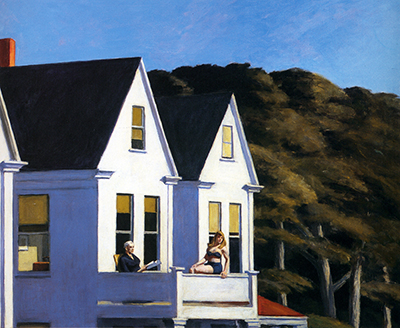
Two white gables rise against a blue sky. Beneath them, two women occupy a small outdoor space above street level: one holds a newspaper, while the other sits near the balcony's outer edge in a bathing suit. Dark woodland presses close behind the houses. Edward Hopper's Second Story Sunlight makes these human positions part of a larger arrangement of bright walls, steep roofs and shadow.
The Whitney Museum of American Art records the work as a 1960 oil on canvas, 102.1 × 127.3 cm, accession 60.54, purchased with funds from the Friends of the Whitney Museum of American Art. [1] Its title directs attention upwards, towards a domestic level where people and architecture are unusually exposed to the light.
At a Glance
- ArtistEdward Hopper [1]
- Date1960 [1]
- MediumOil on canvas [1]
- Collection / recordWhitney Museum of American Art [1]
- Accession60.54 [1]
This work across Edward Hopper’s career
American Village
1912Soir Bleu
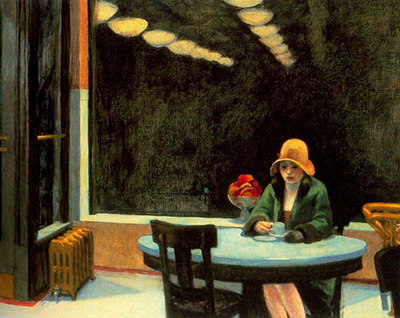
1914Automat
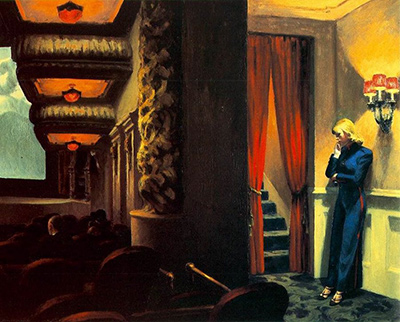
1927New York Movie
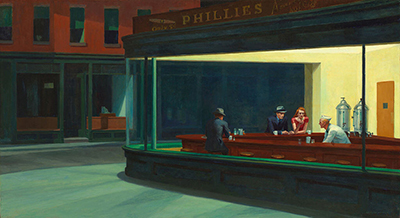
1939Nighthawks
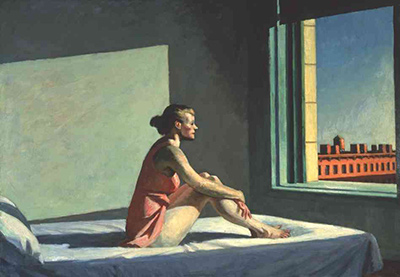
1942Morning Sun
1952Two Comedians
1966Contents
- Gables before faces
- Hopper on painting white sunlight
- Two women at different positions
- Sitting back and sitting at the edge
- The newspaper as a pale shape
- Light on the white walls
- Yellow shades and unequal openings
- A red chimney and a red roof
- The wood beyond the houses
- A balcony without a visible approach
Gables before faces
The two main roof triangles are among the first shapes we notice. Their dark slopes meet the lighter upright ends of the houses, giving each building a distinct silhouette. A fragment of another gable appears at the left edge, suggesting that the row continues beyond the selected view.
The paired forms are similar without being identical in their position. One stands nearer and larger; the other appears further to the right. Their overlap establishes a relationship in depth while allowing both triangular outlines to remain clear.
Each gable contains a narrow upper window. These small rectangles interrupt broad pale wall areas, making the architecture seem inhabited even above the two visible figures. Yellowish coverings add a warmer note within the white facades.
The dark roofs have a different weight from the walls. Their relatively continuous colour creates firm caps above surfaces that catch much stronger light. Hopper uses that distinction to make the buildings legible as volumes rather than as two flat white triangles.
The crop changes the usual presentation of a house. We do not begin at the pavement and follow a path towards a door. The lower buildings are cut off, bringing the second-storey space close to the spectator and giving the roofs an unusually prominent share of attention.
Hopper on painting white sunlight
In a conversation with Brian O'Doherty transcribed by the Whitney, Hopper described his particular aim in Second Story Sunlight: he wanted the light to have a white quality, rather than the yellow often used to represent sunshine. He qualified the distinction by allowing for the yellower light of early and late parts of the day. [2] This is a painter discussing the appearance he sought in a specific work.
The statement directs us towards the largest lit passages. The white gable ends are not merely neutral supports for the figures. Their brightness is an important subject in itself, given definition by the darker roofs, the blue-grey areas and the vegetation behind them.
The yellow shades make that aim more interesting. Warm colour remains clearly visible inside the window openings, but it does not spread across every sunlit surface. The picture distinguishes between the colour of an object in a window and the impression of illumination on the surrounding wall.
Nor does white light require a uniform white facade. The nearer house changes markedly as it turns away from direct illumination. Cooler passages around the lower windows and balcony help the brightest wall retain its force. The light becomes convincing through the relation between surfaces rather than through a single colour applied everywhere.
Hopper's account offers an alternative starting point to the figures' imagined relationship. A spectator can notice an age difference immediately and begin inventing a shared history. Beginning with the white wall reveals another substantial purpose: a domestic building has become a means of giving light a particular presence.
Two women at different positions
The older-looking woman sits towards the left, wearing dark clothing and holding a light newspaper. Her pale head and the paper stand out against the darker opening behind her. The surrounding architecture frames her within a comparatively narrow interval.
The other woman sits further right in a bathing suit. More of her body is exposed to the light, and her position close to the outer rail gives her a different relationship to the open air. She is less enclosed by a dark window recess than her companion.
The Fondation Beyeler's 2020 guide describes one woman sunbathing and the other momentarily lowering her newspaper to enjoy the light. [3] That reading connects their different activities through the same environmental condition rather than assigning them a detailed shared story.
Their proximity does not settle their relationship. The painting supplies no identifying names, conversation or event that would establish whether they are relatives, friends or neighbours. The difference in apparent age is visible; a particular family history is not.
Their contrasting clothing also works pictorially. Dark fabric makes one figure a compact mass, while the bathing suit allows the other body's warmer tones to remain conspicuous. Hopper gives the two people different visual weights within a similarly bright architectural setting.
Sitting back and sitting at the edge
The woman in dark clothing occupies a relatively recessed position. Her head rises above the newspaper, but the shaded opening and pale vertical boundaries hold her within a compact area. The paper's extension is one of the few elements that reaches out from that small enclosure.
The sunbather's posture is more exposed. Her seated body belongs near the outer edge, with a bent arm lifting a hand towards her head. The warm bare limbs provide a different sort of contour from the straight architecture. The figure remains small in the canvas, yet her position makes her seem closer to the open air.
Looking at the bodies before assigning them characters reveals two practical uses of the same architectural level. One position accommodates holding and reading a sheet; the other allows the body to receive light more directly. The clothing and posture make those uses distinct even without a conversation between the women.
The railing connects them while also making their difference visible. It provides a horizontal boundary in front of the more sheltered figure and a place near which the sunbather sits. Its top edge gives the eye a route from one person towards the other, then back into the surrounding divisions of the house.
That route is more complicated than a simple opposition between contentment and restlessness. The reader can look up, and a person sitting in the sun can remain still. Hopper has selected positions that make several possibilities imaginable while giving both bodies a firm place in the architecture.
The newspaper as a pale shape
The newspaper is a small but useful detail. Its light area interrupts the darker clothing and helps distinguish the seated woman's hands and posture. It provides an activity without making a readable headline the subject.
Its angle differs from the more rigid window frames nearby. The sheet belongs to something being held, capable of moving or being lowered, while the surrounding uprights remain fixed. A modest change of direction brings human handling into the geometry.
The paper also separates looking down to read from looking out into the sunlight. Even if the precise moment remains open, it supplies an alternative focus of attention within the same space. The balcony contains more than one way of occupying a quiet interval.
Nothing requires both women to share the same thoughts. Their bodies are near one another, but the painting allows their attention to remain distinct. The newspaper gives that distinction a concrete object rather than a purely psychological explanation.
Light on the white walls
The facade contains several kinds of brightness. Broad white areas receive direct light, while cooler blue-grey passages mark surfaces turned away from it. These changes give the facade depth even where its divisions are strongly outlined.
The tall lower windows make those changes more complex. Their dark glass or interiors create narrow recesses within the pale wall, while yellow shades occupy parts of the openings. Light does not erase the building's divisions; it makes some especially clear.
The balcony's horizontal edges provide another rhythm beneath the roofs. Their flatter lines contrast with the steep upper slopes, giving the figures a more stable place within the architecture. People sit along a relatively level band beneath a sequence of triangles.
The pale walls make the limited areas of warm skin, dark fabric and yellow shade especially conspicuous.
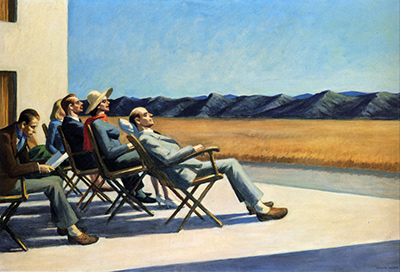
Compare: People in the Sun, 1960.
Yellow shades and unequal openings
The windows introduce smaller variations within the repeated gable forms. Their yellow coverings occupy only part of the dark openings, leaving bands or patches through which the interior appears more deeply shaded. The effect is especially clear when we compare the upper windows with those closer to the women.
A shade is a modest object with a consequential visual role. It can regulate light within a house, but from outside it also becomes a coloured rectangle. Hopper uses both possibilities: we understand a practical fitting and see an emphatic warm mark set into a bright wall.
The upper openings are particularly concentrated. Each sits within a broad triangle and can therefore seem more insistent than its small size would predict. Lower down, the wall contains several competing divisions and the people themselves. The same basic shape has a different force according to what surrounds it.
This is one reason the paired houses can seem to possess character without turning literally into faces. Repeated windows offer a point of comparison, while changes in height, shadow and exposure prevent perfect symmetry. The architecture can appear watchful or inward without needing those impressions to become a fixed symbolic code.
A red chimney and a red roof
Two red passages interrupt the dominant white, blue and dark green. A chimney appears near the upper left, while a small roof shape enters near the lower right. Their distance from one another gives the colour a route across the composition.
The chimney is an upright architectural accent, cut close to the picture's edge. The lower roof is more oblique and partly hidden. Their different shapes keep the correspondence from becoming a simple repeated symbol.
Brian O'Doherty, Hopper's friend and a later interpreter of the painting, draws attention to this relationship in the Whitney's commentary. He also emphasizes the paired gables, their windows and the two people below. [1] His account helps direct the eye towards connections spread across the whole canvas.
The red accents matter even if we do not begin by noticing them. They keep the architecture from being entirely absorbed into a pattern of white walls and black roofs. Small warm interruptions can affect a much larger arrangement.
The wood beyond the houses
At the right, the trees form a dense, irregular mass. Their foliage rises behind the gables, while darker trunks become visible lower down. The woodland has a layered texture quite different from the buildings' broad planes.
The contrast gives the white architecture a sharper presence. Pale edges become especially clear where they meet the dark growth, and the roofs remain distinct through their firmer triangular shapes. Houses and trees occupy adjacent spaces without sharing the same kind of order.
The wood also limits the view. There is no broad distant panorama behind the women; vegetation rises close to their setting. The small balcony offers open air while remaining beside a substantial, less penetrable mass.
The blue sky supplies a different kind of openness above. Its comparatively clear field makes the gable silhouettes emphatic, separating the roofs from the more intricate foliage. The picture holds together several scales of space: balcony, house, wooded bank and sky.
Watch: Edward Hopper’s Life and Art
Explore Hopper’s paintings and the places behind them in these museum films. Choose a film below.
A balcony without a visible approach
The painting gives us the upper level of a house while cutting away most of the route by which someone would reach it. There is no complete entrance sequence from street to front door, staircase and balcony. The two women are already in place when our view begins.
This omission changes the force of the foreground. We cannot treat it as a path along which to approach the people. Instead, the near architecture rises as a partially cropped object, and the small outside platform becomes a destination visible from a separate position.
The neighbouring gable makes that separation more complex. Its receding scale establishes depth, yet the succession of pointed roofs also creates a strong pattern across the canvas. The eye can move between houses through their repeated shapes without reconstructing a precise plan of all the rooms below.
The title gives the elevated level a specific importance. We are looking at sunlight on an upper domestic storey, where a newspaper and a bathing suit bring ordinary use into a view dominated by roofs. The building is neither an isolated architectural specimen nor simply a backdrop behind a pair of portraits.
The absent approach also helps explain why the scene can feel unusually held in place. We see people who must have arrived at their positions through everyday actions, but those actions have no depicted route. Their current places are clear; the movements connecting them to the rest of the house are left outside the composition.
Model and painted character
Gail Levin's general account of Jo Hopper's modelling helps distinguish a sitter from a painted character. She explains how Hopper transformed Jo's appearance to supply different ages, shapes and characters. [4]
The distinction allows us to look at the women as people constructed for the painting's situation. Their apparent age, dress and posture can differ even when an artist draws on familiar observations in the studio. A model supplies information; the finished character belongs to the picture's selected arrangement.
This matters especially in a composition with two women of different apparent ages. Their contrast can organize the balcony visually without demonstrating a particular episode from the Hoppers' marriage or family life. The architecture provides their shared setting, while the painting leaves their personal connection open.
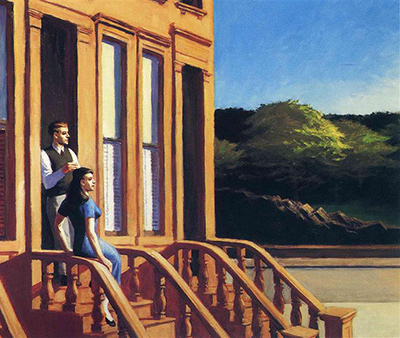
Compare: Sunlight on Brownstones, 1956.
Names in the record book
Robert Hobbs's 1987 account transmits a record-book description that characterises the white-haired woman as elderly and Gothic and calls the younger figure “Toots.” He places the entry among other examples of the Hoppers giving their painted people invented identities. [5] Such names belong to the construction and discussion of characters, rather than identifying two independently documented residents of a house.
This written play adds a useful complication to the painting's apparent reserve. An image can leave the public uncertain about its people even when its makers have tried out a name or a description in private. The small figures need not have been conceived as wholly anonymous arrangements of paint.
At the same time, the record does not make the older woman the younger one's mother, landlady or future self. Those relationships require information beyond the transmitted entry. What the description establishes is a contrast in character and appearance that could be developed through pose and dress.
The difference between naming and narrating is important here. A nickname makes a figure easier to discuss while leaving much of a life unspecified. The painting continues to place its strongest emphasis on how each person occupies the light, the recess and the edge of the outdoor space.
A friend's reading of a late painting
O'Doherty calls attention to the scene's uncanny atmosphere and the force of its upper windows. In his account, architectural openings can seem as charged with character as the figures themselves. He also recalls Hopper answering a question about what he sought in his work by pointing back to himself. [1]
The recollection is an interpretation offered by someone who knew the artist. It does not provide a single explanation for every figure or shadow. Its value lies partly in redirecting attention from a guessed balcony story towards Hopper's larger investment in buildings, people, woods and light.
The painting's 1960 date places it late in his career. Its recognizable domestic forms remain carefully controlled, while the strong simplification of roofs, walls and openings gives the scene a striking overall clarity. Ordinary subject matter sustains a substantial arrangement of shapes.
Youth and age in a later interpretation
Hobbs also gives the two women a more explicit psychological reading. He describes the younger figure as eager to participate in life beyond the balcony and the older woman as more willing to remain a spectator. [5] This is a critic's interpretation of their contrasting positions, not a statement that the canvas supplies their thoughts.
The visible setting gives that reading some of its appeal. The sunbather sits closer to an exposed edge, while the reader is more sheltered. A difference in place can readily become a difference in attitude when we attach human expectations to the bodies.
Yet the same details can support attention to immediate bodily comfort. Shade, a seat, an object held for reading and sunlight on exposed skin are all present conditions, independently of a larger allegory about stages of life. The picture's interest comes partly from how closely these practical and imaginative accounts remain connected.
Hopper's own emphasis on the colour of sunlight does not forbid the psychological response. It changes the balance of evidence. We have an artist's declared pictorial aim alongside a later writer's account of what the figures might suggest. Allowing them to remain distinct gives the painting more room than asking either to settle every aspect of the scene.
The wood contributes to that openness. Its dense, irregular masses can be felt as a threat, a shelter or simply a dark setting against which the house becomes intensely bright. The distinction between foliage and roof is visible; the feeling attached to that contrast belongs to the encounter between picture and spectator.
Other places to sit in the sun
Sunlight on Brownstones places two figures on a stoop nearer the street. Its curved rails give their setting a different movement from the steeper gables and broad balcony edge here.
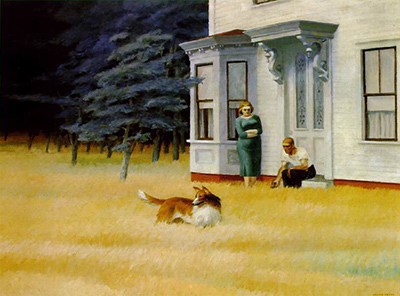
Cape Cod Morning keeps one woman within a projecting window, leaning towards the outside. Second Story Sunlight opens the domestic setting more fully, allowing two distinct positions within the light.
People in the Sun extends the subject into a group seated before a broad landscape. The balcony picture remains closer to the buildings, with the woods limiting the view and the roofs dominating above.
Follow the edge of one white gable towards its small yellow window, then down to the newspaper and across to the woman in the bathing suit. The picture joins those different scales without making any one of them explain the rest. Sunlight connects the architecture and its occupants while preserving their separate forms.
Artworks and studies directory
This researched directory includes finished works and separately identified studies. It is not a complete catalogue raisonné. Linked titles open the articles; unlinked studies are identified by their collection accessions. Watercolours retain their recorded media, and original prints remain distinct from reproductions.
| Name | Date | Medium |
|---|---|---|
| (Bridge and Embankment) (70.1298) | 1906 | Oil on wood |
| (Jo Sketching at Good Harbor Beach) (70.1129) | 1923–1924 | Watercolor and fabricated chalk on paper |
| (Manhattan Bridge) (70.1098) | 1925–1926 | Watercolor and graphite pencil on paper |
| (Rooftops) (70.1114) | 1926 | Watercolor and graphite pencil on paper |
| (Seated Male Model, Bent Over) (70.1277) | c. 1902–1903 | Oil on canvas |
| (Self-Portrait) (70.1254) | 1903–1906 | Oil on canvas |
| (Solitary Figure in a Theater) (70.1418) | c. 1902–1904 | Oil on board |
| 5 A.M. | 1937 | oil on canvas |
| Adam's House | 1928 | watercolour and charcoal on paper |
| American Village | 1912 | Oil on canvas |
| Apartment Houses | 1923 | oil on canvas |
| Approaching a City | 1946 | oil on canvas |
| August in the City | 1945 | oil on canvas |
| Automat | 1927 | oil on canvas |
| Barber Shop | 1931 | oil on canvas |
| Blackwell's Island | 1928 | oil on canvas |
| Bridge on the Seine | 1909 | Oil on canvas |
| Bridle Path | 1939 | oil on canvas |
| Burly Cobb's House South Truro | 1930–1933 | oil on canvas |
| Cape Cod Evening | 1939 | oil on canvas |
| Cape Cod Morning | 1950 | oil on canvas |
| Chair Car | 1965 | oil on canvas |
| Chop Suey | 1929 | oil on canvas |
| City Roofs | 1932 | Oil on canvas |
| Coast Guard Station | 1929 | oil on canvas |
| Compartment C, Car 293 | 1938 | oil on canvas |
| Conference at Night | 1949 | oil on canvas |
| Corn Hill | 1930 | oil on canvas |
| Dawn in Pennsylvania | 1942 | oil on canvas |
| Drug Store | 1927 | oil on canvas |
| Early Sunday Morning | 1930 | Oil on canvas |
| East Side Interior (70.1020) | 1922 | Etching |
| East Wind Over Weehawken | 1934 | oil on canvas |
| El Palacio | 1946 | Watercolor and graphite pencil on paper |
| Eleven A.M. | 1926 | oil on canvas |
| Evening Wind | 1921 | etching |
| Excursion into Philosophy | 1959 | oil on canvas |
| First Row Orchestra | 1951 | oil on canvas |
| Freight Car at Truro | 1931 | watercolour over graphite on paper |
| Gas | 1940 | oil on canvas |
| Girl at a Sewing Machine | c. 1921 | oil on canvas |
| Gloucester Harbor | 1912 | Oil on canvas |
| Ground Swell | 1939 | oil on canvas |
| Haskell's House | 1924 | watercolour over graphite on paperboard |
| High Noon | 1949 | oil on canvas |
| Hill and Houses Cape Elizabeth Maine | 1927 | watercolour over graphite pencil |
| Hills South Truro | 1930 | oil on canvas |
| Hotel by a Railroad | 1952 | oil on canvas |
| Hotel Lobby | 1943 | oil on canvas |
| Hotel Room | 1931 | oil on canvas |
| Hotel Window | 1955 | oil on canvas |
| House by the Railroad | 1925 | oil on canvas |
| House by the Squam River | 1926 | watercolour over graphite on paper |
| Le Bistro or The Wine Shop | 1909 | Oil on canvas |
| Le Pont des Arts | 1907 | Oil on canvas |
| Le Pont Royal | 1909 | Oil on canvas |
| Le Quai des Grands Augustins | 1909 | Oil on canvas |
| Lighthouse and Buildings Portland Head | 1927 | watercolour over graphite pencil on paper |
| Lighthouse Hill | 1927 | oil painting |
| Manhattan Bridge Loop | 1928 | oil on canvas |
| Model Sitting | c. 1902 | oil painting; support not asserted |
| Morning Sun | 1952 | oil on canvas |
| New York Movie | 1939 | oil on canvas |
| New York New Haven and Hartford | 1931 | oil on canvas |
| New York Office | 1962 | oil on canvas |
| New York Pavements | 1924–1925 | oil on canvas |
| New York Restaurant | c. 1922 | oil on canvas |
| Night Windows | 1928 | oil on canvas |
| Nighthawks | 1942 | oil on canvas |
| October on Cape Cod | 1946 | oil on canvas |
| Office at Night | 1940 | oil on canvas |
| Office in a Small City | 1953 | oil on canvas |
| Pennsylvania Coal Town | 1947 | oil on canvas |
| People in the Sun | 1960 | oil on canvas |
| Portrait of Orleans | 1950 | oil on canvas |
| Queensborough Bridge | 1913 | Oil on canvas |
| Railroad Sunset | 1929 | Oil on canvas |
| Railroad Train | 1908 | oil on canvas |
| Road in Maine | 1914 | oil on canvas |
| Room in Brooklyn | 1932 | oil on canvas |
| Room in New York | 1932 | oil on canvas |
| Rooms by the Sea | 1951 | oil on canvas |
| Rooms for Tourists | 1945 | oil on canvas |
| Route 6 Eastham | 1941 | oil on canvas |
| Second Story Sunlight | 1960 | Oil on canvas |
| Self-Portrait | 1925–1930 | Oil on canvas |
| Self-Portrait with Hat (70.1903) | c. 1918, posthumous print | Drypoint |
| Seven A.M. | 1948 | Oil on canvas |
| Soir Bleu | 1914 | oil on canvas |
| South Carolina Morning | 1955 | Oil on canvas |
| Stairway at 48 Rue de Lille Paris | 1906 | Oil on wood |
| Study for 5 A.M. (70.153) | 1937 | Fabricated chalk on paper |
| Study for 5 A.M. (70.429) | 1937 | Fabricated chalk and graphite pencil on paper |
| Study for Approaching a City (70.869) | 1946 | Fabricated chalk and charcoal on paper |
| Study for August in the City (70.158a-b) | 1945 | Fabricated chalk on paper |
| Study for August in the City (70.159) | 1945 | Fabricated chalk on paper |
| Study for Bridle Path (70.220) | 1939 | Fabricated chalk on paper |
| Study for Bridle Path (70.235) | 1939 | Fabricated chalk on paper |
| Study for Compartment C, Car 293 (70.430) | 1938 | Fabricated chalk on paper |
| Study for Compartment C, Car 293 (70.431a-b) | 1938 | Fabricated chalk and charcoal on paper |
| Study for Conference at Night (70.170) | 1949 | Fabricated chalk on paper (recto); Typewriter ink on paper (verso) |
| Study for Conference at Night (70.174) | 1949 | Fabricated chalk on paper ( recto); Typewriter ink on paper (verso) |
| Study for East Wind over Weehawken (70.249) | 1934 | Graphite pencil on paper |
| Study for East Wind over Weehawken (70.252) | 1934 | Fabricated chalk and charcoal on paper |
| Study for Evening Wind (70.343a-b) | 1921 | Fabricated chalk on paper |
| Study for First Row Orchestra (70.841) | 1951 | Fabricated chalk and charcoal on paper |
| Study for Gas (70.263) | 1940 | Fabricated chalk on paper |
| Study for Ground Swell (70.339) | 1939 | Fabricated chalk, charcoal and graphite pencil on paper |
| Study for Hotel by a Railroad (70.199) | 1952 | Fabricated chalk on paper |
| Study for Hotel by a Railroad (70.427) | 1952 | Fabricated chalk on paper |
| Study for Hotel by a Railroad (70.428) | 1952 | Fabricated chalk on paper |
| Study for Hotel Lobby (70.117) | 1942 | Fabricated chalk and graphite pencil on paper |
| Study for Hotel Lobby (70.839) | 1942 | Fabricated chalk and charcoal on paper |
| Study for Hotel Window (70.161) | 1955 | Fabricated chalk, graphite pencil and colored pencil on paper |
| Study for Morning Sun (70.243) | 1952 | Fabricated chalk on paper |
| Study for Morning Sun (70.244) | 1952 | Fabricated chalk on paper |
| Study for Morning Sun (70.290) | 1952 | Fabricated chalk on paper |
| Study for Morning Sun (70.291) | 1952 | Fabricated chalk and graphite pencil on paper |
| Study for New York Movie (70.273) | 1939 | Fabricated chalk on paper |
| Study for New York Movie (70.274a-b) | 1938 or 1939 | Fabricated chalk and charcoal on paper (recto); Fabricated chalk on paper (verso) |
| Study for New York Movie (70.455) | 1939 | Fabricated chalk and charcoal on paper |
| Study for New York Office (70.822) | 1962 | Fabricated chalk on paper |
| Study for Nighthawks (70.192) | 1941 or 1942 | Fabricated chalk on paper |
| Study for Nighthawks (70.193) | 1941 or 1942 | Fabricated chalk on paper |
| Study for Office at Night (70.340) | 1940 | Fabricated chalk and charcoal on paper |
| Study for Office at Night (70.341) | 1940 | Fabricated chalk and graphite pencil on paper |
| Study for Pennsylvania Coal Town (70.198) | 1947 | Fabricated chalk on paper |
| Study for Pennsylvania Coal Town (70.229) | 1947 | Fabricated chalk and charcoal on paper |
| Study for Rooms for Tourists (70.438) | 1945 | Fabricated chalk and charcoal on paper |
| Study for Rooms for Tourists (70.848) | 1945 | Fabricated chalk and charcoal on paper |
| Study for Route 6, Eastham (70.369) | 1941 | Fabricated chalk and graphite pencil on paper |
| Study for Route 6, Eastham (70.854) | 1941 | Fabricated chalk and graphite pencil on paper |
| Study for South Carolina Morning (70.162a-b) | 1955 | Fabricated chalk on paper (recto and verso) |
| Study for The Sheridan Theatre (70.969) | 1937 | Graphite pencil on paper |
| Study for Two on the Aisle (70.128) | 1927 | Fabricated chalk on paper |
| Study for Two on the Aisle (70.129) | 1927 | Fabricated chalk on paper |
| Study for Yawl Riding a Swell (70.439) | 1935 | Fabricated chalk and graphite pencil on paper |
| Summer Evening | 1947 | oil on canvas |
| Summer Interior | 1909 | Oil on canvas |
| Sun in an Empty Room | 1963 | oil on canvas |
| Sunlight in a Cafeteria | 1958 | oil on canvas |
| Sunlight on Brownstones | 1956 | oil on canvas |
| Tables for Ladies | 1930 | oil on canvas |
| The Bootleggers | 1925 | oil on canvas |
| The Camel's Hump | 1931 | oil on canvas |
| The Circle Theatre | 1936 | oil on canvas |
| The City | 1927 | oil on canvas |
| The Lighthouse at Two Lights | 1929 | oil on canvas |
| The Long Leg | 1935 | oil on canvas |
| The Mansard Roof | 1923 | watercolour over graphite on paper |
| The Sheridan Theatre | 1937 | oil on canvas |
| Tramp Steamer | 1908 | oil on canvas |
| Two Comedians | 1966 | oil on canvas |
| Two on the Aisle | 1927 | oil on canvas |
| Valley of the Seine | 1909 | Oil on canvas |
| Western Motel | 1957 | oil on canvas |
Frequently Asked Questions
Edward Hopper made Second Story Sunlight in 1960. [1]
The recorded medium is Oil on canvas. [1]
Two white gables rise against a blue sky. Beneath them, two women occupy a small outdoor space above street level: one holds a newspaper, while the other sits near the balcony's outer edge in a bathing suit. Dark woodland presses close behind the houses. Edward Hopper's Second Story Sunlight makes these human positions part of a larger arrangement of bright walls, steep roofs and shadow.
Discussion
Look again at the images and ideas explored in Second Story Sunlight. These editorial prompts invite your observations.
Reader Insights
Which boundary, gesture or change of light first holds your attention in Second Story Sunlight?
Compare People in the Sun with Second Story Sunlight. Which visual difference matters most to your reading?
Which detail would you look at again after reading “The newspaper as a pale shape”?
Join the Conversation
Share a detail, comparison or question about Second Story Sunlight below.
References
- Whitney Museum of American Art, Second Story Sunlight, 1960, oil on canvas, accession 60.54; current dimensions and Friends of the Whitney purchase credit, and Brian O'Doherty's interpretation transcript. His recollection of Hopper is transmitted through this museum commentary. View source.
- Whitney Museum of American Art, Edward Hopper’s New York, 2022, stop 535, Conversation with Edward Hopper, historical Brian O’Doherty interview transcript, discussion of Second Story Sunlight, white and yellow sunlight, and High Noon; the transcript was read for this account. View source.
- Fondation Beyeler, Edward Hopper, English exhibition guide, 2020, Room 6, entry 12, Second Story Sunlight; the two women, newspaper, balcony and light. View source.
- Gail Levin, “The Role of Drawing in the Art of Edward Hopper”, ©1991, reprinted in A Window into the World of Edward and Josephine Hopper, Pilgrim Monument and Provincetown Museum, 1996, pp.14–25, especially p.24; Jo Hopper as model and the transformation of her appearance. View source.
- Robert Hobbs, Edward Hopper, introduction excerpt, Harry N. Abrams in association with the National Museum of American Art, Smithsonian Institution, 1987, especially printed pp. 16, 19–20; interpretation of the two women, transmitted artist remarks and record-book character descriptions. The publicly supplied excerpt contains selected pages from pp. 9–20. View source.
- Collection or catalogue record, American Village, 1912; medium and identity as discussed in the linked article. View source.
- Collection or catalogue record, Soir Bleu, 1914; medium and identity as discussed in the linked article. View source.
- Collection or catalogue record, House by the Railroad, 1925; medium and identity as discussed in the linked article. View source.
- Collection or catalogue record, Automat, 1927; medium and identity as discussed in the linked article. View source.
- Collection or catalogue record, Early Sunday Morning, 1930; medium and identity as discussed in the linked article. View source.
- Collection or catalogue record, New York Movie, 1939; medium and identity as discussed in the linked article. View source.
- Collection or catalogue record, Nighthawks, 1942; medium and identity as discussed in the linked article. View source.
- Collection or catalogue record, Morning Sun, 1952; medium and identity as discussed in the linked article. View source.
- Collection or catalogue record, Second Story Sunlight, 1960; medium and identity as discussed in the linked article. View source.
- Collection or catalogue record, Two Comedians, 1966; medium and identity as discussed in the linked article. View source.
- Whitney Museum of American Art, Study for Route 6, Eastham, 1941, accession 70.854; exact object record. View source.
- Whitney Museum of American Art, Study for Conference at Night, 1949, accession 70.170; exact object record. View source.
- Whitney Museum of American Art, Study for First Row Orchestra, 1951, accession 70.841; exact object record. View source.
- Whitney Museum of American Art, (Bridge and Embankment), 1906, accession 70.1298; exact object record. View source.
- Whitney Museum of American Art, (Seated Male Model, Bent Over), c. 1902–1903, accession 70.1277; exact object record. View source.
- Whitney Museum of American Art, Study for Morning Sun, 1952, accession 70.244; exact object record. View source.
- Whitney Museum of American Art, Study for Morning Sun, 1952, accession 70.243; exact object record. View source.
- Whitney Museum of American Art, Study for Two on the Aisle, 1927, accession 70.128; exact object record. View source.
- Whitney Museum of American Art, Study for New York Office, 1962, accession 70.822; exact object record. View source.
- Whitney Museum of American Art, Study for Two on the Aisle, 1927, accession 70.129; exact object record. View source.
- Whitney Museum of American Art, Study for Pennsylvania Coal Town, 1947, accession 70.229; exact object record. View source.
- Whitney Museum of American Art, (Rooftops), 1926, accession 70.1114; exact object record. View source.
- Whitney Museum of American Art, Study for South Carolina Morning, 1955, accession 70.162a-b; exact object record. View source.
- Whitney Museum of American Art, (Self-Portrait), 1903–1906, accession 70.1254; exact object record. View source.
- Whitney Museum of American Art, (Manhattan Bridge), 1925–1926, accession 70.1098; exact object record. View source.
- Whitney Museum of American Art, (Solitary Figure in a Theater), c. 1902–1904, accession 70.1418; exact object record. View source.
- Whitney Museum of American Art, Study for Approaching a City, 1946, accession 70.869; exact object record. View source.
- Whitney Museum of American Art, Study for August in the City, 1945, accession 70.159; exact object record. View source.
- Whitney Museum of American Art, Study for Compartment C, Car 293, 1938, accession 70.430; exact object record. View source.
- Whitney Museum of American Art, Study for Compartment C, Car 293, 1938, accession 70.431a-b; exact object record. View source.
- Whitney Museum of American Art, Study for East Wind over Weehawken, 1934, accession 70.252; exact object record. View source.
- Whitney Museum of American Art, Study for East Wind over Weehawken, 1934, accession 70.249; exact object record. View source.
- Whitney Museum of American Art, Study for Evening Wind, 1921, accession 70.343a-b; exact object record. View source.
- Whitney Museum of American Art, Study for The Sheridan Theatre, 1937, accession 70.969; exact object record. View source.
- Whitney Museum of American Art, Study for New York Movie, 1939, accession 70.455; exact object record. View source.
- Whitney Museum of American Art, Study for New York Movie, 1939, accession 70.273; exact object record. View source.
- Whitney Museum of American Art, Study for New York Movie, 1938 or 1939, accession 70.274a-b; exact object record. View source.
- Whitney Museum of American Art, Study for 5 A.M., 1937, accession 70.153; exact object record. View source.
- Whitney Museum of American Art, Study for 5 A.M., 1937, accession 70.429; exact object record. View source.
- Whitney Museum of American Art, (Jo Sketching at Good Harbor Beach), 1923–1924, accession 70.1129; exact object record. View source.
- Whitney Museum of American Art, Study for August in the City, 1945, accession 70.158a-b; exact object record. View source.
- Whitney Museum of American Art, Study for Morning Sun, 1952, accession 70.291; exact object record. View source.
- Whitney Museum of American Art, Study for Morning Sun, 1952, accession 70.290; exact object record. View source.
- Whitney Museum of American Art, Study for Office at Night, 1940, accession 70.340; exact object record. View source.
- Whitney Museum of American Art, Study for Office at Night, 1940, accession 70.341; exact object record. View source.
- Whitney Museum of American Art, Study for Hotel by a Railroad, 1952, accession 70.427; exact object record. View source.
- Whitney Museum of American Art, Study for Hotel by a Railroad, 1952, accession 70.199; exact object record. View source.
- Whitney Museum of American Art, Study for Hotel by a Railroad, 1952, accession 70.428; exact object record. View source.
- Whitney Museum of American Art, Study for Hotel Lobby, 1942, accession 70.117; exact object record. View source.
- Whitney Museum of American Art, Study for Hotel Lobby, 1942, accession 70.839; exact object record. View source.
- Whitney Museum of American Art, Study for Conference at Night, 1949, accession 70.174; exact object record. View source.
- Whitney Museum of American Art, Study for Hotel Window, 1955, accession 70.161; exact object record. View source.
- Whitney Museum of American Art, Study for Pennsylvania Coal Town, 1947, accession 70.198; exact object record. View source.
- Whitney Museum of American Art, Study for Route 6, Eastham, 1941, accession 70.369; exact object record. View source.
- Whitney Museum of American Art, Study for Bridle Path, 1939, accession 70.220; exact object record. View source.
- Whitney Museum of American Art, Study for Bridle Path, 1939, accession 70.235; exact object record. View source.
- Whitney Museum of American Art, Study for Ground Swell, 1939, accession 70.339; exact object record. View source.
- Whitney Museum of American Art, Study for Yawl Riding a Swell, 1935, accession 70.439; exact object record. View source.
- Whitney Museum of American Art, Study for Rooms for Tourists, 1945, accession 70.848; exact object record. View source.
- Whitney Museum of American Art, Study for Rooms for Tourists, 1945, accession 70.438; exact object record. View source.
- Whitney Museum of American Art, Study for Nighthawks, 1941 or 1942, accession 70.193; exact object record. View source.
- Whitney Museum of American Art, Study for Nighthawks, 1941 or 1942, accession 70.192; exact object record. View source.
- Whitney Museum of American Art, Study for Gas, 1940, accession 70.263; exact object record. View source.
- Whitney Museum of American Art, Self-Portrait with Hat, c. 1918, posthumous print, accession 70.1903; exact object record. View source.
- Whitney Museum of American Art, East Side Interior, 1922, accession 70.1020; exact object record. View source.
- Art Institute of Chicago, Selected Chronology for Edward Hopper; training, travels, exhibitions, New York and Truro chronology. View source.
- Emily C. Burns, Spectral figures: Edward Hopper’s empty Paris, chapter 5 in Empty Spaces: Confronting Emptiness in National, Cultural and Urban Histories, 2019; complete chapter and notes consulted. View source.
- Charles Brock, Regionalism and Folk Art, National Gallery of Art; complete essay and two notes consulted. View source.