 by Tom Gurney
Tom Gurney BSc (Hons) is an art history expert with over 20 years experience
Email: tomgurney1@gmail.com / Phone: +44 7429 011000
Eleven A.M.: Introduction
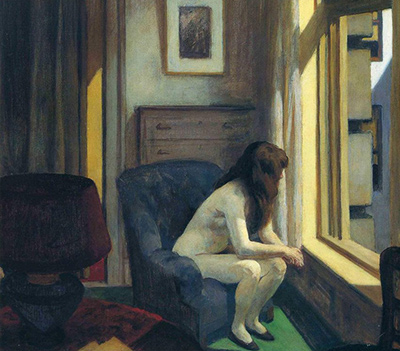
A nude woman sits in a deep blue chair beside a large window. She leans forward, her elbows near her knees and her hands gathered together, while long hair conceals much of her face. A red-shaded lamp occupies the darker foreground at the left; part of another chair enters at the right. In Edward Hopper's Eleven A.M., bright daylight reaches into a furnished room whose surrounding shadows remain substantial.
The painting dates from 1926 and belongs to the Hirshhorn Museum and Sculpture Garden, Smithsonian Institution. The museum records oil on canvas, 28⅛ by 36⅛ inches, accession 66.2504, a gift of the Joseph H. Hirshhorn Foundation in 1966. [1] The title gives a precise hour, while the room supplies no equally precise account of the woman's circumstances.
At a Glance
- ArtistEdward Hopper [1]
- Date1926 [1]
- Mediumoil on canvas [1]
- Collection / recordHirshhorn Museum and Sculpture Garden [1]
- Accession66.2504 [1]
This work across Edward Hopper’s career
American Village
1912Soir Bleu
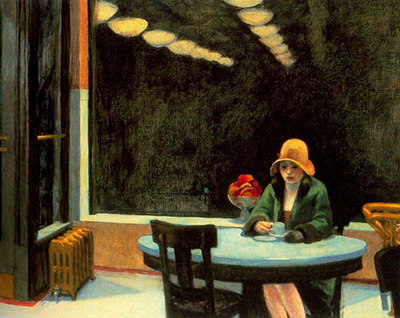
1914Automat
1927New York Movie
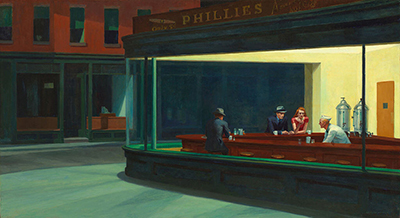
1939Nighthawks
1942Morning Sun
1952Two Comedians
1966Contents
- A seated figure turned towards the light
- Arms, knees and the floor
- The blue chair
- The window as an edge
- A dressed woman at Sloan's window
- Lamp, table and the other chair
- The green floor and the red lamp
- Curtains, dresser and a framed picture
- An exact hour and an unspecified life
- A later photograph inside another room
A seated figure turned towards the light
The woman's position establishes a clear direction. Her body is seen largely in profile, facing the window on the right. The upper torso bends forward, and the arms bring attention down towards the hands. The pose is concentrated without becoming a tightly closed shape.
The window lights selected parts of the body. Pale passages on shoulder, arms and legs stand against the darker upholstery, making the figure especially legible where it meets the chair. Other areas are more shaded, so the body retains volume rather than appearing as one uniform light silhouette.
Her hair is a separate dark mass. It falls around the head and over the shoulder, partly obscuring the face. This makes the body's orientation easier to establish than a particular facial expression. The painting shows a person turned towards a source of light, but leaves the exact focus of attention less explicit.
The black shoes are a small but consequential detail. They place an ordinary item of dress beside an otherwise unclothed body, reinforcing the room's everyday character. They do not provide a reliable story about what the figure has just been doing or intends to do next.
The pose also gives the lower part a rhythm of bends. Torso, arms and knees make connected angles against the chair's fuller curves. These directions allow the figure to remain distinct from its support while making the two forms physically dependent on one another.
Arms, knees and the floor
The hands gather near the knees, below the brighter upper part of the body. Their position helps connect the seated figure's several bends: neck and back incline, elbows turn, and the legs descend towards the floor. These are changes of bodily direction within a pose that otherwise remains still.
The shoes introduce a small darker ending to that sequence. They touch a brighter green passage below the chair, giving the lowest part of the body a specific relation to the furnished floor. The figure is supported by the seat and grounded through ordinary footwear.
This combination differs from a nude arranged solely to display the body's front. The profile and gathered arms restrict what is offered to the spectator, while the window gives the pose an orientation within a room. Exposure of skin and limited access to expression coexist in the same figure.
The body also changes as it meets the chair. A brighter shoulder can appear sharply distinct from the dark blue upholstery; a more shaded contour approaches it less decisively. Hopper varies the boundary instead of isolating the nude through one uninterrupted outline.
The blue chair
The upholstery supplies one of the painting's strongest colour areas. Its deep blue surrounds the torso and supports the legs, making a large cooler mass within the warmer light near the window. The chair is substantial enough to give the body an immediate, recognizable setting.
Its surface is not equally bright throughout. Variations of tone and small changes around the arms and back suggest softness and depth. The lighter body meets those darker passages along an irregular outline, allowing flesh and upholstery to be read separately even where they are close.
The chair's bulk also changes the scale of the figure. This is not a body isolated against an empty studio wall. It occupies a particular kind of seat, with a broad back and arms that remain visible around it. The furniture holds a significant part of the composition in its own right.
The blue is answered by other cooler areas in the room, but its concentration remains distinctive. It gathers the middle of the picture around the seated person, while the warmer window frame and pale light pull towards the right. Colour supplies a second direction alongside the figure's pose.
The window as an edge
The window occupies much of the right side and continues beyond the frame. Its bright area is divided by solid uprights, with part of the exterior building visible close beyond. Hopper does not open the room onto an expansive landscape. The outside remains another set of nearby architectural surfaces.
The sill and frame establish a strong boundary beside the figure. Their straighter lines contrast with the body's bends and the chair's upholstered curves. The window can therefore function as both a source of light and a firm piece of room construction.
The light around it is more intense than in the left foreground. Selected vertical surfaces glow, and the pale body becomes especially prominent nearby. Yet the painting retains much darker passages only a short distance away. The interior contains a wide range of illumination within a relatively confined area.
This unevenness keeps the view from becoming a simple statement of brightness. The room has daylight, but its corners and furnishings remain partly concealed. Hopper lets the spectator understand its general arrangement while continuing to discover objects within the darker parts.
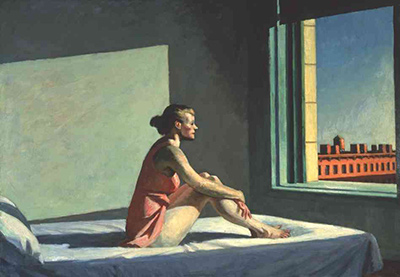
Compare: Morning Sun, 1952.
A dressed woman at Sloan's window
John Sloan's A Window on the Street, painted in 1912 and now at Bowdoin College Museum of Art, offers a useful earlier comparison. The museum's account places a young woman at the centre of a view turned away from the street towards its inhabitants. [2] The painting shows her dressed, leaning on the sill within a dark opening.
Sloan gives the spectator a view from the window's public side. Curtains rise around the woman, and her pale face stands out against the room behind. Her bent arm brings a hand near the head, while a small flowerpot supplies another visible object at the sill.
Hopper changes that relation to the opening. We share a position inside the furnished room and look towards the window beside the nude. The exterior wall becomes something beyond her, rather than the near architectural frame through which we inspect a stranger.
The change affects the body as well. Sloan's clothing, window ledge and upper-body crop keep much of his figure out of view. Hopper includes the torso, bent legs, chair and shoes, making sitting itself a more extensive part of the composition.
Both pictures make a pale human presence conspicuous against darker surroundings. Their difference lies partly in who occupies the window's edge and where the spectator is placed. The comparison does not establish a direct source for Hopper. It makes his choice to put us inside the room more apparent.
Lamp, table and the other chair
The red-shaded lamp stands in the near left. Its broad shade and dark base make a conspicuous mass below the curtains, with patterned cloth spread across the table beneath. These warmer, darker forms differ markedly from the pale figure beside the window.
Their position gives the foreground weight. We look past a substantial furnishing before reaching the seated woman. The lamp is close enough to be cropped and partly difficult to separate from shadow, making the spectator's position less open than a straightforward frontal view of the chair.
At the lower right, the back of another chair enters from outside the canvas. The Hirshhorn's visual description identifies it as a ladder-back chair. [3] Its narrower wooden forms provide a different kind of interruption from the lamp and upholstered seat.
The two foreground furnishings help create a passage between them. The woman is visible beyond their uneven edges, set further into the room. The resulting depth depends on overlap and partial concealment rather than a long, empty corridor into the picture.
The tablecloth introduces a more intricate surface at the left. Its pattern can be noticed without being fully resolved, giving the darker foreground a degree of domestic detail. Hopper has not reduced the room to body and window alone; he allows ordinary furnishings to complicate their relationship.
The green floor and the red lamp
A bright green area beneath the woman's feet adds a sharp note near the lower right. Its intensity differs from the deeper blue chair and the more muted curtains above. That small visible part of the floor brings colour into the body's contact with its surroundings.
The lamp at the left provides a warmer counterweight. Its dark red shade is much broader than the shoes, and the patterned cloth below it introduces still smaller changes of colour. These passages keep the foreground active even when attention first falls on the nude and window.
The effect depends on their separation. Red shade, blue upholstery and green floor do not merge into one local cluster of bright objects. They occupy different depths and sides of the view, giving the eye several routes through a room whose illumination is uneven.
This also changes the impression of a supposedly bare Hopper interior. The scene contains different kinds of fabric: hanging curtains, padded upholstery and a patterned covering. Their directions and surfaces give the room a domestic particularity that exceeds the simple pairing of a figure and an opening.
The nude's comparatively continuous flesh tones stand among those materials. The body is distinctive, but it belongs to a scene built from several kinds of softness, pattern and light. Colour and texture make that belonging visible without supplying a personal biography.
Watch: Edward Hopper’s Life and Art
Explore Hopper’s paintings and the places behind them in these museum films. Choose a film below.
Curtains, dresser and a framed picture
Olive-green curtains occupy a large part of the background. Their vertical folds continue the height of the room while absorbing more light than the window frame. The difference gives the right-hand brightness a darker edge.
A chest of drawers stands behind the blue chair, with a small framed picture on the wall above. Their partial concealment makes them secondary, but not negligible. The dresser supplies another broad horizontal and a sequence of smaller drawer divisions within the room's larger arrangement.
The framed picture remains indistinct as an image. Its importance lies partly in its placement: a small dark rectangle on a paler wall, set above furniture that is itself interrupted by the seated group. The room contains several nested areas of attention, none offering a complete account of its occupant.
These background objects also make the interior feel more extensive than the portion visible around the chair. A table, curtains, drawers, wall picture and additional seat suggest a room used for more than the one pose shown. The figure is part of a furnished environment whose other activities remain outside this moment.
An exact hour and an unspecified life
The title is unusually definite. It identifies a time within the morning, while the image leaves the person unnamed and the room unlocated. The precision directs attention to the condition of daylight rather than supplying a complete narrative timetable.
The painting's specific objects can be understood without resolving those possibilities. Shoes, chair, lamp and dresser establish an ordinary domestic setting; the arrangement of bright and dark areas gives that setting its force. Hopper makes the room clear enough to inhabit imaginatively while withholding the information that would turn it into a biographical episode.
Carol Troyen places Eleven A.M. in a longer sequence of Hopper's figures beside windows, connecting it with intimate etchings such as Evening Wind. Her account emphasizes the tension between an enclosing room and the possibilities suggested by the world beyond. [4] That interpretation is grounded in a recurring spatial relationship, rather than a verified private history of this sitter.
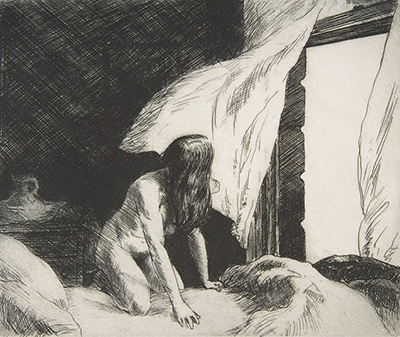
Compare: Evening Wind, 1921.
A later photograph inside another room
Lee Friedlander's Las Vegas, dated 1970, places a partly undressed woman in a rectangle of strong light on a bedroom wall. Fraenkel Gallery included the photograph in its 2009 exhibition Edward Hopper & Company, which examined Hopper's relationship to the sensibilities of eight photographers. [5] The juxtaposition offers a later point from which to reconsider Eleven A.M.
Friedlander's woman faces the camera, standing in underpants with her arms drawn behind her. Her body occupies a bright patch rather than sitting beside a visible window. An unmade bed fills the lower foreground, and an open doorway at the left reveals another dark space.
The light makes the photograph's body and wall difficult to separate uniformly. Brightness crosses the figure, while the face lies near the upper edge of the illuminated area. In Hopper, the forward lean and blue chair give the nude a different outline against the light. The source is approached from the side rather than represented chiefly by a rectangle behind a frontal figure.
Both images bring a spectator inside a furnished room, with personal exposure and ordinary objects sharing the same view. Their bodily arrangements are nonetheless distinct. Friedlander's figure acknowledges the camera through frontal presence; Hopper's woman remains directed towards the opening beside her.
The photograph also contains a framed landscape above the bed. Hopper includes a smaller framed picture above the dresser, but its subject remains indistinct. Each interior has more to look at than the exposed body, although those secondary objects are given different degrees of descriptive clarity.
The gallery's wider argument about influence does not prove that Friedlander set out to remake this particular canvas. The comparison is valuable because the images solve related problems differently: where to place the spectator, how a light area crosses a body, and how furniture gives a private setting its weight.
From Rehn to the Hirshhorn
The museum's provenance traces the painting from Frank K. M. Rehn's gallery to Joseph H. Hirshhorn on 11 September 1954, followed by the Foundation's gift in 1966. Its exhibition history records an earlier appearance in Rehn's 1927 show of Hopper's recent works. [1]
These dates distinguish making, early exhibition, private collection and museum gift. The 1926 canvas was already part of Hopper's public work before the later Hirshhorn acquisition. Its subsequent appearances included the Whitney retrospective of 1950 and the major Hopper exhibition of 2007–08. [1]
Eleven o'clock without a visible clock
The title supplies a specific time that the room itself does not visibly announce through a prominent clock. We are asked to encounter a morning condition of light without receiving a timetable for the woman's activities.
That precision has a different function from the clock in a restaurant or railway station. Nothing here makes eleven o'clock a shared appointment. The time belongs first to the picture's identity, giving the contrast between window brightness and furnished shadow a place within the day.
The red-shaded lamp sharpens that distinction. It is an apparatus for another source of illumination, but the scene's most assertive light comes from the window. An object useful after daylight fades remains present during a bright morning. The room contains equipment for more than the hour currently named.
The dresser, curtains and second chair have a similar effect on our sense of duration. They suggest repeated use while the body is held in one pose. This is a room with an ordinary continuing life, of which the title selects a moment and the frame selects a portion.
The specificity therefore belongs to the light and arrangement more securely than to a guessed event. We can inspect how the body leans at this hour, how the window catches colour and how the foreground stays dark. The person's earlier and later activities remain outside that precise but limited view.
Other figures in enclosed rooms
Summer Interior, painted in 1909, brings a partly clothed figure down beside the edge of a bed. Its bent body is closely entangled with bedding and floor. Eleven A.M. gives the figure a more clearly defined support in the blue chair, while the window establishes a stronger direction of attention.
In the 1921 etching Evening Wind, a curtain passes above a kneeling woman at a bed. The print's dark crosshatching and white paper make the window encounter more abrupt. The oil painting spreads its contrasts across a fuller set of coloured furnishings.
Room in Brooklyn gives a back-turned seated figure a much broader view through a bay of windows. Here, the nearby frame and exterior wall restrict the opening, keeping the blue chair and exposed body close to its edge. Hopper makes a morning interior out of that concentrated meeting of seat, person, furniture and light.
Artworks and studies directory
This researched directory includes finished works and separately identified studies. It is not a complete catalogue raisonné. Linked titles open the articles; unlinked studies are identified by their collection accessions. Watercolours retain their recorded media, and original prints remain distinct from reproductions.
| Name | Date | Medium |
|---|---|---|
| (Bridge and Embankment) (70.1298) | 1906 | Oil on wood |
| (Jo Sketching at Good Harbor Beach) (70.1129) | 1923–1924 | Watercolor and fabricated chalk on paper |
| (Manhattan Bridge) (70.1098) | 1925–1926 | Watercolor and graphite pencil on paper |
| (Rooftops) (70.1114) | 1926 | Watercolor and graphite pencil on paper |
| (Seated Male Model, Bent Over) (70.1277) | c. 1902–1903 | Oil on canvas |
| (Self-Portrait) (70.1254) | 1903–1906 | Oil on canvas |
| (Solitary Figure in a Theater) (70.1418) | c. 1902–1904 | Oil on board |
| 5 A.M. | 1937 | oil on canvas |
| Adam's House | 1928 | watercolour and charcoal on paper |
| American Village | 1912 | Oil on canvas |
| Apartment Houses | 1923 | oil on canvas |
| Approaching a City | 1946 | oil on canvas |
| August in the City | 1945 | oil on canvas |
| Automat | 1927 | oil on canvas |
| Barber Shop | 1931 | oil on canvas |
| Blackwell's Island | 1928 | oil on canvas |
| Bridge on the Seine | 1909 | Oil on canvas |
| Bridle Path | 1939 | oil on canvas |
| Burly Cobb's House South Truro | 1930–1933 | oil on canvas |
| Cape Cod Evening | 1939 | oil on canvas |
| Cape Cod Morning | 1950 | oil on canvas |
| Chair Car | 1965 | oil on canvas |
| Chop Suey | 1929 | oil on canvas |
| City Roofs | 1932 | Oil on canvas |
| Coast Guard Station | 1929 | oil on canvas |
| Compartment C, Car 293 | 1938 | oil on canvas |
| Conference at Night | 1949 | oil on canvas |
| Corn Hill | 1930 | oil on canvas |
| Dawn in Pennsylvania | 1942 | oil on canvas |
| Drug Store | 1927 | oil on canvas |
| Early Sunday Morning | 1930 | Oil on canvas |
| East Side Interior (70.1020) | 1922 | Etching |
| East Wind Over Weehawken | 1934 | oil on canvas |
| El Palacio | 1946 | Watercolor and graphite pencil on paper |
| Eleven A.M. | 1926 | oil on canvas |
| Evening Wind | 1921 | etching |
| Excursion into Philosophy | 1959 | oil on canvas |
| First Row Orchestra | 1951 | oil on canvas |
| Freight Car at Truro | 1931 | watercolour over graphite on paper |
| Gas | 1940 | oil on canvas |
| Girl at a Sewing Machine | c. 1921 | oil on canvas |
| Gloucester Harbor | 1912 | Oil on canvas |
| Ground Swell | 1939 | oil on canvas |
| Haskell's House | 1924 | watercolour over graphite on paperboard |
| High Noon | 1949 | oil on canvas |
| Hill and Houses Cape Elizabeth Maine | 1927 | watercolour over graphite pencil |
| Hills South Truro | 1930 | oil on canvas |
| Hotel by a Railroad | 1952 | oil on canvas |
| Hotel Lobby | 1943 | oil on canvas |
| Hotel Room | 1931 | oil on canvas |
| Hotel Window | 1955 | oil on canvas |
| House by the Railroad | 1925 | oil on canvas |
| House by the Squam River | 1926 | watercolour over graphite on paper |
| Le Bistro or The Wine Shop | 1909 | Oil on canvas |
| Le Pont des Arts | 1907 | Oil on canvas |
| Le Pont Royal | 1909 | Oil on canvas |
| Le Quai des Grands Augustins | 1909 | Oil on canvas |
| Lighthouse and Buildings Portland Head | 1927 | watercolour over graphite pencil on paper |
| Lighthouse Hill | 1927 | oil painting |
| Manhattan Bridge Loop | 1928 | oil on canvas |
| Model Sitting | c. 1902 | oil painting; support not asserted |
| Morning Sun | 1952 | oil on canvas |
| New York Movie | 1939 | oil on canvas |
| New York New Haven and Hartford | 1931 | oil on canvas |
| New York Office | 1962 | oil on canvas |
| New York Pavements | 1924–1925 | oil on canvas |
| New York Restaurant | c. 1922 | oil on canvas |
| Night Windows | 1928 | oil on canvas |
| Nighthawks | 1942 | oil on canvas |
| October on Cape Cod | 1946 | oil on canvas |
| Office at Night | 1940 | oil on canvas |
| Office in a Small City | 1953 | oil on canvas |
| Pennsylvania Coal Town | 1947 | oil on canvas |
| People in the Sun | 1960 | oil on canvas |
| Portrait of Orleans | 1950 | oil on canvas |
| Queensborough Bridge | 1913 | Oil on canvas |
| Railroad Sunset | 1929 | Oil on canvas |
| Railroad Train | 1908 | oil on canvas |
| Road in Maine | 1914 | oil on canvas |
| Room in Brooklyn | 1932 | oil on canvas |
| Room in New York | 1932 | oil on canvas |
| Rooms by the Sea | 1951 | oil on canvas |
| Rooms for Tourists | 1945 | oil on canvas |
| Route 6 Eastham | 1941 | oil on canvas |
| Second Story Sunlight | 1960 | Oil on canvas |
| Self-Portrait | 1925–1930 | Oil on canvas |
| Self-Portrait with Hat (70.1903) | c. 1918, posthumous print | Drypoint |
| Seven A.M. | 1948 | Oil on canvas |
| Soir Bleu | 1914 | oil on canvas |
| South Carolina Morning | 1955 | Oil on canvas |
| Stairway at 48 Rue de Lille Paris | 1906 | Oil on wood |
| Study for 5 A.M. (70.153) | 1937 | Fabricated chalk on paper |
| Study for 5 A.M. (70.429) | 1937 | Fabricated chalk and graphite pencil on paper |
| Study for Approaching a City (70.869) | 1946 | Fabricated chalk and charcoal on paper |
| Study for August in the City (70.158a-b) | 1945 | Fabricated chalk on paper |
| Study for August in the City (70.159) | 1945 | Fabricated chalk on paper |
| Study for Bridle Path (70.220) | 1939 | Fabricated chalk on paper |
| Study for Bridle Path (70.235) | 1939 | Fabricated chalk on paper |
| Study for Compartment C, Car 293 (70.430) | 1938 | Fabricated chalk on paper |
| Study for Compartment C, Car 293 (70.431a-b) | 1938 | Fabricated chalk and charcoal on paper |
| Study for Conference at Night (70.170) | 1949 | Fabricated chalk on paper (recto); Typewriter ink on paper (verso) |
| Study for Conference at Night (70.174) | 1949 | Fabricated chalk on paper ( recto); Typewriter ink on paper (verso) |
| Study for East Wind over Weehawken (70.249) | 1934 | Graphite pencil on paper |
| Study for East Wind over Weehawken (70.252) | 1934 | Fabricated chalk and charcoal on paper |
| Study for Evening Wind (70.343a-b) | 1921 | Fabricated chalk on paper |
| Study for First Row Orchestra (70.841) | 1951 | Fabricated chalk and charcoal on paper |
| Study for Gas (70.263) | 1940 | Fabricated chalk on paper |
| Study for Ground Swell (70.339) | 1939 | Fabricated chalk, charcoal and graphite pencil on paper |
| Study for Hotel by a Railroad (70.199) | 1952 | Fabricated chalk on paper |
| Study for Hotel by a Railroad (70.427) | 1952 | Fabricated chalk on paper |
| Study for Hotel by a Railroad (70.428) | 1952 | Fabricated chalk on paper |
| Study for Hotel Lobby (70.117) | 1942 | Fabricated chalk and graphite pencil on paper |
| Study for Hotel Lobby (70.839) | 1942 | Fabricated chalk and charcoal on paper |
| Study for Hotel Window (70.161) | 1955 | Fabricated chalk, graphite pencil and colored pencil on paper |
| Study for Morning Sun (70.243) | 1952 | Fabricated chalk on paper |
| Study for Morning Sun (70.244) | 1952 | Fabricated chalk on paper |
| Study for Morning Sun (70.290) | 1952 | Fabricated chalk on paper |
| Study for Morning Sun (70.291) | 1952 | Fabricated chalk and graphite pencil on paper |
| Study for New York Movie (70.273) | 1939 | Fabricated chalk on paper |
| Study for New York Movie (70.274a-b) | 1938 or 1939 | Fabricated chalk and charcoal on paper (recto); Fabricated chalk on paper (verso) |
| Study for New York Movie (70.455) | 1939 | Fabricated chalk and charcoal on paper |
| Study for New York Office (70.822) | 1962 | Fabricated chalk on paper |
| Study for Nighthawks (70.192) | 1941 or 1942 | Fabricated chalk on paper |
| Study for Nighthawks (70.193) | 1941 or 1942 | Fabricated chalk on paper |
| Study for Office at Night (70.340) | 1940 | Fabricated chalk and charcoal on paper |
| Study for Office at Night (70.341) | 1940 | Fabricated chalk and graphite pencil on paper |
| Study for Pennsylvania Coal Town (70.198) | 1947 | Fabricated chalk on paper |
| Study for Pennsylvania Coal Town (70.229) | 1947 | Fabricated chalk and charcoal on paper |
| Study for Rooms for Tourists (70.438) | 1945 | Fabricated chalk and charcoal on paper |
| Study for Rooms for Tourists (70.848) | 1945 | Fabricated chalk and charcoal on paper |
| Study for Route 6, Eastham (70.369) | 1941 | Fabricated chalk and graphite pencil on paper |
| Study for Route 6, Eastham (70.854) | 1941 | Fabricated chalk and graphite pencil on paper |
| Study for South Carolina Morning (70.162a-b) | 1955 | Fabricated chalk on paper (recto and verso) |
| Study for The Sheridan Theatre (70.969) | 1937 | Graphite pencil on paper |
| Study for Two on the Aisle (70.128) | 1927 | Fabricated chalk on paper |
| Study for Two on the Aisle (70.129) | 1927 | Fabricated chalk on paper |
| Study for Yawl Riding a Swell (70.439) | 1935 | Fabricated chalk and graphite pencil on paper |
| Summer Evening | 1947 | oil on canvas |
| Summer Interior | 1909 | Oil on canvas |
| Sun in an Empty Room | 1963 | oil on canvas |
| Sunlight in a Cafeteria | 1958 | oil on canvas |
| Sunlight on Brownstones | 1956 | oil on canvas |
| Tables for Ladies | 1930 | oil on canvas |
| The Bootleggers | 1925 | oil on canvas |
| The Camel's Hump | 1931 | oil on canvas |
| The Circle Theatre | 1936 | oil on canvas |
| The City | 1927 | oil on canvas |
| The Lighthouse at Two Lights | 1929 | oil on canvas |
| The Long Leg | 1935 | oil on canvas |
| The Mansard Roof | 1923 | watercolour over graphite on paper |
| The Sheridan Theatre | 1937 | oil on canvas |
| Tramp Steamer | 1908 | oil on canvas |
| Two Comedians | 1966 | oil on canvas |
| Two on the Aisle | 1927 | oil on canvas |
| Valley of the Seine | 1909 | Oil on canvas |
| Western Motel | 1957 | oil on canvas |
Frequently Asked Questions
Edward Hopper made Eleven A.M. in 1926. [1]
The recorded medium is oil on canvas. [1]
A nude woman sits in a deep blue chair beside a large window. She leans forward, her elbows near her knees and her hands gathered together, while long hair conceals much of her face. A red-shaded lamp occupies the darker foreground at the left; part of another chair enters at the right. In Edward Hopper's Eleven A.M., bright daylight reaches into a furnished room whose surrounding shadows remain substantial.
Discussion
Look again at the images and ideas explored in Eleven A.M.. These editorial prompts invite your observations.
Reader Insights
Which boundary, gesture or change of light first holds your attention in Eleven A.M.?
Compare Morning Sun with Eleven A.M.. Which visual difference matters most to your reading?
Which detail would you look at again after reading “The window as an edge”?
Join the Conversation
Share a detail, comparison or question about Eleven A.M. below.
References
- Hirshhorn Museum and Sculpture Garden, Smithsonian Institution, Eleven A.M., 1926, accession 66.2504; current object record, provenance and exhibition history. Medium, measurements and gift credit are also recorded in the Smithsonian collection catalogue. View source 1. View source 2.
- Bowdoin College Museum of Art, Creeping Pavement: Depictions of an Urbanizing America, illustrated labels, 9 April 2021–30 January 2022, p. 5; John Sloan, A Window on the Street, 1912, accession 1961.50, Bequest of George Otis Hamlin. Full reproduction and label inspected. View source.
- Hirshhorn Museum and Sculpture Garden, Revolutions: Art from the Hirshhorn Collection, 1860–1960, accessibility brochure, 2024, p. 33, Eleven A.M. visual description, also reproduced in the Smithsonian object record.
- Carol Troyen, “Dramas of the human predicament”: Edward Hopper's Prints, Notes from a Scholar, Menconi+Schoelkopf, n.d., pp. 8–9, especially fig. 13 and the print-to-painting window comparison. View source.
- Fraenkel Gallery, Edward Hopper & Company, 5 March–2 May 2009; complete exhibition account and reproduced Lee Friedlander, Las Vegas, 1970, gelatin silver print. The photograph was inspected for the visual comparison; no specific copying claim is made. View source.
- Collection or catalogue record, American Village, 1912; medium and identity as discussed in the linked article. View source.
- Collection or catalogue record, Soir Bleu, 1914; medium and identity as discussed in the linked article. View source.
- Collection or catalogue record, House by the Railroad, 1925; medium and identity as discussed in the linked article. View source.
- Collection or catalogue record, Automat, 1927; medium and identity as discussed in the linked article. View source.
- Collection or catalogue record, Early Sunday Morning, 1930; medium and identity as discussed in the linked article. View source.
- Collection or catalogue record, New York Movie, 1939; medium and identity as discussed in the linked article. View source.
- Collection or catalogue record, Nighthawks, 1942; medium and identity as discussed in the linked article. View source.
- Collection or catalogue record, Morning Sun, 1952; medium and identity as discussed in the linked article. View source.
- Collection or catalogue record, Second Story Sunlight, 1960; medium and identity as discussed in the linked article. View source.
- Collection or catalogue record, Two Comedians, 1966; medium and identity as discussed in the linked article. View source.
- Whitney Museum of American Art, Study for Route 6, Eastham, 1941, accession 70.854; exact object record. View source.
- Whitney Museum of American Art, Study for Conference at Night, 1949, accession 70.170; exact object record. View source.
- Whitney Museum of American Art, Study for First Row Orchestra, 1951, accession 70.841; exact object record. View source.
- Whitney Museum of American Art, (Bridge and Embankment), 1906, accession 70.1298; exact object record. View source.
- Whitney Museum of American Art, (Seated Male Model, Bent Over), c. 1902–1903, accession 70.1277; exact object record. View source.
- Whitney Museum of American Art, Study for Morning Sun, 1952, accession 70.244; exact object record. View source.
- Whitney Museum of American Art, Study for Morning Sun, 1952, accession 70.243; exact object record. View source.
- Whitney Museum of American Art, Study for Two on the Aisle, 1927, accession 70.128; exact object record. View source.
- Whitney Museum of American Art, Study for New York Office, 1962, accession 70.822; exact object record. View source.
- Whitney Museum of American Art, Study for Two on the Aisle, 1927, accession 70.129; exact object record. View source.
- Whitney Museum of American Art, Study for Pennsylvania Coal Town, 1947, accession 70.229; exact object record. View source.
- Whitney Museum of American Art, (Rooftops), 1926, accession 70.1114; exact object record. View source.
- Whitney Museum of American Art, Study for South Carolina Morning, 1955, accession 70.162a-b; exact object record. View source.
- Whitney Museum of American Art, (Self-Portrait), 1903–1906, accession 70.1254; exact object record. View source.
- Whitney Museum of American Art, (Manhattan Bridge), 1925–1926, accession 70.1098; exact object record. View source.
- Whitney Museum of American Art, (Solitary Figure in a Theater), c. 1902–1904, accession 70.1418; exact object record. View source.
- Whitney Museum of American Art, Study for Approaching a City, 1946, accession 70.869; exact object record. View source.
- Whitney Museum of American Art, Study for August in the City, 1945, accession 70.159; exact object record. View source.
- Whitney Museum of American Art, Study for Compartment C, Car 293, 1938, accession 70.430; exact object record. View source.
- Whitney Museum of American Art, Study for Compartment C, Car 293, 1938, accession 70.431a-b; exact object record. View source.
- Whitney Museum of American Art, Study for East Wind over Weehawken, 1934, accession 70.252; exact object record. View source.
- Whitney Museum of American Art, Study for East Wind over Weehawken, 1934, accession 70.249; exact object record. View source.
- Whitney Museum of American Art, Study for Evening Wind, 1921, accession 70.343a-b; exact object record. View source.
- Whitney Museum of American Art, Study for The Sheridan Theatre, 1937, accession 70.969; exact object record. View source.
- Whitney Museum of American Art, Study for New York Movie, 1939, accession 70.455; exact object record. View source.
- Whitney Museum of American Art, Study for New York Movie, 1939, accession 70.273; exact object record. View source.
- Whitney Museum of American Art, Study for New York Movie, 1938 or 1939, accession 70.274a-b; exact object record. View source.
- Whitney Museum of American Art, Study for 5 A.M., 1937, accession 70.153; exact object record. View source.
- Whitney Museum of American Art, Study for 5 A.M., 1937, accession 70.429; exact object record. View source.
- Whitney Museum of American Art, (Jo Sketching at Good Harbor Beach), 1923–1924, accession 70.1129; exact object record. View source.
- Whitney Museum of American Art, Study for August in the City, 1945, accession 70.158a-b; exact object record. View source.
- Whitney Museum of American Art, Study for Morning Sun, 1952, accession 70.291; exact object record. View source.
- Whitney Museum of American Art, Study for Morning Sun, 1952, accession 70.290; exact object record. View source.
- Whitney Museum of American Art, Study for Office at Night, 1940, accession 70.340; exact object record. View source.
- Whitney Museum of American Art, Study for Office at Night, 1940, accession 70.341; exact object record. View source.
- Whitney Museum of American Art, Study for Hotel by a Railroad, 1952, accession 70.427; exact object record. View source.
- Whitney Museum of American Art, Study for Hotel by a Railroad, 1952, accession 70.199; exact object record. View source.
- Whitney Museum of American Art, Study for Hotel by a Railroad, 1952, accession 70.428; exact object record. View source.
- Whitney Museum of American Art, Study for Hotel Lobby, 1942, accession 70.117; exact object record. View source.
- Whitney Museum of American Art, Study for Hotel Lobby, 1942, accession 70.839; exact object record. View source.
- Whitney Museum of American Art, Study for Conference at Night, 1949, accession 70.174; exact object record. View source.
- Whitney Museum of American Art, Study for Hotel Window, 1955, accession 70.161; exact object record. View source.
- Whitney Museum of American Art, Study for Pennsylvania Coal Town, 1947, accession 70.198; exact object record. View source.
- Whitney Museum of American Art, Study for Route 6, Eastham, 1941, accession 70.369; exact object record. View source.
- Whitney Museum of American Art, Study for Bridle Path, 1939, accession 70.220; exact object record. View source.
- Whitney Museum of American Art, Study for Bridle Path, 1939, accession 70.235; exact object record. View source.
- Whitney Museum of American Art, Study for Ground Swell, 1939, accession 70.339; exact object record. View source.
- Whitney Museum of American Art, Study for Yawl Riding a Swell, 1935, accession 70.439; exact object record. View source.
- Whitney Museum of American Art, Study for Rooms for Tourists, 1945, accession 70.848; exact object record. View source.
- Whitney Museum of American Art, Study for Rooms for Tourists, 1945, accession 70.438; exact object record. View source.
- Whitney Museum of American Art, Study for Nighthawks, 1941 or 1942, accession 70.193; exact object record. View source.
- Whitney Museum of American Art, Study for Nighthawks, 1941 or 1942, accession 70.192; exact object record. View source.
- Whitney Museum of American Art, Study for Gas, 1940, accession 70.263; exact object record. View source.
- Whitney Museum of American Art, Self-Portrait with Hat, c. 1918, posthumous print, accession 70.1903; exact object record. View source.
- Whitney Museum of American Art, East Side Interior, 1922, accession 70.1020; exact object record. View source.
- Art Institute of Chicago, Selected Chronology for Edward Hopper; training, travels, exhibitions, New York and Truro chronology. View source.
- Emily C. Burns, Spectral figures: Edward Hopper’s empty Paris, chapter 5 in Empty Spaces: Confronting Emptiness in National, Cultural and Urban Histories, 2019; complete chapter and notes consulted. View source.
- Charles Brock, Regionalism and Folk Art, National Gallery of Art; complete essay and two notes consulted. View source.