by Tom Gurney
Tom Gurney BSc (Hons) is an art history expert with over 20 years experience
Email: tomgurney1@gmail.com / Phone: +44 7429 011000
Conference at Night: Introduction
A man in a hat and long coat stands with his back towards us. Beyond him, a woman faces a second man who sits on the edge of a desk, one hand raised. Strong light cuts across the wall behind their heads. Edward Hopper's Conference at Night offers the visible arrangement of an exchange while withholding the words that would explain it.
Painted in oil on canvas in 1949, the work belongs to the Wichita Art Museum's Roland P. Murdock Collection, accession M100.52. The museum supplied these details for its seventy-fifth-anniversary exhibition checklist. [1] The title gives the group a shared occasion, but leaves the conference's subject and outcome unstated.
At a Glance
- ArtistEdward Hopper [1]
- Date1949 [1]
- Mediumoil on canvas [1]
- Collection / recordWichita Art Museum [1]
- AccessionM100.52 [1]
This work across Edward Hopper’s career
American Village
1912Soir Bleu
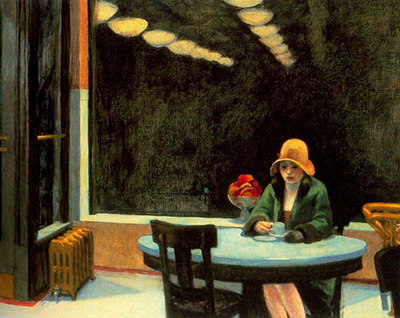
1914Automat
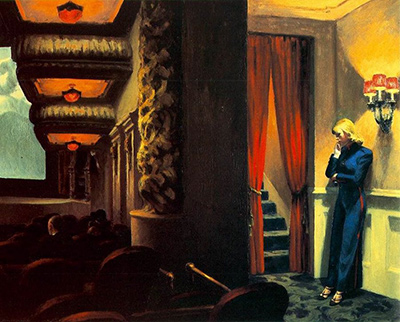
1927New York Movie
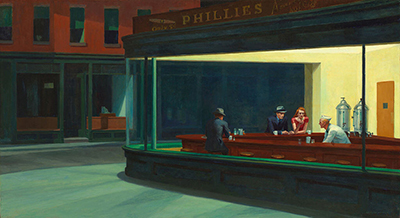
1939Nighthawks
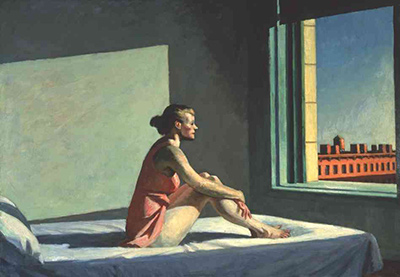
1942Morning Sun
1952Two Comedians
1966Contents
- Three people around a desk
- The white shape on the wall
- Hopper's explanation of the setting
- Papers, partition and working surfaces
- A seated man becomes a standing figure
- Posing for the hands
- What the title allows us to know
- Other ways to occupy an office
Three people around a desk
The hatted man occupies the nearest part of the group. His dark back blocks some of the room and partially overlaps the woman, placing us behind a participant rather than before an evenly displayed set of portraits.
The woman stands farther into the office. Her head turns towards the seated man, while her hands remain close to the centre of her body. The light makes the side of her face and hair distinct from the dark clothing around them.
The man on the desk has a more expansive pose. One arm supports his weight behind him, and the other extends towards the people standing before him. The bend of his legs and the angle of his torso make sitting on the desk quite different from occupying a conventional office chair.
These positions create an unequal distribution of movement. The near man offers a broad, largely closed silhouette; the woman provides a narrower upright; the seated man introduces an open gesture. The group can suggest conversation before any individual is assigned a particular role.
The painting does not identify an employer, client, secretary or visitor. Clothes, furniture and posture give us material for those assumptions, but they do not establish professional ranks. The conference remains a relationship among three bodies within a working room.
The white shape on the wall
The broad illuminated area is almost another participant. Its diagonal boundary rises behind the figures, separating a pale wall from cooler shade above. The bodies are made legible against a light shape much larger than any one of them.
The ceiling beams and upper walls retain a blue-grey darkness. Their repeated divisions press down over the room, contrasting with the more open pale area behind the heads. The effect gives the lower space a concentration that is difficult to ignore.
The light does not simply make everything equally visible. It leaves the nearest man's back dark while picking out the woman's profile and the seated man's white shirt. Each figure receives a different degree of exposure within the same exchange.
The window and partition at the left add vertical darkness to the composition. At the right, another window creates a more slender opening beside the seated man. Architecture frames the group without providing a detailed city panorama.
Hopper's explanation of the setting
Writing three years after the painting, in a letter to Elizabeth Navas dated 28 June 1952, Hopper explained that the idea of street light entering a loft or business building at night had occupied him for years. He connected it with impressions gathered while walking on Broadway after dark. Gail Levin reproduces his account in her study of office imagery. [2]
The explanation gives the unusual illumination a source in accumulated looking. It does not identify one building in which three people held this particular meeting. The city supplied impressions that could be developed into a scene.
Hopper also described the difficulty of giving definite form to an indistinct impression and stressed improvisation rather than a known incident. [2] The letter distinguishes the painting's sharply visible figures and furniture from the less definite beginnings of the idea.
That distinction helps account for the scene's combination of clarity and uncertainty. The desk, clothing and broad light are strongly realised, while the event itself remains unspecified. Hopper could resolve a composition without resolving it into a report of something witnessed.
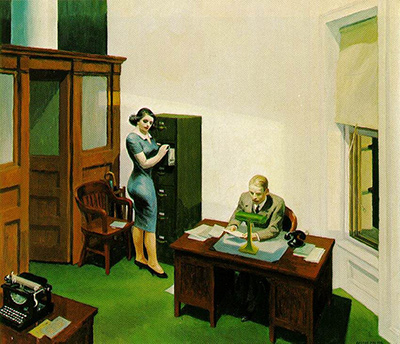
Compare: Office at Night, 1940.
Papers, partition and working surfaces
The desk at the right gives the seated man a substantial support. Its warm brown top contrasts with the cooler wall and provides a large horizontal plane below the figures' heads.
At the left, another working surface carries papers and a thick green volume with a reddish edge. These objects establish the presence of record keeping or office work, but offer no readable information about the discussion. They are part of the room's practical equipment rather than clues to a decipherable transaction.
The wood-and-glass partition adds a familiar kind of business architecture. It separates one area from another while allowing some visual continuity. Like the windows, it divides the office without explaining the whole building.
A partly visible chair behind the group provides another possible place for a body. Its presence makes the man's position on the desk more conspicuous: the room contains conventional seating, yet the exchange takes this less formal arrangement.
The furnishings give the painting specificity without making it a fully documented workplace. We recognise surfaces and objects that could support everyday tasks, while the three people concentrate attention on an undefined interruption or encounter.
A seated man becomes a standing figure
The Whitney Museum's study, accession 70.170, dates to 1949 and uses fabricated chalk on the front of a sheet. In this arrangement the hatted foreground man sits in a chair, the woman stands behind him, and the man at the right leans towards the working surface. [3]
The positions alter the balance among the participants. The near figure is lower, and the woman has a more clearly independent upright shape. Loose repeated lines search through the furniture, ceiling and window divisions around them.
A second Whitney composition, accession 70.174, brings the group closer to the final arrangement. The hatted man stands with his back towards us, the woman remains near the centre, and the man at the right sits on the desk while gesturing. [4]
Raising the near man turns him into a dark barrier through which the rest of the group must be seen. It also makes the two standing figures and seated speaker a more compact cluster.
Both drawings date to the year of the painting. Their comparison reveals alternatives in posture and spacing without supplying a complete, securely dated sequence for every surviving sheet. The final encounter emerged through choices about where bodies would stand, sit and overlap.
Watch: Edward Hopper’s Life and Art
Explore Hopper’s paintings and the places behind them in these museum films. Choose a film below.
Posing for the hands
In the opening of her account of 1949, Levin records Jo Hopper posing for the woman's hands on 16 January. She places completion of the painting on that day and delivery to Rehn Gallery on 18 January. [5] A small part of the central figure thus has a documented place in the painting's final working days.
The hands deserve attention within the completed group. Held near the woman's body, they offer a contained gesture beside the seated man's more extended arm. The difference contributes to the exchange's visual character even though it cannot tell us what either figure is saying.
Jo's posing also separates a model's practical work from the identity of the painted woman. The hands could be studied in the studio and incorporated into an invented business setting. The evidence does not turn the scene into a literal meeting attended by the Hoppers.
The delivery date belongs to the object's history rather than the fictional hour depicted. The painting could enter a dealer's hands on a particular January day while the conversation within it remained permanently unspecified.
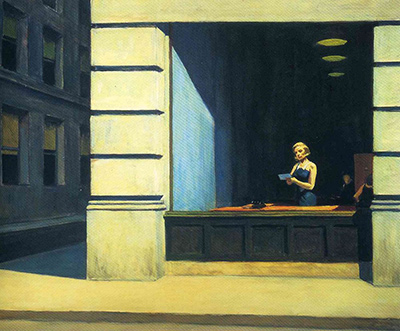
Compare: New York Office, 1962.
What the title allows us to know
A conference implies people brought together for discussion. The raised hand and the woman's orientation make that description plausible. The nearer man's back places the spectator in a position where the group is accessible but not entirely open.
The dramatic lighting can suggest an argument or a moment of crisis. The image supplies no text, emblem or recognisable historical participant that would identify a particular incident.
Levin discusses the office in relation to the dramatic illumination and grouped figures of earlier Dutch painting. [2] The comparison directs attention towards a longer pictorial tradition of giving ordinary interiors visual force. It need not establish that Hopper copied a particular meeting or assigned his figures a hidden historical identity.
The work's theatrical effect comes from concrete decisions: a bright wall, shaded beams, a near figure seen from behind, and a speaker raised onto a desk. We can examine those decisions even while disagreeing about the human stakes they suggest.
Other ways to occupy an office
Office at Night gives two workers a room of files, desk and partition. Their attention never becomes as explicit an exchange as the gesture here, where a third figure helps establish a group.
Office in a Small City leaves a seated man alone within a broad architectural opening. The city view takes some of the attention that this painting concentrates on the people facing one another.
In New York Office, a large street-facing window puts the spectator outside. Here the overlapping figures and office furnishings bring us closer to the conference while keeping the nearest participant's face concealed.
Look from the seated man's raised hand to the woman's hands, then to the broad dark back in front of them. Three different bodily arrangements make an exchange visible. The large white light holds them together without telling us how the meeting ends.
Artworks and studies directory
This researched directory includes finished works and separately identified studies. It is not a complete catalogue raisonné. Linked titles open the articles; unlinked studies are identified by their collection accessions. Watercolours retain their recorded media, and original prints remain distinct from reproductions.
| Name | Date | Medium |
|---|---|---|
| (Bridge and Embankment) (70.1298) | 1906 | Oil on wood |
| (Jo Sketching at Good Harbor Beach) (70.1129) | 1923–1924 | Watercolor and fabricated chalk on paper |
| (Manhattan Bridge) (70.1098) | 1925–1926 | Watercolor and graphite pencil on paper |
| (Rooftops) (70.1114) | 1926 | Watercolor and graphite pencil on paper |
| (Seated Male Model, Bent Over) (70.1277) | c. 1902–1903 | Oil on canvas |
| (Self-Portrait) (70.1254) | 1903–1906 | Oil on canvas |
| (Solitary Figure in a Theater) (70.1418) | c. 1902–1904 | Oil on board |
| 5 A.M. | 1937 | oil on canvas |
| Adam's House | 1928 | watercolour and charcoal on paper |
| American Village | 1912 | Oil on canvas |
| Apartment Houses | 1923 | oil on canvas |
| Approaching a City | 1946 | oil on canvas |
| August in the City | 1945 | oil on canvas |
| Automat | 1927 | oil on canvas |
| Barber Shop | 1931 | oil on canvas |
| Blackwell's Island | 1928 | oil on canvas |
| Bridge on the Seine | 1909 | Oil on canvas |
| Bridle Path | 1939 | oil on canvas |
| Burly Cobb's House South Truro | 1930–1933 | oil on canvas |
| Cape Cod Evening | 1939 | oil on canvas |
| Cape Cod Morning | 1950 | oil on canvas |
| Chair Car | 1965 | oil on canvas |
| Chop Suey | 1929 | oil on canvas |
| City Roofs | 1932 | Oil on canvas |
| Coast Guard Station | 1929 | oil on canvas |
| Compartment C, Car 293 | 1938 | oil on canvas |
| Conference at Night | 1949 | oil on canvas |
| Corn Hill | 1930 | oil on canvas |
| Dawn in Pennsylvania | 1942 | oil on canvas |
| Drug Store | 1927 | oil on canvas |
| Early Sunday Morning | 1930 | Oil on canvas |
| East Side Interior (70.1020) | 1922 | Etching |
| East Wind Over Weehawken | 1934 | oil on canvas |
| El Palacio | 1946 | Watercolor and graphite pencil on paper |
| Eleven A.M. | 1926 | oil on canvas |
| Evening Wind | 1921 | etching |
| Excursion into Philosophy | 1959 | oil on canvas |
| First Row Orchestra | 1951 | oil on canvas |
| Freight Car at Truro | 1931 | watercolour over graphite on paper |
| Gas | 1940 | oil on canvas |
| Girl at a Sewing Machine | c. 1921 | oil on canvas |
| Gloucester Harbor | 1912 | Oil on canvas |
| Ground Swell | 1939 | oil on canvas |
| Haskell's House | 1924 | watercolour over graphite on paperboard |
| High Noon | 1949 | oil on canvas |
| Hill and Houses Cape Elizabeth Maine | 1927 | watercolour over graphite pencil |
| Hills South Truro | 1930 | oil on canvas |
| Hotel by a Railroad | 1952 | oil on canvas |
| Hotel Lobby | 1943 | oil on canvas |
| Hotel Room | 1931 | oil on canvas |
| Hotel Window | 1955 | oil on canvas |
| House by the Railroad | 1925 | oil on canvas |
| House by the Squam River | 1926 | watercolour over graphite on paper |
| Le Bistro or The Wine Shop | 1909 | Oil on canvas |
| Le Pont des Arts | 1907 | Oil on canvas |
| Le Pont Royal | 1909 | Oil on canvas |
| Le Quai des Grands Augustins | 1909 | Oil on canvas |
| Lighthouse and Buildings Portland Head | 1927 | watercolour over graphite pencil on paper |
| Lighthouse Hill | 1927 | oil painting |
| Manhattan Bridge Loop | 1928 | oil on canvas |
| Model Sitting | c. 1902 | oil painting; support not asserted |
| Morning Sun | 1952 | oil on canvas |
| New York Movie | 1939 | oil on canvas |
| New York New Haven and Hartford | 1931 | oil on canvas |
| New York Office | 1962 | oil on canvas |
| New York Pavements | 1924–1925 | oil on canvas |
| New York Restaurant | c. 1922 | oil on canvas |
| Night Windows | 1928 | oil on canvas |
| Nighthawks | 1942 | oil on canvas |
| October on Cape Cod | 1946 | oil on canvas |
| Office at Night | 1940 | oil on canvas |
| Office in a Small City | 1953 | oil on canvas |
| Pennsylvania Coal Town | 1947 | oil on canvas |
| People in the Sun | 1960 | oil on canvas |
| Portrait of Orleans | 1950 | oil on canvas |
| Queensborough Bridge | 1913 | Oil on canvas |
| Railroad Sunset | 1929 | Oil on canvas |
| Railroad Train | 1908 | oil on canvas |
| Road in Maine | 1914 | oil on canvas |
| Room in Brooklyn | 1932 | oil on canvas |
| Room in New York | 1932 | oil on canvas |
| Rooms by the Sea | 1951 | oil on canvas |
| Rooms for Tourists | 1945 | oil on canvas |
| Route 6 Eastham | 1941 | oil on canvas |
| Second Story Sunlight | 1960 | Oil on canvas |
| Self-Portrait | 1925–1930 | Oil on canvas |
| Self-Portrait with Hat (70.1903) | c. 1918, posthumous print | Drypoint |
| Seven A.M. | 1948 | Oil on canvas |
| Soir Bleu | 1914 | oil on canvas |
| South Carolina Morning | 1955 | Oil on canvas |
| Stairway at 48 Rue de Lille Paris | 1906 | Oil on wood |
| Study for 5 A.M. (70.153) | 1937 | Fabricated chalk on paper |
| Study for 5 A.M. (70.429) | 1937 | Fabricated chalk and graphite pencil on paper |
| Study for Approaching a City (70.869) | 1946 | Fabricated chalk and charcoal on paper |
| Study for August in the City (70.158a-b) | 1945 | Fabricated chalk on paper |
| Study for August in the City (70.159) | 1945 | Fabricated chalk on paper |
| Study for Bridle Path (70.220) | 1939 | Fabricated chalk on paper |
| Study for Bridle Path (70.235) | 1939 | Fabricated chalk on paper |
| Study for Compartment C, Car 293 (70.430) | 1938 | Fabricated chalk on paper |
| Study for Compartment C, Car 293 (70.431a-b) | 1938 | Fabricated chalk and charcoal on paper |
| Study for Conference at Night (70.170) | 1949 | Fabricated chalk on paper (recto); Typewriter ink on paper (verso) |
| Study for Conference at Night (70.174) | 1949 | Fabricated chalk on paper ( recto); Typewriter ink on paper (verso) |
| Study for East Wind over Weehawken (70.249) | 1934 | Graphite pencil on paper |
| Study for East Wind over Weehawken (70.252) | 1934 | Fabricated chalk and charcoal on paper |
| Study for Evening Wind (70.343a-b) | 1921 | Fabricated chalk on paper |
| Study for First Row Orchestra (70.841) | 1951 | Fabricated chalk and charcoal on paper |
| Study for Gas (70.263) | 1940 | Fabricated chalk on paper |
| Study for Ground Swell (70.339) | 1939 | Fabricated chalk, charcoal and graphite pencil on paper |
| Study for Hotel by a Railroad (70.199) | 1952 | Fabricated chalk on paper |
| Study for Hotel by a Railroad (70.427) | 1952 | Fabricated chalk on paper |
| Study for Hotel by a Railroad (70.428) | 1952 | Fabricated chalk on paper |
| Study for Hotel Lobby (70.117) | 1942 | Fabricated chalk and graphite pencil on paper |
| Study for Hotel Lobby (70.839) | 1942 | Fabricated chalk and charcoal on paper |
| Study for Hotel Window (70.161) | 1955 | Fabricated chalk, graphite pencil and colored pencil on paper |
| Study for Morning Sun (70.243) | 1952 | Fabricated chalk on paper |
| Study for Morning Sun (70.244) | 1952 | Fabricated chalk on paper |
| Study for Morning Sun (70.290) | 1952 | Fabricated chalk on paper |
| Study for Morning Sun (70.291) | 1952 | Fabricated chalk and graphite pencil on paper |
| Study for New York Movie (70.273) | 1939 | Fabricated chalk on paper |
| Study for New York Movie (70.274a-b) | 1938 or 1939 | Fabricated chalk and charcoal on paper (recto); Fabricated chalk on paper (verso) |
| Study for New York Movie (70.455) | 1939 | Fabricated chalk and charcoal on paper |
| Study for New York Office (70.822) | 1962 | Fabricated chalk on paper |
| Study for Nighthawks (70.192) | 1941 or 1942 | Fabricated chalk on paper |
| Study for Nighthawks (70.193) | 1941 or 1942 | Fabricated chalk on paper |
| Study for Office at Night (70.340) | 1940 | Fabricated chalk and charcoal on paper |
| Study for Office at Night (70.341) | 1940 | Fabricated chalk and graphite pencil on paper |
| Study for Pennsylvania Coal Town (70.198) | 1947 | Fabricated chalk on paper |
| Study for Pennsylvania Coal Town (70.229) | 1947 | Fabricated chalk and charcoal on paper |
| Study for Rooms for Tourists (70.438) | 1945 | Fabricated chalk and charcoal on paper |
| Study for Rooms for Tourists (70.848) | 1945 | Fabricated chalk and charcoal on paper |
| Study for Route 6, Eastham (70.369) | 1941 | Fabricated chalk and graphite pencil on paper |
| Study for Route 6, Eastham (70.854) | 1941 | Fabricated chalk and graphite pencil on paper |
| Study for South Carolina Morning (70.162a-b) | 1955 | Fabricated chalk on paper (recto and verso) |
| Study for The Sheridan Theatre (70.969) | 1937 | Graphite pencil on paper |
| Study for Two on the Aisle (70.128) | 1927 | Fabricated chalk on paper |
| Study for Two on the Aisle (70.129) | 1927 | Fabricated chalk on paper |
| Study for Yawl Riding a Swell (70.439) | 1935 | Fabricated chalk and graphite pencil on paper |
| Summer Evening | 1947 | oil on canvas |
| Summer Interior | 1909 | Oil on canvas |
| Sun in an Empty Room | 1963 | oil on canvas |
| Sunlight in a Cafeteria | 1958 | oil on canvas |
| Sunlight on Brownstones | 1956 | oil on canvas |
| Tables for Ladies | 1930 | oil on canvas |
| The Bootleggers | 1925 | oil on canvas |
| The Camel's Hump | 1931 | oil on canvas |
| The Circle Theatre | 1936 | oil on canvas |
| The City | 1927 | oil on canvas |
| The Lighthouse at Two Lights | 1929 | oil on canvas |
| The Long Leg | 1935 | oil on canvas |
| The Mansard Roof | 1923 | watercolour over graphite on paper |
| The Sheridan Theatre | 1937 | oil on canvas |
| Tramp Steamer | 1908 | oil on canvas |
| Two Comedians | 1966 | oil on canvas |
| Two on the Aisle | 1927 | oil on canvas |
| Valley of the Seine | 1909 | Oil on canvas |
| Western Motel | 1957 | oil on canvas |
Frequently Asked Questions
Edward Hopper made Conference at Night in 1949. [1]
The recorded medium is oil on canvas. [1]
A man in a hat and long coat stands with his back towards us. Beyond him, a woman faces a second man who sits on the edge of a desk, one hand raised. Strong light cuts across the wall behind their heads. Edward Hopper's Conference at Night offers the visible arrangement of an exchange while withholding the words that would explain it.
Discussion
Look again at the images and ideas explored in Conference at Night. These editorial prompts invite your observations.
Reader Insights
Which boundary, gesture or change of light first holds your attention in Conference at Night?
Compare Office at Night with Conference at Night. Which visual difference matters most to your reading?
Which detail would you look at again after reading “Hopper's explanation of the setting”?
Join the Conversation
Share a detail, comparison or question about Conference at Night below.
References
- Wichita Art Museum, Wichita Art Museum: 75 Years of American Art, 14 November 2010–24 July 2011, museum-supplied exhibition material and checklist published by Resource Library, entry for Conference at Night, M100.52. View source.
- Gail Levin, “The Office Image in the Visual Arts,” Arts Magazine, September 1984, pp. 98–103; discussion of Conference at Night and transmitted Hopper letter to Elizabeth Navas, 28 June 1952.
- Whitney Museum of American Art, Study for Conference at Night, 1949, accession 70.170, recto. View source.
- Whitney Museum of American Art, Study for Conference at Night, 1949, accession 70.174, recto. View source.
- Gail Levin, Edward Hopper: An Intimate Biography, chapter 28, “Melancholy Reflection: 1949”, 1995, pp. 408–420, chapter opening on the January completion and delivery. View source.
- Collection or catalogue record, American Village, 1912; medium and identity as discussed in the linked article. View source.
- Collection or catalogue record, Soir Bleu, 1914; medium and identity as discussed in the linked article. View source.
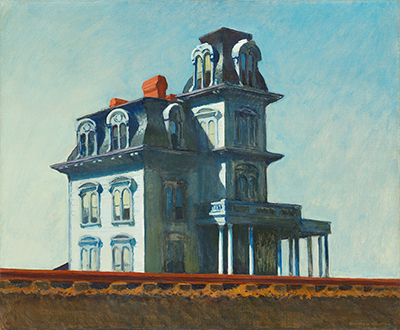
- Collection or catalogue record, House by the Railroad, 1925; medium and identity as discussed in the linked article. View source.
- Collection or catalogue record, Automat, 1927; medium and identity as discussed in the linked article. View source.
- Collection or catalogue record, Early Sunday Morning, 1930; medium and identity as discussed in the linked article. View source.
- Collection or catalogue record, New York Movie, 1939; medium and identity as discussed in the linked article. View source.
- Collection or catalogue record, Nighthawks, 1942; medium and identity as discussed in the linked article. View source.
- Collection or catalogue record, Morning Sun, 1952; medium and identity as discussed in the linked article. View source.
- Collection or catalogue record, Second Story Sunlight, 1960; medium and identity as discussed in the linked article. View source.
- Collection or catalogue record, Two Comedians, 1966; medium and identity as discussed in the linked article. View source.
- Whitney Museum of American Art, Study for Route 6, Eastham, 1941, accession 70.854; exact object record. View source.
- Whitney Museum of American Art, Study for Conference at Night, 1949, accession 70.170; exact object record. View source.
- Whitney Museum of American Art, Study for First Row Orchestra, 1951, accession 70.841; exact object record. View source.
- Whitney Museum of American Art, (Bridge and Embankment), 1906, accession 70.1298; exact object record. View source.
- Whitney Museum of American Art, (Seated Male Model, Bent Over), c. 1902–1903, accession 70.1277; exact object record. View source.
- Whitney Museum of American Art, Study for Morning Sun, 1952, accession 70.244; exact object record. View source.
- Whitney Museum of American Art, Study for Morning Sun, 1952, accession 70.243; exact object record. View source.
- Whitney Museum of American Art, Study for Two on the Aisle, 1927, accession 70.128; exact object record. View source.
- Whitney Museum of American Art, Study for New York Office, 1962, accession 70.822; exact object record. View source.
- Whitney Museum of American Art, Study for Two on the Aisle, 1927, accession 70.129; exact object record. View source.
- Whitney Museum of American Art, Study for Pennsylvania Coal Town, 1947, accession 70.229; exact object record. View source.
- Whitney Museum of American Art, (Rooftops), 1926, accession 70.1114; exact object record. View source.
- Whitney Museum of American Art, Study for South Carolina Morning, 1955, accession 70.162a-b; exact object record. View source.
- Whitney Museum of American Art, (Self-Portrait), 1903–1906, accession 70.1254; exact object record. View source.
- Whitney Museum of American Art, (Manhattan Bridge), 1925–1926, accession 70.1098; exact object record. View source.
- Whitney Museum of American Art, (Solitary Figure in a Theater), c. 1902–1904, accession 70.1418; exact object record. View source.
- Whitney Museum of American Art, Study for Approaching a City, 1946, accession 70.869; exact object record. View source.
- Whitney Museum of American Art, Study for August in the City, 1945, accession 70.159; exact object record. View source.
- Whitney Museum of American Art, Study for Compartment C, Car 293, 1938, accession 70.430; exact object record. View source.
- Whitney Museum of American Art, Study for Compartment C, Car 293, 1938, accession 70.431a-b; exact object record. View source.
- Whitney Museum of American Art, Study for East Wind over Weehawken, 1934, accession 70.252; exact object record. View source.
- Whitney Museum of American Art, Study for East Wind over Weehawken, 1934, accession 70.249; exact object record. View source.
- Whitney Museum of American Art, Study for Evening Wind, 1921, accession 70.343a-b; exact object record. View source.
- Whitney Museum of American Art, Study for The Sheridan Theatre, 1937, accession 70.969; exact object record. View source.
- Whitney Museum of American Art, Study for New York Movie, 1939, accession 70.455; exact object record. View source.
- Whitney Museum of American Art, Study for New York Movie, 1939, accession 70.273; exact object record. View source.
- Whitney Museum of American Art, Study for New York Movie, 1938 or 1939, accession 70.274a-b; exact object record. View source.
- Whitney Museum of American Art, Study for 5 A.M., 1937, accession 70.153; exact object record. View source.
- Whitney Museum of American Art, Study for 5 A.M., 1937, accession 70.429; exact object record. View source.
- Whitney Museum of American Art, (Jo Sketching at Good Harbor Beach), 1923–1924, accession 70.1129; exact object record. View source.
- Whitney Museum of American Art, Study for August in the City, 1945, accession 70.158a-b; exact object record. View source.
- Whitney Museum of American Art, Study for Morning Sun, 1952, accession 70.291; exact object record. View source.
- Whitney Museum of American Art, Study for Morning Sun, 1952, accession 70.290; exact object record. View source.
- Whitney Museum of American Art, Study for Office at Night, 1940, accession 70.340; exact object record. View source.
- Whitney Museum of American Art, Study for Office at Night, 1940, accession 70.341; exact object record. View source.
- Whitney Museum of American Art, Study for Hotel by a Railroad, 1952, accession 70.427; exact object record. View source.
- Whitney Museum of American Art, Study for Hotel by a Railroad, 1952, accession 70.199; exact object record. View source.
- Whitney Museum of American Art, Study for Hotel by a Railroad, 1952, accession 70.428; exact object record. View source.
- Whitney Museum of American Art, Study for Hotel Lobby, 1942, accession 70.117; exact object record. View source.
- Whitney Museum of American Art, Study for Hotel Lobby, 1942, accession 70.839; exact object record. View source.
- Whitney Museum of American Art, Study for Conference at Night, 1949, accession 70.174; exact object record. View source.
- Whitney Museum of American Art, Study for Hotel Window, 1955, accession 70.161; exact object record. View source.
- Whitney Museum of American Art, Study for Pennsylvania Coal Town, 1947, accession 70.198; exact object record. View source.
- Whitney Museum of American Art, Study for Route 6, Eastham, 1941, accession 70.369; exact object record. View source.
- Whitney Museum of American Art, Study for Bridle Path, 1939, accession 70.220; exact object record. View source.
- Whitney Museum of American Art, Study for Bridle Path, 1939, accession 70.235; exact object record. View source.
- Whitney Museum of American Art, Study for Ground Swell, 1939, accession 70.339; exact object record. View source.
- Whitney Museum of American Art, Study for Yawl Riding a Swell, 1935, accession 70.439; exact object record. View source.
- Whitney Museum of American Art, Study for Rooms for Tourists, 1945, accession 70.848; exact object record. View source.
- Whitney Museum of American Art, Study for Rooms for Tourists, 1945, accession 70.438; exact object record. View source.
- Whitney Museum of American Art, Study for Nighthawks, 1941 or 1942, accession 70.193; exact object record. View source.
- Whitney Museum of American Art, Study for Nighthawks, 1941 or 1942, accession 70.192; exact object record. View source.
- Whitney Museum of American Art, Study for Gas, 1940, accession 70.263; exact object record. View source.
- Whitney Museum of American Art, Self-Portrait with Hat, c. 1918, posthumous print, accession 70.1903; exact object record. View source.
- Whitney Museum of American Art, East Side Interior, 1922, accession 70.1020; exact object record. View source.
- Art Institute of Chicago, Selected Chronology for Edward Hopper; training, travels, exhibitions, New York and Truro chronology. View source.
- Emily C. Burns, Spectral figures: Edward Hopper’s empty Paris, chapter 5 in Empty Spaces: Confronting Emptiness in National, Cultural and Urban Histories, 2019; complete chapter and notes consulted. View source.
- Charles Brock, Regionalism and Folk Art, National Gallery of Art; complete essay and two notes consulted. View source.